EP1365369A1 - Dispositif lumineux d'alerte et d'indication d'une issue de secours - Google Patents
Dispositif lumineux d'alerte et d'indication d'une issue de secours Download PDFInfo
- Publication number
- EP1365369A1 EP1365369A1 EP03291051A EP03291051A EP1365369A1 EP 1365369 A1 EP1365369 A1 EP 1365369A1 EP 03291051 A EP03291051 A EP 03291051A EP 03291051 A EP03291051 A EP 03291051A EP 1365369 A1 EP1365369 A1 EP 1365369A1
- Authority
- EP
- European Patent Office
- Prior art keywords
- light
- indicator
- state
- emergency exit
- emergency
- Prior art date
- Legal status (The legal status is an assumption and is not a legal conclusion. Google has not performed a legal analysis and makes no representation as to the accuracy of the status listed.)
- Granted
Links
Images


Classifications
-
- G—PHYSICS
- G08—SIGNALLING
- G08B—SIGNALLING SYSTEMS, e.g. PERSONAL CALLING SYSTEMS; ORDER TELEGRAPHS; ALARM SYSTEMS
- G08B7/00—Signalling systems according to two or more of groups G08B3/00 - G08B6/00
- G08B7/06—Signalling systems according to two or more of groups G08B3/00 - G08B6/00 using electric transmission, e.g. involving audible and visible signalling through the use of sound and light sources
- G08B7/062—Signalling systems according to two or more of groups G08B3/00 - G08B6/00 using electric transmission, e.g. involving audible and visible signalling through the use of sound and light sources indicating emergency exits
-
- G—PHYSICS
- G08—SIGNALLING
- G08B—SIGNALLING SYSTEMS, e.g. PERSONAL CALLING SYSTEMS; ORDER TELEGRAPHS; ALARM SYSTEMS
- G08B7/00—Signalling systems according to two or more of groups G08B3/00 - G08B6/00
- G08B7/06—Signalling systems according to two or more of groups G08B3/00 - G08B6/00 using electric transmission, e.g. involving audible and visible signalling through the use of sound and light sources
- G08B7/066—Signalling systems according to two or more of groups G08B3/00 - G08B6/00 using electric transmission, e.g. involving audible and visible signalling through the use of sound and light sources guiding along a path, e.g. evacuation path lighting strip
Definitions
- the invention relates to a luminous warning and indication device. at least one emergency exit that is located in an environment closed.
- the enclosed environment can be in particular a building (cinema, apartment building, school, ...), a room (conference room, %) of a building, a ship, an aircraft, ...
- Said warning systems are only intended to attract attention people about the existence of a potential danger.
- These devices can, for example, being a siren that goes off when the conditions triggering events occur (fire for example).
- the emergency exit devices may be light indicators emitting light signals, in particular light panels which are generally used in public buildings, such as cinemas for example.
- this sound device emits, simultaneously and / or successively, sounds comprising a majority of the frequencies among those audible by the human ear. These noise emissions are used simultaneously as warning signal and as orientation signal thanks to the different frequencies used. They allow people identify emergency exit routes and be guided to them.
- the noise level is generally very high [screams from people, noise generated by the events (fire, ...) at the origin of the danger, ...] making it difficult for the human ear to make the selection between useful noise emissions and background noise or even simply to hear useful sound emissions.
- This sound device may therefore, in certain situations, not achieve its objectives.
- said first light radiation is such that it does not visually disturb a person in said environment closed
- said second light radiation is such that it alerts visually a person in said enclosed environment of a dangerous situation and guides her to at least one emergency exit.
- the indicator light in normal, safe situation, emits a first continuous light radiation, weak intensity, which simply signals people in the in the enclosed environment (building, ship, aircraft, ...) the emergency exit, but which does not disturb them in their occupation.
- said first light radiation must not reduce the darkness necessary for the good projection of a film. Said radiation The light emitted therefore depends on the enclosed environment, to which it is applied.
- the indicator light is brought in the state of alert, in which, by a second light radiation disturbing, because discontinuous and of high intensity, it alerts people to the situation and guides them towards an (practicable) emergency exit which it helps to locate (either by locating it directly, for example by being arranged above said emergency exit, and thus signaling its position, either indicating the direction in which this emergency exit is located, for example using an arrow).
- the emergency exit alert and indication system is particularly effective, since, in the alert state, the second light radiation emitted is as it remains visible to the human eye in all circumstances, even in the presence of smoke.
- said light indicator is susceptible to be brought into said third state, during an evacuation emergency, when said emergency exit is impractical. So when an emergency evacuation, the device according to the invention prevents people to be evacuated when an emergency exit is impassable.
- said third state corresponds to said waking state, while, in a second variant of the invention, in said third state, said light indicator emits a third light radiation which is different from said first and second light radiation.
- the light indicator is off in said third state. In this case, people are not more guided to the corresponding emergency exit which is, anyway way, impractical.
- said light indicator includes two indicator light elements capable of emitting light rays, both of which are in the waking state in a situation normal.
- only one of said two indicator light elements is controlled by said control means when a situation changes.
- the two indication light elements are controlled by said control means during a change situation.
- said second means have a member which can be operated manually.
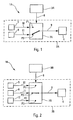
- FIGS 1 and 2 show the block diagrams of two alternative embodiments of the device according to the invention.
- Figure 3 schematically shows a particular embodiment of the device shown in Figure 1.
- Figure 4 schematically shows a particular embodiment of the device shown in Figure 2.
- Figures 5 and 6 show schematically, in perspective, two different embodiments of a light indicating means of a device according to the invention.
- the device according to the invention and represented according to two modes of different embodiments 1A and 1B respectively in FIGS. 1 and 2, is an alert and indication device for at least one emergency exit not shown in a closed environment such as a building (cinema, apartment building, school, ...), one room (conference room, %) of a building, a ship, an aircraft, ...
- said first light radiation is such that it does not visually disturb a person being in said closed environment
- said second radiation bright is such that it visually alerts any person in the said closed environment, danger and the need to evacuate the enclosed environment and guide it to at least one emergency exit.
- said first light radiation is a light neutral (white for example) and said second light radiation has a green color.
- the color green which is, in general, associated with a "positive" signal (traffic lights, airlock of a bank, ...) and which is therefore recognized by the public, is the one that best helps guide people to an emergency exit.
- the indicator light 2A, 2B emits a (first) continuous light radiation low intensity, which simply signals people that they are found in the enclosed environment (building, ship, aircraft, ...) at minus an emergency exit, but which does not disturb them in their occupation.
- said first light radiation must not reduce the darkness necessary for the proper projection of a movie. The light radiation emitted therefore depends on the enclosed environment, to which it is applied.
- the indicator bright 2A, 2B is brought into the alert state, in which, by a (second) very disturbing light radiation, as discontinuous and intense raised, it alerts people to the situation and guides them to the outcome that it helps to locate [either by locating it directly, by example by being arranged above said emergency exit, and by signaling thus its position, either by indicating the direction in which find this emergency exit, for example using an arrow (figure 6) or with one hand ( Figure 5)].
- this device 1A, 1B alert and indication of emergency exit is particularly effective, since, in the state of alert, the (second) light radiation emitted is such (discontinuous and intense high) that it remains visible to the human eye under all circumstances, even in presence of smoke, and thus helps guide people towards the outcome of help.
- said light indicator 2A, 2B is likely to be brought into a third state, and said means of control 3A, 3B bring said indicator light 2A, 2B into said third state, during an emergency evacuation, when said exit from rescue is impractical.
- the device 1A, 1B according to the invention warns people to evacuate when an exit relief became impractical.
- the third state in which the means 4 is brought when, during a emergency evacuation, the emergency exit is impracticable, is said state of standby, i.e. the switch 7A is controlled by the means 3A command to resume said position P1.
- the means 4 is then connected to the source 5 of continuous and weak energy supply and emits said first light radiation.
- the third state in which the means 4 is brought when, during an emergency evacuation, the emergency exit is impractical corresponds to a specific state.
- switch 7B is controlled by the control means 3B to take a position P3 making it possible to connect the means 4 to an element 12 (connection 13).
- said element 12 is a third energy supply source, providing energy that is different from those provided by sources 5 and 6 so that the means 4 then emits a third particular light radiation, which is different said first and second light rays.
- the different power sources in energy can be combined into a single unit capable of supply the different energies required.
- said element 12 is the mass so that the means 4 is no longer supplied with energy when it is connected to this element 12 and then goes out. In this case, people are no longer guided towards the corresponding emergency exit, which is in any case impracticable.
- said first means 14 are means manually operable, in particular by an environmental manager closed, for example the captain of an airplane. Situation normal, said first means 14 are not activated and, when are activated, they emit said emergency signal (evacuation order).
- the means 16A comprise, for example, an AND logic gate 23.
- this gate 23 does not deliver signal so that the switch 7A remains in the initial position P1 (standby state for indicator 2A). It switches to position P2 (state alert for indicator 2A) when an emergency signal (first means 14) is issued, as well as a signal informing that the emergency exit is practicable (second means 15A). Such a switch order is however canceled when said second means 15A emit a signal of impracticability (return to position P1).
- This logic gate 28 makes it possible to switch, thanks to a link 8B, the switching means 26 between a position PO (allowing the connection by switching means 25) and position P3.
- said light means indication 4 has two indication light elements 30 and 31 (figure 5), 32 and 33 (figure 6), which are both in the standby state, in normal situation.
- only one of said two light elements indication preferably item 30 ( Figure 5) or 33 ( Figure 6) is controlled by said control means 3A, 3B during a change in situation and is brought into said alert state or in said third state, depending on the situation.
- This item 30 or 33 includes, for example, a ramp of light emitting diodes.
- the other element 31, 32 remains, meanwhile, always in the standby state.
- the two light elements 30 and 31, 32 and 33 are controlled simultaneously, when a change in situation.
Landscapes
- Physics & Mathematics (AREA)
- General Physics & Mathematics (AREA)
- Business, Economics & Management (AREA)
- Emergency Management (AREA)
- Audible And Visible Signals (AREA)
- Alarm Systems (AREA)
- Fire Alarms (AREA)
- Non-Portable Lighting Devices Or Systems Thereof (AREA)
- Road Signs Or Road Markings (AREA)
Abstract
Description
- les dispositifs d'alerte ; et
- les dispositifs indiquant les issues de secours aux personnes se trouvant dans l'environnement clos et permettant de les guider.
- premièrement, en cas de dégagement de fumée (feu ou dégagement de produit chimique par exemple), les signaux lumineux émis par ces indicateurs lumineux sont généralement difficilement visibles à cause de l'effet d'écran engendré par la fumée. Par conséquent, ces signaux lumineux qui sont masqués aux yeux des personnes cherchant à évacuer l'environnement clos où ils se trouvent, ne sont plus d'aucune utilité. Ces indicateurs lumineux sont donc inefficaces dans un tel cas ;
- deuxièmement, les issues de secours repérées par les signaux lumineux peuvent être impraticables. Elles peuvent notamment être bloquées, par exemple par une déformation du cadre de la porte ou par l'obstruction par un élément extérieur tel qu'un arbre ou par un élément intérieur tel qu'une partie effondrée du plafond par exemple. Dans une telle situation, l'indicateur lumineux continue d'indiquer une issue de secours qui ne peut pas être utilisée pour l'évacuation. Dans ce cas, les indicateurs lumineux induisent en erreur les personnes qui veulent sortir de l'environnement clos.
- alerter les personnes se trouvant dans un environnement clos de toute situation de danger nécessitant une évacuation ; et
- indiquer une issue de secours praticable de manière à pouvoir guider lesdites personnes vers cette issue de secours praticable lors d'une évacuation.
- ledit indicateur lumineux est susceptible d'être amené dans l'un de trois
états différents :
- un état de veille, dans lequel il émet un premier rayonnement lumineux qui est continu et qui présente une première intensité ;
- un état d'alerte, dans lequel il émet un deuxième rayonnement lumineux qui est discontinu et qui présente une deuxième intensité qui est supérieure à ladite première intensité ; et
- un troisième état ; et
- lesdits moyens de commande commandent ledit indicateur lumineux de
manière à l'amener :
- dans ledit état de veille, en situation normale ;
- dans ledit état d'alerte, lors d'une évacuation d'urgence dudit environnement clos par ladite issue de secours, cette dernière étant praticable ; et
- dans ledit troisième état, lors d'une évacuation d'urgence, lorsque ladite issue de secours est impraticable.
- au moins un moyen d'indication lumineux ;
- au moins deux sources d'alimentation en énergie, susceptibles d'alimenter avec des énergies différentes ledit moyen lumineux d'indication de sorte qu'il puisse émettre des rayonnements lumineux différents ; et
- un commutateur commandable susceptible de relier ledit moyen d'indication lumineux à l'une desdites sources d'alimentation, pour son alimentation en énergie.
- des premiers moyens pour engendrer le cas échéant un signal d'urgence ;
- des seconds moyens pour engendrer le cas échéant un signal informant de l'impraticabilité de ladite issue de secours ; et
- des troisièmes moyens pour commander ledit indicateur lumineux, en fonction des signaux engendrés par lesdits premiers et seconds moyens.
- au moins un capteur susceptible de mesurer la valeur d'au moins un paramètre représentatif de l'impraticabilité de ladite issue de secours ; et
- au moins un moyen de traitement susceptible d'engendrer un signal informant de l'impraticabilité de ladite issue de secours, en fonction de la valeur dudit paramètre, mesurée par ledit capteur.
- un indicateur lumineux 2A, 2B destiné à indiquer ladite issue de secours
et susceptible d'être amené dans au moins l'un de deux états différents
:
- un état de veille, dans lequel il émet un premier rayonnement lumineux qui est continu et qui présente une première intensité réduite ; et
- un état d'alerte, dans lequel il émet un deuxième rayonnement lumineux qui est discontinu et qui présente une seconde intensité qui est élevée et supérieure à ladite première intensité ; et
- des moyens de commande 3A, 3B pour commander ledit indicateur lumineux
2A, 2B de manière à l'amener :
- dans ledit état de veille, en situation normale, c'est-à-dire en l'absence de danger (donc pas d'alerte ni d'évacuation) ; et
- dans ledit état d'alerte, lors d'une évacuation d'urgence dudit environnement clos en cas de danger (feu, ...) par ladite issue de secours, cette dernière étant praticable.
- à alerter les personnes de ladite situation de danger ; et
- à guider lesdites personnes vers au moins une issue de secours.
- au moins un moyen lumineux d'indication 4 ;
- au moins deux sources d'alimentation en énergie 5 et 6, susceptibles d'alimenter avec des énergies différentes ledit moyen lumineux d'indication 4 de sorte qu'il puisse émettre des rayonnements lumineux différents ; et
- un commutateur commandable 7A, 7B qui est relié par des liaisons 8, 9, 10 et 11 respectivement aux moyens de commande 3A ou 3B, au moyen lumineux d'indication 4, à la source d'alimentation 5 et à la source d'alimentation 6, et qui est susceptible de relier ledit moyen lumineux d'indication 4 à l'une desdites sources d'alimentation 5 et 6 pour son alimentation en énergie.
- dans la position P1, le moyen 4 est alimenté en énergie électrique par la source 5 ; et
- dans la position P2, ledit moyen 4 est alimenté en énergie électrique par la source 6.
- la source d'alimentation 5 fournit une énergie E (en fonction du temps t) qui est continue et qui présente une valeur E1 faible. Ainsi, lorsqu'il est relié à cette source 5, le moyen 4 émet ledit premier rayonnement lumineux (indicateur lumineux 3A, 3B dans l'état de veille) ; et
- la source d'alimentation 6 fournit une énergie E qui est discontinue entre une valeur minimale E2 et une valeur maximale E3, cette dernière étant élevée. Ainsi, lorsqu'il est relié à cette source 6, le moyen 4 émet ledit second rayonnement lumineux (indicateur lumineux 3A, 3B dans l'état d'alerte).
- des premiers moyens 14 pour engendrer, le cas échéant, un signal d'urgence prévenant d'un danger et de la nécessité d'évacuer l'environnement clos ;
- des seconds moyens 15A, 15B pour engendrer, le cas échéant, un signal informant de l'impraticabilité ou non de l'issue de secours utilisée pour l'évacuation ; et
- des troisièmes moyens 16A, 16B (qui sont reliés par une liaison 17 aux premiers moyens 14 et par une liaison 18A, 18B aux seconds moyens 15A, 15B) pour commander ledit indicateur lumineux 2A, 2B, en fonction des signaux engendrés par lesdits premiers et seconds moyens.
- un organe manuel 19, de préférence de type à contacteur (poignée, interrupteur, ...) comme représenté sur la figure 3 ; ou
- un dispositif automatique 15B, précisé ci-dessous, comme représenté sur la figure 4 ; ou
- simultanément un organe manuel 19 et un dispositif automatique 15B.
- au moins un capteur 20 (de position, de pression, ...) susceptible de mesurer la valeur d'au moins un paramètre représentatif de l'impraticabilité de l'issue de secours ; et
- au moins un moyen de traitement 22 relié par une liaison 21 au capteur 20 et susceptible d'engendrer un signal informant de l'impraticabilité de ladite issue de secours, en fonction de la valeur dudit paramètre, mesurée par ledit capteur 20.
- une porte logique 27, de type "inverseur", qui est reliée à la sortie des seconds moyens 15B susceptibles d'émettre un signal informant si l'issue de secours est praticable ou non. Cette information est donc inversée ; et
- une porte logique ET 28 qui est reliée à la sortie de la porte 27 par une liaison 29, ainsi qu'à la sortie des premiers moyens 14 susceptibles d'émettre un signal d'urgence.
Claims (12)
- Dispositif lumineux d'alerte et d'indication d'au moins une issue de secours d'un environnement clos, ledit dispositif comportant un indicateur lumineux (2A, 2B) destiné à indiquer ladite issue de secours et des moyens de commande (3A, 3B) pour commander ledit indicateur lumineux (3A, 3B),
caractérisé en ce que :ledit indicateur lumineux (2A, 2B) est susceptible d'être amené dans l'un de trois états différents :un état de veille, dans lequel il émet un premier rayonnement lumineux qui est continu et qui présente une première intensité ;un état d'alerte, dans lequel il émet un deuxième rayonnement lumineux qui est discontinu et qui présente une deuxième intensité qui est supérieure à ladite première intensité ; etun troisième état ; etlesdits moyens de commande (3A, 3B) commandent ledit indicateur lumineux (2A, 2B) de manière à l'amener :dans ledit état de veille, en situation normale ;dans ledit état d'alerte, lors d'une évacuation d'urgence dudit environnement clos par ladite issue de secours, cette dernière étant praticable ; etdans ledit troisième état, lors d'une évacuation d'urgence, lorsque ladite issue de secours est impraticable. - Dispositif selon la revendication 1,
caractérisé en ce que ledit premier rayonnement lumineux est tel qu'il ne perturbe pas visuellement une personne se trouvant dans ledit environnement clos, et en ce que ledit deuxième rayonnement lumineux est tel qu'il alerte visuellement une personne se trouvant dans ledit environnement clos d'une situation en danger et la guide vers ladite issue de secours. - Dispositif selon l'une des revendications 1 et 2,
caractérisé en ce que ledit troisième état correspond audit état de veille. - Dispositif selon l'une des revendications 1 et 2,
caractérisé en ce que, dans ledit troisième état, ledit indicateur lumineux (2B) émet un troisième rayonnement lumineux qui est différent desdits premier et deuxième rayonnements lumineux. - Dispositif selon l'une des revendications 1 et 2,
caractérisé en ce que, dans ledit troisième état, ledit indicateur lumineux (2B) est éteint. - Dispositif selon l'une quelconque des revendications précédentes,
caractérisé en ce que ledit indicateur lumineux (2A, 2B) comprend deux éléments lumineux d'indication (30, 31 ; 32, 33) susceptibles d'émettre des rayonnements lumineux, qui sont tous deux dans l'état de veille en situation normale. - Dispositif selon la revendication 6,
caractérisé en ce que seul l'un desdits deux éléments lumineux d'indication (30, 31 ; 32, 33) est commandé par lesdits moyens de commande (3A, 3B) lors d'un changement de situation. - Dispositif selon la revendication 6,
caractérisé en ce que les deux éléments lumineux d'indication (30, 31 ; 32, 33) sont commandés par lesdits moyens de commande (3A, 3B) lors d'un changement de situation. - Dispositif selon l'une quelconque des revendications précédentes,
caractérisé en ce que ledit indicateur lumineux (2A, 2B) comprendau moins un moyen lumineux d'indication (4) ;au moins deux sources (5, 6, 12) d'alimentation en énergie, susceptibles d'alimenter avec des énergies différentes ledit moyen lumineux d'indication (4) de sorte qu'il puisse émettre des rayonnements lumineux différents ; etun commutateur commandable (7A, 7B) susceptible de relier ledit moyen lumineux d'indication (4) à l'une desdites sources d'alimentation (5, 6, 12), pour son alimentation en énergie. - Dispositif selon l'une quelconque des revendications précédentes,
caractérisé en ce que lesdits moyens de commande (3A, 3B) comportent :des premiers moyens (14) pour engendrer le cas échéant un signal d'urgence ;des seconds moyens (15A, 15B) pour engendrer le cas échéant un signal informant de l'impraticabilité de ladite issue de secours ; etdes troisièmes moyens (16A, 16B) pour commander ledit indicateur lumineux (3A, 3B), en fonction des signaux engendrés par lesdits premiers et seconds moyens. - Dispositif selon la revendication 10,
caractérisé en ce que lesdits seconds moyens (15A) comportent un organe (19) qui est actionnable manuellement. - Dispositif selon l'une des revendications 10 et 11,
caractérisé en ce que lesdits seconds moyens (15B) comportent :au moins un capteur (20) susceptible de mesurer la valeur d'au moins un paramètre représentatif de l'impraticabilité de ladite issue de secours ; etau moins un moyen de traitement (22) susceptible d'engendrer un signal informant de l'impraticabilité de ladite issue de secours, en fonction de la valeur dudit paramètre, mesurée par ledit capteur (20).
Applications Claiming Priority (2)
| Application Number | Priority Date | Filing Date | Title |
|---|---|---|---|
| FR0206271A FR2840096B1 (fr) | 2002-05-23 | 2002-05-23 | Dispositif lumineux d'alerte et d'indication d'une issue de secours |
| FR0206271 | 2002-05-23 |
Publications (3)
| Publication Number | Publication Date |
|---|---|
| EP1365369A1 true EP1365369A1 (fr) | 2003-11-26 |
| EP1365369B1 EP1365369B1 (fr) | 2006-09-27 |
| EP1365369B8 EP1365369B8 (fr) | 2006-11-15 |
Family
ID=29286624
Family Applications (1)
| Application Number | Title | Priority Date | Filing Date |
|---|---|---|---|
| EP03291051A Expired - Lifetime EP1365369B8 (fr) | 2002-05-23 | 2003-04-30 | Dispositif lumineux d'alerte et d'indication d'une issue de secours |
Country Status (8)
| Country | Link |
|---|---|
| US (1) | US6842120B2 (fr) |
| EP (1) | EP1365369B8 (fr) |
| JP (1) | JP2003346250A (fr) |
| AT (1) | ATE341057T1 (fr) |
| CA (1) | CA2428142C (fr) |
| DE (1) | DE60308590T2 (fr) |
| ES (1) | ES2272912T3 (fr) |
| FR (1) | FR2840096B1 (fr) |
Cited By (1)
| Publication number | Priority date | Publication date | Assignee | Title |
|---|---|---|---|---|
| US8952828B2 (en) | 2010-12-22 | 2015-02-10 | Airbus Operations Gmbh | System for evacuating persons from a vehicle |
Families Citing this family (13)
| Publication number | Priority date | Publication date | Assignee | Title |
|---|---|---|---|---|
| US6967587B2 (en) * | 2003-09-22 | 2005-11-22 | Sanidoor, Llc | Hands-free door opener and method |
| US7026947B2 (en) * | 2003-12-12 | 2006-04-11 | Honeywell International, Inc. | Building emergency path finding systems and method |
| US7061392B2 (en) * | 2003-12-12 | 2006-06-13 | Honeywell International, Inc. | System and method of disabling an evacuation location device |
| GB2416616A (en) * | 2004-02-27 | 2006-02-01 | Christopher Yardley | Aircraft door handle alarm |
| JP2008257320A (ja) * | 2007-04-02 | 2008-10-23 | Shimizu Corp | 誘導灯装置 |
| US9689542B2 (en) * | 2008-12-12 | 2017-06-27 | Sonja K. Zozula | Emergency exit route illumination system and methods |
| DE102009009187B4 (de) | 2009-02-16 | 2013-01-24 | Airbus Operations Gmbh | Textile phosphoreszierende Fluchtwegmarkierung |
| JP5783775B2 (ja) * | 2011-04-07 | 2015-09-24 | 三菱電機株式会社 | 誘導灯装置 |
| DE102011120764A1 (de) * | 2011-12-09 | 2013-06-13 | Airbus Operations Gmbh | Passagierüberwachungs- und -leitsystem zur Verwendung in einer Flugzeugkabine |
| JP6523754B2 (ja) * | 2015-04-07 | 2019-06-05 | ホーチキ株式会社 | 光警報装置 |
| KR101728503B1 (ko) * | 2015-05-29 | 2017-04-19 | 지병찬 | 화재경보용 조명스위치장치 |
| JP7889054B2 (ja) * | 2022-05-11 | 2026-07-14 | 株式会社大林組 | 誘導支援システム、誘導支援方法及び誘導支援プログラム |
| US12664866B2 (en) * | 2024-05-21 | 2026-06-23 | Roen William Lenz | Fire safety light |
Citations (5)
| Publication number | Priority date | Publication date | Assignee | Title |
|---|---|---|---|---|
| GB2215105A (en) * | 1988-02-16 | 1989-09-13 | Richard William Henry Ford | Personnel evacuation system |
| GB2220288A (en) * | 1988-06-24 | 1990-01-04 | George Wakefield | An emergency exit route directing system |
| FR2686177A1 (fr) * | 1992-01-13 | 1993-07-16 | Cerberus Guinard | Systeme d'evacuation dynamique pour locaux et procede d'evacuation. |
| US5297011A (en) * | 1992-08-12 | 1994-03-22 | George Triunfol | Lighted corner guard |
| US5612665A (en) * | 1992-01-02 | 1997-03-18 | Gerhardsen; Arne | Escape route indication system |
Family Cites Families (11)
| Publication number | Priority date | Publication date | Assignee | Title |
|---|---|---|---|---|
| JPS5853399B2 (ja) * | 1975-10-15 | 1983-11-29 | 松下電工株式会社 | ヒナンユウドウホウシキ |
| JPS52108792A (en) * | 1976-03-09 | 1977-09-12 | Mitsubishi Electric Corp | On and off type refuge guidance light |
| JPS6074096A (ja) * | 1983-09-30 | 1985-04-26 | 東芝ライテック株式会社 | 点滅形誘導灯 |
| JPS6386000A (ja) * | 1986-09-30 | 1988-04-16 | 東芝ライテック株式会社 | 誘導装置 |
| CA2130972A1 (fr) * | 1993-08-26 | 1995-02-27 | Michael Lucas | Systeme d'alarme et d'evacuation |
| US5581230A (en) * | 1995-01-05 | 1996-12-03 | Amerisafe Corporation | Illuminated door handle assembly |
| PT846311E (pt) | 1995-07-07 | 2002-12-31 | Sound Alert Ltd | Melhoramentos relativos a dispositivos de localizacao |
| JPH1125366A (ja) * | 1997-06-30 | 1999-01-29 | Sony Corp | 避難誘導装置 |
| JPH11175854A (ja) * | 1997-12-12 | 1999-07-02 | Matsushita Electric Ind Co Ltd | 誘導表示装置 |
| JP2000133018A (ja) * | 1998-10-30 | 2000-05-12 | Matsushita Electric Works Ltd | 避難誘導灯 |
| GB0027863D0 (en) * | 2000-11-15 | 2000-12-27 | Bligh Maurice | Emergency floor lighting system |
-
2002
- 2002-05-23 FR FR0206271A patent/FR2840096B1/fr not_active Expired - Fee Related
-
2003
- 2003-04-30 EP EP03291051A patent/EP1365369B8/fr not_active Expired - Lifetime
- 2003-04-30 ES ES03291051T patent/ES2272912T3/es not_active Expired - Lifetime
- 2003-04-30 DE DE60308590T patent/DE60308590T2/de not_active Expired - Lifetime
- 2003-04-30 AT AT03291051T patent/ATE341057T1/de not_active IP Right Cessation
- 2003-05-01 CA CA2428142A patent/CA2428142C/fr not_active Expired - Fee Related
- 2003-05-09 US US10/434,211 patent/US6842120B2/en not_active Expired - Lifetime
- 2003-05-12 JP JP2003132603A patent/JP2003346250A/ja active Pending
Patent Citations (5)
| Publication number | Priority date | Publication date | Assignee | Title |
|---|---|---|---|---|
| GB2215105A (en) * | 1988-02-16 | 1989-09-13 | Richard William Henry Ford | Personnel evacuation system |
| GB2220288A (en) * | 1988-06-24 | 1990-01-04 | George Wakefield | An emergency exit route directing system |
| US5612665A (en) * | 1992-01-02 | 1997-03-18 | Gerhardsen; Arne | Escape route indication system |
| FR2686177A1 (fr) * | 1992-01-13 | 1993-07-16 | Cerberus Guinard | Systeme d'evacuation dynamique pour locaux et procede d'evacuation. |
| US5297011A (en) * | 1992-08-12 | 1994-03-22 | George Triunfol | Lighted corner guard |
Cited By (1)
| Publication number | Priority date | Publication date | Assignee | Title |
|---|---|---|---|---|
| US8952828B2 (en) | 2010-12-22 | 2015-02-10 | Airbus Operations Gmbh | System for evacuating persons from a vehicle |
Also Published As
| Publication number | Publication date |
|---|---|
| DE60308590D1 (de) | 2006-11-09 |
| CA2428142C (fr) | 2011-07-19 |
| ES2272912T3 (es) | 2007-05-01 |
| EP1365369B8 (fr) | 2006-11-15 |
| DE60308590T2 (de) | 2007-08-23 |
| US6842120B2 (en) | 2005-01-11 |
| CA2428142A1 (fr) | 2003-11-23 |
| ATE341057T1 (de) | 2006-10-15 |
| FR2840096B1 (fr) | 2006-06-30 |
| EP1365369B1 (fr) | 2006-09-27 |
| US20030218545A1 (en) | 2003-11-27 |
| FR2840096A1 (fr) | 2003-11-28 |
| JP2003346250A (ja) | 2003-12-05 |
Similar Documents
| Publication | Publication Date | Title |
|---|---|---|
| EP1365369B1 (fr) | Dispositif lumineux d'alerte et d'indication d'une issue de secours | |
| US7528700B2 (en) | Integrated fire exit alert system | |
| CH673723A5 (fr) | ||
| WO1995032488A1 (fr) | Installation de guidage en cas d'evacuation d'urgence | |
| TW201303804A (zh) | 消防逃生警示及引導系統 | |
| EP1420375A1 (fr) | Dispositif de sécurité pour lieux publics | |
| FR2976704A1 (fr) | Systeme et procede de guidage et de signalisation pour personne deficiente visuelle. | |
| FR2636756A1 (fr) | Systeme d'alarme autonome a infrarouge actif | |
| EP2474957B1 (fr) | Emetteur d'un système d'appel pour une installation comprenant une pluralité de lieux d'appel | |
| EP3742411A2 (fr) | Dispositif de signalisation de position d'alarme, système d'alarme et procédé correspondant | |
| FR3064101B1 (fr) | Dispositif pour emettre une alerte lumineuse, systeme de gestion d'alerte associe | |
| FR3143102A1 (fr) | Dispositif d’éclairage de sécurité | |
| FR2970182A1 (fr) | Dispositif de signalisation a pictogramme dynamique | |
| EP4634903A1 (fr) | Dispositif d'eclairage de securite | |
| FR2963463A1 (fr) | Procede et systeme de signalisation d'un etat d'alerte dans un batiment | |
| FR2572829A1 (fr) | Systeme de protection contre le vol avec dispositif de confirmation incorpore | |
| FR2829607A3 (fr) | Dispositif radioelectrique intelligent de site d'incendie | |
| EP3980618A1 (fr) | Système de verrouillage d'une porte | |
| FR2714510A1 (fr) | Installation de détection et limitation de sons d'origine musicale dans des locaux à usage public ou privé. | |
| FR2908216A1 (fr) | Alarme perimetrique sans fil | |
| FR2884017A1 (fr) | Procede de commande d'un systeme de barriere lumineuse | |
| FR2964231A1 (fr) | Installation de securite perfectionnee | |
| FR2827326A1 (fr) | Installation d'habitation a plusieurs zones individuelles dans un espace commun et une zone commune | |
| EP2678845B2 (fr) | Dispositif de déclenchement d'alarme pour un système de sécurité | |
| FR2945220A1 (fr) | Systeme d'affichage de chemin d'evacuation d'urgence, notamment pour le guidage des pompiers en cas d'incendie |
Legal Events
| Date | Code | Title | Description |
|---|---|---|---|
| PUAI | Public reference made under article 153(3) epc to a published international application that has entered the european phase |
Free format text: ORIGINAL CODE: 0009012 |
|
| AK | Designated contracting states |
Kind code of ref document: A1 Designated state(s): AT BE BG CH CY CZ DE DK EE ES FI FR GB GR HU IE IT LI LU MC NL PT RO SE SI SK TR |
|
| AX | Request for extension of the european patent |
Extension state: AL LT LV MK |
|
| 17P | Request for examination filed |
Effective date: 20040205 |
|
| AKX | Designation fees paid |
Designated state(s): AT BE BG CH CY CZ DE DK EE ES FI FR GB GR HU IE IT LI LU MC NL PT RO SE SI SK TR |
|
| 17Q | First examination report despatched |
Effective date: 20040728 |
|
| GRAP | Despatch of communication of intention to grant a patent |
Free format text: ORIGINAL CODE: EPIDOSNIGR1 |
|
| GRAS | Grant fee paid |
Free format text: ORIGINAL CODE: EPIDOSNIGR3 |
|
| GRAA | (expected) grant |
Free format text: ORIGINAL CODE: 0009210 |
|
| AK | Designated contracting states |
Kind code of ref document: B1 Designated state(s): AT BE BG CH CY CZ DE DK EE ES FI FR GB GR HU IE IT LI LU MC NL PT RO SE SI SK TR |
|
| PG25 | Lapsed in a contracting state [announced via postgrant information from national office to epo] |
Ref country code: IT Free format text: LAPSE BECAUSE OF FAILURE TO SUBMIT A TRANSLATION OF THE DESCRIPTION OR TO PAY THE FEE WITHIN THE PRESCRIBED TIME-LIMIT;WARNING: LAPSES OF ITALIAN PATENTS WITH EFFECTIVE DATE BEFORE 2007 MAY HAVE OCCURRED AT ANY TIME BEFORE 2007. THE CORRECT EFFECTIVE DATE MAY BE DIFFERENT FROM THE ONE RECORDED. Effective date: 20060927 Ref country code: CZ Free format text: LAPSE BECAUSE OF FAILURE TO SUBMIT A TRANSLATION OF THE DESCRIPTION OR TO PAY THE FEE WITHIN THE PRESCRIBED TIME-LIMIT Effective date: 20060927 Ref country code: FI Free format text: LAPSE BECAUSE OF FAILURE TO SUBMIT A TRANSLATION OF THE DESCRIPTION OR TO PAY THE FEE WITHIN THE PRESCRIBED TIME-LIMIT Effective date: 20060927 Ref country code: RO Free format text: LAPSE BECAUSE OF FAILURE TO SUBMIT A TRANSLATION OF THE DESCRIPTION OR TO PAY THE FEE WITHIN THE PRESCRIBED TIME-LIMIT Effective date: 20060927 Ref country code: SI Free format text: LAPSE BECAUSE OF FAILURE TO SUBMIT A TRANSLATION OF THE DESCRIPTION OR TO PAY THE FEE WITHIN THE PRESCRIBED TIME-LIMIT Effective date: 20060927 Ref country code: AT Free format text: LAPSE BECAUSE OF FAILURE TO SUBMIT A TRANSLATION OF THE DESCRIPTION OR TO PAY THE FEE WITHIN THE PRESCRIBED TIME-LIMIT Effective date: 20060927 Ref country code: SK Free format text: LAPSE BECAUSE OF FAILURE TO SUBMIT A TRANSLATION OF THE DESCRIPTION OR TO PAY THE FEE WITHIN THE PRESCRIBED TIME-LIMIT Effective date: 20060927 Ref country code: IE Free format text: LAPSE BECAUSE OF FAILURE TO SUBMIT A TRANSLATION OF THE DESCRIPTION OR TO PAY THE FEE WITHIN THE PRESCRIBED TIME-LIMIT Effective date: 20060927 Ref country code: NL Free format text: LAPSE BECAUSE OF FAILURE TO SUBMIT A TRANSLATION OF THE DESCRIPTION OR TO PAY THE FEE WITHIN THE PRESCRIBED TIME-LIMIT Effective date: 20060927 |
|
| REG | Reference to a national code |
Ref country code: GB Ref legal event code: FG4D Free format text: NOT ENGLISH |
|
| REG | Reference to a national code |
Ref country code: CH Ref legal event code: EP |
|
| REG | Reference to a national code |
Ref country code: IE Ref legal event code: FG4D Free format text: LANGUAGE OF EP DOCUMENT: FRENCH |
|
| RAP2 | Party data changed (patent owner data changed or rights of a patent transferred) |
Owner name: AIRBUS Owner name: AIRBUS DEUTSCHLAND GMBH |
|
| REF | Corresponds to: |
Ref document number: 60308590 Country of ref document: DE Date of ref document: 20061109 Kind code of ref document: P |
|
| GBT | Gb: translation of ep patent filed (gb section 77(6)(a)/1977) |
Effective date: 20061108 |
|
| REG | Reference to a national code |
Ref country code: GB Ref legal event code: ERR Free format text: NOTIFICATION HAS NOW BEEN RECEIVED FROM THE EUROPEAN PATENT OFFICE THAT THE CORRECT NAMES ARE: AIRBUS AIRBUS DEUTSCHLAND GMBH THIS CORRECTION WILL BE PUBLISHED IN THE EUROPEAN PATENT BULLETIN 06/44 DATED 20061102 |
|
| PG25 | Lapsed in a contracting state [announced via postgrant information from national office to epo] |
Ref country code: BG Free format text: LAPSE BECAUSE OF FAILURE TO SUBMIT A TRANSLATION OF THE DESCRIPTION OR TO PAY THE FEE WITHIN THE PRESCRIBED TIME-LIMIT Effective date: 20061227 Ref country code: DK Free format text: LAPSE BECAUSE OF FAILURE TO SUBMIT A TRANSLATION OF THE DESCRIPTION OR TO PAY THE FEE WITHIN THE PRESCRIBED TIME-LIMIT Effective date: 20061227 |
|
| NLT2 | Nl: modifications (of names), taken from the european patent patent bulletin |
Owner name: AIRBUS EN AIRBUS DEUTSCHLAND GMBH Effective date: 20061102 |
|
| REG | Reference to a national code |
Ref country code: SE Ref legal event code: TRGR |
|
| NLV1 | Nl: lapsed or annulled due to failure to fulfill the requirements of art. 29p and 29m of the patents act | ||
| PG25 | Lapsed in a contracting state [announced via postgrant information from national office to epo] |
Ref country code: PT Free format text: LAPSE BECAUSE OF FAILURE TO SUBMIT A TRANSLATION OF THE DESCRIPTION OR TO PAY THE FEE WITHIN THE PRESCRIBED TIME-LIMIT Effective date: 20070313 |
|
| REG | Reference to a national code |
Ref country code: IE Ref legal event code: FD4D |
|
| REG | Reference to a national code |
Ref country code: ES Ref legal event code: FG2A Ref document number: 2272912 Country of ref document: ES Kind code of ref document: T3 |
|
| PLBE | No opposition filed within time limit |
Free format text: ORIGINAL CODE: 0009261 |
|
| STAA | Information on the status of an ep patent application or granted ep patent |
Free format text: STATUS: NO OPPOSITION FILED WITHIN TIME LIMIT |
|
| 26N | No opposition filed |
Effective date: 20070628 |
|
| REG | Reference to a national code |
Ref country code: CH Ref legal event code: PL |
|
| BERE | Be: lapsed |
Owner name: AIRBUS DEUTSCHLAND G.M.B.H. (HRB 43527) Effective date: 20070430 Owner name: AIRBUS Effective date: 20070430 |
|
| PG25 | Lapsed in a contracting state [announced via postgrant information from national office to epo] |
Ref country code: CH Free format text: LAPSE BECAUSE OF NON-PAYMENT OF DUE FEES Effective date: 20070430 Ref country code: LI Free format text: LAPSE BECAUSE OF NON-PAYMENT OF DUE FEES Effective date: 20070430 |
|
| PG25 | Lapsed in a contracting state [announced via postgrant information from national office to epo] |
Ref country code: BE Free format text: LAPSE BECAUSE OF NON-PAYMENT OF DUE FEES Effective date: 20070430 |
|
| PG25 | Lapsed in a contracting state [announced via postgrant information from national office to epo] |
Ref country code: GR Free format text: LAPSE BECAUSE OF FAILURE TO SUBMIT A TRANSLATION OF THE DESCRIPTION OR TO PAY THE FEE WITHIN THE PRESCRIBED TIME-LIMIT Effective date: 20061228 |
|
| PG25 | Lapsed in a contracting state [announced via postgrant information from national office to epo] |
Ref country code: EE Free format text: LAPSE BECAUSE OF FAILURE TO SUBMIT A TRANSLATION OF THE DESCRIPTION OR TO PAY THE FEE WITHIN THE PRESCRIBED TIME-LIMIT Effective date: 20060927 |
|
| PG25 | Lapsed in a contracting state [announced via postgrant information from national office to epo] |
Ref country code: MC Free format text: LAPSE BECAUSE OF NON-PAYMENT OF DUE FEES Effective date: 20070430 |
|
| PG25 | Lapsed in a contracting state [announced via postgrant information from national office to epo] |
Ref country code: CY Free format text: LAPSE BECAUSE OF FAILURE TO SUBMIT A TRANSLATION OF THE DESCRIPTION OR TO PAY THE FEE WITHIN THE PRESCRIBED TIME-LIMIT Effective date: 20060927 Ref country code: LU Free format text: LAPSE BECAUSE OF NON-PAYMENT OF DUE FEES Effective date: 20070430 |
|
| PG25 | Lapsed in a contracting state [announced via postgrant information from national office to epo] |
Ref country code: TR Free format text: LAPSE BECAUSE OF FAILURE TO SUBMIT A TRANSLATION OF THE DESCRIPTION OR TO PAY THE FEE WITHIN THE PRESCRIBED TIME-LIMIT Effective date: 20060927 Ref country code: HU Free format text: LAPSE BECAUSE OF FAILURE TO SUBMIT A TRANSLATION OF THE DESCRIPTION OR TO PAY THE FEE WITHIN THE PRESCRIBED TIME-LIMIT Effective date: 20070328 |
|
| REG | Reference to a national code |
Ref country code: ES Ref legal event code: PC2A Owner name: AIRBUS OPERATIONS GMBH Effective date: 20110928 |
|
| PGFP | Annual fee paid to national office [announced via postgrant information from national office to epo] |
Ref country code: SE Payment date: 20120418 Year of fee payment: 10 |
|
| PGFP | Annual fee paid to national office [announced via postgrant information from national office to epo] |
Ref country code: IT Payment date: 20120420 Year of fee payment: 10 |
|
| PGFP | Annual fee paid to national office [announced via postgrant information from national office to epo] |
Ref country code: ES Payment date: 20120425 Year of fee payment: 10 |
|
| REG | Reference to a national code |
Ref country code: SE Ref legal event code: EUG |
|
| PG25 | Lapsed in a contracting state [announced via postgrant information from national office to epo] |
Ref country code: SE Free format text: LAPSE BECAUSE OF NON-PAYMENT OF DUE FEES Effective date: 20130501 |
|
| PG25 | Lapsed in a contracting state [announced via postgrant information from national office to epo] |
Ref country code: IT Free format text: LAPSE BECAUSE OF NON-PAYMENT OF DUE FEES Effective date: 20130430 |
|
| REG | Reference to a national code |
Ref country code: ES Ref legal event code: FD2A Effective date: 20140715 |
|
| PG25 | Lapsed in a contracting state [announced via postgrant information from national office to epo] |
Ref country code: ES Free format text: LAPSE BECAUSE OF NON-PAYMENT OF DUE FEES Effective date: 20130501 |
|
| REG | Reference to a national code |
Ref country code: FR Ref legal event code: PLFP Year of fee payment: 13 |
|
| REG | Reference to a national code |
Ref country code: FR Ref legal event code: PLFP Year of fee payment: 14 |
|
| REG | Reference to a national code |
Ref country code: FR Ref legal event code: PLFP Year of fee payment: 15 |
|
| REG | Reference to a national code |
Ref country code: FR Ref legal event code: PLFP Year of fee payment: 16 |
|
| PGFP | Annual fee paid to national office [announced via postgrant information from national office to epo] |
Ref country code: DE Payment date: 20180420 Year of fee payment: 16 |
|
| PGFP | Annual fee paid to national office [announced via postgrant information from national office to epo] |
Ref country code: FR Payment date: 20180420 Year of fee payment: 16 |
|
| PGFP | Annual fee paid to national office [announced via postgrant information from national office to epo] |
Ref country code: GB Payment date: 20180418 Year of fee payment: 16 |
|
| REG | Reference to a national code |
Ref country code: DE Ref legal event code: R119 Ref document number: 60308590 Country of ref document: DE |
|
| GBPC | Gb: european patent ceased through non-payment of renewal fee |
Effective date: 20190430 |
|
| PG25 | Lapsed in a contracting state [announced via postgrant information from national office to epo] |
Ref country code: GB Free format text: LAPSE BECAUSE OF NON-PAYMENT OF DUE FEES Effective date: 20190430 Ref country code: DE Free format text: LAPSE BECAUSE OF NON-PAYMENT OF DUE FEES Effective date: 20191101 |
|
| PG25 | Lapsed in a contracting state [announced via postgrant information from national office to epo] |
Ref country code: FR Free format text: LAPSE BECAUSE OF NON-PAYMENT OF DUE FEES Effective date: 20190430 |