EP1363952B1 - Verfahren zur herstellung eines photochromen stabilisierten latex, so hergestelltes latex und seine verwendung in der ophtalmischen latex - Google Patents
Verfahren zur herstellung eines photochromen stabilisierten latex, so hergestelltes latex und seine verwendung in der ophtalmischen latex Download PDFInfo
- Publication number
- EP1363952B1 EP1363952B1 EP02710986A EP02710986A EP1363952B1 EP 1363952 B1 EP1363952 B1 EP 1363952B1 EP 02710986 A EP02710986 A EP 02710986A EP 02710986 A EP02710986 A EP 02710986A EP 1363952 B1 EP1363952 B1 EP 1363952B1
- Authority
- EP
- European Patent Office
- Prior art keywords
- group
- cyclohexene
- methyl
- latex
- groups
- Prior art date
- Legal status (The legal status is an assumption and is not a legal conclusion. Google has not performed a legal analysis and makes no representation as to the accuracy of the status listed.)
- Expired - Lifetime
Links
- 229920000126 latex Polymers 0.000 title claims abstract description 59
- 239000004816 latex Substances 0.000 title claims abstract description 57
- 238000000034 method Methods 0.000 title claims abstract description 29
- 150000001875 compounds Chemical class 0.000 claims abstract description 66
- 239000000203 mixture Substances 0.000 claims abstract description 52
- 239000000839 emulsion Substances 0.000 claims abstract description 30
- 239000000178 monomer Substances 0.000 claims abstract description 29
- 239000003795 chemical substances by application Substances 0.000 claims abstract description 22
- 238000006116 polymerization reaction Methods 0.000 claims abstract description 20
- 230000000087 stabilizing effect Effects 0.000 claims abstract description 4
- HGCIXCUEYOPUTN-UHFFFAOYSA-N cyclohexene Chemical compound C1CCC=CC1 HGCIXCUEYOPUTN-UHFFFAOYSA-N 0.000 claims description 41
- 125000004432 carbon atom Chemical group C* 0.000 claims description 22
- 239000001257 hydrogen Substances 0.000 claims description 21
- 229910052739 hydrogen Inorganic materials 0.000 claims description 21
- -1 2-oxoethyl group Chemical group 0.000 claims description 20
- ASUAYTHWZCLXAN-UHFFFAOYSA-N prenol Chemical compound CC(C)=CCO ASUAYTHWZCLXAN-UHFFFAOYSA-N 0.000 claims description 15
- 230000006641 stabilisation Effects 0.000 claims description 15
- 238000011105 stabilization Methods 0.000 claims description 15
- 125000002496 methyl group Chemical group [H]C([H])([H])* 0.000 claims description 14
- 125000000217 alkyl group Chemical group 0.000 claims description 12
- 125000002887 hydroxy group Chemical group [H]O* 0.000 claims description 12
- 150000002431 hydrogen Chemical class 0.000 claims description 11
- IGODOXYLBBXFDW-UHFFFAOYSA-N alpha-Terpinyl acetate Chemical compound CC(=O)OC(C)(C)C1CCC(C)=CC1 IGODOXYLBBXFDW-UHFFFAOYSA-N 0.000 claims description 10
- LPIQUOYDBNQMRZ-UHFFFAOYSA-N cyclopentene Chemical compound C1CC=CC1 LPIQUOYDBNQMRZ-UHFFFAOYSA-N 0.000 claims description 10
- 125000004178 (C1-C4) alkyl group Chemical group 0.000 claims description 9
- 229910052799 carbon Inorganic materials 0.000 claims description 9
- UFHFLCQGNIYNRP-UHFFFAOYSA-N Hydrogen Chemical compound [H][H] UFHFLCQGNIYNRP-UHFFFAOYSA-N 0.000 claims description 8
- 125000003118 aryl group Chemical group 0.000 claims description 8
- 125000002947 alkylene group Chemical group 0.000 claims description 7
- 125000001495 ethyl group Chemical group [H]C([H])([H])C([H])([H])* 0.000 claims description 7
- RXBQNMWIQKOSCS-UHFFFAOYSA-N (7,7-dimethyl-4-bicyclo[3.1.1]hept-3-enyl)methanol Chemical compound C1C2C(C)(C)C1CC=C2CO RXBQNMWIQKOSCS-UHFFFAOYSA-N 0.000 claims description 6
- ZCHHRLHTBGRGOT-SNAWJCMRSA-N (E)-hex-2-en-1-ol Chemical compound CCC\C=C\CO ZCHHRLHTBGRGOT-SNAWJCMRSA-N 0.000 claims description 6
- CTMHWPIWNRWQEG-UHFFFAOYSA-N 1-methylcyclohexene Chemical compound CC1=CCCCC1 CTMHWPIWNRWQEG-UHFFFAOYSA-N 0.000 claims description 6
- IITQJMYAYSNIMI-UHFFFAOYSA-N 3-Methyl-2-cyclohexen-1-one Chemical compound CC1=CC(=O)CCC1 IITQJMYAYSNIMI-UHFFFAOYSA-N 0.000 claims description 6
- XNDZQQSKSQTQQD-UHFFFAOYSA-N 3-methylcyclohex-2-en-1-ol Chemical compound CC1=CC(O)CCC1 XNDZQQSKSQTQQD-UHFFFAOYSA-N 0.000 claims description 6
- FSWCCQWDVGZMRD-UHFFFAOYSA-N 4-methylcyclohexene Chemical compound CC1CCC=CC1 FSWCCQWDVGZMRD-UHFFFAOYSA-N 0.000 claims description 6
- AANMVENRNJYEMK-UHFFFAOYSA-N 4-propan-2-ylcyclohex-2-en-1-one Chemical compound CC(C)C1CCC(=O)C=C1 AANMVENRNJYEMK-UHFFFAOYSA-N 0.000 claims description 6
- BAVONGHXFVOKBV-UHFFFAOYSA-N Carveol Chemical compound CC(=C)C1CC=C(C)C(O)C1 BAVONGHXFVOKBV-UHFFFAOYSA-N 0.000 claims description 6
- RTZKZFJDLAIYFH-UHFFFAOYSA-N Diethyl ether Chemical compound CCOCC RTZKZFJDLAIYFH-UHFFFAOYSA-N 0.000 claims description 6
- WONIGEXYPVIKFS-UHFFFAOYSA-N Verbenol Chemical compound CC1=CC(O)C2C(C)(C)C1C2 WONIGEXYPVIKFS-UHFFFAOYSA-N 0.000 claims description 6
- XXROGKLTLUQVRX-UHFFFAOYSA-N allyl alcohol Chemical compound OCC=C XXROGKLTLUQVRX-UHFFFAOYSA-N 0.000 claims description 6
- 150000001721 carbon Chemical group 0.000 claims description 6
- 125000000753 cycloalkyl group Chemical group 0.000 claims description 6
- 150000001935 cyclohexenes Chemical class 0.000 claims description 6
- HJOVHMDZYOCNQW-UHFFFAOYSA-N isophorone Chemical compound CC1=CC(=O)CC(C)(C)C1 HJOVHMDZYOCNQW-UHFFFAOYSA-N 0.000 claims description 6
- MKUWVMRNQOOSAT-UHFFFAOYSA-N methylvinylmethanol Natural products CC(O)C=C MKUWVMRNQOOSAT-UHFFFAOYSA-N 0.000 claims description 6
- NSPPRYXGGYQMPY-UHFFFAOYSA-N 3-Methylbuten-2-ol-1 Natural products CC(C)C(O)=C NSPPRYXGGYQMPY-UHFFFAOYSA-N 0.000 claims description 5
- WRYLYDPHFGVWKC-UHFFFAOYSA-N 4-terpineol Chemical compound CC(C)C1(O)CCC(C)=CC1 WRYLYDPHFGVWKC-UHFFFAOYSA-N 0.000 claims description 5
- 150000001335 aliphatic alkanes Chemical class 0.000 claims description 5
- IGODOXYLBBXFDW-NSHDSACASA-N alpha-Terpinyl acetate Natural products CC(=O)OC(C)(C)[C@@H]1CCC(C)=CC1 IGODOXYLBBXFDW-NSHDSACASA-N 0.000 claims description 5
- 125000002029 aromatic hydrocarbon group Chemical group 0.000 claims description 5
- 150000008371 chromenes Chemical class 0.000 claims description 5
- ZXIJMRYMVAMXQP-UHFFFAOYSA-N cycloheptene Chemical compound C1CCC=CCC1 ZXIJMRYMVAMXQP-UHFFFAOYSA-N 0.000 claims description 5
- URYYVOIYTNXXBN-UPHRSURJSA-N cyclooctene Chemical compound C1CCC\C=C/CC1 URYYVOIYTNXXBN-UPHRSURJSA-N 0.000 claims description 5
- 239000004913 cyclooctene Substances 0.000 claims description 5
- 125000004435 hydrogen atom Chemical group [H]* 0.000 claims description 5
- RGSFGYAAUTVSQA-UHFFFAOYSA-N pentamethylene Natural products C1CCCC1 RGSFGYAAUTVSQA-UHFFFAOYSA-N 0.000 claims description 5
- 150000003254 radicals Chemical class 0.000 claims description 5
- 239000000758 substrate Substances 0.000 claims description 5
- 125000004169 (C1-C6) alkyl group Chemical group 0.000 claims description 4
- 125000004453 alkoxycarbonyl group Chemical group 0.000 claims description 4
- LWKWNIYBQLKBMQ-UHFFFAOYSA-N alpha-Terpineol butanoate Chemical compound CCCC(=O)OC(C)(C)C1CCC(C)=CC1 LWKWNIYBQLKBMQ-UHFFFAOYSA-N 0.000 claims description 4
- CMKQOKAXUWQAHG-UHFFFAOYSA-N alpha-Terpineol propanoate Chemical compound CCC(=O)OC(C)(C)C1CCC(C)=CC1 CMKQOKAXUWQAHG-UHFFFAOYSA-N 0.000 claims description 4
- 125000002768 hydroxyalkyl group Chemical group 0.000 claims description 4
- 229920000642 polymer Polymers 0.000 claims description 4
- BAVONGHXFVOKBV-ZJUUUORDSA-N (-)-trans-carveol Natural products CC(=C)[C@@H]1CC=C(C)[C@@H](O)C1 BAVONGHXFVOKBV-ZJUUUORDSA-N 0.000 claims description 3
- WUOACPNHFRMFPN-SECBINFHSA-N (S)-(-)-alpha-terpineol Chemical compound CC1=CC[C@@H](C(C)(C)O)CC1 WUOACPNHFRMFPN-SECBINFHSA-N 0.000 claims description 3
- LLNAMUJRIZIXHF-VQHVLOKHSA-N (e)-2-methyl-3-phenylprop-2-en-1-ol Chemical compound OCC(/C)=C/C1=CC=CC=C1 LLNAMUJRIZIXHF-VQHVLOKHSA-N 0.000 claims description 3
- VHTFHZGAMYUZEP-UHFFFAOYSA-N 2,6,6-Trimethyl-1-cyclohexen-1-acetaldehyde Chemical compound CC1=C(CC=O)C(C)(C)CCC1 VHTFHZGAMYUZEP-UHFFFAOYSA-N 0.000 claims description 3
- WCASXYBKJHWFMY-NSCUHMNNSA-N 2-Buten-1-ol Chemical compound C\C=C\CO WCASXYBKJHWFMY-NSCUHMNNSA-N 0.000 claims description 3
- BYDRTKVGBRTTIT-UHFFFAOYSA-N 2-methylprop-2-en-1-ol Chemical compound CC(=C)CO BYDRTKVGBRTTIT-UHFFFAOYSA-N 0.000 claims description 3
- LDRWAWZXDDBHTG-UHFFFAOYSA-N 3,5,5-trimethylcyclohex-2-en-1-ol Chemical compound CC1=CC(O)CC(C)(C)C1 LDRWAWZXDDBHTG-UHFFFAOYSA-N 0.000 claims description 3
- NOQKKFBBAODEHN-UHFFFAOYSA-N 3,5-dimethylcyclohex-2-en-1-one Chemical compound CC1CC(C)=CC(=O)C1 NOQKKFBBAODEHN-UHFFFAOYSA-N 0.000 claims description 3
- UZPWKTCMUADILM-UHFFFAOYSA-N 3-methylcyclohexene Chemical compound CC1CCCC=C1 UZPWKTCMUADILM-UHFFFAOYSA-N 0.000 claims description 3
- HAUNPYVLVAIUOO-UHFFFAOYSA-N 4,4-dimethylcyclohex-2-en-1-one Chemical compound CC1(C)CCC(=O)C=C1 HAUNPYVLVAIUOO-UHFFFAOYSA-N 0.000 claims description 3
- OKTJSMMVPCPJKN-UHFFFAOYSA-N Carbon Chemical compound [C] OKTJSMMVPCPJKN-UHFFFAOYSA-N 0.000 claims description 3
- 239000004215 Carbon black (E152) Substances 0.000 claims description 3
- IRZWAJHUWGZMMT-UHFFFAOYSA-N Chrysanthenol Natural products CC1=CCC2C(C)(C)C1C2O IRZWAJHUWGZMMT-UHFFFAOYSA-N 0.000 claims description 3
- RXBQNMWIQKOSCS-RKDXNWHRSA-N Myrtenol Natural products C1[C@H]2C(C)(C)[C@@H]1CC=C2CO RXBQNMWIQKOSCS-RKDXNWHRSA-N 0.000 claims description 3
- 125000005250 alkyl acrylate group Chemical group 0.000 claims description 3
- OVKDFILSBMEKLT-UHFFFAOYSA-N alpha-Terpineol Natural products CC(=C)C1(O)CCC(C)=CC1 OVKDFILSBMEKLT-UHFFFAOYSA-N 0.000 claims description 3
- 229940088601 alpha-terpineol Drugs 0.000 claims description 3
- 229930007646 carveol Natural products 0.000 claims description 3
- PQANGXXSEABURG-UHFFFAOYSA-N cyclohex-2-en-1-ol Chemical compound OC1CCCC=C1 PQANGXXSEABURG-UHFFFAOYSA-N 0.000 claims description 3
- 150000002148 esters Chemical class 0.000 claims description 3
- WCASXYBKJHWFMY-UHFFFAOYSA-N gamma-methylallyl alcohol Natural products CC=CCO WCASXYBKJHWFMY-UHFFFAOYSA-N 0.000 claims description 3
- 229930195733 hydrocarbon Natural products 0.000 claims description 3
- 125000000468 ketone group Chemical group 0.000 claims description 3
- KXPWRCPEMHIZGU-UHFFFAOYSA-N methyl cyclohexene-1-carboxylate Chemical compound COC(=O)C1=CCCCC1 KXPWRCPEMHIZGU-UHFFFAOYSA-N 0.000 claims description 3
- 229920001577 copolymer Polymers 0.000 claims description 2
- 239000006185 dispersion Substances 0.000 claims description 2
- 238000001035 drying Methods 0.000 claims description 2
- 229920000058 polyacrylate Polymers 0.000 claims description 2
- 229920000193 polymethacrylate Polymers 0.000 claims description 2
- OOCCDEMITAIZTP-QPJJXVBHSA-N (E)-cinnamyl alcohol Chemical compound OC\C=C\C1=CC=CC=C1 OOCCDEMITAIZTP-QPJJXVBHSA-N 0.000 claims 2
- ORTVZLZNOYNASJ-UPHRSURJSA-N (z)-but-2-ene-1,4-diol Chemical compound OC\C=C/CO ORTVZLZNOYNASJ-UPHRSURJSA-N 0.000 claims 2
- WRYLYDPHFGVWKC-SNVBAGLBSA-N 4-Terpineol Natural products CC(C)[C@]1(O)CCC(C)=CC1 WRYLYDPHFGVWKC-SNVBAGLBSA-N 0.000 claims 2
- 125000001931 aliphatic group Chemical group 0.000 claims 2
- CBOIHMRHGLHBPB-UHFFFAOYSA-N hydroxymethyl Chemical group O[CH2] CBOIHMRHGLHBPB-UHFFFAOYSA-N 0.000 claims 2
- 239000002245 particle Substances 0.000 claims 1
- 238000010526 radical polymerization reaction Methods 0.000 claims 1
- 230000003287 optical effect Effects 0.000 abstract description 2
- 239000003381 stabilizer Substances 0.000 description 14
- XLYOFNOQVPJJNP-UHFFFAOYSA-N water Substances O XLYOFNOQVPJJNP-UHFFFAOYSA-N 0.000 description 12
- 239000010408 film Substances 0.000 description 10
- 239000004094 surface-active agent Substances 0.000 description 8
- NIXOWILDQLNWCW-UHFFFAOYSA-M Acrylate Chemical compound [O-]C(=O)C=C NIXOWILDQLNWCW-UHFFFAOYSA-M 0.000 description 7
- 239000008346 aqueous phase Substances 0.000 description 7
- 239000003999 initiator Substances 0.000 description 7
- WEVYAHXRMPXWCK-UHFFFAOYSA-N Acetonitrile Chemical compound CC#N WEVYAHXRMPXWCK-UHFFFAOYSA-N 0.000 description 6
- 239000002904 solvent Substances 0.000 description 6
- 230000000052 comparative effect Effects 0.000 description 5
- OZAIFHULBGXAKX-UHFFFAOYSA-N 2-(2-cyanopropan-2-yldiazenyl)-2-methylpropanenitrile Chemical compound N#CC(C)(C)N=NC(C)(C)C#N OZAIFHULBGXAKX-UHFFFAOYSA-N 0.000 description 4
- IJGRMHOSHXDMSA-UHFFFAOYSA-N Atomic nitrogen Chemical compound N#N IJGRMHOSHXDMSA-UHFFFAOYSA-N 0.000 description 4
- 230000015556 catabolic process Effects 0.000 description 4
- 238000006731 degradation reaction Methods 0.000 description 4
- 238000007720 emulsion polymerization reaction Methods 0.000 description 4
- 229920003008 liquid latex Polymers 0.000 description 4
- 238000003756 stirring Methods 0.000 description 4
- 239000012080 ambient air Substances 0.000 description 3
- IISBACLAFKSPIT-UHFFFAOYSA-N bisphenol A Chemical compound C=1C=C(O)C=CC=1C(C)(C)C1=CC=C(O)C=C1 IISBACLAFKSPIT-UHFFFAOYSA-N 0.000 description 3
- 238000006243 chemical reaction Methods 0.000 description 3
- 230000007423 decrease Effects 0.000 description 3
- 239000003505 polymerization initiator Substances 0.000 description 3
- 238000002360 preparation method Methods 0.000 description 3
- 125000001436 propyl group Chemical group [H]C([*])([H])C([H])([H])C([H])([H])[H] 0.000 description 3
- LZZYPRNAOMGNLH-UHFFFAOYSA-M Cetrimonium bromide Chemical compound [Br-].CCCCCCCCCCCCCCCC[N+](C)(C)C LZZYPRNAOMGNLH-UHFFFAOYSA-M 0.000 description 2
- CWYNVVGOOAEACU-UHFFFAOYSA-N Fe2+ Chemical compound [Fe+2] CWYNVVGOOAEACU-UHFFFAOYSA-N 0.000 description 2
- MHAJPDPJQMAIIY-UHFFFAOYSA-N Hydrogen peroxide Chemical compound OO MHAJPDPJQMAIIY-UHFFFAOYSA-N 0.000 description 2
- PPBRXRYQALVLMV-UHFFFAOYSA-N Styrene Chemical compound C=CC1=CC=CC=C1 PPBRXRYQALVLMV-UHFFFAOYSA-N 0.000 description 2
- LSNNMFCWUKXFEE-UHFFFAOYSA-N Sulfurous acid Chemical class OS(O)=O LSNNMFCWUKXFEE-UHFFFAOYSA-N 0.000 description 2
- LXEKPEMOWBOYRF-UHFFFAOYSA-N [2-[(1-azaniumyl-1-imino-2-methylpropan-2-yl)diazenyl]-2-methylpropanimidoyl]azanium;dichloride Chemical compound Cl.Cl.NC(=N)C(C)(C)N=NC(C)(C)C(N)=N LXEKPEMOWBOYRF-UHFFFAOYSA-N 0.000 description 2
- 125000001118 alkylidene group Chemical group 0.000 description 2
- 230000015572 biosynthetic process Effects 0.000 description 2
- 125000000484 butyl group Chemical group [H]C([*])([H])C([H])([H])C([H])([H])C([H])([H])[H] 0.000 description 2
- 238000004587 chromatography analysis Methods 0.000 description 2
- 238000007796 conventional method Methods 0.000 description 2
- 150000002191 fatty alcohols Chemical class 0.000 description 2
- 229910001448 ferrous ion Inorganic materials 0.000 description 2
- 238000009472 formulation Methods 0.000 description 2
- DCAYPVUWAIABOU-UHFFFAOYSA-N hexadecane Chemical compound CCCCCCCCCCCCCCCC DCAYPVUWAIABOU-UHFFFAOYSA-N 0.000 description 2
- 238000004128 high performance liquid chromatography Methods 0.000 description 2
- 238000002156 mixing Methods 0.000 description 2
- 229910052757 nitrogen Inorganic materials 0.000 description 2
- HMZGPNHSPWNGEP-UHFFFAOYSA-N octadecyl 2-methylprop-2-enoate Chemical compound CCCCCCCCCCCCCCCCCCOC(=O)C(C)=C HMZGPNHSPWNGEP-UHFFFAOYSA-N 0.000 description 2
- 239000012074 organic phase Substances 0.000 description 2
- JRKICGRDRMAZLK-UHFFFAOYSA-L persulfate group Chemical group S(=O)(=O)([O-])OOS(=O)(=O)[O-] JRKICGRDRMAZLK-UHFFFAOYSA-L 0.000 description 2
- 239000012071 phase Substances 0.000 description 2
- 229920005989 resin Polymers 0.000 description 2
- 239000011347 resin Substances 0.000 description 2
- 150000003839 salts Chemical class 0.000 description 2
- 229910052708 sodium Inorganic materials 0.000 description 2
- 239000011734 sodium Substances 0.000 description 2
- 238000003786 synthesis reaction Methods 0.000 description 2
- 125000000008 (C1-C10) alkyl group Chemical group 0.000 description 1
- WRYLYDPHFGVWKC-JTQLQIEISA-N (R)-(-)-p-Menth-1-en-4-ol Natural products CC(C)[C@@]1(O)CCC(C)=CC1 WRYLYDPHFGVWKC-JTQLQIEISA-N 0.000 description 1
- 125000000954 2-hydroxyethyl group Chemical group [H]C([*])([H])C([H])([H])O[H] 0.000 description 1
- LFQSCWFLJHTTHZ-UHFFFAOYSA-N Ethanol Chemical compound CCO LFQSCWFLJHTTHZ-UHFFFAOYSA-N 0.000 description 1
- 238000010268 HPLC based assay Methods 0.000 description 1
- DGAQECJNVWCQMB-PUAWFVPOSA-M Ilexoside XXIX Chemical compound C[C@@H]1CC[C@@]2(CC[C@@]3(C(=CC[C@H]4[C@]3(CC[C@@H]5[C@@]4(CC[C@@H](C5(C)C)OS(=O)(=O)[O-])C)C)[C@@H]2[C@]1(C)O)C)C(=O)O[C@H]6[C@@H]([C@H]([C@@H]([C@H](O6)CO)O)O)O.[Na+] DGAQECJNVWCQMB-PUAWFVPOSA-M 0.000 description 1
- KFZMGEQAYNKOFK-UHFFFAOYSA-N Isopropanol Chemical group CC(C)O KFZMGEQAYNKOFK-UHFFFAOYSA-N 0.000 description 1
- CERQOIWHTDAKMF-UHFFFAOYSA-M Methacrylate Chemical compound CC(=C)C([O-])=O CERQOIWHTDAKMF-UHFFFAOYSA-M 0.000 description 1
- SECXISVLQFMRJM-UHFFFAOYSA-N N-Methylpyrrolidone Chemical compound CN1CCCC1=O SECXISVLQFMRJM-UHFFFAOYSA-N 0.000 description 1
- ZLMJMSJWJFRBEC-UHFFFAOYSA-N Potassium Chemical compound [K] ZLMJMSJWJFRBEC-UHFFFAOYSA-N 0.000 description 1
- DBMJMQXJHONAFJ-UHFFFAOYSA-M Sodium laurylsulphate Chemical compound [Na+].CCCCCCCCCCCCOS([O-])(=O)=O DBMJMQXJHONAFJ-UHFFFAOYSA-M 0.000 description 1
- ZJCCRDAZUWHFQH-UHFFFAOYSA-N Trimethylolpropane Chemical compound CCC(CO)(CO)CO ZJCCRDAZUWHFQH-UHFFFAOYSA-N 0.000 description 1
- 239000006096 absorbing agent Substances 0.000 description 1
- 239000002253 acid Substances 0.000 description 1
- 150000001252 acrylic acid derivatives Chemical class 0.000 description 1
- NIXOWILDQLNWCW-UHFFFAOYSA-N acrylic acid group Chemical group C(C=C)(=O)O NIXOWILDQLNWCW-UHFFFAOYSA-N 0.000 description 1
- 239000000654 additive Substances 0.000 description 1
- 238000013019 agitation Methods 0.000 description 1
- 239000003513 alkali Substances 0.000 description 1
- 150000001412 amines Chemical class 0.000 description 1
- 239000003963 antioxidant agent Substances 0.000 description 1
- 150000001491 aromatic compounds Chemical class 0.000 description 1
- 238000003556 assay Methods 0.000 description 1
- JXLHNMVSKXFWAO-UHFFFAOYSA-N azane;7-fluoro-2,1,3-benzoxadiazole-4-sulfonic acid Chemical compound N.OS(=O)(=O)C1=CC=C(F)C2=NON=C12 JXLHNMVSKXFWAO-UHFFFAOYSA-N 0.000 description 1
- 125000001797 benzyl group Chemical group [H]C1=C([H])C([H])=C(C([H])=C1[H])C([H])([H])* 0.000 description 1
- JKJWYKGYGWOAHT-UHFFFAOYSA-N bis(prop-2-enyl) carbonate Chemical compound C=CCOC(=O)OCC=C JKJWYKGYGWOAHT-UHFFFAOYSA-N 0.000 description 1
- CDQSJQSWAWPGKG-UHFFFAOYSA-N butane-1,1-diol Chemical compound CCCC(O)O CDQSJQSWAWPGKG-UHFFFAOYSA-N 0.000 description 1
- 238000005119 centrifugation Methods 0.000 description 1
- YQHLDYVWEZKEOX-UHFFFAOYSA-N cumene hydroperoxide Chemical compound OOC(C)(C)C1=CC=CC=C1 YQHLDYVWEZKEOX-UHFFFAOYSA-N 0.000 description 1
- 238000007872 degassing Methods 0.000 description 1
- 230000008021 deposition Effects 0.000 description 1
- 230000006866 deterioration Effects 0.000 description 1
- VVSMKOFFCAJOSC-UHFFFAOYSA-L disodium;dodecylbenzene;sulfate Chemical compound [Na+].[Na+].[O-]S([O-])(=O)=O.CCCCCCCCCCCCC1=CC=CC=C1 VVSMKOFFCAJOSC-UHFFFAOYSA-L 0.000 description 1
- 239000002612 dispersion medium Substances 0.000 description 1
- 230000000694 effects Effects 0.000 description 1
- 238000010828 elution Methods 0.000 description 1
- 238000004945 emulsification Methods 0.000 description 1
- 230000005281 excited state Effects 0.000 description 1
- 239000000284 extract Substances 0.000 description 1
- 238000000605 extraction Methods 0.000 description 1
- 239000004744 fabric Substances 0.000 description 1
- 239000012530 fluid Substances 0.000 description 1
- FATAVLOOLIRUNA-UHFFFAOYSA-N formylmethyl Chemical group [CH2]C=O FATAVLOOLIRUNA-UHFFFAOYSA-N 0.000 description 1
- 239000011521 glass Substances 0.000 description 1
- 238000010438 heat treatment Methods 0.000 description 1
- 125000004029 hydroxymethyl group Chemical group [H]OC([H])([H])* 0.000 description 1
- 230000000977 initiatory effect Effects 0.000 description 1
- 125000000959 isobutyl group Chemical group [H]C([H])([H])C([H])(C([H])([H])[H])C([H])([H])* 0.000 description 1
- 238000010829 isocratic elution Methods 0.000 description 1
- 239000007788 liquid Substances 0.000 description 1
- 238000004811 liquid chromatography Methods 0.000 description 1
- 239000007791 liquid phase Substances 0.000 description 1
- 239000000320 mechanical mixture Substances 0.000 description 1
- 239000002609 medium Substances 0.000 description 1
- 150000002734 metacrylic acid derivatives Chemical class 0.000 description 1
- 229910052751 metal Inorganic materials 0.000 description 1
- 239000002184 metal Substances 0.000 description 1
- 125000005395 methacrylic acid group Chemical group 0.000 description 1
- 125000001160 methoxycarbonyl group Chemical group [H]C([H])([H])OC(*)=O 0.000 description 1
- LABTWGUMFABVFG-UHFFFAOYSA-N methyl propenyl ketone Chemical compound CC=CC(C)=O LABTWGUMFABVFG-UHFFFAOYSA-N 0.000 description 1
- 125000001570 methylene group Chemical group [H]C([H])([*:1])[*:2] 0.000 description 1
- 239000002736 nonionic surfactant Substances 0.000 description 1
- 150000002894 organic compounds Chemical class 0.000 description 1
- 150000002978 peroxides Chemical class 0.000 description 1
- 150000004965 peroxy acids Chemical class 0.000 description 1
- 125000001997 phenyl group Chemical group [H]C1=C([H])C([H])=C(*)C([H])=C1[H] 0.000 description 1
- 229910052700 potassium Inorganic materials 0.000 description 1
- 239000011591 potassium Substances 0.000 description 1
- 230000005855 radiation Effects 0.000 description 1
- 239000002516 radical scavenger Substances 0.000 description 1
- 239000011541 reaction mixture Substances 0.000 description 1
- 235000019333 sodium laurylsulphate Nutrition 0.000 description 1
- 230000007928 solubilization Effects 0.000 description 1
- 238000005063 solubilization Methods 0.000 description 1
- 238000005507 spraying Methods 0.000 description 1
- CIHOLLKRGTVIJN-UHFFFAOYSA-N tert‐butyl hydroperoxide Chemical compound CC(C)(C)OO CIHOLLKRGTVIJN-UHFFFAOYSA-N 0.000 description 1
- 239000010409 thin film Substances 0.000 description 1
- 239000003643 water by type Substances 0.000 description 1
- 238000004383 yellowing Methods 0.000 description 1
Classifications
-
- C—CHEMISTRY; METALLURGY
- C08—ORGANIC MACROMOLECULAR COMPOUNDS; THEIR PREPARATION OR CHEMICAL WORKING-UP; COMPOSITIONS BASED THEREON
- C08F—MACROMOLECULAR COMPOUNDS OBTAINED BY REACTIONS ONLY INVOLVING CARBON-TO-CARBON UNSATURATED BONDS
- C08F12/00—Homopolymers and copolymers of compounds having one or more unsaturated aliphatic radicals, each having only one carbon-to-carbon double bond, and at least one being terminated by an aromatic carbocyclic ring
-
- C—CHEMISTRY; METALLURGY
- C08—ORGANIC MACROMOLECULAR COMPOUNDS; THEIR PREPARATION OR CHEMICAL WORKING-UP; COMPOSITIONS BASED THEREON
- C08F—MACROMOLECULAR COMPOUNDS OBTAINED BY REACTIONS ONLY INVOLVING CARBON-TO-CARBON UNSATURATED BONDS
- C08F2/00—Processes of polymerisation
- C08F2/44—Polymerisation in the presence of compounding ingredients, e.g. plasticisers, dyestuffs, fillers
Definitions
- the invention relates generally to a process for obtaining a photochromic latex whose properties, in particular photochromic, remain stable over time, latex stabilized photochromics and their application to optics ophthalmic.
- photochromic latexes are conventionally obtained in preparing a first solution comprising the monomer (s), the photochromic compound (s) and a second solution comprising the dispersion medium, usually water and a surfactant, in mixing the two solutions with vigorous stirring to get a pre-emulsion.
- the pre-emulsion is then transferred in one go in a reactor and is degassed under nitrogen with stirring.
- the polymerization initiator is introduced generally into solution in a solvent (typically water) and heat polymerization to obtain the latex.
- the latex obtained is then roughly filtered on fabric and then stored at protected from light.
- the initial mixture is obtained by preparing separately a first solution comprising the monomer (s), the or the photochromic compound (s) and optionally the agent (s) stabilizer and a second solution comprising the water and the agent (s) surfactant (s), then bringing together the two solutions.
- the miniemulsion is obtained for example by emulsification at medium of a microfluidizer such as the microfluidizer described in the US Patent 4,533,254.
- mini-emulsions for emulsion polymerization is also described in documents FR 2.785.904, EP 852.239, US 5,569,716, US 5,653,965 and WO 98/50436.
- Latex obtained by conventional methods and the method of mini-emulsion polymerization although giving full satisfaction when they are deposited and dried shortly after they are obtained, have the disadvantage of a significant loss of their photochromic properties over time.
- the object of the invention is therefore to provide a method of obtaining of a photochromic latex whose properties, in particular photochromics, remain stable over time, especially when this latex is kept away from the ambient air and in the absence of light.
- the subject of the invention is also a photochromic latex stabilized, whose photochromic properties remain stable during the time, especially when this latex is stored away from the ambient air and in the absence of light.
- the subject of the invention is also substrates, in particular optical items such as ophthalmic lenses, coated with films dried latex as defined above.
- the stabilizing agent is introduced into the mixture initial polymerizable.
- final latex is intended to mean a latex whose dry matter content no longer evolves over time. Generally, latex final is obtained after about 1 hour of reaction.
- Stabilizers of photochromic properties according to the invention are compounds known as anti-yellowing agents in formulations based on dimethacrylates of bisphenol A or diallyl carbonate of bisphenol A. These agents are described inter alia in US Patents 5,702,825 and EP 224,123.
- these stabilizers are compounds cyclopentene, cyclohexene, cycloheptene, cyclooctene and compounds comprising ethylenic unsaturation not being part of of an aromatic cycle and which comprise, in position ⁇ with respect to ethylenic unsaturation, a carbon atom carrying a group free hydroxy.
- the preferred stabilizers are the derivatives of cyclohexene.
- cyclohexenic compounds can be used as the stabilizer.
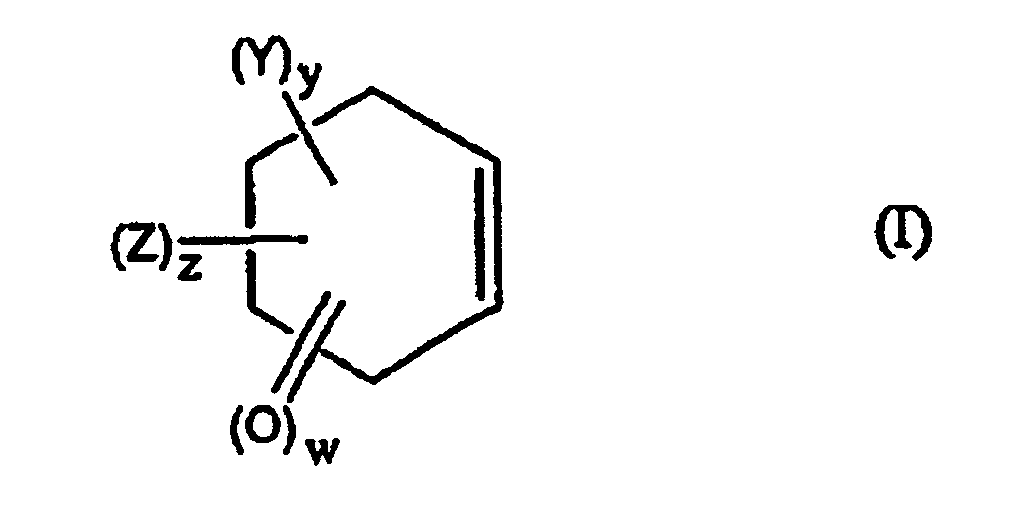
- the cyclohexenic compounds can be represented by the formula: wherein each Y is independently an alkyl group having 1 to 4 carbon atoms, Z is hydroxyl, 2-oxo-ethyl, hydroxyalkyl having 1 to 3 carbon atoms, alkoxycarbonyl having 2 to 5 carbon atoms, or in which R 'is an alkyl radical having 1 to 4 carbon atoms and R "is a di-yl alkane radical having 2 to 4 carbon atoms or alkylidene having 1 to 5 carbon atoms, y is an integer of 0 to 3, z is 0 or 1, w is 0 or 1, and the sum of z and w is 0 or 1.
- Y is preferably a methyl group. Groups represented by Y may be the same or different.
- Z When Z is hydroxyalkyl, it is typically a group hydroxymethyl, 2-hydroxyethyl, or 1-hydroxy-1-methylethyl.
- Z When Z is an alkoxycarbonyl, it typically contains 2 or 3 carbon atoms carbon.
- the preferred group is methoxycarbonyl.
- R ' is from preferably a methyl, ethyl or propyl group.
- R "is a alkane di-yl group it can be linear or branched.
- the favorite group is the ethane di-yl group.
- R "is an alkylidene group it is typically the methylene group or a methyl ethylidene.
- y 0 or 1.
- preferably z is 0 or 1. More preferably, w is 0.
- cyclohexenic compounds which can be used in the invention, mention may be made of cyclohexene, ⁇ -terpineol, terpinene-4-ol, ⁇ -terpinylacetate, ⁇ -terpinylpropionate, ⁇ -terpinylbutyrate, 1-methyl-1-cyclohexene, 3-methyl-1-cyclohexene, 4-methyl-1-cyclohexene, methyl-1-cyclohexene-1-carboxylate, 3-methyl-2-cyclohexen-1-ol, 3-methyl-2-cyclohexen-1-one, 4-isopropyl-2-cyclohexen-1-one, 3,5-dimethyl-2-cyclohexen-1-one, the 4,4-dimethyl-2-cyclohexen-1-one, isophorone, 2,6,6-trimethyl-1-cyclohexene-1-acetaldehyde, and 3,5,5-trimethyl-2-cyclohexene-1
- the preferred cyclohexene derivatives are cyclohexene, ⁇ -terpinylacetate, ⁇ -terpinylpropionate and ⁇ -terpinylbutyrate, all cyclohexene, ⁇ -terpinylacetate or a mixture of them.
- Ethylenically unsaturated compounds suitable for the invention comprise, as indicated previously, unsaturation which are not part of an aromatic ring and ⁇ position with respect to the ethylenic unsaturation a carbon atom bearing a hydroxyl group and which is preferably bonded to at least one hydrogen atom.
- These ethylenically unsaturated compounds are preferably chosen from compounds of formula: wherein R 1 , R 2 are hydrogen or one of R 1 and R 2 is hydrogen, while the other forms with R 5 a C 5 -C 10 ring which may be substituted by one or more linear or branched C 1 -C 4 alkyl groups or one or more C 2 -C 4 alkylene groups; or one of the groups R 1 , R 2 may represent hydrogen while the other represents a C 1 -C 6 aliphatic alkyl group, a C 4 -C 16 cyclic hydrocarbon group or a C 6 -C 6 aromatic hydrocarbon group; C 16 ; R 3 , R 4 and R 5 , independently of each other, represent hydrogen or a C 1 -C 6 alkyl group which may be substituted with one or more OH groups and in which the chain may be interrupted by one or more several ether, ester or ketone groups; a C 6 -C 16 aromatic hydrocarbon group or a C 4 -C 16
- the C 1 -C 6 alkyl group is preferably a methyl or ethyl group.
- R 1 and R 2 represent hydrogen
- R 3 represents a methyl group
- R 4 represents hydrogen or a methyl group
- R 5 represents hydrogen, a methyl group, an ethyl group or a CH 2 group.
- Preferred ethylenically unsaturated compounds of formula (II) are allyl alcohol, methallyl alcohol, crotyl alcohol, 2-cyclohexene-1-ol, trans-2-hexen-1-ol, cis-2-butene-1-4-diol, 3-methyl-2-buten-1-ol, trans-2-methyl-3-phenyl-2-propen-1-ol, 3-butene-2-ol, carveol, myrtenol, verbenol and alcohol transcinnamylique.
- the particularly preferred ethylenically unsaturated compound is 3-methyl-2-butene-1-ol (MBOL).
- the stabilization officer (s) photochromic properties can be introduced at any time at during the preparation of the latex, and in particular in the mixture of monomers or in the final latex, that is to say at the end of the synthesis of the latex, when the dry extract obtained is stable and no longer evolves during the time. This end of synthesis usually occurs after 1 hour of reaction.
- the introduction of the agent (s) of stabilization of photochromic properties is done in the mixture initial polymerizable.
- the amount of stabilizing agent introduced may vary in broad measures, but must be at least sufficient to obtain a significant stabilization of the photochromic properties of the final latex.
- the amount of the stabilizing agent (s) added is 0.1 to 10% by weight, preferably 1 to 10% by weight and preferably about 5% by weight relative to the mass of the monomers of the initial mixture.
- Radically polymerizable monomers suitable for the present invention may be aromatic or nonaromatic.
- the recommended monomers are monomers of the type alkyl (meth) acrylate, preferably of mono (meth) acrylate type and mixtures thereof.
- the alkyl groups are preferably C 1 -C 10 alkyl groups such as methyl, ethyl, propyl and butyl.
- aromatic monomers mention may be made of monofunctional aromatic compounds such as phenyl (meth) acrylate, benzyl (meth) acrylate, phenoxyethyl (meth) acrylate, and styrene.
- mixtures of these monomers in particular mixtures of C 2 -C 10 alkyl monomers and of C 1 -C 3 alkyl methacrylate.
- the claimed stabilized photochromic latex comprises a polymer characterized in that it is an alkyl polyacrylate, a alkyl polymethacrylate or a copolymer of alkyl acrylate and alkyl methacrylate.
- Organic photochromic compounds suitable in the present invention are all organic compounds having photochromic properties. These compounds are well known in the technical.
- Preferred compounds are chromenes and spirooxazines and mixtures thereof.
- Chromenes are described among others in the documents US 3,567,605, US 5,066,818, US 5,645,767, US 5,656,206, WO 93/17071, WO 94/20869, FR 2.688.782, FR 2.718.447, EP 0.401.958 and EP 0.562.915.
- Spirooxazines are also photochromic compounds well known. Such compounds are described, inter alia, in patents US 5.114.621, EP 0.245.020, JP A 03251587, WO 96/04590 and FR 2,763,070.
- the photochromic compound is introduced in sufficient quantity to obtain the desired photochromic effect in the final films of latex.
- Concentrations of photochromic compounds vary generally from 1 to 10%, preferably from 2 to 7% by weight relative to the mass of polymerizable monomers present in the latex.
- the photochromic compound can possibly add in this mixture a small quantity of one solvent of the photochromic compound, for example N-methylpyrrolidone in the case of chromenes.
- the amount of solvent can be up to 20% by weight (depending on the solubility of the compound photochromic) with respect to the mass of polymerizable monomers present in the initial mixture.
- the polymerizable mixture initial can include a surfactant.
- the surfactant can be ionic, nonionic or amphoteric.
- the surfactants ionic mention may be made of sodium dodecyl sulphate and dodecylbenzene sodium sulphate, sodium sulphonate, fatty alcohol sulphates ethoxylates and cetyltrimethylammonium bromide (CTAB), the acid azobiscyanopentanoic (dissolved and neutralized).
- nonionic surfactants mention may be made of fatty alcohols ethoxylates.
- the initial polymerizable mixture further comprises a primer polymerization.
- the polymerization initiator can be any initiator classically used. It can be soluble in water or phase organic.
- Water-soluble initiators used for polymerization compositions according to the invention are salts and compounds possessing at least one hydrophilic function.
- persulfates of alkali and ammonium metals in particular sodium persulfates or potassium, hydrogen peroxide, 2,2'-azobis (2-amidinopropane) dihydrochloride.
- Partial peroxides can also be used water-soluble agents such as succinic peracid and t-butyl hydroperoxide.
- Redox systems such as persulfates associated with a ferrous ion.
- cumyl hydroperoxide or water can be used oxygenated, in the presence of ferrous ions, sulphites or bisulfites.
- the initiator can be added in one once in the initial polymerizable mixture, but it is also possible to add it semi-continuously during the reaction of polymerization.
- the aqueous phase of the latex may comprise only water or it may comprise a mixture of water and appropriate solvent, for example to assist in the filming.
- the aqueous phase may also comprise a buffer, for example NaHCO 3 .
- a solvent When a solvent is present, it can generally represent up to 10% by weight of the aqueous phase, preferably less than 5% by weight and more preferably less than 2% by weight.
- the aqueous phase comprises only water.
- the emulsion polymerization of the initial polymerizable mixture of monomers can be carried out classic or by the so-called "mini-emulsion” technique.
- mini-emulsion technique When using the mini-emulsion technique, one can also add to the initial polymerizable mixture of monomers a stabilization of the mini-emulsion.
- This stabilizer of a mini-emulsion may be an alkane, a halogenated alkane or a polymerizable monomer or not, comprising a fatty chain such as a fatty alcohol or a fatty alcohol ester.
- Preferred stabilizers are hexadecane, alcohol cetyl and stearyl methacrylate.
- the most preferred agent is stearyl methacrylate because it integrates into the network, because of the presence of the function methacrylate.
- the content of stabilizing agents in the mixture varies generally from 0.1 to 10%, preferably from 2 to 6% by weight relative to to the mass of polymerizable monomers present in the initial mixture.
- the deposition on substrates of the latexes according to the invention can be carried out by any conventional method: centrifugation, spraying, or by combining one and the other of these methods.
- compositions of the initial polymerizable mixtures used are given in Table I below:
- the latices were prepared either by a polymerization process in conventional emulsion, or by a process of polymerization mini-emulsion.
- the initial mixtures were prepared by combining a solution A containing the polymerizable monomer, optionally the stabilization of the photochromic properties and the stabilizing agent of mini-emulsion and the photochromic compound to a solution B containing surfactant and water.
- the mixtures are treated in one only passes through a microfluidizer STANSTED FLUID POWER LTD; model nm-CEN 7400 H at a pressure of 70 MPa.
- An initiator solution was then prepared by dissolving 0.48 g of 2,2'-azobis (2-amidinopropane) dihydrochloride in 4.8 g of water and add this solution in one go to the reactor containing 103g emulsion or mini-emulsion for initiating the polymerization reaction.
- the polymerization is carried out at a temperature of 60 ° C.
- the heating is stopped and left cool to room temperature (23 ° C) and, if necessary, added the appropriate amount of agent, stabilizing properties photochromic when it has not been added to the mixture initial polymerizable.
- Example N Initial mixing Emulsion type Addition of photochromic properties stabilizing agent in the final latex MBOL (g) Cyclohexene (g) Comparative A M1 Mini-emulsion - - 1 M2 classical - - 2 M3 classical 2.32 - 3 M4 Mini-emulsion - - 4 M5 Mini-emulsion - - 5 M6 Mini-emulsion - - 6 M7 Mini-emulsion - -
- the films were recovered and the compounds were extracted photochromics with 10 ml of acetonitrile at 80 ° C in the presence of a KEMIX internal standard n ° 16. This extraction was done during 20mm. After stirring, the solution was filtered and analyzed by chromatography in high pressure liquid phase (HPLC) reverse phase. The chromatography was performed on KROMASIL® C18 column (TOUZART and MATIGNON).
- the eluting solvent was a mixture of acetonitrile / water (80/20) isocratic elution mode or in gradient mode and the elution rate was 1 ml / minute.
- the detector used was a WATERS 484 detector at 230 nm.
- the yield (%) of photochromic compounds is the ratio of amount of photochromic compound found in the film compared to the theoretical amount expected.
- Examples 1 to 5 clearly show that the addition of an agent according to the invention stabilizes the photochromic compound content in the liquid latex for periods of at least two months.
- cyclohexene agents appear to lead to longer periods of stabilization, a significant deterioration in photochromic properties appearing from two months with the MBOL, which is not the case with cyclohexene.
- cyclohexene has the advantage of not giving any residual color of the film.
Landscapes
- Chemical & Material Sciences (AREA)
- Health & Medical Sciences (AREA)
- Chemical Kinetics & Catalysis (AREA)
- Medicinal Chemistry (AREA)
- Polymers & Plastics (AREA)
- Organic Chemistry (AREA)
- Addition Polymer Or Copolymer, Post-Treatments, Or Chemical Modifications (AREA)
- Polymerisation Methods In General (AREA)
- Compositions Of Macromolecular Compounds (AREA)
- Eyeglasses (AREA)
- Heterocyclic Carbon Compounds Containing A Hetero Ring Having Oxygen Or Sulfur (AREA)
Claims (30)
- Verfahren zum Erhalt eines photochromen Latex, umfassend eine Polymerisation in wässriger Emulsion einer polymerisierbaren Ausgangsmischung, umfassend ein oder mehrere organische Monomere mit radikalisch polymerisierbaren C=C-Gruppen und eine oder mehrere photochrome Verbindung(en), bis zum Erhalt eines endgültigen Latex, dadurch gekennzeichnet, dass es die Zugabe einer wirksamen Menge mindestens eines Stabilisierungsmittels mit photochromen Eigenschaften, ausgewählt aus Cyclopenten-, Cyclohexen-, Cyclohepten-, Cyclooctenverbindungen und den Verbindungen mit einer ethylenisch ungesättigten Position außerhalb eines aromatischen Rings umfasst und in α-Stellung bezogen auf die ethylenisch ungesättigte Position ein Kohlenstoffatom mit einer freien Hydroxylgruppe, zur polymerisierbaren Ausgangsmischung, im Verlauf der Polymerisation der polymerisierbaren Ausgangsmischung oder im endgültigen Latex umfasst.
- Verfahren nach Anspruch 1, dadurch gekennzeichnet, dass das Stabilisierungsmittel eine Cyclohexenverbindung ist.
- Verfahren nach Anspruch 2, dadurch gekennzeichnet, dass die Cyclohexenverbindungen der folgenden Formel entsprechen:wobei in dieser Formel jedes Y unabhängig voneinander einen Alkylrest mit 1 bis 4 Kohlenstoffatomen darstellt, Z eine Hydroxylgruppe, einen 2-Oxoethylrest, einen Hydroxyalkylrest mit 1 bis 3 Kohlenstoffatomen, einen Alkoxycarbonylrest mit 2 bis 5 Kohlenstoffatomen oder eine Gruppe R'COOR" darstellt, in welcher R' ein Alkylrest mit 1 bis 4 Kohlenstoffatomen und R" ein Alkandiylrest mit 2 bis 4 Kohlenstoffatomen oder ein Alkylidenrest mit 1 bis 5 Kohlenstoffatomen ist, y eine ganze Zahl zwischen 0 und 3 ist, z gleich 0 oder 1 ist, w gleich 0 oder 1 ist und die Summe aus z und w gleich 0 oder 1 ist.
- Verfahren nach Anspruch 3, dadurch gekennzeichnet, dass die Cyclohexenverbindungen ausgewählt werden aus Cyclohexen, α-Terpineol, Terpinen-4-ol, Essigsäure-α-terpinylester, Propansäure-α-terpinylester, Buttersäure-α-terpinylester, 1-Methyl-1-cyclohexen, 3-Methyl-1-cyclohexen, 4-Methyl-1-cyclohexen, Methyl-1-cyclohexen-1-carboxylat, 3-Methyl-2-cyclohexen-1-ol, 3-Methyl-2-cyclohexen-1-on, 4-Isopropyl-2-cyclohexen-1-on, 3,5-Dimethyl-2-cyclohexen-1-on, 4,4-Dimethyl-2-cyclohexen-1-on, Isophoron, 2,6,6-Trimethyl-1-cyclohexen-1-acetaldehyd und 3,5,5-Trimethyl-2-cyclohexen-1-ol.
- Verfahren nach Anspruch 3, dadurch gekennzeichnet, dass die Cyclohexenverbindung Cyclohexen ist.
- Verfahren nach Anspruch 1, dadurch gekennzeichnet, dass das Kohlenstoffatom in α-Stellung zur ethylenisch ungesättigten Position an mindestens ein Wasserstoffatom gebunden ist.
- Verfahren nach Anspruch 6, dadurch gekennzeichnet, dass die Verbindungen mit einer ethylenisch ungesättigten Position der folgenden Formel entsprechen:wobei in der Formel R1 und R2 ein Wasserstoffatom darstellen oder eine der Gruppen R1 und R2 ein Wasserstoffatom darstellt, während die andere mit der Gruppe R5 einen C5-C10-Ring bildet, der gegebenenfalls durch eine oder mehrere lineare oder verzweigte C1-C4-Alkylgruppen oder eine oder mehrere C2-C4-Alkylengruppen substituiert sein kann; oder eine der Gruppen R1 und R2 kann ein Wasserstoffatom darstellen, während die andere eine aliphatische C1-C6-Alkylgruppe, eine cyclische C4-C16-Kohlenwasserstoffgruppe oder eine aromatische C6-C16-Gruppe darstellt;

R3, R4 und R5 unabhängig voneinander ein Wasserstoffatom oder eine C1-C6-Alkylgruppe, die gegebenenfalls durch eine oder mehrere OH-Gruppen substituiert sein können und deren Ketten durch eine oder mehrere Ether-, Ester- oder Ketogruppen unterbrochen sein können, eine aromatische C6-C16-Gruppe oder eine cyclische C4-C16-Kohlenwasserstoffgruppe darstellen; R5 kann mit den Gruppen R1 oder R2 einen C5-C10-Ring bilden, der gegebenenfalls durch eine oder mehrere lineare oder verzweigte C1-C4-Alkylgruppen oder eine oder mehrer C2-C4-Alkylengruppen substituiert sein kann;
R3 und R4 können einen C5-C10-Ring bilden, der gegebenenfalls durch eine oder mehrere C1-C4-Alkylgruppen oder eine oder mehrere C2-C4-Alkylengruppen substituiert sein kann;
zwei oder mehrere der Kohlenstoffatome des aus R1 oder R2 und R5 oder aus R3 und R4 gebildeten C5-C10-Rings können durch eine Kohlenwasserstoffbrücke verbunden sein. - Verfahren nach Anspruch 7, dadurch gekennzeichnet, dass R1 und R2 ein Wasserstoffatom darstellen, R3 eine Methylgruppe darstellt, R4 ein Wasserstoffatom oder eine Methylgruppe darstellt und R5 ein Wasserstoffatom, eine Methylgruppe, eine Ethylgruppe oder eine CH2OH-Gruppe darstellt.
- Verfahren nach Anspruch 7, dadurch gekennzeichnet, dass die Verbindung mit der Formel (II) ausgewählt wird aus der Gruppe bestehend aus Allylalkohol, Methallylalkohol, Crotylalkohol, 2-Cyclohexen-1-ol, trans-2-Hexen-1-ol, cis-2-Buten-1,4-diol, 3-Methyl-2-buten-1-ol, trans-2-Methyl-3-phenyl-2-propen-1-ol, 3-Buten-2-ol, Carveol, Myrtenol, Verbenol und trans-Zimtalkohol.
- Verfahren nach Anspruch 9, dadurch gekennzeichnet, dass die Verbindung mit der Formel (II) 3-Methyl-2-buten-1-ol ist.
- Verfahren nach einem der vorhergehenden Ansprüche, dadurch gekennzeichnet, dass die zugegebene Menge an Stabilisierungsmittel mit photochromen Eigenschaften 0,1 bis 10 Massen-%, vorzugsweise 1 bis 10 Massen-% und mehr bevorzugt 5 Massen-% bezogen auf die Masse der Monomere der Ausgangsmischung beträgt.
- Verfahren nach einem der vorhergehenden Ansprüche, dadurch gekennzeichnet, dass die wässrige Emulsion der polymerisierbaren Ausgangsmischung eine Miniemulsion ist.
- Verfahren nach einem der vorhergehenden Ansprüche, dadurch gekennzeichnet, dass die radikalisch polymerisierbaren Monomere ausgewählt werden aus den Alkylacrylaten, Alkylmethacrylaten und ihren Mischungen.
- Verfahren nach einem der vorhergehenden Ansprüche, dadurch gekennzeichnet, dass die photochrome Verbindung ausgewählt wird aus den Chromenen, den Spirooxazinen und ihren Mischungen.
- Verfahren nach einem der vorhergehenden Ansprüche, dadurch gekennzeichnet, dass das Stabilisierungsmittel mit photochromen Eigenschaften zu der polymerisierbaren Ausgangsmischung gegeben wird.
- Stabilisierter, photochromer Latex, umfassend eine wässrige Dispersion von Polymerpartikeln, resultierend aus der radikalischen Polymerisation eines oder mehrerer organischer Monomer(e) mit C=C-Gruppen und einer oder mehrerer photochromen Verbindung(en), dadurch gekennzeichnet, dass es eine wirksame Menge mindestens eines Stabilisierungsmittels mit photochromen Eigenschaften umfasst, ausgewählt aus Cyclopenten-, Cyclohexen-, Cyclohepten-, Cyclooctenverbindungen und den Verbindungen mit einer ethylenisch ungesättigten Position außerhalb eines aromatischen Rings umfasst und in α-Stellung bezogen auf die ethylenisch ungesättigte Position ein Kohlenstoffatom mit einer freien Hydroxylgruppe.
- Latex nach Anspruch 16, dadurch gekennzeichnet, dass das Stabilisierungsmittel eine Cyclohexenverbindung ist.
- Latex nach Anspruch 17, dadurch gekennzeichnet, dass die Cyclohexenverbindungen der folgenden Formel entsprechen:wobei in dieser Formel jedes Y unabhängig voneinander einen Alkylrest mit 1 bis 4 Kohlenstoffatomen darstellt, Z eine Hydroxylgruppe, einen 2-Oxoethylrest, einen Hydroxyalkylrest mit 1 bis 3 Kohlenstoffatomen, einen Alkoxycarbonylrest mit 2 bis 5 Kohlenstoffatomen oder eine Gruppe R'COOR" darstellt, in welcher R' ein Alkylrest mit 1 bis 4 Kohlenstoffatomen und R" ein Alkandiylrest mit 2 bis 4 Kohlenstoffatomen oder ein Alkylidenrest mit 1 bis 5 Kohlenstoffatomen ist, y eine ganze Zahl zwischen 0 und 3 ist, z gleich 0 oder 1 ist, w gleich 0 oder 1 ist und die Summe aus z und w gleich 0 oder 1 ist.

- Latex nach Anspruch 18, dadurch gekennzeichnet, dass die Cyclohexenverbindungen ausgewählt werden aus Cyclohexen, α-Terpineol, Terpinen-4-ol, Essigsäure-α-terpinylester, Propansäure-α-terpinylester, Buttersäure-α-terpinylester, 1-Methyl-1-cyclohexen, 3-Methyl-1-cyclohexen, 4-Methyl-1-cyclohexen, Methyl-1-cyclohexen-1-carboxylat, 3-Methyl-2-cyclohexen-1-ol, 3-Methyl-2-cyclohexen-1-on, 4-Isopropyl-2-cyclohexen-1-on, 3,5-Dimethyl-2-cyclohexen-1-on, 4,4-Dimethyl-2-cyclohexen-1-on, Isophoron, 2,6,6-Trimethyl-1-cyclohexen-1-acetaldehyd und 3,5,5-Trimethyl-2-cyclohexen-1-ol.
- Latex nach Anspruch 18, dadurch gekennzeichnet, dass die Cyclohexenverbindung Cyclohexen ist.
- Latex nach Anspruch 17, dadurch gekennzeichnet, dass das Kohlenstoffatom in α-Stellung zur ethylenisch ungesättigten Position an mindestens ein Wasserstoffatom gebunden ist.
- Latex nach Anspruch 17, dadurch gekennzeichnet, dass die Verbindungen mit einer ethylenisch ungesättigten Position der folgenden Formel entsprechen:wobei in der Formel R1 und R2 ein Wasserstoffatom darstellen oder eine der Gruppen R1 und R2 ein Wasserstoffatom darstellt, während die andere mit der Gruppe R5 einen C5-C10-Ring bildet, der gegebenenfalls durch eine oder mehrere lineare oder verzweigte C1-C4-Alkylgruppen oder eine oder mehrere C2-C4-Alkylengruppen substituiert sein kann; oder eine der Gruppen R1 und R2 kann ein Wasserstoffatom darstellen, während die andere eine aliphatische C1-C6-Alkylgruppe, eine cyclische C4-C16-Kohlenwasserstoffgruppe oder eine aromatische C6-C16-Gruppe darstellt;

R3, R4 und R5 unabhängig voneinander ein Wasserstoffatom oder eine C1-C6-Alkylgruppe, die gegebenenfalls durch eine oder mehrere OH-Gruppen substituiert sein können und deren Ketten durch eine oder mehrere Ether-, Ester- oder Ketogruppen unterbrochen sein können, eine aromatische C6-C16-Gruppe oder eine cyclische C4-C16-Kohlenwasserstoffgruppe darstellen; R5 kann mit den Gruppen R1 oder R2 einen C5-C10-Ring bilden, der gegebenenfalls durch eine oder mehrere lineare oder verzweigte C1-C4-Alkylgruppen oder eine oder mehrer C2-C4-Alkylengruppen substituiert sein kann;
R3 und R4 können einen C5-C10-Ring bilden, der gegebenenfalls durch eine oder mehrere C1-C4-Alkylgruppen oder eine oder mehrer C2-C4-Alkylengruppen substituiert sein kann;
zwei oder mehrere der Kohlenstoffatome des aus R1 oder R2 und R5 oder aus R3 und R4 gebildeten C5-C10-Rings können durch eine Kohlenwasserstoffbrücke verbunden sein. - Latex nach Anspruch 22, dadurch gekennzeichnet, dass R1 und R2 ein Wasserstoffatom darstellen, R3 eine Methylgruppe darstellt, R4 ein Wasserstoffatom oder eine Methylgruppe darstellt und R5 ein Wasserstoffatom, eine Methylgruppe, eine Ethylgruppe oder eine CH2OH-Gruppe darstellt.
- Latex nach Anspruch 22 dadurch gekennzeichnet, dass die Verbindung mit der Formel (II) ausgewählt wird aus der Gruppe bestehend aus Allylalkohol, Methallylalkohol, Crotylalkohol, 2-Cyclohexen-1-ol, trans-2-Hexen-1-ol, cis-2-Buten-1,4-diol, 3-Methyl-2-buten-1-ol, trans-2-Methyl-3-phenyl-2-propen-1-ol, 3-Buten-2-ol, Carveol, Myrtenol, Verbenol und trans-Zimtalkohol.
- Latex nach Anspruch 24, dadurch gekennzeichnet, dass die Verbindung mit der Formel (II) 3-Methyl-2-buten-1-ol ist.
- Latex nach einem der Ansprüche 16 bis 25, dadurch gekennzeichnet, dass die zugegebene Menge an Stabilisierungsmittel mit photochromen Eigenschaften 0,1 bis 10 Massen-%, vorzugsweise 1 bis 10 Massen-% und mehr bevorzugt 5 Massen-% bezogen auf die Masse der Monomere der Ausgangsmischung beträgt.
- Latex nach einem der Ansprüche 16 bis 26, dadurch gekennzeichnet, dass die radikalisch polymerisierbaren Monomere ausgewählt werden aus den Alkylacrylaten, Alkylmethacrylaten und ihren Mischungen.
- Verfahren nach einem der Ansprüche 16 bis 27, dadurch gekennzeichnet, dass die photochrome Verbindung ausgewählt wird aus den Chromenen, den Spirooxazinen und ihren Mischungen.
- Substrat, beschichtet mit einem durch Trocknen eines Latex nach einem der Ansprüche 16 bis 28 gebildeten Film.
- Substrat nach Anspruch 29, dadurch gekennzeichnet, dass es aus eine ophthalmische Linse besteht.
Applications Claiming Priority (3)
| Application Number | Priority Date | Filing Date | Title |
|---|---|---|---|
| FR0100343 | 2001-01-11 | ||
| FR0100343A FR2819258B1 (fr) | 2001-01-11 | 2001-01-11 | Procede d'obtention d'un latex photochromique stabilise, latex obtenu et application a l'optique ophtalmique |
| PCT/FR2002/000116 WO2002055564A1 (fr) | 2001-01-11 | 2002-01-11 | Procede d'obtention d'un latex photochromique stabilise, latex obtenu et application a l'optique ophtalmique |
Publications (2)
| Publication Number | Publication Date |
|---|---|
| EP1363952A1 EP1363952A1 (de) | 2003-11-26 |
| EP1363952B1 true EP1363952B1 (de) | 2005-07-27 |
Family
ID=8858707
Family Applications (1)
| Application Number | Title | Priority Date | Filing Date |
|---|---|---|---|
| EP02710986A Expired - Lifetime EP1363952B1 (de) | 2001-01-11 | 2002-01-11 | Verfahren zur herstellung eines photochromen stabilisierten latex, so hergestelltes latex und seine verwendung in der ophtalmischen latex |
Country Status (15)
| Country | Link |
|---|---|
| US (1) | US6740699B2 (de) |
| EP (1) | EP1363952B1 (de) |
| JP (1) | JP4067405B2 (de) |
| KR (1) | KR100789947B1 (de) |
| CN (1) | CN1233666C (de) |
| AT (1) | ATE300557T1 (de) |
| AU (1) | AU2002229884B8 (de) |
| BR (1) | BR0206384B1 (de) |
| CA (1) | CA2433984C (de) |
| DE (1) | DE60205225T2 (de) |
| ES (1) | ES2244755T3 (de) |
| FR (1) | FR2819258B1 (de) |
| MX (1) | MXPA03006237A (de) |
| WO (1) | WO2002055564A1 (de) |
| ZA (1) | ZA200305158B (de) |
Families Citing this family (22)
| Publication number | Priority date | Publication date | Assignee | Title |
|---|---|---|---|---|
| FR2790264A1 (fr) * | 1999-02-26 | 2000-09-01 | Essilor Int | Procede de preparation d'un latex a proprietes photochromiques et ses applications, en particulier dans le domaine ophtalmique |
| US6562466B2 (en) * | 2001-07-02 | 2003-05-13 | Essilor International Compagnie Generale D'optique | Process for transferring a coating onto a surface of a lens blank |
| CN100473666C (zh) * | 2004-02-05 | 2009-04-01 | Lg化学株式会社 | 使用液态微乳液作为种子微粒的乳液聚合法 |
| US20080006368A9 (en) * | 2005-02-01 | 2008-01-10 | Peiqi Jiang | Process for applying a coating onto a surface of a lens substrate |
| US20060219347A1 (en) * | 2005-04-04 | 2006-10-05 | Essilor International Compagnie Generale D'optique | Process for transferring coatings onto a surface of a lens substrate with most precise optical quality |
| US20070034322A1 (en) * | 2005-08-15 | 2007-02-15 | Essilor International Compagnie Generale D'optique | System and process for making a coated article |
| US20070035070A1 (en) * | 2005-08-15 | 2007-02-15 | Essilor International Compagnie Generale D'optique | Inflatable membrane pressing apparatus for a film or coating application or lamination process |
| US20070034321A1 (en) * | 2005-08-15 | 2007-02-15 | Essilor International Compagnie Generale D'optique | System and process for making a coated article |
| US20080026217A1 (en) * | 2005-12-02 | 2008-01-31 | Kim Hye M | Method for preparing a photochromic nanoparticle and nanoparticle prepared therefrom |
| KR100756173B1 (ko) | 2006-05-08 | 2007-09-05 | 주식회사 엘지화학 | 산소 차단성이 우수한 광색성 염료-고분자 일체화 입자 및이의 제조방법 |
| US7892387B2 (en) * | 2006-05-19 | 2011-02-22 | International Compagnie Generale d'Optique | Process and system for applying a coating onto a surface of a lens substrate |
| US7961372B2 (en) * | 2007-08-24 | 2011-06-14 | Lg Chem, Ltd. | Photochromic films and method for manufacturing the same |
| US9132594B2 (en) * | 2008-11-04 | 2015-09-15 | Essilor International (Compagnie Générale d'Optique) | Bi-layer adhesive for lens lamination |
| IT1395736B1 (it) * | 2009-08-04 | 2012-10-19 | Dipharma Francis Srl | Forme cristalline di rufinamide |
| US20120309761A1 (en) * | 2009-10-27 | 2012-12-06 | Agency For Science, Technology And Research | Fast-response photochromic nanostructured contact lenses |
| ES2694044T3 (es) | 2009-11-02 | 2018-12-17 | Essilor International | Sistema adhesivo de triple capa para una lente estratificada y método para aplicar el mismo |
| EP2902822B1 (de) | 2014-01-31 | 2018-08-08 | Essilor International | Polarisierende Struktur mit Glyoxalhaftsystem und polarisierte Linse damit |
| KR102426026B1 (ko) | 2015-10-15 | 2022-07-27 | 한밭대학교 산학협력단 | 시광안료를 이용한 양산 겸용 우산 |
| CN105259698A (zh) * | 2015-11-27 | 2016-01-20 | 昆山龙腾光电有限公司 | 一种液晶显示装置 |
| EP3658598B1 (de) * | 2017-07-28 | 2022-11-16 | Nikon Corporation | Photohärtbare zusammensetzung und verfahren zur herstellung eines dreidimensionalen objekts |
| JP2022151090A (ja) * | 2021-03-26 | 2022-10-07 | ホヤ レンズ タイランド リミテッド | 重合性組成物の製造方法およびフォトクロミック物品の製造方法 |
| JP2024037393A (ja) * | 2022-09-07 | 2024-03-19 | 三菱鉛筆株式会社 | フォトクロミック粒子水分散体及びこれを含有した水性インク組成物 |
Family Cites Families (27)
| Publication number | Priority date | Publication date | Assignee | Title |
|---|---|---|---|---|
| US3567605A (en) | 1966-03-30 | 1971-03-02 | Ralph S Becker | Photochemical process |
| US4533254A (en) | 1981-04-17 | 1985-08-06 | Biotechnology Development Corporation | Apparatus for forming emulsions |
| CA1290489C (en) | 1985-11-22 | 1991-10-08 | Edward John Sare | Compositions for producing polymers of high refractive index and low yellowness |
| GB8610709D0 (en) | 1986-05-01 | 1986-06-04 | Plinkington Bros Plc | Photochromic lenses |
| US4931220A (en) * | 1987-11-24 | 1990-06-05 | Ppg Industries, Inc. | Organic photochromic pigment particulates |
| EP0401958B1 (de) | 1989-06-05 | 1995-01-11 | Tokuyama Corporation | Fotochromische Verbindung, deren Zusammensetzung und Verwendung |
| FR2647790A1 (fr) | 1989-06-05 | 1990-12-07 | Essilor Int | Composes photochromiques de type indolino-spiro-oxazine, leur procede de preparation, compositions et articles photochromiques contenant de tels composes |
| JP2856818B2 (ja) | 1990-02-26 | 1999-02-10 | 株式会社トクヤマ | スピロオキサジン化合物及びその製造方法 |
| US5066818A (en) | 1990-03-07 | 1991-11-19 | Ppg Industries, Inc. | Photochromic naphthopyran compounds |
| US5238981A (en) | 1992-02-24 | 1993-08-24 | Transitions Optical, Inc. | Photochromic naphthopyrans |
| FR2688782A1 (fr) | 1992-03-19 | 1993-09-24 | Essilor Int | Nouveaux chromenes heterocycliques et leur utilisation dans le domaine de l'optique ophtalmique. |
| US5605923A (en) | 1992-04-02 | 1997-02-25 | Smithkline Beecham Corporation | Compounds useful for treating inflammatory diseases and inhibiting production of tumor necrosis factor |
| US5702825A (en) | 1992-12-22 | 1997-12-30 | Essilor International (Compagnie Generale D'optique) | Low yellow index polymer compositions, polymerizable compositions and lenses using said compositions |
| WO1994020869A1 (en) | 1993-03-12 | 1994-09-15 | Ppg Industries, Inc. | Novel benzopyrans |
| FR2718447B1 (fr) | 1994-04-06 | 1996-05-24 | Essilor Int | Chromènes du type 2,2-diphényl hétéroannélés en 6,7 et leur utilisation dans le domaine de l'optique ophtalmique. |
| JP3464042B2 (ja) | 1994-06-02 | 2003-11-05 | 出光石油化学株式会社 | ゴム組成物 |
| FR2723218A1 (fr) | 1994-07-29 | 1996-02-02 | Essilor Internal Cie Gle Optique | Composes photochromiques de structure spiro (indoline-(2,3')-benzoxazine) a groupement cyano en 6', et leur utilisation dans le domaine de l'optique ophtalmique |
| US5645767A (en) | 1994-11-03 | 1997-07-08 | Transitions Optical, Inc. | Photochromic indeno-fused naphthopyrans |
| US5656206A (en) | 1995-06-14 | 1997-08-12 | Transitions Optical, Inc. | Substituted naphthopyrans |
| US5653965A (en) | 1995-07-21 | 1997-08-05 | Isp Investments Inc. | Low VOC, sunscreen spray composition containing a hydrophobic, film-forming polymer |
| DE69717296D1 (de) * | 1996-10-11 | 2003-01-02 | Corning Inc | Photochromes organisches material, dessen herstellung und dieses enthaltende photochrome artikel |
| US5914174A (en) | 1996-12-05 | 1999-06-22 | Innotech, Inc. | Lens or semi-finished blank comprising photochromic resin compositions |
| US5840813A (en) | 1997-01-03 | 1998-11-24 | Dow Corning Corporation | Homopolymerization of acrylate or methacrylate endblocked polydiorganosiloxanes |
| FR2763070B1 (fr) | 1997-05-06 | 1999-07-02 | Essilor Int | Nouveaux composes photochromiques spirooxazines, leur utilisation dans le domaine de l'optique ophtalmique |
| AUPO669697A0 (en) | 1997-05-08 | 1997-06-05 | Unisearch Limited | Polymerisation reactions under miniemulsion conditions |
| FR2785904B1 (fr) | 1998-11-13 | 2000-12-15 | Atochem Elf Sa | Polymeres fluores par polymerisation en miniemulsion |
| FR2790264A1 (fr) * | 1999-02-26 | 2000-09-01 | Essilor Int | Procede de preparation d'un latex a proprietes photochromiques et ses applications, en particulier dans le domaine ophtalmique |
-
2001
- 2001-01-11 FR FR0100343A patent/FR2819258B1/fr not_active Expired - Fee Related
-
2002
- 2002-01-11 AU AU2002229884A patent/AU2002229884B8/en not_active Ceased
- 2002-01-11 EP EP02710986A patent/EP1363952B1/de not_active Expired - Lifetime
- 2002-01-11 MX MXPA03006237A patent/MXPA03006237A/es active IP Right Grant
- 2002-01-11 DE DE60205225T patent/DE60205225T2/de not_active Expired - Lifetime
- 2002-01-11 ES ES02710986T patent/ES2244755T3/es not_active Expired - Lifetime
- 2002-01-11 CA CA2433984A patent/CA2433984C/fr not_active Expired - Lifetime
- 2002-01-11 WO PCT/FR2002/000116 patent/WO2002055564A1/fr not_active Ceased
- 2002-01-11 BR BRPI0206384-0A patent/BR0206384B1/pt not_active IP Right Cessation
- 2002-01-11 JP JP2002556632A patent/JP4067405B2/ja not_active Expired - Fee Related
- 2002-01-11 US US10/044,608 patent/US6740699B2/en not_active Expired - Lifetime
- 2002-01-11 CN CNB028036158A patent/CN1233666C/zh not_active Expired - Fee Related
- 2002-01-11 AT AT02710986T patent/ATE300557T1/de not_active IP Right Cessation
- 2002-01-11 KR KR1020037009288A patent/KR100789947B1/ko not_active Expired - Fee Related
-
2003
- 2003-07-02 ZA ZA200305158A patent/ZA200305158B/en unknown
Also Published As
| Publication number | Publication date |
|---|---|
| DE60205225D1 (de) | 2005-09-01 |
| FR2819258A1 (fr) | 2002-07-12 |
| EP1363952A1 (de) | 2003-11-26 |
| CN1233666C (zh) | 2005-12-28 |
| ZA200305158B (en) | 2004-08-26 |
| MXPA03006237A (es) | 2004-10-15 |
| ES2244755T3 (es) | 2005-12-16 |
| BR0206384B1 (pt) | 2010-12-28 |
| KR20030071808A (ko) | 2003-09-06 |
| AU2002229884B8 (en) | 2005-12-08 |
| BR0206384A (pt) | 2004-02-03 |
| ATE300557T1 (de) | 2005-08-15 |
| JP4067405B2 (ja) | 2008-03-26 |
| CA2433984C (fr) | 2011-11-29 |
| WO2002055564A1 (fr) | 2002-07-18 |
| KR100789947B1 (ko) | 2007-12-31 |
| DE60205225T2 (de) | 2006-06-01 |
| FR2819258B1 (fr) | 2003-04-11 |
| CA2433984A1 (fr) | 2002-07-18 |
| US20030100672A1 (en) | 2003-05-29 |
| CN1531556A (zh) | 2004-09-22 |
| AU2002229884B2 (en) | 2005-11-24 |
| US6740699B2 (en) | 2004-05-25 |
| JP2004527593A (ja) | 2004-09-09 |
Similar Documents
| Publication | Publication Date | Title |
|---|---|---|
| CA2433984C (fr) | Procede d'obtention d'un latex photochromique stabilise, latex obtenu et application a l'optique ophtalmique | |
| CA2397673C (fr) | Procede d'obtention d'un latex photochromique | |
| WO1995009874A1 (fr) | Microdispersions stables et microgels a base de polymeres acryliques, leur procede d'obtention et compositions, notamment cosmetiques, les contenant | |
| EP0644205A1 (de) | Verfahren zur Herstellung einer Latex mit ultrafeinen Partikeln | |
| FR2725721A1 (fr) | Latex et melanges de latex acryliques et methacyliques fluores, leurs procedes de fabrication et leurs applications dans le domaine des revetements hydrophobes | |
| FR2934861A1 (fr) | Nouveaux modifiants chocs du type coeur-ecorce pour matrices polymeres transparentes. | |
| EP1161512A1 (de) | Verfahren zur herstellung von einem photochromen latex und dessen verwendung, insbesondere für ophthalmische anwendung | |
| FR2767327A1 (fr) | Nouveaux polymeres associatifs et leur procede de preparation par emulsion inverse | |
| EP0783530B1 (de) | Nagellack mit mikrogelpartikeln | |
| EP0890621A2 (de) | Beschichtungsstoff | |
| CA2187462A1 (fr) | Copolymeres hydrosolubles associatifs triblocs | |
| CA2070156A1 (fr) | Composition fluide luminescente polymerisable et son application | |
| CA2706129A1 (fr) | Procede de mise en dispersion dans l'eau de resines alkydes avec des polymeres associatifs, formulations obtenues et peintures aqueuses les contenant | |
| FR2761694A1 (fr) | Polymere photochromique, intrinsequement stable a la lumiere sa preparation et les articles en renfermant | |
| EP1312628A1 (de) | Funktionelles vernetzbar Polymer für die Herstellung von lichtleitenden Materialien | |
| FR3121682A1 (fr) | Composition comprenant au moins un peroxyde aromatique et au moins un composé ayant un groupe éther | |
| FR3121684A1 (fr) | Composition comprenant au moins un peroxyde aromatique et au moins du peroxyde d'hydrogène | |
| FR2755009A1 (fr) | Vernis a ongles aqueux | |
| FR2937037A1 (fr) | Compositions moulables a base de polymere d'halogenure de vinyle. |
Legal Events
| Date | Code | Title | Description |
|---|---|---|---|
| PUAI | Public reference made under article 153(3) epc to a published international application that has entered the european phase |
Free format text: ORIGINAL CODE: 0009012 |
|
| 17P | Request for examination filed |
Effective date: 20030811 |
|
| AK | Designated contracting states |
Kind code of ref document: A1 Designated state(s): AT BE CH CY DE DK ES FI FR GB GR IE IT LI LU MC NL PT SE TR |
|
| AX | Request for extension of the european patent |
Extension state: AL LT LV MK RO SI |
|
| GRAP | Despatch of communication of intention to grant a patent |
Free format text: ORIGINAL CODE: EPIDOSNIGR1 |
|
| GRAS | Grant fee paid |
Free format text: ORIGINAL CODE: EPIDOSNIGR3 |
|
| GRAA | (expected) grant |
Free format text: ORIGINAL CODE: 0009210 |
|
| AK | Designated contracting states |
Kind code of ref document: B1 Designated state(s): AT BE CH CY DE DK ES FI FR GB GR IE IT LI LU MC NL PT SE TR |
|
| PG25 | Lapsed in a contracting state [announced via postgrant information from national office to epo] |
Ref country code: TR Free format text: LAPSE BECAUSE OF FAILURE TO SUBMIT A TRANSLATION OF THE DESCRIPTION OR TO PAY THE FEE WITHIN THE PRESCRIBED TIME-LIMIT Effective date: 20050727 Ref country code: NL Free format text: LAPSE BECAUSE OF FAILURE TO SUBMIT A TRANSLATION OF THE DESCRIPTION OR TO PAY THE FEE WITHIN THE PRESCRIBED TIME-LIMIT Effective date: 20050727 Ref country code: FI Free format text: LAPSE BECAUSE OF FAILURE TO SUBMIT A TRANSLATION OF THE DESCRIPTION OR TO PAY THE FEE WITHIN THE PRESCRIBED TIME-LIMIT Effective date: 20050727 Ref country code: AT Free format text: LAPSE BECAUSE OF FAILURE TO SUBMIT A TRANSLATION OF THE DESCRIPTION OR TO PAY THE FEE WITHIN THE PRESCRIBED TIME-LIMIT Effective date: 20050727 |
|
| REG | Reference to a national code |
Ref country code: GB Ref legal event code: FG4D Free format text: NOT ENGLISH |
|
| REG | Reference to a national code |
Ref country code: CH Ref legal event code: EP |
|
| REG | Reference to a national code |
Ref country code: IE Ref legal event code: FG4D Free format text: LANGUAGE OF EP DOCUMENT: FRENCH |
|
| REF | Corresponds to: |
Ref document number: 60205225 Country of ref document: DE Date of ref document: 20050901 Kind code of ref document: P |
|
| PG25 | Lapsed in a contracting state [announced via postgrant information from national office to epo] |
Ref country code: SE Free format text: LAPSE BECAUSE OF FAILURE TO SUBMIT A TRANSLATION OF THE DESCRIPTION OR TO PAY THE FEE WITHIN THE PRESCRIBED TIME-LIMIT Effective date: 20051027 Ref country code: GR Free format text: LAPSE BECAUSE OF FAILURE TO SUBMIT A TRANSLATION OF THE DESCRIPTION OR TO PAY THE FEE WITHIN THE PRESCRIBED TIME-LIMIT Effective date: 20051027 Ref country code: DK Free format text: LAPSE BECAUSE OF FAILURE TO SUBMIT A TRANSLATION OF THE DESCRIPTION OR TO PAY THE FEE WITHIN THE PRESCRIBED TIME-LIMIT Effective date: 20051027 |
|
| GBT | Gb: translation of ep patent filed (gb section 77(6)(a)/1977) |
Effective date: 20051114 |
|
| REG | Reference to a national code |
Ref country code: ES Ref legal event code: FG2A Ref document number: 2244755 Country of ref document: ES Kind code of ref document: T3 |
|
| PG25 | Lapsed in a contracting state [announced via postgrant information from national office to epo] |
Ref country code: PT Free format text: LAPSE BECAUSE OF FAILURE TO SUBMIT A TRANSLATION OF THE DESCRIPTION OR TO PAY THE FEE WITHIN THE PRESCRIBED TIME-LIMIT Effective date: 20051227 |
|
| PG25 | Lapsed in a contracting state [announced via postgrant information from national office to epo] |
Ref country code: MC Free format text: LAPSE BECAUSE OF NON-PAYMENT OF DUE FEES Effective date: 20060131 Ref country code: LU Free format text: LAPSE BECAUSE OF NON-PAYMENT OF DUE FEES Effective date: 20060131 Ref country code: LI Free format text: LAPSE BECAUSE OF NON-PAYMENT OF DUE FEES Effective date: 20060131 Ref country code: CH Free format text: LAPSE BECAUSE OF NON-PAYMENT OF DUE FEES Effective date: 20060131 Ref country code: BE Free format text: LAPSE BECAUSE OF NON-PAYMENT OF DUE FEES Effective date: 20060131 |
|
| NLV1 | Nl: lapsed or annulled due to failure to fulfill the requirements of art. 29p and 29m of the patents act | ||
| PLBE | No opposition filed within time limit |
Free format text: ORIGINAL CODE: 0009261 |
|
| STAA | Information on the status of an ep patent application or granted ep patent |
Free format text: STATUS: NO OPPOSITION FILED WITHIN TIME LIMIT |
|
| 26N | No opposition filed |
Effective date: 20060428 |
|
| REG | Reference to a national code |
Ref country code: CH Ref legal event code: PL |
|
| BERE | Be: lapsed |
Owner name: ESSILOR INTERNATIONAL CIE GENERALE D'OPTIQUE Effective date: 20060131 |
|
| PG25 | Lapsed in a contracting state [announced via postgrant information from national office to epo] |
Ref country code: CY Free format text: LAPSE BECAUSE OF FAILURE TO SUBMIT A TRANSLATION OF THE DESCRIPTION OR TO PAY THE FEE WITHIN THE PRESCRIBED TIME-LIMIT Effective date: 20050727 |
|
| PGFP | Annual fee paid to national office [announced via postgrant information from national office to epo] |
Ref country code: IE Payment date: 20091223 Year of fee payment: 9 |
|
| REG | Reference to a national code |
Ref country code: IE Ref legal event code: MM4A |
|
| PG25 | Lapsed in a contracting state [announced via postgrant information from national office to epo] |
Ref country code: IE Free format text: LAPSE BECAUSE OF NON-PAYMENT OF DUE FEES Effective date: 20110111 |
|
| REG | Reference to a national code |
Ref country code: FR Ref legal event code: PLFP Year of fee payment: 15 |
|
| REG | Reference to a national code |
Ref country code: FR Ref legal event code: PLFP Year of fee payment: 16 |
|
| REG | Reference to a national code |
Ref country code: FR Ref legal event code: PLFP Year of fee payment: 17 |
|
| REG | Reference to a national code |
Ref country code: DE Ref legal event code: R082 Ref document number: 60205225 Country of ref document: DE Representative=s name: 24IP LAW GROUP SONNENBERG FORTMANN, DE Ref country code: DE Ref legal event code: R081 Ref document number: 60205225 Country of ref document: DE Owner name: ESSILOR INTERNATIONAL, FR Free format text: FORMER OWNER: ESSILOR INTERNATIONAL COMPAGNIE GENERALE D'OPTIQUE, CHARENTON, FR |
|
| REG | Reference to a national code |
Ref country code: ES Ref legal event code: PC2A Owner name: ESSILOR INTERNATIONAL Effective date: 20180521 Ref country code: ES Ref legal event code: PC2A Effective date: 20180521 |
|
| REG | Reference to a national code |
Ref country code: GB Ref legal event code: 732E Free format text: REGISTERED BETWEEN 20180517 AND 20180523 |
|
| REG | Reference to a national code |
Ref country code: FR Ref legal event code: TP Owner name: ESSILOR INTERNATIONAL, FR Effective date: 20180601 |
|
| PGFP | Annual fee paid to national office [announced via postgrant information from national office to epo] |
Ref country code: ES Payment date: 20200205 Year of fee payment: 19 Ref country code: DE Payment date: 20200129 Year of fee payment: 19 Ref country code: IT Payment date: 20200123 Year of fee payment: 19 Ref country code: GB Payment date: 20200127 Year of fee payment: 19 |
|
| PGFP | Annual fee paid to national office [announced via postgrant information from national office to epo] |
Ref country code: FR Payment date: 20200127 Year of fee payment: 19 |
|
| REG | Reference to a national code |
Ref country code: DE Ref legal event code: R119 Ref document number: 60205225 Country of ref document: DE |
|
| GBPC | Gb: european patent ceased through non-payment of renewal fee |
Effective date: 20210111 |
|
| PG25 | Lapsed in a contracting state [announced via postgrant information from national office to epo] |
Ref country code: FR Free format text: LAPSE BECAUSE OF NON-PAYMENT OF DUE FEES Effective date: 20210131 |
|
| PG25 | Lapsed in a contracting state [announced via postgrant information from national office to epo] |
Ref country code: GB Free format text: LAPSE BECAUSE OF NON-PAYMENT OF DUE FEES Effective date: 20210111 Ref country code: DE Free format text: LAPSE BECAUSE OF NON-PAYMENT OF DUE FEES Effective date: 20210803 |
|
| REG | Reference to a national code |
Ref country code: ES Ref legal event code: FD2A Effective date: 20220422 |
|
| PG25 | Lapsed in a contracting state [announced via postgrant information from national office to epo] |
Ref country code: IT Free format text: LAPSE BECAUSE OF NON-PAYMENT OF DUE FEES Effective date: 20210111 |
|
| PG25 | Lapsed in a contracting state [announced via postgrant information from national office to epo] |
Ref country code: ES Free format text: LAPSE BECAUSE OF NON-PAYMENT OF DUE FEES Effective date: 20210112 |
|
| P01 | Opt-out of the competence of the unified patent court (upc) registered |
Effective date: 20230525 |