EP1362017B1 - Zement-artiges material - Google Patents
Zement-artiges material Download PDFInfo
- Publication number
- EP1362017B1 EP1362017B1 EP02712087A EP02712087A EP1362017B1 EP 1362017 B1 EP1362017 B1 EP 1362017B1 EP 02712087 A EP02712087 A EP 02712087A EP 02712087 A EP02712087 A EP 02712087A EP 1362017 B1 EP1362017 B1 EP 1362017B1
- Authority
- EP
- European Patent Office
- Prior art keywords
- blend
- range
- sludge
- ash
- wastepaper
- Prior art date
- Legal status (The legal status is an assumption and is not a legal conclusion. Google has not performed a legal analysis and makes no representation as to the accuracy of the status listed.)
- Expired - Lifetime
Links
Images


Classifications
-
- C—CHEMISTRY; METALLURGY
- C04—CEMENTS; CONCRETE; ARTIFICIAL STONE; CERAMICS; REFRACTORIES
- C04B—LIME, MAGNESIA; SLAG; CEMENTS; COMPOSITIONS THEREOF, e.g. MORTARS, CONCRETE OR LIKE BUILDING MATERIALS; ARTIFICIAL STONE; CERAMICS; REFRACTORIES; TREATMENT OF NATURAL STONE
- C04B28/00—Compositions of mortars, concrete or artificial stone, containing inorganic binders or the reaction product of an inorganic and an organic binder, e.g. polycarboxylate cements
- C04B28/02—Compositions of mortars, concrete or artificial stone, containing inorganic binders or the reaction product of an inorganic and an organic binder, e.g. polycarboxylate cements containing hydraulic cements other than calcium sulfates
- C04B28/08—Slag cements
-
- C—CHEMISTRY; METALLURGY
- C04—CEMENTS; CONCRETE; ARTIFICIAL STONE; CERAMICS; REFRACTORIES
- C04B—LIME, MAGNESIA; SLAG; CEMENTS; COMPOSITIONS THEREOF, e.g. MORTARS, CONCRETE OR LIKE BUILDING MATERIALS; ARTIFICIAL STONE; CERAMICS; REFRACTORIES; TREATMENT OF NATURAL STONE
- C04B18/00—Use of agglomerated or waste materials or refuse as fillers for mortars, concrete or artificial stone; Treatment of agglomerated or waste materials or refuse, specially adapted to enhance their filling properties in mortars, concrete or artificial stone
- C04B18/04—Waste materials; Refuse
- C04B18/06—Combustion residues, e.g. purification products of smoke, fumes or exhaust gases
- C04B18/10—Burned or pyrolised refuse
- C04B18/101—Burned rice husks or other burned vegetable material
-
- Y—GENERAL TAGGING OF NEW TECHNOLOGICAL DEVELOPMENTS; GENERAL TAGGING OF CROSS-SECTIONAL TECHNOLOGIES SPANNING OVER SEVERAL SECTIONS OF THE IPC; TECHNICAL SUBJECTS COVERED BY FORMER USPC CROSS-REFERENCE ART COLLECTIONS [XRACs] AND DIGESTS
- Y02—TECHNOLOGIES OR APPLICATIONS FOR MITIGATION OR ADAPTATION AGAINST CLIMATE CHANGE
- Y02W—CLIMATE CHANGE MITIGATION TECHNOLOGIES RELATED TO WASTEWATER TREATMENT OR WASTE MANAGEMENT
- Y02W30/00—Technologies for solid waste management
- Y02W30/50—Reuse, recycling or recovery technologies
- Y02W30/91—Use of waste materials as fillers for mortars or concrete
Definitions
- the present invention is concerned with a cementitious material suitable for use in the construction industry, a method of making a cementitious material, and products manufactured from the cementitious material.
- Portland cement as a cementitious material is well established and widely used in industry. Portland cement provides a strong, relatively cheap and durable product (concrete/mortar).
- Portland cement clinker a hydraulic material which consists of two thirds by weight calcium silicates ((CaO) 3 SiO 2 and (CaO) 2 SiO 2 , the remainder being calcium aluminates (CaO) 3 Al 2 O 3 , and calcium ferro-aluminate (CaO) 4 Al 2 O 3 Fe 2 O 3 (and other oxides), minor additional constituents, such as granulated blast furnace slag, natural pozzolana, pulverised fuel ash (fly ash or filler), calcium sulfate and additives (which typically are less than 1% by weight of the final product).
- Portland cement clinker a hydraulic material which consists of two thirds by weight calcium silicates ((CaO) 3 SiO 2 and (CaO) 2 SiO 2 , the remainder being calcium aluminates (CaO) 3 Al 2 O 3 , and calcium ferro-aluminate (CaO) 4 Al 2 O 3 Fe 2 O 3 (and other oxides)
- Portland cement has the disadvantage that its production is a high energy intensive process that involves significant environmental damage due to the high level of carbon dioxide produced; there is also the problem of the acquisition of raw materials.
- Portland cement has a further disadvantage of being the most expensive component of concrete and mortar.
- GGBS Ground Granulated Blast Furnace Slag
- waste slag a by-product derived from waste slag, which is produced during the manufacture of pig iron from iron ore and limestone in a blast furnace.
- Blast furnace slag a molten material composed from the gangue derived from the iron ore, the combustion residue of the coke, the limestone and other materials that are added
- the chemical composition of the slag can vary widely depending on the nature of the ore, composition of the limestone flux, coke composition and the type of iron being made.
- GGBS is latently hydraulic, that is, it will hydrate if exposed to an alkaline environment.
- the part of the paper that is not recovered during recycling comprises a de-inking sludge; which is typically disposed of by landfill.
- the dry sludge comprises approximately equal amounts of organic and inorganic components, the latter consisting principally of limestone and kaolin.
- the latent energy of the organic component mainly residual cellulose fibres
- Waste materials as partial pozzolanic replacements for Portland cement have been widely documented. Such materials have been shown to be of great economic potential and are also beneficial to the environment in many areas of the construction industry. Although the use of Portland cement has been greatly reduced by partial replacement with waste materials, there is still a necessity to use Portland cement.
- Wastepaper sludge ash which has been produced by "soaking" sludge at a constant temperature, in combination with ground granulated blast furnace slag, has been used as a partial replacement for Portland cement.
- Such known methods still require a considerable amount of Portland cement to be used which, as mentioned previously, is disadvantageous.
- previous methods require at least 50% Portland cement to be used.
- Waste paper recycling company (Aylesford Newsprint Ltd.) combusts wastepaper sludge in a fluidised bed and utilises the resultant energy to run and operate the plant.
- the resultant ash (approximately 700 tonnes/week) is currently dumped to landfill.
- Waste paper sludge includes kaolinite in the range 15-75% and also calcite in the range 21-70%.
- the composition is a function of the type, grade and quality of the paper being recycled.
- phase composition of the ash will be dependent on its thermal history.
- the phase composition of the ash varies greatly between ashes made by different methods, each type of ash having different properties.
- US5614016 discloses a method and plant for burning sludge or filter cakes during cement clinker manufacture.
- GB2362643 discloses a cementitious material comprising waste paper sludge ash and waste glass.
- a hydratable cementitious composition which includes a blend of
- the waste paper sludge ash used according to the present invention contains hydraulic components as well as pozzolonic components and has a relatively short setting time (which may be considered a disadvantage for normal concrete or mortar, but is an advantage for precast or premoulded components such as concrete blocks because of the necessity for short handling times).
- the combustion temperature is at least 900°C. It is particularly preferred that the ash is produced by heating the sludge for a dwell time of about 1 to 30 seconds, further preferably about 3-5 seconds.
- the sludge after the sludge has been heated it is cooled to a temperature in the range 170°C to 230°C (such as about 200°C) within about 2-6 seconds (preferably 3-5 seconds) of the end of the dwell time.
- Waste paper sludge consists, after cellulose fibre removal and de-inking, of the surface coatings of the paper (inorganic materials, predominantly kaolinite and calcium carbonate, together with other trace clay minerals), plus any residual inks or fibres.
- the wastepaper sludge ash (WSA) used according to the present invention is produced by the sludge entering a combustion zone with around 40% moisture so the flue gases generally consist of 25% water vapour (steam). Air is blown in at the bottom and it is occasionally necessary to burn gas in the air to preheat it. In the combustion zone the temperatures can vary between 850°C and 1200°C, being cooled towards the top.
- the mixture will stay in the combustion zone for 3-5 seconds before going through a cooling zone which cools the gases to around 200°C in about 3-5 seconds.
- This is designed to produce extremely low levels of dioxins.
- three samples of ash taken from the combustor in September 1999 gave total ITEC (International Toxic Equivalents) values (ppt) ranging from 0.80ng/kg to 1.1ng/kg which is significantly below levels observed in ashes from other similar combustion processes (e.g. PFA).
- the sludge used to obtain the Waste Paper Sludge Ash used in the invention is obtained from a sludge consisting essentially of (after cellulose fibre removal) kaolinite and calcium carbonate. This is heated rapidly in a fluidised bed to temperatures in excess of 1000°C for a period of a few seconds. It is then cooled rapidly to 200°C over a period of a few seconds. This is a non-equilibrium treatment, and results in a residual ash that contains a wide range of different phases and therefore differs from ashes used in prior art cementitious materials.
- Wastepaper sludge calcined by soaking at 700-750°C (to give metakaolin and calcite) and used as a mineral admixture in high strength concrete is as an effective pozzolan as silica fume and metakaolin.
- the commercial process of combustion of wastepaper sludge in a fluidised bed (as with the ash used according to the present invention) is very different from soaking at a constant temperature.
- the hydration products comprise crystalline calcium hydroxide, both crystalline calcium aluminate hydrates and alumino-silicate hydrates (typically C 4 AH 13 , C 3 A.0.5C C .0.5CH.H 11.5 and C 2 ASH 8 ) and amorphous C-S-H/C-A-S-H gel.
- the hydration products are formed both as a result of direct hydration of components in the ash and also by pozzolanic action between calcium hydroxide and the amorphous aluminous/siliceous material.
- the strength development of the hydrated material can be improved and the setting time increased by blending the WSA with GGBS.
- the GGBS hydration is activated by the free lime in the WSA and also consumes some of the free lime. It also increases the setting time of the WSA, which sets very rapidly after adding water.
- the GGBS also improves the quality of the cementitious gel formed during hydration. When WSA hydrates on its own the hydrated paste is very porous and the pores very coarse. By combining the WSA with GGBS, providing lime is present, the hydrated paste becomes less porous and has a finer microstructure, which is why there is a marked improvement in strength development when WSA is blended with GGBS.
- the combustion method used is dictated by two factors:
- the calcining temperature of the wastepaper sludge in a fluidised bed combustor is in part determined by the particular energy recovery system adopted (if employed) and also by the requirement of a maximum allowable limit for dioxin emissions.
- the resultant ash is known to be quite highly alkaline (pH 11-12) which is a result of residual free lime.
- the calcium oxide hydrates to calcium hydroxide, which itself reacts with the amorphous or semi-amorphous silica and alumina containing components in the ash including any residual metakaolin to form cementitious calcium aluminate hydrates, calcium alumino-silicate hydrates and calcium silicate hydrates.
- the calcium hydroxide creates the alkaline environment necessary for the activation of GGBS to produce a cementitious product.
- the calcium silicates hydrate to form cementitious calcium silicate hydrates.
- ashes made from soaking waste paper sludge ash at a temperature between 600°C and 850°C would consist, depending on the temperature and soaking time of:
- gehlenite and anorthite may be present due to a small amount of reaction between calcium oxide and metakaolin.
- the ash used according to the present invention due to the higher temperature and short heating time contains dicalcium silicate, gehlenite, anorthite and residual amorphous or semi-amorphous silica and alumina based material and small amounts of calcium oxide and calcium carbonate. It is therefore both hydraulic/semihydraulic (due to the dicalcium silicate) and pozzolanic (due to the residual amorphous or semi-amorphous silica and alumina based material which reacts with calcium hydroxide to form cementitious products.
- the present invention extends to a hydratable cementitious composition which includes a blend of
- the ash has a composition of 20.5-31.0% SiO 2 , 15.0-22.7% Al 2 O 3 , 0.7-1.1% Fe 2 O 3 , 34.8-52.2% CaO, 4.1-6.2% MgO, 1.2-2.0% Na 2 O, 1.0-1.6% K 2 O, 0.8-1.4% SO 3 , the remainder being other oxides, incidental ingredients and impurities.
- a Particularly preferred composition for the ash is 25.2-26.2% SiO 2 , 18.4-19.4% Al 2 O 3 , 0.4-1.4% Fe 2 O 3 , 43-44.0% CaO, 4.7-5.7% MgO, 1.1-2.1% Na 2 O, 0.8-1.8% K 2 O, 0.6-1.6% SO 3 , the remainder being other oxides, incidental ingredients and impurities.
- the waste paper sludge ash has an average particle size diameter of less than about 50 ⁇ m; further preferably less than about 30 ⁇ m.
- the particle size may conform to this condition when the waste paper sludge ash is formed, or alternatively, it may be obtained by grinding or the like.
- the blend initially includes about 30% to 70% wastepaper sludge ash by weight of the blend, and about 70% to 30% ground granulated blast furnace slag by weight of the blend. Further preferably, the blend includes about 40-60% waste paper sludge ash, and about 60-40% ground granulated blast furnace slag.
- the blend may further include Portland cement.
- Portland cement When Portland cement is present, it is particularly preferred that the Portland cement is present in an amount of no more than about 25% of the blend, by weight.
- a particularly, preferred blend includes about 40% ash, about 40% ground granulated blast furnace slag and about 20% Portland cement, all amounts being percentage by weight of the blend.
- the blend may include an activator, which is arranged to increase the pH of the blend.
- the activator may be Portland cement (as discussed above).
- the activator may be an inorganic compound such as sodium carbonate, potassium carbonate, sodium sulfate or potassium sulfate.
- the activator is an inorganic compound it is present in amount of 0.5 to 10(preferably 0.5-5.0%) by weight of the blend.
- the inorganic compound is typically added to the mixing water.
- the blend typically includes additives such as plasticisers and/or retarders, for example the superplasticiser 'Daracem SP1' (which is based on a soluble salt of polymeric naphthalene) and/or calcium sulfate.
- additives such as plasticisers and/or retarders, for example the superplasticiser 'Daracem SP1' (which is based on a soluble salt of polymeric naphthalene) and/or calcium sulfate.
- the addition of additives advantageously improve workability and compaction properties of the resultant cementitious material and also controls the setting time of the cementitious material.
- the blend is typically mixed with sand (preferably in a ratio of about 1 part cementitious material to about 3 parts sand) so as to provide a mortar.
- the blend is typically mixed with sand and aggregate (preferably in the ratio of about 1 part binder: 2 parts sand: 3 parts aggregate), so as to provide a concrete material.
- a method of manufacturing a cementitious composition which includes providing a blend of wastepaper sludge ash and ground granulated blast furnace slag, according to the first aspect of the present invention, and preferably hydrating the blend.
- the cementitious composition is typically subjected to vibration and/or external pressure so as to provide a formed body.
- the hydrated blend is water cured or moisture cured.
- a formed body which is manufactured from hydrating a hydratable cementitious composition.
- wastepaper sludge ash and ground granulated blast furnace slag as a partial replacement for Portland cement in the manufacture of cementitious materials, the ash is produced by heating wastepaper sludge to combustion temperature in the range 900°C to 1200°C for a dwell time in the range 1 to 30 seconds, followed by cooling the heated sludge to a cooling temperature in the range 170°C to 230°C at the end of the dwell time, wherein the waste paper sludge ash is present in an amount in the range 30% to 70% by weight of the composition.
- a formed cementitious body which is manufactured from a hydrated blend of wastepaper sludge ash and ground granulated blast furnace slag.
- the wastepaper sludge ash is substantially as described hereinbefore.
- the formed body is typically for use in the construction industry.
- the formed body may be a block, brick or the like.
- a method of manufacturing a formed cementitious body includes:
- the blend is preferably substantially as described herein before with reference to the first aspect of the present invention.
- the blend in (a) may optionally contain Portland cement.
- the blending may be carried out in a mould, or in a separate vessel.
- the curing can advantageously be carried out in the mould, or subsequent to demoulding.
- the blend is cured for at least 7 days.
- a hydratable cementitious composition which includes a blend of Portland cement and wastepaper sludge ash, or a blend of Portland cement, wastepaper sludge ash and ground granulated blast furnace slag.
- the waste paper sludge ash is substantially as described hereinbefore.
- wastepaper sludge ash or a blend of wastepaper sludge ash and ground granulated blast furnace slag, wherein the ash has been produced by heating wastepaper sludge to a combustion temperature in the range 850°C to 1200°C for a dwell time in the range 1 to 60 seconds, and ground granulated blast furnace slag, as a partial replacement of Portland cement in the manufacture of cementitious materials.
- a cementitious composition which includes wastepaper sludge ash which has been produced by heating wastepaper sludge to a combustion temperature in the range 850°C to 1200°C for a dwell time in the range 1 to 60 seconds.
- the WSA was supplied by Aylesford Newsprint Limited (ANL) in the form of a dry powder.
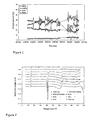
- the variation in major oxide content (CaO, SiO 2 , Al 2 O 3 , and MgO) of WSA during the period June 1996 - May 2000 is given in Figure 1 which shows the variation of major oxide component of WSA with time. Over this period the CaO content increased from about 30% to 45% and the SiO 2 content decreased from about 40% to 25%. The Al 2 O 3 content also decreased from about 25% to 20%, whilst the MgO content increased slightly to about 6%.
- An example of oxide content, for WSA tested in June 1999, is given in Table 1 which shows the Chemical composition and physical properties of GGBS and Portland Cement.
- the XRD analysis of the ash shows that the crystalline phases present in the dry WSA are quartz, anorthite, gehlenite, dicalcium silicate, calcite and some evidence of quicklime.
- the relative intensities of the various diffraction peaks suggest that, of the crystalline phases in the ash, quartz and gehlenite are the major phases present.
- GGBS Ground Granulated Blast-furnace Slag
- the GGBS used for the current work was supplied by Civil and Marine Slag Cement Limited and its chemical composition is given in Table 1.
- a standard Portland cement (to BS12, see Table 1), supplied by rugby Cement Group Limited, was used for the control mixes.
- Sand dredged from the Bristol Channel, was used as fine aggregate. Its particle size ranged from 0.25 to 1.71mm.
- the coarse aggregates (10mm) were limestone from Aberkenfig quarry in South Wales and both aggregates conformed with the BS812, BS882 and BS8110.
- a superplasticiser Daracem SP1 was used.
- the superplasticiser was supplied by W.R. Grace Limited. It is based on the soluble salt of polymeric naphthalene sulfonate and conforms with ASTM designation C494 and also complies with BS 5075: Parts 1 and 3.
- the specimens were water cured for 3,7,28 and 90 days after which they were dried to constant weight over silica gel and Carbosob (a carbon dioxide absorbing agent). The specimens were then broken and internal pieces were selected for grinding and the resulting powder further dried as before.
- Thermal analysis was conducted using a TA Instruments TGA 2950 thermogravimetric analyser in a dry nitrogen atmosphere (on samples whose weight ranged from 4-10mg) with a heating rate of 10°C/min. In order to fully characterise the hydration products, a high resolution ramp was applied below 300°C, followed by a constant temperature ramp up to 950-1000°C.
- the mortar mix (which was also used for sulfate expansion tests) had a 1:3 (binder:sand) ratio and the w/b ratio used (0.65) was higher than specified in the standard (0.5) due to the high water demand at high WSA contents.
- Mortar cubes were cast in 50mm steel moulds, covered with cling film to prevent moisture loss and after 24 hours demoulded. For each blend, half the cubes were water cured and half were moist cured (wrapped in cling film and stored over water) and were tested in compression at 1,7 and 28 days.
- Concrete For research on concrete, the 20:80 blend was replaced by a 70:30 blend. Concrete mixtures with a binder:sand:aggregate ratio 1:2:3 were made up at w/b ratios of 0.5 and 0.4 and tested for slump. Concrete cubes were cast in 100mm steel moulds, covered with cling film, de-moulded at 24 hours and cured in water for 1,7,28 and 90 days. They were tested in compression using a Denison Mayes Group testing machine at compression rates of 45 kN/min (mortar) and 180 kN/min (concrete). Each reported value is the average of three separate results. A superplasticiser was used to achieve workability close to that of the Portland cement control concrete mix. The demand for superplasticiser (unnecessary at 30:70 composition) increased according to the amount of WSA present in the concrete mix. Without the use of the superplasticiser, the high WSA:GGBS ratio mixtures set so rapidly that they were completely unworkable.
- the binder compositions employed ranged from 20:80 to 50:50 and Portland cement was used for the control mortar. Both mortar prisms (20mm x 20mm x 160mm) and mortar cubes (50mm) were produced using the same procedures as described above for mortar. After 28 days of water curing the lengths of the mortar prisms were determined before being immersed, along with the cubes, in the relevant solutions (de-ionised water, or sodium sulfate solution of concentration 16.0 ⁇ 0.5g SO 4 per litre). At each test interval (28 days) the length of each mortar prism was determined using a comparator, the sodium sulfate solution was renewed, and the deionised water level was adjusted to maintain a volume of one litre. After 142 days exposure the compressive strengths of the mortar cubes were determined.
- Figure 2 shows the TG analysis of the dry WSA:GGBS blends for temperatures of up to 1000°C. All blends show a peak at 400-450°C, due to dehydroxylation of hydrated lime (CH, ⁇ 3.4% by wt of WSA) in the WSA (formed due to hydration of CaO during exposure to air).
- the broad peak at about 600°C is identified as being due to carbonate decomposition (CaCO 3 ⁇ 1.4% by wt of WSA) confirmed by the observation of calcite in XRD traces and of carbonate in the chemical analysis.
- This low decomposition temperature may be a result of the small amount of carbonate present in the WSA, and the presence of sulfate (see Table 1).
- Mortar Table 3 shows the compressive strengths of the water cured and moist cured mortars for up to 28 days and also the strengths relative to Portland cement mortar at the same age. At 1 day compressive strengths are very low but as curing periods increase to 28 days strengths increase significantly relative to those of Portland cement mortar, indicating substantial cementing activity.
- water cured mortar with a binder composition of 60:40 achieves a 28 day strength (15.0 MPa) in excess of 50% of the strength of the control Portland cement mortar (28.8 MPa).
- the strengths of moist cured mortars are rather smaller than the strengths of equivalent water cured mortars and in particular the mortar with a 60:40 binder composition shows a much lower strength when moist cured as opposed to water cured.
- composition 70:30 the strengths at w/b ratio 0.4 are substantially less than at w/b ratio 0.5. It is suggested that this is a result of the much higher water demand and poorer compaction at high WSA:GGBS ratios.
- the strength of concrete made with WSA-GGBS as binder is substantially below that made with Portland cement (Table 4), the former achieving the highest relative strength value of 0.42 for the 50:50 blend. Also the rate of early strength development is much slower for the WSA:GGBS concrete. For example, at 1 day concrete made with Portland cement, achieved about 52% (w/b ratio 0.5) and 72% (w/b ratio 0.4) of its strength at age 28 days, while concrete with WSA:GGBS binders achieved only 2-6% of the 28 day strength for both w/b ratios. However the strength of WSA:GGBS concrete shows substantial improvement between 1 and 28 days and continues to show significant increase up to 90 days.
- Figure 4 shows the expansion of WSA:GGBS mortars (of various compositions) exposed to sodium sulfate solution for up to 250 days. After 112 days exposure the control (i.e. Portland cement mortar) shows rapid increase in expansion. This relatively short time period prior to the onset of expansion of the Portland cement mortar is a result of the high w/b ratio (0.65)used in these mixes.
- the XRD and chemical analysis suggest that WSA has a significant silica containing amorphous content and the thermogravimetric analysis confirms that hydration does take place evidenced by the observation of increasing amounts of C-S-H gel with increasing WSA levels in the blends.
- the apparently low free lime content of the WSA suggests that the gel derives mainly from hydration of a component in the WSA rather than from pozzolanic reaction with the lime.
- the strength data indicate that the WSA contributes to strength development both by hydrating itself and by activating hydration of the slag. Strength data on the mortar support the view that the WSA makes its major contribution to strength between 1 and 28 days and the slag makes its major contribution beyond 28 days.
Landscapes
- Chemical & Material Sciences (AREA)
- Engineering & Computer Science (AREA)
- Ceramic Engineering (AREA)
- Organic Chemistry (AREA)
- Environmental & Geological Engineering (AREA)
- Materials Engineering (AREA)
- Structural Engineering (AREA)
- Combustion & Propulsion (AREA)
- Inorganic Chemistry (AREA)
- Chemical Kinetics & Catalysis (AREA)
- Civil Engineering (AREA)
- Curing Cements, Concrete, And Artificial Stone (AREA)
- Manufacturing Of Micro-Capsules (AREA)
- Acyclic And Carbocyclic Compounds In Medicinal Compositions (AREA)
- Pharmaceuticals Containing Other Organic And Inorganic Compounds (AREA)
- Processing Of Solid Wastes (AREA)
- Materials For Medical Uses (AREA)
Claims (27)
- Hydratisierbare zementartige Zusammensetzung, enthaltend eine Mischung aus:(iii) gemahlener granulierter Hochofenschlacke in einer Menge von 30 bis 70 Gewichts-% der Mischung;(iv) Altpapierschlammasche in einer Menge von 30 bis 70%-Gewicht der Mischung, wobei die Altpapierschlammasche hergestellt ist durch Erwärmen von Altpapierschlamm auf eine Verbrennungstemperatur im Bereich von 900 °C bis 1200 °C für eine Haltezeit im Bereich von 1 bis 30 Sekunden, mit anschließendem Abkühlen des erwärmten Schlamms auf eine Kühltemperatur im Bereich von 170 °C bis 230 °C am Ende der Haltezeit.
- Hydratisierbare zementartige Zusammensetzung nach Anspruch 1, wobei die Haltezeit im Bereich von 3 bis 5 Sekunden liegt.
- Hydratisierbare zementartige Zusammensetzung nach Anspruch 1 oder 2, wobei der erwärmte Altpapierschlamm innerhalb von 2-6 Sekunden nach dem Ende der Haltezeit auf die Kühltemperatur abgekühlt wird.
- Hydratisierbare zementartige Zusammensetzung nach Anspruch 3, wobei der Schlamm am Ende der Haltezeit innerhalb von 2-6 Sekunden auf eine Temperatur von etwa 200 °C abgekühlt wurde.
- Hydratisierbare zementartige Zusammensetzung nach einem der vorhergehenden Ansprüche, wobei die Altpapierschlammasche im wesentlichen die Zusammensetzung 19-32,5% (beispielsweise 20,5-31,0%) SiO2, 12,75-26,25% (beispielsweise 15-22,7%) Al2O3, 0,3-3,5% (beispielsweise 0,7-1,1) Fe2O3, 30-56% (beispielsweise 34,8-52,2) CaO, 3,3-6,75% (beispielsweise 4,1-6,2) MgO, 0,75-2,5% (beispielsweise 1,1 bis 2,0%) Na2O, 0,75-2,5% (beispielsweise 1,0-1,6%) K2O und 0,3-1,9% (beispielsweise 0,8-1,4%) SO3 aufweist, wobei der Rest andere Oxide, Nebenbestandteile und Verunreinigungen sind.
- Hydratisierbares zementartiges Material nach einem der vorhergehenden Ansprüche, das einen durchschnittlichen Partikelgrößendurchmesser von weniger als etwa 50 µm (wie beispielsweise weniger als etwa 30 µm) aufweist.
- Hydratisierbares zementartiges Material nach Anspruch 6, wobei die Partikelgröße sich dieser Bedingung vorzugsweise bei der Bildung der Altpapierschlammasche anpaßt, oder sie durch Mahlen oder Stampfen erhalten werden kann.
- Hydratisierbares zementartiges Material nach einem der vorhergehenden Ansprüche, wobei die Mischung anfänglich etwa 30 bis 70% (vorzugsweise 40-60%) der Mischung, bezogen auf das Gewicht der Mischung, Altpapierschlammasche, und etwa 70 bis 30% (60%-40%) der Mischung, bezogen auf das Gewicht der Mischung, gemahlene granulierte Hochofenschlacke enthält.
- Hydratisierbares zementartiges Material nach einem der vorhergehenden Ansprüche, das ferner einen Aktivator enthält, der Portlandzement und/oder eine anorganische Verbindung (wie beispielsweise Natriumcarbonat, Kaliumcarbonat, Natriumsulfat oder Kaliumsulfat) enthalten kann.
- Hydratisierbares zementartiges Material nach Anspruch 9, wobei die anorganische Verbindung in einer Menge von 0,5 bis 10,0 Gewichts-% der Mischung zugegen ist und/oder Portlandzement in einer Menge von 0,5 bis 25 Gewichts-% der Mischung zugegen ist.
- Hydratisierbares zementartiges Material nach Anspruch 7, wobei die Mischung etwa 40% Altpapierschlammasche, etwa 40% gemahlene granulierte Hochofenschlacke und etwa 20% Portlandzement enthält, wobei alle Mengen Gewichtsprozente der Mischung sind.
- Hydratisierbares zementartiges Material nach einem der vorhergehenden Ansprüche, wobei die Mischung ein oder mehrere Zusätze enthält, wie beispielsweise einen Superweichmacher auf Basis eines löslichen Salzes von polymetrischem Naphthalin oder Kalziumsulfat.
- Hydratisierbares zementartiges Material nach einem der vorhergehenden Ansprüche, das mit Sand (vorzugsweise in einem Verhältnis von etwa 1 Teil zementartigem Material zu etwa 3 Teilen Sand) gemischt ist, um einen Mörtel bereitzustellen.
- Hydratisierbares zementartiges Material nach einem der vorhergehenden Ansprüche, das mit Sand und Zuschlagstoff (vorzugsweise in dem Verhältnis von etwa 1 Teil Binder: 2 Teilen Sand : 3 Teilen Zuschlagstoff) gemischt ist, um ein Betonmaterial bereitzustellen.
- Verfahren zur Herstellung einer zementartigen Zusammensetzung, das die Bereitstellung einer hydratisierbaren zementartigen Zusammensetzung nach einem der Ansprüche 1 bis 14 und die Hydratisierung der Mischung beinhaltet.
- Verfahren nach Anspruch 15, wobei die zementartige Zusammensetzung einer Vibration und/oder äußerem Druck ausgesetzt wird, um einen Formkörper bereitzustellen.
- Verfahren nach Anspruch 15 oder 16, wobei die hydratisierbare Mischung wassergehärtet oder feuchtigkeitsgehärtet ist.
- Formkörper, hergestellt durch Hydratisierung einer hydratisierbaren zementartigen Zusammensetzung nach einem der Ansprüche 1 bis 14.
- Formkörper nach Anspruch 18, der zur Verwendung in der Bauindustrie vorgesehen ist und in Form eines Blocks oder Ziegels vorliegen kann.
- Verfahren zur Herstellung eines Formkörpers, wobei das Verfahren beinhaltet:(a) das Bereitstellen eines hydratisierbaren zementartigen Materials nach einem der Ansprüche 1 bis 14;(b) das Hydratisieren der Mischung;(c) Formen der Mischung; und(d) Aushärtenlassen der Mischung.
- Verfahren nach Anspruch 20, wobei die Mischung Portlandzement enthält.
- Verfahren nach Anspruch 20 oder 21, wobei das Formen in einer Form durchgeführt wird.
- Verfahren nach einem der Ansprüche 20 bis 22, wobei das Mischen in einer Form oder in einem separaten Gefäß durchgeführt wird.
- Verfahren nach einem der Ansprüche 20 bis 23, wobei das Aushärten in der Form oder im Anschluss an die Ausformung durchgeführt wird.
- Verfahren nach einem der Ansprüche 20 bis 24, wobei die Mischung für mindestens 7 Tage ausgehärtet wird.
- Verwendung einer Mischung von Altpapierschlammasche und gemahlener granulierter Hochofenschlacke als teilweisen Ersatz für Portlandzement bei der Herstellung von zementartigen Materialien, wobei die Asche hergestellt wird durch Erwärmen von Altpapierschlamm auf eine Verbrennungstemperatur im Bereich von 900 °C bis 1200 °C für eine Haltezeit im Bereich von 1 bis 30 Sekunden, gefolgt von einer Abkühlung des erwärmten Schlamms auf eine Kühltemperatur im Bereich von 170 °C bis 230 °C am Ende der Haltezeit, wobei die Altpapierschlammasche in einer Menge im Bereich von 30 bis 70 Gewichts-% der Zusammensetzung zugegen ist.
- Verwendung von Altpapierschlammasche als zementartigen Binder bei der Herstellung eines zementartigen Materials umfassend Altpapierschlammasche und gemahlene und granulierte Hochofenschlacke, wobei die Altpapierschlammasche hergestellt wird durch Erwärmen von Altpapierschlamm auf eine Verbrennungstemperatur im Bereich von 900 °C bis 1200 °C für eine Haltezeit im Bereich von 1 bis 30 Sekunden, gefolgt von einer Abkühlung des erwärmten Schlamms auf eine Kühltemperatur im Bereich von 170 °C bis 230 °C am Ende der Haltezeit, wobei die Altpapierschlammasche in einer Menge im Bereich von 30 bis 70 Gewichts-% des zementartigen Materials zugegen ist.
Applications Claiming Priority (3)
| Application Number | Priority Date | Filing Date | Title |
|---|---|---|---|
| GB0104091 | 2001-02-19 | ||
| GB0104091A GB0104091D0 (en) | 2001-02-19 | 2001-02-19 | Cementitious material |
| PCT/GB2002/000708 WO2002066392A1 (en) | 2001-02-19 | 2002-02-19 | Cementitious material |
Publications (2)
| Publication Number | Publication Date |
|---|---|
| EP1362017A1 EP1362017A1 (de) | 2003-11-19 |
| EP1362017B1 true EP1362017B1 (de) | 2005-06-29 |
Family
ID=9909068
Family Applications (1)
| Application Number | Title | Priority Date | Filing Date |
|---|---|---|---|
| EP02712087A Expired - Lifetime EP1362017B1 (de) | 2001-02-19 | 2002-02-19 | Zement-artiges material |
Country Status (8)
| Country | Link |
|---|---|
| US (1) | US20030159624A1 (de) |
| EP (1) | EP1362017B1 (de) |
| JP (1) | JP2004518605A (de) |
| AT (1) | ATE298732T1 (de) |
| DE (1) | DE60204853T2 (de) |
| GB (2) | GB0104091D0 (de) |
| WO (1) | WO2002066392A1 (de) |
| ZA (1) | ZA200209341B (de) |
Families Citing this family (24)
| Publication number | Priority date | Publication date | Assignee | Title |
|---|---|---|---|---|
| GB2401104B (en) * | 2003-04-29 | 2007-08-29 | Gary Hunt | Cementitious material |
| AU2003288709A1 (en) * | 2003-12-22 | 2005-07-14 | Andhra Polymers Private Limited | Improved ceiling tiles and a process for the manufacture thereof |
| GB0401561D0 (en) * | 2004-01-24 | 2004-02-25 | Veolia Water Uk Plc | Process for particulate material |
| JP4593133B2 (ja) * | 2004-03-12 | 2010-12-08 | 電気化学工業株式会社 | 水硬性組成物、それを用いてなる硬化体、及び硬化体の製造方法 |
| BRPI0616887A2 (pt) * | 2005-10-06 | 2011-07-05 | Daio Seishi Kk | agregado de partìculas regeneradas, método de fabricação de agregado de partìculas regeneradas, papel contendo partìcula regenerada e papel revestido para impressão com um agregado de partìculas regeneradas |
| MX2008011133A (es) * | 2006-03-01 | 2008-12-18 | Cementech Pty Ltd | Matriz para elementos de albañileria y metodo de fabricacion de la misma. |
| BRPI0604142A (pt) * | 2006-08-31 | 2008-04-22 | Univ Minas Gerais | processo de preparação de metakflex aglomerante de alta resistência de produtos e processos que venham a utilizar metakflex |
| WO2011134025A1 (en) * | 2010-04-29 | 2011-11-03 | Boral Cement Limited | Low c02 cement |
| ES2392069B1 (es) * | 2010-09-07 | 2013-11-06 | Consejo Superior De Investigaciones Científicas (Csic) | Composición autonivelante. |
| KR101347210B1 (ko) | 2011-06-03 | 2014-01-16 | 한밭대학교 산학협력단 | 친환경 고강도 경량 내화단열 패널 조성물을 이용한 경량 벽체 시스템 및 그 시공방법 |
| JP6690273B2 (ja) * | 2015-05-18 | 2020-04-28 | 宇部興産株式会社 | セメント組成物およびその製造方法 |
| US11746048B2 (en) | 2015-10-23 | 2023-09-05 | Roman Cement, Llc | Cement-SCM compositions and methods and systems for their manufacture |
| US10494298B1 (en) * | 2015-10-23 | 2019-12-03 | Roman Cement Llc | Cement-SCM compositions and methods and systems for their manufacture |
| US11655186B2 (en) | 2015-10-23 | 2023-05-23 | Roman Cement, Llc | Activitation of natural pozzolans |
| KR101902616B1 (ko) | 2016-04-29 | 2018-10-01 | 경남대학교 산학협력단 | 폐지를 이용한 모르타르 제조 방법 |
| US10207954B2 (en) * | 2016-12-22 | 2019-02-19 | Nano And Advanced Materials Institute Limited | Synthetic aggregate from waste materials |
| EP3720583A4 (de) | 2017-12-04 | 2021-09-08 | Gmt Ip, Llc | Verarbeitung von nachindustriellen und nachverbraucherabfallströmen und herstellung von nachindustriellen und nachverbraucherprodukten daraus |
| WO2019113135A1 (en) * | 2017-12-04 | 2019-06-13 | Gmt Ip, Llc | Processing post-industrial and post-consumer waste streams and preparation of post-industrial and post-consumer products therefrom |
| FI129938B (fi) * | 2020-02-13 | 2022-11-15 | Fatec Oy | Menetelmä yhdyskuntajätteen polton tuhkan käsittelemiseksi ja menetelmällä muodostettu tuote sekä tuotteen käyttö |
| CN113732009B (zh) * | 2021-08-13 | 2023-05-05 | 广西博世科环保科技股份有限公司 | 一种大修渣废耐火材料长期稳定化及资源化方法 |
| US20230138857A1 (en) * | 2021-10-28 | 2023-05-04 | Halliburton Energy Services, Inc. | Methods of Making and Using a Cementitious Composition with Ultra-Low Portland Cement |
| EP4279471A1 (de) * | 2022-05-20 | 2023-11-22 | Saint-Gobain Weber France | Trockenmörtelzusammensetzung |
| CN115231839A (zh) * | 2022-06-30 | 2022-10-25 | 衡通瑞科技(深圳)有限公司 | 一种利用污泥灰制备的水泥基复合材料及其制备方法 |
| US12540101B2 (en) | 2023-09-05 | 2026-02-03 | Roman Cement, Llc | Non-hydraulically reactive particulate mineral compositions for reducing cement content in concrete |
Family Cites Families (8)
| Publication number | Priority date | Publication date | Assignee | Title |
|---|---|---|---|---|
| EP0115306B1 (de) * | 1983-01-26 | 1990-04-11 | Fuji Fire-Proof Material Industry Co., Ltd. | Verfahren zur Herstellung eines feuerbeständigen, leichten Konstruktionsmaterials |
| AT394711B (de) * | 1990-11-30 | 1992-06-10 | Wopfinger Stein Kalkwerke | Verfahren zum herstellen von zementklinker |
| JPH05223264A (ja) * | 1992-02-10 | 1993-08-31 | Matsushita Electric Ind Co Ltd | 電気床暖房装置等の制御装置 |
| TW337517B (en) * | 1993-06-03 | 1998-08-01 | Smidth & Co As F L | Method and plant for manufacturing cement clinker |
| US5500044A (en) * | 1993-10-15 | 1996-03-19 | Greengrove Corporation | Process for forming aggregate; and product |
| NL9400292A (nl) * | 1994-02-25 | 1995-10-02 | Pelt & Hooykaas | Werkwijze voor het immobiliseren van milieuschadelijke organische en anorganische verbindingen. |
| JP2000344564A (ja) * | 1999-06-07 | 2000-12-12 | Nippon Kayaku Co Ltd | 軽量水硬性組成物 |
| GB2362643B (en) * | 2000-05-26 | 2004-02-11 | William Ajua Tasong | Production of 'green' cement |
-
2001
- 2001-02-19 GB GB0104091A patent/GB0104091D0/en not_active Ceased
-
2002
- 2002-02-19 EP EP02712087A patent/EP1362017B1/de not_active Expired - Lifetime
- 2002-02-19 JP JP2002565912A patent/JP2004518605A/ja active Pending
- 2002-02-19 AT AT02712087T patent/ATE298732T1/de not_active IP Right Cessation
- 2002-02-19 DE DE2002604853 patent/DE60204853T2/de not_active Expired - Fee Related
- 2002-02-19 WO PCT/GB2002/000708 patent/WO2002066392A1/en not_active Ceased
- 2002-02-19 US US10/296,357 patent/US20030159624A1/en not_active Abandoned
- 2002-02-19 GB GB0227020A patent/GB2379215B/en not_active Expired - Fee Related
- 2002-11-18 ZA ZA200209341A patent/ZA200209341B/xx unknown
Also Published As
| Publication number | Publication date |
|---|---|
| EP1362017A1 (de) | 2003-11-19 |
| US20030159624A1 (en) | 2003-08-28 |
| DE60204853D1 (de) | 2005-08-04 |
| JP2004518605A (ja) | 2004-06-24 |
| GB0104091D0 (en) | 2001-04-04 |
| ZA200209341B (en) | 2004-03-10 |
| GB2379215B (en) | 2003-12-24 |
| ATE298732T1 (de) | 2005-07-15 |
| WO2002066392A1 (en) | 2002-08-29 |
| DE60204853T2 (de) | 2006-04-27 |
| GB0227020D0 (en) | 2002-12-24 |
| GB2379215A (en) | 2003-03-05 |
Similar Documents
| Publication | Publication Date | Title |
|---|---|---|
| US20030159624A1 (en) | Cementitious material | |
| Newman et al. | Advanced concrete technology set | |
| EP3152176B9 (de) | Verfahren zur herstellung von einer zementzusammensetzung | |
| US5073198A (en) | Method of preparing building materials | |
| EP1420000A1 (de) | Zementzusatzmittel, zementzusammensetzung und verfahren zur unterdrückung der carbonatisierung unter dessen verwendung | |
| CA3193324A1 (en) | Transformation of lump slag into supplementary cementitious material by carbonatization | |
| EP1561736A1 (de) | Verfahren zur Herstellung eines Baustoffes | |
| EP4472936B1 (de) | Klinkerersatzmaterialien aus recyceltem zementstein | |
| CA3227936A1 (en) | Method for manufacturing supplementary cementitious material | |
| Babako et al. | Setting time and standard consistency of Portland cement binders blended with rice husk ash, calcium carbide and metakaolin admixtures | |
| CA2989367A1 (en) | Activator having a low ph value for supplementary cementitious material | |
| Kinuthia et al. | A preliminary study of the cementitious properties of wastepaper sludge ash ground granulated blast-furnace slag (WSA-GGBS) blends | |
| RU2163574C2 (ru) | Способ получения сульфатного цемента или заполнителей из сульфатного цемента | |
| RU2049081C1 (ru) | Расширяющая добавка к цементу | |
| JP7717537B2 (ja) | グラウト材料、グラウトモルタル組成物及び硬化体 | |
| AU2022350771B2 (en) | Method for manufacturing a supplementary cementitious material | |
| JP2007331976A (ja) | セメント添加材及びセメント組成物 | |
| MO'Farrell | GRANULATED BLAST-FURNACE SLAG (WSA-GGBS) BLENDS | |
| EP4428109A1 (de) | Alkaliaktivierte kristalline bof-schlacke/pozzolan-mischung | |
| KR20260014146A (ko) | 폐펄라이트를 활용한 산업부산물 기반 무시멘트 복합재 및 이의 제조방법 | |
| Chaipanich | A NEW CONCRETE INCORPORATING WASTEPAPER SLUDGE ASH (WSA) | |
| Marchese | Microstructure and strength development in cement paste | |
| WO2005075374A1 (en) | Method for preparing a building material | |
| TR2025019492A2 (tr) | Kalsi̇ne ki̇l ve agrega yikama çamuru esasli jeopoli̇mer bağlayici | |
| JP2023136532A (ja) | セメント混和材 |
Legal Events
| Date | Code | Title | Description |
|---|---|---|---|
| PUAI | Public reference made under article 153(3) epc to a published international application that has entered the european phase |
Free format text: ORIGINAL CODE: 0009012 |
|
| 17P | Request for examination filed |
Effective date: 20021120 |
|
| AK | Designated contracting states |
Kind code of ref document: A1 Designated state(s): AT BE CH CY DE DK ES FI FR GB GR IE IT LI LU MC NL PT SE TR |
|
| AX | Request for extension of the european patent |
Extension state: AL LT LV MK RO SI |
|
| 17Q | First examination report despatched |
Effective date: 20031222 |
|
| GRAP | Despatch of communication of intention to grant a patent |
Free format text: ORIGINAL CODE: EPIDOSNIGR1 |
|
| GRAS | Grant fee paid |
Free format text: ORIGINAL CODE: EPIDOSNIGR3 |
|
| GRAA | (expected) grant |
Free format text: ORIGINAL CODE: 0009210 |
|
| AK | Designated contracting states |
Kind code of ref document: B1 Designated state(s): AT BE CH CY DE DK ES FI FR GB GR IE IT LI LU MC NL PT SE TR |
|
| PG25 | Lapsed in a contracting state [announced via postgrant information from national office to epo] |
Ref country code: IT Free format text: LAPSE BECAUSE OF FAILURE TO SUBMIT A TRANSLATION OF THE DESCRIPTION OR TO PAY THE FEE WITHIN THE PRESCRIBED TIME-LIMIT;WARNING: LAPSES OF ITALIAN PATENTS WITH EFFECTIVE DATE BEFORE 2007 MAY HAVE OCCURRED AT ANY TIME BEFORE 2007. THE CORRECT EFFECTIVE DATE MAY BE DIFFERENT FROM THE ONE RECORDED. Effective date: 20050629 Ref country code: BE Free format text: LAPSE BECAUSE OF FAILURE TO SUBMIT A TRANSLATION OF THE DESCRIPTION OR TO PAY THE FEE WITHIN THE PRESCRIBED TIME-LIMIT Effective date: 20050629 Ref country code: AT Free format text: LAPSE BECAUSE OF FAILURE TO SUBMIT A TRANSLATION OF THE DESCRIPTION OR TO PAY THE FEE WITHIN THE PRESCRIBED TIME-LIMIT Effective date: 20050629 Ref country code: NL Free format text: LAPSE BECAUSE OF FAILURE TO SUBMIT A TRANSLATION OF THE DESCRIPTION OR TO PAY THE FEE WITHIN THE PRESCRIBED TIME-LIMIT Effective date: 20050629 Ref country code: CH Free format text: LAPSE BECAUSE OF FAILURE TO SUBMIT A TRANSLATION OF THE DESCRIPTION OR TO PAY THE FEE WITHIN THE PRESCRIBED TIME-LIMIT Effective date: 20050629 Ref country code: FI Free format text: LAPSE BECAUSE OF FAILURE TO SUBMIT A TRANSLATION OF THE DESCRIPTION OR TO PAY THE FEE WITHIN THE PRESCRIBED TIME-LIMIT Effective date: 20050629 Ref country code: LI Free format text: LAPSE BECAUSE OF FAILURE TO SUBMIT A TRANSLATION OF THE DESCRIPTION OR TO PAY THE FEE WITHIN THE PRESCRIBED TIME-LIMIT Effective date: 20050629 |
|
| REG | Reference to a national code |
Ref country code: GB Ref legal event code: FG4D |
|
| REG | Reference to a national code |
Ref country code: CH Ref legal event code: EP |
|
| REF | Corresponds to: |
Ref document number: 60204853 Country of ref document: DE Date of ref document: 20050804 Kind code of ref document: P |
|
| REG | Reference to a national code |
Ref country code: IE Ref legal event code: FG4D |
|
| PG25 | Lapsed in a contracting state [announced via postgrant information from national office to epo] |
Ref country code: SE Free format text: LAPSE BECAUSE OF FAILURE TO SUBMIT A TRANSLATION OF THE DESCRIPTION OR TO PAY THE FEE WITHIN THE PRESCRIBED TIME-LIMIT Effective date: 20050929 Ref country code: GR Free format text: LAPSE BECAUSE OF FAILURE TO SUBMIT A TRANSLATION OF THE DESCRIPTION OR TO PAY THE FEE WITHIN THE PRESCRIBED TIME-LIMIT Effective date: 20050929 Ref country code: DK Free format text: LAPSE BECAUSE OF FAILURE TO SUBMIT A TRANSLATION OF THE DESCRIPTION OR TO PAY THE FEE WITHIN THE PRESCRIBED TIME-LIMIT Effective date: 20050929 |
|
| NLV1 | Nl: lapsed or annulled due to failure to fulfill the requirements of art. 29p and 29m of the patents act | ||
| PG25 | Lapsed in a contracting state [announced via postgrant information from national office to epo] |
Ref country code: PT Free format text: LAPSE BECAUSE OF FAILURE TO SUBMIT A TRANSLATION OF THE DESCRIPTION OR TO PAY THE FEE WITHIN THE PRESCRIBED TIME-LIMIT Effective date: 20051207 |
|
| REG | Reference to a national code |
Ref country code: CH Ref legal event code: PL |
|
| PG25 | Lapsed in a contracting state [announced via postgrant information from national office to epo] |
Ref country code: LU Free format text: LAPSE BECAUSE OF NON-PAYMENT OF DUE FEES Effective date: 20060228 Ref country code: MC Free format text: LAPSE BECAUSE OF NON-PAYMENT OF DUE FEES Effective date: 20060228 |
|
| ET | Fr: translation filed | ||
| PLBE | No opposition filed within time limit |
Free format text: ORIGINAL CODE: 0009261 |
|
| STAA | Information on the status of an ep patent application or granted ep patent |
Free format text: STATUS: NO OPPOSITION FILED WITHIN TIME LIMIT |
|
| 26N | No opposition filed |
Effective date: 20060330 |
|
| PGFP | Annual fee paid to national office [announced via postgrant information from national office to epo] |
Ref country code: IE Payment date: 20070116 Year of fee payment: 6 |
|
| PGFP | Annual fee paid to national office [announced via postgrant information from national office to epo] |
Ref country code: DE Payment date: 20070118 Year of fee payment: 6 |
|
| PGFP | Annual fee paid to national office [announced via postgrant information from national office to epo] |
Ref country code: FR Payment date: 20070111 Year of fee payment: 6 |
|
| PG25 | Lapsed in a contracting state [announced via postgrant information from national office to epo] |
Ref country code: TR Free format text: LAPSE BECAUSE OF FAILURE TO SUBMIT A TRANSLATION OF THE DESCRIPTION OR TO PAY THE FEE WITHIN THE PRESCRIBED TIME-LIMIT Effective date: 20050629 |
|
| REG | Reference to a national code |
Ref country code: IE Ref legal event code: MM4A |
|
| PG25 | Lapsed in a contracting state [announced via postgrant information from national office to epo] |
Ref country code: CY Free format text: LAPSE BECAUSE OF FAILURE TO SUBMIT A TRANSLATION OF THE DESCRIPTION OR TO PAY THE FEE WITHIN THE PRESCRIBED TIME-LIMIT Effective date: 20050629 |
|
| REG | Reference to a national code |
Ref country code: FR Ref legal event code: ST Effective date: 20081031 |
|
| PG25 | Lapsed in a contracting state [announced via postgrant information from national office to epo] |
Ref country code: IE Free format text: LAPSE BECAUSE OF NON-PAYMENT OF DUE FEES Effective date: 20080219 Ref country code: DE Free format text: LAPSE BECAUSE OF NON-PAYMENT OF DUE FEES Effective date: 20080902 |
|
| PG25 | Lapsed in a contracting state [announced via postgrant information from national office to epo] |
Ref country code: FR Free format text: LAPSE BECAUSE OF NON-PAYMENT OF DUE FEES Effective date: 20080229 |
|
| PG25 | Lapsed in a contracting state [announced via postgrant information from national office to epo] |
Ref country code: ES Free format text: LAPSE BECAUSE OF NON-PAYMENT OF DUE FEES Effective date: 20060228 |
|
| PGFP | Annual fee paid to national office [announced via postgrant information from national office to epo] |
Ref country code: GB Payment date: 20090223 Year of fee payment: 8 |
|
| GBPC | Gb: european patent ceased through non-payment of renewal fee |
Effective date: 20100219 |
|
| PG25 | Lapsed in a contracting state [announced via postgrant information from national office to epo] |
Ref country code: GB Free format text: LAPSE BECAUSE OF NON-PAYMENT OF DUE FEES Effective date: 20100219 |