EP1357142A2 - Katalysatoren zur Polymerisation von Alkylenoxiden - Google Patents
Katalysatoren zur Polymerisation von Alkylenoxiden Download PDFInfo
- Publication number
- EP1357142A2 EP1357142A2 EP03008043A EP03008043A EP1357142A2 EP 1357142 A2 EP1357142 A2 EP 1357142A2 EP 03008043 A EP03008043 A EP 03008043A EP 03008043 A EP03008043 A EP 03008043A EP 1357142 A2 EP1357142 A2 EP 1357142A2
- Authority
- EP
- European Patent Office
- Prior art keywords
- group
- substituted
- unsubstituted
- catalysts
- polymerization
- Prior art date
- Legal status (The legal status is an assumption and is not a legal conclusion. Google has not performed a legal analysis and makes no representation as to the accuracy of the status listed.)
- Granted
Links
Classifications
-
- C—CHEMISTRY; METALLURGY
- C08—ORGANIC MACROMOLECULAR COMPOUNDS; THEIR PREPARATION OR CHEMICAL WORKING-UP; COMPOSITIONS BASED THEREON
- C08F—MACROMOLECULAR COMPOUNDS OBTAINED BY REACTIONS ONLY INVOLVING CARBON-TO-CARBON UNSATURATED BONDS
- C08F4/00—Polymerisation catalysts
- C08F4/06—Metallic compounds other than hydrides and other than metallo-organic compounds; Boron halide or aluminium halide complexes with organic compounds containing oxygen
- C08F4/16—Metallic compounds other than hydrides and other than metallo-organic compounds; Boron halide or aluminium halide complexes with organic compounds containing oxygen of silicon, germanium, tin, lead, titanium, zirconium or hafnium
- C08F4/18—Oxides
-
- C—CHEMISTRY; METALLURGY
- C08—ORGANIC MACROMOLECULAR COMPOUNDS; THEIR PREPARATION OR CHEMICAL WORKING-UP; COMPOSITIONS BASED THEREON
- C08G—MACROMOLECULAR COMPOUNDS OBTAINED OTHERWISE THAN BY REACTIONS ONLY INVOLVING UNSATURATED CARBON-TO-CARBON BONDS
- C08G65/00—Macromolecular compounds obtained by reactions forming an ether link in the main chain of the macromolecule
- C08G65/02—Macromolecular compounds obtained by reactions forming an ether link in the main chain of the macromolecule from cyclic ethers by opening of the heterocyclic ring
- C08G65/26—Macromolecular compounds obtained by reactions forming an ether link in the main chain of the macromolecule from cyclic ethers by opening of the heterocyclic ring from cyclic ethers and other compounds
- C08G65/2642—Macromolecular compounds obtained by reactions forming an ether link in the main chain of the macromolecule from cyclic ethers by opening of the heterocyclic ring from cyclic ethers and other compounds characterised by the catalyst used
- C08G65/2645—Metals or compounds thereof, e.g. salts
- C08G65/266—Metallic elements not covered by group C08G65/2648 - C08G65/2645, or compounds thereof
-
- B—PERFORMING OPERATIONS; TRANSPORTING
- B01—PHYSICAL OR CHEMICAL PROCESSES OR APPARATUS IN GENERAL
- B01J—CHEMICAL OR PHYSICAL PROCESSES, e.g. CATALYSIS OR COLLOID CHEMISTRY; THEIR RELEVANT APPARATUS
- B01J31/00—Catalysts comprising hydrides, coordination complexes or organic compounds
- B01J31/02—Catalysts comprising hydrides, coordination complexes or organic compounds containing organic compounds or metal hydrides
- B01J31/0201—Oxygen-containing compounds
- B01J31/0211—Oxygen-containing compounds with a metal-oxygen link
- B01J31/0212—Alkoxylates
-
- B—PERFORMING OPERATIONS; TRANSPORTING
- B01—PHYSICAL OR CHEMICAL PROCESSES OR APPARATUS IN GENERAL
- B01J—CHEMICAL OR PHYSICAL PROCESSES, e.g. CATALYSIS OR COLLOID CHEMISTRY; THEIR RELEVANT APPARATUS
- B01J31/00—Catalysts comprising hydrides, coordination complexes or organic compounds
- B01J31/02—Catalysts comprising hydrides, coordination complexes or organic compounds containing organic compounds or metal hydrides
- B01J31/0201—Oxygen-containing compounds
- B01J31/0211—Oxygen-containing compounds with a metal-oxygen link
- B01J31/0214—Aryloxylates, e.g. phenolates
-
- C—CHEMISTRY; METALLURGY
- C07—ORGANIC CHEMISTRY
- C07F—ACYCLIC, CARBOCYCLIC OR HETEROCYCLIC COMPOUNDS CONTAINING ELEMENTS OTHER THAN CARBON, HYDROGEN, HALOGEN, OXYGEN, NITROGEN, SULFUR, SELENIUM OR TELLURIUM
- C07F3/00—Compounds containing elements of Groups 2 or 12 of the Periodic Table
- C07F3/003—Compounds containing elements of Groups 2 or 12 of the Periodic Table without C-Metal linkages
-
- C—CHEMISTRY; METALLURGY
- C07—ORGANIC CHEMISTRY
- C07F—ACYCLIC, CARBOCYCLIC OR HETEROCYCLIC COMPOUNDS CONTAINING ELEMENTS OTHER THAN CARBON, HYDROGEN, HALOGEN, OXYGEN, NITROGEN, SULFUR, SELENIUM OR TELLURIUM
- C07F5/00—Compounds containing elements of Groups 3 or 13 of the Periodic Table
- C07F5/06—Aluminium compounds
- C07F5/069—Aluminium compounds without C-aluminium linkages
-
- C—CHEMISTRY; METALLURGY
- C07—ORGANIC CHEMISTRY
- C07F—ACYCLIC, CARBOCYCLIC OR HETEROCYCLIC COMPOUNDS CONTAINING ELEMENTS OTHER THAN CARBON, HYDROGEN, HALOGEN, OXYGEN, NITROGEN, SULFUR, SELENIUM OR TELLURIUM
- C07F7/00—Compounds containing elements of Groups 4 or 14 of the Periodic Table
- C07F7/003—Compounds containing elements of Groups 4 or 14 of the Periodic Table without C-Metal linkages
-
- C—CHEMISTRY; METALLURGY
- C08—ORGANIC MACROMOLECULAR COMPOUNDS; THEIR PREPARATION OR CHEMICAL WORKING-UP; COMPOSITIONS BASED THEREON
- C08G—MACROMOLECULAR COMPOUNDS OBTAINED OTHERWISE THAN BY REACTIONS ONLY INVOLVING UNSATURATED CARBON-TO-CARBON BONDS
- C08G65/00—Macromolecular compounds obtained by reactions forming an ether link in the main chain of the macromolecule
- C08G65/02—Macromolecular compounds obtained by reactions forming an ether link in the main chain of the macromolecule from cyclic ethers by opening of the heterocyclic ring
- C08G65/26—Macromolecular compounds obtained by reactions forming an ether link in the main chain of the macromolecule from cyclic ethers by opening of the heterocyclic ring from cyclic ethers and other compounds
- C08G65/2642—Macromolecular compounds obtained by reactions forming an ether link in the main chain of the macromolecule from cyclic ethers by opening of the heterocyclic ring from cyclic ethers and other compounds characterised by the catalyst used
- C08G65/2645—Metals or compounds thereof, e.g. salts
- C08G65/2654—Aluminium or boron; Compounds thereof
-
- B—PERFORMING OPERATIONS; TRANSPORTING
- B01—PHYSICAL OR CHEMICAL PROCESSES OR APPARATUS IN GENERAL
- B01J—CHEMICAL OR PHYSICAL PROCESSES, e.g. CATALYSIS OR COLLOID CHEMISTRY; THEIR RELEVANT APPARATUS
- B01J2531/00—Additional information regarding catalytic systems classified in B01J31/00
- B01J2531/40—Complexes comprising metals of Group IV (IVA or IVB) as the central metal
- B01J2531/46—Titanium
Definitions
- the invention relates to new coordinative catalysts for the polymerization of Alkylene oxides.
- Polyalkylene oxides obtained by polymerizing alkylene oxides e.g. ethylene oxide, Propylene oxide or 1,2-butylene oxide are commercially available in a variety of applications, such as non-ionic Surfactants, lubricants, brake fluids or hydraulic fluids.
- alkylene oxides e.g. ethylene oxide, Propylene oxide or 1,2-butylene oxide
- non-ionic Surfactants e.g. ethylene oxide, Propylene oxide or 1,2-butylene oxide
- brake fluids or hydraulic fluids e.g. ethylene oxide, Propylene oxide or 1,2-butylene oxide
- polyether polyols are obtained which to a large extent for the production of polyurethane materials, e.g. varnishes, Sealants, elastomers or foams can be used.
- the polymerization of the alkylene oxides can be basic, acidic or coordinatively catalyzed become.
- basic catalysts for the polymerization of alkylene oxides technically predominantly alkali hydroxides (e.g. KOH) are used.
- alkali hydroxides e.g. KOH
- a disadvantage of the Polymerization catalyzed by alkali hydroxides are the long reaction times and the very complex product work-up to remove the basic catalyst.
- Another problem is the base-catalyzed as a side reaction Rearrangement of alkylene oxides, for example propylene oxide, to allyl or Propenyl alcohols, which form monofunctional, unsaturated polyethers with a terminal double bond, so-called monools.
- monools There the proportion of monool increases sharply with increasing molecular weight of the polyether Polyether polyol production by means of KOH catalysis the equivalent molar mass (number average Molar mass / functionality) limited to about
- Acid catalysis has the disadvantage that it has side reactions (e.g. the formation of volatile, low molecular weight ring ethers such as dioxanes or dioxolanes) favored to an increased extent, so that generally only products with number average molecular weights up to about 1,000 g / mol can be obtained, and that the molar mass distribution of the polyalkylene oxides is broader than that of base catalysis manufactured products.
- side reactions e.g. the formation of volatile, low molecular weight ring ethers such as dioxanes or dioxolanes
- Porphyrin complexes of aluminum, zinc and manganese also catalyze them Polymerization of alkylene oxides by a coordinative mechanism (see e.g. EP-A 195 951, EP-A 510 602, US-A 5 328 970).
- the polyalkylene oxides obtained are atactic and have a narrow molar mass distribution.
- Double metal cyanide (DMC) catalysts based on zinc hexacyanocobaltate are very effective catalysts after modification with suitable organic complex ligands for coordinative alkylene oxide polymerization (see e.g. US-A 3 404 109, US-A 3 829 505, US-A 3 941 849, US-A 5 158 922, US-A 5 470 813).
- DMC catalysts Through commitment highly active DMC catalysts are used with atactic polyalkylene oxides narrow molar mass distributions and extremely low levels of unsaturated Get by-products.
- DMC catalysts have the disadvantage that that they do not allow controlled polymerization of ethylene oxide and thus not the production of polyethylene oxides or polyalkylene oxide block copolymers with ethylene oxide blocks. It also causes the characteristic of DMC catalysis Induction period at the beginning of the polymerization often process engineering Problems, especially with process control on an industrial scale.
- n 0.
- n 1.
- n 3. Examples are V (V), Nb (V) and Ta (V).
- n 4. Examples are Cr (VI), Mo (VI), W (VI) and Re (VI).
- Metal complex compounds of the general formula are preferably used (I) with metals M in the oxidation state II, III and IV. Particularly preferred Zn (II), Al (III), Ti (IV), Zr (IV) and Hf (IV).
- the catalysts of the invention are used for coordinative polymerization of alkylene oxides used.
- Suitable alkylene oxides are, for example, ethylene oxide, propylene oxide, 1,2-butylene oxide, 2,3-butylene oxide, styrene oxide, vinyl oxirane, glycidol, allyl glycidyl ether as well as their mixtures.
- the structure of the polyether chains by alkoxylation can be carried out with only one monomeric alkylene oxide or also statistically or in blocks with two or more different monomeric alkylene oxides respectively.
- Ethylene oxide, propylene oxide, 1,2-butylene oxide are preferably used, 2,3-butylene oxide or mixtures thereof.
- the polymerization of the alkylene oxides in the presence of active hydrogen atoms is optional having starter connections carried out. This makes polyether polyols receive that are suitable for the production of polyurethane materials are.
- starter compounds having active hydrogen atoms compounds with molecular weights of 18 to 1,000 and 1 to 8 hydroxyl, thiol and / or Amino groups used.
- Examples are ethylene glycol, diethylene glycol, Triethylene glycol, 1,2-propylene glycol, 1,4-butanediol, hexamethylene glycol, bisphenol A, trimethylolpropane, glycerin, pentaerythritol, sorbitol, cane sugar, degraded Starch, water, methylamine, ethylamine, propylamine, butylamine, aniline, benzylamine, o- or p-toluidine, ⁇ , ⁇ -naphthylamine, ammonia, ethylenediamine, propylenediamine, 1,4-butylenediamine, 1,2-, 1,3-, 1,4-, 1,5- or 1,6-hexamethylene diamine, o-, m- or p-phenylenediamine, 2,2'-, 2,4'- or 4,4'-diaminodiphenylmethane or Diethylene.
- Alkylene oxides generally take place at temperatures of from -20 to 200 ° C., preferably 0 to 180 ° C, particularly preferably 20 to 160 ° C.
- the reaction can be at total pressures from 0.001 to 20 bar.
- the polymerization can take place in Substance or in an inert organic solvent, e.g. cyclohexane, Toluene, xylene, tetrahydrofuran, diethyl ether, dimethoxyethane, dioxane and / or chlorinated hydrocarbons, such as methylene chloride, chloroform or 1,2-dichloropropane, be performed.
- the amount of solvent is usually 10 to 30 wt .-%, based on the amount of polyalkylene oxide to be produced.
- the catalyst concentration is chosen so that under the given reaction conditions good control of the polymerization reaction is possible.
- the Catalyst concentration is generally 0.001% by weight to 2% by weight, preferably 0.01 to 1.5% by weight, particularly preferably 0.1 to 1% by weight, based on the amount of polyalkylene oxide to be produced.
- the response times range from a few minutes to several hours.
- the polyalkoxylation process can be continuous, in a batch or in a semi-batch process be performed.
- the (number average) molecular weights of the polyalkylene oxides which can be prepared using the catalysts according to the invention are 200 to 500,000 g / mol, preferably 500 to 50,000 g / mol, particularly preferably 1,000 to 20,000 g / mol.
- the polyalkylene oxides produced by the catalysts according to the invention are distinguished by narrow molar mass distributions or low polydispersities (M w / M n ).
- the polydispersities are generally less than 1.5 and preferably less than 1.2.
- the molar mass values and polydispersities are usually determined by gel permeation chromatography (GPC) calibrated with appropriate polyalkylene oxide standards.
- the polymerization of propylene oxide with the catalysts according to the invention gives atactic polypropylene oxides. Tacticity is usually determined using 13 C-NMR spectroscopy.
- the polypropylene oxides obtained with catalyst A have relatively high number-average molar masses with values between approximately 10,000 and 15,000 g / mol and very narrow molar mass distributions with polydispersities M w / M n ⁇ 1.08.
- the polypropylene oxide from Example 2 was additionally examined by means of 13 C-NMR spectroscopy.
- the 13 C-NMR analysis showed that an atactic product with a statistical distribution of isotactic and syndiotactic diads is present.
- the by-products characteristic of basic or acid catalysis could not be detected.
Landscapes
- Chemical & Material Sciences (AREA)
- Organic Chemistry (AREA)
- Chemical Kinetics & Catalysis (AREA)
- Engineering & Computer Science (AREA)
- Polymers & Plastics (AREA)
- Medicinal Chemistry (AREA)
- Health & Medical Sciences (AREA)
- Materials Engineering (AREA)
- Polyethers (AREA)
- Organic Low-Molecular-Weight Compounds And Preparation Thereof (AREA)
- Catalysts (AREA)
- Epoxy Compounds (AREA)
- Transition And Organic Metals Composition Catalysts For Addition Polymerization (AREA)
Abstract
Description

- R1 - R9
- gleiche oder verschiedene Reste sein können und unabhängig voneinander H, eine substituierte oder unsubstituierte, lineare oder verzweigte C1-C20- Alkylgruppe, eine substituierte oder unsubstituierte C5-C20-Arylgruppe, eine substituierte oder unsubstituierte C5-C20-Aralkylgruppe, eine Acyl- gruppe, eine Alkoxidgruppe, F, Cl, Br, I, CN, oder NO2 bedeuten. R1 bis R4 sowie R6 bis R9 können auch gemeinsam mit C1 und C2 bzw. C3 und C4 aromatische Ringsysteme bilden. R2 und R3 bzw. R7 und R8 können auch Bestandteil eines C3-C20-cycloaliphatischen Ringsystems, wie z.B. Cyclohexyl, sein.
- M
- ist ein Metall in der Oxidationsstufe II - VII.
- X
- bedeutet F, Cl, Br, I, H, CN, eine substituierte oder unsubstituierte, lineare oder verzweigte C1-C20-Alkylgruppe, eine substituierte oder unsubstituierte C5-C20-Arylgruppe, eine substituierte oder unsubstituierte C5-C20- Aralkylgruppe, eine Acylgruppe, eine Alkoxidgruppe, eine Thiolatgruppe oder eine Dialkylaminogruppe. Gegebenenfalls können 2 oder mehr der Gruppen X auch verbrückt sein, bevorzugt über eine Alkylenbrücke. Für n ≥ 2 können die Gruppen X gleich oder verschieden sein. X ist bevorzugt F, Cl, Br, I, besonders bevorzugt Cl.
- n
- ist 0, 1, 2, 3, 4 oder 5, wobei n so gewählt wird, dass die Elektroneutralität der Metallkomplexverbindung gewährleistet ist.

- R10 - R18
- gleiche oder verschiedene Reste sein können und unabhängig voneinander H, eine substituierte oder unsubstituierte, lineare oder verzweigte C1-C20-Alkylgruppe, eine substituierte oder unsubstituierte C5-C20- Arylgruppe, eine substituierte oder unsubstituierte C5-C20-Aralkylgruppe, eine Acylgruppe, eine Alkoxidgruppe, eine Thiolatgruppe, F, Cl, Br, I, CN, NO2, sowie Bestandteile ankondensierter cycloaliphatischer oder aromatischer Ringsysteme mit 3-20 C-Atomen sind. Bevorzugt sind R10 bis R18 H, lineare oder verzweigte C1-C6-Alkylgruppen, F, Cl, Br, I oder Bestandteile ankondensierter cycloaliphatischer oder aromatischer Ringsysteme mit 3-15 C-Atomen.
- M, X und n
- die in Formel (I) definierte Bedeutung haben. Bevorzugt sind Verbindungen, die Metalle M in der Oxidationsstufe II, III und IV enthalten, besonders bevorzugt solche, in denen M Zn(II), Al(III), Ti(IV), Zr(IV) oder Hf(IV) ist. X ist bevorzugt F, Cl, Br, I, besonders bevorzugt Cl.

Ausbeute: 524 mg (1,40 mmol, 94 %)
| Propylenoxid-Polymerisationen mit Katalysator A | ||||||
| Bsp. | Zeit [h] | Ausbeute [g] | Umsatz [%] | Mn [g/mol] | Mw [g/mol] | Mw/Mn |
| 1 | 0,5 | 3,48 | 41,9 | 9 823 | 10 601 | 1,0793 |
| 2 | 1 | 4,04 | 48,6 | 10 796 | 11 555 | 1,0703 |
| 3 | 2 | 4,69 | 56,5 | 12 963 | 13 917 | 1,0736 |
| 4 | 3 | 5,02 | 60,5 | 11 863 | 12 737 | 1,0736 |
| 5 | 4 | 5,43 | 65,4 | 12 047 | 12 922 | 1,0726 |
| 6 | 5 | 5,79 | 69,8 | 12 342 | 13 281 | 1,0760 |
| 7 | 6 | 6,06 | 73,0 | 12 525 | 13 357 | 1,0664 |
| 8 | 15 | 6,52 | 78,6 | 13 324 | 14 213 | 1,0667 |
| 9 | 48 | 7,13 | 85,9 | 14 340 | 15 440 | 1,0767 |
Claims (5)
- Katalysatoren der allgemeinen Formel (I)in der

- R1 - R9
- unabhängig voneinander H, eine substituierte oder unsubstituierte, lineare oder verzweigte C1-C20-Alkylgruppe, eine substituierte oder unsubstituierte C5-C20-Arylgruppe, eine substituierte oder unsubstituierte C5-C20-Aralkylgruppe, eine Acylgruppe, eine Alkoxid-gruppe, F, Cl, Br, I, CN, oder NO2 bedeuten, oder R2 und R3 und/oder R7 und R8 gemeinsam ein ankondensiertes C3-C20-cyclo-aliphatisches Ringsystem bilden, oder R1 bis R4 und/oder R6 bis R9 gemeinsam ein ankondensiertes aromatisches Ringsystem bilden;
- M
- ein Metall in der Oxidationsstufe II - VII ist;
- X
- F, Cl, Br, I, H, CN, eine substituierte oder unsubstituierte, lineare oder verzweigte C1-C20-Alkylgruppe, eine substituierte oder unsubstituierte C5-C20-Arylgruppe, eine substituierte oder unsubstituierte C5-C20-Aralkylgruppe, eine Acylgruppe, eine Alkoxidgruppe, eine Thiolatgruppe oder eine Dialkylaminogruppe bedeutet;
- n
- 0, 1, 2, 3, 4 oder 5 ist, wobei n so gewählt wird, dass die Elektro-neutralität der Metallkomplexverbindung gewährleistet ist.
- Katalysatoren gemäß Anspruch 1 der allgemeinen Formel (II)in der
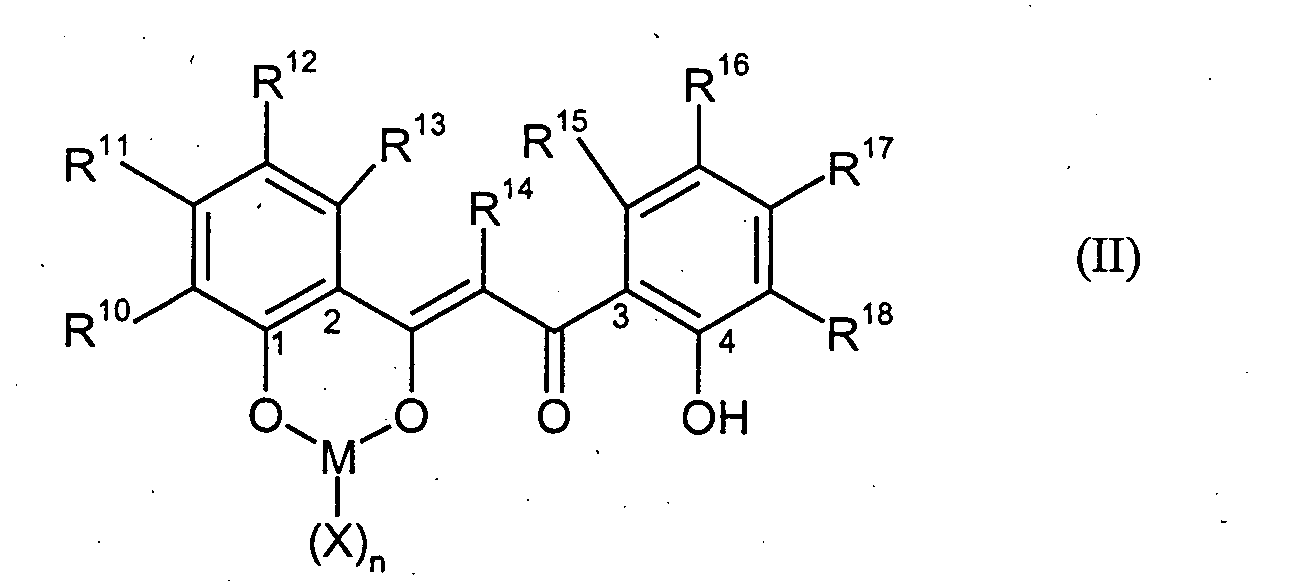
- R10 - R18
- unabhängig voneinander H, eine substituierte oder unsubstituierte, lineare oder verzweigte C1-C20-Alkylgruppe, eine substituierte oder unsubstituierte C5-C20-Arylgruppe, eine substituierte oder unsubstituierte C5-C20-Aralkylgruppe, eine Acylgruppe, eine Alkoxidgruppe, eine Thiolatgruppe, F, Cl, Br, I, CN, NO2, oder Teile ankondensierter cycloaliphatischer oder aromatischer Ringsysteme mit 3-20 C-Atomen sind;
- M, X, n
- die in Anspruch 1 definierte Bedeutung haben.
- Katalysatoren gemäß Anspruch 2, bei denen
- R10-R18
- unabhängig voneinander H, lineare oder verzweigte C1-C6-Alkylgruppen, F, Cl, Br, I oder Bestandteile ankondensierter cyclo-aliphatischer oder aromatischer Ringsysteme mit 3 bis 15 C-Atomen sind;
- M
- Zn(II), Al(III), Ti(IV), Zr(IV) oder Hf(IV) ist;
- X
- F, Cl, Br oder I ist.
- Verfahren zur Polymerisation von Alkylenoxiden, bei dem die Alkylenoxide in Gegenwart eines Katalysators gemäß Anspruch 1, 2 oder 3 polymerisiert werden.
- Verwendung der Katalysatoren gemäß Anspruch 1, 2 oder 3 bei der Polymerisation von Alkylenoxiden
Applications Claiming Priority (2)
| Application Number | Priority Date | Filing Date | Title |
|---|---|---|---|
| DE10218583 | 2002-04-26 | ||
| DE10218583A DE10218583A1 (de) | 2002-04-26 | 2002-04-26 | Katalysatoren zur Polymerisation von Alkylenoxiden |
Publications (3)
| Publication Number | Publication Date |
|---|---|
| EP1357142A2 true EP1357142A2 (de) | 2003-10-29 |
| EP1357142A3 EP1357142A3 (de) | 2003-11-19 |
| EP1357142B1 EP1357142B1 (de) | 2005-01-26 |
Family
ID=28685289
Family Applications (1)
| Application Number | Title | Priority Date | Filing Date |
|---|---|---|---|
| EP03008043A Expired - Lifetime EP1357142B1 (de) | 2002-04-26 | 2003-04-14 | Katalysatoren zur Polymerisation von Alkylenoxiden |
Country Status (12)
| Country | Link |
|---|---|
| US (1) | US6809211B2 (de) |
| EP (1) | EP1357142B1 (de) |
| JP (1) | JP2004067993A (de) |
| KR (1) | KR20030084755A (de) |
| CN (1) | CN1453300A (de) |
| AT (1) | ATE287915T1 (de) |
| BR (1) | BR0301244A (de) |
| CA (1) | CA2425734A1 (de) |
| DE (2) | DE10218583A1 (de) |
| MX (1) | MXPA03003676A (de) |
| PL (1) | PL359837A1 (de) |
| RU (1) | RU2003112037A (de) |
Families Citing this family (2)
| Publication number | Priority date | Publication date | Assignee | Title |
|---|---|---|---|---|
| US8031804B2 (en) * | 2006-04-24 | 2011-10-04 | Parkervision, Inc. | Systems and methods of RF tower transmission, modulation, and amplification, including embodiments for compensating for waveform distortion |
| EP2543689B1 (de) | 2011-07-04 | 2016-08-10 | Repsol, S.A. | Kontinuierliches verfahren zur synthese von polyolen |
Family Cites Families (7)
| Publication number | Priority date | Publication date | Assignee | Title |
|---|---|---|---|---|
| GB1063525A (en) | 1963-02-14 | 1967-03-30 | Gen Tire & Rubber Co | Organic cyclic oxide polymers, their preparation and tires prepared therefrom |
| US3829505A (en) | 1970-02-24 | 1974-08-13 | Gen Tire & Rubber Co | Polyethers and method for making the same |
| US3941849A (en) | 1972-07-07 | 1976-03-02 | The General Tire & Rubber Company | Polyethers and method for making the same |
| JPS61197631A (ja) | 1985-02-28 | 1986-09-01 | Kanegafuchi Chem Ind Co Ltd | 分子量分布の狭いポリアルキレンオキシドの製造方法 |
| JPH04323204A (ja) | 1991-04-22 | 1992-11-12 | Kansai Paint Co Ltd | リビング重合体の製造方法 |
| US5158922A (en) | 1992-02-04 | 1992-10-27 | Arco Chemical Technology, L.P. | Process for preparing metal cyanide complex catalyst |
| US5470813A (en) | 1993-11-23 | 1995-11-28 | Arco Chemical Technology, L.P. | Double metal cyanide complex catalysts |
-
2002
- 2002-04-26 DE DE10218583A patent/DE10218583A1/de not_active Withdrawn
-
2003
- 2003-04-14 DE DE50300271T patent/DE50300271D1/de not_active Expired - Fee Related
- 2003-04-14 AT AT03008043T patent/ATE287915T1/de not_active IP Right Cessation
- 2003-04-14 EP EP03008043A patent/EP1357142B1/de not_active Expired - Lifetime
- 2003-04-16 CA CA002425734A patent/CA2425734A1/en not_active Abandoned
- 2003-04-21 US US10/419,583 patent/US6809211B2/en not_active Expired - Fee Related
- 2003-04-24 JP JP2003119753A patent/JP2004067993A/ja active Pending
- 2003-04-24 BR BR0301244-1A patent/BR0301244A/pt not_active Application Discontinuation
- 2003-04-24 PL PL03359837A patent/PL359837A1/xx not_active Application Discontinuation
- 2003-04-25 CN CN03122414A patent/CN1453300A/zh active Pending
- 2003-04-25 MX MXPA03003676A patent/MXPA03003676A/es not_active Application Discontinuation
- 2003-04-25 KR KR10-2003-0026264A patent/KR20030084755A/ko not_active Withdrawn
- 2003-04-25 RU RU2003112037/04A patent/RU2003112037A/ru not_active Application Discontinuation
Non-Patent Citations (5)
| Title |
|---|
| F. TEIXIDOR, A. LLOBET, L. ESCRICHE, J. CASABO: POLYHEDRON, Bd. 3, 1984, Seiten 1017-1019, XP008021941 * |
| F. TEIXIDOR, A. LLOBET, L. ESCRICHE, J. CASABO: POLYHEDRON, Bd. 4, Nr. 2, 1985, Seiten 215-219, XP008021942 * |
| F. TEIXIDOR, F. FLOR, J. CASABO: INORG. CHIM. ACTA, Bd. 118, 1986, Seiten 125-128, XP008021940 * |
| J. CASABO, J. COLOMER, L. ESCRICHE, F. TEIXIDOR, E. MOLINS, C. MIRAVITLLES: INORG. CHIM. ACTA, Bd. 178, 1990, Seiten 221-226, XP008021939 * |
| SNELL, ALEXANDER H.: "Neuartige Gruppe-4-Metallkomplexe f}r die Polymerisation von polaren und unpolaren Monomeren, Dissertation Universit{t M}nster" 24. Juni 2002 (2002-06-24) , MIAMI, UNIVERSIT[TS- UND LANDESBIBLIOTHEK M]NSTER , M]NSTER XP002255161 * Seite 6-27 * * Seite 55-69 * * |
Also Published As
| Publication number | Publication date |
|---|---|
| KR20030084755A (ko) | 2003-11-01 |
| DE50300271D1 (de) | 2005-03-03 |
| PL359837A1 (en) | 2003-11-03 |
| CN1453300A (zh) | 2003-11-05 |
| US20040010165A1 (en) | 2004-01-15 |
| MXPA03003676A (es) | 2005-02-14 |
| BR0301244A (pt) | 2004-08-17 |
| RU2003112037A (ru) | 2004-12-10 |
| US6809211B2 (en) | 2004-10-26 |
| EP1357142B1 (de) | 2005-01-26 |
| JP2004067993A (ja) | 2004-03-04 |
| CA2425734A1 (en) | 2003-10-26 |
| DE10218583A1 (de) | 2003-11-06 |
| EP1357142A3 (de) | 2003-11-19 |
| ATE287915T1 (de) | 2005-02-15 |
Similar Documents
| Publication | Publication Date | Title |
|---|---|---|
| EP1071509B1 (de) | Verbesserte doppelmetallcyanid-katalysatoren für die herstellung von polyetherpolyolen | |
| DE69531072T2 (de) | Polymerisation von cyclischen Ethern und unter Anwendung der Katalysatoren ausgewählten Metallverbindungen | |
| DE69626906T2 (de) | Doppelmetallcyanidkatalysatorzusammensetzung enthaltend Polyetherpolyole | |
| US5032671A (en) | Preparation of lactone polymers using double metal cyanide catalysts | |
| EP1432751B1 (de) | Verfahren zur herstellung von polycarbonathomo- und copolymeren mittels doppel metallcyanid-katalyse | |
| EP3145977B1 (de) | Ethoxylatherstellung unter verwendung hoch aktiver doppelmetallcyanid-katalysatoren | |
| RU2207189C2 (ru) | Катализатор на основе цинк/металл-гексацианокобальта для получения полиэфирполиолов и способ его изготовления | |
| EP1173498B1 (de) | Langkettige polyetherpolyole mit hohem anteil primärer oh-gruppen | |
| DE69333518T2 (de) | Depolymerisation zu zyclischen Ethern unter Verwendung der Katalysatoren aus gewählten Metallverbindungen | |
| EP1073689B1 (de) | Verfahren zur herstellung langkettiger polyetherpolyole | |
| US5426081A (en) | Polyurethane foam-supported double metal cyanide catalysts for polyol synthesis | |
| EP0855417A1 (de) | Verfahren zur Herstellung von Polyetherpolyolen | |
| EP1357142B1 (de) | Katalysatoren zur Polymerisation von Alkylenoxiden | |
| DE10121807A1 (de) | Verfahren zur Herstellung von Polyetherpolyolen | |
| DE19748359A1 (de) | Verfahren zur Herstellung teilkristalliner Polyetherpolyole | |
| EP0686167B1 (de) | Copolymerisation von tetrahydrofuranen und cyclischen anhydriden | |
| DE602005002950T2 (de) | Verfahren zur herstellung von polyetherpolyolen | |
| US5990264A (en) | Copolymerization of tetrahydrofurans and cyclic anhydrides | |
| EP3713989B1 (de) | Hochmolekulare polyoxyalkylene mit tiefer glastemperatur hergestellt nach der grafting-through-methode | |
| EP1485424B2 (de) | Polyether und deren verwendung als trägeröle | |
| DD148957A1 (de) | Verfahren zur herstellung von hochmolekularen polyetheralkoholen | |
| Taquet et al. | A possible route to the controlled synthesis of polymethyloxirane oligomers using bimetallic μ‐oxoalkoxides | |
| HK1060140A (en) | Catalysts for polymerization of alkylene oxides | |
| DE1645143C (de) | Verfahren zur Herstellung von Alkylenoxyd-Polymeren | |
| WO2026005975A1 (en) | Narrow polydispersity alkoxylation with alternative catalyst |
Legal Events
| Date | Code | Title | Description |
|---|---|---|---|
| PUAI | Public reference made under article 153(3) epc to a published international application that has entered the european phase |
Free format text: ORIGINAL CODE: 0009012 |
|
| PUAL | Search report despatched |
Free format text: ORIGINAL CODE: 0009013 |
|
| AK | Designated contracting states |
Kind code of ref document: A2 Designated state(s): AT BE BG CH CY CZ DE DK EE ES FI FR GB GR HU IE IT LI LU MC NL PT RO SE SI SK TR |
|
| AX | Request for extension of the european patent |
Extension state: AL LT LV MK |
|
| RIC1 | Information provided on ipc code assigned before grant |
Ipc: 7B 01J 31/12 B Ipc: 7B 01J 31/22 B Ipc: 7C 07F 7/00 B Ipc: 7C 08G 65/26 B Ipc: 7C 08F 4/42 B Ipc: 7C 08G 65/12 A |
|
| AK | Designated contracting states |
Kind code of ref document: A3 Designated state(s): AT BE BG CH CY CZ DE DK EE ES FI FR GB GR HU IE IT LI LU MC NL PT RO SE SI SK TR |
|
| AX | Request for extension of the european patent |
Extension state: AL LT LV MK |
|
| RAP1 | Party data changed (applicant data changed or rights of an application transferred) |
Owner name: BAYER MATERIALSCIENCE AG |
|
| GRAP | Despatch of communication of intention to grant a patent |
Free format text: ORIGINAL CODE: EPIDOSNIGR1 |
|
| 17P | Request for examination filed |
Effective date: 20040519 |
|
| AKX | Designation fees paid |
Designated state(s): AT BE BG CH CY CZ DE DK EE ES FI FR GB GR HU IE IT LI LU MC NL PT RO SE SI SK TR |
|
| GRAS | Grant fee paid |
Free format text: ORIGINAL CODE: EPIDOSNIGR3 |
|
| GRAA | (expected) grant |
Free format text: ORIGINAL CODE: 0009210 |
|
| AK | Designated contracting states |
Kind code of ref document: B1 Designated state(s): AT BE BG CH CY CZ DE DK EE ES FI FR GB GR HU IE IT LI LU MC NL PT RO SE SI SK TR |
|
| PG25 | Lapsed in a contracting state [announced via postgrant information from national office to epo] |
Ref country code: TR Free format text: LAPSE BECAUSE OF FAILURE TO SUBMIT A TRANSLATION OF THE DESCRIPTION OR TO PAY THE FEE WITHIN THE PRESCRIBED TIME-LIMIT Effective date: 20050126 Ref country code: SK Free format text: LAPSE BECAUSE OF FAILURE TO SUBMIT A TRANSLATION OF THE DESCRIPTION OR TO PAY THE FEE WITHIN THE PRESCRIBED TIME-LIMIT Effective date: 20050126 Ref country code: SI Free format text: LAPSE BECAUSE OF FAILURE TO SUBMIT A TRANSLATION OF THE DESCRIPTION OR TO PAY THE FEE WITHIN THE PRESCRIBED TIME-LIMIT Effective date: 20050126 Ref country code: RO Free format text: LAPSE BECAUSE OF FAILURE TO SUBMIT A TRANSLATION OF THE DESCRIPTION OR TO PAY THE FEE WITHIN THE PRESCRIBED TIME-LIMIT Effective date: 20050126 Ref country code: NL Free format text: LAPSE BECAUSE OF FAILURE TO SUBMIT A TRANSLATION OF THE DESCRIPTION OR TO PAY THE FEE WITHIN THE PRESCRIBED TIME-LIMIT Effective date: 20050126 Ref country code: IT Free format text: LAPSE BECAUSE OF FAILURE TO SUBMIT A TRANSLATION OF THE DESCRIPTION OR TO PAY THE FEE WITHIN THE PRESCRIBED TIME-LIMIT;WARNING: LAPSES OF ITALIAN PATENTS WITH EFFECTIVE DATE BEFORE 2007 MAY HAVE OCCURRED AT ANY TIME BEFORE 2007. THE CORRECT EFFECTIVE DATE MAY BE DIFFERENT FROM THE ONE RECORDED. Effective date: 20050126 Ref country code: IE Free format text: LAPSE BECAUSE OF FAILURE TO SUBMIT A TRANSLATION OF THE DESCRIPTION OR TO PAY THE FEE WITHIN THE PRESCRIBED TIME-LIMIT Effective date: 20050126 Ref country code: GB Free format text: LAPSE BECAUSE OF FAILURE TO SUBMIT A TRANSLATION OF THE DESCRIPTION OR TO PAY THE FEE WITHIN THE PRESCRIBED TIME-LIMIT Effective date: 20050126 Ref country code: FR Free format text: LAPSE BECAUSE OF NON-PAYMENT OF DUE FEES Effective date: 20050126 Ref country code: FI Free format text: LAPSE BECAUSE OF FAILURE TO SUBMIT A TRANSLATION OF THE DESCRIPTION OR TO PAY THE FEE WITHIN THE PRESCRIBED TIME-LIMIT Effective date: 20050126 Ref country code: EE Free format text: LAPSE BECAUSE OF FAILURE TO SUBMIT A TRANSLATION OF THE DESCRIPTION OR TO PAY THE FEE WITHIN THE PRESCRIBED TIME-LIMIT Effective date: 20050126 Ref country code: CZ Free format text: LAPSE BECAUSE OF FAILURE TO SUBMIT A TRANSLATION OF THE DESCRIPTION OR TO PAY THE FEE WITHIN THE PRESCRIBED TIME-LIMIT Effective date: 20050126 Ref country code: BG Free format text: LAPSE BECAUSE OF FAILURE TO SUBMIT A TRANSLATION OF THE DESCRIPTION OR TO PAY THE FEE WITHIN THE PRESCRIBED TIME-LIMIT Effective date: 20050126 |
|
| REG | Reference to a national code |
Ref country code: GB Ref legal event code: FG4D Free format text: NOT ENGLISH |
|
| REG | Reference to a national code |
Ref country code: CH Ref legal event code: EP |
|
| REG | Reference to a national code |
Ref country code: IE Ref legal event code: FG4D Free format text: GERMAN |
|
| REF | Corresponds to: |
Ref document number: 50300271 Country of ref document: DE Date of ref document: 20050303 Kind code of ref document: P |
|
| PG25 | Lapsed in a contracting state [announced via postgrant information from national office to epo] |
Ref country code: LU Free format text: LAPSE BECAUSE OF NON-PAYMENT OF DUE FEES Effective date: 20050414 Ref country code: CY Free format text: LAPSE BECAUSE OF FAILURE TO SUBMIT A TRANSLATION OF THE DESCRIPTION OR TO PAY THE FEE WITHIN THE PRESCRIBED TIME-LIMIT Effective date: 20050414 Ref country code: AT Free format text: LAPSE BECAUSE OF NON-PAYMENT OF DUE FEES Effective date: 20050414 |
|
| PG25 | Lapsed in a contracting state [announced via postgrant information from national office to epo] |
Ref country code: SE Free format text: LAPSE BECAUSE OF FAILURE TO SUBMIT A TRANSLATION OF THE DESCRIPTION OR TO PAY THE FEE WITHIN THE PRESCRIBED TIME-LIMIT Effective date: 20050426 Ref country code: GR Free format text: LAPSE BECAUSE OF FAILURE TO SUBMIT A TRANSLATION OF THE DESCRIPTION OR TO PAY THE FEE WITHIN THE PRESCRIBED TIME-LIMIT Effective date: 20050426 Ref country code: DK Free format text: LAPSE BECAUSE OF FAILURE TO SUBMIT A TRANSLATION OF THE DESCRIPTION OR TO PAY THE FEE WITHIN THE PRESCRIBED TIME-LIMIT Effective date: 20050426 |
|
| PG25 | Lapsed in a contracting state [announced via postgrant information from national office to epo] |
Ref country code: HU Free format text: LAPSE BECAUSE OF FAILURE TO SUBMIT A TRANSLATION OF THE DESCRIPTION OR TO PAY THE FEE WITHIN THE PRESCRIBED TIME-LIMIT Effective date: 20050427 |
|
| PG25 | Lapsed in a contracting state [announced via postgrant information from national office to epo] |
Ref country code: MC Free format text: LAPSE BECAUSE OF NON-PAYMENT OF DUE FEES Effective date: 20050430 Ref country code: BE Free format text: LAPSE BECAUSE OF NON-PAYMENT OF DUE FEES Effective date: 20050430 |
|
| PG25 | Lapsed in a contracting state [announced via postgrant information from national office to epo] |
Ref country code: ES Free format text: LAPSE BECAUSE OF FAILURE TO SUBMIT A TRANSLATION OF THE DESCRIPTION OR TO PAY THE FEE WITHIN THE PRESCRIBED TIME-LIMIT Effective date: 20050507 |
|
| NLV1 | Nl: lapsed or annulled due to failure to fulfill the requirements of art. 29p and 29m of the patents act | ||
| GBV | Gb: ep patent (uk) treated as always having been void in accordance with gb section 77(7)/1977 [no translation filed] |
Effective date: 20050126 |
|
| REG | Reference to a national code |
Ref country code: IE Ref legal event code: FD4D |
|
| BERE | Be: lapsed |
Owner name: BAYER MATERIALSCIENCE A.G. Effective date: 20050430 |
|
| PLBE | No opposition filed within time limit |
Free format text: ORIGINAL CODE: 0009261 |
|
| STAA | Information on the status of an ep patent application or granted ep patent |
Free format text: STATUS: NO OPPOSITION FILED WITHIN TIME LIMIT |
|
| 26N | No opposition filed |
Effective date: 20051027 |
|
| EN | Fr: translation not filed | ||
| PGFP | Annual fee paid to national office [announced via postgrant information from national office to epo] |
Ref country code: DE Payment date: 20060324 Year of fee payment: 4 |
|
| REG | Reference to a national code |
Ref country code: CH Ref legal event code: PL |
|
| BERE | Be: lapsed |
Owner name: BAYER MATERIALSCIENCE A.G. Effective date: 20050430 |
|
| PG25 | Lapsed in a contracting state [announced via postgrant information from national office to epo] |
Ref country code: PT Free format text: LAPSE BECAUSE OF NON-PAYMENT OF DUE FEES Effective date: 20050626 |
|
| PG25 | Lapsed in a contracting state [announced via postgrant information from national office to epo] |
Ref country code: DE Free format text: LAPSE BECAUSE OF NON-PAYMENT OF DUE FEES Effective date: 20071101 |
|
| PG25 | Lapsed in a contracting state [announced via postgrant information from national office to epo] |
Ref country code: LI Free format text: LAPSE BECAUSE OF NON-PAYMENT OF DUE FEES Effective date: 20070430 Ref country code: CH Free format text: LAPSE BECAUSE OF NON-PAYMENT OF DUE FEES Effective date: 20070430 |