EP1356151B1 - Wäschetrockner und verfahren zum behandeln von wäsche - Google Patents
Wäschetrockner und verfahren zum behandeln von wäsche Download PDFInfo
- Publication number
- EP1356151B1 EP1356151B1 EP02706650A EP02706650A EP1356151B1 EP 1356151 B1 EP1356151 B1 EP 1356151B1 EP 02706650 A EP02706650 A EP 02706650A EP 02706650 A EP02706650 A EP 02706650A EP 1356151 B1 EP1356151 B1 EP 1356151B1
- Authority
- EP
- European Patent Office
- Prior art keywords
- ozone generator
- ozone
- air current
- laundry
- tumble dryer
- Prior art date
- Legal status (The legal status is an assumption and is not a legal conclusion. Google has not performed a legal analysis and makes no representation as to the accuracy of the status listed.)
- Expired - Lifetime
Links
- 238000000034 method Methods 0.000 title claims description 21
- CBENFWSGALASAD-UHFFFAOYSA-N Ozone Chemical compound [O-][O+]=O CBENFWSGALASAD-UHFFFAOYSA-N 0.000 claims description 190
- 238000001035 drying Methods 0.000 claims description 30
- 238000010438 heat treatment Methods 0.000 claims description 25
- 230000007246 mechanism Effects 0.000 claims description 17
- 239000004020 conductor Substances 0.000 claims description 10
- BASFCYQUMIYNBI-UHFFFAOYSA-N platinum Chemical compound [Pt] BASFCYQUMIYNBI-UHFFFAOYSA-N 0.000 claims description 10
- 230000000903 blocking effect Effects 0.000 claims description 9
- 229910052697 platinum Inorganic materials 0.000 claims description 5
- 239000002245 particle Substances 0.000 claims description 4
- 238000009833 condensation Methods 0.000 claims description 3
- 230000005494 condensation Effects 0.000 claims description 3
- 230000001105 regulatory effect Effects 0.000 claims description 2
- 244000052616 bacterial pathogen Species 0.000 description 18
- XLYOFNOQVPJJNP-UHFFFAOYSA-N water Substances O XLYOFNOQVPJJNP-UHFFFAOYSA-N 0.000 description 13
- 238000006385 ozonation reaction Methods 0.000 description 12
- 239000000126 substance Substances 0.000 description 12
- 235000019645 odor Nutrition 0.000 description 9
- 238000005406 washing Methods 0.000 description 9
- 238000004519 manufacturing process Methods 0.000 description 8
- 230000008569 process Effects 0.000 description 7
- 239000012071 phase Substances 0.000 description 6
- 239000003989 dielectric material Substances 0.000 description 5
- 230000000694 effects Effects 0.000 description 5
- 239000007789 gas Substances 0.000 description 5
- 229910052760 oxygen Inorganic materials 0.000 description 5
- 239000002156 adsorbate Substances 0.000 description 4
- 238000006243 chemical reaction Methods 0.000 description 4
- 238000005949 ozonolysis reaction Methods 0.000 description 4
- 102000004169 proteins and genes Human genes 0.000 description 4
- 108090000623 proteins and genes Proteins 0.000 description 4
- 230000009471 action Effects 0.000 description 3
- 239000003599 detergent Substances 0.000 description 3
- 239000000463 material Substances 0.000 description 3
- 230000001590 oxidative effect Effects 0.000 description 3
- 239000001301 oxygen Substances 0.000 description 3
- 239000004753 textile Substances 0.000 description 3
- 241000894006 Bacteria Species 0.000 description 2
- MYMOFIZGZYHOMD-UHFFFAOYSA-N Dioxygen Chemical compound O=O MYMOFIZGZYHOMD-UHFFFAOYSA-N 0.000 description 2
- 240000003517 Elaeocarpus dentatus Species 0.000 description 2
- 241000700605 Viruses Species 0.000 description 2
- 230000002411 adverse Effects 0.000 description 2
- 238000005054 agglomeration Methods 0.000 description 2
- 230000002776 aggregation Effects 0.000 description 2
- 239000007864 aqueous solution Substances 0.000 description 2
- QVGXLLKOCUKJST-UHFFFAOYSA-N atomic oxygen Chemical compound [O] QVGXLLKOCUKJST-UHFFFAOYSA-N 0.000 description 2
- 230000009286 beneficial effect Effects 0.000 description 2
- 239000006227 byproduct Substances 0.000 description 2
- 238000011109 contamination Methods 0.000 description 2
- 230000001276 controlling effect Effects 0.000 description 2
- 238000000354 decomposition reaction Methods 0.000 description 2
- 238000010586 diagram Methods 0.000 description 2
- 235000014113 dietary fatty acids Nutrition 0.000 description 2
- 239000000428 dust Substances 0.000 description 2
- 229930195729 fatty acid Natural products 0.000 description 2
- 239000000194 fatty acid Substances 0.000 description 2
- 150000004665 fatty acids Chemical class 0.000 description 2
- 239000007792 gaseous phase Substances 0.000 description 2
- 239000011521 glass Substances 0.000 description 2
- 239000012212 insulator Substances 0.000 description 2
- 230000002503 metabolic effect Effects 0.000 description 2
- 230000003287 optical effect Effects 0.000 description 2
- 150000002894 organic compounds Chemical class 0.000 description 2
- 239000002304 perfume Substances 0.000 description 2
- 230000035943 smell Effects 0.000 description 2
- 239000000243 solution Substances 0.000 description 2
- 230000001954 sterilising effect Effects 0.000 description 2
- 238000004659 sterilization and disinfection Methods 0.000 description 2
- 230000001960 triggered effect Effects 0.000 description 2
- 238000009423 ventilation Methods 0.000 description 2
- 206010011409 Cross infection Diseases 0.000 description 1
- 241000196324 Embryophyta Species 0.000 description 1
- 206010067482 No adverse event Diseases 0.000 description 1
- 230000004071 biological effect Effects 0.000 description 1
- 239000012620 biological material Substances 0.000 description 1
- 230000015572 biosynthetic process Effects 0.000 description 1
- 239000000919 ceramic Substances 0.000 description 1
- 238000003795 desorption Methods 0.000 description 1
- 238000009792 diffusion process Methods 0.000 description 1
- 229910001882 dioxygen Inorganic materials 0.000 description 1
- 239000003651 drinking water Substances 0.000 description 1
- 235000020188 drinking water Nutrition 0.000 description 1
- 238000011010 flushing procedure Methods 0.000 description 1
- XLYOFNOQVPJJNP-UHFFFAOYSA-M hydroxide Chemical compound [OH-] XLYOFNOQVPJJNP-UHFFFAOYSA-M 0.000 description 1
- 150000004679 hydroxides Chemical class 0.000 description 1
- 230000007774 longterm Effects 0.000 description 1
- 230000007257 malfunction Effects 0.000 description 1
- 238000005259 measurement Methods 0.000 description 1
- 229910052751 metal Inorganic materials 0.000 description 1
- 239000002184 metal Substances 0.000 description 1
- 244000005700 microbiome Species 0.000 description 1
- 238000002156 mixing Methods 0.000 description 1
- 231100000252 nontoxic Toxicity 0.000 description 1
- 230000000474 nursing effect Effects 0.000 description 1
- 239000007800 oxidant agent Substances 0.000 description 1
- 230000003647 oxidation Effects 0.000 description 1
- 238000007254 oxidation reaction Methods 0.000 description 1
- 239000012476 oxidizable substance Substances 0.000 description 1
- 239000002244 precipitate Substances 0.000 description 1
- 238000003825 pressing Methods 0.000 description 1
- 230000035755 proliferation Effects 0.000 description 1
- 238000009420 retrofitting Methods 0.000 description 1
- 210000002023 somite Anatomy 0.000 description 1
- 230000009182 swimming Effects 0.000 description 1
- 230000009897 systematic effect Effects 0.000 description 1
Images

Classifications
-
- D—TEXTILES; PAPER
- D06—TREATMENT OF TEXTILES OR THE LIKE; LAUNDERING; FLEXIBLE MATERIALS NOT OTHERWISE PROVIDED FOR
- D06F—LAUNDERING, DRYING, IRONING, PRESSING OR FOLDING TEXTILE ARTICLES
- D06F58/00—Domestic laundry dryers
- D06F58/20—General details of domestic laundry dryers
- D06F58/203—Laundry conditioning arrangements
-
- D—TEXTILES; PAPER
- D06—TREATMENT OF TEXTILES OR THE LIKE; LAUNDERING; FLEXIBLE MATERIALS NOT OTHERWISE PROVIDED FOR
- D06F—LAUNDERING, DRYING, IRONING, PRESSING OR FOLDING TEXTILE ARTICLES
- D06F58/00—Domestic laundry dryers
- D06F58/32—Control of operations performed in domestic laundry dryers
- D06F58/34—Control of operations performed in domestic laundry dryers characterised by the purpose or target of the control
- D06F58/36—Control of operational steps, e.g. for optimisation or improvement of operational steps depending on the condition of the laundry
- D06F58/44—Control of operational steps, e.g. for optimisation or improvement of operational steps depending on the condition of the laundry of conditioning or finishing, e.g. for smoothing or removing creases
-
- D—TEXTILES; PAPER
- D06—TREATMENT OF TEXTILES OR THE LIKE; LAUNDERING; FLEXIBLE MATERIALS NOT OTHERWISE PROVIDED FOR
- D06F—LAUNDERING, DRYING, IRONING, PRESSING OR FOLDING TEXTILE ARTICLES
- D06F2103/00—Parameters monitored or detected for the control of domestic laundry washing machines, washer-dryers or laundry dryers
- D06F2103/02—Characteristics of laundry or load
- D06F2103/08—Humidity
-
- D—TEXTILES; PAPER
- D06—TREATMENT OF TEXTILES OR THE LIKE; LAUNDERING; FLEXIBLE MATERIALS NOT OTHERWISE PROVIDED FOR
- D06F—LAUNDERING, DRYING, IRONING, PRESSING OR FOLDING TEXTILE ARTICLES
- D06F2103/00—Parameters monitored or detected for the control of domestic laundry washing machines, washer-dryers or laundry dryers
- D06F2103/28—Air properties
- D06F2103/34—Humidity
-
- D—TEXTILES; PAPER
- D06—TREATMENT OF TEXTILES OR THE LIKE; LAUNDERING; FLEXIBLE MATERIALS NOT OTHERWISE PROVIDED FOR
- D06F—LAUNDERING, DRYING, IRONING, PRESSING OR FOLDING TEXTILE ARTICLES
- D06F2105/00—Systems or parameters controlled or affected by the control systems of washing machines, washer-dryers or laundry dryers
- D06F2105/38—Conditioning or finishing, e.g. control of perfume injection
Definitions
- the invention relates to a tumble dryer with a container for laundry, in which, for the purpose of drying the laundry, a supply air stream can be introduced, according to the preamble of claim 1.
- the invention relates to a Process for treating laundry according to the preamble of claim 15.
- Ozone the triatomic oxygen (O 3 ), is favorably used in numerous technical applications.
- ventilation applications for example, ozone-borne germs, but also oxidizable gases and vapors and odors are oxidatively destroyed.
- water applications such as drinking water, swimming pool
- ozone is dissolved in small amounts of about 1-2g / m 3 in the water with the aim to prevent biological activities in the water and kill germs, as well as oxidatively destroy organic substances dissolved in water.
- this weak concentration of 1-2 ppm by weight in aqueous solution there is no toxic effect on humans and no aggressive action against materials, although germs are killed after an average of 10 minutes and in general the proliferation of biological material is massively prevented.
- Ozone is the most reactive oxidant with very high potency over all oxidizable substances and against germs of all kinds.
- Newer ozone generators are no longer the classic principle of a tube but often constructed as a flat multilayer dielectric assembly in Planar technology.
- Document US.A. 4,941,270 also describes a clothes dryer with a container for laundry, in particular drum, in which for the purpose of Drying of the laundry, a supply air flow can be introduced, and which characterized is by an ozone generator, which add ozone to the supply air is able.
- Document US.A. 4,941,270 also describes a method for treating laundry, which is in a container, in particular drum of a tumble dryer, is located, for the purpose of treatment, especially drying, the laundry in the container a supply air flow is introduced, characterized in that the Supply air ozone is added, which before its introduction into the Supply air flow is generated by an ozone generator.
- the ozone is first stored in a reservoir pressure vessel from which it is slowly in the supply air flow is discharged, so that the ozone in this case of one of Place the laundry drying remote ozone generator may have been made.
- This invention provides ozone beneficial in electric dryers use. This is because modern laundry detergents and modern laundry detergents use it have made possible, the washing temperature and the amount of water more and more decrease. Although the optical washing result and the ability to dirt getting out of the wash and flushing out got better and better is due to the low washing temperature no heat sterilization of Laundry. The number of germs in the laundry is verifiable. The hygienic Washing result becomes objectively worse.
- the ozone generation is preferably carried out electrically after Principle of dielectrically impeded silent discharge.
- ozone generators prefers compact flat modules for use.
- the generated in the system Ozone levels are typically in a range between 50-200mg / h, which is at permanent decomposition of the ozone and in the presence of wet laundry Ozone concentrations of about 0.5-1ppm results.
- a large part of the ozone dissolves in the water, which is contained in the wet tissue to be dried. 4.94ml (or about 10mg) of ozone dissolves in 1000ml of water.
- ozonolysis are highly effective to form ozonides organic Compounds and even fatty acids split, protein is denatured and split, bacteria and viruses are destroyed or biologically passivated.
- the process according to the invention thus ensures that it attaches to the laundry Germs, protein residues and odoriferous chemical substances (organic Substances) are oxidatively destroyed or at least passivated.
- the laundry is hygienically perfect in every way.
- the invention can in particular also for the treatment of hospital laundry be used and thus help reduce the risk of hospital internal To reduce cross infections.
- the supply air flow is preferably used to accelerate the drying process heated.
- the tumble dryer therefore preferably has an air heater on, which is capable of heating the supply air flow.
- the supply air stream comprises two partial air streams, namely a main air flow and a secondary air flow, wherein in the secondary air flow a smaller amount of air per unit time flows than in the main air flow and the ozone generator is disposed in one of the two partial air streams.
- the ozone generator can be arranged in the secondary air flow and in the same a filter may be arranged, which particles from the secondary air flow filters out.
- the secondary air flow is in this case passed through the filter.
- Advantageous This is that the main air flow needs no filter to pass and the Nevertheless, ozone generators are protected against contamination, e.g. preserved by lint and dust becomes.
- the ozonization preferably only in the first phase of the drying process, in which the laundry still wet.
- the ozone generator is switched off, when the humidity of the laundry or the air flowing out of it is lower is considered a given threshold.
- the tumble dryer a humidity sensor on which the moisture of the laundry or from the air flowing out of the laundry and then, if this humidity is lower as a predetermined threshold, the ozone generator shuts off or one Shutdown of the ozone generator triggers.
- the ozone generator according to a predetermined Duration after the start of the laundry drying process and before the end of the same automatically shut off.
- the tumble dryer a Timer having the ozone generator after a predetermined period of time after the beginning of the laundry drying process is able to turn off.
- this is the supply air stream after switching off the ozone generator for a certain period of time, both kept going and heated.
- the container has a closable hatch on, wherein the ozone generator is switched on only when the hatch is closed and the tumble dryer comprises a shut-off switch which is capable of Disconnect the ozone generator before or when opening the hatch forcibly.
- the switch can be triggered in parallel.
- the container has a closable hatch with an opening mechanism with a blocking device which is capable is to block the opening mechanism when the ozone generator, so that opening the hatch is possible only when the ozone generator is switched off. In this way it is prevented that the ozone generator with open hatch continues to produce ozone and releases it via the hatch opening to the outside.
- the container has a closable hatch with an opening mechanism with a blocking device, wherein a Actuation of the opening mechanism triggers a shutdown of the ozone generator and the blocking device the opening mechanism with the ozone generator and after switching off the ozone generator for a given Waiting time blocked and only then releases.
- the blocking of the opening mechanism only canceled when the ozone generator is switched off and after his Switch off at least a predetermined waiting time has elapsed.
- the blocking device can e.g. with the help of a delay circuit be able to the opening mechanism after switching off the ozone generator still to block for a given waiting time and only then release so that opening the hatch after switching off the ozone generator after Expiration of the waiting time is possible.
- the supply air flow after switching off the ozone generator for a certain period of time continues to be kept going as well as heated.
- the dryer is therefore able to supply air and the Air heater after switching off the ozone sensor for a certain period of time to keep going.
- the invention therefore proposes to heat the ozone generator.
- the ozone generator by a heating element heated to such a high temperature that on the ozone generator no Condensation takes place.
- the ozone generator by means of a Heating element beyond the dew point temperature to be heated.
- this temperature of the ozone generator is regulated, wherein a Temperature setpoint is set, which is higher than the dew point temperature.
- the tumble dryer can be a temperature controller which is connected to the heating element and one on or in the ozone generator arranged temperature sensor is connected and capable of measuring the temperature of the To regulate ozone generator by influencing the heating power of the heating element.
- the heating element may be an electrical resistance, which thermally conductively connected to the ozone generator.
- the ozone production preferably takes place by means of compact, flat modules the principle of the electrically disabled discharge according to DE 1 99 31 366.0.
- the ozone generator is therefore preferably one which has two electrodes between which a high voltage of a high voltage generator is created and between which there are at least two dielectrics.
- the Accordingly, ozone is preferably generated by an ozone generator, which produces two Having electrodes between which a high voltage is applied and between which there are at least two dielectrics, and which after the Principle of dielectrically impeded discharge is operated.
- the temperature sensor and / or the heating element may e.g. a ladder structure, in particular of platinum, which is applied to one of the dielectrics, in particular evaporated, is.
- FIG. 1 schematically shows an embodiment of a clothes dryer according to the invention 10, which has an ozone generator 6 with two electrodes (not shown in FIG. 1) having. Between the two electrodes is via corresponding, not shown Leads a high voltage of a high voltage generator (in Fig. 1 not displayed).
- the laundry to be dried is in a rotatable drum 5 or in rotatable Drums 5 with the help of supply air thoroughly aerated, with the powerful Fans 2 through the system transported air in Walkerregistem. 3 is heated.
- the supply air enters the tumble dryer in two partial air streams 1A, 1B a, namely in a main air flow 1A and in a secondary air flow 1B, the both are driven by the fan 2.
- the secondary airflow 1B flows through in contrast to the main air flow 1A before entering the drum. 5 a tube 7, which contains the ozone generator 6, and is thereby treated with ozone enriched. Both partial air streams 1A, 1B are swirled by the fan 2 and thereby largely homogeneously mixed together.
- a filter which particles the secondary air flow filters out and so the ozone generator 6 from contamination protects.
- a Filter may be arranged to e.g. at the standstill of the fan 2, a diffusion to prevent dust or lint in the pipe 7.
- the ozone generator can be in the main flow of internally transported air are located. This has the disadvantage that textile fluff and other particles on the Surface of the ozone generator can settle and its function in the long term can hamper. According to the invention is therefore proposed, preferably the To arrange ozone generator in a side stream, as shown in Fig. 1 based on a Embodiment is shown.
- Simple systems blow the heated air through itself in the drum 5 Moving laundry simply by, the moist hot air 8 just after is derived outside.
- More complex systems work in the air circulation, whereby the condensate (cooled surfaces) of the air after the humidity removed from the condensation principle and stored in a container which is to be emptied after the drying process.
- the air intended for drying is proposed To mix ozone.
- the ozone generation is preferably carried out electrically after Principle of dielectrically impeded silent discharge.
- the generated in the system Ozone levels are typically in a range between 50-200mg / h, which is at permanent decomposition of the ozone and in the presence of wet laundry Ozone concentrations of about 0.5-1ppm results.
- the ozone generator 6 is arranged in front of the fan 2 in FIG. In another embodiment (not shown), the ozone generator 6 is interposed the fan 2 and the air heater 3, in yet another embodiment (not shown) between the air heater 3 and the drum 5 is arranged.
- the turbulence generated by the fan 2 also ensures in these embodiments a mixing of the secondary air flow with the main air flow.
- ozone dissolves in the water, which is contained in the wet tissue to be dried (4.94 ml (or about 10 mg) of ozone dissolves in 1000 ml of water).
- the inventive method ensures that attached to the laundry Germs, protein residues and odoriferous chemical substances, organic Substances are oxidatively destroyed or at least passivated.
- the laundry In connection to the ozone treatment, the laundry is hygienically perfect in every way.
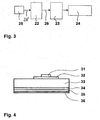
- FIG. 3 shows a schematic block diagram for a humidity control of a Clothes dryer according to one embodiment of the invention with a Humidity sensor 25, a central control and command device 22, an ozone generator 24 and a controllable high voltage generator 23, which the Ozone generator 24 is capable of supplying high voltage.
- control device 22 which one or more conventional functions of the tumble dryer controls and to serve as control and command device 22 ( Figure 3) is, in which case for the moisture control of ozone generation advantageously no additional control and command device is required.
- the command and Control unit 22 of FIG. 3 can therefore be an existing or a be retrofitted control device.
- FIG. 3 is an electrical connection 26,26 'between the tumble dryer controlling central control and command device 22, the sensors 25 and the high voltage generator 23, which drives the ozonization module 24.
- the humidity sensor 25 detects according to the embodiment of Fig. 3, the humidity of the Laundry or the air flowing from the laundry and, if this moisture is less than the predetermined threshold, a switching signal to the control and Command device 22 from. This then gives in turn a switching signal to the high voltage generator 23, which causes this, the high voltage shut down so that the ozone generator 24 no longer receives high voltage and is turned off.
- a humidity sensor is direct connected to the high voltage generator and able to this to Switch off the high voltage, if the measured humidity of the Threshold falls below, without a control and command device is involved.
- these control methods prevent that inside the device can form very high ozone concentrations. Because if the laundry is wet, a large proportion of the ozone produced goes from the gaseous phase to the aqueous one Solution. At a given ozone production of about 50-100mg / h and given natural rate of ozone depletion, namely half-life at high air temperatures and high humidity in the range of a few minutes, resulting in wet laundry ozone concentrations in the range of typically 0.5-1ppm, resulting in a volume of about 50 liters only a weight of a few micrograms airborne ozone. Existing ozone is less in the Air as in front of weak aqueous solution.
- the airborne ozone concentration can be within of the device but increase to values around 3-5ppm. That's not just in terms of the intended objective ineffective, but can permanently adverse effects on Surfaces and ozone-related engineering components.
- Ozone generator by means of a heating element beyond the dew point temperature addition heated.
- the heating element may in particular be an electrical resistance, which is traversed by a heating current and thermally conductive with the Ozone generator is connected.
- a Heating-acting electrical resistance thermally with the ozonization module to pair. By raising the dew point, the formation becomes reliable avoided by condensate. In practical implementation, this is done e.g. by Ankittung a current-carrying electrical resistance to the Ceramic module of the ozonizer.
- the ozone generator has two electrodes, between which a high voltage of a high voltage generator is applied and between which there are at least two dielectrics and after the principle of dielectrically impeded discharge works. Ozone production takes place preferably in compact, flat modules according to the principle of the electrically disabled silent discharge according to the teaching of DE 199 31366.0.
- the tumble dryer has a temperature controller on which with the heating element and on or in the ozone generator arranged temperature sensor is connected and capable of measuring the temperature of the To regulate ozone generator by influencing the heating power of the heating element.
- the temperature sensor can be designed as a conductor structure, in particular made of platinum which is applied to one of the dielectrics, in particular vapor-deposited, is.
- Fig. 4 shows a schematic representation of an embodiment of such Ozone generator, which, however, additionally with a temperature sensor serving conductor structure 36 is provided.
- the ozone generator of Fig. 4 comprises a carrier 33, which consists of a first dielectric and on its a main surface one consisting of another, second dielectric, the Main surface of the carrier 33 only partially covering layer 32 carries.
- a band electrode 31 is arranged so that the second dielectric 32nd between the band electrode 31 and the carrier 33 is located.
- a counter electrode 34 is arranged on the opposite Main surface of the carrier 33.
- a glass layer 35 which serves as an insulator and protection for the Counter electrode 34 is used.
- a conductor structure 36 of a vapor-deposited Metal applied preferably made of platinum.
- This conductor is used on the basis of known dependence temperature / platinum resistance as a temperature sensor. In this case, via lines not shown, the electrical resistance of the conductor structure 36 detected.
- a suitable electrical circuit will ensure that that the temperature of the ozonization module is always a few degrees above the Dew point is operated.
- the counter electrode 34 is at the same time as Temperature sensor used, so that the separate conductor structure 36 can be omitted.
- the counter electrode 34 is referred to as Temperature sensor, wherein the separate conductor structure 36 of a heating current is flowed through and used as a heating element.
- the invention is for a device for the purpose of drying laundry industrially applicable, which on a dry material receiving rotatable Drum, over an air heating and. Over an air fan which, which the heated air through the drum and thus through the to be dried Laundry transported. In the air stream an ozonization device is installed, so that the air is enriched with ozone.
- This will be advantageous the chemical mechanism of oxidation of the laundry carried germs, Odors and organic substances destroyed or passivated.
- the invention in hospitals and nursing homes commercially applicable.
Landscapes
- Engineering & Computer Science (AREA)
- Textile Engineering (AREA)
- Detail Structures Of Washing Machines And Dryers (AREA)
- Accessory Of Washing/Drying Machine, Commercial Washing/Drying Machine, Other Washing/Drying Machine (AREA)
- Oxygen, Ozone, And Oxides In General (AREA)
- Apparatus For Disinfection Or Sterilisation (AREA)
Description
- Fig. 1
- eine schematische Darstellung eines erfindungsgemäßen Wäschetrockners,
- Fig. 2
- einen schematischen Zeitplan für einen erfindungsgemäßen Wäschetrocknungsvorgang,
- Fig. 3
- ein schematisches Blockschaltbild für eine Feuchtesteuerung eines Wäschetrockners gemäß einer Ausführungsform der Erfindung, und
- Fig. 4
- eine schematische Darstellung einer Ausführungsform eines bekannten Ozonerzeugers, welcher zusätzlich mit einer als Temperatursensor dienenden Leiterstruktur versehen ist.
- 1A
- Hauptluftstrom
- 1B
- Nebenluftstrom
- 2
- Ventilator
- 3
- Luftheizer
- 4
- Welle
- 5
- Trommel
- 6,24
- Ozonerzeuger
- 7
- Rohr
- 8
- Abluftstrom
- 10
- Wäschetrockner
- 11
- Einschaltzeit des Ventilators
- 12
- Einschaltzeit des Luftheizers
- 13
- Einschaltzeit des Ozonerzeugers
- 22
- Steuer- und Befehlsgerät
- 23
- Hochspannungsgenerator
- 25
- Feuchtesensor
- 26,26'
- Verbindungen
- 31
- Bandelektrode
- 32
- zweites Dielektrikum
- 33
- erstes Dielektrikum
- 34
- Gegenelektrode
- 35
- Glasschicht
- 36
- Leiterstruktur
- t1
- Abschaltzeitpunkt des Ventilators
- t2
- Abschaltzeitpunkt des Luftheizers
- t3
- Abschaltzeitpunkt des Ozonerzeugers
Claims (21)
- Wäschetrockner mit einem Behälter für Wäsche, insbesondere Trommel (5), in welchen zum Zweck der Trocknung der Wäsche ein Zuluftstrom einleitbar ist, wobei ein Ozonerzeuger (6, 24) angebracht ist, welcher dem Zuluftstrom Ozon zuzusetzen imstande ist, dadurch gekennzeichnet, dass der Zuluftstrom zwei Teil-Luftströme, nämlich einen Hauptluftstrom (1A) und einen Nebenluftstrom (1B) umfasst, wobei in dem Nebenluftstrom (1B) eine geringere Luftmenge pro Zeiteinheit fließt als in dem Hauptluftstrom (1A) und der Ozonerzeuger (6, 24) einem der beiden Teil-Luftströme (1A, 1B) angeordnet ist.
- Wäschetrockner nach Anspruch 1, dadurch gekennzeichnet, dass er einen Luftheizer (3) aufweist, der den Zuluftstrom erwärmt.
- Wäschetrockner nach Anspruch 1 oder 2, dadurch gekennzeichnet, dass der Ozonerzeuger (6,24) im Nebenluftstrom (1B) angeordnet ist und in demselben ein Filter angeordnet ist, welches Partikel aus dem Nebenluftstrom (1B) ausfiltert.
- Wäschetrockner nach mindestens einem der Ansprüche 1 bis 3, dadurch gekennzeichnet, dass derselbe einen Feuchtesensor aufweist, welcher imstande ist, die Feuchte der Wäsche oder der von der Wäsche abströmenden Luft zu erfassen und dann, wenn diese Feuchte geringer ist als ein vorgegebener Schwellenwert, den Ozonerzeuger (6,24) abzuschalten oder eine Abschaltung des Ozonerzeugers (6,24) auszulösen.
- Wäschetrockner nach mindestens einem der Ansprüche 1 bis 4, dadurch gekennzeichnet, dass derselbe einen Zeitgeber aufweist, welcher den Ozonerzeuger (6,24) nach einer vorgegebenen Zeitdauer (T1) nach Beginn des Wäschetrocknungsvorgangs abzuschalten imstande ist.
- Wäschetrockner nach mindestens einem der Ansprüche 1 bis 5, dadurch gekennzeichnet, dass der Behälter (5) eine verschließbare Ladeluke aufweist, wobei der Ozonerzeuger (6,24) nur bei geschlossener Ladeluke einschaltbar ist und der Wäschetrockner (10) einen Abschalter umfasst, welcher imstande ist, den Ozonerzeuger (6,24) vor oder bei Öffnen der Ladeluke zwangsweise abzuschalten.
- Wäschetrockner nach mindestens einem der Ansprüche 1 bis 6, dadurch gekennzeichnet, dass der Behälter (5) eine verschließbare Ladeluke mit einem Öffnungsmechanismus mit einer Blockiereinrichtung aufweist, welche imstande ist, den Öffnungsmechanismus bei eingeschaltetem Ozonerzeuger (6,24) zu blockieren, so dass ein Öffnen der Ladeluke nur bei abgeschaltetem Ozonerzeuger (6,24) möglich ist.
- Wäschetrockner nach Anspruch 7, dadurch gekennzeichnet, dass die Blockierung imstande ist, den Öffnungsmechanismus nach Abschalten des Ozonerzeugers (6,24) noch für eine vorgegebene Wartezeit zu blockieren und erst danach freizugeben, so dass ein Öffnen der Ladeluke nach dem Abschalten des Ozonerzeugers (6,24) erst nach Ablauf der Wartezeit möglich ist.
- Wäschetrockner nach Anspruch 2 und einem der Ansprüche 4 bis 8, dadurch gekennzeichnet, dass derselbe imstande ist, den Zuluftstrom und den Luftheizer (3) nach Abschalten des Ozonerzeugers (10) noch für eine bestimmte Zeitspanne in Gang zu halten.
- Wäschetrockner nach mindestens einem der vorhergehenden Ansprüche, dadurch gekennzeichnet, dass der Ozonerzeuger mittels eines Heizelementes über die Taupunktstemperatur hinaus heizbar ist.
- Wäschetrockner nach Anspruch 10, dadurch gekennzeichnet, dass derselbe einen Temperaturregler aufweist, welcher mit dem Heizelement und einem an oder in dem Ozonerzeuger (6,24) angeordneten Temperatursensor verbunden und imstande ist, die Temperatur des Ozonerzeugers (6,24) durch Beeinflussung der Heizleistung des Heizelementes zu regeln.
- Wäschetrockner nach Anspruch 10 oder 11, dadurch gekennzeichnet, dass das Heizelement ein elektrischer Widerstand ist, welcher thermisch leitend mit dem Ozonerzeuger (6,24) verbunden ist.
- Wäschetrockner nach Anspruch 1, dadurch gekennzeichnet, dass der Ozonerzeuger (6,24) zwei Elektroden aufweist, zwischen welchen eine Hochspannung eines Hochspannungsgenerators (23) angelegt ist und zwischen welchen sich mindestens zwei Dielektrika befinden, und nach dem Prinzip der dielektrisch behinderten Entladung arbeitet.
- Wäschetrockner nach Anspruch 11 und 13, dadurch gekennzeichnet, dass der Temperatursensor und/oder das Heizelement eine Leiterstruktur, insbesondere aus Platin, ist, welche auf eines der Dielektrika aufgebracht, insbesondere aufgedampft, ist.
- Verfahren zum Behandeln von Wäsche, welche sich in einem Behälter, insbesondere Trommel (5) eines Wäschetrockners (10), befindet, wobei zum Zweck der Behandlung der Wäsche, insbesondere Trocknung, in den Behälter ein Zuluftstrom eingeleitet wird, wobei dem Zuluftstrom Ozon zugesetzt wird, welches vor der Einbringung in den Zuluftstrom von einem Ozonerzeuger (6,24) erzeugt wird, dadurch gekennzeichnet, dass der Zuluftstrom zwei Teil-Luftströme umfasst, nämlich einen Hauptluftstrom (1A) und einen Nebenluftstrom (1B), wobei in dem Nebenluftstrom (1B) eine geringere Luftmenge pro Zeiteinheit fließt als in dem Hauptluftstrom (1A), wobei der Ozonerzeuger (6,24) in einem der beiden Teil-Luftströme (1A,1B) angeordnet ist.
- Verfahren nach Anspruch 15, dadurch gekennzeichnet, dass sich das Ozon zunächst in einem Vorrats-Druckbehälter befindet, aus welchem es langsam in den Zuluftstrom entlassen wird.
- Verfahren nach Anspruch 15, dadurch gekennzeichnet, dass der Ozonerzeuger (6,24) zwei Elektroden aufweist, zwischen denen eine Hochspannung angelegt ist und zwischen denen sich mindestens zwei Dielektrika befinden, und welcher nach dem Prinzip der dielektrisch behinderten Entladung betrieben wird.
- Verfahren nach einem der Ansprüche 15 bis 17, dadurch gekennzeichnet, dass der Zuluftstrom nach Abschalten des Ozonerzeugers (6,24) noch für eine bestimmte Zeitspanne in Gang gehalten und geheizt wird.
- Verfahren nach einem der Ansprüche 15 bis 18, dadurch gekennzeichnet, dass der Behälter (5) eine verschließbare Ladeluke mit einem Öffnungsmechanismus mit einer Blockiereinrichtung aufweist, wobei eine Betätigung des Öffnungsmechanismus ein Abschalten des Ozonerzeugers (6,24) auslöst und die Blockiereinrichtung den Öffnungsmechanismus bei eingeschaltetem Ozonerzeuger (6,24) sowie nach Abschalten des Ozonerzeugers (6,24) noch für eine vorgegebene Wartezeit blockiert und erst danach freigibt.
- Verfahren nach mindestens einem der Ansprüche 15 bis 19, dadurch gekennzeichnet, dass der Ozonerzeuger (6,24) durch ein Heizelement auf eine so hohe Temperatur erwärmt wird, dass auf dem Ozonerzeuger (6,24) keine Kondensation stattfindet.
- Verfahren nach Anspruch 20, dadurch gekennzeichnet, dass die Temperatur des Ozonerzeugers (6,24) geregelt wird.
Applications Claiming Priority (3)
| Application Number | Priority Date | Filing Date | Title |
|---|---|---|---|
| DE10103905A DE10103905A1 (de) | 2001-01-30 | 2001-01-30 | Hygienisch einwandfreie Trocknung von Wäsche unter Einsatz von Ozonisatoren |
| DE10103905 | 2001-01-30 | ||
| PCT/DE2002/000317 WO2002061197A1 (de) | 2001-01-30 | 2002-01-30 | Wäschetrockner und verfahren zum behandeln von wäsche |
Publications (2)
| Publication Number | Publication Date |
|---|---|
| EP1356151A1 EP1356151A1 (de) | 2003-10-29 |
| EP1356151B1 true EP1356151B1 (de) | 2005-09-14 |
Family
ID=7672075
Family Applications (1)
| Application Number | Title | Priority Date | Filing Date |
|---|---|---|---|
| EP02706650A Expired - Lifetime EP1356151B1 (de) | 2001-01-30 | 2002-01-30 | Wäschetrockner und verfahren zum behandeln von wäsche |
Country Status (5)
| Country | Link |
|---|---|
| US (1) | US20040237338A1 (de) |
| EP (1) | EP1356151B1 (de) |
| JP (1) | JP2004524892A (de) |
| DE (3) | DE10103905A1 (de) |
| WO (1) | WO2002061197A1 (de) |
Families Citing this family (14)
| Publication number | Priority date | Publication date | Assignee | Title |
|---|---|---|---|---|
| DE10311255A1 (de) | 2002-09-18 | 2004-04-01 | T.E.M.! Technologische Entwicklungen Und Management Gmbh | Lufttransport- und/oder Aufbereitungsanlagen mit katalytisch beschichteten Oberflächen luftberührender Flächen |
| DE10260149A1 (de) * | 2002-12-20 | 2004-07-01 | BSH Bosch und Siemens Hausgeräte GmbH | Vorrichtung zur Bestimmung des Leitwertes von Wäsche, Wäschetrockner und Verfahren zur Verhinderung von Schichtbildung auf Elektroden |
| DE102006037239A1 (de) * | 2006-08-09 | 2008-02-14 | BSH Bosch und Siemens Hausgeräte GmbH | Verfahren und Wäschetrockner bzw. Waschtrockner zum Steuern des Trocknens von feuchter Wäsche |
| WO2008128279A1 (en) * | 2007-04-20 | 2008-10-30 | Eco-Dry Systems Pty Ltd | Ozone dryer |
| KR101308510B1 (ko) * | 2007-11-05 | 2013-09-12 | 동부대우전자 주식회사 | 히터 내장형 흡기관을 구비하는 건조기 |
| KR101256145B1 (ko) * | 2007-11-05 | 2013-04-23 | 동부대우전자 주식회사 | 히터 내장형 흡기관을 구비하는 건조기 |
| DE102010029885A1 (de) * | 2010-06-09 | 2011-12-15 | BSH Bosch und Siemens Hausgeräte GmbH | Verfahren zur Behandlung von Wäsche in einer Waschmaschine bei niedriger Temperatur und hierzu geeignete Waschmaschine |
| TR201010882A1 (tr) * | 2010-12-24 | 2012-07-23 | Ar�El�K Anon�M ��Rket� | Bir ozon üretici içeren kurutucu. |
| KR101580173B1 (ko) * | 2011-02-01 | 2015-12-24 | 삼성전자 주식회사 | 세탁기, 전력 관리기 및 그의 제어 방법 |
| KR102658780B1 (ko) * | 2016-09-21 | 2024-04-19 | 엘지전자 주식회사 | 건조기의 제어 방법 |
| US10648944B2 (en) * | 2016-09-30 | 2020-05-12 | Endress+Hauser Conducta Inc. | Failure analysis of a measuring sensor with an integrated temperature sensor |
| CN108310425B (zh) * | 2018-02-02 | 2021-02-12 | 毕玉亮 | 大棚自动灭菌机 |
| CN113237314B (zh) * | 2021-06-02 | 2022-04-29 | 中科瑞能(山东)科技有限公司 | 一种具有臭氧杀菌功能的粮食烘干塔 |
| CN114108280B (zh) * | 2021-12-24 | 2025-07-11 | 珠海格力电器股份有限公司 | 烘干系统及包括其的衣物处理设备 |
Family Cites Families (7)
| Publication number | Priority date | Publication date | Assignee | Title |
|---|---|---|---|---|
| US2957330A (en) * | 1954-02-26 | 1960-10-25 | Kermit R Cline | Combination washer and drier |
| US3226842A (en) * | 1963-03-06 | 1966-01-04 | Gen Electric | Fabric dryer with ozone type bleaching system |
| US3438136A (en) * | 1965-11-01 | 1969-04-15 | Jack E Raymond | Ozone producing laundry freshening units |
| US3877152A (en) * | 1973-10-03 | 1975-04-15 | Dewitt Y Gorman | Sanitizing and deodorizing apparatus |
| DE3343236A1 (de) * | 1983-11-30 | 1985-06-05 | Hans 4600 Dortmund Baltes | Verfahren und vorrichtung zum trocknen und sterilisieren von geweben, insbesondere von empflindlichen geweben |
| US4941270A (en) * | 1987-09-21 | 1990-07-17 | 501 Geonate Holdings Inc. | Ozone dryer |
| DE19935984A1 (de) * | 1999-07-30 | 2001-02-01 | Bsh Bosch Siemens Hausgeraete | Vorrichtung und Verfahren zum Desodorieren und Desinfizieren von Wäsche |
-
2001
- 2001-01-30 DE DE10103905A patent/DE10103905A1/de not_active Withdrawn
-
2002
- 2002-01-30 JP JP2002561123A patent/JP2004524892A/ja not_active Withdrawn
- 2002-01-30 DE DE50204252T patent/DE50204252D1/de not_active Expired - Lifetime
- 2002-01-30 WO PCT/DE2002/000317 patent/WO2002061197A1/de not_active Ceased
- 2002-01-30 US US10/466,319 patent/US20040237338A1/en not_active Abandoned
- 2002-01-30 EP EP02706650A patent/EP1356151B1/de not_active Expired - Lifetime
- 2002-01-30 DE DE10290283T patent/DE10290283D2/de not_active Expired - Fee Related
Also Published As
| Publication number | Publication date |
|---|---|
| DE10290283D2 (de) | 2004-04-15 |
| EP1356151A1 (de) | 2003-10-29 |
| JP2004524892A (ja) | 2004-08-19 |
| DE50204252D1 (de) | 2005-10-20 |
| WO2002061197A1 (de) | 2002-08-08 |
| DE10103905A1 (de) | 2002-08-01 |
| US20040237338A1 (en) | 2004-12-02 |
Similar Documents
| Publication | Publication Date | Title |
|---|---|---|
| DE3603900A1 (de) | Trinkwasserreinigungseinrichtung | |
| DE60220389T2 (de) | System und verfahren zur desinfektion eines kryostats | |
| EP1356151A1 (de) | Wäschetrockner und verfahren zum behandeln von wäsche | |
| DE60122480T2 (de) | Überwachung von sterilisation unter verwendung von gas | |
| DE60006142T2 (de) | Methode und apparat zur dampfphasensterilisation | |
| US5788930A (en) | Apparatus for purifying an environment using ozone generation | |
| DE69029660T2 (de) | Rückführung sowie dampf- und feuchtigkeitskontrolle in einem abdichtbaren behälter | |
| EP2785385B1 (de) | Domestic appliance with deodorising system | |
| DE102005003923A1 (de) | Vorrichtung und Verfahren zum Entkeimen von Raumluft | |
| DE102014224728B3 (de) | Wäschepflegegerät mit einer Desodorierungseinrichtung | |
| WO2009021919A2 (de) | Verfahren zur textilreinigung und desinfektion mittels plasma und plasmaschleuse | |
| DE102011082925B4 (de) | Dunstabzugsvorrichtung und Verfahren zum Betreiben einer Dunstabzugsvorrichtung | |
| DE202010018636U1 (de) | Vorrichtung für die Behandlung von Verunreinigungen in Luft und Materialien | |
| DE202017007059U1 (de) | Luftbehandlungssystem | |
| WO2022248097A1 (de) | Plasmaquelle zur handdesinfektion | |
| WO2004014442A1 (de) | Luftreinigungsgerät | |
| EP1925478B1 (de) | Belüftungssystem, Heizungs- und/oder Klimaanlage | |
| DE2657315A1 (de) | Verfahren und anlage zur desinfektion mit formalin | |
| DE19513943A1 (de) | Verfahren und Vorrichtung zur Verbesserung der Raumluftqualität | |
| DE102020206222A1 (de) | Plasmavorrichtung | |
| WO2023148026A1 (de) | Vorrichtung und verfahren zur wiederaufbereitung von zu flakes zerkleinerten und gewaschenen post-consumer kunststoffabfällen | |
| WO2004028668A9 (de) | Lufttransport- und/oder aufbereitungsanlagen mit katalytisch beschichteten oberflächen luftberührender flächen | |
| WO2021191040A1 (de) | Vorrichtung zur desinfektion von gegenständen oder feststoffen, vorzugsweise von schutzausrüstungsteilen, und deren verwendung | |
| DE19935984A1 (de) | Vorrichtung und Verfahren zum Desodorieren und Desinfizieren von Wäsche | |
| EP3964760A1 (de) | Luftbehandlungssystem zum reinigen von raumluft |
Legal Events
| Date | Code | Title | Description |
|---|---|---|---|
| PUAI | Public reference made under article 153(3) epc to a published international application that has entered the european phase |
Free format text: ORIGINAL CODE: 0009012 |
|
| 17P | Request for examination filed |
Effective date: 20030828 |
|
| AK | Designated contracting states |
Kind code of ref document: A1 Designated state(s): AT BE CH CY DE DK ES FI FR GB GR IE IT LI LU MC NL PT SE TR |
|
| AX | Request for extension of the european patent |
Extension state: AL LT LV MK RO SI |
|
| 17Q | First examination report despatched |
Effective date: 20040121 |
|
| GRAP | Despatch of communication of intention to grant a patent |
Free format text: ORIGINAL CODE: EPIDOSNIGR1 |
|
| GRAS | Grant fee paid |
Free format text: ORIGINAL CODE: EPIDOSNIGR3 |
|
| RAP1 | Party data changed (applicant data changed or rights of an application transferred) |
Owner name: AUTOMOTIVE AG |
|
| GRAA | (expected) grant |
Free format text: ORIGINAL CODE: 0009210 |
|
| RBV | Designated contracting states (corrected) |
Designated state(s): DE FR GB IT |
|
| AK | Designated contracting states |
Kind code of ref document: B1 Designated state(s): DE FR GB IT |
|
| REG | Reference to a national code |
Ref country code: GB Ref legal event code: FG4D Free format text: NOT ENGLISH |
|
| REF | Corresponds to: |
Ref document number: 50204252 Country of ref document: DE Date of ref document: 20051020 Kind code of ref document: P |
|
| GBT | Gb: translation of ep patent filed (gb section 77(6)(a)/1977) |
Effective date: 20051202 |
|
| ET | Fr: translation filed | ||
| PLBE | No opposition filed within time limit |
Free format text: ORIGINAL CODE: 0009261 |
|
| STAA | Information on the status of an ep patent application or granted ep patent |
Free format text: STATUS: NO OPPOSITION FILED WITHIN TIME LIMIT |
|
| 26N | No opposition filed |
Effective date: 20060615 |
|
| PGFP | Annual fee paid to national office [announced via postgrant information from national office to epo] |
Ref country code: FR Payment date: 20100315 Year of fee payment: 9 Ref country code: IT Payment date: 20100227 Year of fee payment: 9 |
|
| PGFP | Annual fee paid to national office [announced via postgrant information from national office to epo] |
Ref country code: DE Payment date: 20100215 Year of fee payment: 9 Ref country code: GB Payment date: 20100219 Year of fee payment: 9 |
|
| GBPC | Gb: european patent ceased through non-payment of renewal fee |
Effective date: 20110130 |
|
| REG | Reference to a national code |
Ref country code: FR Ref legal event code: ST Effective date: 20110930 |
|
| PG25 | Lapsed in a contracting state [announced via postgrant information from national office to epo] |
Ref country code: FR Free format text: LAPSE BECAUSE OF NON-PAYMENT OF DUE FEES Effective date: 20110131 |
|
| PG25 | Lapsed in a contracting state [announced via postgrant information from national office to epo] |
Ref country code: GB Free format text: LAPSE BECAUSE OF NON-PAYMENT OF DUE FEES Effective date: 20110130 |
|
| REG | Reference to a national code |
Ref country code: DE Ref legal event code: R119 Ref document number: 50204252 Country of ref document: DE Effective date: 20110802 |
|
| PG25 | Lapsed in a contracting state [announced via postgrant information from national office to epo] |
Ref country code: IT Free format text: LAPSE BECAUSE OF NON-PAYMENT OF DUE FEES Effective date: 20110130 |
|
| PG25 | Lapsed in a contracting state [announced via postgrant information from national office to epo] |
Ref country code: DE Free format text: LAPSE BECAUSE OF NON-PAYMENT OF DUE FEES Effective date: 20110802 |