EP1355083A2 - Thermisches Modell zum Ausgleich der Temperatur eines magnetorheologischen Dämpfers - Google Patents
Thermisches Modell zum Ausgleich der Temperatur eines magnetorheologischen Dämpfers Download PDFInfo
- Publication number
- EP1355083A2 EP1355083A2 EP03075995A EP03075995A EP1355083A2 EP 1355083 A2 EP1355083 A2 EP 1355083A2 EP 03075995 A EP03075995 A EP 03075995A EP 03075995 A EP03075995 A EP 03075995A EP 1355083 A2 EP1355083 A2 EP 1355083A2
- Authority
- EP
- European Patent Office
- Prior art keywords
- damper
- coefficient
- temperature
- characteristic
- power input
- Prior art date
- Legal status (The legal status is an assumption and is not a legal conclusion. Google has not performed a legal analysis and makes no representation as to the accuracy of the status listed.)
- Withdrawn
Links
- 239000000725 suspension Substances 0.000 claims abstract description 34
- 238000000034 method Methods 0.000 claims abstract description 21
- 230000001965 increasing effect Effects 0.000 claims description 8
- 230000003247 decreasing effect Effects 0.000 claims description 4
- 239000012530 fluid Substances 0.000 description 31
- 238000004364 calculation method Methods 0.000 description 13
- 230000006870 function Effects 0.000 description 13
- 238000010586 diagram Methods 0.000 description 10
- 239000000047 product Substances 0.000 description 5
- 230000005291 magnetic effect Effects 0.000 description 4
- 239000006096 absorbing agent Substances 0.000 description 3
- 230000000694 effects Effects 0.000 description 3
- 230000035939 shock Effects 0.000 description 3
- XEEYBQQBJWHFJM-UHFFFAOYSA-N Iron Chemical compound [Fe] XEEYBQQBJWHFJM-UHFFFAOYSA-N 0.000 description 2
- 230000006835 compression Effects 0.000 description 2
- 238000007906 compression Methods 0.000 description 2
- 238000013016 damping Methods 0.000 description 2
- 238000013461 design Methods 0.000 description 2
- 238000013507 mapping Methods 0.000 description 2
- 238000005259 measurement Methods 0.000 description 2
- 239000002245 particle Substances 0.000 description 2
- 230000008569 process Effects 0.000 description 2
- 238000012360 testing method Methods 0.000 description 2
- 229910000640 Fe alloy Inorganic materials 0.000 description 1
- 230000001133 acceleration Effects 0.000 description 1
- 238000013459 approach Methods 0.000 description 1
- 230000003139 buffering effect Effects 0.000 description 1
- 230000008859 change Effects 0.000 description 1
- 238000001816 cooling Methods 0.000 description 1
- 230000002349 favourable effect Effects 0.000 description 1
- 230000005294 ferromagnetic effect Effects 0.000 description 1
- 230000001939 inductive effect Effects 0.000 description 1
- 230000002452 interceptive effect Effects 0.000 description 1
- 229910052742 iron Inorganic materials 0.000 description 1
- 239000006249 magnetic particle Substances 0.000 description 1
- 238000012986 modification Methods 0.000 description 1
- 230000004048 modification Effects 0.000 description 1
- 239000012466 permeate Substances 0.000 description 1
- 238000012545 processing Methods 0.000 description 1
- 230000000135 prohibitive effect Effects 0.000 description 1
- 238000012546 transfer Methods 0.000 description 1
- 230000009466 transformation Effects 0.000 description 1
Images


Classifications
-
- B—PERFORMING OPERATIONS; TRANSPORTING
- B60—VEHICLES IN GENERAL
- B60G—VEHICLE SUSPENSION ARRANGEMENTS
- B60G17/00—Resilient suspensions having means for adjusting the spring or vibration-damper characteristics, for regulating the distance between a supporting surface and a sprung part of vehicle or for locking suspension during use to meet varying vehicular or surface conditions, e.g. due to speed or load
- B60G17/015—Resilient suspensions having means for adjusting the spring or vibration-damper characteristics, for regulating the distance between a supporting surface and a sprung part of vehicle or for locking suspension during use to meet varying vehicular or surface conditions, e.g. due to speed or load the regulating means comprising electric or electronic elements
- B60G17/0152—Resilient suspensions having means for adjusting the spring or vibration-damper characteristics, for regulating the distance between a supporting surface and a sprung part of vehicle or for locking suspension during use to meet varying vehicular or surface conditions, e.g. due to speed or load the regulating means comprising electric or electronic elements characterised by the action on a particular type of suspension unit
-
- F—MECHANICAL ENGINEERING; LIGHTING; HEATING; WEAPONS; BLASTING
- F16—ENGINEERING ELEMENTS AND UNITS; GENERAL MEASURES FOR PRODUCING AND MAINTAINING EFFECTIVE FUNCTIONING OF MACHINES OR INSTALLATIONS; THERMAL INSULATION IN GENERAL
- F16F—SPRINGS; SHOCK-ABSORBERS; MEANS FOR DAMPING VIBRATION
- F16F9/00—Springs, vibration-dampers, shock-absorbers, or similarly-constructed movement-dampers using a fluid or the equivalent as damping medium
- F16F9/32—Details
- F16F9/53—Means for adjusting damping characteristics by varying fluid viscosity, e.g. electromagnetically
- F16F9/535—Magnetorheological [MR] fluid dampers
-
- B—PERFORMING OPERATIONS; TRANSPORTING
- B60—VEHICLES IN GENERAL
- B60G—VEHICLE SUSPENSION ARRANGEMENTS
- B60G2400/00—Indexing codes relating to detected, measured or calculated conditions or factors
- B60G2400/20—Speed
- B60G2400/202—Piston speed; Relative velocity between vehicle body and wheel
-
- B—PERFORMING OPERATIONS; TRANSPORTING
- B60—VEHICLES IN GENERAL
- B60G—VEHICLE SUSPENSION ARRANGEMENTS
- B60G2400/00—Indexing codes relating to detected, measured or calculated conditions or factors
- B60G2400/20—Speed
- B60G2400/204—Vehicle speed
-
- B—PERFORMING OPERATIONS; TRANSPORTING
- B60—VEHICLES IN GENERAL
- B60G—VEHICLE SUSPENSION ARRANGEMENTS
- B60G2400/00—Indexing codes relating to detected, measured or calculated conditions or factors
- B60G2400/70—Temperature of vehicle part or in the vehicle
- B60G2400/73—Temperature of vehicle part or in the vehicle of other part than suspension unit
- B60G2400/732—Temperature of vehicle part or in the vehicle of other part than suspension unit of propulsion unit
-
- B—PERFORMING OPERATIONS; TRANSPORTING
- B60—VEHICLES IN GENERAL
- B60G—VEHICLE SUSPENSION ARRANGEMENTS
- B60G2400/00—Indexing codes relating to detected, measured or calculated conditions or factors
- B60G2400/80—Exterior conditions
- B60G2400/84—Atmospheric conditions
- B60G2400/842—Temperature
Definitions
- the present invention relates generally to vehicular suspension systems. More particularly, the invention relates to a thermal model for magnetorheological damper temperature compensation.
- Linear suspension dampers such as shock absorbers and McPherson struts, may include a rod and piston positioned within a cylindrical housing. Suspension movements transmitted to the rod and piston may be dampened as the damper compresses and rebounds.
- the rod may be attached concentrically to one side of the piston and both translate back and forth inside the housing, which is filled with a substantially incompressible hydraulic fluid. As the piston moves, the fluid is forced through one or more passageways from in the piston. The piston is met with frictional resistance during damper compression and rebound.
- MR fluids are commonly used in dampers to provide favorable dampening characteristics during compression and rebound.
- MR fluids are generally suspensions of magnetic particles such as iron or iron alloys in a fluid medium. The flow characteristics of these fluids can change by several orders of magnitude within milliseconds when subjected to a suitable magnetic field due to suspension of the particles. The ferromagnetic particles remain suspended under the influence of magnetic fields and applied forces.
- MR fluids are well known and have been found to have desirable electromagnetomechanical interactive properties for controlling dissipative forces along the damper's axis.
- a linear acting MR damper piston may include a coil assembly, a core, and an annular piston ring positioned around the pole pieces to form an annular flow passageway.
- MR fluid is forced through the passageway from one area of the damper housing to another.
- the coil is energized (e.g., damper on-state)
- a magnetic field permeates a portion of the passageway and excites a transformation of the MR fluid to a state that exhibits increased damping force.
- the degree of dampening force may be selectively controlled by adjusting the current run through the coil assembly and locally modulating the flow characteristics of the MR fluid.
- MR fluid viscosity is a function of fluid temperature, which invariably increases during damper operation.
- An increase in fluid temperature typically attenuates damping force thereby changing the dampening profile and vehicle ride characteristics.
- the MR fluid state may be used to compensate for changes in fluid temperature.
- the coil assembly current may be increased with higher temperatures to counter the effects of decreased fluid viscosity and dampening force. This strategy, however, is predicated on a reliable measurement or fluid temperature estimation. Accordingly, it would be desirable to provide a strategy for estimating damper temperature.
- a first aspect of the present invention provides a method of controlling a magnetorheological damper.
- the method includes calculating a power input coefficient based on at least one power input characteristic.
- a power dissipation coefficient is calculated based on at least one power dissipation characteristic.
- a damper temperature is estimated based on the calculated power input coefficient and the calculated power dissipation coefficient.
- At least one dampening force characteristic is modulated based on the estimated damper temperature.
- a second aspect of the present invention provides a computer usable medium including a program for controlling a magnetorheological damper as described for the first aspect of the invention.
- a third aspect of the present invention provides a suspension control system for controlling at least one magnetorheological damper.
- the suspension control system includes means for calculating a power input coefficient based on at least one power input characteristic and means for calculating a power dissipation coefficient based on at least one power dissipation characteristic.
- the suspension control system further includes means for estimating a damper temperature based on the calculated power input coefficient and the calculated power dissipation coefficient and means for modulating at least one dampening force characteristic based on the estimated damper temperature
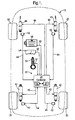
- FIG. 1 is a schematic view of a vehicle, shown generally by numeral 10, with a suspension control system 20 in accordance with the present invention.
- vehicle 10 and suspension control system 20 may include a number of alternative designs and may be employed in a variety of applications.
- the vehicle 10 and suspension control system 20 include four linear acting fluid magnetorheological (MR) dampers for generating dampening forces in a motor vehicle suspension system.
- MR linear acting fluid magnetorheological
- Vehicle 10 is supported on four wheels 30 by four suspensions including springs (not shown) of a known type.
- Each suspension may include a variable-force, real time, controllable MR damper 40 connected to dampen vertical forces between wheel 30 and vehicle 10 body at that suspension point.
- the damper 40 may be an electrically controllable, variable dampening force shock absorber with a weight bearing coil spring in a parallel spring/shock absorber or McPherson strut arrangement.
- MR damper that may be adapted for use with the present invention is described in U.S. Pat. No. 6,419,058 to Oliver et al.
- a damper may receive a signal for generating variable dampening forces by, for example, applying current to a coil assembly associated with a damper piston.
- the coil generates a magnetic field inducing localized flow characteristic changes in MR fluid thereby increasing dampening force.
- Each damper 40 may include a relative position sensor 42 that provides an output signal, represented by line 44 , indicative of the relative vertical distance between the corresponding wheel 30 and a suspended vehicle body at that corner of the vehicle 10.
- the outputs of position sensors 42 may be differentiated to produce relative body-wheel vertical velocity signals for each corner of the vehicle 10 .
- the position sensor 42 may include a resistive device mounted to the vehicle 10 body and a link pivotally coupled between the wheel 30 and a pivot arm on the resistive device.
- the resistive device may provide an impedance output that varies with the relative vertical position between wheel 30 and the corner of body 10 .
- Each position sensor 42 may further include an internal circuit board with a buffer circuit for buffering the output signal of the resistive device and providing the buffered signal to a suspension controller 25 .
- Suitable position sensors 42 are known to, or can be constructed by, those skilled in the art. Numerous alternative types of position, velocity, and acceleration sensors, including transformer type sensors, may be adapted for use with the present invention.
- the outputs of the position sensors 42 may be provided to the suspension controller 25 , which may process the signals to calculate damper relative velocity and thus estimate average dampening force.
- the suspension controller 25 may utilize such data stored in a memory portion, such as a look-up table, to estimate average dampening force wherein a direct linear relationship exists between damper relative velocity and average dampening force. The data may be determined experimentally for each individual damper 40 .
- the suspension controller 25 may estimate dampening force using any number of mathematical formulae or equations known in the art.
- damper relative velocity may be measured directly by appropriate sensors coupled to the damper 40 and the sensor information sent to the suspension controller 25 .
- Those skilled in the art will appreciate that numerous strategies may be utilized to facilitate calculations and determinations associated with the present invention. The calculations and determinations may be performed using look-up tables, equations, relationships, and other means known in the art.
- the suspension controller 25 may include a digital microprocessor 26 programmed to process a plurality of input signals in a stored algorithm and generate output control signals 46 for varying the dampening force of the dampers 40 .
- the methods, algorithms, and determinations e.g., calculations and estimations, including those based on equations or value tables, may be performed by a device such as the microprocessor 26 .
- the microprocessor 26 may receive input, perform determinations, and provide output for controlling the damper 40 dampening force and, consequently, the vehicle 10 suspension characteristics.
- the computer usable medium and value tables associated with the present invention may be programmed or read into a microprocessor memory portion 27 (e.g., ROM, RAM, and the like) for executing functions associated with the present invention.
- Analog signal processing may be provided for some of the input signals.
- the signals from relative position sensors 42 may be low-pass filtered through four analog low-pass filters and differentiated through four analog differentiators to provide four discrete relative velocity signals, one for each damper 40 .
- the resulting relative velocity signals represent the relative vertical velocities between each of wheels 30 and the corresponding corner of the vehicle 10 body.
- Each of these relative velocity signals may be input into the microprocessor 26 , which includes an input A/D converter with multiplexed inputs.
- the relative position sensors 42 may be replaced with relative velocity sensors of a type known to those skilled in the art capable of outputting signals indicative of the relative velocity between each wheel 30 and corner of the vehicle 10 body. In this alternative, there is no need for the differentiators.
- one or more ambient temperature sensor(s) 50 may provide ambient temperature signal(s) 52 to the microprocessor 26 .
- one or more vehicle speed sensor(s) 54 may provide vehicle speed signal(s) 56 to the microprocessor 26
- one or more engine temperature sensor(s) 58 may provide engine temperature signal(s) 60 to the microprocessor 26 .
- the signals 44, 52, 56, 60 may be buffered in a manner known in the art to remove unwanted noise.
- the signals 44, 52, 56, 60 may comprise a pulse train having pulse timing, of which the type and decoding are well known in the art.
- FIG. 2 is a flow diagram of a magnetorheological damper control algorithm for use in the suspension control system 20 of FIG. 1 .
- a power input coefficient is calculated based on at least one power input characteristic (step 300 ).
- the power input coefficient calculation may address numerous factors that provide direct or indirect energy input to the damper (fluid) and may thus affect its temperature.
- the power input characteristics may be damper relative velocity and vehicle speed.
- the power input characteristic may address numerous other factors influencing damper power input including, but not limited to, damper coil current and damper coil resistance.
- An ambient temperature coefficient may be calculated based on at least one thermal characteristic (step 301 ).
- the ambient temperature coefficient calculation may address numerous factors that affect the air temperature immediately surrounding a given damper.
- the thermal characteristics may be engine temperature and ambient temperature.
- the thermal characteristic may address numerous other factors influencing damper air temperature.
- a power dissipation coefficient is calculated based on at least one power dissipation characteristic (step 302 ).
- the power dissipation coefficient calculation may address numerous factors that affect energy output from the damper (fluid) and may thus affect its temperature.
- the power dissipation characteristic may be vehicle speed and the previously calculated ambient temperature coefficient.
- the power dissipation coefficient may address numerous other factors influencing damper power output including, but not limited to, damper surface area, damper heat conductivity, and damper air flow.
- a damper temperature is then estimated based on the calculated power input coefficient and the calculated power dissipation coefficient (step 303 ).
- a temperature estimate may be provided for each vehicle damper.
- the calculated damper temperature estimate may be stored and retrieved in the microprocessor memory portion at essentially any point of the magnetorheological damper control algorithm (step 304 ).
- At least one dampening force characteristic may then be modulated based on the estimated damper temperature (step 305 ).
- modulating the dampening force characteristic includes increasing or decreasing damper force to compensate for changes in damper performance due to fluid temperature changes.
- FIG. 3 is a block diagram of a portion of the magnetorheological damper control algorithm represented in FIG. 2.
- four damper relative velocities 100 and a vehicle speed 102 may be input into a power input block 104 for calculating four power input coefficients, one for each damper: a left front (LF) power input coefficient 106 , a right front (RF) power input coefficient 107 , a left rear (LR) power input coefficient 108 , and a right rear (RR) power input coefficient 109 .
- the vehicle speed 102 , an ambient temperature 110 , and an engine temperature 112 may be provided to an ambient temperature coefficient calculation block 114 for calculating four ambient temperature coefficients, one for each damper 115, 116, 117, 118 .
- the vehicle speed 102 and the corresponding calculated power input coefficient 106, 107, 108, 109 and ambient temperature coefficient 115, 116, 117, 118 may be provided to a temperature estimation block 120, 121, 122, 123 for estimating temperature of each damper: a left front (LF) damper temperature estimate 125 , a right front (RF) damper temperature estimate 126 , a left rear (LR) damper temperature estimate 127 , and a right rear (RR) damper temperature estimate 128.
- LF left front
- RF right front
- LR left rear
- RR right rear
- the damper temperature estimates 125, 126, 127, 128 may then be stored in the microprocessor memory portion 27 for use by the suspension controller.
- the microprocessor memory portion 27 may provide means for storing the damper temperature estimates 125, 126, 127, 128 in a nonvolatile manner.
- the damper temperature estimates 125, 126, 127, 128 may be recalled for numerous functions and at various times as, for example, after the vehicle is shut down and restarted.
- FIG. 4 is a block diagram detail of the power input coefficient calculation block 104 shown in FIG. 3.
- an absolute value of the four damper relative velocities 100 may be calculated and the subsequent signal 130 demuxed as known in the art into two portions, representing front and rear damper relative velocities 131, 132.
- the front and rear damper relative velocities 131, 132 may be further demuxed into left and right portions, thus producing relative velocity values for each damper 135 , 136, 137, 138.
- the front and rear damper relative velocity portions 131, 132 may also be input into front and rear look-up tables 140, 142 , respectively, to provide front and rear damper force value estimates 144, 145.
- Look-up tables 140, 142 may be determined empirically based on typical damper coil current profiles and damper force-velocity characteristics. A straight-line mapping of damper relative velocity to damper force estimate value, as indicated graphically in blocks 140, 142, may provide an acceptable estimation of damper force value. Higher-order functions of damper relative velocity or multiple-point look-up table approaches may also be used. For a controlled damper such as a magnetorheological damper, the actual damper force value at any instant may be a function of both damper relative velocity and damper coil current.
- damper force value estimates may be computed based on damper relative velocity and damper coil current, and using a complete two-dimensional mapping of expected damper force versus damper velocity and damper coil current.
- damper test press data at multiple test velocities and multiple coil current levels may be used to create the indices for a two-dimensional look-up table. This embodiment will typically produce very accurate damper force estimate values, but may be computationally prohibitive.
- the force value estimates 144, 145 may then be demuxed into right and left portions, thus producing force value estimates for each damper 146 , 147, 148, 149.
- the relative velocity values 135, 136, 137, 138 and force estimates 146, 147, 148, 149 may be input to an operational block 150, 151, 152, 153 wherein a power input coefficient 106, 107, 108, 109 is calculated as the product of the relative velocity values 135, 136, 137, 138 and the corresponding force estimates 146, 147, 148, 149 .
- the calculated power input coefficient 106, 107, 108, 109 may then be provided to an operational switch 160, 161, 162, 163.
- the operation switch 160, 161, 162, 163 may also receive a power limit value 165 , which may be determined based on a comparison of vehicle speed 102 to a predetermined speed threshold level 166 .
- the power limit value 165 may be provided as a "cut-off" so that power input to the damper is ignored or set to a predetermined value when the vehicle travels below a certain speed. For example, if the vehicle speed 102 is equal to or greater than the speed threshold level 166 , then the operational switch 160, 161, 162, 163 may output the calculated power input coefficient 106, 107, 108, 109 from the operational block 150, 151, 152, 153. If the vehicle speed 102 is below the speed threshold level 166 , then the operational switch 160, 161, 162, 163 may reset the calculated power input coefficient 106, 107, 108, 109 to a predetermined value 167, in this case 0.
- FIG. 5 is a block diagram detail of an ambient temperature coefficient calculation block 114 shown in FIG. 3.
- the ambient temperature coefficient 115, 116, 117, 118 may be determined by block 170, 171, 172, 173 as the sum of the ambient temperature 110 and a temperature adjustment coefficient 175, 176, 177, 178.
- the temperature adjustment coefficient 175, 176, 177, 178 may be determined by block 180, 181, 182, 183 as the product of a scale factor 185, 186, 187, 188 and an engine temperature coefficient 184.
- the scale factor 185, 186, 187, 188 may be determined from a look-up table 190, 191, 192, 193 for each damper as a function of the vehicle speed 102 wherein differential air flow at each damper affects its cooling rate.
- Parameters for look-up table 190, 191, 192, 193 will generally be such that scale factor outputs 185, 186, 187, 188 decrease with increasing vehicle speed, and may be determined empirically based on measured vehicle data.
- maximum scale factor outputs 185, 186, 187, 188 may be equivalent to the maximum additional temperature for each respective damper due to the influence of engine temperature. These values may be determined by measurement.
- the engine temperature coefficient 184 may be determined by block 194 , which receives a time based gain value 195 and a scale factor 196 .
- the time based gain value 195 may be determined from a look-up table 197 that receives input from a clock 198 function wherein the amount of engine heat transferred to the dampers progressively increases over time until a pre-defined maximum gain value is achieved.
- the scale factor 196 may be determined from a look-up table 199 as a function of the engine temperature 112 .
- the time based gain value 195 and scale factor 196 and thus their product, the engine temperature coefficient 184 may range in value from 0 to 1.
- the engine temperature 112 and/or ambient temperature coefficient 115, 116, 117, 118 may be stored to nonvolatile microprocessor memory portion 27 , so that previously stored values may be retrieved at the start of an ignition cycle and used along with time information to compute initial conditions.
- FIG. 6 is a block diagram detail of the left front damper temperature estimation block 120 shown in FIG. 3.
- a damper temperature estimation block is performed for each damper in a manner analogous to that shown for the left front damper.
- the left front damper power input coefficient 106 and a power dissipation coefficient 200 may be input into a heat flow estimation block 210.
- the power dissipation coefficient 200 may be calculated by a power dissipation block 202 as the product of a convection/conduction coefficient 204 and a damper temperature rise over ambient value 206.
- the convection/conduction coefficient 204 may be calculated via a look-up table 205 using the vehicle speed 102 as an input.
- the damper temperature rise over ambient value 206 may be calculated by a modified temperature block 207 as the previously computed damper temperature estimate 125 minus the ambient temperature coefficient 115 .
- the heat flow estimation block 210 may calculate a fluid heat flow coefficient 211 as the power input coefficient 106 minus the power dissipation coefficient 200 . In this manner, the fluid heat flow coefficient 211 relates to the heat flow into or out of the damper.
- the fluid heat flow coefficient 211 is input to a block 212 along with a thermal inertia coefficient 213 .
- the block 212 may compute a modified fluid heat flow coefficient 214 as the product of the fluid heat flow coefficient 211 and the thermal inertia coefficient 213 .
- Modified fluid heat flow coefficient 214 may be output to a discrete-time integrator block 215 , which may also receive an initial temperature value 216 .
- the initial temperature value 216 may be calculated by block 220 , which may receive a time value 221 , a cool-off coefficient 222 , and a muxed signal 223 including the previously determined stored damper temperature estimate 209 retrieved from the microprocessor memory portion 27 and the ambient temperature coefficient 115 .
- the initial temperature value 216 will generally have a value between the ambient temperature coefficient 115 and the previously determined stored damper temperature estimate 209 , and may be determined as a function of time since last damper activity and a pre-determined cool-down rate.
- Block 220 may employ a multi-point look-up table wherein the rate at which a given damper cools is estimated as a function of time from last damper activity (e.g., cool-off time), ambient temperature, and the like.
- the discrete-time integrator block 215 may estimate the left front damper temperature 125 , which may then be stored in the microprocessor memory portion 27. As reflected in FIG. 6, discrete-time integrator block 215 may be implemented with a discrete-time transfer function T/(z-1), where parameter T may be chosen based on the execution interval, as recognized to those skilled in the art.
- the suspension controller 25 may modulate dampening force characteristics based on those estimates.
- the suspension controller 25 may generate output control signals 46 for varying the dampening force of the dampers 40 .
- the suspension controller 25 may compensate for the loss in dampening force by increasing the current provided to the MR assembly of the damper 40 .
- One or more look-up table(s), equations, and the like may be provided to the suspension controller 25 as known in the art for relating damper fluid temperature to MR current for maintaining a desired dampening force.
- pending application Serial No. 09/981,082 filed October 16, 2001 to lyengar et al discloses a strategy for temperature compensation in an MR fluid damper that may be adapted for use with the present invention.
- suspension control system and method of controlling the MR damper are not limited to any particular design, configuration, sequence, or arrangement.
- the damper, sensor, and controller configuration, size, shape, geometry, location, orientation, number, and function may vary without limiting the utility of the invention.
- the method may be accomplished by numerous alternative strategies, may include additional steps, and vary in step order.
Landscapes
- Engineering & Computer Science (AREA)
- Mechanical Engineering (AREA)
- General Engineering & Computer Science (AREA)
- Physics & Mathematics (AREA)
- Electromagnetism (AREA)
- Vehicle Body Suspensions (AREA)
Applications Claiming Priority (2)
| Application Number | Priority Date | Filing Date | Title |
|---|---|---|---|
| GB0208685 | 2002-04-16 | ||
| GBGB0208685.8A GB0208685D0 (en) | 2002-04-16 | 2002-04-16 | Temperature compensation for a magnetorheological fluid damper |
Publications (2)
| Publication Number | Publication Date |
|---|---|
| EP1355083A2 true EP1355083A2 (de) | 2003-10-22 |
| EP1355083A3 EP1355083A3 (de) | 2004-01-21 |
Family
ID=9934918
Family Applications (1)
| Application Number | Title | Priority Date | Filing Date |
|---|---|---|---|
| EP03075995A Withdrawn EP1355083A3 (de) | 2002-04-16 | 2003-04-04 | Thermisches Modell zum Ausgleich der Temperatur eines magnetorheologischen Dämpfers |
Country Status (3)
| Country | Link |
|---|---|
| US (1) | US20030195683A1 (de) |
| EP (1) | EP1355083A3 (de) |
| GB (1) | GB0208685D0 (de) |
Cited By (8)
| Publication number | Priority date | Publication date | Assignee | Title |
|---|---|---|---|---|
| EP1557304A1 (de) * | 2004-01-23 | 2005-07-27 | Delphi Technologies, Inc. | Magnetorheologischer Dämpfer mit Überhitzungsschutz |
| US6953108B2 (en) * | 2003-04-04 | 2005-10-11 | Millenworks | Magnetorheological damper system |
| FR2899844A1 (fr) * | 2006-04-14 | 2007-10-19 | Peugeot Citroen Automobiles Sa | Procede de commande de suspension pour vehicule automobile minimisant la sensibilite a l'aquaplanning et systeme integrant le procede de commande |
| US8322497B2 (en) | 2006-05-01 | 2012-12-04 | Lord Corporation | Magneto-rheological dampers for semi-active suspension systems |
| US8602182B2 (en) | 2006-05-01 | 2013-12-10 | Lord Corporation | Controllable vehicle suspension system with a controllable magnetorheological fluid strut |
| DE102012012535A1 (de) * | 2012-06-26 | 2014-01-02 | Inventus Engineering Gmbh | Dämpfer und Verfahren zum Betreiben eines Dämfers |
| JPWO2017002620A1 (ja) * | 2015-06-30 | 2018-05-24 | 日立オートモティブシステムズ株式会社 | サスペンション制御装置 |
| US11358432B2 (en) | 2018-09-25 | 2022-06-14 | Hitachi Astemo, Ltd. | Suspension control apparatus |
Families Citing this family (9)
| Publication number | Priority date | Publication date | Assignee | Title |
|---|---|---|---|---|
| US8275515B2 (en) * | 2007-12-12 | 2012-09-25 | Honeywell International Inc. | Shock absorber health and condition monitoring device |
| DE102008006187B4 (de) | 2008-01-26 | 2015-03-05 | Audi Ag | Kraftfahrzeug mit verbesserter Radbewegungsdämpfung |
| US9527364B2 (en) * | 2014-12-08 | 2016-12-27 | Ford Global Technologies, Llc | System and method for estimating damper temperature |
| JP2020142535A (ja) * | 2017-06-28 | 2020-09-10 | 日立オートモティブシステムズ株式会社 | サスペンション制御装置 |
| JP7018859B2 (ja) * | 2018-09-25 | 2022-02-14 | 日立Astemo株式会社 | サスペンション制御装置 |
| IT201800020989A1 (it) * | 2018-12-24 | 2020-06-24 | Sistemi Sospensioni Spa | Compensazione dell'effetto termico in un sistema di sospensione di un veicolo. |
| US12139203B2 (en) * | 2022-10-03 | 2024-11-12 | Deere & Company | Suspension system for a work vehicle |
| CN116604990B (zh) * | 2023-06-27 | 2026-01-02 | 中国第一汽车股份有限公司 | 车辆中减震器电流的确定方法、装置、车辆和存储介质 |
| US20260065721A1 (en) * | 2024-08-29 | 2026-03-05 | GM Global Technology Operations LLC | System for determining damper velocity in a solid axle suspension |
Citations (2)
| Publication number | Priority date | Publication date | Assignee | Title |
|---|---|---|---|---|
| US5255191A (en) | 1992-03-26 | 1993-10-19 | General Motors Corporation | Vehicle suspension control with relative suspension position sensor and differentiator |
| US6419058B1 (en) | 2001-03-30 | 2002-07-16 | Delphi Technologies, Inc. | Magnetorheological damper with piston bypass |
Family Cites Families (7)
| Publication number | Priority date | Publication date | Assignee | Title |
|---|---|---|---|---|
| DE4131532A1 (de) * | 1991-09-21 | 1993-03-25 | Fichtel & Sachs Ag | Verstellbares daempfventil mittels eines elektrorheologischen steuermediums fuer einen schwingungsdaempfer |
| US5396973A (en) * | 1991-11-15 | 1995-03-14 | Lord Corporation | Variable shock absorber with integrated controller, actuator and sensors |
| JP3042280B2 (ja) * | 1993-10-28 | 2000-05-15 | トヨタ自動車株式会社 | ショックアブソーバ油温推定装置およびそれを用いた減衰力制御装置 |
| US5579229A (en) * | 1995-03-27 | 1996-11-26 | General Motors Corporation | Temperature responsive suspension system control |
| US6360148B1 (en) * | 1999-11-16 | 2002-03-19 | Michael W. Halpin | Method and apparatus for controlling hydraulic dampers |
| US6397134B1 (en) * | 2000-09-13 | 2002-05-28 | Delphi Technologies, Inc. | Vehicle suspension control with enhanced body control in steering crossover |
| US6508108B1 (en) * | 2001-12-13 | 2003-01-21 | Delphi Technologies, Inc. | Settling test for magnetorheological fluids |
-
2002
- 2002-04-16 GB GBGB0208685.8A patent/GB0208685D0/en not_active Ceased
-
2003
- 2003-04-04 US US10/407,381 patent/US20030195683A1/en not_active Abandoned
- 2003-04-04 EP EP03075995A patent/EP1355083A3/de not_active Withdrawn
Patent Citations (2)
| Publication number | Priority date | Publication date | Assignee | Title |
|---|---|---|---|---|
| US5255191A (en) | 1992-03-26 | 1993-10-19 | General Motors Corporation | Vehicle suspension control with relative suspension position sensor and differentiator |
| US6419058B1 (en) | 2001-03-30 | 2002-07-16 | Delphi Technologies, Inc. | Magnetorheological damper with piston bypass |
Cited By (12)
| Publication number | Priority date | Publication date | Assignee | Title |
|---|---|---|---|---|
| US6953108B2 (en) * | 2003-04-04 | 2005-10-11 | Millenworks | Magnetorheological damper system |
| US7600616B2 (en) | 2003-04-04 | 2009-10-13 | Millenworks | Magnetorheological damper system |
| US8413773B2 (en) | 2003-04-04 | 2013-04-09 | Millenworks | Magnetorheological damper system |
| US9273748B2 (en) | 2003-04-04 | 2016-03-01 | Millenworks | Magnetorheological damper system |
| EP1557304A1 (de) * | 2004-01-23 | 2005-07-27 | Delphi Technologies, Inc. | Magnetorheologischer Dämpfer mit Überhitzungsschutz |
| FR2899844A1 (fr) * | 2006-04-14 | 2007-10-19 | Peugeot Citroen Automobiles Sa | Procede de commande de suspension pour vehicule automobile minimisant la sensibilite a l'aquaplanning et systeme integrant le procede de commande |
| US8322497B2 (en) | 2006-05-01 | 2012-12-04 | Lord Corporation | Magneto-rheological dampers for semi-active suspension systems |
| US8602182B2 (en) | 2006-05-01 | 2013-12-10 | Lord Corporation | Controllable vehicle suspension system with a controllable magnetorheological fluid strut |
| DE102012012535A1 (de) * | 2012-06-26 | 2014-01-02 | Inventus Engineering Gmbh | Dämpfer und Verfahren zum Betreiben eines Dämfers |
| DE102012012535B4 (de) * | 2012-06-26 | 2015-10-29 | Inventus Engineering Gmbh | Dämpfer und Verfahren zum Betreiben eines Dämpfers |
| JPWO2017002620A1 (ja) * | 2015-06-30 | 2018-05-24 | 日立オートモティブシステムズ株式会社 | サスペンション制御装置 |
| US11358432B2 (en) | 2018-09-25 | 2022-06-14 | Hitachi Astemo, Ltd. | Suspension control apparatus |
Also Published As
| Publication number | Publication date |
|---|---|
| GB0208685D0 (en) | 2002-05-29 |
| EP1355083A3 (de) | 2004-01-21 |
| US20030195683A1 (en) | 2003-10-16 |
Similar Documents
| Publication | Publication Date | Title |
|---|---|---|
| US20030195683A1 (en) | Magnetorheological damper temperature compensation - thermal model | |
| US5721681A (en) | Arrangement for control of a chassis vibration damping device | |
| JP5594365B2 (ja) | 車両の制御装置 | |
| JP4864123B2 (ja) | 減衰力可変ダンパの制御装置 | |
| CA2473140C (en) | Semi-active shock absorber control system | |
| US5377107A (en) | System and method for controlling damping force characteristic of shock absorber applicable to automotive suspension | |
| US6701235B2 (en) | Suspension control system | |
| JP5585632B2 (ja) | サスペンション制御装置 | |
| Sohn et al. | Semi-active control of the Macpherson suspension system: hardware-in-the-loop simulations | |
| US12269309B2 (en) | Suspension stroke related value estimation device and method | |
| JPWO2020066624A1 (ja) | サスペンション制御装置 | |
| CN113199916A (zh) | 磁流变半主动悬架阻尼力约束线性分段控制方法 | |
| US5579229A (en) | Temperature responsive suspension system control | |
| JPH04201710A (ja) | サスペンション装置 | |
| Carratù et al. | Semi-active suspension system for motorcycles: From the idea to the industrial product | |
| CN115113661A (zh) | 一种基于相对位移分频的减振器阻尼控制方法和装置 | |
| US4776610A (en) | Short-stroke position transducer for a vehicle suspension system | |
| US5481459A (en) | Control system for an active suspension system in a motor vehicle and method for controlling motor vehicle handling around curves | |
| US6789002B1 (en) | Determination of vehicle payload condition | |
| Sebesta et al. | Experimental device for testing of semi-active magnetorheological damper | |
| JP4110943B2 (ja) | ショックアブソーバ作動油温度の高温化を抑制する減衰力特性制御装置および減衰力関連量取得プログラム | |
| JP2010095210A (ja) | 車両のサスペンション装置 | |
| Kaldas et al. | Development of a semi-active suspension controller using adaptive-fuzzy with Kalman filter | |
| KR100771960B1 (ko) | 차량용 반능동 현가장치의 자기유동성 가변형 댐퍼의민감도 제어방법 | |
| JPH03217313A (ja) | サスペンション装置 |
Legal Events
| Date | Code | Title | Description |
|---|---|---|---|
| PUAI | Public reference made under article 153(3) epc to a published international application that has entered the european phase |
Free format text: ORIGINAL CODE: 0009012 |
|
| AK | Designated contracting states |
Kind code of ref document: A2 Designated state(s): AT BE BG CH CY CZ DE DK EE ES FI FR GB GR HU IE IT LI LU MC NL PT RO SE SI SK TR |
|
| AX | Request for extension of the european patent |
Extension state: AL LT LV MK |
|
| PUAL | Search report despatched |
Free format text: ORIGINAL CODE: 0009013 |
|
| AK | Designated contracting states |
Kind code of ref document: A3 Designated state(s): AT BE BG CH CY CZ DE DK EE ES FI FR GB GR HU IE IT LI LU MC NL PT RO SE SI SK TR |
|
| AX | Request for extension of the european patent |
Extension state: AL LT LV MK |
|
| AKX | Designation fees paid | ||
| REG | Reference to a national code |
Ref country code: DE Ref legal event code: 8566 |
|
| STAA | Information on the status of an ep patent application or granted ep patent |
Free format text: STATUS: THE APPLICATION IS DEEMED TO BE WITHDRAWN |
|
| 18D | Application deemed to be withdrawn |
Effective date: 20040724 |