EP1349996B1 - Schalldämmmatte für bodenbeläge sowie verfahren zu dessen herstellung - Google Patents
Schalldämmmatte für bodenbeläge sowie verfahren zu dessen herstellung Download PDFInfo
- Publication number
- EP1349996B1 EP1349996B1 EP02708268A EP02708268A EP1349996B1 EP 1349996 B1 EP1349996 B1 EP 1349996B1 EP 02708268 A EP02708268 A EP 02708268A EP 02708268 A EP02708268 A EP 02708268A EP 1349996 B1 EP1349996 B1 EP 1349996B1
- Authority
- EP
- European Patent Office
- Prior art keywords
- mat
- fibers
- sound insulation
- binder
- density
- Prior art date
- Legal status (The legal status is an assumption and is not a legal conclusion. Google has not performed a legal analysis and makes no representation as to the accuracy of the status listed.)
- Expired - Lifetime
Links
- 238000009413 insulation Methods 0.000 title claims description 53
- 238000000034 method Methods 0.000 title claims description 33
- 238000004519 manufacturing process Methods 0.000 title claims description 22
- 239000002245 particle Substances 0.000 claims abstract description 30
- 238000009826 distribution Methods 0.000 claims abstract description 8
- 239000000835 fiber Substances 0.000 claims description 81
- 239000000853 adhesive Substances 0.000 claims description 35
- 230000001070 adhesive effect Effects 0.000 claims description 35
- 239000011230 binding agent Substances 0.000 claims description 20
- 239000002994 raw material Substances 0.000 claims description 17
- 239000000203 mixture Substances 0.000 claims description 14
- -1 elastomeric Substances 0.000 claims description 7
- 244000025254 Cannabis sativa Species 0.000 claims description 6
- 235000012766 Cannabis sativa ssp. sativa var. sativa Nutrition 0.000 claims description 6
- 235000012765 Cannabis sativa ssp. sativa var. spontanea Nutrition 0.000 claims description 6
- 235000009120 camo Nutrition 0.000 claims description 6
- 235000005607 chanvre indien Nutrition 0.000 claims description 6
- 239000011487 hemp Substances 0.000 claims description 6
- 239000000463 material Substances 0.000 claims description 6
- 239000002023 wood Substances 0.000 claims description 6
- 244000198134 Agave sisalana Species 0.000 claims description 5
- 235000013162 Cocos nucifera Nutrition 0.000 claims description 5
- 244000060011 Cocos nucifera Species 0.000 claims description 5
- 235000004431 Linum usitatissimum Nutrition 0.000 claims description 5
- 229920001169 thermoplastic Polymers 0.000 claims description 5
- 239000004416 thermosoftening plastic Substances 0.000 claims description 5
- 230000000694 effects Effects 0.000 claims description 3
- 229910052500 inorganic mineral Inorganic materials 0.000 claims description 3
- 239000011707 mineral Substances 0.000 claims description 3
- 230000035515 penetration Effects 0.000 claims description 3
- 239000000227 bioadhesive Substances 0.000 claims description 2
- 229920002994 synthetic fiber Polymers 0.000 claims description 2
- 238000007493 shaping process Methods 0.000 claims 2
- 240000006240 Linum usitatissimum Species 0.000 claims 1
- 238000005056 compaction Methods 0.000 claims 1
- 239000007769 metal material Substances 0.000 claims 1
- 238000003892 spreading Methods 0.000 claims 1
- 229920002522 Wood fibre Polymers 0.000 description 23
- 239000002025 wood fiber Substances 0.000 description 23
- 230000008569 process Effects 0.000 description 11
- 238000009408 flooring Methods 0.000 description 8
- VYPSYNLAJGMNEJ-UHFFFAOYSA-N Silicium dioxide Chemical compound O=[Si]=O VYPSYNLAJGMNEJ-UHFFFAOYSA-N 0.000 description 7
- 229920003043 Cellulose fiber Polymers 0.000 description 6
- 239000004698 Polyethylene Substances 0.000 description 6
- 239000006004 Quartz sand Substances 0.000 description 6
- 229920000573 polyethylene Polymers 0.000 description 6
- 239000000126 substance Substances 0.000 description 6
- 230000009471 action Effects 0.000 description 5
- 229920000728 polyester Polymers 0.000 description 5
- 241000208202 Linaceae Species 0.000 description 4
- TZCXTZWJZNENPQ-UHFFFAOYSA-L barium sulfate Chemical compound [Ba+2].[O-]S([O-])(=O)=O TZCXTZWJZNENPQ-UHFFFAOYSA-L 0.000 description 4
- 230000015572 biosynthetic process Effects 0.000 description 4
- 229920001971 elastomer Polymers 0.000 description 4
- 239000005060 rubber Substances 0.000 description 4
- 238000007711 solidification Methods 0.000 description 4
- 230000008023 solidification Effects 0.000 description 4
- 239000004744 fabric Substances 0.000 description 3
- 239000000945 filler Substances 0.000 description 3
- 238000002844 melting Methods 0.000 description 3
- 230000008018 melting Effects 0.000 description 3
- 230000009467 reduction Effects 0.000 description 3
- 101100491335 Caenorhabditis elegans mat-2 gene Proteins 0.000 description 2
- XEEYBQQBJWHFJM-UHFFFAOYSA-N Iron Chemical compound [Fe] XEEYBQQBJWHFJM-UHFFFAOYSA-N 0.000 description 2
- 238000004026 adhesive bonding Methods 0.000 description 2
- DQXBYHZEEUGOBF-UHFFFAOYSA-N but-3-enoic acid;ethene Chemical compound C=C.OC(=O)CC=C DQXBYHZEEUGOBF-UHFFFAOYSA-N 0.000 description 2
- 239000007799 cork Substances 0.000 description 2
- 238000013016 damping Methods 0.000 description 2
- 230000029087 digestion Effects 0.000 description 2
- 239000005038 ethylene vinyl acetate Substances 0.000 description 2
- 238000007380 fibre production Methods 0.000 description 2
- 239000013067 intermediate product Substances 0.000 description 2
- 239000007788 liquid Substances 0.000 description 2
- 229920001200 poly(ethylene-vinyl acetate) Polymers 0.000 description 2
- 239000004814 polyurethane Substances 0.000 description 2
- 238000003825 pressing Methods 0.000 description 2
- 230000005855 radiation Effects 0.000 description 2
- 239000007787 solid Substances 0.000 description 2
- 238000001228 spectrum Methods 0.000 description 2
- 230000000930 thermomechanical effect Effects 0.000 description 2
- NIXOWILDQLNWCW-UHFFFAOYSA-M Acrylate Chemical compound [O-]C(=O)C=C NIXOWILDQLNWCW-UHFFFAOYSA-M 0.000 description 1
- 235000008733 Citrus aurantifolia Nutrition 0.000 description 1
- 229920000742 Cotton Polymers 0.000 description 1
- 241000196324 Embryophyta Species 0.000 description 1
- 241000219146 Gossypium Species 0.000 description 1
- 239000004743 Polypropylene Substances 0.000 description 1
- 229920001131 Pulp (paper) Polymers 0.000 description 1
- 229920002472 Starch Polymers 0.000 description 1
- 235000011941 Tilia x europaea Nutrition 0.000 description 1
- 150000001252 acrylic acid derivatives Chemical class 0.000 description 1
- 229910052782 aluminium Inorganic materials 0.000 description 1
- XAGFODPZIPBFFR-UHFFFAOYSA-N aluminium Chemical compound [Al] XAGFODPZIPBFFR-UHFFFAOYSA-N 0.000 description 1
- 229920003180 amino resin Polymers 0.000 description 1
- 230000005540 biological transmission Effects 0.000 description 1
- 239000011093 chipboard Substances 0.000 description 1
- 239000002131 composite material Substances 0.000 description 1
- 238000007596 consolidation process Methods 0.000 description 1
- 230000001419 dependent effect Effects 0.000 description 1
- 239000006185 dispersion Substances 0.000 description 1
- 238000001035 drying Methods 0.000 description 1
- 239000000839 emulsion Substances 0.000 description 1
- 230000002349 favourable effect Effects 0.000 description 1
- 239000011094 fiberboard Substances 0.000 description 1
- 230000006872 improvement Effects 0.000 description 1
- 238000010348 incorporation Methods 0.000 description 1
- 230000005865 ionizing radiation Effects 0.000 description 1
- 229910052742 iron Inorganic materials 0.000 description 1
- 239000004571 lime Substances 0.000 description 1
- 239000011159 matrix material Substances 0.000 description 1
- 230000007246 mechanism Effects 0.000 description 1
- 229910052751 metal Inorganic materials 0.000 description 1
- 239000002184 metal Substances 0.000 description 1
- 150000002739 metals Chemical class 0.000 description 1
- 229920001568 phenolic resin Polymers 0.000 description 1
- 229920001155 polypropylene Polymers 0.000 description 1
- 229920001296 polysiloxane Polymers 0.000 description 1
- 229920002635 polyurethane Polymers 0.000 description 1
- 229920002689 polyvinyl acetate Polymers 0.000 description 1
- 239000011118 polyvinyl acetate Substances 0.000 description 1
- 239000000843 powder Substances 0.000 description 1
- 239000010453 quartz Substances 0.000 description 1
- 230000000630 rising effect Effects 0.000 description 1
- 239000000243 solution Substances 0.000 description 1
- 239000007921 spray Substances 0.000 description 1
- 239000008107 starch Substances 0.000 description 1
- 235000019698 starch Nutrition 0.000 description 1
- 239000012209 synthetic fiber Substances 0.000 description 1
- 239000004753 textile Substances 0.000 description 1
- 239000012815 thermoplastic material Substances 0.000 description 1
- 229920001187 thermosetting polymer Polymers 0.000 description 1
- 239000002699 waste material Substances 0.000 description 1
- 238000005303 weighing Methods 0.000 description 1
- 239000010803 wood ash Substances 0.000 description 1
Images
Classifications
-
- D—TEXTILES; PAPER
- D04—BRAIDING; LACE-MAKING; KNITTING; TRIMMINGS; NON-WOVEN FABRICS
- D04H—MAKING TEXTILE FABRICS, e.g. FROM FIBRES OR FILAMENTARY MATERIAL; FABRICS MADE BY SUCH PROCESSES OR APPARATUS, e.g. FELTS, NON-WOVEN FABRICS; COTTON-WOOL; WADDING ; NON-WOVEN FABRICS FROM STAPLE FIBRES, FILAMENTS OR YARNS, BONDED WITH AT LEAST ONE WEB-LIKE MATERIAL DURING THEIR CONSOLIDATION
- D04H1/00—Non-woven fabrics formed wholly or mainly of staple fibres or like relatively short fibres
- D04H1/40—Non-woven fabrics formed wholly or mainly of staple fibres or like relatively short fibres from fleeces or layers composed of fibres without existing or potential cohesive properties
- D04H1/54—Non-woven fabrics formed wholly or mainly of staple fibres or like relatively short fibres from fleeces or layers composed of fibres without existing or potential cohesive properties by welding together the fibres, e.g. by partially melting or dissolving
- D04H1/541—Composite fibres, e.g. sheath-core, sea-island or side-by-side; Mixed fibres
- D04H1/5412—Composite fibres, e.g. sheath-core, sea-island or side-by-side; Mixed fibres sheath-core
-
- D—TEXTILES; PAPER
- D04—BRAIDING; LACE-MAKING; KNITTING; TRIMMINGS; NON-WOVEN FABRICS
- D04H—MAKING TEXTILE FABRICS, e.g. FROM FIBRES OR FILAMENTARY MATERIAL; FABRICS MADE BY SUCH PROCESSES OR APPARATUS, e.g. FELTS, NON-WOVEN FABRICS; COTTON-WOOL; WADDING ; NON-WOVEN FABRICS FROM STAPLE FIBRES, FILAMENTS OR YARNS, BONDED WITH AT LEAST ONE WEB-LIKE MATERIAL DURING THEIR CONSOLIDATION
- D04H1/00—Non-woven fabrics formed wholly or mainly of staple fibres or like relatively short fibres
- D04H1/40—Non-woven fabrics formed wholly or mainly of staple fibres or like relatively short fibres from fleeces or layers composed of fibres without existing or potential cohesive properties
- D04H1/54—Non-woven fabrics formed wholly or mainly of staple fibres or like relatively short fibres from fleeces or layers composed of fibres without existing or potential cohesive properties by welding together the fibres, e.g. by partially melting or dissolving
- D04H1/542—Adhesive fibres
- D04H1/55—Polyesters
-
- D—TEXTILES; PAPER
- D04—BRAIDING; LACE-MAKING; KNITTING; TRIMMINGS; NON-WOVEN FABRICS
- D04H—MAKING TEXTILE FABRICS, e.g. FROM FIBRES OR FILAMENTARY MATERIAL; FABRICS MADE BY SUCH PROCESSES OR APPARATUS, e.g. FELTS, NON-WOVEN FABRICS; COTTON-WOOL; WADDING ; NON-WOVEN FABRICS FROM STAPLE FIBRES, FILAMENTS OR YARNS, BONDED WITH AT LEAST ONE WEB-LIKE MATERIAL DURING THEIR CONSOLIDATION
- D04H1/00—Non-woven fabrics formed wholly or mainly of staple fibres or like relatively short fibres
- D04H1/40—Non-woven fabrics formed wholly or mainly of staple fibres or like relatively short fibres from fleeces or layers composed of fibres without existing or potential cohesive properties
- D04H1/44—Non-woven fabrics formed wholly or mainly of staple fibres or like relatively short fibres from fleeces or layers composed of fibres without existing or potential cohesive properties the fleeces or layers being consolidated by mechanical means, e.g. by rolling
- D04H1/46—Non-woven fabrics formed wholly or mainly of staple fibres or like relatively short fibres from fleeces or layers composed of fibres without existing or potential cohesive properties the fleeces or layers being consolidated by mechanical means, e.g. by rolling by needling or like operations to cause entanglement of fibres
-
- D—TEXTILES; PAPER
- D04—BRAIDING; LACE-MAKING; KNITTING; TRIMMINGS; NON-WOVEN FABRICS
- D04H—MAKING TEXTILE FABRICS, e.g. FROM FIBRES OR FILAMENTARY MATERIAL; FABRICS MADE BY SUCH PROCESSES OR APPARATUS, e.g. FELTS, NON-WOVEN FABRICS; COTTON-WOOL; WADDING ; NON-WOVEN FABRICS FROM STAPLE FIBRES, FILAMENTS OR YARNS, BONDED WITH AT LEAST ONE WEB-LIKE MATERIAL DURING THEIR CONSOLIDATION
- D04H1/00—Non-woven fabrics formed wholly or mainly of staple fibres or like relatively short fibres
- D04H1/40—Non-woven fabrics formed wholly or mainly of staple fibres or like relatively short fibres from fleeces or layers composed of fibres without existing or potential cohesive properties
- D04H1/54—Non-woven fabrics formed wholly or mainly of staple fibres or like relatively short fibres from fleeces or layers composed of fibres without existing or potential cohesive properties by welding together the fibres, e.g. by partially melting or dissolving
-
- D—TEXTILES; PAPER
- D04—BRAIDING; LACE-MAKING; KNITTING; TRIMMINGS; NON-WOVEN FABRICS
- D04H—MAKING TEXTILE FABRICS, e.g. FROM FIBRES OR FILAMENTARY MATERIAL; FABRICS MADE BY SUCH PROCESSES OR APPARATUS, e.g. FELTS, NON-WOVEN FABRICS; COTTON-WOOL; WADDING ; NON-WOVEN FABRICS FROM STAPLE FIBRES, FILAMENTS OR YARNS, BONDED WITH AT LEAST ONE WEB-LIKE MATERIAL DURING THEIR CONSOLIDATION
- D04H1/00—Non-woven fabrics formed wholly or mainly of staple fibres or like relatively short fibres
- D04H1/40—Non-woven fabrics formed wholly or mainly of staple fibres or like relatively short fibres from fleeces or layers composed of fibres without existing or potential cohesive properties
- D04H1/54—Non-woven fabrics formed wholly or mainly of staple fibres or like relatively short fibres from fleeces or layers composed of fibres without existing or potential cohesive properties by welding together the fibres, e.g. by partially melting or dissolving
- D04H1/541—Composite fibres, e.g. sheath-core, sea-island or side-by-side; Mixed fibres
- D04H1/5418—Mixed fibres, e.g. at least two chemically different fibres or fibre blends
-
- E—FIXED CONSTRUCTIONS
- E04—BUILDING
- E04F—FINISHING WORK ON BUILDINGS, e.g. STAIRS, FLOORS
- E04F15/00—Flooring
- E04F15/18—Separately-laid insulating layers; Other additional insulating measures; Floating floors
- E04F15/20—Separately-laid insulating layers; Other additional insulating measures; Floating floors for sound insulation
-
- E—FIXED CONSTRUCTIONS
- E04—BUILDING
- E04F—FINISHING WORK ON BUILDINGS, e.g. STAIRS, FLOORS
- E04F15/00—Flooring
- E04F15/18—Separately-laid insulating layers; Other additional insulating measures; Floating floors
- E04F15/20—Separately-laid insulating layers; Other additional insulating measures; Floating floors for sound insulation
- E04F15/203—Separately-laid layers for sound insulation
-
- G—PHYSICS
- G10—MUSICAL INSTRUMENTS; ACOUSTICS
- G10K—SOUND-PRODUCING DEVICES; METHODS OR DEVICES FOR PROTECTING AGAINST, OR FOR DAMPING, NOISE OR OTHER ACOUSTIC WAVES IN GENERAL; ACOUSTICS NOT OTHERWISE PROVIDED FOR
- G10K11/00—Methods or devices for transmitting, conducting or directing sound in general; Methods or devices for protecting against, or for damping, noise or other acoustic waves in general
- G10K11/16—Methods or devices for protecting against, or for damping, noise or other acoustic waves in general
- G10K11/162—Selection of materials
- G10K11/165—Particles in a matrix
Definitions
- the invention relates to a sound insulation mat for floor coverings, especially hard floors such as parquet floors or laminate flooring, which is both impact sound insulation as well as room sound insulation.
- EP 1 001 111 A2 discloses a mat for sound insulation with a thickness of 3-5 mm, a basis weight of 2-3.5 kg / m 2 , the mat consisting of an adhesive based on polyurethane (PU) and small rubber parts.
- PU polyurethane
- PE Polyethylene
- EP 0 864 712 A2 describes a mat consisting of a flexible, thermoplastic material with viscoelastic behavior with a thickness of 1-3 mm and a minimum density of 2 g / cm 3 .
- EVA ethylene vinyl acetate
- Fillers with a density greater than 2.5 g / cm 3 are provided to adjust the mat density.
- the mat consists of adhesive and fillers. Mineral components such as lime, heavy spar and barium sulfate are disclosed as fillers.
- the adhesive can be, for example, polyethylene (PE).
- the impact sound insulation is said to be one Sound transmission to the underlying substructure, e.g. Screed, and subsequently on the reduce the space below. That's the way it is understandable that for this purpose flexible mats with a low density are advantageous.
- polyethylene cushioning film e.g. with a thickness of 2 to 5 mm
- cork mats wood fiber insulation boards
- the Impact sound insulation is intended to prevent the flooring has direct contact with the substructure, thus forms a sound bridge.
- bumps should of the subsurface.
- Room sound is understood to be the emission or reverberation of sound energy into the room located above the floor covering.
- energy is transferred to the floor by walking on it, which can be passed on in the floor and can thus be radiated as sound from the entire floor area into the room.
- Energy can also act on the floor in the form of sound waves, such as music or conversations, which can be reflected back into the room by reflection.
- the damping effect of the floor covering determines the ratio of incident energy to sound energy.
- the aim of room sound insulation is now to influence this damping effect in a suitable combination of flooring and insulation mat.
- the density and the viscoelastic behavior of both are the main influencing factors.
- Hard floor coverings, such as a laminate floor have a density of approx. 1000 kg / m 3 and a covering thickness between 5 and 14 mm.
- the sound insulation mat should now have a density that is well above 1000 kg / m 3 and also has a low modulus of elasticity.
- the invention is therefore based on the technical problem a sound insulation mat and a process for its manufacture specify with which both the impact sound as room sound insulation can also be improved.
- the sound insulation mat has a mat layer, which has a mat top and a mat bottom, the mat layer of natural raw material fibers, at least has a binder and high density particles.
- the high-density particles are inside the mat layer arranged inhomogeneously distributed and generate one from the bottom of the mat to the top of the mat increasing density distribution. Because of the strongly inhomogeneous On the one hand, the density profile is good impact sound insulation and on the other hand achieves good room sound insulation.
- the mat can be a simple thermal or material disposal after their use. This ideally applies even to a common one Disposal with the floor covering even in the event that this is a wood-based floor covering, e.g. Parquet flooring or laminate flooring.
- the inhomogeneous density profile preferably corresponds to one continuous function, d. H. there are no leaps in density and the density increases with the exception of the edge areas steadily from the underside of the mat to the top of the mat.
- the inhomogeneous density profile is preferably characterized by the following values.
- the density of the mat layer is greater than 300 kg / m 3 on the underside of the mat and greater than 1500 kg / m 3 on the underside of the mat.
- a high material density suitable for room sound insulation is thus present on the top of the mat facing the floor covering.
- the sound insulation mat has a lower material density in the area of the underside of the mat, which faces the substructure, for example the screed, so that the impact sound insulation is improved.
- the natural raw material fibers consist of wood fibers, flax fibers, Hemp fibers, sisal fibers, coconut fibers or fibers from other natural raw materials.
- the properties of the wood fibers correspond to those such as those used in the manufacture of MDF boards (medium density fibreboard) or HDF boards (Hardboard) are known.
- the fibers can e.g. obtained from a thermo-mechanical digestion from wood become.
- a production from waste materials such as Chipboard, fiberboard, OSB (Oriented Strand Board) or other wood-based materials is also conceivable and a thermo-mechanical digestion for the Manufacturing the fibers is not mandatory.
- wood fiber can also be other natural fibers, e.g. of annual plants like Flax, hemp, sisal or coconut can be used.
- Flax, hemp, sisal or coconut can be used.
- the defibration for this is much easier, it is usually a purely mechanical one Process.
- Wood fibers are due to their fiber diameter and their The length of the fiber is only suitable to a limited extent Form soundproofing mat.
- the wood fibers after their production as a binder so-called binding fibers mixed in, which is a good one To ensure matting of the wood fibers.
- the binding fibers can e.g. made of synthetic fibers (e.g. polyester fibers), from natural fibers (e.g. cellulose fibers) or from natural fibers (cotton, sisal, hemp, flax, coconut) consist.
- the proportion of binding fibers is dependent on their fiber length and fiber diameter between 1 and 20 percent by weight based on dry wood pulp.
- the binding fiber length Depending on the fiber properties, the Finished mat thickness and the possibilities of the mat forming system are in the range between 0.5 and 10 cm, the Binding fiber diameter can be between 2 and 10 dtex. However, longer or shorter, thicker ones can also be used or thinner binder fibers may be suitable.
- the unit 1 dtex corresponds to an average inside diameter, which adjusts itself when the fiber is weighing of 1 gram has a length of 10,000 meters.
- Adhesives are suitable as adhesives with thermosetting properties, e.g. amino resins, Phenoplasts, acrylates, with thermoplastic Properties such as Polyethylene, polyvinyl acetate, polypropylene, or with elastomeric properties, such as e.g. based on polyurethane, rubber, silicone. Natural adhesives, e.g. based on starch equally conceivable. A mixture of different adhesives to optimize the mat properties is also possible.
- the proportion of adhesive based on the dry wood mass is between 0.5 depending on the adhesive and 30 weight percent.
- Binding fibers adhesives or a combination thereof can be used. For example, adding an adhesive the wood fibers are completely dispensed with, if the required binding is made via the binding fiber.
- the high-density particles have a specific weight of greater than 2000 kg / m 3 .
- the particles can consist of a mineral substance such as chalk, quartz sand, barium sulfate, heavy spar, wood ash or the like.
- the high-density particles made of metals e.g. Aluminum, iron or the like exist.
- metals e.g. Aluminum, iron or the like.
- the high density particles are said to be during manufacture the sound insulation mat penetrate into it and, if at all, only to a small extent directly on the Mat surface come to rest.
- the ideal diameter or the grain size spectrum depends on the used Natural raw material fibers (wood fibers, natural fibers, binding fibers), the binding fibers used and / or the used Adhesives or the mixture of adhesives used from.
- the penetration behavior of the high-density particles in the mat can also be coordinated with a specific one Grain size spectrum or also over the elongated or spherical geometry of the small particles influenced become.
- quartz sand as a high density fabric e.g. an average grain size between 0.1 and 0.5, in particular 0.2 to 0.4 mm, was found to be particularly favorable.
- Weight fraction in the range between 30 to 300 weight percent based on the dry matter of the natural raw material fibers.
- the wood fibers and binding fibers are therefore in one first processing step into a, preferably homogeneous, Mix in the desired ratio and add a loose mat.
- the mat laying can either mechanically or in the Airlay process. The the latter procedure is used also for mat formation of non-woven mats and has also been used for Proven production of the mat according to the invention.
- the supply of the adhesive - if necessary - can be done during mat production. application techniques depending on the nature of the adhesive (solid or liquid) spray systems, litter box systems, Disc systems etc.
- the mat can then be solidified mechanically (for example by needling) or, if a thermoplastic adhesive is used, by the action of heat to a predetermined degree, with or without prior needling.
- the mat flows through an oven in which hot air flows through the mat between wire grids and is passed through pairs of calibration rollers.
- the mat is cooled with cold air under the melting area of the thermoplastic adhesive in order to bring the mat into a dimensionally stable state.
- the mat can also be heated, for example, by infrared radiation, microwave energy or high-frequency energy.
- ionizing radiation eg electron radiation
- Mats produced in this way have a density between 70 and 200 kg / m 3 and a basis weight between 500 and 3000 g / m 2 .
- the high density is sprinkled in Particle. These are sprinkled on the mat surface and e.g. by shaking from the top into the Depth of the mat introduced. Remaining on the surface Excess particles can, if necessary, e.g. removed by suction or other mechanisms become.
- the mat is actually solidified through the action of heat and pressure.
- it is advantageous to acting temperature clearly on the mat top to choose higher than on the mat underside.
- the press plate on the underside of the mat can also be advantageous, the press plate on the underside of the mat to cool.
- the acting temperature and the Press time must be chosen so that the used Adhesives can react.
- the acting temperature on the mat top is usually between 100 and 200 ° C, usually on the underside of the mat below 100 ° C.
- the individual manufacturing steps can be carried out immediately in a row. But it is also conceivable that separate manufacturing steps, temporally and locally, perform.
- the production of an endless mat up to the pressing is certainly to be aimed for, but one cyclical production is also possible.
- the pressing can either be cyclical for given mat formats or in a continuous manufacturing process e.g. with a double belt press or a calender system.
- the inhomogeneous density profile is therefore on the one hand by the one-sided scattering of high-density fabrics achieved.
- the last step in the process solidification taking place due to the unequal action from warmth to the top and bottom of the mat even the inhomogeneous distribution of the high-density particles can be achieved.
- the natural raw material fibers especially the wood fibers, can already during the fiber production with an adhesive in the blow-line process.
- An afterthought Application of adhesives after fiber drying is also conceivable and can be in front of or in In the course of mat formation.
- a required application of adhesives in particular glueing of the flax fibers, hemp fibers, Sisal fibers, coconut fibers or fibers from other natural raw materials can also during mat formation or beforehand in suitable gluing units.
- the adhesives can be in solid form, e.g. as a powder, or in liquid form, e.g. as a solution, dispersion or Emulsion applied to the fibers to be loaded become.
- Binding fibers and adhesive is an application of the adhesive on the binding fiber itself before the mat is formed possible.
- the adhesive can also be used in the course of mat formation either on the wood fiber and / or on the binding fiber be applied.
- the overall task of the adhesive is the fiber composite to solidify in such a way that a defined thickness of the sound insulation mat and the particles of high density embedded in the fibers are thus fixed are that during further processing and Laying the mat or during use Can’t remove particles from the mat.
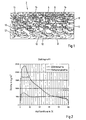
- Fig. 1 shows a schematic representation of the Structural structure of a sound insulation mat according to the invention 2.
- This has a mat layer 4, which represents the actual material of the sound insulation mat 2.
- the Mat layer 4 has a mat top 6 and a Mat underside 8 on.
- When used as a sound insulation mat 2 is on the mat top 6 of the flooring (not shown) and on the mat bottom 8 the substructure of the floor (not shown).
- the mat layer 4 essentially has components Natural raw material fibers 10, a binder 12 (not shown structured) and high-density particles 14.
- the particles 14 are within the mat layer 4 arranged inhomogeneously distributed and generate one rising from the mat bottom 8 to the mat top 6 Density distribution on. 1 shows that the frequency distribution of the occurrence of the particles 14 in the area of the mat top 6 significantly larger than in middle area of the mat layer 4 and as in the area the underside of the mat 8. Otherwise the natural raw material fibers 10 and the binder 12 substantially homogeneous are distributed, results within the mat layer 4 the inhomogeneous density distribution.
- Fig. 2 shows an example of such a density profile of such an insulation mat.
- the density in the area of the underside of the mat - i.e. the side facing the substructure when installed - is around 300 kg / m 3 .
- Wood fibers or natural fibers with such a density are hardly consolidated with each other, so that the function of impact sound insulation can be very well fulfilled.
- the mat can still be deformed to a certain extent, which compensates for unevenness in the substructure.
- the density of the mat then increases steadily towards the top of the mat - in the exemplary case up to a density of approx. 2400 kg / m 3 just below the top of the mat.
- the increase in density is achieved on the one hand by the one-sided incorporation of high-density substances in the fiber matrix, and on the other hand by the production parameters of pressure and temperature.
- Example 1 The production of such an insulation mat is described in Example 1 below.
- 100 parts by weight of unglued wood fibers are mixed homogeneously with 1.0 part by weight of polyester fiber.
- the polyester fiber consists of a core fiber with a melting point above 160 ° C and a sheathing made of polyester with a melting range between 110 and 130 ° C.
- the polyester fiber has a staple length of approx. 50mm and a fiber diameter of approx. 5 dtex.
- the fiber mixture of wood fiber and binder fiber is formed into an endless mat in the airlay process and then needled to stabilize it.
- the intermediate product thus obtained has a weight per unit area of approx. 1500 g / m 2 and a thickness of approx. 12 mm.
- a soundproofing mat with a thickness of approx. 3 mm is obtained is very flexible and has a density profile corresponding to that Figure 1 has.
- the mat results in the full area on the Glued underside of a laminate floor board effective reduction of impact and room noise levels.
- a sound insulation mat is produced as in example 1.
- the mat is thermally consolidated, so-called thermobonding.
- Hot air at a temperature of around 180 ° C is passed through the mat in an oven and the thickness is set using calibration roller pairs.
- the result is an intermediate product with a basis weight of approx. 2500 g / m 2 .
- quartz sand is sprinkled in as described in Example 1 and the mat is compacted with analog press parameters.
- the density profile of the mat is almost identical, as are the acoustic properties.
- Example 3 describes the production of a sound insulation mat consisting of glued wood fibers and unglued Binding fibers based on cellulose fibers.
- 100 parts by weight the glued wood fibers are with 10 parts by weight Cellulose fibers mixed homogeneously and in the air-lay process shaped into a mat.
- the cellulose fibers have one Stack length of approx. 60 mm and have a fiber diameter of approx. 7 dtex.
- the mat becomes a solidification needled.
- Example 4 describes the production of a mat without the use of an adhesive.
- 30 parts by weight of hemp fibers (average length approx. 20 mm) are mixed with 70 parts by weight of wood fibers and 10 parts by weight of a binding fiber (cellulose fiber, length approx. 50 mm, fiber diameter approx. 7 dtex) and a loose mat is produced using the airlay process with a basis weight of 3000 g / m 2 100 parts by weight of quartz sand with a grain diameter between 0.2 and 0.4 mm are evenly distributed on the top of the mat and introduced into the depth of the mat by shaking.
- a fine fiber fleece based on cellulose fiber is placed on the top side, which prevents the quartz particles from loosening too much when needling.
- the mat produced in this way is then solidified by intensive needling.
- the thickness of the mat is approx. 8 mm.
- the density in the upper area of the mat is approx. 1600 kg / m 3 .
Landscapes
- Engineering & Computer Science (AREA)
- Textile Engineering (AREA)
- Architecture (AREA)
- Civil Engineering (AREA)
- Structural Engineering (AREA)
- Multimedia (AREA)
- Acoustics & Sound (AREA)
- Physics & Mathematics (AREA)
- Mechanical Engineering (AREA)
- Floor Finish (AREA)
- Laminated Bodies (AREA)
- Building Environments (AREA)
- Dry Formation Of Fiberboard And The Like (AREA)
- Soundproofing, Sound Blocking, And Sound Damping (AREA)
Description
- Fig. 1
- ein Ausführungsbeispiel einer erfindungsgemäßen Schalldämmatte,
- Fig. 2
- eine graphische Darstellung des Dichteprofils der in Fig. 1 dargestellten Schalldämmmatte.
- Heizplattentemperatur oben/unten: 180°C/55°C
- Presszeit: 60 Sekunden
- Dickengesteuerte Fahrweise (Solldicke 3 mm)
- Heizplattentemperatur oben/unten: 180°C/70°C
- Presszeit: 60 Sekunden
- Dickengesteuerte Fahrweise (Solldicke 5 mm)
Claims (28)
- Schalldämmmatte für Bodenbeläge, insbesondere für Parkettböden und Laminatfußböden,dadurch gekennzeichnet,mit einer Mattenschicht (4), die eine Mattenoberseite (6) und eine Mattenunterseite (8) aufweist,wobei die Mattenschicht (4) Naturrohstofffasern (10), mindestens ein Bindemittel (12) und hochdichte Partikel (14) aufweist,daß die hochdichten Partikel (14) innerhalb der Mattenschicht (4) inhomogen verteilt angeordnet sind und eine von der Mattenunterseite (8) zur Mattenoberseite (6) ansteigende Dichteverteilung erzeugen.
- Schalldämmmatte nach Anspruch 1,
dadurch gekennzeichnet, daß die Dichteverteilung stetig von der Mattenunterseite (8) zur Mattenoberseite (6) ansteigt. - Schalldämmmatte nach Anspruch 1 oder 2,
dadurch gekennzeichnet, daß die Dichte der Mattenschicht an der Mattenunterseite (8) größer als 300 kg/m3 und an der Mattenoberseite (6) größer als 1500 kg/m3 ist. - Schalldämmmatte nach einem der Ansprüche 1 bis 3,
dadurch gekennzeichnet, daß die Naturrohstofffasern (10) Fasern aus Holz, Flachs, Hanf, Sisal oder Kokos bestehen. - Schalldämmmatte nach einem der Ansprüche 1 bis 4,
dadurch gekennzeichnet, daß das Bindemittel (12) zumindest teilweise aus Bindefasern besteht, die aus Kunstfasern, aus naturnahen Fasern oder aus Naturfasern oder einer Mischung daraus bestehen. - Schalldämmmatte nach Anspruch 5,
dadurch gekennzeichnet, daß der Gewichtsanteil der Bindefasern bezogen auf die Trockenmasse der Naturrohstofffasern (10) 1 bis 20 Gew.-% beträgt. - Schalldämmmatte nach Anspruch 5 oder 6,
dadurch gekennzeichnet, daß die Länge der Bindefaser im Bereich von 0,5 bis 10 cm liegt. - Schalldämmmatte nach einem der Ansprüche 5 bis 7,
dadurch gekennzeichnet, daß die Dicke der Bindefaser im Bereich von 2 bis 10 dtex liegt. - Schalldämmmatte nach einem der Ansprüche 1 bis 8,
dadurch gekennzeichnet, daß das Bindemittel (12) zumindest teilweise aus einem duroplastischen, thermoplastischen, elastomeren oder natürlichem Klebemittel oder aus einer Mischung daraus besteht. - Schalldämmmatte nach Anspruch 9,
dadurch gekennzeichnet, daß der Gewichtsanteil des Klebemittels bezogen auf die Trockenmasse der Naturrohstofffasern (10) 0,5 bis 30 Gew.-% beträgt. - Schalldämmmatte nach einem der Ansprüche 1 bis 10,
dadurch gekennzeichnet, daß die hochdichten Partikel (14) ein spezifisches Gewicht von größer als 2000 kg/m3 aufweisen. - Schalldämmmatte nach Anspruch 11,
dadurch gekennzeichnet, daß die hochdichten Partikel (14) aus einem mineralischen Stoff oder aus einem metallischen Stoff oder einer Mischung daraus bestehen. - Schalldämmmatte nach Anspruch 11 oder 12,
dadurch gekennzeichnet, daß die Korngröße der hochdichten Partikel (14) im Bereich zwischen 0,1 bis 0,5, insbesondere zwischen 0,2 und 0,4 mm liegt. - Schalldämmmatte nach einem der Ansprüche 11 bis 13,
dadurch gekennzeichnet, daß der Gewichtsanteil der hochdichten Partikel (14) bezogen auf die Trockenmasse der Naturrohstofffasern (10) 30 bis 300 Gew.-% beträgt. - Verfahren zur Herstellung einer Schalldämmmatte nach einem der Ansprüche 1 bis 14,bei dem ein Gemisch aus Naturrohstofffasern und mindestens einem Bindemittel erzeugt wird,bei dem aus dem Gemisch eine lockere Matte geformt wird,bei dem hochdichte Partikel auf der Mattenoberseite verteilt angeordnet werden, die anschließend in die Matte eindringen, undbei dem die Matte anschließend verfestigt wird.
- Verfahren nach Anspruch 15,
bei dem Bindefasern als Bindemittel dem Gemisch zugefügt werden. - Verfahren nach Anspruch 16,
bei dem Klebemittel als Bindemittel dem Gemisch zugeführt wird. - Verfahren nach einem der Ansprüche 15 bis 17,
bei dem Klebemittel auf die Naturrohstofffaser und/oder auf die Bindefaser aufgebracht wird. - Verfahren nach Anspruch 18,
bei dem Klebemittel vor dem Formen der lockeren Matte aufgebracht wird. - Verfahren nach Anspruch 18,
bei dem Klebemittel während des Formens der lockeren Matte aufgebracht wird. - Verfahren nach einem der Ansprüche 15 bis 20,
bei dem die Matte mechanisch oder im Airlay-Verfahren aufgebracht wird. - Verfahren nach einem der Ansprüche 15 bis 21,
bei dem die Matte mechanisch verfestigt wird, insbesondere durch Vernadelung. - Verfahren nach einem der Ansprüche 15 bis 22,
bei dem die Matte durch das Einwirken von Druck und/oder Härtungsenergie, vorzugsweise Wärmeenergie, verfestigt wird. - Verfahren nach einem der Ansprüche 15 bis 23,
bei dem die Verteilung der hochdochten Partikel auf der Mattenoberseite durch gleichmäßiges Einstreuen durchgeführt wird. - Verfahren nach einem der Ansprüche 15 bis 24,
bei dem das Eindringen der hochdichten Partikel in die Matte durch Rütteln beschleunigt wird. - Verfahren nach einem der Ansprüche 15 bis 25,
bei dem während der Verfestigung die auf die Mattenoberseite einwirkende Temperatur größer als die auf die Mattenunterseite einwirkende Temperatur eingestellt wird. - Verfahren nach Anspruch 26,
bei dem die Temperatur an der Mattenoberseite im Bereich von 100 bis 200°C eingestellt wird. - Verfahren nach Anspruch 26 oder 27,
bei dem die Temperatur an der Mattenunterseite unterhalb von 100°C eingestellt wird.
Applications Claiming Priority (3)
| Application Number | Priority Date | Filing Date | Title |
|---|---|---|---|
| DE20100632U DE20100632U1 (de) | 2001-01-12 | 2001-01-12 | Schalldämmmatte |
| DE20100632U | 2001-01-12 | ||
| PCT/EP2002/000143 WO2002055811A1 (de) | 2001-01-12 | 2002-01-09 | Schalldämmmatte für bodenbeläge sowie verfahren zu dessen herstellung |
Publications (2)
| Publication Number | Publication Date |
|---|---|
| EP1349996A1 EP1349996A1 (de) | 2003-10-08 |
| EP1349996B1 true EP1349996B1 (de) | 2004-09-22 |
Family
ID=7951595
Family Applications (1)
| Application Number | Title | Priority Date | Filing Date |
|---|---|---|---|
| EP02708268A Expired - Lifetime EP1349996B1 (de) | 2001-01-12 | 2002-01-09 | Schalldämmmatte für bodenbeläge sowie verfahren zu dessen herstellung |
Country Status (4)
| Country | Link |
|---|---|
| EP (1) | EP1349996B1 (de) |
| AT (1) | ATE277247T1 (de) |
| DE (3) | DE20100632U1 (de) |
| WO (1) | WO2002055811A1 (de) |
Families Citing this family (7)
| Publication number | Priority date | Publication date | Assignee | Title |
|---|---|---|---|---|
| FR2870160A1 (fr) * | 2004-05-13 | 2005-11-18 | Cera | Systeme de protection acoustique a impedance variable |
| DE102004056131B4 (de) | 2004-11-16 | 2006-08-31 | Kronotec Ag | Schalldämmplatte |
| DE202005007293U1 (de) | 2005-05-07 | 2006-09-07 | Kronospan Technical Co. Ltd., Engomi | Paneele mit dreilagiger Trittschalldämpfung |
| FR2889617B1 (fr) * | 2005-08-03 | 2008-03-14 | Mecaplast Sa | Couche d'insonorisation et complexe d'insonorisation incorporant celle-ci |
| DE202007018098U1 (de) * | 2007-12-21 | 2009-05-14 | Witex Flooring Products Gmbh | Unterlegematte |
| DK2338928T3 (da) | 2009-12-17 | 2012-01-30 | Ems Patent Ag | Bindefiber til fastgørelse af flade materialer, der indeholder naturfibre |
| FR3078040B1 (fr) * | 2018-02-22 | 2020-03-13 | Faurecia Automotive Industrie | Piece d'insonorisation de vehicule automobile et procede de fabrication associe |
Citations (1)
| Publication number | Priority date | Publication date | Assignee | Title |
|---|---|---|---|---|
| DE10017202A1 (de) * | 2000-04-06 | 2000-09-21 | Fasa Gmbh | Seegras-Dämmstoff-Bauelement |
Family Cites Families (11)
| Publication number | Priority date | Publication date | Assignee | Title |
|---|---|---|---|---|
| CH245004A (de) * | 1943-09-22 | 1946-10-31 | Gmbh Parkettfabrik Goldbach | Schalldämpfende und wärmeisolierende Parkettplatte. |
| DE3322375A1 (de) * | 1983-06-22 | 1985-01-03 | Karl 5249 Hamm Rische | Schall- und waermedaemmende platte und verfahren zu ihrer herstellung |
| DE4307550A1 (de) * | 1993-03-10 | 1994-09-15 | Gefinex Jackon Gmbh | Trittschalldämmung |
| DE4428613A1 (de) * | 1994-08-12 | 1996-02-15 | Kinkel Werner Helmut | Schall- und Wämedämmstoff |
| US5684278A (en) * | 1994-11-18 | 1997-11-04 | Lockheed Missiles & Space Co., Inc. | Acoustical ceramic panel and method |
| DK0864712T3 (da) * | 1997-03-11 | 2002-03-11 | Akustik Ag | Gulvbelægning med lydisoleringsmåtte |
| DE19711992A1 (de) | 1997-03-14 | 1998-09-17 | Ikon Praezisionstechnik | Schließzylinder |
| JP3180065B2 (ja) * | 1997-09-29 | 2001-06-25 | 株式会社江田組 | 床材及びこの床材を用いた床張り施工方法 |
| DE19813543C2 (de) * | 1998-03-27 | 2001-05-17 | Karl Goesele | Körperschalldämpfende Dämmplatte sowie eine solche Dämmplatte enthaltendes doppelschaliges Bauelement |
| DE19851656C2 (de) * | 1998-11-10 | 2002-12-05 | Johannes Schulte | Fußbodendiele |
| DE29908733U1 (de) * | 1999-05-18 | 1999-08-12 | Witex AG, 32832 Augustdorf | Schalldämmvorrichtung für Bodenbeläge |
-
2001
- 2001-01-12 DE DE20100632U patent/DE20100632U1/de not_active Expired - Lifetime
-
2002
- 2002-01-09 DE DE50201097T patent/DE50201097D1/de not_active Expired - Lifetime
- 2002-01-09 DE DE10200559A patent/DE10200559C2/de not_active Expired - Fee Related
- 2002-01-09 AT AT02708268T patent/ATE277247T1/de active
- 2002-01-09 EP EP02708268A patent/EP1349996B1/de not_active Expired - Lifetime
- 2002-01-09 WO PCT/EP2002/000143 patent/WO2002055811A1/de not_active Ceased
Patent Citations (1)
| Publication number | Priority date | Publication date | Assignee | Title |
|---|---|---|---|---|
| DE10017202A1 (de) * | 2000-04-06 | 2000-09-21 | Fasa Gmbh | Seegras-Dämmstoff-Bauelement |
Also Published As
| Publication number | Publication date |
|---|---|
| EP1349996A1 (de) | 2003-10-08 |
| DE10200559C2 (de) | 2003-04-10 |
| DE10200559A1 (de) | 2002-08-14 |
| DE20100632U1 (de) | 2002-02-28 |
| ATE277247T1 (de) | 2004-10-15 |
| WO2002055811A1 (de) | 2002-07-18 |
| DE50201097D1 (de) | 2004-10-28 |
Similar Documents
| Publication | Publication Date | Title |
|---|---|---|
| DE3541386C2 (de) | ||
| DE60317658T2 (de) | Polstermaterial mit dichtegradient und verfahren zu dessen herstellung | |
| DE102008039720B4 (de) | Verfahren zur Herstellung von Holzfaser-Dämmplatten" | |
| EP1420127B1 (de) | Paneel und Verfahren zur Herstellung eines Paneels | |
| EP0611340A1 (de) | Holzbelag, insbesondere holzbodenbelag. | |
| DE102004062649B4 (de) | Verfahren zur Herstellung einer Holzfaserdämmstoffplatte bzw.-matte und nach diesem Verfahren hergestellte Holzfaserdämmstoffplatten bzw.-matten | |
| EP1674633B1 (de) | Holzfaserdämmstoffplatte bzw. -matte | |
| DE20108668U1 (de) | Laminatfußboden mit zweilagiger Trittschalldämpfung | |
| DE102004011931A1 (de) | Dämmstoffplatte aus einem Holzwerkstoff-Bindemittelfaser-Gemisch | |
| DE102020114155A1 (de) | Plattenförmiges Akustikelement | |
| EP0688644A2 (de) | Formteil und Verfahren zu seiner Herstellung | |
| DE10200559C2 (de) | Schalldämmmatte für Bodenbeläge sowie Verfahren zu deren Herstellung | |
| EP0688643A2 (de) | Formteil und Verfahren zu seiner Herstellung | |
| DE102004056131B4 (de) | Schalldämmplatte | |
| DE202015100411U1 (de) | Trittschallunterlage auf Basis eines Holz-Kunststoff-Verbundwerkstoffs | |
| EP2963204B1 (de) | Platte für einen boden-, wand- oder deckenbelag oder für ein möbelbauteil sowie verfahren und pressvorrichtung zur herstellung einer solchen platte | |
| EP2801677B1 (de) | Eine mit mindestens einer Kaschierung versehene Holzfaserdämmstoffplatte und ein Verfahren zu deren Herstellung | |
| EP2319671A1 (de) | Holzwerkstoffplatte | |
| AT513506B1 (de) | Flexible Vlieselemente auf Basis von Rohrkolben-Blattfasern für Dämmzwecke | |
| WO2004087388A1 (de) | Vorrichtung und verfahren zum bedampfen | |
| DE20180258U1 (de) | Dämmstoff aus Hanffasern | |
| WO2012107053A1 (de) | Formkörper auf basis von rohrkolben-blattfasern mit hochglatter oberfläche | |
| DE102011003318B4 (de) | Faserplatten mit funktionsorientiertem Rohdichteprofil und Verfahren zu deren Herstellung | |
| DE102012012408B4 (de) | Verfahren zur Herstellung eines Holzverbundwerkstoffs | |
| WO2012107055A1 (de) | Bindemittelarme formkörper aus rohrkolben-blattfasern |
Legal Events
| Date | Code | Title | Description |
|---|---|---|---|
| PUAI | Public reference made under article 153(3) epc to a published international application that has entered the european phase |
Free format text: ORIGINAL CODE: 0009012 |
|
| 17P | Request for examination filed |
Effective date: 20030618 |
|
| AK | Designated contracting states |
Kind code of ref document: A1 Designated state(s): AT BE CH CY DE DK ES FI FR GB GR IE IT LI LU MC NL PT SE TR |
|
| AX | Request for extension of the european patent |
Extension state: AL LT LV MK RO SI |
|
| GRAP | Despatch of communication of intention to grant a patent |
Free format text: ORIGINAL CODE: EPIDOSNIGR1 |
|
| RBV | Designated contracting states (corrected) |
Designated state(s): AT BE CH DE FR GB LI |
|
| GRAS | Grant fee paid |
Free format text: ORIGINAL CODE: EPIDOSNIGR3 |
|
| GRAA | (expected) grant |
Free format text: ORIGINAL CODE: 0009210 |
|
| AK | Designated contracting states |
Kind code of ref document: B1 Designated state(s): AT BE CH DE FR GB LI |
|
| REG | Reference to a national code |
Ref country code: GB Ref legal event code: FG4D Free format text: NOT ENGLISH |
|
| REG | Reference to a national code |
Ref country code: CH Ref legal event code: EP |
|
| REG | Reference to a national code |
Ref country code: IE Ref legal event code: FG4D Free format text: GERMAN |
|
| REF | Corresponds to: |
Ref document number: 50201097 Country of ref document: DE Date of ref document: 20041028 Kind code of ref document: P |
|
| REG | Reference to a national code |
Ref country code: CH Ref legal event code: NV Representative=s name: TROESCH SCHEIDEGGER WERNER AG |
|
| GBT | Gb: translation of ep patent filed (gb section 77(6)(a)/1977) |
Effective date: 20050115 |
|
| LTIE | Lt: invalidation of european patent or patent extension |
Effective date: 20040922 |
|
| REG | Reference to a national code |
Ref country code: IE Ref legal event code: FD4D |
|
| PLBE | No opposition filed within time limit |
Free format text: ORIGINAL CODE: 0009261 |
|
| STAA | Information on the status of an ep patent application or granted ep patent |
Free format text: STATUS: NO OPPOSITION FILED WITHIN TIME LIMIT |
|
| ET | Fr: translation filed | ||
| 26N | No opposition filed |
Effective date: 20050623 |
|
| REG | Reference to a national code |
Ref country code: FR Ref legal event code: PLFP Year of fee payment: 15 |
|
| REG | Reference to a national code |
Ref country code: FR Ref legal event code: PLFP Year of fee payment: 16 |
|
| REG | Reference to a national code |
Ref country code: FR Ref legal event code: PLFP Year of fee payment: 17 |
|
| PGFP | Annual fee paid to national office [announced via postgrant information from national office to epo] |
Ref country code: CH Payment date: 20210118 Year of fee payment: 20 Ref country code: FR Payment date: 20210118 Year of fee payment: 20 |
|
| PGFP | Annual fee paid to national office [announced via postgrant information from national office to epo] |
Ref country code: GB Payment date: 20210118 Year of fee payment: 20 Ref country code: AT Payment date: 20210119 Year of fee payment: 20 Ref country code: DE Payment date: 20210119 Year of fee payment: 20 Ref country code: BE Payment date: 20210118 Year of fee payment: 20 |
|
| REG | Reference to a national code |
Ref country code: DE Ref legal event code: R071 Ref document number: 50201097 Country of ref document: DE |
|
| REG | Reference to a national code |
Ref country code: CH Ref legal event code: PL |
|
| REG | Reference to a national code |
Ref country code: GB Ref legal event code: PE20 Expiry date: 20220108 |
|
| REG | Reference to a national code |
Ref country code: BE Ref legal event code: MK Effective date: 20220109 |
|
| REG | Reference to a national code |
Ref country code: AT Ref legal event code: MK07 Ref document number: 277247 Country of ref document: AT Kind code of ref document: T Effective date: 20220109 |
|
| PG25 | Lapsed in a contracting state [announced via postgrant information from national office to epo] |
Ref country code: GB Free format text: LAPSE BECAUSE OF EXPIRATION OF PROTECTION Effective date: 20220108 |