EP1319641B1 - Verfahren zur Herstellung eines elektro-pyrotechnischen Zünders unter Verwendung eines wässrigen Klebstoffes - Google Patents
Verfahren zur Herstellung eines elektro-pyrotechnischen Zünders unter Verwendung eines wässrigen Klebstoffes Download PDFInfo
- Publication number
- EP1319641B1 EP1319641B1 EP02293070A EP02293070A EP1319641B1 EP 1319641 B1 EP1319641 B1 EP 1319641B1 EP 02293070 A EP02293070 A EP 02293070A EP 02293070 A EP02293070 A EP 02293070A EP 1319641 B1 EP1319641 B1 EP 1319641B1
- Authority
- EP
- European Patent Office
- Prior art keywords
- process according
- pyrotechnic
- initiator
- weight
- explosive
- Prior art date
- Legal status (The legal status is an assumption and is not a legal conclusion. Google has not performed a legal analysis and makes no representation as to the accuracy of the status listed.)
- Expired - Lifetime
Links
Images

Classifications
-
- F—MECHANICAL ENGINEERING; LIGHTING; HEATING; WEAPONS; BLASTING
- F42—AMMUNITION; BLASTING
- F42C—AMMUNITION FUZES; ARMING OR SAFETY MEANS THEREFOR
- F42C19/00—Details of fuzes
- F42C19/08—Primers; Detonators
- F42C19/12—Primers; Detonators electric
-
- F—MECHANICAL ENGINEERING; LIGHTING; HEATING; WEAPONS; BLASTING
- F42—AMMUNITION; BLASTING
- F42B—EXPLOSIVE CHARGES, e.g. FOR BLASTING, FIREWORKS, AMMUNITION
- F42B3/00—Blasting cartridges, i.e. case and explosive
- F42B3/10—Initiators therefor
- F42B3/195—Manufacture
-
- C—CHEMISTRY; METALLURGY
- C06—EXPLOSIVES; MATCHES
- C06C—DETONATING OR PRIMING DEVICES; FUSES; CHEMICAL LIGHTERS; PYROPHORIC COMPOSITIONS
- C06C7/00—Non-electric detonators; Blasting caps; Primers
-
- C—CHEMISTRY; METALLURGY
- C06—EXPLOSIVES; MATCHES
- C06C—DETONATING OR PRIMING DEVICES; FUSES; CHEMICAL LIGHTERS; PYROPHORIC COMPOSITIONS
- C06C7/00—Non-electric detonators; Blasting caps; Primers
- C06C7/02—Manufacture; Packing
-
- F—MECHANICAL ENGINEERING; LIGHTING; HEATING; WEAPONS; BLASTING
- F42—AMMUNITION; BLASTING
- F42B—EXPLOSIVE CHARGES, e.g. FOR BLASTING, FIREWORKS, AMMUNITION
- F42B3/00—Blasting cartridges, i.e. case and explosive
- F42B3/10—Initiators therefor
- F42B3/12—Bridge initiators
- F42B3/124—Bridge initiators characterised by the configuration or material of the bridge
Definitions
- the present invention relates to the technical field of electro-pyrotechnic initiators. More specifically, the invention relates to a method for producing an electro-pyrotechnic initiator.
- This manufacturing process adapts to any type of initiator. They are either detonating initiators, also called detonators, or initiators type igniters, for the ignition of propellant powder or gas generating substance. In the latter case, the most common application is that of igniters for safety devices intended to protect the occupants of a motor vehicle.
- An electro-pyrotechnic initiator consists of a heating resistive element and a thermosensitive substance.
- the resistive element may be in the form of a filament, a small flat element and very thin deposited on a printed circuit support or a resistive bridge or semiconductor in thin layers.
- the structure of the initiator must include very robust elements, such as a compression ring for example.
- the assembly process of the initiator requires the implementation of important means for metering and compressing the powdery substance.
- a distribution hopper and a hydraulic press are generally used. Such a process is generally carried out under a pressure of the order of 1000 bar. Such a method, often used in industry, therefore requires significant means of protecting personnel against the risks inherent in the implementation and compression of dry explosive materials. Moreover, during compression, the resistive element can be damaged.
- thermosensitive substance is then deposited in the form of a compact paint and adherent to the support.
- a first embodiment is to use solvents.
- the patent FR 2704944 and his correspondent US 5544585 describe such an embodiment.
- the explosive lacquer described in this patent consists of a primary explosive or a thermosensitive oxidizing-reducing mixture added with 2 to 15% of film-forming binder, previously dissolved in a solvent. The lacquer is deposited on the resistive element and the solvent is evaporated.
- the explosive lacquer comprises a pyrotechnic material in the form of particles and a binder consisting of a particulate polymeric resin.
- the lacquer may further comprise a solvent, ethyl alcohol.
- the lacquer is first deposited on the element resistive then heated at a first temperature, of the order of 100 ° C, to expel the solvent and then at a second temperature of the order of 150 ° C, to agglomerate the particles of the binder and to bind the lacquer to the resistive element.
- thermosensitive substance Another known embodiment for bonding the thermosensitive substance to the resistive element is in situ polymerization.
- the patent FR 2781878 describes such an embodiment.
- the heat-sensitive substance comprises from 40 to 60% by weight of pulverulent pyrotechnic substance suspended in 60 to 40% by weight of inert binder capable of curing by polymerization.
- the thermosensitive substance is deposited on the resistive element and the polymerization is obtained by heating or by radiation.
- This embodiment requires in practice high levels of binder. This therefore limits the proportion of pyrotechnic material in the thermosensitive substance, increases its dispersion, and thereby decreases the sensitivity of the initiator.
- the present invention relates to such a method.
- the invention relates to a method for producing an electro-pyrotechnic initiator comprising a pyrotechnic lacquer initiated by a resistive heating element, characterized in that said pyrotechnic lacquer is obtained by depositing on the resistive element, an aqueous adhesive constituted a dispersion of an explosive substance and additives in an aqueous suspension based on a copolymer selected from ethylene / vinyl acetate copolymers and vinyl acetate / ethylene acetate / ethylene copolymers, followed by drying of said aqueous adhesive at a temperature between 55 ° C and 75 ° C.
- lacquer the solid element obtained by evaporation of the water contained in the drop of aqueous adhesive deposited on the initiator.
- This lacquer is also sometimes called pearl ignition.
- the invention has the advantage of not using volatile and flammable solvents. Indeed, only water is used. Contrary to the prejudices indicated in the patent FR 2781878 , the water is easily removed, the drying step is not long and it does not degrade the performance of the thermosensitive substance.
- Another advantage of the invention is to achieve a dispersion of the explosive substance in an aqueous suspension based on a copolymer. This makes it possible to numb the explosive substance and to handle it safely in the liquid state.
- the aqueous adhesive is deposited on the liquid resistive element in the form of a calibrated drop, using a lacquerer comprising a pneumatic doser.
- the drop of aqueous adhesive is then dried at a temperature of between 55 ° C. and 75 ° C., preferably at 60 ° C.
- the heating at a temperature below 80 ° C avoids the formation of bubbles and therefore poor contact with the resistive element.
- the drying is carried out according to a drying mode common in industry such as infra-red radiation, hot air pulsed or induction.
- a preferred drying mode is infra-red radiation.
- the explosive substance used in the composition of the aqueous adhesive is chosen from the group consisting of primary explosives and oxidizing-reducing mixtures.
- the primary explosive is a dinitrobenzofuroxane salt and, more preferably, the primary explosive is potassium dinitrobenzofuroxanate.
- the explosive substance is a mixture of zirconium and potassium perchlorate.
- the explosive substance used in the composition may be lead-free, which allows for aqueous adhesives compatible with the environment.
- the content of explosive substance of the pyrotechnic lacquer after drying is between 65% and 95% by weight relative to the total weight of the pyrotechnic lacquer.
- the water content of the aqueous adhesive before drying is between 55% and 70% by weight relative to the total weight of the aqueous adhesive. This production method therefore allows to have, before drying, a significant proportion of water, which facilitates the implementation and after drying, a large proportion of explosive substance, which makes the initiator very reactive.
- the aqueous suspension based on copolymer is obtained by emulsification of ethylene / vinyl acetate copolymer or vinyl acetate / ethylene acetate / ethylene in the presence of surfactant.
- the preferred surfactants are anionic surfactants and polyvinyl alcohol.
- the amount of surfactant used is between 0.1% and 2% by weight relative to the weight of the aqueous suspension based on copolymer.
- the aqueous suspension based on copolymer further comprises a plasticizer.
- This plasticizer is chosen from phthalates.
- a preferred plasticizer is dibutyl phthalate. This compound makes it possible to improve the adhesion of the adhesive on the resistive element and to adjust the hardness of the adhesive.
- the amount of plasticizer is between 0% and 20% by weight relative to the weight of the aqueous suspension based on copolymer.
- the copolymer is an ethylene / vinyl acetate copolymer and the proportion of ethylene is between 10 and 30% by weight relative to the total weight of the ethylene / vinyl acetate copolymer.
- the amount of copolymer is between 50% and 60% by weight relative to the total weight of the aqueous suspension based on said copolymer.
- the aqueous adhesive further comprises additives such as a thickening agent and an RX marker.
- the thickening agent is based on modified cellulose, this makes it possible to adjust the viscosity of the adhesive, between 6.5 and 9 Pa.s, to the deposition process. Hydroxylpropylcellulose, carboxymethylcellulose, methylhydroxypropylcellulose, hydroxyethylcellulose and carboxymethylhydroxyethylcellulose may be mentioned as thickeners.
- the amount of thickening agent is between 0.5 and 2.5% by weight relative to the total weight of the aqueous glue before drying.
- the glue may also contain an RX marker. Its role is to make the glue opaque to X-rays in the case where the other constituents of the aqueous glue, and in particular the explosive substance, do not contain heavy metals.
- the marker RX is constituted by a metal powder or a metal salt, said metal having to sufficiently absorb the X-rays, while being compatible with the environment. It is preferably selected from the group consisting of tungsten, zirconium, bismuth or silver. This marker therefore makes it possible to control the initiator at the level of its manufacturing process.
- the fundamental originality of the invention lies in the fact of using an aqueous adhesive comprising an explosive substance and a copolymer suspended in water.
- the glue is deposited using a lacquerer comprising a pneumatic metering device, in the form of a drop calibrated on the heating resistive element and the water is then evaporated.
- the evaporation of the water and the nature of the copolymer make it possible, as shown by the tests carried out, to obtain a very good adhesion of the adhesive to the resistive element.
- the surfactant is chosen from surfactants anionic and polyvinyl alcohol.
- the additives contain a thickening agent and an RX marker.
- the thickening agent makes it possible to adjust the viscosity of the glue, it is based on modified cellulose.
- the RX marker makes the pyrotechnic lacquer X-ray opaque. It is a metal powder or a metal salt, the metal being selected from the group consisting of tungsten, zirconium, bismuth or silver.
- the explosive substance is selected from the group consisting of primary explosives and oxidizing-reducing mixtures.
- a preferred primary explosive is a dinitrobenzofuroxane salt, and more preferably potassium dinitrobenzofuroxanate, and a preferred oxidizing-reducing mixture is zirconium / potassium perchlorate.
- the resistive heating element is a cylindrical filament, a bridge directly photograved on a printed circuit support or a thin-layer bridge surface-mounted on a printed circuit support.
- the explosive substance is a primary explosive and the resistive element is a semiconductor bridge often designated by the abbreviation SCB from its Anglo-Saxon designation "semi conductor bridge”.
- the figure 1 represents, in section, an electro-pyrotechnic initiator produced according to the object method of the invention, wherein the resistive element is surface mounted.
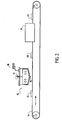
- the figure 2 is a diagram of the device for performing the method object of the invention.
- this electro-pyrotechnic initiator 1 is made from a glass / metal feedthrough comprising a metal liner 9 and an insulating element 2 carrying the two electrodes 3, 4.
- Each of these two electrodes 3, 4 presents, on the one hand, an upper end fixed by welding to a printed circuit board 5 having a heating resistive element 11 of the CMS type ("surface-mounted component"), and on the other hand, a lower end intended to be connected to a tubular plug corresponding.
- the printed circuit 5 is itself attached to the insulating element 2.
- a pyrotechnic lacquer 6 is bonded to the printed circuit 5 and the resistive element 11 and is surmounted by a metal cap 7 enclosing a pyrotechnic reinforcing composition 8, this cap metal 7 being welded to the cylindrical metal liner 9 of the glass / metal feedthrough.
- thermoplastic resin partially coats the electrodes 3, 4 and ensures, with the metal cap 7, the sealing of the initiator 1.
- Electro-pyrotechnic initiators 1 not yet assembled with the metal cap 7 and the reinforcing pyrotechnic composition 8 are placed in a vehicle 13.
- This vehicle 13 contains 10 rows of 20 igniters.
- the vehicle 13 is placed on a conveyor belt 14.Only placed in a lacquer 15, shown in section, 20g of aqueous glue.
- the aqueous adhesive consists of 2.5% by weight of ethylene vinyl polyacetate and surfactant, 29% by weight of potassium dinitrobenzofuroxanate, 8% by weight of tungsten, 59.5% by weight of water and adds 1% by weight of hydroxypropyl cellulose to adjust the viscosity to about 8 Pa.s.
- the lacquer 15 is constituted by a rotary stirrer 16. This rotary stirrer 16 is set in motion with a speed of rotation of 35 ⁇ 5 revolutions per minute in order to keep the elements of the adhesive in suspension.
- the vehicle 20 containing the igniters whose resistive element 11 is covered with a drop of aqueous glue is then fed by the conveyor belt 14 into an infrared radiation oven 21.
- the oven temperature is 60 ° C and the residence time of the igniters in the oven is 30 minutes.
- the vehicle 22 containing the dried igniters that is to say covered with a drop of pyrotechnic lacquer 6 with a mass of 9 mg ⁇ 3 mg, is then recovered at the outlet of the oven.
- the pyrotechnic lacquer After drying, the pyrotechnic lacquer consists of 72% by weight of potassium dinitrobenzofuroxanate, 6% by weight of ethylene vinylpolyacetate and surfactant, 2% by weight of hydroxypropyl cellulose and 20% by weight of tungsten powder .
- composition A * aqueous adhesive according to the invention, before drying:
- ethylene vinylpolyacetate marketed by Labord SA under the name 239M.
- pyrotechnic lacquer according to the invention, after drying: - potassium dinitrobenzofuroxanate 72.0 ⁇ 1.0% - ethylene vinyl polyacetate (EVA) + polyvinyl alcohol 6.0 ⁇ 0.5% - hydroxypropyl cellulose 2.0 ⁇ 0.05% - tungsten powder 20.0 ⁇ 1.0%
- Example 1 Adhesion of the pyrotechnic lacquer on the resistive element.
- the first test consists in subjecting the initiator to an acceleration greater than 20 000 g, ie greater than 196 000 m / s 2 in the positive direction of the axis of the initiator perpendicular to the gluing plane of the pyrotechnic lacquer.
- a second test consists in testing the adhesion of a non-active pyrotechnic lacquer, that is to say in which the explosive substance has been replaced, for reasons of safety, by an inert substance, on a metal support.
- a non-active pyrotechnic lacquer that is to say in which the explosive substance has been replaced, for reasons of safety, by an inert substance, on a metal support.
- two test pieces are glued with this non-active pyrotechnic lacquer, a tensile test is carried out on these two test pieces and the maximum stress that the pyrotechnic lacquer can withstand is measured.
- composition B Composition B or modified for the 2 nd test
- the first test shows that igniters comprising an initiator produced according to the method that is the subject of the invention can withstand up to 6 times 20,000 g of acceleration, that is to say up to 6 times an acceleration of 196,000 m. / s 2 .
- composition A thus has a better adhesion to the resistive element.
- the maximum stress measured to obtain the separation of the two specimens bonded by the ignition bead of composition A is 8.5 times greater to that measured to obtain the separation of the two glued specimens by the ignition bead composition B, that is to say according to the state of the art.
- This test consists of conditioning the initiator at -40 ° C for 2 hours and then placing it in a pressure bomb and subjecting it to an electrical pulse with an amplitude of 1.2A for 2ms. The pressure generated by the initiator is then measured inside the bomb.
- pressure onset time is the time required for a pressure of 0.2 ⁇ 10 5 Pa, or 0.2 bar, to be generated inside the pressure bomb.
- composition A Initiators whose resistive element is covered with the pyrotechnic lacquer according to the invention give shorter operating times and more reproducible than the initiators according to the state of the art (composition B).
- Example 3 Ability of the pyrotechnic lacquer to initiate the reinforcing charge of the electro-pyrotechnic initiator
- the electro-pyrotechnic initiator previously described is used.
- the reinforcing filler is physically separated from the body of the initiator.
- the initiator comprising only the resistive element covered with the pyrotechnic lacquer and on the other hand the reinforcing charge. These two elements are placed at a calibrated distance from each other.
- the initiator is subjected, at ambient temperature, to an electrical pulse with an amplitude of 1.2A for 2ms.
- the pressure curve is recorded and the times corresponding to the first rise in pressure and the second rise in pressure are measured from the time to correspond to the beginning of the electric pulse.
- the first increase in pressure is due to the combustion of the pyrotechnic lacquer and the second increase in pressure is due to the combustion of the reinforcing filler.
- This test is carried out on new initiators and on aged initiators (accelerated aging of 400 hours at 107 ° C.).
Landscapes
- Engineering & Computer Science (AREA)
- General Engineering & Computer Science (AREA)
- Chemical & Material Sciences (AREA)
- Organic Chemistry (AREA)
- Manufacturing & Machinery (AREA)
- Air Bags (AREA)
- Adhesives Or Adhesive Processes (AREA)
- Automotive Seat Belt Assembly (AREA)
- Compositions Of Macromolecular Compounds (AREA)
Claims (25)
- Verfahren zur Herstellung eines elektropyrotechnischen Zünders (1), umfassend einen pyrotechnischen Lack (6), der von einem Wärmewiderstandselement (11) gezündet wird, dadurch gekennzeichnet, dass der pyrotechnische Lack erhalten wird durch Ablegen auf dem Widerstandselement eines wässrigen Klebstoffes, der aus einer Dispersion einer explosiven Substanz und Additiven in einer wässrigen Suspension auf der Basis eines Copolymers gebildet ist, das aus den Copolymeren Ethylen/Vinylacetat und den Copolymeren Vinylacetat/Ethylenacetat/Ethylen ausgewählt ist, dann durch Trocknen des wässrigen Klebstoffes bei einer Temperatur zwischen 55°C und 75°C.
- Verfahren gemäß Anspruch 1, dadurch gekennzeichnet, dass das Trocknen des wässrigen Klebstoffes durch Infrarotbestrahlung durchgeführt wird.
- Verfahren gemäß Anspruch 1, dadurch gekennzeichnet, dass der wässrige Klebstoff liquid auf dem Widerstandselement in Form eines kalibrierten Tropfen abgelegt wird, mit Hilfe eines Lackierers (15), der einen pneumatischen Dosierer (18) umfasst.
- Verfahren gemäß Anspruch 1, dadurch gekennzeichnet, dass die explosive Substanz aus der Gruppe gewählt wird, die aus primären Explosivstoffen und oxidierend-reduzierenden Mischungen gebildet ist.
- Verfahren gemäß Anspruch 4, dadurch gekennzeichnet, dass der primäre Explosivstoff ein Dinitrobenzofuroxansalz ist.
- Verfahren gemäß Anspruch 5, dadurch gekennzeichnet, dass der primäre Explosivstoff Kaliumdinitrobenzofuroxanat ist.
- Verfahren gemäß Anspruch 4, dadurch gekennzeichnet, dass die explosive Substanz eine Mischung aus Zirconium und Kaliumperchlorat ist.
- Verfahren gemäß Anspruch 1, dadurch gekennzeichnet, dass der Wassergehalt des wässrigen Klebstoffes vor dem Trocknen zwischen 55 und 70 Gew.% in Bezug zum Gewicht des wässrigen Klebstoffes beträgt.
- Verfahren gemäß Anspruch 1, dadurch gekennzeichnet, dass der Gehalt der explosiven Substanz des pyrotechnischen Lacks nach Trocknen zwischen 65 und 95 Gew.% in Bezug zum Gesamtgewicht des pyrotechnischen Lacks beträgt.
- Verfahren gemäß Anspruch 1, dadurch gekennzeichnet, dass die Menge an Copolymer zwischen 50 und 60 Gew.% in Bezug zum Gesamtgewicht der wässrigen Suspension auf Copolymer-Basis beträgt.
- Verfahren gemäß Anspruch 1, dadurch gekennzeichnet, dass die wässrige Suspension auf Copolymer-Basis außerdem ein Tensioaktiv enthält, das gewählt ist aus der Gruppe, die aus anionischen Tensioaktiven und Polyvinylalkohol gebildet ist.
- Verfahren gemäß Anspruch 1, dadurch gekennzeichnet, dass die wässrige Suspension auf Copolymer-Basis außerdem einen Weichmacher enthält, der aus Phthalaten gewählt ist.
- Verfahren gemäß Anspruch 1, dadurch gekennzeichnet, dass der wässrige Klebstoff außerdem ein Verdickungsmittel auf der Basis modifizierter Zellulose enthält.
- Verfahren gemäß Anspruch 1, dadurch gekennzeichnet, dass der wässrige Klebstoff außerdem einen Metallstaub oder ein Metallsalz enthält, das für Röntgenstrahlen undurchdringlich ist.
- Verfahren gemäß Anspruch 14, dadurch gekennzeichnet, dass das Metall aus der Gruppe gewählt ist, die aus Wolfram, Zirconium, Bismut oder Silber gebildet ist.
- Elektropyrotechnischer Zünder (1) hergestellt gemäß Anspruch 1, umfassend einen pyrotechnischen Lack (6), der von einem Wärmewiderstandselement (11) gezündet wird, dadurch gekennzeichnet, dass der pyrotechnische Lack umfasst:- von 60 bis 95 Gew.% explosive Gewichtssubstanz,- von 5 bis 15 Gew.% Tensioaktiv und Copolymer Ethylen/Vinylacetat oder Vinylacetat/Ethylenacetat/Ethylen,- von 0 bis 25 Gew.% Additive.
- Elektropyrotechnischer Zünder (1) gemäß Anspruch 16, dadurch gekennzeichnet, dass die Additive ein Verdickungsmittel und einen RX-Marker enthalten.
- Elektropyrotechnischer Zünder (1) gemäß Anspruch 17, dadurch gekennzeichnet, dass das Verdickungsmittel auf Basis modifizierter Zellulose ist.
- Elektropyrotechnischer Zünder (1) gemäß Anspruch 17, dadurch gekennzeichnet, dass der RX-Marker ein Metallpulver oder ein Metallsalz ist, wobei das Metall aus der Gruppe gewählt ist, die aus Wolfram, Zirconium, Bismut oder Silber gebildet ist.
- Elektropyrotechnischer Zünder (1) gemäß Anspruch 16, dadurch gekennzeichnet, dass die explosive Substanz aus der Gruppe gewählt ist, die aus den primären Explosivstoffen und den oxidierend-reduzierenden Mischungen gebildet ist.
- Elektropyrotechnischer Zünder (1) gemäß Anspruch 20, dadurch gekennzeichnet, dass das Wärmewiderstandselement (11) ein zylindrisches Filament ist.
- Elektropyrotechnischer Zünder (1) gemäß Anspruch 20, dadurch gekennzeichnet, dass das Wärmewiderstandselement (11) eine direkt auf einen Träger einer gedruckten Leiterplatte photogravierte Brücke ist.
- Elektropyrotechnischer Zünder (1) gemäß Anspruch 20, dadurch gekennzeichnet, dass das Wärmewiderstandselement (11) eine Brücke mit dünnen Schichten ist, die auf der Oberfläche auf einem Träger einer gedruckten Leiterplatte angebracht ist.
- Elektropyrotechnischer Zünder (1) gemäß Anspruch 20, dadurch gekennzeichnet, dass die explosive Substanz ein primärer Explosivstoff ist.
- Elektropyrotechnischer Zünder (1) gemäß Anspruch 24, dadurch gekennzeichnet, dass das Wärmewiderstandselement (11) eine Halbleiterbrücke, genannt SCB, ist.
Applications Claiming Priority (2)
| Application Number | Priority Date | Filing Date | Title |
|---|---|---|---|
| FR0116218A FR2833693B1 (fr) | 2001-12-14 | 2001-12-14 | Procede de realisation d'un initiateur electro-pyrotechnique par emploi d'une colle aqueuse |
| FR0116218 | 2001-12-14 |
Publications (3)
| Publication Number | Publication Date |
|---|---|
| EP1319641A2 EP1319641A2 (de) | 2003-06-18 |
| EP1319641A3 EP1319641A3 (de) | 2009-12-30 |
| EP1319641B1 true EP1319641B1 (de) | 2010-10-20 |
Family
ID=8870509
Family Applications (1)
| Application Number | Title | Priority Date | Filing Date |
|---|---|---|---|
| EP02293070A Expired - Lifetime EP1319641B1 (de) | 2001-12-14 | 2002-12-12 | Verfahren zur Herstellung eines elektro-pyrotechnischen Zünders unter Verwendung eines wässrigen Klebstoffes |
Country Status (10)
| Country | Link |
|---|---|
| US (1) | US6823797B2 (de) |
| EP (1) | EP1319641B1 (de) |
| JP (1) | JP3860534B2 (de) |
| KR (1) | KR100671728B1 (de) |
| AT (1) | ATE485250T1 (de) |
| BR (1) | BR0205261A (de) |
| CA (1) | CA2413014C (de) |
| DE (1) | DE60238027D1 (de) |
| FR (1) | FR2833693B1 (de) |
| MX (1) | MXPA02012212A (de) |
Families Citing this family (18)
| Publication number | Priority date | Publication date | Assignee | Title |
|---|---|---|---|---|
| DE10308443A1 (de) * | 2003-02-27 | 2004-09-09 | Dynltec Gmbh | Elektrischer Detonator |
| DE20307603U1 (de) * | 2003-05-15 | 2003-09-25 | TRW Airbag Systems GmbH, 84544 Aschau | Anzünder zur Verwendung in einer Schutzvorrichtung für Fahrzeuginsassen |
| CN1969167A (zh) * | 2004-04-16 | 2007-05-23 | 日本化药株式会社 | 点火器及具有该点火器的气体产生器 |
| FR2877720B1 (fr) * | 2004-11-05 | 2009-11-06 | Davey Bickford Snc | Procede de realisation d'une interface electropyrotechnique entre un pont electrothermique et une composition primaire au sein d'un initiateur, initiateur obtenu |
| EP2022770A1 (de) | 2006-04-19 | 2009-02-11 | Nipponkayaku Kabushikikaisha | Sprengstoff, sprengstoff-formkörper und herstellungsverfahren dafür |
| DE102007017679A1 (de) * | 2007-01-11 | 2008-07-17 | Rheinmetall Waffe Munition Gmbh | Anzündmittel |
| CN103465864B (zh) * | 2008-09-30 | 2017-03-15 | Trw空气气袋系统股份有限公司 | 气体发生器、其制造方法以及带有气体发生器的模块 |
| CN104692984A (zh) * | 2013-12-10 | 2015-06-10 | 北京北方邦杰科技发展有限公司 | 雷管自动点药系统 |
| LU92500B1 (en) * | 2014-07-22 | 2016-01-25 | Gerrit Leon Theodor Henri Spaas | Pyro-electrically actuated needle free injection device |
| CN104496734B (zh) * | 2014-12-13 | 2016-08-17 | 西安近代化学研究所 | 一种非理想炸药爆热测量用标准物质造型粉的制备方法 |
| RU2631441C1 (ru) * | 2016-07-25 | 2017-09-22 | Акционерное общество "Муромский приборостроительный завод" | Линия изготовления капсюлей-воспламенителей |
| RU2721519C1 (ru) * | 2019-07-19 | 2020-05-19 | Акционерное общество "Муромский приборостроительный завод" | Электровоспламенительный состав для патронных капсюлей к нелетальному оружию |
| CN110963872B (zh) * | 2019-11-15 | 2021-09-07 | 上海航天化工应用研究所 | 一种高燃速固体推进剂用的改性氧化剂及其制备方法 |
| US11486836B1 (en) * | 2020-06-29 | 2022-11-01 | The United States Of America As Represented By The Secretary Of The Navy | Method and system for determining the location in 3D space of an object within an enclosed opaque container |
| CZ2021180A3 (cs) * | 2021-04-12 | 2022-10-19 | Austin Detonator S.R.O. | Suspenze třaskavé slože hlavičky pilule pro průmyslové elektrické rozbušky |
| AT527095B1 (de) * | 2021-04-12 | 2025-08-15 | Austin Detonator Sro | Suspension einer explosiven Zusammensetzung eines pillenförmigen Zündkopfes für industrielle elektrische Detonatoren |
| DE102024107528A1 (de) * | 2024-03-15 | 2025-09-18 | Rws Gmbh | Tropfsatz zur Initiierung einer gasgenerierenden Aufladung |
| EP4617253A1 (de) * | 2024-03-15 | 2025-09-17 | RWS GmbH | Tropfsatz zur initiierung einer gasgenerierenden aufladung |
Family Cites Families (12)
| Publication number | Priority date | Publication date | Assignee | Title |
|---|---|---|---|---|
| FR2082019A6 (de) * | 1969-12-22 | 1971-12-10 | France Etat | |
| FR2704944B1 (fr) | 1993-05-05 | 1995-08-04 | Ncs Pyrotechnie Technologies | Initiateur électro-pyrotechnique. |
| US5648634A (en) * | 1993-10-20 | 1997-07-15 | Quantic Industries, Inc. | Electrical initiator |
| FR2720494B1 (fr) * | 1994-05-24 | 1996-06-28 | Thomson Brandt Armements | Amorce détonateur à éclateur intégré. |
| US5939660A (en) * | 1997-03-12 | 1999-08-17 | Trw Inc. | Inflator for an inflatable vehicle occupant protection device |
| US5889228A (en) * | 1997-04-09 | 1999-03-30 | The Ensign-Bickford Company | Detonator with loosely packed ignition charge and method of assembly |
| JPH1153860A (ja) * | 1997-06-06 | 1999-02-26 | Sony Corp | ディスクカートリッジ |
| US6093269A (en) * | 1997-12-18 | 2000-07-25 | Atlantic Research Corporation | Pyrotechnic gas generant composition including high oxygen balance fuel |
| TW412499B (en) * | 1998-06-29 | 2000-11-21 | Sony Corp | Cartridge holder |
| FR2781878B1 (fr) | 1998-07-31 | 2001-02-16 | Giat Ind Sa | Procede de mise en oeuvre d'une substance pyrotechnique et initiateur pyrotechnique obtenu avec un tel procede |
| FR2790078B1 (fr) * | 1999-02-18 | 2004-11-26 | Livbag Snc | Allumeur electropyrotechnique a securite d'allumage renforcee |
| US6272992B1 (en) | 1999-03-24 | 2001-08-14 | Trw Inc. | Power spot ignition droplet |
-
2001
- 2001-12-14 FR FR0116218A patent/FR2833693B1/fr not_active Expired - Fee Related
-
2002
- 2002-11-22 US US10/301,567 patent/US6823797B2/en not_active Expired - Fee Related
- 2002-12-05 CA CA002413014A patent/CA2413014C/fr not_active Expired - Fee Related
- 2002-12-10 MX MXPA02012212A patent/MXPA02012212A/es active IP Right Grant
- 2002-12-11 BR BR0205261-0A patent/BR0205261A/pt not_active Application Discontinuation
- 2002-12-12 EP EP02293070A patent/EP1319641B1/de not_active Expired - Lifetime
- 2002-12-12 DE DE60238027T patent/DE60238027D1/de not_active Expired - Lifetime
- 2002-12-12 AT AT02293070T patent/ATE485250T1/de not_active IP Right Cessation
- 2002-12-13 KR KR1020020079728A patent/KR100671728B1/ko not_active Expired - Fee Related
- 2002-12-16 JP JP2002364045A patent/JP3860534B2/ja not_active Expired - Fee Related
Also Published As
| Publication number | Publication date |
|---|---|
| CA2413014C (fr) | 2005-06-28 |
| DE60238027D1 (de) | 2010-12-02 |
| US6823797B2 (en) | 2004-11-30 |
| MXPA02012212A (es) | 2004-10-29 |
| KR20030051316A (ko) | 2003-06-25 |
| JP3860534B2 (ja) | 2006-12-20 |
| EP1319641A2 (de) | 2003-06-18 |
| EP1319641A3 (de) | 2009-12-30 |
| CA2413014A1 (fr) | 2003-06-14 |
| KR100671728B1 (ko) | 2007-01-22 |
| BR0205261A (pt) | 2004-07-20 |
| FR2833693A1 (fr) | 2003-06-20 |
| FR2833693B1 (fr) | 2004-03-12 |
| ATE485250T1 (de) | 2010-11-15 |
| JP2003238285A (ja) | 2003-08-27 |
| US20030110971A1 (en) | 2003-06-19 |
Similar Documents
| Publication | Publication Date | Title |
|---|---|---|
| EP1319641B1 (de) | Verfahren zur Herstellung eines elektro-pyrotechnischen Zünders unter Verwendung eines wässrigen Klebstoffes | |
| EP0631104B1 (de) | Elektropyrotechnischer Anzünder | |
| CA2217399C (fr) | Initiateur electropyrotechnique, procede de realisation d'un tel initiateur et systeme de securite pour vehicule | |
| EP0711400B1 (de) | Pyrotechnischer anzünder | |
| EP0180488B1 (de) | Ultraschneller Gaserzeuger mit erhöhter Sicherheit | |
| EP0728634B1 (de) | Pyrotechnischer Aufblaser für einen Kraftfahrzeug-Gassack | |
| FR2761982A1 (fr) | Procede pour assurer un deploiement progressif d'un coussin de protection et chargement pyrotechnique pour sa mise en oeuvre | |
| FR2649478A1 (fr) | Generateur pyrotechnique de gaz froids et son procede de fabrication | |
| FR2568679A1 (fr) | Fusee, en particulier fusee pyrotechnique. | |
| EP0949224B1 (de) | Verfahren zur Herstellung eines Objektes aus körnigem Material und nach diesem Verfahren hergestelltes Zündrohr und Treibsatz | |
| EP0468838B1 (de) | Zündsystem für eine pyrotechnische Zusammensetzung | |
| FR2794235A1 (fr) | Allumeur de commande electrique, en particulier pour le gonflage d'un dispositif de protection d'un occupant d'un vehicule | |
| EP1101076B1 (de) | Herstellungsverfahren für einen pyrotechnischen satz und ein mittels dieses verfahren hergestellter, pyrotechnischer zünder | |
| FR2757266A1 (fr) | Generateur pyrotechnique de gaz a chargement composite | |
| FR2813429A1 (fr) | Resistance non lineaire a sensibilite en tension | |
| EP0076210B1 (de) | Elektrische Brückenzünder für pyrotechnische Ladungen | |
| FR2463385A1 (fr) | Detonateur sans explosif initial | |
| FR2599361A1 (fr) | Composition pyrotechnique pour inflammateur et allumeur electrique de securite, inflammateur et allumeur ainsi obtenus | |
| EP1500639B1 (de) | Pyrotechnisches Material und Verfahren zu deren Herstellung | |
| EP2508838A1 (de) | Zünder, pyrotechnische Komponente und Herstellungsverfahren einer solchen pyrotechnischen Komponente | |
| EP0065435A1 (de) | Granate für den zivilen Einsatz mit schwacher Zündladung | |
| FR2590360A1 (fr) | Chargements mixtes pour munitions avec douille comprenant des charges fragmentables spheriques enrobees | |
| FR2720494A1 (fr) | Amorce détonateur à éclateur intégré. | |
| WO2018185426A1 (fr) | Dispositif générateur de gaz pour le gonflage d'un coussin gonflable de sécurité comprenant une charge secondaire pulvérulente permettant de réduire les risques d'explosion | |
| FR2503859A1 (fr) | Procede et dispositif d'allumage par choc d'une charge pyrotechnique receptrice au travers d'une paroi etanche |
Legal Events
| Date | Code | Title | Description |
|---|---|---|---|
| PUAI | Public reference made under article 153(3) epc to a published international application that has entered the european phase |
Free format text: ORIGINAL CODE: 0009012 |
|
| AK | Designated contracting states |
Designated state(s): AT BE BG CH CY CZ DE DK EE ES FI FR GB GR IE IT LI LU MC NL PT SE SI SK TR |
|
| AX | Request for extension of the european patent |
Extension state: AL LT LV MK RO |
|
| 17P | Request for examination filed |
Effective date: 20030905 |
|
| RAP1 | Party data changed (applicant data changed or rights of an application transferred) |
Owner name: LIVBAG |
|
| PUAL | Search report despatched |
Free format text: ORIGINAL CODE: 0009013 |
|
| AK | Designated contracting states |
Kind code of ref document: A3 Designated state(s): AT BE BG CH CY CZ DE DK EE ES FI FR GB GR IE IT LI LU MC NL PT SE SI SK TR |
|
| AX | Request for extension of the european patent |
Extension state: AL LT LV MK RO |
|
| RIC1 | Information provided on ipc code assigned before grant |
Ipc: C06C 7/02 20060101ALI20091120BHEP Ipc: F42B 3/13 20060101ALI20091120BHEP Ipc: C06C 7/00 20060101AFI20030409BHEP |
|
| GRAP | Despatch of communication of intention to grant a patent |
Free format text: ORIGINAL CODE: EPIDOSNIGR1 |
|
| GRAS | Grant fee paid |
Free format text: ORIGINAL CODE: EPIDOSNIGR3 |
|
| AKX | Designation fees paid |
Designated state(s): AT BE BG CH CY CZ DE DK EE ES FI FR GB GR IE IT LI LU MC NL PT SE SI SK TR |
|
| GRAA | (expected) grant |
Free format text: ORIGINAL CODE: 0009210 |
|
| AK | Designated contracting states |
Kind code of ref document: B1 Designated state(s): AT BE BG CH CY CZ DE DK EE ES FI FR GB GR IE IT LI LU MC NL PT SE SI SK TR |
|
| REG | Reference to a national code |
Ref country code: GB Ref legal event code: FG4D Free format text: NOT ENGLISH |
|
| REG | Reference to a national code |
Ref country code: CH Ref legal event code: EP |
|
| REG | Reference to a national code |
Ref country code: IE Ref legal event code: FG4D Free format text: LANGUAGE OF EP DOCUMENT: FRENCH |
|
| REF | Corresponds to: |
Ref document number: 60238027 Country of ref document: DE Date of ref document: 20101202 Kind code of ref document: P |
|
| REG | Reference to a national code |
Ref country code: NL Ref legal event code: VDEP Effective date: 20101020 |
|
| REG | Reference to a national code |
Ref country code: IE Ref legal event code: FD4D |
|
| PG25 | Lapsed in a contracting state [announced via postgrant information from national office to epo] |
Ref country code: SI Free format text: LAPSE BECAUSE OF FAILURE TO SUBMIT A TRANSLATION OF THE DESCRIPTION OR TO PAY THE FEE WITHIN THE PRESCRIBED TIME-LIMIT Effective date: 20101020 Ref country code: BG Free format text: LAPSE BECAUSE OF FAILURE TO SUBMIT A TRANSLATION OF THE DESCRIPTION OR TO PAY THE FEE WITHIN THE PRESCRIBED TIME-LIMIT Effective date: 20110120 Ref country code: AT Free format text: LAPSE BECAUSE OF FAILURE TO SUBMIT A TRANSLATION OF THE DESCRIPTION OR TO PAY THE FEE WITHIN THE PRESCRIBED TIME-LIMIT Effective date: 20101020 Ref country code: SE Free format text: LAPSE BECAUSE OF FAILURE TO SUBMIT A TRANSLATION OF THE DESCRIPTION OR TO PAY THE FEE WITHIN THE PRESCRIBED TIME-LIMIT Effective date: 20101020 Ref country code: FI Free format text: LAPSE BECAUSE OF FAILURE TO SUBMIT A TRANSLATION OF THE DESCRIPTION OR TO PAY THE FEE WITHIN THE PRESCRIBED TIME-LIMIT Effective date: 20101020 Ref country code: PT Free format text: LAPSE BECAUSE OF FAILURE TO SUBMIT A TRANSLATION OF THE DESCRIPTION OR TO PAY THE FEE WITHIN THE PRESCRIBED TIME-LIMIT Effective date: 20110221 Ref country code: NL Free format text: LAPSE BECAUSE OF FAILURE TO SUBMIT A TRANSLATION OF THE DESCRIPTION OR TO PAY THE FEE WITHIN THE PRESCRIBED TIME-LIMIT Effective date: 20101020 |
|
| BERE | Be: lapsed |
Owner name: LIVBAG Effective date: 20101231 |
|
| PG25 | Lapsed in a contracting state [announced via postgrant information from national office to epo] |
Ref country code: GR Free format text: LAPSE BECAUSE OF FAILURE TO SUBMIT A TRANSLATION OF THE DESCRIPTION OR TO PAY THE FEE WITHIN THE PRESCRIBED TIME-LIMIT Effective date: 20110121 |
|
| PG25 | Lapsed in a contracting state [announced via postgrant information from national office to epo] |
Ref country code: EE Free format text: LAPSE BECAUSE OF FAILURE TO SUBMIT A TRANSLATION OF THE DESCRIPTION OR TO PAY THE FEE WITHIN THE PRESCRIBED TIME-LIMIT Effective date: 20101020 Ref country code: IE Free format text: LAPSE BECAUSE OF FAILURE TO SUBMIT A TRANSLATION OF THE DESCRIPTION OR TO PAY THE FEE WITHIN THE PRESCRIBED TIME-LIMIT Effective date: 20101020 Ref country code: CZ Free format text: LAPSE BECAUSE OF FAILURE TO SUBMIT A TRANSLATION OF THE DESCRIPTION OR TO PAY THE FEE WITHIN THE PRESCRIBED TIME-LIMIT Effective date: 20101020 Ref country code: MC Free format text: LAPSE BECAUSE OF NON-PAYMENT OF DUE FEES Effective date: 20101231 Ref country code: ES Free format text: LAPSE BECAUSE OF FAILURE TO SUBMIT A TRANSLATION OF THE DESCRIPTION OR TO PAY THE FEE WITHIN THE PRESCRIBED TIME-LIMIT Effective date: 20110131 |
|
| REG | Reference to a national code |
Ref country code: CH Ref legal event code: PL |
|
| PLBE | No opposition filed within time limit |
Free format text: ORIGINAL CODE: 0009261 |
|
| STAA | Information on the status of an ep patent application or granted ep patent |
Free format text: STATUS: NO OPPOSITION FILED WITHIN TIME LIMIT |
|
| PG25 | Lapsed in a contracting state [announced via postgrant information from national office to epo] |
Ref country code: SK Free format text: LAPSE BECAUSE OF FAILURE TO SUBMIT A TRANSLATION OF THE DESCRIPTION OR TO PAY THE FEE WITHIN THE PRESCRIBED TIME-LIMIT Effective date: 20101020 Ref country code: DK Free format text: LAPSE BECAUSE OF FAILURE TO SUBMIT A TRANSLATION OF THE DESCRIPTION OR TO PAY THE FEE WITHIN THE PRESCRIBED TIME-LIMIT Effective date: 20101020 |
|
| 26N | No opposition filed |
Effective date: 20110721 |
|
| GBPC | Gb: european patent ceased through non-payment of renewal fee |
Effective date: 20110120 |
|
| PG25 | Lapsed in a contracting state [announced via postgrant information from national office to epo] |
Ref country code: BE Free format text: LAPSE BECAUSE OF NON-PAYMENT OF DUE FEES Effective date: 20101231 |
|
| PG25 | Lapsed in a contracting state [announced via postgrant information from national office to epo] |
Ref country code: LI Free format text: LAPSE BECAUSE OF NON-PAYMENT OF DUE FEES Effective date: 20101231 Ref country code: CH Free format text: LAPSE BECAUSE OF NON-PAYMENT OF DUE FEES Effective date: 20101231 |
|
| REG | Reference to a national code |
Ref country code: DE Ref legal event code: R097 Ref document number: 60238027 Country of ref document: DE Effective date: 20110721 |
|
| PG25 | Lapsed in a contracting state [announced via postgrant information from national office to epo] |
Ref country code: GB Free format text: LAPSE BECAUSE OF NON-PAYMENT OF DUE FEES Effective date: 20110120 |
|
| PG25 | Lapsed in a contracting state [announced via postgrant information from national office to epo] |
Ref country code: IT Free format text: LAPSE BECAUSE OF FAILURE TO SUBMIT A TRANSLATION OF THE DESCRIPTION OR TO PAY THE FEE WITHIN THE PRESCRIBED TIME-LIMIT Effective date: 20101020 |
|
| PG25 | Lapsed in a contracting state [announced via postgrant information from national office to epo] |
Ref country code: CY Free format text: LAPSE BECAUSE OF FAILURE TO SUBMIT A TRANSLATION OF THE DESCRIPTION OR TO PAY THE FEE WITHIN THE PRESCRIBED TIME-LIMIT Effective date: 20101020 |
|
| PG25 | Lapsed in a contracting state [announced via postgrant information from national office to epo] |
Ref country code: LU Free format text: LAPSE BECAUSE OF NON-PAYMENT OF DUE FEES Effective date: 20101212 |
|
| PG25 | Lapsed in a contracting state [announced via postgrant information from national office to epo] |
Ref country code: TR Free format text: LAPSE BECAUSE OF FAILURE TO SUBMIT A TRANSLATION OF THE DESCRIPTION OR TO PAY THE FEE WITHIN THE PRESCRIBED TIME-LIMIT Effective date: 20101020 |
|
| PGFP | Annual fee paid to national office [announced via postgrant information from national office to epo] |
Ref country code: DE Payment date: 20141204 Year of fee payment: 13 |
|
| PGFP | Annual fee paid to national office [announced via postgrant information from national office to epo] |
Ref country code: FR Payment date: 20141203 Year of fee payment: 13 |
|
| REG | Reference to a national code |
Ref country code: DE Ref legal event code: R119 Ref document number: 60238027 Country of ref document: DE |
|
| REG | Reference to a national code |
Ref country code: FR Ref legal event code: ST Effective date: 20160831 |
|
| PG25 | Lapsed in a contracting state [announced via postgrant information from national office to epo] |
Ref country code: DE Free format text: LAPSE BECAUSE OF NON-PAYMENT OF DUE FEES Effective date: 20160701 |
|
| PG25 | Lapsed in a contracting state [announced via postgrant information from national office to epo] |
Ref country code: FR Free format text: LAPSE BECAUSE OF NON-PAYMENT OF DUE FEES Effective date: 20151231 |