EP1316543A1 - Verfahren zur Herstellung von Aminocarbonsäuren - Google Patents
Verfahren zur Herstellung von Aminocarbonsäuren Download PDFInfo
- Publication number
- EP1316543A1 EP1316543A1 EP02021495A EP02021495A EP1316543A1 EP 1316543 A1 EP1316543 A1 EP 1316543A1 EP 02021495 A EP02021495 A EP 02021495A EP 02021495 A EP02021495 A EP 02021495A EP 1316543 A1 EP1316543 A1 EP 1316543A1
- Authority
- EP
- European Patent Office
- Prior art keywords
- alkyl
- alcohol
- acid
- cyanate
- aryl
- Prior art date
- Legal status (The legal status is an assumption and is not a legal conclusion. Google has not performed a legal analysis and makes no representation as to the accuracy of the status listed.)
- Granted
Links
- 238000000034 method Methods 0.000 title claims abstract description 36
- KXDHJXZQYSOELW-UHFFFAOYSA-N Carbamic acid Chemical class NC(O)=O KXDHJXZQYSOELW-UHFFFAOYSA-N 0.000 title claims abstract description 17
- 230000008569 process Effects 0.000 title claims abstract description 10
- 238000002360 preparation method Methods 0.000 title claims description 3
- -1 halocarboxylic acid ester Chemical class 0.000 claims abstract description 47
- 238000006243 chemical reaction Methods 0.000 claims abstract description 32
- LFQSCWFLJHTTHZ-UHFFFAOYSA-N Ethanol Chemical compound CCO LFQSCWFLJHTTHZ-UHFFFAOYSA-N 0.000 claims abstract description 30
- XLJMAIOERFSOGZ-UHFFFAOYSA-M cyanate Chemical compound [O-]C#N XLJMAIOERFSOGZ-UHFFFAOYSA-M 0.000 claims abstract description 18
- 229910052751 metal Inorganic materials 0.000 claims abstract description 16
- 239000002184 metal Substances 0.000 claims abstract description 16
- 238000007127 saponification reaction Methods 0.000 claims abstract description 10
- 150000002148 esters Chemical class 0.000 claims abstract description 5
- 239000003495 polar organic solvent Substances 0.000 claims abstract description 4
- 230000002378 acidificating effect Effects 0.000 claims abstract description 3
- ZMXDDKWLCZADIW-UHFFFAOYSA-N N,N-Dimethylformamide Chemical compound CN(C)C=O ZMXDDKWLCZADIW-UHFFFAOYSA-N 0.000 claims description 24
- 125000004209 (C1-C8) alkyl group Chemical group 0.000 claims description 20
- 239000002253 acid Substances 0.000 claims description 10
- 125000003118 aryl group Chemical group 0.000 claims description 9
- 229910052801 chlorine Inorganic materials 0.000 claims description 9
- 239000000460 chlorine Substances 0.000 claims description 8
- 125000001072 heteroaryl group Chemical group 0.000 claims description 8
- WEVYAHXRMPXWCK-UHFFFAOYSA-N Acetonitrile Chemical compound CC#N WEVYAHXRMPXWCK-UHFFFAOYSA-N 0.000 claims description 6
- WKBOTKDWSSQWDR-UHFFFAOYSA-N Bromine atom Chemical compound [Br] WKBOTKDWSSQWDR-UHFFFAOYSA-N 0.000 claims description 6
- ZAMOUSCENKQFHK-UHFFFAOYSA-N Chlorine atom Chemical compound [Cl] ZAMOUSCENKQFHK-UHFFFAOYSA-N 0.000 claims description 6
- IAZDPXIOMUYVGZ-UHFFFAOYSA-N Dimethylsulphoxide Chemical compound CS(C)=O IAZDPXIOMUYVGZ-UHFFFAOYSA-N 0.000 claims description 6
- OKKJLVBELUTLKV-UHFFFAOYSA-N Methanol Chemical compound OC OKKJLVBELUTLKV-UHFFFAOYSA-N 0.000 claims description 6
- GKKCIDNWFBPDBW-UHFFFAOYSA-M potassium cyanate Chemical compound [K]OC#N GKKCIDNWFBPDBW-UHFFFAOYSA-M 0.000 claims description 6
- 125000006552 (C3-C8) cycloalkyl group Chemical group 0.000 claims description 5
- GDTBXPJZTBHREO-UHFFFAOYSA-N bromine Substances BrBr GDTBXPJZTBHREO-UHFFFAOYSA-N 0.000 claims description 5
- 229910052794 bromium Inorganic materials 0.000 claims description 5
- 150000007513 acids Chemical class 0.000 claims description 4
- 125000003710 aryl alkyl group Chemical group 0.000 claims description 4
- 229910052736 halogen Inorganic materials 0.000 claims description 4
- 125000004475 heteroaralkyl group Chemical group 0.000 claims description 4
- DGAQECJNVWCQMB-PUAWFVPOSA-M Ilexoside XXIX Chemical compound C[C@@H]1CC[C@@]2(CC[C@@]3(C(=CC[C@H]4[C@]3(CC[C@@H]5[C@@]4(CC[C@@H](C5(C)C)OS(=O)(=O)[O-])C)C)[C@@H]2[C@]1(C)O)C)C(=O)O[C@H]6[C@@H]([C@H]([C@@H]([C@H](O6)CO)O)O)O.[Na+] DGAQECJNVWCQMB-PUAWFVPOSA-M 0.000 claims description 3
- WHXSMMKQMYFTQS-UHFFFAOYSA-N Lithium Chemical compound [Li] WHXSMMKQMYFTQS-UHFFFAOYSA-N 0.000 claims description 3
- SECXISVLQFMRJM-UHFFFAOYSA-N N-Methylpyrrolidone Chemical compound CN1CCCC1=O SECXISVLQFMRJM-UHFFFAOYSA-N 0.000 claims description 3
- 239000007864 aqueous solution Substances 0.000 claims description 3
- 150000005690 diesters Chemical class 0.000 claims description 3
- 229910052744 lithium Inorganic materials 0.000 claims description 3
- 229910052708 sodium Inorganic materials 0.000 claims description 3
- 239000011734 sodium Substances 0.000 claims description 3
- 125000002252 acyl group Chemical group 0.000 claims description 2
- 125000005233 alkylalcohol group Chemical group 0.000 claims description 2
- 229910052500 inorganic mineral Inorganic materials 0.000 claims description 2
- 239000011707 mineral Substances 0.000 claims description 2
- 239000000243 solution Substances 0.000 claims description 2
- 238000004519 manufacturing process Methods 0.000 abstract description 7
- VEXZGXHMUGYJMC-UHFFFAOYSA-N Hydrochloric acid Chemical compound Cl VEXZGXHMUGYJMC-UHFFFAOYSA-N 0.000 description 16
- 230000015572 biosynthetic process Effects 0.000 description 13
- JOYRKODLDBILNP-UHFFFAOYSA-N Ethyl urethane Chemical compound CCOC(N)=O JOYRKODLDBILNP-UHFFFAOYSA-N 0.000 description 12
- 238000003786 synthesis reaction Methods 0.000 description 10
- 239000002904 solvent Substances 0.000 description 9
- 239000000047 product Substances 0.000 description 8
- XLYOFNOQVPJJNP-UHFFFAOYSA-N water Substances O XLYOFNOQVPJJNP-UHFFFAOYSA-N 0.000 description 6
- 229910052783 alkali metal Inorganic materials 0.000 description 5
- 230000007062 hydrolysis Effects 0.000 description 5
- 238000006460 hydrolysis reaction Methods 0.000 description 5
- WCUXLLCKKVVCTQ-UHFFFAOYSA-M Potassium chloride Chemical compound [Cl-].[K+] WCUXLLCKKVVCTQ-UHFFFAOYSA-M 0.000 description 4
- 238000006114 decarboxylation reaction Methods 0.000 description 4
- BDAGIHXWWSANSR-UHFFFAOYSA-N methanoic acid Natural products OC=O BDAGIHXWWSANSR-UHFFFAOYSA-N 0.000 description 4
- 239000000203 mixture Substances 0.000 description 4
- BDJRBEYXGGNYIS-UHFFFAOYSA-N nonanedioic acid Chemical compound OC(=O)CCCCCCCC(O)=O BDJRBEYXGGNYIS-UHFFFAOYSA-N 0.000 description 4
- 230000035484 reaction time Effects 0.000 description 4
- 239000007787 solid Substances 0.000 description 4
- 125000006648 (C1-C8) haloalkyl group Chemical group 0.000 description 3
- XDTMQSROBMDMFD-UHFFFAOYSA-N Cyclohexane Chemical compound C1CCCCC1 XDTMQSROBMDMFD-UHFFFAOYSA-N 0.000 description 3
- YXFVVABEGXRONW-UHFFFAOYSA-N Toluene Chemical compound CC1=CC=CC=C1 YXFVVABEGXRONW-UHFFFAOYSA-N 0.000 description 3
- 125000003545 alkoxy group Chemical group 0.000 description 3
- 230000008901 benefit Effects 0.000 description 3
- 125000004432 carbon atom Chemical group C* 0.000 description 3
- 238000004140 cleaning Methods 0.000 description 3
- 239000007789 gas Substances 0.000 description 3
- 125000005842 heteroatom Chemical group 0.000 description 3
- 229910052757 nitrogen Inorganic materials 0.000 description 3
- IJGRMHOSHXDMSA-UHFFFAOYSA-N nitrogen Substances N#N IJGRMHOSHXDMSA-UHFFFAOYSA-N 0.000 description 3
- 229910052760 oxygen Inorganic materials 0.000 description 3
- 229920000642 polymer Polymers 0.000 description 3
- 239000000376 reactant Substances 0.000 description 3
- 229910052717 sulfur Inorganic materials 0.000 description 3
- 150000003673 urethanes Chemical class 0.000 description 3
- OSWFIVFLDKOXQC-UHFFFAOYSA-N 4-(3-methoxyphenyl)aniline Chemical compound COC1=CC=CC(C=2C=CC(N)=CC=2)=C1 OSWFIVFLDKOXQC-UHFFFAOYSA-N 0.000 description 2
- HBAQYPYDRFILMT-UHFFFAOYSA-N 8-[3-(1-cyclopropylpyrazol-4-yl)-1H-pyrazolo[4,3-d]pyrimidin-5-yl]-3-methyl-3,8-diazabicyclo[3.2.1]octan-2-one Chemical class C1(CC1)N1N=CC(=C1)C1=NNC2=C1N=C(N=C2)N1C2C(N(CC1CC2)C)=O HBAQYPYDRFILMT-UHFFFAOYSA-N 0.000 description 2
- 238000006237 Beckmann rearrangement reaction Methods 0.000 description 2
- CURLTUGMZLYLDI-UHFFFAOYSA-N Carbon dioxide Chemical compound O=C=O CURLTUGMZLYLDI-UHFFFAOYSA-N 0.000 description 2
- PXGOKWXKJXAPGV-UHFFFAOYSA-N Fluorine Chemical compound FF PXGOKWXKJXAPGV-UHFFFAOYSA-N 0.000 description 2
- KFZMGEQAYNKOFK-UHFFFAOYSA-N Isopropanol Chemical compound CC(C)O KFZMGEQAYNKOFK-UHFFFAOYSA-N 0.000 description 2
- LRHPLDYGYMQRHN-UHFFFAOYSA-N N-Butanol Chemical compound CCCCO LRHPLDYGYMQRHN-UHFFFAOYSA-N 0.000 description 2
- 238000007126 N-alkylation reaction Methods 0.000 description 2
- QAOWNCQODCNURD-UHFFFAOYSA-N Sulfuric acid Chemical compound OS(O)(=O)=O QAOWNCQODCNURD-UHFFFAOYSA-N 0.000 description 2
- DKGAVHZHDRPRBM-UHFFFAOYSA-N Tert-Butanol Chemical compound CC(C)(C)O DKGAVHZHDRPRBM-UHFFFAOYSA-N 0.000 description 2
- 150000005840 aryl radicals Chemical class 0.000 description 2
- 238000009835 boiling Methods 0.000 description 2
- BTANRVKWQNVYAZ-UHFFFAOYSA-N butan-2-ol Chemical compound CCC(C)O BTANRVKWQNVYAZ-UHFFFAOYSA-N 0.000 description 2
- 150000001733 carboxylic acid esters Chemical class 0.000 description 2
- 125000001309 chloro group Chemical group Cl* 0.000 description 2
- 150000001875 compounds Chemical class 0.000 description 2
- 238000004821 distillation Methods 0.000 description 2
- IIEWJVIFRVWJOD-UHFFFAOYSA-N ethylcyclohexane Chemical compound CCC1CCCCC1 IIEWJVIFRVWJOD-UHFFFAOYSA-N 0.000 description 2
- 238000001914 filtration Methods 0.000 description 2
- 229910052731 fluorine Inorganic materials 0.000 description 2
- 239000011737 fluorine Substances 0.000 description 2
- 235000019253 formic acid Nutrition 0.000 description 2
- 125000005843 halogen group Chemical group 0.000 description 2
- 150000002367 halogens Chemical class 0.000 description 2
- 238000010438 heat treatment Methods 0.000 description 2
- ZXEKIIBDNHEJCQ-UHFFFAOYSA-N isobutanol Chemical compound CC(C)CO ZXEKIIBDNHEJCQ-UHFFFAOYSA-N 0.000 description 2
- 239000003880 polar aprotic solvent Substances 0.000 description 2
- 239000001103 potassium chloride Substances 0.000 description 2
- 235000011164 potassium chloride Nutrition 0.000 description 2
- 150000003254 radicals Chemical class 0.000 description 2
- 239000011541 reaction mixture Substances 0.000 description 2
- 150000003839 salts Chemical class 0.000 description 2
- 238000000926 separation method Methods 0.000 description 2
- 230000007306 turnover Effects 0.000 description 2
- UFKIFRTVLLVFOM-UHFFFAOYSA-N 2-(6-aminohexyl)propanedioic acid Chemical compound NCCCCCCC(C(O)=O)C(O)=O UFKIFRTVLLVFOM-UHFFFAOYSA-N 0.000 description 1
- UPFSMSDGKQSRLD-UHFFFAOYSA-N 2-hexylpropanedioic acid Chemical class CCCCCCC(C(O)=O)C(O)=O UPFSMSDGKQSRLD-UHFFFAOYSA-N 0.000 description 1
- 125000003682 3-furyl group Chemical group O1C([H])=C([*])C([H])=C1[H] 0.000 description 1
- 125000001397 3-pyrrolyl group Chemical group [H]N1C([H])=C([*])C([H])=C1[H] 0.000 description 1
- 125000001541 3-thienyl group Chemical group S1C([H])=C([*])C([H])=C1[H] 0.000 description 1
- 125000000339 4-pyridyl group Chemical group N1=C([H])C([H])=C([*])C([H])=C1[H] 0.000 description 1
- IYHHYVVMODWLBP-UHFFFAOYSA-N 7-carboxyheptylazanium;chloride Chemical compound Cl.NCCCCCCCC(O)=O IYHHYVVMODWLBP-UHFFFAOYSA-N 0.000 description 1
- OISXOUGTIYAWAZ-UHFFFAOYSA-N 7-cyanohepta-2,5-dienoic acid Chemical compound OC(=O)C=CCC=CCC#N OISXOUGTIYAWAZ-UHFFFAOYSA-N 0.000 description 1
- JHEDVJAVAYETMK-UHFFFAOYSA-N 7-cyanoheptanoic acid Chemical compound OC(=O)CCCCCCC#N JHEDVJAVAYETMK-UHFFFAOYSA-N 0.000 description 1
- ZCYVEMRRCGMTRW-UHFFFAOYSA-N 7553-56-2 Chemical compound [I] ZCYVEMRRCGMTRW-UHFFFAOYSA-N 0.000 description 1
- ILYSGRJYPHWBRS-UHFFFAOYSA-N 8,8-dichlorooct-7-en-1-amine Chemical compound NCCCCCCC=C(Cl)Cl ILYSGRJYPHWBRS-UHFFFAOYSA-N 0.000 description 1
- UQXNEWQGGVUVQA-UHFFFAOYSA-N 8-aminooctanoic acid Chemical compound NCCCCCCCC(O)=O UQXNEWQGGVUVQA-UHFFFAOYSA-N 0.000 description 1
- SCTRLHIAVHHIEJ-UHFFFAOYSA-N 8-chlorooctanoic acid Chemical compound OC(=O)CCCCCCCCl SCTRLHIAVHHIEJ-UHFFFAOYSA-N 0.000 description 1
- QGZKDVFQNNGYKY-UHFFFAOYSA-N Ammonia Chemical compound N QGZKDVFQNNGYKY-UHFFFAOYSA-N 0.000 description 1
- 238000006969 Curtius rearrangement reaction Methods 0.000 description 1
- IYXGSMUGOJNHAZ-UHFFFAOYSA-N Ethyl malonate Chemical compound CCOC(=O)CC(=O)OCC IYXGSMUGOJNHAZ-UHFFFAOYSA-N 0.000 description 1
- NINIDFKCEFEMDL-UHFFFAOYSA-N Sulfur Chemical compound [S] NINIDFKCEFEMDL-UHFFFAOYSA-N 0.000 description 1
- 238000005903 acid hydrolysis reaction Methods 0.000 description 1
- 125000000641 acridinyl group Chemical group C1(=CC=CC2=NC3=CC=CC=C3C=C12)* 0.000 description 1
- 150000001298 alcohols Chemical class 0.000 description 1
- 125000004466 alkoxycarbonylamino group Chemical group 0.000 description 1
- 229940100198 alkylating agent Drugs 0.000 description 1
- 239000002168 alkylating agent Substances 0.000 description 1
- 150000001413 amino acids Chemical class 0.000 description 1
- 235000019728 animal nutrition Nutrition 0.000 description 1
- 125000005428 anthryl group Chemical group [H]C1=C([H])C([H])=C2C([H])=C3C(*)=C([H])C([H])=C([H])C3=C([H])C2=C1[H] 0.000 description 1
- 230000003466 anti-cipated effect Effects 0.000 description 1
- QVGXLLKOCUKJST-UHFFFAOYSA-N atomic oxygen Chemical compound [O] QVGXLLKOCUKJST-UHFFFAOYSA-N 0.000 description 1
- 239000004305 biphenyl Substances 0.000 description 1
- 235000010290 biphenyl Nutrition 0.000 description 1
- 244000309464 bull Species 0.000 description 1
- 239000006227 byproduct Substances 0.000 description 1
- 239000001569 carbon dioxide Substances 0.000 description 1
- 229910002092 carbon dioxide Inorganic materials 0.000 description 1
- GUPWNYUKYICHQX-UHFFFAOYSA-N carbonobromidic acid Chemical class OC(Br)=O GUPWNYUKYICHQX-UHFFFAOYSA-N 0.000 description 1
- 230000015556 catabolic process Effects 0.000 description 1
- 150000003841 chloride salts Chemical class 0.000 description 1
- 150000001805 chlorine compounds Chemical class 0.000 description 1
- 150000003982 chlorocarboxylic acids Chemical class 0.000 description 1
- 238000003776 cleavage reaction Methods 0.000 description 1
- 208000012839 conversion disease Diseases 0.000 description 1
- 238000002425 crystallisation Methods 0.000 description 1
- 230000008025 crystallization Effects 0.000 description 1
- 150000001913 cyanates Chemical class 0.000 description 1
- 125000001995 cyclobutyl group Chemical group [H]C1([H])C([H])([H])C([H])(*)C1([H])[H] 0.000 description 1
- 125000000582 cycloheptyl group Chemical group [H]C1([H])C([H])([H])C([H])([H])C([H])([H])C([H])(*)C([H])([H])C1([H])[H] 0.000 description 1
- 125000000113 cyclohexyl group Chemical group [H]C1([H])C([H])([H])C([H])([H])C([H])(*)C([H])([H])C1([H])[H] 0.000 description 1
- IIRFCWANHMSDCG-UHFFFAOYSA-N cyclooctanone Chemical compound O=C1CCCCCCC1 IIRFCWANHMSDCG-UHFFFAOYSA-N 0.000 description 1
- 125000001511 cyclopentyl group Chemical group [H]C1([H])C([H])([H])C([H])([H])C([H])(*)C1([H])[H] 0.000 description 1
- 125000001559 cyclopropyl group Chemical group [H]C1([H])C([H])([H])C1([H])* 0.000 description 1
- 230000006735 deficit Effects 0.000 description 1
- 238000006731 degradation reaction Methods 0.000 description 1
- 230000001419 dependent effect Effects 0.000 description 1
- 239000003814 drug Substances 0.000 description 1
- 238000001035 drying Methods 0.000 description 1
- 230000000694 effects Effects 0.000 description 1
- 125000004185 ester group Chemical group 0.000 description 1
- HNHPPZMCJLFGRP-UHFFFAOYSA-N ethyl 8-chlorooctanoate Chemical compound CCOC(=O)CCCCCCCCl HNHPPZMCJLFGRP-UHFFFAOYSA-N 0.000 description 1
- 125000001495 ethyl group Chemical group [H]C([H])([H])C([H])([H])* 0.000 description 1
- 238000002474 experimental method Methods 0.000 description 1
- 125000003187 heptyl group Chemical group [H]C([*])([H])C([H])([H])C([H])([H])C([H])([H])C([H])([H])C([H])([H])C([H])([H])[H] 0.000 description 1
- 150000002390 heteroarenes Chemical class 0.000 description 1
- 125000004051 hexyl group Chemical group [H]C([H])([H])C([H])([H])C([H])([H])C([H])([H])C([H])([H])C([H])([H])* 0.000 description 1
- 150000003840 hydrochlorides Chemical class 0.000 description 1
- 238000005984 hydrogenation reaction Methods 0.000 description 1
- 230000003301 hydrolyzing effect Effects 0.000 description 1
- 230000006872 improvement Effects 0.000 description 1
- 238000009413 insulation Methods 0.000 description 1
- 229910052740 iodine Inorganic materials 0.000 description 1
- 239000011630 iodine Substances 0.000 description 1
- 238000005342 ion exchange Methods 0.000 description 1
- 125000000959 isobutyl group Chemical group [H]C([H])([H])C([H])(C([H])([H])[H])C([H])([H])* 0.000 description 1
- 238000002955 isolation Methods 0.000 description 1
- 125000001449 isopropyl group Chemical group [H]C([H])([H])C([H])(*)C([H])([H])[H] 0.000 description 1
- 238000002844 melting Methods 0.000 description 1
- 230000008018 melting Effects 0.000 description 1
- 229910001510 metal chloride Inorganic materials 0.000 description 1
- KYLVAMSNNZMHSX-UHFFFAOYSA-N methyl 6-bromohexanoate Chemical compound COC(=O)CCCCCBr KYLVAMSNNZMHSX-UHFFFAOYSA-N 0.000 description 1
- RZYHYFOTLPEKJO-UHFFFAOYSA-N methyl 6-chlorohexanoate Chemical compound COC(=O)CCCCCCl RZYHYFOTLPEKJO-UHFFFAOYSA-N 0.000 description 1
- 235000010755 mineral Nutrition 0.000 description 1
- 125000001624 naphthyl group Chemical group 0.000 description 1
- 125000002347 octyl group Chemical group [H]C([*])([H])C([H])([H])C([H])([H])C([H])([H])C([H])([H])C([H])([H])C([H])([H])C([H])([H])[H] 0.000 description 1
- 230000003287 optical effect Effects 0.000 description 1
- 239000003960 organic solvent Substances 0.000 description 1
- 239000001301 oxygen Substances 0.000 description 1
- 125000004430 oxygen atom Chemical group O* 0.000 description 1
- 235000016236 parenteral nutrition Nutrition 0.000 description 1
- 125000001147 pentyl group Chemical group C(CCCC)* 0.000 description 1
- 239000000546 pharmaceutical excipient Substances 0.000 description 1
- 125000004934 phenanthridinyl group Chemical group C1(=CC=CC2=NC=C3C=CC=CC3=C12)* 0.000 description 1
- 125000005561 phenanthryl group Chemical group 0.000 description 1
- 125000001997 phenyl group Chemical group [H]C1=C([H])C([H])=C(*)C([H])=C1[H] 0.000 description 1
- ZUOUZKKEUPVFJK-UHFFFAOYSA-N phenylbenzene Natural products C1=CC=CC=C1C1=CC=CC=C1 ZUOUZKKEUPVFJK-UHFFFAOYSA-N 0.000 description 1
- 229910052698 phosphorus Inorganic materials 0.000 description 1
- BDERNNFJNOPAEC-UHFFFAOYSA-N propan-1-ol Chemical compound CCCO BDERNNFJNOPAEC-UHFFFAOYSA-N 0.000 description 1
- 125000004943 pyrimidin-6-yl group Chemical group N1=CN=CC=C1* 0.000 description 1
- 125000002943 quinolinyl group Chemical group N1=C(C=CC2=CC=CC=C12)* 0.000 description 1
- 238000010992 reflux Methods 0.000 description 1
- 238000007142 ring opening reaction Methods 0.000 description 1
- 230000007017 scission Effects 0.000 description 1
- 125000002914 sec-butyl group Chemical group [H]C([H])([H])C([H])([H])C([H])(*)C([H])([H])[H] 0.000 description 1
- 239000007858 starting material Substances 0.000 description 1
- 239000000126 substance Substances 0.000 description 1
- 239000011593 sulfur Substances 0.000 description 1
- 238000010189 synthetic method Methods 0.000 description 1
- 125000000999 tert-butyl group Chemical group [H]C([H])([H])C(*)(C([H])([H])[H])C([H])([H])[H] 0.000 description 1
- 238000005406 washing Methods 0.000 description 1
- 239000002699 waste material Substances 0.000 description 1
Classifications
-
- C—CHEMISTRY; METALLURGY
- C07—ORGANIC CHEMISTRY
- C07C—ACYCLIC OR CARBOCYCLIC COMPOUNDS
- C07C227/00—Preparation of compounds containing amino and carboxyl groups bound to the same carbon skeleton
- C07C227/04—Formation of amino groups in compounds containing carboxyl groups
- C07C227/06—Formation of amino groups in compounds containing carboxyl groups by addition or substitution reactions, without increasing the number of carbon atoms in the carbon skeleton of the acid
Definitions
- the present invention is concerned with manufacturing of aminocarboxylic acids.
- halocarboxylic acid esters with a Metal cyanate and an alcohol advantageous Urethane carboxylic acid esters can be implemented which then aminocarboxylic acids by saponification are to be released.
- Aminocarboxylic acids are of great importance i.a. in the area parenteral or animal nutrition, organic Synthesis e.g. in polymer chemistry and as a building block for the presentation of pharmaceuticals.
- the object of the present invention was therefore to provide a further process for the production of To specify aminocarboxylic acids, which in particular industrial scale under economic and ecological Considered from an advantageous point of view.
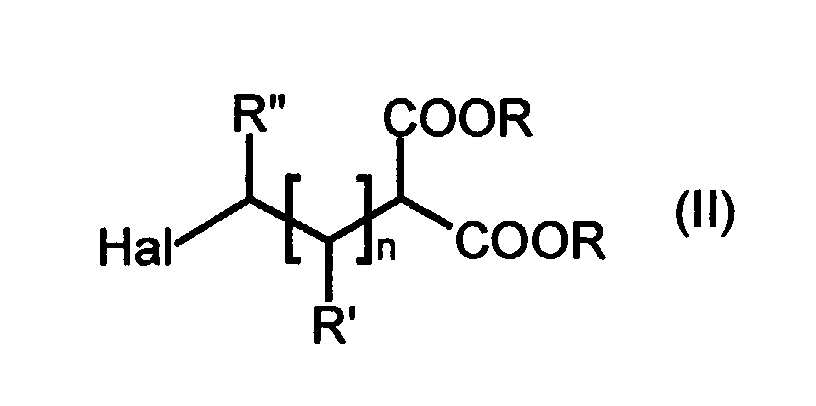
- Halodicarboxylic acid diesters of the general formula (II) are also easy to implement wherein n is an integer from 0 to 10, R is a (C 1 -C 8 ) alkyl, R 'and R "independently of one another are H, (C 1 -C 8 ) alkyl, (C 1 -C 8 ) acyl, (C 3 -C 8 ) cycloalkyl, (C 6 -C 18 ) aryl, (C 7 -C 19) aralkyl, (C 3 -C 18) -heteroaryl, (C 4 -C 19) -heteroaralkyl, ((C 1 -C 8) -alkyl) 1- 3 - (C 3 -C 8 ) -Cycloalkyl, ((C 1 -C 8 ) alkyl) 1-3 - (C 6 -C 18 ) aryl, ((C 1 -C 8 ) alkyl) 1-3
- the one according to the invention is very particularly preferred Process for the preparation of ⁇ -aminocarboxylic acids such as for example the ⁇ -aminooctanoic acid required in polymer chemistry applied.
- Alkali metal cyanates are preferably used as Metal cyanate, particularly preferably lithium, sodium or Potassium cyanate used.
- Alcohols for this purpose obvious connections application.
- the one used Alcohol should be as cheap as possible and yet that Allow urethane formation in a suitable manner.
- linear or arbitrarily branched Alkyl alcohols such as e.g. Methanol, ethanol, propanol, Isopropanol, butanol, sec-butanol, isobutanol, tert-butanol etc.
- the solvent to be used in urethane formation should be an aprotic polar organic. It should sufficient solubility for the used Own reaction partners and on the other hand to the Reaction conditions behave as inert.
- Advantage Solvents such as dimethylformamide, dimethyl sulfoxide, n-methylpyrrolidone or acetonitrile. Very particularly preferred is dimethylformamide.
- the temperature during urethane formation should be chosen so that on the one hand, the reaction is as fast as possible, on the other hand, if possible, the formation of by-products is suppressed in order to achieve an optimal space / time yield guarantee. Routine experiments can help aminocarboxylic acids to be prepared the appropriate temperature be determined.
- the embodiment in which the addition of alcohol and Halocarboxylic acid esters at 80 ° C to 200 ° C, preferably at 120 ° C to 160 ° C, most preferably at 140 ° C is carried out.
- the molar ratio of the individual reactants should be at least 1: 1: 1 for each other Halic carboxylic acid ester, the alcohol and the metal cyanate be.
- it is otherwise based on the Standards of optimal yield of product in one produce in the shortest possible time in a cost-effective manner to be able to. For this reason, from the above relationship be deviated.
- the use of a is very particularly preferred Excess alcohol of 10-50 mol% in one Ratio of halocarboxylic acid ester to metal cyanate of 1: 1.
- the urethane carboxylic acid formed can finally Aminocarboxylic acid are saponified, and in the case of Use of compounds of general formula (I) Saponification of the ester and urethane as well as the Decarboxylation of the resulting carbamic acid function run in parallel.
- the general formal (II) also finds one further saponification and decarboxylation of the malonic ester instead of.
- the reaction can be based on the amount of gas released be followed well. These reactions can occur after Methods known to those skilled in the art can be carried out.
- the acidic saponification of the formed Urethane carboxylic acid ester using an aqueous solution a mineral acid.
- Very particularly preferred is the use of aqueous hydrochloric acid for this purpose, since the hydrochlorides of the amino acids formed as Salts can be obtained purely by crystallization can.
- halocarboxylic acid ester N-alkylation to urethane takes place after The method according to the invention in that e.g. on Alkali metal cyanate in the highest possible boiling polar aprotic solvent and initially on Reaction temperature is heated.
- alkali metal cyanates can use lithium, sodium or potassium cyanate be, with potassium cyanate is preferred.
- Dimethylformamide is particularly suitable, Dimethyl sulfoxide and N-methylpyrrolidone, where Dimethylformamide is preferably used.
- the reaction will depend on the solvent used and the Reactants at a temperature greater than 80 ° C, preferably carried out at 140 ° C.
- the metal chloride salt e.g. Potassium chloride
- the solvent used is distilled from the product separated and can be used again in the reaction become.
- the formed urethanes in raw form or by distillation Cleaning can be used.
- the advantage is Use of raw products.
- the organic solvent is recycled can be dispensed with, the saponification can also be done without prior separation of the organic by distillation Solvent can be worked.
- the method presented allows it surprisingly simple even with chlorine-substituted An exchange of the chlorine atom for a carboxylic acid Nitrogen-bearing group in one for one large-scale process acceptable time and yield manufacture.
- the radicals can be substituted one or more times with heteroatoms such as N, P, S, O or interrupted.
- a (C 6 -C 18 ) aryl radical is understood to mean an aromatic radical with 6 to 18 C atoms.
- these include compounds such as phenyl, naphthyl, anthryl, phenanthryl, biphenyl radicals. These can be substituted one or more times with (C 1 -C 8 ) alkoxy, (C 1 -C 8 ) haloalkyl, OH, Cl, NH 2 , NO 2 .
- the rest can have one or more heteroatoms such as N, O, S.
- (C 1 -C 8 ) alkoxy is a (C 1 -C 8 ) alkyl radical bonded to the molecule under consideration via an oxygen atom.
- a (C 7 -C 19 ) aralkyl radical is a (C 6 -C 18 ) aryl radical bonded to the molecule via a (C 1 -C 8 ) alkyl radical.
- (C 1 -C 8 ) haloalkyl is a (C 1 -C 8 ) alkyl radical substituted by one or more halogen atoms. Chlorine and fluorine are particularly suitable as halogen atoms.
- a (C 3 -C 18 ) heteroaryl radical denotes a five-, six- or seven-membered aromatic ring system composed of 3 to 18 carbon atoms, which heteroatoms such as, for. B. has nitrogen, oxygen or sulfur in the ring.
- heteroaromatics are, in particular, radicals such as 1-, 2-, 3-furyl, such as 1-, 2-, 3-pyrrolyl, 1-, 2-, 3-thienyl, 2-, 3-, 4-pyridyl, 2-, 3-, 4-, 5-, 6-, 7-indolyl, 3-, 4-, 5-pyrazolyl, 2-, 4-, 5-imidazolyl, acridinyl, quinolinyl, phenanthridinyl, 2-, 4- , 5-, 6-pyrimidinyl.
- radicals such as 1-, 2-, 3-furyl, such as 1-, 2-, 3-pyrrolyl, 1-, 2-, 3-thienyl, 2-, 3-, 4-pyridyl, 2-, 3-, 4-, 5-, 6-, 7-indolyl, 3-, 4-, 5-pyrazolyl, 2-, 4-, 5-imidazolyl, acridinyl, quinolinyl, phenanthridinyl, 2-, 4- , 5-, 6-pyrimidinyl.
- Cycloalkyl means cyclopropyl, cyclobutyl, cyclopentyl, cyclohexyl or cycloheptyl or cyclooctyl radicals.
- Halogen is fluorine, chlorine, bromine, iodine.
- the chemical structures shown refer to all possible stereoisomers, by changing the Configuration of the individual chiral centers, axes or Levels can be reached, i.e. all possible Diastereomers, as well as all optical ones included Isomers (enantiomers).
- 1.5 mol of potassium cyanate are in 750 ml of dimethylformamide submitted and heated to 140 ° C. Following that a mixture of 1.5 mol of 8-chloroctanoic acid and 1.65 mol of ethanol were metered in over a period of 1 hour and another 3 hours to complete sales Stirred 140 ° C. The precipitated potassium chloride filtered off and excess dimethylformamide on Rotary evaporator removed in vacuo. The so obtained Raw product is made without further cleaning and without solvents submitted at 100 ° C. Then over a period of 1.5 Hours a mixture of 887 g conc. HCl and 162 g water added. After complete sales (about 3 hours) Cyclohexane added, all water removed and the precipitated solid filtered off. After repeated washing and drying the product in vacuo you get that Hydrochloride of 8-aminooctanoic acid as white, crystalline Solid (melting point: 141-144 ° C) with 80% yield.
Landscapes
- Chemical & Material Sciences (AREA)
- Organic Chemistry (AREA)
- Chemical Kinetics & Catalysis (AREA)
- Organic Low-Molecular-Weight Compounds And Preparation Thereof (AREA)
Abstract
Description
Auch die hydrolytische Spaltung der Urethangruppe, die mit einem Gemisch aus Ameisensäure und Salzsäure in Wasser beschrieben wird und laut Autoren ein 24 stündiges Erhitzen auf Rückflusstemperatur erfordert, lässt diese Verfahrensweise für den großtechnischen Einsatz als nicht geeignet erscheinen.

n eine ganze Zahl von 0 bis 10 ist,
R ein (C1-C8)-Alkyl ist,
R' und R" unabhängig voneinander für H, (C1-C8)-Alkyl, (C3-C8)-Cycloalkyl, (C6-C18)-Aryl, (C7-C19)-Aralkyl, (C3-C18)-Heteroaryl, (C4-C19) -Heteroaralkyl, ((C1-C8)-Alkyl)1-3-(C3-C8)-Cycloalkyl, ((C1-C8)-Alkyl)1-3-(C6-C18)-Aryl, ((C1-C8)-Alkyl)1-3-(C3-C18)-Heteroaryl stehen,
Hal Chlor oder Brom bedeutet.
n eine ganze Zahl von 0 bis 10 ist,
R ein (C1-C8)-Alkyl ist,
R' und R" unabhängig voneinander für H, (C1-C8)-Alkyl, (C1-C8)-Acyl, (C3-C8)-Cycloalkyl, (C6-C18)-Aryl, (C7-C19)-Aralkyl, (C3-C18)-Heteroaryl, (C4-C19)-Heteroaralkyl, ((C1-C8)-Alkyl)1- 3-(C3-C8)-Cycloalkyl, ((C1-C8)-Alkyl)1-3-(C6-C18)-Aryl, ((C1-C8)-Alkyl)1-3-(C3-C18)-Heteroaryl stehen,
Hal Chlor oder Brom bedeutet.
(C7-C19)-Aralkylrest entsprechendes heteroaromatisches System verstanden.
Claims (10)
- Verfahren zur Herstellung von Aminocarbonsäuren ausgehend von einem Halogencarbonsäureester durch Umsetzung mit einem Metallcyanat und einem Alkohol und anschließender saurer Verseifung,
dadurch gekennzeichnet, daß
man das Metallcyanat in einem aprotisch-polaren organischen Lösungsmittel bei erhöhten Temperaturen vorlegt und anschließend den Alkohol und den Ester bei erhöhter Temperatur zur Cyanat-Lösung kontinuierlich zudosiert. - Verfahren nach Anspruch 1,
dadurch gekennzeichnet, daß
man Halogencarbonsäureester der folgenden allgemeinen Formel (I)worin
n eine ganze Zahl von 0 bis 10 ist,
R ein (C1-C8)-Alkyl ist,
R' und R" unabhängig voneinander für H, (C1-C8)-Alkyl, (C3-C8)-Cycloalkyl, (C6-C18)-Aryl, (C7-C19)-Aralkyl, (C3-C18)-Heteroaryl, (C4-C19)-Heteroaralkyl, ((C1-C8)-Alkyl)1-3-(C3-C8)-Cycloalkyl, ((C1-C8)-Alkyl)1-3-(C6-C18)-Aryl, ((C1-C8)-Alkyl)1-3-(C3-C18)-Heteroaryl stehen,
Hal Chlor oder Brom bedeutet,
umsetzt. - Verfahren nach einem oder mehreren der vorhergehenden Ansprüche,
dadurch gekennzeichnet, daß
man Halogendicarbonsäurediester der allgemeinen Formel (II)worin
n eine ganze Zahl von 0 bis 10 ist,
R ein (C1-C8)-Alkyl ist,
R' und R" unabhängig voneinander für H, (C1-C8)-Alkyl, (C1-C8)-Acyl, (C3-C8)-Cycloalkyl, (C6-C18)-Aryl, (C7-C19)-Aralkyl, (C3-C18)-Heteroaryl, (C4-C19)-Heteroaralkyl, ((C1-C8)-Alkyl)1-3-(C3-C8)-Cycloalkyl, ((C1-C8)-Alkyl)1-3-(C6-C18)-Aryl, ((C1-C8)-Alkyl)1-3-(C3-C18)-Heteroaryl stehen,
Hal Chlor oder Brom bedeutet,
umsetzt. - Verfahren nach einem oder mehreren der vorhergehenden Ansprüche,
dadurch gekennzeichnet, daß
man ω-Aminocarbonsäuren herstellt. - Verfahren nach einem oder mehreren der vorhergehenden Ansprüche,
dadurch gekennzeichnet, daß
man als Metallcyanat Lithium-, Natrium- oder Kaliumcyanat verwendet. - Verfahren nach einem oder mehreren der vorhergehenden Ansprüche,
dadurch gekennzeichnet, daß
man als Alkohol einen Alkylalkohol wie Methanol oder Ethanol einsetzt. - Verfahren nach einem oder mehreren der vorhergehenden Ansprüche,
dadurch gekennzeichnet, daß
man als aprotisch-polares organisches Lösungsmittel Dimethylformamid, Dimethylsulfoxid, n-Methylpyrrolidon oder Acetonitril. - Verfahren nach einem oder mehreren der vorhergehenden Ansprüche,
dadurch gekennzeichnet, daß
man die Zugabe des Alkohols und des Halogencarbonsäureesters bei 120°C bis 160°C durchführt. - Verfahren nach einem oder mehreren der vorhergehenden Ansprüche,
dadurch gekennzeichnet, daß
man bezogen auf den Halogencarbonsäureester den Alkohol und das Metallcyanat im Mol-Verhältnis 1:1-2:1-1,5 einsetzt. - Verfahren nach einem oder mehreren der vorhergehenden Ansprüche,
dadurch gekennzeichnet, daß
man die saure Verseifung des gebildeten Urethancarbonsäureesters mittels einer wässrigen Lösung einer Mineralsäure durchführt.
Applications Claiming Priority (2)
| Application Number | Priority Date | Filing Date | Title |
|---|---|---|---|
| DE10158537A DE10158537A1 (de) | 2001-11-29 | 2001-11-29 | Verfahren zur Herstellung von Aminocarbonsäuren |
| DE10158537 | 2001-11-29 |
Publications (2)
| Publication Number | Publication Date |
|---|---|
| EP1316543A1 true EP1316543A1 (de) | 2003-06-04 |
| EP1316543B1 EP1316543B1 (de) | 2006-06-21 |
Family
ID=7707355
Family Applications (1)
| Application Number | Title | Priority Date | Filing Date |
|---|---|---|---|
| EP02021495A Expired - Lifetime EP1316543B1 (de) | 2001-11-29 | 2002-09-26 | Verfahren zur Herstellung von Aminocarbonsäuren |
Country Status (5)
| Country | Link |
|---|---|
| US (1) | US6916947B2 (de) |
| EP (1) | EP1316543B1 (de) |
| AT (1) | ATE330931T1 (de) |
| DE (2) | DE10158537A1 (de) |
| ES (1) | ES2264712T3 (de) |
Families Citing this family (1)
| Publication number | Priority date | Publication date | Assignee | Title |
|---|---|---|---|---|
| JP2007294747A (ja) * | 2006-04-26 | 2007-11-08 | Matsushita Electric Ind Co Ltd | レーザ駆動回路、レーザ駆動方法、記録再生装置 |
Citations (1)
| Publication number | Priority date | Publication date | Assignee | Title |
|---|---|---|---|---|
| DE2854627B1 (de) * | 1978-12-18 | 1979-10-04 | Degussa | Verfahren zur Herstellung von Aminocarbonsaeruehydrochloriden bzw. Diaminocarbonsaeure-di-hydrochloriden |
Family Cites Families (3)
| Publication number | Priority date | Publication date | Assignee | Title |
|---|---|---|---|---|
| US3244733A (en) | 1962-01-30 | 1966-04-05 | Asahi Chemical Ind | Process for producing omega-amino acids |
| US4147716A (en) * | 1978-06-05 | 1979-04-03 | Basf Wyandotte Corporation | Preparation of N-substituted carbamates |
| US5962710A (en) | 1997-05-09 | 1999-10-05 | Emisphere Technologies, Inc. | Method of preparing salicyloylamino acids |
-
2001
- 2001-11-29 DE DE10158537A patent/DE10158537A1/de not_active Withdrawn
-
2002
- 2002-09-26 DE DE50207278T patent/DE50207278D1/de not_active Expired - Fee Related
- 2002-09-26 EP EP02021495A patent/EP1316543B1/de not_active Expired - Lifetime
- 2002-09-26 AT AT02021495T patent/ATE330931T1/de not_active IP Right Cessation
- 2002-09-26 ES ES02021495T patent/ES2264712T3/es not_active Expired - Lifetime
- 2002-11-25 US US10/303,078 patent/US6916947B2/en not_active Expired - Fee Related
Patent Citations (1)
| Publication number | Priority date | Publication date | Assignee | Title |
|---|---|---|---|---|
| DE2854627B1 (de) * | 1978-12-18 | 1979-10-04 | Degussa | Verfahren zur Herstellung von Aminocarbonsaeruehydrochloriden bzw. Diaminocarbonsaeure-di-hydrochloriden |
Non-Patent Citations (2)
| Title |
|---|
| EFFENBERGER F & DRAUZ K: "Neue Synthese von Aminosäuren aus Halogencarbonsäureestern", ANGEWANDTE CHEMIE, vol. 91, no. 6, 1979, pages 504 - 505, XP009007084 * |
| EFFENBERGER F ET AL.: "Darstellung von Aminosäuren aus Halogencarbonsäuren-alkyl-estern mit Alkalimetallcyanaten", CHEMISCHE BERICHTE, vol. 114, no. 1, 1981, pages 173 - 189, XP009007085 * |
Also Published As
| Publication number | Publication date |
|---|---|
| ES2264712T3 (es) | 2007-01-16 |
| US20030120084A1 (en) | 2003-06-26 |
| DE10158537A1 (de) | 2003-06-12 |
| ATE330931T1 (de) | 2006-07-15 |
| EP1316543B1 (de) | 2006-06-21 |
| DE50207278D1 (de) | 2006-08-03 |
| US6916947B2 (en) | 2005-07-12 |
Similar Documents
| Publication | Publication Date | Title |
|---|---|---|
| EP0414274B1 (de) | Verfahren zur Herstellung von 1-Aminomethyl-1-cyclohexanessigsäure | |
| DE2240883A1 (de) | Verfahren zur herstellung von carbonsaeure- und sulfonsaeurechloriden | |
| EP1316543B1 (de) | Verfahren zur Herstellung von Aminocarbonsäuren | |
| DE69219363T2 (de) | VERFAHREN ZUR HERSTELLUNG VON OPTISCH AKTIVEN ALIPHATISCHEN Carbonsäuren | |
| DE60004850T2 (de) | Verfahren zur herstellung von (r) und (s)-aminocarnitin und deren derivative aus d- und l-aspargin säure | |
| EP0275470B1 (de) | N-substituierte, Estergruppen enthaltende Acrylamide | |
| EP0362350A1 (de) | Verfahren zur herstellung von 5-gliedrigen, stickstoffhaltigen heteroaromaten | |
| DE3824961A1 (de) | Verfahren zur herstellung von bis(aminomethyl)-phosphinsaeure oder deren sauren oder basischen salzen | |
| CH639945A5 (de) | Verfahren zur trennung von racemischen alpha-aminonitrilen. | |
| DE19524337C1 (de) | Verfahren zur Herstellung von beta-Amino-alpha-hydroxycarbonsäuren und deren Derivaten | |
| DE1232127B (de) | Verfahren zur Herstellung von gesaettigten aliphatischen oder aromatischen Nitrilen | |
| EP0728736B1 (de) | Verfahren zur Herstellung von optisch aktivem tert-Leucinol und dessen Verwendung | |
| DE69821763T2 (de) | Verfahren zur herstellung von 2-alkylthio-substituierten benzoesäurederivaten | |
| EP1438286B1 (de) | Verfahren zur herstellung von arylsulfonsäureisocyanaten | |
| DE19629692A1 (de) | Verfahren zur Herstellung von racemischen Phenethylaminen | |
| EP0757981B1 (de) | Verfahren zur Herstellung von racemischen Amino-Derivaten | |
| DE335993C (de) | Verfahren zur Herstellung von Hydantoinen | |
| DE4022982A1 (de) | Verfahren zur herstellung von n-alkylsulfonylaminosulfonylharnstoffen | |
| DE69604247T2 (de) | 2-Cyanopiperazin und ihre Verwendung für die Synthese von biologisch wirksamen Stoffen | |
| EP0293752A2 (de) | Verfahren zur Herstellung von E-2-Propyl-2-pentensäure und physiologisch verträglichen Salzen derselben | |
| EP1207151A1 (de) | Verfahren zur Herstellung von N-Methylenglycinaten | |
| DE2221109A1 (de) | Verfahren zur Herstellung von alpha-anilincarbonsaeureestern und -nitrilen | |
| DE1251304B (de) | Verfahren zur Herstellung von a [0 0 Dialkyl-mono- bzw -ditniophosphoryl] - carbonsäureamiden | |
| DE2361604C3 (de) | Verfahren zur Herstellung von N1Ndisubstituierten Carbonsäureamiden | |
| EP1671939A1 (de) | Verfahren zur Herstellung von enantiomerenangereicherten 2-Fluorcarbonsäureestern |
Legal Events
| Date | Code | Title | Description |
|---|---|---|---|
| PUAI | Public reference made under article 153(3) epc to a published international application that has entered the european phase |
Free format text: ORIGINAL CODE: 0009012 |
|
| 17P | Request for examination filed |
Effective date: 20020926 |
|
| AK | Designated contracting states |
Designated state(s): AT BE BG CH CY CZ DE DK EE ES FI FR GB GR IE IT LI LU MC NL PT SE SK TR |
|
| AX | Request for extension of the european patent |
Extension state: AL LT LV MK RO SI |
|
| AKX | Designation fees paid |
Designated state(s): AT BE BG CH CY CZ DE DK EE ES FI FR GB GR IE IT LI LU MC NL PT SE SK TR |
|
| GRAP | Despatch of communication of intention to grant a patent |
Free format text: ORIGINAL CODE: EPIDOSNIGR1 |
|
| GRAS | Grant fee paid |
Free format text: ORIGINAL CODE: EPIDOSNIGR3 |
|
| GRAA | (expected) grant |
Free format text: ORIGINAL CODE: 0009210 |
|
| AK | Designated contracting states |
Kind code of ref document: B1 Designated state(s): AT BE BG CH CY CZ DE DK EE ES FI FR GB GR IE IT LI LU MC NL PT SE SK TR |
|
| PG25 | Lapsed in a contracting state [announced via postgrant information from national office to epo] |
Ref country code: SK Free format text: LAPSE BECAUSE OF FAILURE TO SUBMIT A TRANSLATION OF THE DESCRIPTION OR TO PAY THE FEE WITHIN THE PRESCRIBED TIME-LIMIT Effective date: 20060621 Ref country code: FI Free format text: LAPSE BECAUSE OF FAILURE TO SUBMIT A TRANSLATION OF THE DESCRIPTION OR TO PAY THE FEE WITHIN THE PRESCRIBED TIME-LIMIT Effective date: 20060621 Ref country code: IE Free format text: LAPSE BECAUSE OF FAILURE TO SUBMIT A TRANSLATION OF THE DESCRIPTION OR TO PAY THE FEE WITHIN THE PRESCRIBED TIME-LIMIT Effective date: 20060621 Ref country code: NL Free format text: LAPSE BECAUSE OF FAILURE TO SUBMIT A TRANSLATION OF THE DESCRIPTION OR TO PAY THE FEE WITHIN THE PRESCRIBED TIME-LIMIT Effective date: 20060621 Ref country code: CZ Free format text: LAPSE BECAUSE OF FAILURE TO SUBMIT A TRANSLATION OF THE DESCRIPTION OR TO PAY THE FEE WITHIN THE PRESCRIBED TIME-LIMIT Effective date: 20060621 |
|
| REG | Reference to a national code |
Ref country code: GB Ref legal event code: FG4D Free format text: NOT ENGLISH |
|
| REG | Reference to a national code |
Ref country code: CH Ref legal event code: EP Ref country code: CH Ref legal event code: NV Representative=s name: SCHMAUDER & PARTNER AG PATENTANWALTSBUERO |
|
| REG | Reference to a national code |
Ref country code: IE Ref legal event code: FG4D Free format text: LANGUAGE OF EP DOCUMENT: GERMAN |
|
| REF | Corresponds to: |
Ref document number: 50207278 Country of ref document: DE Date of ref document: 20060803 Kind code of ref document: P |
|
| GBT | Gb: translation of ep patent filed (gb section 77(6)(a)/1977) |
Effective date: 20060719 |
|
| PG25 | Lapsed in a contracting state [announced via postgrant information from national office to epo] |
Ref country code: SE Free format text: LAPSE BECAUSE OF FAILURE TO SUBMIT A TRANSLATION OF THE DESCRIPTION OR TO PAY THE FEE WITHIN THE PRESCRIBED TIME-LIMIT Effective date: 20060921 Ref country code: DK Free format text: LAPSE BECAUSE OF FAILURE TO SUBMIT A TRANSLATION OF THE DESCRIPTION OR TO PAY THE FEE WITHIN THE PRESCRIBED TIME-LIMIT Effective date: 20060921 |
|
| PG25 | Lapsed in a contracting state [announced via postgrant information from national office to epo] |
Ref country code: MC Free format text: LAPSE BECAUSE OF NON-PAYMENT OF DUE FEES Effective date: 20060930 Ref country code: BE Free format text: LAPSE BECAUSE OF NON-PAYMENT OF DUE FEES Effective date: 20060930 |
|
| PG25 | Lapsed in a contracting state [announced via postgrant information from national office to epo] |
Ref country code: PT Free format text: LAPSE BECAUSE OF FAILURE TO SUBMIT A TRANSLATION OF THE DESCRIPTION OR TO PAY THE FEE WITHIN THE PRESCRIBED TIME-LIMIT Effective date: 20061121 |
|
| NLV1 | Nl: lapsed or annulled due to failure to fulfill the requirements of art. 29p and 29m of the patents act | ||
| ET | Fr: translation filed | ||
| REG | Reference to a national code |
Ref country code: ES Ref legal event code: FG2A Ref document number: 2264712 Country of ref document: ES Kind code of ref document: T3 |
|
| RAP2 | Party data changed (patent owner data changed or rights of a patent transferred) |
Owner name: DEGUSSA GMBH |
|
| REG | Reference to a national code |
Ref country code: IE Ref legal event code: FD4D |
|
| PLBE | No opposition filed within time limit |
Free format text: ORIGINAL CODE: 0009261 |
|
| STAA | Information on the status of an ep patent application or granted ep patent |
Free format text: STATUS: NO OPPOSITION FILED WITHIN TIME LIMIT |
|
| 26N | No opposition filed |
Effective date: 20070322 |
|
| BERE | Be: lapsed |
Owner name: DEGUSSA A.G. Effective date: 20060930 |
|
| PG25 | Lapsed in a contracting state [announced via postgrant information from national office to epo] |
Ref country code: GR Free format text: LAPSE BECAUSE OF FAILURE TO SUBMIT A TRANSLATION OF THE DESCRIPTION OR TO PAY THE FEE WITHIN THE PRESCRIBED TIME-LIMIT Effective date: 20060922 |
|
| PG25 | Lapsed in a contracting state [announced via postgrant information from national office to epo] |
Ref country code: BG Free format text: LAPSE BECAUSE OF FAILURE TO SUBMIT A TRANSLATION OF THE DESCRIPTION OR TO PAY THE FEE WITHIN THE PRESCRIBED TIME-LIMIT Effective date: 20060921 Ref country code: EE Free format text: LAPSE BECAUSE OF FAILURE TO SUBMIT A TRANSLATION OF THE DESCRIPTION OR TO PAY THE FEE WITHIN THE PRESCRIBED TIME-LIMIT Effective date: 20060621 |
|
| PG25 | Lapsed in a contracting state [announced via postgrant information from national office to epo] |
Ref country code: LU Free format text: LAPSE BECAUSE OF NON-PAYMENT OF DUE FEES Effective date: 20060926 Ref country code: TR Free format text: LAPSE BECAUSE OF FAILURE TO SUBMIT A TRANSLATION OF THE DESCRIPTION OR TO PAY THE FEE WITHIN THE PRESCRIBED TIME-LIMIT Effective date: 20060621 |
|
| PGFP | Annual fee paid to national office [announced via postgrant information from national office to epo] |
Ref country code: CH Payment date: 20080915 Year of fee payment: 7 |
|
| PG25 | Lapsed in a contracting state [announced via postgrant information from national office to epo] |
Ref country code: CY Free format text: LAPSE BECAUSE OF FAILURE TO SUBMIT A TRANSLATION OF THE DESCRIPTION OR TO PAY THE FEE WITHIN THE PRESCRIBED TIME-LIMIT Effective date: 20060621 |
|
| PGFP | Annual fee paid to national office [announced via postgrant information from national office to epo] |
Ref country code: AT Payment date: 20080915 Year of fee payment: 7 Ref country code: FR Payment date: 20080912 Year of fee payment: 7 Ref country code: IT Payment date: 20080920 Year of fee payment: 7 |
|
| PGFP | Annual fee paid to national office [announced via postgrant information from national office to epo] |
Ref country code: GB Payment date: 20080918 Year of fee payment: 7 |
|
| PGFP | Annual fee paid to national office [announced via postgrant information from national office to epo] |
Ref country code: DE Payment date: 20080919 Year of fee payment: 7 |
|
| PGFP | Annual fee paid to national office [announced via postgrant information from national office to epo] |
Ref country code: ES Payment date: 20080929 Year of fee payment: 7 |
|
| REG | Reference to a national code |
Ref country code: CH Ref legal event code: PCAR Free format text: SCHMAUDER & PARTNER AG PATENT- UND MARKENANWAELTE VSP;ZWAENGIWEG 7;8038 ZUERICH (CH) |
|
| REG | Reference to a national code |
Ref country code: CH Ref legal event code: PFA Owner name: EVONIK DEGUSSA GMBH Free format text: DEGUSSA AG#BENNIGSENPLATZ 1#40474 DUESSELDORF (DE) -TRANSFER TO- EVONIK DEGUSSA GMBH#RELLINGHAUSER STRASSE 1-11#45128 ESSEN (DE) |
|
| REG | Reference to a national code |
Ref country code: FR Ref legal event code: CA Ref country code: FR Ref legal event code: CD Ref country code: FR Ref legal event code: CJ |
|
| REG | Reference to a national code |
Ref country code: CH Ref legal event code: PL |
|
| GBPC | Gb: european patent ceased through non-payment of renewal fee |
Effective date: 20090926 |
|
| REG | Reference to a national code |
Ref country code: FR Ref legal event code: ST Effective date: 20100531 |
|
| PG25 | Lapsed in a contracting state [announced via postgrant information from national office to epo] |
Ref country code: AT Free format text: LAPSE BECAUSE OF NON-PAYMENT OF DUE FEES Effective date: 20090926 |
|
| PG25 | Lapsed in a contracting state [announced via postgrant information from national office to epo] |
Ref country code: FR Free format text: LAPSE BECAUSE OF NON-PAYMENT OF DUE FEES Effective date: 20090930 Ref country code: DE Free format text: LAPSE BECAUSE OF NON-PAYMENT OF DUE FEES Effective date: 20100401 |
|
| PG25 | Lapsed in a contracting state [announced via postgrant information from national office to epo] |
Ref country code: LI Free format text: LAPSE BECAUSE OF NON-PAYMENT OF DUE FEES Effective date: 20090930 Ref country code: CH Free format text: LAPSE BECAUSE OF NON-PAYMENT OF DUE FEES Effective date: 20090930 |
|
| PG25 | Lapsed in a contracting state [announced via postgrant information from national office to epo] |
Ref country code: GB Free format text: LAPSE BECAUSE OF NON-PAYMENT OF DUE FEES Effective date: 20090926 |
|
| PG25 | Lapsed in a contracting state [announced via postgrant information from national office to epo] |
Ref country code: IT Free format text: LAPSE BECAUSE OF NON-PAYMENT OF DUE FEES Effective date: 20090926 |
|
| REG | Reference to a national code |
Ref country code: ES Ref legal event code: FD2A Effective date: 20111116 |
|
| PG25 | Lapsed in a contracting state [announced via postgrant information from national office to epo] |
Ref country code: ES Free format text: LAPSE BECAUSE OF NON-PAYMENT OF DUE FEES Effective date: 20090927 |