EP1300505A2 - Gassack für ein Rückhaltesystem in Fahrzeugen - Google Patents
Gassack für ein Rückhaltesystem in Fahrzeugen Download PDFInfo
- Publication number
- EP1300505A2 EP1300505A2 EP02022219A EP02022219A EP1300505A2 EP 1300505 A2 EP1300505 A2 EP 1300505A2 EP 02022219 A EP02022219 A EP 02022219A EP 02022219 A EP02022219 A EP 02022219A EP 1300505 A2 EP1300505 A2 EP 1300505A2
- Authority
- EP
- European Patent Office
- Prior art keywords
- airbag
- fabric
- plasma
- plasma treatment
- treated
- Prior art date
- Legal status (The legal status is an assumption and is not a legal conclusion. Google has not performed a legal analysis and makes no representation as to the accuracy of the status listed.)
- Granted
Links
Images
Classifications
-
- B—PERFORMING OPERATIONS; TRANSPORTING
- B60—VEHICLES IN GENERAL
- B60R—VEHICLES, VEHICLE FITTINGS, OR VEHICLE PARTS, NOT OTHERWISE PROVIDED FOR
- B60R21/00—Arrangements or fittings on vehicles for protecting or preventing injuries to occupants or pedestrians in case of accidents or other traffic risks
- B60R21/02—Occupant safety arrangements or fittings, e.g. crash pads
- B60R21/16—Inflatable occupant restraints or confinements designed to inflate upon impact or impending impact, e.g. air bags
- B60R21/23—Inflatable members
- B60R21/235—Inflatable members characterised by their material
-
- D—TEXTILES; PAPER
- D06—TREATMENT OF TEXTILES OR THE LIKE; LAUNDERING; FLEXIBLE MATERIALS NOT OTHERWISE PROVIDED FOR
- D06M—TREATMENT, NOT PROVIDED FOR ELSEWHERE IN CLASS D06, OF FIBRES, THREADS, YARNS, FABRICS, FEATHERS OR FIBROUS GOODS MADE FROM SUCH MATERIALS
- D06M10/00—Physical treatment of fibres, threads, yarns, fabrics or fibrous goods made from such materials, e.g. by ultrasonic waves, corona discharge, irradiation, electric currents or magnetic fields; Physical treatment combined with treatment with chemical compounds or elements
- D06M10/02—Sonic or ultrasonic waves; Corona discharge
- D06M10/025—Corona discharge or low temperature plasma
-
- D—TEXTILES; PAPER
- D06—TREATMENT OF TEXTILES OR THE LIKE; LAUNDERING; FLEXIBLE MATERIALS NOT OTHERWISE PROVIDED FOR
- D06M—TREATMENT, NOT PROVIDED FOR ELSEWHERE IN CLASS D06, OF FIBRES, THREADS, YARNS, FABRICS, FEATHERS OR FIBROUS GOODS MADE FROM SUCH MATERIALS
- D06M10/00—Physical treatment of fibres, threads, yarns, fabrics or fibrous goods made from such materials, e.g. by ultrasonic waves, corona discharge, irradiation, electric currents or magnetic fields; Physical treatment combined with treatment with chemical compounds or elements
- D06M10/04—Physical treatment combined with treatment with chemical compounds or elements
- D06M10/06—Inorganic compounds or elements
-
- D—TEXTILES; PAPER
- D06—TREATMENT OF TEXTILES OR THE LIKE; LAUNDERING; FLEXIBLE MATERIALS NOT OTHERWISE PROVIDED FOR
- D06M—TREATMENT, NOT PROVIDED FOR ELSEWHERE IN CLASS D06, OF FIBRES, THREADS, YARNS, FABRICS, FEATHERS OR FIBROUS GOODS MADE FROM SUCH MATERIALS
- D06M10/00—Physical treatment of fibres, threads, yarns, fabrics or fibrous goods made from such materials, e.g. by ultrasonic waves, corona discharge, irradiation, electric currents or magnetic fields; Physical treatment combined with treatment with chemical compounds or elements
- D06M10/04—Physical treatment combined with treatment with chemical compounds or elements
- D06M10/08—Organic compounds
-
- D—TEXTILES; PAPER
- D06—TREATMENT OF TEXTILES OR THE LIKE; LAUNDERING; FLEXIBLE MATERIALS NOT OTHERWISE PROVIDED FOR
- D06M—TREATMENT, NOT PROVIDED FOR ELSEWHERE IN CLASS D06, OF FIBRES, THREADS, YARNS, FABRICS, FEATHERS OR FIBROUS GOODS MADE FROM SUCH MATERIALS
- D06M11/00—Treating fibres, threads, yarns, fabrics or fibrous goods made from such materials, with inorganic substances or complexes thereof; Such treatment combined with mechanical treatment, e.g. mercerising
- D06M11/83—Treating fibres, threads, yarns, fabrics or fibrous goods made from such materials, with inorganic substances or complexes thereof; Such treatment combined with mechanical treatment, e.g. mercerising with metals; with metal-generating compounds, e.g. metal carbonyls; Reduction of metal compounds on textiles
-
- D—TEXTILES; PAPER
- D06—TREATMENT OF TEXTILES OR THE LIKE; LAUNDERING; FLEXIBLE MATERIALS NOT OTHERWISE PROVIDED FOR
- D06M—TREATMENT, NOT PROVIDED FOR ELSEWHERE IN CLASS D06, OF FIBRES, THREADS, YARNS, FABRICS, FEATHERS OR FIBROUS GOODS MADE FROM SUCH MATERIALS
- D06M14/00—Graft polymerisation of monomers containing carbon-to-carbon unsaturated bonds on to fibres, threads, yarns, fabrics, or fibrous goods made from such materials
- D06M14/18—Graft polymerisation of monomers containing carbon-to-carbon unsaturated bonds on to fibres, threads, yarns, fabrics, or fibrous goods made from such materials using wave energy or particle radiation
- D06M14/26—Graft polymerisation of monomers containing carbon-to-carbon unsaturated bonds on to fibres, threads, yarns, fabrics, or fibrous goods made from such materials using wave energy or particle radiation on to materials of synthetic origin
- D06M14/30—Graft polymerisation of monomers containing carbon-to-carbon unsaturated bonds on to fibres, threads, yarns, fabrics, or fibrous goods made from such materials using wave energy or particle radiation on to materials of synthetic origin of macromolecular compounds obtained otherwise than by reactions only involving carbon-to-carbon unsaturated bonds
- D06M14/32—Polyesters
-
- D—TEXTILES; PAPER
- D06—TREATMENT OF TEXTILES OR THE LIKE; LAUNDERING; FLEXIBLE MATERIALS NOT OTHERWISE PROVIDED FOR
- D06M—TREATMENT, NOT PROVIDED FOR ELSEWHERE IN CLASS D06, OF FIBRES, THREADS, YARNS, FABRICS, FEATHERS OR FIBROUS GOODS MADE FROM SUCH MATERIALS
- D06M14/00—Graft polymerisation of monomers containing carbon-to-carbon unsaturated bonds on to fibres, threads, yarns, fabrics, or fibrous goods made from such materials
- D06M14/18—Graft polymerisation of monomers containing carbon-to-carbon unsaturated bonds on to fibres, threads, yarns, fabrics, or fibrous goods made from such materials using wave energy or particle radiation
- D06M14/26—Graft polymerisation of monomers containing carbon-to-carbon unsaturated bonds on to fibres, threads, yarns, fabrics, or fibrous goods made from such materials using wave energy or particle radiation on to materials of synthetic origin
- D06M14/30—Graft polymerisation of monomers containing carbon-to-carbon unsaturated bonds on to fibres, threads, yarns, fabrics, or fibrous goods made from such materials using wave energy or particle radiation on to materials of synthetic origin of macromolecular compounds obtained otherwise than by reactions only involving carbon-to-carbon unsaturated bonds
- D06M14/34—Polyamides
-
- B—PERFORMING OPERATIONS; TRANSPORTING
- B60—VEHICLES IN GENERAL
- B60R—VEHICLES, VEHICLE FITTINGS, OR VEHICLE PARTS, NOT OTHERWISE PROVIDED FOR
- B60R21/00—Arrangements or fittings on vehicles for protecting or preventing injuries to occupants or pedestrians in case of accidents or other traffic risks
- B60R21/02—Occupant safety arrangements or fittings, e.g. crash pads
- B60R21/16—Inflatable occupant restraints or confinements designed to inflate upon impact or impending impact, e.g. air bags
- B60R21/23—Inflatable members
- B60R21/231—Inflatable members characterised by their shape, construction or spatial configuration
- B60R2021/23123—Heat protection panels
-
- B—PERFORMING OPERATIONS; TRANSPORTING
- B60—VEHICLES IN GENERAL
- B60R—VEHICLES, VEHICLE FITTINGS, OR VEHICLE PARTS, NOT OTHERWISE PROVIDED FOR
- B60R21/00—Arrangements or fittings on vehicles for protecting or preventing injuries to occupants or pedestrians in case of accidents or other traffic risks
- B60R21/02—Occupant safety arrangements or fittings, e.g. crash pads
- B60R21/16—Inflatable occupant restraints or confinements designed to inflate upon impact or impending impact, e.g. air bags
- B60R21/23—Inflatable members
- B60R21/235—Inflatable members characterised by their material
- B60R2021/23504—Inflatable members characterised by their material characterised by material
- B60R2021/23509—Fabric
- B60R2021/23514—Fabric coated fabric
-
- B—PERFORMING OPERATIONS; TRANSPORTING
- B60—VEHICLES IN GENERAL
- B60R—VEHICLES, VEHICLE FITTINGS, OR VEHICLE PARTS, NOT OTHERWISE PROVIDED FOR
- B60R21/00—Arrangements or fittings on vehicles for protecting or preventing injuries to occupants or pedestrians in case of accidents or other traffic risks
- B60R21/02—Occupant safety arrangements or fittings, e.g. crash pads
- B60R21/16—Inflatable occupant restraints or confinements designed to inflate upon impact or impending impact, e.g. air bags
- B60R21/23—Inflatable members
- B60R21/235—Inflatable members characterised by their material
- B60R2021/23533—Inflatable members characterised by their material characterised by the manufacturing process
Definitions
- the present invention relates to an airbag for a restraint system in Vehicles, a device for protecting vehicle occupants with such Airbag, a method for manufacturing the airbag and its use a fabric for the gas bag.
- Airbags or airbags for vehicle occupant restraint systems usually exist made of silicone-coated or uncoated polyamide or polyester fabrics.
- the fabrics need a targeted adjustment of air permeability enable and also be heat-resistant.
- the Fabric in the interest of the smallest possible space requirement for the accommodation the gas bag in the vehicle is easy to fold and as low as possible Have mass.
- the invention provides an airbag for a restraint system in vehicles, with a wall of tissue, which is characterized in that a surface of the fabric to increase heat resistance, in particular against incident hot gases, is treated in a plasma.
- the Plasma treatment is preferably a metallization, which by the Metallization formed metal layer can be between 40 nm and 10 microns thick. Depending on the application, the plasma treatment can also be fluorinated his.
- the gas bag according to the invention preferably has an inside for receiving of a gas volume, the plasma-treated surface of the gas bag fabric faces the gas volume in the inflated state of the gas bag is.
- At least parts of the gas bag wall preferably consist of the fabric with the plasma treated surface.
- the wall can also be completely formed from the plasma-treated tissue.
- the invention is also directed to a device for Protection of vehicle occupants with the gas bag according to the invention.
- the invention also provides a method for producing an airbag for a restraint system in vehicles, comprising the following steps: Providing one or more webs of fabric; Plasma treatment of a surface the fabric webs in a microwave reactor or a high frequency reactor to increase the heat resistance of the fabric and cutting and joining the fabric sheets in a known manner to form the invention Airbag.
- the plasma treatment is preferably in a microwave reactor at 2.4 up to 2.6 GHz. It can also be used for plasma treatment High frequency reactor can be used, treatment under vacuum 13 to 14 MHz is performed. It is particularly preferred to carry out the Plasma treatment in the basically known roll-to-roll process, which is called continuous process enables a particularly economical production.
- the invention also relates to the use of a fabric with an at least partially treated in a plasma surface for the gas bag according to the invention.
- the plasma treated fabrics show compared to the conventional uncoated Fabrics have a heat resistance that is between two and ten times higher against hot gases hitting the plasma-treated surface. Due to the extremely low layer thicknesses of the coating is a problem Folding of the gas bag ensured. Even the kink resistance of the folded Air bags in the gas bag module is over a lifetime corresponding to the vehicle Sufficient time. Finally, the plasma coating leads also not to change the previously set air permeability of the Tissue.
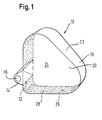
- the gas bag 10 shown here consists of a middle fabric part 18 and two side fabric parts 20, 22, which together form the wall 24. However, other cuts can also be used become.
- the gas volume flowing into the gas bag from the gas generator 16 facing surface 26 of the fabric part 18 on the inside of the gas bag is in the embodiment shown here to increase the heat resistance treated in a plasma.
- the inside of the gas bag can also facing surfaces of the side fabric parts 20 and 22 plasma treated his. It is also possible to use only the areas of the fabric parts 18, 20 and 22 to be treated in the plasma, which flows out of the gas generator 16 are particularly exposed to hot gases. Generally, these will be the Mouth opening 12 adjacent areas of the gas bag fabric and that of Mouth opening 12 opposite in the flow direction of the hot gases Be fabric parts.
- the plasma treatment a metallization so that a metal layer 28 is formed on the surface 26 is, which can have a thickness of between 40 nm and 10 microns.
- surface 26 is fluorinated.
- Fabric webs are made from the gas bag according to the invention suitable polyamide or polyester fabrics with predetermined air permeability provided. These webs are first of all in one by one Treated microwave reactor or a high-frequency reactor generated plasma.
- the plasma treatment is preferably carried out according to the already known roll-to-roll Process that as a continuous process is quick and economical Manufacturing enables.
- the plasma is generated in the microwave reactor, for example at 2.4 to 2.6 GHz with controlled supply of up to three gases for setting the type of coating and coating thickness.
- the coating in the high-frequency reactor can generate a low-pressure plasma at 13 up to 14 MHz under vacuum by magnetron sputtering or electron beam evaporation respectively.
- a metallic one is preferably used for the plasma treatment Protective layer applied to the surfaces of the fabric sheets.
- the Layer thickness is preferably in the range of 40 nm to 10 microns.
- the metallic protective layer offers effective protection against the Exposure to hot gases. So on a polyamide fabric of the type 470 / F72dtex that the tissue metallized by plasma treatment Depending on the thickness of the coating, heat resistance is increased two to ten times compared to untreated tissue of the same type. For the Experimental setup was using a defined surface of the respective tissue a 33 g heavy metal ball with a diameter of 850 ° C of 20 mm and measured the time until the tissue melts.
- Another advantage of the metallic generated by the plasma treatment Protective layer on the gas bag fabric is in the shielding effect against high frequency electromagnetic fields.
- the one folded over the gas generator Airbag can also add to the sensitive ignition mechanism of the gas generator and shield the vehicle electronics underneath. So were able to reduce attenuation of approx. 70 dB between 300 and 1000 MHz can be achieved with a coating thickness of approx. 400 nm.
- Airbag fabrics that are only supposed to have improved heat resistance can also be fluorinated by means of a plasma treatment.
- a short treatment is carried out in the reactors described above using a C 2 F 6 / Ar plasma.
- the conditions of the plasma treatment suitable for achieving the desired degree of fluorination or the desired coating thickness, in particular pressure, temperature, time and composition of the plasma, can be determined by suitable preliminary tests.
- tissue parts treated with the method described above become then cut in the usual manner and to form the invention Gas bags connected together.
- the gas bag thus produced has an improved resistance to hot gases.
- the increase in mass of the airbag fabric is due to the small Coating thickness, however, is insignificant. So the essential remain Advantages of uncoated gas bags, in particular the smaller space requirement in the folded state.
- the kink resistance of those from the plasma treated Fabric bags formed gas bags is one of the vehicle life adequate period. Since the coating of the fabric parts in a continuous process is also an inexpensive manufacture of particularly heat-resistant gas bags possible.
Landscapes
- Engineering & Computer Science (AREA)
- Textile Engineering (AREA)
- Chemical & Material Sciences (AREA)
- Chemical Kinetics & Catalysis (AREA)
- Health & Medical Sciences (AREA)
- Toxicology (AREA)
- Inorganic Chemistry (AREA)
- Physics & Mathematics (AREA)
- Plasma & Fusion (AREA)
- Mechanical Engineering (AREA)
- Chemical Or Physical Treatment Of Fibers (AREA)
- Treatments Of Macromolecular Shaped Articles (AREA)
- Air Bags (AREA)
- Treatment Of Fiber Materials (AREA)
Abstract
Description
- Figur 1 eine schematische Perspektivansicht eines Gassacks in aufgeblasenem Zustand.
Claims (13)
- Gassack (10) für ein Rückhaltesystem in Fahrzeugen, mit einer Wandung (24) aus Gewebe (18, 20, 22), dadurch gekennzeichnet, daß eine Oberfläche (26) des Gewebes (18, 20, 22) zur Steigerung der Hitzebeständigkeit in einem Plasma behandelt ist.
- Gassack nach Anspruch 1, dadurch gekennzeichnet, daß die Plasmabehandlung eine Metallisierung ist.
- Gassack nach Anspruch 2, dadurch gekennzeichnet, daß die durch die Metallisierung gebildete Metallschicht (28) zwischen 40 nm und 10 µm dick ist.
- Gassack nach Anspruch 1, dadurch gekennzeichnet, daß die Plasmabehandlung eine Fluorierung ist.
- Gassack nach einem der Ansprüche 1 bis 4, dadurch gekennzeichnet, daß der Gassack (10) eine Innenseite zur Aufnahme eines Gasvolumens aufweist und die plasmabehandelte Oberfläche (26) im aufgeblasenen Zustand des Gassacks (10) dem Gasvolumen zugewandt ist.
- Gassack nach einem der Ansprüche 1 bis 5, dadurch gekennzeichnet, daß die Wandung (24) wenigstens teilweise aus dem Gewebe (18, 20, 22) mit der plasmabehandelten Oberfläche (26) besteht.
- Gassack nach einem der Ansprüche 1 bis 5, dadurch gekennzeichnet, daß die Wandung (24) vollständig aus dem Gewebe (18, 20, 22) mit der plasmabehandelten Oberfläche (26) besteht.
- Vorrichtung zum Schutz von Fahrzeuginsassen, mit einem Gassack (10) gemäß einem der Ansprüche 1 bis 7.
- Verfahren zur Herstellung eines Gassacks (10) für ein Rückhaltesystem in Fahrzeugen , welches die folgenden Schritte umfaßt: Bereitstellen einer oder mehrerer Gewebebahnen; Plasmabehandeln einer Oberfläche der Gewebebahnen in einem Mikrowellenreaktor oder einem Hochfrequenzreaktor zur Steigerung der Hitzebeständigkeit des Gewebes und Zuschneiden und Verbinden der Gewebebahnen unter Bildung eines Gassacks gemäß einem der Ansprüche 1 bis 7.
- Verfahren nach Anspruch 9 , dadurch gekennzeichnet, daß die Plasmabehandlung in dem Mikrowellenreaktor bei 2,4 bis 2,6 GHz durchgeführt wird.
- Verfahren nach Anspruch 9, dadurch gekennzeichnet, daß die Plasmabehandlung in dem Hochfrequenzreaktor unter Vakuum bei 13 bis 14 MHz durchgeführt wird.
- Verfahren nach einem der Ansprüche 9 bis 11, dadurch gekennzeichnet, daß die Plasmabehandlung in einem roll-to-roll Prozess durchgeführt wird.
- Verwendung eines Gewebes mit einer wenigstens teilweise in einem Plasma behandelten Oberfläche in einem Gassack gemäß den Ansprüchen 1 bis 7.
Applications Claiming Priority (2)
| Application Number | Priority Date | Filing Date | Title |
|---|---|---|---|
| DE10148634 | 2001-10-02 | ||
| DE10148634A DE10148634B4 (de) | 2001-10-02 | 2001-10-02 | Gassack für ein Rückhaltesystem in Fahrzeugen |
Publications (3)
| Publication Number | Publication Date |
|---|---|
| EP1300505A2 true EP1300505A2 (de) | 2003-04-09 |
| EP1300505A3 EP1300505A3 (de) | 2003-09-17 |
| EP1300505B1 EP1300505B1 (de) | 2007-02-14 |
Family
ID=7701147
Family Applications (1)
| Application Number | Title | Priority Date | Filing Date |
|---|---|---|---|
| EP02022219A Expired - Lifetime EP1300505B1 (de) | 2001-10-02 | 2002-10-01 | Gassack für ein Rückhaltesystem in Fahrzeugen |
Country Status (4)
| Country | Link |
|---|---|
| US (1) | US7007974B2 (de) |
| EP (1) | EP1300505B1 (de) |
| DE (2) | DE10148634B4 (de) |
| ES (1) | ES2280468T3 (de) |
Families Citing this family (2)
| Publication number | Priority date | Publication date | Assignee | Title |
|---|---|---|---|---|
| US20050161919A1 (en) * | 2002-06-04 | 2005-07-28 | Johann Berger | Airbag and method of producing an airbag |
| DE102011116447A1 (de) * | 2011-10-20 | 2013-04-25 | Gm Global Technology Operations, Llc | Sicherheitseinrichtung mit elastischer Membran |
Family Cites Families (23)
| Publication number | Priority date | Publication date | Assignee | Title |
|---|---|---|---|---|
| US4357387A (en) * | 1981-08-20 | 1982-11-02 | Subtex, Inc. | Flame resistant insulating fabric compositions prepared by plasma spraying |
| JPS6075669A (ja) | 1983-10-03 | 1985-04-30 | 豊田合成株式会社 | 金属付着繊維物 |
| US4657807A (en) | 1984-07-05 | 1987-04-14 | Fuerstman Myron M | Bright metalized fabric and method of producing such a fabric |
| JPS61146869A (ja) | 1984-12-21 | 1986-07-04 | 平岡織染株式会社 | 繊維性基布の表面金属化方法 |
| US4728564A (en) * | 1985-02-05 | 1988-03-01 | Kuraray Co., Ltd. | Sheet-like structures and process for producing the same |
| JPS61186569A (ja) | 1985-02-13 | 1986-08-20 | 東レ株式会社 | 金属光沢繊維製品の製造方法 |
| US4817853A (en) * | 1986-11-26 | 1989-04-04 | Sundstrand Corporation | Composite, method of forming a composite, and article of manufacture |
| JP2596771B2 (ja) | 1987-12-28 | 1997-04-02 | 東レ・ダウコーニング・シリコーン株式会社 | シリコーンゴム被覆布積層体の製造方法 |
| JP3185311B2 (ja) | 1992-02-03 | 2001-07-09 | 東レ株式会社 | エアバッグの製造方法 |
| CA2073783A1 (en) | 1992-03-12 | 1993-09-13 | Kimberly-Clark Corporation | Elastomeric metallized fabric and process to make the same |
| JPH05338092A (ja) * | 1992-06-04 | 1993-12-21 | Toray Ind Inc | エアバッグ基布の製造方法 |
| JPH06228881A (ja) | 1992-12-08 | 1994-08-16 | Toray Ind Inc | ポリエステル系繊維の処理方法 |
| JPH06305089A (ja) | 1993-04-21 | 1994-11-01 | Tomoegawa Paper Co Ltd | エアーバック用基布の製造方法 |
| JPH07171923A (ja) | 1993-12-20 | 1995-07-11 | Dainippon Printing Co Ltd | 空気袋及びその製造方法 |
| CN1058538C (zh) | 1995-09-15 | 2000-11-15 | 上海市纺织科学研究院 | 织物表面金属化处理的方法及其设备与产品 |
| SE508134C2 (sv) | 1996-12-19 | 1998-08-31 | Fov Fabrics Ab | Värmereflekterande väv till luftsäckar i fordon |
| WO1998040438A1 (en) * | 1997-03-12 | 1998-09-17 | Daicel Chemical Industries, Ltd. | Binder composition and coating composition for decorative paper both based on polyurethane resin, and laminated cloth and air bag both having coating of the same |
| GB2327482A (en) | 1997-06-09 | 1999-01-27 | Torrington Co | Composite camshaft with internal variable cam timing mechanism |
| US6209482B1 (en) * | 1997-10-01 | 2001-04-03 | Energy Conversion Devices, Inc. | Large area microwave plasma apparatus with adaptable applicator |
| DE19823203A1 (de) * | 1998-05-25 | 1999-12-02 | Techno Coat Oberflaechentechni | Verfahren zur Herstellung von flexiblem Bandmaterial mit verbesserten Oberflächeneigenschaften |
| SK5642001A3 (en) * | 1998-10-28 | 2001-09-11 | Ciba Sc Holding Ag | Method for producing adhesive surface coatings |
| JP2001097170A (ja) | 1999-09-30 | 2001-04-10 | Nippon Plast Co Ltd | 側部用エアバッグ |
| JP2001163166A (ja) | 1999-12-06 | 2001-06-19 | Mitsubishi Rayon Co Ltd | エアバッグインフレータ用高圧容器 |
-
2001
- 2001-10-02 DE DE10148634A patent/DE10148634B4/de not_active Expired - Fee Related
-
2002
- 2002-10-01 US US10/262,021 patent/US7007974B2/en not_active Expired - Lifetime
- 2002-10-01 ES ES02022219T patent/ES2280468T3/es not_active Expired - Lifetime
- 2002-10-01 EP EP02022219A patent/EP1300505B1/de not_active Expired - Lifetime
- 2002-10-01 DE DE50209464T patent/DE50209464D1/de not_active Expired - Lifetime
Also Published As
| Publication number | Publication date |
|---|---|
| US20030067150A1 (en) | 2003-04-10 |
| US7007974B2 (en) | 2006-03-07 |
| EP1300505B1 (de) | 2007-02-14 |
| DE10148634B4 (de) | 2007-03-15 |
| ES2280468T3 (es) | 2007-09-16 |
| DE10148634A1 (de) | 2003-04-24 |
| EP1300505A3 (de) | 2003-09-17 |
| DE50209464D1 (de) | 2007-03-29 |
Similar Documents
| Publication | Publication Date | Title |
|---|---|---|
| EP1380477B1 (de) | Airbagabdeckung und Verfahren zur Herstellung einer Airbagabdeckung | |
| CH647814A5 (de) | Verfahren zum aufbringen eines hochtemperaturtauglichen materials auf ein substrat sowie plasmaerzeuger und -spritzvorrichtung zur durchfuehrung des verfahrens. | |
| DE102008062519A1 (de) | Lochplatte und Verfahren zu deren Herstellung | |
| DE2523435C2 (de) | Verfahren und Vorrichtungen zum Plasma-Flammspritzen | |
| DE102015115290A1 (de) | Gegenstand und Verfahren zur Herstellung eines Gegenstands | |
| DE10131041C2 (de) | Herstellung von Strukturen aus Metallschaum | |
| DE69522098T2 (de) | Thermische sprühdüse zur herstellung von thermischen rauhen sprühbeschichtungen; verfahren zur herstellung von thermischen rauhen sprühbeschichtungen | |
| DE4439321A1 (de) | Airbagaufblasvorrichtung mit einem Speichergasbehälter aus Compositmaterial | |
| EP2279280A2 (de) | Verfahren zum beschichten eines faserverbundbauteils für ein luft- oder raumfahrzeug und durch ein derartiges verfahren hergestelltes faserverbundbauteil | |
| EP2152829A1 (de) | Abdeckklebebänder und verfahren zum beschichten und/oder ausbessern von bauteilen | |
| DE10148634B4 (de) | Gassack für ein Rückhaltesystem in Fahrzeugen | |
| EP1508487A1 (de) | Airbagmodul | |
| DE102006054587B4 (de) | Funktionalisierung des Abstandsgewirkes in Dekorverbunden | |
| EP3679187B1 (de) | Vlies zur abschirmung von terahertz frequenzen | |
| DE2161453C3 (de) | Verfahren zur Herstellung eines Reibhelages auf Unterlagen, wie Bremsen oder Kupplungen mittels Plasmastrahl | |
| EP2617868A1 (de) | Verfahren und Vorrichtung zum thermischen Spritzen | |
| EP0990713B1 (de) | Anwendung eines thermischen Spritzverfahrens zur Herstellung einer Wärmedämmschicht | |
| DE69728861T2 (de) | Ein fur die verwendung in einem leichtwasserkernreaktor entworfener bauteil und verfahren zu seiner herstellung | |
| DE10024706C2 (de) | Verfahren zur Herstellung einer geklebten Verbundstruktur | |
| DE19637321A1 (de) | Abdeckung für Airbag-Systeme aus Kunststoff und Verfahren zu deren Herstellung | |
| WO2004058902A1 (de) | Intumeszierender körper | |
| EP3638492B1 (de) | Bändchenförmiger kompositwerkstoff | |
| DE10241930A1 (de) | Verfahren zur Schwächung einer Verbunddekorschicht durch Laser und geschwächte Verbunddekorschicht | |
| DE102007053264A1 (de) | Mit einem Flammschutzmittel ausgerüsteter Gassack | |
| DE202006017287U1 (de) | Mit einem Flammschutzmittel ausgerüsteter Gassack |
Legal Events
| Date | Code | Title | Description |
|---|---|---|---|
| PUAI | Public reference made under article 153(3) epc to a published international application that has entered the european phase |
Free format text: ORIGINAL CODE: 0009012 |
|
| AK | Designated contracting states |
Kind code of ref document: A2 Designated state(s): AT BE BG CH CY CZ DE DK EE ES FI FR GB GR IE IT LI LU MC NL PT SE SK TR Designated state(s): AT BE BG CH CY CZ DE DK EE ES FI FR GB GR IE IT LI LU MC NL PT SE SK TR |
|
| AX | Request for extension of the european patent |
Extension state: AL LT LV MK RO SI |
|
| PUAL | Search report despatched |
Free format text: ORIGINAL CODE: 0009013 |
|
| RIC1 | Information provided on ipc code assigned before grant |
Ipc: 7D 06M 14/34 B Ipc: 7D 06M 10/08 B Ipc: 7B 60R 21/16 B Ipc: 7D 06M 14/32 B Ipc: 7D 06M 10/06 A Ipc: 7D 06M 11/83 B |
|
| AK | Designated contracting states |
Kind code of ref document: A3 Designated state(s): AT BE BG CH CY CZ DE DK EE ES FI FR GB GR IE IT LI LU MC NL PT SE SK TR |
|
| AX | Request for extension of the european patent |
Extension state: AL LT LV MK RO SI |
|
| 17P | Request for examination filed |
Effective date: 20040205 |
|
| AKX | Designation fees paid |
Designated state(s): DE ES FR GB IT |
|
| 17Q | First examination report despatched |
Effective date: 20040510 |
|
| GRAP | Despatch of communication of intention to grant a patent |
Free format text: ORIGINAL CODE: EPIDOSNIGR1 |
|
| GRAS | Grant fee paid |
Free format text: ORIGINAL CODE: EPIDOSNIGR3 |
|
| RAP1 | Party data changed (applicant data changed or rights of an application transferred) |
Owner name: TRW AUTOMOTIVE SAFETY SYSTEMS GMBH |
|
| GRAA | (expected) grant |
Free format text: ORIGINAL CODE: 0009210 |
|
| AK | Designated contracting states |
Kind code of ref document: B1 Designated state(s): DE ES FR GB IT |
|
| REG | Reference to a national code |
Ref country code: GB Ref legal event code: FG4D Free format text: NOT ENGLISH |
|
| REF | Corresponds to: |
Ref document number: 50209464 Country of ref document: DE Date of ref document: 20070329 Kind code of ref document: P |
|
| ET | Fr: translation filed | ||
| GBV | Gb: ep patent (uk) treated as always having been void in accordance with gb section 77(7)/1977 [no translation filed] |
Effective date: 20070214 |
|
| REG | Reference to a national code |
Ref country code: ES Ref legal event code: FG2A Ref document number: 2280468 Country of ref document: ES Kind code of ref document: T3 |
|
| PG25 | Lapsed in a contracting state [announced via postgrant information from national office to epo] |
Ref country code: GB Free format text: LAPSE BECAUSE OF FAILURE TO SUBMIT A TRANSLATION OF THE DESCRIPTION OR TO PAY THE FEE WITHIN THE PRESCRIBED TIME-LIMIT Effective date: 20070214 |
|
| PLBE | No opposition filed within time limit |
Free format text: ORIGINAL CODE: 0009261 |
|
| STAA | Information on the status of an ep patent application or granted ep patent |
Free format text: STATUS: NO OPPOSITION FILED WITHIN TIME LIMIT |
|
| 26N | No opposition filed |
Effective date: 20071115 |
|
| PGFP | Annual fee paid to national office [announced via postgrant information from national office to epo] |
Ref country code: ES Payment date: 20081013 Year of fee payment: 7 |
|
| PGFP | Annual fee paid to national office [announced via postgrant information from national office to epo] |
Ref country code: IT Payment date: 20081015 Year of fee payment: 7 |
|
| REG | Reference to a national code |
Ref country code: ES Ref legal event code: FD2A Effective date: 20110307 |
|
| PG25 | Lapsed in a contracting state [announced via postgrant information from national office to epo] |
Ref country code: IT Free format text: LAPSE BECAUSE OF NON-PAYMENT OF DUE FEES Effective date: 20091001 |
|
| PG25 | Lapsed in a contracting state [announced via postgrant information from national office to epo] |
Ref country code: ES Free format text: LAPSE BECAUSE OF NON-PAYMENT OF DUE FEES Effective date: 20110304 |
|
| PG25 | Lapsed in a contracting state [announced via postgrant information from national office to epo] |
Ref country code: ES Free format text: LAPSE BECAUSE OF NON-PAYMENT OF DUE FEES Effective date: 20091002 |
|
| REG | Reference to a national code |
Ref country code: FR Ref legal event code: PLFP Year of fee payment: 14 |
|
| REG | Reference to a national code |
Ref country code: FR Ref legal event code: PLFP Year of fee payment: 15 |
|
| REG | Reference to a national code |
Ref country code: FR Ref legal event code: PLFP Year of fee payment: 16 |
|
| REG | Reference to a national code |
Ref country code: FR Ref legal event code: PLFP Year of fee payment: 17 |
|
| REG | Reference to a national code |
Ref country code: DE Ref legal event code: R081 Ref document number: 50209464 Country of ref document: DE Owner name: ZF AUTOMOTIVE SAFETY GERMANY GMBH, DE Free format text: FORMER OWNER: TRW AUTOMOTIVE SAFETY SYSTEMS GMBH, 63743 ASCHAFFENBURG, DE Ref country code: DE Ref legal event code: R082 Ref document number: 50209464 Country of ref document: DE Representative=s name: PRINZ & PARTNER MBB PATENTANWAELTE RECHTSANWAE, DE |
|
| PGFP | Annual fee paid to national office [announced via postgrant information from national office to epo] |
Ref country code: DE Payment date: 20211031 Year of fee payment: 20 |
|
| PGFP | Annual fee paid to national office [announced via postgrant information from national office to epo] |
Ref country code: FR Payment date: 20211025 Year of fee payment: 20 |
|
| REG | Reference to a national code |
Ref country code: DE Ref legal event code: R071 Ref document number: 50209464 Country of ref document: DE |