EP1285853A1 - Verwendung eines doppelseitig klebend ausgerüsteten Klebebands zum Verschliessen und Öffnen von Kartons oder kartonähnlichen Verpackungen - Google Patents
Verwendung eines doppelseitig klebend ausgerüsteten Klebebands zum Verschliessen und Öffnen von Kartons oder kartonähnlichen Verpackungen Download PDFInfo
- Publication number
- EP1285853A1 EP1285853A1 EP02015825A EP02015825A EP1285853A1 EP 1285853 A1 EP1285853 A1 EP 1285853A1 EP 02015825 A EP02015825 A EP 02015825A EP 02015825 A EP02015825 A EP 02015825A EP 1285853 A1 EP1285853 A1 EP 1285853A1
- Authority
- EP
- European Patent Office
- Prior art keywords
- cover
- adhesive tape
- cardboard
- adhesive
- layers
- Prior art date
- Legal status (The legal status is an assumption and is not a legal conclusion. Google has not performed a legal analysis and makes no representation as to the accuracy of the status listed.)
- Granted
Links
- 239000002390 adhesive tape Substances 0.000 title claims abstract description 50
- 239000010410 layer Substances 0.000 claims abstract description 45
- 239000000853 adhesive Substances 0.000 claims abstract description 30
- 230000001070 adhesive effect Effects 0.000 claims abstract description 28
- 239000012790 adhesive layer Substances 0.000 claims abstract description 26
- 238000004806 packaging method and process Methods 0.000 claims abstract description 24
- 239000000463 material Substances 0.000 claims description 9
- 239000012876 carrier material Substances 0.000 claims description 8
- 239000003292 glue Substances 0.000 claims description 2
- 239000000835 fiber Substances 0.000 description 30
- 239000004744 fabric Substances 0.000 description 20
- -1 PA) Substances 0.000 description 19
- 239000011230 binding agent Substances 0.000 description 17
- 239000004745 nonwoven fabric Substances 0.000 description 16
- 229920000728 polyester Polymers 0.000 description 16
- 239000006185 dispersion Substances 0.000 description 9
- 239000004753 textile Substances 0.000 description 9
- 238000004026 adhesive bonding Methods 0.000 description 8
- 238000000034 method Methods 0.000 description 8
- 239000000203 mixture Substances 0.000 description 8
- 239000004743 Polypropylene Substances 0.000 description 7
- 238000009958 sewing Methods 0.000 description 7
- 238000004519 manufacturing process Methods 0.000 description 6
- 229920001155 polypropylene Polymers 0.000 description 6
- 125000006850 spacer group Chemical group 0.000 description 6
- NIXOWILDQLNWCW-UHFFFAOYSA-N acrylic acid group Chemical group C(C=C)(=O)O NIXOWILDQLNWCW-UHFFFAOYSA-N 0.000 description 5
- 239000011888 foil Substances 0.000 description 5
- 229920001577 copolymer Polymers 0.000 description 4
- 239000012943 hotmelt Substances 0.000 description 4
- 239000000123 paper Substances 0.000 description 4
- 239000002245 particle Substances 0.000 description 4
- 238000006068 polycondensation reaction Methods 0.000 description 4
- 239000004814 polyurethane Substances 0.000 description 4
- 230000005855 radiation Effects 0.000 description 4
- 239000002904 solvent Substances 0.000 description 4
- VGGSQFUCUMXWEO-UHFFFAOYSA-N Ethene Chemical compound C=C VGGSQFUCUMXWEO-UHFFFAOYSA-N 0.000 description 3
- 239000004698 Polyethylene Substances 0.000 description 3
- 239000011248 coating agent Substances 0.000 description 3
- 238000000576 coating method Methods 0.000 description 3
- 238000007596 consolidation process Methods 0.000 description 3
- 238000007872 degassing Methods 0.000 description 3
- 238000001035 drying Methods 0.000 description 3
- 150000002148 esters Chemical class 0.000 description 3
- 238000009940 knitting Methods 0.000 description 3
- 239000000178 monomer Substances 0.000 description 3
- 229920000139 polyethylene terephthalate Polymers 0.000 description 3
- 239000005020 polyethylene terephthalate Substances 0.000 description 3
- 229920000098 polyolefin Polymers 0.000 description 3
- 230000008569 process Effects 0.000 description 3
- 239000000126 substance Substances 0.000 description 3
- XLYOFNOQVPJJNP-UHFFFAOYSA-N water Substances O XLYOFNOQVPJJNP-UHFFFAOYSA-N 0.000 description 3
- WHBMMWSBFZVSSR-UHFFFAOYSA-N 3-hydroxybutyric acid Chemical compound CC(O)CC(O)=O WHBMMWSBFZVSSR-UHFFFAOYSA-N 0.000 description 2
- 229920005789 ACRONAL® acrylic binder Polymers 0.000 description 2
- NIXOWILDQLNWCW-UHFFFAOYSA-M Acrylate Chemical compound [O-]C(=O)C=C NIXOWILDQLNWCW-UHFFFAOYSA-M 0.000 description 2
- 229920000742 Cotton Polymers 0.000 description 2
- 239000005977 Ethylene Substances 0.000 description 2
- OFOBLEOULBTSOW-UHFFFAOYSA-N Malonic acid Chemical compound OC(=O)CC(O)=O OFOBLEOULBTSOW-UHFFFAOYSA-N 0.000 description 2
- 239000004712 Metallocene polyethylene (PE-MC) Substances 0.000 description 2
- 229920000954 Polyglycolide Polymers 0.000 description 2
- XTXRWKRVRITETP-UHFFFAOYSA-N Vinyl acetate Chemical class CC(=O)OC=C XTXRWKRVRITETP-UHFFFAOYSA-N 0.000 description 2
- 239000002253 acid Substances 0.000 description 2
- 230000004913 activation Effects 0.000 description 2
- 230000008901 benefit Effects 0.000 description 2
- ISAOCJYIOMOJEB-UHFFFAOYSA-N benzoin Chemical class C=1C=CC=CC=1C(O)C(=O)C1=CC=CC=C1 ISAOCJYIOMOJEB-UHFFFAOYSA-N 0.000 description 2
- 230000015572 biosynthetic process Effects 0.000 description 2
- IISBACLAFKSPIT-UHFFFAOYSA-N bisphenol A Chemical compound C=1C=C(O)C=CC=1C(C)(C)C1=CC=C(O)C=C1 IISBACLAFKSPIT-UHFFFAOYSA-N 0.000 description 2
- BVKZGUZCCUSVTD-UHFFFAOYSA-N carbonic acid Chemical compound OC(O)=O BVKZGUZCCUSVTD-UHFFFAOYSA-N 0.000 description 2
- 239000002131 composite material Substances 0.000 description 2
- 238000005520 cutting process Methods 0.000 description 2
- 230000006378 damage Effects 0.000 description 2
- 150000002009 diols Chemical class 0.000 description 2
- 229920001971 elastomer Polymers 0.000 description 2
- 238000005516 engineering process Methods 0.000 description 2
- 238000009472 formulation Methods 0.000 description 2
- QQVIHTHCMHWDBS-UHFFFAOYSA-N isophthalic acid Chemical compound OC(=O)C1=CC=CC(C(O)=O)=C1 QQVIHTHCMHWDBS-UHFFFAOYSA-N 0.000 description 2
- 239000007788 liquid Substances 0.000 description 2
- 239000011159 matrix material Substances 0.000 description 2
- 239000000155 melt Substances 0.000 description 2
- 230000008018 melting Effects 0.000 description 2
- 238000002844 melting Methods 0.000 description 2
- 229920000747 poly(lactic acid) Polymers 0.000 description 2
- 229920001707 polybutylene terephthalate Polymers 0.000 description 2
- 229920000573 polyethylene Polymers 0.000 description 2
- 229920002635 polyurethane Polymers 0.000 description 2
- 239000002356 single layer Substances 0.000 description 2
- 239000007787 solid Substances 0.000 description 2
- VZCYOOQTPOCHFL-UHFFFAOYSA-N trans-butenedioic acid Natural products OC(=O)C=CC(O)=O VZCYOOQTPOCHFL-UHFFFAOYSA-N 0.000 description 2
- 125000000391 vinyl group Chemical group [H]C([*])=C([H])[H] 0.000 description 2
- MSMAPCFQRXQMRL-UHFFFAOYSA-N (2-oxo-1,2-diphenylethyl) prop-2-enoate Chemical compound C=1C=CC=CC=1C(OC(=O)C=C)C(=O)C1=CC=CC=C1 MSMAPCFQRXQMRL-UHFFFAOYSA-N 0.000 description 1
- SMZOUWXMTYCWNB-UHFFFAOYSA-N 2-(2-methoxy-5-methylphenyl)ethanamine Chemical compound COC1=CC=C(C)C=C1CCN SMZOUWXMTYCWNB-UHFFFAOYSA-N 0.000 description 1
- JAHNSTQSQJOJLO-UHFFFAOYSA-N 2-(3-fluorophenyl)-1h-imidazole Chemical compound FC1=CC=CC(C=2NC=CN=2)=C1 JAHNSTQSQJOJLO-UHFFFAOYSA-N 0.000 description 1
- BLDFSDCBQJUWFG-UHFFFAOYSA-N 2-(methylamino)-1,2-diphenylethanol Chemical compound C=1C=CC=CC=1C(NC)C(O)C1=CC=CC=C1 BLDFSDCBQJUWFG-UHFFFAOYSA-N 0.000 description 1
- NEFZIZUSNPOFFC-UHFFFAOYSA-N 2-hydroxy-1,2-diphenylethanone;2-methylprop-2-enoic acid Chemical compound CC(=C)C(O)=O.C=1C=CC=CC=1C(O)C(=O)C1=CC=CC=C1 NEFZIZUSNPOFFC-UHFFFAOYSA-N 0.000 description 1
- VPWNQTHUCYMVMZ-UHFFFAOYSA-N 4,4'-sulfonyldiphenol Chemical class C1=CC(O)=CC=C1S(=O)(=O)C1=CC=C(O)C=C1 VPWNQTHUCYMVMZ-UHFFFAOYSA-N 0.000 description 1
- QISOBCMNUJQOJU-UHFFFAOYSA-N 4-bromo-1h-pyrazole-5-carboxylic acid Chemical compound OC(=O)C=1NN=CC=1Br QISOBCMNUJQOJU-UHFFFAOYSA-N 0.000 description 1
- 229930185605 Bisphenol Natural products 0.000 description 1
- VZCYOOQTPOCHFL-OWOJBTEDSA-N Fumaric acid Natural products OC(=O)\C=C\C(O)=O VZCYOOQTPOCHFL-OWOJBTEDSA-N 0.000 description 1
- 239000004831 Hot glue Substances 0.000 description 1
- 239000004640 Melamine resin Substances 0.000 description 1
- 229920000877 Melamine resin Polymers 0.000 description 1
- CERQOIWHTDAKMF-UHFFFAOYSA-N Methacrylic acid Chemical compound CC(=C)C(O)=O CERQOIWHTDAKMF-UHFFFAOYSA-N 0.000 description 1
- YGYAWVDWMABLBF-UHFFFAOYSA-N Phosgene Chemical compound ClC(Cl)=O YGYAWVDWMABLBF-UHFFFAOYSA-N 0.000 description 1
- 229920001233 Poly-4-hydroxybenzoate Polymers 0.000 description 1
- 229920001283 Polyalkylene terephthalate Polymers 0.000 description 1
- 229920011250 Polypropylene Block Copolymer Polymers 0.000 description 1
- 229920000297 Rayon Polymers 0.000 description 1
- 239000002174 Styrene-butadiene Substances 0.000 description 1
- QYKIQEUNHZKYBP-UHFFFAOYSA-N Vinyl ether Chemical class C=COC=C QYKIQEUNHZKYBP-UHFFFAOYSA-N 0.000 description 1
- 208000027418 Wounds and injury Diseases 0.000 description 1
- 229920005700 acResin® Polymers 0.000 description 1
- 150000007513 acids Chemical class 0.000 description 1
- 150000003926 acrylamides Chemical class 0.000 description 1
- 150000001252 acrylic acid derivatives Chemical class 0.000 description 1
- 239000008186 active pharmaceutical agent Substances 0.000 description 1
- 150000001298 alcohols Chemical class 0.000 description 1
- 125000001931 aliphatic group Chemical group 0.000 description 1
- 238000004873 anchoring Methods 0.000 description 1
- 125000000129 anionic group Chemical group 0.000 description 1
- 125000003118 aryl group Chemical group 0.000 description 1
- 238000009835 boiling Methods 0.000 description 1
- MTAZNLWOLGHBHU-UHFFFAOYSA-N butadiene-styrene rubber Chemical compound C=CC=C.C=CC1=CC=CC=C1 MTAZNLWOLGHBHU-UHFFFAOYSA-N 0.000 description 1
- 125000004432 carbon atom Chemical group C* 0.000 description 1
- 150000001735 carboxylic acids Chemical class 0.000 description 1
- 125000002091 cationic group Chemical group 0.000 description 1
- 230000008859 change Effects 0.000 description 1
- 230000000295 complement effect Effects 0.000 description 1
- 239000000470 constituent Substances 0.000 description 1
- 238000004132 cross linking Methods 0.000 description 1
- 125000004122 cyclic group Chemical group 0.000 description 1
- 238000011161 development Methods 0.000 description 1
- 230000018109 developmental process Effects 0.000 description 1
- 150000001991 dicarboxylic acids Chemical class 0.000 description 1
- 239000000806 elastomer Substances 0.000 description 1
- 238000004049 embossing Methods 0.000 description 1
- 230000007613 environmental effect Effects 0.000 description 1
- 238000001125 extrusion Methods 0.000 description 1
- 239000006260 foam Substances 0.000 description 1
- 238000009998 heat setting Methods 0.000 description 1
- 229920001903 high density polyethylene Polymers 0.000 description 1
- 239000004700 high-density polyethylene Substances 0.000 description 1
- 229930195733 hydrocarbon Natural products 0.000 description 1
- 150000002430 hydrocarbons Chemical class 0.000 description 1
- 125000002887 hydroxy group Chemical group [H]O* 0.000 description 1
- 208000014674 injury Diseases 0.000 description 1
- 150000002576 ketones Chemical class 0.000 description 1
- 150000002596 lactones Chemical class 0.000 description 1
- 238000003475 lamination Methods 0.000 description 1
- 229920000092 linear low density polyethylene Polymers 0.000 description 1
- 239000004707 linear low-density polyethylene Substances 0.000 description 1
- 229920001684 low density polyethylene Polymers 0.000 description 1
- 239000004702 low-density polyethylene Substances 0.000 description 1
- VZCYOOQTPOCHFL-UPHRSURJSA-N maleic acid Chemical compound OC(=O)\C=C/C(O)=O VZCYOOQTPOCHFL-UPHRSURJSA-N 0.000 description 1
- FPYJFEHAWHCUMM-UHFFFAOYSA-N maleic anhydride Chemical compound O=C1OC(=O)C=C1 FPYJFEHAWHCUMM-UHFFFAOYSA-N 0.000 description 1
- 229920001179 medium density polyethylene Polymers 0.000 description 1
- 239000004701 medium-density polyethylene Substances 0.000 description 1
- 125000005397 methacrylic acid ester group Chemical group 0.000 description 1
- LVHBHZANLOWSRM-UHFFFAOYSA-N methylenebutanedioic acid Natural products OC(=O)CC(=C)C(O)=O LVHBHZANLOWSRM-UHFFFAOYSA-N 0.000 description 1
- 229920003052 natural elastomer Polymers 0.000 description 1
- 229920001194 natural rubber Polymers 0.000 description 1
- 239000003960 organic solvent Substances 0.000 description 1
- 235000011837 pasties Nutrition 0.000 description 1
- ISWSIDIOOBJBQZ-UHFFFAOYSA-N phenol group Chemical group C1(=CC=CC=C1)O ISWSIDIOOBJBQZ-UHFFFAOYSA-N 0.000 description 1
- 229920001568 phenolic resin Polymers 0.000 description 1
- 239000005011 phenolic resin Substances 0.000 description 1
- 150000003022 phthalic acids Chemical class 0.000 description 1
- 229920003023 plastic Polymers 0.000 description 1
- 239000004033 plastic Substances 0.000 description 1
- 229920001230 polyarylate Polymers 0.000 description 1
- 229920001610 polycaprolactone Polymers 0.000 description 1
- 229920000515 polycarbonate Polymers 0.000 description 1
- 239000004417 polycarbonate Substances 0.000 description 1
- 229920000642 polymer Polymers 0.000 description 1
- 229920005629 polypropylene homopolymer Polymers 0.000 description 1
- 229920005630 polypropylene random copolymer Polymers 0.000 description 1
- 239000000843 powder Substances 0.000 description 1
- 238000004886 process control Methods 0.000 description 1
- 239000013557 residual solvent Substances 0.000 description 1
- 230000000717 retained effect Effects 0.000 description 1
- 238000007151 ring opening polymerisation reaction Methods 0.000 description 1
- 239000011435 rock Substances 0.000 description 1
- 239000005060 rubber Substances 0.000 description 1
- 239000004576 sand Substances 0.000 description 1
- 238000007789 sealing Methods 0.000 description 1
- 238000000926 separation method Methods 0.000 description 1
- 238000007711 solidification Methods 0.000 description 1
- 230000008023 solidification Effects 0.000 description 1
- 239000007921 spray Substances 0.000 description 1
- 238000005728 strengthening Methods 0.000 description 1
- 239000011115 styrene butadiene Substances 0.000 description 1
- 229920003048 styrene butadiene rubber Polymers 0.000 description 1
- 150000005846 sugar alcohols Polymers 0.000 description 1
- 230000008961 swelling Effects 0.000 description 1
- 229920003051 synthetic elastomer Polymers 0.000 description 1
- 239000005061 synthetic rubber Substances 0.000 description 1
- KKEYFWRCBNTPAC-UHFFFAOYSA-L terephthalate(2-) Chemical compound [O-]C(=O)C1=CC=C(C([O-])=O)C=C1 KKEYFWRCBNTPAC-UHFFFAOYSA-L 0.000 description 1
- 229920001169 thermoplastic Polymers 0.000 description 1
- 229920002397 thermoplastic olefin Polymers 0.000 description 1
- 229920001187 thermosetting polymer Polymers 0.000 description 1
- 239000004416 thermosoftening plastic Substances 0.000 description 1
- 230000001960 triggered effect Effects 0.000 description 1
- 238000002604 ultrasonography Methods 0.000 description 1
- 229920001567 vinyl ester resin Polymers 0.000 description 1
- 229920002554 vinyl polymer Polymers 0.000 description 1
- 238000010792 warming Methods 0.000 description 1
Images


Classifications
-
- B—PERFORMING OPERATIONS; TRANSPORTING
- B65—CONVEYING; PACKING; STORING; HANDLING THIN OR FILAMENTARY MATERIAL
- B65D—CONTAINERS FOR STORAGE OR TRANSPORT OF ARTICLES OR MATERIALS, e.g. BAGS, BARRELS, BOTTLES, BOXES, CANS, CARTONS, CRATES, DRUMS, JARS, TANKS, HOPPERS, FORWARDING CONTAINERS; ACCESSORIES, CLOSURES, OR FITTINGS THEREFOR; PACKAGING ELEMENTS; PACKAGES
- B65D5/00—Rigid or semi-rigid containers of polygonal cross-section, e.g. boxes, cartons or trays, formed by folding or erecting one or more blanks made of paper
- B65D5/02—Rigid or semi-rigid containers of polygonal cross-section, e.g. boxes, cartons or trays, formed by folding or erecting one or more blanks made of paper by folding or erecting a single blank to form a tubular body with or without subsequent folding operations, or the addition of separate elements, to close the ends of the body
- B65D5/0236—Rigid or semi-rigid containers of polygonal cross-section, e.g. boxes, cartons or trays, formed by folding or erecting one or more blanks made of paper by folding or erecting a single blank to form a tubular body with or without subsequent folding operations, or the addition of separate elements, to close the ends of the body with end closures formed by inward folding of flaps and securing them by adhesive tapes, labels or the like; for decoration purposes
-
- B—PERFORMING OPERATIONS; TRANSPORTING
- B65—CONVEYING; PACKING; STORING; HANDLING THIN OR FILAMENTARY MATERIAL
- B65D—CONTAINERS FOR STORAGE OR TRANSPORT OF ARTICLES OR MATERIALS, e.g. BAGS, BARRELS, BOTTLES, BOXES, CANS, CARTONS, CRATES, DRUMS, JARS, TANKS, HOPPERS, FORWARDING CONTAINERS; ACCESSORIES, CLOSURES, OR FITTINGS THEREFOR; PACKAGING ELEMENTS; PACKAGES
- B65D2313/00—Connecting or fastening means
- B65D2313/08—Double sided adhesive tape, e.g. for suspension of the container
Definitions
- the invention relates to the use of a double-sided adhesive tape for closing and opening boxes or cardboard-like packaging.
- the opening is glued the packaging, the problem of getting back to the content, and as far as possible simple way.
- tear strips for example made of plastic or in, is also known Form of a thin rope, which is pulled to open and the one to be opened Separate or tear the packaging.
- the known tear strips do not allow the packaging to be used to close first and then offer an opening aid, i.e. at the same time Closure and an opening means to be.
- double-sided adhesive tapes are used to securely seal a box offered, but which do not offer a tear aid.
- the object of the present invention is to provide a closure tape for cardboard boxes or to create comparable packaging that also offers an opening aid, that is Combination of two previously completely separate functions in one solution.
- the invention describes the use of a double-sided adhesive equipped adhesive tape for closing and opening cardboard boxes or cardboard-like Packaging, wherein at least one of the two adhesive layers is double-sided adhesive equipped adhesive tape with a non-adhesive strip-shaped cover is.
- the adhesive tape first serves to seal the box.
- the release paper or the release film covering at least one of the two adhesive layers is partially removed from the adhesive layer, so that a strip-shaped cover remains on the adhesive layer which is still non-adhesive.
- the adhesive tape is between two layers to be glued together Tabs of the cardboard or the cardboard-like packaging applied, the Glue the adhesive tape between the two layers or tabs in this way that the part of the cover not removed from the adhesive layer is also between the two layers or tabs.
- cover is 30% removed, ie 70% of the width of the adhesive tape is non-adhesive due to the remaining cover. Further advantageous values of the cover to be removed are 50% or 70%. Of course, it is within the skill of the art to move up or down from the stated values if the application requires it.
- This predetermined breaking point is preferably determined by a The separation paper has slit.
- a part to be removed protruding cover a so-called one-sided finger lift, to provide the Gripping the same to make it easier for the user.
- the adhesive tape can be done in two ways with the preferably existing slit in the or the layers or tabs cooperate.
- the position or flap of the box or the box-like one Packaging on which the cover rests must be slotted above the cover.
- the slot created by mostly two incisions in the position or tab Its width preferably corresponds approximately to the width of the cover.
- the position or flap of the box or the box-like one Packaging that is not in contact with the cover is slotted above the cover, against which the cover is not in contact.
- both layers or tabs of the box or of the cardboard-like packaging are preferably identical to both layers or tabs of the box or of the cardboard-like packaging.
- the adhesive layer of the adhesive tape underneath the cover cannot bond to the layer or flap of the cardboard located above, because the cover prevents this.
- the non-bonded cover thus forms the first part of a handle, which is particularly easy to grip if one or two slots are correspondingly in the position or the layers or the tab or the tabs.
- the handle is grasped, which emerges from the cover, the Adhesive tape and the outer layer of cardboard. Splits when pulling on the handle the adhesive tape and the layer or tab of the cardboard to be separated.
- the handle is gripped, which is only the cover and the outer layer of cardboard.
- the handle is gripped, which is only the cover and the outer layer of cardboard.
- the cover preferably consists of a suitable tear-resistant material, preferably MOP.
- the adhesive tape can consist of a single layer. In this case it is about a strapless tape.
- the carrier layer of the adhesive tape can be formed from foils (for example made of PUR, PE or PP, polyester such as PET, PA), nonwovens, fabrics, foams, metallized Foils, composites, cotton, laminates, foamed foils, paper etc. Very it is advantageous if the carrier layer is easy to tear or separate.
- thermoplastic polyolefin film which is undrawn and preferably at least one polyolefin from the group of polyethylenes (for example HDPE, LDPE, MDPE, LLDPE, VLLDPE, copolymers of ethylene with polar comonomers) and the group of polypropylenes (for example polypropylene- Homopolymers, polypropylene random copolymers or polypropylene block copolymers) contains.
- polyethylenes for example HDPE, LDPE, MDPE, LLDPE, VLLDPE, copolymers of ethylene with polar comonomers
- polypropylenes for example polypropylene- Homopolymers, polypropylene random copolymers or polypropylene block copolymers
- films can be used excellently as films, monoaxially and biaxially stretched films based on polyolefins, then films based on stretched Polyethylene or stretched copolymers containing ethylene and / or Polypropylene units.
- Monoaxially stretched polypropylene is characterized by its very high tensile strength and low elongation in the longitudinal direction and is used, for example, for the production of Strapping tapes used.
- Monoaxially oriented foils based on are particularly preferred of polypropylene.
- the thicknesses of the monoaxially stretched films based on polypropylene are preferred between 0.2 and 0.5 mm, in particular between 0.23 and 0.28 mm.
- Monoaxially stretched films are predominantly single-layer, but in principle can also multilayer monoaxially stretched films are produced. Most are known one-, two- and three-layer foils, the number of layers also being chosen larger can be.
- Biaxially stretched films based on polypropylene are also particularly preferred a longitudinal stretch ratio between 1: 4 and 1: 9, preferably between 1: 4.8 and 1: 6 and a transverse stretch ratio between 1: 4 and 1: 9, preferably between 1: 4.8 and 1: 8.5.
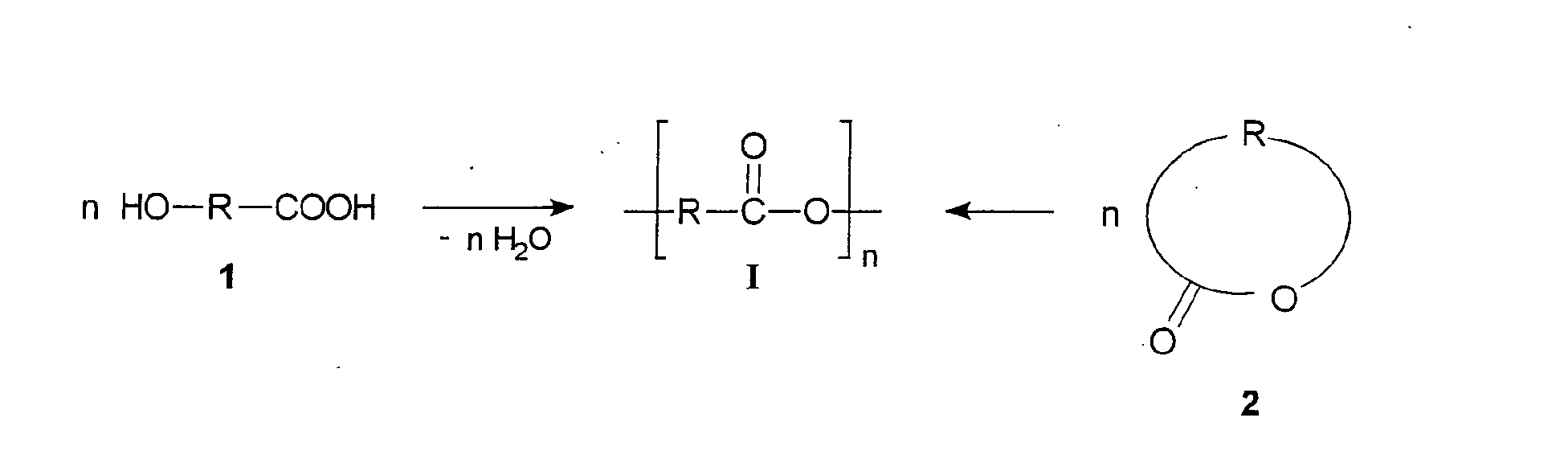
- the former are produced from only a single monomer, for example by polycondensation of an ⁇ -hydroxycarboxylic acid 1 or by ring-opening polymerization of cyclic esters (lactones) 2, for example
- lactones cyclic esters
- the latter is built up by polycondensation of two complementary monomers, for example a diol 3 u.
- a dicarboxylic acid 4 Branched and crosslinked polyesters are obtained in the polycondensation of trihydric or polyhydric alcohols with polyfunctional carboxylic acids.
- Polyesters generally include polycarbonates (carbonic acid polyesters).
- PET polyethylene terephthalate
- PBT polybutylene terephthalate
- PCDT Poly (1,4-cyclohexanedimethylene terephthalate) e
- These types of polyester can vary widely in their properties by using other aromatic dicarboxylic acids (for example isophthalic acid) or by using di
- a metallocene polyethylene nonwoven is suitable as the backing layer.
- Spacer fabrics and knitted fabrics with lamination can also be used. Spacer fabrics of this type are disclosed in EP 0 071 212 B1. Spacer fabrics are mat-shaped laminates with a cover layer made of a fiber or filament fleece, an underlayer and individual or tufts of holding fibers between these layers, which are needled over the surface of the laminate and are needled through the particle layer and connect the cover layer and the underlayer to one another. According to EP 0 071 212 B1, particles of inert rock particles, such as sand, gravel or the like, are present in the holding fibers as an additional but not necessary feature.
- the nonwovens used are particularly solidified staple fiber nonwovens, but also filament, Meltblown and spunbonded nonwovens, which usually have to be additionally consolidated.
- consolidation methods are mechanical, thermal and chemical solidification known.
- mechanical strengthening the fibers mostly by swirling the individual fibers, by meshing fiber bundles or can be held together mechanically by sewing in additional threads by thermal as well as by chemical adhesive processes (with binder) or achieve cohesive (binder-free) fiber-fiber bonds. This can be done with a suitable Formulation and process control exclusively or at least predominantly Restrict fiber nodes so that the loose, open structure in the fleece is retained nevertheless, a stable, three-dimensional network is formed.
- Nonwovens have proven to be particularly advantageous, in particular by overstitching separate threads or are solidified by meshing.
- Solidified nonwovens of this type are produced, for example, on sewing-knitting machines of the "Malivlies" type from Karl Meyer, formerly Malimo, and can be obtained, inter alia, from Naue Fasertechnik and Techtex GmbH.
- a Mali fleece is characterized in that a cross fiber fleece is consolidated by the formation of stitches from fibers of the fleece.
- a fleece of the type Kunitvlies or Multiknitvlies can also be used as a carrier.
- a Kunitvlies is characterized in that it results from the processing of a longitudinally oriented nonwoven fabric to a flat structure, which has loops on one side and mesh webs on the other side or poly fiber folds, but has neither threads nor prefabricated flat structures.
- Such a fleece has also been produced for a long time, for example, on sewing-knitting machines of the "Kunitvlies" type from Karl Mayer. Another characteristic feature of this fleece is that it can absorb high tensile forces in the longitudinal direction as a longitudinal fiber fleece.
- a multi-knit fleece is characterized in comparison to the Kunit fleece in that the fleece is strengthened by both-sided piercing with needles both on the top and on the bottom.
- nonwovens are also suitable as a preliminary product to form an adhesive tape according to the invention.
- a sewing fleece is formed from a fleece material with a plurality of seams running parallel to one another. These seams are created by sewing or sewing continuous textile threads. Sewing-knitting machines of the "Maliwatt" type from Karl Mayer, formerly Malimo, are known for this type of fleece.
- a staple fiber fleece that is pre-consolidated by mechanical processing in the first step or that is a wet fleece that has been laid hydrodynamically, wherein between 2% and 50% of the fibers of the fleece are melt fibers, in particular between 5% and 40% of the fibers of the fleece.
- a fleece is characterized in that the fibers are laid wet or, for example, a staple fiber fleece is pre-consolidated by forming stitches from fibers of the fleece or by needling, sewing or air and / or water jet processing.
- heat setting takes place, the strength of the fleece being increased again by melting or melting on the melt fibers.
- the nonwoven backing can also be solidified without a binder, for example Achieve hot stamping with structured rollers, using pressure, temperature, dwell time and the embossing geometry properties such as strength, thickness, density, flexibility and the like. can be controlled.
- the adhesive consolidation of mechanically pre-consolidated or wet-laid nonwovens of interest, these over Binder can be added in solid, liquid, foamed or pasty form.
- solid binders as Powder for trickling in, as a film or as a grid or in the form of binding fibers.
- liquid Binders are dissolved in water or organic solvents or as a dispersion to apply.
- Binding dispersions are mainly chosen for adhesive bonding: Thermosets in the form of phenolic or melamine resin dispersions, elastomers as Dispersions of natural or synthetic rubbers or mostly dispersions of Thermoplastics such as acrylates, vinyl acetates, polyurethanes, styrene-butadiene systems, PVC and the like. and their copolymers. Usually these are anionic or non-ionic Stabilized dispersions, but in special cases also cationic dispersions be an advantage.
- binder can be applied according to the prior art and is for example in standard works of coating or nonwoven technology such as nonwovens " (Georg Thieme Verlag, Stuttgart, 1982) or "Textile Technology Nonwovens Production” (Employers' group overall textile, Eschborn, 1996).
- binders For mechanically pre-consolidated nonwovens that already have sufficient bond strength, one-sided spray application of a binder is recommended in order to specifically change surface properties. In addition to the economical use of the binding agent, the energy required for drying is also significantly reduced in this way. Since no squeeze rollers are required and the dispersions predominantly remain in the upper area of the nonwoven, undesirable hardening and stiffening of the nonwoven can be largely prevented. For adequate adhesive bonding of the nonwoven backing, binders of the order of 1% to 50%, in particular 3% to 20%, based on the weight of the nonwoven, are generally to be added.
- the addition of the binder can already during the manufacture of the fleece, in the mechanical Pre-consolidation or in a separate process step, this in-line or can be done off-line.
- Binders After the binder has been added temporarily for Binders are created a state in which this becomes sticky and adhesive the fibers connects - this can happen during drying of dispersions, for example, but also can be achieved by warming, using flat or partial pressure further variation possibilities are given.
- Activation of the binder can be done in known drying tunnels, but also with suitable binder selection Infrared radiation, UV radiation, ultrasound, high-frequency radiation or the like respectively. For the later end use it makes sense, but not absolutely necessary, that the binder has lost its stickiness after the nonwoven manufacturing process.
- Another special form of adhesive bonding is that the activation of the Binder by dissolving or swelling.
- the Fibers themselves or mixed special fibers take over the function of the binder.
- solvents for most polymeric fibers Environmental considerations are questionable or problematic in their handling this method is rarely used.
- polyester, polypropylene, Viscose or cotton fibers are provided.
- the present invention is not limited to that mentioned materials, but it can be recognized by those skilled in the art without need to be inventive, a variety of other fibers for the production of Fleece can be used.
- Knitted fabrics are textile fabrics made from one or more threads or Thread systems through stitch formation (thread loops), in contrast to woven goods (Fabrics) in which the surface is crossed by crossing two thread systems (warp and Weft threads) is produced and the nonwovens (fiber composites), in which a loose Fiber pile is solidified by heat, needling, sewing or by water jets.
- Thread loops woven goods
- warp and Weft threads woven goods
- nonwovens fiber composites
- Knitted fabrics can be knitted in which the threads cross through the Run textile, and divide it into knitted fabrics in which the threads run lengthways through the textile. Because of their knitted structure, knitted fabrics are in principle flexible, cuddly Textiles because the stitches can stretch in length and width and the endeavor have to return to their starting position. They are very high quality material durable.
- the carrier material is very important for the carrier material as a whole that this is in the longitudinal direction, that is, in the running direction of the adhesive tape, is cleavable. In this way it is possible that the strip-shaped cover can cut through the backing material to subsequently For example, tear open the cardboard layers of the cardboard.
- a commercially available pressure-sensitive mass comes as a self-adhesive mass
- Adhesive based on PUR, acrylate or rubber is used.
- An acrylic hotmelt-based adhesive which has a K value of at least 20, in particular greater than 30, has been found to be particularly advantageous as an adhesive, and can be obtained by concentrating a solution of such a composition into a system which can be processed as a hotmelt. Concentration can take place in suitably equipped kettles or extruders, particularly in the case of the associated degassing, a degassing extruder is preferred.
- Such an adhesive is set out in DE 43 13 008 A1, the content of which is hereby incorporated by reference and the content of which forms part of this disclosure and invention.
- the solvent is completely removed from these acrylic masses produced in this way.
- other volatile components are removed. After coating from the melt, these masses have only a small proportion of volatile constituents.
- compositions described in the patent have a high K value and thus a high molecular weight.
- Those skilled in the art are aware that systems with higher molecular weights can be crosslinked more efficiently.
- the proportion of volatile components drops accordingly.
- the solution of the composition can contain 5 to 80% by weight, in particular 30 to 70% by weight, of solvent.
- Benzoin derivatives can be polymerized into the acrylate hotmelt-based adhesive, for example benzoin acrylate or benzoin methacrylate, acrylic acid or methacrylic acid esters. Such benzoin derivatives are described in EP 0 578 151 A1.
- the acrylic hot melt adhesive can also be chemically cross-linked.
- copolymers of (meth) acrylic acid and its esters with 1 to 25 carbon atoms, maleic, fumaric and / or itaconic acid and / or their esters, substituted (meth) acrylamides, maleic anhydride and other vinyl compounds are used as self-adhesive compositions , such as vinyl esters, especially vinyl acetate, vinyl alcohols and / or vinyl ethers.
- the residual solvent content should be less than 1% by weight.
- An adhesive that is particularly suitable is a low molecular weight Acrylic hotmelt PSA, such as those under the name acResin UV or Acronal ®, in particular Acronal DS 3458, which is managed by BASF.
- This adhesive with low K value gets its application-oriented properties through a final crosslinking triggered by radiation.
- FIG. 1 on the one hand, there is a double-sided adhesive tape, such as that is used according to the prior art for gluing cartons, and another double-sided adhesive tape according to the invention with slotted Cover for closing and opening boxes or cardboard-like packaging shown.
- the adhesive tape consists of a carrier layer, which is provided with an adhesive coating on the upper and on the lower side. There is a cover on the top adhesive layer.
- the adhesive tape according to the invention is characterized in that one of the two adhesive layers of the double-sided adhesive tape, namely the upper one, is covered with a non-adhesive cover, this cover being slotted so that part of the cover is peeled off when a carton is being glued and the other part of the cover can remain on the adhesive.
- the part of the cover which does not remain on the adhesive layer has the special feature that the cover extends beyond the adhesive tape, that is to say the width of the entire split cover is greater than the width of the carrier material of the adhesive tape. This creates a handle called a finger lift that can be easily gripped by the user. Removing the cover is made very easy.
- Figure 2 shows the double-sided adhesive tape during use as a closure tape for a carton, which is shown very stylized in side section. A part of the non-adhesive cover is removed from the adhesive layer for gluing the adhesive tape between two layers of the cardboard, the adhesive tape being glued between the two layers of the cardboard or the cardboard-like packaging such that the part of the cover not removed from the adhesive layer is also between the two layers.
- the closure of the carton is ensured by the free part of the upper adhesive layer being firmly glued to the upper layer of the carton and by the entire lower adhesive layer adhering to the lower layer of the carton at the same time.
- the cardboard lies on top of the cover remaining on the top adhesive layer.
- the gluing is done so that the side of the adhesive layer that is with the cover is provided, so glued to the top flap of the box that this on the of the Outside edge of the flap facing away, while the adhesive side of the Adhesive layer to the outer edge of the flap of the cardboard shows.
- FIG. 3 shows the double-sided adhesive tape according to the invention shown in FIG. 1 during use as an opening aid for a carton.
- the box is torn open by pulling on the cover, causing the top layer of the box to split.
Landscapes
- Engineering & Computer Science (AREA)
- Mechanical Engineering (AREA)
- Adhesive Tapes (AREA)
Abstract
Description
Gegenstand der Unteransprüche sind vorteilhafte Fortbildungen des Erfindungsgegenstands.
Hierzu wird zunächst das vollflächig zumindest eine der beiden Klebeschichten abdeckende Trennpapier oder die Trennfolie partiell von der Klebeschicht entfernt, so daß eine streifenförmige Abdeckung auf der Klebeschicht verbleibt, die weiterhin nichtklebend ist.
Selbstverständlich liegt es innerhalb des fachmännischen Könnens, von den genannten Werten nach oben oder unten auszuweichen, wenn es der Anwendungsfall erfordert.
Dadurch können auch sehr reißfeste Trägermaterialien des Klebebandes beim Aufreißvorgang sicher durchtrennt werden.
Beim Spalten wird dann die obere Lasche derart getrennt, daß das von der oberen Lasche abgetrennte Teil der unteren Lasche (beziehungsweise gegebenenfalls auf dem Karton) verbleibt, so daß die ehemals verklebte obere Lasche aufgeklappt werden kann.
Die nicht verklebte Abdeckung bildet somit den ersten Teils eines Anfassers, der besonders gut zu greifen ist, wenn ein oder zwei Schlitze entsprechend in der Lage oder den Lagen beziehungsweise der Lasche oder den Laschen vorhanden sind.
Bevorzugt werden Mischungen verschiedener geeigneter Polyolefine verwendet, um die mechanischen und thermischen Eigenschaften sowie Glanz, Extrusionsverhalten, Verankerung des Klebers, usw. optimal einstellen zu können.
- die Hydroxycarbonsäure-Typen (AB-Polyester) und
- die Dihydroxy-Dicarbonsäure-Typen (AA-BB-Polyester).

Mengenmäßig größte technische Bedeutung haben AA-BB-Typ-Polyester aus aliphatischen Diolen und aromatischen Dicarbonsäuren, insbesondere die Polyalkylenterephthalate [R2 = C6H4, mit Polyethylenterephthalat (PET) R1 = (CH2)2, Polybutylenterephthalat (PBT) R1 = (CH2)4 u. Poly(1,4-cyclohexandimethylenterephthalat)e (PCDT) R1 = CH2-C6H10-CH2] als wichtigste Vertreter. Diese Typen von Polyester können durch Mitverwenden anderer aromatischer Dicarbonsäuren (zum Beispiel Isophthalsäure) bzw. durch Einsatz von Diol-Gemischen bei der Polykondensation in ihren Eigenschaften breit variiert u. unterschiedlichen Anwendungsgebieten angepaßt werden.
- ein Flächengewicht von 40 bis 200 g/m2, insbesondere von 60 bis 120 g/m2, und/oder
- eine Dicke von 0,1 bis 0,6 mm, insbesondere von 0,2 bis 0,5, und/oder
- eine Höchstzugkraft-Dehnung längs von 400 bis 700% und/oder
- eine Höchstzugkraft-Dehnung quer von 250 bis 550%.
Derartige Abstandsgewebe werden in der EP 0 071 212 B1 offenbart. Abstandsgewebe sind mattenförmige Schichtkörper mit einer Deckschicht aus einem Faser- oder Filamentvlies, einer Unterlagsschicht und zwischen diesen Schichten vorhandene einzelne oder Büschel von Haltefasern, die über die Fläche des Schichtkörpers verteilt durch die Partikelschicht hindurchgenadelt sind und die Deckschicht und die Unterlagsschicht untereinander verbinden. Als zusätzliches, aber nicht erforderliches Merkmal sind gemäß EP 0 071 212 B1 in den Haltefasern Partikel aus inerten Gesteinspartikeln, wie zum Beispiel Sand, Kies oder dergleichen, vorhanden.
und
Als Träger kann weiterhin ein Vlies vom Typ Kunitvlies oder Multiknitvlies verwendet werden. Ein Kunitvlies ist dadurch gekennzeichnet, daß es aus der Verarbeitung eines längsorientierten Faservlieses zu einem Flächengebilde hervorgeht, das auf einer Seite Maschen und auf der anderen Maschenstege oder Polfaser-Falten aufweist, aber weder Fäden noch vorgefertigte Flächengebilde besitzt. Auch ein derartiges Vlies wird beispielsweise auf Nähwirkmaschinen des Typs "Kunitvlies" der Firma Karl Mayer schon seit längerer Zeit hergestellt. Ein weiteres kennzeichnendes Merkmal dieses Vlieses besteht darin, daß es als Längsfaservlies in Längsrichtung hohe Zugkräfte aufnehmen kann. Ein Multiknitvlies ist gegenüber dem Kunitvlies dadurch gekennzeichnet, daß das Vlies durch das beidseitige Durchstechen mit Nadeln sowohl auf der Ober- als auch auf der Unterseite eine Verfestigung erfährt.
Schließlich sind auch Nähvliese als Vorprodukt geeignet, ein erfindungsgemäßes Klebeband zu bilden. Ein Nähvlies wird aus einem Vliesmaterial mit einer Vielzahl parallel zueinander verlaufender Nähte gebildet. Diese Nähte entstehen durch das Einnähen oder Nähwirken von durchgehenden textilen Fäden. Für diesen Typ Vlies sind Nähwirkmaschinen des Typs "Maliwatt" der Firma Karl Mayer, ehemals Malimo, bekannt.
Ein derartiges Vlies ist dadurch gekennzeichnet, daß die Fasern naß gelegt werden oder zum Beispiel ein Stapelfaservlies durch die Bildung von Maschen aus Fasern des Vlieses oder durch Nadelung, Vemähung beziehungsweise Luft- und/oder Wasserstrahlbearbeitung vorverfestigt wird.
In einem zweiten Schritt erfolgt die Thermofixierung, wobei die Festigkeit des Vlieses durch das Auf- oder Anschmelzen der Schmelzfasern nochmals erhöht wird.
Neben dem sparsamen Umgang mit dem Bindemittel wird bei derartiger Arbeitsweise auch der Energiebedarf zur Trocknung deutlich reduziert. Da keine Abquetschwalzen benötigt werden und die Dispersionen vorwiegend in dem oberen Bereich des Vliesstoffes verbleibt, kann eine unerwünschte Verhärtung und Versteifung des Vlieses weitgehend verhindert werden.
Für eine ausreichende adhäsive Verfestigung des Vliesträgers ist im allgemeinen Bindemittel in der Größenordnung von 1 % bis 50 %, insbesondere 3 % bis 20 %, bezogen auf das Gewicht des Faservlieses, zuzugeben.
Das Aufkonzentrieren kann in entsprechend ausgerüsteten Kesseln oder Extrudern stattfinden, insbesondere beim damit einhergehenden Entgasen ist ein Entgasungsextruder bevorzugt.
Eine derartige Klebemasse ist in der DE 43 13 008 A1 dargelegt, auf deren Inhalt hiermit Bezug genommen wird und deren Inhalt Teil dieser Offenbarung und Erfindung wird. Diesen auf diesem Wege hergestellten Acrylatmassen wird in einem Zwischenschritt das Lösungsmittel vollständig entzogen.
Zusätzlich werden dabei weitere leichtflüchtige Bestanteile entfernt. Nach der Beschichtung aus der Schmelze weisen diese Massen nur noch geringe Anteile an flüchtigen Bestandteilen auf. Somit können alle im oben angeführten Patent beanspruchten Monomere/Rezepturen übernommen werden. Ein weiterer Vorteil der im Patent beschriebenen Massen ist darin zu sehen, daß diese einen hohen K-Wert und damit ein hohes Molekulargewicht aufweisen. Dem Fachmann ist bekannt, daß sich Systeme mit höheren Molekulargewichten effizienter vernetzen lassen. Damit sinkt entsprechend der Anteil an flüchtigen Bestandteilen.
Die Lösung der Masse kann 5 bis 80 Gew.-%, insbesondere 30 bis 70 Gew.-% Lösungsmittel enthalten.
Weiter vorzugsweise werden Einschnecken-, Zweischnecken- oder Mehrschneckenextruder mit einer oder insbesondere zwei oder mehreren Entgasungseinheiten eingesetzt.
In der Klebemasse auf Acrylathotmelt-Basis können Benzoinderivate einpolymerisiert sein, so beispielsweise Benzoinacrylat oder Benzoinmethacrylat, Acrylsäure- oder Methacrylsäureester. Derartige Benzoinderivate sind in der EP 0 578 151 A1 beschrieben.
Die Klebemasse auf Acrylathotmelt-Basis kann aber auch chemisch vemetzt sein.
In einer besonders bevorzugten Ausführungsform werden als Selbstklebemassen Copolymerisate aus (Meth)acrylsäure und deren Estern mit 1 bis 25 C-Atomen, Malein-, Fumar- und/oder Itaconsäure und/oder deren Estem, substituierten (Meth)acrylamiden, Maleinsäureanhydrid und anderen Vinylverbindungen, wie Vinylestern, insbesondere Vinylacetat, Vinylalkoholen und/oder Vinylethem eingesetzt.
Der Restlösungsmittel-Gehalt sollte unter 1 Gew.-% betragen.
- Figur 1
- ein doppelseitig klebend ausgerüstetes Klebeband, wie es gemäß Stand der Technik zum Verkleben von Kartons verwendet wird, und ein erfindungsgemäßes doppelseitig klebend ausgerüstetes Klebeband mit geschlitzter Abdeckung zum Verschließen und Öffnen von Kartons oder kartonähnlichen Verpackungen,
- Figur 2
- das in Figur 1 gezeigte doppelseitig klebend ausgerüstetes Klebeband während der Anwendung als Verschlußband für einen Karton und
- Figur 3
- das in Figur 1 gezeigte doppelseitig klebend ausgerüstetes Klebeband während der Anwendung als Öffnungshilfe für einen Karton.
Das erfindungsgemäße Klebeband zeichnet sich dadurch aus, daß eine der beiden Klebeschichten des doppelseitig klebend ausgerüstetes Klebeband, nämlich die obere, abgedeckt ist mit einer nicht klebenden Abdeckung, wobei diese Abdeckung geschlitzt ist, so daß ein Teil der Abdeckung beim Verkleben eines Kartons abgezogen und der andere Teil der Abdeckung auf der Klebemasse verbleiben kann.
Auf dies Art wird ein Anfasser geschaffen, Fingerlift genannt, der vom Verwender leicht gegriffen werden kann. Die Entfernung der Abdeckung wird sehr erleichtert.
Ein Teil der nichtklebenden Abdeckung ist zum Verkleben des Klebebands zwischen zwei Lagen des Kartons von der Klebeschicht entfernt, wobei das Verkleben des Klebebands zwischen den zwei Lagen des Kartons oder der kartonähnlichen Verpackungen derart erfolgt, daß der nicht von der Klebeschicht entfernte Teil der Abdeckung ebenfalls zwischen den zwei Lagen liegt.
Oberhalb der auf der oberen Klebeschicht verbliebenen Abdeckung liegt der Karton auf.
Der Karton wird aufgerissen, indem an der Abdeckung gezogen wird, was zur Spaltung der oberen Lage des Kartons führt.
Claims (10)
- Verwendung eines doppelseitig klebend ausgerüsteten Klebebands zum Verschließen und Öffnen von Kartons oder kartonähnlichen Verpackungen, wobei zumindest eine der beiden Klebeschichten eines doppelseitig klebend ausgerüstetes Klebeband mit einer nichtklebenden Abdeckung versehen ist, die zum Verkleben des Klebebands zwischen zwei Lagen beziehungsweise Laschen partiell von der Klebeschicht entfernt wird, wobei das Verkleben des Klebebands zwischen den zwei Lagen beziehungsweise Laschen des Kartons oder der kartonähnlichen Verpackungen derart erfolgt, daß der nicht von der Klebeschicht entfernte Teil der Abdeckung ebenfalls zwischen den zwei Lagen beziehungsweise Laschen liegt.
- Verwendung nach Anspruch 1, dadurch gekennzeichnet, daß das Entfemen eines Teils der Abdeckung durch eine Sollbruchstelle in der Abdeckung erleichtert wird, vorzugsweise ausgeführt als Schlitzung.
- Verwendung nach den Ansprüchen 1 und 2, dadurch gekennzeichnet, daß das zu entfernende Teil der Abdeckung einseitig übersteht, also eine größere Breite aufweist als das Klebeband.
- Verwendung nach den Ansprüchen 1 bis 3, dadurch gekennzeichnet, daß das zu entfernende Teil der Abdeckung 30 % der Klebebandbreite einnimmt.
- Verwendung nach zumindest einem der vorherigen Ansprüche, dadurch gekennzeichnet, daß das Trägermaterial des Klebebands geschwächt ist, vorzugsweise gespalten.
- Verwendung nach zumindest einem der vorherigen Ansprüche, dadurch gekennzeichnet, daß die Lage beziehungsweise Lasche des Kartons oder der kartonähnlichen Verpackungen, an der die Abdeckung anliegt, oberhalb der Abdeckung geschlitzt ist, insbesondere der Breite der verbliebenen Abdeckung angepaßt.
- Verwendung nach zumindest einem der vorherigen Ansprüche, dadurch gekennzeichnet, daß die Lage beziehungsweise Lasche des Kartons oder der kartonähnlichen Verpackungen, an der die Abdeckung nicht anliegt, oberhalb der Abdeckung geschlitzt ist, insbesondere der Breite der verbliebenen Abdeckung angepaßt.
- Verwendung nach zumindest einem der vorherigen Ansprüche, dadurch gekennzeichnet, daß beide Lagen beziehungsweise Laschen des Kartons oder der kartonähnlichen Verpackungen oberhalb der Abdeckung geschlitzt sind, insbesondere der Breite der verbliebenen Abdeckung angepaßt.
- Verwendung nach zumindest einem der vorherigen Ansprüche, dadurch gekennzeichnet, daß die Abdeckung aus einem reißfesten Material besteht, vorzugsweise MOPP.
- Verwendung nach zumindest einem der vorherigen Ansprüche, dadurch gekennzeichnet, daß das Trägermaterial aus einem leicht zu trennendem Material besteht, vorzugsweise PET.
Applications Claiming Priority (2)
| Application Number | Priority Date | Filing Date | Title |
|---|---|---|---|
| DE10138350 | 2001-08-04 | ||
| DE10138350A DE10138350A1 (de) | 2001-08-04 | 2001-08-04 | Verwendung eines doppelseitig klebend ausgerüsteten Klebebands zum Verschließen und Öffnen von Kartons oder kartonähnlichen Verpackungen |
Publications (2)
| Publication Number | Publication Date |
|---|---|
| EP1285853A1 true EP1285853A1 (de) | 2003-02-26 |
| EP1285853B1 EP1285853B1 (de) | 2009-11-04 |
Family
ID=7694417
Family Applications (1)
| Application Number | Title | Priority Date | Filing Date |
|---|---|---|---|
| EP02015825A Expired - Lifetime EP1285853B1 (de) | 2001-08-04 | 2002-07-16 | Verwendung eines doppelseitig klebend ausgerüsteten Klebebands zum Verschliessen und Öffnen von Kartons oder kartonähnlichen Verpackungen |
Country Status (4)
| Country | Link |
|---|---|
| US (1) | US6689244B2 (de) |
| EP (1) | EP1285853B1 (de) |
| DE (2) | DE10138350A1 (de) |
| ES (1) | ES2333106T3 (de) |
Cited By (1)
| Publication number | Priority date | Publication date | Assignee | Title |
|---|---|---|---|---|
| EP2196399A1 (de) * | 2008-12-09 | 2010-06-16 | tesa SE | Doppelseitig klebend ausgerüstetes Klebeband, Verfahren zum Verschließen von Kartons oder kartonähnlichen Verpackungen und Verwendung des Klebebands in besagtem Verfahren |
Families Citing this family (18)
| Publication number | Priority date | Publication date | Assignee | Title |
|---|---|---|---|---|
| EP1361162B1 (de) * | 2002-05-08 | 2005-08-24 | tesa AG | Verwendung eines doppelseitig klebend ausgerüsteten Klebebands zum Verschliessen und Öffnen von Kartons oder kartonähnlichen Verpackungen |
| WO2004110881A1 (en) * | 2003-06-12 | 2004-12-23 | Thomas Johannes Bingle | Carton with re-closable dispensing opening |
| DE102004019908A1 (de) * | 2004-04-21 | 2005-11-17 | Tesa Ag | Verwendung eines doppelseitig klebend ausgerüsteten Schaumstoff-Klebebands zum Befestigen von struktuierten Flachleitungen insbesondere auf Untergründen wie die Innenraum-Dekorteile eines Pkws, insbesondere Dachhimmel, Türseitenteil, Kofferraumdeckel |
| US8809690B2 (en) * | 2010-03-04 | 2014-08-19 | Rogers Corporation | Dielectric bond plies for circuits and multilayer circuits, and methods of manufacture thereof |
| DE102010034598A1 (de) * | 2010-08-12 | 2012-02-16 | Faurecia Innenraum Systeme Gmbh | Dichtband und Innenverkleidungsteil |
| PL2484510T5 (pl) * | 2011-02-04 | 2023-05-15 | Mosca Gmbh | Sposób zgrzewania surowców odnawialnych |
| EP2484602B2 (de) | 2011-02-04 | 2022-02-23 | Mosca GmbH | Umreifungsbänder aus nachwachsenden Rohstoffen |
| EP2527264A1 (de) * | 2011-05-26 | 2012-11-28 | Embalajes Capsa, S. L. | Lager- und Transportbox |
| TWI473868B (zh) * | 2011-09-29 | 2015-02-21 | Ind Tech Res Inst | 黏著劑組成物、黏膠及其形成方法與膠帶 |
| DE102012104661B4 (de) * | 2012-05-30 | 2018-03-29 | Max Frank Gmbh & Co Kg | Verfahren zum Herstellen eines Schalungsrohres aus Flachmaterial durch Spiralwickeln auf einer Sprialwickelmaschine sowie Schalungsrohr |
| US10696810B2 (en) | 2015-03-13 | 2020-06-30 | Toray Plastics (America), Inc. | Tear resistant mono-axially oriented propylene-based film |
| US9714112B1 (en) * | 2016-07-12 | 2017-07-25 | Shih-Fong Lin | Sealing device for paper-based container |
| US9994364B1 (en) * | 2016-12-09 | 2018-06-12 | Shih-Fong Lin | Reusable sealing device for plastic courier bag |
| US10723496B2 (en) | 2017-06-30 | 2020-07-28 | H.B Fuller Company | Container closing and opening article, system, and method |
| DE102022106959A1 (de) | 2022-03-24 | 2023-09-28 | Tesa Se | Verfahren zur Herstellung eines Multifunktionselements |
| DE202022101764U1 (de) | 2022-04-01 | 2023-07-04 | Rudolf Siegle | Banderole zur Anordnung an einer Versandkiste und Verpackungseinheit |
| DE102022113863A1 (de) | 2022-06-01 | 2023-12-07 | Tesa Se | Verfahren zur Herstellung eines Multifunktionselements |
| USD1116821S1 (en) | 2023-09-29 | 2026-03-10 | Pratt Corrugated Holdings, Inc. | Box with tape strip |
Citations (5)
| Publication number | Priority date | Publication date | Assignee | Title |
|---|---|---|---|---|
| DE8216242U1 (de) | 1982-06-04 | 1982-08-05 | Wilh. Winckel KG, 5920 Bad Berleburg | Verschlussanordnung fuer Versandtaschen |
| US4386705A (en) * | 1981-01-26 | 1983-06-07 | James River-Dixie/Northern, Inc. | Ice cream carton |
| FR2733203A1 (fr) * | 1995-04-19 | 1996-10-25 | Colas Laurent Jean Jacques | Emballage rapide |
| EP0795480A1 (de) * | 1996-03-11 | 1997-09-17 | RCO Spécialités | Kartonverpackung mit integriertem Verschlussband |
| CH690574A5 (de) * | 1996-01-26 | 2000-10-31 | Brieger Verpackungen Ag | Verpackung. |
Family Cites Families (12)
| Publication number | Priority date | Publication date | Assignee | Title |
|---|---|---|---|---|
| US1724648A (en) | 1923-09-21 | 1929-08-13 | Walter A Fellowes | Knockdown paper box |
| DE1006786B (de) * | 1954-09-02 | 1957-04-18 | Agfa Ag | Verschluss von Verpackungen |
| US4026754A (en) * | 1976-07-12 | 1977-05-31 | Pitney-Bowes, Inc. | Double adhesive tape applying apparatus |
| DE3021989C2 (de) * | 1980-06-12 | 1982-01-07 | Friedel 3000 Hannover Knittel | Versandtasche, insbesondere Briefumschlag |
| IL66103A0 (en) | 1981-07-27 | 1982-09-30 | Tesch G H | Mat shaped composite body and its preparation |
| DE8704633U1 (de) * | 1987-03-28 | 1987-05-14 | Ernst Mayer Briefhüllenfabrik GmbH & Co, 7100 Heilbronn | Briefumschlag für Drucksachen |
| US4869769A (en) | 1987-05-28 | 1989-09-26 | The Loveshaw Corporation | Method and apparatus for forming pull-tabs on a sealing tape course length applied to a carton |
| DE4222334A1 (de) * | 1992-07-08 | 1994-01-13 | Beiersdorf Ag | Schmelzhaftkleber für Medical-Produkte |
| DE4313008C1 (de) * | 1993-04-21 | 1994-11-10 | Beiersdorf Ag | Selbstklebemasse auf Acrylathotmelt-Basis, Verfahren zu deren Herstellung und deren Verwendung |
| US5439101A (en) * | 1993-07-30 | 1995-08-08 | Waldorf Corporation | Convertible envelope |
| CA2269467C (en) * | 1999-04-20 | 2003-02-18 | Leslie H. Goldberg | Folding box construction |
| FR2795480B1 (fr) | 1999-06-28 | 2001-07-27 | Pyroalliance | Actionneur de secours pour robinets et vannes de grand diametre comportant un obturateur a translation |
-
2001
- 2001-08-04 DE DE10138350A patent/DE10138350A1/de not_active Ceased
-
2002
- 2002-05-23 US US10/154,676 patent/US6689244B2/en not_active Expired - Fee Related
- 2002-07-16 EP EP02015825A patent/EP1285853B1/de not_active Expired - Lifetime
- 2002-07-16 DE DE50213976T patent/DE50213976D1/de not_active Expired - Lifetime
- 2002-07-16 ES ES02015825T patent/ES2333106T3/es not_active Expired - Lifetime
Patent Citations (5)
| Publication number | Priority date | Publication date | Assignee | Title |
|---|---|---|---|---|
| US4386705A (en) * | 1981-01-26 | 1983-06-07 | James River-Dixie/Northern, Inc. | Ice cream carton |
| DE8216242U1 (de) | 1982-06-04 | 1982-08-05 | Wilh. Winckel KG, 5920 Bad Berleburg | Verschlussanordnung fuer Versandtaschen |
| FR2733203A1 (fr) * | 1995-04-19 | 1996-10-25 | Colas Laurent Jean Jacques | Emballage rapide |
| CH690574A5 (de) * | 1996-01-26 | 2000-10-31 | Brieger Verpackungen Ag | Verpackung. |
| EP0795480A1 (de) * | 1996-03-11 | 1997-09-17 | RCO Spécialités | Kartonverpackung mit integriertem Verschlussband |
Cited By (1)
| Publication number | Priority date | Publication date | Assignee | Title |
|---|---|---|---|---|
| EP2196399A1 (de) * | 2008-12-09 | 2010-06-16 | tesa SE | Doppelseitig klebend ausgerüstetes Klebeband, Verfahren zum Verschließen von Kartons oder kartonähnlichen Verpackungen und Verwendung des Klebebands in besagtem Verfahren |
Also Published As
| Publication number | Publication date |
|---|---|
| ES2333106T3 (es) | 2010-02-17 |
| US20030041964A1 (en) | 2003-03-06 |
| EP1285853B1 (de) | 2009-11-04 |
| DE50213976D1 (de) | 2009-12-17 |
| US6689244B2 (en) | 2004-02-10 |
| DE10138350A1 (de) | 2003-02-20 |
Similar Documents
| Publication | Publication Date | Title |
|---|---|---|
| EP1285853B1 (de) | Verwendung eines doppelseitig klebend ausgerüsteten Klebebands zum Verschliessen und Öffnen von Kartons oder kartonähnlichen Verpackungen | |
| EP1315781B1 (de) | Verfahren zur ummantelung von langgestrecktem gut, wie insbesondere kabelsätzen, mit einem klebeband | |
| EP1300452B1 (de) | Verfahren zur Ummantelung von langgestrecktem Gut | |
| EP0995782B1 (de) | Verwendung eines Klebebands auf Basis eines mit Schmelzfasern thermofixierten Vlieses | |
| EP2500389B1 (de) | Klebeband mit laminat-träger gebildet aus einem textilen träger und einer folie zum ummanteln von langgestrecktem gut wie insbesondere kabelsätzen und verfahren zur ummantelung | |
| EP1361162B1 (de) | Verwendung eines doppelseitig klebend ausgerüsteten Klebebands zum Verschliessen und Öffnen von Kartons oder kartonähnlichen Verpackungen | |
| EP0995783B1 (de) | Verwendung eines Klebebands auf Basis eines mittels Bindemittel verfestigten Vlieses | |
| EP0942057B2 (de) | Klebeband zur Bündelung von Kabeln | |
| EP2756045B1 (de) | VERWENDUNG EINES KLEBEBANDSYSTEM ZUR BILDUNG EINES AUFREIßSTREIFENS AUF EINEM KARTON | |
| DE10036805A1 (de) | Verfahren zur Ummantelung von langgestrecktem Gut, wie insbesondere Kabelsätzen | |
| DE10329994A1 (de) | Verfahren zur Ummantelung von langgestrecktem Gut, wie insbesondere Kabelsätzen, mit einem Klebeband | |
| DE10229527A1 (de) | Band aus einer Reihe hintereinander und überlappend angeordneter einzelner Ummantelungsabschnitte zum Ummanteln von langgestrecktem Gut, wie insbesondere Kabelsätzen | |
| EP2497806B1 (de) | Klebeband mit Nähwirkvlies-Träger für die Kabelbandagierung | |
| DE19923399A1 (de) | Klebeband auf Basis eines mit Schmelzfasern thermofixierten Vlieses | |
| DE10116600A1 (de) | Schneidemaschine für das Ablängen von selbstklebend ausgerüsteten textilen Trägern | |
| EP1288271B1 (de) | Klebeband, insbesondere Verpackungsklebeband, mit einem Träger auf Basis einer gereckten Thermoplastfolie, der einseitig mit einer Klebemasse beschichtet ist | |
| EP1298082A2 (de) | Spendevorrichtung zum kontinuierlichen und diskontinuierlichen Verspenden von Material, das aus einer auf einer Rolle befindlichem, beidseitig selbstklebend ausgerüstetem Trägermaterial besteht | |
| DE10116770A1 (de) | Schneidemaschine für das Ablängen von selbstklebend ausgerüsteten textilen Trägern | |
| DE20022272U1 (de) | Mit einer textilen Eindeckung ummanteltes langgestrecktes Gut, wie insbesondere einen Kabelsatz | |
| EP4424496A1 (de) | Verfahren zum konfektionieren von textilen klebebändern | |
| EP1097975A2 (de) | Selbstklebendes Abdeckband | |
| EP1678800A1 (de) | VERFAHREN ZUM VERKLEBEN VON KABELBÄUMEN AUF UNTERGRÜNDEN WIE DIE INNENRAUM-DEKORTEILE EINES PKWs, INSBESONDERE DACHHIMMEL, TÜRSEITENTEIL, KOFFERRAUMDECKEL | |
| EP1097974A2 (de) | Selbstklebender Formkörper | |
| EP3321337A2 (de) | Mehrlagenverklebung | |
| DE10147036A1 (de) | Verfahren zum Delaminieren einer zumindest einschichtigen ersten Bahn von einem Laminat und zum anschließenden Laminieren einer zumindest einschichtigen weiten Bahn auf das Restlaminat |
Legal Events
| Date | Code | Title | Description |
|---|---|---|---|
| PUAI | Public reference made under article 153(3) epc to a published international application that has entered the european phase |
Free format text: ORIGINAL CODE: 0009012 |
|
| AK | Designated contracting states |
Kind code of ref document: A1 Designated state(s): AT BE BG CH CY CZ DE DK EE ES FI FR GB GR IE IT LI LU MC NL PT SE SK TR Designated state(s): AT BE BG CH CY CZ DE DK EE ES FI FR GB GR IE IT LI LU MC NL PT SE SK TR |
|
| AX | Request for extension of the european patent |
Extension state: AL LT LV MK RO SI |
|
| 17P | Request for examination filed |
Effective date: 20030826 |
|
| AKX | Designation fees paid |
Designated state(s): DE ES FR GB IT |
|
| RAP1 | Party data changed (applicant data changed or rights of an application transferred) |
Owner name: TESA AG |
|
| GRAP | Despatch of communication of intention to grant a patent |
Free format text: ORIGINAL CODE: EPIDOSNIGR1 |
|
| RAP1 | Party data changed (applicant data changed or rights of an application transferred) |
Owner name: TESA SE |
|
| GRAS | Grant fee paid |
Free format text: ORIGINAL CODE: EPIDOSNIGR3 |
|
| GRAA | (expected) grant |
Free format text: ORIGINAL CODE: 0009210 |
|
| AK | Designated contracting states |
Kind code of ref document: B1 Designated state(s): DE ES FR GB IT |
|
| REG | Reference to a national code |
Ref country code: GB Ref legal event code: FG4D Free format text: NOT ENGLISH |
|
| REF | Corresponds to: |
Ref document number: 50213976 Country of ref document: DE Date of ref document: 20091217 Kind code of ref document: P |
|
| REG | Reference to a national code |
Ref country code: ES Ref legal event code: FG2A Ref document number: 2333106 Country of ref document: ES Kind code of ref document: T3 |
|
| PLBE | No opposition filed within time limit |
Free format text: ORIGINAL CODE: 0009261 |
|
| STAA | Information on the status of an ep patent application or granted ep patent |
Free format text: STATUS: NO OPPOSITION FILED WITHIN TIME LIMIT |
|
| 26N | No opposition filed |
Effective date: 20100805 |
|
| PGFP | Annual fee paid to national office [announced via postgrant information from national office to epo] |
Ref country code: ES Payment date: 20130729 Year of fee payment: 12 Ref country code: DE Payment date: 20130731 Year of fee payment: 12 |
|
| PGFP | Annual fee paid to national office [announced via postgrant information from national office to epo] |
Ref country code: FR Payment date: 20130722 Year of fee payment: 12 Ref country code: GB Payment date: 20130719 Year of fee payment: 12 |
|
| PGFP | Annual fee paid to national office [announced via postgrant information from national office to epo] |
Ref country code: IT Payment date: 20130730 Year of fee payment: 12 |
|
| REG | Reference to a national code |
Ref country code: DE Ref legal event code: R119 Ref document number: 50213976 Country of ref document: DE |
|
| GBPC | Gb: european patent ceased through non-payment of renewal fee |
Effective date: 20140716 |
|
| REG | Reference to a national code |
Ref country code: FR Ref legal event code: ST Effective date: 20150331 |
|
| PG25 | Lapsed in a contracting state [announced via postgrant information from national office to epo] |
Ref country code: IT Free format text: LAPSE BECAUSE OF NON-PAYMENT OF DUE FEES Effective date: 20140716 Ref country code: DE Free format text: LAPSE BECAUSE OF NON-PAYMENT OF DUE FEES Effective date: 20150203 |
|
| REG | Reference to a national code |
Ref country code: DE Ref legal event code: R119 Ref document number: 50213976 Country of ref document: DE Effective date: 20150203 |
|
| PG25 | Lapsed in a contracting state [announced via postgrant information from national office to epo] |
Ref country code: FR Free format text: LAPSE BECAUSE OF NON-PAYMENT OF DUE FEES Effective date: 20140731 Ref country code: GB Free format text: LAPSE BECAUSE OF NON-PAYMENT OF DUE FEES Effective date: 20140716 |
|
| REG | Reference to a national code |
Ref country code: ES Ref legal event code: FD2A Effective date: 20150827 |
|
| PG25 | Lapsed in a contracting state [announced via postgrant information from national office to epo] |
Ref country code: ES Free format text: LAPSE BECAUSE OF NON-PAYMENT OF DUE FEES Effective date: 20140717 |