EP1283220A1 - Gekoppelte und mit elektrophilen Gruppen modifizierte Dien-Polymere - Google Patents
Gekoppelte und mit elektrophilen Gruppen modifizierte Dien-Polymere Download PDFInfo
- Publication number
- EP1283220A1 EP1283220A1 EP02016300A EP02016300A EP1283220A1 EP 1283220 A1 EP1283220 A1 EP 1283220A1 EP 02016300 A EP02016300 A EP 02016300A EP 02016300 A EP02016300 A EP 02016300A EP 1283220 A1 EP1283220 A1 EP 1283220A1
- Authority
- EP
- European Patent Office
- Prior art keywords
- groups
- coupled
- compounds
- polymer
- coupling
- Prior art date
- Legal status (The legal status is an assumption and is not a legal conclusion. Google has not performed a legal analysis and makes no representation as to the accuracy of the status listed.)
- Withdrawn
Links
- 229920000642 polymer Polymers 0.000 title claims abstract description 101
- 150000001993 dienes Chemical class 0.000 title claims abstract description 30
- 238000005859 coupling reaction Methods 0.000 claims abstract description 35
- 230000008878 coupling Effects 0.000 claims abstract description 25
- 238000010168 coupling process Methods 0.000 claims abstract description 25
- 150000001875 compounds Chemical class 0.000 claims abstract description 22
- 150000001450 anions Chemical class 0.000 claims abstract description 10
- 238000002360 preparation method Methods 0.000 claims abstract description 9
- 125000000391 vinyl group Chemical group [H]C([*])=C([H])[H] 0.000 claims abstract description 5
- 229920001971 elastomer Polymers 0.000 claims description 20
- 239000005060 rubber Substances 0.000 claims description 19
- -1 vinyl aromatic compounds Chemical class 0.000 claims description 15
- 150000002894 organic compounds Chemical class 0.000 claims description 13
- 238000004519 manufacturing process Methods 0.000 claims description 12
- 230000004048 modification Effects 0.000 claims description 12
- 238000012986 modification Methods 0.000 claims description 12
- 229920002554 vinyl polymer Polymers 0.000 claims description 12
- 229910052783 alkali metal Inorganic materials 0.000 claims description 11
- 150000001340 alkali metals Chemical class 0.000 claims description 11
- PPBRXRYQALVLMV-UHFFFAOYSA-N Styrene Chemical compound C=CC1=CC=CC=C1 PPBRXRYQALVLMV-UHFFFAOYSA-N 0.000 claims description 10
- RTZKZFJDLAIYFH-UHFFFAOYSA-N Diethyl ether Chemical compound CCOCC RTZKZFJDLAIYFH-UHFFFAOYSA-N 0.000 claims description 9
- KAKZBPTYRLMSJV-UHFFFAOYSA-N Butadiene Chemical compound C=CC=C KAKZBPTYRLMSJV-UHFFFAOYSA-N 0.000 claims description 8
- RRHGJUQNOFWUDK-UHFFFAOYSA-N Isoprene Chemical compound CC(=C)C=C RRHGJUQNOFWUDK-UHFFFAOYSA-N 0.000 claims description 6
- 239000003513 alkali Substances 0.000 claims description 6
- SYEWHONLFGZGLK-UHFFFAOYSA-N 2-[1,3-bis(oxiran-2-ylmethoxy)propan-2-yloxymethyl]oxirane Chemical compound C1OC1COCC(OCC1OC1)COCC1CO1 SYEWHONLFGZGLK-UHFFFAOYSA-N 0.000 claims description 5
- 150000001339 alkali metal compounds Chemical class 0.000 claims description 5
- IGGDKDTUCAWDAN-UHFFFAOYSA-N 1-vinylnaphthalene Chemical compound C1=CC=C2C(C=C)=CC=CC2=C1 IGGDKDTUCAWDAN-UHFFFAOYSA-N 0.000 claims description 4
- 238000000034 method Methods 0.000 claims description 4
- 229910052757 nitrogen Inorganic materials 0.000 claims description 4
- XPJCIBUAEOITBZ-UHFFFAOYSA-N n,n-bis(oxiran-2-ylmethoxy)aniline Chemical compound C1OC1CON(C=1C=CC=CC=1)OCC1CO1 XPJCIBUAEOITBZ-UHFFFAOYSA-N 0.000 claims description 3
- VAUOPRZOGIRSMI-UHFFFAOYSA-N n-(oxiran-2-ylmethyl)aniline Chemical compound C1OC1CNC1=CC=CC=C1 VAUOPRZOGIRSMI-UHFFFAOYSA-N 0.000 claims description 3
- 230000008569 process Effects 0.000 claims description 3
- AFVDZBIIBXWASR-AATRIKPKSA-N (E)-1,3,5-hexatriene Chemical group C=C\C=C\C=C AFVDZBIIBXWASR-AATRIKPKSA-N 0.000 claims description 2
- OUPZKGBUJRBPGC-UHFFFAOYSA-N 1,3,5-tris(oxiran-2-ylmethyl)-1,3,5-triazinane-2,4,6-trione Chemical compound O=C1N(CC2OC2)C(=O)N(CC2OC2)C(=O)N1CC1CO1 OUPZKGBUJRBPGC-UHFFFAOYSA-N 0.000 claims description 2
- XKMDZVINHIFHLY-UHFFFAOYSA-N 1-ethenyl-3,5-dimethylbenzene Chemical compound CC1=CC(C)=CC(C=C)=C1 XKMDZVINHIFHLY-UHFFFAOYSA-N 0.000 claims description 2
- GXMRYVSTCLCSJZ-UHFFFAOYSA-N 1-ethenyl-4-(2-methylphenyl)benzene Chemical compound CC1=CC=CC=C1C1=CC=C(C=C)C=C1 GXMRYVSTCLCSJZ-UHFFFAOYSA-N 0.000 claims description 2
- VVTGQMLRTKFKAM-UHFFFAOYSA-N 1-ethenyl-4-propylbenzene Chemical compound CCCC1=CC=C(C=C)C=C1 VVTGQMLRTKFKAM-UHFFFAOYSA-N 0.000 claims description 2
- OIEANVCCDIRIDJ-UHFFFAOYSA-N 1-ethenyl-5-hexylnaphthalene Chemical compound C1=CC=C2C(CCCCCC)=CC=CC2=C1C=C OIEANVCCDIRIDJ-UHFFFAOYSA-N 0.000 claims description 2
- QEDJMOONZLUIMC-UHFFFAOYSA-N 1-tert-butyl-4-ethenylbenzene Chemical compound CC(C)(C)C1=CC=C(C=C)C=C1 QEDJMOONZLUIMC-UHFFFAOYSA-N 0.000 claims description 2
- QSOMQGJOPSLUAZ-UHFFFAOYSA-N 2-ethenylbuta-1,3-dienylbenzene Chemical compound C=CC(C=C)=CC1=CC=CC=C1 QSOMQGJOPSLUAZ-UHFFFAOYSA-N 0.000 claims description 2
- MECNWXGGNCJFQJ-UHFFFAOYSA-N 3-piperidin-1-ylpropane-1,2-diol Chemical compound OCC(O)CN1CCCCC1 MECNWXGGNCJFQJ-UHFFFAOYSA-N 0.000 claims description 2
- JLBJTVDPSNHSKJ-UHFFFAOYSA-N 4-Methylstyrene Chemical compound CC1=CC=C(C=C)C=C1 JLBJTVDPSNHSKJ-UHFFFAOYSA-N 0.000 claims description 2
- XYLMUPLGERFSHI-UHFFFAOYSA-N alpha-Methylstyrene Chemical compound CC(=C)C1=CC=CC=C1 XYLMUPLGERFSHI-UHFFFAOYSA-N 0.000 claims description 2
- 230000009477 glass transition Effects 0.000 claims description 2
- 229920005669 high impact polystyrene Polymers 0.000 claims description 2
- 239000004797 high-impact polystyrene Substances 0.000 claims description 2
- 238000010068 moulding (rubber) Methods 0.000 claims description 2
- 239000003960 organic solvent Substances 0.000 claims description 2
- 229920003023 plastic Polymers 0.000 claims description 2
- 239000004033 plastic Substances 0.000 claims description 2
- 239000002990 reinforced plastic Substances 0.000 claims description 2
- QXJQHYBHAIHNGG-UHFFFAOYSA-N trimethylolethane Chemical compound OCC(C)(CO)CO QXJQHYBHAIHNGG-UHFFFAOYSA-N 0.000 claims description 2
- 150000001491 aromatic compounds Chemical class 0.000 claims 1
- 238000006243 chemical reaction Methods 0.000 abstract description 9
- 238000009826 distribution Methods 0.000 abstract description 2
- 239000003795 chemical substances by application Substances 0.000 description 22
- 239000007822 coupling agent Substances 0.000 description 20
- 239000000203 mixture Substances 0.000 description 13
- 239000000178 monomer Substances 0.000 description 11
- VLKZOEOYAKHREP-UHFFFAOYSA-N n-Hexane Chemical class CCCCCC VLKZOEOYAKHREP-UHFFFAOYSA-N 0.000 description 10
- 229920001577 copolymer Polymers 0.000 description 9
- 238000006116 polymerization reaction Methods 0.000 description 9
- VYPSYNLAJGMNEJ-UHFFFAOYSA-N Silicium dioxide Chemical compound O=[Si]=O VYPSYNLAJGMNEJ-UHFFFAOYSA-N 0.000 description 7
- ZMANZCXQSJIPKH-UHFFFAOYSA-N Triethylamine Chemical compound CCN(CC)CC ZMANZCXQSJIPKH-UHFFFAOYSA-N 0.000 description 6
- 229920006318 anionic polymer Polymers 0.000 description 6
- 125000003700 epoxy group Chemical group 0.000 description 5
- 239000002798 polar solvent Substances 0.000 description 5
- 229920003048 styrene butadiene rubber Polymers 0.000 description 5
- LFQSCWFLJHTTHZ-UHFFFAOYSA-N Ethanol Chemical compound CCO LFQSCWFLJHTTHZ-UHFFFAOYSA-N 0.000 description 4
- WHXSMMKQMYFTQS-UHFFFAOYSA-N Lithium Chemical compound [Li] WHXSMMKQMYFTQS-UHFFFAOYSA-N 0.000 description 4
- MZRVEZGGRBJDDB-UHFFFAOYSA-N N-Butyllithium Chemical compound [Li]CCCC MZRVEZGGRBJDDB-UHFFFAOYSA-N 0.000 description 4
- 239000000010 aprotic solvent Substances 0.000 description 4
- 239000000945 filler Substances 0.000 description 4
- 239000003999 initiator Substances 0.000 description 4
- 229910052744 lithium Inorganic materials 0.000 description 4
- 229910052718 tin Inorganic materials 0.000 description 4
- UHOVQNZJYSORNB-UHFFFAOYSA-N Benzene Chemical compound C1=CC=CC=C1 UHOVQNZJYSORNB-UHFFFAOYSA-N 0.000 description 3
- ZRALSGWEFCBTJO-UHFFFAOYSA-N Guanidine Chemical compound NC(N)=N ZRALSGWEFCBTJO-UHFFFAOYSA-N 0.000 description 3
- ZLMJMSJWJFRBEC-UHFFFAOYSA-N Potassium Chemical compound [K] ZLMJMSJWJFRBEC-UHFFFAOYSA-N 0.000 description 3
- YXFVVABEGXRONW-UHFFFAOYSA-N Toluene Chemical compound CC1=CC=CC=C1 YXFVVABEGXRONW-UHFFFAOYSA-N 0.000 description 3
- 150000001298 alcohols Chemical class 0.000 description 3
- 125000003172 aldehyde group Chemical group 0.000 description 3
- 238000010539 anionic addition polymerization reaction Methods 0.000 description 3
- 125000000129 anionic group Chemical group 0.000 description 3
- 230000008901 benefit Effects 0.000 description 3
- MTHSVFCYNBDYFN-UHFFFAOYSA-N diethylene glycol Chemical compound OCCOCCO MTHSVFCYNBDYFN-UHFFFAOYSA-N 0.000 description 3
- 125000004185 ester group Chemical group 0.000 description 3
- 125000001033 ether group Chemical group 0.000 description 3
- 150000004820 halides Chemical group 0.000 description 3
- 125000000468 ketone group Chemical group 0.000 description 3
- 239000002480 mineral oil Substances 0.000 description 3
- 235000010446 mineral oil Nutrition 0.000 description 3
- 238000002156 mixing Methods 0.000 description 3
- 229910052700 potassium Inorganic materials 0.000 description 3
- 239000011591 potassium Substances 0.000 description 3
- 238000005096 rolling process Methods 0.000 description 3
- 229910052710 silicon Inorganic materials 0.000 description 3
- 239000010703 silicon Substances 0.000 description 3
- 239000000377 silicon dioxide Substances 0.000 description 3
- KVNYFPKFSJIPBJ-UHFFFAOYSA-N 1,2-diethylbenzene Chemical compound CCC1=CC=CC=C1CC KVNYFPKFSJIPBJ-UHFFFAOYSA-N 0.000 description 2
- OWRCNXZUPFZXOS-UHFFFAOYSA-N 1,3-diphenylguanidine Chemical compound C=1C=CC=CC=1NC(=N)NC1=CC=CC=C1 OWRCNXZUPFZXOS-UHFFFAOYSA-N 0.000 description 2
- QRMPKOFEUHIBNM-UHFFFAOYSA-N 1,4-dimethylcyclohexane Chemical compound CC1CCC(C)CC1 QRMPKOFEUHIBNM-UHFFFAOYSA-N 0.000 description 2
- SDJHPPZKZZWAKF-UHFFFAOYSA-N 2,3-dimethylbuta-1,3-diene Chemical compound CC(=C)C(C)=C SDJHPPZKZZWAKF-UHFFFAOYSA-N 0.000 description 2
- NUNQKTCKURIZQX-UHFFFAOYSA-N 2-(2-ethoxyethoxy)-2-methylpropane Chemical compound CCOCCOC(C)(C)C NUNQKTCKURIZQX-UHFFFAOYSA-N 0.000 description 2
- GTEXIOINCJRBIO-UHFFFAOYSA-N 2-[2-(dimethylamino)ethoxy]-n,n-dimethylethanamine Chemical compound CN(C)CCOCCN(C)C GTEXIOINCJRBIO-UHFFFAOYSA-N 0.000 description 2
- AHIPJALLQVEEQF-UHFFFAOYSA-N 4-(oxiran-2-ylmethoxy)-n,n-bis(oxiran-2-ylmethyl)aniline Chemical compound C1OC1COC(C=C1)=CC=C1N(CC1OC1)CC1CO1 AHIPJALLQVEEQF-UHFFFAOYSA-N 0.000 description 2
- IJGRMHOSHXDMSA-UHFFFAOYSA-N Atomic nitrogen Chemical compound N#N IJGRMHOSHXDMSA-UHFFFAOYSA-N 0.000 description 2
- OKTJSMMVPCPJKN-UHFFFAOYSA-N Carbon Chemical compound [C] OKTJSMMVPCPJKN-UHFFFAOYSA-N 0.000 description 2
- CURLTUGMZLYLDI-UHFFFAOYSA-N Carbon dioxide Chemical compound O=C=O CURLTUGMZLYLDI-UHFFFAOYSA-N 0.000 description 2
- XDTMQSROBMDMFD-UHFFFAOYSA-N Cyclohexane Chemical compound C1CCCCC1 XDTMQSROBMDMFD-UHFFFAOYSA-N 0.000 description 2
- RGSFGYAAUTVSQA-UHFFFAOYSA-N Cyclopentane Chemical compound C1CCCC1 RGSFGYAAUTVSQA-UHFFFAOYSA-N 0.000 description 2
- LCGLNKUTAGEVQW-UHFFFAOYSA-N Dimethyl ether Chemical compound COC LCGLNKUTAGEVQW-UHFFFAOYSA-N 0.000 description 2
- 239000004593 Epoxy Substances 0.000 description 2
- YNQLUTRBYVCPMQ-UHFFFAOYSA-N Ethylbenzene Chemical compound CCC1=CC=CC=C1 YNQLUTRBYVCPMQ-UHFFFAOYSA-N 0.000 description 2
- DGAQECJNVWCQMB-PUAWFVPOSA-M Ilexoside XXIX Chemical compound C[C@@H]1CC[C@@]2(CC[C@@]3(C(=CC[C@H]4[C@]3(CC[C@@H]5[C@@]4(CC[C@@H](C5(C)C)OS(=O)(=O)[O-])C)C)[C@@H]2[C@]1(C)O)C)C(=O)O[C@H]6[C@@H]([C@H]([C@@H]([C@H](O6)CO)O)O)O.[Na+] DGAQECJNVWCQMB-PUAWFVPOSA-M 0.000 description 2
- KWYHDKDOAIKMQN-UHFFFAOYSA-N N,N,N',N'-tetramethylethylenediamine Chemical compound CN(C)CCN(C)C KWYHDKDOAIKMQN-UHFFFAOYSA-N 0.000 description 2
- IMNFDUFMRHMDMM-UHFFFAOYSA-N N-Heptane Chemical class CCCCCCC IMNFDUFMRHMDMM-UHFFFAOYSA-N 0.000 description 2
- BLRPTPMANUNPDV-UHFFFAOYSA-N Silane Chemical compound [SiH4] BLRPTPMANUNPDV-UHFFFAOYSA-N 0.000 description 2
- XUIMIQQOPSSXEZ-UHFFFAOYSA-N Silicon Chemical compound [Si] XUIMIQQOPSSXEZ-UHFFFAOYSA-N 0.000 description 2
- 235000021355 Stearic acid Nutrition 0.000 description 2
- NINIDFKCEFEMDL-UHFFFAOYSA-N Sulfur Chemical compound [S] NINIDFKCEFEMDL-UHFFFAOYSA-N 0.000 description 2
- WYURNTSHIVDZCO-UHFFFAOYSA-N Tetrahydrofuran Chemical compound C1CCOC1 WYURNTSHIVDZCO-UHFFFAOYSA-N 0.000 description 2
- 125000003277 amino group Chemical group 0.000 description 2
- 230000003712 anti-aging effect Effects 0.000 description 2
- 230000015572 biosynthetic process Effects 0.000 description 2
- 229920001400 block copolymer Polymers 0.000 description 2
- MTAZNLWOLGHBHU-UHFFFAOYSA-N butadiene-styrene rubber Chemical class C=CC=C.C=CC1=CC=CC=C1 MTAZNLWOLGHBHU-UHFFFAOYSA-N 0.000 description 2
- 229910052792 caesium Inorganic materials 0.000 description 2
- TVFDJXOCXUVLDH-UHFFFAOYSA-N caesium atom Chemical compound [Cs] TVFDJXOCXUVLDH-UHFFFAOYSA-N 0.000 description 2
- 239000006229 carbon black Substances 0.000 description 2
- 238000007334 copolymerization reaction Methods 0.000 description 2
- 229960004132 diethyl ether Drugs 0.000 description 2
- IIEWJVIFRVWJOD-UHFFFAOYSA-N ethylcyclohexane Chemical compound CCC1CCCCC1 IIEWJVIFRVWJOD-UHFFFAOYSA-N 0.000 description 2
- 229960004198 guanidine Drugs 0.000 description 2
- 238000011065 in-situ storage Methods 0.000 description 2
- 230000003993 interaction Effects 0.000 description 2
- 239000000543 intermediate Substances 0.000 description 2
- IQPQWNKOIGAROB-UHFFFAOYSA-N isocyanate group Chemical group [N-]=C=O IQPQWNKOIGAROB-UHFFFAOYSA-N 0.000 description 2
- UAEPNZWRGJTJPN-UHFFFAOYSA-N methylcyclohexane Chemical compound CC1CCCCC1 UAEPNZWRGJTJPN-UHFFFAOYSA-N 0.000 description 2
- JAYXSROKFZAHRQ-UHFFFAOYSA-N n,n-bis(oxiran-2-ylmethyl)aniline Chemical compound C1OC1CN(C=1C=CC=CC=1)CC1CO1 JAYXSROKFZAHRQ-UHFFFAOYSA-N 0.000 description 2
- DEQZTKGFXNUBJL-UHFFFAOYSA-N n-(1,3-benzothiazol-2-ylsulfanyl)cyclohexanamine Chemical compound C1CCCCC1NSC1=NC2=CC=CC=C2S1 DEQZTKGFXNUBJL-UHFFFAOYSA-N 0.000 description 2
- QIQXTHQIDYTFRH-UHFFFAOYSA-N octadecanoic acid Chemical compound CCCCCCCCCCCCCCCCCC(O)=O QIQXTHQIDYTFRH-UHFFFAOYSA-N 0.000 description 2
- OQCDKBAXFALNLD-UHFFFAOYSA-N octadecanoic acid Natural products CCCCCCCC(C)CCCCCCCCC(O)=O OQCDKBAXFALNLD-UHFFFAOYSA-N 0.000 description 2
- ODLMAHJVESYWTB-UHFFFAOYSA-N propylbenzene Chemical compound CCCC1=CC=CC=C1 ODLMAHJVESYWTB-UHFFFAOYSA-N 0.000 description 2
- 239000011541 reaction mixture Substances 0.000 description 2
- 230000035484 reaction time Effects 0.000 description 2
- 230000002787 reinforcement Effects 0.000 description 2
- 229910052701 rubidium Inorganic materials 0.000 description 2
- IGLNJRXAVVLDKE-UHFFFAOYSA-N rubidium atom Chemical compound [Rb] IGLNJRXAVVLDKE-UHFFFAOYSA-N 0.000 description 2
- 125000005373 siloxane group Chemical group [SiH2](O*)* 0.000 description 2
- 229910052708 sodium Inorganic materials 0.000 description 2
- 239000011734 sodium Substances 0.000 description 2
- 239000002904 solvent Substances 0.000 description 2
- 239000008117 stearic acid Substances 0.000 description 2
- 125000001424 substituent group Chemical group 0.000 description 2
- 229910052717 sulfur Inorganic materials 0.000 description 2
- 239000011593 sulfur Substances 0.000 description 2
- GETQZCLCWQTVFV-UHFFFAOYSA-N trimethylamine Chemical compound CN(C)C GETQZCLCWQTVFV-UHFFFAOYSA-N 0.000 description 2
- XLYOFNOQVPJJNP-UHFFFAOYSA-N water Substances O XLYOFNOQVPJJNP-UHFFFAOYSA-N 0.000 description 2
- 229910001868 water Inorganic materials 0.000 description 2
- AHAREKHAZNPPMI-AATRIKPKSA-N (3e)-hexa-1,3-diene Chemical compound CC\C=C\C=C AHAREKHAZNPPMI-AATRIKPKSA-N 0.000 description 1
- PMJHHCWVYXUKFD-SNAWJCMRSA-N (E)-1,3-pentadiene Chemical group C\C=C\C=C PMJHHCWVYXUKFD-SNAWJCMRSA-N 0.000 description 1
- DHKHKXVYLBGOIT-UHFFFAOYSA-N 1,1-Diethoxyethane Chemical compound CCOC(C)OCC DHKHKXVYLBGOIT-UHFFFAOYSA-N 0.000 description 1
- QTYUSOHYEPOHLV-FNORWQNLSA-N 1,3-Octadiene Chemical compound CCCC\C=C\C=C QTYUSOHYEPOHLV-FNORWQNLSA-N 0.000 description 1
- NGNBDVOYPDDBFK-UHFFFAOYSA-N 2-[2,4-di(pentan-2-yl)phenoxy]acetyl chloride Chemical group CCCC(C)C1=CC=C(OCC(Cl)=O)C(C(C)CCC)=C1 NGNBDVOYPDDBFK-UHFFFAOYSA-N 0.000 description 1
- UGWOAPBVIGCNOV-UHFFFAOYSA-N 5-ethenyldec-5-ene Chemical compound CCCCC=C(C=C)CCCC UGWOAPBVIGCNOV-UHFFFAOYSA-N 0.000 description 1
- XTHFKEDIFFGKHM-UHFFFAOYSA-N Dimethoxyethane Chemical compound COCCOC XTHFKEDIFFGKHM-UHFFFAOYSA-N 0.000 description 1
- GYHNNYVSQQEPJS-UHFFFAOYSA-N Gallium Chemical compound [Ga] GYHNNYVSQQEPJS-UHFFFAOYSA-N 0.000 description 1
- CHJJGSNFBQVOTG-UHFFFAOYSA-N N-methyl-guanidine Natural products CNC(N)=N CHJJGSNFBQVOTG-UHFFFAOYSA-N 0.000 description 1
- CTQNGGLPUBDAKN-UHFFFAOYSA-N O-Xylene Chemical compound CC1=CC=CC=C1C CTQNGGLPUBDAKN-UHFFFAOYSA-N 0.000 description 1
- OFBQJSOFQDEBGM-UHFFFAOYSA-N Pentane Chemical class CCCCC OFBQJSOFQDEBGM-UHFFFAOYSA-N 0.000 description 1
- OAICVXFJPJFONN-UHFFFAOYSA-N Phosphorus Chemical compound [P] OAICVXFJPJFONN-UHFFFAOYSA-N 0.000 description 1
- 239000002174 Styrene-butadiene Substances 0.000 description 1
- ATJFFYVFTNAWJD-UHFFFAOYSA-N Tin Chemical compound [Sn] ATJFFYVFTNAWJD-UHFFFAOYSA-N 0.000 description 1
- 150000001412 amines Chemical class 0.000 description 1
- QGZKDVFQNNGYKY-UHFFFAOYSA-O ammonium group Chemical group [NH4+] QGZKDVFQNNGYKY-UHFFFAOYSA-O 0.000 description 1
- 239000003963 antioxidant agent Substances 0.000 description 1
- 150000004945 aromatic hydrocarbons Chemical class 0.000 description 1
- QVGXLLKOCUKJST-UHFFFAOYSA-N atomic oxygen Chemical compound [O] QVGXLLKOCUKJST-UHFFFAOYSA-N 0.000 description 1
- IMJGQTCMUZMLRZ-UHFFFAOYSA-N buta-1,3-dien-2-ylbenzene Chemical compound C=CC(=C)C1=CC=CC=C1 IMJGQTCMUZMLRZ-UHFFFAOYSA-N 0.000 description 1
- 239000006227 byproduct Substances 0.000 description 1
- 125000004432 carbon atom Chemical group C* 0.000 description 1
- 239000001569 carbon dioxide Substances 0.000 description 1
- 229910002092 carbon dioxide Inorganic materials 0.000 description 1
- 238000005119 centrifugation Methods 0.000 description 1
- 239000003153 chemical reaction reagent Substances 0.000 description 1
- 239000003086 colorant Substances 0.000 description 1
- 230000000052 comparative effect Effects 0.000 description 1
- 238000013329 compounding Methods 0.000 description 1
- 239000003431 cross linking reagent Substances 0.000 description 1
- 229920003244 diene elastomer Polymers 0.000 description 1
- SWSQBOPZIKWTGO-UHFFFAOYSA-N dimethylaminoamidine Natural products CN(C)C(N)=N SWSQBOPZIKWTGO-UHFFFAOYSA-N 0.000 description 1
- POLCUAVZOMRGSN-UHFFFAOYSA-N dipropyl ether Chemical compound CCCOCCC POLCUAVZOMRGSN-UHFFFAOYSA-N 0.000 description 1
- 238000001035 drying Methods 0.000 description 1
- 239000000806 elastomer Substances 0.000 description 1
- 239000003974 emollient agent Substances 0.000 description 1
- 238000005516 engineering process Methods 0.000 description 1
- 150000002118 epoxides Chemical group 0.000 description 1
- 150000002170 ethers Chemical class 0.000 description 1
- 229940052303 ethers for general anesthesia Drugs 0.000 description 1
- 238000001125 extrusion Methods 0.000 description 1
- 238000005189 flocculation Methods 0.000 description 1
- 230000016615 flocculation Effects 0.000 description 1
- 125000000524 functional group Chemical group 0.000 description 1
- 229910052733 gallium Inorganic materials 0.000 description 1
- 238000010438 heat treatment Methods 0.000 description 1
- DMEGYFMYUHOHGS-UHFFFAOYSA-N heptamethylene Natural products C1CCCCCC1 DMEGYFMYUHOHGS-UHFFFAOYSA-N 0.000 description 1
- 229920001519 homopolymer Polymers 0.000 description 1
- 229930195733 hydrocarbon Natural products 0.000 description 1
- 150000002430 hydrocarbons Chemical class 0.000 description 1
- 229910052739 hydrogen Inorganic materials 0.000 description 1
- 239000001257 hydrogen Substances 0.000 description 1
- 125000004435 hydrogen atom Chemical class [H]* 0.000 description 1
- 125000002887 hydroxy group Chemical group [H]O* 0.000 description 1
- 150000002484 inorganic compounds Chemical class 0.000 description 1
- 229910010272 inorganic material Inorganic materials 0.000 description 1
- 230000002452 interceptive effect Effects 0.000 description 1
- 125000005647 linker group Chemical group 0.000 description 1
- CCZVEWRRAVASGL-UHFFFAOYSA-N lithium;2-methanidylpropane Chemical compound [Li+].CC(C)[CH2-] CCZVEWRRAVASGL-UHFFFAOYSA-N 0.000 description 1
- UBJFKNSINUCEAL-UHFFFAOYSA-N lithium;2-methylpropane Chemical compound [Li+].C[C-](C)C UBJFKNSINUCEAL-UHFFFAOYSA-N 0.000 description 1
- WGOPGODQLGJZGL-UHFFFAOYSA-N lithium;butane Chemical compound [Li+].CC[CH-]C WGOPGODQLGJZGL-UHFFFAOYSA-N 0.000 description 1
- CETVQRFGPOGIQJ-UHFFFAOYSA-N lithium;hexane Chemical compound [Li+].CCCCC[CH2-] CETVQRFGPOGIQJ-UHFFFAOYSA-N 0.000 description 1
- SZAVVKVUMPLRRS-UHFFFAOYSA-N lithium;propane Chemical compound [Li+].C[CH-]C SZAVVKVUMPLRRS-UHFFFAOYSA-N 0.000 description 1
- 239000000314 lubricant Substances 0.000 description 1
- GYNNXHKOJHMOHS-UHFFFAOYSA-N methyl-cycloheptane Natural products CC1CCCCCC1 GYNNXHKOJHMOHS-UHFFFAOYSA-N 0.000 description 1
- DVSDBMFJEQPWNO-UHFFFAOYSA-N methyllithium Chemical compound C[Li] DVSDBMFJEQPWNO-UHFFFAOYSA-N 0.000 description 1
- 150000007522 mineralic acids Chemical class 0.000 description 1
- 150000007524 organic acids Chemical class 0.000 description 1
- 229910052760 oxygen Inorganic materials 0.000 description 1
- 239000001301 oxygen Substances 0.000 description 1
- NHKJPPKXDNZFBJ-UHFFFAOYSA-N phenyllithium Chemical compound [Li]C1=CC=CC=C1 NHKJPPKXDNZFBJ-UHFFFAOYSA-N 0.000 description 1
- 229910052698 phosphorus Inorganic materials 0.000 description 1
- 239000011574 phosphorus Substances 0.000 description 1
- 239000000049 pigment Substances 0.000 description 1
- PMJHHCWVYXUKFD-UHFFFAOYSA-N piperylene Natural products CC=CC=C PMJHHCWVYXUKFD-UHFFFAOYSA-N 0.000 description 1
- 239000004014 plasticizer Substances 0.000 description 1
- 239000000047 product Substances 0.000 description 1
- 230000001681 protective effect Effects 0.000 description 1
- 150000003254 radicals Chemical class 0.000 description 1
- 230000009467 reduction Effects 0.000 description 1
- 239000012744 reinforcing agent Substances 0.000 description 1
- 239000013557 residual solvent Substances 0.000 description 1
- 230000004044 response Effects 0.000 description 1
- 229910000077 silane Inorganic materials 0.000 description 1
- 150000003377 silicon compounds Chemical class 0.000 description 1
- 239000007858 starting material Substances 0.000 description 1
- 230000003068 static effect Effects 0.000 description 1
- 238000001256 steam distillation Methods 0.000 description 1
- 238000003756 stirring Methods 0.000 description 1
- 239000000126 substance Substances 0.000 description 1
- QAZLUNIWYYOJPC-UHFFFAOYSA-M sulfenamide Chemical compound [Cl-].COC1=C(C)C=[N+]2C3=NC4=CC=C(OC)C=C4N3SCC2=C1C QAZLUNIWYYOJPC-UHFFFAOYSA-M 0.000 description 1
- FWMUJAIKEJWSSY-UHFFFAOYSA-N sulfur dichloride Chemical group ClSCl FWMUJAIKEJWSSY-UHFFFAOYSA-N 0.000 description 1
- 238000003786 synthesis reaction Methods 0.000 description 1
- 150000003512 tertiary amines Chemical class 0.000 description 1
- YLQBMQCUIZJEEH-UHFFFAOYSA-N tetrahydrofuran Natural products C=1C=COC=1 YLQBMQCUIZJEEH-UHFFFAOYSA-N 0.000 description 1
- 125000001730 thiiranyl group Chemical group 0.000 description 1
- 125000000101 thioether group Chemical group 0.000 description 1
- 150000003568 thioethers Chemical class 0.000 description 1
- 150000003606 tin compounds Chemical class 0.000 description 1
- 231100000331 toxic Toxicity 0.000 description 1
- 230000002588 toxic effect Effects 0.000 description 1
- 230000001988 toxicity Effects 0.000 description 1
- 231100000419 toxicity Toxicity 0.000 description 1
- YFTHZRPMJXBUME-UHFFFAOYSA-N tripropylamine Chemical compound CCCN(CCC)CCC YFTHZRPMJXBUME-UHFFFAOYSA-N 0.000 description 1
- 239000008096 xylene Substances 0.000 description 1
Classifications
-
- C—CHEMISTRY; METALLURGY
- C08—ORGANIC MACROMOLECULAR COMPOUNDS; THEIR PREPARATION OR CHEMICAL WORKING-UP; COMPOSITIONS BASED THEREON
- C08F—MACROMOLECULAR COMPOUNDS OBTAINED BY REACTIONS ONLY INVOLVING CARBON-TO-CARBON UNSATURATED BONDS
- C08F212/00—Copolymers of compounds having one or more unsaturated aliphatic radicals, each having only one carbon-to-carbon double bond, and at least one being terminated by an aromatic carbocyclic ring
-
- C—CHEMISTRY; METALLURGY
- C08—ORGANIC MACROMOLECULAR COMPOUNDS; THEIR PREPARATION OR CHEMICAL WORKING-UP; COMPOSITIONS BASED THEREON
- C08C—TREATMENT OR CHEMICAL MODIFICATION OF RUBBERS
- C08C19/00—Chemical modification of rubber
- C08C19/30—Addition of a reagent which reacts with a hetero atom or a group containing hetero atoms of the macromolecule
- C08C19/42—Addition of a reagent which reacts with a hetero atom or a group containing hetero atoms of the macromolecule reacting with metals or metal-containing groups
- C08C19/44—Addition of a reagent which reacts with a hetero atom or a group containing hetero atoms of the macromolecule reacting with metals or metal-containing groups of polymers containing metal atoms exclusively at one or both ends of the skeleton
-
- C—CHEMISTRY; METALLURGY
- C08—ORGANIC MACROMOLECULAR COMPOUNDS; THEIR PREPARATION OR CHEMICAL WORKING-UP; COMPOSITIONS BASED THEREON
- C08L—COMPOSITIONS OF MACROMOLECULAR COMPOUNDS
- C08L19/00—Compositions of rubbers not provided for in groups C08L7/00 - C08L17/00
- C08L19/006—Rubber characterised by functional groups, e.g. telechelic diene polymers
-
- C—CHEMISTRY; METALLURGY
- C08—ORGANIC MACROMOLECULAR COMPOUNDS; THEIR PREPARATION OR CHEMICAL WORKING-UP; COMPOSITIONS BASED THEREON
- C08K—Use of inorganic or non-macromolecular organic substances as compounding ingredients
- C08K3/00—Use of inorganic substances as compounding ingredients
- C08K3/34—Silicon-containing compounds
-
- C—CHEMISTRY; METALLURGY
- C08—ORGANIC MACROMOLECULAR COMPOUNDS; THEIR PREPARATION OR CHEMICAL WORKING-UP; COMPOSITIONS BASED THEREON
- C08L—COMPOSITIONS OF MACROMOLECULAR COMPOUNDS
- C08L9/00—Compositions of homopolymers or copolymers of conjugated diene hydrocarbons
Definitions
- the present invention relates to coupled and modified with electrophilic groups Diene polymers, their preparation and their use.
- linking agent for the abovementioned rubbers in addition to the most diverse organic compounds with corresponding ones for linking groups capable of living polymers, such as epoxy groups, isocyanate groups, Aldehyde groups, keto groups, ester groups and halide groups, especially appropriate silicon or tin compounds used, such as their halides, sulfides or amines.
- linking groups capable of living polymers such as epoxy groups, isocyanate groups, Aldehyde groups, keto groups, ester groups and halide groups, especially appropriate silicon or tin compounds used, such as their halides, sulfides or amines.
- EP-A 0 890 580 and EP-A 0 930 318 where diene polymers or copolymers that are coupled by tin halides and, as described in EP-A 0 890 580, additionally with Hydroxysiloxanes were terminated or modified.
- DE 19 803 039 A 1 Described rubber compositions for high-performance tire treads, the underlying rubbers are partially with tin, phosphorus, gallium or Silicon compounds were coupled.
- rubber mixtures are known from WO 01 / 123467A1, the one Contain rubber based on conjugated dienes with polyfunctional ones Compounds containing two or more epoxy groups have been modified.
- the diene rubber described there is more than 60% by weight with the polyfunctional ones Functionalized compounds in the end group.
- a coupling reaction with the used polyfunctional compounds practically not take place.
- Japanese patent application 7 330 959-A2 describes rubber mixtures for tire treads which contain coupled and modified styrene-butadiene copolymer prepared in solution.
- the styrene-butadiene copolymer described there has a molecular weight ratio (M w / Mn) of 2.2 to 3.2 and a weight average molecular weight (M w ) of ⁇ 500,000.
- linking agents used so far are sometimes still considerable Disadvantages are associated, such as formation of undesirable by-products in the Coupling, toxicity of the linking agent or insufficient linking of the polymers with the coupling agents (see corresponding explanations in DE 19 857 768 A1), linkage or coupling means are sought that the Disadvantages of the coupling or linking means used so far do not have and furthermore additional advantages in the processing behavior of the produced polymers and in the physical and dynamic properties in the vulcanizates.
- the object of the present invention was therefore to form a star (highly branched) linked and modified with electrophilic groups diene polymers and copolymers to provide the good processing properties associated with have improved physical and dynamic properties, and which the Ability possess, for example, the electrophilic groups present in the molecule interact with fillers.
- M w / Mn molecular weight ratio
- M w / Mn weight average molecular weight
- T G glass
- the proportion of electrophilic groups used for modification is preferably based on the amount formed during the manufacture of the polymer intermediate Alkali metal terminated polymer anions 5 to 25 mol%, in particular 10 to 25 mol%.
- the modified polymers according to the invention are produced by reacting living anionic polymers, usually by corresponding alkali metals are terminated with the functional according to the invention organic compounds.
- the anionic polymerization of unsaturated Connections is a widely used process, for example for Production of corresponding elastomers and of course familiar to the skilled worker.
- Such anionic polymerization reactions with corresponding theoretical The background includes described in more detail in Polymer Synthesis (Paul Rempp and Erdward W. Merill) Huethig and Wepf-Verlag, Basel, Heidelberg, New York, 1986, Page 114 to page 138 and in Science and Technology of Rubber, second edition, (edited by: Shane E. Mark, Burak Erman and Frederick R. Eirich) Academic Press, 1994, pages 60 to 70.
- DE 198 57 768 A1 referenced where the coupling of living alkali metal terminated polymers with a linking agent containing epoxy groups is described.
- dienes are used for the production of corresponding polymer anions are common.
- Examples include: 1,3-butadiene, 2,3-dimethyl-1,3-butadiene, 3-butyl-1,3-octadiene, isoprene, piperylene, 1,3-hexadiene, 1,3-octadiene, 2-phenyl-1,3-butadiene, preferably 1,3-butadiene and isoprene, and mixtures thereof.
- the known vinyl aromatic compounds also come as vinyl aromatic compounds Compounds considered together with the conjugated services can be copolymerized. Examples include styrene, p-methylstyrene, ⁇ -methylstyrene, 3,5-dimethylstyrene, vinylnaphthalene, p-tert-butylstyrene, Divinylstyrene, divinylethylene, 4-propylstyrene, p-tolylstyrene, 1-vinyl-5-hexylnaphthalene, 1-vinylnaphthalene, preferably styrene, or mixtures thereof.
- Compounds is the amount of vinyl aromatic compounds used usually 5 to 55% by weight, preferably 10 to 45% by weight, and the amount 45 to 95% by weight, preferably 55, of conjugated dienes used up to 90% by weight.
- the copolymers can be a statistical, step block or complete block copolymer of the various monomers mentioned act.
- the living anionic polymers based on the monomers mentioned are - like mentioned - terminated by alkali metals and are used in this form for implementation used with the functional organic compounds according to the invention.
- the terminating alkali metals are the alkali metals lithium, sodium, Potassium, rubidium and cesium, preferably lithium.
- organic compounds are used as polyfunctional compounds used the at least three groups capable of coupling and at least contain an electrophilic group for modification in the molecule. It is it is possible that the groups capable of coupling with those for modification serving electrophilic groups are identical.
- polyfunctional compounds to be used according to the invention preferably 3 to 10, in particular 3 to 4 groups, with the living anionic Polymers are able to react. They also have polyfunctional ones Compounds still 1 to 5, preferably 1 to 3 groups, which for modification the polymers serve.
- groups involved in the coupling reaction with the living anionic polymers are capable, for example, epoxy groups, isocyanate groups, aldehyde groups, Keto groups, ester groups, acid chloride groups, alkoxysilane groups, Thiirane groups, sulfenyl chloride groups as well as silicon and tin halide groups called.
- Epoxy groups, aldehyde groups, keto groups, ester groups, Silicon and tin halide groups. are very particularly preferred Epoxide groups.
- these groups can also be used to modify the polymers serve.
- groups which serve to modify the polymers e.g. considered: tert-amino groups, ether groups (symmetrical and asymmetrical), Ammonium groups, siloxane groups and / or thioether groups.
- Amino groups, ether groups and / or siloxane groups especially amino groups and / or ether groups. These groups only serve to modify the polymers and do not undergo a coupling reaction with the living polymers.
- the functional organic compounds to be used symmetrical with regard to their substituents (i.e. all groups or substituents in the Molecule are the same) or asymmetrical (i.e. the groups have a different one chemical structure).
- N N -bis- (2,3-epoxypropoxy) -aniline, 4,4-methylene-bis- ( N , N -glycidylaniline) ), Tris- (2,3-epoxypropyl) -1,3,5-triazine-2,4,6-trione, trimethylolethane triglycidyl ether, trimethylolpropane triglycidyl ether or triglycidylglycerol, especially 4,4-methylene-bis- ( N , N -glycidylaniline), triglycidylglycerol or N , N -bis- (2,3-epoxypropoxy) -aniline and their mixtures with one another.
- the linkage ratio and the properties of the resulting linked, modified polymers include depending on the amount of linking agent used. Therefore, it is appropriate to find the cheapest amount of linking agent determined by appropriate preliminary tests.
- the polymers coupled according to the invention and modified with electrophilic groups preferably have a molecular weight ratio (M w / Mn) of 1.2 to 2.0, in particular 1.5 to 2.0.
- the weight average molecular weight (M w ) is preferably in the range from 50,000 to 1,000,000, in particular 100,000 to 800,000.
- the amount of vinyl groups in the polymer is preferably in the range from 10 to 90% by weight.
- the polymers according to the invention preferably have a linking number in the range from 2 to 4.
- inert aprotic solvents can be paraffinic hydrocarbons, such as isomeric pentanes, hexanes, Heptanes, octanes, decanes, 2,4-trimethylpentane, cyclopentane, cyclohexane, methylcyclohexane, Ethylcyclohexane or 1,4-dimethylcyclohexane, or aromatic hydrocarbons, such as benzene, toluene, ethylbenzene, xylene, diethylbenzene or Propylbenzene. These solvents can be used singly or in combination become. Cyclohexane and n-hexane are preferred.
- polar solvents mentioned in the copolymerization of vinyl aromatic compounds with the conjugated dienes Increase in the rate of polymerization and / or to modify the A polar solvent can be added to polymer structures.
- polar solvents include ethers such as tetrahydrofuran, diethyl ether, cycloamyl ether, Dipropyl ether, ethylene dimethyl ether, ethylene diethyl ether, diethylene glycol, Dimethyl ether, tert-butoxyethoxyethane or bis (2-dimethylaminoethyl) ether, preferably tert-butoxyethoxyethane or bis (2-dimethylaminoethyl) ether, and also tertiary amines, such as trimethylamine, triethylamine, tripropylamine or tetramethylethylenediamine, preferably triethylamine or tetramethylethylenediamine.
- polar solvents can also - how mentioned - the microstructure of the corresponding copolymers are changed, for example from step block to statistical.
- the polymer structure modification Polar solvents to be used in the anionic polymerization in Generally in amounts of 0.1 to 40 mol, preferably 0.1 to 10 mol, based on one mol of the initiator used.
- the amount of solvents to be used can vary widely. It is usually about 300 to 1500 parts by weight per 100 parts by weight of total monomers.
- the production of the coupled and modified polymers according to the invention essentially takes place in two steps.
- the first step is a living one Anionic, alkali metal-terminated polymer produced, which in the second Step with the functional organic according to the invention defined above Connections.
- These organic compounds can vary depending on the desired properties of the polymers to be produced to any Time of polymerization can be added.
- the first step in the preparation of the polymers of the invention is general performed so that an alkali metal initiator system with the respective Monomer or the monomers is reacted to the living anionic To form polymers.
- This polymerization step can be done in one step or in perform a sequence of steps.
- the polymer chain is a homopolymer or a static or step copolymer of two or more monomers the monomers are polymerized simultaneously with the alkali metal initiator. Is the polymeric chain a block copolymer containing two or more homo- or copolymer blocks includes, so the individual blocks can be incremental or consecutive Generate monomer addition.
- alkali metal-based initiator systems used in the first step of the process for the preparation of the polymers linked according to the invention are based on alkali metal compounds of the general formula R 1 -M, in which R 1 is a hydrocarbonyl radical having 1 to 20 carbon atoms and M is one of lithium, sodium, Potassium, rubidium or cesium is selected alkali metal.
- lithium starters examples include methyl lithium, isopropyllithium, n-butyllithium, s-butyllithium, isobutyllithium, tert-butyllithium, tert-octyllithium, hexyllithium, n-undecyllithium, phenyllithium, naphthyllithium, p-tolyllithium, 4-phenylbutyllithium and 4-cyclohexylbutyllithium.
- the amount of alkali metal compounds used depends on the desired properties of the polymer, in particular on the desired molecular weight.
- the alkali metal compounds are normally used in the range from 0.2 to 20 mmol per 100 g of total monomers.
- the polymerization reaction is carried out in the presence of the aforementioned inert aprotic solvent, optionally mixed with polar solvents, carried out.
- the polymerization temperature can vary over a wide range and lies in the generally in the range from 0 ° C to 200 ° C, preferably at 40 ° C to 130 ° C.
- the Response times also vary in a wide range from a few minutes up to a few hours. Usually the polymerization takes place within a period of time from about 30 minutes to 8 hours, preferably 4 hours. she can carried out both at normal pressure and at elevated pressure (1 to 10 bar) become.
- the at the polymerization mixture obtained with the functional groups mentioned organic compounds that serve as coupling agents are mixed.
- the coupling reaction is usually carried out at temperatures which are in correspond approximately to the temperatures of the polymerization reaction. This means that the linking reaction at temperatures from about 0 ° C to 200 ° C, preferably 50 ° C to 120 ° C is carried out.
- the linkage reaction can also at Normal pressure as well as at increased pressure (1 to 10 bar) can be carried out.
- the reaction time of the coupling reaction is relatively short. It is in the range of about 1 minute to about 1 hour.
- polyfunctional organic compounds per mole of alkali metal-terminated Polymer anions used for the coupling reaction.
- the coupled and now obtained modified polymers obtained by mixing the reaction mixture with termination reagents - As mentioned above - treated that contain active hydrogen, such as Alcohols or water or mixtures thereof. Furthermore, it is from Advantage if antioxidants are added to the reaction mixture before the linked polymer is isolated.
- the polymer according to the invention is separated off in a customary manner by steam distillation or flocculation with a suitable flocculant, like alcohols.
- a suitable flocculant like alcohols.
- the flocculated polymer is then, for example removed from the resulting medium by centrifugation or extrusion. Residual solvent and other volatile components can be removed by heating, optionally under reduced pressure or in a fan air flow, remove from the isolated polymer.
- the preparation of the polymers according to the invention can be carried out batchwise as well as in a continuous driving style.
- the continuous one is preferred Operation in a reactor cascade consisting of several, preferably at least 2, in particular 2 to 4, reactors connected in series.
- Another object of the present invention is therefore a method for Manufacture of coupled polymers modified with electrophilic groups based on conjugated dienes or conjugated dienes and vinyl aromatic Compounds as well as polyfunctional compounds with at least three groups capable of coupling and at least one for modification serving electrophilic group with the aforementioned physical parameters, which is characterized by being conjugated diene or conjugated diene with vinyl aromatic compounds in the presence of inert organic Solvents and in the presence of organic alkali metal compounds in Polymerized in the usual way, the alkali metal-terminated polymer anions formed with polyfunctional connections, with at least three for coupling capable groups and at least one electrophilic for modification Group implements, the molar ratio of polyfunctional used Compounds for akali metal-terminated polymer anions is 0.03 to 0.33: 1.
- the polymers according to the invention can still use the usual ones Compounding components, such as fillers, colorants, pigments, emollients and reinforcing agents can be added.
- Compounding components such as fillers, colorants, pigments, emollients and reinforcing agents
- the known rubber auxiliaries and crosslinking agents as described in "Manual for the Rubber Industry", 2. Edition, 1991, publisher: Bayer AG.
- the polymers of the invention with known in a known manner Mix rubbers to create special property profiles for those to be manufactured To achieve molded rubber articles.
- the coupled and modified polymers according to the invention can be found in known manner for the production of vulcanizates or rubber moldings of all Type are used, in particular for the production of tires and tire components, of golf balls and other technical rubber articles, as well as for Manufacture of rubber reinforced plastics such as ABS and HIPS plastics.
- the uncoupled and unmodified styrene-butadiene copolymer was prepared as described in Example la).
- the subsequent coupling of the copolymer produced was carried out directly - in situ - with 6 mmol of N , N -diglycidylaniline (coupling agent 4).
- the reaction times of the coupling and the processing of the polymers were carried out as described under 1b).
- the molar ratio given also relates to the complete coupling with the polymer.
- the SBR copolymer coupled with the coupling agent 4 is referred to in the tables below as a reference.
- Example 2 example 1 Example 3 reference Polymer with coupling agent 2 60 Polymer with coupling agent 1 60 Polymer with coupling agent 3 60 reference 60 Buna CB 25 40 40 40 40 Carbon black N 234 50 50 50 50 50 Mineral oil* 5 5 5 5 ZnO RS 3 3 3 3 stearic acid 2 2 2 2 Antilux 654 ** 1.5 1.5 1.5 1.5 Vulkanox HS **** 1 1 1 1 Vulkanox 4020 *** 1 1 1 1 Vulkacit CZ ****** 1.4 1.4 1.4 1.4 Vulkacit D***** 0.3 0.3 0.3 0.3 sulfur 1.8 1.8 1.8 1.8 1.8 1.8 Mixing characteristics, DIN 53523 Mooney viscosity ML1 + 4 @ 100 ° C 74 81 87 78 Vulcanizate properties, ISO 37 Strength, Mpa 19 21.5 20 19.3 Elongation at break,% 420 435 400 405 Voltage value 100%, Mpa 2.8 2.6 2.6 Voltage value 300%, Mpa 14.7 13.1 13.6 12.5 gain 5.3
- the polymers according to the invention show in vulcanizates filled with silica also an improved interaction with the filler expressed by increased degrees of reinforcement.
- reduced rolling resistance lower tan delta at 60 ° C
- wet properties with this type of tread compound tires made from it improved increased tan delta at -20 ° C).
Landscapes
- Chemical & Material Sciences (AREA)
- Health & Medical Sciences (AREA)
- Chemical Kinetics & Catalysis (AREA)
- Medicinal Chemistry (AREA)
- Polymers & Plastics (AREA)
- Organic Chemistry (AREA)
- General Chemical & Material Sciences (AREA)
- Addition Polymer Or Copolymer, Post-Treatments, Or Chemical Modifications (AREA)
Abstract
Die erfindungsgemäßen gekoppelten und mit Heteroatomen enthaltenden Gruppen modifizierten Polymeren auf Basis von konjugierten Dienen oder von konjugierten Dienen und vinylaromatischen Verbindungen, erhältlich durch Umsetzung von lebenden anionischen Polymeren auf Basis der genannten Monomeren mit funktionellen organischen Verbindungen, die mindestens 3 mit den lebenden Polymeren zur Reaktion fähige Gruppen und mindestens eine Gruppe im Molekül enthalten, welches zur Modifizierung der Polymere dienen, besitzen sehr gute Verarbeitungseigenschaften sowie verbesserte physikalische und dynamische Eigenschaften, mit dem Vorteil, dass die eingesetzten Kopplungsmittel bei der Verarbeitung keine toxische Wirkung entfalten. Die erfindungsgemäßen Polymere sind geeignet zur Herstellung von Formkörpern aller Art, insbesondere zur Herstellung von Reifen und Reifenbauteilen, von Golfbällen und technischen Gummiartikeln sowie zur Herstellung von kautschukverstärkten Kunststoffen, wie ABS- und HIPS-Kunststoffen.
Description
Die vorliegende Erfindung betrifft gekoppelte und mit elektrophilen Gruppen modifizierte
Dien-Polymere, deren Herstellung sowie deren Verwendung.
Es ist bekannt, insbesondere für den Einsatz im Reifenbau, lebende, bevorzugt
lebende Alkali-terminierte Polymere, auf Basis von konjugierten Dienen oder auf
Basis von konjugierten Dienen und vinylaromatischen Verbindungen mit besonders
dafür geeigneten organischen oder anorganischen Verbindungen zu verknüpfen
(koppeln), wobei insbesondere die Verarbeitungseigenschaften sowie die physikalischen
und dynamischen Eigenschaften, insbesondere solche, die im Zusammenhang
mit dem Rollwiderstand bei Reifen stehen, verbessert werden.
Als Verknüpfungsmittel für die genannten Kautschuke werden in der Technik neben
den verschiedensten organischen Verbindungen mit entsprechenden, zur Verknüpfung
mit den lebenden Polymeren fähigen Gruppierungen, wie Epoxidgruppen, Isocyanatgruppen,
Aldehydgruppen, Ketogruppen, Estergruppen sowie Halogenidgruppen,
vor allem entsprechende Silicium- oder Zinn-Verbindungen eingesetzt, wie
deren Halogenide, Sulfide oder Amine. Wir verweisen in diesem Zusammenhang
beispielsweise auf DE 19 857 768 A 1, wo bekannte Verknüpfungs- bzw. Kopplungsmittel
beschrieben und diskutiert und neue Epoxidgruppen-haltige organische
Verknüpfungsmittel sowie damit verknüpfte Polymere vorgestellt werden. Darüber
hinaus sind z.B. von Interesse EP-A 0 890 580 und EP-A 0 930 318, wo Dien-Polymere
oder Copolymere beschrieben werden, die durch Zinn-Halogenide gekoppelt
wurden und wie in EP-A 0 890 580 beschrieben noch zusätzlich mit
Hydroxysiloxanen terminiert bzw. modifiziert wurden. In DE 19 803 039 A 1 sind
Kautschuk-Zusammensetzungen für Hochleistungs-Reifen-Laufflächen beschrieben,
deren zugrunde liegenden Kautschuke teilweise mit Zinn-, Phosphor-, Gallium- oder
Silicium-Verbindungen gekoppelt wurden.
Weiterhin sind aus WO 01/123467A1 Kautschukmischungen bekannt, die einen
Kautschuk enthalten auf Basis von konjugierten Dienen, der mit polyfunktionellen
Verbindungen, welche zwei oder mehr Epoxygruppen enthalten, modifiziert wurde.
Der dort beschriebene Dien-Kautschuk ist zu mehr als 60 Gew.-% mit den polyfunktionellen
Verbindungen in der Endgruppe funktionalisiert. Wie u.a. aus den
Tabellen der Patentanmeldung ersichtlich, fand eine Kopplungsreaktion mit den eingesetzten
polyfunktionellen Verbindungen praktisch nicht statt.
In der japanischen Patentanmeldung 7 330 959-A2 werden Kautschukmischungen für
Reifenlaufflächen beschrieben, welche gekoppeltes und modifiziertes in Lösung
hergestelltes Styrol-Butadien-Copolymer enthalten. Das dort beschriebene Styrol-Butadien-Copolymere
besitzt ein Molekulargewichtsverhältnis (Mw/Mn) von 2,2 bis
3,2 und ein Gewichtsmittel des Molekulargewichts (Mw) von ≥ 500.000.
Da die bisher verwendeten Verknüpfungsmittel zum Teil mit noch erheblichen
Nachteilen verbunden sind, wie Bildung von unerwünschten Nebenprodukten bei der
Kopplung, Toxizität der Verknüpfungsmittel oder nicht ausreichende Verknüpfung
der Polymere mit den Kopplungsmitteln (siehe entsprechende Ausführungen in DE
19 857 768 A1), werden Verknüpfungs- bzw. Kopplungsmittel gesucht, die die
Nachteile der bisher eingesetzten Kopplungs- bzw. Verknüpfungsmittel nicht aufweisen
und darüber hinaus noch zusätzliche Vorteile im Verarbeitungsverhalten der
hergestellten Polymere und bei den physikalischen und dynamischen Eigenschaften
bei den Vulkanisaten aufweisen.
Darüber hinaus ist noch zu erwähnen, dass die in WO 01/123467 A1 und JP
7 330 959-A2 beschriebene Kautschuke zum einen praktisch keine Kopplung und
daher nur einen geringen Verzweigungsgrad besitzen (WO 01/123467 A1) und zum
anderen ein hohes Molekulargewicht verbunden mit einer breiten Molekulargewichtsverteilung
aufweisen (JP 7 330 959-A2). Auch weisen die in den eben genannten
Patentveröffentlichungen beschriebenen modifizierten bzw. gekoppelten Kautschuke
kein optimales Verhältnis zwischen Verarbeitungseigenschaften der Kautschuke
und den physikalischen und dynamischen Eigenschaften bei den Vulkanisaten
auf.
Aufgabe der vorliegenden Erfindung war es daher, sternförmig (hoch verzweigte)
verknüpfte und mit elektrophilen Gruppen modifizierte Dien-Polymere und Copolymere
zur Verfügung zu stellen, die gute Verarbeitungseigenschaften verbunden mit
verbesserten physikalischen und dynamischen Eigenschaften aufweisen, und die die
Fähigkeit besitzen über die im Molekül vorhandenen elektrophilen Gruppen beispielsweise
mit Füllstoffen in Wechselwirkung zu treten.
Darüber hinaus war es Aufgabe der vorliegenden Erfindung Dien-Polymere und
Copolymere mit Kopplungs- bzw. Verknüpfungsmitteln zu koppeln, die keine
toxische Wirkung entfalten und daher nicht unter besonderen Schutzmaßnahmen
verarbeitet werden müssen.
Gegenstand der vorliegenden Erfindung sind daher gekoppelte und mit elektrophilen
Gruppen modifizierte Polymere auf Basis von konjugierten Dienen oder von
konjugierten Dienen und vinylaromatischen Verbindungen sowie polyfunktionellen
Verbindungen mit mindestens drei zur Kopplung fähigen Gruppen und mindestens
einer zur Modifizierung dienenden elektrophilen Gruppe, wobei die Polymere ein
Molekulargewichtsverhältnis (Mw/Mn) von 1,0 bis 2,1, ein Gewichtsmittel des
Molekulargewichts (Mw) von > = 50.000, eine Glasübergangstemperatur (TG) von
-100 bis -10°C, eine Menge an Vinylgruppen im Polymeren von 5 bis 90 %, bezogen
auf die im Polymeren vorhandenen Dien-Einheiten, und eine Verknüpfungszahl
(Kopplungszahl) von mindestens 2 aufweisen und wobei der Anteil an zur Modifizierung
dienenden elektrophilen Gruppen, bezogen auf die Menge der bei der
Herstellung des Polymeren intermediär gebildeten Alkalimetall-terminierten-Polymeranionen,
2 bis 33 mol-% beträgt.
Bevorzugt beträgt der Anteil an zur Modifizierung dienenden elektrophilen Gruppen,
bezogen auf die Menge bei der Herstellung des Polymeren intermediär gebildeten
Alkalimetall-terminierten-Polymeranionen 5 bis 25 mol-%, insbesondere 10 bis
25 mol-%.
Wie erwähnt, werden die erfindungsgemäßen modifizierten Polymere hergestellt
durch Umsetzung von lebenden anionischen Polymeren, die üblicherweise durch
entsprechende Alkalimetalle terminiert sind, mit den erfindungsgemäßen funktionellen
organischen Verbindungen. Die anionische Polymerisation von ungesättigten
Verbindungen ist ein weit verbreitetes Verfahren, beispielsweise zur
Herstellung von entsprechenden Elastomeren und natürlich dem Fachmann geläufig.
Solche anionischen Polymerisationsreaktionen mit entsprechendem theoretischen
Hintergrund sind u.a. näher beschrieben in Polymer Synthesis (Paul Rempp und
Erdward W. Merill) Huethig und Wepf-Verlag, Basel, Heidelberg, New York, 1986,
Seite 114 bis Seite 138 sowie in Science and Technology of Rubber, second edition,
(edited by: Shane E. Mark, Burak Erman und Frederick R. Eirich) Academic Press,
1994, Seite 60 bis 70. Darüber hinaus wird nochmals auf DE 198 57 768 A1
verwiesen, wo die Kopplung von lebenden Alkalimetall-terminierten Polymeren mit
einem Epoxidgruppen enthaltenden Verknüpfungsmittel beschrieben wird.
Als konjugierte Diene zum Aufbau der lebenden anionischen Polymeren können alle
bekannten Diene eingesetzt werden, die für die Herstellung entsprechender Polymeranionen
üblich sind. Beispielsweise sind zu nennen: 1,3-Butadien, 2,3-Dimethyl-1,3-butadien,
3-Butyl-1,3-octadien, Isopren, Piperylen, 1,3-Hexadien, 1,3-Octadien, 2-Phenyl-1,3-butadien,
bevorzugt 1,3-Butadien und Isopren, sowie Mischungen derselben.
Als vinylaromatische Verbindungen kommen ebenfalls die bekannten vinylaromatischen
Verbindungen in Betracht, die zusammen mit den konjugierten Dienen
copolymerisiert werden können. Zu nennen sind beispielsweise Styrol, p-Methylstyrol,
α-Methylstyrol, 3,5-Dimethylstyrol, Vinylnaphthalin, p-tert.-Butylstyrol,
Divinylstyrol, Divinylethylen, 4-Propylstyrol, p-Tolylstyrol, 1-Vinyl-5-hexylnaphthalin,
1-Vinylnaphthalin, bevorzugt Styrol, oder Mischungen derselben.
Bei der Copolymerisation der genannten konjugierten Diene mit den vinylaromatischen
Verbindungen beträgt die Menge an eingesetzten vinylaromatischen Verbindungen
üblicherweise 5 bis 55 Gew.-%, bevorzugt 10 bis 45 Gew.-%, und die Menge
an eingesetzten konjugierten Dienen entsprechend 45 bis 95 Gew.-%, bevorzugt 55
bis 90 Gew.-%. Bei den Copolymeren kann es sich um ein statistisches, Stufenblockoder
vollständiges Blockcopolymer der verschiedenen, genannten Monomeren
handeln.
Die lebenden anionischen Polymeren auf Basis der genannten Monomeren sind - wie
erwähnt - durch Alkalimetalle terminiert und werden in dieser Form zur Umsetzung
mit den erfindungsgemäßen funktionellen organischen Verbindungen eingesetzt.
Als terminierendes Alkalimetall kommen die Alkalimetalle Lithium, Natrium,
Kalium, Rubidium und Cäsium, vorzugsweise Lithium, in Betracht.
Als polyfunktionelle Verbindungen werden erfindungsgemäß organische Verbindungen
eingesetzt, die mindestens drei zur Kopplung fähige Gruppen und mindestens
eine zur Modifizierung dienende elektrophile Gruppe im Molekül enthalten. Dabei ist
es möglich, das die zur Kopplung fähigen Gruppen mit den zur Modifizierung
dienenden elektrophilen Gruppen identisch sind.
Die erfindungsgemäß einzusetzenden polyfunktionellen Verbindungen enthalten
bevorzugt 3 bis 10, insbesondere 3 bis 4 Gruppen, die mit den lebenden anionischen
Polymeren zur Reaktion fähig sind. Des Weiteren besitzen die polyfunktionellen
Verbindungen noch 1 bis 5, bevorzugt 1 bis 3 Gruppen, welche zur Modifizierung
der Polymere dienen.
Als Gruppen, die zur Kopplungsreaktion mit den lebenden anionischen Polymeren
fähig sind, werden beispielsweise Epoxidgruppen, Isocyanatgruppen, Aldehydgruppen,
Ketogruppen, Estergruppen, Säurechloridgruppen, Alkoxysilangruppen,
Thiirangruppen, Sulfenylchloridgruppen sowie Silizium- und Zinnhalogenidgruppen
genannt. Bevorzugt sind Epoxidgruppen, Aldehydgruppen, Ketogruppen, Estergruppen,
Silizium- und Zinnhalogenidgruppen. Ganz besonders bevorzugt sind
Epoxidgruppen.
Diese Gruppen können auch - wie oben erwähnt - zur Modifizierung der Polymere
dienen.
Darüber hinaus kommen als Gruppen, die zur Modifizierung der Polymere dienen,
z.B. in Betracht: tert.-Aminogruppen, Ethergruppen (symmetrisch und asymetrisch),
Ammoniumgruppen, Siloxangruppen und/oder Thioethergruppen. Bevorzugt sind
Aminogruppen, Ethergruppen und/oder Siloxangruppen, insbesondere Aminogruppen
und/oder Ethergruppen. Diese Gruppen dienen nur zur Modifizierung der Polymeren
und gehen keine Kopplungsreaktion mit den lebenden Polymeren ein.
Demnach können die einzusetzenden funktionellen organischen Verbindungen
bezüglich ihrer Substituenten symmetrisch (d.h. alle Gruppen bzw. Substituenten im
Molekül sind gleich) oder asymetrisch (d.h. die Gruppen besitzen ein unterschiedlichen
chemischen Aufbau) aufgebaut sein.
Die obige Definition der funktionellen organischen Verbindungen bezieht sich auf
die Verbindungen, wie sie vor der Kupplungsreaktion vorliegen. Das bedeutet, dass
nach der Kopplungsreaktion sich zusätzliche, zur Modifizierung der Polymeren
fähige Gruppen ausbilden können, beispielsweise Epoxid- in Hydroxygruppen.
Als funktionelle organische Verbindungen der genannten Art können beispielsweise
folgende Verbindungen als Kopplungs- und Modifizierungsmittel eingesetzt werden:,
N,N-bis-(2,3-Epoxypropoxy)-anilin, 4,4-Methylen-bis-(N,N-glycidylanilin), Tris-(2,3-epoxypropyl)-1,3,5-triazine-2,4,6-trione,
Trimethylolethan-triglycidylether, Trimethylolpropan-triglycidylether
oder Triglycidylglycerol, insbesondere 4,4-Methylen-bis-(N,N-glycidylanilin),
Triglycidylglycerol oder N,N-bis-(2,3-Epoxypropoxy)-anilin
sowie deren Gemische untereinander.
Das Verknüpfungsverhältnis und die Eigenschaften des erhaltenen verknüpften,
modifizierten Polymers sind u.a. abhängig von der Menge des eingesetzten Verknüpfungsmittels.
Daher ist es zweckmäßig, die günstigste Menge an Verknüpfungsmittel
durch entsprechende Vorversuche zu bestimmen.
Die erfindungsgemäß gekoppelten und mit elektrophilen Gruppen modifizierten
Polymere besitzen bevorzugt ein Molekulargewichtsverhältnis (Mw/Mn) von 1,2 bis
2,0, insbesondere 1,5 bis 2,0. Das Gewichtsmittel des Molekulargewichts (Mw) liegt
bevorzugt im Bereich von 50.000 bis 1.000.000, insbesondere 100.000 bis 800.000.
Die Menge an Vinylgruppen im Polymeren liegt bevorzugt im Bereich von 10 bis
90 Gew.-%. Die erfindungsgemäßen Polymere besitzen bevorzugt eine Verknüpfungszahl
im Bereich von 2 bis 4.
Zur Herstellung der erfindungsgemäßen gekoppelten und modifizierten Polymere
wird die Umsetzung der lebenden anionischen Polymere mit den erfindungsgemäßen
funktionellen organischen Verbindungen in üblicher Weise in Gegenwart von
inerten, aprotischen Lösungsmitteln durchgeführt. Solche inerte aprotische Lösungsmittel
können paraffinische Kohlenwasserstoffe sein, wie isomere Pentane, Hexane,
Heptane, Octane, Decane, 2,4-Trimethylpentan, Cyclopentan, Cyclohexan, Methylcyclohexan,
Ethylcyclohexan oder 1,4-Dimethylcyclohexan, oder aromatische Kohlenwasserstoffe,
wie Benzol, Toluol, Ethylbenzol, Xylol, Diethylbenzol oder
Propylbenzol. Diese Lösungsmittel können einzeln oder in Kombination verwendet
werden. Bevorzugt sind Cyclohexan und n-Hexan.
Gegebenenfalls kann den genannten aprotischen Lösungsmitteln bei der Copolymerisation
von vinylaromatischen Verbindungen mit den konjugierten Dienen zur
Steigerung der Polymerisationsgeschwindigkeit und/oder zur Modifizierung der
Polymerstrukturen ein polares Lösungsmittel zugesetzt werden. Zu den geeigneten
polaren Lösungsmitteln gehören Ether, wie Tetrahydrofuran, Diethylether, Cycloamylether,
Dipropylether, Ethylendimethylether, Ethylendiethylether, Diethylenglykol,
Dimethylether, tert.-Butoxyethoxyethan oder Bis-(2-dimethylaminoethyl)ether,
vorzugsweise tert.-Butoxyethoxyethan oder Bis-(2-dimethylaminoethyl)ether,
sowie tertiäre Amine, wie Trimethylamin, Triethylamin, Tripropylamin
oder Tetramethylethylendiamin, vorzugsweise Triethylamin oder Tetramethylethylendiamin.
Mit der Zugabe von polaren Lösungsmitteln kann zudem - wie
erwähnt - die Mikrostruktur der entsprechenden Copolymerisate geändert werden,
beispielsweise von Stufenblock zu statistisch. Die zur Polymerstrukturmodifizierung
einzusetzenden polaren Lösungsmittel werden bei der anionischen Polymerisation im
Allgemeinen in Mengen von 0,1 bis 40 mol, bevorzugt 0,1 bis 10 mol, bezogen auf
ein mol des eingesetzten Initiators eingesetzt.
Die Menge an einzusetzenden Lösungsmitteln kann in weiten Bereichen variieren.
Sie beträgt üblicherweise etwa 300 bis 1500 Gew.-Teile pro 100 Gew.-Teile Gesamtmonomere.
Die Herstellung der erfindungsgemäßen gekoppelten und modifizierten Polymere
erfolgt im wesentlichen in zwei Schritten. Beim ersten Schritt wird ein lebendes
anionisches, Alkalimetall-terminiertes Polymer hergestellt, welches im zweiten
Schritt mit den vorstehend definierten, erfindungsgemäßen funktionellen organischen
Verbindungen verknüpft wird. Diese organischen Verbindungen können je nach den
gewünschten Eigenschaften der herzustellenden Polymeren zu jedem beliebigen
Zeitpunkt der Polymerisation zugegeben werden.
Der erste Schritt zur Herstellung der erfindungsgemäßen Polymere wird im Allgemeinen
so durchgeführt, dass ein Alkalimetall-Initiatorsystem mit dem jeweiligen
Monomer oder den Monomeren umgesetzt wird, um die lebenden anionischen
Polymere zu bilden. Dieser Polymerisationsschritt lässt sich in einem Schritt oder in
einer Abfolge von Schritten durchführen. Ist die polymere Kette ein Homopolymer
oder ein statisches oder Stufencopolymer aus zwei oder mehr Monomeren, so werden
die Monomere gleichzeitig mit dem Alkalimetall-Initiator polymerisiert. Ist die
polymere Kette ein Blockcopolymer, das zwei oder mehr Homo- oder Copolymerblöcke
umfasst, so lassen sich die einzelnen Blöcke in inkrementelle oder aufeinanderfolgende
Monomerzugabe erzeugen.
Die beim ersten Schritt des Verfahrens zur Herstellung der erfindungsgemäß verknüpften
Polymere verwendeten Alkalimetall-basierenden Initiatorsysteme beruhen
auf Alkalimetall-Verbindungen der allgemeinen Formel R1-M, worin R1 ein Hydrocarbonyl-Rest
mit 1 bis 20 Kohlenstoffatomen und M ein aus Lithium, Natrium,
Kalium, Rubidium oder Cäsium ausgewähltes Alkalimetall ist. Beispiele für
derartige Lithium-Starter sind Methyllithium, Isopropyllithium, n-Butyllithium, s-Butyllithium,
Isobutyllithium, tert.-Butyllithium, tert.-Octyllithium, Hexyllithium,
n-Undecyllithium, Phenyllithium, Naphthyllithium, p-Tolyllithium, 4-Phenylbutyllithium,
Cyclohexyllithium und 4-Cyclohexylbutyllithium. Die Menge der eingesetzten
Alkalimetallverbindungen richtet sich nach den gewünschten Eigenschaften
des Polymers, insbesondere nach dem gewünschten Molekulargewicht. Normalerweise
werden die Alkalimetallverbindungen im Bereich von 0,2 bis 20 mmol pro
100 g Gesamtmonomere eingesetzt.
Die Polymerisationsreaktion wird in Gegenwart der zuvor erwähnten inerten
aprotischen Lösungsmittel, gegebenenfalls in Abmischung mit polaren Lösungsmitteln,
durchgeführt.
Die Polymerisationstemperatur kann in weiten Bereichen schwanken und liegt im
allgemeinen im Bereich von 0°C bis 200°C, bevorzugt bei 40°C bis 130°C. Die
Reaktionszeit schwankt ebenfalls in breiten Bereichen von einigen Minuten bis zu
einigen Stunden. Üblicherweise wird die Polymerisation innerhalb einer Zeitspanne
von etwa 30 Minuten bis zu 8 Stunden, bevorzugt 4 Stunden, durchgeführt. Sie kann
sowohl bei Normaldruck, als auch bei erhöhtem Druck (1 bis 10 bar) durchgeführt
werden.
Zur Durchführung des zweiten Reaktionsschrittes (Verknüpfungsschritt) wird die bei
der Polymerisation erhaltene Polymerisationsmischung mit den genannten funktionellen
organischen Verbindungen, die als Kopplungsmittel dienen, vermischt.
Bei der Kopplungsreaktion ist darauf zu achten, dass störende Verbindungen, die die
Kopplungsreaktion beeinträchtigen könnten, nicht vorhanden sind. Solche störenden
Verbindungen sind z.B. Kohlendioxid, Sauerstoff, Wasser, Halogenide, Alkohole,
organische und anorganische Säuren.
Die Kopplungsreaktion wird üblicherweise bei Temperaturen durchgeführt, die in
etwa den Temperaturen der Polymerisationsreaktion entsprechen. Dies bedeutet, dass
die Verknüpfungsreaktion bei Temperaturen von etwa 0°C bis 200°C, vorzugsweise
50°C bis 120°C durchgeführt wird. Die Verknüpfungsreaktion kann ebenfalls bei
Normaldruck als auch bei erhöhtem Druck (1 bis 10 bar) durchgeführt werden.
Die Reaktionszeit der Kopplungsreaktion ist relativ kurz. Sie liegt im Bereich von
etwa 1 Minute bis etwa 1 Stunde.
Erfindungsgemäß werden etwa 0,03 bis 0,33 mol, bevorzugt 0,1 bis 0,26 mol an
polyfunktionellen organischen Verbindungen pro mol Alkalimetall-terminierten
Polymeranionen für die Kopplungsreaktion eingesetzt.
Nach der Verknüpfungsreaktion werden die nunmehr erhaltenen gekoppelten und
modifizierten Polymere gewonnen, indem man die Reaktionsmischung mit Abbruchreagenzien
- wie oben erwähnt - behandelt, die aktiven Wasserstoff enthalten, wie
Alkohole oder Wasser oder entsprechende Gemische. Darüber hinaus ist es von
Vorteil, wenn der Reaktionsmischung Antioxidantien zugesetzt werden, bevor das
verknüpfte Polymer isoliert wird.
Die Abtrennung des erfindungsgemäßen Polymeren erfolgt in üblicher Weise etwa
durch Wasserdampfdestillation oder Ausflockung mit einem geeigneten Ausflockungsmittel,
wie Alkoholen. Das ausgeflockte Polymer wird dann beispielsweise
durch Zentrifugieren oder Extrudieren aus dem resultierenden Medium entfernt.
Restliches Lösungsmittel und andere flüchtige Bestandteile lassen sich durch Erwärmen,
gegebenenfalls unter vermindertem Druck oder in einem Gebläseluftstrom,
aus dem isolierten Polymer entfernen.
Die Herstellung der erfindungsgemäßen Polymere kann sowohl in diskontinuierlicher
als auch in kontinuierlicher Fahrweise erfolgen. Bevorzugt ist die kontinuierliche
Fahrweise in einer Reaktorkaskade, bestehend aus mehreren, bevorzugt mindestens
2, insbesondere 2 bis 4, in Reihe geschalteten Reaktoren.
Ein weiterer Gegenstand der vorliegenden Erfindung ist daher ein Verfahren zur
Herstellung von gekoppelten und mit elektrophilen Gruppen modifizierten Polymeren
auf Basis von konjugierten Dienen oder von konjugierten Dienen und vinylaromatischen
Verbindungen sowie von polyfunktionellen Verbindungen mit mindestens
drei zur Kopplung fähigen Gruppen und mindestens einer zur Modifzierung
dienenden elektrophilen Gruppe mit den zuvor genannten physikalischen Parametern,
das dadurch gekennzeichnet ist, dass man konjugierte Diene oder konjugierte Diene
mit vinylaromatischen Verbindungen in Gegenwart von inerten organischen
Lösungsmitteln und in Anwesenheit von organischen Alkalimetall-Verbindungen in
üblicher Weise polymerisiert, die gebildeten Alkalimetall-terminierten Polymeranionen
mit polyfunktionellen Verbindungen, mit mindestens drei zur Kopplung
fähigen Gruppen und mindestens einer zur Modifizierung dienenden elektrophilen
Gruppe umsetzt, wobei das molare Verhältnis von eingesetzten polyfunktionellen
Verbindungen zur Akalimetall-terminierten Polymeranionen 0,03 bis 0,33 : 1 beträgt.
Selbstverständlich können den erfindungsgemäßen Polymeren noch die üblichen
Compoundierkomponenten, wie Füllstoffe, Farbstoff, Pigmente, Erweichungsmittel
und Verstärkungsmittel, zugesetzt werden. Darüber hinaus die bekannten Kautschukhilfsmittel
und Vernetzungsmittel, wie in "Handbuch für die Gummiindustrie", 2.
Ausgabe, 1991, Herausgeber: Bayer AG, beschrieben. Darüber hinaus ist es ebenfalls
möglich, in bekannter Weise die erfindungsgemäßen Polymeren mit bekannten
Kautschuken abzumischen, um besondere Eigenschaftsprofile für die herzustellenden
Kautschukformkörper zu erzielen.
Die erfindungsgemäßen gekoppelten und modifizierten Polymere können in
bekannter Weise zur Herstellung von Vulkanisaten bzw. Kautschukformkörpern aller
Art verwendet werden, insbesondere zur Herstellung von Reifen und Reifenbauteilen,
von Golfbällen und anderen technischen Gummiartikeln, als auch zur
Herstellung von kautschukverstärkten Kunststoffen, wie ABS- und HIPS-Kunststoffen.
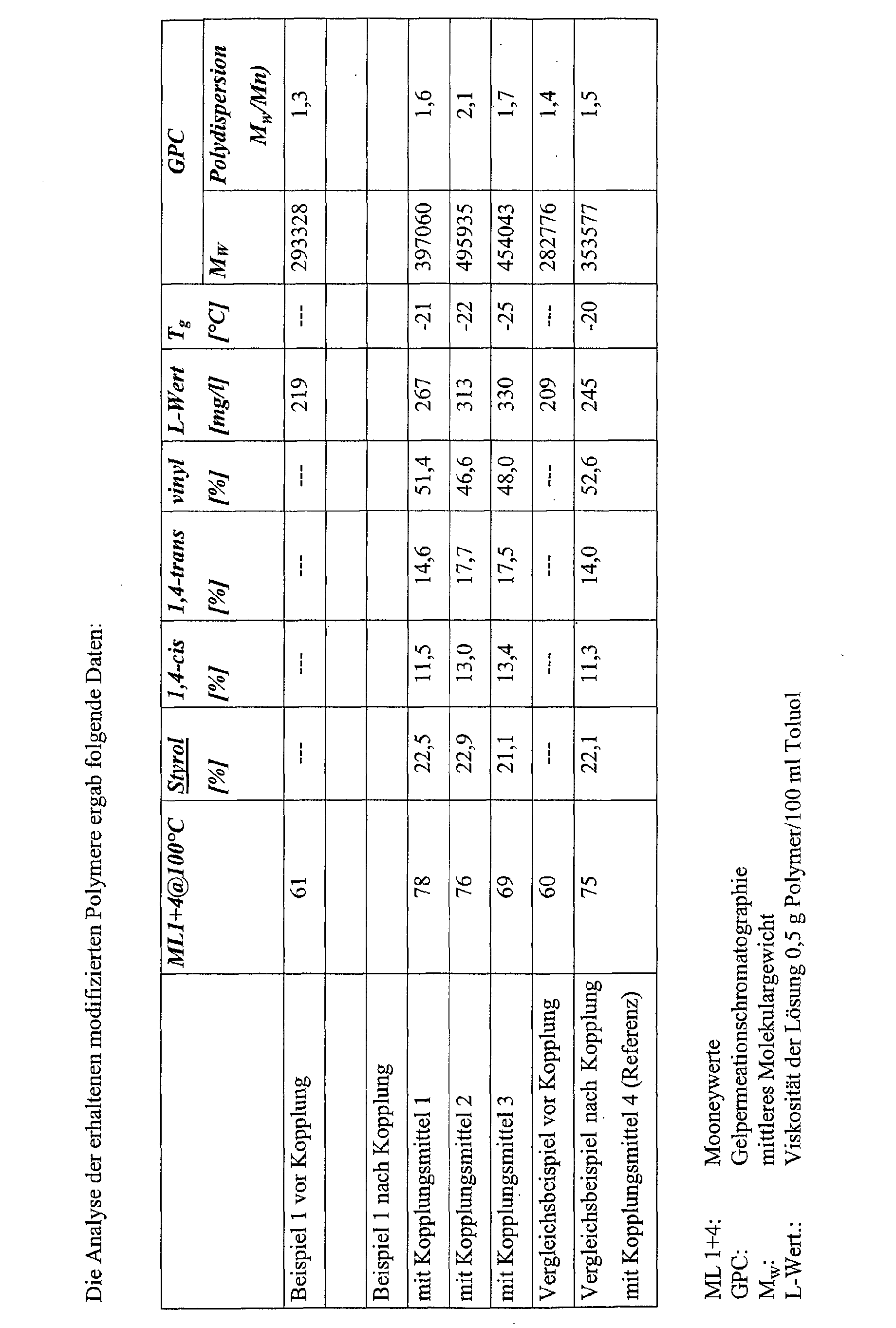
In einem mit Stickstoff gespülten und mit einem Rührer versehenen Autoklaven
wurden 8.500 g technisches Hexan vorgelegt. Danach wurde unter
Rühren zu dem vorgelegten Hexan 90mmol tert.-Butoxy-ethoxy-ethan,
0,80 mmol Kalium-tert.-amylat und 12 mmol n-Butyllithium (Buli) gegeben.
Zu diesem Gemisch wurde dann 1125 g getrocknetes, destabilisiertes 1,3-Butadien
und 375 g getrocknetes, destabilisiertes Styrol zudosiert. Die Polymerisation
der Monomere wurde bei einer Temperatur von 70°C bis zum
quantitativen Umsatz des Monomers durchgeführt.
Das in a) erhaltene Polymer wurde direkt - in situ - mit
Molares Verhältnis von Kopplungsmittel zu Li-terminiertem Polymer:
Die angegebenen Molverhältnisse beziehen sich auf vollständige Kopplung.
Die Herstellung des nicht gekoppelten und nicht modifizierten Styrol-Butadien-Copolymers
erfolgte wie in Beispiel la) beschrieben. Die anschließende Kopplung
des hergestellten Copolymers erfolgte direkt - in situ - mit 6 mmol N,N-Diglycidylanilin
(Kopplungsmittel 4). Die Reaktionszeiten der Kopplung sowie die Aufarbeitung
der Polymere erfolgte wie unter 1b) beschrieben.
Molares Verhältnis von Kopplungsmittel zu Li-terminiertem Polymer:
Das angegebene Molverhältnis bezieht sich ebenfalls auf die vollständige Kopplung
mit dem Polymer.
Das mit dem Kopplungsmittel 4 gekoppelte SBR-Copolymer wird in den nachstehenden
Tabellen als Referenz bezeichnet.
| Rußmischungen | ||||
| Beispiel 2 | Beispiel 1 | Beispiel 3 | Referenz | |
| Polymer mit Kopplungsmittel 2 | 60 | |||
| Polymer mit Kopplungsmittel 1 | 60 | |||
| Polymer mit Kopplungsmittel 3 | 60 | |||
| Referenz | 60 | |||
| Buna CB 25 | 40 | 40 | 40 | 40 |
| Ruß N 234 | 50 | 50 | 50 | 50 |
| Mineralöl* | 5 | 5 | 5 | 5 |
| ZnO RS | 3 3 3 | 3 | ||
| Stearinsäure | 2 | 2 | 2 | 2 |
| Antilux 654** | 1,5 | 1,5 | 1,5 | 1,5 |
| Vulkanox HS**** | 1 | 1 | 1 | 1 |
| Vulkanox 4020*** | 1 | 1 | 1 | 1 |
| Vulkacit CZ****** | 1,4 | 1,4 | 1,4 | 1,4 |
| Vulkacit D******* | 0,3 | 0,3 | 0,3 | 0,3 |
| Schwefel | 1,8 | 1,8 | 1,8 | 1,8 |
|
Mischungseigenschaften,
DIN 53523 |
||||
| Mooney Viskosität ML1 +4@100°C | 74 | 81 | 87 | 78 |
| Vulkanisateigenschaften, ISO 37 | ||||
| Festigkeit, Mpa | 19 | 21,5 | 20 | 19,3 |
| Bruchdehnung, % | 420 | 435 | 400 | 405 |
| Spannungswert 100%, Mpa | 2,8 | 2,6 | 2,6 | 2,6 |
| Spannungswert 300%, Mpa | 14,7 | 13,1 | 13,6 | 12,5 |
| Verstärkungsgrad | 5,3 | 5,0 | 5,2 | 4,8 |
| Härte 23°C, Shore A | 67 | 67 | 66 | 67 |
| Härte 70°C, Shore A | 64 | 63 | 65 | 63 |
| Elastizität 23°C, % | 44 | 42 | 48 | 42 |
| Elastizität 70°C, % | 60 | 58 | 59 | 57 |
| Roelig, 10 HZ, DIN 53513 | ||||
| tan delta 60°C | 0,133 | 0,133 | 0,124 | 0,137 |
Die erfindungsgemäßen Polymere mit Kopplungsmittel 1, 2 und 3 zeigen gegenüber
dem Referenz-Polymer (Referenz) in typischen rußgefüllten Vulkanisaten für Reifenlaufflächen
deutliche Vorteile im Verstärkungsgrad, der die Wechselwirkung des
Polymeren mit dem Füllstoff veranschaulicht. Als Konsequenz führt dies zu einer
Erhöhung der Elastizität insbesondere bei hohen Temperaturen (70°C) und zu einer
Absenkung des tan delta nach Roelig bei 60°C, was der Fachmann mit einer Reduktion
des Rollwiderstandes entsprechend hergestellter Reifen gleichsetzt.
| Kieselsäuremischungen | ||||
| Beispiel 2 | Beispiel 1 | Beispiel 3 | Referenz | |
| Polymer mit Kopplungsmittel 2 | 70 | |||
| Polymer mit Kopplungsmittel 1 | 70 | |||
| Polymer mit Kopplungsmittel 3 | 70 | |||
| Referenz | 70 | |||
| Buna CB 25 | 30 | 30 | 30 | 30 |
| Mineralöl* | 37,5 | 37,5 | 37,5 | 37,5 |
| Vulkasil S******** | 80 | 80 | 80 | 80 |
| Silan Si 69********* | 6,4 | 6,4 | 6,4 | 6,4 |
| ZnO RS | 2,5 | 2,5 | 2,5 | 2,5 |
| Stearinsäure | 1 | 1 | 1 | 1 |
| Vulkanox HS**** | 1 | 1 | 1 | 1 |
| Vulkanox 4020*** | 1 | 1 | 1 | 1 |
| Vulkacit CZ****** | 1,8 | 1,8 | 1,8 | 1,8 |
| Vulkacit D******* | 2 | 2 | 2 | 2 |
| Schwefel | 1,5 | 1,5 | 1,5 | 1,5 |
| Mischungseigenschaften, DIN 53523 | ||||
| Mooney Viskosität ML1+4@100°C | 73,5 | 83,8 | 90 | 79,4 |
| Vulkanisateigenschaften, ISO 37 | ||||
| Festigkeit, Mpa | 18,5 | 17,5 | 18,1 | 17,4 |
| Bruchdehnung, % | 436 | 430 | 430 | 435 |
| Spannungswert 100%, Mpa | 3,0 | 2,8 | 2,9 | 3,1 |
| Spannungswert 300%, Mpa | 11,3 | 10,6 | 10,8 | 10,4 |
| Verstärkungsgrad | 3,8 | 3,8 | 3,7 | 3,4 |
| Härte 23°C, Shore A | 75 | 75 | 75 | 76 |
| Härte 70°C, Shore A | 70 | 71 | 72 | 70 |
| Elastizität 23°C, % | 34 | 32 | 39 | 32 |
| Elastizität 70°C, % | 54 | 54 | 56 | 54 |
| Roelig, 10 HZ, DIN 53513 | ||||
| tan delta -20°C | 0,457 | 0,415 | 0,462 | 0,382 |
| 60°C | 0,127 | 0,127 | 0,112 | 0,129 |
In mit Kieselsäure gefüllten Vulkanisaten zeigen die erfindungsgemäßen Polymere
ebenfalls eine verbesserte Wechselwirkung mit dem Füllstoff, ausgedrückt durch
erhöhte Verstärkungsgrade. Zusätzlich zu reduziertem Rollwiderstand (niedrigerer
tan delta bei 60°C) sind mit dieser Art Laufflächenmischungen die Nässeeigenschaften
daraus hergestellter Reifen verbessert (erhöhter tan delta bei -20°C).
Claims (7)
- Gekoppelte und mit elektrophilen Gruppen modifizierte Polymere auf Basis von konjugierten Dienen oder von konjugierten Dienen und vinylaromatischen Verbindungen sowie polyfunktionellen Verbindungen mit mindestens drei zur Kopplung fähigen Gruppen und mindestens einer zur Modifizierung dienenden elektrophilen Gruppe, wobei die Polymeren ein Molekulargewichtsverhältnis (Mw/Mn) von 1,0 bis 2,1, einem Gewichtsmittel des Molekulargewichts (Mw) von ≥ 50.000, einer Glasübergangstemperatur (TG) von -100 bis -10°C, einer Menge an Vinylgruppen in Polymeren von 5 bis 90 %, bezogen auf die im Polymeren vorhandenen Dieneinheiten und eine Verknüpfungszahl (Kopplungszahl) von mindestens 2 aufweisen und wobei der Anteil an zur Modifizierung dienenden elektrophilen Gruppen, bezogen auf die Menge der bei der Herstellung des Polymeren intermediär gebildeten Alkalimetall-terminierten-Polymeranionen, 3 bis 33 mol-% beträgt.
- Gekoppelte und modifizierte Polymere nach Anspruch 1, dadurch gekennzeichnet, dass sie als vinylaromatische Verbindungen Styrol, p-Methylstyrol, α-Methylstyrol, 3,5-Dimethylstyrol, Vinylnaphthalin, p-tert.-Butylstyrol, Divinylstyrol, Divinylethylen, 4-Propylstyrol, p-Tolylstyrol, 1-Vinyl-5-hexylnaphthalin und/oder 1-Vinylnaphthalin enthalten.
- Gekoppelte und modifizierte Polymere nach Anspruch 1, dadurch gekennzeichnet, dass sie als konjugierte Diene 1,3-Butadien und/oder Isopren und als vinylaromatische Verbindung Styrol enthalten.
- Gekoppelte und modifizierte Polymere nach Anspruch 1, dadurch gekennzeichnet, dass sie die konjugierten Diene in Mengen von 45 bis 95 Gew.-% und die vinylaromatischen Verbindungen in Mengen von 5 bis 55 Gew.-% enthalten.
- Gekoppelte und modifizierte Polymere nach Anspruch 1, dadurch gekennzeichnet, dass sie als funktionelle organische Verbindungen N,N-bis-(2,3-Epoxypropoxy)-anilin, 4,4-Methylen-bis-(N,N-glycidylanilin), Tris-(2,3-epoxypropyl)-1,3,5-triazine-2,4,6-trione, Trimethylolethan-triglycidylether, Trimethylolpropan-triglycidylether oder Triglycidylglycerol.
- Verfahren zur Herstellung von gekoppelten und mit elektrophilen Gruppen modifizierten Polymeren nach Anspruch 1, dadurch gekennzeichnet, dass man konjugierte Diene oder konjugierte Diene mit vinylaromatischen Verbindungen in Gegenwart von inerten organischen Lösungsmitteln und in Anwesenheit von organischen Alkalimetall-Verbindungen in üblicher Weise polymerisiert, die gebildeten Alkalimetall-terminierten Polymeranionen mit polyfunktionellen Verbindungen, mit mindestens drei zur Kopplung fähigen Gruppen und mindestens einer zur Modifizierung dienenden elektrophilen Gruppe umsetzt, wobei das molare Verhältnis von eingesetzten polyfunktionellen Verbindungen zur Akalimetall-terminierten Polymeranionen 0,03 bis 0,33 : 1 beträgt.
- Verwendung der gekoppelten und modifizierten Polymere nach Anspruch 1, zur Herstellung von Vulkanisaten und Kautschukformkörpern aller Art, insbesondere zur Herstellung von Reifen und Reifenbauteilen, von Golfbällen und technischen Gummiartikeln sowie zur Herstellung von kautschukverstärkten Kunststoffen wie ABS- und HIPS-Kunststoffen.
Applications Claiming Priority (4)
| Application Number | Priority Date | Filing Date | Title |
|---|---|---|---|
| DE10139304 | 2001-08-06 | ||
| DE10139304 | 2001-08-06 | ||
| DE10217800A DE10217800B4 (de) | 2001-08-06 | 2002-04-22 | Gekoppelte und mit elektrophilen Gruppen modifizierte Dien-Polymere, Verfahren zur Herstellung und Verwendung |
| DE10217800 | 2002-04-22 |
Publications (1)
| Publication Number | Publication Date |
|---|---|
| EP1283220A1 true EP1283220A1 (de) | 2003-02-12 |
Family
ID=26009921
Family Applications (1)
| Application Number | Title | Priority Date | Filing Date |
|---|---|---|---|
| EP02016300A Withdrawn EP1283220A1 (de) | 2001-08-06 | 2002-07-24 | Gekoppelte und mit elektrophilen Gruppen modifizierte Dien-Polymere |
Country Status (8)
| Country | Link |
|---|---|
| US (1) | US20030114612A1 (de) |
| EP (1) | EP1283220A1 (de) |
| JP (1) | JP2003119223A (de) |
| KR (1) | KR20030014107A (de) |
| CN (1) | CN1406992A (de) |
| BR (1) | BR0203048A (de) |
| CA (1) | CA2396687A1 (de) |
| MX (1) | MXPA02007539A (de) |
Cited By (1)
| Publication number | Priority date | Publication date | Assignee | Title |
|---|---|---|---|---|
| EP1398329A1 (de) * | 2002-09-16 | 2004-03-17 | Bayer Aktiengesellschaft | Hochverzweigte Dien-Polymere |
Families Citing this family (6)
| Publication number | Priority date | Publication date | Assignee | Title |
|---|---|---|---|---|
| CN101516917B (zh) * | 2006-07-25 | 2012-05-09 | 株式会社普利司通 | 官能化聚合物 |
| ATE534674T1 (de) | 2007-03-28 | 2011-12-15 | Asahi Kasei Chemicals Corp | Verfahren zur herstellung eines modifizierten konjugierten dienpolymers, zusammensetzungen mit dem polymer und reifen mit diesen zusammensetzungen |
| JP5411447B2 (ja) * | 2008-05-16 | 2014-02-12 | 旭化成ケミカルズ株式会社 | 変性共役ジエン系重合体組成物及びこれを用いた加硫ゴム組成物 |
| KR101497497B1 (ko) * | 2012-04-30 | 2015-03-03 | 금호석유화학 주식회사 | 고무-실리카 네트워크용 계면 고분자 |
| WO2014021002A1 (ja) * | 2012-08-03 | 2014-02-06 | 住友ゴム工業株式会社 | トレッド用ゴム組成物及び空気入りタイヤ |
| FR3103490B1 (fr) * | 2019-11-21 | 2021-10-22 | Michelin & Cie | Composition de caoutchouc comprenant un polybutadiene fonctionnalise |
Citations (3)
| Publication number | Priority date | Publication date | Assignee | Title |
|---|---|---|---|---|
| EP0260325A1 (de) * | 1986-03-13 | 1988-03-23 | Asahi Kasei Kogyo Kabushiki Kaisha | Dienpolymere, herstellungsverfahren und diese enthaltende kautschukzubereitungen |
| WO1999001490A1 (de) * | 1997-06-30 | 1999-01-14 | Basf Aktiengesellschaft | Glycidylether aliphatischer polyalkohole als kopplungsmittel in der anionischen polymerisation |
| WO2001023467A1 (en) * | 1999-09-27 | 2001-04-05 | Asahi Kasei Kabushiki Kaisha | Rubber composition |
Family Cites Families (4)
| Publication number | Priority date | Publication date | Assignee | Title |
|---|---|---|---|---|
| US6228908B1 (en) * | 1997-07-11 | 2001-05-08 | Bridgestone Corporation | Diene polymers and copolymers incorporating partial coupling and terminals formed from hydrocarboxysilane compounds |
| US6008295A (en) * | 1997-07-11 | 1999-12-28 | Bridgestone Corporation | Diene polymers and copolymers incorporating partial coupling and terminals formed from hydrocarboxysilane compounds |
| TW345589B (en) * | 1997-12-13 | 1998-11-21 | Taiwan Synthetic Rubber Corp | Tread rubber suitable for high performance tire |
| GB2344593A (en) * | 1998-12-07 | 2000-06-14 | Taiwan Synthetic Rubber Corp | Coupled polymers |
-
2002
- 2002-07-24 EP EP02016300A patent/EP1283220A1/de not_active Withdrawn
- 2002-08-02 US US10/211,118 patent/US20030114612A1/en not_active Abandoned
- 2002-08-02 JP JP2002226260A patent/JP2003119223A/ja active Pending
- 2002-08-02 CA CA002396687A patent/CA2396687A1/en not_active Abandoned
- 2002-08-05 MX MXPA02007539A patent/MXPA02007539A/es unknown
- 2002-08-05 KR KR1020020046015A patent/KR20030014107A/ko not_active Withdrawn
- 2002-08-05 BR BR0203048-9A patent/BR0203048A/pt not_active Application Discontinuation
- 2002-08-06 CN CN02127810A patent/CN1406992A/zh active Pending
Patent Citations (4)
| Publication number | Priority date | Publication date | Assignee | Title |
|---|---|---|---|---|
| EP0260325A1 (de) * | 1986-03-13 | 1988-03-23 | Asahi Kasei Kogyo Kabushiki Kaisha | Dienpolymere, herstellungsverfahren und diese enthaltende kautschukzubereitungen |
| WO1999001490A1 (de) * | 1997-06-30 | 1999-01-14 | Basf Aktiengesellschaft | Glycidylether aliphatischer polyalkohole als kopplungsmittel in der anionischen polymerisation |
| WO2001023467A1 (en) * | 1999-09-27 | 2001-04-05 | Asahi Kasei Kabushiki Kaisha | Rubber composition |
| EP1153972A1 (de) * | 1999-09-27 | 2001-11-14 | Asahi Kasei Kabushiki Kaisha | Kautschukmischung |
Cited By (1)
| Publication number | Priority date | Publication date | Assignee | Title |
|---|---|---|---|---|
| EP1398329A1 (de) * | 2002-09-16 | 2004-03-17 | Bayer Aktiengesellschaft | Hochverzweigte Dien-Polymere |
Also Published As
| Publication number | Publication date |
|---|---|
| CN1406992A (zh) | 2003-04-02 |
| JP2003119223A (ja) | 2003-04-23 |
| CA2396687A1 (en) | 2003-02-06 |
| US20030114612A1 (en) | 2003-06-19 |
| KR20030014107A (ko) | 2003-02-15 |
| MXPA02007539A (es) | 2005-02-17 |
| BR0203048A (pt) | 2003-05-27 |
Similar Documents
| Publication | Publication Date | Title |
|---|---|---|
| EP1397390B1 (de) | Modifizierte polymere mit einem hohen anteil an cis-ständigen doppelbindungen, ein verfahren zu deren herstellung sowie deren verwendung | |
| DE3889624T2 (de) | Blockierung von Polydienen. | |
| DE69612155T2 (de) | Kautschukmischung für Reifenlaufflächen | |
| DE60104131T2 (de) | Silizium-haltige Kupplungsreagenzien mit einem Kohlenwasserstoffkern für gefüllte Elastomermischungen | |
| EP2181000B1 (de) | Nanostrukturierte polymere auf basis von konjugierten dienen | |
| DE69817830T2 (de) | Kieselsäure-haltige, mit Schwefel vulkanisierbare Kautschukmischung | |
| DE3315525C2 (de) | Kautschukzusammensetzung | |
| DE69808367T2 (de) | Kautschukzusammensetzung enthaltend Russ mit auf seiner Oberfläche fixiertes Siliciumdioxid und ein mit Silanol-Gruppe funktionalisertes oder modifiziertes Dienpolymer | |
| DE69119125T2 (de) | Luftreifen | |
| DE60316445T2 (de) | Funktionalisiertes polymer und verbesserte vulkanisate daraus | |
| DE102004004557B4 (de) | Verfahren zur Herstellung von modifiziertem Dienpolymerkautschuk | |
| DE60027704T2 (de) | Kautschukmischung | |
| DE69713262T2 (de) | Polymere, Elastomerzusammensetzungen und daraus hergestellte Produkte mit Aminverbindungen als Endgruppen, die reaktive Organohalogengruppen in der Seitenkette enthalten | |
| EP2643414B1 (de) | Verfahren zur herstellung von polymer-funktionalisierten kieselsäurepartikel | |
| DE69601704T2 (de) | Kupplung von anionischen polymeren mit trialkoxysilanen, die silizium-wasserstoff-bindungen enthalten | |
| DE69303115T2 (de) | Luftreifen mit geringem Rollwiderstand | |
| DE10315274A1 (de) | Verfahren zur Herstellung eines modifizierten Polymerkautschuks | |
| EP2026981B1 (de) | Kautschukmischung und reifen | |
| DE69809981T2 (de) | Reifenlauffläche welche gekuppeltes SIBR enthält | |
| EP1319673A1 (de) | Polymere, die durch funktionelle Gruppen modifiziert sind | |
| DE69124869T2 (de) | Hydriertes und verzweigtes Blockcopolymer und Verfahren zur Herstellung | |
| EP0220602A1 (de) | Transparente, schlagzähe Styrol-Block-Polymerisate und Verfahren zu ihrer Herstellung | |
| EP3452518B1 (de) | Kautschukmischung, vulkanisat der kautschukmischung und fahrzeugreifen | |
| EP4011958A1 (de) | Kautschukmischung und fahrzeugluftreifen | |
| EP1398329A1 (de) | Hochverzweigte Dien-Polymere |
Legal Events
| Date | Code | Title | Description |
|---|---|---|---|
| PUAI | Public reference made under article 153(3) epc to a published international application that has entered the european phase |
Free format text: ORIGINAL CODE: 0009012 |
|
| AK | Designated contracting states |
Designated state(s): AT BE BG CH CY CZ DE DK EE ES FI FR GB GR IE IT LI LU MC NL PT SE SK TR |
|
| AX | Request for extension of the european patent |
Extension state: AL LT LV MK RO SI |
|
| 17P | Request for examination filed |
Effective date: 20030812 |
|
| AKX | Designation fees paid |
Designated state(s): DE ES FR GB IT |
|
| 17Q | First examination report despatched |
Effective date: 20050429 |
|
| STAA | Information on the status of an ep patent application or granted ep patent |
Free format text: STATUS: THE APPLICATION IS DEEMED TO BE WITHDRAWN |
|
| 18D | Application deemed to be withdrawn |
Effective date: 20050912 |