EP1268718B1 - Verdickungsmittel-komponente und aluminiumkomplex-schmierfett - Google Patents
Verdickungsmittel-komponente und aluminiumkomplex-schmierfett Download PDFInfo
- Publication number
- EP1268718B1 EP1268718B1 EP01929230A EP01929230A EP1268718B1 EP 1268718 B1 EP1268718 B1 EP 1268718B1 EP 01929230 A EP01929230 A EP 01929230A EP 01929230 A EP01929230 A EP 01929230A EP 1268718 B1 EP1268718 B1 EP 1268718B1
- Authority
- EP
- European Patent Office
- Prior art keywords
- aluminium
- compound
- thickener component
- aluminum
- monocarboxylic acid
- Prior art date
- Legal status (The legal status is an assumption and is not a legal conclusion. Google has not performed a legal analysis and makes no representation as to the accuracy of the status listed.)
- Expired - Lifetime
Links
Classifications
-
- C—CHEMISTRY; METALLURGY
- C10—PETROLEUM, GAS OR COKE INDUSTRIES; TECHNICAL GASES CONTAINING CARBON MONOXIDE; FUELS; LUBRICANTS; PEAT
- C10M—LUBRICATING COMPOSITIONS; USE OF CHEMICAL SUBSTANCES EITHER ALONE OR AS LUBRICATING INGREDIENTS IN A LUBRICATING COMPOSITION
- C10M123/00—Lubricating compositions characterised by the thickener being a mixture of two or more compounds covered by more than one of the main groups C10M113/00 - C10M121/00, each of these compounds being essential
-
- C—CHEMISTRY; METALLURGY
- C07—ORGANIC CHEMISTRY
- C07C—ACYCLIC OR CARBOCYCLIC COMPOUNDS
- C07C51/00—Preparation of carboxylic acids or their salts, halides or anhydrides
- C07C51/41—Preparation of salts of carboxylic acids
- C07C51/412—Preparation of salts of carboxylic acids by conversion of the acids, their salts, esters or anhydrides with the same carboxylic acid part
-
- C—CHEMISTRY; METALLURGY
- C07—ORGANIC CHEMISTRY
- C07F—ACYCLIC, CARBOCYCLIC OR HETEROCYCLIC COMPOUNDS CONTAINING ELEMENTS OTHER THAN CARBON, HYDROGEN, HALOGEN, OXYGEN, NITROGEN, SULFUR, SELENIUM OR TELLURIUM
- C07F5/00—Compounds containing elements of Groups 3 or 13 of the Periodic Table
- C07F5/06—Aluminium compounds
- C07F5/069—Aluminium compounds without C-aluminium linkages
-
- C—CHEMISTRY; METALLURGY
- C10—PETROLEUM, GAS OR COKE INDUSTRIES; TECHNICAL GASES CONTAINING CARBON MONOXIDE; FUELS; LUBRICANTS; PEAT
- C10M—LUBRICATING COMPOSITIONS; USE OF CHEMICAL SUBSTANCES EITHER ALONE OR AS LUBRICATING INGREDIENTS IN A LUBRICATING COMPOSITION
- C10M115/00—Lubricating compositions characterised by the thickener being a non-macromolecular organic compound other than a carboxylic acid or salt thereof
- C10M115/04—Lubricating compositions characterised by the thickener being a non-macromolecular organic compound other than a carboxylic acid or salt thereof containing oxygen
-
- C—CHEMISTRY; METALLURGY
- C10—PETROLEUM, GAS OR COKE INDUSTRIES; TECHNICAL GASES CONTAINING CARBON MONOXIDE; FUELS; LUBRICANTS; PEAT
- C10M—LUBRICATING COMPOSITIONS; USE OF CHEMICAL SUBSTANCES EITHER ALONE OR AS LUBRICATING INGREDIENTS IN A LUBRICATING COMPOSITION
- C10M117/00—Lubricating compositions characterised by the thickener being a non-macromolecular carboxylic acid or salt thereof
- C10M117/02—Lubricating compositions characterised by the thickener being a non-macromolecular carboxylic acid or salt thereof having only one carboxyl group bound to an acyclic carbon atom, cycloaliphatic carbon atom or hydrogen
-
- C—CHEMISTRY; METALLURGY
- C10—PETROLEUM, GAS OR COKE INDUSTRIES; TECHNICAL GASES CONTAINING CARBON MONOXIDE; FUELS; LUBRICANTS; PEAT
- C10M—LUBRICATING COMPOSITIONS; USE OF CHEMICAL SUBSTANCES EITHER ALONE OR AS LUBRICATING INGREDIENTS IN A LUBRICATING COMPOSITION
- C10M2203/00—Organic non-macromolecular hydrocarbon compounds and hydrocarbon fractions as ingredients in lubricant compositions
- C10M2203/10—Petroleum or coal fractions, e.g. tars, solvents, bitumen
-
- C—CHEMISTRY; METALLURGY
- C10—PETROLEUM, GAS OR COKE INDUSTRIES; TECHNICAL GASES CONTAINING CARBON MONOXIDE; FUELS; LUBRICANTS; PEAT
- C10M—LUBRICATING COMPOSITIONS; USE OF CHEMICAL SUBSTANCES EITHER ALONE OR AS LUBRICATING INGREDIENTS IN A LUBRICATING COMPOSITION
- C10M2203/00—Organic non-macromolecular hydrocarbon compounds and hydrocarbon fractions as ingredients in lubricant compositions
- C10M2203/10—Petroleum or coal fractions, e.g. tars, solvents, bitumen
- C10M2203/102—Aliphatic fractions
-
- C—CHEMISTRY; METALLURGY
- C10—PETROLEUM, GAS OR COKE INDUSTRIES; TECHNICAL GASES CONTAINING CARBON MONOXIDE; FUELS; LUBRICANTS; PEAT
- C10M—LUBRICATING COMPOSITIONS; USE OF CHEMICAL SUBSTANCES EITHER ALONE OR AS LUBRICATING INGREDIENTS IN A LUBRICATING COMPOSITION
- C10M2207/00—Organic non-macromolecular hydrocarbon compounds containing hydrogen, carbon and oxygen as ingredients in lubricant compositions
- C10M2207/006—Organic non-macromolecular hydrocarbon compounds containing hydrogen, carbon and oxygen as ingredients in lubricant compositions used as thickening agents
-
- C—CHEMISTRY; METALLURGY
- C10—PETROLEUM, GAS OR COKE INDUSTRIES; TECHNICAL GASES CONTAINING CARBON MONOXIDE; FUELS; LUBRICANTS; PEAT
- C10M—LUBRICATING COMPOSITIONS; USE OF CHEMICAL SUBSTANCES EITHER ALONE OR AS LUBRICATING INGREDIENTS IN A LUBRICATING COMPOSITION
- C10M2207/00—Organic non-macromolecular hydrocarbon compounds containing hydrogen, carbon and oxygen as ingredients in lubricant compositions
- C10M2207/02—Hydroxy compounds
- C10M2207/0206—Hydroxy compounds used as thickening agents
-
- C—CHEMISTRY; METALLURGY
- C10—PETROLEUM, GAS OR COKE INDUSTRIES; TECHNICAL GASES CONTAINING CARBON MONOXIDE; FUELS; LUBRICANTS; PEAT
- C10M—LUBRICATING COMPOSITIONS; USE OF CHEMICAL SUBSTANCES EITHER ALONE OR AS LUBRICATING INGREDIENTS IN A LUBRICATING COMPOSITION
- C10M2207/00—Organic non-macromolecular hydrocarbon compounds containing hydrogen, carbon and oxygen as ingredients in lubricant compositions
- C10M2207/02—Hydroxy compounds
- C10M2207/023—Hydroxy compounds having hydroxy groups bound to carbon atoms of six-membered aromatic rings
- C10M2207/027—Neutral salts thereof
-
- C—CHEMISTRY; METALLURGY
- C10—PETROLEUM, GAS OR COKE INDUSTRIES; TECHNICAL GASES CONTAINING CARBON MONOXIDE; FUELS; LUBRICANTS; PEAT
- C10M—LUBRICATING COMPOSITIONS; USE OF CHEMICAL SUBSTANCES EITHER ALONE OR AS LUBRICATING INGREDIENTS IN A LUBRICATING COMPOSITION
- C10M2207/00—Organic non-macromolecular hydrocarbon compounds containing hydrogen, carbon and oxygen as ingredients in lubricant compositions
- C10M2207/04—Ethers; Acetals; Ortho-esters; Ortho-carbonates
- C10M2207/0413—Ethers; Acetals; Ortho-esters; Ortho-carbonates used as thickening agent
-
- C—CHEMISTRY; METALLURGY
- C10—PETROLEUM, GAS OR COKE INDUSTRIES; TECHNICAL GASES CONTAINING CARBON MONOXIDE; FUELS; LUBRICANTS; PEAT
- C10M—LUBRICATING COMPOSITIONS; USE OF CHEMICAL SUBSTANCES EITHER ALONE OR AS LUBRICATING INGREDIENTS IN A LUBRICATING COMPOSITION
- C10M2207/00—Organic non-macromolecular hydrocarbon compounds containing hydrogen, carbon and oxygen as ingredients in lubricant compositions
- C10M2207/09—Metal enolates, i.e. keto-enol metal complexes
- C10M2207/095—Metal enolates, i.e. keto-enol metal complexes used as thickening agent
-
- C—CHEMISTRY; METALLURGY
- C10—PETROLEUM, GAS OR COKE INDUSTRIES; TECHNICAL GASES CONTAINING CARBON MONOXIDE; FUELS; LUBRICANTS; PEAT
- C10M—LUBRICATING COMPOSITIONS; USE OF CHEMICAL SUBSTANCES EITHER ALONE OR AS LUBRICATING INGREDIENTS IN A LUBRICATING COMPOSITION
- C10M2207/00—Organic non-macromolecular hydrocarbon compounds containing hydrogen, carbon and oxygen as ingredients in lubricant compositions
- C10M2207/10—Carboxylix acids; Neutral salts thereof
- C10M2207/12—Carboxylix acids; Neutral salts thereof having carboxyl groups bound to acyclic or cycloaliphatic carbon atoms
- C10M2207/121—Carboxylix acids; Neutral salts thereof having carboxyl groups bound to acyclic or cycloaliphatic carbon atoms having hydrocarbon chains of seven or less carbon atoms
- C10M2207/122—Carboxylix acids; Neutral salts thereof having carboxyl groups bound to acyclic or cycloaliphatic carbon atoms having hydrocarbon chains of seven or less carbon atoms monocarboxylic
- C10M2207/1225—Carboxylix acids; Neutral salts thereof having carboxyl groups bound to acyclic or cycloaliphatic carbon atoms having hydrocarbon chains of seven or less carbon atoms monocarboxylic used as thickening agent
-
- C—CHEMISTRY; METALLURGY
- C10—PETROLEUM, GAS OR COKE INDUSTRIES; TECHNICAL GASES CONTAINING CARBON MONOXIDE; FUELS; LUBRICANTS; PEAT
- C10M—LUBRICATING COMPOSITIONS; USE OF CHEMICAL SUBSTANCES EITHER ALONE OR AS LUBRICATING INGREDIENTS IN A LUBRICATING COMPOSITION
- C10M2207/00—Organic non-macromolecular hydrocarbon compounds containing hydrogen, carbon and oxygen as ingredients in lubricant compositions
- C10M2207/10—Carboxylix acids; Neutral salts thereof
- C10M2207/12—Carboxylix acids; Neutral salts thereof having carboxyl groups bound to acyclic or cycloaliphatic carbon atoms
- C10M2207/125—Carboxylix acids; Neutral salts thereof having carboxyl groups bound to acyclic or cycloaliphatic carbon atoms having hydrocarbon chains of eight up to twenty-nine carbon atoms, i.e. fatty acids
-
- C—CHEMISTRY; METALLURGY
- C10—PETROLEUM, GAS OR COKE INDUSTRIES; TECHNICAL GASES CONTAINING CARBON MONOXIDE; FUELS; LUBRICANTS; PEAT
- C10M—LUBRICATING COMPOSITIONS; USE OF CHEMICAL SUBSTANCES EITHER ALONE OR AS LUBRICATING INGREDIENTS IN A LUBRICATING COMPOSITION
- C10M2207/00—Organic non-macromolecular hydrocarbon compounds containing hydrogen, carbon and oxygen as ingredients in lubricant compositions
- C10M2207/10—Carboxylix acids; Neutral salts thereof
- C10M2207/12—Carboxylix acids; Neutral salts thereof having carboxyl groups bound to acyclic or cycloaliphatic carbon atoms
- C10M2207/125—Carboxylix acids; Neutral salts thereof having carboxyl groups bound to acyclic or cycloaliphatic carbon atoms having hydrocarbon chains of eight up to twenty-nine carbon atoms, i.e. fatty acids
- C10M2207/126—Carboxylix acids; Neutral salts thereof having carboxyl groups bound to acyclic or cycloaliphatic carbon atoms having hydrocarbon chains of eight up to twenty-nine carbon atoms, i.e. fatty acids monocarboxylic
- C10M2207/1265—Carboxylix acids; Neutral salts thereof having carboxyl groups bound to acyclic or cycloaliphatic carbon atoms having hydrocarbon chains of eight up to twenty-nine carbon atoms, i.e. fatty acids monocarboxylic used as thickening agent
-
- C—CHEMISTRY; METALLURGY
- C10—PETROLEUM, GAS OR COKE INDUSTRIES; TECHNICAL GASES CONTAINING CARBON MONOXIDE; FUELS; LUBRICANTS; PEAT
- C10M—LUBRICATING COMPOSITIONS; USE OF CHEMICAL SUBSTANCES EITHER ALONE OR AS LUBRICATING INGREDIENTS IN A LUBRICATING COMPOSITION
- C10M2207/00—Organic non-macromolecular hydrocarbon compounds containing hydrogen, carbon and oxygen as ingredients in lubricant compositions
- C10M2207/10—Carboxylix acids; Neutral salts thereof
- C10M2207/12—Carboxylix acids; Neutral salts thereof having carboxyl groups bound to acyclic or cycloaliphatic carbon atoms
- C10M2207/129—Carboxylix acids; Neutral salts thereof having carboxyl groups bound to acyclic or cycloaliphatic carbon atoms having hydrocarbon chains of thirty or more carbon atoms
-
- C—CHEMISTRY; METALLURGY
- C10—PETROLEUM, GAS OR COKE INDUSTRIES; TECHNICAL GASES CONTAINING CARBON MONOXIDE; FUELS; LUBRICANTS; PEAT
- C10M—LUBRICATING COMPOSITIONS; USE OF CHEMICAL SUBSTANCES EITHER ALONE OR AS LUBRICATING INGREDIENTS IN A LUBRICATING COMPOSITION
- C10M2207/00—Organic non-macromolecular hydrocarbon compounds containing hydrogen, carbon and oxygen as ingredients in lubricant compositions
- C10M2207/10—Carboxylix acids; Neutral salts thereof
- C10M2207/16—Naphthenic acids
- C10M2207/166—Naphthenic acids used as thickening agents
-
- C—CHEMISTRY; METALLURGY
- C10—PETROLEUM, GAS OR COKE INDUSTRIES; TECHNICAL GASES CONTAINING CARBON MONOXIDE; FUELS; LUBRICANTS; PEAT
- C10M—LUBRICATING COMPOSITIONS; USE OF CHEMICAL SUBSTANCES EITHER ALONE OR AS LUBRICATING INGREDIENTS IN A LUBRICATING COMPOSITION
- C10M2207/00—Organic non-macromolecular hydrocarbon compounds containing hydrogen, carbon and oxygen as ingredients in lubricant compositions
- C10M2207/10—Carboxylix acids; Neutral salts thereof
- C10M2207/18—Tall oil acids
- C10M2207/186—Tall oil acids used as thickening agents
-
- C—CHEMISTRY; METALLURGY
- C10—PETROLEUM, GAS OR COKE INDUSTRIES; TECHNICAL GASES CONTAINING CARBON MONOXIDE; FUELS; LUBRICANTS; PEAT
- C10M—LUBRICATING COMPOSITIONS; USE OF CHEMICAL SUBSTANCES EITHER ALONE OR AS LUBRICATING INGREDIENTS IN A LUBRICATING COMPOSITION
- C10M2207/00—Organic non-macromolecular hydrocarbon compounds containing hydrogen, carbon and oxygen as ingredients in lubricant compositions
- C10M2207/10—Carboxylix acids; Neutral salts thereof
- C10M2207/20—Rosin acids
- C10M2207/206—Rosin acids used as thickening agents
-
- C—CHEMISTRY; METALLURGY
- C10—PETROLEUM, GAS OR COKE INDUSTRIES; TECHNICAL GASES CONTAINING CARBON MONOXIDE; FUELS; LUBRICANTS; PEAT
- C10M—LUBRICATING COMPOSITIONS; USE OF CHEMICAL SUBSTANCES EITHER ALONE OR AS LUBRICATING INGREDIENTS IN A LUBRICATING COMPOSITION
- C10M2207/00—Organic non-macromolecular hydrocarbon compounds containing hydrogen, carbon and oxygen as ingredients in lubricant compositions
- C10M2207/10—Carboxylix acids; Neutral salts thereof
- C10M2207/24—Epoxidised acids; Ester derivatives thereof
- C10M2207/246—Epoxidised acids; Ester derivatives thereof used as thickening agents
-
- C—CHEMISTRY; METALLURGY
- C10—PETROLEUM, GAS OR COKE INDUSTRIES; TECHNICAL GASES CONTAINING CARBON MONOXIDE; FUELS; LUBRICANTS; PEAT
- C10N—INDEXING SCHEME ASSOCIATED WITH SUBCLASS C10M RELATING TO LUBRICATING COMPOSITIONS
- C10N2010/00—Metal present as such or in compounds
- C10N2010/06—Groups 3 or 13
Definitions
- the invention relates to a thickener component based on an aluminum carboxylate compound and a made of this with the addition of a base liquid Aluminum complex grease.
- Aluminum complex greases are known. These consist essentially of a mineral oil base fluid and a thickener system containing one or more aluminum carboxylate compounds.
- the Aiuminiumcarboxylat compound is obtained from the reaction of a fatty acid and / or an aromatic carboxylic acid with an aluminum alcoholate derivative.
- Aluminum alcoholates used in the art are aluminum isopropoxylate and tri-oxy-aluminum triisopropoxide. The reaction follows in theory the reaction schemes shown below: Al (OR) 3 + R'-COOH + Ar-COOH + H 2 O ⁇ Al (-OH) (-OCOR ') (-OCOAr) + 3 ROH
- Aluminum complex greases are characterized by a high dropping point, good conveyability and resistance to water and low oil separation.
- the object of the invention is more effective aluminum complex greases, in particular more suitable thickener components for the preparation of thickeners for Aluminum complex greases to provide. More effective means that the grease improved lubrication properties over conventional aluminum complex greases having.
- the used for the production of aluminum complex greases Thickener component should also be as such storable and salable, so that the actual production of the grease or thickener in the grease at the grease manufacturer can take place.
- Hydrolisable aluminum compounds in the context of the invention are aluminum compounds which are suitable for forming proton-donating compounds, such as water or organic acids, aluminum-oxygen bonds.
- the hydrolyzable aluminum compounds are aluminum alcoholate or aluminum oxo-alcoholate compounds, the alkoxide group preferably being a C 2 to C 4 alcohol, in particular isopropanolate.
- the carboxylic acids may be: aliphatic branched or unbranched monocarboxylic acid of the type R 1 -COOH in which R 1 is a C 10 to C 40 radical, preferably a C 14 to C 24 radical or a C 16 to C 24 radical.
- Carboxylic acid derivatives within the meaning of the invention are compounds which are capable of form aluminum-carboxylate bonds with the aluminum compounds, the would also arise using the corresponding acids. Called e.g. the Anhydrides, acid chlorides or amides of the above-mentioned carboxylic acids.
- Ester compounds are, in particular, those which can be obtained by reacting in the Reaction mixture of existing alcohols / alcoholates with the carboxylic acids / Carboxylate radicals can form.
- the preparation of the thickener component is carried out by reaction, preferably by about equimolar reaction (i.e., about 1 mole of monocarboxylic acid per mole of Al atoms in the compound), a hydrolyzable aluminum compound having one or more a plurality of the above-described carboxylic acids or carboxylic acid derivatives in a Temperature not exceeding 145 ° C, more preferably 135 ° C, especially preferably a temperature difference of at least 20 ° C, preferably in one Time interval of at least 90 min, increasing temperature profile, is complied with .
- the hydrolyzable aluminum compound is introduced.
- Thickener in the context of the invention is a compound prepared from the thickener Konponente or compound mixture obtained by reacting the thickener Konponente with aromatic or cyclic monocarboxylic acids of the type R 2 -COOH, wherein R 2 is a C6 to C16 radical, or whose derivatives can be produced.
- aromatic or cyclic carboxylic acid derivatives used have the meaning indicated above.
- the remaining portion is of aromatic or cyclic monocarboxylic acid residues formed.
- An aromatic monocarboxylic acid in the context of the invention is a carboxylic acid which comprises at least one benzene ring or condensed benzene ring and may contain aliphatic hydrocarbon radicals next to it.
- compounds such as C 6 H 5 -CH 2 -CH 2 -COOH or CH 3 -CH 2 -C 6 H 4 -COOH.
- the thickening component possibly added in further base liquid, added with the aromatic or cyclic monocarboxylic acid.
- the production process according to the invention has the consequence that a low-ester raw material (Thickener component) for the preparation of the actual thickener obtained which remains esterarm even after storage.
- Thickener component a low-ester raw material for the preparation of the actual thickener obtained which remains esterarm even after storage.
- the aluminum complex greases of the invention contain, in addition to the invention Thickeners continue to be a base fluid, with the base fluid a hydrocarbon compound and / or a synthetic oil and the overall composition to 30 to 98 wt.%, Preferably to 60 to 95 wt.% Is added.
- the hydrocarbon compound may be a paraffinic or naphthenic mineral oil, a polyalphaolefin or a white oil.
- suitable as a base fluid Synthetic oils are fatty acid esters based on mono- or polyfunctional fatty acids the chain length 8 to 24 carbon atoms and mono- or polyfunctional alcohols.
- Other components of the aluminum complex greases according to the invention can continue to be typical additives. Examples of suitable additives can be found in Table 1 be removed.
- the thickener components according to the invention serve as raw materials for the production of thickeners that incorporated component of aluminum complex greases with Lubricating properties are. They are preferably used in high-temperature applications, in which the achievable high dropping points of particular importance as well as in centralized lubrication systems and / or for the lubrication of machinery z. B. be used in food-producing or processing processes.
- the thickeners based on aluminum carboxylate compounds prepared according to the prior art or the aluminum complex greases produced therefrom have much higher ester concentrations. Were surprising by the inventive method compositions with lower ester concentrations (preferably ⁇ 6% in the thickener component) and improved Lubricating properties accessible.
- the thickener components preferably also contain 20 to 80 Wt.%, Particularly preferably 30 to 70 wt.%, Of the above-identified base liquid.
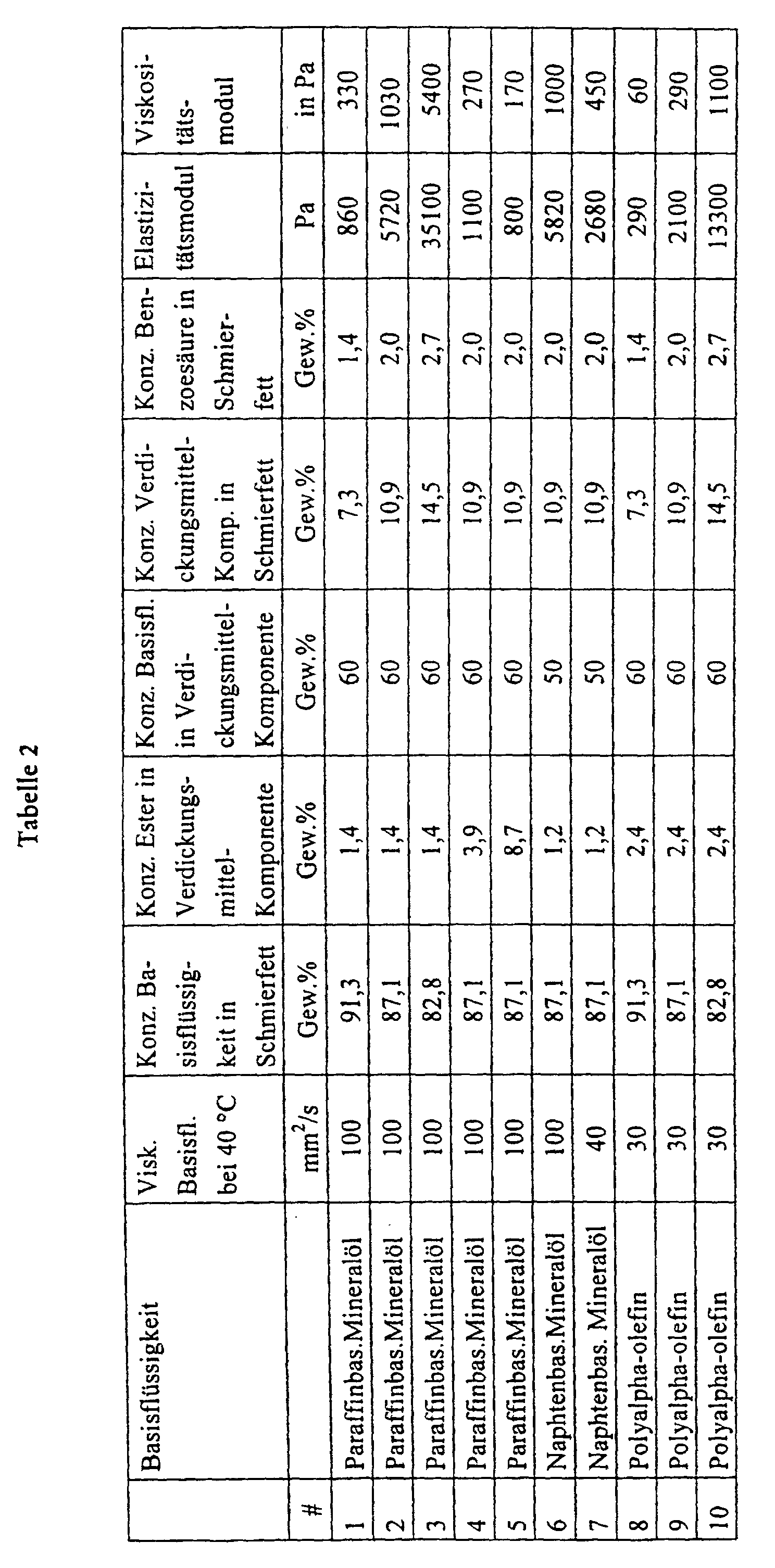
- Example 4 has high and Example 5 (Comparative Example) too high ester concentrations.
- the measured values are based on a thickener component with an Al content of 4.1% by weight.
- the solvent of the Al-containing thickener component is identical to the base oil,
- the starting product is aluminum isopropoxide.
- As aliphatic monocarboxylic acid is a technical stearic acid mixture used.
- the starting materials are 1.466 mol (299.5 g) DOROX® D 10 (aluminum triisopropylate, liquid) and mineral oil Sera® 100 (500.0 g) (about 50% by weight of paraffinic base oil) and with stirring to 97 ° C (bottom temperature) heated.
- the stearic acid was heated to 75-80 ° C to give the to ensure liquid state of aggregation even during feed-in.
- the liquid Stearic acid (bp 209 mg KOH / g) 1.466 mol (393.5 g) and the mixture of water and 2-propanol 1.372 mol (24.7 g) of water and 2-propanol (123.6 g) were within of 2.5 hours evenly and temporally parallel dosed via separate dip tubes and liberated 2-propanol was taken off overhead (head temperature max 85 ° C).
- the sump temperature is ramped up to 127 ° C within 2.5 h. At a bottom temperature of 127 ° C, the pressure within 20 min to 200 hPa lowered and residues of the low boiler 2-propanol withdrawn.
- Substance parameters of the thickener component are given in Table 3. Concentration range% by weight High-pressure additives 2 - 10 Dibenzyl disulfide with chlorinated paraffins, sulfurized fatty oils or terpenes Additives to increase film strength 0.1 - 5 Diisopropyl or dilauryl hydrogen phosphite Antirust additives 0,5 - 5 Sodium petroleum sulfonates or barium dinonylnaphthalenesulfonate Copper deactivators 0.05 - 1 2-mercaptobenzothiazole Viscosity index improvers 0.1 - 1 polymethacrylates Entschlämmer 0.001 silicone oils Active ingredients for producing stringy properties 0,5 - 2 polymers Anti-wear agents 0.1-2 Tricresyl phosphate, zinc dialkyl dithiophosphates Active ingredients for producing water-repellent properties 0.1 - 2 Oil or other vegetable fatty acids Odor maskers 0.05 - 0.5 perfumes Corrosion protection additives 0,5 - 3 Non
Landscapes
- Chemical & Material Sciences (AREA)
- Organic Chemistry (AREA)
- Oil, Petroleum & Natural Gas (AREA)
- Chemical Kinetics & Catalysis (AREA)
- General Chemical & Material Sciences (AREA)
- Engineering & Computer Science (AREA)
- Health & Medical Sciences (AREA)
- Emergency Medicine (AREA)
- Lubricants (AREA)
Description

| Konzentrations- bereich Gew.-% | ||
| Hochdruck-Additive | 2 - 10 | Dibenzyldisulfid mit chlorierten Paraffinen, geschwefelte Fettöle oder Terpene |
| Additive zur Erhöhung der Filmfestigkeit | 0,1 - 5 | Diisopropyl- oder Dilaurylhydrogenphosphit |
| Rostschutzadditive | 0,5 - 5 | Natrium-Petroleumsulfonate oder Barium-Dinonylnaphthalinsulfonat |
| Kupfer ― Desaktivatoren | 0,05 - 1 | 2-Mercaptobenzthiazol |
| Viskositätsindex-Verbesserer | 0,1 - 1 | Polymethacrylate |
| Entschlämmer | 0,001 | Siliconöle |
| Wirkstoffe zur Erzeugung fadenziehender Eigenschaften | 0,5 - 2 | Polymere |
| Anti-Verschleiß-Wirkstoffe | 0,1-2 | Trikresylphosphat, Zink - Dialkyldithiophosphate |
| Wirkstoffe zur Erzeugung wasserabstoßender Eigenschaften | 0,1 - 2 | Öl- oder andere pflanzliche Fettsäuren |
| Geruchsüberdecker | 0,05 - 0,5 | Parfüme |
| Korrosionsschutz Additive | 0,5 - 3 | Nonylphenoxyessig, Ethylendiaminsulfonat, Bleidinonylnaphthylsulfonat, Bariumsulfonate, Blei- und Zinknaphthenate |
| Oxidationsinhibitoren | Diphenylamin, Phenyl-α-naphthylamin, Dioctyldiphenylamin, Phenothiazin, Polymeres Trimethyldihydrochinolin, 2,6-Di-tert-butyl-4-methylphenol, Bleidiamyldithiocarbamat, Dilaurylthiodipropionat-1/Citronensäure, Ascorbinsäue |
| Methode | |||
| Al-Gehalt | 4,1 | % | M635 |
| Trübzahl | 20 | FNU | DIN 38404 T2 |
| Viskosität (25°C) | 1500 | mPa s | DIN 53015 |
| Viskosität (100 °C) | 100 | mPa s | Rotation (200 s-1) |
| Trübzahl | 20 | FNU | DIN 38404 T2 |
| Pourpoint | 16 | °C | DIN ISO 3016 |
| Konz. 2-Propanol | 3,5 | % | |
| Dichte (20°C) | 0,94 | g /cm3 | DIN 51757 |
| Dichte (40°C) | 0,93 | g /cm3 | DIN 51757 |
| Dichte (50°C) | 0,93 | g /cm3 | DIN 51757 |
| Flammpunkt | 190 | °C | DIN 51758 |
| Farbzahl | 10 | DIN 6162 |
Claims (8)
- Verdickungsmittel-Komponente enthaltend:jeweils bezogen auf die Summe der Komponenten (A) und (B).(A) 99,99 bis 94 Gew.% einer Aluminiumverbindung, die herstellbar ist durch etwa equimolare Umsetzung einer hydrolisierbaren Aluminiumverbindung mit einer oder mehreren aliphatischen Monocarbonsäuren oder deren Derivaten, in Gegenwart von Wasser und ggf. einem C1- bis C40- Alkohol, unter Ausbildung einer oder mehrerer Aluminium-Verbindungen, die im Mittel pro Aluminium-Atom eine Aluminium-Carboxylat-Bindung und des weiteren eine oder mehrere Aluminium-Hydroxy- , Aluminium-Alkoholat- oder Aluminium-Sauerstoff-Aluminium-Bindungen aufweisen, und(B) 0,01 bis 6 Gew.% einer Esterverbindung mit 6 bis 60 Kohlenstoffatomen,
- Verdickungsmittel-Komponente gemäß Anspruch 1, dadurch gekennzeichnet, daß die hydrolisierbare Aluminiumverbindung eine Aluminiumalkoholat- oder Aluminium-oxo-alkoholat-Verbindung ist.
- Verdickungsmittel-Komponente gemäß einem der vorhergehenden Ansprüche, dadurch gekennzeichnet, daß die aliphatischen Monocarbonsäure eine aliphatische verzweigte oder unverzweigte Monocarbonsäure des Typs R1-COOH ist, worin R1 ein C10- bis C40- Rest, vorzugsweise ein C14- bis C24- Rest, oder ein Derivat dieser Monocarbonsäure ist.
- Verdickungsmittel-Komponente gemäß einem der vorhergehenden Ansprüche, dadurch gekennzeichnet, daß bei der Herstellung der Aluminiumverbindung durch Umsetzung einer hydrolisierbaren Aluminiumverbindung mit einer oder mehreren Carbonsäuren oder Carbonsäure-Derivaten eine Temperatur von 145°C, vorzugsweise 135°C, nicht überschritten wird.
- Verdickungsmittel-Komponente gemäß Anspruch 4, dadurch gekennzeichnet, daß bei der Umsetzung ein in einem Zeitintervall von mindestens 90 min über zumindest 20°C Temperaturunterschied ansteigendes Temperaturprofil eingehalten wird.
- Aluminiumkomplex-Schmierfett enthaltendeine mittels der esterarmen Verdickungsmittel-Komponente gemäß einem der vorhergehenden Ansprüche hergestellte Verbindung bzw. Verbindungsgemisch, herstellbar durch Umsetzung der VerdickunQsmittel-Komponente mit zumindest einer aromatischen und/oder cyclischen Monocarbonsäure des Typs R2-COOH. worin R2 ein C6- bis C 16- Rest ist. und/oder deren Derivat, undweiterhin eine Basisflüssigkeit, wobei die Basisflüssigkeit eine Kohlenwasserstoff-Verbindung und/oder ein Syntheseöl ist und der Gesamtzusammensetzung zu 30 bis 98 Gew.% , vorzugsweise zu 60 bis 95 Gew.%, zugesetzt ist.
- Aluminiumkomplex-Schmierfett gemäß Anspruch 6, dadurch gekennzeichnet, daß die Basisflüssigkeit eine Viskosität von 20 bis 200 mm2/s bei 40 °C gemessen nach DIN 51562 aufweist.
- Aluminiumkomplex-Schmierfett gemäß Anspruch 6, dadurch gekennzeichnet, daß die Basisflüssigkeit ein Mineraloel mit einem Siedepunkt von größer 250 °C ist .
Applications Claiming Priority (3)
| Application Number | Priority Date | Filing Date | Title |
|---|---|---|---|
| DE10011333A DE10011333A1 (de) | 2000-03-10 | 2000-03-10 | Verdickungsmittel-Komponente und Aluminiumkomplex-Schmierfett |
| DE10011333 | 2000-03-10 | ||
| PCT/DE2001/000829 WO2001066675A2 (de) | 2000-03-10 | 2001-03-06 | Verdickungsmittel-komponente und aluminiumkomplex-schmierfett |
Publications (2)
| Publication Number | Publication Date |
|---|---|
| EP1268718A2 EP1268718A2 (de) | 2003-01-02 |
| EP1268718B1 true EP1268718B1 (de) | 2005-05-11 |
Family
ID=7634001
Family Applications (1)
| Application Number | Title | Priority Date | Filing Date |
|---|---|---|---|
| EP01929230A Expired - Lifetime EP1268718B1 (de) | 2000-03-10 | 2001-03-06 | Verdickungsmittel-komponente und aluminiumkomplex-schmierfett |
Country Status (4)
| Country | Link |
|---|---|
| US (2) | US20040097381A1 (de) |
| EP (1) | EP1268718B1 (de) |
| DE (2) | DE10011333A1 (de) |
| WO (1) | WO2001066675A2 (de) |
Families Citing this family (2)
| Publication number | Priority date | Publication date | Assignee | Title |
|---|---|---|---|---|
| US7288506B2 (en) | 2002-11-27 | 2007-10-30 | Baker Hughes Incorporated | Aluminum carboxylate drag reducers for hydrocarbon emulsions |
| CN100540640C (zh) * | 2006-01-25 | 2009-09-16 | 李政兆 | 一种柴油车润滑油组合物 |
Family Cites Families (10)
| Publication number | Priority date | Publication date | Assignee | Title |
|---|---|---|---|---|
| US2768138A (en) * | 1952-10-18 | 1956-10-23 | California Research Corp | Complex basic aluminum soap greases |
| US3345291A (en) * | 1963-12-17 | 1967-10-03 | Chevron Res | Production of complex basic aluminum soap greases |
| US3591505A (en) * | 1968-06-18 | 1971-07-06 | Sun Oil Co | Aluminum complex soap greases |
| US3620975A (en) * | 1968-07-03 | 1971-11-16 | Sun Oil Co | Mixed complex aluminum soap-clay grease composition |
| US3791972A (en) * | 1972-01-13 | 1974-02-12 | Southwest Petro Chem Inc | Lubricating grease |
| EP0029589B1 (de) * | 1979-11-23 | 1984-07-04 | Chattem, Inc. | Verfahren zur Herstellung von Fettzusammensetzungen |
| HU201343B (en) * | 1989-05-03 | 1990-10-28 | Magyar Asvanyolaj Es Foeldgaz | Process for producing aluminium-oxide-carboxylate polymeres containing not more than 2 mass % of esters |
| GB2269169A (en) * | 1992-07-24 | 1994-02-02 | Rhone Poulenc Chemicals | Aluminium complexes useful for cross-linking coating compositions |
| US5358664A (en) * | 1992-10-15 | 1994-10-25 | Caschem, Inc. | Gelled oil compositions |
| EP0625564B1 (de) * | 1993-05-18 | 1999-01-13 | INDIAN OIL CORPORATION Ltd. | Schmieröl |
-
2000
- 2000-03-10 DE DE10011333A patent/DE10011333A1/de not_active Withdrawn
-
2001
- 2001-03-06 WO PCT/DE2001/000829 patent/WO2001066675A2/de not_active Ceased
- 2001-03-06 DE DE50106204T patent/DE50106204D1/de not_active Expired - Lifetime
- 2001-03-06 US US10/221,336 patent/US20040097381A1/en not_active Abandoned
- 2001-03-06 EP EP01929230A patent/EP1268718B1/de not_active Expired - Lifetime
-
2005
- 2005-08-30 US US11/214,649 patent/US20060019842A1/en not_active Abandoned
Also Published As
| Publication number | Publication date |
|---|---|
| WO2001066675A3 (de) | 2002-06-27 |
| EP1268718A2 (de) | 2003-01-02 |
| US20040097381A1 (en) | 2004-05-20 |
| DE50106204D1 (de) | 2005-06-16 |
| WO2001066675A2 (de) | 2001-09-13 |
| DE10011333A1 (de) | 2001-09-20 |
| US20060019842A1 (en) | 2006-01-26 |
Similar Documents
| Publication | Publication Date | Title |
|---|---|---|
| DE69634330T2 (de) | VERWENDUNG VON EINEM POLYOLESTERZUSAMMENSETZUNGEN MIT NICHT-UMGEZETZTEN HYDROXYLGRUPPEN ENTHALTENDEN SCHMIERMITTEL ALS kURBELGEHÄUSESCHMIERMITTEL | |
| DE69019146T2 (de) | Anwendung von Schmierölzusammensetzung für Fluorkohlenwasserstoff-Kältemittel. | |
| DE69421032T2 (de) | Schmiermittel für kühlschrank und dieses enthaltende schmiermittelzusammensetzung | |
| DE2713440A1 (de) | Carbonsaeureester, deren herstellung und verwendung als basisschmieroel | |
| EP3601209B1 (de) | Neue esterverbindungen, verfahren zu ihrer herstellung sowie ihre verwendung | |
| EP4073213B1 (de) | Verwendung einer schmierfettzusammensetzung mit hoher oberer gebrauchstemperatur | |
| DE2356269A1 (de) | Schmieroelmischung | |
| DE102007061422A1 (de) | Schmierölzusammensetzung für verbesserte Oxidations-,Viskositätsanstiegs-,Ölverbrauchs- und Kolbenablagerungskontrolle | |
| DE1197869B (de) | Verfahren zur Herstellung von als Schmiermittel dienenden Estern der Pivalinsaeure | |
| DE69010486T2 (de) | Verwendung von schmieröl auf polyesterbasis als schmieröl für kühlsysteme. | |
| DE1068844B (de) | Schmiermittel auf Schmierölibasis und Verfahren zu dessen Herstellung | |
| DE2806133C2 (de) | Verwendung von Polyoxyalkylenglykoldiethern für die Bereitung von Getriebeölen | |
| WO2001066675A2 (de) | Verdickungsmittel-komponente und aluminiumkomplex-schmierfett | |
| DE1056314B (de) | Hochdruckschmiermittel fuer Turbinenstrahltriebwerke und Turbinenpropellermaschinen von Flugzeugen | |
| DE2437842A1 (de) | Schmiermittelzusatzstoffe | |
| DE2512887A1 (de) | Schmierfettgemisch und verfahren zu seiner herstellung | |
| US3184408A (en) | High temperature stabilizing lubricant additive | |
| DE2235908C3 (de) | Schmiermittel | |
| DE10115829A1 (de) | Oxidationsstabiles Hydrauliköl | |
| DE69512937T2 (de) | Schwefel enthaltende karbonatreaktionsprodukte als schmierölverschleissschutzadditive | |
| DE942524C (de) | Zusaetze zu Schmiermitteln | |
| DE68923968T2 (de) | Als antioxidations-schmiermittelzusatz verwendbare dihydroxyaryl-hydroxyaliphatische borate und diese enthaltende schmiermittel. | |
| DE961383C (de) | Synthetische Schmiermittel | |
| DE2119448C3 (de) | Stabilisierungsadditiv für Schmieröle und Schmierfette | |
| WO2025011910A1 (de) | Phthalimidverbindungen als basisöl für schmierstoffzusammensetzungen |
Legal Events
| Date | Code | Title | Description |
|---|---|---|---|
| PUAI | Public reference made under article 153(3) epc to a published international application that has entered the european phase |
Free format text: ORIGINAL CODE: 0009012 |
|
| 17P | Request for examination filed |
Effective date: 20020816 |
|
| AK | Designated contracting states |
Kind code of ref document: A2 Designated state(s): AT BE CH CY DE DK ES FI FR GB GR IE IT LI LU MC NL PT SE TR |
|
| 17Q | First examination report despatched |
Effective date: 20030312 |
|
| RBV | Designated contracting states (corrected) |
Designated state(s): AT BE CH CY DE FR GB IT LI |
|
| GRAP | Despatch of communication of intention to grant a patent |
Free format text: ORIGINAL CODE: EPIDOSNIGR1 |
|
| RBV | Designated contracting states (corrected) |
Designated state(s): DE FR GB IT |
|
| GRAS | Grant fee paid |
Free format text: ORIGINAL CODE: EPIDOSNIGR3 |
|
| GRAA | (expected) grant |
Free format text: ORIGINAL CODE: 0009210 |
|
| AK | Designated contracting states |
Kind code of ref document: B1 Designated state(s): DE FR GB IT |
|
| REG | Reference to a national code |
Ref country code: GB Ref legal event code: FG4D Free format text: NOT ENGLISH |
|
| REG | Reference to a national code |
Ref country code: IE Ref legal event code: FG4D Free format text: LANGUAGE OF EP DOCUMENT: GERMAN |
|
| REF | Corresponds to: |
Ref document number: 50106204 Country of ref document: DE Date of ref document: 20050616 Kind code of ref document: P |
|
| GBT | Gb: translation of ep patent filed (gb section 77(6)(a)/1977) |
Effective date: 20050711 |
|
| ET | Fr: translation filed | ||
| PLBE | No opposition filed within time limit |
Free format text: ORIGINAL CODE: 0009261 |
|
| STAA | Information on the status of an ep patent application or granted ep patent |
Free format text: STATUS: NO OPPOSITION FILED WITHIN TIME LIMIT |
|
| 26N | No opposition filed |
Effective date: 20060214 |
|
| REG | Reference to a national code |
Ref country code: FR Ref legal event code: TP |
|
| REG | Reference to a national code |
Ref country code: GB Ref legal event code: 732E |
|
| REG | Reference to a national code |
Ref country code: FR Ref legal event code: PLFP Year of fee payment: 15 |
|
| REG | Reference to a national code |
Ref country code: GB Ref legal event code: 732E Free format text: REGISTERED BETWEEN 20150813 AND 20150819 |
|
| REG | Reference to a national code |
Ref country code: DE Ref legal event code: R082 Ref document number: 50106204 Country of ref document: DE Representative=s name: MUELLER SCHUPFNER & PARTNER PATENT- UND RECHTS, DE Ref country code: DE Ref legal event code: R081 Ref document number: 50106204 Country of ref document: DE Owner name: INEOS SOLVENTS GERMANY GMBH, DE Free format text: FORMER OWNER: SASOL SOLVENTS GERMANY GMBH, 20537 HAMBURG, DE |
|
| REG | Reference to a national code |
Ref country code: FR Ref legal event code: TP Owner name: INEOS SOLVENTS GERMANY GMBH, DE Effective date: 20151203 |
|
| REG | Reference to a national code |
Ref country code: FR Ref legal event code: PLFP Year of fee payment: 16 |
|
| REG | Reference to a national code |
Ref country code: FR Ref legal event code: PLFP Year of fee payment: 17 |
|
| REG | Reference to a national code |
Ref country code: FR Ref legal event code: PLFP Year of fee payment: 18 |
|
| PGFP | Annual fee paid to national office [announced via postgrant information from national office to epo] |
Ref country code: GB Payment date: 20200327 Year of fee payment: 20 Ref country code: IT Payment date: 20200323 Year of fee payment: 20 Ref country code: DE Payment date: 20200327 Year of fee payment: 20 |
|
| PGFP | Annual fee paid to national office [announced via postgrant information from national office to epo] |
Ref country code: FR Payment date: 20200325 Year of fee payment: 20 |
|
| REG | Reference to a national code |
Ref country code: DE Ref legal event code: R071 Ref document number: 50106204 Country of ref document: DE |
|
| REG | Reference to a national code |
Ref country code: GB Ref legal event code: PE20 Expiry date: 20210305 |
|
| PG25 | Lapsed in a contracting state [announced via postgrant information from national office to epo] |
Ref country code: GB Free format text: LAPSE BECAUSE OF EXPIRATION OF PROTECTION Effective date: 20210305 |