EP1266093B2 - Auftragsvorrichtung und verfahren - Google Patents
Auftragsvorrichtung und verfahren Download PDFInfo
- Publication number
- EP1266093B2 EP1266093B2 EP01913875A EP01913875A EP1266093B2 EP 1266093 B2 EP1266093 B2 EP 1266093B2 EP 01913875 A EP01913875 A EP 01913875A EP 01913875 A EP01913875 A EP 01913875A EP 1266093 B2 EP1266093 B2 EP 1266093B2
- Authority
- EP
- European Patent Office
- Prior art keywords
- substrate
- application
- application medium
- applicator unit
- curtain
- Prior art date
- Legal status (The legal status is an assumption and is not a legal conclusion. Google has not performed a legal analysis and makes no representation as to the accuracy of the status listed.)
- Expired - Lifetime
Links
Images
Classifications
-
- D—TEXTILES; PAPER
- D21—PAPER-MAKING; PRODUCTION OF CELLULOSE
- D21H—PULP COMPOSITIONS; PREPARATION THEREOF NOT COVERED BY SUBCLASSES D21C OR D21D; IMPREGNATING OR COATING OF PAPER; TREATMENT OF FINISHED PAPER NOT COVERED BY CLASS B31 OR SUBCLASS D21G; PAPER NOT OTHERWISE PROVIDED FOR
- D21H23/00—Processes or apparatus for adding material to the pulp or to the paper
- D21H23/02—Processes or apparatus for adding material to the pulp or to the paper characterised by the manner in which substances are added
- D21H23/22—Addition to the formed paper
- D21H23/46—Pouring or allowing the fluid to flow in a continuous stream on to the surface, the entire stream being carried away by the paper
- D21H23/48—Curtain coaters
-
- B—PERFORMING OPERATIONS; TRANSPORTING
- B05—SPRAYING OR ATOMISING IN GENERAL; APPLYING FLUENT MATERIALS TO SURFACES, IN GENERAL
- B05C—APPARATUS FOR APPLYING FLUENT MATERIALS TO SURFACES, IN GENERAL
- B05C5/00—Apparatus in which liquid or other fluent material is projected, poured or allowed to flow on to the surface of the work
- B05C5/005—Curtain coaters
Definitions
- the invention relates to a device for one-sided or two-sided application of liquid or pasty application medium on a running surface, comprising a spaced from the substrate applicator, which emits the application medium in the free application medium beam to the ground, the substrate for direct application to the surface a material web, in particular of paper or cardboard, and in the case of indirect application, the surface of a transfer element, preferably a transfer roller, which then transfers the application medium to the surface of the material web, according to the preambles of claims 1, 5 and 27.
- the invention relates to a Curtain applicator, ie an applicator device in which the applicator dispenses the application medium to the substrate as a curtain or veil that essentially moves as a result of gravity.
- the application medium is delivered to the substrate in the form of a coating medium curtain, which moves substantially by gravity from the commissioned work to the ground.
- a curtain applicator also known in the art as "curtain coating”
- the curtain applicator is located at a predetermined distance from the ground, among other things, has the advantage that it is exposed to a lower risk of damage, for example, in a web break.
- Curtain coats differ fundamentally from other "non-contact" coateries, such as free-jet jet coaters, in which the movement of the coating medium from the applicator to the substrate is primarily due to the ejection pulse from the applicator nozzle, since the shape of the curtain emerging from the dispenser nozzle is merely that of the applicator Interplay between the surface tension of the application medium and gravity is exposed.
- the surface tension tries to contract the curtain, which has a very large surface or circumferential length in relation to its volume or its cross-sectional area, so as to reduce its surface area. This effect is resisted only by gravity, which seeks to stretch the curtain. It is therefore easy to see that it is all the more difficult to obtain a uniform over the entire working width coating medium curtain, the larger this working width.
- the coating of webs by means of a curtain applicator, which feeds the web to the application medium as a substantially gravitationally moving application medium curtain or fog, has long been known from the coating of photographic films, Tonbändem and the like.
- the material webs in these applications have a significantly smaller width than is the case in modern paper and paperboard production lines where web widths of more than 10 m are required.
- Forming a uniformly thick application medium curtain over this width and being able to hold it in a stable manner is a task in which it is far from obvious to expect suggestions for a functional solution from the comparatively easy-to-control known narrow application medium curtains.
- the webs move in modern paper and paperboard production lines at speeds of up to 3000 m / min, which is many times the speed at which the known narrow webs move, and also a further high load on the Stability of the application medium curtain.
- a device of the type mentioned is known from DE 197 16 466 A1.
- This document shows a device for applying dispersions to a material web by a so-called curtain coating application method.
- application medium curtain depending on a commissioned work to the web extending edge guide element are arranged, which may be wetted depending on the embodiment of the application medium or not.
- wetted edge guide elements the application medium curtain is stretched at its lateral edges by adhesive forces in the web direction.
- these are designed as electrodes which generate an electric field which acts on the lateral edges of the application medium curtain such that it is stretched in the web direction.
- a disadvantage of this prior art is that the application medium curtain can be influenced by said device only at its lateral edges. This can lead to unsatisfactory order results, especially in the working width center, especially for large working widths.
- WO 97/03009 deals with the problem of drying material webs after the application of media, namely printing inks, especially in low-web offset and flexographic printing. It proposes ionizing the gas molecules at the surface of the web by means of a corona discharge and accelerating them towards an electrode in order to increase the drying efficiency by the gas exchange at the web surface which accompanies this "ion wind".
- DE 1 98 03 240 A1 discloses a curtain coating application device which comprises a sensor device for detecting the amount of coating applied to the material web application medium layer and a control device for controlling the order quantity.
- the order quantity is regulated via a change in the gap width of the application medium discharge gap at the commissioned unit.
- EP 0 937 815 A1 shows an apparatus for applying a liquid or pasty application medium by a application medium jet, in which the application area can be increased or reduced by aperture elements which moves from the lateral edges of the application area in the material web transverse direction via application medium nozzles can be that the emanating from this order medium beam is intercepted by the aperture and does not reach the web.
- the curtain coating process coating speeds at high curtain flow rates are limited by the formation of a so-called metastable region.
- This metastable region is illustrated in column 3, lines 27-33 of US-A-5,609,923, in that at moderate to high flow rates in the application medium curtain, the coating speed at which air entrapment begins is higher than the rate at which it expands dissolves.
- the coating is metastable to any perturbation that can lead to air entrapment. For practical purposes, therefore, these intermediate coating speeds can not be used.
- WO-A-89/05477 solves the identical problem of entrapment of air bubbles by substantially identical means, namely the electrostatic charging of the running underground, and tries to give a scientific explanation for this: according to column 6, line 30 to page 7 , Line 1, of WO-A-89/05477, contributes a high level of electrostatic charging of the subsurface to a substantially attracting force acting in the appropriate direction in the area where the curtain impinges on the subsurface, thus allowing an increase in the running speed of the substrate, without affecting the coating success.
- column US-A-5,122,386 states phenomenologically in column 3, lines 38-45 that by electrostatic charging of the running underground - here recommended immediately before the impact of the curtain on the ground - a running speed of the ground of up to 330 m / min is possible without air entrapment.
- the document US-A-5,290,600 relates essentially to a device for the attachment of road markings.
- this document does not relate to any apparatus for applying the application medium in the curtain-coating process, in which the application medium curtain moves substantially gravity-driven from the commissioned work to the ground.
- the electric field is the driving force which provides for movement of the application medium from the commissioned work to the ground.
- the electric field can at best be supported by gravity.
- the electric field assisting the gravitational force in the acceleration of the application medium jet is generated in a simple manner in that the applicator unit is held at a first predetermined electrical potential, while the substrate is at a second predetermined electrical potential, for example ground or ground potential. can be held. In this case, no additional electrodes need to be provided, but it is sufficient to provide the existing devices with electrical connections.
- the application medium jet moves in the applicator device according to the invention not only under the influence of gravity from the discharge nozzle to the ground. Rather, this movement is assisted by an additional force which is exerted by the field generation device on the application medium beam and seeks to stretch the beam on its way from the delivery nozzle to the ground (pre-stretch). Therefore, in the case of "curtain coating applicators", the stability of the jet can be increased either with the same distance between the dispensing nozzle and the substrate, or the distance between the dispensing nozzle and the substrate can be selected larger for a given desired jet stability.
- the latter is advantageous, considering that the total extension of the coating medium from a jet thickness determined by the width of the dispensing nozzle to the thickness of the layer of coating medium ultimately applied to the substrate is the product of the pre-stretching of the jet on the path described above composed of the dispensing nozzle to the ground and the Needlesstrekkung, which stems from the difference between the speed of the beam immediately before hitting the ground and the running speed of the ground upon contact of the application medium with the ground.
- the Actstrekkung composed as evenly as possible of pre-stretching and contact stretching.
- an electrode assembly which is maintained at a predetermined electrical electrode assembly potential may be provided on the upstream side of the applicator and in the vicinity thereof. "In addition” means that both the commissioned work and the electrode arrangement are kept at a predetermined, different from the ground potential.
- the object of the present invention is achieved according to a second aspect of the invention by the just described "alternative" provision of an electrode arrangement, namely by an application device having the features of claim 5.
- a force is exerted by the electric field on the application medium beam, which has a component orthogonal to its direction of movement, i. E. the electrode assembly attracts the application medium beam.
- This force component also helps to stabilize the application medium jet against the influence of the entrained air boundary layer on the surface of the substrate.
- the electrode arrangement may comprise at least one flat electrode.
- the flat electrode may have a plurality of protrusions or needle points on its side facing the ground.
- the electrode arrangement may comprise a plurality of individual electrodes arranged in the transverse direction of the substrate, preferably needle electrodes.
- a device for generating an electric field be provided downstream of the impact position of the application medium on the substrate.
- This electric field exerts on the application medium applied to the substrate a force directed towards the ground, which leads to a displacement of the excess application medium at locations where too much application medium has been applied.
- the further field-generating device has a further electrode arrangement adjacent to the substrate, which is preferably held at a further predetermined electrical potential.
- Such a force, which is applied to the substrate and applied to the substrate, can in principle also result from residual charging of the application medium applied to the substrate as a consequence of discharges induced by the first electrode arrangement.
- the predetermined electrical potential (s) other than the ground potential may have a value of between 5 kV and about 60 kV, preferably about 30 kV.
- the substrate is preferably kept at ground potential.
- a counter-element preferably a counter-roller, which supports the material web in the area of the applicator when directly applied or on the surface of which the applicator applies the application medium in the case of indirect application, is in contact with an electrode in order to apply it to hold the second predetermined electrical potential.
- the electrode is in electrically conductive contact with a bearing shaft of the counter-roller.
- another alternative is to hold the material web at the second predetermined electrical potential, that is to say preferably the ground potential, by means of an electrode designed, for example, as a web-guiding element.
- the electrode arrangement in the running direction of the ground is arranged upstream of a device for weakening the entrained air boundary layer.
- the air boundary layer weakening device may comprise a suction device with the aid of which the air boundary layer can be actively removed from the running underground.
- a drag scraper which is in sliding contact with the substrate may be provided.
- This drag scraper seals the suction towards the environment and hinders the further movement of the air boundary layer towards the commissioned work.
- entrained in the air boundary layer air is dammed, which at least partially destroys the laminar nature of the flow of the air boundary layer. This facilitates the suction and increases the suction efficiency of the suction device.
- the air boundary layer can be weakened by the inventively designed suction particularly effective, if not completely removed from the ground.
- the drag scraper may be formed as a flexible film, preferably made of plastic, sheet metal or a composite material.
- the flexible film nestles under the suction of the suction device against the ground, which on the one hand improves the seal and on the other prevents the construction of a new air boundary layer.
- the drag scraper Made of sheet metal so preferably stainless steel sheet is used with a thickness of at most 0.1 mm.
- drag scrapers of composite material with a surface coating made of Teflon have proven to be advantageous.
- the composite ensures the required temperature resistance and flexibility, while the Teflon surface coating ensures low friction between the drag scraper and the running surface.
- the drag scraper can be curved in the direction of rotation, which facilitates the elastic evasion and further reduces the friction with the ground.
- a further electrode arrangement be provided in the region of the suction device, preferably between the downstream end of the suction device and the drag scraper.
- the entrained air boundary layer can be influenced and in particular weakened.
- the further electrode arrangement comprises a plurality of individual electrodes arranged in the transverse direction of the substrate, preferably needle electrodes, or if the further electrode arrangement comprises at least one flat electrode which has a plurality of projections or needle tips on its side facing towards the ground there are also discharge processes between the tips of the further electrode arrangement and the substrate.
- the further electrode arrangement have a distance of between about 2 mm and about 30 mm from the substrate.
- the further electrode arrangement can in principle be connected to an external power supply. However, it is also possible, and structurally even easier to realize, when the electrical potential of the further electrode arrangement is suspended ("floating potential"). In this case, as a result of the discharges emanating from the first electrode arrangement, the further electrode arrangement is charged and thus likewise brought to a potential which differs from the ground potential. To reduce the capacity of the further electrode arrangement as well as for safety reasons, it is proposed that the further electrode arrangement on the suction device is arranged so as to be electrically insulated from it.
- the surface tension of the application medium attempts to reduce the surface of the application medium jet, which has an effect, in particular, in the region of the side edges of the application medium jet and results in jet narrowing.
- This beam narrowing can be prevented by the provision of edge guiding elements, since in this case additional adhesion forces act between the application medium and the surface of the edge guiding elements, which resist the tendency of the surface tension of the application medium to be constricted.
- the object of the invention is therefore achieved by a device having the features of claim 27.
- the edge guide elements For reasons of good wetting of the edge guide elements, they have a structured surface.
- the surface of at least one edge guide element has a toothed surface, for example in the form of an external thread or else an internal thread.
- the adhesion between the edge guide elements and the application medium can be improved by selecting the surface properties of at least one edge guide element such that the wetting or contact angle dependent on the properties of the application medium and the surface of the edge guide elements is less than 90 °.
- the edge guide elements may be made of glass or metal, for example, since these materials have a sufficiently high surface tension. For metals, however, it should be noted that some metals tend to adsorb water vapor from the surrounding atmosphere, lowering their surface tension to the value of the adsorbed water layer.
- At least one edge guide element is displaceably arranged in the transverse direction of the substrate and / or that the angle which an edge guide element encloses with the vertical is adjustable.
- the angular adjustability may include pivoting the free ends of the edge guide elements in the transverse direction and / or in the longitudinal direction.
- the effect of the edge guide elements can also be improved by the provision of an electric field, for example by providing an electrode in the vicinity of at least one of the edge guide elements, preferably substantially parallel thereto, which is held at a predetermined electrical potential.
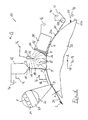
- an applicator device is generally designated 10. It comprises a curtain applicator 12 with a dispensing nozzle 14, is discharged from the application medium 16 in the form of a curtain 18 to a moving in the direction L substrate U.
- the substrate U is in the illustrated embodiment, the surface 20a of a web 20, which wraps around the peripheral surfaces of a support roller 22 in the field of applicator 12 partially.
- the application medium 16 On its way from the dispensing nozzle 14 to the substrate U, the application medium 16 is accelerated. This leads to a reduction in the thickness of the curtain 18 from the value D in the region of the dispensing nozzle 14 to the value d immediately before the impact position P on the substrate U (pre-stretch). Due to the difference between the speed of the application medium curtain 18 immediately before the impact position P and the running speed of the substrate U, the application medium 16 is stretched again when hitting the substrate U, so that the application layer 24 applied to the substrate U finally has the thickness s (Contact stretching). The total extension of the application medium 16 results as a product of the stretch factors of pre-stretch and contact stretch.
- the application medium 16 when hitting the substrate U is usually stretched more than on the way from the discharge nozzle 14 to the substrate U, since with regard to a stable curtain 18 as possible, the drop distance between the discharge nozzle 14 and substrate U not arbitrarily large can. Excessive contact stretching, however, adversely affects the uniformity of the coating layer 24 applied to the substrate U.
- the applicator 10 now offers a way by which you can either increase the Vorstreckung of the curtain 18 at the same drop height between the dispensing nozzle 14 and substrate U and how to reduce the drop height between dispensing nozzle 14 and substrate U and thus the curtain at the same Vorstreckung 18 can stabilize.
- the application medium curtain 18 on its way from the discharge nozzle 14 to the substrate U is not left solely to gravity, but electrostatic forces are additionally exerted thereon.
- This strengthening of the curtain 18 stretching forces has, as the surface tension of the application medium 16, which seeks to contract the curtain 18 in order to reduce the surface thereof, constant, a higher stability of the application medium curtain 18 result.
- the electrostatic forces could be provided by applying a first predetermined electrical voltage V 1 to the housing of the applicator 12 and the support roller 22 on the
- an electrode arrangement 30 is provided in the running direction L immediately in front of the applicator 12, which may comprise, for example, a flat electrode extending in the transverse direction Q with a plurality of needle points, or a plurality of needle electrodes 32 arranged adjacent to one another in the transverse direction Q can.
- a predetermined voltage V 3 is applied, while the surrounding parts of the applicator 10, namely the applicator 12, the support roller 22 and provided with respect to the running direction L upstream of the electrode assembly 30 suction box 34 for weakening one of the web 20th entrained air boundary layer at ground or ground potential V E are held.
- a force is exerted on the curtain 18 due to the discharges E but also a force which has a component orthogonal to its falling movement direction. This force component also helps to stabilize the application medium curtain 18 from the influence of the air boundary layer G entrained on the surface of the material web 20.
- the suction box 34 serves to weaken the air boundary layer G.
- a drag scraper 36 is provided on the outlet side of this suction box 34 which is in sliding contact with the surface 20a of the material web 20 and seals the suction region of the suction box 34 on the outlet side.
- the drag scraper 36 may be made of, for example, a Teflon coated composite. by virtue of the use of a composite material, the Schlepp scraper 36 has sufficient temperature resistance and flexibility, and due to the surface coating with Teflon sufficient low friction.
- a further electrode arrangement 40 is now provided between this drag scraper 36 and the suction box 34, which is attached to the suction box 34 via an electrical insulation 42.
- the further electrode arrangement 40 can in turn be formed either by a flat electrode having a plurality of needle tips or a plurality of needle electrodes arranged adjacent to one another in the transverse direction Q.
- the electrode arrangement 40 can in principle be connected to an external power supply. In the illustrated embodiment, however, it is in a floating state in terms of its electrical potential, but is charged as a result of discharges E emanating from the electrode assembly 30 and thus also brought to a potential different from the ground potential.
- the charging of the electrode assembly 40 is sufficient to allow discharges e to occur between the tips of the electrode assembly 40 and the substrate U. These discharges e disturb the laminar flow of the air boundary layer G and at least partially convert it into a turbulent flow. This facilitates the extraction of the air boundary layer G from the surface 20a of the web and thus improves the effectiveness of the suction box 34.
- a further electrode arrangement in the form of a plate electrode 46 may be provided, which is held at a predetermined electrical potential V 4 . Between this plate electrode 46 and the support roller 22 held at ground potential, a relatively homogeneous electric field is formed which exerts a force directed toward the substrate U on the application medium.
- This force provides at locations of the web surface 20a, has been applied to the excessive application medium 16, to a displacement of the excess coating medium and thus to a homogenization of the coating layer 24. In extreme cases, it may even happen that previously uncovered areas of the web surface 20a as a result Force be covered for the first time with application medium 16.
- the above-mentioned force also improves the bond that the application medium 16 makes with the surface 20 a of the material web 20.
- the back-up roll 22 can be held in different ways at the ground potential V E.
- the rolling axis A can be connected to a sliding contact, as described for example in DE 197 33 333 A1.
- a sliding contact 50 which is in contact with the surface 22a of the roller 22 may also be provided.
- the material web 20 may also be held at ground potential V E via contacts formed, for example, by web guiding elements 48.
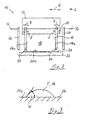
- FIG. 2 shows a view of the application device 10, viewed in the direction of travel L.
- the application medium curtain 18 can also be stabilized in the region of its side edges 18a.
- the surface tension of the application medium 16 seeking to contract the curtain 18 is mainly effective in the edge regions 18 of the curtain 18. It leads there to a lateral contraction of the curtain 18 and its thickening.
- Jardinsfeisten 54 are provided which are attached to the commissioned work 12 such that they catch the emerging from the dispensing nozzle 14 curtain 18 and on his fall path to just before the surface 20 a of the web 20 to lead.
- the effect of the edge strips 54 is based on the adhesion forces between the application medium 16 and the surface of the edge strips 54.
- the contact angle or wetting angle ⁇ of a droplet T of application medium 16 on the surface 54a of the edge strips 54 should be as low as possible Have value. This can be achieved, for example, by making the surface of the edge strips 54 of a material with high surface tension.
- the wetting between application medium 16 and edge strips 54 can be improved by a toothed surface structure of the edge strips 54. This can be achieved, for example, by using threaded rods as edge strips 54.
- a further possibility to be able to improve the adhesion of the application medium 16 to the edge strips 54 consists in providing electrode strips 56 substantially parallel to the edge strips 54 to which a predetermined electrical voltage V 5 is applied. As a result, similar to what has been described above for the arrangement according to FIG. 1, an attractive force is exerted on the application medium.
- edge strips 54 To the edge strips 54 to the respectively desired Working width, ie, to be able to adjust the particular width of the material web 20, these are arranged slidably on the commissioned work 12 in the transverse direction Q, which is indicated in Fig. 2 by the arrows q.
- the edge strips 54 can also be arranged pivotably on the applicator 12, namely about the longitudinal direction L and / or to the transverse direction Q substantially parallel axes, in Fig. 2 by the arrows I only a pivoting in the transverse direction Q, ie is indicated by an axis extending substantially parallel to the longitudinal direction L axis.
Landscapes
- Coating Apparatus (AREA)
- Paper (AREA)
- Seal Device For Vehicle (AREA)
- Preparation Of Compounds By Using Micro-Organisms (AREA)
- Electrical Discharge Machining, Electrochemical Machining, And Combined Machining (AREA)
- Electrostatic Spraying Apparatus (AREA)
Applications Claiming Priority (5)
| Application Number | Priority Date | Filing Date | Title |
|---|---|---|---|
| DE2000112256 DE10012256A1 (de) | 2000-03-14 | 2000-03-14 | Auftragsvorrichtung |
| DE10012347 | 2000-03-14 | ||
| DE10012256 | 2000-03-14 | ||
| DE2000112347 DE10012347A1 (de) | 2000-03-14 | 2000-03-14 | Vorhang- Auftragsvorrichtung |
| PCT/EP2001/002828 WO2001068982A1 (de) | 2000-03-14 | 2001-03-13 | Auftragsvorrichtung |
Publications (3)
| Publication Number | Publication Date |
|---|---|
| EP1266093A1 EP1266093A1 (de) | 2002-12-18 |
| EP1266093B1 EP1266093B1 (de) | 2004-05-19 |
| EP1266093B2 true EP1266093B2 (de) | 2007-02-07 |
Family
ID=26004823
Family Applications (1)
| Application Number | Title | Priority Date | Filing Date |
|---|---|---|---|
| EP01913875A Expired - Lifetime EP1266093B2 (de) | 2000-03-14 | 2001-03-13 | Auftragsvorrichtung und verfahren |
Country Status (6)
| Country | Link |
|---|---|
| EP (1) | EP1266093B2 (https=) |
| JP (1) | JP2003527237A (https=) |
| AT (1) | ATE267293T1 (https=) |
| CA (1) | CA2403004A1 (https=) |
| DE (1) | DE50102327D1 (https=) |
| WO (1) | WO2001068982A1 (https=) |
Families Citing this family (6)
| Publication number | Priority date | Publication date | Assignee | Title |
|---|---|---|---|---|
| US20050098285A1 (en) | 2002-06-24 | 2005-05-12 | Richard Aust | Machine for making/treating a sheet of material |
| DE10236908A1 (de) * | 2002-08-12 | 2004-02-26 | Voith Paper Patent Gmbh | Vorrichtung zum Auftragen eines Auftragsmediums auf einen sich bewegenden Untergrund |
| DE10245075A1 (de) * | 2002-09-27 | 2004-04-01 | Voith Paper Patent Gmbh | Auftragswerk |
| DE10359677A1 (de) * | 2003-12-18 | 2005-07-14 | Voith Paper Patent Gmbh | Verfahren zum einseitigen oder beidseitigen Vorhang- oder Schleierauftrag auf die Oberfläche einer laufenden Materialbahn, insbesondere aus Papier oder Karton |
| FI116738B (fi) * | 2004-07-20 | 2006-02-15 | Metso Paper Inc | Verhopäällystysyksikkö ja verhopäällystysmenetelmä |
| DE102024113445A1 (de) | 2024-05-14 | 2025-11-20 | Andritz Küsters Gmbh | Verfahren und Vorrichtung zum Auftragen eines Auftragsmediums auf eine bewegte Papier- oder Kartonbahn |
Family Cites Families (13)
| Publication number | Priority date | Publication date | Assignee | Title |
|---|---|---|---|---|
| US3369522A (en) * | 1965-01-18 | 1968-02-20 | Continental Oil Co | Curtain coating apparatus |
| DE3780472T2 (de) * | 1987-12-03 | 1993-03-11 | Eastman Kodak Co | Verfahren und vorrichtung zum schnellbeschichten nach dem vorhangsverfahren. |
| JP2747837B2 (ja) * | 1989-03-10 | 1998-05-06 | 富士写真フイルム株式会社 | 支持体の帯電方法 |
| EP0440279A1 (en) * | 1990-01-29 | 1991-08-07 | Agfa-Gevaert N.V. | Curtain coater for photographic elements |
| GB9024548D0 (en) * | 1990-11-12 | 1991-01-02 | Ici Plc | Apparatus and process for producing sheets of material |
| GB9503849D0 (en) * | 1995-02-25 | 1995-04-19 | Kodak Ltd | Improvements in or relating to curtain coating |
| DE19631888A1 (de) * | 1996-08-07 | 1998-02-12 | Voith Sulzer Papiermasch Gmbh | Auftragwerk zum direkten oder indirekten Auftragen eines flüssigen oder pastösen Streichmediums auf eine laufende Materialbahn, insbesondere aus Papier oder Karton |
| DE19716466A1 (de) * | 1997-04-21 | 1998-10-22 | Bachofen & Meier Ag | Verfahren und Vorrichtung zum Auftragen von Dispersionen auf eine Materialbahn |
| DE19735588A1 (de) * | 1997-04-21 | 1999-02-18 | Jagenberg Papiertech Gmbh | Verfahren und Vorrichtung zum Auftragen einer Pigmentstreichfarbe auf eine Papier- oder Kartonbahn |
| DE19755625A1 (de) * | 1997-12-15 | 1999-07-01 | Jagenberg Papiertech Gmbh | Schlitzdüse zum Beschichten von Materialbahnen, insbesondere Papier- oder Kartonbahnen mit Pigmentstreichfarbe |
| DE19803240A1 (de) * | 1998-01-28 | 1999-07-29 | Voith Sulzer Papiertech Patent | Farbvorhang-Auftragsvorrichtung |
| DE19903559B4 (de) * | 1998-01-30 | 2004-02-26 | Mitsubishi Paper Mills Limited | Verfahren und Apparatur zur Vorhangbeschichtung |
| DE19807000A1 (de) * | 1998-02-19 | 1999-08-26 | Voith Sulzer Papiertech Patent | Vorrichtung und Verfahren zum Auftragen eines flüssigen oder pastösen Auftragsmediums auf einen Auftragsbereich eines laufenden Untergrunds |
-
2001
- 2001-03-13 WO PCT/EP2001/002828 patent/WO2001068982A1/de not_active Ceased
- 2001-03-13 AT AT01913875T patent/ATE267293T1/de not_active IP Right Cessation
- 2001-03-13 JP JP2001567851A patent/JP2003527237A/ja active Pending
- 2001-03-13 DE DE50102327T patent/DE50102327D1/de not_active Expired - Fee Related
- 2001-03-13 EP EP01913875A patent/EP1266093B2/de not_active Expired - Lifetime
- 2001-03-13 CA CA002403004A patent/CA2403004A1/en not_active Abandoned
Also Published As
| Publication number | Publication date |
|---|---|
| DE50102327D1 (de) | 2004-06-24 |
| JP2003527237A (ja) | 2003-09-16 |
| CA2403004A1 (en) | 2001-09-20 |
| WO2001068982A1 (de) | 2001-09-20 |
| EP1266093A1 (de) | 2002-12-18 |
| ATE267293T1 (de) | 2004-06-15 |
| EP1266093B1 (de) | 2004-05-19 |
Similar Documents
| Publication | Publication Date | Title |
|---|---|---|
| EP1367174B1 (de) | Auftragsvorrichtung | |
| EP1208917B1 (de) | Vorhang-Auftragsvorrichtung | |
| EP0881330B1 (de) | Verfahren und Vorrichtung zum Auftragen eines flüssigen oder pastösen Auftragmediums auf eine laufende Oberfläche | |
| DE19718773B4 (de) | Lackierkopf | |
| DE10012344A1 (de) | Vorhang-Auftragsverfahren | |
| EP1516087B1 (de) | Vorrichtung zum beidseitigen streichen und zum trocknen einer materialbahn, insbesondere aus papier oder karton | |
| DE10012256A1 (de) | Auftragsvorrichtung | |
| DE3135220A1 (de) | Vorrichtung zum aufbringen von puderteilchen | |
| EP1266093B2 (de) | Auftragsvorrichtung und verfahren | |
| EP1541765A1 (de) | Auftragsvorrichtung | |
| DE10232949A1 (de) | Vorhang-Auftragsvorrichtung | |
| DE10012347A1 (de) | Vorhang- Auftragsvorrichtung | |
| DE10057731A1 (de) | Vorhang-Auftragsvorrichtung | |
| DE20023954U1 (de) | Vorhang-Auftragsvorrichtung | |
| WO2002004744A1 (de) | Auftragsvorrichtung | |
| DE3438041A1 (de) | Luftmesser-beschichter | |
| EP1375746B1 (de) | Verfahren und Vorrichtung zum ein- oder beidseitigen Auftragen eines flüssigen bis pastösen Mediums | |
| EP1209274B1 (de) | Vorhang-Auftragsvorrichtung | |
| EP1432525A2 (de) | Auftragsvorrichtung | |
| CH713662A2 (de) | Pulversprühkopf und Pulverbeschichtungsanlage mit einem solchen. | |
| WO2008015043A1 (de) | Auftragsvorrichtung | |
| DE102005035317A1 (de) | Auftragsverfahren | |
| DE202011105877U1 (de) | Vorrichtung zum Auftragen wenigstens eines chemischen Additivs auf eine laufende mehrlagige Faserstoffbahn | |
| DE10125376A1 (de) | Auftragsvorrichtung | |
| WO2006069904A2 (de) | Verfahren und vorrichtung zum behandeln einer laufenden papier-, karton- oder anderen faserstoffbahn |
Legal Events
| Date | Code | Title | Description |
|---|---|---|---|
| PUAI | Public reference made under article 153(3) epc to a published international application that has entered the european phase |
Free format text: ORIGINAL CODE: 0009012 |
|
| 17P | Request for examination filed |
Effective date: 20020909 |
|
| AK | Designated contracting states |
Kind code of ref document: A1 Designated state(s): AT BE CH CY DE DK ES FI FR GB GR IE IT LI LU MC NL PT SE TR |
|
| 17Q | First examination report despatched |
Effective date: 20030502 |
|
| RTI1 | Title (correction) |
Free format text: APPLICATION DEVICE AND PROCESS |
|
| GRAP | Despatch of communication of intention to grant a patent |
Free format text: ORIGINAL CODE: EPIDOSNIGR1 |
|
| GRAS | Grant fee paid |
Free format text: ORIGINAL CODE: EPIDOSNIGR3 |
|
| GRAA | (expected) grant |
Free format text: ORIGINAL CODE: 0009210 |
|
| AK | Designated contracting states |
Kind code of ref document: B1 Designated state(s): AT DE FI SE |
|
| REG | Reference to a national code |
Ref country code: IE Ref legal event code: FG4D Free format text: GERMAN |
|
| REF | Corresponds to: |
Ref document number: 50102327 Country of ref document: DE Date of ref document: 20040624 Kind code of ref document: P |
|
| REG | Reference to a national code |
Ref country code: SE Ref legal event code: TRGR |
|
| REG | Reference to a national code |
Ref country code: IE Ref legal event code: FD4D |
|
| PLAQ | Examination of admissibility of opposition: information related to despatch of communication + time limit deleted |
Free format text: ORIGINAL CODE: EPIDOSDOPE2 |
|
| PLBQ | Unpublished change to opponent data |
Free format text: ORIGINAL CODE: EPIDOS OPPO |
|
| PLBI | Opposition filed |
Free format text: ORIGINAL CODE: 0009260 |
|
| PLAQ | Examination of admissibility of opposition: information related to despatch of communication + time limit deleted |
Free format text: ORIGINAL CODE: EPIDOSDOPE2 |
|
| PLAR | Examination of admissibility of opposition: information related to receipt of reply deleted |
Free format text: ORIGINAL CODE: EPIDOSDOPE4 |
|
| PLBQ | Unpublished change to opponent data |
Free format text: ORIGINAL CODE: EPIDOS OPPO |
|
| PLAB | Opposition data, opponent's data or that of the opponent's representative modified |
Free format text: ORIGINAL CODE: 0009299OPPO |
|
| PLAQ | Examination of admissibility of opposition: information related to despatch of communication + time limit deleted |
Free format text: ORIGINAL CODE: EPIDOSDOPE2 |
|
| PLAR | Examination of admissibility of opposition: information related to receipt of reply deleted |
Free format text: ORIGINAL CODE: EPIDOSDOPE4 |
|
| PLBQ | Unpublished change to opponent data |
Free format text: ORIGINAL CODE: EPIDOS OPPO |
|
| PLAB | Opposition data, opponent's data or that of the opponent's representative modified |
Free format text: ORIGINAL CODE: 0009299OPPO |
|
| PLAX | Notice of opposition and request to file observation + time limit sent |
Free format text: ORIGINAL CODE: EPIDOSNOBS2 |
|
| 26 | Opposition filed |
Opponent name: BACHOFEN+MEIER AG Effective date: 20050221 |
|
| R26 | Opposition filed (corrected) |
Opponent name: BACHOFEN+MEIER AG Effective date: 20050221 |
|
| R26 | Opposition filed (corrected) |
Opponent name: BACHOFEN+MEIER AG Effective date: 20050221 |
|
| PLBB | Reply of patent proprietor to notice(s) of opposition received |
Free format text: ORIGINAL CODE: EPIDOSNOBS3 |
|
| RAP2 | Party data changed (patent owner data changed or rights of a patent transferred) |
Owner name: VOITH PATENT GMBH |
|
| PUAH | Patent maintained in amended form |
Free format text: ORIGINAL CODE: 0009272 |
|
| STAA | Information on the status of an ep patent application or granted ep patent |
Free format text: STATUS: PATENT MAINTAINED AS AMENDED |
|
| 27A | Patent maintained in amended form |
Effective date: 20070207 |
|
| AK | Designated contracting states |
Kind code of ref document: B2 Designated state(s): AT DE FI SE |
|
| REG | Reference to a national code |
Ref country code: SE Ref legal event code: RPEO |
|
| PGFP | Annual fee paid to national office [announced via postgrant information from national office to epo] |
Ref country code: FI Payment date: 20080314 Year of fee payment: 8 Ref country code: SE Payment date: 20080313 Year of fee payment: 8 |
|
| PLAB | Opposition data, opponent's data or that of the opponent's representative modified |
Free format text: ORIGINAL CODE: 0009299OPPO |
|
| PGFP | Annual fee paid to national office [announced via postgrant information from national office to epo] |
Ref country code: AT Payment date: 20080314 Year of fee payment: 8 |
|
| PGFP | Annual fee paid to national office [announced via postgrant information from national office to epo] |
Ref country code: DE Payment date: 20080321 Year of fee payment: 8 |
|
| PG25 | Lapsed in a contracting state [announced via postgrant information from national office to epo] |
Ref country code: FI Free format text: LAPSE BECAUSE OF NON-PAYMENT OF DUE FEES Effective date: 20090313 Ref country code: AT Free format text: LAPSE BECAUSE OF NON-PAYMENT OF DUE FEES Effective date: 20090313 |
|
| EUG | Se: european patent has lapsed | ||
| PG25 | Lapsed in a contracting state [announced via postgrant information from national office to epo] |
Ref country code: DE Free format text: LAPSE BECAUSE OF NON-PAYMENT OF DUE FEES Effective date: 20091001 |
|
| PG25 | Lapsed in a contracting state [announced via postgrant information from national office to epo] |
Ref country code: SE Free format text: LAPSE BECAUSE OF NON-PAYMENT OF DUE FEES Effective date: 20090314 |