EP1265151A2 - Netzwerk und Verfahren zur Identifikation von Einheiten, die sich einen gemeinsamen Ort im Netzwerk teilen - Google Patents
Netzwerk und Verfahren zur Identifikation von Einheiten, die sich einen gemeinsamen Ort im Netzwerk teilen Download PDFInfo
- Publication number
- EP1265151A2 EP1265151A2 EP01117827A EP01117827A EP1265151A2 EP 1265151 A2 EP1265151 A2 EP 1265151A2 EP 01117827 A EP01117827 A EP 01117827A EP 01117827 A EP01117827 A EP 01117827A EP 1265151 A2 EP1265151 A2 EP 1265151A2
- Authority
- EP
- European Patent Office
- Prior art keywords
- network
- unique
- location
- private
- list
- Prior art date
- Legal status (The legal status is an assumption and is not a legal conclusion. Google has not performed a legal analysis and makes no representation as to the accuracy of the status listed.)
- Withdrawn
Links
Images





Classifications
-
- G—PHYSICS
- G06—COMPUTING OR CALCULATING; COUNTING
- G06Q—INFORMATION AND COMMUNICATION TECHNOLOGY [ICT] SPECIALLY ADAPTED FOR ADMINISTRATIVE, COMMERCIAL, FINANCIAL, MANAGERIAL OR SUPERVISORY PURPOSES; SYSTEMS OR METHODS SPECIALLY ADAPTED FOR ADMINISTRATIVE, COMMERCIAL, FINANCIAL, MANAGERIAL OR SUPERVISORY PURPOSES, NOT OTHERWISE PROVIDED FOR
- G06Q10/00—Administration; Management
- G06Q10/10—Office automation; Time management
Definitions
- This invention relates generally to a network for introducing individuals or other entities to each other, and more particularly to a social introduction network that relies on a third person to make introductions between strangers.
- Bars and clubs can overcome some of the problems by initially allowing strangers to remain anonymous. Although immediate contacts are available, strangers have no prior information about each other and there is the problem of "ice-breaking," that is finding a suitable basis and the privacy to introduce oneself to a total stranger. The only evidence that a "match” is possible is the presence of both persons at the same place and time.
- the LovegetyTM is a device that stores simple user interests, and then notifies the user when a device with similar interests is nearby.
- the device comes in "male” and “female” version so only devices of opposite "gender” recognize each other.
- the device uses RF technology to continuously broadcast and receive data.
- GaydarTM is a similar device intended for gay users.
- Friend.LinkTM is a portable messaging device that transmits messages via RF signals. Like some of the above described devices, this device stores, exchanges, and compares user-entered interests. However, this device can also send messages to specific devices, a feature not found in the devices described above.
- the device described in U.S. Patent 5,950,200 distinguishes itself amongst this group by attempting to protect the confidentiality of the users by only signaling two people after they have both indicated interest in each other.
- U.S. Patent - 6,032,051 Wireless mobile communication devices for group use describes a data exchange mechanism for wireless mobile communication devices.
- U.S. Patent 5,793,630 - High precision spatially defined data transfer system describes wireless data transfer between portable electronic devices.
- U.S. Patent 5,539,665- Recording and retrieval of information relevant to the activities of a user describes a device that records events relevant to a user.
- Sixdegrees Inc provides an Internet based system that allow strangers sharing a common interest to meet through their social network.
- the devices operate on the basis of common interests. Furthermore, the devices do not usually provide the opportunity for an individual to make the decision of whether or not an introduction between the two strangers is worthwhile.
- the devices simply make a comparison of interests, and if there is a match of interests, the users are signaled.
- the problems with such devices are that the lists of interests are likely to be a crude and an imprecise characterization of the person, the backgrounds, habits, and lifestyles of the two users are not considered, and there is no opportunity for a human to intervene and decide whether an introduction is appropriate.
- the invention provides a computerized method for identifying entities accessing locations in a communications network.
- a unique identification is associated with a private identification for each entity accessing the network.
- a known list is maintained for each entity. Each entry in the known list for a particular entity includes the unique identification and private identification of other entities known to the particular entity.
- a location list is maintained. Each entry in the location list includes a plurality of unique identifications of other entities having shared a common location in the network.
- a message is generated only if at least two unique identifications of a particular entry of the location list are identical to at least two unique identifications found in the known list of the particular entity. The message includes the associated private identifications of the at least two identical unique identifications.
- the communications network is local and mobile, and network locations are physical, and in another aspect, the communications network is wide area, and the network locations are virtual.
- common friend can act as a catalyst for the establishment of the new relationship, and the common friend can provide the two individuals with information to provide a "common basis, " e.g., by informing them of interests that they share.
- Our invention provides means to expand one's social network by recognizing when two strangers share both a similar network location and a mutual friend. To accomplish this, the invention recognizes that two strangers are in the same location.
- our invention comprises the following basic elements: means for maintaining a list of friends for each individual (known list), means for maintaining a list of pairs of strangers who share a network location (location list), and means for determining if two strangers with a shared location have a mutual friend. If it is determined that two strangers with a mutual friend frequently share locations, then a message is generated for the mutual friend to suggest an introduction between the two strangers.
- Our invention can be implemented in the physical world and/or in virtual worlds. Here, we describe elements common to both implementations.
- our invention assigns users of our invention (entities) an arbitrary, but unique identification 101, hereafter referred to as the user's unique ID.
- the user or entity also associates a private identification 102 with the unique ID.
- the private ID can be a name, telephone number, email address, audio recording of their name, or any other form of identification that will allow others to know the identity of the user or entity from the private ID alone.
- Our invention thus, creates a mapping associating the unique ID 101 with the private ID 102. The mapping is stored in a memory controlled and accessible by the user.
- the user can exchange this stored mapping of IDs with friends, as shown in Figure 2.
- the exchange occurs over a secure communication channel 203, so that only trusted users can receive these mappings.
- the newly exchanged data are recorded in a memory. By exchanging these data, users essentially generate known lists 10 comprised of the unique and private IDs of known users.
- our invention also makes the unique ID 101 of the user available to unknown users (strangers), see Figure 1.
- the unique ID can be broadcast and received on a short-range public broadcast communication channel 109.
- the unique ID can then be associated with a specific location. This pairing of unique ID and location is recorded as an entry 131 in a location list 130 by our invention system.
- the invention does not need'to know what activities or interests brings the two strangers to the same location, or even where the location is in the network. Instead, and as an advantage, the present invention only needs to know that at some location in the network, it does not matter where, the two strangers interacted in some undetermined manner, or shared some undetermined activity or interest. In other words, the strangers have a common context at some location without knowing either what the context or location is.
- our invention equips many users with portable devices that continually broadcast their unique IDs 101.
- the network is mobile, and the locations in the network are wherever the users operate their devices.
- Other user devices in close proximity, can receive and record the broadcasted unique IDs. This information marks an instance when at least two devices (and users) share the same close physical location. From this information one can infer a shared location between the users carrying the portable devices without knowing where the location is.
- the unique IDs and locations are recorded when users "visit" a virtual location, for example, web sites, newsgroups, or chat rooms on the Internet.
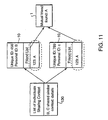
- a computer-implemented process can determine whether two or more users, who are strangers to each other, shared a virtual location. Using the same data, it can also be determined whether or not these two users share a common friend 1 as shown in Figure 11.
- Another process can then determine whether an introduction of the strangers should be suggested via the mutual friend.
- the process receives the unique IDs of the two strangers who share a location, and compares their unique IDs with those on the known list 10. At this point, a message suggesting an introduction be made between the individuals can be generated.
- the shared network location is inferred through the common location of two or more users in a physical environment.
- the shared location is explicitly generated in a virtual environment.
- the first embodiment of our invention provides a social network for introducing individuals sharing a common location in a physical environment, henceforth referred to as a network location.
- a mobile local area network includes a number of portable communication devices that operate in broadcast or point-to-point communications modes depending on the function performed.
- the devices also include memories to store data interchanged over the broadcast and point-to-point communications channels.
- Devices in the physical implementation of our invention differ from prior systems in that, with our invention, strangers are matched according to a shared network location.
- a shared network location we mean that the two strangers frequent the same locations at the same time.
- the exact activities and interests of the strangers are irrelevant - what matters is that the strangers engage in activities in close physical proximity to one another.
- Our invention does not need to know what this shared location or activity is, it simply needs to know that there is a common network location between two strangers.
- Our invention further differentiates itself by requiring a trusted third person, a mutual friend, to initiate an introduction of the two strangers. This provides a human element to mediate the introduction of two strangers who nonetheless share the same network location and a mutual friend.
- Devices in the physical implementation of our invention are compact, wireless communication devices, like the keyless remote devices used to operate car doors. The device can be carried unobtrusively in one's pocket.
- each device stores a unique ID 101 only associated with that device.
- the user enters the private ID 102.
- Each device can also store the known list 10.
- the list is generated by an exchange of unique and private IDs via the secure point-to-point communications channel 203 as shown in Figure 2. For example, friends "touch" their devices together to make an electronic connection and exchange their IDs 101-102.
- This point-to-point connection is a secure connection so that data interchanged via this connection cannot become known to others.
- Each device also broadcasts its unique ID 101 using a short range radio frequency (RF) signal 109.
- RF radio frequency
- the "location" extends over the range a distance that the transmitted signal can be received, and no farther.
- a device receives an unknown unique ID over the broadcast channel 109, that is a unique ID that is not stored in its known list 10; the unknown ID is recorded on the location list 20.
- the date, time, and duration of the encounter with the stranger are also stored in the memory and comprise an encounter record 21 in the location list.
- the process of broadcasting and receiving IDs and recording the IDs occurs automatically in the background; the users of the devices, both the broadcasters and the receivers, are unaware of this activity when it occurs. Note in contrast with prior art device, we do not need to store what the location, activity, or interest is that brings the two strangers to the same location, we only record the fact that there was an encounter somewhere.
- each device can examine the received location list and determine if anyone on the location list is known to this device, i.e., an ID on the other device's location list is on this device's known list.
- the device If the device does find unique IDs of the other device's location list on its known list, the device generates and displays a message suggesting an introduction between the two individuals. The user of the device, that is, the mutual friend, can then determine whether an introduction of the two strangers would be beneficial. Thus, a common, trusted third person determines whether to introduce the two strangers, and if so, the manner in which the introduction will be conducted.
- FIG. 1 shows an initial process 100 used by our communication devices.
- Each device is equipped with the unique ID 101.
- the unique ID is factory installed and inaccessible to the user.
- the user enters a user name or some other human understandable private ID 102, such as a telephone number, e-mail address, and the like.
- the private ID 102 is stored with the unique ID 101.
- the device broadcasts 109 its unique ID 101, and listens for other unique IDs.
- Figure 2 shows a process 200 executed when two friends wish to add each other to their known lists 10.
- the devices 201 and 202 are electronically connected by a point-to-point private link 203, and their unique and private IDs 101-102 are exchanged.
- the unique and private ID 101-102 pair is stored on the known list 10.
- the link can be achieved by physically touching the two devices to each other, or by a short range infrared (IR) transceiver such as found on remote controls.
- IR infrared
- the intent is for the private IDs to be exchanged using private communications links, while the unique IDs are exchanged using a public communications links, so that the mapping between unique and private IDs is never made available to unknown third parties.
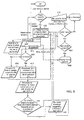
- Figure 3 shows a process 300 executed when a unique ID 101 is received in step 310 at some network location.
- Step 320 checks if the received unique ID is on its known list 10. If not, then step 230 adds the unknown ID to its location list 20 and also stores the date, time and duration of the encounter with the unknown ID as an encounter record. If the received ID is already stored in location list 20, than just the date, time and duration of this subsequent encounter is added. If the ID is on the known list 10 then proceed with process 400 of Figure 4. Note, the location itself does not need to be stored.
- step 410 of Figure 4 the two friends exchange their location lists 20.
- each device determines if any of the unknown unique IDs received from the other device is on its own known list 10. If any unknown IDs on the other's device's location list are on this device's known list, step 430 makes a decision of whether an introduction of the strangers should be suggested to the mutual friend. This determination can be based on the frequency of the encounters, their durations, times, and any other factors known to the system. Note again, the location itself does not need to be a factor in the thresholding decision.
- a message is generated suggesting an introduction between the two individuals who do not know each other.
- the message maps the unique IDs of the friends to the friends' private IDs to obtain a human-readable message.
- the mutual friend can then make a determination whether the two strangers, who frequently share a network location, should be introduced.
- Figure 5 overlays the above described step to illustrate a state transition diagram of the device.
- Figure 6 shows the steps of a process 600 to execute when menu buttons of the device are pressed 601.
- Full reset 610 will clear all data from the memory, e.g., friends and location lists. except for the memory storing the device's own ID, after confirmation 630.
- Set name 620 activates the process 100.
- Set time 630 simply sets the time and date clock of the device.
- List friends 640 allows the user to edit the known list 10, e.g., remove IDs and names of individuals no longer considered "friends.”
- Delete all messages 650 removes any pending messages stored in the device, and show messages 660 displays pending messages.
- Figure 7 shows the general external structure 700 of our communication device.
- the device includes the following control buttons, on/off 710, a menu 720, cancel 730, OK 740, up and down 750-751.
- the up and down buttons can also be implemented as a thumb wheel or slide bar, and can be used to reset the device to its initial condition, erasing all stored data except for the unique identification 101.
- the device also includes a physical electronic port 760, and transceiver 770, either RF, IR, or both.
- the device also includes a message indicator 780, and a display 790, and a loudspeaker 795 which can also act as a silent mechanical vibrator.
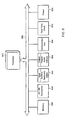
- Figure 8 shows the general internal structure 800 of our device.
- the device includes a processor 810, a memory 900, a transceiver 830, an input interface 840, output interface 850, a communication port 860, a real-time clock 870, and a power unit 880 all connected to each other by a bus 890.
- Figure 9 shows data structures stored in the memory 900.
- the structure 910 stores the unique ID 101 of the device and the private ID 102, e.g., the owner's name or some other private identification.
- the unique ID is factory installed and cannot be changed; the user enters the private ID as shown in Figure 1.
- the known list 10 stores entries of unique and private IDs of friends.
- the entries in this list are generated by connecting two devices together so that the unique and private IDs can be exchanged as shown in Figure 2.
- the location list 10 stores unique IDs and encounter entries of unknown devices.
- the encounters are stored as encounter entries that include the date, time, and duration of the encounter.
- the messages 950 store message texts.
- the ignore list 960 stores a list of IDs of friends, or pairs of users, who should not be introduced by this device. No introductions are suggested for individuals or pairs of users found on the ignore list.
- the former known list 970 stores IDs of users who are no longer considered friends. If a device in close proximity is found to be on the former known list, no exchanges of data are performed, i.e., location lists are not exchanged. Furthermore, no introductions are suggested for users found on the former known list.
- Programs 980 and other data 990 used by the programs are also stored in the memory.
- beacon is a relay station to enable time-delayed communication between devices.
- the beacon facilitates the exchange of unique IDs between devices that pass the location at different times. For example, two people might use the same sports facility at slightly different times.
- a beacon stores a received ID, and then re-broadcasts the ID for a short period of time after reception, for example, one hour.
- Beacons allow users to leave a "trace" in a particular space that maintains the same location throughout the day.
- our device can also be incorporated into other "host" portable electronic devices, such as hand-held games, cellular phones, or private digital assistants.
- the nature of the activities of the host device may also be known, providing additional locational information that may be used to determine when an introduction is suggested between two or more people.
- portable devices detect a shared location between individuals by noting when other devices are in the same place at the same time. While the nature of the shared location is unknown to the devices. The unique IDs of strangers' devices are known. These unique IDs, and the times at which they were observed, are recorded to mark a shared physical location between two people. At a later time, a device owned by a mutual friend receives this data and can generate a message suggesting an introduction between two strangers.
- the shared locations are web pages, newsgroups, chat rooms, or other virtual locations that can be uniquely identified.
- the number of "visitors” to a particular site can number in the millions per day.
- the number of "unknown” people is staggeringly large as compared to those found when navigating through the physical environment. Tracking all of these unknown unique IDs on a per-person basis is thus impractical.
- a proxy to intercept requests to virtual locations, e.g. web pages, chat-rooms, game rooms, and the like.
- the intercepted locations are used to maintain the location list, or a log of all the places an individual visits on the Internet.
- Processes periodically exchange the location lists of friends and, for the purpose of making an introduction, determine if two strangers with a mutual friend share common virtual locations.
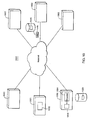
- Figure 10 shows a virtual network 1000 according to the second embodiment of the invention.
- the network includes a number of "client” computers 1001 and “server” computers 1002 connected to each other by a wide area network 1003, e.g. the Internet.
- a wide area network 1003 e.g. the Internet.
- the number of clients and servers number in the millions.
- the clients 1001 are in most aspects conventional, i.e., workstations, PCs, laptops, cell phones, PDAs, and the like.
- the clients execute application programs, including a network access application such as a browser 1004.
- the servers are also conventional.
- the client and servers can be identically configured, and both can operate in either a "client” or “server” mode.
- it is the servers that maintain virtual locations 1005 such as sites, pages, and other "universal resources.”
- the locations are identified by a Universal Resource Locator (URL) or some other location name 1006.
- URL Universal Resource Locator
- the clients can also maintain resources. However, in most cases, the client will need some type of rudimentary file server capability to makes such resources visible to other clients. However, it is possible for that a single client can provide two different users, i.e., strangers, access to the same local virtual location.
- One application 1010 generates the unique ID 101 for each user, and associates this ID with the user's private ID 102, for example, the user's name.
- the application also allows two users, on friendly terms, to exchange their unique and private IDs using, for example, a secure electronic message exchange.
- a user requests a web page 1005 with the browser 1004
- the request is intercepted by the application 1010, and an entry is made in the location list recording the URL of the request and the unique ID of the user making the request.
- processes on behalf of the two friends can exchange their location lists.
- the application can execute a routine that determines if two strangers having a common friend share the same virtual location.
- a user has the ability to enter "filter” parameters to influence when, where, and how the system operates. These parameters can, for example, block out specific days and time periods when the device should not be active. In such a case, users could specify that they are not interested in being introduced to people they encounter during working hours.
- the device is equipped with a GPS receiver or other, similar, location-sensing equipment, users could also filter out encounters for specific geographic areas, e.g. their place of employment. In the virtual embodiment, specific locations on the Internet could be selected to be ignored in the location list.
- a user can also specify the rules for determining when an introduction should be suggested. For example, in the physical embodiment, a user living in a densely populated area may require that a higher frequency of shared location be observed before an introduction is suggested. A more socially active person, on the other hand, may desire an introduction on the first encounter.
- the duration of the encounters may also be used to alter the decision of when to suggest an introduction.
- the range of the transceivers can also be varied, for example, to only exchange IDs on close encounters. This can be done by measuring the signal strength, or varying the signal strength at either the sender or the receiver's end.
- the user can be provided with the ability to flag introductions the system should ignore in the future using the ignore list 960.
- the mutual friend may know that the introduction should not be made, for whatever reason, and should be able to indicate to the system that this introduction should never be suggested again in the future.
- a user may wish to block all introductions for a particular person, for whatever reason. This is a more proactive action then blocking a generated suggested introduction, as it instructs the system to never generate an introduction suggestion for a particular person.
- Our system can also consider the relative nature of a relationship between two users when determining the threshold for suggesting an introduction.
- we speak of the relative nature of a relationship we speak of a description of the type of relationship, and/or the relative positions of the individuals in the relationship. For example, one user may be more socially connected then the other user, or one user may hold a position of power over the other user.
- a user may wish to indicate the nature of the relationship one has with another user, indicating, for example, that the friend is a co-worker, a sibling, an acquaintance, or an intimate friend.
- the nature of the relationship can then influence the operation of the device by, for example, influencing the threshold function used to determine when introductions should be suggested.
- This information can be manually inputted, or may be generated automatically by the system by, for example, measuring the frequency and duration of two friends meeting.
- Mobile agents that are transmitted across a computer network are known. Mobile agents are comprised of code and data, both of which are transmitted across the computer network. Technologies such as client-server protocols, remote procedure call protocols, and distributed object technologies are employed to transmit mobile agents across the computer network. The agents typically "visit” different locations in the network to do work. Often, the agents collaborate with each other. The invention enables agents that are "strangers" to each other to start collaborations through the use of a third part agent, common to the two stranger agents.
Landscapes
- Engineering & Computer Science (AREA)
- Business, Economics & Management (AREA)
- Strategic Management (AREA)
- Entrepreneurship & Innovation (AREA)
- Human Resources & Organizations (AREA)
- Operations Research (AREA)
- General Business, Economics & Management (AREA)
- Marketing (AREA)
- Data Mining & Analysis (AREA)
- Quality & Reliability (AREA)
- Tourism & Hospitality (AREA)
- Physics & Mathematics (AREA)
- Economics (AREA)
- General Physics & Mathematics (AREA)
- Theoretical Computer Science (AREA)
- Management, Administration, Business Operations System, And Electronic Commerce (AREA)
- Information Retrieval, Db Structures And Fs Structures Therefor (AREA)
- Information Transfer Between Computers (AREA)
- Mobile Radio Communication Systems (AREA)
Applications Claiming Priority (2)
| Application Number | Priority Date | Filing Date | Title |
|---|---|---|---|
| US639665 | 2000-08-16 | ||
| US09/639,665 US6681108B1 (en) | 2000-08-16 | 2000-08-16 | Network and method for identifying entities sharing a common network location |
Publications (2)
| Publication Number | Publication Date |
|---|---|
| EP1265151A2 true EP1265151A2 (de) | 2002-12-11 |
| EP1265151A3 EP1265151A3 (de) | 2004-01-14 |
Family
ID=24565058
Family Applications (1)
| Application Number | Title | Priority Date | Filing Date |
|---|---|---|---|
| EP01117827A Withdrawn EP1265151A3 (de) | 2000-08-16 | 2001-07-23 | Netzwerk und Verfahren zur Identifikation von Einheiten, die sich einen gemeinsamen Ort im Netzwerk teilen |
Country Status (3)
| Country | Link |
|---|---|
| US (1) | US6681108B1 (de) |
| EP (1) | EP1265151A3 (de) |
| JP (1) | JP4870881B2 (de) |
Cited By (7)
| Publication number | Priority date | Publication date | Assignee | Title |
|---|---|---|---|---|
| EP1825430A4 (de) * | 2004-10-19 | 2009-08-26 | Yahoo Inc | System und verfahren für soziale vernetzung auf ortsbasis |
| US8023929B2 (en) | 2004-02-11 | 2011-09-20 | Yahoo! Inc. | System and method for wireless communication between previously known and unknown users |
| US8108501B2 (en) | 2006-11-01 | 2012-01-31 | Yahoo! Inc. | Searching and route mapping based on a social network, location, and time |
| US8260315B2 (en) | 2006-11-01 | 2012-09-04 | Yahoo! Inc. | Determining mobile content for a social network based on location and time |
| WO2013151824A1 (en) * | 2012-04-02 | 2013-10-10 | Amulet, Inc. | Amulet - an intelligent fashion piece |
| EP3370157A4 (de) * | 2015-10-27 | 2019-06-26 | Tap Around Inc. | Hilfsserver für gemeinsame informationsnutzung, hilfssystem für gemeinsame informationsnutzung und hilfsverfahren für gemeinsame informationsnutzung |
| US11272020B2 (en) | 2004-10-19 | 2022-03-08 | Verizon Patent And Licensing Inc. | Social network for mapping gradations to target intent |
Families Citing this family (98)
| Publication number | Priority date | Publication date | Assignee | Title |
|---|---|---|---|---|
| US6832245B1 (en) | 1999-12-01 | 2004-12-14 | At&T Corp. | System and method for analyzing communications of user messages to rank users and contacts based on message content |
| KR100415372B1 (ko) * | 2000-08-31 | 2004-01-16 | (주) 고미드 | 가상 공간 상에서의 유사 정보 사용자를 결정하는 시스템및 방법 |
| US7356347B1 (en) * | 2000-09-28 | 2008-04-08 | Palmsource, Inc. | Efficient discovery of devices in a bluetooth environment |
| JP3851944B2 (ja) * | 2000-10-17 | 2006-11-29 | 株式会社メキキ | 人脈関係登録システム、人脈関係登録方法とサーバ、人脈関係登録プログラムと当該プログラムを記録したコンピュータ読取可能な記録媒体 |
| JP2002140278A (ja) * | 2000-10-31 | 2002-05-17 | Sony Corp | 情報処理装置および方法、並びに記録媒体 |
| US20020065881A1 (en) * | 2000-11-29 | 2002-05-30 | Tapio Mansikkaniemi | Wireless family bulletin board |
| US7174368B2 (en) * | 2001-03-27 | 2007-02-06 | Xante Corporation | Encrypted e-mail reader and responder system, method, and computer program product |
| US20020174248A1 (en) * | 2001-05-16 | 2002-11-21 | Motorola, Inc. | Method and system for communicating chat and game messages in a wireless network |
| US7266379B2 (en) * | 2001-05-30 | 2007-09-04 | Palm, Inc. | Resource location through location history |
| US7774711B2 (en) | 2001-09-28 | 2010-08-10 | Aol Inc. | Automatic categorization of entries in a contact list |
| EP1442411A4 (de) | 2001-09-30 | 2006-02-01 | Realcontacts Ltd | Verbindungsdienst |
| US20030087602A1 (en) * | 2001-11-05 | 2003-05-08 | Palm, Inc. | Data prioritization and distribution limitation system and method |
| US8000724B1 (en) * | 2001-11-14 | 2011-08-16 | Sprint Spectrum L.P. | Method and system for subnet-based transmission of mobile station location |
| US20030104782A1 (en) * | 2001-11-30 | 2003-06-05 | Palm, Inc. | Object tagging system and method |
| US8135609B2 (en) * | 2002-01-08 | 2012-03-13 | Microsoft Corporation | Identifying and surveying subscribers |
| US7167910B2 (en) * | 2002-02-20 | 2007-01-23 | Microsoft Corporation | Social mapping of contacts from computer communication information |
| US7343365B2 (en) * | 2002-02-20 | 2008-03-11 | Microsoft Corporation | Computer system architecture for automatic context associations |
| US7640300B2 (en) * | 2002-06-10 | 2009-12-29 | Microsoft Corporation | Presence and notification system for maintaining and communicating information |
| US7640293B2 (en) * | 2002-07-17 | 2009-12-29 | Research In Motion Limited | Method, system and apparatus for messaging between wireless mobile terminals and networked computers |
| US8150922B2 (en) * | 2002-07-17 | 2012-04-03 | Research In Motion Limited | Voice and text group chat display management techniques for wireless mobile terminals |
| US20040048605A1 (en) * | 2002-09-11 | 2004-03-11 | Schaefer Robert A. | Wireless communications system |
| US7263614B2 (en) | 2002-12-31 | 2007-08-28 | Aol Llc | Implicit access for communications pathway |
| US7945674B2 (en) | 2003-04-02 | 2011-05-17 | Aol Inc. | Degrees of separation for handling communications |
| US7472110B2 (en) * | 2003-01-29 | 2008-12-30 | Microsoft Corporation | System and method for employing social networks for information discovery |
| US7603417B2 (en) | 2003-03-26 | 2009-10-13 | Aol Llc | Identifying and using identities deemed to be known to a user |
| US20040235493A1 (en) * | 2003-05-23 | 2004-11-25 | Thomas Ekerborn | Tags for location-based services in wireless networks |
| WO2005022330A2 (en) * | 2003-08-27 | 2005-03-10 | Jambo Networks, Inc. | A system and method for providing communication services to mobile device users |
| US20050071479A1 (en) * | 2003-09-30 | 2005-03-31 | Dimitris Achlioptas | Smart button |
| GB2409300A (en) * | 2003-12-17 | 2005-06-22 | Symbian Ltd | Determining common entries between contact stores |
| DE602004013272T2 (de) * | 2004-02-19 | 2009-07-16 | Alcatel Lucent | Verfahren, Server und mobiles Endgerät zum Aufbau von Verbindungen zwischen Teilnehmern eines Telekommunikationsnetzwerks |
| US20050197922A1 (en) * | 2004-03-04 | 2005-09-08 | Peter Pezaris | Method and system for accessing and printing access-controlled photographs using a public computer network |
| US20050198305A1 (en) * | 2004-03-04 | 2005-09-08 | Peter Pezaris | Method and system for associating a thread with content in a social networking environment |
| US8635273B2 (en) | 2004-03-05 | 2014-01-21 | Aol Inc. | Announcing new users of an electronic communications system to existing users |
| US20060069734A1 (en) * | 2004-09-01 | 2006-03-30 | Michael Gersh | Method and system for organizing and displaying message threads |
| US8316315B2 (en) | 2005-02-28 | 2012-11-20 | Microsoft Corporation | Automatically generated highlight view of electronic interactions |
| JP4781743B2 (ja) | 2005-05-06 | 2011-09-28 | 任天堂株式会社 | 通信ゲームシステム |
| JP5001445B2 (ja) * | 2005-05-06 | 2012-08-15 | 任天堂株式会社 | 通信ゲームシステム |
| US20060265383A1 (en) * | 2005-05-18 | 2006-11-23 | Pezaris Design, Inc. | Method and system for performing and sorting a content search |
| US8150416B2 (en) | 2005-08-08 | 2012-04-03 | Jambo Networks, Inc. | System and method for providing communication services to mobile device users incorporating proximity determination |
| US7698061B2 (en) | 2005-09-23 | 2010-04-13 | Scenera Technologies, Llc | System and method for selecting and presenting a route to a user |
| WO2007053708A2 (en) | 2005-10-31 | 2007-05-10 | The Trustees Of Columbia University In The City Of New York | Methods, media, and systems for securing communications between a first node and a second node |
| WO2007062004A2 (en) | 2005-11-22 | 2007-05-31 | The Trustees Of Columbia University In The City Of New York | Methods, media, and devices for moving a connection from one point of access to another point of access |
| US7809805B2 (en) | 2007-02-28 | 2010-10-05 | Facebook, Inc. | Systems and methods for automatically locating web-based social network members |
| US7801542B1 (en) * | 2005-12-19 | 2010-09-21 | Stewart Brett B | Automatic management of geographic information pertaining to social networks, groups of users, or assets |
| US8756501B1 (en) | 2005-12-30 | 2014-06-17 | Google Inc. | Method, system, and graphical user interface for meeting-spot-related introductions |
| US7831917B1 (en) * | 2005-12-30 | 2010-11-09 | Google Inc. | Method, system, and graphical user interface for identifying and communicating with meeting spots |
| US7797642B1 (en) | 2005-12-30 | 2010-09-14 | Google Inc. | Method, system, and graphical user interface for meeting-spot-related contact lists |
| US7917866B1 (en) * | 2005-12-30 | 2011-03-29 | Google Inc. | Method, system, and graphical user interface for meeting-spot-related online communications |
| US8171424B1 (en) | 2005-12-30 | 2012-05-01 | Google Inc. | Method, system, and graphical user interface for meeting-spot maps for online communications |
| US8005729B1 (en) * | 2006-03-30 | 2011-08-23 | Adobe Systems Incorporated | Environment modification using system and usage data |
| US8572169B2 (en) * | 2006-08-28 | 2013-10-29 | Myspace, Llc | System, apparatus and method for discovery of music within a social network |
| JP2008059222A (ja) * | 2006-08-30 | 2008-03-13 | Matsushita Electric Ind Co Ltd | サービス提供システム |
| US7689524B2 (en) * | 2006-09-28 | 2010-03-30 | Microsoft Corporation | Dynamic environment evaluation and service adjustment based on multiple user profiles including data classification and information sharing with authorized other users |
| US20080082465A1 (en) * | 2006-09-28 | 2008-04-03 | Microsoft Corporation | Guardian angel |
| US8578501B1 (en) | 2006-11-14 | 2013-11-05 | John W. Ogilvie | Anonymous social networking with community-based privacy reviews obtained by members |
| US11496598B2 (en) * | 2006-12-11 | 2022-11-08 | International Business Machines Corporation | Caching data at network processing nodes based on device location |
| US8566602B2 (en) * | 2006-12-15 | 2013-10-22 | At&T Intellectual Property I, L.P. | Device, system and method for recording personal encounter history |
| US7769370B2 (en) * | 2006-12-27 | 2010-08-03 | Motorola, Inc. | Method and system for pairing electronic devices |
| US8626844B2 (en) * | 2007-03-26 | 2014-01-07 | The Trustees Of Columbia University In The City Of New York | Methods and media for exchanging data between nodes of disconnected networks |
| US7949359B2 (en) | 2007-04-05 | 2011-05-24 | Sejo Pan | Methods and system for dynamically and anonymously linking wireless communications unit users |
| US20080254811A1 (en) | 2007-04-11 | 2008-10-16 | Palm, Inc. | System and method for monitoring locations of mobile devices |
| US9140552B2 (en) * | 2008-07-02 | 2015-09-22 | Qualcomm Incorporated | User defined names for displaying monitored location |
| US9031583B2 (en) * | 2007-04-11 | 2015-05-12 | Qualcomm Incorporated | Notification on mobile device based on location of other mobile device |
| US20080270038A1 (en) * | 2007-04-24 | 2008-10-30 | Hadi Partovi | System, apparatus and method for determining compatibility between members of a social network |
| CN101690099B (zh) * | 2007-06-28 | 2014-03-19 | 摩托罗拉移动公司 | 用于在多个通信网络上向用户设备提供ims会话连续性的方法和系统 |
| JP4322296B2 (ja) * | 2007-08-02 | 2009-08-26 | 株式会社コナミデジタルエンタテインメント | 通信システム、サーバ装置および玩具 |
| US8031595B2 (en) * | 2007-08-21 | 2011-10-04 | International Business Machines Corporation | Future location determination using social networks |
| US9288751B2 (en) * | 2007-08-29 | 2016-03-15 | Qualcomm Incorporated | Use of position data to select wireless access point |
| US7945862B2 (en) * | 2007-09-11 | 2011-05-17 | Yahoo! Inc. | Social network site including contact-based recommendation functionality |
| US8180807B2 (en) | 2007-11-27 | 2012-05-15 | At&T Intellectual Property I, L.P. | System and method of determining relationship information |
| TWI355593B (en) * | 2007-12-06 | 2012-01-01 | Ind Tech Res Inst | System and method for social relation oriented ser |
| US8237550B2 (en) * | 2008-03-11 | 2012-08-07 | Microsoft Corporation | Action using switched device that transmits data |
| US8495506B2 (en) * | 2008-04-29 | 2013-07-23 | International Business Machines Corporation | Identifying mutual friends in online environments |
| US20100077403A1 (en) * | 2008-09-23 | 2010-03-25 | Chaowei Yang | Middleware for Fine-Grained Near Real-Time Applications |
| US20100174747A1 (en) * | 2009-01-06 | 2010-07-08 | International Business Machines Corporation | Methods for recommending new individuals to be invited into a confirmed social network based on mined social data |
| US8417262B2 (en) | 2009-03-13 | 2013-04-09 | Tti Inventions D Llc | System and method for privacy-enabled mobile locator services with dynamic encounter horizon |
| US20130318167A1 (en) * | 2009-05-20 | 2013-11-28 | Aaron SEREBOFF | Method and apparatus for providing exchange of profile information |
| US20100313142A1 (en) * | 2009-06-03 | 2010-12-09 | David Brown | Location based social networking system |
| US8395547B2 (en) * | 2009-08-27 | 2013-03-12 | Hewlett-Packard Development Company, L.P. | Location tracking for mobile computing device |
| US8755815B2 (en) | 2010-08-31 | 2014-06-17 | Qualcomm Incorporated | Use of wireless access point ID for position determination |
| CN102483788B (zh) * | 2009-09-10 | 2015-07-08 | 索尼计算机娱乐公司 | 信息处理系统、信息处理方法、信息处理设备、信息处理设备控制方法、信息处理终端、信息处理终端控制方法、信息存储介质以及程序 |
| US9119027B2 (en) * | 2009-10-06 | 2015-08-25 | Facebook, Inc. | Sharing of location-based content item in social networking service |
| KR101529372B1 (ko) * | 2009-11-06 | 2015-06-17 | 알까뗄 루슨트 | 콘텐츠를 프리페치하여 캐싱하기 위한 시스템 및 방법 |
| WO2011094795A1 (en) * | 2010-02-02 | 2011-08-11 | Dot Com Ventures Pty Ltd | Controlled communication system |
| US20110237274A1 (en) * | 2010-03-25 | 2011-09-29 | Palm, Inc. | Mobile computing device having relative positioning circuit |
| US9208239B2 (en) | 2010-09-29 | 2015-12-08 | Eloy Technology, Llc | Method and system for aggregating music in the cloud |
| CN103222319B (zh) | 2010-09-29 | 2016-08-10 | 高通股份有限公司 | 一种用于移动计算设备的方法及移动计算设备 |
| US9025832B2 (en) * | 2011-06-01 | 2015-05-05 | Microsoft Technology Licensing, Llc | Automated sensor driven friending |
| JP5729192B2 (ja) * | 2011-07-22 | 2015-06-03 | 大日本印刷株式会社 | 交流支援サーバ装置、交流支援システム及び交流支援サーバプログラム |
| US9462004B1 (en) | 2011-11-04 | 2016-10-04 | Google Inc. | Automatic group assignment of users in a social network |
| US9704205B2 (en) * | 2014-02-28 | 2017-07-11 | Christine E. Akutagawa | Device for implementing body fluid analysis and social networking event planning |
| US9294991B2 (en) | 2014-07-10 | 2016-03-22 | Facebook, Inc. | Systems and methods for utilizing wireless communications to suggest connections for a user |
| JP6649709B2 (ja) | 2015-06-29 | 2020-02-19 | 任天堂株式会社 | 情報処理システム、情報処理システムの制御方法および情報処理システムの制御プログラム |
| US10089363B2 (en) | 2015-10-15 | 2018-10-02 | At&T Intellectual Property I, L.P. | Method and apparatus for identifying users who know each other |
| US9591465B1 (en) | 2015-12-07 | 2017-03-07 | Sprint Spectrum L.P. | Automatic distribution of communication to user having common subject-matter interest and served by same or adjacent base station |
| US10341352B2 (en) * | 2016-02-06 | 2019-07-02 | Maximilian Ralph Peter von Liechtenstein | Gaze initiated interaction technique |
| US10141967B1 (en) * | 2017-07-28 | 2018-11-27 | Ford Global Technologies, Llc | Virtual network interface connectivity |
| JP6720132B2 (ja) * | 2017-12-27 | 2020-07-08 | 任天堂株式会社 | 情報処理システム、情報処理方法、情報処理装置、および、情報処理プログラム |
Family Cites Families (19)
| Publication number | Priority date | Publication date | Assignee | Title |
|---|---|---|---|---|
| US4173016A (en) * | 1978-01-04 | 1979-10-30 | Dickson Carlisle H | Interpersonal-introduction signalling system |
| US4348744A (en) | 1978-04-04 | 1982-09-07 | White Edward A | Method and portable apparatus for comparison of stored sets of data |
| IL90277A0 (en) | 1989-05-12 | 1989-12-15 | Shmuel Shapira | System for locating compatible persons at a given locality |
| US5920845A (en) * | 1997-04-04 | 1999-07-06 | Risemberg; Rafael | Date matching methods |
| JPH10283298A (ja) * | 1997-04-04 | 1998-10-23 | Casio Comput Co Ltd | 情報提供システム、端末装置及びサーバ装置 |
| JPH10289249A (ja) * | 1997-04-11 | 1998-10-27 | Casio Comput Co Ltd | 情報提供システム及び装置 |
| US6052122A (en) * | 1997-06-13 | 2000-04-18 | Tele-Publishing, Inc. | Method and apparatus for matching registered profiles |
| JP4158213B2 (ja) * | 1997-10-23 | 2008-10-01 | カシオ計算機株式会社 | 通信システム及び該システムの制御方法 |
| US6032051A (en) | 1997-12-01 | 2000-02-29 | Telefonaktiebolaget L/M Ericsson | Wireless mobile comunication devices for group use |
| JP3765175B2 (ja) * | 1998-01-09 | 2006-04-12 | 富士ゼロックス株式会社 | コミュニケーションシステム |
| JPH11252003A (ja) * | 1998-03-04 | 1999-09-17 | Nippon Telegr & Teleph Corp <Ntt> | モバイルユーザ向け情報案内における個人情報案内方法および装置と個人情報案内プログラムを記録した記録媒体 |
| US6150937A (en) * | 1998-06-29 | 2000-11-21 | Rackman; Michael I. | Personal contact "ice breaker" |
| JP3654773B2 (ja) * | 1998-07-08 | 2005-06-02 | 富士通株式会社 | 情報交換方法、情報管理流通装置、情報管理装置、情報流通装置、情報管理流通プログラムを記録したコンピュータ読み取り可能な記録媒体、情報管理プログラムを記録したコンピュータ読み取り可能な記録媒体及び情報流通プログラムを記録したコンピュータ読み取り可能な記録媒体 |
| JP3025479B2 (ja) * | 1998-08-12 | 2000-03-27 | 翼システム株式会社 | 関係情報提供装置、関係情報提供方法及び記録媒体 |
| CN1165853C (zh) * | 1998-08-21 | 2004-09-08 | 皇家菲利浦电子有限公司 | 信息处理设备 |
| US8650496B1 (en) * | 1998-08-21 | 2014-02-11 | U.S. Philips Corporation | Information exchange audio player |
| WO2000022558A1 (en) * | 1998-09-17 | 2000-04-20 | Simar, Llc | System and method for transmitting and comparing personality profiles |
| US6020810A (en) * | 1998-10-22 | 2000-02-01 | Har-Even; Eva A. | Automatic electronic date/mate finder and method of electronically finding a date/mate |
| JP2000132509A (ja) * | 1998-10-27 | 2000-05-12 | Nippon Telegr & Teleph Corp <Ntt> | 出会いを支援するコミュニケーションサービス方法及びシステム及びコミュニケーションサービスプログラムを格納した記憶媒体 |
-
2000
- 2000-08-16 US US09/639,665 patent/US6681108B1/en not_active Expired - Lifetime
-
2001
- 2001-07-23 EP EP01117827A patent/EP1265151A3/de not_active Withdrawn
- 2001-07-30 JP JP2001229764A patent/JP4870881B2/ja not_active Expired - Fee Related
Cited By (10)
| Publication number | Priority date | Publication date | Assignee | Title |
|---|---|---|---|---|
| US8023929B2 (en) | 2004-02-11 | 2011-09-20 | Yahoo! Inc. | System and method for wireless communication between previously known and unknown users |
| EP1825430A4 (de) * | 2004-10-19 | 2009-08-26 | Yahoo Inc | System und verfahren für soziale vernetzung auf ortsbasis |
| US8019692B2 (en) | 2004-10-19 | 2011-09-13 | Yahoo! Inc. | System and method for location based social networking |
| US11272020B2 (en) | 2004-10-19 | 2022-03-08 | Verizon Patent And Licensing Inc. | Social network for mapping gradations to target intent |
| US11283885B2 (en) | 2004-10-19 | 2022-03-22 | Verizon Patent And Licensing Inc. | System and method for location based matching and promotion |
| US8108501B2 (en) | 2006-11-01 | 2012-01-31 | Yahoo! Inc. | Searching and route mapping based on a social network, location, and time |
| US8260315B2 (en) | 2006-11-01 | 2012-09-04 | Yahoo! Inc. | Determining mobile content for a social network based on location and time |
| WO2013151824A1 (en) * | 2012-04-02 | 2013-10-10 | Amulet, Inc. | Amulet - an intelligent fashion piece |
| EP3370157A4 (de) * | 2015-10-27 | 2019-06-26 | Tap Around Inc. | Hilfsserver für gemeinsame informationsnutzung, hilfssystem für gemeinsame informationsnutzung und hilfsverfahren für gemeinsame informationsnutzung |
| US10944825B2 (en) | 2015-10-27 | 2021-03-09 | Tap Around Inc. | Information sharing support server, information sharing support system, and information sharing support method |
Also Published As
| Publication number | Publication date |
|---|---|
| JP2002163353A (ja) | 2002-06-07 |
| JP4870881B2 (ja) | 2012-02-08 |
| EP1265151A3 (de) | 2004-01-14 |
| US6681108B1 (en) | 2004-01-20 |
Similar Documents
| Publication | Publication Date | Title |
|---|---|---|
| US6681108B1 (en) | Network and method for identifying entities sharing a common network location | |
| US6819919B1 (en) | Method for providing matching and introduction services to proximate mobile users and service providers | |
| US8014763B2 (en) | Wireless communications with proximal targets identified visually, aurally, or positionally | |
| US7877082B2 (en) | Combined short range radio network and cellular telephone network for interpersonal communications | |
| US8688141B2 (en) | System and method for providing communication services to mobile device users incorporating proximity determination | |
| TWI392308B (zh) | 後續地連結人際關係的裝置、方法及系統 | |
| US8346863B2 (en) | Contact initialization based upon automatic profile sharing between computing devices | |
| US6711414B1 (en) | Wearable computing device capable of responding intelligently to surroundings | |
| US8521185B2 (en) | Wireless communications with visually-identified targets | |
| US6771972B2 (en) | System and method for a distributed search for a lost asset | |
| US20190166072A1 (en) | System and method for the automated notification of compatibility between real-time network participants | |
| US20080291022A1 (en) | Automatic locating system | |
| US20080051033A1 (en) | Wireless communications with visually- identified targets | |
| US20080086261A1 (en) | Location-based social interaction network | |
| JP6023718B2 (ja) | 仮想空間の生成を含む通信システム及び方法 | |
| US20070260730A1 (en) | Automatically updated instant messaging (IM) presence of roaming IM user | |
| JP2014511136A (ja) | アドホックメッシュネットワークを利用しコンテキスト情報に基づいて関心コミュニティを自動的に決定する方法および装置 | |
| TW525069B (en) | Methods, systems and computer program products for identifying a compatible individual in a geographic area | |
| WO2017199592A1 (ja) | 情報処理装置、情報処理方法及びプログラム | |
| US20040203896A1 (en) | Proximity-based matching method and system | |
| KR20020004265A (ko) | 인터넷과 연계된 휴대용 이동통신 단말기를 이용한 미팅매칭 장치 및 그 운영 방법 | |
| US20180310163A1 (en) | Tracking people | |
| GB2455055A (en) | Establishing communication between mobile terminals | |
| Jason et al. | An architecture for privacy-sensitive ubiquitous computing | |
| CN208337885U (zh) | 一种服务器、用户端、社交系统 |
Legal Events
| Date | Code | Title | Description |
|---|---|---|---|
| PUAI | Public reference made under article 153(3) epc to a published international application that has entered the european phase |
Free format text: ORIGINAL CODE: 0009012 |
|
| AK | Designated contracting states |
Kind code of ref document: A2 Designated state(s): AT BE CH CY DE DK ES FI FR GB GR IE IT LI LU MC NL PT SE TR |
|
| AX | Request for extension of the european patent |
Free format text: AL;LT;LV;MK;RO;SI |
|
| PUAL | Search report despatched |
Free format text: ORIGINAL CODE: 0009013 |
|
| AK | Designated contracting states |
Kind code of ref document: A3 Designated state(s): AT BE CH CY DE DK ES FI FR GB GR IE IT LI LU MC NL PT SE TR |
|
| AX | Request for extension of the european patent |
Extension state: AL LT LV MK RO SI |
|
| AKX | Designation fees paid | ||
| REG | Reference to a national code |
Ref country code: DE Ref legal event code: 8566 |
|
| STAA | Information on the status of an ep patent application or granted ep patent |
Free format text: STATUS: THE APPLICATION IS DEEMED TO BE WITHDRAWN |
|
| 18D | Application deemed to be withdrawn |
Effective date: 20040715 |