EP1256466A2 - Verfahren zur Regelung des Speicherdruckes in einer geschlossenen Niveauregelanlage - Google Patents
Verfahren zur Regelung des Speicherdruckes in einer geschlossenen Niveauregelanlage Download PDFInfo
- Publication number
- EP1256466A2 EP1256466A2 EP02008370A EP02008370A EP1256466A2 EP 1256466 A2 EP1256466 A2 EP 1256466A2 EP 02008370 A EP02008370 A EP 02008370A EP 02008370 A EP02008370 A EP 02008370A EP 1256466 A2 EP1256466 A2 EP 1256466A2
- Authority
- EP
- European Patent Office
- Prior art keywords
- air
- compressed air
- control system
- reservoir
- level control
- Prior art date
- Legal status (The legal status is an assumption and is not a legal conclusion. Google has not performed a legal analysis and makes no representation as to the accuracy of the status listed.)
- Granted
Links
- 238000000034 method Methods 0.000 title claims abstract description 22
- 230000001105 regulatory effect Effects 0.000 abstract description 3
- 239000003570 air Substances 0.000 abstract 5
- 239000012080 ambient air Substances 0.000 abstract 1
- 238000012549 training Methods 0.000 description 8
- 238000011161 development Methods 0.000 description 6
- 238000010586 diagram Methods 0.000 description 3
- TZCXTZWJZNENPQ-UHFFFAOYSA-L barium sulfate Chemical compound [Ba+2].[O-]S([O-])(=O)=O TZCXTZWJZNENPQ-UHFFFAOYSA-L 0.000 description 2
- 238000012546 transfer Methods 0.000 description 2
- 238000012935 Averaging Methods 0.000 description 1
- 208000034423 Delivery Diseases 0.000 description 1
- 238000009530 blood pressure measurement Methods 0.000 description 1
- 230000001276 controlling effect Effects 0.000 description 1
- 230000003247 decreasing effect Effects 0.000 description 1
- 239000004615 ingredient Substances 0.000 description 1
- 238000007689 inspection Methods 0.000 description 1
- 230000003068 static effect Effects 0.000 description 1
- 238000013022 venting Methods 0.000 description 1
Images

Classifications
-
- B—PERFORMING OPERATIONS; TRANSPORTING
- B60—VEHICLES IN GENERAL
- B60G—VEHICLE SUSPENSION ARRANGEMENTS
- B60G17/00—Resilient suspensions having means for adjusting the spring or vibration-damper characteristics, for regulating the distance between a supporting surface and a sprung part of vehicle or for locking suspension during use to meet varying vehicular or surface conditions, e.g. due to speed or load
- B60G17/02—Spring characteristics, e.g. mechanical springs and mechanical adjusting means
- B60G17/04—Spring characteristics, e.g. mechanical springs and mechanical adjusting means fluid spring characteristics
- B60G17/052—Pneumatic spring characteristics
- B60G17/0523—Regulating distributors or valves for pneumatic springs
-
- B—PERFORMING OPERATIONS; TRANSPORTING
- B60—VEHICLES IN GENERAL
- B60G—VEHICLE SUSPENSION ARRANGEMENTS
- B60G2202/00—Indexing codes relating to the type of spring, damper or actuator
- B60G2202/10—Type of spring
- B60G2202/15—Fluid spring
- B60G2202/152—Pneumatic spring
-
- B—PERFORMING OPERATIONS; TRANSPORTING
- B60—VEHICLES IN GENERAL
- B60G—VEHICLE SUSPENSION ARRANGEMENTS
- B60G2202/00—Indexing codes relating to the type of spring, damper or actuator
- B60G2202/10—Type of spring
- B60G2202/15—Fluid spring
- B60G2202/154—Fluid spring with an accumulator
-
- B—PERFORMING OPERATIONS; TRANSPORTING
- B60—VEHICLES IN GENERAL
- B60G—VEHICLE SUSPENSION ARRANGEMENTS
- B60G2202/00—Indexing codes relating to the type of spring, damper or actuator
- B60G2202/40—Type of actuator
- B60G2202/41—Fluid actuator
- B60G2202/412—Pneumatic actuator
-
- B—PERFORMING OPERATIONS; TRANSPORTING
- B60—VEHICLES IN GENERAL
- B60G—VEHICLE SUSPENSION ARRANGEMENTS
- B60G2500/00—Indexing codes relating to the regulated action or device
- B60G2500/20—Spring action or springs
- B60G2500/201—Air spring system type
- B60G2500/2014—Closed systems
-
- B—PERFORMING OPERATIONS; TRANSPORTING
- B60—VEHICLES IN GENERAL
- B60G—VEHICLE SUSPENSION ARRANGEMENTS
- B60G2500/00—Indexing codes relating to the regulated action or device
- B60G2500/20—Spring action or springs
- B60G2500/202—Height or leveling valve for air-springs
-
- B—PERFORMING OPERATIONS; TRANSPORTING
- B60—VEHICLES IN GENERAL
- B60G—VEHICLE SUSPENSION ARRANGEMENTS
- B60G2500/00—Indexing codes relating to the regulated action or device
- B60G2500/20—Spring action or springs
- B60G2500/204—Pressure regulating valves for air-springs
-
- B—PERFORMING OPERATIONS; TRANSPORTING
- B60—VEHICLES IN GENERAL
- B60G—VEHICLE SUSPENSION ARRANGEMENTS
- B60G2600/00—Indexing codes relating to particular elements, systems or processes used on suspension systems or suspension control systems
- B60G2600/02—Retarders, delaying means, dead zones, threshold values, cut-off frequency, timer interruption
-
- B—PERFORMING OPERATIONS; TRANSPORTING
- B60—VEHICLES IN GENERAL
- B60G—VEHICLE SUSPENSION ARRANGEMENTS
- B60G2600/00—Indexing codes relating to particular elements, systems or processes used on suspension systems or suspension control systems
- B60G2600/85—Speed of regulation
Definitions
- Such a level control system is known for example from DE 199 59 556 C2 and makes it possible to keep the vehicle body of a motor vehicle at a normal level.
- compressed air is turned from the compressed air reservoir into the air springs of the level control system transferred to raise the vehicle body of the motor vehicle or it becomes Lowering the vehicle body
- Compressed air from the air springs via the compressor in transfers the compressed air reservoir when the vehicle body is no longer in the predetermined normal level.
- the accumulator pressure of the compressed air reservoir must are within a certain range if the vehicle body is on the predetermined normal level, on the one hand, a quick lifting of the Vehicle body and on the other hand a quick lowering of the vehicle body enable.
- the storage pressure in the compressed air reservoir is too high, then it is the vehicle body can be raised quickly, but not lowered quickly of the vehicle body, since the compressed air in this case comes from the air springs against the high Storage pressure must be transferred to the compressed air storage. Accordingly, it applies that if the storage pressure in the compressed air storage is too low, it is a fast one Lowering the vehicle body is possible, but not a quick lifting of the Vehicle body.
- the accumulator pressure of the compressed air reservoir varies because of different ones Loading conditions and different level settings by the driver or by the regulation of the level control system can be specified (e.g. around an off-road vehicle to provide more ground clearance). This can lead to memory pressure due to the current loading condition and / or the current Level setting of the vehicle body is outside the desired range, although it would be within this range if the vehicle body was in the given normal state. At such a time the Storage pressure determined, this would lead to a filling of the compressed air reservoir Air from the atmosphere or to empty the compressed air reservoir into the Lead atmosphere, although this should not actually happen. Rather, in the Compressed air accumulator by filling or emptying only leakage losses or Storage pressure fluctuations are compensated for due to strong Temperature fluctuations occur. You could solve the problem that the accumulator pressure can only be determined when the vehicle body is in the Normal level, but this often does not happen over a long period of time.
- the invention has for its object a method for controlling the Storage pressure of the compressed air reservoir of a closed level control system create, which ensures as far as possible that the memory pressure in one certain area and the compressed air reservoir is not unnecessarily filled with compressed air the atmosphere is filled or emptied into it.
- the Storage pressure in a certain state of the motor vehicle in a certain Area to ensure that the vehicle body is raised and lowered quickly.
- the basic idea of the invention is to be seen in the fact that the amount of air is always as possible is kept in a certain work area and consequently the storage pressure in a certain condition of the motor vehicle is also in a certain range.
- the working range for the air volume is preferably chosen so that in one certain normal state of the motor vehicle the storage pressure is in a range, in which on the one hand a quick lifting and on the other hand a quick lowering of the Vehicle body is possible.
- An advantage achieved with the invention can be seen in particular in that the method to control the storage pressure at any time and in any State of the motor vehicle can be carried out, since in the method only (the amount of air independent of the current state of the motor vehicle) in the Level control system is determined and it is checked whether it is in a certain Workspace.
- Another advantage of the invention is that the Storage pressure by filling or emptying the compressed air reservoir only then is adjusted if due to leakage or large Temperature fluctuations have resulted in the amount of air in the level control system outside the work area (and consequently the storage pressure outside the desired range).
- the compressor is used to fill up the compressed air reservoir So only activated if this is absolutely necessary, so that the Compressor runtimes shortened and compressor life extended.
- the advantage of the invention is that the amount of air in the Level control system can be determined in a simple manner.
- the amount of air in all components of the Level control system i.e. in the air springs, the compressed air reservoir, the compressor, the Air dryer and the compressed air lines can be determined.
- the amount of air in the level control system the sum of the air volumes in the air springs and the air volume in the Compressed air reservoir determined. It is assumed that the air volume in the other components of the level control system compared to the components mentioned can be neglected.
- the advantage of this training is that the Air volume in the air springs and in the compressed air reservoir with the help of the height sensors the level control system and a central pressure sensor in a simple way can be determined (for more details see the description of the figures).
- the compressed air reservoir filled or emptied such that the amount of air after filling or emptying is at least close to the center of the work area (preferably corresponds to Air volume exactly this value).
- the advantage achieved with the training can be seen in the fact that the compressor for Refill the compressed air reservoir only once for the certain period of time need, or that the drain valve, via which the compressed air from the Compressed air reservoir flows into the atmosphere, only once for a certain period of time needs to be opened.
- the length of a day can be taken into account as the period.
- the work area z. B. be determined by the fact that the middle Air volume of the working area is taken at 15 ° C and the lower and upper Limit of the working range at 15 ° C +/- 20 ° C.
- the amount of air then does not leave the working area in a temperature range of -5 ° C to 35 ° C (depending on the season or the region in which the vehicle is built, other temperatures can also be set).
- the advantage of continuing education is to see that the amount of air due to temperature fluctuations over the mentioned period does not leave the work area and therefore within the period a readjustment of the air volume due to the temperature fluctuations necessary is.
- the amount of air in the Level control system at commissioning (preferably every commissioning) of the Motor vehicle determined.
- One advantage of this further training is that the Corrected the air volume before starting the vehicle without any risk can be.
- Another advantage of training is that it is at a standstill the amount of air in the pressure medium chambers of the motor vehicle in a simple manner and Way can be measured precisely, since no dynamic influences on the Motor vehicle and act on the pressure medium chambers.
- the advantage of further training can be seen in the fact that due to the averaging - over a longer period of temperature fluctuations, have an influence on the air volume determination, be "smoothed".
- the average of the Working area based on a certain ambient temperature, a certain state of charge, a certain normal level of vehicle bodywork and certain minimum control times for raising or lowering the vehicle body fixed the normal level in other certain levels.
- the work area for the Air volume is determined based on this average.
- Load state and normal level are values that determine the Motor vehicle often occupies.
- the advantage of this further training can be seen in the fact that the working area is determined based on a normal state of the motor vehicle and that a quick lifting and lowering of the vehicle body from the Normal level is guaranteed in other certain levels.
- FIG. 1 shows a closed level control system in a schematic representation (detailed explanations on the structure and functioning of these Level control system can be found in DE 199 59 556 C2).
- the level control system points Air springs 2a to 2d and a compressed air reservoir 4.
- the Level control system a compressor 6, the at least compressed air from its input 8 to can convey its exit 10.
- the ingredients mentioned are over Compressed air lines connected to each other, in which controllable directional valves 14, 18 and 24a - 24d.
- the air spring 2a explains how compressed air from transferred to the compressed air reservoir 4 via the compressor 6 in the air springs 2a to 2d can be.
- control unit (not shown) of the level control system the controllable directional control valve 24a is actuated, so that this is different from that shown in FIG shown first switching state changes into the second switching state.
- the compressor 6 is controlled so that it starts to run.
- the compressor 6 From the Compressed air reservoir 4 is then on the controllable directional valve 14, the compressor 6, the controllable directional valve 18 and the controllable directional valve 24a compressed air in the air spring 2a transferred.
- the control unit in turn controls the compressor 6 so that it stops to run, and moreover the controllable directional control valve 24a is no longer energized, so that it switches back to the first switching state.
- the air springs 2b to 2d can corresponding way with compressed air from the compressed air reservoir 4 are filled (A simultaneous filling of several air springs 2a to 2d is also possible here).
- the air spring 2a is used as an example to explain how compressed air from the Air springs 2a to 2d are transferred to the compressed air reservoir 4 via the compressor 6 can: First, the control unit of the level control system switches the electrical controllable directional control valves 14, 18 and 24a, so that this is different from that shown in FIG change the first switching state shown in the second switching state. After that, from the control unit, the compressor 6 is controlled so that it starts to run. From the Air spring 2a is then compressed air via the directional control valve 24a, the directional control valve 14 Compressor 6 and the directional control valve 18 are transferred to the compressed air reservoir 4.
- the control unit controls the compressor 6, so that this stops running.
- the controllable directional valves 14, 18 and 24a is no longer energized, so that they revert to the first switching state.
- On the air springs 2b to 2d can be correspondingly inserted into the compressed air reservoir 4 can be emptied (this is also a simultaneous emptying of several air springs 2a up to 2d possible).
- a quick lifting of the vehicle body from a predetermined normal level Filling the air springs 2a to 2d with compressed air from the compressed air reservoir 4 can only can be guaranteed if the storage pressure in the compressed air reservoir 4 is high enough.
- a quick lowering of the vehicle body from a too high one Level in the normal level by venting the air springs 2a to 2d in the Compressed air accumulator 4 can only be guaranteed in that the accumulator pressure in the Compressed air reservoir 4 is not too high. So in order to raise the Vehicle body and a lowering of the vehicle body with a certain To ensure minimum speed, the accumulator pressure in the Compressed air storage 4 are in a certain range when the vehicle Normal state.
- the storage pressure of the compressed air reservoir 4 is therefore indirectly via the air volume in of the level control system, by determining this air volume and, if necessary by filling the compressed air reservoir 4 with air from the atmosphere or by emptying the compressed air reservoir 4 into the atmosphere - in a certain one Work area is held (this work area is chosen so that in the Normal delivery of the motor vehicle the storage pressure in the compressed air reservoir 4 in the desired range).
- the controllable directional valves from the control unit of the level control system 34 and 18 driven so that they from the first switching state shown in Figure 1 change to the second switching state. Then the compressor is activated so that this starts to run. The atmosphere is then via the directional valve 34, the Compressor 6 and the directional control valve 18 transfer air into the compressed air reservoir 4. Shouldn't More air from the atmosphere in the compressed air reservoir 4 are transferred, so the controllable directional valves 34 and 18 no longer energized by the control unit, so that these switch back to the first switching state. In addition, the compressor 6 is no longer activated so that it stops running.
- the control unit Level control system controlled the controllable directional valve 34, so that this from the in the first basic state shown in Figure 1 passes into the second switching state.
- the Compressed air reservoir 4 can then be emptied into the atmosphere via directional valves 14 and 34 become. If the compressed air reservoir 4 is not to be emptied further, the controllable one becomes Directional control valve 34 is no longer energized by the control unit of the level control system, so that it changes back to the first switching state shown.
- the air spring 2a explains how the pressure pi in the pressure sensor in the Air springs 2a - 2d can be determined: First, the control unit controllable directional valve 18 controlled so that it is from the first shown in Figure 1 Switching state changes into the second switching state. The air springs 2a to 2d are then completely separated from the compressor 6 and the compressed air reservoir 4. After that controlled by the control unit of the level control system, the controllable directional valve 24a, so that this from the first switching state shown in Figure 1 in the second Switching status changes. The pressure in the air spring 2a is then at the pressure sensor 30 so that it is measured and passed on to the control unit of the level control system can be.
- the directional control valves 18 and 24a are no longer energized by the control unit, so that this again in the in the Figure 1 go over the first switching state. Accordingly, the pressure in the Air springs 2b to 2d are measured.
- the deflection state of the air spring 2a is measured with the height sensor (not shown) assigned to the air spring 2a and passed on to the control unit of the level control system.
- the control unit stores which volume of the air spring 2a belongs to the current deflection state thereof, so that the volume of the air spring 2a can be determined from the transmitted signal of the height sensor.
- the volume of the air springs 2b to 2d is determined in a corresponding manner.
- the Compressed air reservoir 4 is then connected to pressure sensor 30 via this, so that a pressure equalization between the compressed air reservoir 4 and the pressure sensor 30 takes place when the pressure in the compressed air reservoir 4 is greater than at the pressure sensor 30.
- the controllable directional control valves 14 and 18 are shown from the first Switching state transferred to the second switching state.
- the pressure sensor 30 is then over the controllable directional valve 14, the compressor 6 and the controllable directional valve 18 with the compressed air reservoir 4 connected so that a pressure equalization between the Pressure sensor 30 and the compressed air tank 4 takes place when the pressure at the pressure sensor 30 is larger than in the compressed air tank 4.
- the directional control valves 14 and 18 before Pressure measurement rests on the pressure sensor 30 in any case the static air pressure in the compressed air reservoir 4 and is thus by this measurable.
- the pressure measured by the pressure sensor 30 is sent to the control unit of the Level control system passed on.
- the volume V s of the compressed air accumulator 4 is stored in the control unit of the level control system, so that all the variables required for calculating the air quantity L are now available in the control unit of the level control system.
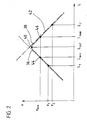
- FIG. 2 shows a diagram in which the control speed v over the air quantity L in the level control system is applied.
- a first straight line 36 is toward the diagram take out the control speed v for lifting the vehicle body a certain normal level depending on the air volume L. If the air volume L is small, this means that the storage pressure in the Compressed air reservoir 4 is low, so that there is a low control speed v. ever the greater the amount of air L, the faster lifting of the vehicle body can Help the air from the compressed air reservoir 4.
- the straight line 38 gives the control speed v for lowering the vehicle body a predetermined average load from a predetermined normal level depending on the air volume L again.
- the lower the amount of air L the more Compressed air from the air springs 2a to 2d can be moved faster to lower the Vehicle body, the compressor in the compressed air reservoir 4 and the more Lowering the vehicle body is possible more quickly.
- the two straight lines 36 and 38 intersect at a point to which a certain amount of air L opt belongs.
- the lifting process is faster than the lifting process
- the lifting process is faster than the lowering.
- Curve 42 almost straight lines 36 and 38 together, with curve 42 recording only the slower control speeds (ie to the left of vertex 40, to which air quantity L opt belongs, curve 42 becomes control speeds L for lifting of the vehicle body and to the right of the vertex 40, the control speeds L for the lowering of the vehicle body are represented by the curve 42).
- the minimum control speed v min for lifting the vehicle body can no longer be maintained. If the amount of air has dropped to L 1 below L min , for example, the control speed v for lifting the vehicle body is v 1 , which is less than the minimum control speed v min . If, when determining the air volume in the level control system, it is determined that the air volume L in the level control system is only L 1 , i.e. less than L min , the compressed air reservoir 4 (see FIG. 1) is filled with air from the atmosphere as long as until the air volume L is back in the work area.
- the filling of the compressed air reservoir 4 is preferably carried out until the air quantity L in the level control system again takes up the air quantity L opt , since this air quantity L opt lies in the middle of the working area and thus the air quantity in the level control system has the maximum fluctuation range after filling. until it falls out of the work area.
- the time span over which the compressed air reservoir 4 has to be filled can be determined, for example, as follows: First, the difference L opt - L 1 is determined. This difference likely that air flow L on fixed, which are incorporated in the level control system needs to opt out of the air quantity L 1 to the amount of air L to come. Then, with the aid of the compressor 6 of the level control system, air is transferred from the atmosphere into the compressed air reservoir 4 until the air quantity L has been transferred into the compressed air reservoir 4 (for filling the compressed air reservoir with the aid of the compressor 6, see FIG. 1).
- the required time period can be determined from a characteristic curve stored in the control unit of the level control system, which for all conceivable air quantities L auf (L auf is maximum L opt (if the level control system was empty before filling) and minimal O (if it was the amount of air in the level control system L opt corresponds)) shows the relationship between the amount of air L to be delivered by the compressor and the compressor running time.
- the vehicle body is lowered at a control speed v 2 that is less than the minimum control speed v min .
- compressed air is discharged from the compressed air reservoir 4 until the compressed air present in the level control system is again in the work area.
- Compressed air is preferably discharged from the compressed air reservoir 4 until the actual air quantity L in the level control system corresponds to the air quantity L opt (for reasons see above).
- the time span over which compressed air must be released can be determined as follows: First, the difference L 2 - L opt is determined.
- the method explained above ensures that the actual air quantity L in the level control system is brought to the air quantity L opt after the actual air quantity in the level control system has been outside the working area.
- the work area becomes so large chosen that due to the temperature fluctuations within a set
- the duration of the varying amount of air L is always within the working range. For example, the duration of a day can be used as a time period for the temperature fluctuations can be assumed and for the size of the temperature fluctuation, for example a range from - 20 ° C to + 20 ° C can be specified.
Landscapes
- Engineering & Computer Science (AREA)
- Mechanical Engineering (AREA)
- Vehicle Body Suspensions (AREA)
- Control Of Positive-Displacement Pumps (AREA)
- Filling Or Discharging Of Gas Storage Vessels (AREA)
- Fluid-Pressure Circuits (AREA)
Abstract
Description
- einen Kompressor,
- einen Druckluftspeicher, der mit Luft aus der Atmosphäre befüllbar und der in die Atmosphäre entleerbar ist,
- mindestens eine Luftfeder, wobei die Luftfeder über den Kompressor mit dem Druckluftspeicher derart in Verbindung steht, dass Druckluft aus der Luftfeder in den Druckluftspeicher und in die umgekehrte Richtung überführbar ist.
- der Druckluftspeicher mit Luft aus der Atmosphäre aufgefüllt wird, wenn die Luftmenge unterhalb einer unteren Grenze liegt und
- der Druckluftspeicher in die Atmosphäre entleert wird, wenn die Luftmenge oberhalb einer oberen Grenze liegt, wobei die Regelung derart vorgenommen wird, dass die Luftmenge nach dem Auffüllen bzw. Entleeren in einem Arbeitsbereich zwischen der unteren und der oberen Grenze liegt.
- die Luftmenge in der Niveauregelanlage bestimmt wird
- die bestimmte Luftmenge von einer vorgegebenen Luftmenge, die innerhalb des Arbeitsbereiches liegt, abgezogen wird
- aus der Differenz eine Zeitspanne bestimmt wird, über die der Druckluftspeicher aufgefüllt oder entleert werden muss, um von der bestimmten Luftmenge zu der vorgegebenen Luftmenge zu kommen
- der Druckluftspeicher über die bestimmte Zeitspanne aufgefüllt oder entleert wird.
- jeweils über einen längeren Zeitraum der arithmetrische Mittelwert aus den während des Zeitraumes bestimmten Luftmengen gebildet wird
- ein so bestimmter Mittelwert mit mindestens einem zuvor entsprechend bestimmten Mittelwert verglichen wird, und
- bei einem Sinken des Mittelwertes auf eine Leckage der Niveauregelanlage geschlossen wird.
- Fig. 1
- eine geschlossene Niveauregelanlage in schematischer Darstellung
- Fig. 2
- ein Diagramm.
- der Druckluftspeicher 4 mit Luft aus der Atmosphäre aufgefüllt wird, wenn die Luftmenge unterhalb der unteren Grenze Lmin liegt
- der Druckluftspeicher 4 in die Atmosphäre entleert wird, wenn die Luftmenge oberhalb der oberen Grenze Lmax liegt, wobei die Regelung derart vorgenommen wird, dass die Luftmenge nach dem Auffüllen bzw. Entleeren in dem Arbeitsbereich liegt.
- 2a, ..., 2d
- Luftfeder
- 4
- Druckluftspeicher
- 6
- Kompressor
- 8
- Eingang des Kompressors
- 10
- Ausgang des Kompressors
- 14
- steuerbares Wegeventil
- 18
- steuerbares Wegeventil
- 24a, ..., 24d
- steuerbare Wegeventile
- 30
- Drucksensor
- 34
- steuerbares Wegeventil
- 36
- Gerade
- 38
- Gerade
- 40
- Scheitelpunkt
- 42
- Kurve
- 44
- Punkt
- 46
- Punkt
Claims (8)
- Verfahren zur Regelung des Speicherdruckes des Druckluftspeichers (4) einer geschlossenen Niveauregelanlage für ein Kraftfahrzeug, die folgende Bestandteile enthält:dadurch gekennzeichnet, dass der Speicherdruck des Druckluftspeichers (4) indirekt über die Luftmenge in der Niveauregelanlage geregelt wird, indem diese bestimmt wird undeinen Kompressor (6),einen Druckluftspeicher (4), der mit Luft aus der Atmosphäre befüllbar und der in die Atmosphäre entleerbar istmindestens eine Luftfeder (2a - 2d), wobei die Luftfeder (2a - 2d) über den Kompressor (6) mit dem Druckluftspeicher (4) derart in Verbindung steht, dass Druckluft aus der Luftfeder (2a - 2d) in den Druckluftspeicher (4) und in die umgekehrte Richtung überführbar istder Druckluftspeicher (4) mit Luft aus der Atmosphäre aufgefüllt wird, wenn die Luftmenge unterhalb einer unteren Grenze liegtder Druckluftspeicher (4) in die Atmosphäre entleert wird, wenn die Luftmenge oberhalb einer oberen Grenze liegt, wobei die Regelung derart vorgenommen wird, dass die Luftmenge nach dem Auffüllen bzw. Entleeren in einem Arbeitsbereich zwischen der unteren und der oberen Grenze liegt.
- Verfahren nach Anspruch 1, dadurch gekennzeichnet, dass die Luftmenge in der Niveauregelanlage aus der Summe der Luftmengen in den Luftfedern (2a - 2d) und der Luftmenge in dem Druckluftspeicher (4) bestimmt wird.
- Verfahren nach einem der Ansprüche 1 bis 2, dadurch gekennzeichnet, dass der Druckluftspeicher (4) derart aufgefüllt oder entleert wird, dass die Luftmenge nach dem Auffüllen oder Entleeren zumindest nahe der Mitte des Arbeitsbereiches liegt.
- Verfahren nach einem der Ansprüche 1 bis 3, dadurch gekennzeichnet, dassdie Luftmenge in der Niveauregelanlage bestimmt wirddie bestimmte Luftmenge von einer vorgegebenen Luftmenge, die innerhalb des Arbeitsbereiches liegt, abgezogen wirdaus der Differenz wird eine Zeitspanne bestimmt, über die der Druckluftspeicher (4) aufgefüllt oder entleert werden muß, um von der bestimmten Luftmenge zu der vorgegebenen Luftmenge zu kommender Druckluftspeicher (4) wird über die bestimmte Zeitspanne aufgefüllt oder entleert.
- Verfahren nach einem der Ansprüche 1 bis 4, dadurch gekennzeichnet, dass der Arbeitsbereich so gewählt wird, dass die Luftmenge in der Niveauregelanlage auch bei Temperaturschwankungen im Laufe eines längeren Zeitraumes zumindest meistens innerhalb des Arbeitsbereiches liegt.
- Verfahren nach einem der Ansprüche 1 bis 5, dadurch gekennzeichnet, dass die Luftmenge in der Niveauregelanlage bei Inbetriebnahme des Kraftfahrzeuges bestimmt wird.
- Verfahren nach einem der Ansprüche 1 bis 6, dadurch gekennzeichnet, dassjeweils über einen langen Zeitraum der Mittelwert aus den während des Zeitraumes bestimmten Luftmengen gebildet wirdein so bestimmter Mittelwert mit mindestens einem zuvor entsprechend bestimmten Mittelwert verglichen wird, undbei einem Sinken des Mittelwertes auf eine Undichtigkeit der Niveauregelanlage geschlossen wird.
- Verfahren nach einem der Ansprüche 1 bis 7, dadurch gekennzeichnet, dass der Mittelwert des Arbeitsbereiches ausgehend von einer bestimmten Umgebungstemperatur, einem bestimmten Beladungszustandes, eines bestimmten Normalniveaus des Fahrzeugaufbaus und bestimmten Mindestregelzeiten für das Anheben bzw. Absenken des Fahrzeugaufbaus aus dem Normalniveau in andere bestimmte Niveaus festgelegt wird.
Applications Claiming Priority (2)
| Application Number | Priority Date | Filing Date | Title |
|---|---|---|---|
| DE10122567A DE10122567C1 (de) | 2001-05-10 | 2001-05-10 | Verfahren zur Regelung des Speicherdruckes in einer geschlossenen Niveauregelanlage |
| DE10122567 | 2001-05-10 |
Publications (3)
| Publication Number | Publication Date |
|---|---|
| EP1256466A2 true EP1256466A2 (de) | 2002-11-13 |
| EP1256466A3 EP1256466A3 (de) | 2004-09-15 |
| EP1256466B1 EP1256466B1 (de) | 2007-03-07 |
Family
ID=7684186
Family Applications (1)
| Application Number | Title | Priority Date | Filing Date |
|---|---|---|---|
| EP02008370A Expired - Lifetime EP1256466B1 (de) | 2001-05-10 | 2002-04-12 | Verfahren zur Regelung des Speicherdruckes in einer geschlossenen Niveauregelanlage |
Country Status (4)
| Country | Link |
|---|---|
| US (1) | US6874772B2 (de) |
| EP (1) | EP1256466B1 (de) |
| JP (1) | JP4040898B2 (de) |
| DE (2) | DE10122567C1 (de) |
Cited By (5)
| Publication number | Priority date | Publication date | Assignee | Title |
|---|---|---|---|---|
| WO2005002892A1 (de) * | 2003-07-04 | 2005-01-13 | Continental Aktiengesellschaft | Verfahren zur höhenregelung für ein fahrzeug |
| WO2007048689A1 (de) * | 2005-10-28 | 2007-05-03 | Continental Aktiengesellschaft | Pneumatische niveauregelanlage |
| EP2301775A1 (de) * | 2009-09-29 | 2011-03-30 | Continental Teves AG & Co. oHG | Verfahren zur Bestimmung der Luftmasse in einem elektronisch regelbaren Luftfedersystem für Kraftfahrzeuge und Vorrichtung zur Durchführung des Verfahrens |
| WO2011104272A1 (de) * | 2010-02-25 | 2011-09-01 | Knorr-Bremse Systeme für Nutzfahrzeuge GmbH | Verfahren zum betreiben einer niveauregeleinrichtung eines fahrzeugs |
| EP3659834A3 (de) * | 2018-10-15 | 2020-08-12 | Amk Holding Gmbh & Co. Kg | Lagervorrichtung für einen luftkompressor eines fahrzeugs |
Families Citing this family (30)
| Publication number | Priority date | Publication date | Assignee | Title |
|---|---|---|---|---|
| JP4158150B2 (ja) * | 2003-06-04 | 2008-10-01 | いすゞ自動車株式会社 | 車高調整装置 |
| FR2857300B1 (fr) * | 2003-07-11 | 2007-03-02 | Volkswagen Ag | Systeme de suspension et d'amortissement pour vehicule, et vehicule le comportant |
| DE10333204A1 (de) * | 2003-07-22 | 2005-02-24 | Conti Temic Microelectronic Gmbh | Verfahren und Vorrichtung zur Druckmessung |
| DE10336441A1 (de) | 2003-08-08 | 2005-03-03 | Wabco Gmbh & Co.Ohg | Verfahren zur Regelung des Speicherdrucks eines Druckluftspeichers einer Niveauregelanlage für ein Kraftfahrzeug |
| DE10342120A1 (de) * | 2003-09-10 | 2005-04-28 | Continental Ag | Verfahren zur Messung eines Drucks, Niveauregelanlage und Ventil |
| DE10343094B4 (de) * | 2003-09-18 | 2012-05-16 | Continental Teves Ag & Co. Ohg | Verfahren zur Regelung der Luftmenge in einer Niveauregelanlage für ein Kraftfahrzeug |
| DE10344153A1 (de) | 2003-09-22 | 2005-04-28 | Continental Ag | Luftfedersystem |
| DE102004021170A1 (de) * | 2004-04-29 | 2005-11-24 | Continental Aktiengesellschaft | Geschlossene Niveauregelanlage für ein Kraftfahrzeug |
| DE102004021592A1 (de) | 2004-05-03 | 2005-12-01 | Continental Aktiengesellschaft | Verfahren zur Luftmengenregelung in einer geschlossenen Luftversorgungsanlage für ein Fahrwerk |
| DE102004021593A1 (de) * | 2004-05-03 | 2005-12-01 | Continental Aktiengesellschaft | Verfahren zur Luftmengenregelung in einer geschlossenen Luftversorgungsanlage für ein Fahrwerk |
| DE102004025340A1 (de) * | 2004-05-19 | 2005-12-15 | Continental Aktiengesellschaft | Verfahren zur Luftmengenregelung in einer geschlossenen Luftversorgungsanlage für ein Fahrwerk |
| DE102004033524A1 (de) | 2004-07-10 | 2006-02-16 | Continental Aktiengesellschaft | Verfahren zur beladungsabhängigen Luftmengenregelung in einem Luftfedersystem |
| KR100579453B1 (ko) * | 2004-07-22 | 2006-05-15 | 현대모비스 주식회사 | 차량의 에어 서스펜션 시스템 |
| KR100599480B1 (ko) | 2004-09-06 | 2006-07-12 | 현대모비스 주식회사 | 폐루프 차고조절시스템 |
| DE102005045269A1 (de) * | 2005-09-22 | 2007-03-29 | Continental Aktiengesellschaft | Verfahren und Vorrichtung zur Erkennung von Leckagen in einer Kraftfahrzeug-Luftfederanordnung |
| JP4702078B2 (ja) * | 2006-02-03 | 2011-06-15 | トヨタ自動車株式会社 | エアサスペンション装置 |
| US8947531B2 (en) * | 2006-06-19 | 2015-02-03 | Oshkosh Corporation | Vehicle diagnostics based on information communicated between vehicles |
| US8139109B2 (en) | 2006-06-19 | 2012-03-20 | Oshkosh Corporation | Vision system for an autonomous vehicle |
| JP4793577B2 (ja) * | 2006-11-10 | 2011-10-12 | アイシン精機株式会社 | 車高調整装置 |
| DE102006054813A1 (de) * | 2006-11-22 | 2008-05-29 | Wabco Gmbh | Verfahren zur Druckluftversorgung in einem Fahrzeug |
| US20090050219A1 (en) * | 2007-08-21 | 2009-02-26 | Briggs And Stratton Corporation | Fluid compressor and control device for the same |
| DE102010008748A1 (de) * | 2010-02-20 | 2011-08-25 | Dr. Ing. h.c. F. Porsche Aktiengesellschaft, 70435 | Luftfedersystem |
| US8851237B2 (en) * | 2010-04-22 | 2014-10-07 | Bishamon Industries Corporation | Variable-capacity self-adjusting pneumatic load elevator |
| US8459619B2 (en) * | 2010-10-24 | 2013-06-11 | Oshkosh Corporation | Gas spring control system and method |
| JP6221693B2 (ja) * | 2013-11-29 | 2017-11-01 | アイシン精機株式会社 | 車高調整装置 |
| JP6378228B2 (ja) | 2016-03-14 | 2018-08-22 | トヨタ自動車株式会社 | 車高調整システム |
| JP6475179B2 (ja) | 2016-03-14 | 2019-02-27 | アイシン精機株式会社 | 車高制御システム |
| KR102562114B1 (ko) * | 2016-10-10 | 2023-08-02 | 현대모비스 주식회사 | 에어 현가 공압 회로 |
| DE102019205426B3 (de) * | 2019-04-15 | 2020-09-24 | Continental Teves Ag & Co. Ohg | Verfahren zur Ermittlung/Überwachung des Beladungszustandes eines mit einem Luftfedersystem versehenen Fahrzeuges |
| EP4101666B1 (de) * | 2021-06-08 | 2025-04-02 | Wuhan Lotus Cars Co., Ltd. | Verfahren, steuermodul und system zur vermeidung einer überhitzung eines fahrzeuguntersystems |
Citations (1)
| Publication number | Priority date | Publication date | Assignee | Title |
|---|---|---|---|---|
| DE19959556C1 (de) | 1999-12-10 | 2000-12-14 | Continental Ag | Geschlossene Niveauregeleinrichtung für Fahrzeuge |
Family Cites Families (8)
| Publication number | Priority date | Publication date | Assignee | Title |
|---|---|---|---|---|
| JPS5913137Y2 (ja) * | 1979-08-20 | 1984-04-19 | トキコ株式会社 | 車高調整装置 |
| US4858895A (en) * | 1987-06-09 | 1989-08-22 | Toyota Jidosha Kabushiki Kaisha | Vehicle fluid suspension circuit with equalized supply and discharge speeds |
| DE19603593C1 (de) * | 1996-02-01 | 1997-04-30 | Daimler Benz Ag | Pneumatisches bzw. hydropneumatisches Federungssystem |
| GB9724444D0 (en) * | 1997-11-19 | 1998-01-14 | Dunlop Ltd | Vehicle suspension gas supply system |
| DE19813672C1 (de) * | 1998-03-27 | 1999-05-20 | Daimler Chrysler Ag | Luftfederungsanlage für Fahrzeuge |
| DE19940922A1 (de) * | 1999-08-27 | 2001-03-22 | Continental Ag | Niveauregelsystem mit einem Druckspeicher für ein Fahrzeug mit Luftfedern |
| US6173974B1 (en) * | 1999-09-28 | 2001-01-16 | Ford Global Technologies, Inc. | Detecting jacking or hoisting of a vehicle having a suspension system that includes gas levelers |
| DE10006024C1 (de) * | 2000-02-11 | 2001-10-25 | Continental Ag | Verfahren zum Auffüllen einer Druckmittelkammer einer Niveauregelanlage aus einem Druckmittelspeicher |
-
2001
- 2001-05-10 DE DE10122567A patent/DE10122567C1/de not_active Expired - Fee Related
-
2002
- 2002-04-12 EP EP02008370A patent/EP1256466B1/de not_active Expired - Lifetime
- 2002-04-12 DE DE50209623T patent/DE50209623D1/de not_active Expired - Lifetime
- 2002-04-12 JP JP2002110664A patent/JP4040898B2/ja not_active Expired - Fee Related
- 2002-05-09 US US10/140,811 patent/US6874772B2/en not_active Expired - Lifetime
Patent Citations (1)
| Publication number | Priority date | Publication date | Assignee | Title |
|---|---|---|---|---|
| DE19959556C1 (de) | 1999-12-10 | 2000-12-14 | Continental Ag | Geschlossene Niveauregeleinrichtung für Fahrzeuge |
Cited By (9)
| Publication number | Priority date | Publication date | Assignee | Title |
|---|---|---|---|---|
| WO2005002892A1 (de) * | 2003-07-04 | 2005-01-13 | Continental Aktiengesellschaft | Verfahren zur höhenregelung für ein fahrzeug |
| WO2007048689A1 (de) * | 2005-10-28 | 2007-05-03 | Continental Aktiengesellschaft | Pneumatische niveauregelanlage |
| EP2301775A1 (de) * | 2009-09-29 | 2011-03-30 | Continental Teves AG & Co. oHG | Verfahren zur Bestimmung der Luftmasse in einem elektronisch regelbaren Luftfedersystem für Kraftfahrzeuge und Vorrichtung zur Durchführung des Verfahrens |
| WO2011104272A1 (de) * | 2010-02-25 | 2011-09-01 | Knorr-Bremse Systeme für Nutzfahrzeuge GmbH | Verfahren zum betreiben einer niveauregeleinrichtung eines fahrzeugs |
| EP2363309A1 (de) * | 2010-02-25 | 2011-09-07 | KNORR-BREMSE Systeme für Nutzfahrzeuge GmbH | Verfahren zum Betreiben einer Niveauregeleinrichtung eines Fahrzeugs |
| CN102905917A (zh) * | 2010-02-25 | 2013-01-30 | 克诺尔商用车制动系统有限公司 | 一种汽车车身水平调整装置的运行方法 |
| US8746706B2 (en) | 2010-02-25 | 2014-06-10 | Knorr-Bremse Systeme Fuer Nutzfahrzeuge Gmbh | Method for operating a leveling device of a vehicle |
| CN102905917B (zh) * | 2010-02-25 | 2015-09-16 | 克诺尔商用车制动系统有限公司 | 一种汽车车身水平调整装置的运行方法 |
| EP3659834A3 (de) * | 2018-10-15 | 2020-08-12 | Amk Holding Gmbh & Co. Kg | Lagervorrichtung für einen luftkompressor eines fahrzeugs |
Also Published As
| Publication number | Publication date |
|---|---|
| DE50209623D1 (de) | 2007-04-19 |
| DE10122567C1 (de) | 2002-11-21 |
| US6874772B2 (en) | 2005-04-05 |
| JP4040898B2 (ja) | 2008-01-30 |
| JP2003054236A (ja) | 2003-02-26 |
| EP1256466B1 (de) | 2007-03-07 |
| EP1256466A3 (de) | 2004-09-15 |
| US20020166321A1 (en) | 2002-11-14 |
Similar Documents
| Publication | Publication Date | Title |
|---|---|---|
| DE10122567C1 (de) | Verfahren zur Regelung des Speicherdruckes in einer geschlossenen Niveauregelanlage | |
| EP1744914B1 (de) | Geschlossene niveauregelanlage für ein kraftfahrzeug | |
| EP1380453A1 (de) | Geschlossene Niveauregelanlage mit zwei Druckspeichern für Fahrzeuge | |
| DE10232769B4 (de) | Hydropneumatische Achsfederung für Fahrzeuge für Fahrzeuge mit stark wechselden Achslasten | |
| DE102014010956B4 (de) | Druckluftversorgungsanlage, pneumatisches System und Verfahren zum Betreiben einer Druckluftversorgungsanlage | |
| WO2005005181A1 (de) | Verfafhren zur niveauregelung für pneumatische niveauregelanlagen in kraftfahrzeugen | |
| DE102009003686A1 (de) | Kraftfahrzeug mit einer Niveauregelanlage | |
| DE102008021818B4 (de) | Verfahren zum Steuern einer Niveauregelanlage sowie Niveauregelanlage | |
| WO2007073786A2 (de) | Hydropneumatische achsfederung für fahrzeuge | |
| DE4027689C2 (de) | Aktives Radaufhängungssystem für Kraftfahrzeuge | |
| DE102017011905A1 (de) | Verfahren und Einrichtung zum Betreiben eines pneumatischen Systems mit einer Druckluftversorgungsanlage und einer Luftfederanlage und pneumatisches System mit einer Druckluftversorgungsanlage und einer Luftfederanlage sowie Fahrzeug | |
| DE102014004337A1 (de) | Kommunalfahrzeug | |
| DE102009020111A1 (de) | Hydrostatisches Antriebssystem und Verfahren zum Betrieb eines hydrostatischen Antriebssystems | |
| DE4313597B4 (de) | Verfahren zum Betreiben einer verstellbaren hydrostatischen Pumpe und dafür ausgebildetes hydrostatisches Antriebssystem | |
| DE3300662A1 (de) | Niveauregeleinrichtung fuer fahrzeuge | |
| DE102004008611A1 (de) | Hydrauliksystem eines Getriebes | |
| DE102006054032A1 (de) | Steuerungsvorrichtung für ein Getriebe und Verfahren zur Steuerung eines Getriebes | |
| DE10343094B4 (de) | Verfahren zur Regelung der Luftmenge in einer Niveauregelanlage für ein Kraftfahrzeug | |
| DE112004002768B4 (de) | Hydraulisches Steuersystem | |
| EP1744916B1 (de) | Verfahren zur luftmengenregelung in einer geschlossenen luftversorgungsanlage für ein fahrwerk | |
| WO2020239440A1 (de) | Elektronisch gesteuert und/oder geregeltes luftfedersystem, luftfederanlage und verfahren zur höhenregulierung eines fahrzeugs | |
| DE19925665B4 (de) | Verfahren zum Einstellen des Systemdrucks in einem hydraulischen Stellantrieb und hydraulischer Stellantrieb | |
| DE102005054506B4 (de) | Niveauregelanlage für Fahrzeuge | |
| WO2022207416A9 (de) | Vorrichtung zum regeln einer hydraulikpumpe oder eines hydraulikmotors | |
| EP0670230B1 (de) | Druckmittelversorgung für eine hydropneumatische, niveaugeregelte Achsfederung eines Arbeitsfahrzeuges |
Legal Events
| Date | Code | Title | Description |
|---|---|---|---|
| PUAI | Public reference made under article 153(3) epc to a published international application that has entered the european phase |
Free format text: ORIGINAL CODE: 0009012 |
|
| AK | Designated contracting states |
Kind code of ref document: A2 Designated state(s): AT BE CH CY DE DK ES FI FR GB GR IE IT LI LU MC NL PT SE TR |
|
| AX | Request for extension of the european patent |
Free format text: AL;LT;LV;MK;RO;SI |
|
| PUAL | Search report despatched |
Free format text: ORIGINAL CODE: 0009013 |
|
| AK | Designated contracting states |
Kind code of ref document: A3 Designated state(s): AT BE CH CY DE DK ES FI FR GB GR IE IT LI LU MC NL PT SE TR |
|
| AX | Request for extension of the european patent |
Extension state: AL LT LV MK RO SI |
|
| 17P | Request for examination filed |
Effective date: 20050315 |
|
| AKX | Designation fees paid |
Designated state(s): DE ES FR GB IT SE |
|
| GRAP | Despatch of communication of intention to grant a patent |
Free format text: ORIGINAL CODE: EPIDOSNIGR1 |
|
| GRAS | Grant fee paid |
Free format text: ORIGINAL CODE: EPIDOSNIGR3 |
|
| GRAA | (expected) grant |
Free format text: ORIGINAL CODE: 0009210 |
|
| AK | Designated contracting states |
Kind code of ref document: B1 Designated state(s): DE ES FR GB IT SE |
|
| REG | Reference to a national code |
Ref country code: GB Ref legal event code: FG4D Free format text: NOT ENGLISH |
|
| REF | Corresponds to: |
Ref document number: 50209623 Country of ref document: DE Date of ref document: 20070419 Kind code of ref document: P |
|
| PG25 | Lapsed in a contracting state [announced via postgrant information from national office to epo] |
Ref country code: SE Free format text: LAPSE BECAUSE OF FAILURE TO SUBMIT A TRANSLATION OF THE DESCRIPTION OR TO PAY THE FEE WITHIN THE PRESCRIBED TIME-LIMIT Effective date: 20070607 |
|
| PG25 | Lapsed in a contracting state [announced via postgrant information from national office to epo] |
Ref country code: ES Free format text: LAPSE BECAUSE OF FAILURE TO SUBMIT A TRANSLATION OF THE DESCRIPTION OR TO PAY THE FEE WITHIN THE PRESCRIBED TIME-LIMIT Effective date: 20070618 |
|
| ET | Fr: translation filed | ||
| GBV | Gb: ep patent (uk) treated as always having been void in accordance with gb section 77(7)/1977 [no translation filed] |
Effective date: 20070307 |
|
| PG25 | Lapsed in a contracting state [announced via postgrant information from national office to epo] |
Ref country code: GB Free format text: LAPSE BECAUSE OF FAILURE TO SUBMIT A TRANSLATION OF THE DESCRIPTION OR TO PAY THE FEE WITHIN THE PRESCRIBED TIME-LIMIT Effective date: 20070307 |
|
| PLBE | No opposition filed within time limit |
Free format text: ORIGINAL CODE: 0009261 |
|
| STAA | Information on the status of an ep patent application or granted ep patent |
Free format text: STATUS: NO OPPOSITION FILED WITHIN TIME LIMIT |
|
| 26N | No opposition filed |
Effective date: 20071210 |
|
| PGFP | Annual fee paid to national office [announced via postgrant information from national office to epo] |
Ref country code: IT Payment date: 20090423 Year of fee payment: 8 |
|
| PG25 | Lapsed in a contracting state [announced via postgrant information from national office to epo] |
Ref country code: IT Free format text: LAPSE BECAUSE OF NON-PAYMENT OF DUE FEES Effective date: 20100412 |
|
| REG | Reference to a national code |
Ref country code: DE Ref legal event code: R081 Ref document number: 50209623 Country of ref document: DE Owner name: CONTINENTAL TEVES AG & CO. OHG, DE Free format text: FORMER OWNER: CONTINENTAL AKTIENGESELLSCHAFT, 30165 HANNOVER, DE Effective date: 20110414 |
|
| REG | Reference to a national code |
Ref country code: FR Ref legal event code: PLFP Year of fee payment: 15 |
|
| REG | Reference to a national code |
Ref country code: FR Ref legal event code: PLFP Year of fee payment: 16 |
|
| REG | Reference to a national code |
Ref country code: FR Ref legal event code: PLFP Year of fee payment: 17 |
|
| PGFP | Annual fee paid to national office [announced via postgrant information from national office to epo] |
Ref country code: DE Payment date: 20190430 Year of fee payment: 18 |
|
| PGFP | Annual fee paid to national office [announced via postgrant information from national office to epo] |
Ref country code: FR Payment date: 20200420 Year of fee payment: 19 |
|
| REG | Reference to a national code |
Ref country code: DE Ref legal event code: R119 Ref document number: 50209623 Country of ref document: DE |
|
| PG25 | Lapsed in a contracting state [announced via postgrant information from national office to epo] |
Ref country code: DE Free format text: LAPSE BECAUSE OF NON-PAYMENT OF DUE FEES Effective date: 20201103 |
|
| PG25 | Lapsed in a contracting state [announced via postgrant information from national office to epo] |
Ref country code: FR Free format text: LAPSE BECAUSE OF NON-PAYMENT OF DUE FEES Effective date: 20210430 |