EP1255761B1 - Silicon containing compounds from michael - type addition reactions useful as monomers and macromers - Google Patents
Silicon containing compounds from michael - type addition reactions useful as monomers and macromers Download PDFInfo
- Publication number
- EP1255761B1 EP1255761B1 EP01905867A EP01905867A EP1255761B1 EP 1255761 B1 EP1255761 B1 EP 1255761B1 EP 01905867 A EP01905867 A EP 01905867A EP 01905867 A EP01905867 A EP 01905867A EP 1255761 B1 EP1255761 B1 EP 1255761B1
- Authority
- EP
- European Patent Office
- Prior art keywords
- group
- groups
- aryl
- alkyl
- sup
- Prior art date
- Legal status (The legal status is an assumption and is not a legal conclusion. Google has not performed a legal analysis and makes no representation as to the accuracy of the status listed.)
- Expired - Lifetime
Links
- 239000000178 monomer Substances 0.000 title description 19
- 238000007259 addition reaction Methods 0.000 title 1
- 239000002210 silicon-based material Substances 0.000 title 1
- -1 cycloalkynyl Chemical group 0.000 claims abstract description 62
- 125000003118 aryl group Chemical group 0.000 claims abstract description 34
- 239000000203 mixture Substances 0.000 claims abstract description 27
- 238000000034 method Methods 0.000 claims abstract description 26
- 239000001257 hydrogen Substances 0.000 claims abstract description 25
- 229910052739 hydrogen Inorganic materials 0.000 claims abstract description 25
- 125000000217 alkyl group Chemical group 0.000 claims abstract description 24
- 125000002877 alkyl aryl group Chemical group 0.000 claims abstract description 23
- 125000003710 aryl alkyl group Chemical group 0.000 claims abstract description 23
- 125000003342 alkenyl group Chemical group 0.000 claims abstract description 20
- 125000000304 alkynyl group Chemical group 0.000 claims abstract description 20
- UFHFLCQGNIYNRP-UHFFFAOYSA-N Hydrogen Chemical compound [H][H] UFHFLCQGNIYNRP-UHFFFAOYSA-N 0.000 claims abstract description 19
- 229920000642 polymer Polymers 0.000 claims abstract description 19
- 125000000392 cycloalkenyl group Chemical group 0.000 claims abstract description 16
- 125000000753 cycloalkyl group Chemical group 0.000 claims abstract description 16
- IQPQWNKOIGAROB-UHFFFAOYSA-N isocyanate group Chemical group [N-]=C=O IQPQWNKOIGAROB-UHFFFAOYSA-N 0.000 claims abstract description 16
- 125000002887 hydroxy group Chemical group [H]O* 0.000 claims abstract description 13
- 125000005375 organosiloxane group Chemical group 0.000 claims abstract description 12
- 125000004457 alkyl amino carbonyl group Chemical group 0.000 claims abstract description 9
- 125000002915 carbonyl group Chemical group [*:2]C([*:1])=O 0.000 claims abstract description 9
- 125000005041 acyloxyalkyl group Chemical group 0.000 claims abstract description 8
- 125000004183 alkoxy alkyl group Chemical group 0.000 claims abstract description 8
- 125000004171 alkoxy aryl group Chemical group 0.000 claims abstract description 8
- 230000008569 process Effects 0.000 claims abstract description 8
- 125000004945 acylaminoalkyl group Chemical group 0.000 claims abstract description 7
- 125000004423 acyloxy group Chemical group 0.000 claims abstract description 7
- 150000001282 organosilanes Chemical class 0.000 claims abstract description 7
- 125000005128 aryl amino alkyl group Chemical group 0.000 claims abstract description 6
- 150000002431 hydrogen Chemical group 0.000 claims abstract description 6
- 125000006575 electron-withdrawing group Chemical group 0.000 claims abstract description 5
- 125000001188 haloalkyl group Chemical group 0.000 claims abstract description 5
- 125000003106 haloaryl group Chemical group 0.000 claims abstract description 5
- 150000004714 phosphonium salts Chemical class 0.000 claims abstract description 5
- 125000001174 sulfone group Chemical group 0.000 claims abstract description 5
- RWSOTUBLDIXVET-UHFFFAOYSA-O sulfonium Chemical compound [SH3+] RWSOTUBLDIXVET-UHFFFAOYSA-O 0.000 claims abstract description 5
- 125000003545 alkoxy group Chemical group 0.000 claims abstract description 4
- 125000004453 alkoxycarbonyl group Chemical group 0.000 claims abstract description 4
- 125000004103 aminoalkyl group Chemical group 0.000 claims abstract description 4
- 238000000576 coating method Methods 0.000 claims abstract description 4
- 125000005113 hydroxyalkoxy group Chemical group 0.000 claims abstract description 4
- XUIMIQQOPSSXEZ-UHFFFAOYSA-N Silicon Chemical compound [Si] XUIMIQQOPSSXEZ-UHFFFAOYSA-N 0.000 claims abstract description 3
- 125000005083 alkoxyalkoxy group Chemical group 0.000 claims abstract description 3
- 229910052710 silicon Inorganic materials 0.000 claims abstract description 3
- 239000010703 silicon Substances 0.000 claims abstract description 3
- 238000006243 chemical reaction Methods 0.000 claims description 34
- 150000001875 compounds Chemical class 0.000 claims description 34
- 239000012948 isocyanate Substances 0.000 claims description 20
- 150000002513 isocyanates Chemical class 0.000 claims description 17
- 125000002496 methyl group Chemical group [H]C([H])([H])* 0.000 claims description 16
- 125000002924 primary amino group Chemical group [H]N([H])* 0.000 claims description 16
- 229910052757 nitrogen Inorganic materials 0.000 claims description 15
- KFZMGEQAYNKOFK-UHFFFAOYSA-N Isopropanol Chemical compound CC(C)O KFZMGEQAYNKOFK-UHFFFAOYSA-N 0.000 claims description 14
- 239000002904 solvent Substances 0.000 claims description 14
- IJGRMHOSHXDMSA-UHFFFAOYSA-N nitrogen Substances N#N IJGRMHOSHXDMSA-UHFFFAOYSA-N 0.000 claims description 13
- 125000004178 (C1-C4) alkyl group Chemical group 0.000 claims description 12
- NIXOWILDQLNWCW-UHFFFAOYSA-M Acrylate Chemical compound [O-]C(=O)C=C NIXOWILDQLNWCW-UHFFFAOYSA-M 0.000 claims description 12
- 125000004432 carbon atom Chemical group C* 0.000 claims description 10
- 150000003254 radicals Chemical class 0.000 claims description 9
- 125000004400 (C1-C12) alkyl group Chemical group 0.000 claims description 8
- 125000004429 atom Chemical group 0.000 claims description 7
- 125000001261 isocyanato group Chemical group *N=C=O 0.000 claims description 7
- 125000004433 nitrogen atom Chemical group N* 0.000 claims description 7
- QJGQUHMNIGDVPM-UHFFFAOYSA-N nitrogen group Chemical group [N] QJGQUHMNIGDVPM-UHFFFAOYSA-N 0.000 claims description 7
- 239000003960 organic solvent Substances 0.000 claims description 7
- 125000004169 (C1-C6) alkyl group Chemical group 0.000 claims description 5
- LFQSCWFLJHTTHZ-UHFFFAOYSA-N Ethanol Chemical compound CCO LFQSCWFLJHTTHZ-UHFFFAOYSA-N 0.000 claims description 5
- 125000001931 aliphatic group Chemical group 0.000 claims description 5
- 125000000623 heterocyclic group Chemical group 0.000 claims description 5
- JUJWROOIHBZHMG-UHFFFAOYSA-N Pyridine Chemical compound C1=CC=NC=C1 JUJWROOIHBZHMG-UHFFFAOYSA-N 0.000 claims description 4
- 150000001298 alcohols Chemical class 0.000 claims description 4
- HXBPYFMVGFDZFT-UHFFFAOYSA-N allyl isocyanate Chemical compound C=CCN=C=O HXBPYFMVGFDZFT-UHFFFAOYSA-N 0.000 claims description 4
- 125000000129 anionic group Chemical group 0.000 claims description 4
- 125000002091 cationic group Chemical group 0.000 claims description 4
- 150000002170 ethers Chemical class 0.000 claims description 4
- 125000000524 functional group Chemical group 0.000 claims description 4
- 125000000022 2-aminoethyl group Chemical group [H]C([*])([H])C([H])([H])N([H])[H] 0.000 claims description 3
- 239000005058 Isophorone diisocyanate Substances 0.000 claims description 3
- 125000004202 aminomethyl group Chemical group [H]N([H])C([H])([H])* 0.000 claims description 3
- 239000003153 chemical reaction reagent Substances 0.000 claims description 3
- 150000008280 chlorinated hydrocarbons Chemical class 0.000 claims description 3
- 239000011248 coating agent Substances 0.000 claims description 3
- 125000001495 ethyl group Chemical group [H]C([H])([H])C([H])([H])* 0.000 claims description 3
- 125000001153 fluoro group Chemical group F* 0.000 claims description 3
- NIMLQBUJDJZYEJ-UHFFFAOYSA-N isophorone diisocyanate Chemical compound CC1(C)CC(N=C=O)CC(C)(CN=C=O)C1 NIMLQBUJDJZYEJ-UHFFFAOYSA-N 0.000 claims description 3
- QGZKDVFQNNGYKY-UHFFFAOYSA-O Ammonium Chemical compound [NH4+] QGZKDVFQNNGYKY-UHFFFAOYSA-O 0.000 claims description 2
- 125000000882 C2-C6 alkenyl group Chemical group 0.000 claims description 2
- 239000005057 Hexamethylene diisocyanate Substances 0.000 claims description 2
- NINIDFKCEFEMDL-UHFFFAOYSA-N Sulfur Chemical compound [S] NINIDFKCEFEMDL-UHFFFAOYSA-N 0.000 claims description 2
- 125000006620 amino-(C1-C6) alkyl group Chemical group 0.000 claims description 2
- 125000000732 arylene group Chemical group 0.000 claims description 2
- 125000000118 dimethyl group Chemical group [H]C([H])([H])* 0.000 claims description 2
- RRAMGCGOFNQTLD-UHFFFAOYSA-N hexamethylene diisocyanate Chemical compound O=C=NCCCCCCN=C=O RRAMGCGOFNQTLD-UHFFFAOYSA-N 0.000 claims description 2
- 125000001997 phenyl group Chemical group [H]C1=C([H])C([H])=C(*)C([H])=C1[H] 0.000 claims description 2
- XYFCBTPGUUZFHI-UHFFFAOYSA-O phosphonium Chemical compound [PH4+] XYFCBTPGUUZFHI-UHFFFAOYSA-O 0.000 claims description 2
- UMJSCPRVCHMLSP-UHFFFAOYSA-N pyridine Natural products COC1=CC=CN=C1 UMJSCPRVCHMLSP-UHFFFAOYSA-N 0.000 claims description 2
- 125000000547 substituted alkyl group Chemical group 0.000 claims description 2
- 125000000467 secondary amino group Chemical class [H]N([*:1])[*:2] 0.000 claims 4
- ZXEKIIBDNHEJCQ-UHFFFAOYSA-N isobutanol Chemical compound CC(C)CO ZXEKIIBDNHEJCQ-UHFFFAOYSA-N 0.000 claims 2
- 239000002184 metal Substances 0.000 claims 2
- 239000007788 liquid Substances 0.000 claims 1
- 125000001820 oxy group Chemical group [*:1]O[*:2] 0.000 claims 1
- DKGAVHZHDRPRBM-UHFFFAOYSA-N tert-butyl alcohol Substances CC(C)(C)O DKGAVHZHDRPRBM-UHFFFAOYSA-N 0.000 claims 1
- 150000003509 tertiary alcohols Chemical class 0.000 claims 1
- 125000001302 tertiary amino group Chemical group 0.000 claims 1
- 238000004519 manufacturing process Methods 0.000 abstract description 9
- 125000003302 alkenyloxy group Chemical group 0.000 abstract description 2
- 125000005133 alkynyloxy group Chemical group 0.000 abstract 1
- 125000004465 cycloalkenyloxy group Chemical group 0.000 abstract 1
- 125000000000 cycloalkoxy group Chemical group 0.000 abstract 1
- 125000005020 hydroxyalkenyl group Chemical group 0.000 abstract 1
- 125000005016 hydroxyalkynyl group Chemical group 0.000 abstract 1
- 125000005027 hydroxyaryl group Chemical group 0.000 abstract 1
- 125000002560 nitrile group Chemical group 0.000 abstract 1
- 229920001296 polysiloxane Polymers 0.000 description 21
- 150000001412 amines Chemical class 0.000 description 18
- 239000000047 product Substances 0.000 description 17
- 239000000463 material Substances 0.000 description 14
- WEVYAHXRMPXWCK-UHFFFAOYSA-N Acetonitrile Chemical compound CC#N WEVYAHXRMPXWCK-UHFFFAOYSA-N 0.000 description 12
- 238000006845 Michael addition reaction Methods 0.000 description 12
- 150000001252 acrylic acid derivatives Chemical class 0.000 description 10
- XLYOFNOQVPJJNP-UHFFFAOYSA-N water Substances O XLYOFNOQVPJJNP-UHFFFAOYSA-N 0.000 description 10
- 230000035699 permeability Effects 0.000 description 9
- HEDRZPFGACZZDS-MICDWDOJSA-N Trichloro(2H)methane Chemical compound [2H]C(Cl)(Cl)Cl HEDRZPFGACZZDS-MICDWDOJSA-N 0.000 description 8
- 125000003277 amino group Chemical group 0.000 description 8
- 150000003335 secondary amines Chemical group 0.000 description 8
- WOBHKFSMXKNTIM-UHFFFAOYSA-N Hydroxyethyl methacrylate Chemical compound CC(=C)C(=O)OCCO WOBHKFSMXKNTIM-UHFFFAOYSA-N 0.000 description 7
- 239000004205 dimethyl polysiloxane Substances 0.000 description 7
- 229920000435 poly(dimethylsiloxane) Polymers 0.000 description 7
- 238000002360 preparation method Methods 0.000 description 7
- 238000005160 1H NMR spectroscopy Methods 0.000 description 6
- WHNPOQXWAMXPTA-UHFFFAOYSA-N 3-methylbut-2-enamide Chemical compound CC(C)=CC(N)=O WHNPOQXWAMXPTA-UHFFFAOYSA-N 0.000 description 6
- CERQOIWHTDAKMF-UHFFFAOYSA-M Methacrylate Chemical compound CC(=C)C([O-])=O CERQOIWHTDAKMF-UHFFFAOYSA-M 0.000 description 6
- OKKJLVBELUTLKV-UHFFFAOYSA-N Methanol Chemical compound OC OKKJLVBELUTLKV-UHFFFAOYSA-N 0.000 description 6
- QVGXLLKOCUKJST-UHFFFAOYSA-N atomic oxygen Chemical compound [O] QVGXLLKOCUKJST-UHFFFAOYSA-N 0.000 description 6
- 239000003431 cross linking reagent Substances 0.000 description 6
- 125000004386 diacrylate group Chemical group 0.000 description 6
- 230000002209 hydrophobic effect Effects 0.000 description 6
- 239000001301 oxygen Substances 0.000 description 6
- 229910052760 oxygen Inorganic materials 0.000 description 6
- 239000000243 solution Substances 0.000 description 6
- 125000001424 substituent group Chemical group 0.000 description 6
- NIXOWILDQLNWCW-UHFFFAOYSA-N acrylic acid group Chemical group C(C=C)(=O)O NIXOWILDQLNWCW-UHFFFAOYSA-N 0.000 description 5
- 229920002818 (Hydroxyethyl)methacrylate Polymers 0.000 description 4
- BEWCNXNIQCLWHP-UHFFFAOYSA-N 2-(tert-butylamino)ethyl 2-methylprop-2-enoate Chemical compound CC(=C)C(=O)OCCNC(C)(C)C BEWCNXNIQCLWHP-UHFFFAOYSA-N 0.000 description 4
- KWYHDKDOAIKMQN-UHFFFAOYSA-N N,N,N',N'-tetramethylethylenediamine Chemical compound CN(C)CCN(C)C KWYHDKDOAIKMQN-UHFFFAOYSA-N 0.000 description 4
- 229910019142 PO4 Inorganic materials 0.000 description 4
- 229910018540 Si C Inorganic materials 0.000 description 4
- 150000003926 acrylamides Chemical class 0.000 description 4
- 125000005442 diisocyanate group Chemical group 0.000 description 4
- 238000009472 formulation Methods 0.000 description 4
- 239000000017 hydrogel Substances 0.000 description 4
- 229960004592 isopropanol Drugs 0.000 description 4
- 239000010452 phosphate Substances 0.000 description 4
- 150000003904 phospholipids Chemical class 0.000 description 4
- 238000010992 reflux Methods 0.000 description 4
- 229910010271 silicon carbide Inorganic materials 0.000 description 4
- 238000003756 stirring Methods 0.000 description 4
- 0 C*C(*)C(*)N(*)C(N*)=O Chemical compound C*C(*)C(*)N(*)C(N*)=O 0.000 description 3
- 238000005033 Fourier transform infrared spectroscopy Methods 0.000 description 3
- PEDCQBHIVMGVHV-UHFFFAOYSA-N Glycerine Chemical compound OCC(O)CO PEDCQBHIVMGVHV-UHFFFAOYSA-N 0.000 description 3
- 239000003125 aqueous solvent Substances 0.000 description 3
- 238000006555 catalytic reaction Methods 0.000 description 3
- 238000004132 cross linking Methods 0.000 description 3
- 125000004435 hydrogen atom Chemical group [H]* 0.000 description 3
- 125000001181 organosilyl group Chemical group [SiH3]* 0.000 description 3
- 229920002338 polyhydroxyethylmethacrylate Polymers 0.000 description 3
- 239000011541 reaction mixture Substances 0.000 description 3
- 150000003839 salts Chemical class 0.000 description 3
- 238000005809 transesterification reaction Methods 0.000 description 3
- XFCMNSHQOZQILR-UHFFFAOYSA-N 2-[2-(2-methylprop-2-enoyloxy)ethoxy]ethyl 2-methylprop-2-enoate Chemical compound CC(=C)C(=O)OCCOCCOC(=O)C(C)=C XFCMNSHQOZQILR-UHFFFAOYSA-N 0.000 description 2
- 125000003903 2-propenyl group Chemical group [H]C([*])([H])C([H])=C([H])[H] 0.000 description 2
- HRPVXLWXLXDGHG-UHFFFAOYSA-N Acrylamide Chemical compound NC(=O)C=C HRPVXLWXLXDGHG-UHFFFAOYSA-N 0.000 description 2
- 239000004971 Cross linker Substances 0.000 description 2
- 102000004190 Enzymes Human genes 0.000 description 2
- 108090000790 Enzymes Proteins 0.000 description 2
- IZWSFJTYBVKZNK-UHFFFAOYSA-O N-dodecyl-N,N-dimethyl-3-ammonio-1-propanesulfonic acid Chemical compound CCCCCCCCCCCC[N+](C)(C)CCCS(O)(=O)=O IZWSFJTYBVKZNK-UHFFFAOYSA-O 0.000 description 2
- PPBRXRYQALVLMV-UHFFFAOYSA-N Styrene Chemical compound C=CC1=CC=CC=C1 PPBRXRYQALVLMV-UHFFFAOYSA-N 0.000 description 2
- WYURNTSHIVDZCO-UHFFFAOYSA-N Tetrahydrofuran Chemical compound C1CCOC1 WYURNTSHIVDZCO-UHFFFAOYSA-N 0.000 description 2
- 239000007983 Tris buffer Substances 0.000 description 2
- 239000002253 acid Substances 0.000 description 2
- 125000003158 alcohol group Chemical group 0.000 description 2
- 150000001408 amides Chemical class 0.000 description 2
- 230000015572 biosynthetic process Effects 0.000 description 2
- IISBACLAFKSPIT-UHFFFAOYSA-N bisphenol A Chemical compound C=1C=C(O)C=CC=1C(C)(C)C1=CC=C(O)C=C1 IISBACLAFKSPIT-UHFFFAOYSA-N 0.000 description 2
- 239000008280 blood Substances 0.000 description 2
- 210000004369 blood Anatomy 0.000 description 2
- OSGAYBCDTDRGGQ-UHFFFAOYSA-L calcium sulfate Chemical compound [Ca+2].[O-]S([O-])(=O)=O OSGAYBCDTDRGGQ-UHFFFAOYSA-L 0.000 description 2
- 239000003795 chemical substances by application Substances 0.000 description 2
- 238000013461 design Methods 0.000 description 2
- 150000004985 diamines Chemical class 0.000 description 2
- 230000008034 disappearance Effects 0.000 description 2
- 150000002148 esters Chemical class 0.000 description 2
- STVZJERGLQHEKB-UHFFFAOYSA-N ethylene glycol dimethacrylate Substances CC(=C)C(=O)OCCOC(=O)C(C)=C STVZJERGLQHEKB-UHFFFAOYSA-N 0.000 description 2
- KWIUHFFTVRNATP-UHFFFAOYSA-N glycine betaine Chemical group C[N+](C)(C)CC([O-])=O KWIUHFFTVRNATP-UHFFFAOYSA-N 0.000 description 2
- 239000003999 initiator Substances 0.000 description 2
- 125000005647 linker group Chemical group 0.000 description 2
- 238000002156 mixing Methods 0.000 description 2
- NBIIXXVUZAFLBC-UHFFFAOYSA-K phosphate Chemical compound [O-]P([O-])([O-])=O NBIIXXVUZAFLBC-UHFFFAOYSA-K 0.000 description 2
- 230000000704 physical effect Effects 0.000 description 2
- 229920000570 polyether Polymers 0.000 description 2
- 229920001223 polyethylene glycol Polymers 0.000 description 2
- 102000004169 proteins and genes Human genes 0.000 description 2
- 108090000623 proteins and genes Proteins 0.000 description 2
- 125000004469 siloxy group Chemical group [SiH3]O* 0.000 description 2
- 125000005353 silylalkyl group Chemical group 0.000 description 2
- 239000007858 starting material Substances 0.000 description 2
- 239000000126 substance Substances 0.000 description 2
- 238000003786 synthesis reaction Methods 0.000 description 2
- GETQZCLCWQTVFV-UHFFFAOYSA-N trimethylamine Chemical compound CN(C)C GETQZCLCWQTVFV-UHFFFAOYSA-N 0.000 description 2
- 125000000391 vinyl group Chemical group [H]C([*])=C([H])[H] 0.000 description 2
- 229920002554 vinyl polymer Polymers 0.000 description 2
- 230000000007 visual effect Effects 0.000 description 2
- 238000010626 work up procedure Methods 0.000 description 2
- 125000000008 (C1-C10) alkyl group Chemical group 0.000 description 1
- 125000004209 (C1-C8) alkyl group Chemical group 0.000 description 1
- 125000006656 (C2-C4) alkenyl group Chemical group 0.000 description 1
- AZYRZNIYJDKRHO-UHFFFAOYSA-N 1,3-bis(2-isocyanatopropan-2-yl)benzene Chemical compound O=C=NC(C)(C)C1=CC=CC(C(C)(C)N=C=O)=C1 AZYRZNIYJDKRHO-UHFFFAOYSA-N 0.000 description 1
- ZVEMLYIXBCTVOF-UHFFFAOYSA-N 1-(2-isocyanatopropan-2-yl)-3-prop-1-en-2-ylbenzene Chemical compound CC(=C)C1=CC=CC(C(C)(C)N=C=O)=C1 ZVEMLYIXBCTVOF-UHFFFAOYSA-N 0.000 description 1
- SBMUNILHNJLMBF-UHFFFAOYSA-N 2-chloro-1,3,2$l^{5}-dioxaphospholane 2-oxide Chemical compound ClP1(=O)OCCO1 SBMUNILHNJLMBF-UHFFFAOYSA-N 0.000 description 1
- OMIGHNLMNHATMP-UHFFFAOYSA-N 2-hydroxyethyl prop-2-enoate Chemical compound OCCOC(=O)C=C OMIGHNLMNHATMP-UHFFFAOYSA-N 0.000 description 1
- NJNWCIAPVGRBHO-UHFFFAOYSA-N 2-hydroxyethyl-dimethyl-[(oxo-$l^{5}-phosphanylidyne)methyl]azanium Chemical group OCC[N+](C)(C)C#P=O NJNWCIAPVGRBHO-UHFFFAOYSA-N 0.000 description 1
- BESKSSIEODQWBP-UHFFFAOYSA-N 3-tris(trimethylsilyloxy)silylpropyl 2-methylprop-2-enoate Chemical compound CC(=C)C(=O)OCCC[Si](O[Si](C)(C)C)(O[Si](C)(C)C)O[Si](C)(C)C BESKSSIEODQWBP-UHFFFAOYSA-N 0.000 description 1
- 238000004679 31P NMR spectroscopy Methods 0.000 description 1
- DBCAQXHNJOFNGC-UHFFFAOYSA-N 4-bromo-1,1,1-trifluorobutane Chemical compound FC(F)(F)CCCBr DBCAQXHNJOFNGC-UHFFFAOYSA-N 0.000 description 1
- RZVAJINKPMORJF-UHFFFAOYSA-N Acetaminophen Chemical compound CC(=O)NC1=CC=C(O)C=C1 RZVAJINKPMORJF-UHFFFAOYSA-N 0.000 description 1
- 125000004648 C2-C8 alkenyl group Chemical group 0.000 description 1
- 125000004649 C2-C8 alkynyl group Chemical group 0.000 description 1
- QUNAGQLGMPHBQM-UHFFFAOYSA-O C[N+](C)(C)CC(O)=P(=O)C(=O)C=C Chemical compound C[N+](C)(C)CC(O)=P(=O)C(=O)C=C QUNAGQLGMPHBQM-UHFFFAOYSA-O 0.000 description 1
- 239000004970 Chain extender Substances 0.000 description 1
- IAZDPXIOMUYVGZ-UHFFFAOYSA-N Dimethylsulphoxide Chemical compound CS(C)=O IAZDPXIOMUYVGZ-UHFFFAOYSA-N 0.000 description 1
- 239000004593 Epoxy Substances 0.000 description 1
- JOYRKODLDBILNP-UHFFFAOYSA-N Ethyl urethane Chemical compound CCOC(N)=O JOYRKODLDBILNP-UHFFFAOYSA-N 0.000 description 1
- HTTJABKRGRZYRN-UHFFFAOYSA-N Heparin Chemical compound OC1C(NC(=O)C)C(O)OC(COS(O)(=O)=O)C1OC1C(OS(O)(=O)=O)C(O)C(OC2C(C(OS(O)(=O)=O)C(OC3C(C(O)C(O)C(O3)C(O)=O)OS(O)(=O)=O)C(CO)O2)NS(O)(=O)=O)C(C(O)=O)O1 HTTJABKRGRZYRN-UHFFFAOYSA-N 0.000 description 1
- 238000004566 IR spectroscopy Methods 0.000 description 1
- SECXISVLQFMRJM-UHFFFAOYSA-N N-Methylpyrrolidone Chemical compound CN1CCCC1=O SECXISVLQFMRJM-UHFFFAOYSA-N 0.000 description 1
- 235000008673 Persea americana Nutrition 0.000 description 1
- 240000002426 Persea americana var. drymifolia Species 0.000 description 1
- 229920003171 Poly (ethylene oxide) Polymers 0.000 description 1
- 239000002202 Polyethylene glycol Substances 0.000 description 1
- 239000004721 Polyphenylene oxide Substances 0.000 description 1
- 239000004743 Polypropylene Substances 0.000 description 1
- XLYOFNOQVPJJNP-PWCQTSIFSA-N Tritiated water Chemical compound [3H]O[3H] XLYOFNOQVPJJNP-PWCQTSIFSA-N 0.000 description 1
- XTXRWKRVRITETP-UHFFFAOYSA-N Vinyl acetate Chemical compound CC(=O)OC=C XTXRWKRVRITETP-UHFFFAOYSA-N 0.000 description 1
- 239000000370 acceptor Substances 0.000 description 1
- 150000007513 acids Chemical class 0.000 description 1
- 125000002252 acyl group Chemical group 0.000 description 1
- 125000004442 acylamino group Chemical group 0.000 description 1
- 125000005024 alkenyl aryl group Chemical group 0.000 description 1
- 150000001413 amino acids Chemical group 0.000 description 1
- 238000004458 analytical method Methods 0.000 description 1
- 150000008064 anhydrides Chemical class 0.000 description 1
- 150000001450 anions Chemical class 0.000 description 1
- 238000013459 approach Methods 0.000 description 1
- 239000012298 atmosphere Substances 0.000 description 1
- JXLHNMVSKXFWAO-UHFFFAOYSA-N azane;7-fluoro-2,1,3-benzoxadiazole-4-sulfonic acid Chemical compound N.OS(=O)(=O)C1=CC=C(F)C2=NON=C12 JXLHNMVSKXFWAO-UHFFFAOYSA-N 0.000 description 1
- 229960003237 betaine Drugs 0.000 description 1
- 229920000249 biocompatible polymer Polymers 0.000 description 1
- 239000013060 biological fluid Substances 0.000 description 1
- 239000003618 borate buffered saline Substances 0.000 description 1
- 230000005587 bubbling Effects 0.000 description 1
- 239000000872 buffer Substances 0.000 description 1
- 239000007853 buffer solution Substances 0.000 description 1
- 229910052799 carbon Inorganic materials 0.000 description 1
- 150000007942 carboxylates Chemical class 0.000 description 1
- 125000002843 carboxylic acid group Chemical group 0.000 description 1
- 238000005266 casting Methods 0.000 description 1
- 239000003054 catalyst Substances 0.000 description 1
- 150000001768 cations Chemical class 0.000 description 1
- 210000000170 cell membrane Anatomy 0.000 description 1
- 238000012512 characterization method Methods 0.000 description 1
- 239000007795 chemical reaction product Substances 0.000 description 1
- 239000007810 chemical reaction solvent Substances 0.000 description 1
- 230000021615 conjugation Effects 0.000 description 1
- 230000008094 contradictory effect Effects 0.000 description 1
- 238000001816 cooling Methods 0.000 description 1
- 229920001577 copolymer Polymers 0.000 description 1
- 210000004087 cornea Anatomy 0.000 description 1
- 239000007857 degradation product Substances 0.000 description 1
- 238000001212 derivatisation Methods 0.000 description 1
- 238000001514 detection method Methods 0.000 description 1
- 150000005690 diesters Chemical class 0.000 description 1
- 239000003085 diluting agent Substances 0.000 description 1
- 229960001760 dimethyl sulfoxide Drugs 0.000 description 1
- 150000002009 diols Chemical class 0.000 description 1
- KPUWHANPEXNPJT-UHFFFAOYSA-N disiloxane Chemical class [SiH3]O[SiH3] KPUWHANPEXNPJT-UHFFFAOYSA-N 0.000 description 1
- 229940079593 drug Drugs 0.000 description 1
- 239000003814 drug Substances 0.000 description 1
- 238000005516 engineering process Methods 0.000 description 1
- 238000011156 evaluation Methods 0.000 description 1
- 230000001747 exhibiting effect Effects 0.000 description 1
- 239000011521 glass Substances 0.000 description 1
- 150000002314 glycerols Chemical class 0.000 description 1
- 229960002897 heparin Drugs 0.000 description 1
- 229920000669 heparin Polymers 0.000 description 1
- 125000004356 hydroxy functional group Chemical group O* 0.000 description 1
- 125000002768 hydroxyalkyl group Chemical group 0.000 description 1
- 239000007943 implant Substances 0.000 description 1
- 238000010348 incorporation Methods 0.000 description 1
- 230000003993 interaction Effects 0.000 description 1
- 238000002955 isolation Methods 0.000 description 1
- LVHBHZANLOWSRM-UHFFFAOYSA-N itaconic acid Chemical class OC(=O)CC(=C)C(O)=O LVHBHZANLOWSRM-UHFFFAOYSA-N 0.000 description 1
- 231100001231 less toxic Toxicity 0.000 description 1
- 239000003446 ligand Substances 0.000 description 1
- 150000002632 lipids Chemical class 0.000 description 1
- 239000012528 membrane Substances 0.000 description 1
- 150000004702 methyl esters Chemical class 0.000 description 1
- 125000001570 methylene group Chemical group [H]C([H])([*:1])[*:2] 0.000 description 1
- 238000012986 modification Methods 0.000 description 1
- 230000004048 modification Effects 0.000 description 1
- ZIUHHBKFKCYYJD-UHFFFAOYSA-N n,n'-methylenebisacrylamide Chemical compound C=CC(=O)NCNC(=O)C=C ZIUHHBKFKCYYJD-UHFFFAOYSA-N 0.000 description 1
- 229940088644 n,n-dimethylacrylamide Drugs 0.000 description 1
- YLGYACDQVQQZSW-UHFFFAOYSA-N n,n-dimethylprop-2-enamide Chemical compound CN(C)C(=O)C=C YLGYACDQVQQZSW-UHFFFAOYSA-N 0.000 description 1
- 239000012299 nitrogen atmosphere Substances 0.000 description 1
- 230000000269 nucleophilic effect Effects 0.000 description 1
- 239000003921 oil Substances 0.000 description 1
- 238000005580 one pot reaction Methods 0.000 description 1
- 238000004987 plasma desorption mass spectroscopy Methods 0.000 description 1
- 229920001155 polypropylene Polymers 0.000 description 1
- 229920003226 polyurethane urea Polymers 0.000 description 1
- 239000002243 precursor Substances 0.000 description 1
- XTUSEBKMEQERQV-UHFFFAOYSA-N propan-2-ol;hydrate Chemical compound O.CC(C)O XTUSEBKMEQERQV-UHFFFAOYSA-N 0.000 description 1
- 125000001436 propyl group Chemical group [H]C([*])([H])C([H])([H])C([H])([H])[H] 0.000 description 1
- 239000005297 pyrex Substances 0.000 description 1
- 230000009257 reactivity Effects 0.000 description 1
- 239000011369 resultant mixture Substances 0.000 description 1
- 238000002791 soaking Methods 0.000 description 1
- 239000012265 solid product Substances 0.000 description 1
- 230000000707 stereoselective effect Effects 0.000 description 1
- 239000000758 substrate Substances 0.000 description 1
- 150000003512 tertiary amines Chemical group 0.000 description 1
- YLQBMQCUIZJEEH-UHFFFAOYSA-N tetrahydrofuran Natural products C=1C=COC=1 YLQBMQCUIZJEEH-UHFFFAOYSA-N 0.000 description 1
- OTYBJBJYBGWBHB-UHFFFAOYSA-N trimethylsilyl prop-2-enoate Chemical compound C[Si](C)(C)OC(=O)C=C OTYBJBJYBGWBHB-UHFFFAOYSA-N 0.000 description 1
- 238000007039 two-step reaction Methods 0.000 description 1
- 239000012498 ultrapure water Substances 0.000 description 1
- XSQUKJJJFZCRTK-UHFFFAOYSA-N urea group Chemical group NC(=O)N XSQUKJJJFZCRTK-UHFFFAOYSA-N 0.000 description 1
- 229920001567 vinyl ester resin Polymers 0.000 description 1
- 238000009736 wetting Methods 0.000 description 1
Images
Classifications
-
- C—CHEMISTRY; METALLURGY
- C08—ORGANIC MACROMOLECULAR COMPOUNDS; THEIR PREPARATION OR CHEMICAL WORKING-UP; COMPOSITIONS BASED THEREON
- C08L—COMPOSITIONS OF MACROMOLECULAR COMPOUNDS
- C08L83/00—Compositions of macromolecular compounds obtained by reactions forming in the main chain of the macromolecule a linkage containing silicon with or without sulfur, nitrogen, oxygen or carbon only; Compositions of derivatives of such polymers
- C08L83/04—Polysiloxanes
- C08L83/08—Polysiloxanes containing silicon bound to organic groups containing atoms other than carbon, hydrogen and oxygen
-
- C—CHEMISTRY; METALLURGY
- C07—ORGANIC CHEMISTRY
- C07F—ACYCLIC, CARBOCYCLIC OR HETEROCYCLIC COMPOUNDS CONTAINING ELEMENTS OTHER THAN CARBON, HYDROGEN, HALOGEN, OXYGEN, NITROGEN, SULFUR, SELENIUM OR TELLURIUM
- C07F7/00—Compounds containing elements of Groups 4 or 14 of the Periodic Table
- C07F7/02—Silicon compounds
- C07F7/08—Compounds having one or more C—Si linkages
- C07F7/0834—Compounds having one or more O-Si linkage
- C07F7/0838—Compounds with one or more Si-O-Si sequences
-
- C—CHEMISTRY; METALLURGY
- C07—ORGANIC CHEMISTRY
- C07F—ACYCLIC, CARBOCYCLIC OR HETEROCYCLIC COMPOUNDS CONTAINING ELEMENTS OTHER THAN CARBON, HYDROGEN, HALOGEN, OXYGEN, NITROGEN, SULFUR, SELENIUM OR TELLURIUM
- C07F9/00—Compounds containing elements of Groups 5 or 15 of the Periodic Table
- C07F9/02—Phosphorus compounds
- C07F9/06—Phosphorus compounds without P—C bonds
- C07F9/08—Esters of oxyacids of phosphorus
- C07F9/09—Esters of phosphoric acids
- C07F9/091—Esters of phosphoric acids with hydroxyalkyl compounds with further substituents on alkyl
-
- C—CHEMISTRY; METALLURGY
- C08—ORGANIC MACROMOLECULAR COMPOUNDS; THEIR PREPARATION OR CHEMICAL WORKING-UP; COMPOSITIONS BASED THEREON
- C08G—MACROMOLECULAR COMPOUNDS OBTAINED OTHERWISE THAN BY REACTIONS ONLY INVOLVING UNSATURATED CARBON-TO-CARBON BONDS
- C08G77/00—Macromolecular compounds obtained by reactions forming a linkage containing silicon with or without sulfur, nitrogen, oxygen or carbon in the main chain of the macromolecule
- C08G77/04—Polysiloxanes
- C08G77/38—Polysiloxanes modified by chemical after-treatment
- C08G77/382—Polysiloxanes modified by chemical after-treatment containing atoms other than carbon, hydrogen, oxygen or silicon
- C08G77/388—Polysiloxanes modified by chemical after-treatment containing atoms other than carbon, hydrogen, oxygen or silicon containing nitrogen
-
- C—CHEMISTRY; METALLURGY
- C08—ORGANIC MACROMOLECULAR COMPOUNDS; THEIR PREPARATION OR CHEMICAL WORKING-UP; COMPOSITIONS BASED THEREON
- C08G—MACROMOLECULAR COMPOUNDS OBTAINED OTHERWISE THAN BY REACTIONS ONLY INVOLVING UNSATURATED CARBON-TO-CARBON BONDS
- C08G77/00—Macromolecular compounds obtained by reactions forming a linkage containing silicon with or without sulfur, nitrogen, oxygen or carbon in the main chain of the macromolecule
- C08G77/04—Polysiloxanes
- C08G77/38—Polysiloxanes modified by chemical after-treatment
- C08G77/382—Polysiloxanes modified by chemical after-treatment containing atoms other than carbon, hydrogen, oxygen or silicon
- C08G77/392—Polysiloxanes modified by chemical after-treatment containing atoms other than carbon, hydrogen, oxygen or silicon containing sulfur
-
- C—CHEMISTRY; METALLURGY
- C08—ORGANIC MACROMOLECULAR COMPOUNDS; THEIR PREPARATION OR CHEMICAL WORKING-UP; COMPOSITIONS BASED THEREON
- C08G—MACROMOLECULAR COMPOUNDS OBTAINED OTHERWISE THAN BY REACTIONS ONLY INVOLVING UNSATURATED CARBON-TO-CARBON BONDS
- C08G77/00—Macromolecular compounds obtained by reactions forming a linkage containing silicon with or without sulfur, nitrogen, oxygen or carbon in the main chain of the macromolecule
- C08G77/04—Polysiloxanes
- C08G77/38—Polysiloxanes modified by chemical after-treatment
- C08G77/382—Polysiloxanes modified by chemical after-treatment containing atoms other than carbon, hydrogen, oxygen or silicon
- C08G77/395—Polysiloxanes modified by chemical after-treatment containing atoms other than carbon, hydrogen, oxygen or silicon containing phosphorus
-
- Y—GENERAL TAGGING OF NEW TECHNOLOGICAL DEVELOPMENTS; GENERAL TAGGING OF CROSS-SECTIONAL TECHNOLOGIES SPANNING OVER SEVERAL SECTIONS OF THE IPC; TECHNICAL SUBJECTS COVERED BY FORMER USPC CROSS-REFERENCE ART COLLECTIONS [XRACs] AND DIGESTS
- Y10—TECHNICAL SUBJECTS COVERED BY FORMER USPC
- Y10T—TECHNICAL SUBJECTS COVERED BY FORMER US CLASSIFICATION
- Y10T428/00—Stock material or miscellaneous articles
- Y10T428/14—Layer or component removable to expose adhesive
- Y10T428/1452—Polymer derived only from ethylenically unsaturated monomer
- Y10T428/1457—Silicon
-
- Y—GENERAL TAGGING OF NEW TECHNOLOGICAL DEVELOPMENTS; GENERAL TAGGING OF CROSS-SECTIONAL TECHNOLOGIES SPANNING OVER SEVERAL SECTIONS OF THE IPC; TECHNICAL SUBJECTS COVERED BY FORMER USPC CROSS-REFERENCE ART COLLECTIONS [XRACs] AND DIGESTS
- Y10—TECHNICAL SUBJECTS COVERED BY FORMER USPC
- Y10T—TECHNICAL SUBJECTS COVERED BY FORMER US CLASSIFICATION
- Y10T428/00—Stock material or miscellaneous articles
- Y10T428/249921—Web or sheet containing structurally defined element or component
- Y10T428/249953—Composite having voids in a component [e.g., porous, cellular, etc.]
- Y10T428/249967—Inorganic matrix in void-containing component
- Y10T428/249969—Of silicon-containing material [e.g., glass, etc.]
-
- Y—GENERAL TAGGING OF NEW TECHNOLOGICAL DEVELOPMENTS; GENERAL TAGGING OF CROSS-SECTIONAL TECHNOLOGIES SPANNING OVER SEVERAL SECTIONS OF THE IPC; TECHNICAL SUBJECTS COVERED BY FORMER USPC CROSS-REFERENCE ART COLLECTIONS [XRACs] AND DIGESTS
- Y10—TECHNICAL SUBJECTS COVERED BY FORMER USPC
- Y10T—TECHNICAL SUBJECTS COVERED BY FORMER US CLASSIFICATION
- Y10T428/00—Stock material or miscellaneous articles
- Y10T428/31504—Composite [nonstructural laminate]
- Y10T428/31652—Of asbestos
- Y10T428/31663—As siloxane, silicone or silane
Definitions
- the reaction may be carried out with either acrylate or methacrylate, although the former is generally preferred in the literature on reactivity grounds.
- the reaction proceeds usually without catalysis, although there are reports of catalysts to promote soley 1,4 addition in good yields ( Catalysis of the specific Michael addition: the example of acrylate acceptors. Cabral, Jose; Laszlo, Pierre; Mahe, Loic; Montaufier, Marie Therese; Randriamahefa, S. Lalatiana., Tetrahedron Lett. (1989), 30(30), 3969-72 ).
- Michael addition of acrylate compounds to aminofunctional polysiloxanes is used to introduce various functionalities, such as polyethers, aliphatic and aromatic groups including some hydrophilic groups, e.g. polyoxyethylene groups.
- acrylic functional silicone compounds are synthesised by reaction of amine functional silicones with diacrylate compounds.
- a monomeric acrylate or an anhydride is added to block further reaction of the diacrylate with amine groups having reactive hydrogen atoms.
- Other disclosures of using diacrylates to crosslink aminefunctional silicones are made in EP-A-0933399, in which monomeric acrylates including zwitterionic compounds may also be reacted with amine groups.
- an excess of diacrylate is used whereby acrylic functionality is introduced into the polysiloxane.
- the excess of acrylic functional reagent over primary amine groups is limited to avoid residual unreacted acrylic groups with the active hydrogen of secondary amine groups present in the starting material or formed in the Michael addition.
- the diacrylate may include hydrophilic functionalities such as polyoxyethylene.
- the product is cured by radical polymerisation of the remaining acylic groups.
- Monofunctional acrylates may also be reacted onto the polysiloxane by Michael addition to introduce functionalities such as hydroxy or amino groups for crosslinking by reaction with epoxy.
- Silicone prepolymers have been used in the production of extended wear contact lenses, in processes in which they are copolymerised with hydrophilic and hydrophobic comonomers, with cross-linking agent, to give lenses which are very oxygen permeable, for instance in US-A-5760100.
- the silicone prepolymers generally comprise sequentially linearly linked siloxane blocks, hydrophilic blocks and ethylenic blocks, with a variety of linking moieties.
- EP-A-0455585 ethylenic unsaturation is introduced into amine functional silicones by reaction of the silicone with an isocyanate-functional ethylenic compound.
- Phospholipids are phosphate diester compounds, naturally found in the cell membrane, in which one of the alcohol residues is generally a glycerol derivative, and the other is a derivative of a different alcohol which may include a non-ionic, cationic or even an anionic functionality.
- Phospholipid and phospholipid analogues are of increasing interest, for example to impart the useful properties of biocompatibility, haemocompatibility and to influence the interaction of surfaces with biomolecules such as proteins or enzymes.
- EP-A 0032622 EP-A- 0157469, EP-A-0555295, EP-A-0601041, EP-A-0593561, EP-A- 00639989 and EP-A-818479
- WO-A-9416748 and WO-A-9416749 describe various synthetic zwitterionic compounds including phospholipid analogues and their application in devices having biocompatible and haemocompatible surfaces.
- the present invention relates to new polymers, processes for producing them, processes for coating surfaces with them and polymer compositions.
- the invention also provides new prepolymers and processes for their production.
- Such polymers are particularly useful in the manufacture or coating of devices with medical applications such as blood contacting devices, contact and intraocular lenses, and other devices which are used in contact with protein-containing or biological fluids.
- the design of materials for biological or medical applications necessitates that a number of strict material requirements be met.
- the design of contact lenses necessitates that the material must be optically transparent even after autoclaving, possess chemical stability, have suitable mechanical properties (low modulus of elasticity for patient comfort, adequate tear strength for handling), be biocompatible and have a sufficient water content so that the lens is wettable by tears and moves freely over the eye.
- the lens because of lack of blood vesicles in cornea, the lens must be permeable to oxygen directly from the atmosphere.
- the material can be polymerised using present contact lens manufacturing techniques. This normally involves the free radical initiated casting of methacrylate functional monomers, particularly hydrophilic monomers, to form water-swellable hydrogels.
- Polydimethylsiloxane based materials are well known to have low modulus of elasticity, excellent transparency and high oxygen permeability.
- PDMS is completely non wettable by tears and exhibits are high affinity for lipids with poor wetting and lens adhesion.
- Simple blending of PDMS or methacrylate functionalised PDMS with hydrophilic monomers tends to give rise to incompatibility and phase-separated opaque materials exhibiting poor mechanical properties.
- the present invention provides a silicon containing Michael-type adduct having the formula X in which X 1 is an electron withdrawing group selected from the group consisting of carbonyl and sulphone groups, sulphonium and phosphonium salts;
- Any alkyl group or moiety is preferably C 1-18 alkyl, any alkenyl group or moiety is preferably C 2-18 alkenyl, any alkynyl group or moiety is preferably C 2-12 alkynyl, any aryl group or moiety is preferably C 6-24 aryl, any alkaryl group or moiety is preferably C 7-24 alkaryl and any aralkyl group or moiety is preferably C 7-24 aralkyl, any cycloalkyl group or moiety is preferably C 4-24 cycloalkyl, any cycloalkenyl group or moiety is preferably C 5-24 cycloalkenyl, any cycloalkynyl group or moiety is preferably C 5-24 cycloalkynyl.
- a zwitterionic substituent in R 24 is preferably a zwitterionic group Z having the general formula (II) in which the moieties A 1 and A 2 , which are the same or different, are -O-, -S-, -NH- or a valence bond, preferably -O-, and W + is a group comprising an ammonium, phosphonium or sulphonium cationic group and a group linking the anionic and cationic moieties which is preferably a C 1-12 -alkanediyl group, preferably in which W + is a group of formula -W 1 -N + R 5 3' -W 1 -P + R 6 3 , -W 1 -S + R 6 2 or -W 1 -Het + in which:
- the zwitterionic group of the formula (II) has the general formula (III): where the groups R 7 are the same or different and each is hydrogen or C 1-4 alkyl, and m is from 1 to 4, in which preferably the groups R 7 are the same preferably methyl.
- the zwitterionic group may be a betaine group (ie. in which the cation is closer to the backbone), for instance a sulpho-, carboxy- or phospho-betaine.
- a betaine group should have no overall charge and is preferably therefore a carboxy- or sulpho-betaine. If it is a phosphobetaine the phosphate terminal group must be a diester, i.e., be esterified with an alcohol.
- Such groups may be represented by the general formula (IV) -A 3 -R 8 ⁇ N ⁇ (R 9 ) 2 ⁇ R 10 -V ⁇ in which A 3 is a valence bond, -O-, -S- or -NH-, preferably -O-;
- One preferred sulphobetaine group has the formula (V) where the groups R 11 are the same or different and each is hydrogen or C 1-4 alkyl and s is from 2 to 4.
- the groups R 11 are the same. It is also preferable that at least one of the groups R 11 is methyl, and more preferable that the groups R 11' are both methyl.
- s is 2 or 3, more preferably 3.
- the zwitterionic group may be an amino acid moiety in which the alpha carbon atom (to which an amine group and the carboxylic acid group are attached) is joined through a linker group to the backbone of the biocompatible polymer.
- Such groups may be represented by the general formula (VI) in which A 4 is a valence bond, -O-, -S- or -NH-, preferably -O-,
- the zwitterionic group is an ethylene-2-(trimethylammonium)ethylphosphate inner salt.
- X 1 is preferably a carbonyl group.
- (VII) has a formula weight of 300-20000 Da, preferably 1000-7000, most preferably 3000-6000.
- Group (VII) is preferably connected to group X 1 via the R 14 or R 15 group, preferably the R 14 group. Where this is the case, another of the groups R 14 -R 16 , preferably R 15 , may be connected to another group - XCH(R 1 )CH(R 2 )NR 3 R 4 . Alternatively, or in addition to R 15 being connected to another such group, another of R 14 to R 16 may comprise an amine group, e.g.
- R 17 is selected from linear and branched alkyl, alkenyl, and alkynyl groups, aryl, alkoxycarbonyl, alkylaminocarbonyl, cycloalkyl, cycloalkenyl, cycloalkynyl, haloaryl, haloalkyl, alkaryl, aralkyl, alkoxyaryl, alkoxyalkyl, oligoalkoxyalkyl, aminoalkyl, mono- and di-alkylaminoalkyl, arylaminoalkyl, N-aryl-N-alkylaminoalkyl and -aminoaryl, acyloxy, acyloxyalkyl, acylaminoalkyl, N-diacyl-iminoalkyl groups, alkylaminocarbonyl, oxacycloal
- each R 16 is selected from the group consisting of C 1-6 alkyl groups, preferably C 1-4 alkyl groups, most preferably methyl.
- the groups R 16 are the same.
- R 14 is selected from methanediyl, ethanediyl, propanediyl and butanediyl.
- R 15 is either C 1-4 -alkyl or C 1-4 -alkyl substituted by a group -N(R 3 )CH(R 1 )CH(R 2 )XR, preferably R 3 , R 1 , R 2 , X and R having the same meanings as such groups in the core part of the molecule of the formula I.
- the ethylenically unsaturated group or isocyanate group in R 28 is capable of polymerising with comonomers.
- Such reactive groups may additionally allow derivatisation of the adduct by conjugation to drugs, ligands or biological molecules such as enzymes or heparin.
- An ethylenic group is preferably selected from the group consisting of (meth)acryloyloxy, (meth)acrylamido and allyl groups.
- R 25 and R 26 are preferably selected from hydrogen and C 1 -C 4 alkyl groups, most preferably both are hydrogen.
- Optional substituents in R 27 and R 28 are preferably selected from hydroxyl, alkoxy, acyl, acyloxy, acylamino, isocyanate, amine, zwitterions, aryl, alkenylaryl and alkenyloxy groups and may comprise polymeric moieties.
- the compounds of the general formula X comprises a polymerisable group, i.e. the ethylenically unsaturated group or an isocyanate. This group is preferably part of a substituent on an alkyl group. Most preferably R 28 is alkenylphenyl, allyl, 2-(meth)acryloyloxyethyl, isocyanatoalkyl or isocyanatoalkylarylalkyl.
- a substituent comprises a polymeric moiety
- this may be the homo- or co-polymerisation product of a compound of the general formula X.
- a substituent may comprise the product of the polymerisation of an ethylenically unsaturated compound having the general formula X, or the product of the reaction of a compound of the general formula X having at least two isocyanate substituents with a coreactive compound having at least two active hydrogen atoms (e.g. a diamine or diol), or alternatively of a compound of the general formula X having at least two active hydrogens with a coreactive di- or higher-isocyanate compound.
- an adduct has the formula (XI) or (XII); wherein
- the order of the siloxyl groups is not intended to represent the specific order within the organosiloxane backbone and in fact these groups can be randomly or specifically ordered within the backbone.
- R 29 and any groups R 31 are methyl and R 30 is selected from ethanediyl, propanediyl and butanediyl.
- any alkyl group or moiety is preferably C 1-18 alkyl
- any alkenyl group or moiety is preferably C 2-18 alkenyl
- any alkynyl group or moiety is preferably C 2-12 alkynyl
- any aryl group or moiety is preferably C 6-24 aryl
- any alkaryl group or moiety is preferably C 7-24 alkaryl and any aralkyl group or moiety is preferably C 7-24 aralkyl
- any cycloalkyl group or moiety is preferably C 4-24 cycloalkyl
- any cycloalkenyl group or moiety is preferably C 5-24 cycloalkenyl
- any cycloalkynyl group or moiety is preferably C 5-24 cycloalkynyl.
- R 53 -R 56 are each selected from C 1-8 alkyl, C 2-8 alkenyl and C 2-8 alkynyl, C 6-12 aryl, C 7-12 aralkyl and C 7-12 alkaryl, any of which may be optionally substituted by a primary amine group.
- R 53 -R 56 not substituted by an amine, they are preferably C 1-4 alkyl or C 2-4 alkenyl, most preferably methyl, ethyl, propyl, and mixtures thereof.
- Those of R 53 -R 56 substituted by an amine are preferably selected from the group consisting of aminomethyl, aminoethyl, aminopropyl, aminobutyl and mixtures thereof.
- R 54 comprise the primary amine groups. More preferably R 54 and amino-C 1-6 -alkyl groups, most preferably amino methyl, aminoethyl, aminopropyl, or aminobutyl.
- the organosiloxane (XXI) has molecular weight in the range of 300-20000 and comprises at least one primary amine group, more preferably 1-20 primary amine groups, more preferably 2-10 primary amine groups, most preferably 2 primary amine groups.
- the isocyanate (XXII) has the formula R 51 (NCO) m , where R 51 is an m-functional organic radical where m is an integer of 1-10. More preferably m is an integer of 1 or 2.
- R 51 is selected from the group consisting of linear and branched alkyl, alkenyl, and alkynyl groups, cycloalkyl, cycloalkenyl, cycloalkynyl, haloaryl, haloalkyl, aryl, aralkyl, alkaryl, alkoxyaryl, alkoxyalkyl, oligoalkoxyalkyl, acyloxy (including alkenoyloxyalkyl), acyloxyalkyl (including alkenoyloxyalkyl), acylaminoalkyl, N-diacyl-iminoalkyl groups, alkylaminocarbonyl, oxacycloalkyl, oxacycloalkenyl, organosilane bonded to the (NCO) m through an alkyl group, and organosiloxane groups and any of the above groups substituted with a zwitterionic group Z, or an organosilox
- any alkyl group or moiety is preferably C 1-18 alkyl
- any alkenyl group or moiety is preferably C 2-18 alkenyl
- any alkynyl group or moiety is preferably C 2-12 alkynyl
- any aryl group or moiety is preferably C 6-24 aryl
- any alkaryl group or moiety is preferably C 7-24 alkaryl and any aralkyl group or moiety is preferably C 7-24 aralkyl
- any cycloalkyl group or moiety is preferably C 4-24 cycloalkyl
- any cycloalkenyl group or moiety is preferably C 5-24 cycloalkenyl
- any cycloalkynyl group or moiety is preferably C 5-24 cycloalkynyl.
- R 51 comprises a site of unsaturation, most preferably an isocyanate group capable of crosslinking to another compound of general structure (XIX), another compound, polymer or group, or alternatively a substrate as defined hereinbefore.
- Said site of unsaturation may alternatively provide a site at which homo or co-polymerisation of a compound (XXII) may occur, for example an ethylenically unsaturated group such as (meth)acryloyloxy.
- the compound (XXII) is an isocyanate or diisocyanate selected from the group consisting of C 2-30 aliphatic, C 6-30 aromatic and C 6-20 alicyclic diisocyanates C 4-30 allyl isocyanates, C 3-30 isocyanatoalkylacrylates, C 5-30 isocyanato alkylmethacrylates, more preferably preferably allyl isocyanate, dimethyl meta-isopropenylbenzylisocyanate, isophorone diisocyanate, hexamethylene diisocyanate, meta-tetramethylxylylene diisocyanate.
- reaction with (XXII) may leave the second isocyanate moiety unreacted. This can then be used to crosslink or chain-extend the compound (XIX). Crosslinking may occur with another adduct (XIX) or compound bearing an active >NH or -NH 2 group. Reaction of the second isocyanate may take place with a compound bearing a hydroxy group to form a urethane linkage.
- the first step (reaction of the ⁇ , ⁇ -unsaturated group with amine-bearing component may be performed in a solventless system when one component is able to solubilise the other.
- an aqueous or organic solvent may be utilised.
- Preferred organic solvents include alcohols (including hydroxyalkyl(meht)acrylate, particularly hydroxyethyl methacrylate), chlorinated hydrocarbons, organosulphoxides, amides and ethers.
- the second step of the reaction (reaction of (XXII) with (XIX) or reaction of (XXII) with (XXV) may be carried out in a solventless system or in aqueous or organic solvents.
- organic solvents include alcohols, chlorinated hydrocarbons, organosulphoxides, amines and ethers.
- the reaction may be carried out in a solventless system or in aqueous or organic solvents.
- Preferred solvents include amides, for example dimethylacrylamide, and alcohols, for example, isopropylalcohol or hydroxyethyl methacrylate.
- a particularly preferred solvent for the first reaction is isopropanol.
- the preferred solvents include dimethylsulphoxide, isopropanol, hydroxyethyl methacrylate, tetrahydrofuran, ethanol, or N-methylpyrrolidone.
- Scheme 1 shows two reaction routes resulting in particularly preferred products.
- j is an integer of 10-400.
- W represents a phosphorylcholine group. It could be replaced by another hydrophilic substituent.
- the first two steps may be carried out separately or concurrently depending on the stoichiometry of the reaction.
- the production of (E) by the group (A) and (B) occurs in one step.
- the reaction product may be recovered and the further step of reaction with a reactive group (in the examples shown, a diisocyanate), is carried out.
- reaction of a compound of type (F) with a capping compound for example hydroxyethylmethacrylate or t-butylaminoethylmethacrylate, may be used to produce a methacrylate-terminated oligomer ideal for free-radical polymerisation with other ethylenically unsaturated monomers.
- a Michael adduct of the type (XIX) is reacted with an isocyanate bearing unsaturation in some form.
- isocyanates such as dimethylmeta-isopropenylbenzylisocyanate, allylisocyanate or methacryloloxyethylisocyanate.
- a blend of primary or secondary amine bearing compounds may be added to the ⁇ , ⁇ -unsaturated group of, for example, compound (A) in order to produce a mixture of macromers.
- compound (A) a blend of primary or secondary amine bearing compounds
- the resultant mixture can be oligomerised or polymerised to produce macromers or polymers comprising a mixture of units having tailored physical properties.
- compound (F) Prior to introduction of a cap, compound (F), for example, could be reacted with a similar or dissimilar group (E), for example.
- Another amine (either having undergone or not undergone a Michael addition reaction) may be introduced to react with (F) as another way of adding additional entities with desired physical and/or chemical properties into the molecule.
- the "other amine” is typically any diamine for which the ratio of diisocyanate is adjusted such that some chain extension of compound (F) occurs, prior to capping the molecule.
- the addition of the "other" amine is prior to cap addition and may be accompanied by further diisocyanate addition to maintain stoichiometry.
- the Michael addition reaction may be carried out with either acrylate or methacrylate, although the former is more reactive. This factor may be exploited to generat a methacrylate-functional product by producing a mixed acrylate/methacrylate precursor as in example 13a.
- Michael addition with an amine-containing group can lead to selective addition to the acrylate functionality.
- the unreacted methacrylate group can undergo Michael addition with an alternative group, for example an amine containing compound with differing physical properties to the first amine-containing group, or be used as a polymerisable group.
- organosiloxane containing adducts of either aspect the present invention, or polymers or copolymers produced by their polymerisation have particular utility in the manufacture of contact and intra ocular lenses. They provide high oxygen permeability and biocompatibility within the ocular environment.
- a zwitterionic component in a polymer provided by polymerisation of an adduct or product of either aspect the present invention improves the biocompatibibility of the material compared with non-zwitterionic containing analogues. If, for example, it is desirable to make biodegradable materials, this could be achieved by the incorporation of a suitably labile chain extender, the degradation product being less toxic to the body than a similar compound not bearing a zwitterionic group. Similarly, wear-debris from a non-degradable implant or contact lens of the materials should also be of less risk than a similar material not bearing a zwitterionic group to the body or ocular environment.
- the production of a polymer by homo- or co-polymerising an adduct or product of the present invention may be achieved by any known polymerisation method.
- an adduct having a site of unsaturation is capable of, for example, free radical polymerisation.
- the present invention additionally incorporates compositions comprising adduct(s) and/or products of the present invention, and compositions of polymers produced by polymerisation of such an adduct.
- copolymerise adducts having ethylenically unsaturated groups with ethylenically unsaturated comonomers preferably include at least one hydrophobic monomer, at least one hydrophilic monomer and at least one cross-linker.
- Hydrophilic comonomers are preferably selected from N-vinyl lactams, N,N-dimethyl(meth)acrylamide, (meth)acrylamide, hydroxy-C 1-4 -alkyl(meth)acrylates, vinyl acetate, hydroxy-C 1-4 alkyl(meth)acrylamides and glycerol(meth)acrylate, and mixtures thereof.
- Hydrophobic comonomers preferably incude at least one organosilyl-group containing monomer, or a fluorinated monomer, or both, and optionlaly also at least one alkyl or aryl group containing monomer.
- the organosilyl monomer may be for instance (meth)acrylates of siloxy group substituted alkanols, such as tris(trialkylsiloxy)silylalkyl(meth)acrylates, pentaalkyl- and triaryldialkyl-disiloxanylalkyl(meth)acrylates, alkyldi(trialkylsiloxy)silylalkyl(meth)acrylates, heptaalkyl-cyclotetrasiloxysilylalkyl(meth)acryaltes, more preferably tris(trimethylsiloxy)silylpropyl methacrylate.
- a fluorinated monomer may be selected from vinyl monomers containing at least 3 fluorine atoms, for instance fluoralkyl-(meth)acryalates and -(meth)acrylamides. Specific examples are hexafluoroisopropyl(meth)acrylates and 1,1,2,2-tetrahydroperfluoro-C 4-12 -alkyl-(meth)arylates and -(meth)acrylamides.
- hydrophobic monomers include C 1-24 -alkyl(meth)acrylates, mono- or di-C 3-24 -alkyl(meth)acrylamides, styrene and its derivatives, mono- nad di-C 4-24 -alkyl esters of maleic and itaconic acids, C 1-10 -alkyl vnyl ethers, and vinyl esters of C 4-24 -alkanoic acids.
- Cross-linking agents have two or more ethylenic groups. They may be water-soluble or water-insoluble. It may be desirable to include one or more water-soluble cross-linking agent, and one or more water-insoluble cross-linking agent. Suitable water-soluble agents are methylene bisacrylamide, ethyleneglycol dimethacrylate and diethylene glycol dimethacrylate. Suitable water-insoluble agents include di(meth)acrylic esters of aromatic diols such as bisphenol A dimathacrylate.
- the adduct of the invention is preferably included in the pmonomer mixture in an weight proportion in the range 10 to 95%, preferably 25 to 75%.
- the hydrophilic monomer is present in an amount in the range 2.5 to 90%, preferably 10 to 25%.
- the hydrophobic monomer is present in a preferred amount in the range 2.5 to 90%, more preferably 5 to 25%.
- the cross-linking agent is preferably present in an amount in the range 0.01 to 10%, more preferably 0.1 to 1.0%.
- Hydrophilic monomer contributes to higher water contents of the final polymer, whilst hydrophobic monomer of the fluorinated or silyl type contibutes to incresed oxygen permeability which may be of particular where the product is a lens.
- the level of cross-linking agent affects the water content and physical strength of the polymer. The presence of other hydrohobic monomer contributes also to physical strength.
- PEG refers to polyethyleneglycol and AEW refers to amine equivalent weight.
- AMS 162 (AEW 1170, Apollo Scientific) was weighed into a 250ml r.b. flask fitted with stirrer, thermometer and nitrogen blanket. 3.0g of HEA was added and a small exotherm ( ⁇ 5°C) was noted. An oil bath was placed around the flask and the temperature raised to 60°C. After 1h the reaction was cooled to 35°C.
- the HEA was dissolved in 700ml acetonitrile and cooled to 0°C using a solvent/CO 2 bath. Whilst stirring, N,N,N',N' -tetramethylene diamine (TMEDA, Aldrich Chemical Co.) (36g, 0.24mol, 1.05equiv.) were added, followed by the dropwise addition of the CCP solution over a 20 minute period. The reaction mixture went cloudy upon addition of the CCP as the TMEDA.2HCl salt formed. The reaction was left to stir for 2 hours.
- TMEDA N,N,N',N' -tetramethylene diamine
- TMEDA.2HCl was filtered off under vacuum and an N 2 atmosphere and washed with acetonitrile ( ⁇ 60ml).
- the clear pale yellow solution was collected in a 2L Florentine flask.
- a solvent/CO 2 bath was used to cool the solution to ⁇ 0°C before bubbling Trimethylamine (TMA, Aldrich Chemical Co.) (81.53, 1.38mol, 3 equiv.) into the solution, while stirring.
- the flask was fitted with an air condenser with a balloon attached to the top and stirred at 50°C for 16 hours.
- Excess TMA was then removed under vacuum via a solvent/CO 2 cold trap, using a HCl trap, whilst stirring at 40°C. ⁇ 300ml of acetonitrile was removed and white solid product of APC was filtered off under vacuum and N 2 .
- BAM t-butylaminoethyl methacrylate
- DMA N,N dimethylacrylamide
- Example 11 Preparation of a Silicone/APC-JED600/APC-TMXDI-BAM Macromer
- the contact lens formulation (macromer/comonomers/initiator/crosslinker) was placed into a glass vial and the mixture degasssed for 10 mins with N 2 before dispensing known amounts into polypropylene contact lens moulds (to give -3.0 D power lenses).
- the moulds were then sealed and UV cured for 1 hour using a Blak-Ray longwave UV lamp model B100AP.
- the lenses were removed from the mould by soaking in high purity water for 1 hour. They were then soaked in a 70:30 water IPA solution for 2 hours and in borate buffered saline for a further hour. The lenses were then bottled in buffer. A visual assessment of the lenses was made and this was recorded.
- Lenses were placed in vials that were filled with buffer solution. They were then sterilised by autoclaving at 120°C for 30 mins. A visual assessment of the lenses was made and this was recorded.
- the oxygen permeability (Dk) of the lenses was determined by use of Mocon's OptiPermTM technology according to their SOP#70-006, designed for measuring the Dk value of hydrophilic contact lens materials (Mocon/Modern Controls Inc., 7500 Boone Avenue North, Minneapolis, Minnesota, 55428 USA).
- Examples 22-27 Contact Lens Formulations Using Invention Macromers.
- Contact lens formulations were on the basis of mixing the macromers of the described invention with NNDMA for further water content enhancement, TRIS for extra silicone content and increase O 2 permeability, EGDMA crosslinked for mechanical properties and Darocur as the UV initiator (see Table 3 for typical formulations).
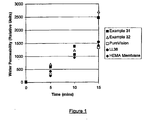
- the water permeabilities are seen to be superior to PHEMA hydrogels and indeed better than commerically available silicone hydrogel materials.
Landscapes
- Chemical & Material Sciences (AREA)
- Organic Chemistry (AREA)
- Health & Medical Sciences (AREA)
- Polymers & Plastics (AREA)
- Medicinal Chemistry (AREA)
- Chemical Kinetics & Catalysis (AREA)
- General Chemical & Material Sciences (AREA)
- General Health & Medical Sciences (AREA)
- Molecular Biology (AREA)
- Biochemistry (AREA)
- Life Sciences & Earth Sciences (AREA)
- Silicon Polymers (AREA)
- Polyurethanes Or Polyureas (AREA)
- Eyeglasses (AREA)
- Manufacture Of Macromolecular Shaped Articles (AREA)
- Paints Or Removers (AREA)
Priority Applications (1)
| Application Number | Priority Date | Filing Date | Title |
|---|---|---|---|
| EP01905867A EP1255761B1 (en) | 2000-02-07 | 2001-02-07 | Silicon containing compounds from michael - type addition reactions useful as monomers and macromers |
Applications Claiming Priority (4)
| Application Number | Priority Date | Filing Date | Title |
|---|---|---|---|
| EP00300942 | 2000-02-07 | ||
| EP00300942 | 2000-02-07 | ||
| PCT/GB2001/000519 WO2001057048A1 (en) | 2000-02-07 | 2001-02-07 | Silicon containing compounds from michael - type addition reactions useful as monomers and macromers |
| EP01905867A EP1255761B1 (en) | 2000-02-07 | 2001-02-07 | Silicon containing compounds from michael - type addition reactions useful as monomers and macromers |
Publications (2)
| Publication Number | Publication Date |
|---|---|
| EP1255761A1 EP1255761A1 (en) | 2002-11-13 |
| EP1255761B1 true EP1255761B1 (en) | 2005-08-31 |
Family
ID=8172685
Family Applications (1)
| Application Number | Title | Priority Date | Filing Date |
|---|---|---|---|
| EP01905867A Expired - Lifetime EP1255761B1 (en) | 2000-02-07 | 2001-02-07 | Silicon containing compounds from michael - type addition reactions useful as monomers and macromers |
Country Status (7)
| Country | Link |
|---|---|
| US (1) | US7064174B2 (enExample) |
| EP (1) | EP1255761B1 (enExample) |
| JP (1) | JP2003522227A (enExample) |
| AT (1) | ATE303391T1 (enExample) |
| AU (1) | AU3383901A (enExample) |
| DE (1) | DE60113066T2 (enExample) |
| WO (1) | WO2001057048A1 (enExample) |
Families Citing this family (24)
| Publication number | Priority date | Publication date | Assignee | Title |
|---|---|---|---|---|
| ATE266668T1 (de) * | 2000-02-07 | 2004-05-15 | Biocompatibles Uk Ltd | Silizium enthaltende verbindungen hergestellt durch michael addition als monomere und macromere |
| JP4245336B2 (ja) * | 2002-11-25 | 2009-03-25 | 株式会社資生堂 | ホスホリルコリン基を有するポリシロキサン及びその製造方法 |
| CN100549018C (zh) * | 2003-12-02 | 2009-10-14 | 株式会社资生堂 | 含有磷酸胆碱基的化合物及包含该化合物的表面改性剂 |
| US8231218B2 (en) | 2006-06-15 | 2012-07-31 | Coopervision International Holding Company, Lp | Wettable silicone hydrogel contact lenses and related compositions and methods |
| US7540609B2 (en) * | 2006-06-15 | 2009-06-02 | Coopervision International Holding Company, Lp | Wettable silicone hydrogel contact lenses and related compositions and methods |
| US7572841B2 (en) | 2006-06-15 | 2009-08-11 | Coopervision International Holding Company, Lp | Wettable silicone hydrogel contact lenses and related compositions and methods |
| US20080004413A1 (en) * | 2006-06-30 | 2008-01-03 | Derek Schorzman | Carboxylic M2Dx-like siloxanyl monomers |
| US7868120B2 (en) * | 2006-09-21 | 2011-01-11 | Ppg Industries Ohio, Inc. | Low temperature, moisture curable coating compositions and related methods |
| US20080075871A1 (en) * | 2006-09-21 | 2008-03-27 | Ppg Industries Ohio, Inc. | Low temperature, moisture curable coating compositions and related methods |
| US8349066B2 (en) * | 2006-09-21 | 2013-01-08 | Ppg Industries Ohio, Inc. | Low temperature, moisture curable coating compositions and related methods |
| US8168738B2 (en) * | 2006-09-21 | 2012-05-01 | Ppg Industries Ohio, Inc. | Low temperature, moisture curable coating compositions and related methods |
| US20090111912A1 (en) * | 2006-09-21 | 2009-04-30 | Ppg Industries Ohio, Inc. | Low temperature, moisture curable coating compositions and related methods |
| US20090078156A1 (en) * | 2006-09-21 | 2009-03-26 | Ppg Industries Ohio, Inc. | Low temperature, moisture curable coating compositions and related methods |
| US9006305B2 (en) | 2011-09-01 | 2015-04-14 | Vertellus Specialties Inc. | Biocompatible material |
| SG11201400287XA (en) * | 2011-09-01 | 2014-03-28 | Vertellus Specialties Inc | Methods for producing biocompatible materials |
| GB201119363D0 (en) * | 2011-11-10 | 2011-12-21 | Vertellus Specialities Inc | Polymerisable material |
| US9200119B2 (en) * | 2012-11-09 | 2015-12-01 | Momentive Performance Materials Inc. | Silicon-containing zwitterionic linear copolymer composition |
| US11407846B2 (en) | 2017-11-28 | 2022-08-09 | Mitsui Chemicals, Inc. | (Meth)acrylate, monomer composition, dental material obtained from composition, and production method thereof |
| KR102288126B1 (ko) * | 2017-12-01 | 2021-08-11 | 주식회사 엘지에너지솔루션 | 겔 폴리머 전해질 조성물 및 이를 포함하는 리튬 이차전지 |
| WO2019108032A1 (ko) * | 2017-12-01 | 2019-06-06 | 주식회사 엘지화학 | 겔 폴리머 전해질 조성물 및 이를 포함하는 리튬 이차전지 |
| US11316194B2 (en) * | 2018-01-03 | 2022-04-26 | Lg Energy Solution, Ltd. | Gel polymer electrolyte composition, gel polymer electrolyte prepared thereby, and lithium secondary battery including the gel polymer electrolyte |
| JP7591863B2 (ja) * | 2019-03-19 | 2024-11-29 | 信越化学工業株式会社 | オルガノポリシロキサン、紫外線硬化性シリコーン組成物及び硬化物 |
| EP4397694A4 (en) * | 2021-08-31 | 2025-11-19 | Nof Corp | MONOMER CONTAINING POLYDIMETHYLSILOXANE HAVING A PHOSPHORYLCHOLINE GROUP AND A HYDROXYL GROUP |
| KR20240051140A (ko) * | 2021-08-31 | 2024-04-19 | 니치유 가부시키가이샤 | 포스포릴콜린기와 수산기를 갖는 폴리디메틸실록산 함유 모노머 |
Family Cites Families (46)
| Publication number | Priority date | Publication date | Assignee | Title |
|---|---|---|---|---|
| US2924588A (en) | 1957-04-22 | 1960-02-09 | Dow Corning | Organosiloxane alcohols |
| US3146250A (en) | 1961-10-11 | 1964-08-25 | Dow Corning | Nitrogen-containing cyclic silanes, their preparation and hydrolysis |
| EP0032622B1 (en) | 1979-12-20 | 1985-08-14 | Dennis Chapman | Polymerisable phospholipids and polymers thereof, methods for their preparation, methods for their use in coating substrates and forming liposomes and the resulting coated substrates and liposome compositions |
| US4486577A (en) | 1982-10-12 | 1984-12-04 | Ciba-Geigy Corporation | Strong, silicone containing polymers with high oxygen permeability |
| US4507466A (en) | 1983-01-07 | 1985-03-26 | The Dow Chemical Corporation | Dense star polymers having core, core branches, terminal groups |
| US5380904A (en) | 1984-01-20 | 1995-01-10 | Biocompatibles Ltd. | Process for rendering a surface biocompatible, and articles containing the same |
| JPH0627196B2 (ja) * | 1984-03-12 | 1994-04-13 | 大日本印刷株式会社 | 放射線硬化性有機珪素化合物の製造法 |
| DE3417912C1 (de) | 1984-05-15 | 1985-07-25 | Goldschmidt Ag Th | Betaingruppen enthaltende Siloxane,deren Herstellung und Verwendung in kosmetischen Zubereitungen |
| CA1257727A (en) | 1984-12-18 | 1989-07-18 | Chi-Long Lee | Hydrophilic silicone-organic copolymer elastomers |
| US4606933A (en) * | 1985-09-25 | 1986-08-19 | Sws Silicones Corporation | Acrylate-functional organopolysiloxanes |
| US4697026A (en) | 1986-01-06 | 1987-09-29 | Dow Corning Corporation | Acryl functional silicone compounds |
| US4734475A (en) | 1986-12-15 | 1988-03-29 | Ciba-Geigy Corporation | Wettable surface modified contact lens fabricated from an oxirane containing hydrophobic polymer |
| JPH0618866B2 (ja) * | 1986-12-22 | 1994-03-16 | 鐘淵化学工業株式会社 | 常温硬化性樹脂の製造法 |
| US5712327A (en) | 1987-01-07 | 1998-01-27 | Chang; Sing-Hsiung | Soft gas permeable contact lens having improved clinical performance |
| US4918210A (en) | 1987-01-20 | 1990-04-17 | Fenton William N | Zwitterionic polysiloxane compositions |
| US4780515A (en) | 1987-02-05 | 1988-10-25 | Bausch & Lomb Incorporated | Continuous-wear lenses having improved physical properties |
| US5070169A (en) | 1988-02-26 | 1991-12-03 | Ciba-Geigy Corporation | Wettable, flexible, oxygen permeable contact lens containing block copolymer polysiloxane-polyoxyalkylene backbone units and use thereof |
| US4912240A (en) | 1988-08-01 | 1990-03-27 | Dow Corning Corporation | Organofunctional betaine modified siloxanes |
| US4962178A (en) | 1988-11-03 | 1990-10-09 | Ciba-Geigy Corporation | Novel polysiloxane-polyurethanes and contact lens thereof |
| CA2015903A1 (en) | 1989-05-12 | 1990-11-12 | Andrew B. Auerbach | Grafting of amine functional polymers onto functionalized oxymethylene polymers and the resulting graft polymers thereof |
| US5010141A (en) | 1989-10-25 | 1991-04-23 | Ciba-Geigy Corporation | Reactive silicone and/or fluorine containing hydrophilic prepolymers and polymers thereof |
| DE69101464T2 (de) | 1990-04-26 | 1994-07-14 | Ciba Geigy | Ungesättigte Harnstoff-Polysiloxane. |
| GB9023498D0 (en) | 1990-10-29 | 1990-12-12 | Biocompatibles Ltd | Soft contact lens material |
| AU666485B2 (en) | 1991-07-05 | 1996-02-15 | Biocompatibles Uk Limited | Polymeric surface coatings |
| ATE270310T1 (de) * | 1991-08-08 | 2004-07-15 | Biocompatibles Uk Ltd | Polymere oberflächenbeschichtungszusammensetzungen |
| GB9118597D0 (en) | 1991-08-30 | 1991-10-16 | Biocompatibles Ltd | Polymer treatments |
| EP0603268B1 (en) | 1991-09-12 | 1996-12-18 | BAUSCH & LOMB INCORPORATED | Wettable silicone hydrogel compositions and methods |
| DE69211152T2 (de) | 1991-11-05 | 1997-01-02 | Bausch & Lomb | Zusammensetzungen von benetzbaren siliconhydrogels und verfahren zu deren herstellung |
| US5352714A (en) | 1991-11-05 | 1994-10-04 | Bausch & Lomb Incorporated | Wettable silicone hydrogel compositions and methods for their manufacture |
| US5296144A (en) | 1992-01-02 | 1994-03-22 | World Trade Corporation | Composite membrane of a hydrophilic asymmetric membrane coated with an organosiloxane block copolymer |
| US5194251A (en) | 1992-02-10 | 1993-03-16 | Dow Corning Corporation | Hair treatment with zwitterionomeric siloxanes |
| JPH07505900A (ja) | 1992-04-24 | 1995-06-29 | バイオコンパテイブルズ・リミテツド | 金属皮膜 |
| GB9301702D0 (en) | 1993-01-28 | 1993-03-17 | Biocompatibles Ltd | New materials |
| GB9301701D0 (en) | 1993-01-28 | 1993-03-17 | Biocompatibles Ltd | New zwitterionic materials |
| US5321108A (en) | 1993-02-12 | 1994-06-14 | Bausch & Lomb Incorporated | Fluorosilicone hydrogels |
| US5550219A (en) | 1993-10-20 | 1996-08-27 | Siltech Inc. | Silicone polymers |
| US5405983A (en) | 1993-12-28 | 1995-04-11 | Mona Industries, Inc. | Silicone modified phospholipid compositions |
| US5792827A (en) | 1994-01-13 | 1998-08-11 | Basf Lacke + Farben, Ag | Addition products, radiation-curable surface coating compositions based on the addition products and their use for woodcoating and papercoating |
| US5760100B1 (en) | 1994-09-06 | 2000-11-14 | Ciba Vision Corp | Extended wear ophthalmic lens |
| US6194539B1 (en) | 1994-11-22 | 2001-02-27 | Daicel Chemical Industries, Inc. | Polylactone having amino groups, a process for the preparation thereof, a compound having amino group, a composition for coatings, a composition for printing inks |
| US5786086A (en) | 1996-01-02 | 1998-07-28 | Union Camp Corporation | Conductive wire coating |
| US5602224A (en) | 1996-03-19 | 1997-02-11 | Siltech Inc. | Silicone alkyl quats |
| JPH09291135A (ja) | 1996-04-26 | 1997-11-11 | Toyo Ink Mfg Co Ltd | 硬化剤及びそれを含む硬化性樹脂組成物 |
| US5739192A (en) * | 1996-11-20 | 1998-04-14 | Dow Corning Corporation | Polysiloxane copolymers from Michael Adduct reactions |
| US6136943A (en) | 1997-09-01 | 2000-10-24 | Toyo Ink Mfg. Co., Ltd. | Multi-branched compounds and curable composition |
| DE19803468A1 (de) * | 1998-01-29 | 1999-08-05 | Wacker Chemie Gmbh | Durch Michael-Addition-ähnliche Reaktionen vernetzte Aminosiliconölemulsionen |
-
2001
- 2001-02-07 JP JP2001557879A patent/JP2003522227A/ja active Pending
- 2001-02-07 US US10/203,203 patent/US7064174B2/en not_active Expired - Lifetime
- 2001-02-07 EP EP01905867A patent/EP1255761B1/en not_active Expired - Lifetime
- 2001-02-07 AU AU33839/01A patent/AU3383901A/en not_active Abandoned
- 2001-02-07 AT AT01905867T patent/ATE303391T1/de not_active IP Right Cessation
- 2001-02-07 DE DE60113066T patent/DE60113066T2/de not_active Expired - Lifetime
- 2001-02-07 WO PCT/GB2001/000519 patent/WO2001057048A1/en not_active Ceased
Non-Patent Citations (1)
| Title |
|---|
| DATABASE BEILSTEIN BEILSTEIN INSTITUTE FOR ORGANIC CHEMISTRY, FRANKFURT-MAIN, DE; 1995, retrieved from XFIRE Database accession no. BRN7066466 * |
Also Published As
| Publication number | Publication date |
|---|---|
| US20030152786A1 (en) | 2003-08-14 |
| DE60113066D1 (de) | 2005-10-06 |
| DE60113066T2 (de) | 2006-06-14 |
| US7064174B2 (en) | 2006-06-20 |
| WO2001057048A1 (en) | 2001-08-09 |
| JP2003522227A (ja) | 2003-07-22 |
| AU3383901A (en) | 2001-08-14 |
| WO2001057048A8 (en) | 2001-11-15 |
| ATE303391T1 (de) | 2005-09-15 |
| EP1255761A1 (en) | 2002-11-13 |
Similar Documents
| Publication | Publication Date | Title |
|---|---|---|
| US7064174B2 (en) | Silicon containing compounds | |
| JP2011099106A (ja) | モノマー及びマクロマーとして有用なマイケル型反応からの化合物を含む両性イオン基 | |
| AU2012213442B2 (en) | Silicone containing monomers with hydrophilic end groups | |
| EP1968986B1 (en) | Process for making cationic hydrophilic siloxanyl monomers | |
| KR100422852B1 (ko) | 폴리디알킬실록산-폴리아미드 공중합체, 그 제조방법 및각종 재료 | |
| EP2004729B1 (en) | Cationic end-capped siloxane prepolymer for reduced cross-link density | |
| EP1109853B1 (en) | Method for providing coated moulded polymeric articles | |
| US8501893B2 (en) | Synthetic method for preparing dual curable silicone compositions | |
| AU2012213442A1 (en) | Silicone containing monomers with hydrophilic end groups | |
| US20140350184A1 (en) | Surface modification of polymers via surface active and reactive end groups | |
| EP2066732A2 (en) | Pendant end-capped low modulus cationic siloxanyls | |
| AU2011363044A1 (en) | Siloxane monomers containing hydrolysis resistance carbosiloxane linkage, process for their preparation and thin films containing the same for contact lens application | |
| WO2014143926A1 (en) | Ethylenically unsaturated polymerizable groups comprising polycarbosiloxane monomers | |
| JPS59206392A (ja) | N―アルケノイルアミネートを包含する重合性組成物 | |
| WO2012095293A2 (en) | Process for the synthesis of compounds from cyclic carbonates | |
| US20170088564A1 (en) | Silicone containing monomers with hydrophilic end groups | |
| ES2366968T3 (es) | Proceso para fabricar monómeros de siloxanilo hidrófilos catiónicos. | |
| Dragan et al. | Ionic hybrid hydrogels |
Legal Events
| Date | Code | Title | Description |
|---|---|---|---|
| PUAI | Public reference made under article 153(3) epc to a published international application that has entered the european phase |
Free format text: ORIGINAL CODE: 0009012 |
|
| 17P | Request for examination filed |
Effective date: 20020826 |
|
| AK | Designated contracting states |
Kind code of ref document: A1 Designated state(s): AT BE CH CY DE DK ES FI FR GB GR IE IT LI LU MC NL PT SE TR |
|
| AX | Request for extension of the european patent |
Free format text: AL;LT;LV;MK;RO;SI |
|
| RAP1 | Party data changed (applicant data changed or rights of an application transferred) |
Owner name: BIOCOMPATIBLES UK LIMITED |
|
| 17Q | First examination report despatched |
Effective date: 20040621 |
|
| GRAP | Despatch of communication of intention to grant a patent |
Free format text: ORIGINAL CODE: EPIDOSNIGR1 |
|
| GRAS | Grant fee paid |
Free format text: ORIGINAL CODE: EPIDOSNIGR3 |
|
| GRAA | (expected) grant |
Free format text: ORIGINAL CODE: 0009210 |
|
| AK | Designated contracting states |
Kind code of ref document: B1 Designated state(s): AT BE CH CY DE DK ES FI FR GB GR IE IT LI LU MC NL PT SE TR |
|
| PG25 | Lapsed in a contracting state [announced via postgrant information from national office to epo] |
Ref country code: IT Free format text: LAPSE BECAUSE OF FAILURE TO SUBMIT A TRANSLATION OF THE DESCRIPTION OR TO PAY THE FEE WITHIN THE PRE;WARNING: LAPSES OF ITALIAN PATENTS WITH EFFECTIVE DATE BEFORE 2007 MAY HAVE OCCURRED AT ANY TIME BEFORE 2007. THE CORRECT EFFECTIVE DATE MAY BE DIFFERENT FROM THE ONE RECORDED.SCRIBED TIME-LIMIT Effective date: 20050831 Ref country code: FI Free format text: LAPSE BECAUSE OF FAILURE TO SUBMIT A TRANSLATION OF THE DESCRIPTION OR TO PAY THE FEE WITHIN THE PRESCRIBED TIME-LIMIT Effective date: 20050831 Ref country code: BE Free format text: LAPSE BECAUSE OF FAILURE TO SUBMIT A TRANSLATION OF THE DESCRIPTION OR TO PAY THE FEE WITHIN THE PRESCRIBED TIME-LIMIT Effective date: 20050831 Ref country code: AT Free format text: LAPSE BECAUSE OF FAILURE TO SUBMIT A TRANSLATION OF THE DESCRIPTION OR TO PAY THE FEE WITHIN THE PRESCRIBED TIME-LIMIT Effective date: 20050831 Ref country code: CH Free format text: LAPSE BECAUSE OF FAILURE TO SUBMIT A TRANSLATION OF THE DESCRIPTION OR TO PAY THE FEE WITHIN THE PRESCRIBED TIME-LIMIT Effective date: 20050831 Ref country code: NL Free format text: LAPSE BECAUSE OF FAILURE TO SUBMIT A TRANSLATION OF THE DESCRIPTION OR TO PAY THE FEE WITHIN THE PRESCRIBED TIME-LIMIT Effective date: 20050831 Ref country code: LI Free format text: LAPSE BECAUSE OF FAILURE TO SUBMIT A TRANSLATION OF THE DESCRIPTION OR TO PAY THE FEE WITHIN THE PRESCRIBED TIME-LIMIT Effective date: 20050831 |
|
| REG | Reference to a national code |
Ref country code: GB Ref legal event code: FG4D Ref country code: CH Ref legal event code: EP |
|
| REG | Reference to a national code |
Ref country code: IE Ref legal event code: FG4D |
|
| REF | Corresponds to: |
Ref document number: 60113066 Country of ref document: DE Date of ref document: 20051006 Kind code of ref document: P |
|
| PG25 | Lapsed in a contracting state [announced via postgrant information from national office to epo] |
Ref country code: GR Free format text: LAPSE BECAUSE OF FAILURE TO SUBMIT A TRANSLATION OF THE DESCRIPTION OR TO PAY THE FEE WITHIN THE PRESCRIBED TIME-LIMIT Effective date: 20051130 Ref country code: DK Free format text: LAPSE BECAUSE OF FAILURE TO SUBMIT A TRANSLATION OF THE DESCRIPTION OR TO PAY THE FEE WITHIN THE PRESCRIBED TIME-LIMIT Effective date: 20051130 Ref country code: SE Free format text: LAPSE BECAUSE OF FAILURE TO SUBMIT A TRANSLATION OF THE DESCRIPTION OR TO PAY THE FEE WITHIN THE PRESCRIBED TIME-LIMIT Effective date: 20051130 |
|
| PG25 | Lapsed in a contracting state [announced via postgrant information from national office to epo] |
Ref country code: ES Free format text: LAPSE BECAUSE OF FAILURE TO SUBMIT A TRANSLATION OF THE DESCRIPTION OR TO PAY THE FEE WITHIN THE PRESCRIBED TIME-LIMIT Effective date: 20051212 |
|
| PG25 | Lapsed in a contracting state [announced via postgrant information from national office to epo] |
Ref country code: IE Free format text: LAPSE BECAUSE OF NON-PAYMENT OF DUE FEES Effective date: 20060207 |
|
| PG25 | Lapsed in a contracting state [announced via postgrant information from national office to epo] |
Ref country code: PT Free format text: LAPSE BECAUSE OF FAILURE TO SUBMIT A TRANSLATION OF THE DESCRIPTION OR TO PAY THE FEE WITHIN THE PRESCRIBED TIME-LIMIT Effective date: 20060222 |
|
| PG25 | Lapsed in a contracting state [announced via postgrant information from national office to epo] |
Ref country code: MC Free format text: LAPSE BECAUSE OF NON-PAYMENT OF DUE FEES Effective date: 20060228 Ref country code: LU Free format text: LAPSE BECAUSE OF NON-PAYMENT OF DUE FEES Effective date: 20060228 |
|
| NLV1 | Nl: lapsed or annulled due to failure to fulfill the requirements of art. 29p and 29m of the patents act | ||
| REG | Reference to a national code |
Ref country code: CH Ref legal event code: PL |
|
| ET | Fr: translation filed | ||
| PLBE | No opposition filed within time limit |
Free format text: ORIGINAL CODE: 0009261 |
|
| STAA | Information on the status of an ep patent application or granted ep patent |
Free format text: STATUS: NO OPPOSITION FILED WITHIN TIME LIMIT |
|
| 26N | No opposition filed |
Effective date: 20060601 |
|
| REG | Reference to a national code |
Ref country code: IE Ref legal event code: MM4A |
|
| PG25 | Lapsed in a contracting state [announced via postgrant information from national office to epo] |
Ref country code: TR Free format text: LAPSE BECAUSE OF FAILURE TO SUBMIT A TRANSLATION OF THE DESCRIPTION OR TO PAY THE FEE WITHIN THE PRESCRIBED TIME-LIMIT Effective date: 20050831 |
|
| PG25 | Lapsed in a contracting state [announced via postgrant information from national office to epo] |
Ref country code: CY Free format text: LAPSE BECAUSE OF FAILURE TO SUBMIT A TRANSLATION OF THE DESCRIPTION OR TO PAY THE FEE WITHIN THE PRESCRIBED TIME-LIMIT Effective date: 20050831 |
|
| REG | Reference to a national code |
Ref country code: DE Ref legal event code: R082 Ref document number: 60113066 Country of ref document: DE Representative=s name: MEISSNER BOLTE PATENTANWAELTE RECHTSANWAELTE P, DE Ref country code: DE Ref legal event code: R082 Ref document number: 60113066 Country of ref document: DE Representative=s name: MEISSNER, BOLTE & PARTNER GBR, DE |
|
| REG | Reference to a national code |
Ref country code: DE Ref legal event code: R082 Ref document number: 60113066 Country of ref document: DE Representative=s name: MEISSNER, BOLTE & PARTNER GBR, DE |
|
| REG | Reference to a national code |
Ref country code: FR Ref legal event code: PLFP Year of fee payment: 16 |
|
| REG | Reference to a national code |
Ref country code: FR Ref legal event code: PLFP Year of fee payment: 17 |
|
| REG | Reference to a national code |
Ref country code: FR Ref legal event code: PLFP Year of fee payment: 18 |
|
| PGFP | Annual fee paid to national office [announced via postgrant information from national office to epo] |
Ref country code: DE Payment date: 20180123 Year of fee payment: 18 |
|
| PGFP | Annual fee paid to national office [announced via postgrant information from national office to epo] |
Ref country code: FR Payment date: 20190111 Year of fee payment: 19 |
|
| REG | Reference to a national code |
Ref country code: DE Ref legal event code: R119 Ref document number: 60113066 Country of ref document: DE |
|
| PG25 | Lapsed in a contracting state [announced via postgrant information from national office to epo] |
Ref country code: DE Free format text: LAPSE BECAUSE OF NON-PAYMENT OF DUE FEES Effective date: 20190903 |
|
| PGFP | Annual fee paid to national office [announced via postgrant information from national office to epo] |
Ref country code: GB Payment date: 20200129 Year of fee payment: 20 |
|
| PG25 | Lapsed in a contracting state [announced via postgrant information from national office to epo] |
Ref country code: FR Free format text: LAPSE BECAUSE OF NON-PAYMENT OF DUE FEES Effective date: 20200229 |
|
| REG | Reference to a national code |
Ref country code: GB Ref legal event code: PE20 Expiry date: 20210206 |
|
| PG25 | Lapsed in a contracting state [announced via postgrant information from national office to epo] |
Ref country code: GB Free format text: LAPSE BECAUSE OF EXPIRATION OF PROTECTION Effective date: 20210206 |