EP1252769B2 - System und verfahren zur verbreitung von bildobjekten - Google Patents
System und verfahren zur verbreitung von bildobjekten Download PDFInfo
- Publication number
- EP1252769B2 EP1252769B2 EP00901025A EP00901025A EP1252769B2 EP 1252769 B2 EP1252769 B2 EP 1252769B2 EP 00901025 A EP00901025 A EP 00901025A EP 00901025 A EP00901025 A EP 00901025A EP 1252769 B2 EP1252769 B2 EP 1252769B2
- Authority
- EP
- European Patent Office
- Prior art keywords
- user
- objects
- media
- picture
- video
- Prior art date
- Legal status (The legal status is an assumption and is not a legal conclusion. Google has not performed a legal analysis and makes no representation as to the accuracy of the status listed.)
- Expired - Lifetime
Links
Images
Classifications
-
- H—ELECTRICITY
- H04—ELECTRIC COMMUNICATION TECHNIQUE
- H04N—PICTORIAL COMMUNICATION, e.g. TELEVISION
- H04N21/00—Selective content distribution, e.g. interactive television or video on demand [VOD]
- H04N21/40—Client devices specifically adapted for the reception of or interaction with content, e.g. set-top-box [STB]; Operations thereof
- H04N21/43—Processing of content or additional data, e.g. demultiplexing additional data from a digital video stream; Elementary client operations, e.g. monitoring of home network or synchronising decoder's clock; Client middleware
- H04N21/442—Monitoring of processes or resources, e.g. detecting the failure of a recording device, monitoring the downstream bandwidth, the number of times a movie has been viewed, the storage space available from the internal hard disk
- H04N21/44213—Monitoring of end-user related data
- H04N21/44218—Detecting physical presence or behaviour of the user, e.g. using sensors to detect if the user is leaving the room or changes his face expression during a TV program
-
- G—PHYSICS
- G06—COMPUTING OR CALCULATING; COUNTING
- G06F—ELECTRIC DIGITAL DATA PROCESSING
- G06F3/00—Input arrangements for transferring data to be processed into a form capable of being handled by the computer; Output arrangements for transferring data from processing unit to output unit, e.g. interface arrangements
- G06F3/01—Input arrangements or combined input and output arrangements for interaction between user and computer
- G06F3/011—Arrangements for interaction with the human body, e.g. for user immersion in virtual reality
- G06F3/013—Eye tracking input arrangements
-
- H—ELECTRICITY
- H04—ELECTRIC COMMUNICATION TECHNIQUE
- H04N—PICTORIAL COMMUNICATION, e.g. TELEVISION
- H04N21/00—Selective content distribution, e.g. interactive television or video on demand [VOD]
- H04N21/20—Servers specifically adapted for the distribution of content, e.g. VOD servers; Operations thereof
- H04N21/25—Management operations performed by the server for facilitating the content distribution or administrating data related to end-users or client devices, e.g. end-user or client device authentication, learning user preferences for recommending movies
- H04N21/258—Client or end-user data management, e.g. managing client capabilities, user preferences or demographics, processing of multiple end-users preferences to derive collaborative data
- H04N21/25866—Management of end-user data
- H04N21/25891—Management of end-user data being end-user preferences
-
- H—ELECTRICITY
- H04—ELECTRIC COMMUNICATION TECHNIQUE
- H04N—PICTORIAL COMMUNICATION, e.g. TELEVISION
- H04N21/00—Selective content distribution, e.g. interactive television or video on demand [VOD]
- H04N21/40—Client devices specifically adapted for the reception of or interaction with content, e.g. set-top-box [STB]; Operations thereof
- H04N21/41—Structure of client; Structure of client peripherals
- H04N21/422—Input-only peripherals, i.e. input devices connected to specially adapted client devices, e.g. global positioning system [GPS]
- H04N21/42201—Input-only peripherals, i.e. input devices connected to specially adapted client devices, e.g. global positioning system [GPS] biosensors, e.g. heat sensor for presence detection, EEG sensors or any limb activity sensors worn by the user
-
- H—ELECTRICITY
- H04—ELECTRIC COMMUNICATION TECHNIQUE
- H04N—PICTORIAL COMMUNICATION, e.g. TELEVISION
- H04N21/00—Selective content distribution, e.g. interactive television or video on demand [VOD]
- H04N21/40—Client devices specifically adapted for the reception of or interaction with content, e.g. set-top-box [STB]; Operations thereof
- H04N21/41—Structure of client; Structure of client peripherals
- H04N21/422—Input-only peripherals, i.e. input devices connected to specially adapted client devices, e.g. global positioning system [GPS]
- H04N21/4223—Cameras
-
- H—ELECTRICITY
- H04—ELECTRIC COMMUNICATION TECHNIQUE
- H04N—PICTORIAL COMMUNICATION, e.g. TELEVISION
- H04N21/00—Selective content distribution, e.g. interactive television or video on demand [VOD]
- H04N21/40—Client devices specifically adapted for the reception of or interaction with content, e.g. set-top-box [STB]; Operations thereof
- H04N21/45—Management operations performed by the client for facilitating the reception of or the interaction with the content or administrating data related to the end-user or to the client device itself, e.g. learning user preferences for recommending movies, resolving scheduling conflicts
- H04N21/458—Scheduling content for creating a personalised stream, e.g. by combining a locally stored advertisement with an incoming stream; Updating operations, e.g. for OS modules ; time-related management operations
- H04N21/4586—Content update operation triggered locally, e.g. by comparing the version of software modules in a DVB carousel to the version stored locally
-
- H—ELECTRICITY
- H04—ELECTRIC COMMUNICATION TECHNIQUE
- H04N—PICTORIAL COMMUNICATION, e.g. TELEVISION
- H04N21/00—Selective content distribution, e.g. interactive television or video on demand [VOD]
- H04N21/40—Client devices specifically adapted for the reception of or interaction with content, e.g. set-top-box [STB]; Operations thereof
- H04N21/45—Management operations performed by the client for facilitating the reception of or the interaction with the content or administrating data related to the end-user or to the client device itself, e.g. learning user preferences for recommending movies, resolving scheduling conflicts
- H04N21/466—Learning process for intelligent management, e.g. learning user preferences for recommending movies
-
- H—ELECTRICITY
- H04—ELECTRIC COMMUNICATION TECHNIQUE
- H04N—PICTORIAL COMMUNICATION, e.g. TELEVISION
- H04N7/00—Television systems
- H04N7/16—Analogue secrecy systems; Analogue subscription systems
- H04N7/173—Analogue secrecy systems; Analogue subscription systems with two-way working, e.g. subscriber sending a programme selection signal
- H04N7/17309—Transmission or handling of upstream communications
- H04N7/17318—Direct or substantially direct transmission and handling of requests
Definitions
- the present invention relates to a system and a method for distributing image objects. More particularly, the present invention relates to a system and method for distributing image objects stored in an image object database associated with a media center, wherein image objects in the image object database are each associated with image object information, wherein the image objects are provided by the media center to one or more of a communication network
- This communications network connectable communication terminals are transmitted, and wherein the image objects are made visible to a user of the communication terminal in each case by means of a display unit of the communication terminal.
- image objects centrally stored and provided with associated object information are transmitted to communication terminals via a communication network and made visible to the users of these communication terminals by means of a display unit of the communication terminals are known.
- image objects in the following text called data files that include image content, which is preferably constructed according to a suitable media and / or image data standard and a user by suitable means, such as software or hardware executed functions, in particular De- / Kompressions- and Playback functions, can be made visible on a display unit.
- the image content of these image objects relates, for example, to still images, for example digitized photos, graphics and / or texts, but may also relate to moving images, for example video sequences.
- image objects are being transmitted from web servers to communication terminals over the Internet; such as personal computers, transmitted there and the relevant user through a display unit, such as a screen made visible.
- image objects are possibly linked to the communication terminal of the user, depending on how the user navigates through various pages available to the web server, that is to say which navigation commands and / or search commands and search parameters the user inputs Transmitted user, without being selected by the web server individual image objects user-specific and transmitted to the user.
- US Pat. No. 5,758,257 describes a system and method for scheduling the distribution of and access to video programs based on user profiles.
- user profiles are determined and stored in the set-top box for users of television cable networks, each in a set-top box connected to the television based on viewing habits of the user.
- virtual channels are generated in the set-top boxes respectively from the video programs of the regular television channels received via the television cable network, the contents of which correspond as far as possible to the interests of the user concerned.
- a plurality of user profiles can also be stored in a set-top box, to which different user identifications are respectively assigned, so that individual user profiles for the generation of the virtual channels can be activated by the respective users.
- user set information can be transmitted from the set-top boxes via a return channel, for example a telephone network, to the head end of the television cable network, whereupon an overall user profile is determined based on which the viewing habits of all users are summarized. Based on this overall user profile, according to the teaching of US Pat. No. 5,758,257, the temporal planning of video programs to be distributed via the television cable network is continuously made possible at the head end.
- a system for distributing image objects comprising a communication network, at least one media center connected to this communication network, an image object database connected to the media center, in which image object database the image objects and image object information associated with these image objects are stored are, and one or more connectable to this communication network communication terminals, each having a display unit, by means of which display unit, the image objects are made visible to a user of the communication terminals are accepted by the media center user identification data, each of one of the communication terminals via the communication network the media center is transmitted by the media center from a user interest database associated with the media center in which users are stored, the user center profile assigned to the user data received user data profile is determined by the media center from the image object database image objects are assigned to the image object information, the at least one match, that is, at least one correlation according to a predefined correlation value with information the particular user interest profile, and that is transmitted by the media center at least one of the specific image objects via the communication network to the relevant communication terminal from which the
- Receiving user identification data from a user's communication terminal, determining a user interest profile assigned to this user identification profile, and selecting and transmitting image objects based on the particular user interest profile and the image object information associated with the image object information by the media center has the advantage that image objects are user-specific by the media center can be selected and transmitted to the communication terminal of the user, without the need for this user commands and / or data must be entered.
- the current viewing direction of at least one eye of a user is determined in each case by a sighting determination module of the communication terminal of the user concerned, the particular current viewing direction each of this communication terminal via the communication network to the media center, and it will be determined by a Berurgisauswakmodul the media center on the basis current viewing direction and on the basis of video objects and / or image objects that have been transmitted from the media center via the communication network to this communication terminal determines image objects that are viewed by the user of this communication terminal.
- the acquisition of image objects that are viewed by a user has the advantage that it is possible to statistically evaluate which image objects as a whole or, in particular, are viewed by specific users. If, for example, the image objects relate to advertising for services and / or products offered by a corresponding provider, the distribution efficiency of this type of advertising can be assessed without the user having to provide information.
- user interest profiles are determined by an interest determination module of the media center on the basis of the specific image objects and stored in the user interest database.
- the image object information includes order numbers
- the user identification data includes a unique user identification
- a purchase order module of the media center places an order for one of the particular image objects, using the order number associated with that image object and the unique user identification.
- the particular image objects are inserted by the media center into video objects, which video objects are transmitted from the media center via the communication network to the relevant communication terminal, where they are made visible to the user of the relevant communication terminal by means of the display unit.
- the insertion of image objects into video objects that are transmitted to the communication terminal of a respective user and made visible to that user by means of a display device is that the user can be visualized while viewing the video objects image objects, these image objects, as stated above , can be selected according to the interest profile of the user concerned.
- the user can play movies (video objects) for free, to which, for example from time to time, image objects are inserted whose image content relates to advertising for products and / or services offered by a provider and which correspond to the respective user interest profile.
- movies video objects
- the video objects are generated by a video synthesizer from stored media objects, wherein the media objects to which media object information is assigned, for example by the video synthesizer, are determined such that the media object information includes at least one match, ie at least one correlation according to a predefined correlation value have the information of the particular user interest profile.
- the advantage of generating the video objects from media objects, which are selected in particular according to the interest profile of the user concerned, is that the video objects can be generated dynamically and user-specifically by the video synthesizer.
- image objects can be inserted into the video objects in such a way that they are perceived by the user as part of the video sequences corresponding to the video objects, ie that the image objects are perceived as an integral part of the video sequences considered.
- biometric user features are detected in the communication terminals by means of sensors, which biometric user features are inserted into the user identification data.
- biometric user features such as fingerprints, eye patterns, facial features and / or voice patterns
- the biometric features in a database can be assigned further user information, for example name, address and bank details.
- the biometric features can also be used for the mere (anonymous) recognition of a respective user, wherein the biometric features are assigned no further information for identifying the user.
- retinal patterns are detected by means of microelectromechanical scanner, which retina patterns are inserted into the user identification data.
- the advantage of the retinal patterns is that retinal patterns allow for unambiguous user (re) recognition that meets high safety requirements, particularly because retinal patterns represent less variable biometric features that change only slightly over time.
- the use of microelectromechanical scanners for detecting the retinal patterns has the advantage that the microelectromechanical scanners have very small dimensions and, for example, can also be part of a virtual retinal display device.
- light signals corresponding to the video objects and / or the image objects are projected directly onto the retina of the user by means of such a virtual retinal display unit.
- the communication network comprises a mobile radio network, for example a GSM network (Global System for Mobile Communications), a UMTS network (Universal Mobile Telephone System) and / or another, for example satellite-based, mobile radio network
- the communication terminals include mobile devices, for example Mobile telephones and / or portable communication-capable computers.
- GSM Global System for Mobile Communications
- UMTS Universal Mobile Telephone System
- the communication terminals include mobile devices, for example Mobile telephones and / or portable communication-capable computers.
- image objects and associated image object information which respectively relate to products and / or services and which are input by providers of such products and / or services via a communication network, for example a mobile radio network or a fixed network, in particular the Internet or the public switched telephone network ISDN network, received and stored in the image object database.
- a communication network for example a mobile radio network or a fixed network, in particular the Internet or the public switched telephone network ISDN network
- the advantage of this embodiment variant is that it gives the providers of products and / or services direct access to an advertising platform, via which access the providers image objects and associated image object information on their own initiative and independently in the inventive system for automatic and user-specific distribution of Can enter picture objects.
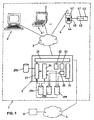
- Figure 1 shows a block diagram of the system for disseminating image objects, which block diagram schematically illustrates a media center connected via a communication network to communication terminals each having a display device and a sighting determination module.
- reference numeral 1 refers to the system for distributing image objects.
- a description of the picture objects has already been given in the introduction;
- image objects according to the MPEG-4 standard are to be mentioned here, an ISO / IEC standard (ISO / IEC 14496) developed by MPEG (Moving Picture Expert Group) and referring to this at the time of application, for example on the Internet site www.cselt .stet.it / mpeg / standards / mpeg-4 an overview was available.
- MPEG-4 provides a standard for a) the representation of objects with audible, visual or audiovisual content, so-called media objects, whose content may be of natural origin (recorded by microphone and / or camera) or of synthetic origin (generated by computer), b) the description of the composition of such media objects into composite media objects forming audiovisual scenes, c) the multiplexing and synchronization of data of such media objects for transmission over communication networks, and d) the interaction with audiovisual scenes generated at the receiver.
- media objects whose content may be of natural origin (recorded by microphone and / or camera) or of synthetic origin (generated by computer), b) the description of the composition of such media objects into composite media objects forming audiovisual scenes, c) the multiplexing and synchronization of data of such media objects for transmission over communication networks, and d) the interaction with audiovisual scenes generated at the receiver.
- audiovisual scenes are composed of several hierarchically organized media objects, for example, from still image objects, for example, a motionless background, of moving picture objects, which are also referred to here as video objects, for example, a singing musician, and of audio objects, for example, the song of the musician.
- MPEG-4 defines the coded representation of media objects of content of natural or synthetic origin, which may be implemented in two or three-dimensional form.
- the MPEG-4 standard is used as standard for still picture objects, for moving picture objects (or video objects), and for audio objects, wherein the still picture objects and the moving picture objects (or video objects) are simple or composite media objects according to this preferred standard, and wherein said media objects, as mentioned above, may also comprise audio objects.
- the delivery multimedia integration framework (DMIF) protocol defined in MPEG-4 can be used.
- BIFS Binary Format for Scenes
- VRML Virtual Reality Modeling Language
- the communication terminals 4, 4 ', 4 connectable to the communication network 3 can comprise "various types of communication terminals, for example permanently installed communication terminals 4', for example a person al computer or publicly accessible terminals, or portable communication-capable computer 4 ", for example laptop computer, palmtop computer or mobile data assistant (PDA, Personal Data Assistant) with suitable communication modules, or mobile devices, in particular mobile phones 4.
- a media center 2 that is to say in particular can exchange data
- the communication terminals 4, 4 ', 4 connectable to the communication network 3 can comprise "various types of communication terminals, for example permanently installed communication terminals 4', for example a person al computer or publicly accessible terminals, or portable communication-capable computer 4 ", for example laptop computer, palmtop computer or mobile data assistant (PDA, Personal Data Assistant) with suitable communication modules, or mobile devices, in particular mobile phones 4.
- PDA Personal Data Assistant
- the communication network 3 can also comprise a unidirectional broadcast system, for example a DAB (Digital Audio Broadcasting) or DVB (Digital Video Broadcasting) system, via which media objects are transmitted from the media center 2 to the communication terminals 4, 4 ', 4 "
- DAB Digital Audio Broadcasting
- DVB Digital Video Broadcasting
- the three points in FIG be that a plurality of communication terminals 4, 4 ', 4 "via the communication network 3 with the media center 2 are connectable.
- certain components of the communication terminals are shown only for the cellular phone 4 in Fig. 1, all of these components may be available in the other communication terminals 4 'and 4 "as examples of such certain components at this point the display unit 41, the sighting determination module 42 and the retina scanner 43 are mentioned, which are connected to the mobile telephone 4, for example, via a contact-based or a contactless device interface.
- the display unit 41 is, for example, a virtual retinal display unit 41 that makes image objects visible to the user by projecting light signals corresponding to the image objects directly onto the retina of the user's eye.
- the display unit 41 comprises at least one microelectromechanical (MEMS, Microelectromechanical System) element, in particular a microelectromechanical scanner.
- MEMS Microelectromechanical System
- a microelectromechanical scanner comprising a microelectromechanical element with a biaxial mirror for the projection of image objects in a direct retinal display unit and / or for the reception of light reflected or emitted by objects is described for example in the patent application WO 98/13720.
- a virtual retinal display unit which can project corresponding light signals directly onto the retina of a viewer, has been described, for example, in patent applications WO 94/09472, WO97 / 37339 and in the abovementioned patent application WO 98/13720.
- These virtual retinal display units can be supplied with data from image objects via a video interface, for example in the form of an RGB signal, an NTSC signal, a VGA signal or another formatted colored or monochrome video or graphic signal.
- the video interface described therein to be adapted so that they can efficiently receive and process different data formats depending on the image objects used.
- an interface module not shown, which is set up, for example, in the communication terminal 4
- data from image objects can also be suitably adapted to the video interface, or received data from image objects can be converted such that they are applied to the video interface and by means of the virtual retinal display unit 41 the user can be made visible.
- the components of the display unit 41 are preferably integrated in a common housing or installed on a common support, which housing or support is preferably designed so that it can be placed by a user such as conventional glasses or a helmet.
- Other components such as a microphone, a headphone, the aforementioned device interface, the viewing direction determination module 42 and / or the retina scanner 43 may also be mounted on / in this common carrier.
- the viewing direction determination module 42 is connected to the display unit 41, which determines the current viewing direction of the user's eyes by determining the current eye positions of the user when viewing image objects and directs them to the mobile telephone 4 via the above-mentioned device interface can.
- a Eye Tracker which determines current eye positions based on the position of the pupil of a user, has also been described in the aforementioned patent application WO 94/09472 and may be extended by one skilled in the art to the particular eye position via the device interface to the cellular phone 4 can be transmitted; Depending on the version, values can be made available for both eyes.
- determined eye positions for example in the mobile telephone 4, additionally with detected head position, respectively head movement, which are detected for example by an additional, not shown elaboratepeteilpositionsbeticiansaku with respect to the horizontal and vertical plane as horizontal and vertical head rotation angle can be combined to determine the actual viewing direction of the user, which is not limited to the viewing direction with respect to the display unit 41.
- the microelectromechanical scanner By means of the above-mentioned microelectromechanical scanner, or by means of an additional such micro-electro-mechanical scanner, which can be used in addition to the projection of light signals on the retina for the detection of objects reflected or emitted light, also the retinal pattern of a user, in particular by the Blood vessels of the retina formed patterns, are captured.
- the microelectromechanical scanner performs the light reflected from the retina, for example by means of a beam splitter (at least) a photosensitive element.
- a beam splitter at least
- Such a retina scanner which can also be used for multicolored images and is suitable for detecting such retinal patterns, has been described, for example, in the abovementioned patent application WO 98/13720.
- the light values detected in the photosensitive element (s) are digitized in the retina scanner 43, for example, and the retinal pattern is generated from the reflection data obtained thereby, for example by means of a difference operation of projected and reflected light.
- the acquisition of retinal patterns from the retina scanner 43 may be initiated, for example, by a corresponding command directed from the cellular phone 4 to the retinal scanner 43 via the device interface.
- the retina scanner 43 may be provided with a separate light source for the determination of the retinal patterns, for example an LED (Light Emitting Diode) or a laser whose light beams, for example by means of a suitable microelectromechanical moving mirror, are used as a raster of images.
- This direct detection of the retinal patterns may occur during the simultaneous viewing of image objects by the user when the separate light source emits light comprising wavelengths other than the light signals corresponding to the image objects, for example when that light source is an infrared light source, and when the photosensitive element used is designed accordingly for this light.
- retinal patterns as eye features is discussed, but that other eye patterns, for example patterns of the iris (iris), can be detected in their place.
- components used by the virtual retinal display unit 41, the gaze direction determination module 42, and the retina scanner 43 such as rotatable microelectromechanical mirrors, light sources, photosensitive Elements and / or programmable processors in various embodiments of the display unit 41, the sight line determination module 42 and the retina scanner 43 can be used in combination or separate components can be used for the display unit 41, the sight line determination module 42 and the retina scanner 43, respectively. It is also possible that individual components, for example an LED light source and a photosensitive element, can be replaced by components with a combined function.
- the media center 2 consists of one or more interconnected computers, especially powerful servers that have a communication module 21, with the necessary hardware and software components for communication via the communication network 3 with the communication terminals 4, 4 ', 4 "and on the Communication network 5, which may be embodied as the communication network 3, with communication terminals 6 of providers who, for example, products and / or services is equipped ..
- the media center 2 is connected to different databases 291-294 These databases 291-294 may be executed on separate computers connected to the media center 2 and / or shared on the same computer (s) as the mien center 2.
- the databases 291-294 may also be executed in a common database To store their data, Date nb 291-294 suitable data carriers, which can be designed differently depending on the volume and required access time of the data stored thereon.
- the media center 2 comprises further functional modules, in particular the functional modules 22-27 shown in FIG. 1, which are realized either as programmed software modules stored in a memory of the media center 2 and executable on a processor of the media center 2, or as a combination of such software modules are realized with suitable hardware components, or are realized as pure hardware components.
- An interested user can communicate with his communication-capable communication terminal 4, 4 ', 4 "the media center 2 via the communication network 3, for example by automated or manual dialing of a corresponding service number of the media center 2.
- After making contact, for example, on request of the media center 2 transmits the Communication terminal 4 User identification data of the user concerned via the communication network 3 to the media center 2, where they are received, for example, by the communication module 21 and forwarded to the interest determination module 25.
- the user identification data are cached in the media center 2, wherein for the assignment of a user concerned to his communication terminal 4, 4 ', 4 "the user identification data is associated with an identification that relates to the communication terminal 4, 4', 4" from which the user identification data was obtained, or the communication SSON (session) with this communication terminal 4, 4 ', 4 "relates.
- the user identification data comprise, for example, biometric user features, for example fingerprints, eye patterns, facial features and / or voice patterns, which are stored, for example, on a chip card 44 removably connected to the communication terminal 4, or which are detected by suitable sensors of the communication terminal 4.
- the eye pattern is, for example, a retinal pattern detected by the above-mentioned retina scanner 43.
- the user credentials may also include other elements, such as a unique user identifier that may be used internationally, such as an International Mobile Subscriber Identity (IMSI) for identification by a network operator or user identification, such as an International Debit User Identification (IDUI), for identification Financial service providers, such as banks and / or credit card companies, or who may be used to uniquely identify the user by one or a group of providers, for example a membership number.
- IMSI International Mobile Subscriber Identity
- IDUI International Debit User Identification
- Financial service providers such as banks and / or credit card companies, or who may be used to uniquely identify the user by one or a group of providers, for example a membership number.
- the media center 2 allow the user to choose from a variety of available services and / or media offerings, especially movie offers.
- media objects in particular video objects
- the video objects correspond to movies stored in the video database 293, or the video objects are generated by a video synthesizer 27 of the media center 2 from media objects stored in the media object database 294.
- the generation of video objects by the video synthesizer 27 enables the automatic production of synthetic or virtual films, for example according to object-oriented scripts.
- the media object, or video object or image object, which lies in the current viewing direction of the video and / or image objects viewed by the user is determined by a viewing direction evaluation module 23 in the media center 2
- this media object, or video object or image object is determined by the fact that from the current viewing direction with respect to the display unit 41, the coordinates of the considered point of the at that time
- the media object (image or video object) made visible to the user can be ascertained, and the media object, or video object or image object, which is located at this location is determined on the basis of these coordinates
- An object reference to the thus determined media object, respectively video object or image Object is made available by Magnoliaargentsauspitmodul 23 other modules of the media center 2, for example, the interest determination module 25, for further use.
- the object references to the specific media objects, respectively video or image objects, the user identification data of the user concerned are stored and, for example, on the basis of the frequency and / or duration of these media objects, respectively video or image objects , are viewed by the user concerned, a user interest profile is created, respectively updated, which is stored in the user interest database 292 associated with the user identification data of the respective user.
- the interest determination module 25 takes into account media object information, in particular video and / or image object information, which are respectively stored in the media object database 294 or image object database 291 for the respective media object, respectively video or image object.
- media object information, or video or image object information, for media objects, respectively video or image objects, which relate to products and / or services include, for example, information relating to these products and / or services, for example types, names, structured classifications, costs, technical properties and / or external appearance (design, color), and / or information concerning the supplier (s) and / or manufacturer of such products and / or services, for example industry, names, addresses, number of employees, financial circumstances and / or year of foundation of the company
- the user interest profile includes, for example, information regarding products and / or services that the user is interested in, for example, types, names, structured classifications, costs, technical characteristics, and / or appearance (color), and / or Information concerning suppliers and / or manufacturers of such products and / or services that the user concerned is interested in, such as industries, names, addresses, number of employees, financial circumstances and / or year of establishment.
- the user interest profile may also contain information about the service and / or media offers desired by the user in question, in particular movie offers. It is also possible for user interest profiles to be defined on-line by the user himself, for example via the communication network 3 or off-line, respectively, and updated directly, respectively at a later time, in the user interest database 292.
- the user interest profile assigned to these user identification data in the user interest database 492 is determined in the media center 2 on the basis of the user identification data received from a respective user. Based on the particular user interest profile, the media object determination module 26 determines media objects stored in the media object database 294 and image objects stored in the image object database 291, respectively which the user in question might be interested in. For this purpose, the media object determination module 26 determines the correlation between the user interest profile and the media object information or image object information, respectively stored in the media objects, respectively the image objects associated with the media object database 294 and the image object database 291, respectively.
- the correlation factor that is to say the degree of correspondence between the user interest profile and the media object information or image object information, which is assumed that a media object or an image object is classified as being of interest by the media object determination module 26, can be varied, for example as the case may be. How many details are contained in a user interest profile.
- a minimal correlation between user interest profile and the media object information, or image object information, is, for example, the, for example semantic, match of at least one data element.
- Object references to media objects stored in the media object database 294, or to image objects stored in the image object database 291 that are considered to be of interest to the user, are forwarded to the video synthesizer 27 by the media object determination module 26.
- the time sequence of the forwarding of object references to the video synthesizer 27, in particular if numerous media objects, respectively picture objects, are classified as being of interest to the user, for example, is controlled by the media object determination module 26.
- the media object determination module 26 may also limit the number of object references passed to the video synthesizer 27 to a predefined number, which may be defined, for example, as number per unit time, and advantageously prefers object references to media objects, or image objects, with the highest determined correlation to get redirected.
- the video synthesizer extracts from the object database 291 the picture object corresponding to an object reference and inserts it into the video objects which are transmitted from the video database 293 to the communication terminal 4 of the relevant user from whom the relevant user identification data was obtained.
- the coordinates at which the image object is inserted into the video object can for example be predefined or determined using a random algorithm.
- image objects can also be inserted into the video objects so that they interrupt the video sequence from the user's point of view by filling the entire image area.
- the video synthesizer can also synthetically generate video scenes, or movies, by extracting media objects from the media object database 294, in particular media objects for which object references were obtained from the media object determination module 26 and, for example, predefined scripts Media objects, respectively video objects, are composed, which are transmitted to the communication terminal 4 of a user concerned.
- Image objects for which object references have been obtained by the media object determination module 26 can also be inserted by the video synthesizer into such synthetically generated media objects or video objects.
- the picture objects from the picture object database 291, which are inserted into the media objects or video objects are not limited to still pictures, but can also contain moving pictures, and even audio objects.
- forwarded object references can be stored in the media center 2 and entered numerically.
- the image object information of the image objects additionally includes an order number that includes an identification of a product and / or a service and, for example, an identification of a provider of this product and / or service.
- image objects may, for example, be marked for the user with a visible graphic identifier. If the user views such an image object and at the same time transmits a predefined order command to the media center 2, for example by means of spoken language or with operating elements 45 of the communication terminal 4 or by directly following a graphical control icon visualized by the display unit 41 for the user, an order is initiated in the media center 2 by the order module 22.
- an order which includes the order number and details for the unique identification of the user concerned, and directed to the relevant provider, for example by e-mail, by fax or by conventional mail.
- user identification data with biometric features make it possible for a user to be recognized unambiguously, further user-specific information such as name and address, in particular a delivery address, should be assigned to these user identification data for processing an order.
- the user identification data comprises an alternative or additional unique user identification, for example an International Mobile Subscriber Identity (IMSI) that can be used by the operator of the communication network 3, the user concerned to identify and to complete the order with further information from the user, for example from the subscriber database, before they are forwarded to the relevant provider.
- IMSI International Mobile Subscriber Identity
- the media center 2 has an image object input module 24, which is accessed by these providers by means of suitable communication terminals 6 and can be accessed via the communication network 5 by means of suitable access software, such as browsers.
- the image object input module 22 can also provide the providers with, for example, conversion and editing tools, for example to facilitate the input of image objects that use a format other than that used by the media center 2.
- Image objects inputted via the image object input module 22 and associated image object information are stored by the image object input module 22 in the image object database 291.
- the providers may be charged for a monetary amount depending on the number and / or the data volume of the stored image objects and associated image object information. This amount of money can also be determined by interested users depending on the storage duration (which may be limited, for example) of these image objects in the image object database 291 and / or on the number of transmissions of the image objects to communication terminals 4, 4 ', 4 ".
- the inventive system and method for the distribution of image objects enables a user-specific distribution of the image objects according to user interest profiles.
- the system and the method for user-specific distribution of image objects mean that these user interest profiles can also be determined automatically without the user concerned having to enter data.
- the described system and method may also automatically acquire user identification data from respective users without requiring the user to enter data and associate determined user interest profiles with user identification data.
- the user interest profiles can be reassigned to a respective user at later times, which can take place, for example, anonymously, that is, without knowledge of the identity of the user in question, if no further personal data is assigned to the user identification data would allow the determination of the identity of the user in question.
- the system and method according to the invention for distributing image objects offers, in particular, providers of products and / or services a platform for the automated and user-specific distribution of advertising regarding their products and / or services, whereby the providers are informed in particular also with statistical information about how often and / or how long, for example compared to image objects of other providers, their image objects are viewed by users. If the mentioned anonymity is not desired, further identification information of relevant users can be stored assigned to the user identification data, for example with the on-line consent of the respective user. Interested providers may also be provided with statistical information about the overall interests of users of the system for disseminating image objects.
Landscapes
- Engineering & Computer Science (AREA)
- Databases & Information Systems (AREA)
- Multimedia (AREA)
- Signal Processing (AREA)
- Health & Medical Sciences (AREA)
- General Health & Medical Sciences (AREA)
- Social Psychology (AREA)
- Theoretical Computer Science (AREA)
- General Engineering & Computer Science (AREA)
- Biophysics (AREA)
- Human Computer Interaction (AREA)
- Biomedical Technology (AREA)
- Chemical & Material Sciences (AREA)
- Neurosurgery (AREA)
- Computer Graphics (AREA)
- Life Sciences & Earth Sciences (AREA)
- Analytical Chemistry (AREA)
- Physics & Mathematics (AREA)
- General Physics & Mathematics (AREA)
- Computer Networks & Wireless Communication (AREA)
- Processing Or Creating Images (AREA)
- Two-Way Televisions, Distribution Of Moving Picture Or The Like (AREA)
- Image Processing (AREA)
- Mobile Radio Communication Systems (AREA)
Applications Claiming Priority (1)
| Application Number | Priority Date | Filing Date | Title |
|---|---|---|---|
| PCT/CH2000/000053 WO2001058160A1 (de) | 2000-02-01 | 2000-02-01 | System und verfahren zur verbreitung von bildobjekten |
Publications (3)
| Publication Number | Publication Date |
|---|---|
| EP1252769A1 EP1252769A1 (de) | 2002-10-30 |
| EP1252769B1 EP1252769B1 (de) | 2003-05-21 |
| EP1252769B2 true EP1252769B2 (de) | 2006-12-20 |
Family
ID=4358036
Family Applications (1)
| Application Number | Title | Priority Date | Filing Date |
|---|---|---|---|
| EP00901025A Expired - Lifetime EP1252769B2 (de) | 2000-02-01 | 2000-02-01 | System und verfahren zur verbreitung von bildobjekten |
Country Status (6)
| Country | Link |
|---|---|
| US (6) | US7565671B1 (enExample) |
| EP (1) | EP1252769B2 (enExample) |
| JP (1) | JP4040302B2 (enExample) |
| AU (1) | AU2000220901A1 (enExample) |
| DE (1) | DE50002313D1 (enExample) |
| WO (1) | WO2001058160A1 (enExample) |
Families Citing this family (16)
| Publication number | Priority date | Publication date | Assignee | Title |
|---|---|---|---|---|
| EP1252769B2 (de) * | 2000-02-01 | 2006-12-20 | Swisscom Mobile AG | System und verfahren zur verbreitung von bildobjekten |
| DE50006287D1 (de) * | 2000-03-10 | 2004-06-03 | Rudolf Ritter | Verfahren, kommunikationssystem und empfangsvorrichtung für die verrechnung von zugriffskontrollierten programmen und/oder daten von broadcastsendern |
| FR2890815B1 (fr) * | 2005-09-14 | 2007-11-23 | Streamezzo Sa | Procede de transmission d'un contenu multimedia vers un terminal de radiocommunication, programme d'ordinateur, signal, terminal de radiocommunication et serveur de diffusion correspondants |
| US8347325B2 (en) * | 2009-12-22 | 2013-01-01 | Vizio, Inc. | System, method and apparatus for viewer detection and action |
| CN102934458B (zh) * | 2011-02-04 | 2016-06-29 | 松下电器(美国)知识产权公司 | 兴趣度估计装置以及兴趣度估计方法 |
| US8584177B2 (en) | 2011-04-11 | 2013-11-12 | Ericsson Television Inc. | Controlling delivery of video programs using user defined identifiers for video receiver devices |
| US8885882B1 (en) | 2011-07-14 | 2014-11-11 | The Research Foundation For The State University Of New York | Real time eye tracking for human computer interaction |
| AU2011205223C1 (en) | 2011-08-09 | 2013-03-28 | Microsoft Technology Licensing, Llc | Physical interaction with virtual objects for DRM |
| US10019962B2 (en) | 2011-08-17 | 2018-07-10 | Microsoft Technology Licensing, Llc | Context adaptive user interface for augmented reality display |
| US9153195B2 (en) | 2011-08-17 | 2015-10-06 | Microsoft Technology Licensing, Llc | Providing contextual personal information by a mixed reality device |
| WO2013028908A1 (en) | 2011-08-24 | 2013-02-28 | Microsoft Corporation | Touch and social cues as inputs into a computer |
| US8875175B1 (en) * | 2013-08-30 | 2014-10-28 | Sony Corporation | Smart live streaming event ads playback and resume method |
| US10044710B2 (en) | 2016-02-22 | 2018-08-07 | Bpip Limited Liability Company | Device and method for validating a user using an intelligent voice print |
| US10491940B1 (en) | 2018-08-23 | 2019-11-26 | Rovi Guides, Inc. | Systems and methods for displaying multiple media assets for a plurality of users |
| GR20200100010A (el) * | 2020-01-13 | 2021-08-13 | Ανδρεας Κωνσταντινου Γεωργιου | Μεθοδος για την εισαγωγη ή/και την αλλαγη αντικειμενων σε ψηφιακα αρχεια εικονας |
| CN111857488B (zh) * | 2020-06-30 | 2022-06-28 | 北京百度网讯科技有限公司 | 小程序中菜单弹出的方法、装置、电子设备和存储介质 |
Citations (10)
| Publication number | Priority date | Publication date | Assignee | Title |
|---|---|---|---|---|
| EP0643541A2 (en) † | 1993-09-14 | 1995-03-15 | AT&T Corp. | Personalized information service system |
| WO1997010558A1 (en) † | 1995-09-14 | 1997-03-20 | Bell Communications Research, Inc. | Method and system for providing continually updated personalized information |
| WO1997041654A1 (en) † | 1996-04-29 | 1997-11-06 | Telefonaktiebolaget Lm Ericsson | Telecommunications information dissemination system |
| WO1998001750A1 (de) † | 1996-07-09 | 1998-01-15 | Hydac Filtertechnik Gmbh | Vorrichtung zur überwachung von gebrauchseigenschaften von fluiden, insbesondere von druckflüssigkeiten in fluidtechnischen anlagen |
| EP0860763A1 (en) † | 1997-02-19 | 1998-08-26 | Hitachi, Ltd. | Information registration method and document information processing apparatus |
| US5886683A (en) † | 1996-06-25 | 1999-03-23 | Sun Microsystems, Inc. | Method and apparatus for eyetrack-driven information retrieval |
| US5893091A (en) † | 1997-04-11 | 1999-04-06 | Immediata Corporation | Multicasting with key words |
| WO1999066746A2 (en) † | 1998-06-15 | 1999-12-23 | Nokia Networks Oy | A method for delivering messages in a wireless communications system using the same protocol for all types of messages |
| US6009410A (en) † | 1997-10-16 | 1999-12-28 | At&T Corporation | Method and system for presenting customized advertising to a user on the world wide web |
| US6011537A (en) † | 1997-01-27 | 2000-01-04 | Slotznick; Benjamin | System for delivering and simultaneously displaying primary and secondary information, and for displaying only the secondary information during interstitial space |
Family Cites Families (43)
| Publication number | Priority date | Publication date | Assignee | Title |
|---|---|---|---|---|
| GB1540992A (en) * | 1975-04-22 | 1979-02-21 | Smiths Industries Ltd | Display or other systems and equipment for use in such systems |
| US4595990A (en) * | 1980-12-31 | 1986-06-17 | International Business Machines Corporation | Eye controlled information transfer |
| US5016282A (en) * | 1988-07-14 | 1991-05-14 | Atr Communication Systems Research Laboratories | Eye tracking image pickup apparatus for separating noise from feature portions |
| US4931865A (en) * | 1988-08-24 | 1990-06-05 | Sebastiano Scarampi | Apparatus and methods for monitoring television viewers |
| US4950069A (en) * | 1988-11-04 | 1990-08-21 | University Of Virginia | Eye movement detector with improved calibration and speed |
| US5467104A (en) * | 1992-10-22 | 1995-11-14 | Board Of Regents Of The University Of Washington | Virtual retinal display |
| JPH0759000A (ja) * | 1993-08-03 | 1995-03-03 | Canon Inc | 画像送信システム |
| US5855369A (en) * | 1993-08-27 | 1999-01-05 | Lieberman; Lee | Equipment for and methods of conducting a prize drawing game of chance |
| US5572596A (en) * | 1994-09-02 | 1996-11-05 | David Sarnoff Research Center, Inc. | Automated, non-invasive iris recognition system and method |
| JP3629047B2 (ja) * | 1994-09-16 | 2005-03-16 | 株式会社東芝 | 情報処理装置 |
| US5758257A (en) | 1994-11-29 | 1998-05-26 | Herz; Frederick | System and method for scheduling broadcast of and access to video programs and other data using customer profiles |
| CA2173698A1 (en) * | 1995-04-12 | 1996-10-13 | Jakob Nielsen | Method and system for comicstrip representation of multimedia presentations |
| US6085112A (en) * | 1995-05-03 | 2000-07-04 | Siemens Aktiengesellschaft | Communication device |
| JPH0951522A (ja) * | 1995-08-07 | 1997-02-18 | Hitachi Ltd | 広告映像配送方法 |
| US5758259A (en) * | 1995-08-31 | 1998-05-26 | Microsoft Corporation | Automated selective programming guide |
| JP3724859B2 (ja) * | 1995-10-16 | 2005-12-07 | 富士通株式会社 | 画像表示システム |
| JPH09245107A (ja) * | 1996-03-07 | 1997-09-19 | Computer Soft Kaihatsu Kk | フリーハンズ商取引システム |
| WO1997041854A1 (en) | 1996-05-07 | 1997-11-13 | The Trustees Of The University Of Pennsylvania | Inhibitors of glycogen synthase kinase-3 and methods for identifying and using the same |
| JPH09321894A (ja) | 1996-05-31 | 1997-12-12 | Sony Corp | 情報処理装置 |
| JP2982698B2 (ja) * | 1996-07-08 | 1999-11-29 | 日本電気株式会社 | 分散情報サービスシステム |
| WO1998011750A2 (en) | 1996-09-11 | 1998-03-19 | Yang Li | Method of using fingerprints to authenticate wireless communications |
| JP3617884B2 (ja) * | 1996-09-18 | 2005-02-09 | 株式会社東芝 | 携帯型情報機器 |
| JP2001513278A (ja) * | 1997-02-21 | 2001-08-28 | エス.エム. ヘルツ,フレデリック | 非対称アップリンク/ダウンリンク帯域幅を用いた放送データ分配システム |
| JPH10304335A (ja) * | 1997-04-28 | 1998-11-13 | Fujitsu Ltd | 情報伝送装置 |
| JPH10320413A (ja) * | 1997-05-22 | 1998-12-04 | Matsushita Electric Ind Co Ltd | ユーザプロファイル情報管理システム |
| JP3152172B2 (ja) * | 1997-07-16 | 2001-04-03 | 日本電気株式会社 | 無線携帯ショッピング情報システム及びそれに用いる移動端末 |
| JP3687293B2 (ja) * | 1997-08-11 | 2005-08-24 | 横河電機株式会社 | 動画通信管理装置 |
| JP3609590B2 (ja) * | 1997-08-13 | 2005-01-12 | 株式会社日立製作所 | 情報提供システム、端末における情報の出力方法、移動情報端末及び情報提供装置 |
| DE19736995B4 (de) * | 1997-08-26 | 2009-05-07 | Fraunhofer-Gesellschaft zur Förderung der angewandten Forschung e.V. | Vorrichtung zum Bestimmen eines Fixationspunktes |
| JPH1185762A (ja) * | 1997-09-01 | 1999-03-30 | Seiko Epson Corp | 検索情報処理方法および検索情報処理装置並びに検索情報処理プログラムを記憶した記憶媒体 |
| JPH11250145A (ja) * | 1997-12-31 | 1999-09-17 | Victor Co Of Japan Ltd | コンテンツ情報流通システム |
| US6173069B1 (en) * | 1998-01-09 | 2001-01-09 | Sharp Laboratories Of America, Inc. | Method for adapting quantization in video coding using face detection and visual eccentricity weighting |
| JPH11203006A (ja) * | 1998-01-20 | 1999-07-30 | Fujitsu Ltd | ユーザ状況推定装置 |
| US6286005B1 (en) * | 1998-03-11 | 2001-09-04 | Cannon Holdings, L.L.C. | Method and apparatus for analyzing data and advertising optimization |
| JP3513003B2 (ja) * | 1998-03-18 | 2004-03-31 | 富士通株式会社 | 情報提供装置、及び情報提供方法 |
| US6133912A (en) * | 1998-05-04 | 2000-10-17 | Montero; Frank J. | Method of delivering information over a communication network |
| IL127793A0 (en) * | 1998-05-28 | 1999-10-28 | Ibm | Internet server |
| CN1867068A (zh) * | 1998-07-14 | 2006-11-22 | 联合视频制品公司 | 交互式电视节目导视系统及其方法 |
| US6243076B1 (en) * | 1998-09-01 | 2001-06-05 | Synthetic Environments, Inc. | System and method for controlling host system interface with point-of-interest data |
| US6577329B1 (en) * | 1999-02-25 | 2003-06-10 | International Business Machines Corporation | Method and system for relevance feedback through gaze tracking and ticker interfaces |
| US7113918B1 (en) * | 1999-08-01 | 2006-09-26 | Electric Planet, Inc. | Method for video enabled electronic commerce |
| US6792135B1 (en) * | 1999-10-29 | 2004-09-14 | Microsoft Corporation | System and method for face detection through geometric distribution of a non-intensity image property |
| EP1252769B2 (de) * | 2000-02-01 | 2006-12-20 | Swisscom Mobile AG | System und verfahren zur verbreitung von bildobjekten |
-
2000
- 2000-02-01 EP EP00901025A patent/EP1252769B2/de not_active Expired - Lifetime
- 2000-02-01 US US10/049,908 patent/US7565671B1/en not_active Expired - Fee Related
- 2000-02-01 JP JP2001557287A patent/JP4040302B2/ja not_active Expired - Lifetime
- 2000-02-01 AU AU2000220901A patent/AU2000220901A1/en not_active Abandoned
- 2000-02-01 DE DE50002313T patent/DE50002313D1/de not_active Expired - Lifetime
- 2000-02-01 WO PCT/CH2000/000053 patent/WO2001058160A1/de not_active Ceased
-
2009
- 2009-04-01 US US12/416,469 patent/US8099748B2/en not_active Expired - Fee Related
-
2012
- 2012-01-17 US US13/351,670 patent/US8763019B2/en not_active Expired - Fee Related
-
2014
- 2014-06-23 US US14/311,714 patent/US9113206B2/en not_active Expired - Fee Related
-
2015
- 2015-08-18 US US14/829,091 patent/US10097887B2/en not_active Expired - Fee Related
-
2018
- 2018-08-22 US US16/109,518 patent/US20180367846A1/en not_active Abandoned
Patent Citations (10)
| Publication number | Priority date | Publication date | Assignee | Title |
|---|---|---|---|---|
| EP0643541A2 (en) † | 1993-09-14 | 1995-03-15 | AT&T Corp. | Personalized information service system |
| WO1997010558A1 (en) † | 1995-09-14 | 1997-03-20 | Bell Communications Research, Inc. | Method and system for providing continually updated personalized information |
| WO1997041654A1 (en) † | 1996-04-29 | 1997-11-06 | Telefonaktiebolaget Lm Ericsson | Telecommunications information dissemination system |
| US5886683A (en) † | 1996-06-25 | 1999-03-23 | Sun Microsystems, Inc. | Method and apparatus for eyetrack-driven information retrieval |
| WO1998001750A1 (de) † | 1996-07-09 | 1998-01-15 | Hydac Filtertechnik Gmbh | Vorrichtung zur überwachung von gebrauchseigenschaften von fluiden, insbesondere von druckflüssigkeiten in fluidtechnischen anlagen |
| US6011537A (en) † | 1997-01-27 | 2000-01-04 | Slotznick; Benjamin | System for delivering and simultaneously displaying primary and secondary information, and for displaying only the secondary information during interstitial space |
| EP0860763A1 (en) † | 1997-02-19 | 1998-08-26 | Hitachi, Ltd. | Information registration method and document information processing apparatus |
| US5893091A (en) † | 1997-04-11 | 1999-04-06 | Immediata Corporation | Multicasting with key words |
| US6009410A (en) † | 1997-10-16 | 1999-12-28 | At&T Corporation | Method and system for presenting customized advertising to a user on the world wide web |
| WO1999066746A2 (en) † | 1998-06-15 | 1999-12-23 | Nokia Networks Oy | A method for delivering messages in a wireless communications system using the same protocol for all types of messages |
Non-Patent Citations (2)
| Title |
|---|
| ETSI TS 22 140 V3.0.0: UMTS; Service Aspects; Stage 1 Multimedia Messaging Service; Seiten 1-14 † |
| International Conference on Intelligent User Interfaces; New Orleans, 9.-12. January 2000; Paul P. Maglio et al.: SUITOR: An Attentive Information System" † |
Also Published As
| Publication number | Publication date |
|---|---|
| US8099748B2 (en) | 2012-01-17 |
| US20140304725A1 (en) | 2014-10-09 |
| DE50002313D1 (de) | 2003-06-26 |
| JP4040302B2 (ja) | 2008-01-30 |
| JP2003522485A (ja) | 2003-07-22 |
| AU2000220901A1 (en) | 2001-08-14 |
| US9113206B2 (en) | 2015-08-18 |
| EP1252769B1 (de) | 2003-05-21 |
| US10097887B2 (en) | 2018-10-09 |
| US20120117582A1 (en) | 2012-05-10 |
| US20180367846A1 (en) | 2018-12-20 |
| EP1252769A1 (de) | 2002-10-30 |
| US8763019B2 (en) | 2014-06-24 |
| US20160044376A1 (en) | 2016-02-11 |
| US7565671B1 (en) | 2009-07-21 |
| US20090187933A1 (en) | 2009-07-23 |
| WO2001058160A1 (de) | 2001-08-09 |
Similar Documents
| Publication | Publication Date | Title |
|---|---|---|
| EP1252769B2 (de) | System und verfahren zur verbreitung von bildobjekten | |
| DE69731549T2 (de) | Interaktivität mit audiovisueller programmierung | |
| DE69821092T2 (de) | Rundfunkdatenverteilsystem mit asymmetrischen auf- und abwärtsverbindungsbandbreiten | |
| DE69625965T2 (de) | Interaktives Fernsehsystem | |
| DE69708042T2 (de) | Rundkfunkempfänger, der wahlweise auf navigationsinformationen zugreift, die sich zeitversetzt auf einem datenstrom befinden, und aufzeichnungsmedium, auf dem das dazugehörige verfahren gespeichert ist | |
| DE69930747T2 (de) | Elektronischer client-server rprogrammführer | |
| DE69626776T2 (de) | Interaktive unterhaltungsvorrichtung | |
| DE69611029T2 (de) | Informationsverarbeitung für interaktive Apparatur | |
| US20020138843A1 (en) | Video distribution method and system | |
| DE69903977T2 (de) | Anwendergruppen-identifizierungs-system | |
| US20030091239A1 (en) | Communications method using images and device for the same | |
| EP1198957B1 (de) | Mobile Bildaufnahme, Retinaprojektion von gemäss Augenposition eines Benutzers ermittelten Bilddaten, sowie Wiedergabe von aus den ermittelten Bilddaten gewonnener Nutzinformation | |
| WO2001050754A1 (de) | Verfahren für die übermittlung von bilddaten | |
| DE112017005879T5 (de) | Informationsverarbeitungsvorrichtung, informationsverarbeitungsverfahren und programm | |
| WO2005020533A1 (de) | Verfahren zur automatisierten generierung von zugriffskontrollierten, personifizierten daten und/oder programmen | |
| DE60005482T2 (de) | Verfahren und system zur auswahl von produkten in einer video produktion unter verwendung von referenzbildern | |
| Cathcart | Viewer needs and desires in television newscasters | |
| US20040139174A1 (en) | Method and apparatus for information exchange, as well as corresponding computer program product and corresponding computer-readable storage medium | |
| DE60221636T2 (de) | Verfahren und vorrichtung zur verwaltung von interaktionen im standard mpeg-4 | |
| CN119603487A (zh) | 直播推流方法、装置、系统、电子设备及存储介质 | |
| EP1667423B1 (de) | Verfahren und System zur Wiedergabe des Bildes einer Person | |
| KR20000036395A (ko) | 인터넷을 통하여 비디오를 대여하여 실시간으로 상영하는방법 및 이 방법을 수행하기 위한 영화 상영 프로세스 모듈 | |
| Ohkubo et al. | Design of an information skimming space | |
| DE60307915T2 (de) | Antworttakt-Erfassung | |
| DE102006049681B4 (de) | Aufnahmeeinrichtung zur Erstellung einer multimedialen Aufnahme einer Veranstaltung und Verfahren zur Bereitstellung einer multimedialen Aufnahme |
Legal Events
| Date | Code | Title | Description |
|---|---|---|---|
| PUAI | Public reference made under article 153(3) epc to a published international application that has entered the european phase |
Free format text: ORIGINAL CODE: 0009012 |
|
| 17P | Request for examination filed |
Effective date: 20011217 |
|
| AK | Designated contracting states |
Kind code of ref document: A1 Designated state(s): CH DE FR GB LI |
|
| AX | Request for extension of the european patent |
Free format text: AL;LT;LV;MK;RO;SI |
|
| GRAH | Despatch of communication of intention to grant a patent |
Free format text: ORIGINAL CODE: EPIDOS IGRA |
|
| GRAH | Despatch of communication of intention to grant a patent |
Free format text: ORIGINAL CODE: EPIDOS IGRA |
|
| GRAA | (expected) grant |
Free format text: ORIGINAL CODE: 0009210 |
|
| AK | Designated contracting states |
Designated state(s): CH DE FR GB LI |
|
| REG | Reference to a national code |
Ref country code: GB Ref legal event code: FG4D Free format text: NOT ENGLISH |
|
| REG | Reference to a national code |
Ref country code: CH Ref legal event code: EP |
|
| REG | Reference to a national code |
Ref country code: CH Ref legal event code: NV Representative=s name: BOVARD AG PATENTANWAELTE |
|
| REG | Reference to a national code |
Ref country code: IE Ref legal event code: FG4D Free format text: GERMAN |
|
| REF | Corresponds to: |
Ref document number: 50002313 Country of ref document: DE Date of ref document: 20030626 Kind code of ref document: P |
|
| GBT | Gb: translation of ep patent filed (gb section 77(6)(a)/1977) | ||
| REG | Reference to a national code |
Ref country code: IE Ref legal event code: FD4D Ref document number: 1252769E Country of ref document: IE |
|
| PLBQ | Unpublished change to opponent data |
Free format text: ORIGINAL CODE: EPIDOS OPPO |
|
| PLBI | Opposition filed |
Free format text: ORIGINAL CODE: 0009260 |
|
| PLAX | Notice of opposition and request to file observation + time limit sent |
Free format text: ORIGINAL CODE: EPIDOSNOBS2 |
|
| ET | Fr: translation filed | ||
| 26 | Opposition filed |
Opponent name: ORANGE PERSONAL COMMUNICATIONS SERVICES LIMITED Effective date: 20040220 |
|
| REG | Reference to a national code |
Ref country code: CH Ref legal event code: NV Representative=s name: ISLER & PEDRAZZINI AG |
|
| PLBB | Reply of patent proprietor to notice(s) of opposition received |
Free format text: ORIGINAL CODE: EPIDOSNOBS3 |
|
| PUAH | Patent maintained in amended form |
Free format text: ORIGINAL CODE: 0009272 |
|
| STAA | Information on the status of an ep patent application or granted ep patent |
Free format text: STATUS: PATENT MAINTAINED AS AMENDED |
|
| 27A | Patent maintained in amended form |
Effective date: 20061220 |
|
| AK | Designated contracting states |
Kind code of ref document: B2 Designated state(s): CH DE FR GB LI |
|
| REG | Reference to a national code |
Ref country code: CH Ref legal event code: AEN Free format text: AUFRECHTERHALTUNG DES PATENTES IN GEAENDERTER FORM |
|
| GBTA | Gb: translation of amended ep patent filed (gb section 77(6)(b)/1977) | ||
| ET3 | Fr: translation filed ** decision concerning opposition | ||
| REG | Reference to a national code |
Ref country code: CH Ref legal event code: PCAR Free format text: ISLER & PEDRAZZINI AG;POSTFACH 1772;8027 ZUERICH (CH) |
|
| REG | Reference to a national code |
Ref country code: CH Ref legal event code: NV Representative=s name: RENTSCH & PARTNER Ref country code: CH Ref legal event code: PUE Owner name: SWISSCOM (SCHWEIZ) AG Free format text: SWISSCOM MOBILE AG#SCHWARZTORSTRASSE 61#3050 BERN (CH) -TRANSFER TO- SWISSCOM (SCHWEIZ) AG#ALTE TIEFENAUSTRASSE 6#3050 BERN (CH) |
|
| REG | Reference to a national code |
Ref country code: GB Ref legal event code: 732E Free format text: REGISTERED BETWEEN 20091217 AND 20091223 |
|
| REG | Reference to a national code |
Ref country code: CH Ref legal event code: PUE Owner name: SWISSCOM AG Free format text: SWISSCOM (SCHWEIZ) AG#ALTE TIEFENAUSTRASSE 6#3050 BERN (CH) -TRANSFER TO- SWISSCOM AG#ALTE TIEFENAUSTRASSE 6#3050 BERN (CH) |
|
| REG | Reference to a national code |
Ref country code: FR Ref legal event code: TP |
|
| REG | Reference to a national code |
Ref country code: CH Ref legal event code: PFA Owner name: SWISSCOM AG Free format text: SWISSCOM AG#ALTE TIEFENAUSTRASSE 6#3050 BERN (CH) -TRANSFER TO- SWISSCOM AG#ALTE TIEFENAUSTRASSE 6#3050 BERN (CH) |
|
| REG | Reference to a national code |
Ref country code: FR Ref legal event code: PLFP Year of fee payment: 17 |
|
| REG | Reference to a national code |
Ref country code: FR Ref legal event code: PLFP Year of fee payment: 18 |
|
| REG | Reference to a national code |
Ref country code: FR Ref legal event code: PLFP Year of fee payment: 19 |
|
| PGFP | Annual fee paid to national office [announced via postgrant information from national office to epo] |
Ref country code: GB Payment date: 20190218 Year of fee payment: 20 Ref country code: CH Payment date: 20190218 Year of fee payment: 20 Ref country code: DE Payment date: 20190219 Year of fee payment: 20 |
|
| PGFP | Annual fee paid to national office [announced via postgrant information from national office to epo] |
Ref country code: FR Payment date: 20190219 Year of fee payment: 20 |
|
| REG | Reference to a national code |
Ref country code: DE Ref legal event code: R071 Ref document number: 50002313 Country of ref document: DE |
|
| REG | Reference to a national code |
Ref country code: GB Ref legal event code: PE20 Expiry date: 20200131 |
|
| REG | Reference to a national code |
Ref country code: CH Ref legal event code: PL |
|
| PG25 | Lapsed in a contracting state [announced via postgrant information from national office to epo] |
Ref country code: GB Free format text: LAPSE BECAUSE OF EXPIRATION OF PROTECTION Effective date: 20200131 |