EP1242851B1 - Use of a composition in stereolithography - Google Patents
Use of a composition in stereolithography Download PDFInfo
- Publication number
- EP1242851B1 EP1242851B1 EP00985544A EP00985544A EP1242851B1 EP 1242851 B1 EP1242851 B1 EP 1242851B1 EP 00985544 A EP00985544 A EP 00985544A EP 00985544 A EP00985544 A EP 00985544A EP 1242851 B1 EP1242851 B1 EP 1242851B1
- Authority
- EP
- European Patent Office
- Prior art keywords
- group
- compound
- formula
- use according
- independently selected
- Prior art date
- Legal status (The legal status is an assumption and is not a legal conclusion. Google has not performed a legal analysis and makes no representation as to the accuracy of the status listed.)
- Expired - Lifetime
Links
- 239000000203 mixture Substances 0.000 title description 16
- 150000001875 compounds Chemical class 0.000 claims description 105
- -1 hydroxy, carboxy Chemical group 0.000 claims description 38
- 238000000034 method Methods 0.000 claims description 32
- 125000001183 hydrocarbyl group Chemical group 0.000 claims description 28
- 229910052739 hydrogen Inorganic materials 0.000 claims description 27
- 239000001257 hydrogen Substances 0.000 claims description 27
- 125000000217 alkyl group Chemical group 0.000 claims description 25
- 229920000642 polymer Polymers 0.000 claims description 25
- 125000006575 electron-withdrawing group Chemical group 0.000 claims description 21
- UFHFLCQGNIYNRP-UHFFFAOYSA-N Hydrogen Chemical compound [H][H] UFHFLCQGNIYNRP-UHFFFAOYSA-N 0.000 claims description 18
- 230000005855 radiation Effects 0.000 claims description 14
- 125000003118 aryl group Chemical group 0.000 claims description 12
- 125000004432 carbon atom Chemical group C* 0.000 claims description 11
- 125000002496 methyl group Chemical group [H]C([H])([H])* 0.000 claims description 11
- 229910052736 halogen Inorganic materials 0.000 claims description 10
- 150000002367 halogens Chemical class 0.000 claims description 10
- 125000004435 hydrogen atom Chemical group [H]* 0.000 claims description 10
- 229910052796 boron Inorganic materials 0.000 claims description 9
- 238000006243 chemical reaction Methods 0.000 claims description 9
- 229910052757 nitrogen Inorganic materials 0.000 claims description 9
- 150000001408 amides Chemical class 0.000 claims description 8
- 125000005842 heteroatom Chemical group 0.000 claims description 8
- 125000000623 heterocyclic group Chemical group 0.000 claims description 8
- 125000003342 alkenyl group Chemical group 0.000 claims description 7
- 229910021645 metal ion Inorganic materials 0.000 claims description 7
- 150000001450 anions Chemical class 0.000 claims description 6
- 125000004433 nitrogen atom Chemical group N* 0.000 claims description 6
- 125000000304 alkynyl group Chemical group 0.000 claims description 5
- 125000001424 substituent group Chemical group 0.000 claims description 5
- 229920001187 thermosetting polymer Polymers 0.000 claims description 5
- PXGOKWXKJXAPGV-UHFFFAOYSA-N Fluorine Chemical compound FF PXGOKWXKJXAPGV-UHFFFAOYSA-N 0.000 claims description 4
- 125000003368 amide group Chemical group 0.000 claims description 4
- 125000004122 cyclic group Chemical group 0.000 claims description 4
- 229910052731 fluorine Inorganic materials 0.000 claims description 4
- 239000011737 fluorine Substances 0.000 claims description 4
- 229910052698 phosphorus Inorganic materials 0.000 claims description 4
- 150000001336 alkenes Chemical group 0.000 claims description 3
- 229920001296 polysiloxane Polymers 0.000 claims description 3
- 150000003839 salts Chemical class 0.000 claims description 3
- JPVYNHNXODAKFH-UHFFFAOYSA-N Cu2+ Chemical compound [Cu+2] JPVYNHNXODAKFH-UHFFFAOYSA-N 0.000 claims description 2
- 125000004423 acyloxy group Chemical group 0.000 claims description 2
- 125000002837 carbocyclic group Chemical group 0.000 claims description 2
- 229910001431 copper ion Inorganic materials 0.000 claims description 2
- 125000000547 substituted alkyl group Chemical group 0.000 claims description 2
- 229940126062 Compound A Drugs 0.000 claims 10
- NLDMNSXOCDLTTB-UHFFFAOYSA-N Heterophylliin A Natural products O1C2COC(=O)C3=CC(O)=C(O)C(O)=C3C3=C(O)C(O)=C(O)C=C3C(=O)OC2C(OC(=O)C=2C=C(O)C(O)=C(O)C=2)C(O)C1OC(=O)C1=CC(O)=C(O)C(O)=C1 NLDMNSXOCDLTTB-UHFFFAOYSA-N 0.000 claims 10
- 230000001678 irradiating effect Effects 0.000 claims 2
- 238000006116 polymerization reaction Methods 0.000 description 15
- 238000004519 manufacturing process Methods 0.000 description 13
- 239000000463 material Substances 0.000 description 10
- IJGRMHOSHXDMSA-UHFFFAOYSA-N Atomic nitrogen Chemical compound N#N IJGRMHOSHXDMSA-UHFFFAOYSA-N 0.000 description 8
- 125000000524 functional group Chemical group 0.000 description 8
- 125000001997 phenyl group Chemical group [H]C1=C([H])C([H])=C(*)C([H])=C1[H] 0.000 description 7
- 229920005989 resin Polymers 0.000 description 7
- 239000011347 resin Substances 0.000 description 7
- 0 *C(I)=***[N+]([O-])=O Chemical compound *C(I)=***[N+]([O-])=O 0.000 description 5
- LFQSCWFLJHTTHZ-UHFFFAOYSA-N Ethanol Chemical compound CCO LFQSCWFLJHTTHZ-UHFFFAOYSA-N 0.000 description 5
- QVGXLLKOCUKJST-UHFFFAOYSA-N atomic oxygen Chemical compound [O] QVGXLLKOCUKJST-UHFFFAOYSA-N 0.000 description 5
- 238000004132 cross linking Methods 0.000 description 5
- 239000007788 liquid Substances 0.000 description 5
- 239000000178 monomer Substances 0.000 description 5
- 229910052760 oxygen Inorganic materials 0.000 description 5
- 239000001301 oxygen Substances 0.000 description 5
- WSFSSNUMVMOOMR-UHFFFAOYSA-N Formaldehyde Chemical compound O=C WSFSSNUMVMOOMR-UHFFFAOYSA-N 0.000 description 4
- 239000004698 Polyethylene Substances 0.000 description 4
- 239000000654 additive Substances 0.000 description 4
- 238000001723 curing Methods 0.000 description 4
- 125000000449 nitro group Chemical group [O-][N+](*)=O 0.000 description 4
- 239000004033 plastic Substances 0.000 description 4
- 229920003023 plastic Polymers 0.000 description 4
- 229920000573 polyethylene Polymers 0.000 description 4
- 239000002904 solvent Substances 0.000 description 4
- 239000000758 substrate Substances 0.000 description 4
- 125000002023 trifluoromethyl group Chemical group FC(F)(F)* 0.000 description 4
- XLYOFNOQVPJJNP-UHFFFAOYSA-N water Substances O XLYOFNOQVPJJNP-UHFFFAOYSA-N 0.000 description 4
- OZAIFHULBGXAKX-UHFFFAOYSA-N 2-(2-cyanopropan-2-yldiazenyl)-2-methylpropanenitrile Chemical compound N#CC(C)(C)N=NC(C)(C)C#N OZAIFHULBGXAKX-UHFFFAOYSA-N 0.000 description 3
- ZAMOUSCENKQFHK-UHFFFAOYSA-N Chlorine atom Chemical compound [Cl] ZAMOUSCENKQFHK-UHFFFAOYSA-N 0.000 description 3
- RYGMFSIKBFXOCR-UHFFFAOYSA-N Copper Chemical compound [Cu] RYGMFSIKBFXOCR-UHFFFAOYSA-N 0.000 description 3
- YMWUJEATGCHHMB-UHFFFAOYSA-N Dichloromethane Chemical compound ClCCl YMWUJEATGCHHMB-UHFFFAOYSA-N 0.000 description 3
- OKKJLVBELUTLKV-UHFFFAOYSA-N Methanol Chemical compound OC OKKJLVBELUTLKV-UHFFFAOYSA-N 0.000 description 3
- 239000004642 Polyimide Substances 0.000 description 3
- NINIDFKCEFEMDL-UHFFFAOYSA-N Sulfur Chemical compound [S] NINIDFKCEFEMDL-UHFFFAOYSA-N 0.000 description 3
- YXFVVABEGXRONW-UHFFFAOYSA-N Toluene Chemical compound CC1=CC=CC=C1 YXFVVABEGXRONW-UHFFFAOYSA-N 0.000 description 3
- 125000003710 aryl alkyl group Chemical group 0.000 description 3
- ISAOCJYIOMOJEB-UHFFFAOYSA-N benzoin Chemical compound C=1C=CC=CC=1C(O)C(=O)C1=CC=CC=C1 ISAOCJYIOMOJEB-UHFFFAOYSA-N 0.000 description 3
- 239000012965 benzophenone Substances 0.000 description 3
- 125000002915 carbonyl group Chemical group [*:2]C([*:1])=O 0.000 description 3
- 239000000460 chlorine Substances 0.000 description 3
- 229910052801 chlorine Inorganic materials 0.000 description 3
- 238000007796 conventional method Methods 0.000 description 3
- 229920001577 copolymer Polymers 0.000 description 3
- 229910052802 copper Inorganic materials 0.000 description 3
- 239000010949 copper Substances 0.000 description 3
- 238000010894 electron beam technology Methods 0.000 description 3
- 125000000962 organic group Chemical group 0.000 description 3
- 125000004043 oxo group Chemical group O=* 0.000 description 3
- 230000000704 physical effect Effects 0.000 description 3
- 229920001721 polyimide Polymers 0.000 description 3
- 239000002243 precursor Substances 0.000 description 3
- 238000002360 preparation method Methods 0.000 description 3
- 125000002924 primary amino group Chemical group [H]N([H])* 0.000 description 3
- 239000011342 resin composition Substances 0.000 description 3
- 239000004065 semiconductor Substances 0.000 description 3
- 239000000126 substance Substances 0.000 description 3
- 125000004400 (C1-C12) alkyl group Chemical group 0.000 description 2
- ZWEHNKRNPOVVGH-UHFFFAOYSA-N 2-Butanone Chemical compound CCC(C)=O ZWEHNKRNPOVVGH-UHFFFAOYSA-N 0.000 description 2
- XMLYCEVDHLAQEL-UHFFFAOYSA-N 2-hydroxy-2-methyl-1-phenylpropan-1-one Chemical compound CC(C)(O)C(=O)C1=CC=CC=C1 XMLYCEVDHLAQEL-UHFFFAOYSA-N 0.000 description 2
- KWOLFJPFCHCOCG-UHFFFAOYSA-N Acetophenone Chemical compound CC(=O)C1=CC=CC=C1 KWOLFJPFCHCOCG-UHFFFAOYSA-N 0.000 description 2
- QGZKDVFQNNGYKY-UHFFFAOYSA-N Ammonia Chemical class N QGZKDVFQNNGYKY-UHFFFAOYSA-N 0.000 description 2
- CPELXLSAUQHCOX-UHFFFAOYSA-M Bromide Chemical compound [Br-] CPELXLSAUQHCOX-UHFFFAOYSA-M 0.000 description 2
- OKTJSMMVPCPJKN-UHFFFAOYSA-N Carbon Chemical compound [C] OKTJSMMVPCPJKN-UHFFFAOYSA-N 0.000 description 2
- 229910003827 NRaRb Inorganic materials 0.000 description 2
- 244000028419 Styrax benzoin Species 0.000 description 2
- 235000000126 Styrax benzoin Nutrition 0.000 description 2
- 239000005864 Sulphur Substances 0.000 description 2
- 235000008411 Sumatra benzointree Nutrition 0.000 description 2
- WYURNTSHIVDZCO-UHFFFAOYSA-N Tetrahydrofuran Chemical compound C1CCOC1 WYURNTSHIVDZCO-UHFFFAOYSA-N 0.000 description 2
- 239000006096 absorbing agent Substances 0.000 description 2
- 125000000218 acetic acid group Chemical group C(C)(=O)* 0.000 description 2
- 125000002252 acyl group Chemical group 0.000 description 2
- ORILYTVJVMAKLC-UHFFFAOYSA-N adamantane Chemical compound C1C(C2)CC3CC1CC2C3 ORILYTVJVMAKLC-UHFFFAOYSA-N 0.000 description 2
- 239000000853 adhesive Substances 0.000 description 2
- 230000001070 adhesive effect Effects 0.000 description 2
- RMRFFCXPLWYOOY-UHFFFAOYSA-N allyl radical Chemical compound [CH2]C=C RMRFFCXPLWYOOY-UHFFFAOYSA-N 0.000 description 2
- 125000004429 atom Chemical group 0.000 description 2
- 229960002130 benzoin Drugs 0.000 description 2
- RWCCWEUUXYIKHB-UHFFFAOYSA-N benzophenone Chemical compound C=1C=CC=CC=1C(=O)C1=CC=CC=C1 RWCCWEUUXYIKHB-UHFFFAOYSA-N 0.000 description 2
- 150000008366 benzophenones Chemical class 0.000 description 2
- 230000015572 biosynthetic process Effects 0.000 description 2
- 229910052799 carbon Inorganic materials 0.000 description 2
- 125000003178 carboxy group Chemical group [H]OC(*)=O 0.000 description 2
- 125000001309 chloro group Chemical group Cl* 0.000 description 2
- 238000000576 coating method Methods 0.000 description 2
- 239000002131 composite material Substances 0.000 description 2
- 125000004093 cyano group Chemical group *C#N 0.000 description 2
- 125000000753 cycloalkyl group Chemical group 0.000 description 2
- NNBZCPXTIHJBJL-UHFFFAOYSA-N decalin Chemical compound C1CCCC2CCCCC21 NNBZCPXTIHJBJL-UHFFFAOYSA-N 0.000 description 2
- 125000002897 diene group Chemical group 0.000 description 2
- 239000000945 filler Substances 0.000 description 2
- 235000019382 gum benzoic Nutrition 0.000 description 2
- 125000005843 halogen group Chemical group 0.000 description 2
- 125000004356 hydroxy functional group Chemical group O* 0.000 description 2
- 230000000977 initiatory effect Effects 0.000 description 2
- 239000004973 liquid crystal related substance Substances 0.000 description 2
- 150000002825 nitriles Chemical class 0.000 description 2
- 229920001778 nylon Polymers 0.000 description 2
- 239000003960 organic solvent Substances 0.000 description 2
- 230000035699 permeability Effects 0.000 description 2
- BWHMMNNQKKPAPP-UHFFFAOYSA-L potassium carbonate Chemical compound [K+].[K+].[O-]C([O-])=O BWHMMNNQKKPAPP-UHFFFAOYSA-L 0.000 description 2
- 150000003254 radicals Chemical class 0.000 description 2
- 239000003381 stabilizer Substances 0.000 description 2
- 239000007858 starting material Substances 0.000 description 2
- JOXIMZWYDAKGHI-UHFFFAOYSA-N toluene-4-sulfonic acid Chemical group CC1=CC=C(S(O)(=O)=O)C=C1 JOXIMZWYDAKGHI-UHFFFAOYSA-N 0.000 description 2
- 150000003673 urethanes Chemical class 0.000 description 2
- 125000000391 vinyl group Chemical group [H]C([*])=C([H])[H] 0.000 description 2
- QNODIIQQMGDSEF-UHFFFAOYSA-N (1-hydroxycyclohexyl)-phenylmethanone Chemical compound C=1C=CC=CC=1C(=O)C1(O)CCCCC1 QNODIIQQMGDSEF-UHFFFAOYSA-N 0.000 description 1
- QRWAIZJYJNLOPG-UHFFFAOYSA-N (2-oxo-1,2-diphenylethyl) acetate Chemical compound C=1C=CC=CC=1C(OC(=O)C)C(=O)C1=CC=CC=C1 QRWAIZJYJNLOPG-UHFFFAOYSA-N 0.000 description 1
- 125000004642 (C1-C12) alkoxy group Chemical group 0.000 description 1
- 125000006273 (C1-C3) alkyl group Chemical group 0.000 description 1
- OTKCEEWUXHVZQI-UHFFFAOYSA-N 1,2-diphenylethanone Chemical compound C=1C=CC=CC=1C(=O)CC1=CC=CC=C1 OTKCEEWUXHVZQI-UHFFFAOYSA-N 0.000 description 1
- YFKBXYGUSOXJGS-UHFFFAOYSA-N 1,3-Diphenyl-2-propanone Chemical compound C=1C=CC=CC=1CC(=O)CC1=CC=CC=C1 YFKBXYGUSOXJGS-UHFFFAOYSA-N 0.000 description 1
- CWXZAJNUTOBAOI-UHFFFAOYSA-N 1-(2,3-dimethoxyphenyl)-2-hydroxy-2-phenylethanone Chemical compound COC1=CC=CC(C(=O)C(O)C=2C=CC=CC=2)=C1OC CWXZAJNUTOBAOI-UHFFFAOYSA-N 0.000 description 1
- OAMHTTBNEJBIKA-UHFFFAOYSA-N 2,2,2-trichloro-1-phenylethanone Chemical compound ClC(Cl)(Cl)C(=O)C1=CC=CC=C1 OAMHTTBNEJBIKA-UHFFFAOYSA-N 0.000 description 1
- LNBMZFHIYRDKNS-UHFFFAOYSA-N 2,2-dimethoxy-1-phenylethanone Chemical class COC(OC)C(=O)C1=CC=CC=C1 LNBMZFHIYRDKNS-UHFFFAOYSA-N 0.000 description 1
- KWVGIHKZDCUPEU-UHFFFAOYSA-N 2,2-dimethoxy-2-phenylacetophenone Chemical compound C=1C=CC=CC=1C(OC)(OC)C(=O)C1=CC=CC=C1 KWVGIHKZDCUPEU-UHFFFAOYSA-N 0.000 description 1
- DZZAHLOABNWIFA-UHFFFAOYSA-N 2-butoxy-1,2-diphenylethanone Chemical compound C=1C=CC=CC=1C(OCCCC)C(=O)C1=CC=CC=C1 DZZAHLOABNWIFA-UHFFFAOYSA-N 0.000 description 1
- 125000000954 2-hydroxyethyl group Chemical group [H]C([*])([H])C([H])([H])O[H] 0.000 description 1
- 125000003903 2-propenyl group Chemical group [H]C([*])([H])C([H])=C([H])[H] 0.000 description 1
- 125000004180 3-fluorophenyl group Chemical group [H]C1=C([H])C(*)=C([H])C(F)=C1[H] 0.000 description 1
- QCQCHGYLTSGIGX-GHXANHINSA-N 4-[[(3ar,5ar,5br,7ar,9s,11ar,11br,13as)-5a,5b,8,8,11a-pentamethyl-3a-[(5-methylpyridine-3-carbonyl)amino]-2-oxo-1-propan-2-yl-4,5,6,7,7a,9,10,11,11b,12,13,13a-dodecahydro-3h-cyclopenta[a]chrysen-9-yl]oxy]-2,2-dimethyl-4-oxobutanoic acid Chemical compound N([C@@]12CC[C@@]3(C)[C@]4(C)CC[C@H]5C(C)(C)[C@@H](OC(=O)CC(C)(C)C(O)=O)CC[C@]5(C)[C@H]4CC[C@@H]3C1=C(C(C2)=O)C(C)C)C(=O)C1=CN=CC(C)=C1 QCQCHGYLTSGIGX-GHXANHINSA-N 0.000 description 1
- OZAIFHULBGXAKX-VAWYXSNFSA-N AIBN Substances N#CC(C)(C)\N=N\C(C)(C)C#N OZAIFHULBGXAKX-VAWYXSNFSA-N 0.000 description 1
- ZOXJGFHDIHLPTG-UHFFFAOYSA-N Boron Chemical compound [B] ZOXJGFHDIHLPTG-UHFFFAOYSA-N 0.000 description 1
- GAWIXWVDTYZWAW-UHFFFAOYSA-N C[CH]O Chemical group C[CH]O GAWIXWVDTYZWAW-UHFFFAOYSA-N 0.000 description 1
- VEXZGXHMUGYJMC-UHFFFAOYSA-M Chloride anion Chemical compound [Cl-] VEXZGXHMUGYJMC-UHFFFAOYSA-M 0.000 description 1
- 239000004971 Cross linker Substances 0.000 description 1
- 229920001651 Cyanoacrylate Polymers 0.000 description 1
- 239000004593 Epoxy Substances 0.000 description 1
- 239000004606 Fillers/Extenders Substances 0.000 description 1
- KRHYYFGTRYWZRS-UHFFFAOYSA-M Fluoride anion Chemical compound [F-] KRHYYFGTRYWZRS-UHFFFAOYSA-M 0.000 description 1
- DGAQECJNVWCQMB-PUAWFVPOSA-M Ilexoside XXIX Chemical compound C[C@@H]1CC[C@@]2(CC[C@@]3(C(=CC[C@H]4[C@]3(CC[C@@H]5[C@@]4(CC[C@@H](C5(C)C)OS(=O)(=O)[O-])C)C)[C@@H]2[C@]1(C)O)C)C(=O)O[C@H]6[C@@H]([C@H]([C@@H]([C@H](O6)CO)O)O)O.[Na+] DGAQECJNVWCQMB-PUAWFVPOSA-M 0.000 description 1
- 230000005374 Kerr effect Effects 0.000 description 1
- WHXSMMKQMYFTQS-UHFFFAOYSA-N Lithium Chemical compound [Li] WHXSMMKQMYFTQS-UHFFFAOYSA-N 0.000 description 1
- AFVFQIVMOAPDHO-UHFFFAOYSA-N Methanesulfonic acid Chemical group CS(O)(=O)=O AFVFQIVMOAPDHO-UHFFFAOYSA-N 0.000 description 1
- 239000004677 Nylon Substances 0.000 description 1
- 239000002033 PVDF binder Substances 0.000 description 1
- 229920003171 Poly (ethylene oxide) Polymers 0.000 description 1
- 229920002367 Polyisobutene Polymers 0.000 description 1
- 239000004743 Polypropylene Substances 0.000 description 1
- 239000004793 Polystyrene Substances 0.000 description 1
- 229920002396 Polyurea Polymers 0.000 description 1
- ZLMJMSJWJFRBEC-UHFFFAOYSA-N Potassium Chemical compound [K] ZLMJMSJWJFRBEC-UHFFFAOYSA-N 0.000 description 1
- HCHKCACWOHOZIP-UHFFFAOYSA-N Zinc Chemical compound [Zn] HCHKCACWOHOZIP-UHFFFAOYSA-N 0.000 description 1
- 150000008062 acetophenones Chemical class 0.000 description 1
- 239000002253 acid Substances 0.000 description 1
- 150000007513 acids Chemical class 0.000 description 1
- 230000004913 activation Effects 0.000 description 1
- 150000001298 alcohols Chemical class 0.000 description 1
- 125000002009 alkene group Chemical group 0.000 description 1
- 150000005215 alkyl ethers Chemical class 0.000 description 1
- 125000005376 alkyl siloxane group Chemical group 0.000 description 1
- 125000002947 alkylene group Chemical group 0.000 description 1
- 150000003863 ammonium salts Chemical class 0.000 description 1
- 150000008365 aromatic ketones Chemical class 0.000 description 1
- 230000009286 beneficial effect Effects 0.000 description 1
- WURBFLDFSFBTLW-UHFFFAOYSA-N benzil Chemical compound C=1C=CC=CC=1C(=O)C(=O)C1=CC=CC=C1 WURBFLDFSFBTLW-UHFFFAOYSA-N 0.000 description 1
- 125000004618 benzofuryl group Chemical group O1C(=CC2=C1C=CC=C2)* 0.000 description 1
- 125000001164 benzothiazolyl group Chemical group S1C(=NC2=C1C=CC=C2)* 0.000 description 1
- 125000004196 benzothienyl group Chemical group S1C(=CC2=C1C=CC=C2)* 0.000 description 1
- 125000003354 benzotriazolyl group Chemical class N1N=NC2=C1C=CC=C2* 0.000 description 1
- 125000004541 benzoxazolyl group Chemical group O1C(=NC2=C1C=CC=C2)* 0.000 description 1
- 125000001797 benzyl group Chemical group [H]C1=C([H])C([H])=C(C([H])=C1[H])C([H])([H])* 0.000 description 1
- 125000000051 benzyloxy group Chemical group [H]C1=C([H])C([H])=C(C([H])=C1[H])C([H])([H])O* 0.000 description 1
- 238000009835 boiling Methods 0.000 description 1
- MGWVXCJVOQWUQG-UHFFFAOYSA-N bromomethanesulfonic acid Chemical compound OS(=O)(=O)CBr MGWVXCJVOQWUQG-UHFFFAOYSA-N 0.000 description 1
- 125000000484 butyl group Chemical group [H]C([*])([H])C([H])([H])C([H])([H])C([H])([H])[H] 0.000 description 1
- 150000001733 carboxylic acid esters Chemical class 0.000 description 1
- 238000005266 casting Methods 0.000 description 1
- 125000002091 cationic group Chemical group 0.000 description 1
- 238000003486 chemical etching Methods 0.000 description 1
- 230000001112 coagulating effect Effects 0.000 description 1
- 229920006037 cross link polymer Polymers 0.000 description 1
- 150000003983 crown ethers Chemical class 0.000 description 1
- TXWRERCHRDBNLG-UHFFFAOYSA-N cubane Chemical compound C12C3C4C1C1C4C3C12 TXWRERCHRDBNLG-UHFFFAOYSA-N 0.000 description 1
- NLCKLZIHJQEMCU-UHFFFAOYSA-N cyano prop-2-enoate Chemical class C=CC(=O)OC#N NLCKLZIHJQEMCU-UHFFFAOYSA-N 0.000 description 1
- 125000000392 cycloalkenyl group Chemical group 0.000 description 1
- 238000000151 deposition Methods 0.000 description 1
- 238000013461 design Methods 0.000 description 1
- ZICQBHNGXDOVJF-UHFFFAOYSA-N diamantane Chemical compound C1C2C3CC(C4)CC2C2C4C3CC1C2 ZICQBHNGXDOVJF-UHFFFAOYSA-N 0.000 description 1
- 150000001993 dienes Chemical class 0.000 description 1
- 239000003085 diluting agent Substances 0.000 description 1
- 239000013536 elastomeric material Substances 0.000 description 1
- 150000002148 esters Chemical class 0.000 description 1
- 150000002170 ethers Chemical group 0.000 description 1
- 125000004494 ethyl ester group Chemical group 0.000 description 1
- 230000001747 exhibiting effect Effects 0.000 description 1
- YLQWCDOCJODRMT-UHFFFAOYSA-N fluoren-9-one Chemical compound C1=CC=C2C(=O)C3=CC=CC=C3C2=C1 YLQWCDOCJODRMT-UHFFFAOYSA-N 0.000 description 1
- 125000002541 furyl group Chemical group 0.000 description 1
- 239000010439 graphite Substances 0.000 description 1
- 229910002804 graphite Inorganic materials 0.000 description 1
- 150000004820 halides Chemical class 0.000 description 1
- 125000001188 haloalkyl group Chemical group 0.000 description 1
- 238000010438 heat treatment Methods 0.000 description 1
- 229920001519 homopolymer Polymers 0.000 description 1
- XMBWDFGMSWQBCA-UHFFFAOYSA-N hydrogen iodide Chemical compound I XMBWDFGMSWQBCA-UHFFFAOYSA-N 0.000 description 1
- CBOIHMRHGLHBPB-UHFFFAOYSA-N hydroxymethyl Chemical compound O[CH2] CBOIHMRHGLHBPB-UHFFFAOYSA-N 0.000 description 1
- 238000003384 imaging method Methods 0.000 description 1
- 125000002883 imidazolyl group Chemical group 0.000 description 1
- 238000011065 in-situ storage Methods 0.000 description 1
- 239000003999 initiator Substances 0.000 description 1
- 229910052500 inorganic mineral Inorganic materials 0.000 description 1
- 239000010954 inorganic particle Substances 0.000 description 1
- 150000002500 ions Chemical class 0.000 description 1
- XEEYBQQBJWHFJM-UHFFFAOYSA-N iron Substances [Fe] XEEYBQQBJWHFJM-UHFFFAOYSA-N 0.000 description 1
- 229910052742 iron Inorganic materials 0.000 description 1
- 125000001449 isopropyl group Chemical group [H]C([H])([H])C([H])(*)C([H])([H])[H] 0.000 description 1
- 125000000842 isoxazolyl group Chemical group 0.000 description 1
- 150000002576 ketones Chemical class 0.000 description 1
- 229910052744 lithium Inorganic materials 0.000 description 1
- 229910052751 metal Inorganic materials 0.000 description 1
- 239000002184 metal Substances 0.000 description 1
- 150000002739 metals Chemical class 0.000 description 1
- 239000011707 mineral Substances 0.000 description 1
- 125000001624 naphthyl group Chemical group 0.000 description 1
- 229910000069 nitrogen hydride Inorganic materials 0.000 description 1
- 125000006574 non-aromatic ring group Chemical group 0.000 description 1
- UMRZSTCPUPJPOJ-KNVOCYPGSA-N norbornane Chemical compound C1C[C@H]2CC[C@@H]1C2 UMRZSTCPUPJPOJ-KNVOCYPGSA-N 0.000 description 1
- GGMYKFODAVNSDF-UHFFFAOYSA-N o-phenyl phenylsulfanylmethanethioate Chemical compound C=1C=CC=CC=1SC(=S)OC1=CC=CC=C1 GGMYKFODAVNSDF-UHFFFAOYSA-N 0.000 description 1
- 229920002601 oligoester Polymers 0.000 description 1
- 125000002971 oxazolyl group Chemical group 0.000 description 1
- 238000000059 patterning Methods 0.000 description 1
- 230000035515 penetration Effects 0.000 description 1
- 125000005010 perfluoroalkyl group Chemical group 0.000 description 1
- 229920002120 photoresistant polymer Polymers 0.000 description 1
- IEQIEDJGQAUEQZ-UHFFFAOYSA-N phthalocyanine Chemical class N1C(N=C2C3=CC=CC=C3C(N=C3C4=CC=CC=C4C(=N4)N3)=N2)=C(C=CC=C2)C2=C1N=C1C2=CC=CC=C2C4=N1 IEQIEDJGQAUEQZ-UHFFFAOYSA-N 0.000 description 1
- 238000001020 plasma etching Methods 0.000 description 1
- 229920000058 polyacrylate Polymers 0.000 description 1
- 229920000728 polyester Polymers 0.000 description 1
- 229920001195 polyisoprene Polymers 0.000 description 1
- 239000003505 polymerization initiator Substances 0.000 description 1
- 229920001155 polypropylene Polymers 0.000 description 1
- 229920002223 polystyrene Polymers 0.000 description 1
- 229920001343 polytetrafluoroethylene Polymers 0.000 description 1
- 239000004810 polytetrafluoroethylene Substances 0.000 description 1
- 229920002635 polyurethane Polymers 0.000 description 1
- 239000004814 polyurethane Substances 0.000 description 1
- 229920002981 polyvinylidene fluoride Polymers 0.000 description 1
- 150000004032 porphyrins Chemical class 0.000 description 1
- 229910052700 potassium Inorganic materials 0.000 description 1
- 239000011591 potassium Substances 0.000 description 1
- 229910000027 potassium carbonate Inorganic materials 0.000 description 1
- 108090000765 processed proteins & peptides Proteins 0.000 description 1
- 238000012545 processing Methods 0.000 description 1
- 125000003373 pyrazinyl group Chemical group 0.000 description 1
- 125000003226 pyrazolyl group Chemical group 0.000 description 1
- 125000002098 pyridazinyl group Chemical group 0.000 description 1
- 125000004076 pyridyl group Chemical group 0.000 description 1
- 125000000714 pyrimidinyl group Chemical group 0.000 description 1
- 125000000719 pyrrolidinyl group Chemical group 0.000 description 1
- 125000000168 pyrrolyl group Chemical group 0.000 description 1
- 125000002943 quinolinyl group Chemical group N1=C(C=CC2=CC=CC=C12)* 0.000 description 1
- 125000001567 quinoxalinyl group Chemical group N1=C(C=NC2=CC=CC=C12)* 0.000 description 1
- 239000006100 radiation absorber Substances 0.000 description 1
- 238000003847 radiation curing Methods 0.000 description 1
- 238000012552 review Methods 0.000 description 1
- 125000006413 ring segment Chemical group 0.000 description 1
- 229910052701 rubidium Inorganic materials 0.000 description 1
- YYWLHHUMIIIZDH-UHFFFAOYSA-N s-benzoylsulfanyl benzenecarbothioate Chemical class C=1C=CC=CC=1C(=O)SSC(=O)C1=CC=CC=C1 YYWLHHUMIIIZDH-UHFFFAOYSA-N 0.000 description 1
- 125000005373 siloxane group Chemical group [SiH2](O*)* 0.000 description 1
- 229910052708 sodium Inorganic materials 0.000 description 1
- 239000011734 sodium Substances 0.000 description 1
- 239000007787 solid Substances 0.000 description 1
- 125000006850 spacer group Chemical group 0.000 description 1
- FDDDEECHVMSUSB-UHFFFAOYSA-N sulfanilamide Chemical compound NC1=CC=C(S(N)(=O)=O)C=C1 FDDDEECHVMSUSB-UHFFFAOYSA-N 0.000 description 1
- 229940124530 sulfonamide Drugs 0.000 description 1
- 125000000565 sulfonamide group Chemical group 0.000 description 1
- 238000012360 testing method Methods 0.000 description 1
- YLQBMQCUIZJEEH-UHFFFAOYSA-N tetrahydrofuran Natural products C=1C=COC=1 YLQBMQCUIZJEEH-UHFFFAOYSA-N 0.000 description 1
- 125000003831 tetrazolyl group Chemical group 0.000 description 1
- 125000000335 thiazolyl group Chemical group 0.000 description 1
- 125000001544 thienyl group Chemical group 0.000 description 1
- 150000003568 thioethers Chemical class 0.000 description 1
- YRHRIQCWCFGUEQ-UHFFFAOYSA-N thioxanthen-9-one Chemical compound C1=CC=C2C(=O)C3=CC=CC=C3SC2=C1 YRHRIQCWCFGUEQ-UHFFFAOYSA-N 0.000 description 1
- 125000004306 triazinyl group Chemical group 0.000 description 1
- 125000001425 triazolyl group Chemical group 0.000 description 1
- PXXNTAGJWPJAGM-UHFFFAOYSA-N vertaline Natural products C1C2C=3C=C(OC)C(OC)=CC=3OC(C=C3)=CC=C3CCC(=O)OC1CC1N2CCCC1 PXXNTAGJWPJAGM-UHFFFAOYSA-N 0.000 description 1
- 229920002554 vinyl polymer Polymers 0.000 description 1
- 229910052725 zinc Inorganic materials 0.000 description 1
- 239000011701 zinc Substances 0.000 description 1
Images
Classifications
-
- G—PHYSICS
- G03—PHOTOGRAPHY; CINEMATOGRAPHY; ANALOGOUS TECHNIQUES USING WAVES OTHER THAN OPTICAL WAVES; ELECTROGRAPHY; HOLOGRAPHY
- G03F—PHOTOMECHANICAL PRODUCTION OF TEXTURED OR PATTERNED SURFACES, e.g. FOR PRINTING, FOR PROCESSING OF SEMICONDUCTOR DEVICES; MATERIALS THEREFOR; ORIGINALS THEREFOR; APPARATUS SPECIALLY ADAPTED THEREFOR
- G03F7/00—Photomechanical, e.g. photolithographic, production of textured or patterned surfaces, e.g. printing surfaces; Materials therefor, e.g. comprising photoresists; Apparatus specially adapted therefor
- G03F7/004—Photosensitive materials
- G03F7/075—Silicon-containing compounds
- G03F7/0755—Non-macromolecular compounds containing Si-O, Si-C or Si-N bonds
-
- B—PERFORMING OPERATIONS; TRANSPORTING
- B29—WORKING OF PLASTICS; WORKING OF SUBSTANCES IN A PLASTIC STATE IN GENERAL
- B29C—SHAPING OR JOINING OF PLASTICS; SHAPING OF MATERIAL IN A PLASTIC STATE, NOT OTHERWISE PROVIDED FOR; AFTER-TREATMENT OF THE SHAPED PRODUCTS, e.g. REPAIRING
- B29C41/00—Shaping by coating a mould, core or other substrate, i.e. by depositing material and stripping-off the shaped article; Apparatus therefor
- B29C41/003—Shaping by coating a mould, core or other substrate, i.e. by depositing material and stripping-off the shaped article; Apparatus therefor characterised by the choice of material
-
- B—PERFORMING OPERATIONS; TRANSPORTING
- B29—WORKING OF PLASTICS; WORKING OF SUBSTANCES IN A PLASTIC STATE IN GENERAL
- B29C—SHAPING OR JOINING OF PLASTICS; SHAPING OF MATERIAL IN A PLASTIC STATE, NOT OTHERWISE PROVIDED FOR; AFTER-TREATMENT OF THE SHAPED PRODUCTS, e.g. REPAIRING
- B29C64/00—Additive manufacturing, i.e. manufacturing of three-dimensional [3D] objects by additive deposition, additive agglomeration or additive layering, e.g. by 3D printing, stereolithography or selective laser sintering
- B29C64/10—Processes of additive manufacturing
- B29C64/106—Processes of additive manufacturing using only liquids or viscous materials, e.g. depositing a continuous bead of viscous material
- B29C64/124—Processes of additive manufacturing using only liquids or viscous materials, e.g. depositing a continuous bead of viscous material using layers of liquid which are selectively solidified
- B29C64/129—Processes of additive manufacturing using only liquids or viscous materials, e.g. depositing a continuous bead of viscous material using layers of liquid which are selectively solidified characterised by the energy source therefor, e.g. by global irradiation combined with a mask
- B29C64/135—Processes of additive manufacturing using only liquids or viscous materials, e.g. depositing a continuous bead of viscous material using layers of liquid which are selectively solidified characterised by the energy source therefor, e.g. by global irradiation combined with a mask the energy source being concentrated, e.g. scanning lasers or focused light sources
-
- B—PERFORMING OPERATIONS; TRANSPORTING
- B33—ADDITIVE MANUFACTURING TECHNOLOGY
- B33Y—ADDITIVE MANUFACTURING, i.e. MANUFACTURING OF THREE-DIMENSIONAL [3-D] OBJECTS BY ADDITIVE DEPOSITION, ADDITIVE AGGLOMERATION OR ADDITIVE LAYERING, e.g. BY 3-D PRINTING, STEREOLITHOGRAPHY OR SELECTIVE LASER SINTERING
- B33Y70/00—Materials specially adapted for additive manufacturing
-
- G—PHYSICS
- G03—PHOTOGRAPHY; CINEMATOGRAPHY; ANALOGOUS TECHNIQUES USING WAVES OTHER THAN OPTICAL WAVES; ELECTROGRAPHY; HOLOGRAPHY
- G03F—PHOTOMECHANICAL PRODUCTION OF TEXTURED OR PATTERNED SURFACES, e.g. FOR PRINTING, FOR PROCESSING OF SEMICONDUCTOR DEVICES; MATERIALS THEREFOR; ORIGINALS THEREFOR; APPARATUS SPECIALLY ADAPTED THEREFOR
- G03F7/00—Photomechanical, e.g. photolithographic, production of textured or patterned surfaces, e.g. printing surfaces; Materials therefor, e.g. comprising photoresists; Apparatus specially adapted therefor
- G03F7/004—Photosensitive materials
- G03F7/025—Non-macromolecular photopolymerisable compounds having carbon-to-carbon triple bonds, e.g. acetylenic compounds
-
- G—PHYSICS
- G03—PHOTOGRAPHY; CINEMATOGRAPHY; ANALOGOUS TECHNIQUES USING WAVES OTHER THAN OPTICAL WAVES; ELECTROGRAPHY; HOLOGRAPHY
- G03F—PHOTOMECHANICAL PRODUCTION OF TEXTURED OR PATTERNED SURFACES, e.g. FOR PRINTING, FOR PROCESSING OF SEMICONDUCTOR DEVICES; MATERIALS THEREFOR; ORIGINALS THEREFOR; APPARATUS SPECIALLY ADAPTED THEREFOR
- G03F7/00—Photomechanical, e.g. photolithographic, production of textured or patterned surfaces, e.g. printing surfaces; Materials therefor, e.g. comprising photoresists; Apparatus specially adapted therefor
- G03F7/004—Photosensitive materials
- G03F7/027—Non-macromolecular photopolymerisable compounds having carbon-to-carbon double bonds, e.g. ethylenic compounds
Definitions
- the present invention relates to the use of certain photocurable compounds in stereolithography, as well as to stereolithographic compositions containing these compounds, stereolithographic methods using these compounds and products obtained thereby.
- stereolithography processes for producing three-dimensional objects is well known. Broadly speaking, in these processes, a requisite amount of controlled light energy is applied to a liquid photocurable resin to harden the irradiated resin. This may be done in a series of steps, each of which forms a thin layer of hardened resin on top of a base layer. A layer of liquid photocurable resin is applied to a hardened layer and then irradiated under control to harden the resin in the form of a thin layer which is integrally superposed on the previously formed layer. This process can be repeated until a desired solid three-dimensional object is built up.
- a typical and commonly used process for producing a three-dimensional object by stereolithography comprises selectively applying a computer-controller ultraviolet (UV) laser beam to the surface of a liquid photohardenable resin composition.
- the liquid is contained in a container and the laser beam is focused so as to harden the resin to a predetermined depth (thickness) so as to form a desired shape.
- liquid resin composition can be applied to the hardened layer to the thickness corresponding to one layer, and a UV laser beam applied to it so as to form a successive hardened layer on the preceding layer. Again, this procedure can be repeated until a three-dimensional object having the required dimensions and shape has been built up. This process allows three-dimensional objects having complicated shapes to be obtained easily in a relatively short time.
- Photohardenable resin compositions generally used in stereolithography comprise at least one photo-polymerisable compound, such as a photo-polymerisable modified urethane (meth)acrylate compound, an oligoester acrylate compound, an epoxyacrylate compound, an epoxy compound, a polyimide compound, an aminoalkyd compound, or a vinyl ether compound, as a main component, and a photosensitive polymerization initiator.
- a photo-polymerisable compound such as a photo-polymerisable modified urethane (meth)acrylate compound, an oligoester acrylate compound, an epoxyacrylate compound, an epoxy compound, a polyimide compound, an aminoalkyd compound, or a vinyl ether compound, as a main component, and a photosensitive polymerization initiator.
- the polymerisation of polyimide ammonia salts is known from EP0547555 .
- the preparation of photoresists using compounds containing a polymerisable allyl group is known from EP0103225 .
- the polymerisation of diallylamines in the presence of mineral acids is known from US4121986 .
- the use of tetraallylammonium bromide in a single casting operation to produce a single layered object is known from Marek et al Chemistry letters, 1993, pages 291-294 .
- Copending International Patent Application No. WO 00/06610 describes methods of producing polymeric compounds, in particular using radiation curing such ultraviolet or thermal radiation, or chemical curing or electron beam initiated curing. Certain compounds which form polymers under the influence of u.v. light form a further aspect of the invention, as well as to polymers, coatings and adhesives obtained thereby.
- a broad range of compounds with at least two appropriately positioned multiple bonds and in particular double bonds may be activated by the presence of an electron withdrawing group, in particular where the electron withdrawing group is at a position which is alpha, beta or gamma to one or both of the double bonds to make them readily polymerisable under the influence of inter alia radiation.
- the term "readily polymerisable” means that the compounds will undergo polymerization under moderate conditions of temperature and pressure (for example at room temperature and atmospheric pressure) in the presence of radiation and an initiator, in a period of less than 24 hours.
- Polymeric compounds obtained therefrom include cyclic rings. These have many advantageous properties.
- compounds of this type can be used to generate products such as adhesives (see copending WO 00/06658 ), coatings, network polymers or conducing polymers (see copending WO 00/06533 ) depending upon the other aspects of the structure of the starting materials.
- the invention provides the use of a compound of formula (A), in a stereolithographic process, wherein the compound of formula (A) comprises a group of sub-formula (I) where R 1 is CR a' where R a' is hydrogen or alkyl, and R 6 is a bond, or R 1 and R 6 together form an electron withdrawing group where,
- Conditions under which polymerization will occur are those which are used in stereolithography and include the influence of radiation such as u.v. or laser generated radiation or an electron beam.
- Compounds of formula (A) may comprise one or more groups of sub-formula (I) which may be attached to a variety of organic groups. Where the compound of formula (A) includes more than one group of sub-formula (I), these may be connected directly to each other or interposed by various bridging groups as described below.
- X 1 and Y 1 are groups CX 2 X 3 and CY 1 Y 2 respectively and the dotted lines represent an absence of a bond.
- preferred compounds are compounds of formula (B) which include a group of sub-formula (IA) where R 1 , R 2 , R 3 , R 4 , R 5 , R 6 , X 2 , X 3 , Y 2 and Y 3 are as defined above.
- alkyl refers to straight or branched chain alkyl groups, suitably containing up to 20 and preferably up to 6 carbon atoms.
- alkenyl and alkynyl refer to unsaturated straight or branched chains which include for example from 2-20 carbon atoms, for example from 2 to 6 carbon atoms. Chains may include one or more double or triple bonds respectively.
- aryl refers to aromatic groups such as phenyl or naphthyl.
- hydrocarbyl refers to any structure comprising carbon and hydrogen atoms.
- these may be alkyl, alkenyl, alkynyl, aryl such as phenyl or napthyl, arylalkyl, cycloalkyl, cycloalkenyl or cycloalkynyl.
- they will contain up to 20 and preferably up to 10 carbon atoms.
- heterocyclyl includes aromatic or non-aromatic rings, for example containing from 4 to 20, suitably from 5 to 10 ring atoms, at least one of which is a heteroatom such as oxygen, sulphur or nitrogen.
- Examples of such groups include furyl, thienyl, pyrrolyl, pyrrolidinyl, imidazolyl, triazolyl, thiazolyl, tetrazolyl, oxazolyl, isoxazolyl, pyrazolyl, pyridyl, pyrimidinyl, pyrazinyl, pyridazinyl, triazinyl, quinolinyl, iosquinolinyl, quinoxalinyl, benzthiazolyl, benzoxazolyl, benzothienyl or benzofuryl.
- amide is generally understood to refer to a group of formula C(O)NR a R b where R a and R b are hydrogen or an optionally substituted hydrocarbyl group.
- sulphonamide will refer to a group of formula S(O) 2 NR a R b .
- R 1 and R 6 form an electron withdrawing group.
- R 1 is a heteroatom or a substituted heteroatom which has electron withdrawing properties and R 6 is a bond.
- R 1 in this instance include groups N + R 12 (Z m- ) 1/m , S(O) p R 13 , B, or P(O) q R 14 and in particular a group N + R 12 (Z m- ) 1/m , S(O) p R 13 , B, P(O) q R 14 where R 12 , R 13 and R 14 are independently selected from hydrogen or hydrocarbyl, z is an anion of charge m, p is 0, 1 or 2, and q is 1.
- R 1 is a group CH and R 6 is a group -C(O)O- or - OC(O)-.
- R 1 is a group N + R 12 (Z m- ) 1/m , S(O) p R 13 , B or P(O) q R 14 ,and preferably N + R 12 (Z m- ) 1/m , S(O) p R 13 , B, or P(O) q R 14 where R 12 , R 13 and R 14 are independently selected from hydrogen or alkyl in particular C 1-3 alkyl, and Z is an anion, preferably a halide.
- R 1 is a group N + R 12 (Z m- ) 1/m
- R 6 is a bond.
- anion Z will affect the properties of the final polymer and in particular, its conductivity, porosity and water permability.
- Suitable anions for the Z group include halide ions such as fluoride, chloride, bromide or iodide, brides such as boron tetrafluoride; carboxylic acid esters such as those of formula R 14 C(O)O - where R 14 is an optionally substituted hydrocarbyle group group such as haloalkyl, in particular trifluoromethyl; and other cationic groups such as mesylate and tosylate.
- the water permeability of the ultimate polymer will vary as follows: PF 6 - ⁇ BF 4 - ⁇ CF 3 SO 3 - ⁇ CF 3 COO - ⁇ NO 3 - ⁇ SO 4 2- ⁇ I - ⁇ Br - ⁇ Cl -
- R 1 and R 6 forms an amide group, where R 1 is a nitrogen atom and R 6 is a carbonyl group.
- R 1 and R 6 together form a sulphonamide group where R 1 is a nitrogen atom and R 6 is an S(O) 2 group.
- R 11 is an electron withdrawing group, it is suitably acyl such as acetyl, nitrile or nitro.
- X 2 , X 3 , Y 2 and Y 3 are all hydrogen.
- Suitable groups R a' include hydrogen or methyl, in particular hydrogen.
- a preferred group of the compounds of formula (A) are compounds of structure (II) and in particular a compound of formula (IIA) where X 1 , X 2 , X 3 , Y 1 , Y 2 , Y 3 , R 1 , R 2 , R 3 , R 4 , R 5 , R 6 and the dotted bonds are as defined in relation to formulae (I) and (IA) above, r is an integer of 1 or more, and R 16 is a bridging group, an optionally substituted hydrocarbyl group, a perhaloalkyl group or an amide, of valency r.
- Monomers of this type may be represented as structure (III) where X 1 , Y 1 , R 1 , R 2 , R 3 , R 4 , R 5 , R 6 and the dotted lines are as defined above, and R 16' is an optionally substituted hydrocarbyl group, a perhaloalkyl group or an amide.
- a particular example of such a compound is a compound of formula (IIIA) where X 2 , X 3 , Y 2 , Y 3 , R 1 , R 2 , R 3 , R 4 , R 5 and R 6 are as defined in relation to formula (I) above, and R 16' is as defined in relation to formula (III).
- R 1 and R 6 form an electron withdrawing group.
- R 2 and R 3 are groups (CR 7 R 8 ) n and R 4 and R 5 are CH groups.
- R 16 comprises a hydrocarbyl group, optionally substituted by a functional group.
- R 7 includes an unsaturated moiety, such as an aryl or alkenyl group, or a carbonyl substituent.
- a class of compounds of formula (III) is those of formula (IV) where R 16' is as defined above, and is in particular an optionally substituted alkyl, alkenyl, alkynyl or aryl group, wherein the optional substituents may be selected from halogen, hydroxy, carboxy or salts thereof or acyloxy.
- Another class of compound of formula (II) is represented by radiation curable compounds of formula (VI) where Z and m are as defined above, R 22 and R 23 are independently selected from hydrogen and hydrocarbyl, such as alkyl and alkenyl, in particular prop-2-enyl or hydroxyethyl.
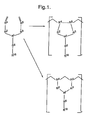
- networks are formed whose properties may be selected depending upon the precise nature of the R 16 group, the amount of chain terminator present and the polymerization conditions employed. Polymerization will occur in accordance with the general scheme set out in Figure 1 hereinafter.
- r is an integer of from 2 to 6, preferably from 2 to 4.
- R 16 will comprise bridging groups for example as is known in polymer chemistry. These may include straight or branched chain alkyl groups, optionally substituted or interposed with functional groups or siloxane groups such as alkyl siloxanes. Suitable bridging groups include those found in polyethylenes, polypropylenes, nylons, as listed in Table 1.
- R is an organic group such as hydrocarbyl Polyacrylates -CH 2 C(COOH)H- Polyureas -NHCONH- Polythioureas -NH-C(S)-NH-
- the length of the bridging group will affect the properties of the polymeric material derived from this. This can be used to design polymers with properties which are best suited to the application. For instance when the bridging group comprises relatively long chains, (for example with in excess of 6 repeat units, for example from 6-20 repeat units), the polymer will have pliable plastic properties. Alternatively, when the bridging group is relatively short, (e.g. less than 6 repeat units) the material will be more brittle.
- a compound of formula IIA where the bridging group is of the polyethylene type and r is 2 will comprise a compound of formula (IIB) where X 2 , X 3 , Y 2 , Y 3 , R 1 , R 2 , R 3 , R 4 , R 5 and R 6 are as defined above and each group X 2 , X 3 , Y 2 , Y 3 , R 1 , R 2 , R 3 , R 4 , R 5 and R 6 may be the same or different to any other group, and d is an integer of from 6-20.
- Another method for producing particular properties of the product arises from the possibility of producing copolymers where another monomeric compound, for example one which is not of formula (I), is mixed with the compound of formula (I) prior to polymerization.
- Such monomers are known in the art.
- Examples of possible bridging groups R 16 where r is 2 are groups of sub-formula (VII) -Z 1 -(Q 1 ) a -(Z 2 -Q 2 ) b -Z 3 - (VII) where a and b are independently selected from 0, 1 or 2, Z 1 , Z 2 and Z 3 are independently selected from a bond, an optionally substituted linear or branched alkyl or alkene chain wherein optionally one or more non-adjacent carbon atoms is replaced with a heteroatom or an amide group, Q 1 and Q 2 are independently selected from an optionally substituted carbocylic or heterocyclic ring which optionally contains bridging alkyl groups.
- Suitable carbocyclic rings for Q 1 and Q 2 include cycloalkyl groups for example from 1 to 20 carbon atoms.
- Bridged carbocylic ring structures include 1,4-bicyclo[2.2.2] octane, decalin, bicyclo[2.2.1]heptane, cubane, diadamantane, adamantane.
- Suitable heterocyclic rings include any of the above where one or more non adjacent carbon atoms are replaced by a heteroatom such as oxygen, sulphur or nitrogen (including amino or substituted amino), or a carboxyl or an amide group.
- Suitable optional substitutents for the groups Q 1 and Q 2 include one or more groups selected from alkyl, alkenyl, alkynyl, aryl, aralkyl such as benzyl, or functional groups as defined above.
- Substitutents for the groups Q 1 and Q 2 are oxo and halogen in particular fluorine and chlorine.
- bridging groups R 16 include electrically conducting chains, for instance, electrically conducting unsaturated chains such as alkenes or chains incorporating aromatic or heterocyclic rings.
- the group R 16 may comprise a tetra substituted conducting unit such as a tertathiafulvalene.
- R 28 , R 29 , R 30 and R 31 are each groups of sub-formula (IX) where R 1 , R 2 , R 3 , R 4 , R 5 and R 6 are as defined in relation to formula (I) above and R 24 , R 25 , R 26 and R 27 are independently selected from groups of sub-formula (VII) as given above.
- R 24 , R 25 , R 26 and R 27 are alkyl groups.
- varying the counter ion Z - can also be used to adjust the physical properties of the polymer, such as water retention, porosity or conductivity.
- Suitably substituted materials will exhibit conducting properties, making them suitable as organic semiconductors for example for use as interconnects for IC chips etc.
- a bridging group R 16 may comprise a tetra or octa substituted non-linear optic unit such as an optionally substituted porphyrin or phthalocyanine wherein the optional substitutents include hydrocarbyl groups as well as groups of sub formula (I).
- An example of such a porphyin compound is a compound of formula (X) where R 24 , R 25 , R 26 , R 27 R 28 , R 29 , R 30 and R 31 are as defined in relation to formula (VIII) above and R 32 , R 33 , R 34 and R 35 are each independently selected from hydrogen or hydrocarbyl groups; and the compound optionally contains a metal ion within the macrocyclic heterocyclic unit.
- An alternative phthalocyanine compound is a compound of formula (XA) where R 50 through to R 65 are independently selected from hydrocarbyl in particular C 1-12 alkyl, a group OR 68 where R 68 is hydrocarbyl in particular butyl, halogen in particular chlorine or a group R 24 -R 28 where R 24 and R 28 are as defined in relation to formula (VIII) above, provided that at least two of R 50 to R 65 are R 24 -R 28 groups, and R 66 and R 67 are either hydrogen or together comprise a metal ion such as a copper ion.
- R 51 , R 52 , R 55 , R 56 , R 59 , R 60 , R 63 and R 64 are halogen and R 50 , R 53 , R 54 , R 57 , R 58 , R 61 , R 62 and R 65 are independently C 1-12 alkyl, C 1-12 alkoxy or a group R 24 -R 28 .
- Materials such as the compounds of formula (X) and (XA) which include metal ions such as copper might be particularly useful in the production of conducting layers for interconnects, useful in the production of say, 1000MHz or more microprocessors. Copper doping of resin resists used as interconnects has been recognised as desirable by much of the electronics industry.
- a photopolymerizable material in accordance with the invention in the production of such microprocessors, reduce damage to substrate as compared to conventional hardening processes would be expected.
- the processing time could be reduced (conventional hardening processes typically require heating at temperatures of 120-350°C for between 10 and 30 minutes). This would therefore improve on batch yield from a wafer.
- Examples of such compounds are compounds of structure (XI) where R 24 , R 25 , R 28 and R 29 are as defined above in relation to formula (VIII), R 32 , R 33 , R 34 are R 35 , are as defined above in relation to formula (X) and in particular are each independently selected from hydrocarbyl such as alkyl and in particular methyl, and each R 36 or R 37 group is independently selected from hydrocarbyl or a group of formula R 26 -R 30 where R 26 and R 30 are as defined above in relation to formula (VIII), and u is 0 or an integer of 1 or more, for example of from 1 to 20.
- compounds of formula (XI) and (XII) or variants thereof will form a cross-linked network where the cross-linking occurs through the groups R 28 , R 29 , R 30 and R 31 as illustrated in Figure 1 .
- Such polymers may exhibit properties similar to those of conventional siloxanes.
- compounds of formula (XI) and (XII) they may be used in stereolithography.
- Compounds of formula (II) are suitably prepared by conventional methods, for example by reacting a compound of formula (XV) where X 1 , Y 1 , R 2 , R 3 , R 4 , R 5 and the dotted bonds are as defined in relation to formula (II), R 1' is a group R 1 as defined in formula II or a precursor thereof, and R 40 is hydrogen or hydroxy, with a compound of formula (XVI) R 16 -[R 6 -Z 4 ] r (XVI) where R 6 , R 16 and r are as defined in relation to formula (II) and Z 4 is a leaving group, and thereafter if necessary, converting a precursor group R 1' to a group R 1 .
- the compound of formula (XV) will be of formula (XVA) where R 1' , R 2 , R 3 , R 4 , R 5 , R 40 , X 2 , X 3 , Y 2 and Y 3 are as defined above.
- Suitable leaving groups Z 4 include halogen in particular bromo, mesylate or tosylate.
- the reaction is suitably effected in an organic solvent such as tetrahydrofuran, dichloromethane, toluene, an alcohol such as methanol or ethanol, or a ketone such as butanone and at elevated temperatures for example near the boiling point of the solvent.
- a base such as potassium carbonate.
- R 1' When the group R 1' is a precursor of the group R 1 , it may be converted to the corresponding R 1 group using conventional techniques.
- R 1' may be a nitrogen atom, which may be converted to a group NR 12 (Z m- ) 1/m where R 12 , Z and m are as defined above, by reaction with an appropriate salt under conventional conditions. Examples of this are illustrated hereinafter.
- Compounds of formulae (XV) and (XVI) are either known compounds or they can be prepared from known compounds by conventional methods.
- the compounds link together by way of the multiple bond, in particular the diene group as illustrated in Figure 1 .
- the compounds used include more than one diene grouping, for example compounds of formula (II) where R is 2 or more, they will tend to become cross linked to form a network or three dimensional structure.
- the degree of cross linking can be controlled by carrying out the polymerization in the presence of cross-linkers, where for example r is greater than 2, for example 4, or diluents.
- the latter will suitably comprise a compound of formula (XVI) where X 1 , X 2 , Y 1 , Y 2 , R 1 , R 2 , R 3 , R 4 , R 5 , R 6 , R 16 and r are as defined in relation to formula (II).
- Stereolithographic compositions which include the compounds described above may also comprise other components.
- they will comprise a photoinitiator compound, and may additionally contain fillers, extenders, stabilisers, radiation absorbers, polarisers, solvents or other monomers as required.
- Suitable photointiators include 2,2'-azobisisobutyronitrile (AIBN), aromatic ketones such as benzophenones in particular acetophenone; chlorinated acetophenones such as di- or tri-chloroacetophenone; dialkoxyacetophenones such as dimethoxyacetophenones (sold under the Trade name "Irgacure 651”); dialkylhydroxyacetophenones such as dimethylhydroxyacetophenone (sold under the Trade name "Darocure 1173”); substituted dialkylhydroxyacetophenone alkyl ethers such compounds of formula where R y is alkyl and in particular 2,2-dimethylethyl, R x is hydroxy or halogen such as chloro, and R p and R q are independently selected from alkyl or halogen such as chloro (examples of which are sold under the Trade names "Darocure 1116" and "Trigonal P1"); 1-benzoylcyclo
- Radiation energy absorbers where present, are typically present in small quantities, for example from 0.001 to 1% by weight of the composition.
- the precise nature of the absorber will depend upon the particular radiation being used and thus the wavelength of the radiation which is being controlled. Examples of such compounds include benzotriazole compounds, benzophenone compounds, phenyl salycilates and cyanoacrylates, for example as described in US Patent No. 5,849,459 .
- Suitable solvents include organic solvents such as alcohols like ethanol so as to make the composition workable for use in a stereolithographic process.
- the compound of formula (I) will comprise from 10 to 100% of the polycurable component of the composition.
- Composites may also be produced by including in the composition other moieties such as graphite, ethers such as crown ethers or thioethers, phthalocyanines, bipyridyls or liquid crystal compounds, all of which will produce composite polymers with modified properties.
- moieties such as graphite, ethers such as crown ethers or thioethers, phthalocyanines, bipyridyls or liquid crystal compounds, all of which will produce composite polymers with modified properties.
- additives which may be included in the compositions include stabilisers such as additives intended to prevent shrinkage of a three-dimensional object obtained by stereolithography.
- Such additives may include components which are soluble in the composition but separate from the composition on hardening to form a different phase such as those described in JP-A-3-20315 .
- Polymeric coagulating materials which coagulate when heated such as those described in JP-A-3-104626 may also be included.
- compositions can be used in a variety of conventional stereolithographic applications, for the production of three-dimensional objects such as plastic moulds, for example those used in the production of prototype devices such as domestic electrical appliances etc., intended for mass production.
- stereolithography compositions of the invention for the formation of semi-conductor features would be advantageous in that it would allow the formation of features on the substrate surface without the use of conventional patterning methods that require several process steps such as plasma etching and chemical etching. These two processes, no matter how carefully done, cause some form of electrical damage to the substrate itself and therefore increase the likelihood of source/drain and collector/drain leakage.
- compositions of the invention would be beneficial, in particular if the layer you are depositing is of a conducting or an insulating layer (a polyimide material based would have good insulating and capacitance properties for example). Again the amount of damage when removing the excess from the unwanted areas of the substrate would be reduced, as a simple solvent clean should remove the uncrosslinked excess.
- the invention further provides a method of carrying out a stereolithographic process to produce a three-dimensional object, said method comprises use of a compound or a composition as described above.
- Sterolithographic apparatus and conditions are well known in the art. Examples of suitable apparatus and systems are described in EP-A-250,121 , US Patent Nos 4,575,330 and 5,922,364 and a review of the area is provided in Journal of Imaging Technology, 15:186-190 (190 ). A method for producing multilayer objects is described in US Patent No 4,752,498 . Compounds of the invention may be used in any of these techniques, provided that appropriate curing radiation, in particular u.v. or electron beam radiation is used.
- the method of the invention can be used in the preparation of homopolymers or copolymers where they are mixed with other monomeric units, which may themselves be of a similar basic structure, for example of formula (II) or otherwise.
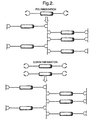
- FIG. 2 A general scheme illustrating the sort of polymerization process which may occur using a polyethylene type bridging group is illustrated in Figure 2 .
- a suitable organic system that has optimal or optimised properties for use in certain applications, e.g. high yield strength, large hyperpolarisability, high pyroelectric coefficient, high conductivity etc, and to structurally modify the system so that it is possible to polymerize it using stereolithography. If functional groups are incorporated that will polymerize, it will become possible to create a three-dimensional network or plastic that will have properties associated with the parent organic system.
- Objects and particularly three-dimensional objects obtained using the method form a further aspect of the invention.
Landscapes
- Physics & Mathematics (AREA)
- Engineering & Computer Science (AREA)
- General Physics & Mathematics (AREA)
- Materials Engineering (AREA)
- Spectroscopy & Molecular Physics (AREA)
- Chemical & Material Sciences (AREA)
- Manufacturing & Machinery (AREA)
- Mechanical Engineering (AREA)
- Optics & Photonics (AREA)
- Addition Polymer Or Copolymer, Post-Treatments, Or Chemical Modifications (AREA)
- Organic Low-Molecular-Weight Compounds And Preparation Thereof (AREA)
- Heterocyclic Compounds Containing Sulfur Atoms (AREA)
- Nitrogen Condensed Heterocyclic Rings (AREA)
- Macromonomer-Based Addition Polymer (AREA)
Applications Claiming Priority (3)
| Application Number | Priority Date | Filing Date | Title |
|---|---|---|---|
| GBGB9928621.3A GB9928621D0 (en) | 1999-12-04 | 1999-12-04 | Composition for use in stereolithography |
| GB9928621 | 1999-12-04 | ||
| PCT/GB2000/004756 WO2001040874A1 (en) | 1999-12-04 | 2000-11-30 | Use of a composition in stereolithography |
Publications (2)
| Publication Number | Publication Date |
|---|---|
| EP1242851A1 EP1242851A1 (en) | 2002-09-25 |
| EP1242851B1 true EP1242851B1 (en) | 2009-08-26 |
Family
ID=10865666
Family Applications (1)
| Application Number | Title | Priority Date | Filing Date |
|---|---|---|---|
| EP00985544A Expired - Lifetime EP1242851B1 (en) | 1999-12-04 | 2000-11-30 | Use of a composition in stereolithography |
Country Status (7)
| Country | Link |
|---|---|
| US (1) | US6951700B2 (enExample) |
| EP (1) | EP1242851B1 (enExample) |
| JP (1) | JP2003515479A (enExample) |
| AU (1) | AU2195601A (enExample) |
| DE (1) | DE60042840D1 (enExample) |
| GB (1) | GB9928621D0 (enExample) |
| WO (1) | WO2001040874A1 (enExample) |
Families Citing this family (18)
| Publication number | Priority date | Publication date | Assignee | Title |
|---|---|---|---|---|
| GB0613013D0 (en) | 2006-06-30 | 2006-08-09 | Novel Polymer Solutions Ltd | Polymeric Materials and Methods for Manufacturing Them |
| GB0722631D0 (en) * | 2007-11-17 | 2007-12-27 | Novel Polymer Solutions Ltd | Method of encapsulating a substance |
| CN102301277B (zh) * | 2008-12-05 | 2013-07-17 | 3M创新有限公司 | 使用非线性热聚合的三维制品 |
| JP5959514B2 (ja) | 2010-08-02 | 2016-08-02 | シンター ファイン ケミカルズ リミテッド | 低表面エネルギー基材の被覆方法 |
| JP5986081B2 (ja) | 2010-08-02 | 2016-09-06 | シンター ファイン ケミカルズ リミテッド | 複合部材及びその製造方法 |
| WO2012017235A1 (en) | 2010-08-02 | 2012-02-09 | Novel Polymer Solutions Limited | Covered floors and methods of adhering flooring to a floor |
| KR101817088B1 (ko) | 2010-08-02 | 2018-01-11 | 신터 파인 케미칼스 리미티드 | 단섬유 가공방법 |
| GB201016670D0 (en) | 2010-10-04 | 2010-11-17 | Novel Polymer Solutions Ltd | Textile having a camouflage pattern thereon |
| GB201105453D0 (en) | 2011-03-31 | 2011-05-18 | Novel Polymer Solutions Ltd | Window frames, structural elements for a roofed construction and methods of assembling same |
| GB201115823D0 (en) | 2011-09-13 | 2011-10-26 | Novel Polymer Solutions Ltd | Mineral processing |
| WO2015108544A1 (en) | 2014-01-16 | 2015-07-23 | Hewlett-Packard Development Company, L.P. | Polymeric powder composition for three-dimensional (3d) printing |
| US10583612B2 (en) | 2014-01-16 | 2020-03-10 | Hewlett-Packard Development Company, L.P. | Three-dimensional (3D) printing method |
| WO2015149223A1 (en) | 2014-03-31 | 2015-10-08 | Dow Global Technologies Llc | Crosslinkable polymeric compositions with diallylamide crosslinking coagents, methods for making the same, and articles made therefrom |
| US20180015662A1 (en) * | 2015-03-05 | 2018-01-18 | Carbon, Inc. | Fabrication of three dimensional objects with variable slice thickness |
| FI129702B (en) | 2015-10-09 | 2022-07-15 | Inkron Ltd | A material suitable for three-dimensional printing and a method for making a 3D-printed product |
| EP3692105A1 (en) | 2017-10-05 | 2020-08-12 | 3D Systems, Inc. | Cyclopolymerizable compounds for 3d printing |
| CN107857706B (zh) * | 2017-11-30 | 2020-11-24 | 华南理工大学 | 一种增加氨纶酸性染料上染率和色牢度的添加剂及其应用 |
| JPWO2020090294A1 (ja) * | 2018-10-31 | 2021-10-07 | 昭和電工マテリアルズ株式会社 | イオン性化合物、有機エレクトロニクス材料、インク組成物、及び有機エレクトロニクス素子 |
Family Cites Families (26)
| Publication number | Priority date | Publication date | Assignee | Title |
|---|---|---|---|---|
| CA999300A (en) * | 1970-09-22 | 1976-11-02 | Rohm And Haas Company | Wet-strength resins, paper and method of making it |
| US3888928A (en) * | 1972-07-31 | 1975-06-10 | Ici Australia Ltd | 1,4-bis(diallylaminomethyl)-benzene |
| JPS5213549B2 (enExample) * | 1973-07-26 | 1977-04-15 | ||
| JPS5213550B2 (enExample) * | 1973-08-13 | 1977-04-15 | ||
| US3912693A (en) * | 1973-04-05 | 1975-10-14 | Nitto Boseki Co Ltd | Process for producing polyamines |
| US3957699A (en) * | 1973-06-12 | 1976-05-18 | Ici Australia Limited | Process for polymerizing allylamines employing a redox initiator consisting of Fe++ or Ti+++ with H2 O2, hydroxyl amine, or hydroperoxides to form insoluble crosslinked polymers |
| JPS5137986A (ja) * | 1974-09-27 | 1976-03-30 | Nitto Boseki Co Ltd | Jiariruaminkyojugotai no seizohoho |
| US4121986A (en) | 1975-05-07 | 1978-10-24 | Ici Australia Limited | Process for the polymerization of polyallylamines in the presence of a mineral acid solution |
| DE3233912A1 (de) * | 1982-09-13 | 1984-03-15 | Merck Patent Gmbh, 6100 Darmstadt | Fotolacke zur ausbildung von reliefstrukturen aus hochwaermebestaendigen polymeren |
| JPH03200815A (ja) * | 1989-04-05 | 1991-09-02 | Mitsui Toatsu Chem Inc | 光重合性組成物、親水性重合体膜および親水性重合体膜で被覆された板状体 |
| US5055372A (en) * | 1990-04-23 | 1991-10-08 | The Mead Corporation | Photohardenable composition containing borate salts and ketone initiators |
| US5241041A (en) * | 1991-12-16 | 1993-08-31 | Occidental Chemical Corporation | Photocrosslinkable polyimide ammonium salts |
| JP3705508B2 (ja) * | 1995-10-31 | 2005-10-12 | ナブテスコ株式会社 | 耐熱性に優れる光硬化性樹脂組成物 |
| GB9522367D0 (en) * | 1995-11-01 | 1996-01-03 | Secr Defence | Liquid crystal polymers |
| GB9522362D0 (en) * | 1995-11-01 | 1996-01-03 | Secr Defence | Liquid crystal polymers |
| JPH09157235A (ja) * | 1995-12-13 | 1997-06-17 | Mitsui Toatsu Chem Inc | 新規n−アリル置換フタル酸ハーフアミド化合物 |
| JPH09202757A (ja) * | 1996-01-26 | 1997-08-05 | Mitsui Toatsu Chem Inc | N−アリル置換テトラヒドロフタル酸ハーフアミド化合物 |
| DE19603577C2 (de) * | 1996-02-01 | 2003-11-13 | Heraeus Kulzer Gmbh & Co Kg | Adhäsive |
| GB9606768D0 (en) * | 1996-03-29 | 1996-06-05 | Secr Defence | Liquid crystal materials and devices |
| US6350840B1 (en) * | 1998-07-02 | 2002-02-26 | National Starch And Chemical Investment Holding Corporation | Underfill encapsulants prepared from allylated amide compounds |
| GB9816163D0 (en) * | 1998-07-25 | 1998-09-23 | Secr Defence | Liquid crystal polymers |
| GB9816167D0 (en) * | 1998-07-25 | 1998-09-23 | Secr Defence | Polymer production |
| GB9816171D0 (en) * | 1998-07-25 | 1998-09-23 | Secr Defence | Monomers and network polymers obtained therefrom |
| GB9816169D0 (en) * | 1998-07-25 | 1998-09-23 | Secr Defence | Adhesives and sealants |
| US6569602B1 (en) * | 1998-10-05 | 2003-05-27 | E. I. Du Pont De Nemours And Company | Ionization radiation imageable photopolymer compositions |
| GB2376020B (en) * | 2000-04-01 | 2004-09-29 | Qinetiq Ltd | Polymers |
-
1999
- 1999-12-04 GB GBGB9928621.3A patent/GB9928621D0/en not_active Ceased
-
2000
- 2000-11-30 EP EP00985544A patent/EP1242851B1/en not_active Expired - Lifetime
- 2000-11-30 WO PCT/GB2000/004756 patent/WO2001040874A1/en not_active Ceased
- 2000-11-30 US US10/148,673 patent/US6951700B2/en not_active Expired - Fee Related
- 2000-11-30 JP JP2001542278A patent/JP2003515479A/ja active Pending
- 2000-11-30 DE DE60042840T patent/DE60042840D1/de not_active Expired - Lifetime
- 2000-11-30 AU AU21956/01A patent/AU2195601A/en not_active Abandoned
Also Published As
| Publication number | Publication date |
|---|---|
| WO2001040874A1 (en) | 2001-06-07 |
| AU2195601A (en) | 2001-06-12 |
| US6951700B2 (en) | 2005-10-04 |
| DE60042840D1 (de) | 2009-10-08 |
| US20030157435A1 (en) | 2003-08-21 |
| EP1242851A1 (en) | 2002-09-25 |
| JP2003515479A (ja) | 2003-05-07 |
| GB9928621D0 (en) | 2000-02-02 |
Similar Documents
| Publication | Publication Date | Title |
|---|---|---|
| EP1242851B1 (en) | Use of a composition in stereolithography | |
| Nguyen et al. | Acrylate‐based photopolymer for two‐photon microfabrication and photonic applications | |
| Hasegawa | Photopolymerization of diolefin crystals | |
| Mendes‐Felipe et al. | State‐of‐the‐art and future challenges of UV curable polymer‐based smart materials for printing technologies | |
| JP3950241B2 (ja) | 樹脂組成物、樹脂硬化物、及び構造物の補修方法、補強方法、補修用材料、補強用材料 | |
| US6099783A (en) | Photopolymerizable compositions for encapsulating microelectronic devices | |
| Lan et al. | UV-nanoimprint lithography: structure, materials and fabrication of flexible molds | |
| EP2199854B1 (en) | Hybrid polymer mold for nano-imprinting and method for making the same | |
| KR101767179B1 (ko) | 폴리머 물질 표면 상호작용을 변화시키는 방법 및 공정 | |
| EP2023169A1 (en) | Wire grid polarizer and method for producing the same | |
| JP2009531516A (ja) | 放射線−硬化性ゴム系接着剤/シーラント | |
| KR101332702B1 (ko) | 방사선 경화성 지환족 장벽 밀봉재 | |
| JP6194099B2 (ja) | 無機粒子を含むイオン交換膜 | |
| CN1058851A (zh) | 采用不同张力弹性薄膜的立体成象系统 | |
| MX2011005900A (es) | Metodo para producir materiales modelados. | |
| JPS61278507A (ja) | 担持光重合開始剤 | |
| Nechausov et al. | Effects of ionic liquids and dual curing on vat photopolymerization process and properties of 3d-printed ionogels | |
| JP5765237B2 (ja) | フルオロポリマーおよび含フッ素硬化性樹脂組成物 | |
| JPH08511571A (ja) | 熱重合エポキシドを使用した防振構造物 | |
| CN104932197B (zh) | 一种纳米压印用膨胀聚合压印胶 | |
| Boey et al. | Cationic UV cure kinetics for multifunctional epoxies | |
| JP2003515479A5 (enExample) | ||
| JP3944217B2 (ja) | 重合開始剤、及びこれを用いた樹脂硬化物の製造方法 | |
| JPH0460483B2 (enExample) | ||
| CN114957563A (zh) | 一种光固化3d打印疏水树脂及其制备方法 |
Legal Events
| Date | Code | Title | Description |
|---|---|---|---|
| PUAI | Public reference made under article 153(3) epc to a published international application that has entered the european phase |
Free format text: ORIGINAL CODE: 0009012 |
|
| 17P | Request for examination filed |
Effective date: 20020527 |
|
| AK | Designated contracting states |
Kind code of ref document: A1 Designated state(s): AT BE CH CY DE DK ES FI FR GB GR IE IT LI LU MC NL PT SE TR |
|
| AX | Request for extension of the european patent |
Free format text: AL;LT;LV;MK;RO;SI |
|
| RBV | Designated contracting states (corrected) |
Designated state(s): AT BE CH DE FR GB LI |
|
| GRAP | Despatch of communication of intention to grant a patent |
Free format text: ORIGINAL CODE: EPIDOSNIGR1 |
|
| RIN1 | Information on inventor provided before grant (corrected) |
Inventor name: BLACKWOOD, KEITH MORAY, Inventor name: HALL, ALAN WILLIAM, Inventor name: MILNE, PAUL EDWARD YOUNG Inventor name: BIGGS, ANDREW GRAHAM, Inventor name: GOODBY, JOHN WILLIAM, Inventor name: BANNISTER, ROBERT WILLIAM, Inventor name: HEATH, RYAN MICHAEL, |
|
| GRAS | Grant fee paid |
Free format text: ORIGINAL CODE: EPIDOSNIGR3 |
|
| GRAA | (expected) grant |
Free format text: ORIGINAL CODE: 0009210 |
|
| AK | Designated contracting states |
Kind code of ref document: B1 Designated state(s): DE FR GB |
|
| REG | Reference to a national code |
Ref country code: GB Ref legal event code: FG4D |
|
| REF | Corresponds to: |
Ref document number: 60042840 Country of ref document: DE Date of ref document: 20091008 Kind code of ref document: P |
|
| PGFP | Annual fee paid to national office [announced via postgrant information from national office to epo] |
Ref country code: DE Payment date: 20091120 Year of fee payment: 10 |
|
| PGFP | Annual fee paid to national office [announced via postgrant information from national office to epo] |
Ref country code: FR Payment date: 20091201 Year of fee payment: 10 Ref country code: GB Payment date: 20091119 Year of fee payment: 10 |
|
| PLBE | No opposition filed within time limit |
Free format text: ORIGINAL CODE: 0009261 |
|
| STAA | Information on the status of an ep patent application or granted ep patent |
Free format text: STATUS: NO OPPOSITION FILED WITHIN TIME LIMIT |
|
| 26N | No opposition filed |
Effective date: 20100527 |
|
| GBPC | Gb: european patent ceased through non-payment of renewal fee |
Effective date: 20101130 |
|
| REG | Reference to a national code |
Ref country code: FR Ref legal event code: ST Effective date: 20110801 |
|
| REG | Reference to a national code |
Ref country code: DE Ref legal event code: R119 Ref document number: 60042840 Country of ref document: DE Effective date: 20110601 Ref country code: DE Ref legal event code: R119 Ref document number: 60042840 Country of ref document: DE Effective date: 20110531 |
|
| PG25 | Lapsed in a contracting state [announced via postgrant information from national office to epo] |
Ref country code: FR Free format text: LAPSE BECAUSE OF NON-PAYMENT OF DUE FEES Effective date: 20101130 |
|
| PG25 | Lapsed in a contracting state [announced via postgrant information from national office to epo] |
Ref country code: GB Free format text: LAPSE BECAUSE OF NON-PAYMENT OF DUE FEES Effective date: 20101130 |
|
| PG25 | Lapsed in a contracting state [announced via postgrant information from national office to epo] |
Ref country code: DE Free format text: LAPSE BECAUSE OF NON-PAYMENT OF DUE FEES Effective date: 20110531 |