EP1237221A2 - Méthode de préparation d'une batterie au lithium - Google Patents
Méthode de préparation d'une batterie au lithium Download PDFInfo
- Publication number
- EP1237221A2 EP1237221A2 EP02075618A EP02075618A EP1237221A2 EP 1237221 A2 EP1237221 A2 EP 1237221A2 EP 02075618 A EP02075618 A EP 02075618A EP 02075618 A EP02075618 A EP 02075618A EP 1237221 A2 EP1237221 A2 EP 1237221A2
- Authority
- EP
- European Patent Office
- Prior art keywords
- cell
- oxygen
- voltage
- electrochemically treating
- carbon
- Prior art date
- Legal status (The legal status is an assumption and is not a legal conclusion. Google has not performed a legal analysis and makes no representation as to the accuracy of the status listed.)
- Withdrawn
Links
Images


Classifications
-
- H—ELECTRICITY
- H01—ELECTRIC ELEMENTS
- H01M—PROCESSES OR MEANS, e.g. BATTERIES, FOR THE DIRECT CONVERSION OF CHEMICAL ENERGY INTO ELECTRICAL ENERGY
- H01M10/00—Secondary cells; Manufacture thereof
- H01M10/05—Accumulators with non-aqueous electrolyte
- H01M10/052—Li-accumulators
- H01M10/0525—Rocking-chair batteries, i.e. batteries with lithium insertion or intercalation in both electrodes; Lithium-ion batteries
-
- H—ELECTRICITY
- H01—ELECTRIC ELEMENTS
- H01M—PROCESSES OR MEANS, e.g. BATTERIES, FOR THE DIRECT CONVERSION OF CHEMICAL ENERGY INTO ELECTRICAL ENERGY
- H01M10/00—Secondary cells; Manufacture thereof
- H01M10/05—Accumulators with non-aqueous electrolyte
- H01M10/056—Accumulators with non-aqueous electrolyte characterised by the materials used as electrolytes, e.g. mixed inorganic/organic electrolytes
- H01M10/0564—Accumulators with non-aqueous electrolyte characterised by the materials used as electrolytes, e.g. mixed inorganic/organic electrolytes the electrolyte being constituted of organic materials only
- H01M10/0565—Polymeric materials, e.g. gel-type or solid-type
-
- H—ELECTRICITY
- H01—ELECTRIC ELEMENTS
- H01M—PROCESSES OR MEANS, e.g. BATTERIES, FOR THE DIRECT CONVERSION OF CHEMICAL ENERGY INTO ELECTRICAL ENERGY
- H01M10/00—Secondary cells; Manufacture thereof
- H01M10/42—Methods or arrangements for servicing or maintenance of secondary cells or secondary half-cells
-
- H—ELECTRICITY
- H01—ELECTRIC ELEMENTS
- H01M—PROCESSES OR MEANS, e.g. BATTERIES, FOR THE DIRECT CONVERSION OF CHEMICAL ENERGY INTO ELECTRICAL ENERGY
- H01M4/00—Electrodes
- H01M4/02—Electrodes composed of, or comprising, active material
- H01M4/13—Electrodes for accumulators with non-aqueous electrolyte, e.g. for lithium-accumulators; Processes of manufacture thereof
- H01M4/133—Electrodes based on carbonaceous material, e.g. graphite-intercalation compounds or CFx
-
- H—ELECTRICITY
- H01—ELECTRIC ELEMENTS
- H01M—PROCESSES OR MEANS, e.g. BATTERIES, FOR THE DIRECT CONVERSION OF CHEMICAL ENERGY INTO ELECTRICAL ENERGY
- H01M10/00—Secondary cells; Manufacture thereof
- H01M10/42—Methods or arrangements for servicing or maintenance of secondary cells or secondary half-cells
- H01M10/44—Methods for charging or discharging
- H01M10/446—Initial charging measures
-
- Y—GENERAL TAGGING OF NEW TECHNOLOGICAL DEVELOPMENTS; GENERAL TAGGING OF CROSS-SECTIONAL TECHNOLOGIES SPANNING OVER SEVERAL SECTIONS OF THE IPC; TECHNICAL SUBJECTS COVERED BY FORMER USPC CROSS-REFERENCE ART COLLECTIONS [XRACs] AND DIGESTS
- Y02—TECHNOLOGIES OR APPLICATIONS FOR MITIGATION OR ADAPTATION AGAINST CLIMATE CHANGE
- Y02E—REDUCTION OF GREENHOUSE GAS [GHG] EMISSIONS, RELATED TO ENERGY GENERATION, TRANSMISSION OR DISTRIBUTION
- Y02E60/00—Enabling technologies; Technologies with a potential or indirect contribution to GHG emissions mitigation
- Y02E60/10—Energy storage using batteries
Definitions
- This invention relates to a method of preparation of lithium batteries, in particular lithium-ion and lithium-ion polymer batteries.
- Lithium-ion cells and batteries are secondary (i.e., rechargeable) energy storage devices well known in the art.
- the lithium-ion cell known also as a rocking chair type lithium battery, typically comprises a carbonaceous anode (negative electrode) that is capable of intercalating lithium ions, a lithium-retentive cathode (positive electrode) that is also capable of intercalating lithium ions, and a non-aqueous, lithium-ion-conducting electrolyte therebetween.
- the carbon anode comprises any of the various types of carbon (e.g., graphite, coke, carbon fiber, etc.) which are capable of reversibly storing lithium species, and which are bonded to an electrically conductive current collector (e.g. copper foil) by means of a suitable organic binder (e.g., polyvinyllidene difluoride, PVdF).
- a suitable organic binder e.g., polyvinyllidene difluoride, PVdF
- the cathode comprises such materials as transition metal chalcogenides that are bonded to an electrically conductive current collector (e.g., aluminum foil) by a suitable organic binder.
- Chalcogenide compounds include oxides, sulfides, selenides, and tellurides of such metals as vanadium, titanium, chromium, copper, molybdenum, niobium, iron, nickel, cobalt and manganese.
- Lithiated transition metal oxides are at present the preferred positive electrode intercalation compounds.
- suitable cathode materials include LiMnO 2 , LiCoO 2 and LiNiO 2 , their solid solutions and/or their combination with other metal oxides.
- the electrolyte in such lithium-ion cells comprises a lithium salt dissolved in a non-aqueous solvent which may be (1) completely liquid, (2) an immobilized liquid, (e.g., gelled or entrapped in a polymer matrix), or (3) a pure polymer.
- a non-aqueous solvent which may be (1) completely liquid, (2) an immobilized liquid, (e.g., gelled or entrapped in a polymer matrix), or (3) a pure polymer.
- Known polymer matrices for entrapping the electrolyte include polyacrylates, polyurethanes, polydialkylsiloxanes, polymethacrylates, polyphosphazenes, polyethers, and polycarbonates, and may be polymerized in situ in the presence of the electrolyte to trap the electrolyte therein as the polymerization occurs.
- Known polymers for pure polymer electrolyte systems include polyethylene oxide (PEO), polymethylene-polyethylene oxide (MPEO), or polyphosphazenes (PPE).
- Known lithium salts for this purpose include, for example, LiPF 6 , LiClO 4 , LiSCN, LiAlCl 4 , LiBF 4 , LiN(CF 3 SO 2 ) 2 , LiCF 3 SO 3 , LiC(SO 2 CF 3 ) 3 , LiO 3 SCF 2 CF 3 , LiC 6 F 5 SO 3 , LiO 2 CF 3 , LiAsF 6 , and LiSbF 6 .
- organic solvents for the lithium salts include, for example, alkylcarbonates (e.g., propylene carbonate, ethylene carbonate), dialkyl carbonates, cyclic ethers, cyclic esters, glymes, lactones, formates, esters, sulfones, nitrites, and oxazolidinones.
- alkylcarbonates e.g., propylene carbonate, ethylene carbonate
- dialkyl carbonates e.g., cyclic ethers, cyclic esters, glymes, lactones, formates, esters, sulfones, nitrites, and oxazolidinones.
- Lithium-ion cells made from pure polymer electrolytes, or liquid electrolytes entrapped in a polymer matrix, are known in the art as ⁇ lithium-ion polymer ⁇ cells, and the electrolytes therefore are known as polymeric electrolytes.
- Lithium-polymer cells are often made by laminating thin films of the anode, cathode and electrolyte together wherein the electrolyte layer is sandwiched between the anode and cathode layers to form an individual cell, and a plurality of such cells are bundled together to form a higher energy/voltage battery.
- lithium ions are deintercalated (or released) from the positive electrode and are intercalated (or inserted) into layer planes of the carbonous material.
- the lithium ions are released from the negative electrode and are inserted into the positive electrode.
- This passivating layer is often called a solid electrolyte interface (SEI) and contains a relatively complex ratio of several passivating film components, such as lithium-containing compositions (e.g., Li 2 CO 3 , Li 2 O, and Li-alkyl CO 3 ).
- SEI solid electrolyte interface
- the SEI plays a major role in determining electrode and battery behavior and properties, including irreversible capacity loss, lithium intercalation-deintercalation efficiency, cycle life, and the like.
- the SEI separates the negative electrodes from the electrolytes and eliminates (or drastically reduces) the transfer of electrons from the electrodes to the electrolytes and also the transfer of solvent molecules and salt anions from the electrolytes to the electrodes.
- the surface compositions and properties of both positive and negative electrodes intercalation compound are of substantial importance.
- the main impurity that contributes to increased cell impedance is water.
- H 2 O traces in the electrolyte may produce HF or other hydrogen-containing acids in the electrolyte, which may cause cell component decomposition. Further, the HF may cause precipitation of LiF on the surface of the cell electrodes, which has a blocking effect of lithium intercalation processes on both electrodes.
- an increase in cell moisture substantially increases electrode impedance and respectively decreases cell power performance and cell capacity at a higher charge-discharge rate.
- the increase in porosity of the SEI layer caused by an increase in the cell moisture increases SEI thickness, which has a strong negative effect on the cell safety performance because the SEI substance tends to react with the electrolyte at elevated temperatures.
- the increase of the cell moisture content decreases the temperature for initiation of cell self-heating, which causes cell thermal runaway at much lower temperatures.
- the moisture also catalyzes generation of decomposition gaseous products in the cell such as carbon monoxide, carbon dioxide, and methane, which have additional negative effect on cell integrity and cell safety performance.
- the increase in cell moisture decreases the cell ⁇ s, power density, energy density and its cycling, shelf life and safety performance.
- desiccants such as silica, alumina and phosphoric anhydride in the cathode composite
- desiccants are inert materials, which decrease the cell ⁇ s, specific power and energy, their strong moisture adsorption property may cause increase of cell moisture content during the cell assembly.
- Acidic descants such as Al 2 O 3 (U.S. Patent No. 5,168,019), Li 2 CO 3 (U.S. Patent No. 5,427,875) or other basic compounds (U.S. Patent No. 5,846,673) are also proposed. However, neutralization of only the acidic products will compensate only a portion of the negative effects caused by moisture impurities in the cell.
- the present invention provides a method for preparing lithium batteries, specifically lithium-ion and lithium-ion polymer batteries, in which a voltage treatment is effective to reduce water content in the battery cell thereby reducing cell impedance.
- a battery cell is provided to have a negative electrode, a positive electrode and a separator therebetween.
- One or both of the electrodes includes carbon.
- the cell is then activated with a lithium salt-based electrolyte.
- Moisture is present in the cell as an impurity.
- Oxygen is also present in the cell, either by purposeful addition, by virtue of being a component of the moisture impurity, and/or by virtue of its presence in the environment in which the cell is assembled.
- the assembled cell is then subjected to an electrochemical treatment in which a voltage is applied to keep the potential of the carbon-containing electrode more positive than the potential necessary for formation of a SEI by reduction of the electrolyte on the carbon-containing electrode.
- the voltage is selected to keep the potential of the carbon-containing electrode in the range of about 1.0 to about 3.0V versus a lithium reference electrode.
- the voltage is also applied so as to simultaneously keep the carbon-containing electrode more negative than the equilibrium potential of the oxygen to insure oxygen reduction on the negative carbon electrode.
- the voltage is applied long enough for the cell moisture to combine in a solid state compound, for example by reacting the oxygen with the moisture in the cell.
- the treatment may be repeated during battery cell cycling utilizing oxygen generated by the cell during use to reduce the moisture content.
- the cell includes a negative carbon electrode and a transition metal chalcogenide positive electrode. In another example of the present invention, the cell includes a negative electrode and a transition metal chalcogenide composite positive electrode containing a carbon additive.
- a lithium battery prepared in accordance with the present invention exhibits significantly lower water content and cell impedance than untreated batteries, and consequently exhibits significantly better elevated temperature calendar life.
- the present invention provides a method for preparing lithium batteries, in particular lithium-ion and lithium-ion polymer batteries having improved power, cycling and storage performance.
- the lithium-ion cell is electrochemically treated prior to formation of a passivating film on a carbon-containing electrode, typically the negative electrode (anode).
- a carbon-containing electrode typically the negative electrode (anode).
- an anode negative electrode
- a lithium-retention cathode positive electrode
- One or both of the electrodes must contain carbon. Moisture is present in the cell as an unavoidable impurity.
- oxygen is provided in the cell, such as by dissolving oxygen in the electrolyte, or by adsorbing oxygen onto at least one of the electrodes.
- oxygen may become trapped in the cell from the environment in which the cell is assembled, which is typically a dry room and/or dry box.
- oxygen is present in the cell as a component of H 2 O, present as an unavoidable impurity.
- the cell Prior to the first discharge-charge cycle of the cell, the cell is electrochemically treated by applying a voltage to the cell.
- the voltage is selected to keep the potential of the carbon-containing electrode(s) more positive than the potential necessary for SEI formation by reduction of electrolyte on the carbon-containing electrode(s), and is further selected to keep the potential of the carbon-containing electrode(s) more negative than the equilibrium potential of the oxygen to insure that oxygen reduction occurs on the carbon-containing electrode(s).
- the voltage applied for the electrochemical pretreatment is in the range of 0.1-2.8V, selected to keep the carbon-containing electrode potential in the range of 1.0-3.0V versus a Li/Li + reference electrode.
- the voltage may be applied by an external source.
- the electrochemical pretreatment may be a float charge or float discharge, or a combination thereof at the predetermined voltage.
- the electrochemical pretreatment may be a voltage sweep or voltage pulse, or a combination thereof at the predetermined voltage.
- the applied voltage may be for a period of about 1 hour to 5 days, for example. More particularly, the voltage is applied for a period of time sufficient to cause a reaction between the oxygen in the cell and the moisture impurity in the cell.
- the partial pressure of oxygen of the cell prior to the electrochemical treatment is maintained in the range of about 0.0001-1.0 atm, for example in the range of about 0.001-0.1 atm.
- the electrochemical pretreatment is performed at a temperature in the range of about -40 to about 120 ⁇ C.
- the electrochemical treatment may be repeated periodically throughout the calendar life of the battery to reduce the moisture, thereby further prolonging the battery calendar life.
- the initial pre-formatting treatment may be skipped, but with periodic treatments throughout the calendar life of the battery.
- a carbon anode is positioned opposite a transition metal chalcogenide cathode with a lithium salt-based electrolyte/separator therebetween.
- moisture is present in the cell as an unavoidable impurity.
- additional oxygen may be provided in the cell.
- the cell Prior to the first discharge-charge cycle of the cell, the cell is electrochemically treated by a applying a voltage to the cell.
- the voltage is selected to keep the potential of the negative carbon electrode more positive than the potential necessary for SEI formation by reduction of electrolyte on the negative electrode, and is further selected to keep the potential of the negative carbon electrode more negative than the equilibrium potential of the oxygen to insure that oxygen reduction occurs on the negative carbon electrode.
- the voltage applied for the electrochemical pretreatment is in the range of 0.1-2.8V, selected to keep the negative electrode potential in the range of 1.0-2.9V versus a Li/Li + reference electrode.
- an anode is positioned opposite a transition metal chalcogenide composite cathode containing a carbon additive with a lithium salt-based electrolyte/separator therebetween. Again, moisture is present in the cell as an unavoidable impurity. Optionally, additional oxygen may be provided in the cell. Prior to the first discharge-charge cycle of the cell, the cell is electrochemically treated by a applying a voltage to the cell.
- the voltage is selected to keep the potential of the positive carbon-containing electrode more positive than the potential necessary for SEI formation by reduction of electrolyte on the carbon additive in the positive electrode, and is further selected to keep the potential of the positive carbon-containing electrode more negative than the equilibrium potential of the oxygen to insure that oxygen reduction occurs at least on the carbon additive in the positive electrode.
- the voltage applied for the electrochemical pretreatment is in the range of 1.0-2.8V, selected to keep the positive electrode potential of 1.0-3.0V versus a Li/Li + reference electrode.
- a battery prepared by the method of the present invention exhibits a decrease in cell impedance and a respective increase in cell power capability. This improvement in electrochemical performance is believed to be caused by a decrease in the water content within the cell. This decrease in water content may be caused by the electrochemical reduction of oxygen on the carbon-containing electrode, for example the negative carbon electrode.
- a negative carbon electrode is known to be one of the best catalysts for oxygen reduction.
- the oxygen reduction may occur on the negative carbon electrode according to the following reaction: 2H 2 O + O 2 + 4e - ⁇ 4OH
- the simultaneous respective reaction on the positive electrode will be as follows: LiMO 2 ⁇ Li 1-x MO 2 + xLi + + xe - where M represents the transition metal or solid solution of transition metals typically used as positive electrode materials in lithium-ion batteries, and x represents the number of electrons or respectively the number of lithium ions exchanged.
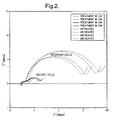
- FIG. 2 The decrease in cell impedance is further illustrated in FIG. 2 where the cell impedance measured by electrochemical impedance spectroscopy (EIS) of four cells treated according to the present invention versus the impedance of untreated reference cells is depicted.
- the cell impedance was measured using 2mV amplitude in the frequency range 10 5 -10 -2 Hz.
- the impedance of the four treated cells by a float charge in the voltage range of 1.2-1.5V for 48 hours is substantially lower than the impedance of the four untreated reference cells.
- FIG. 3 shows the charge and discharge power of the cell treated by a float charge at 1.4V for 48 hours compared with the power of the untreated reference cell as measured using a hybrid pulse power characterization (HPPC) test.
- HPPC hybrid pulse power characterization
- the treated cell according to the present invention has about 70% higher power than the power of the untreated reference cell.
- the polarization amplitude was 2mV.
- a lithium-ion PVdF polymer 250 cm 2 Bellcore type test cell was used for comparative measurement.
- An Al doped LiCo0.2Ni0.8O 2 positive electrode and a natural graphite negative electrode were used. The two electrodes were separated with a PVdF based polymer separator.
- the cell was activated with 1 M LiPF 6 electrolyte dissolved in EC:EMC (ethylene carbonate:ethyl-methyl carbonate). The cell was then hermitically closed and a 1V voltage was applied from an external power source to the cell for a period of about 48 hours.
- the cell was then subjected to EIS impedance measurement in the frequency range of 10 4 -5 x 10 -2 Hz and 5mV amplitude.
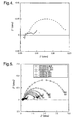
- the cell impedance measured is shown by the solid line in FIG. 4.
- the cell electrolyte was then extracted and the water content in the cell electrolyte measured using a Karl Fischer titration method.
- the water content measured in the cell electrolyte was 24 ⁇ 10 ppm.
- a reference cell with the same chemistry described above was used for comparative measurement.
- the cell was activated with the same 1 M LiPF 6 dissolved in EC:EMC electrolyte.
- the cell was then closed and a standard negative electrode formation cycle was applied at a charge-discharge rate of C/5.
- the cell was then subjected to EIS impedance measurement in the same frequency range at 10 4 -5 x 10 -2 Hz and 5mV amplitude.
- the cell impedance measured is shown by the dashed line in FIG. 4.
- the cell electrolyte was then extracted and the water content in the cell electrolyte was measured using the same Karl Fischer titration method. The water content was 158 ⁇ 10 ppm.
- the treated cell according to the present invention exhibits substantially lower cell impedance than the untreated reference cell and about six times lower water content than the untreated reference cell.
- a 20 cm experimental lithium-ion cell was prepared according to the present invention as described in Example 2, but with a 1.5V pretreatment in accordance with the present invention.
- a comparative reference cell was also prepared as described in Example 2.
- the impedance response of the treated cell of the present invention was measured after 0, 30, 60 and 90 days calendar life test at 55 ⁇ C.
- Impedance response of the reference cell was measured after 0, 30 and 60 days calendar life test at 55 ⁇ C.
- the results are provided in FIG. 5.
- FIG. 5 demonstrates that the cell prepared according to the present invention has a significantly longer calendar life than an untreated reference cell. Further, lithium-ion cells prepared according to the present invention exhibit significantly better elevated temperature calendar life than untreated reference cells.
Landscapes
- Chemical & Material Sciences (AREA)
- Engineering & Computer Science (AREA)
- Electrochemistry (AREA)
- Chemical Kinetics & Catalysis (AREA)
- General Chemical & Material Sciences (AREA)
- Manufacturing & Machinery (AREA)
- Materials Engineering (AREA)
- Dispersion Chemistry (AREA)
- General Physics & Mathematics (AREA)
- Inorganic Chemistry (AREA)
- Condensed Matter Physics & Semiconductors (AREA)
- Physics & Mathematics (AREA)
- Battery Electrode And Active Subsutance (AREA)
- Secondary Cells (AREA)
- Addition Polymer Or Copolymer, Post-Treatments, Or Chemical Modifications (AREA)
Applications Claiming Priority (2)
| Application Number | Priority Date | Filing Date | Title |
|---|---|---|---|
| US09/798,427 US20020122973A1 (en) | 2001-03-02 | 2001-03-02 | Method of preparation of lithium battery |
| US798427 | 2001-03-02 |
Publications (2)
| Publication Number | Publication Date |
|---|---|
| EP1237221A2 true EP1237221A2 (fr) | 2002-09-04 |
| EP1237221A3 EP1237221A3 (fr) | 2006-03-22 |
Family
ID=25173370
Family Applications (1)
| Application Number | Title | Priority Date | Filing Date |
|---|---|---|---|
| EP02075618A Withdrawn EP1237221A3 (fr) | 2001-03-02 | 2002-02-15 | Méthode de préparation d'une batterie au lithium |
Country Status (2)
| Country | Link |
|---|---|
| US (1) | US20020122973A1 (fr) |
| EP (1) | EP1237221A3 (fr) |
Cited By (2)
| Publication number | Priority date | Publication date | Assignee | Title |
|---|---|---|---|---|
| FR3025945A1 (fr) * | 2014-09-17 | 2016-03-18 | Renault Sas | Procede de formation d'une couche d'interface a la surface d'une electrode d'une cellule de batterie lithium-ion a haute tension |
| CN109904534A (zh) * | 2017-12-11 | 2019-06-18 | 北京小米移动软件有限公司 | 防止电池损伤的方法及装置 |
Families Citing this family (27)
| Publication number | Priority date | Publication date | Assignee | Title |
|---|---|---|---|---|
| US6787268B2 (en) * | 2002-09-03 | 2004-09-07 | Quallion Llc | Electrolyte |
| US7572554B2 (en) * | 2002-09-03 | 2009-08-11 | Quallion Llc | Electrolyte |
| US8524397B1 (en) | 2004-11-08 | 2013-09-03 | Quallion Llc | Battery having high rate and high capacity capabilities |
| KR100786968B1 (ko) * | 2005-07-22 | 2007-12-17 | 주식회사 엘지화학 | 전극활물질의 전처리 방법 |
| WO2007021148A1 (fr) | 2005-08-19 | 2007-02-22 | Lg Chem, Ltd. | Dispositif electrochimique haute capacite et procede de preparation de ce dernier |
| US8187752B2 (en) | 2008-04-16 | 2012-05-29 | Envia Systems, Inc. | High energy lithium ion secondary batteries |
| US10056644B2 (en) * | 2009-07-24 | 2018-08-21 | Zenlabs Energy, Inc. | Lithium ion batteries with long cycling performance |
| US8993177B2 (en) * | 2009-12-04 | 2015-03-31 | Envia Systems, Inc. | Lithium ion battery with high voltage electrolytes and additives |
| US8765306B2 (en) * | 2010-03-26 | 2014-07-01 | Envia Systems, Inc. | High voltage battery formation protocols and control of charging and discharging for desirable long term cycling performance |
| US9083062B2 (en) | 2010-08-02 | 2015-07-14 | Envia Systems, Inc. | Battery packs for vehicles and high capacity pouch secondary batteries for incorporation into compact battery packs |
| US9166222B2 (en) | 2010-11-02 | 2015-10-20 | Envia Systems, Inc. | Lithium ion batteries with supplemental lithium |
| US9159990B2 (en) | 2011-08-19 | 2015-10-13 | Envia Systems, Inc. | High capacity lithium ion battery formation protocol and corresponding batteries |
| JP6085994B2 (ja) * | 2012-04-27 | 2017-03-01 | 日産自動車株式会社 | 非水電解質二次電池の製造方法 |
| US10553871B2 (en) | 2012-05-04 | 2020-02-04 | Zenlabs Energy, Inc. | Battery cell engineering and design to reach high energy |
| US9780358B2 (en) | 2012-05-04 | 2017-10-03 | Zenlabs Energy, Inc. | Battery designs with high capacity anode materials and cathode materials |
| EP2882029A4 (fr) | 2012-08-02 | 2015-07-29 | Nissan Motor | Cellule secondaire à électrolyte organique non aqueux |
| DE102012214119A1 (de) * | 2012-08-09 | 2014-02-13 | Robert Bosch Gmbh | Formierungsvorrichtung mit Multiphasen-Architektur und zugehöriges Verfahren zur Formierung von Batteriezellen einer Batterie |
| WO2015024004A1 (fr) | 2013-08-16 | 2015-02-19 | Envia Systems, Inc. | Batteries au lithium-ion présentant un matériau actif anodique à haute capacité et de bonnes propriétés de cyclage pour appareils électroniques grand public |
| US10818914B2 (en) * | 2015-03-05 | 2020-10-27 | The Regents Of The University Of California | Carbonized mushroom electrodes and methods |
| US11094925B2 (en) | 2017-12-22 | 2021-08-17 | Zenlabs Energy, Inc. | Electrodes with silicon oxide active materials for lithium ion cells achieving high capacity, high energy density and long cycle life performance |
| US11316199B2 (en) | 2018-01-16 | 2022-04-26 | International Business Machines Corporation | Rechargeable metal halide battery |
| CN109164146B (zh) * | 2018-11-12 | 2023-06-09 | 桑顿新能源科技(长沙)有限公司 | 一种通过化成曲线判断水含量的方法 |
| DE102018221456A1 (de) * | 2018-12-12 | 2020-06-18 | Robert Bosch Gmbh | Vorrichtung zur elektrochemischen Bestimmung der Menge von insbesondere flüssigen Bestandteilen in Komponenten für Batteriezellen, Verfahren zum Betrieb derselben sowie deren Verwendung |
| US11165093B2 (en) | 2019-03-08 | 2021-11-02 | International Business Machines Corporation | Rechargeable metal halide battery |
| US11335908B2 (en) * | 2019-07-30 | 2022-05-17 | International Business Machines Corporation | Rechargeable metal halide battery |
| US12288877B2 (en) | 2020-07-13 | 2025-04-29 | International Business Machines Corporation | Rechargeable metal halide battery with intercalation anode |
| CN118759406B (zh) * | 2024-09-05 | 2025-01-03 | 宁德时代新能源科技股份有限公司 | 电池模组的日历老化测试方法、装置及系统 |
Family Cites Families (8)
| Publication number | Priority date | Publication date | Assignee | Title |
|---|---|---|---|---|
| US5264201A (en) * | 1990-07-23 | 1993-11-23 | Her Majesty The Queen In Right Of The Province Of British Columbia | Lithiated nickel dioxide and secondary cells prepared therefrom |
| US5436549A (en) * | 1993-04-19 | 1995-07-25 | Valence Technology, Inc. | Methods for extending the cycle life of solid, secondary electrolytic cells |
| CA2147578C (fr) * | 1995-04-21 | 2002-04-16 | Jan Naess Reimers | Oxyde de lithium et de manganise et son utilisation dans les piles rechargeables |
| JP3048899B2 (ja) * | 1995-09-06 | 2000-06-05 | キヤノン株式会社 | リチウム二次電池 |
| JP3489771B2 (ja) * | 1996-08-23 | 2004-01-26 | 松下電器産業株式会社 | リチウム電池およびリチウム電池の製造法 |
| US5853917A (en) * | 1997-03-06 | 1998-12-29 | Mitsubishi Chemical Corporation | Electrolytic cell having a controlled electrode surface interface |
| US6096454A (en) * | 1998-08-31 | 2000-08-01 | The Regents Of The University Of California | Surface modifications for carbon lithium intercalation anodes |
| DE19952335B4 (de) * | 1999-10-29 | 2007-03-29 | Fraunhofer-Gesellschaft zur Förderung der angewandten Forschung e.V. | In elektrochemischen Bauelementen verwendbare pastöse Masse, damit gebildete Schichten, Folien, Schichtverbünde und wiederaufladbare elektrochemische Zellen sowie Verfahren zur Herstellung der Schichten, Folien und Schichtverbünde |
-
2001
- 2001-03-02 US US09/798,427 patent/US20020122973A1/en not_active Abandoned
-
2002
- 2002-02-15 EP EP02075618A patent/EP1237221A3/fr not_active Withdrawn
Cited By (2)
| Publication number | Priority date | Publication date | Assignee | Title |
|---|---|---|---|---|
| FR3025945A1 (fr) * | 2014-09-17 | 2016-03-18 | Renault Sas | Procede de formation d'une couche d'interface a la surface d'une electrode d'une cellule de batterie lithium-ion a haute tension |
| CN109904534A (zh) * | 2017-12-11 | 2019-06-18 | 北京小米移动软件有限公司 | 防止电池损伤的方法及装置 |
Also Published As
| Publication number | Publication date |
|---|---|
| US20020122973A1 (en) | 2002-09-05 |
| EP1237221A3 (fr) | 2006-03-22 |
Similar Documents
| Publication | Publication Date | Title |
|---|---|---|
| US20020122973A1 (en) | Method of preparation of lithium battery | |
| KR102301219B1 (ko) | 음극 활물질, 이를 포함하는 음극 및 리튬 이차전지 | |
| KR100670507B1 (ko) | 리튬 이차 전지 | |
| US7709154B2 (en) | Non-aqueous electrolyte and a lithium secondary battery comprising the same | |
| US6156457A (en) | Lithium secondary battery and method for manufacturing a negative electrode | |
| KR101025278B1 (ko) | 음극활물질, 이를 구비하는 음극 및 리튬이차전지 | |
| US7060392B2 (en) | Non-aqueous electrolyte and a lithium secondary battery comprising the same | |
| US6087043A (en) | Lithium-ion rechargeable battery with carbon-based anode | |
| CN1333486C (zh) | 锂蓄电池 | |
| KR20010057562A (ko) | 재충전 전지의 비수성 전해질용 설페이트 첨가제 | |
| KR20190044444A (ko) | 리튬 이차전지용 양극 활물질, 이의 제조방법, 이를 포함하는 리튬 이차전지용 양극 및 리튬 이차전지 | |
| JP2019016483A (ja) | 非水電解質二次電池 | |
| JP2001006737A (ja) | リチウム二次電池用電解液及びこれを使用したリチウム二次電池 | |
| KR101305462B1 (ko) | 전극조립체 및 이를 구비하는 리튬 이차 전지 | |
| KR20100036955A (ko) | 비수 전해질 전지 | |
| CN118511298A (zh) | 电极、电池以及电池包 | |
| KR20240116401A (ko) | 양극 활물질, 이를 포함하는 양극 및 리튬 이차전지 | |
| US20040101762A1 (en) | Electrolyte for a lithium ion battery and a lithium ion battery comprising the same | |
| JP4741526B2 (ja) | 非水電解質二次電池 | |
| KR100416150B1 (ko) | 리튬 이차 전지의 제조 방법 및 이 제조 방법으로 제조된리튬 이차 전지 | |
| US20050069484A1 (en) | Method of preparation of positive electrode material | |
| KR20090094575A (ko) | 음극활물질, 이를 구비하는 음극 및 리튬이차전지 | |
| KR20000071371A (ko) | 비수성 전해질 전지 | |
| JP2001057235A (ja) | 非水電解液および非水電解液二次電池 | |
| JP4170575B2 (ja) | 寿命特性が改善されたリチウム二次電池用電解液 |
Legal Events
| Date | Code | Title | Description |
|---|---|---|---|
| PUAI | Public reference made under article 153(3) epc to a published international application that has entered the european phase |
Free format text: ORIGINAL CODE: 0009012 |
|
| AK | Designated contracting states |
Kind code of ref document: A2 Designated state(s): AT BE CH CY DE DK ES FI FR GB GR IE IT LI LU MC NL PT SE TR |
|
| AX | Request for extension of the european patent |
Free format text: AL;LT;LV;MK;RO;SI |
|
| RAP1 | Party data changed (applicant data changed or rights of an application transferred) |
Owner name: ENERDEL, INC. |
|
| PUAL | Search report despatched |
Free format text: ORIGINAL CODE: 0009013 |
|
| AK | Designated contracting states |
Kind code of ref document: A3 Designated state(s): AT BE CH CY DE DK ES FI FR GB GR IE IT LI LU MC NL PT SE TR |
|
| AX | Request for extension of the european patent |
Extension state: AL LT LV MK RO SI |
|
| AKX | Designation fees paid | ||
| REG | Reference to a national code |
Ref country code: DE Ref legal event code: 8566 |
|
| STAA | Information on the status of an ep patent application or granted ep patent |
Free format text: STATUS: THE APPLICATION IS DEEMED TO BE WITHDRAWN |
|
| 18D | Application deemed to be withdrawn |
Effective date: 20060923 |