EP1234958B1 - Verfahren und Vorrichtung zum steuerung der Einlassluftquantität in einer Brennkraftmaschine - Google Patents
Verfahren und Vorrichtung zum steuerung der Einlassluftquantität in einer Brennkraftmaschine Download PDFInfo
- Publication number
- EP1234958B1 EP1234958B1 EP02003761A EP02003761A EP1234958B1 EP 1234958 B1 EP1234958 B1 EP 1234958B1 EP 02003761 A EP02003761 A EP 02003761A EP 02003761 A EP02003761 A EP 02003761A EP 1234958 B1 EP1234958 B1 EP 1234958B1
- Authority
- EP
- European Patent Office
- Prior art keywords
- valve
- intake
- lift
- engine
- low load
- Prior art date
- Legal status (The legal status is an assumption and is not a legal conclusion. Google has not performed a legal analysis and makes no representation as to the accuracy of the status listed.)
- Expired - Lifetime
Links
Images



Classifications
-
- F—MECHANICAL ENGINEERING; LIGHTING; HEATING; WEAPONS; BLASTING
- F02—COMBUSTION ENGINES; HOT-GAS OR COMBUSTION-PRODUCT ENGINE PLANTS
- F02D—CONTROLLING COMBUSTION ENGINES
- F02D13/00—Controlling the engine output power by varying inlet or exhaust valve operating characteristics, e.g. timing
- F02D13/02—Controlling the engine output power by varying inlet or exhaust valve operating characteristics, e.g. timing during engine operation
- F02D13/0223—Variable control of the intake valves only
- F02D13/0226—Variable control of the intake valves only changing valve lift or valve lift and timing
-
- F—MECHANICAL ENGINEERING; LIGHTING; HEATING; WEAPONS; BLASTING
- F01—MACHINES OR ENGINES IN GENERAL; ENGINE PLANTS IN GENERAL; STEAM ENGINES
- F01L—CYCLICALLY OPERATING VALVES FOR MACHINES OR ENGINES
- F01L13/00—Modifications of valve-gear to facilitate reversing, braking, starting, changing compression ratio, or other specific operations
- F01L13/0015—Modifications of valve-gear to facilitate reversing, braking, starting, changing compression ratio, or other specific operations for optimising engine performances by modifying valve lift according to various working parameters, e.g. rotational speed, load, torque
- F01L13/0021—Modifications of valve-gear to facilitate reversing, braking, starting, changing compression ratio, or other specific operations for optimising engine performances by modifying valve lift according to various working parameters, e.g. rotational speed, load, torque by modification of rocker arm ratio
-
- F—MECHANICAL ENGINEERING; LIGHTING; HEATING; WEAPONS; BLASTING
- F02—COMBUSTION ENGINES; HOT-GAS OR COMBUSTION-PRODUCT ENGINE PLANTS
- F02M—SUPPLYING COMBUSTION ENGINES IN GENERAL WITH COMBUSTIBLE MIXTURES OR CONSTITUENTS THEREOF
- F02M26/00—Engine-pertinent apparatus for adding exhaust gases to combustion-air, main fuel or fuel-air mixture, e.g. by exhaust gas recirculation [EGR] systems
- F02M26/01—Internal exhaust gas recirculation, i.e. wherein the residual exhaust gases are trapped in the cylinder or pushed back from the intake or the exhaust manifold into the combustion chamber without the use of additional passages
-
- F—MECHANICAL ENGINEERING; LIGHTING; HEATING; WEAPONS; BLASTING
- F01—MACHINES OR ENGINES IN GENERAL; ENGINE PLANTS IN GENERAL; STEAM ENGINES
- F01L—CYCLICALLY OPERATING VALVES FOR MACHINES OR ENGINES
- F01L13/00—Modifications of valve-gear to facilitate reversing, braking, starting, changing compression ratio, or other specific operations
- F01L13/0015—Modifications of valve-gear to facilitate reversing, braking, starting, changing compression ratio, or other specific operations for optimising engine performances by modifying valve lift according to various working parameters, e.g. rotational speed, load, torque
- F01L13/0063—Modifications of valve-gear to facilitate reversing, braking, starting, changing compression ratio, or other specific operations for optimising engine performances by modifying valve lift according to various working parameters, e.g. rotational speed, load, torque by modification of cam contact point by displacing an intermediate lever or wedge-shaped intermediate element, e.g. Tourtelot
- F01L2013/0073—Modifications of valve-gear to facilitate reversing, braking, starting, changing compression ratio, or other specific operations for optimising engine performances by modifying valve lift according to various working parameters, e.g. rotational speed, load, torque by modification of cam contact point by displacing an intermediate lever or wedge-shaped intermediate element, e.g. Tourtelot with an oscillating cam acting on the valve of the "Delphi" type
-
- F—MECHANICAL ENGINEERING; LIGHTING; HEATING; WEAPONS; BLASTING
- F02—COMBUSTION ENGINES; HOT-GAS OR COMBUSTION-PRODUCT ENGINE PLANTS
- F02D—CONTROLLING COMBUSTION ENGINES
- F02D13/00—Controlling the engine output power by varying inlet or exhaust valve operating characteristics, e.g. timing
- F02D13/02—Controlling the engine output power by varying inlet or exhaust valve operating characteristics, e.g. timing during engine operation
- F02D13/0261—Controlling the valve overlap
-
- Y—GENERAL TAGGING OF NEW TECHNOLOGICAL DEVELOPMENTS; GENERAL TAGGING OF CROSS-SECTIONAL TECHNOLOGIES SPANNING OVER SEVERAL SECTIONS OF THE IPC; TECHNICAL SUBJECTS COVERED BY FORMER USPC CROSS-REFERENCE ART COLLECTIONS [XRACs] AND DIGESTS
- Y02—TECHNOLOGIES OR APPLICATIONS FOR MITIGATION OR ADAPTATION AGAINST CLIMATE CHANGE
- Y02T—CLIMATE CHANGE MITIGATION TECHNOLOGIES RELATED TO TRANSPORTATION
- Y02T10/00—Road transport of goods or passengers
- Y02T10/10—Internal combustion engine [ICE] based vehicles
- Y02T10/12—Improving ICE efficiencies
-
- Y—GENERAL TAGGING OF NEW TECHNOLOGICAL DEVELOPMENTS; GENERAL TAGGING OF CROSS-SECTIONAL TECHNOLOGIES SPANNING OVER SEVERAL SECTIONS OF THE IPC; TECHNICAL SUBJECTS COVERED BY FORMER USPC CROSS-REFERENCE ART COLLECTIONS [XRACs] AND DIGESTS
- Y02—TECHNOLOGIES OR APPLICATIONS FOR MITIGATION OR ADAPTATION AGAINST CLIMATE CHANGE
- Y02T—CLIMATE CHANGE MITIGATION TECHNOLOGIES RELATED TO TRANSPORTATION
- Y02T10/00—Road transport of goods or passengers
- Y02T10/10—Internal combustion engine [ICE] based vehicles
- Y02T10/40—Engine management systems
Definitions
- the present invention relates to a method of controlling a quantity of air drawn into an internal combustion engine according to the preamble of independent claim 1 and to an apparatus for continuously controlling a quantity of air drawn into an internal combustion engine according to the preamble of independent claim 8.
- an amount of air drawn into the engine is generally controlled by adjusting a throttle opening of a throttle valve disposed in an air intake passage of an induction system.
- a throttle opening of a throttle valve disposed in an air intake passage of an induction system.
- an intake air quantity is controlled by variably adjusting an engine valve timing, in particular an intake valve closure timing (IVC) and/or a valve lift of the intake valve, instead of using throttle opening adjustment.
- IVC intake valve closure timing
- variable valve actuation system equipped internal combustion engine has been disclosed in Japanese Patent Provisional Publication No. 11-117777 (hereinafter is referred to as "JP11-117777" and corresponding to U.S. Pat. No. 6,039,026 issued March 21, 2000).
- intake and exhaust valves are constructed by electromagnetically-controlled engine valves. Taking into account a less pumping loss, during low and mid engine load operations, an intake air quantity is controlled by variably controlling a valve closure timing of the electromagnetically-controlled intake valve or a lift of the intake valve, while the throttle opening is adjusted to a predetermined value corresponding to a substantially full-throttle position.
- the intake air quantity is controlled by way of throttle opening adjustment.
- variable valve timing control in particular, variable intake valve closure timing control
- the intake valve closure timing has to be advanced gradually from a B.D.C. position (bottom dead center) as the engine load decreases. Therefore, during excessively low load operations such as at idling, there is an increased tendency for the IVC to be controlled to a timing point closer to a T.D.C position (top dead center). In other words, the intake valve tends to close at a timing that the reciprocating piston does not yet move down sufficiently. This reduces an effective compression ratio. In such a case, adequate pressure and temperature cannot be obtained at the BDC on compression stroke, and thereby combustion is deteriorated.
- the intake valve itself acts as a flow constricting orifice or a throttling orifice.
- Prior art document JP 62-13708 teaches a multi-cylinder internal combustion engine comprising an intake variable valve operating device including a variable intake valve angle opening device and a variable intake valve lift device in combination with a respective exhaust variable valve opening device.
- the valve lift of the intake valve is controlled to a certain very small valve lift during idling of the engine.
- an advantageously very small or zero overlap can be achieved so as to reduce the amount of residual gases in the combustion chamber.
- combustion stability in the idling range can be enhanced.
- Prior art document JP 63-100214 teaches a valve control device for an automobile engine, wherein stabilization of combustion during engine idling can be achieved by way of small valve opening and small valve lift.
- a variable valve operating mechanism is associated with two intake ports and an exhaust port is operated at a narrow valve opening angle mode. Accordingly, the valve overlap is adjusted to a minus valve overlap so that direct gas flow from the intake side to the exhaust side is prevented to enhance the charging efficiency of intake air.
- internal exhaust gas recirculation is reduced and fuel economy and combustion stability in the idling range is ensured.
- variable valve operating mechanism is associated with the two intake ports and the two exhaust ports and operated at a wide valve opening angle mode.
- an adequate quantity of intake air and adequate exhaust gas can be ensured to enhance engine power output.
- Prior art document US 5,622,144 teaches a system for operating an internal combustion engine including an intake valve and an exhaust valve.
- Said system comprises an exhaust variable valve timing mechanism and an intake variable valve timing mechanism.
- Said system is controlled so as to reduce a valve overlap by advancing both of exhaust valve opening timing and exhaust valve closing timing and to retard an intake valve opening timing and simultaneously to advance an intake valve closing timing by shortening or reducing the intake valve opening time period during low-speed low-load operation or during low-speed high-load operation.
- the control system controls both of intake and exhaust variable valve timing mechanisms so as to increase the valve overlap by retarding both of exhaust valve opening timing and exhaust valve closing timing and to advance intake valve opening timing and simultaneously to retard intake valve closing timing by lengthening or increasing the intake valve opening time period.
- said prior art document is directed to timing control, in particular valve overlap control achieved by intake and exhaust variable valve timing mechanisms but does not teach a specific valve lift control.
- a method and an apparatus for controlling a quantity of air drawn into an internal combustion engine as indicated above can be taken from the prior art document EP 0 317 372 A1.
- said prior art method comprises the steps of varying the angular phase of the crankshaft and the cam shaft to control the timing of opening of the valve and releasing the force applied by the cam to open the valve while it is being opened to control the timing of the closing of the intake or exhaust valve.
- the related apparatus includes a phase control mechanism disposed between the crankshaft and the camshaft and a lift control mechanism disposed between the cam and the intake or exhaust valve. Both mechanisms are hydraulically operated and controlled in response to engine operating conditions.
- said prior art document teaches the control characteristics achieved by only using the phase control means, the control characteristic achieved by only using a lift control means and the control characteristic achieved by both of the phase control means and the lift control means.
- the operation of the intake valve can be controlled appropriately depending on operating conditions of the engine. Since the amount of intake air and the timing of introducing intake air including the timing of fully closing the intake valve can freely be controlled, it is possible to dispense with even the intake throttle valve of the engine with the result that the internal combustion engine can be operated with high efficiency because it is free of the problem of pumping loss which would otherwise be caused by the intake throttle valve.
- Fig. 4 shows the variable valve actuation system incorporated in the intake air quantity control system of the embodiment.
- the variable valve actuation system has a mechanical valve actuation mechanism that an intake valve 11 is driven in synchronization with rotation of an engine crankshaft.
- the variable valve actuation system has two different control mechanisms, namely a variable lift and working-angle control mechanism 1 and a variable phase control mechanism 21 combined with each other.
- Variable lift and working-angle control mechanism 1 functions to change (increase or decrease) both a valve lift and a working angle ⁇ of intake valve 11, depending on engine/vehicle operating conditions.
- Variable phase control mechanism 21 functions to change (advance or retard) the angular phase at the maximum valve lift point (at the central angle ⁇ of the working angle).
- variable lift and working-angle control mechanism 1 The fundamental structure of variable lift and working-angle control mechanism 1 is hereunder described briefly in reference to Fig. 1.
- Variable lift and working-angle control mechanism 1 is comprised of a drive shaft 2 rotatably supported by a cam bracket (not shown) located on the upper portion of a cylinder head (not shown), a first eccentric cam 3 fixedly connected to drive shaft 2 byway of press-fitting, a control shaft 12 which is rotatably supported by the same cam bracket above the drive shaft and arranged parallel to the drive shaft and has a second eccentric cam 18, a rocker arm 6 oscillatingly or rockably supported on second eccentric cam 18, and a rockable cam 9 which is in abutted-engagement with a tappet 10 attached to the upper portion of the valve stem of intake valve 11.
- First eccentric cam 3 and rocker arm 6 are mechanically linked to each other through a link arm 4 that rotates relative to first eccentric cam 3.
- rocker arm 6 and rockable cam 9 are linked to each other through a link member 8, so that the oscillating motion of rocker arm 6 is produced by link arm 4.
- Drive shaft 2 is driven by the engine crankshaft via a timing chain or a timing belt.
- First eccentric cam 3 is cylindrical in shape. The central axis of the cylindrical outer peripheral surface of first eccentric cam 3 is eccentric to the axis of drive shaft 2 by a predetermined eccentricity.
- a substantially annular portion of link arm 4 is rotatably fitted onto the cylindrical outer peripheral surface of first eccentric cam 3.
- Rocker arm 6 is oscillatingly supported at its substantially central portion by second eccentric cam 18 of control shaft 12.
- a protruded portion of link arm 4 is linked to one end of rocker arm 6 by means of a connecting pin 5.
- rockable cam 9 is rotatably fitted onto the outer periphery of drive shaft 2.
- One end of rockable cam 9 is linked to link member 8 by means of a connecting pin 17.
- Rockable cam 9 is formed on its lower surface with a base-circle surface portion being concentric to drive shaft 2 and a moderately-curved cam surface portion being continuous with the base-circle surface portion and extending toward the one end portion of rockable cam 9.
- the base-circle surface portion and the cam surface portion of rockable cam 9 are designed to be brought into abutted-contact (sliding-contact) with a designated point or a designated position of the upper surface of the associated intake-valve tappet 10, depending on an angular position of rockable cam 9 oscillating. That is, the base-circle surface portion functions as a base-circle section within which a valve lift is zero.
- a predetermined angular range of the cam surface portion being continuous with the base-circle surface portion functions as a ramp section.
- a predetermined angular range of a cam nose portion of the cam surface portion being continuous with the ramp section functions as a lift section.
- control shaft 12 of variable lift and working-angle control mechanism 1 is driven within a predetermined angular range by means of a lift and working-angle control actuator 13.
- lift and working-angle control actuator 13 is comprised of a geared motor composed of a worm 15 plus worm wheel, and a servo motor having a driving connection with control shaft 12.
- the servomotor is controlled in response to a control signal from an electronic engine control unit (ECU) 19.
- ECU electronic engine control unit
- a hydraulic actuator may be used as lift and working-angle control actuator 13.
- a controlled pressure applied to the hydraulic actuator is regulated by way of a hydraulic control module that is responsive to a control signal from ECU 19.
- Actuator 13 is designed so that the angular position of the output shaft of actuator 13 is forced toward and held at an initial angular position by a return spring with actuator 13 de-activated. In a state that actuator 13 is kept at the initial angular position, the intake valve is operated with the valve lift reduced and the working angle reduced. The angular position of control shaft 12 is detected by a control-shaft sensor 14.
- Variable lift and working-angle control mechanism 1 operates as follows.
- link arm 4 moves up and down by virtue of cam action of first eccentric cam 3.
- the up-and-down motion of link arm 4 causes oscillating motion of rocker arm 6.
- the oscillating motion of rocker arm 6 is transmitted via link member 8 to rockable cam 9, and thus rockable cam 9 oscillates.
- rockable cam 9 oscillating, intake-valve tappet 10 is pushed and therefore intake valve 11 lifts. If the angular position of control shaft 12 is varied by actuator 13, an initial position of rocker arm 6 varies and as a result an initial position (or a starting point) of the oscillating motion of rockable cam 9.
- rocker arm 6 shifts upwards.
- the one end portion of rockable cam 9 is relatively pulled upwards. That is, the initial position (the starting point) of rockable cam 9 is shifted so that the rockable cam itself is inclined in a direction that the cam surface portion of rockable cam 9 moves apart from intake-valve tappet 10.
- a lifted period i.e., a working angle ⁇
- IVO intake-valve open timing
- IVC intake-valve closure timing
- rocker arm 6 With rocker arm 6 shifted downwards, when rockable cam 9 oscillates during rotation of drive shaft 2, a portion that is brought into contact with intake-valve tappet 10 is somewhat shifted from the base-circle surface portion to the cam surface portion. As a consequence, a valve lift becomes large. Additionally, a lifted period (i.e., a working angle ⁇ ) from intake-valve open timing IVO to intake-valve closure timing IVC becomes extended.
- the angular position of second eccentric cam 18 can be continuously varied within limits by means of actuator 13, and thus valve operating characteristics (valve lift and working angle) also vary continuously (see Fig. 3). As can be seen from the valve operating characteristics of Fig.
- variable lift and working-angle control mechanism 1 can scale up and down both the valve lift and the working angle continuously simultaneously.
- variable phase control mechanism 21 is comprised of a sprocket 22 and a phase control actuator 23.
- Sprocket 22 is provided at the front end of drive shaft 2.
- Phase control actuator 23 is provided to enable drive shaft 2 to rotate relative to sprocket 22 within a predetermined angular range.
- Sprocket 22 has a driven connection with the engine crankshaft through a timing chain (not shown) or a timing belt (not shown).
- phase control actuator 23 is comprised of an electromagnetically-controlled actuator that is controlled in response to a control signal from ECU 19.
- actuator 23 may be comprised of a hydraulic actuator.
- a controlled pressure applied to the hydraulic actuator is regulated by way of a hydraulic control module, which is responsive to a control signal from ECU 19.
- the relative rotation of drive shaft 2 to sprocket 22 in one rotational direction results in a phase advance at the maximum intake-valve lift point (at the central angle ⁇ ).
- the relative rotation of drive shaft 2 to sprocket 22 in the opposite rotational direction results in a phase retard at the maximum intake-valve lift point. That is, only the phase of working angle (i.e., the angular phase at central angle ⁇ ) is advanced or retarded, with no valve-lift change and no working-angle change.
- variable phase control mechanism 21 The relative angular position of drive shaft 2 to sprocket 22 can be continuously varied within limits by means of actuator 23, and thus the angular phase at central angle ⁇ also vary continuously.
- the control state of variable phase control mechanism 21 is monitored or detected by a drive-shaft sensor 16 that is located near the rear end of drive shaft 2 and senses or detects changes in angular phase of drive shaft 2.
- variable lift and working-angle control and variable phase control for variable lift and working-angle control and variable phase control, the first sensor (control-shaft sensor 14) that detects a valve lift and working angle ⁇ and the second sensor (drive-shaft sensor 16) that detects an angular phase at central angle ⁇ are added and variable lift and working-angle control mechanism 1 and variable phase control mechanism 21 are feedback-controlled respectively based on signals from the first and second sensors at a "closed-loop" mode.
- variable lift and working-angle control mechanism 1 and variable phase control mechanism 21 may be merely feedforward-controlled depending on engine/vehicle operating conditions at an "open-loop" mode.
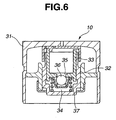
- tappet 10 has a built-in, hydraulic valve clearance adjuster.
- the hydraulic valve clearance adjuster of tappet 10 is comprised of a substantially cylindrical body 31, a plunger 32 disposed in cylindrical body 31, a substantially cylindrical plunger seat 33, a hydraulic pressure chamber 34 defined between plunger 32 and plunger seat 33, a check ball 36, and a return spring 37.
- Body 31 is slidably supported in the cylinder head.
- Plunger 32 is in abutted-engagement with the valve stem of intake valve 11.
- Check ball 36 is spring-loaded to close a central communication hole 35 bored in the central portion of plunger seat 33.
- valve clearance adjuster equipped tappet 10 is somewhat similar to a conventional hydraulic valve lifter.
- Lubricating oil is introduced into hydraulic pressure chamber 34 by virtue of the bias of return spring 37, while the intake valve 11 is seated on the valve seat. Therefore, the valve clearance is constantly maintained at zero.
- variable intake air quantity control executed by the system of the embodiment, utilizing the variable lift and working-angle control and the variable phase control are hereunder described in reference to Figs. 2 and 3.
- Fig. 2 there is shown the control characteristic map showing how the valve lift control area and the valve timing control area have to be varied relative to engine speed and engine load.
- various engine/vehicle operating conditions that is, during idling 1 (containing during very low load and middle or high speed operations), during low load operation 2 (containing during idling with engine accessories actuated), during middle load operation 3, during high load low speed operation 4, during high load middle speed operation 5, and during high load and high speed operation 6, the operating conditions 2, 3, 4, 5, and 6 are included in the valve timing control area.
- the operating condition 1 is included in the valve lift control area.
- the intake air quantity is controlled, aiming mainly at the valve lift control for intake valve 11.
- the intake air quantity is controlled, aiming mainly at the valve timing control, in particular the IVC control.
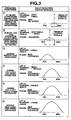
- Fig. 3 there is shown the valve operating characteristics (a lift and a working angle ⁇ , and a phase of working angle, i.e., an angular phase at a central angle ⁇ ) under various engine/vehicle operating conditions 1, 2, 3, 4, 5, and 6.
- a lift and a working angle ⁇ a phase of working angle, i.e., an angular phase at a central angle ⁇
- the valve lift of intake valve 11 is adjusted or controlled to such a very small lift amount that the intake air quantity is unaffected by a change in the angular phase at central angle ⁇ .
- the working angle ⁇ is also adjusted to a very small working angle.
- the phase of central angle ⁇ is kept at a maximum phase-retarded timing value, and thus the intake valve closure timing IVC is adjusted to a given timing value just before BDC.
- intake air flow is suitably throttled or choked by way of a slight aperture defined between the valve seating face of intake valve 11 and the valve-seat face. This ensures a stable very small intake-air flow rate required in the very low load operating range 1.
- an effective compression ratio (generally defined as a ratio of the effective cylinder volume corresponding to the maximum working medium volume to the effective clearance volume corresponding to the minimum working medium volume) becomes a sufficiently high value.
- the valve lift and working angle ⁇ are adjusted to greater values than those used under the very low operating range 1.
- the phase of central angle ⁇ is somewhat advanced as compared to the very low operating range 1. That is, in the low load operating range 2, the intake air quantity control is performed by way of the variable phase control combined with the variable lift and working-angle control. By phase-advancing the IVC, the intake air quantity can be controlled to a comparatively small quantity. As a result of this, the valve lift and working angle ⁇ of intake valve 11 are somewhat increased, thus reducing the pumping loss.
- variable lift and working-angle control enlargement of the valve lift and working angle ⁇
- the variable lift and working-angle control takes priority over the variable phase control.
- the valve lift and working angle ⁇ are adjusted to greater values than those used under the low operating range 2.
- the phase of central angle ⁇ is further advanced as compared to the low operating range 2.
- a maximum phase-advanced timing value for the phase of central angle ⁇ can be obtained. This allows a more complete utilization of internal EGR (exhaust gas or combustion gas recirculated from the exhaust port through the engine cylinder back to the intake port side). Therefore, it is possible to more effectively reduce the pumping loss.
- valve lift and working angle ⁇ are adjusted to greater values than those used under the middle operating range 3. Additionally, in order to attain a suitable intake valve timing, variable phase control mechanism 21 is controlled. As clearly shown in Fig. 3, the valve lift and working angle are further increased or enlarged from high load low speed operating range 4, via high load middle speed operating range 5, to high load and high speed operating range 6. On the other hand, the phase of central angle ⁇ is adjusted to the maximum phase-retarded timing value or a phase-advanced timing value, depending upon the throttle opening or the accelerator opening.
- the stable very small air flow rate control is achieved mainly by way of the valve lift control for intake valve 11.
- Engine loads that are on a border between the valve lift control area and the valve timing control area in other words, a switching point between very low load operating range 1 and low load operating range 2 can be varied or compensated for depending on a state of combustion of the engine, that is, a combustion stability.
- the switching point between very low load operating range 1 and low load operating range 2 may be varied or compensated for depending on engine temperature detected, such as engine coolant temperature or engine oil temperature.
- engine temperature detected such as engine coolant temperature or engine oil temperature.
- valve seat 41 is formed as a ring-shaped surface in the cylinder head.
- Intake valve 11 has a tapered valve seating face (or a seal face) 42, which comes to rest against the valve seat 41.
- valve seat 41 has a tapered valve-seat face 43.
- seal face 42 of intake valve 11 and valve-seat face 43 are designed to fit close together properly.
- seal face 42 and valve-seat face 43 are brought into closely abutted-engagement with each other. Therefore, it is difficult to form deposits on these faces 42 and 43.
- seal face 42 and valve-seat face 43 owing to frictional contact between seal face 42 and valve-seat face 43, it is possible to maintain a good dimensional accuracy of each of the tapered faces 42 and 43, and therefore seal face 42 and valve-seat face 43 tend to be easily automatically maintained as almost the same tapered surface.
- valve and valve-seat layout so that a fluid passage area defined between seal face 42 of intake valve 11 and valve-seat face 43 is a minimum fluid passage area less than a fluid passage area at any other section in the air intake passage.
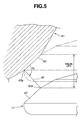
- Fig. 5 shows the concrete specified condition that the fluid passage area defined between tapered faces 42 and 43 corresponds to the minimum fluid passage area. That is, if an angle ⁇ 1 between valve-seat face 43 and a line segment M between and including an inner edge 42a of seal face 42 and an outer edge 43a of valve-seat face 43 is within a predetermined angular range of 90 degrees or less, the fluid passage area defined between tapered faces 42 and 43 corresponds to the minimum fluid passage area. In other words, if the valve lift further increases from the valve-lift range within which the previously-noted angle ⁇ 1 between valve-seat face 43 and line segment M is within the predetermined angular range of 90 degrees or less, the minimum fluid passage area occurs at any other section except the section between tapered faces 42 and 43.
- a valve lift of one of two intake valves contained in the same engine cylinder is fixed to a predetermined value substantially corresponding to a zero lift.
- a required intake air quantity is attained by way of variable valve lift control for only the other intake valve. This method is superior in quality control.
- the ramp section of rockable cam 9 is formed as a constant-velocity ramp, thus producing a substantially constant ramp velocity regardless of the magnitudes of valve lift and working angle. Therefore, in the very low load range, in other words, during the very small valve-lift operating mode, it is possible to execute the improved intake air quantity control that ensures a stable very small intake-air flow rate.
Landscapes
- Engineering & Computer Science (AREA)
- Mechanical Engineering (AREA)
- General Engineering & Computer Science (AREA)
- Chemical & Material Sciences (AREA)
- Combustion & Propulsion (AREA)
- Output Control And Ontrol Of Special Type Engine (AREA)
- Valve Device For Special Equipments (AREA)
- Electrical Control Of Air Or Fuel Supplied To Internal-Combustion Engine (AREA)
- Combined Controls Of Internal Combustion Engines (AREA)
Claims (10)
- Verfahren des kontinuierlichen Steuerns einer Luftmenge, angesaugt in eine Brennkraftmaschine durch Verändern von Betriebscharakteristika des Einlassventiles (11), wobei das Verfahren aufweist:Steuern eines Ventilhubs des Einlassventiles (11) innerhalb eines Bereiches, in dem die Luftmenge durch einen Ventilhub und einen Ventilöffnungswinkel (θ) des Einlassventiles (11) bestimmt wird; undSteuern eines Ventilphasenwinkels des Einlassventiles (11);gekennzeichnet durch
Steuern des Ventilhubs des Einlassventiles (11) innerhalb des Bereiches, in dem die Luftmenge durch einen Ventilhub und einen Ventilöffnungswinkel (θ) bestimmt wird mit einem feststehenden Ventilphasenwinkel, der im Wesentlichen einem maximalen phasenverzögerten Zeitpunktwert des Einlassventiles (11) in einem sehr niedrigen Lastbetriebsbereich (①), der den Leerlauf enthält, entspricht; und
Steuern des Ventilhubs des Einlassventiles (11) innerhalb des Bereichs, in dem die Luftmenge durch einen Ventilhub und einen Ventilöffnungswinkel (θ) des Einlassventiles (11) bestimmt wird und Steuern eines Ventilphasenwinkels des Einlassventiles (11) in Betriebsbereichen (②③④⑤⑥) mit Ausnahme eines sehr niedrigen Lastbetriebsbereiches (①). - Verfahren nach Anspruch 1, dadurch gekennzeichnet, dass der Ventilphasenwinkel in einem sehr niedrigen Lastbetriebsbereich (①) festgelegt wird, höher zu einem unteren Totpunkt bei dem Einlasshub zu sein, im Vergleich zu dem Ventilphasenwinkel in einem niedrigen Lastbetriebsbereich (②), benachbart zu dem sehr niedrigen Lastbetriebsbereich (①).
- Verfahren nach Anspruch 1 oder 2, dadurch gekennzeichnet, dass eine Motorlast, die an einer Grenze zwischen dem sehr niedrigen Lastbetriebsbereich (①) und dem niedrigen Lastbetriebsbereich (②) ist, in Abhängigkeit von einem Verbrennungszustandes des Motors verändert wird.
- Verfahren nach zumindest einem der Ansprüche 1 bis 3, dadurch gekennzeichnet, dass eine Motorlast, die an einer Grenze zwischen dem sehr niedrigen Lastbetriebsbereich (①) und dem niedrigen Lastbetriebsbereich (②) ist, in Abhängigkeit von einer Motortemperatur verändert wird.
- Verfahren nach zumindest einem der Ansprüche 1 bis 4, gekennzeichnet durch Steuern des Ventilhubs innerhalb eines Bereiches, in dem eine Fluid- Kanalfläche, gebildet zwischen einer Dichtungsfläche (42) des Einlassventiles (11) und einer Ventilsitzfläche (43) geringer ist als eine Fluid- Kanalfläche an einem anderen Abschnitt in einem Lufteinlasskanal, in dem sehr niedrigen Lastbetriebsbereich (①).
- Verfahren nach zumindest einem der Ansprüche 1 bis 5, dadurch gekennzeichnet, dass der Motor einen Ventilbetätigungsvorrichtung hat, dass das Einlassventil (11) mechanisch synchron mit der Drehung einer Kurbelwelle des Motors angetrieben wird; und
die Ventilbetätigungsvorrichtung einen Ventilspalteinsteller (31, 32, 33, 34, 35. 36, 37) hat, der einen Ventilspalt bei einem Null- Spalt konstant beibehält. - Verfahren nach Anspruch 6, dadurch gekennzeichnet, dass die Ventilbetätigungsvorrichtung aufweist eine erste veränderbare Vorrichtung (1), die kontinuierlich sowohl den Ventilhub, als auch den Arbeitswinkel (θ) des Einlassventiles (11) verändert, und eine zweite veränderbare Vorrichtung (21), die die Phase des Zentralwinkels (ϕ) verändert.
- Vorrichtung für das kontinuierliche Steuern einer Luftmenge, angesaugt in eine Brennkraftmaschine durch ein Verändern von Betriebscharakteristika eines Einlassventiles (11), wobei die Vorrichtung aufweist:eine erste veränderbare Vorrichtung (1) für das Verändern eines Ventilhubs des Einlassventiles (11) innerhalb eines Bereiches, in dem die Luftmenge durch einen Ventilhub und einen Ventilöffnungswinkel (θ) des Einlassventiles (11) bestimmt wird; undeine zweite veränderbare Vorrichtung (21) für das Verändern eines Ventilphasenwinkels des Einlassventiles (11);eine Steuereinheit (19), konfiguriert um elektronisch mit der ersten und der zweiten veränderbaren Vorrichtung (1, 21) für das veränderbare Steuern der in den Motor eingesaugten Luftmenge verbunden zu sein,dadurch gekennzeichnet, dass
die Steuereinheit (19) konfiguriert ist für das Steuern des Ventilhubs des Einlassventiles (11) innerhalb des Bereiches, wobei die Luftmenge durch einen Ventilhub und einen Ventilöffnungswinkel (θ) bestimmt ist, wobei bei ein feststehender Ventilphasenwinkel gebildet wird, der im Wesentlichen einem maximalen phasenverzögerten Zeitpunktwert des Einlassventiles (11) in einem sehr niedrigen Lastbetriebsbereich (①) entspricht, der den Leerlauf enthält; und
die Steuereinheit (19) konfiguriert ist für das Steuern des Ventilhubs des Einlassventiles (11) innerhalb des Bereiches, wobei die Luftmenge durch einen Ventilhub und einen Ventilöffnungswinkel (θ) des Einlassventiles (11) gebildet wird und Steuern eines Ventilphasenwinkels des Einlassventiles (11) in Betriebsbereichen (②③④⑤⑥), mit Ausnahme des sehr niedrigen Lastbetriebsbereichs (①). - Vorrichtung nach Anspruch 8, dadurch gekennzeichnet, dass eine Motorlast, die an einer Grenze zwischen dem sehr niedrigen Lastbetriebsbereich (①) und dem niedrigen Lastbetriebsbereich (②) ist, in Abhängigkeit von entweder einem Zustand der Verbrennung des Motors oder einer Motortemperatur verändert wird.
- Vorrichtung nach Anspruch 8 oder 9, dadurch gekennzeichnet, dass die Steuereinheit (19) für das Steuern des Ventilhubs innerhalb des Bereiches konfiguriert ist, in dem ein Winkel (θ1) zwischen einer Ventilsitzfläche (43) und einem Liniensegment (M) zwischen und einschließlich einer inneren Kante (42a) der Dichtungsfläche (42) des Einlassventiles (11) und eine äußere Kante (43a) der Ventilsitzfläche (43) innerhalb eines vorbestimmten Winkelbereich von 90 Grad oder weniger ist, in dem sehr niedrigen Lastbetriebsbereich (①).
Applications Claiming Priority (2)
| Application Number | Priority Date | Filing Date | Title |
|---|---|---|---|
| JP2001051422 | 2001-02-27 | ||
| JP2001051422A JP3815233B2 (ja) | 2001-02-27 | 2001-02-27 | 内燃機関の吸気制御装置 |
Publications (3)
| Publication Number | Publication Date |
|---|---|
| EP1234958A2 EP1234958A2 (de) | 2002-08-28 |
| EP1234958A3 EP1234958A3 (de) | 2004-01-21 |
| EP1234958B1 true EP1234958B1 (de) | 2006-06-21 |
Family
ID=18912207
Family Applications (1)
| Application Number | Title | Priority Date | Filing Date |
|---|---|---|---|
| EP02003761A Expired - Lifetime EP1234958B1 (de) | 2001-02-27 | 2002-02-19 | Verfahren und Vorrichtung zum steuerung der Einlassluftquantität in einer Brennkraftmaschine |
Country Status (3)
| Country | Link |
|---|---|
| EP (1) | EP1234958B1 (de) |
| JP (1) | JP3815233B2 (de) |
| DE (1) | DE60212471T2 (de) |
Families Citing this family (19)
| Publication number | Priority date | Publication date | Assignee | Title |
|---|---|---|---|---|
| JP4186613B2 (ja) * | 2002-12-16 | 2008-11-26 | 日産自動車株式会社 | 内燃機関の吸気制御装置 |
| JP4054711B2 (ja) | 2003-04-21 | 2008-03-05 | 株式会社日立製作所 | 可変動弁式内燃機関 |
| JP4137760B2 (ja) * | 2003-10-20 | 2008-08-20 | 本田技研工業株式会社 | 内燃機関の吸入空気量制御装置 |
| JP4304255B2 (ja) | 2003-12-09 | 2009-07-29 | 日産自動車株式会社 | 内燃機関の可変動弁機構 |
| JP4396339B2 (ja) * | 2004-03-18 | 2010-01-13 | 日産自動車株式会社 | 内燃機関の吸気弁駆動制御装置 |
| JP4507693B2 (ja) * | 2004-05-18 | 2010-07-21 | 日産自動車株式会社 | 内燃機関の制御装置 |
| JP4455956B2 (ja) * | 2004-08-26 | 2010-04-21 | トヨタ自動車株式会社 | 内燃機関のアイドル回転速度制御装置 |
| US7210450B2 (en) | 2004-11-02 | 2007-05-01 | Nissan Motor Co., Ltd. | Intake control apparatus and method for internal combustion engine |
| JP4517853B2 (ja) * | 2004-12-22 | 2010-08-04 | 日産自動車株式会社 | V型内燃機関の吸気コレクタ |
| JP4595763B2 (ja) * | 2005-09-21 | 2010-12-08 | 日産自動車株式会社 | 内燃機関の可変動弁装置 |
| JP4740775B2 (ja) | 2006-03-20 | 2011-08-03 | 日産自動車株式会社 | エンジンの吸入空気量制御装置 |
| JP4429286B2 (ja) | 2006-03-28 | 2010-03-10 | トヨタ自動車株式会社 | 可変動弁機構の制御装置 |
| WO2009022729A1 (ja) | 2007-08-10 | 2009-02-19 | Nissan Motor Co., Ltd. | 可変動弁装置 |
| JP5239605B2 (ja) * | 2008-02-25 | 2013-07-17 | 日産自動車株式会社 | 可変動弁装置及び内燃機関 |
| JP4924486B2 (ja) | 2008-03-07 | 2012-04-25 | 日産自動車株式会社 | 車両用内燃機関の吸気制御装置 |
| JP4858729B2 (ja) | 2008-11-12 | 2012-01-18 | 三菱自動車工業株式会社 | 可変動弁装置 |
| KR101807008B1 (ko) | 2012-07-20 | 2017-12-08 | 현대자동차 주식회사 | 연속 가변 밸브 리프트 엔진의 제어 방법 |
| DE102014000397A1 (de) | 2014-01-17 | 2015-07-23 | Fev Gmbh | Modellbasierte Zylinderfüllungserfassung für eine Brennkraftmaschine |
| EP3717762B2 (de) | 2017-11-29 | 2025-06-11 | Volvo Truck Corporation | Verfahren zur steuerung einer verbrennungsmotoranordnung |
Family Cites Families (8)
| Publication number | Priority date | Publication date | Assignee | Title |
|---|---|---|---|---|
| JPH0623527B2 (ja) * | 1985-07-09 | 1994-03-30 | 日産自動車株式会社 | 多気筒内燃機関 |
| JPS63100214A (ja) * | 1986-10-16 | 1988-05-02 | Fuji Heavy Ind Ltd | 自動車用エンジンのバルブ制御装置 |
| JPH01134013A (ja) * | 1987-11-19 | 1989-05-26 | Honda Motor Co Ltd | 内燃機関の動弁制御方法および装置 |
| JP2736997B2 (ja) * | 1989-04-27 | 1998-04-08 | 本田技研工業株式会社 | 内燃機関の弁駆動装置および弁駆動方法 |
| US5572962A (en) * | 1991-12-03 | 1996-11-12 | Motive Holdings Limited | Variable valve lift mechanism for internal combustion engine |
| JP3385717B2 (ja) * | 1994-05-02 | 2003-03-10 | 日産自動車株式会社 | 内燃機関の可変動弁装置 |
| US5937809A (en) * | 1997-03-20 | 1999-08-17 | General Motors Corporation | Variable valve timing mechanisms |
| JPH11117777A (ja) | 1997-10-17 | 1999-04-27 | Hitachi Ltd | 内燃機関の制御方法 |
-
2001
- 2001-02-27 JP JP2001051422A patent/JP3815233B2/ja not_active Expired - Fee Related
-
2002
- 2002-02-19 EP EP02003761A patent/EP1234958B1/de not_active Expired - Lifetime
- 2002-02-19 DE DE60212471T patent/DE60212471T2/de not_active Expired - Lifetime
Also Published As
| Publication number | Publication date |
|---|---|
| EP1234958A3 (de) | 2004-01-21 |
| EP1234958A2 (de) | 2002-08-28 |
| JP3815233B2 (ja) | 2006-08-30 |
| DE60212471D1 (de) | 2006-08-03 |
| DE60212471T2 (de) | 2006-12-07 |
| JP2002256905A (ja) | 2002-09-11 |
Similar Documents
| Publication | Publication Date | Title |
|---|---|---|
| US6615775B2 (en) | Variable valve operating system of internal combustion engine enabling variation of valve-lift characteristic and phase | |
| US6425357B2 (en) | Variable valve drive mechanism and intake air amount control apparatus of internal combustion engine | |
| US7146966B2 (en) | Cylinder cutoff control apparatus of internal combustion engine | |
| US6792924B2 (en) | Engine control system of internal combustion engine with variable compression ratio mechanism and exhaust-gas recirculation control system | |
| EP1223319B1 (de) | Verbrennungssteuersystem einer fremdgezündeten Brennkraftmaschine mit variablem Kolbenhub und variabler Ventilsteuervorrichtung | |
| US6397800B2 (en) | Valve control device of internal combustion engine | |
| EP1234958A2 (de) | Verfahren und Vorrichtung zum steuerung der Einlassluftquantität in einer Brennkraftmaschine | |
| JP3227313B2 (ja) | 内燃機関の吸排気弁駆動制御装置 | |
| US7469669B2 (en) | Variable valve train mechanism of internal combustion engine | |
| US8006658B2 (en) | Variable valve actuation apparatus of internal combustion engine | |
| JP2000038910A (ja) | 内燃機関の可変動弁装置 | |
| US6820579B2 (en) | Variable valve operating system of engine enabling variation of working angle and phase | |
| US20030062009A1 (en) | Variable valve operating system of internal combustion engine enabling variation of valve-lift characteristic | |
| JP3876087B2 (ja) | 内燃機関の可変動弁装置 | |
| EP1878882A1 (de) | Ventilbewegungsvorrichtung für verbrennungsmotor | |
| JPS6213708A (ja) | 多気筒内燃機関 | |
| JP4474058B2 (ja) | 内燃機関の可変動弁装置 | |
| US7159550B2 (en) | Variable valve train of internal combustion engine | |
| JP4020065B2 (ja) | 内燃機関の制御装置 | |
| JP2002221014A (ja) | 内燃機関及びその制御システム | |
| JP4367317B2 (ja) | 内燃機関の可変動弁装置 | |
| JPH0585723B2 (de) | ||
| JPH08319848A (ja) | エンジンの動弁装置 | |
| JPS627365B2 (de) |
Legal Events
| Date | Code | Title | Description |
|---|---|---|---|
| PUAI | Public reference made under article 153(3) epc to a published international application that has entered the european phase |
Free format text: ORIGINAL CODE: 0009012 |
|
| 17P | Request for examination filed |
Effective date: 20020219 |
|
| AK | Designated contracting states |
Kind code of ref document: A2 Designated state(s): AT BE CH CY DE DK ES FI FR GB GR IE IT LI LU MC NL PT SE TR |
|
| AX | Request for extension of the european patent |
Free format text: AL;LT;LV;MK;RO;SI |
|
| PUAL | Search report despatched |
Free format text: ORIGINAL CODE: 0009013 |
|
| AK | Designated contracting states |
Kind code of ref document: A3 Designated state(s): AT BE CH CY DE DK ES FI FR GB GR IE IT LI LU MC NL PT SE TR |
|
| AX | Request for extension of the european patent |
Extension state: AL LT LV MK RO SI |
|
| 17Q | First examination report despatched |
Effective date: 20040714 |
|
| AKX | Designation fees paid |
Designated state(s): DE FR GB |
|
| GRAP | Despatch of communication of intention to grant a patent |
Free format text: ORIGINAL CODE: EPIDOSNIGR1 |
|
| GRAS | Grant fee paid |
Free format text: ORIGINAL CODE: EPIDOSNIGR3 |
|
| GRAA | (expected) grant |
Free format text: ORIGINAL CODE: 0009210 |
|
| AK | Designated contracting states |
Kind code of ref document: B1 Designated state(s): DE FR GB |
|
| REG | Reference to a national code |
Ref country code: GB Ref legal event code: FG4D |
|
| REF | Corresponds to: |
Ref document number: 60212471 Country of ref document: DE Date of ref document: 20060803 Kind code of ref document: P |
|
| ET | Fr: translation filed | ||
| PLBE | No opposition filed within time limit |
Free format text: ORIGINAL CODE: 0009261 |
|
| STAA | Information on the status of an ep patent application or granted ep patent |
Free format text: STATUS: NO OPPOSITION FILED WITHIN TIME LIMIT |
|
| 26N | No opposition filed |
Effective date: 20070322 |
|
| PGFP | Annual fee paid to national office [announced via postgrant information from national office to epo] |
Ref country code: FR Payment date: 20140211 Year of fee payment: 13 |
|
| PGFP | Annual fee paid to national office [announced via postgrant information from national office to epo] |
Ref country code: GB Payment date: 20140219 Year of fee payment: 13 |
|
| PGFP | Annual fee paid to national office [announced via postgrant information from national office to epo] |
Ref country code: DE Payment date: 20140417 Year of fee payment: 13 |
|
| REG | Reference to a national code |
Ref country code: DE Ref legal event code: R119 Ref document number: 60212471 Country of ref document: DE |
|
| GBPC | Gb: european patent ceased through non-payment of renewal fee |
Effective date: 20150219 |
|
| REG | Reference to a national code |
Ref country code: FR Ref legal event code: ST Effective date: 20151030 |
|
| PG25 | Lapsed in a contracting state [announced via postgrant information from national office to epo] |
Ref country code: DE Free format text: LAPSE BECAUSE OF NON-PAYMENT OF DUE FEES Effective date: 20150901 Ref country code: GB Free format text: LAPSE BECAUSE OF NON-PAYMENT OF DUE FEES Effective date: 20150219 |
|
| PG25 | Lapsed in a contracting state [announced via postgrant information from national office to epo] |
Ref country code: FR Free format text: LAPSE BECAUSE OF NON-PAYMENT OF DUE FEES Effective date: 20150302 |