EP1228890B1 - Print media products and methods for producing the same - Google Patents
Print media products and methods for producing the same Download PDFInfo
- Publication number
- EP1228890B1 EP1228890B1 EP20020250457 EP02250457A EP1228890B1 EP 1228890 B1 EP1228890 B1 EP 1228890B1 EP 20020250457 EP20020250457 EP 20020250457 EP 02250457 A EP02250457 A EP 02250457A EP 1228890 B1 EP1228890 B1 EP 1228890B1
- Authority
- EP
- European Patent Office
- Prior art keywords
- ink
- receiving layer
- layer
- print media
- poly
- Prior art date
- Legal status (The legal status is an assumption and is not a legal conclusion. Google has not performed a legal analysis and makes no representation as to the accuracy of the status listed.)
- Expired - Lifetime
Links
- 238000000034 method Methods 0.000 title claims description 49
- 239000000463 material Substances 0.000 claims description 158
- 239000000203 mixture Substances 0.000 claims description 112
- 229920001577 copolymer Polymers 0.000 claims description 103
- 239000000758 substrate Substances 0.000 claims description 93
- 125000000391 vinyl group Chemical group [H]C([*])=C([H])[H] 0.000 claims description 93
- 229920002554 vinyl polymer Polymers 0.000 claims description 93
- 239000011230 binding agent Substances 0.000 claims description 75
- 239000000049 pigment Substances 0.000 claims description 65
- 230000000153 supplemental effect Effects 0.000 claims description 43
- 238000004519 manufacturing process Methods 0.000 claims description 40
- 239000010410 layer Substances 0.000 description 319
- 239000000047 product Substances 0.000 description 125
- 239000000976 ink Substances 0.000 description 84
- VYPSYNLAJGMNEJ-UHFFFAOYSA-N Silicium dioxide Chemical compound O=[Si]=O VYPSYNLAJGMNEJ-UHFFFAOYSA-N 0.000 description 40
- 239000004615 ingredient Substances 0.000 description 34
- 239000011247 coating layer Substances 0.000 description 29
- 230000008901 benefit Effects 0.000 description 25
- 238000001035 drying Methods 0.000 description 25
- 238000000576 coating method Methods 0.000 description 24
- -1 poly(vinyl alcohol) Polymers 0.000 description 21
- 239000011248 coating agent Substances 0.000 description 20
- 238000007639 printing Methods 0.000 description 20
- KRKNYBCHXYNGOX-UHFFFAOYSA-N citric acid Chemical compound OC(=O)CC(O)(C(O)=O)CC(O)=O KRKNYBCHXYNGOX-UHFFFAOYSA-N 0.000 description 18
- 238000005516 engineering process Methods 0.000 description 18
- 239000000123 paper Substances 0.000 description 17
- 229920002451 polyvinyl alcohol Polymers 0.000 description 17
- 239000000377 silicon dioxide Substances 0.000 description 17
- 239000004952 Polyamide Substances 0.000 description 16
- 238000004581 coalescence Methods 0.000 description 16
- 229920002647 polyamide Polymers 0.000 description 16
- 235000019422 polyvinyl alcohol Nutrition 0.000 description 16
- 239000004372 Polyvinyl alcohol Substances 0.000 description 15
- 239000000126 substance Substances 0.000 description 14
- 238000009472 formulation Methods 0.000 description 13
- 239000006185 dispersion Substances 0.000 description 12
- 238000012360 testing method Methods 0.000 description 12
- BRLQWZUYTZBJKN-UHFFFAOYSA-N Epichlorohydrin Chemical compound ClCC1CO1 BRLQWZUYTZBJKN-UHFFFAOYSA-N 0.000 description 11
- 239000000945 filler Substances 0.000 description 11
- 238000010438 heat treatment Methods 0.000 description 11
- 229920005749 polyurethane resin Polymers 0.000 description 11
- 239000003086 colorant Substances 0.000 description 10
- 239000004698 Polyethylene Substances 0.000 description 9
- 239000000654 additive Substances 0.000 description 9
- 239000004035 construction material Substances 0.000 description 9
- 229920000573 polyethylene Polymers 0.000 description 9
- 230000006870 function Effects 0.000 description 8
- 239000000975 dye Substances 0.000 description 7
- 229920002635 polyurethane Polymers 0.000 description 7
- 239000004814 polyurethane Substances 0.000 description 7
- 239000003755 preservative agent Substances 0.000 description 7
- 239000000243 solution Substances 0.000 description 7
- 239000004094 surface-active agent Substances 0.000 description 7
- VTYYLEPIZMXCLO-UHFFFAOYSA-L Calcium carbonate Chemical compound [Ca+2].[O-]C([O-])=O VTYYLEPIZMXCLO-UHFFFAOYSA-L 0.000 description 6
- GWEVSGVZZGPLCZ-UHFFFAOYSA-N Titan oxide Chemical compound O=[Ti]=O GWEVSGVZZGPLCZ-UHFFFAOYSA-N 0.000 description 6
- TZCXTZWJZNENPQ-UHFFFAOYSA-L barium sulfate Chemical compound [Ba+2].[O-]S([O-])(=O)=O TZCXTZWJZNENPQ-UHFFFAOYSA-L 0.000 description 6
- 230000015572 biosynthetic process Effects 0.000 description 6
- 238000004891 communication Methods 0.000 description 6
- 239000012530 fluid Substances 0.000 description 6
- 239000007788 liquid Substances 0.000 description 5
- 229920006122 polyamide resin Polymers 0.000 description 5
- 229920000642 polymer Polymers 0.000 description 5
- 235000010443 alginic acid Nutrition 0.000 description 4
- 229920000615 alginic acid Polymers 0.000 description 4
- 125000002091 cationic group Chemical group 0.000 description 4
- 238000007766 curtain coating Methods 0.000 description 4
- 230000006866 deterioration Effects 0.000 description 4
- 238000011161 development Methods 0.000 description 4
- 230000018109 developmental process Effects 0.000 description 4
- 238000005562 fading Methods 0.000 description 4
- 229920000159 gelatin Polymers 0.000 description 4
- 235000019322 gelatine Nutrition 0.000 description 4
- 238000012545 processing Methods 0.000 description 4
- 239000007787 solid Substances 0.000 description 4
- 108010010803 Gelatin Proteins 0.000 description 3
- 229920003171 Poly (ethylene oxide) Polymers 0.000 description 3
- 239000002202 Polyethylene glycol Substances 0.000 description 3
- 229920002125 Sokalan® Polymers 0.000 description 3
- 229920002472 Starch Polymers 0.000 description 3
- PNEYBMLMFCGWSK-UHFFFAOYSA-N aluminium oxide Inorganic materials [O-2].[O-2].[O-2].[Al+3].[Al+3] PNEYBMLMFCGWSK-UHFFFAOYSA-N 0.000 description 3
- VXAUWWUXCIMFIM-UHFFFAOYSA-M aluminum;oxygen(2-);hydroxide Chemical compound [OH-].[O-2].[Al+3] VXAUWWUXCIMFIM-UHFFFAOYSA-M 0.000 description 3
- 229910000019 calcium carbonate Inorganic materials 0.000 description 3
- 239000005018 casein Substances 0.000 description 3
- BECPQYXYKAMYBN-UHFFFAOYSA-N casein, tech. Chemical compound NCCCCC(C(O)=O)N=C(O)C(CC(O)=O)N=C(O)C(CCC(O)=N)N=C(O)C(CC(C)C)N=C(O)C(CCC(O)=O)N=C(O)C(CC(O)=O)N=C(O)C(CCC(O)=O)N=C(O)C(C(C)O)N=C(O)C(CCC(O)=N)N=C(O)C(CCC(O)=N)N=C(O)C(CCC(O)=N)N=C(O)C(CCC(O)=O)N=C(O)C(CCC(O)=O)N=C(O)C(COP(O)(O)=O)N=C(O)C(CCC(O)=N)N=C(O)C(N)CC1=CC=CC=C1 BECPQYXYKAMYBN-UHFFFAOYSA-N 0.000 description 3
- 235000021240 caseins Nutrition 0.000 description 3
- 230000008859 change Effects 0.000 description 3
- 239000004927 clay Substances 0.000 description 3
- 229910052570 clay Inorganic materials 0.000 description 3
- 150000001875 compounds Chemical class 0.000 description 3
- 238000010276 construction Methods 0.000 description 3
- 239000012467 final product Substances 0.000 description 3
- 239000000499 gel Substances 0.000 description 3
- 239000008273 gelatin Substances 0.000 description 3
- 235000011852 gelatine desserts Nutrition 0.000 description 3
- 239000010440 gypsum Substances 0.000 description 3
- 229910052602 gypsum Inorganic materials 0.000 description 3
- 239000004816 latex Substances 0.000 description 3
- 229920000126 latex Polymers 0.000 description 3
- 239000000314 lubricant Substances 0.000 description 3
- ZLNQQNXFFQJAID-UHFFFAOYSA-L magnesium carbonate Chemical compound [Mg+2].[O-]C([O-])=O ZLNQQNXFFQJAID-UHFFFAOYSA-L 0.000 description 3
- 239000001095 magnesium carbonate Substances 0.000 description 3
- 229910000021 magnesium carbonate Inorganic materials 0.000 description 3
- 239000000395 magnesium oxide Substances 0.000 description 3
- CPLXHLVBOLITMK-UHFFFAOYSA-N magnesium oxide Inorganic materials [Mg]=O CPLXHLVBOLITMK-UHFFFAOYSA-N 0.000 description 3
- AXZKOIWUVFPNLO-UHFFFAOYSA-N magnesium;oxygen(2-) Chemical compound [O-2].[Mg+2] AXZKOIWUVFPNLO-UHFFFAOYSA-N 0.000 description 3
- 230000014759 maintenance of location Effects 0.000 description 3
- TWNQGVIAIRXVLR-UHFFFAOYSA-N oxo(oxoalumanyloxy)alumane Chemical compound O=[Al]O[Al]=O TWNQGVIAIRXVLR-UHFFFAOYSA-N 0.000 description 3
- 239000002245 particle Substances 0.000 description 3
- 239000004584 polyacrylic acid Substances 0.000 description 3
- 229920001223 polyethylene glycol Polymers 0.000 description 3
- 229920000036 polyvinylpyrrolidone Polymers 0.000 description 3
- 239000001267 polyvinylpyrrolidone Substances 0.000 description 3
- 235000013855 polyvinylpyrrolidone Nutrition 0.000 description 3
- 239000000741 silica gel Substances 0.000 description 3
- 229910002027 silica gel Inorganic materials 0.000 description 3
- 239000008107 starch Substances 0.000 description 3
- 235000019698 starch Nutrition 0.000 description 3
- 239000004408 titanium dioxide Substances 0.000 description 3
- 238000012546 transfer Methods 0.000 description 3
- 239000004642 Polyimide Substances 0.000 description 2
- 239000004743 Polypropylene Substances 0.000 description 2
- 239000004793 Polystyrene Substances 0.000 description 2
- 239000004809 Teflon Substances 0.000 description 2
- 229920006362 Teflon® Polymers 0.000 description 2
- 230000002745 absorbent Effects 0.000 description 2
- 239000002250 absorbent Substances 0.000 description 2
- 238000010521 absorption reaction Methods 0.000 description 2
- NIXOWILDQLNWCW-UHFFFAOYSA-N acrylic acid group Chemical group C(C=C)(=O)O NIXOWILDQLNWCW-UHFFFAOYSA-N 0.000 description 2
- 230000004913 activation Effects 0.000 description 2
- 230000000712 assembly Effects 0.000 description 2
- 238000000429 assembly Methods 0.000 description 2
- 230000009286 beneficial effect Effects 0.000 description 2
- 229920002301 cellulose acetate Polymers 0.000 description 2
- 238000012512 characterization method Methods 0.000 description 2
- 239000008199 coating composition Substances 0.000 description 2
- 239000002131 composite material Substances 0.000 description 2
- 239000000470 constituent Substances 0.000 description 2
- 239000010949 copper Substances 0.000 description 2
- 238000000151 deposition Methods 0.000 description 2
- 230000005284 excitation Effects 0.000 description 2
- 238000007641 inkjet printing Methods 0.000 description 2
- 239000004611 light stabiliser Substances 0.000 description 2
- 239000011159 matrix material Substances 0.000 description 2
- 229910052751 metal Inorganic materials 0.000 description 2
- 239000002184 metal Substances 0.000 description 2
- 150000002739 metals Chemical class 0.000 description 2
- 230000005012 migration Effects 0.000 description 2
- 238000013508 migration Methods 0.000 description 2
- 238000012986 modification Methods 0.000 description 2
- 230000004048 modification Effects 0.000 description 2
- 229920000620 organic polymer Polymers 0.000 description 2
- 229920005668 polycarbonate resin Polymers 0.000 description 2
- 239000004431 polycarbonate resin Substances 0.000 description 2
- 229920000139 polyethylene terephthalate Polymers 0.000 description 2
- 239000005020 polyethylene terephthalate Substances 0.000 description 2
- 229920001721 polyimide Polymers 0.000 description 2
- 229920001155 polypropylene Polymers 0.000 description 2
- 229920002223 polystyrene Polymers 0.000 description 2
- 229920001343 polytetrafluoroethylene Polymers 0.000 description 2
- 239000004810 polytetrafluoroethylene Substances 0.000 description 2
- 239000004800 polyvinyl chloride Substances 0.000 description 2
- 229920000915 polyvinyl chloride Polymers 0.000 description 2
- 239000011148 porous material Substances 0.000 description 2
- 230000008569 process Effects 0.000 description 2
- 229910052710 silicon Inorganic materials 0.000 description 2
- 239000010703 silicon Substances 0.000 description 2
- 239000003381 stabilizer Substances 0.000 description 2
- 238000000859 sublimation Methods 0.000 description 2
- 230000008022 sublimation Effects 0.000 description 2
- 239000010409 thin film Substances 0.000 description 2
- XLYOFNOQVPJJNP-UHFFFAOYSA-N water Substances O XLYOFNOQVPJJNP-UHFFFAOYSA-N 0.000 description 2
- FHVDTGUDJYJELY-UHFFFAOYSA-N 6-{[2-carboxy-4,5-dihydroxy-6-(phosphanyloxy)oxan-3-yl]oxy}-4,5-dihydroxy-3-phosphanyloxane-2-carboxylic acid Chemical compound O1C(C(O)=O)C(P)C(O)C(O)C1OC1C(C(O)=O)OC(OP)C(O)C1O FHVDTGUDJYJELY-UHFFFAOYSA-N 0.000 description 1
- RYGMFSIKBFXOCR-UHFFFAOYSA-N Copper Chemical compound [Cu] RYGMFSIKBFXOCR-UHFFFAOYSA-N 0.000 description 1
- IMROMDMJAWUWLK-UHFFFAOYSA-N Ethenol Chemical compound OC=C IMROMDMJAWUWLK-UHFFFAOYSA-N 0.000 description 1
- IAYPIBMASNFSPL-UHFFFAOYSA-N Ethylene oxide Chemical compound C1CO1 IAYPIBMASNFSPL-UHFFFAOYSA-N 0.000 description 1
- 241000197200 Gallinago media Species 0.000 description 1
- 239000001828 Gelatine Substances 0.000 description 1
- 229920000663 Hydroxyethyl cellulose Polymers 0.000 description 1
- 239000004354 Hydroxyethyl cellulose Substances 0.000 description 1
- 239000004115 Sodium Silicate Substances 0.000 description 1
- ATJFFYVFTNAWJD-UHFFFAOYSA-N Tin Chemical compound [Sn] ATJFFYVFTNAWJD-UHFFFAOYSA-N 0.000 description 1
- 239000002253 acid Substances 0.000 description 1
- 230000000996 additive effect Effects 0.000 description 1
- 239000012790 adhesive layer Substances 0.000 description 1
- 150000001298 alcohols Chemical class 0.000 description 1
- 229940072056 alginate Drugs 0.000 description 1
- 229910052782 aluminium Inorganic materials 0.000 description 1
- XAGFODPZIPBFFR-UHFFFAOYSA-N aluminium Chemical compound [Al] XAGFODPZIPBFFR-UHFFFAOYSA-N 0.000 description 1
- QGZKDVFQNNGYKY-UHFFFAOYSA-O ammonium group Chemical group [NH4+] QGZKDVFQNNGYKY-UHFFFAOYSA-O 0.000 description 1
- 238000004458 analytical method Methods 0.000 description 1
- 230000003466 anti-cipated effect Effects 0.000 description 1
- 239000003963 antioxidant agent Substances 0.000 description 1
- 239000007864 aqueous solution Substances 0.000 description 1
- 239000000919 ceramic Substances 0.000 description 1
- 125000002668 chloroacetyl group Chemical group ClCC(=O)* 0.000 description 1
- 239000000306 component Substances 0.000 description 1
- 229910052802 copper Inorganic materials 0.000 description 1
- 230000003247 decreasing effect Effects 0.000 description 1
- 230000008021 deposition Effects 0.000 description 1
- 230000000694 effects Effects 0.000 description 1
- 239000000839 emulsion Substances 0.000 description 1
- 230000007613 environmental effect Effects 0.000 description 1
- 239000004744 fabric Substances 0.000 description 1
- 230000002349 favourable effect Effects 0.000 description 1
- 239000010408 film Substances 0.000 description 1
- 239000011888 foil Substances 0.000 description 1
- 125000000524 functional group Chemical group 0.000 description 1
- 125000001165 hydrophobic group Chemical group 0.000 description 1
- 235000019447 hydroxyethyl cellulose Nutrition 0.000 description 1
- 230000006872 improvement Effects 0.000 description 1
- 229910052500 inorganic mineral Inorganic materials 0.000 description 1
- 239000012092 media component Substances 0.000 description 1
- 125000005395 methacrylic acid group Chemical group 0.000 description 1
- QGBPKJFJAVDUNC-UHFFFAOYSA-N methyl 4-methoxy-3-oxobutanoate Chemical compound COCC(=O)CC(=O)OC QGBPKJFJAVDUNC-UHFFFAOYSA-N 0.000 description 1
- 239000011707 mineral Substances 0.000 description 1
- 238000002156 mixing Methods 0.000 description 1
- 239000000178 monomer Substances 0.000 description 1
- 239000004745 nonwoven fabric Substances 0.000 description 1
- 230000003287 optical effect Effects 0.000 description 1
- 239000011087 paperboard Substances 0.000 description 1
- 229920001277 pectin Polymers 0.000 description 1
- 239000001814 pectin Substances 0.000 description 1
- 235000010987 pectin Nutrition 0.000 description 1
- 230000035699 permeability Effects 0.000 description 1
- 229920003023 plastic Polymers 0.000 description 1
- 239000004033 plastic Substances 0.000 description 1
- 229920003009 polyurethane dispersion Polymers 0.000 description 1
- 238000002360 preparation method Methods 0.000 description 1
- 230000002265 prevention Effects 0.000 description 1
- 230000002035 prolonged effect Effects 0.000 description 1
- 230000001737 promoting effect Effects 0.000 description 1
- 238000011160 research Methods 0.000 description 1
- 229920005989 resin Polymers 0.000 description 1
- 239000011347 resin Substances 0.000 description 1
- 150000004760 silicates Chemical class 0.000 description 1
- 229910052709 silver Inorganic materials 0.000 description 1
- 239000004332 silver Substances 0.000 description 1
- 238000007764 slot die coating Methods 0.000 description 1
- NTHWMYGWWRZVTN-UHFFFAOYSA-N sodium silicate Chemical compound [Na+].[Na+].[O-][Si]([O-])=O NTHWMYGWWRZVTN-UHFFFAOYSA-N 0.000 description 1
- 229910052911 sodium silicate Inorganic materials 0.000 description 1
- 238000005507 spraying Methods 0.000 description 1
- 230000003746 surface roughness Effects 0.000 description 1
- 230000000007 visual effect Effects 0.000 description 1
- 239000002023 wood Substances 0.000 description 1
Images

Classifications
-
- B—PERFORMING OPERATIONS; TRANSPORTING
- B41—PRINTING; LINING MACHINES; TYPEWRITERS; STAMPS
- B41M—PRINTING, DUPLICATING, MARKING, OR COPYING PROCESSES; COLOUR PRINTING
- B41M5/00—Duplicating or marking methods; Sheet materials for use therein
- B41M5/50—Recording sheets characterised by the coating used to improve ink, dye or pigment receptivity, e.g. for ink-jet or thermal dye transfer recording
- B41M5/52—Macromolecular coatings
- B41M5/5254—Macromolecular coatings characterised by the use of polymers obtained by reactions only involving carbon-to-carbon unsaturated bonds, e.g. vinyl polymers
-
- B—PERFORMING OPERATIONS; TRANSPORTING
- B41—PRINTING; LINING MACHINES; TYPEWRITERS; STAMPS
- B41M—PRINTING, DUPLICATING, MARKING, OR COPYING PROCESSES; COLOUR PRINTING
- B41M5/00—Duplicating or marking methods; Sheet materials for use therein
- B41M5/50—Recording sheets characterised by the coating used to improve ink, dye or pigment receptivity, e.g. for ink-jet or thermal dye transfer recording
- B41M5/502—Recording sheets characterised by the coating used to improve ink, dye or pigment receptivity, e.g. for ink-jet or thermal dye transfer recording characterised by structural details, e.g. multilayer materials
- B41M5/506—Intermediate layers
-
- Y—GENERAL TAGGING OF NEW TECHNOLOGICAL DEVELOPMENTS; GENERAL TAGGING OF CROSS-SECTIONAL TECHNOLOGIES SPANNING OVER SEVERAL SECTIONS OF THE IPC; TECHNICAL SUBJECTS COVERED BY FORMER USPC CROSS-REFERENCE ART COLLECTIONS [XRACs] AND DIGESTS
- Y10—TECHNICAL SUBJECTS COVERED BY FORMER USPC
- Y10T—TECHNICAL SUBJECTS COVERED BY FORMER US CLASSIFICATION
- Y10T428/00—Stock material or miscellaneous articles
- Y10T428/24—Structurally defined web or sheet [e.g., overall dimension, etc.]
- Y10T428/24802—Discontinuous or differential coating, impregnation or bond [e.g., artwork, printing, retouched photograph, etc.]
-
- Y—GENERAL TAGGING OF NEW TECHNOLOGICAL DEVELOPMENTS; GENERAL TAGGING OF CROSS-SECTIONAL TECHNOLOGIES SPANNING OVER SEVERAL SECTIONS OF THE IPC; TECHNICAL SUBJECTS COVERED BY FORMER USPC CROSS-REFERENCE ART COLLECTIONS [XRACs] AND DIGESTS
- Y10—TECHNICAL SUBJECTS COVERED BY FORMER USPC
- Y10T—TECHNICAL SUBJECTS COVERED BY FORMER US CLASSIFICATION
- Y10T428/00—Stock material or miscellaneous articles
- Y10T428/24—Structurally defined web or sheet [e.g., overall dimension, etc.]
- Y10T428/24802—Discontinuous or differential coating, impregnation or bond [e.g., artwork, printing, retouched photograph, etc.]
- Y10T428/24893—Discontinuous or differential coating, impregnation or bond [e.g., artwork, printing, retouched photograph, etc.] including particulate material
- Y10T428/24901—Discontinuous or differential coating, impregnation or bond [e.g., artwork, printing, retouched photograph, etc.] including particulate material including coloring matter
-
- Y—GENERAL TAGGING OF NEW TECHNOLOGICAL DEVELOPMENTS; GENERAL TAGGING OF CROSS-SECTIONAL TECHNOLOGIES SPANNING OVER SEVERAL SECTIONS OF THE IPC; TECHNICAL SUBJECTS COVERED BY FORMER USPC CROSS-REFERENCE ART COLLECTIONS [XRACs] AND DIGESTS
- Y10—TECHNICAL SUBJECTS COVERED BY FORMER USPC
- Y10T—TECHNICAL SUBJECTS COVERED BY FORMER US CLASSIFICATION
- Y10T428/00—Stock material or miscellaneous articles
- Y10T428/25—Web or sheet containing structurally defined element or component and including a second component containing structurally defined particles
-
- Y—GENERAL TAGGING OF NEW TECHNOLOGICAL DEVELOPMENTS; GENERAL TAGGING OF CROSS-SECTIONAL TECHNOLOGIES SPANNING OVER SEVERAL SECTIONS OF THE IPC; TECHNICAL SUBJECTS COVERED BY FORMER USPC CROSS-REFERENCE ART COLLECTIONS [XRACs] AND DIGESTS
- Y10—TECHNICAL SUBJECTS COVERED BY FORMER USPC
- Y10T—TECHNICAL SUBJECTS COVERED BY FORMER US CLASSIFICATION
- Y10T428/00—Stock material or miscellaneous articles
- Y10T428/25—Web or sheet containing structurally defined element or component and including a second component containing structurally defined particles
- Y10T428/254—Polymeric or resinous material
-
- Y—GENERAL TAGGING OF NEW TECHNOLOGICAL DEVELOPMENTS; GENERAL TAGGING OF CROSS-SECTIONAL TECHNOLOGIES SPANNING OVER SEVERAL SECTIONS OF THE IPC; TECHNICAL SUBJECTS COVERED BY FORMER USPC CROSS-REFERENCE ART COLLECTIONS [XRACs] AND DIGESTS
- Y10—TECHNICAL SUBJECTS COVERED BY FORMER USPC
- Y10T—TECHNICAL SUBJECTS COVERED BY FORMER US CLASSIFICATION
- Y10T428/00—Stock material or miscellaneous articles
- Y10T428/31504—Composite [nonstructural laminate]
- Y10T428/31855—Of addition polymer from unsaturated monomers
-
- Y—GENERAL TAGGING OF NEW TECHNOLOGICAL DEVELOPMENTS; GENERAL TAGGING OF CROSS-SECTIONAL TECHNOLOGIES SPANNING OVER SEVERAL SECTIONS OF THE IPC; TECHNICAL SUBJECTS COVERED BY FORMER USPC CROSS-REFERENCE ART COLLECTIONS [XRACs] AND DIGESTS
- Y10—TECHNICAL SUBJECTS COVERED BY FORMER USPC
- Y10T—TECHNICAL SUBJECTS COVERED BY FORMER US CLASSIFICATION
- Y10T428/00—Stock material or miscellaneous articles
- Y10T428/31504—Composite [nonstructural laminate]
- Y10T428/31855—Of addition polymer from unsaturated monomers
- Y10T428/3188—Next to cellulosic
- Y10T428/31895—Paper or wood
-
- Y—GENERAL TAGGING OF NEW TECHNOLOGICAL DEVELOPMENTS; GENERAL TAGGING OF CROSS-SECTIONAL TECHNOLOGIES SPANNING OVER SEVERAL SECTIONS OF THE IPC; TECHNICAL SUBJECTS COVERED BY FORMER USPC CROSS-REFERENCE ART COLLECTIONS [XRACs] AND DIGESTS
- Y10—TECHNICAL SUBJECTS COVERED BY FORMER USPC
- Y10T—TECHNICAL SUBJECTS COVERED BY FORMER US CLASSIFICATION
- Y10T428/00—Stock material or miscellaneous articles
- Y10T428/31504—Composite [nonstructural laminate]
- Y10T428/31971—Of carbohydrate
- Y10T428/31975—Of cellulosic next to another carbohydrate
- Y10T428/31978—Cellulosic next to another cellulosic
- Y10T428/31982—Wood or paper
Definitions
- the present invention generally relates to media products for receiving printed images thereon. More particularly, the invention described herein involves image-receiving sheet materials each having at least one ink-receiving layer with a specialized and distinctive chemical composition therein that is used to provide a number of important benefits in a simultaneous fashion. These benefits include but are not limited to a high degree of compatibility between the ink materials being delivered and the ink-receiving layer under consideration, rapid drying times, the generation of smear-fast printed images, the control of ink-coalescence (defined below), the attainment of uniform gloss levels (and a high level of gloss if desired), as well as numerous other benefits relating to image quality.
- Thermal inkjet systems are especially important in this regard.
- Printing units using thermal inkjet technology basically involve an apparatus which includes at least one ink reservoir chamber in fluid communication with a substrate (preferably made of silicon [Si] and/or other comparable materials) having a plurality of thin-film heating resistors thereon.
- the substrate and resistors are maintained within a structure that is conventionally characterized as a "printhead".
- Selective activation of the resistors causes thermal excitation of the ink materials stored inside the reservoir chamber and expulsion thereof from the printhead.
- Representative thermal inkjet systems are discussed in, for example, U.S. Patent No. 4,771,295 to Baker et al . and U.S. Patent No. 5,278,584 to Keefe et al ..
- the ink delivery systems described above typically include an ink containment unit (e.g. a housing, vessel, or tank) having a self-contained supply of ink therein in order to form an ink cartridge.
- an ink containment unit e.g. a housing, vessel, or tank
- the ink containment unit is directly attached to the remaining components of the cartridge to produce an integral and unitary structure wherein the ink supply is considered to be "on-board" as shown in, for example, U.S. Patent No. 4,771,295 to Baker et al .
- the ink containment unit will be provided at a remote location within the printer, with the ink containment unit being operatively connected to and in fluid communication with the printhead using one or more ink transfer conduits.
- off-axis printing units are conventionally known as "off-axis" printing units.
- a representative, non-limiting off-axis ink delivery system is discussed in, for example, U.S. Patent No. 5,975,686 to Hauck et al ..
- the present invention as described below (which involves a plurality of novel ink-receiving print media products) is applicable to both on-board and off-axis systems (as well as any other types which include at least one ink containment vessel that is either directly or remotely in fluid communication with a printhead containing one or more ink-ejecting resistors therein).
- print media materials outlined herein will be discussed with primary reference to thermal inkjet technology, it shall be understood that they may be employed in connection with other ink delivery systems and methods including but not limited to piezoelectric drop devices of the variety disclosed in U.S. Patent No. 4,329,698 to Smith and dot matrix units of the type described in U.S. Patent No. 4,749,291 to Kobayashi et al ., as well as other comparable and diverse systems designed to deliver ink using one or more ink delivery components/assemblies.
- the claimed print media products and methods shall not be considered "print method-specific".
- print media materials In order to effectively generate printed images using the various ink transfer techniques and systems discussed herein (again, with primary but not exclusive reference to thermal inkjet technology), ink-receiving print media materials must be employed which are capable of efficiently accomplishing this goal.
- print media materials should be able to provide numerous advantages and benefits including but not limited to (1) a high level of light-fastness, with the term "light-fastness” being generally defined herein to involve the capacity of a print media product to retain images thereon in a stable fashion without substantial fading, blurring, distortion, and the like over time in the presence of natural or made-made light; (2) rapid drying times in order to avoid smudging and image deterioration immediately after printing is completed due to contact with physical objects and the like; (3) the fast and complete absorption of ink materials in a manner which avoids image distortion caused by color bleed (e.g.
- gloss-control is generally defined herein to involve the ability, during fabrication, to generate a print media product having high-gloss levels for the production of photographic quality images if desired, a semi-gloss character if needed, or other gloss parameters.
- the manufacturing process should be highly controllable in order to achieve a variety of different gloss characteristics without requiring major adjustments in processing steps and materials.
- EP1110745 describes an ink jet recording element comprising a support having thereon the following layers in the order recited, (a) a hydrophilic absorbing layer comprising gelatine or poly(vinyl alcohol); (b) an adhesion promoting layer comprising a pectin or alginate; and (c) a hydrophilic overcoat layer comprising hydroxyethyl cellulose.
- US 6,071,611 describes a sheet for providing an ink-receiving layer comprising a peelable substrate provided with an ink-receiving layer and an adhesive layer laminated thereon in that order.
- gloss-control (with high gloss levels and gloss-uniformity being of primary interest in a preferred embodiment), excellent light-fastness, rapid drying time, an effective level of ink-coalescence control, and the generation of clear, durable, smear-fast, and distinct printed images.
- the present invention and its various embodiments perform all of the functions recited above in a uniquely effective and simultaneous manner while using a minimal number of material layers, chemical compositions, and production steps.
- colorants e.g. inks, pigments, toners, and the like
- Novel and effective print media products are described below which offer numerous advantages and benefits over prior structures. These benefits and advantages include, without limitation, the simultaneous achievement of items [1] - [13] recited above with particular reference to (A) gloss-control (wherein high gloss levels and gloss-uniformity are of primary interest in a preferred embodiment); (B) excellent light-fastness; (C) rapid drying time; (D) a high degree of ink-coalescence control; and (E) the generation of clear, durable, smear-fast, and distinct printed images.
- the claimed invention represents a significant advance in the print media technology and image generation fields.
- the present invention shall not be restricted to any particular component types, sizes, material-selections, arrangements of print media materials, chemical compositions, layering sequences, numbers of layers, layer orientations, thickness values, porosity parameters, and other related factors unless otherwise stated herein.
- the current invention shall not be restricted to any number of layers containing the chosen ingredient formulations provided that at least one of such layers is used.
- the location of the ink-receiving layer(s) on or within the media sheet may be varied as desired and employed in combination with one or more other material layers located above or below the claimed layer(s) of interest. It shall therefore be emphasized that this invention shall cover the ink-receiving layer or layers of interest (e.g. those that employ the special ingredient specified herein) regardless of where such layer(s) are located provided that they are able to receive on or within at least part of the ink compositions being delivered by the chosen printing system.
- this invention shall be construed in its broadest sense to cover a print media product (and method for producing the same) which employs at least one ink-receiving layer having the chosen special ingredient therein [namely, a poly(vinyl alcohol-ethylene oxide) copolymer] so that this layer can receive at least part of the ink materials being delivered.
- a printed image can be generated having the desired characteristics listed above.
- ink materials can be used in connection with the invention without limitation, with the term "ink materials” being defined to encompass compositions incorporating dyes, pigments, liquid or solid toners, and other colorants without restriction.
- ink materials e.g. colorants
- chromatic e.g. colored
- achromatic material black/white
- the present invention shall not be limited to any particular construction techniques (including any given material deposition procedures, layering arrangements, and the like) unless otherwise stated below.
- the terms “forming”, “applying”, “delivering”, “placing”, “positioning”, “operatively attaching”, “operatively connecting”, “converting”, “providing”, “layering”, and the like as used throughout this discussion and as claimed shall broadly encompass any appropriate manufacturing procedures including, without limitation, roll-coating, spray-coating, immersion-coating, cast-coating, slot-die coating, curtain coating, rod-coating, blade-coating, roller application, and other related production methods.
- the invention shall not be considered “production method-specific” unless otherwise stated herein, with the recitation of any particular fabrication techniques, layer deposition methods, number of layers applied in a given step, and the like being set forth for example purposes only.
- operative connection shall be understood that the terms “operative connection”, “operative attachment”, “in operative connection”, “in operative attachment”, “operatively attached”, “positioned on”, “located on”, “positioned above”, “layered on”, “positioned over and above”, “located over and above”, “applied over and above”, and the like as used and claimed herein shall be broadly construed to encompass a variety of divergent layering arrangements and assembly techniques.
- These arrangements and techniques include but are not limited to (1) the direct attachment of one material layer to another material layer with no intervening material layers therebetween; and (2) the attachment of one material layer to another material layer with one or more material layers therebetween provided that the one layer being “attached to”, “connected to”, or “positioned over and above” the other layer is somehow “supported” by the other layer (notwithstanding the presence of one or more additional material layers therebetween).
- Use of the phrase “direct attachment”, “directly attached on”, “directly attached to”, “directly positioned on”, “directly located on”, and the like shall signify a situation wherein a given material layer is secured to another material layer without any intervening material layers therebetween.
- any statement used herein which indicates that one layer of material is “above”, “over”, “positioned over and above”, or “on top of” another layer shall involve a situation wherein the particular layer that is “above”, “over”, “positioned over and above” or “on top of” of the other layer in question shall be the outermost of the two layers relative to the external environment.
- the opposite situation will be applicable regarding use of the terms “below”, “under”, “beneath”, “on the bottom of”, and the like.
- the characterizations recited above shall be effective regardless of the orientation of the print media materials under consideration and, for example, shall encompass a situation where the ink-receiving layer may be placed on either side of the substrate in question.
- the claimed ink-receiving layer or layers may be located at any position within the print media sheet provided that at least some of the ink materials being delivered by the chosen printing system are able to come in contact with such layer or layers, followed by the receipt of ink materials therein and/or thereon.
- the drawing figures associated with this invention illustrate the claimed ink-receiving layer(s) on top of the media sheet as the uppermost/outermost structures which are exposed to the external environment with no other layers thereon.
- top As a final note, the terms "top”, “uppermost”, and “outermost” as applied to a given layer in the claimed structure shall again be construed to involve that layer which is at the top of the print media product in question with no other layers thereon and is exposed to the external environment. When such layer faces the ink delivery components of the printer unit, it is typically the first component of the media product to receive incoming ink materials with no other layers thereon.
- the claimed invention involves one or more novel print media products (discussed in connection with a plurality of preferred embodiments) which are characterized by improved functional abilities, namely, more efficient image generation (e.g. excellent gloss-control/gloss-uniformity, rapid drying, image clarity, the ability to control ink coalescence, light-fastness, water-fastness, smear-fastness, color-bleed avoidance, and the like which are all achieved in a simultaneous and automatic fashion).
- image generation e.g. excellent gloss-control/gloss-uniformity, rapid drying, image clarity, the ability to control ink coalescence, light-fastness, water-fastness, smear-fastness, color-bleed avoidance, and the like which are all achieved in a simultaneous and automatic fashion.
- a support structure "support”, or “substrate” (with all of such terms being considered equivalent from a structural and functional standpoint) is initially provided on which the other layer or layers associated with the print media product reside.
- substrate any commercially-available type
- the chosen substrate may be coated or uncoated on either or both sides thereof.
- the substrate will include an upper surface (also characterized herein as a "first side") and a lower surface (also characterized herein as a "second side”), with at least one of such surfaces/sides (preferably the upper surface or both surfaces) being covered with a substantially non-porous, non-absorbent, and ink-impermeable composition in the form of a coating layer.
- a representative and exemplary coating composition associated with this embodiment involves polyethylene when a paper substrate is employed.
- other coating/substrate combinations can be used without limitation, or the application of substrate coatings can be eliminated entirely if desired as determined by routine preliminary pilot testing.
- the ink-receiving layer Positioned (e.g. provided) over and above the substrate (and secured thereto with “direct attachment” being preferred but not necessarily required) is at least one "ink-receiving layer".
- the ink-receiving layer is designed to provide a high degree of "capacity” (e.g. ink-retention capability) in connection with the media product, to facilitate rapid drying of the printed, image-containing media product, to create a media product with a smooth/even surface, to ensure that the desired gloss characteristics are maintained in the finished product, and to generate a stable printed image with desirable degrees of ink-coalescence control and the like.
- the ink-receiving layer is comprised of a special material which has numerous functions including but not limited to binding capabilities, ink-absorptivity, the capacity to affix and retain printed images in a highly stable manner, and the like.
- This special material involves at least one poly(vinyl alcohol-ethylene oxide) copolymer.
- copolymer basically and generally relates to a polymer which contains two or more different monomers.
- the ink-receiving layer(s) of this invention which incorporate at least one poly(vinyl alcohol-ethylene oxide) copolymer (along with any layers thereover or thereunder) are optimally (but not necessarily) placed on the side or sides that are covered with the chosen coating formulation (e.g. polyethylene and the like).
- the ink-receiving layer of interest which is designed to provide the important benefits listed above may involve many different variants without limitation provided that: (1) at least one ink-receiving layer is employed, with this layer being composed entirely or partially of one or more poly(vinyl alcohol-ethylene oxide) copolymers; and (2) the ink-receiving layer is located on or within the claimed print media product so that it receives at least some of the ink materials thereon or therein which are delivered to the media product by the chosen printer unit.
- a print media product which includes, at the very least, a substrate and at least one ink-receiving layer that is entirely or partially produced from at least one poly(vinyl alcohol-ethylene oxide) copolymer either in the layer or on top of it with both variants being encompassed within the invention. Nonetheless, at this time, preferred embodiments of the invention will now be summarized.
- a first embodiment will encompass a print media product which includes the substrate listed with above with at least one ink-receiving layer positioned over and above or otherwise operatively attached to the substrate which comprises at least one poly(vinyl alcohol-ethylene oxide) copolymer.
- the ink-receiving layer discussed above may further comprise one or more additional ingredients therein combined with the claimed copolymer.
- at least one pigment of a particulate or non-particulate character may be employed within the ink-receiving layer. If this material is used, the ink-receiving layer will optimally include about 15 - 30% by weight pigment therein.
- the foregoing percentage values shall involve the total amount of pigment in question whether a single pigment or multiple pigments in combination are employed. Further information and more specific data involving representative pigment compositions and combinations thereof will be set forth in the Detailed Description of Preferred Embodiments section.
- exemplary and preferred (non-limiting) pigments suitable for use in the ink-receiving layer or layers of this invention will involve the following compositions without limitation: silica (in precipitated, colloidal, gel, sol, or fumed form), cationic-modified silica (e.g. alumina-treated silica in an exemplary and non-limiting embodiment), cationic polymeric binder-treated silica, aluminum oxide, magnesium oxide, magnesium carbonate, calcium carbonate, pseudo-boehmite, barium sulfate, clay, titanium dioxide, gypsum, and mixtures thereof). It should also be understood that, while preferred in the current embodiment, the use of a pigment composition or compositions in the ink-receiving layer shall be considered optional in nature.
- supplemental binder compositions can also be optionally included in the ink-receiving layer(s).
- supplemental binder composition shall be employed herein to involve binder materials other than the claimed poly(vinyl alcohol-ethylene oxide) copolymer.
- the current embodiment shall not be limited to any particular types, quantities, or number of supplemental binder compositions.
- the ink-receiving layer will include about 10 - 30% by weight supplemental binder composition therein.
- supplemental binder compositions therein.
- the foregoing percentage values shall involve the total amount of supplemental binder compositions(s) in question whether a single supplemental binder or multiple supplemental binders in combination are employed. Further information and more specific data pertaining to representative supplemental binder compositions and combinations thereof will be provided in the Detailed Description of Preferred Embodiments section.
- supplemental binder compositions and mixtures thereof include, without limitation, the following: polyvinyl alcohol and derivatives thereof, starch, SBR latex, gelatin, alginates, carboxycellulose materials, polyacrylic acid and derivatives thereof, polyvinyl pyrrolidone, casein, polyethylene glycol, polyurethanes (for example, a modified polyurethane resin dispersion), polyamide resins (for instance, an epichlorohydrin-containing polyamide), mixtures thereof, and others without restriction.
- polyurethanes for example, a modified polyurethane resin dispersion
- polyamide resins for instance, an epichlorohydrin-containing polyamide
- supplemental binder compositions e.g. at least two or more
- a still further version of the present embodiment will involve a situation in which all of the supplemental binders being used are different from each other.
- a mixture of (1) an epichlorohydrin-containing polyamide; and (2) a modified polyurethane resin dispersion combined with the chosen poly(vinyl alcohol-ethylene oxide) copolymer can provide favorable results.
- the present invention shall not be restricted to this particular variant of the claimed print media sheet which is being summarized for example purposes only.
- the claimed ink-receiving layer shall encompass the use of at least one or more poly(vinyl alcohol-ethylene oxide) copolymers alone or with one or more additional ingredients.
- the present invention shall not be restricted to any particular additional ingredients or amounts thereof, with the following representative and non-limiting additional ingredients being employable if desired: (1) at least one pigment (without any supplemental binder compositions); (2) at least one supplemental binder composition (without any pigments); or (3) at least one pigment and at least one supplemental binder composition in combination.
- any or all of the foregoing variants may incorporate one or more subsidiary additives ranging from surfactants to lubricant compositions and preservatives (discussed further below) if needed and desired as determined by routine preliminary testing.
- the claimed invention shall not be restricted to any particular number of ink-receiving layers which contain the desired poly(vinyl alcohol-ethylene oxide) copolymer(s) which may range from one to multiple layers directly adjacent to each other or separated by one or more other material layers.
- the top/uppermost/outermost layer in the media products of the present invention involve the claimed ink-receiving layer which contains at least one poly(vinyl alcohol-ethylene oxide) copolymer.
- additional ink-receiving layers comprised of the claimed copolymer may be located anywhere on or within the print media products as needed and desired as along as such layer(s) can, in some fashion, receive all or part of the ink materials being delivered by the printer unit. All of these variations are again applicable to each of the other embodiments discussed herein as well as those which are covered by the claims set forth below.
- Another embodiment is likewise of particular interest in this case, the selection of which will be based on routine preliminary pilot testing taking into account, for example, the type of ink to be used in connection with the print media products and other factors. All of the information, variants, potential layering arrangements, parameters, terms, definitions, and other items listed above relative to the first embodiment shall be applicable to and incorporated by reference in the alternative embodiment which will now be discussed.
- the key difference between the above-listed first embodiment and the embodiment to be summarized below involves the content of the ink-receiving layer.
- a substrate is again provided of substantially the same type as listed above.
- this structure is again positioned (e.g. provided) over and above the substrate or otherwise operatively attached thereto with "direct attachment" of this structure as defined herein being preferred but not necessarily required.
- the ink-receiving layer in this embodiment is particularly unusual in that it preferably involves a structure consisting essentially of at least one poly(vinyl alcohol-ethylene oxide) copolymer as previously defined in connection with the first embodiment.
- the poly(vinyl alcohol-ethylene oxide) copolymer in connection with the first embodiment is equally applicable to and incorporated by reference in the present embodiment:
- the ink-receiving layer will not contain therein any pigments, fillers (of a particulate or non-particulate nature), supplemental binder compositions, or other materials in more than negligible/trace quantities (for example, those quantities that would incidentally be present as a result of the manufacturing processes being employed).
- the ink-receiving layer in the current embodiment will not include any pigments, fillers, or other materials therein aside from minute, trace amounts that would be considered inconsequential.
- the ink-receiving layer in this embodiment will not contain therein any composition(s) that would materially affect or alter any of the key characteristics listed above in connection with the use of a poly(vinyl alcohol-polyethylene oxide) copolymer.
- Such key characteristics include but are not restricted to gloss-control (with high gloss levels and gloss-uniformity being of primary interest under this category), excellent light-fastness, rapid drying time, the ability to control/prevent ink-coalescence problems, and the generation of clear, durable, smear-fast, and distinct printed images.
- the ink-receiving layer of interest be fabricated so that it is "copolymer only" from a material-content standpoint relative to the poly(vinyl alcohol-ethylene oxide) copolymer discussed herein (e.g. optimally about 100% by weight of at least one poly(vinyl alcohol-ethylene oxide) copolymer.
- This numerical value shall again involve the total quantity of poly(vinyl alcohol-ethylene oxide) copolymer being used whether only a single copolymer is employed or multiple poly(vinyl alcohol-ethylene oxide) copolymers are used in combination.
- additional materials namely, preservatives, surfactants, and others
- the ink-receiving layer(s) "consisting essentially of" at least one poly(vinyl alcohol-ethylene oxide) polymer are the uppermost layer(s) in the print media product. However, they may additionally be placed in other locations on or within the print media product as long as they are able to receive thereon or therein at least some of the ink being delivered by the chosen printing system.
- At least one additional (optional) material layer can be positioned between said substrate and the ink-receiving layer(s) in the claimed print media products if needed and desired as determined by routine preliminary pilot testing.
- This additional material layer is applicable to all of the embodiments discussed above and all others encompassed within the claimed subject matter.
- the content of this additional material layer can vary without limitation regarding the types and amounts of compositions which can be used therein.
- the additional material layer can be comprised of at least one binder, at least one pigment, or mixtures thereof.
- At least one poly(vinyl alcohol-ethylene oxide) copolymer can be used in the additional material layer alone or combined with various pigments, binders, combinations of pigments and binders, and other compositions (e.g. fillers, surfactants, etc.) without limitation.
- one or more of the additional material layers can be used in this embodiment, with such layers also being appropriately characterized as " medial” or “intermediate” layers since, in the completed product, they will be located between the substrate and ink-receiving layer(s).
- the additional material layer (if only one is used) will be secured by “direct attachment” (preferred but not required) to the substrate, with the ink-receiving layer (if only one is used) being secured by “direct attachment” (preferred but not required) to the additional material layer.
- direct attachment preferred but not required
- the additional material layer is operatively attached to the substrate, with operative attachment as a basic term being defined above.
- the layers of materials associated with all of the embodiments expressed herein may be placed on only one side (preferred) of the coated or uncoated substrate or on both sides without limitation. If a coated substrate is employed, it is again particularly desirable to place the material layers on the coated side(s) as previously stated.
- a number of different manufacturing techniques may be implemented in connection with the various embodiments of this invention without restriction as outlined further below.
- the claimed methods of interest regarding the above-listed embodiments will encompass the following basic steps (with the previously-described information involving construction materials, size parameters, and the like being incorporated by reference in the current discussion): (1) providing a substrate; and (2) applying at least one ink-receiving layer in position over and above the substrate.
- the ink-receiving layer can involve a number of different formulations without limitation provided that it includes at least one poly(vinyl alcohol-ethylene oxide) copolymer therein. All of the information listed above regarding the ink-receiving layer formulations and the various embodiments associated therewith (including the materials, material quantities, and the like as previously discussed) are incorporated in this section by reference.
- the ink-receiving layer employed in the above-cited method includes at least one additional ingredient therein.
- the poly(vinyl alcohol-ethylene oxide) copolymer(s) of interest may be combined with (A) at least one pigment; (B) at least one supplemental binder composition; or (C) a combination both materials (at least one pigment + at least one supplemental binder composition).
- the present invention shall not be restricted to any particular numerical quantity values, it is preferred in the current "mixed" embodiment [e.g. where the poly(vinyl alcohol-ethylene oxide) copolymer is combined with one or more additional ingredients] that the ink-receiving layer be formulated to contain not less than about 70% by weight poly(vinyl alcohol-ethylene oxide) copolymer. Again, this value will involve the total amount of poly(vinyl alcohol-ethylene oxide) copolymer being used whether single or multiple poly(vinyl alcohol-ethylene oxide) copolymers are employed.
- the ink-receiving layer will involve a structure "consisting essentially of” at least one poly(vinyl alcohol-ethylene oxide) copolymer with the term “consisting essentially of” being defined above and incorporated by reference in this section.
- the ink-receiving layer will not contain therein any pigments, fillers (of a particulate or non-particulate nature), supplemental binder compositions, or other materials in more than negligible/trace quantities (for example, those quantities that would incidentally be present as a result of the manufacturing processes being employed).
- the ink-receiving layer in the current embodiment will not include any pigments, fillers, or other materials therein aside from minute, trace amounts that would be considered inconsequential.
- the ink-receiving layer in this embodiment will not contain therein any composition(s) that would materially affect or alter any of the key characteristics listed above in connection with the use of a poly(vinyl alcohol-polyethylene oxide) copolymer.
- Such key characteristics include but are not restricted to gloss-control (with high gloss levels and gloss-uniformity being of primary interest under this category), excellent light-fastness, rapid drying time, the ability to control/prevent ink-coalescence problems, and the generation of clear, durable, smear-fast, and distinct printed images.
- the ink-receiving layer of interest be fabricated so that it is "copolymer only" from a material-content standpoint relative to the poly(vinyl alcohol-ethylene oxide) copolymer discussed herein (e.g. optimally about 100% by weight of at least one poly(vinyl alcohol-ethylene oxide) copolymer.
- This numerical value shall again involve the total quantity of poly(vinyl alcohol-ethylene oxide) copolymer being used whether only a single copolymer is employed or multiple poly(vinyl alcohol-ethylene oxide) copolymers are used in combination.
- additional materials namely, preservatives, surfactants, and others
- the completed print media products described herein are designed to receive and retain a printed image thereon in a highly effective manner.
- the novel features discussed above individually and collectively constitute a significant advance in the art of image generation and print media technology.
- the unique structures, components, and methods of the invention with particular reference to the fabrication of an ink-receiving layer which includes therein at least one poly(vinyl alcohol-ethylene oxide) copolymer offer many important benefits compared with prior systems and products including but not limited to: (1) a high level of light-fastness, with the term "light-fastness" being generally defined herein to involve the capacity of a print media product to retain images thereon in a stable fashion without substantial fading, blurring, distortion, and the like over time in the presence of natural or made-made light; (2) rapid drying times in order to avoid smudging and image deterioration immediately after printing is completed due to contact with physical objects and the like; (3) the fast and complete absorption of ink materials in a manner which avoids image distortion caused by color bleed (e.g
- high-efficiency print media products (also characterized herein as “ink-receiving sheets”) which have multifunctional capabilities as noted above.
- the claimed media products offer multiple benefits in combination including but not limited to (A) the production of images that have a high degree of definition, clarity, and resolution; (B) rapid drying; (C) the ability to control ink-coalescence as defined above; (D) the capacity to generate images which rapidly achieve a high degree of smear-fastness; and (E) an excellent level of gloss and gloss-uniformity in order to generate a final imaged product having a uniform level of quality and visual clarity.
- Other benefits are likewise provided by the claimed invention as outlined above.
- the various embodiments of the invention collectively constitute an advance in the print media and image generation fields.
- the print media products described herein are prospectively applicable to many different ink delivery systems and ink materials containing various dyes, pigments, toners (liquid and solid), and colorants.
- ink delivery systems that employ thermal inkjet technology.
- Printing units using thermal inkjet technology again basically involve an apparatus which includes at least one ink reservoir chamber in fluid communication with a substrate (preferably made of silicon [Si] and/or other comparable materials) having a plurality of thin-film heating resistors thereon.
- the substrate and resistors are maintained within a structure that is conventionally characterized as a "printhead".
- Selective activation of the resistors causes thermal excitation of the ink materials stored inside the reservoir chamber and expulsion thereof from the printhead.
- Representative thermal inkjet systems are discussed in, for example, U.S. Patent No. 4,771,295 to Baker et al . and U.S. Patent No. 5,278,584 to Keefe et al ..
- the ink delivery systems described above typically include an ink containment unit (e.g. a housing, vessel, or tank) having a self-contained supply of ink therein in order to form an ink cartridge.
- an ink containment unit e.g. a housing, vessel, or tank
- the ink containment unit is directly attached to the remaining components of the cartridge to produce an integral and unitary structure wherein the ink supply is considered to be "on-board" as shown in, for example, U.S. Patent No. 4,771,295 to Baker et al .
- the ink containment unit will be provided at a remote location within the printer, with the ink containment unit being operatively connected to and in fluid communication with the printhead using one or more ink transfer conduits.
- off-axis printing units are conventionally known as "off-axis" printing units.
- a representative, non-limiting off-axis ink delivery system is again discussed in, for example, U.S. Patent No. 5,975,686 to Hauck et al ..
- the present invention as described herein is applicable to both on-board and off-axis systems (as well as any other types which include at least one ink containment vessel that is either directly or remotely in fluid communication with a printhead containing at least one ink-ejecting resistor therein).
- the print media products described in this section will be discussed with primary reference to thermal inkjet technology, it shall be understood that they may be employed in connection with different ink delivery systems and methods including but not limited to piezoelectric drop devices of the variety disclosed in U.S.
- the claimed print media products and methods shall not be considered "print method-specific”.
- exemplary printer units which are suitable for use with the print media products of the present invention include but are not limited to those manufactured and sold by the Hewlett-Packard Company of Palo Alto, CA (USA) under the following product designations: "DESKJET ® " 400C, 500C, 540C, 660C, 693C, 820C, 850C, 870C, 895CSE, 970CSE, 1200C, and 1600C, as well as systems sold by the Hewlett-Packard Company under the "DESIGNJET ® " trademark (5000 series), and others.
- the claimed invention namely, the novel print media products and production methods associated therewith
- representative ink compositions that can be employed in connection with the print media materials of this invention include but are not limited to those discussed in U.S. Patent Nos. 4,963,189 and 5,185,034 which represent only a small fraction of the ink compositions and colorant formulations that can be used with the present invention.
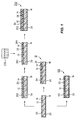
- a preferred print media product in completed form for use as an image-receiving sheet is schematically illustrated at reference number 10.
- the methods, materials, process steps, and other data associated with print media product 10 will now be discussed which constitutes a representative and non-limiting preferred embodiment designed to produce excellent results.
- the print media product 10 is formulated to have a high-gloss character which is accomplished using the particular construction materials identified below.
- gloss is basically defined to involve the relative proportion of light that is specularly reflected from a given product, surface, or region relative to the total amount of light that is reflected.
- High-gloss print media products are particularly desirable in the production of photographic-quality images for a wide variety of home and commercial uses.
- gloss-uniformity as employed throughout this discussion shall generally be defined to involve the production of an image that has consistent and uniform gloss characteristics along and throughout its entire surface area with substantially no zones or regions of gloss that are higher or lower than any other regions on the product. In this manner, a printed media product 10 with a clear, crisp, uniform, and aesthetically pleasing image can be generated.
- a support structure, "support”, or “substrate” 12 (with all of such terms being considered equivalent from a structural and functional standpoint) is initially provided on which the other layers and materials associated with the print media product 10 reside.
- the substrate 12 is optimally fabricated in the form of a flexible sheet having an upper surface 14 (also characterized herein as a "first side") and a lower surface 16 (also characterized herein as a "second side"), with both of the surfaces/sides 14, 16 being substantially planar and having a uniform surface texture in the representative embodiment of Fig. 2 .
- the substrate 12 may be configured in roll, web, strip, film, or sheet form with transparent, semi-transparent, or opaque characteristics as needed and desired.
- the substrate 12 will have an exemplary and non-limiting uniform thickness "T" ( Fig. 2 ) along its entire length of about 0.025 - 0.25 mm, with this range also being applicable to all of the other substrate materials discussed herein.
- T uniform thickness
- Other construction compositions that can be employed in connection with the substrate 12 aside from paper include but are not limited to paperboard, wood, cloth, non-woven fabric, felt, ceramic compositions (optimally unglazed), metals (e.g.
- various organic polymer compositions can be employed in connection with the substrate 12 including but not limited to those fabricated from polyethylene, polystyrene, polyethylene terephthalate, polycarbonate resins, polytetrafluoroethylene (also known as "Teflon ® "), polyimide, polypropylene, cellulose acetate, poly(vinyl chloride), and mixtures thereof without limitation.
- paper materials can be employed wherein at least one of the upper and lower surfaces (e.g. first and second sides) 14, 16 thereof (preferably the upper surface 14 which faces the various layers in the print media product 10 or both surfaces 14, 16) are coated with a substantially non-porous, non-absorbent, and ink-impermeable composition.
- a coating layer 20 is provided on the upper and lower surfaces 14, 16 of the substrate 12 (e.g. made of paper).
- the coating layer 20 optimally has a uniform thickness "T 1 " ( Fig. 2 ) of about 1 - 40 ⁇ m, with this range being subject to change as needed and desired.
- the coating layer 20 is produced from polyethylene although other compositions can be employed for this purpose without restriction including but not limited to various organic polymers such as polystyrene, polyethylene terephthalate, polycarbonate resins, polytetrafluoroethylene (Teflon ® ), polyimide, polypropylene, cellulose acetate, poly(vinyl chloride), and mixtures thereof.
- the use of coating layer 20 can impart added strength and image clarity to the final print media product 10 although the coating layer 20 can be eliminated entirely on either or both surfaces 14, 16 of the substrate 12 if desired as again determined by routine preliminary pilot testing.
- the coating layer 20 shall be construed and defined as part of the substrate 12, with the representative thickness value "T" associated with the substrate 12 being suitably adjusted in this regard.
- T thickness value
- coated paper materials including those discussed herein are traditionally available in pre-manufactured form from various paper suppliers and producers.
- a representative paper substrate 12 covered on both surfaces/sides 14, 16 with a coating layer 20 made of polyethylene is commercially available in completed form from Felix Schoeller Technical Papers, Inc. of Pulaski, NY (USA) [product designations 108395, 108396, and 108397, for example].
- an ink-receiving layer 30 is preferably applied (e.g. operatively attached) to the coating layer 20 on the upper surface 14 of the substrate 12 so that the ink-receiving layer 30 is positioned over and above the substrate 12 as illustrated. If the coating layer 20 was not employed on the substrate 12, the ink-receiving layer 30 in the embodiment of Fig. 2 would simply be placed on the upper surface 14.
- the ink-receiving layer 30 in the current embodiment is designed and configured for use as the "top", "uppermost", or “outermost” layer of material associated with the print media product 10 as previously defined.
- the ink-receiving layer 30 is optimally (but not necessarily) configured for direct attachment to the coating layer 20/upper surface 14 of the substrate 12.
- direct attachment is defined to involve affixation of the ink-receiving layer 30 to the coating layer 20/upper surface 14 of the substrate 12 without any intervening material layers therebetween in order to minimize the number of material layers employed in the final print media product 10.
- one or more intervening material layers can be used between the ink-receiving layer 30 and the substrate 12 (whether coated or uncoated) if needed and desired as determined by routine preliminary research. These intervening material layers can be made from a wide variety of different compositions without restriction as discussed in greater detail below relative to the embodiment of Fig. 4 .
- the ink-receiving layer 30 is designed to provide a high degree of "capacity” (e.g. ink-retention capability) in connection with the media product 10, to facilitate rapid drying of the printed, image-containing media product 10, to create a print media product 10 with a smooth/even surface, and to otherwise ensure that the desired degree of gloss is maintained in the finished product (preferably high gloss with uniform gloss characteristics).
- the ink-receiving layer 30 should likewise be able to substantially prevent ink-coalescence, with this term being defined above.
- the ink-receiving layer 30 should be able to generate smear-fast images (also defined above) using a wide variety of inks, colorant materials, pigments, dye dispersions, sublimation dyes, liquid or solid toner formulations, and other comparable chromatic (e.g. colored) or achromatic (black or white) materials without limitation.
- the ink-receiving layer 30 will have a representative and non-limiting uniform thickness "T 2 " ( Fig. 2 ) along its entire length of about 1 - 50 ⁇ m although this range may be varied as necessary.
- T 2 uniform thickness
- the ink-receiving layer 30 in this embodiment includes a very special ingredient therein which is designed to facilitate the attainment of numerous important goals in a novel and effective manner including those recited above. This special ingredient and its use in the claimed ink-receiving layer 30 will now be discussed.
- the special ingredient which is able to offer the previously-listed benefits and others involves at least one poly(vinyl alcohol-ethylene oxide) copolymer.
- the term "copolymer" is defined above.
- non-limiting features good humid bleed characteristics/control (for example, less than about 15 mil), good light-fastness (for instance, greater than 4 years), better black optical density, better dry smear-fastness, good image gloss and distinctness of image, faster drying times, good ink-media compatibility, and better coalescence control capabilities.
- good humid bleed characteristics/control for example, less than about 15 mil
- good light-fastness for instance, greater than 4 years
- better black optical density better dry smear-fastness
- good image gloss and distinctness of image faster drying times
- good ink-media compatibility good coalescence control capabilities.
- An exemplary poly(vinyl alcohol-ethylene oxide) copolymer which may be used in all of the print media materials of this invention is commercially available from, for example, Nippon Gohsei of Osaka, Japan under the product designation "WO-320". It is not entirely and currently understood as to how ink-coalescence control, rapid drying times, gloss-uniformity, and the other benefits recited above are provided by the use of at least one poly(vinyl alcohol-ethylene oxide) copolymer in the ink-receiving layer 30 (and the other ink receiving layers set forth in the various alternative embodiments discussed below).
- the ink-receiving layer 30 may again employ at least one or more additional ingredients in combination with the poly(vinyl alcohol-ethylene oxide) copolymer without restriction.
- the copolymer may be combined in the ink-receiving layer 30 with at least one or more pigments (organic or inorganic) as discussed above.
- pigments shall generally be defined to involve a material which is used to impart color, opacity, and the like to a given formulation.
- Representative pigment materials which can be employed alone or together in combination with the claimed poly(vinyl alcohol-ethylene oxide) copolymer include but are not limited to silica (in precipitated, colloidal, gel, sol, and/or fumed form), cationic-modified silica (e.g. alumina-treated silica in an exemplary and non-limiting embodiment), cationic polymeric binder-treated silica, aluminum oxide, magnesium oxide, magnesium carbonate, calcium carbonate, pseudo-boehmite, barium sulfate, clay, titanium dioxide, gypsum, mixtures thereof, and others without limitation.
- An exemplary and preferred material which may be used as a pigment is silica as mentioned above (with particular reference to silica gel).
- Silica gel is typically fabricated by combining mineral acid materials with silicates (sodium silicate and the like). The resulting product consists of an aggregated network-type structure within a liquid medium. While the claimed invention (with particular reference to the ink-receiving layer 30) shall not be restricted to any types or grades of silica, a representative silica gel composition suitable for use therein will have an exemplary/preferred mean silica particle size (e.g. diameter) of about 0.3 - 0.4 ⁇ m in water and an exemplary/preferred mean porosity of about 0.8 - 0.9 cm 3 /g which provides excellent results. This particular silica material is commercially available from, for example, Grace Davison, Inc.
- the above-listed recitation of silica in connection with the pigment material(s) to be employed in this particular embodiment is again being provided for example purposes only. It is also possible that the use of one or more pigments can be entirely eliminated from the ink-receiving layer 30 if desired (discussed further below). Likewise, the additional ingredient(s) to be employed in combination with the poly(vinyl alcohol-ethylene oxide) copolymer in the ink-receiving layer 30 can again involve a wide number, variety, and type without limitation ranging from pigments to fillers to supplemental binders and others.
- the ink-receiving layer 30 in the current embodiment may contain (1) at least one poly(vinyl alcohol-ethylene oxide) polymer; and (2) at least one pigment without any other materials or additives [especially since the poly(vinyl alcohol-ethylene oxide) copolymer is capable of performing a binder function].
- the two classes of materials listed above can likewise be combined with one or more other additional ingredients if needed and desired as determined by routine preliminary pilot testing.
- one of these additional ingredients can involve at least one extra (optional) organic or inorganic binder material (characterized herein as a "supplemental binder composition").
- binder as used throughout this discussion shall generally involve compositions that have the ability to chemically, physically, and/or electrostatically retain one or more materials together in a given formulation or structure in order to provide mechanical strength, cohesiveness, and the like.
- supplemental binder compositions which may be employed alone or combined in the ink-receiving layer 30 of the current embodiment include: polyvinyl alcohol and derivatives thereof, starch, SBR latex, gelatin, alginates, carboxycellulose materials, polyacrylic acid and derivatives thereof, polyvinyl pyrrolidone, casein, polyethylene glycol, polyurethanes (for example, a modified polyurethane resin dispersion), polyamide resins (for instance, an epichlorohydrin-containing polyamide), mixtures thereof, and others without restriction.
- polyvinyl alcohols examples include polyvinyl alcohols; (2) polyurethanes; and (3) polyamide resins.
- Exemplary and non-limiting derivatives of polyvinyl alcohol which may be encompassed within the "polyvinyl alcohol" class of materials that are suitable for use in the ink-receiving layer 30 (and other layers discussed herein) include but are not limited to unsubstituted polyvinyl alcohol as illustrated and discussed above, carboxylated polyvinyl alcohol, sulfonated polyvinyl alcohol, acetoacetylated polyvinyl alcohol, and mixtures thereof.
- Acetoacetylated polyvinyl alcohol is commercially available from numerous sources including, for example, Nippon Gohsei of Osaka, Japan under the product designation "GOHSEFIMER Z 200".
- modified polyurethane resin dispersion shall be generally defined herein to involve polyurethane polymers having hydrophobic groups associated therewith, wherein such materials are water-dispersible.
- This type of composition is particularly useful in the ink-receiving layer 30 of the current embodiment because of its ability to provide good water-resistance, a high degree of light-stability (e.g. light-fastness), and fast drying times.
- modified polyurethane resin dispersions are commercially available from numerous sources (and are typically proprietary in nature)
- a modified polyurethane resin dispersion that is appropriate for use as a supplemental binder composition in the ink-receiving layer 30 alone or combined with the other supplemental binder materials set forth herein involves a product sold by Dainippon Ink and Chemicals/Dainippon International (USA), Inc. of Fort Lee, NJ (USA) under the product designation "PATELACOL IJ-30".
- polyamide resins as supplemental binder compositions alone or combined with other binders in the ink-receiving layer 30 (or other material layers discussed herein)
- the following compounds can be encompassed within this class of materials without limitation: acrylic modified polyamides, acrylic polyamide copolymers, methacrylic modified polyamides, cationic polyamides, polyquaternary ammonium polyamides, epichlorohydrin-containing polyamides, and mixtures thereof.
- One composition of particular interest within this group is an epichlorohydrin-containing polyamide.
- This type of material is of interest for use in the ink-receiving layer 30 and other layers associated with the print media product 10 (if desired as determined by routine preliminary pilot testing) because of its ability to provide a high level of ink/dye retention and affinity, along with rapid drying times.
- one representative ink-receiving layer 30 may consist essentially of or be comprised of (with particular reference to the legal meanings traditionally associated with such terms) the following binder mixture: (1) at least one poly(vinyl alcohol-ethylene oxide) copolymer; (2) at least one polyurethane resin dispersion; and (3) at least one epichlorohydrin-containing polyamide as previously described.
- the ink-receiving layer 30 in the current embodiment [which involves the use of at least one poly(vinyl alcohol-ethylene oxide) copolymer combined with at least one other ingredient] this embodiment may not employ any supplemental binder compositions at all.
- the ink-receiving layer 30 can instead simply contain, for example, at least one poly(vinyl alcohol-ethylene oxide) copolymer combined with at least one pigment.
- the ink-receiving layer 30 can be produced from at least one poly(vinyl alcohol-ethylene oxide) copolymer in combination with at least one supplemental binder composition without any pigment compositions if desired.
- at least one poly(vinyl alcohol-ethylene oxide) copolymer is employed in combination with at least one other ingredient (either one or more pigments, one or more supplemental binder compositions, and/or various subsidiary additives/ingredients that are primarily designed to perform non-pigment and non-binder functions).
- these additives include but are not limited to the following materials: fillers, surfactants, lubricants, light-stabilizers, preservatives (e.g. antioxidants), general stabilizers, and the like (along with mixtures thereof) without limitation. While these additives may be contained within the ink-receiving layer 30 in variable amounts, they should again be considered optional and employed on an "as needed" basis. Furthermore, they may be used in the ink-receiving layer 30 having the claimed poly(vinyl alcohol-ethylene oxide) copolymer therein whether or not the layer 30 also includes any pigments and/or supplemental binder compositions.
- the present invention shall not be restricted to any particular amounts which shall be determined in accordance with routine analysis.
- a preferred and non-limiting version of this embodiment will involve a situation in which the ink-receiving layer 30 will contain not less than about 70% by weight poly(vinyl alcohol-ethylene oxide) copolymer (optimally about 80 - 90% by weight).
- the foregoing percentage values shall involve the total amount of the ingredient in question whether a single ingredient [e.g.
- one poly(vinyl alcohol-ethylene oxide) copolymer] or multiple ingredients [namely, a plurality of poly(vinyl alcohol-ethylene oxide) copolymers] in combination are employed.
- an 80% by weight value is used in connection with the poly(vinyl alcohol-ethylene oxide) copolymer, this shall involve a situation where 80% by weight of a single poly(vinyl alcohol-ethylene oxide) copolymer may be employed or multiple poly(vinyl alcohol-ethylene oxide) copolymers with differing numerical constituent values in combination can be used which collectively constitute (as a total) 80% by weight of the dried ink-receiving layer 30.
- all percentage quantity figures mentioned throughout this discussion shall be on a "dry weight" basis as a percentage of the entire dried layer of concern (e.g. the ink-receiving layer 30 in this embodiment).
- At least one pigment and at least one supplemental binder composition are employed together within the ink-receiving layer 30 along with the poly(vinyl alcohol-ethylene oxide) copolymer, then the following preferred and non-limiting dry weight percentages are employed: about 5 - 15% by weight pigment and about 10 - 15% by weight supplemental binder composition. If no supplemental binder compositions are used but at least one pigment is present, then the amount of pigment composition will be increased to about 15 - 30% by weight to account for the non-presence of the supplemental binder composition. Likewise, if no pigments are employed, the quantity of the supplemental binder composition will be raised to about 15 - 30% by weight to account for the lack of any pigment materials therein.
- the combined total amount of such materials as a group within the ink-receiving layer 30 will normally be about 1 - 5% by weight. If one or more of these subsidiary additives/ingredients are employed, then all of the above-listed compositions aside from the poly(vinyl alcohol-ethylene oxide) copolymer may be reduced proportionately to account for the addition of such items. It should again be emphasized that the foregoing percentage values are provided for example purposes only in a non-limiting fashion and constitute preferred numbers designed to produce effective results.
- a number of different techniques may be employed to apply or otherwise deliver the ink-receiving layer 30 in position over and above the substrate 12 (and/or coating layer 20 associated therewith if present).
- Representative application methods which can be chosen for this purpose include but are not limited to the use of a conventional slot-die processing system, meyer bar apparatus, curtain coating system, rod coating device, or other comparable techniques/devices including those that employ circulating and non-circulating coating technologies.
- the claimed invention and its various embodiments shall not be restricted to any particular layer application/formation methods (and coating weights) with a number of different alternatives being employable for this purpose.
- the ink-receiving layer 30 is preferably dried. This may be accomplished by heating the substrate 12/layer 30 combination at a preferred and non-limiting temperature of about 80 - 120°C within a conventional oven-type heating apparatus of a variety normally used for fabricating sheet-type print media products, with the foregoing substrate 12/layer 30 combination moving through the heating apparatus at a representative "web speed" of about 50 - 150 ft/minute.
- a preferred and non-limiting temperature of about 80 - 120°C within a conventional oven-type heating apparatus of a variety normally used for fabricating sheet-type print media products, with the foregoing substrate 12/layer 30 combination moving through the heating apparatus at a representative "web speed" of about 50 - 150 ft/minute.
- other drying methods may be employed without limitation provided that the layer 30 is effectively dried at this stage.
- the total thickness of the print media product 10 may, of course, be appropriately varied depending on the number of any additional layers that may be employed within the print media product 10.
- At least one ink-receiving layer which contains at least one poly(vinyl alcohol-ethylene oxide) copolymer.
- This layer may be located anywhere on or within the media product, provided that it is able to receive at least some of the ink materials being delivered.
- Two alternative embodiments of the invention will now be discussed. Both of these embodiments will involve all of the information, materials, numerical parameters, ink-receiving layer and substrate thickness values, fabrication techniques, term-definitions, procedures, and other items expressed above in connection with the first embodiment (e.g. the embodiment of Fig. 2 ) and are incorporated in the current discussion by reference (unless otherwise stated herein). Thus, the foregoing information will not be repeated.
- the ink-receiving layer 102 as schematically illustrated in Fig. 3 has a uniform thickness "T 3 " along its entire length which is substantially the same as the thickness "T 2 " of the ink-receiving layer 30 in the embodiment of Fig. 2 (namely, about 1 - 50 ⁇ m in a representative and non-limiting example).
- the ink-receiving layer 102 has a different material-content compared with ink-receiving layer 30, with ink-receiving layer 102 "consisting essentially of" at least one poly(vinyl alcohol-ethylene oxide) copolymer.
- the ink-receiving layer 102 will not contain therein any pigments, fillers (of a particulate or non-particulate nature), supplemental binder compositions, or other materials of any kind in more than negligible/trace quantities (for example, those quantities that would incidentally be present as a result of the manufacturing processes being employed).
- the ink-receiving layer 102 in the current embodiment/method will not include any pigments, fillers, or other materials therein aside from minute, trace amounts that would be considered inconsequential.
- the ink-receiving layer 102 in this embodiment will not contain therein any composition(s) that would materially affect or alter any of the key characteristics listed above in connection with the use of at least one poly(vinyl alcohol-polyethylene oxide) copolymer.
- key characteristics include but are not restricted to gloss-control (with high-gloss levels and gloss-uniformity being of primary interest under this category), excellent light-fastness, ink coalescence-control, rapid drying time, and the generation of clear, durable, smear-fast, and distinct printed images.
- the ink-receiving layer 102 may be fabricated so that it is basically "copolymer only” from a material-content standpoint relative to the poly(vinyl alcohol-ethylene oxide) copolymer discussed herein [e.g.
- the claimed invention and its various embodiments shall not be restricted to any particular layer application/formation methods (and coating weights) with a number of different alternatives being employable for this purpose.
- the ink-receiving layer 102 is preferably dried (optimally in the same manner discussed above in connection with the ink-receiving layer 30). This may be accomplished by heating the substrate 12/layer 102 combination at a preferred and non-limiting temperature of about 80 - 120°C within a conventional oven-type heating apparatus of a variety normally used for fabricating sheet-type print media products, with the foregoing substrate 12/layer 102 combination moving through the heating apparatus at a representative "web speed" of about 50 - 150 ft/minute.
- a preferred and non-limiting temperature of about 80 - 120°C
- a conventional oven-type heating apparatus of a variety normally used for fabricating sheet-type print media products
- the foregoing substrate 12/layer 102 combination moving through the heating apparatus at a representative "web speed" of about 50 - 150 ft/minute.
- other drying methods may be employed without limitation provided that the layer 102 is effectively dried at this stage.
- the selection to use it will again depend on numerous factors ranging from the chemical nature of the ink materials being delivered to the type of printing system under consideration. However, employment of the embodiment of Fig. 3 (and the specialized ink-receiving layer 102 associated therewith) is particularly desirable and useful in situations where drying time and smear-fastness are of primary importance as characteristics in the final product. Likewise, the ink-receiving layer 102 can be used alone as the sole material layer in connection with the print media product 100 or in combination with one or more other material layers located above or below the layer 102 provided that the layer 102 is able to receive at least some of the ink materials of interest thereon or therein.
- the print media products 10, 100 may contain at least one additional layer of material located above or below the ink-receiving layers 30, 102.
- a non-limiting example of a print media product 200 which employs an additional layer of material is schematically illustrated in Fig. 4 .
- This additional or intermediate layer (shown at reference number 202) is positioned over and above (e.g. operatively attached to) the upper surface 14 of the substrate 12 (with or without the coating layer 20 thereon).
- the additional layer 202 is "directly affixed" to the upper surface 14/coating layer 20, with this phrase being defined herein to involve direct attachment of such components without any intervening materials or layers therebetween.
- the chosen ink-receiving layer e.g. layer 30, 102 or other selected ink-receiving layer containing at least one poly(vinyl alcohol-ethylene oxide) copolymer
- the chosen ink-receiving layer is positioned over and above the upper surface 204 ( Fig. 4 ) of the additional layer 202 with "direct affixation" of such components being preferred (although not required). While the embodiment of Fig.
- ink-receiving layer 30 shows the use of ink-receiving layer 30, this structure may be replaced with ink-receiving layer 102 [or any other ink-receiving layer containing the desired poly(vinyl alcohol-ethylene oxide) copolymer.] It shall also be understood that various further layers of material (not shown) may be located below the additional layer 202 (between the layer 202 and substrate 12) or above the additional layer 202 (between the layer 202 and ink-receiving layer 30) without limitation.
- a representative and non-limiting thickness value "T 4 " associated with the additional layer 202 will be about 1 - 50 ⁇ m.
- the additional layer 202 may be made from a number of different compositions (e.g. pigments, binders, fillers, surfactants, lubricants, light-stabilizers, preservatives, general stabilizers, and the like alone or combined without restriction).
- compositions e.g. pigments, binders, fillers, surfactants, lubricants, light-stabilizers, preservatives, general stabilizers, and the like alone or combined without restriction.
- all of the compositions recited above in connection with the ink-receiving layer 30 may also be employed within the additional layer 202 [including at least one poly(vinyl alcohol-ethylene oxide) copolymer if desired.]
- exemplary pigments will include silica (in precipitated, colloidal, gel, sol, and/or fumed form), cationic-modified silica (e.g.
- alumina-treated silica in an exemplary and non-limiting embodiment, cationic polymeric binder-treated silica, aluminum oxide, magnesium oxide, magnesium carbonate, calcium carbonate, pseudo-boehmite, barium sulfate, clay, titanium dioxide, gypsum, mixtures thereof, and others without limitation.
- binders will involve polyvinyl alcohol and derivatives thereof, starch, SBR latex, gelatin, alginates, carboxycellulose materials, polyacrylic acid and derivatives thereof, polyvinyl pyrrolidone, casein, polyethylene glycol, polyurethanes (for example, a modified polyurethane resin dispersion), polyamide resins (for instance, an epichlorohydrin-containing polyamide), mixtures thereof, and others without limitation.
- the additional layer 202 can encompass numerous materials and material quantities without limitation, with the additional layer 202 being described in connection with multiple alternatives to convey the understanding that the content of layer 202 shall not be restricted to any given formulations.
- the additional layer 202 can employ the following pigment and binder quantities: about 67 - 87% by weight pigment (e.g. silica) with about 77% by weight being preferred, and about 13 - 33% by binder (e.g. polyvinyl alcohol) with about 23% by weight being preferred.
- any additional/optional ingredients and/or at least one poly(vinyl alcohol-ethylene oxide) copolymer be used within the additional layer 202, the relative quantities of the pigment(s) and binder(s) recited above would be proportionately reduced to account for any added components.
- either one of the pigment(s) or binder(s) could be reduced in quantity on an individual basis to account for the added ingredient(s) if desired.
- the additional layer 202 can involve the use of at least one pigment (without any binders), at least one binder (without any pigments), or may consist essentially of at least one poly(vinyl alcohol-ethylene oxide) copolymer and thus have the same material-content as the ink-receiving layer 102.
- at least one pigment without any binders
- at least one binder without any pigments
- a number of different methods may be employed to apply or otherwise deliver the additional layer 202 in position over and above the substrate 12 (and/or coating layer 20 associated therewith if present).
- Representative application techniques which can be chosen for this purpose include but are not limited to the use of a slot-die processing system, meyer bar apparatus, curtain coating system, rod coating device, or other comparable methods including those that employ circulating and non-circulating coating technologies.
- the claimed invention and its various embodiments shall not be restricted to any particular layer application/formation methods (and coating weights) with a number of different alternatives being employable for this purpose.
- the layer 202 is optimally dried. This may be accomplished by heating the substrate 12/layer 202 combination at a preferred and non-limiting temperature of about 80 - 120°C within a conventional oven-type heating apparatus of a variety normally used for fabricating sheet-type print media products, with the foregoing substrate 12/layer 202 combination moving through the heating apparatus at a representative "web speed" of about 50 - 150 ft/minute.
- a preferred and non-limiting temperature of about 80 - 120°C within a conventional oven-type heating apparatus of a variety normally used for fabricating sheet-type print media products.
- a representative "web speed" of about 50 - 150 ft/minute.
- other drying methods may be employed without limitation provided that the layer 202 is effectively dried at this stage.
- the chosen ink-receiving layer e.g. layers 30, 102 or other desired ink-receiving layer having at least one poly(vinyl alcohol-ethylene oxide) copolymer therein
- the chosen ink-receiving layer can be applied/delivered onto the upper or top surface 204 of the additional layer 202 so that it is operatively attached thereto.
- This step may be accomplished using the techniques, methods, operational parameters, web speeds, coating weights, and other information (including drying steps/temperatures and the like) which are listed above in the two prior embodiments relative to layers 30, 102. Accordingly, such information shall be incorporated in the current discussion by reference.
- an optional intermediate step may be implemented prior to delivery of the chosen ink-receiving layer 30, 102 onto the additional layer 202.
- This step involves the delivery of a supply of an aqueous citric acid solution 210 over all or part of the top surface 204 of the additional layer 202 preferably after the layer 202 is dried so that at least part of the top surface 204 is re-wetted.
- the solution 210 will contain about 0.7% by weight citric acid in water (with the foregoing % by weight value in this instance not involving "dry weight" as discussed above since an aqueous solution is involved).
- any quantity will be adequate provided that a sufficient supply is delivered to uniformly wet the top surface 204 of the additional layer 202 over its entire length and width or in the desired particular locations thereon.
- 1 kg of completed 0.7% by weight citric acid solution as discussed above will be used (e.g. uniformly applied) per 500 ft 2 of the additional layer 202, although other quantities may again be employed as determined by routine preliminary testing.
- the purpose of this step is to avoid bubble formation in the ink-receiving layers 30, 102 to be applied which is effectively accomplished using the above-listed citric acid solution 210. As a result, it is further ensured that the ink-receiving layers 30, 102 will have a uniform consistency which facilitates proper image formation.
- the ink-receiving layers produced in accordance with the invention can be expected in most cases to have the following important characteristics: an average drying time of less than about three (3) minutes and a specular gloss of > about 60 at 20° (as measured by a Micro-TRI-Gloss meter [P/N GB4520] from BYK Gardner USA of Columbia, MD [USA]), with the foregoing numerical parameters being non-limiting but preferred.
- the substrate 12 is constructed from paper coated on both surfaces/sides 14, 16 with a coating layer 20 of polyethylene.
- the thickness values associated with the substrate 12, coating layer 20, and ink-receiving layer 30 are within the ranges specified above.
- the substrate 12 is constructed from paper coated on both surfaces/sides 14, 16 with a coating layer 20 of polyethylene.
- the thickness values associated with the substrate 12, coating layer 20, and ink-receiving layer 102 are within the ranges specified above.
- the substrate 12 is constructed from paper coated on both surfaces/sides 14, 16 with a coating layer 20 of polyethylene.
- the thickness values associated with the substrate 12, coating layer 20, ink-receiving layers 30, 102, and additional layer 202 in this Example are within the ranges specified above.
- Table A - Ink-Receiving Layer Component % By Dry Weight in Layer (Same formulations as those listed above in connection the ink-receiving layers in Examples 1 and 2, either of which may be used in this Example).
- Table B Additional (Intermediate) Layer Component % By Dry Weight in Layer Silica (Pigment) 77 Polyvinyl alcohol (Binder) 23 100
- the basic method of interest with reference to all of the foregoing embodiments will generally involve the following steps: (1) providing a substrate; (2) applying an ink-receiving layer in position over and above the substrate or, more generally, operatively attaching the ink-receiving layer to the substrate.
- the ink receiving layer will, in a primary embodiment, comprise at least one poly(vinyl alcohol-ethylene oxide) copolymer therein.
- the ink-receiving layer may be of a construction "consisting essentially of" at least one poly(vinyl alcohol-ethylene oxide) copolymer as previously discussed.
- At least one additional or intermediate layer of material may be applied in position over and above the substrate prior to application of the ink-receiving layer.
- this step involves placing the additional layer between the substrate and ink-receiving layer so that the additional layer is operatively attached to the substrate and ink-receiving layer.
- One further step which may be employed involves delivering a citric acid solution (e.g. about 0.7% by weight citric acid in a preferred and non-limiting version of the invention) onto part or (preferably) all of the top surface of the additional layer prior to delivery of the ink-receiving layer thereover. It has been discovered that the use of this particular solution can again assist in avoiding undesired bubble formation in the completed products.
- a citric acid solution e.g. about 0.7% by weight citric acid in a preferred and non-limiting version of the invention
Landscapes
- Chemical & Material Sciences (AREA)
- Chemical Kinetics & Catalysis (AREA)
- Ink Jet Recording Methods And Recording Media Thereof (AREA)
- Ink Jet (AREA)
Applications Claiming Priority (2)
| Application Number | Priority Date | Filing Date | Title |
|---|---|---|---|
| US778248 | 1991-10-24 | ||
| US09/778,248 US6528148B2 (en) | 2001-02-06 | 2001-02-06 | Print media products for generating high quality visual images and methods for producing the same |
Publications (3)
| Publication Number | Publication Date |
|---|---|
| EP1228890A2 EP1228890A2 (en) | 2002-08-07 |
| EP1228890A3 EP1228890A3 (en) | 2004-08-18 |
| EP1228890B1 true EP1228890B1 (en) | 2009-04-01 |
Family
ID=25112734
Family Applications (1)
| Application Number | Title | Priority Date | Filing Date |
|---|---|---|---|
| EP20020250457 Expired - Lifetime EP1228890B1 (en) | 2001-02-06 | 2002-01-23 | Print media products and methods for producing the same |
Country Status (5)
| Country | Link |
|---|---|
| US (2) | US6528148B2 (enExample) |
| EP (1) | EP1228890B1 (enExample) |
| JP (1) | JP2002264489A (enExample) |
| DE (1) | DE60231764D1 (enExample) |
| HK (1) | HK1045671B (enExample) |
Families Citing this family (21)
| Publication number | Priority date | Publication date | Assignee | Title |
|---|---|---|---|---|
| US6689433B2 (en) | 2002-05-06 | 2004-02-10 | Hewlett-Packard Development Company, L.P. | Print media products for generating high quality images and methods for making the same |
| US20040033377A1 (en) * | 2002-06-10 | 2004-02-19 | Koenig Michael F. | Waterfast dye fixative compositions for ink jet recording sheets |
| US6866903B2 (en) | 2002-12-11 | 2005-03-15 | Eastman Kodak Company | Ink jet recording element |
| US20040253393A1 (en) * | 2003-06-11 | 2004-12-16 | Bor-Jiunn Niu | Binder to improve light fastness for inkjet photo media |
| JP2005133260A (ja) * | 2003-10-31 | 2005-05-26 | Unitika Ltd | 複合紙状物 |
| US20050136220A1 (en) * | 2003-12-19 | 2005-06-23 | Chang Park | Methods of producing recording sheets having reduced curl |
| US7112629B2 (en) * | 2004-02-09 | 2006-09-26 | Hewlett-Packard Development Company, L.P. | Print media products for generating high quality images and methods for making the same |
| US20050208234A1 (en) * | 2004-03-19 | 2005-09-22 | Agfa-Gevaert | Ink-jet recording material |
| FR2874032B1 (fr) * | 2004-08-03 | 2006-10-27 | Eastman Kodak Co | Materiau destine a la formation d'images par impression par jet d'encre |
| US7687120B2 (en) * | 2004-10-21 | 2010-03-30 | Hewlett-Packard Development Company, L.P. | Print media and methods for making the same |
| US20080057231A1 (en) * | 2006-06-27 | 2008-03-06 | Jun Li | Ink Jet Recording Sheet for Pigmented Ink |
| US20080039549A1 (en) * | 2006-06-30 | 2008-02-14 | Jun Li | Two-Part Printing System with Acrylic-Based Polymers |
| US20080044633A1 (en) * | 2006-06-30 | 2008-02-21 | Yaqiang Frank Ming | Printing Quality Improvement of Pigmented Inks on Glossy Media |
| US8163075B2 (en) | 2006-10-31 | 2012-04-24 | Sensient Colors Llc | Inks comprising modified pigments and methods for making and using the same |
| AU2008288785B2 (en) | 2007-08-23 | 2014-08-21 | Sensient Colors Inc. | Self-dispersed pigments and methods for making and using the same |
| EP2358540B1 (en) * | 2008-12-16 | 2019-03-20 | Hewlett-Packard Development Company, L.P. | Liquid toner digitally printable media |
| KR20110135989A (ko) | 2009-04-07 | 2011-12-20 | 센션트 컬러스 엘엘씨 | 자가-분산 입자 및 그의 제조 및 사용 방법 |
| WO2012057778A1 (en) | 2010-10-29 | 2012-05-03 | Hewlett-Packard Development Company, L.P. | Photo paper |
| US9422439B2 (en) | 2012-02-17 | 2016-08-23 | Hewlett-Packard Development Company, L.P. | Ink set |
| WO2020005201A1 (en) * | 2018-06-25 | 2020-01-02 | Hewlett-Packard Development Company, L.P. | Vinyl substrate printing |
| CN114654884B (zh) * | 2020-12-22 | 2023-06-06 | 精工爱普生株式会社 | 印刷条件设定方法、印刷条件设定系统 |
Family Cites Families (81)
| Publication number | Priority date | Publication date | Assignee | Title |
|---|---|---|---|---|
| US440827A (en) | 1890-11-18 | Fire-escape tower | ||
| US4446174A (en) | 1979-04-27 | 1984-05-01 | Fuiji Photo Film Company, Ltd. | Method of ink-jet recording |
| US4391850A (en) | 1980-06-13 | 1983-07-05 | The Wiggins Teape Group Limited | Record material carrying a color developer composition |
| DE3024205C2 (de) | 1980-06-27 | 1990-11-15 | Felix Schoeller jr. GmbH & Co KG, 4500 Osnabrück | Aufzeichnungspapier für Tintenspritzaufzeichnungsverfahren |
| US4329698A (en) | 1980-12-19 | 1982-05-11 | International Business Machines Corporation | Disposable cartridge for ink drop printer |
| JPS57107879A (en) | 1980-12-25 | 1982-07-05 | Mitsubishi Paper Mills Ltd | Preparation of recording paper |
| JPS60220786A (ja) | 1984-04-17 | 1985-11-05 | Kanzaki Paper Mfg Co Ltd | 感熱記録体の製造方法 |
| US4642247A (en) | 1984-06-29 | 1987-02-10 | Canon Kabushiki Kaisha | Recording medium |
| US4636561A (en) * | 1984-12-11 | 1987-01-13 | Unitika Ltd. | Spiroindolinenaphthoxadine photochromic compounds |
| US4707406A (en) | 1985-01-12 | 1987-11-17 | Konishiroku Photo Industry Co., Ltd. | Thermal transfer recording medium |
| EP0199874A1 (en) * | 1985-02-25 | 1986-11-05 | The Mead Corporation | Ink jet recording sheet having an ink-receptive layer containing polyethylene oxide |
| US4567096A (en) | 1985-03-21 | 1986-01-28 | Piltingsrud Douglas H | Hydrated alumina binder system |
| EP0218956A1 (en) | 1985-09-24 | 1987-04-22 | Asahi Glass Company Ltd. | Recording sheet |
| US4785313A (en) | 1985-12-16 | 1988-11-15 | Canon Kabushiki Kaisha | Recording medium and image formation process using the same |
| US5013603A (en) | 1986-06-13 | 1991-05-07 | Mizusawa Industrial Chemicals, Ltd. | Ink jet recording paper with amorphous silica filler |
| US4771295B1 (en) | 1986-07-01 | 1995-08-01 | Hewlett Packard Co | Thermal ink jet pen body construction having improved ink storage and feed capability |
| US4749291A (en) | 1986-09-23 | 1988-06-07 | Pentel Kabushiki Kaisha | Inking system for wire dot matrix printer |
| EP0298424B1 (en) | 1987-07-07 | 1994-12-07 | Asahi Glass Company Ltd. | Carrier medium for a coloring matter |
| US4892787A (en) | 1987-08-10 | 1990-01-09 | Am International, Inc. | Coated paper for ink jet printing |
| US5266383A (en) | 1988-03-04 | 1993-11-30 | Canon Kabushiki Kaisha | Recording medium and ink jet recording method by use thereof |
| JPH01301368A (ja) | 1988-05-31 | 1989-12-05 | Kanzaki Paper Mfg Co Ltd | 感熱記録体 |
| US5091359A (en) | 1989-02-08 | 1992-02-25 | Kanzaki Paper Manufacturing Co., Ltd. | Heat-sensitive record material |
| US5104730A (en) | 1989-07-14 | 1992-04-14 | Asahi Glass Company Ltd. | Recording sheet |
| US5075153A (en) | 1989-07-24 | 1991-12-24 | Xerox Corporation | Coated paper containing a plastic supporting substrate |
| US4963189A (en) | 1989-08-24 | 1990-10-16 | Hewlett-Packard Company | Waterfast ink formulations with a novel series of anionic dyes containing two or more carboxyl groups |
| US5093159A (en) | 1989-11-06 | 1992-03-03 | National Starch And Chemical Investment Holding Corporation | Process for rapidly immobilizing paper coating compositions |
| US5137773A (en) * | 1990-03-02 | 1992-08-11 | Xerox Corporation | Transparencies |
| EP0490416B1 (en) | 1990-11-30 | 1996-05-15 | Agfa-Gevaert N.V. | Image-receiving material comprising subbed polycarbonate or polypropylene |
| DE69222458T2 (de) | 1991-04-05 | 1998-02-05 | Asahi Glass Co Ltd | Aufzeichnungsblatt für elektrostatische Bildübertragung |
| DE69215781T2 (de) | 1991-07-26 | 1997-04-03 | Asahi Glass Co Ltd | Aufnahmestreifen für Tintenstrahldrucker |
| US5185034A (en) | 1991-08-26 | 1993-02-09 | Hewlett-Packard Company | Ink-jet inks with improved colors and plain paper capacity |
| JP3163697B2 (ja) | 1991-12-19 | 2001-05-08 | 三菱化学ポリエステルフィルム株式会社 | 放射線増感紙 |
| US5198408A (en) * | 1992-02-19 | 1993-03-30 | Eastman Kodak Company | Thermal dye transfer receiving element with backing layer |
| US5278584A (en) | 1992-04-02 | 1994-01-11 | Hewlett-Packard Company | Ink delivery system for an inkjet printhead |
| US5428383A (en) | 1992-08-05 | 1995-06-27 | Hewlett-Packard Corporation | Method and apparatus for preventing color bleed in a multi-ink printing system |
| JP2927377B2 (ja) | 1992-08-07 | 1999-07-28 | 日本製紙株式会社 | インクジェット記録用紙及びその製造方法 |
| EP0600245B2 (en) | 1992-11-09 | 2005-03-16 | Mitsubishi Paper Mills, Ltd. | Ink jet recording sheet and method for producing same |
| DE69305308T2 (de) | 1992-12-10 | 1997-03-20 | Mitsubishi Paper Mills Ltd | Aufzeichnungsblatt für Tintenstrahlschreiber |
| CA2122099C (en) | 1993-04-28 | 1999-08-17 | Hitoshi Yoshino | Recording medium, ink-jet recording method using the same, and dispersion of alumina hydrate |
| JP3264739B2 (ja) | 1993-06-25 | 2002-03-11 | 旭硝子株式会社 | 塗工紙の製造方法 |
| US5515093A (en) | 1993-06-25 | 1996-05-07 | Canon Kabushiki Kaisha | Ink jet printing method and print medium for use in the method |
| EP0634287B1 (en) | 1993-07-16 | 1997-03-12 | Asahi Glass Company Ltd. | Recording sheet and process for its production |
| NZ275767A (en) | 1993-11-22 | 1997-01-29 | Fina Research | Producing colour cards with lacquers; lacquers are applied to paper or cardboard substrate and then are dried |
| JP3654901B2 (ja) | 1994-04-19 | 2005-06-02 | イルフォルト アクチエンゲゼルシャフト | インキジェットプリンテイング用記録シート |
| US5576088A (en) | 1994-05-19 | 1996-11-19 | Mitsubishi Paper Mills Limited | Ink jet recording sheet and process for its production |
| JP3428171B2 (ja) | 1994-09-09 | 2003-07-22 | 旭硝子株式会社 | 塗工紙およびその製造方法 |
| JPH0890916A (ja) | 1994-09-27 | 1996-04-09 | Fuji Photo Film Co Ltd | 感熱記録材料 |
| JPH08165441A (ja) | 1994-10-13 | 1996-06-25 | Canon Inc | 活性エネルギー線重合性組成物、これを含む記録媒体及びこれを用いた画像形成方法 |
| US5975686A (en) | 1994-10-31 | 1999-11-02 | Hewlett-Packard Company | Regulator for a free-ink inkjet pen |
| US5691046A (en) | 1995-05-12 | 1997-11-25 | Asahi Glass Company Ltd. | Recording medium |
| CA2181947A1 (en) | 1995-07-31 | 1997-02-01 | New Oji Paper Co., Ltd. | Heat sensitive recording material |
| JP3605447B2 (ja) | 1995-08-02 | 2004-12-22 | 大日本印刷株式会社 | 画像形成方法 |
| JPH09118067A (ja) * | 1995-10-24 | 1997-05-06 | Denki Kagaku Kogyo Kk | インクジェット用被記録材 |
| JP3133238B2 (ja) | 1995-10-26 | 2001-02-05 | 日本製紙株式会社 | インクジェット記録用キャストコート紙及びその製造方法 |
| US5888367A (en) | 1995-11-29 | 1999-03-30 | Tokushu Paper Mfg. Co., Ltd. | Record sheet used in electro-coagulation printing method |
| JP3074136B2 (ja) | 1995-12-05 | 2000-08-07 | 日本製紙株式会社 | インクジェット記録用キャストコート紙 |
| US5804293A (en) | 1995-12-08 | 1998-09-08 | Ppg Industries, Inc. | Coating composition for recording paper |
| JP3517047B2 (ja) * | 1995-12-26 | 2004-04-05 | 株式会社きもと | インク受容層形成用シート |
| US5605750A (en) | 1995-12-29 | 1997-02-25 | Eastman Kodak Company | Microporous ink-jet recording elements |
| US5665504A (en) | 1996-01-11 | 1997-09-09 | Xerox Corporation | Simulated photographic-quality prints using a plasticizer to reduce curl |
| US5977019A (en) | 1996-02-06 | 1999-11-02 | Fuji Photo Film Co., Ltd. | Multi-color heat-sensitive recording material and thermal recording method |
| US5723211A (en) | 1996-04-01 | 1998-03-03 | Eastman Kodak Company | Ink-jet printer recording element |
| US5912071A (en) | 1996-04-24 | 1999-06-15 | Asahi Glass Company Ltd. | Recording medium and method for its production |
| US5653797A (en) * | 1996-04-26 | 1997-08-05 | National Gypsum Company | Ready mixed setting-type joint compound and method of making same |
| US5744273A (en) | 1996-10-02 | 1998-04-28 | Xerox Corporation | Laminatable backing substrates containing fluoro compounds for improved toner flow |
| US5882388A (en) | 1996-10-16 | 1999-03-16 | Brady Usa, Inc. | Water resistant ink jet recording media topcoats |
| JP3882244B2 (ja) | 1996-12-26 | 2007-02-14 | 大日本インキ化学工業株式会社 | インキジェット用記録材、及び印刷物 |
| US5759727A (en) | 1997-01-21 | 1998-06-02 | Xerox Corporation | Method of generating simulated photographic quality images on luminescent, mirror coated, melt-formed backing substrates |
| US5919552A (en) | 1997-05-07 | 1999-07-06 | Xerox Corporation | Coated substrates and methods |
| US5846637A (en) | 1997-05-07 | 1998-12-08 | Xerox Corporation | Coated xerographic photographic paper |
| US5897961A (en) | 1997-05-07 | 1999-04-27 | Xerox Corporation | Coated photographic papers |
| JPH1166548A (ja) | 1997-08-07 | 1999-03-09 | Kao Corp | 磁気記録媒体 |
| US6040060A (en) | 1997-10-10 | 2000-03-21 | Eastman Kodak Company | High uniform gloss ink-jet receivers |
| US5965244A (en) | 1997-10-24 | 1999-10-12 | Rexam Graphics Inc. | Printing medium comprised of porous medium |
| JP3911077B2 (ja) * | 1997-11-07 | 2007-05-09 | 三菱製紙株式会社 | インクジェット用被記録材料 |
| US5928789A (en) | 1997-12-29 | 1999-07-27 | Industrial Technology Research Institute | Ink jet printing medium |
| JPH11277872A (ja) | 1998-03-31 | 1999-10-12 | Nippon Paper Industries Co Ltd | インクジェット記録用紙 |
| US6197880B1 (en) | 1998-04-22 | 2001-03-06 | Sri International | Method and composition for coating pre-sized paper using azetidinium and/or guanidine polymers |
| US6089704A (en) | 1998-10-19 | 2000-07-18 | Eastman Kodak Company | Overcoat for ink jet recording element |
| US6361853B1 (en) * | 1999-12-20 | 2002-03-26 | Eastman Kodak Company | Ink jet recording element |
| US6413590B1 (en) * | 2000-05-31 | 2002-07-02 | Rexam Graphics Inc. | Glossy ink jet medium |
-
2001
- 2001-02-06 US US09/778,248 patent/US6528148B2/en not_active Expired - Lifetime
-
2002
- 2002-01-23 EP EP20020250457 patent/EP1228890B1/en not_active Expired - Lifetime
- 2002-01-23 DE DE60231764T patent/DE60231764D1/de not_active Expired - Lifetime
- 2002-02-06 JP JP2002029298A patent/JP2002264489A/ja active Pending
- 2002-09-25 HK HK02106997.8A patent/HK1045671B/en not_active IP Right Cessation
- 2002-11-20 US US10/301,141 patent/US20030072955A1/en not_active Abandoned
Also Published As
| Publication number | Publication date |
|---|---|
| DE60231764D1 (de) | 2009-05-14 |
| HK1045671A1 (en) | 2002-12-06 |
| HK1045671B (en) | 2009-10-09 |
| EP1228890A3 (en) | 2004-08-18 |
| US20030072955A1 (en) | 2003-04-17 |
| EP1228890A2 (en) | 2002-08-07 |
| JP2002264489A (ja) | 2002-09-18 |
| US20020148577A1 (en) | 2002-10-17 |
| US6528148B2 (en) | 2003-03-04 |
Similar Documents
| Publication | Publication Date | Title |
|---|---|---|
| US6528148B2 (en) | Print media products for generating high quality visual images and methods for producing the same | |
| EP1361072B1 (en) | Print media products for generating high quality images and methods for making the same | |
| EP0997314B1 (en) | Ink-jet recording sheet containing silica particles, and method for its' use | |
| EP1188572B1 (en) | High efficiency print media products and methods for producing the same | |
| EP1288013B1 (en) | Print media products, methods for making the same and coating formulations | |
| EP1106375B1 (en) | Glossy ink jet recording element | |
| EP0331125B1 (en) | Recording medium and ink jet recording method by use thereof | |
| JPH09175010A (ja) | インクジェット記録シート | |
| US7112629B2 (en) | Print media products for generating high quality images and methods for making the same | |
| EP1631460B1 (en) | Method for improving light-fastness of ink-jet recording materials | |
| EP1319516B1 (en) | Ink jet recording element and printing method | |
| JP3629645B2 (ja) | インクジェット記録シート | |
| US7687120B2 (en) | Print media and methods for making the same | |
| JP3942120B2 (ja) | インクジェット記録用シート | |
| HK1050877B (en) | Print media products, methods for making the same and coating formulations | |
| HK1059246B (en) | Print media products for generating high quality images and methods for making the same | |
| CH696491A5 (de) | Druckmedienprodukte für die Bildung von visuellen Bildern hoher Qualität und Verfahren zu ihrer Herstellung. |
Legal Events
| Date | Code | Title | Description |
|---|---|---|---|
| PUAI | Public reference made under article 153(3) epc to a published international application that has entered the european phase |
Free format text: ORIGINAL CODE: 0009012 |
|
| AK | Designated contracting states |
Kind code of ref document: A2 Designated state(s): AT BE CH CY DE DK ES FI FR GB GR IE IT LI LU MC NL PT SE TR |
|
| AX | Request for extension of the european patent |
Free format text: AL;LT;LV;MK;RO;SI |
|
| PUAL | Search report despatched |
Free format text: ORIGINAL CODE: 0009013 |
|
| AK | Designated contracting states |
Kind code of ref document: A3 Designated state(s): AT BE CH CY DE DK ES FI FR GB GR IE IT LI LU MC NL PT SE TR |
|
| AX | Request for extension of the european patent |
Extension state: AL LT LV MK RO SI |
|
| 17P | Request for examination filed |
Effective date: 20050127 |
|
| AKX | Designation fees paid |
Designated state(s): DE FR GB NL |
|
| RBV | Designated contracting states (corrected) |
Designated state(s): DE FR GB NL |
|
| GRAP | Despatch of communication of intention to grant a patent |
Free format text: ORIGINAL CODE: EPIDOSNIGR1 |
|
| GRAS | Grant fee paid |
Free format text: ORIGINAL CODE: EPIDOSNIGR3 |
|
| GRAA | (expected) grant |
Free format text: ORIGINAL CODE: 0009210 |
|
| AK | Designated contracting states |
Kind code of ref document: B1 Designated state(s): DE FR GB NL |
|
| REG | Reference to a national code |
Ref country code: GB Ref legal event code: FG4D |
|
| REF | Corresponds to: |
Ref document number: 60231764 Country of ref document: DE Date of ref document: 20090514 Kind code of ref document: P |
|
| REG | Reference to a national code |
Ref country code: HK Ref legal event code: GR Ref document number: 1045671 Country of ref document: HK |
|
| PLBE | No opposition filed within time limit |
Free format text: ORIGINAL CODE: 0009261 |
|
| STAA | Information on the status of an ep patent application or granted ep patent |
Free format text: STATUS: NO OPPOSITION FILED WITHIN TIME LIMIT |
|
| 26N | No opposition filed |
Effective date: 20100105 |
|
| REG | Reference to a national code |
Ref country code: GB Ref legal event code: 732E Free format text: REGISTERED BETWEEN 20120329 AND 20120404 |
|
| REG | Reference to a national code |
Ref country code: NL Ref legal event code: SD Effective date: 20120731 |
|
| REG | Reference to a national code |
Ref country code: FR Ref legal event code: PLFP Year of fee payment: 15 |
|
| REG | Reference to a national code |
Ref country code: FR Ref legal event code: PLFP Year of fee payment: 16 |
|
| REG | Reference to a national code |
Ref country code: FR Ref legal event code: PLFP Year of fee payment: 17 |
|
| PGFP | Annual fee paid to national office [announced via postgrant information from national office to epo] |
Ref country code: NL Payment date: 20181221 Year of fee payment: 18 |
|
| PGFP | Annual fee paid to national office [announced via postgrant information from national office to epo] |
Ref country code: FR Payment date: 20181220 Year of fee payment: 18 Ref country code: GB Payment date: 20181219 Year of fee payment: 18 |
|
| PGFP | Annual fee paid to national office [announced via postgrant information from national office to epo] |
Ref country code: DE Payment date: 20181218 Year of fee payment: 18 |
|
| REG | Reference to a national code |
Ref country code: DE Ref legal event code: R119 Ref document number: 60231764 Country of ref document: DE |
|
| REG | Reference to a national code |
Ref country code: NL Ref legal event code: MM Effective date: 20200201 |
|
| GBPC | Gb: european patent ceased through non-payment of renewal fee |
Effective date: 20200123 |
|
| PG25 | Lapsed in a contracting state [announced via postgrant information from national office to epo] |
Ref country code: FR Free format text: LAPSE BECAUSE OF NON-PAYMENT OF DUE FEES Effective date: 20200131 Ref country code: DE Free format text: LAPSE BECAUSE OF NON-PAYMENT OF DUE FEES Effective date: 20200801 Ref country code: NL Free format text: LAPSE BECAUSE OF NON-PAYMENT OF DUE FEES Effective date: 20200201 Ref country code: GB Free format text: LAPSE BECAUSE OF NON-PAYMENT OF DUE FEES Effective date: 20200123 |