EP1220824B1 - Kontinuierliches verfahren zur herstellung von zimtaldehyd- und dihydrozimtaldehydderivaten - Google Patents
Kontinuierliches verfahren zur herstellung von zimtaldehyd- und dihydrozimtaldehydderivaten Download PDFInfo
- Publication number
- EP1220824B1 EP1220824B1 EP00966145A EP00966145A EP1220824B1 EP 1220824 B1 EP1220824 B1 EP 1220824B1 EP 00966145 A EP00966145 A EP 00966145A EP 00966145 A EP00966145 A EP 00966145A EP 1220824 B1 EP1220824 B1 EP 1220824B1
- Authority
- EP
- European Patent Office
- Prior art keywords
- reactors
- reactor
- benzaldehyde
- derivatives
- hydrogenation
- Prior art date
- Legal status (The legal status is an assumption and is not a legal conclusion. Google has not performed a legal analysis and makes no representation as to the accuracy of the status listed.)
- Expired - Lifetime
Links
- KJPRLNWUNMBNBZ-QPJJXVBHSA-N (E)-cinnamaldehyde Chemical compound O=C\C=C\C1=CC=CC=C1 KJPRLNWUNMBNBZ-QPJJXVBHSA-N 0.000 title claims abstract description 34
- YGCZTXZTJXYWCO-UHFFFAOYSA-N 3-phenylpropanal Chemical class O=CCCC1=CC=CC=C1 YGCZTXZTJXYWCO-UHFFFAOYSA-N 0.000 title claims abstract description 14
- KJPRLNWUNMBNBZ-UHFFFAOYSA-N cinnamic aldehyde Natural products O=CC=CC1=CC=CC=C1 KJPRLNWUNMBNBZ-UHFFFAOYSA-N 0.000 title abstract description 10
- 229940117916 cinnamic aldehyde Drugs 0.000 title abstract description 10
- 238000004519 manufacturing process Methods 0.000 title description 9
- 238000011437 continuous method Methods 0.000 title 1
- 239000003054 catalyst Substances 0.000 claims abstract description 35
- 238000006243 chemical reaction Methods 0.000 claims abstract description 31
- 238000005984 hydrogenation reaction Methods 0.000 claims abstract description 31
- 150000003935 benzaldehydes Chemical class 0.000 claims abstract description 26
- UFHFLCQGNIYNRP-UHFFFAOYSA-N Hydrogen Chemical compound [H][H] UFHFLCQGNIYNRP-UHFFFAOYSA-N 0.000 claims abstract description 15
- 239000001257 hydrogen Substances 0.000 claims abstract description 15
- 229910052739 hydrogen Inorganic materials 0.000 claims abstract description 15
- 239000000725 suspension Substances 0.000 claims abstract description 11
- 238000002360 preparation method Methods 0.000 claims abstract description 8
- 238000000034 method Methods 0.000 claims description 65
- OTXINXDGSUFPNU-UHFFFAOYSA-N 4-tert-butylbenzaldehyde Chemical compound CC(C)(C)C1=CC=C(C=O)C=C1 OTXINXDGSUFPNU-UHFFFAOYSA-N 0.000 claims description 50
- HUMNYLRZRPPJDN-UHFFFAOYSA-N benzaldehyde Chemical compound O=CC1=CC=CC=C1 HUMNYLRZRPPJDN-UHFFFAOYSA-N 0.000 claims description 26
- 239000000203 mixture Substances 0.000 claims description 22
- KDLHZDBZIXYQEI-UHFFFAOYSA-N Palladium Chemical compound [Pd] KDLHZDBZIXYQEI-UHFFFAOYSA-N 0.000 claims description 20
- 239000007789 gas Substances 0.000 claims description 13
- QNGNSVIICDLXHT-UHFFFAOYSA-N para-ethylbenzaldehyde Natural products CCC1=CC=C(C=O)C=C1 QNGNSVIICDLXHT-UHFFFAOYSA-N 0.000 claims description 13
- 229910052763 palladium Inorganic materials 0.000 claims description 10
- 239000011541 reaction mixture Substances 0.000 claims description 10
- OKTJSMMVPCPJKN-UHFFFAOYSA-N Carbon Chemical compound [C] OKTJSMMVPCPJKN-UHFFFAOYSA-N 0.000 claims description 9
- 239000012071 phase Substances 0.000 claims description 9
- 238000012856 packing Methods 0.000 claims description 7
- 239000000376 reactant Substances 0.000 claims description 7
- WTWBUQJHJGUZCY-UHFFFAOYSA-N cuminaldehyde Chemical compound CC(C)C1=CC=C(C=O)C=C1 WTWBUQJHJGUZCY-UHFFFAOYSA-N 0.000 claims description 4
- 150000002431 hydrogen Chemical class 0.000 claims description 4
- 239000007791 liquid phase Substances 0.000 claims description 4
- BTFQKIATRPGRBS-UHFFFAOYSA-N o-tolualdehyde Chemical compound CC1=CC=CC=C1C=O BTFQKIATRPGRBS-UHFFFAOYSA-N 0.000 claims description 4
- ZRSNZINYAWTAHE-UHFFFAOYSA-N p-methoxybenzaldehyde Chemical compound COC1=CC=C(C=O)C=C1 ZRSNZINYAWTAHE-UHFFFAOYSA-N 0.000 claims description 4
- 229910052751 metal Inorganic materials 0.000 claims description 3
- 239000002184 metal Substances 0.000 claims description 3
- 239000002245 particle Substances 0.000 claims description 3
- 238000000746 purification Methods 0.000 claims description 3
- ZFNVDHOSLNRHNN-UHFFFAOYSA-N xi-3-(4-Isopropylphenyl)-2-methylpropanal Chemical compound O=CC(C)CC1=CC=C(C(C)C)C=C1 ZFNVDHOSLNRHNN-UHFFFAOYSA-N 0.000 claims description 3
- WMPDAIZRQDCGFH-UHFFFAOYSA-N 3-methoxybenzaldehyde Chemical compound COC1=CC=CC(C=O)=C1 WMPDAIZRQDCGFH-UHFFFAOYSA-N 0.000 claims description 2
- FFQXEFNKZVGJDI-UHFFFAOYSA-N 3-propan-2-ylbenzaldehyde Chemical compound CC(C)C1=CC=CC(C=O)=C1 FFQXEFNKZVGJDI-UHFFFAOYSA-N 0.000 claims description 2
- HKEQMVXZDQLSDY-UHFFFAOYSA-N 3-tert-butylbenzaldehyde Chemical compound CC(C)(C)C1=CC=CC(C=O)=C1 HKEQMVXZDQLSDY-UHFFFAOYSA-N 0.000 claims description 2
- 229910052799 carbon Inorganic materials 0.000 claims description 2
- 229940019836 cyclamen aldehyde Drugs 0.000 claims description 2
- 239000004744 fabric Substances 0.000 claims description 2
- OVWYEQOVUDKZNU-UHFFFAOYSA-N m-tolualdehyde Chemical compound CC1=CC=CC(C=O)=C1 OVWYEQOVUDKZNU-UHFFFAOYSA-N 0.000 claims description 2
- FXLOVSHXALFLKQ-UHFFFAOYSA-N p-tolualdehyde Chemical compound CC1=CC=C(C=O)C=C1 FXLOVSHXALFLKQ-UHFFFAOYSA-N 0.000 claims description 2
- VYPSYNLAJGMNEJ-UHFFFAOYSA-N Silicium dioxide Chemical compound O=[Si]=O VYPSYNLAJGMNEJ-UHFFFAOYSA-N 0.000 claims 2
- GWEVSGVZZGPLCZ-UHFFFAOYSA-N Titan oxide Chemical compound O=[Ti]=O GWEVSGVZZGPLCZ-UHFFFAOYSA-N 0.000 claims 2
- MCMNRKCIXSYSNV-UHFFFAOYSA-N Zirconium dioxide Chemical compound O=[Zr]=O MCMNRKCIXSYSNV-UHFFFAOYSA-N 0.000 claims 2
- PNEYBMLMFCGWSK-UHFFFAOYSA-N aluminium oxide Inorganic materials [O-2].[O-2].[O-2].[Al+3].[Al+3] PNEYBMLMFCGWSK-UHFFFAOYSA-N 0.000 claims 1
- 229910052681 coesite Inorganic materials 0.000 claims 1
- 229910052593 corundum Inorganic materials 0.000 claims 1
- 229910052906 cristobalite Inorganic materials 0.000 claims 1
- 125000001400 nonyl group Chemical group [H]C([*])([H])C([H])([H])C([H])([H])C([H])([H])C([H])([H])C([H])([H])C([H])([H])C([H])([H])C([H])([H])[H] 0.000 claims 1
- 239000000377 silicon dioxide Substances 0.000 claims 1
- 229910052682 stishovite Inorganic materials 0.000 claims 1
- 229910052905 tridymite Inorganic materials 0.000 claims 1
- 229910001845 yogo sapphire Inorganic materials 0.000 claims 1
- 238000010924 continuous production Methods 0.000 abstract description 12
- NBBJYMSMWIIQGU-UHFFFAOYSA-N Propionic aldehyde Chemical compound CCC=O NBBJYMSMWIIQGU-UHFFFAOYSA-N 0.000 description 60
- OKKJLVBELUTLKV-UHFFFAOYSA-N Methanol Chemical compound OC OKKJLVBELUTLKV-UHFFFAOYSA-N 0.000 description 27
- HEMHJVSKTPXQMS-UHFFFAOYSA-M Sodium hydroxide Chemical compound [OH-].[Na+] HEMHJVSKTPXQMS-UHFFFAOYSA-M 0.000 description 24
- 239000007788 liquid Substances 0.000 description 11
- 239000002585 base Substances 0.000 description 10
- ZZSXZEFWZXSQPX-UHFFFAOYSA-N 3-(4-tert-butylphenyl)-2-methylprop-2-enal Chemical compound O=CC(C)=CC1=CC=C(C(C)(C)C)C=C1 ZZSXZEFWZXSQPX-UHFFFAOYSA-N 0.000 description 9
- 239000002904 solvent Substances 0.000 description 9
- IKHGUXGNUITLKF-UHFFFAOYSA-N Acetaldehyde Chemical compound CC=O IKHGUXGNUITLKF-UHFFFAOYSA-N 0.000 description 8
- 238000002156 mixing Methods 0.000 description 8
- KWYUFKZDYYNOTN-UHFFFAOYSA-M Potassium hydroxide Chemical compound [OH-].[K+] KWYUFKZDYYNOTN-UHFFFAOYSA-M 0.000 description 7
- 239000000243 solution Substances 0.000 description 7
- XLYOFNOQVPJJNP-UHFFFAOYSA-N water Substances O XLYOFNOQVPJJNP-UHFFFAOYSA-N 0.000 description 7
- WQDUMFSSJAZKTM-UHFFFAOYSA-N Sodium methoxide Chemical compound [Na+].[O-]C WQDUMFSSJAZKTM-UHFFFAOYSA-N 0.000 description 6
- 239000000463 material Substances 0.000 description 6
- VLKZOEOYAKHREP-UHFFFAOYSA-N n-Hexane Chemical compound CCCCCC VLKZOEOYAKHREP-UHFFFAOYSA-N 0.000 description 6
- LYCAIKOWRPUZTN-UHFFFAOYSA-N Ethylene glycol Chemical compound OCCO LYCAIKOWRPUZTN-UHFFFAOYSA-N 0.000 description 5
- 229910001854 alkali hydroxide Inorganic materials 0.000 description 5
- 150000008044 alkali metal hydroxides Chemical class 0.000 description 5
- 239000002253 acid Substances 0.000 description 4
- 238000005882 aldol condensation reaction Methods 0.000 description 4
- QTBSBXVTEAMEQO-UHFFFAOYSA-N Acetic acid Chemical compound CC(O)=O QTBSBXVTEAMEQO-UHFFFAOYSA-N 0.000 description 3
- RTZKZFJDLAIYFH-UHFFFAOYSA-N Diethyl ether Chemical compound CCOCC RTZKZFJDLAIYFH-UHFFFAOYSA-N 0.000 description 3
- LFQSCWFLJHTTHZ-UHFFFAOYSA-N Ethanol Chemical compound CCO LFQSCWFLJHTTHZ-UHFFFAOYSA-N 0.000 description 3
- RWRDLPDLKQPQOW-UHFFFAOYSA-N Pyrrolidine Chemical compound C1CCNC1 RWRDLPDLKQPQOW-UHFFFAOYSA-N 0.000 description 3
- 150000007513 acids Chemical class 0.000 description 3
- KRKNYBCHXYNGOX-UHFFFAOYSA-N citric acid Chemical compound OC(=O)CC(O)(C(O)=O)CC(O)=O KRKNYBCHXYNGOX-UHFFFAOYSA-N 0.000 description 3
- 150000001875 compounds Chemical class 0.000 description 3
- 238000004821 distillation Methods 0.000 description 3
- 229910018072 Al 2 O 3 Inorganic materials 0.000 description 2
- QGZKDVFQNNGYKY-UHFFFAOYSA-N Ammonia Chemical compound N QGZKDVFQNNGYKY-UHFFFAOYSA-N 0.000 description 2
- VEXZGXHMUGYJMC-UHFFFAOYSA-N Hydrochloric acid Chemical compound Cl VEXZGXHMUGYJMC-UHFFFAOYSA-N 0.000 description 2
- KFZMGEQAYNKOFK-UHFFFAOYSA-N Isopropanol Chemical compound CC(C)O KFZMGEQAYNKOFK-UHFFFAOYSA-N 0.000 description 2
- WMFOQBRAJBCJND-UHFFFAOYSA-M Lithium hydroxide Chemical compound [Li+].[OH-] WMFOQBRAJBCJND-UHFFFAOYSA-M 0.000 description 2
- LRHPLDYGYMQRHN-UHFFFAOYSA-N N-Butanol Chemical compound CCCCO LRHPLDYGYMQRHN-UHFFFAOYSA-N 0.000 description 2
- QAOWNCQODCNURD-UHFFFAOYSA-N Sulfuric acid Chemical compound OS(O)(=O)=O QAOWNCQODCNURD-UHFFFAOYSA-N 0.000 description 2
- 239000003513 alkali Substances 0.000 description 2
- 229910052784 alkaline earth metal Inorganic materials 0.000 description 2
- 150000001412 amines Chemical class 0.000 description 2
- 238000004458 analytical method Methods 0.000 description 2
- 150000007514 bases Chemical class 0.000 description 2
- 238000010923 batch production Methods 0.000 description 2
- 230000015572 biosynthetic process Effects 0.000 description 2
- 239000007795 chemical reaction product Substances 0.000 description 2
- XBDQKXXYIPTUBI-UHFFFAOYSA-N dimethylselenoniopropionate Natural products CCC(O)=O XBDQKXXYIPTUBI-UHFFFAOYSA-N 0.000 description 2
- 238000004090 dissolution Methods 0.000 description 2
- 238000000605 extraction Methods 0.000 description 2
- 239000003205 fragrance Substances 0.000 description 2
- XLYOFNOQVPJJNP-UHFFFAOYSA-M hydroxide Chemical compound [OH-] XLYOFNOQVPJJNP-UHFFFAOYSA-M 0.000 description 2
- 150000004679 hydroxides Chemical class 0.000 description 2
- WGCNASOHLSPBMP-UHFFFAOYSA-N hydroxyacetaldehyde Natural products OCC=O WGCNASOHLSPBMP-UHFFFAOYSA-N 0.000 description 2
- 239000000543 intermediate Substances 0.000 description 2
- BDAGIHXWWSANSR-UHFFFAOYSA-N methanoic acid Natural products OC=O BDAGIHXWWSANSR-UHFFFAOYSA-N 0.000 description 2
- 150000007524 organic acids Chemical class 0.000 description 2
- 235000005985 organic acids Nutrition 0.000 description 2
- XNGIFLGASWRNHJ-UHFFFAOYSA-N phthalic acid Chemical compound OC(=O)C1=CC=CC=C1C(O)=O XNGIFLGASWRNHJ-UHFFFAOYSA-N 0.000 description 2
- BASFCYQUMIYNBI-UHFFFAOYSA-N platinum Chemical compound [Pt] BASFCYQUMIYNBI-UHFFFAOYSA-N 0.000 description 2
- SCVFZCLFOSHCOH-UHFFFAOYSA-M potassium acetate Chemical compound [K+].CC([O-])=O SCVFZCLFOSHCOH-UHFFFAOYSA-M 0.000 description 2
- 239000000047 product Substances 0.000 description 2
- 230000035484 reaction time Effects 0.000 description 2
- 238000000926 separation method Methods 0.000 description 2
- 230000003068 static effect Effects 0.000 description 2
- 238000010626 work up procedure Methods 0.000 description 2
- RYHBNJHYFVUHQT-UHFFFAOYSA-N 1,4-Dioxane Chemical compound C1COCCO1 RYHBNJHYFVUHQT-UHFFFAOYSA-N 0.000 description 1
- HMKKIXGYKWDQSV-SDNWHVSQSA-N 2-Pentyl-3-phenyl-2-propenal Chemical compound CCCCC\C(C=O)=C/C1=CC=CC=C1 HMKKIXGYKWDQSV-SDNWHVSQSA-N 0.000 description 1
- YGHRJJRRZDOVPD-UHFFFAOYSA-N 3-methylbutanal Chemical compound CC(C)CC=O YGHRJJRRZDOVPD-UHFFFAOYSA-N 0.000 description 1
- OSWFIVFLDKOXQC-UHFFFAOYSA-N 4-(3-methoxyphenyl)aniline Chemical compound COC1=CC=CC(C=2C=CC(N)=CC=2)=C1 OSWFIVFLDKOXQC-UHFFFAOYSA-N 0.000 description 1
- JGEGJYXHCFUMJF-UHFFFAOYSA-N 4-methylpentanal Chemical compound CC(C)CCC=O JGEGJYXHCFUMJF-UHFFFAOYSA-N 0.000 description 1
- ZTQSAGDEMFDKMZ-UHFFFAOYSA-N Butyraldehyde Chemical compound CCCC=O ZTQSAGDEMFDKMZ-UHFFFAOYSA-N 0.000 description 1
- AMIMRNSIRUDHCM-UHFFFAOYSA-N Isopropylaldehyde Chemical compound CC(C)C=O AMIMRNSIRUDHCM-UHFFFAOYSA-N 0.000 description 1
- WHXSMMKQMYFTQS-UHFFFAOYSA-N Lithium Chemical compound [Li] WHXSMMKQMYFTQS-UHFFFAOYSA-N 0.000 description 1
- 229920000877 Melamine resin Polymers 0.000 description 1
- 229910004298 SiO 2 Inorganic materials 0.000 description 1
- BQCADISMDOOEFD-UHFFFAOYSA-N Silver Chemical compound [Ag] BQCADISMDOOEFD-UHFFFAOYSA-N 0.000 description 1
- 229910010413 TiO 2 Inorganic materials 0.000 description 1
- ATJFFYVFTNAWJD-UHFFFAOYSA-N Tin Chemical compound [Sn] ATJFFYVFTNAWJD-UHFFFAOYSA-N 0.000 description 1
- FZNCGRZWXLXZSZ-CIQUZCHMSA-N Voglibose Chemical compound OCC(CO)N[C@H]1C[C@](O)(CO)[C@@H](O)[C@H](O)[C@H]1O FZNCGRZWXLXZSZ-CIQUZCHMSA-N 0.000 description 1
- HCHKCACWOHOZIP-UHFFFAOYSA-N Zinc Chemical compound [Zn] HCHKCACWOHOZIP-UHFFFAOYSA-N 0.000 description 1
- GEIAQOFPUVMAGM-UHFFFAOYSA-N ZrO Inorganic materials [Zr]=O GEIAQOFPUVMAGM-UHFFFAOYSA-N 0.000 description 1
- IKHGUXGNUITLKF-XPULMUKRSA-N acetaldehyde Chemical compound [14CH]([14CH3])=O IKHGUXGNUITLKF-XPULMUKRSA-N 0.000 description 1
- 239000004480 active ingredient Substances 0.000 description 1
- 150000001298 alcohols Chemical class 0.000 description 1
- 150000001299 aldehydes Chemical class 0.000 description 1
- 150000001335 aliphatic alkanes Chemical class 0.000 description 1
- 229910000272 alkali metal oxide Inorganic materials 0.000 description 1
- 229910001860 alkaline earth metal hydroxide Inorganic materials 0.000 description 1
- 150000001342 alkaline earth metals Chemical class 0.000 description 1
- 125000003545 alkoxy group Chemical group 0.000 description 1
- 125000000217 alkyl group Chemical group 0.000 description 1
- GUUHFMWKWLOQMM-NTCAYCPXSA-N alpha-hexylcinnamaldehyde Chemical compound CCCCCC\C(C=O)=C/C1=CC=CC=C1 GUUHFMWKWLOQMM-NTCAYCPXSA-N 0.000 description 1
- 229910021529 ammonia Inorganic materials 0.000 description 1
- 239000012736 aqueous medium Substances 0.000 description 1
- 239000008346 aqueous phase Substances 0.000 description 1
- 239000007864 aqueous solution Substances 0.000 description 1
- 230000009286 beneficial effect Effects 0.000 description 1
- VBXYAKBKJUUJDR-UHFFFAOYSA-N benzaldehyde;hydrate Chemical compound O.O=CC1=CC=CC=C1 VBXYAKBKJUUJDR-UHFFFAOYSA-N 0.000 description 1
- 230000033228 biological regulation Effects 0.000 description 1
- 229910052793 cadmium Inorganic materials 0.000 description 1
- BDOSMKKIYDKNTQ-UHFFFAOYSA-N cadmium atom Chemical compound [Cd] BDOSMKKIYDKNTQ-UHFFFAOYSA-N 0.000 description 1
- 239000006229 carbon black Substances 0.000 description 1
- 239000012876 carrier material Substances 0.000 description 1
- 238000005119 centrifugation Methods 0.000 description 1
- 239000000919 ceramic Substances 0.000 description 1
- 239000007809 chemical reaction catalyst Substances 0.000 description 1
- 235000015165 citric acid Nutrition 0.000 description 1
- 239000003426 co-catalyst Substances 0.000 description 1
- 238000009833 condensation Methods 0.000 description 1
- 230000005494 condensation Effects 0.000 description 1
- 239000000356 contaminant Substances 0.000 description 1
- 238000005260 corrosion Methods 0.000 description 1
- 230000007797 corrosion Effects 0.000 description 1
- 238000009295 crossflow filtration Methods 0.000 description 1
- 238000002425 crystallisation Methods 0.000 description 1
- 230000008025 crystallization Effects 0.000 description 1
- 150000004292 cyclic ethers Chemical class 0.000 description 1
- 238000009826 distribution Methods 0.000 description 1
- 230000000694 effects Effects 0.000 description 1
- 238000005516 engineering process Methods 0.000 description 1
- 150000002170 ethers Chemical class 0.000 description 1
- 238000001914 filtration Methods 0.000 description 1
- 239000012530 fluid Substances 0.000 description 1
- 239000006260 foam Substances 0.000 description 1
- 235000019253 formic acid Nutrition 0.000 description 1
- 238000004508 fractional distillation Methods 0.000 description 1
- 238000004817 gas chromatography Methods 0.000 description 1
- 239000010439 graphite Substances 0.000 description 1
- 229910002804 graphite Inorganic materials 0.000 description 1
- 229930195733 hydrocarbon Natural products 0.000 description 1
- 150000002430 hydrocarbons Chemical class 0.000 description 1
- 238000011065 in-situ storage Methods 0.000 description 1
- 238000002955 isolation Methods 0.000 description 1
- 238000009533 lab test Methods 0.000 description 1
- SDQFDHOLCGWZPU-UHFFFAOYSA-N lilial Chemical compound O=CC(C)CC1=CC=C(C(C)(C)C)C=C1 SDQFDHOLCGWZPU-UHFFFAOYSA-N 0.000 description 1
- 229910052744 lithium Inorganic materials 0.000 description 1
- 238000012423 maintenance Methods 0.000 description 1
- 230000014759 maintenance of location Effects 0.000 description 1
- 150000007522 mineralic acids Chemical class 0.000 description 1
- HGBOYTHUEUWSSQ-UHFFFAOYSA-N pentanal Chemical compound CCCCC=O HGBOYTHUEUWSSQ-UHFFFAOYSA-N 0.000 description 1
- 238000005191 phase separation Methods 0.000 description 1
- 229920003023 plastic Polymers 0.000 description 1
- 239000004033 plastic Substances 0.000 description 1
- 229910052697 platinum Inorganic materials 0.000 description 1
- 239000004814 polyurethane Substances 0.000 description 1
- 229920005749 polyurethane resin Polymers 0.000 description 1
- 235000011056 potassium acetate Nutrition 0.000 description 1
- LPNYRYFBWFDTMA-UHFFFAOYSA-N potassium tert-butoxide Chemical compound [K+].CC(C)(C)[O-] LPNYRYFBWFDTMA-UHFFFAOYSA-N 0.000 description 1
- 238000012545 processing Methods 0.000 description 1
- BDERNNFJNOPAEC-UHFFFAOYSA-N propan-1-ol Chemical compound CCCO BDERNNFJNOPAEC-UHFFFAOYSA-N 0.000 description 1
- 235000019260 propionic acid Nutrition 0.000 description 1
- 238000005086 pumping Methods 0.000 description 1
- IUVKMZGDUIUOCP-BTNSXGMBSA-N quinbolone Chemical compound O([C@H]1CC[C@H]2[C@H]3[C@@H]([C@]4(C=CC(=O)C=C4CC3)C)CC[C@@]21C)C1=CCCC1 IUVKMZGDUIUOCP-BTNSXGMBSA-N 0.000 description 1
- 229910052761 rare earth metal Inorganic materials 0.000 description 1
- 150000002910 rare earth metals Chemical class 0.000 description 1
- 239000012429 reaction media Substances 0.000 description 1
- 230000000717 retained effect Effects 0.000 description 1
- 238000013341 scale-up Methods 0.000 description 1
- 238000004062 sedimentation Methods 0.000 description 1
- 229910052709 silver Inorganic materials 0.000 description 1
- 239000004332 silver Substances 0.000 description 1
- KKCBUQHMOMHUOY-UHFFFAOYSA-N sodium oxide Chemical compound [O-2].[Na+].[Na+] KKCBUQHMOMHUOY-UHFFFAOYSA-N 0.000 description 1
- 229910001948 sodium oxide Inorganic materials 0.000 description 1
- 239000007858 starting material Substances 0.000 description 1
- 238000003756 stirring Methods 0.000 description 1
- 238000003786 synthesis reaction Methods 0.000 description 1
- 230000007306 turnover Effects 0.000 description 1
- 238000011144 upstream manufacturing Methods 0.000 description 1
- 239000002351 wastewater Substances 0.000 description 1
- 229910052725 zinc Inorganic materials 0.000 description 1
- 239000011701 zinc Substances 0.000 description 1
Images

Classifications
-
- C—CHEMISTRY; METALLURGY
- C07—ORGANIC CHEMISTRY
- C07C—ACYCLIC OR CARBOCYCLIC COMPOUNDS
- C07C45/00—Preparation of compounds having >C = O groups bound only to carbon or hydrogen atoms; Preparation of chelates of such compounds
- C07C45/61—Preparation of compounds having >C = O groups bound only to carbon or hydrogen atoms; Preparation of chelates of such compounds by reactions not involving the formation of >C = O groups
- C07C45/67—Preparation of compounds having >C = O groups bound only to carbon or hydrogen atoms; Preparation of chelates of such compounds by reactions not involving the formation of >C = O groups by isomerisation; by change of size of the carbon skeleton
- C07C45/68—Preparation of compounds having >C = O groups bound only to carbon or hydrogen atoms; Preparation of chelates of such compounds by reactions not involving the formation of >C = O groups by isomerisation; by change of size of the carbon skeleton by increase in the number of carbon atoms
- C07C45/72—Preparation of compounds having >C = O groups bound only to carbon or hydrogen atoms; Preparation of chelates of such compounds by reactions not involving the formation of >C = O groups by isomerisation; by change of size of the carbon skeleton by increase in the number of carbon atoms by reaction of compounds containing >C = O groups with the same or other compounds containing >C = O groups
- C07C45/74—Preparation of compounds having >C = O groups bound only to carbon or hydrogen atoms; Preparation of chelates of such compounds by reactions not involving the formation of >C = O groups by isomerisation; by change of size of the carbon skeleton by increase in the number of carbon atoms by reaction of compounds containing >C = O groups with the same or other compounds containing >C = O groups combined with dehydration
-
- C—CHEMISTRY; METALLURGY
- C07—ORGANIC CHEMISTRY
- C07C—ACYCLIC OR CARBOCYCLIC COMPOUNDS
- C07C45/00—Preparation of compounds having >C = O groups bound only to carbon or hydrogen atoms; Preparation of chelates of such compounds
- C07C45/61—Preparation of compounds having >C = O groups bound only to carbon or hydrogen atoms; Preparation of chelates of such compounds by reactions not involving the formation of >C = O groups
- C07C45/62—Preparation of compounds having >C = O groups bound only to carbon or hydrogen atoms; Preparation of chelates of such compounds by reactions not involving the formation of >C = O groups by hydrogenation of carbon-to-carbon double or triple bonds
-
- C—CHEMISTRY; METALLURGY
- C07—ORGANIC CHEMISTRY
- C07C—ACYCLIC OR CARBOCYCLIC COMPOUNDS
- C07C45/00—Preparation of compounds having >C = O groups bound only to carbon or hydrogen atoms; Preparation of chelates of such compounds
- C07C45/61—Preparation of compounds having >C = O groups bound only to carbon or hydrogen atoms; Preparation of chelates of such compounds by reactions not involving the formation of >C = O groups
- C07C45/67—Preparation of compounds having >C = O groups bound only to carbon or hydrogen atoms; Preparation of chelates of such compounds by reactions not involving the formation of >C = O groups by isomerisation; by change of size of the carbon skeleton
- C07C45/68—Preparation of compounds having >C = O groups bound only to carbon or hydrogen atoms; Preparation of chelates of such compounds by reactions not involving the formation of >C = O groups by isomerisation; by change of size of the carbon skeleton by increase in the number of carbon atoms
- C07C45/72—Preparation of compounds having >C = O groups bound only to carbon or hydrogen atoms; Preparation of chelates of such compounds by reactions not involving the formation of >C = O groups by isomerisation; by change of size of the carbon skeleton by increase in the number of carbon atoms by reaction of compounds containing >C = O groups with the same or other compounds containing >C = O groups
- C07C45/73—Preparation of compounds having >C = O groups bound only to carbon or hydrogen atoms; Preparation of chelates of such compounds by reactions not involving the formation of >C = O groups by isomerisation; by change of size of the carbon skeleton by increase in the number of carbon atoms by reaction of compounds containing >C = O groups with the same or other compounds containing >C = O groups combined with hydrogenation
Definitions
- the present invention relates to a continuous process for the production of cinnamaldehyde or cinnamaldehyde derivatives by continuous reaction of benzaldehyde derivatives with alkanals in the presence of bases and, if appropriate, subsequent ones Hydrogenation in a circulation reactor in the presence of a Suspension catalyst and hydrogen to dihydrocinnamaldehyde derivatives.
- Cinnamaldehyde derivatives such as 2-pentyl-3-phenyl-2-propenal or the 2-hexyl-3-phenyl-2-propenal, the cinnamaldehyde itself, or the corresponding dihydro compounds, for example Cyclamenaldehyde (2-methyl-3- (p-isopropylphenyl) propanal) or Lysmeral (2-methyl-3- (p-tert-butyl-phenyl) propanal) find as intermediates for fragrances, or as Fragrances themselves use and are also used as starting materials for the synthesis of active ingredients in the pharmaceutical sector and crop protection (see GB 1 086 447).
- a disadvantage of this method are both for use on an industrial scale unsatisfactory yields as well as the required large amount of alkali hydroxide, which in addition to the necessary costs, a heavy pollution of the waste water means, as well as the relatively long Response time, which requires correspondingly large reaction vessels makes.
- D.P. B 9977 from 1950 becomes a semi-continuous process for the production of cinnamaldehyde by the condensation of Benzaldehyde and acetaldehyde using alkali in an aqueous medium described.
- the benzaldehyde should be used in excess and the acetaldehyde will only be added gradually. additionally should be about 2 to 3 parts by weight per part by weight of benzaldehyde Water can be applied. Especially because of the used large amount of water that needs to be cleaned and disposed of the process is not economical.
- EP 392 579 describes a process for the preparation of ⁇ -substituted Cinnamaldehydes by reacting benzaldehyde with Alkanals described.
- Alkali hydroxide and Glycol used as solvent.
- non-polar hydrocarbons such as hexane are used. It is detailed here (see page 2, lines 10-16 and 38-39), that because of the formation of poorly separable secondary components the use of continuously flowed reactors unfavorable be. Our work refuted this prejudice.
- EP 392 579 the implementation of the process in a continuously flowing Mixing kettle with a residence time of 9.5 hours described.
- a multi-stage reactor cascade is not mentioned.
- the disadvantage of the described method is that it is necessary long dwell time and the resulting large and expensive reaction vessels. Since the implementation in a system of two liquid, immiscible phases, is the Scale-up from laboratory experiments to a large plant is also very much difficult. Furthermore, the regulation of the continuous flow Stirred kettle and the exact observance of the right one Phase ratio quite difficult (computer controlled required).
- EP 771 780 for the production of ⁇ -alkyl-cinnamaldehyde by reacting Benzaldehyde with alkanal with pyrrolidine as the basic catalyst proposed. Additional co-catalysts are described herein Acids such as sulfuric acid or hydrochloric acid are recommended. To work up the raw reaction product should first with aqueous Washed sodium hydroxide solution and then neutralized with acid.
- the disadvantage of this method is the use of an expensive one Catalyst that is added in large quantities and not can be traced back. This means increased costs for Input materials and disposal.
- Another disadvantage is the elaborate, complicated workup in which the reaction product must be washed with large amounts of lye. This procedure causes high input material costs and disposal costs. Since acids are used as cocatalysts the equipment is made of corrosion-resistant materials become. Because of the disadvantages mentioned above, the process is uneconomical.
- JP 72 50096 also recommends the addition of basic compounds such as K 2 CO 3 in a batch process for the hydrogenation of cinnamaldehyde derivatives over palladium catalysts.
- the educt is used without solvents in a high purity> 97%.
- EP 058 326 also describes a batch process for implementation of a cinnamaldehyde derivative previously generated in situ on palladium catalysts described in the presence of amines.
- the present invention was therefore based on the object a continuous process for the production of cinnamaldehyde or cinnamaldehyde derivatives based on the corresponding benzaldehydes and to develop alkanals in which the above Disadvantages of the known methods can be avoided as also a continuous process for the preparation of dihydrocinnamaldehyde derivatives.
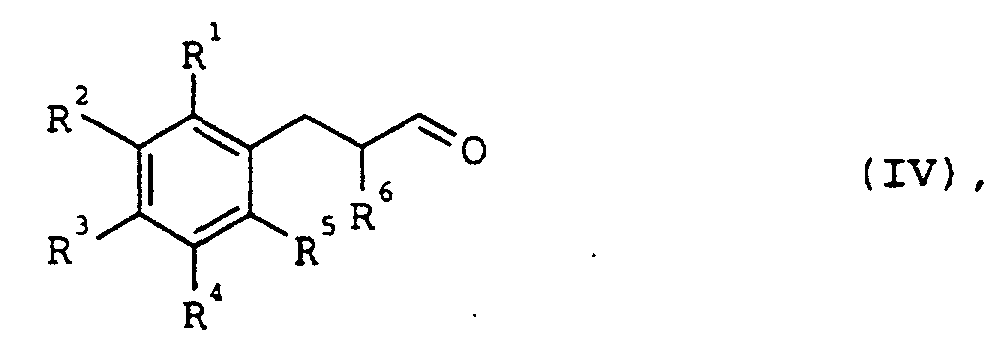
- the invention relates to both continuous production of the cinnamaldehyde derivative of the general formula I as also the preparation of the dihydrocinnamaldehyde derivative of the general Formula IV by combining process steps (a) and (b).
- stage (a) is followed by hydrogenation in accordance with (b)
- the method is distinguished from the prior art one through the continuous reaction management of both processes from and on the other hand that for the hydrogenation Purification or isolation of the educt, which is in the upstream Aldol condensation between the benzaldehyde derivative of the general formula II and the alkanal of the general Formula III is made is not required.
- the reaction discharge obtained under (a) is after adjustment a pH between 7 and 13, preferably between 8 and 9 fed without working up the hydrogenation.
- Brönstedt acids are suitable for adjusting the pH value, preferably organic acids such as formic acid, propionic acid, Citric acid, phthalic acid, particularly preferably acetic acid.
- benzaldehyde derivatives of the general formula II for example, benzaldehyde itself, m-isopropylbenzaldehyde, p-isopropyl-benzaldehyde, p-tert-butyl-benzaldehyde, m-tert-butyl-benzaldehyde, m-methyl-benzaldehyde, p-methyl-benzaldehyde, o-methyl-benzaldehyde, m-anisaldehyde or p-anisaldehyde, or mixtures of two or more of these benzaldehyde derivatives used.
- alkanals suitable for the implementation of the invention of the general formula IV are in particular acetaldehyde, Propanal, n- and iso-butanal, n- and iso-pentanal, n- and called iso-hexanal.
- Preferred dihydrocinnamaldehyde derivatives of the formula IV are Cyclamenaldeyd or Lysmeral. Is particularly preferred with the method according to the invention (stage (a) and stage (b)) Lysmeral made.
- stage (a) for the process according to the invention are basic compounds, such as the alkali hydroxides NaOH, KOH and LiOH, alkaline earth metal hydroxides and mixtures thereof or compounds of the alkali and alkaline earth metals, which are present in the presence of Water can release the corresponding hydroxides, as well Ammonia, amines or alcoholates such as sodium methylate or potassium tert-butoxide used.
- basic compounds such as the alkali hydroxides NaOH, KOH and LiOH, alkaline earth metal hydroxides and mixtures thereof or compounds of the alkali and alkaline earth metals, which are present in the presence of Water can release the corresponding hydroxides, as well Ammonia, amines or alcoholates such as sodium methylate or potassium tert-butoxide used.
- the concentration of the oxide or hydroxide between 0.5 and 50% by weight, preferably between 10 and Is 50% by weight.
- the base is generally completely in introduced the first reactor, but can also on all reactors be distributed.
- the amount of base needed is very small, which is a particular advantage of the method according to the invention represents. So should the concentration of the base in the reaction mixture only between 0.01% and 20% by weight, preferably be between 0.1% and 5% by weight.
- Step (a) of the process according to the invention is described in the Examples 1 to 4 using one of 3 reactors existing cascade clarified.
- the preferred system for continuous production The cinnamaldehyde derivatives of the formula I exist in principle from several cascaded reactors connected in series.
- the number of reactors used is generally between 2 and 20, preferably between 2 and 10 and especially between 2 and 5 reactors.
- the reactors are operated in cascade, which means that the course of the one reactor is passed into the next reactor. At the The reaction mixture formed then leaves the last reactor taken.
- the method can also product mixture from one or more of the rear reactors removed and into one or more of the front reactors to be led back.
- Reactors that are not backmixed are reactors, such as tubular reactors or built-in retention containers, but preferably back-mixed reactors, such as stirred tanks, Loop reactors, jet loop reactors or jet nozzle reactors suitable. Combinations of one another can also be used following backmixed reactors and not backmixed Reactors are used.
- reactors can be used in a multi-stage Equipment.
- Such reactors are, for example, loop reactors with built-in sieve plates, cascaded containers, tubular reactors with intermediate feed or Stirred columns.
- the individual reactors are recommended all or partially equipped with heat exchangers.
- Must in the reactors ensure good mixing of the reactants, which for example by stirring or pumping, optionally in Combination with treatment with static mixers or mixing nozzles can be done.
- the volume of the reactors should be such that the middle Residence time of the reaction mixture in the reactors between 5 minutes and 8 hours, especially between 10 minutes and Is 5 hours. It is particularly advantageous to work with reactors which have approximately the same volume, can in principle but also reactors with different volumes are used become.
- the temperature in the reactors is generally between 20 and 130 ° C, especially between 30 and 100 ° C.
- the pressure in the reactors is not critical, but it should be be high so that the contents of the reactors remain almost liquid. in the generally pressures from 1 bar to 40 bar are required, the pressure is advantageously between 1 and 6 bar.
- the benzaldehyde or the benzaldehyde derivative of the general Formula II is preferably used in the first reactor of the plant Cascade connection introduced. In some cases it can may also be required to aliquots of the benzaldehyde (derivatives) in add the other reactors to the plant with cascade connection.
- the method is the benzaldehyde or the benzaldehyde derivative before premixed with the part of the alkanal before being introduced into the reactors, which is added to the same reactor.
- the usual mixers such as static ones, can be premixed Mixers, stirred tanks, mixing nozzles or the like can be used.
- the premixing of the two reactants leads to an increase selectivity. This increase in selectivity is special Surprisingly, as stated in US Pat. No. 2,529,186 will that premixing of the reactants will reduce the Selectivity.
- the alkanal is said to be in more than one reactor of the reaction plant be added. It is particularly advantageous if in each Reactor of the plant in cascade part of the alkanal is added. Furthermore, it was also found that a Even distribution of the alkanal across all reactors is unfavorable for high selectivity. It has therefore proven to be beneficial proved that in the first reactor between about 20% and 70% of the total amount of alkanal to be added, in particular brings in between 40 and 60% of the alkanal and the rest Quantity, i.e. about 80 to 30% of alkanal in the one or more Reactors admits. Furthermore, it is particularly advantageous if to mix at least part of the alkanal with part or the Total amount of the benzaldehyde derivative premixed in the reactor brings.
- the alkanal is generally used in liquid form. In principle, however, gaseous addition is also possible.
- the amount of alkanal chosen so that the molar ratio from benzaldehyde (derivative) to alkanal in all reactors between 5 and 100 mol / mol, preferably between 10 and 60 mol / mol.
- This molar ratio can be determined by analyzing the reaction mixture using known analytical methods, for example can be easily determined by gas chromatography. In general a single analysis per day is sufficient, in special cases can but online analytics may also be required.
- the residence time and the The amount of base is the conversion of the benzaldehyde (derivatives) between 20% and 95%, preferably between 30% and 80%.
- the conversion of the alkanal is so high that usually does not recover the unreacted alkanal can be.
- the solvents are alcohols, such as methanol, ethanol, propanol, isopropanol, butanol or Ethylene glycols, or ethers such as diethyl ether or cyclic Ethers such as dioxane. Used with particular advantage one uses methanol as solvent.
- the solvent can be unmixed or with one or more of the reactants or the base mixed can be introduced into the individual reactors. However, the solvent is preferred completely in the first Reactor added.
- the discharge from the reaction system can easily be worked up by means of the usual separation operations, such as crystallization, phase separation or fractional distillation, and the cinnamaldehyde derivative can thus be isolated in a simple manner.
- step (a) cinnamaldehyde and generally cinnamaldehyde derivatives of formula I in high Purity, very good quality made in a simple way become.
- the method according to the invention are only few, simple, small and inexpensive devices required.
- the Cinnamaldehyde derivatives of the formula I in high selectivities, based on both the alkanal and the benzaldehyde derivative.
- the device with openings or channels for passage of the reaction medium can consist of a bed, a knitted fabric, an open-cell foam structure, preferably made of plastic (e.g. polyurethane or melamine resins) or ceramic, or a Packing element as it is basically, i.e. its geometric Shape, already from the distillation and extraction technology is known to exist.
- plastic e.g. polyurethane or melamine resins
- ceramic e.g. polyurethane or melamine resins
- Packing element as it is basically, i.e. its geometric Shape, already from the distillation and extraction technology is known to exist.
- Such packing elements which have the advantage of a low pressure drop offer are e.g. Wire mesh packing.
- the present invention basically has the packs one significantly smaller, regularly by a factor of 2 to 10 hydraulic diameter as comparable internals in the area the distillation and extraction technology.
- tissue packs packs made from other woven, withered or felted liquid-permeable materials be used.
- Other suitable packs are tin packs.
- Packings made of expanded metal are also advantageous, such as Montz BSH packs.
- the openings, e.g. Perforations must be kept accordingly small.
- Crucial for the suitability of a package in the context of the present Invention is not its geometry, but that of opening sizes or channel widths resulting from the current flow in the pack.
- catalyst particles can be used for the suspension with an average grain size of 0.0001 to 2 mm, preferably from 0.001 to 0.1 mm, particularly preferably from 0.005 to 0.05 mm can be used.
- the hydrogenation is carried out by the process according to the invention in a reactor with one of the internals described above in the presence of hydrogen at a pressure between 1 and 100 bar, preferably 1 and 30 bar, particularly preferably 1 and 15 bar.
- the reaction temperatures are between 10 and 160 ° C, preferably between 20 and 80 ° C, particularly preferably between 40 and 75 ° C.
- Tissue packs or sheet metal packs are used as internals in the hydrogenation reactor.
- the reaction mixture, catalyst and hydrogen are circulated through the reactor at high speed.
- the cross-sectional area load of the gas and liquid phases is more than 50 m 3 / m 2 h, preferably in the range from 50 to 300 m 3 / m 2 h, particularly preferably in the range from 100 to 250 m 3 / m 2 h.
- the gas phase is intimately mixed with the liquid phase by means of an injector nozzle.
- a commercially available suspension catalyst which preferably contains at least palladium as the active component.
- the catalyst can also contain other active components such as zinc, cadmium, platinum, silver or a rare earth metal.
- the catalyst can be used in metallic and / or oxidic form, inter alia on support materials. Suitable carrier materials are, for example, SiO 2 , TiO 2 , ZrO 2 , Al 2 O 3 or carbon such as graphite, carbon black or activated carbon, activated carbon being particularly preferred.
- the palladium content is between 0.1 and 10% by weight, preferably between 1 and 7% by weight.
- the hydrogenation according to the invention for the production of dihydrocinnamaldehyde derivatives is characterized in that the liquid with an empty tube speed of about 50 to 300 m 3 / m 2 h, preferably from 250 to 200 m 3 / m 2 h, through the device with openings and described above Channels is guided. If the gas phase is present at the same time, its empty tube speed is preferably 50 to 300 m 3 / m 2 h, particularly preferably 100 to 200 m 3 / m 2 h.
- the present hydrogenation can be carried out continuously in various ways operated reactor designs, such as jet nozzle reactors, bubble columns or tube bundle reactors.
- the above internals listed preferably fill but not necessarily the entire reactor.
- the invention Reactor is preferably a vertically arranged bubble column, which, in the presence of a gas phase, preferably in cocurrent from is flowed through upwards.
- Another preferred reactor is a heatable and coolable tube bundle reactor in which the Internals according to the invention housed in the individual tubes are. In the presence of a gas phase, the reactor is preferred flows in direct current from bottom to top. That suspended Catalyst material can be introduced using common techniques and separated again (sedimentation, centrifugation, Cake filtration, cross flow filtration).
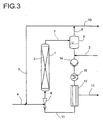
- a reactor for the hydrogenation of dehydrolysmeral is exemplified to Lysmeral with a suspension catalyst according to the present Invention of stage (b) with reference to Figure 3 in detail described.
- Figure 3 shows an example of the experimental setup of a continuously operated reactor (bubble column) 1 with packing 2, via the lines 3 with liquid and via the line 4 is fed with fresh gas.
- the cycle gas 5 is by means of Mixing nozzle 6 with fresh gas and by the pump 14 in a circle guided suspension 11 mixed.
- the reactor discharge is over the line 7 moved into the separation vessel 8, in which the gas phase is deposited and discharged via line 9.
- the amount of gas is used to limit the build-up of gaseous contaminants a partial stream is removed via line 10 and the remaining amount passed through line 5 into the reactor.
- the suspended catalyst remains in the reactor system by retained via a crossflow filter 12 and only catalyst-free Liquid phase exits and is removed via line 13 becomes. Via the heat exchanger 15, the temperature in the reactor system be set specifically.
- the apparatus (see FIG. 1) consisted of three in a row switched containers B1, B2 and B3 with a volume of each 275 ml, each with the help of a double jacket of a thermostat and heated via the heat exchangers W1, W2 and W3 were cooled and their contents with the pumps P1, P2 and P3 were circulated.
- the benzaldehyde derivative was mixed with the solvent and part of the base in the first container added (stream ⁇ 1>).
- the second part of the base was in the given the first container (current ⁇ 2>).
- the alkanal was by means of the mixing nozzles M1, M2 and M3 into the appropriate containers mixed in (currents ⁇ 21>, ⁇ 22>, ⁇ 23>).
- a stream of ⁇ 1> 217 ml / h Mixture consisting of 54 wt .-% methanol, 45.5 wt .-% p-tert-butyl-benzaldehyde and 0.5% of a 50% by weight aqueous sodium hydroxide solution, as stream ⁇ 21> 13.1 g / h propanal and as stream ⁇ 2> 6 g / h of sodium hydroxide solution (50% in water) are metered in.
- the second Containers were streamed into the ⁇ 22> 6.6 g / h propanal and third container as stream ⁇ 23> 3.3 g / h propanal metered.
- the Temperatures of the separately heated containers were between 47 ° C and 48 ° C.
- the amount of liquid pumped was measured in each container set at 600 ml / min.
- the cascade of 8 h had the discharge of the third container following composition: ⁇ 0.1 wt .-% propanal; 21% by weight p-tert-butylbenzaldehyde 20.5% by weight.
- Example 1 The apparatus described in Example 1 was used.
- a mixture of 217 ml / h consisting of 54 wt .-% methanol, 45.5 wt .-% p-tert-butylbenzaldehyde and 0.5% by weight of a 50% by weight aqueous sodium hydroxide solution, as stream ⁇ 21> 13.1 g / h propanal and as stream ⁇ 2> 6 g / h of sodium hydroxide solution (50% in water) are metered in.
- the second Containers were streamed as ⁇ 22> 6.6 g / h propanal and into the third container as stream ⁇ 23> 3.3 g / h propanal metered.
- the Temperatures of the separately heated containers were between 47 ° C and 48 ° C.
- the amount of liquid pumped was measured in each container set to 1200 ml / min.
- the cascade of 8 h had the discharge of the third container following composition: ⁇ 0.1 wt .-% propanal; 19% by weight p-tert-butylbenzaldehyde and 23.5% by weight.
- 3- (p-tert-butylphenyl) -2-methyl-2-propenal This corresponds to sales of p-tert-butyl-benzaldehyde of 52%.
- the selectivity 3- (p-tert-butylphenyl) -2-methyl-2-propenal was thus 87% the theory, based on the benzaldehyde derivative, and 70% by weight, based on the propanal.
- the apparatus (see FIG. 2) consisted of three series Containers B1, B2 and B3 with a volume of 275 ml each, each over a double jacket with the help of a thermostat were heated and cooled via the heat exchangers W1, W2 and W3. The contents of these containers were with the pumps P1, P2 and P3 circulated.
- the benzaldehyde derivative and that for the first container Certain aliquots of the alkane were in the mixing container M1 premixed and then metered into the first container B1 (current ⁇ 1>).
- the quantity intended for the second and third containers Alkanal Alkanal was mixed into the corresponding ones using the mixing nozzles M2 and M3 Container mixed in (streams ⁇ 22> and ⁇ 23>).
- the Solvent was mixed with the base and the obtained one Mixture introduced into the first container (stream ⁇ 2>).
- a flow of ⁇ 1> 114 g / h was one Mixture consisting of 87.7% by weight of p-tert-butyl-benzaldehyde and 12.3% by weight propanal and as a stream ⁇ 2> 129.7 g / h a mixture consisting of 4% by weight aqueous sodium hydroxide solution (50 wt .-%) and 96 wt .-% methanol metered.
- the second Containers were streamed at ⁇ 22> 6.6 g / h of propanal and into the third container was stream ⁇ 23> 4.2 g / h of propanal added.
- the temperatures of the separately heated containers were between 43 ° C and 51 ° C.
- the amount of pumped Liquid was adjusted to 1200 ml / min in each container. After a cascade operating time of 8 hours, the discharge had of the third container has the following composition: ⁇ 0.1% by weight Propanal, 16.2% by weight of p-tert-butylbenzaldehyde and 28.3% by weight 3- (p-tert-butyl-phenyl) -2-methyl-2-propenal. This matches with a conversion of p-tert-butyl-benzaldehyde of 60% of theory. The selectivity based on the benzaldehyde derivative was thus 94% of theory and 83% of theory, based on the propanal.
- a flow of ⁇ 1> 114 g / h was one Mixture consisting of 87.7% by weight of p-tert-butyl-benzaldehyde and 12.3% by weight propanal and as stream ⁇ 2> 123 g / h one Mixture containing 1 mole of sodium methoxide per mole of methanol added.
- the flow was ⁇ 22> 6.6 g / h Propanal and in the third container as stream 203 4.2 g / h Propanal added.
- the temperatures of the separately heated Containers were between 43 and 50 ° C.
- the amount of pumped Liquid was adjusted to 1200 ml / min in each container.
- the discharge had of the third container has the following composition: ⁇ 0.1% by weight Propanal, 20.4% by weight of p-tert-butylbenzaldehyde and 20.3% by weight 3- (p-tert-butyl-phenyl) -2-methyl-2-propenal.
- the selectivity an 3- (p-tert-butylphenyl) -2-methyl-2-propenal thus 83% of theory, based on the benzaldehyde derivative and 59% of theory, based on the propanal.
- a flow of ⁇ 1> 114 g / h was one Mixture consisting of 87.7% by weight of p-tert-butyl-benzaldehyde and 12.3% by weight propanal and as a stream ⁇ 2> 123 g / h a mixture consisting of 5% by weight aqueous potassium hydroxide solution (25 wt .-%) and 95 wt .-% Methancl metered.
- the second Containers were streamed into the ⁇ 22> 6.6 g / h propanal and third container as stream ⁇ 23> 4.2 g / h propanal metered.
- the Temperatures of the separately heated containers were between 48 and 51 ° C.
- the amount of fluid pumped was in each Container set to 1200 ml / min. After an operating time of The cascade of 24 hours was followed by the discharge of the third container Composition: ⁇ 0.1% by weight propanal, 16.4% by weight p-tert-butyl-benzaldehyde and 30.8% by weight of 3- (p-tert-butylphenyl) -2-methyl-2-propenal. This corresponds to a conversion of p-tert-butylbenzaldehyde of 58%.
- the selectivity of 3- (p-tert-butylphenyl) -2-methyl-2-propenal was 99% of theory based on the benzaldehyde derivative and 91% of theory to the propanal.
- the reaction was used in a tissue packed bubble column (1000mm, 27.3mm diameter) according to the present invention for hydrogenation.
- the experimental setup corresponded to FIG. 3.
- the geometry of the pack corresponded to a commercially available tissue pack of the Montz A1 1200 type.
- the volume-related surface area of the pack is 1200 m 2 / m 3 , this information relating only to the surface of the tissue.
- the liquid with the suspended catalyst and the gas were introduced into the packed reactor from below at an empty tube speed of 200 m 3 / m 2 h.
- the reaction was carried out continuously under a hydrogen pressure of 10 bar.
- a conventional suspension catalyst was used Containing 5% palladium on activated carbon used, which had an average grain size around 30 microns.
- the feed from the continuously conducted aldol condensation of p-tert-butylbenzaldehyde (TBA) with propanal was used as feed for the packed bubble column after setting a pH of 8.6 without purification by distillation.
- Such an admixture usually has the composition 50% by weight of methanol, 29% by weight of dehydrolysmeral (DHL), 13% by weight of TBA, 5% by weight of water, 1% by weight of high boiler, etc. Thermostats set to 60 ° C. The conversion was> 96% with a selectivity of> 93%.
- the catalyst load is 5.8 kg DHL / (kg Kat * h), the space-time yield 118 kg DHL / (m 3 h).
- Example 6 An inlet as described above (Example 6) was used as the inlet for the packed bubble column, which was additionally diluted in a ratio of 1: 2 with discharge from the hydrogenation.
- a dissolution usually has the composition 50% by weight of methanol, 20% by weight of Lysmeral, 10% by weight of dehydrolysmeral, 13% by weight of TBA, 5% by weight of water, 1% by weight of high boiler, etc.
- the temperature was set to 60 ° C using thermostats.
- the feed rate was 600 g / h. Under these conditions, a conversion of 98.2% and a selectivity of 88.4% could be achieved.
- the space-time yield was 103 kg DHL / m 3 * h, the catalyst load 3.7 kg DHL / (kg Kat * h).
- Example 6 An inlet as described above (Example 6) was used as the inlet for the packed bubble column, which was additionally diluted in a ratio of 1: 2 with discharge from the hydrogenation.
- a dissolution usually has the composition 50% by weight of methanol, 20% by weight of Lysmeral, 10% by weight of dehydrolysmeral, 13% by weight of TBA, 5% by weight of water, 1% by weight of high boiler, etc.
- the temperature was set to 60 ° C using thermostats.
- the feed rate was 900 g / h. Under these conditions, a conversion of 94.5% and at the same time a selectivity of 90% could be achieved.
- the space-time yield was 253 kg DHL / m 3 * h, the catalyst load 8.5 kg DHL / (kg Kat * h).
Landscapes
- Chemical & Material Sciences (AREA)
- Organic Chemistry (AREA)
- Chemical Kinetics & Catalysis (AREA)
- Organic Low-Molecular-Weight Compounds And Preparation Thereof (AREA)
- Low-Molecular Organic Synthesis Reactions Using Catalysts (AREA)
Description

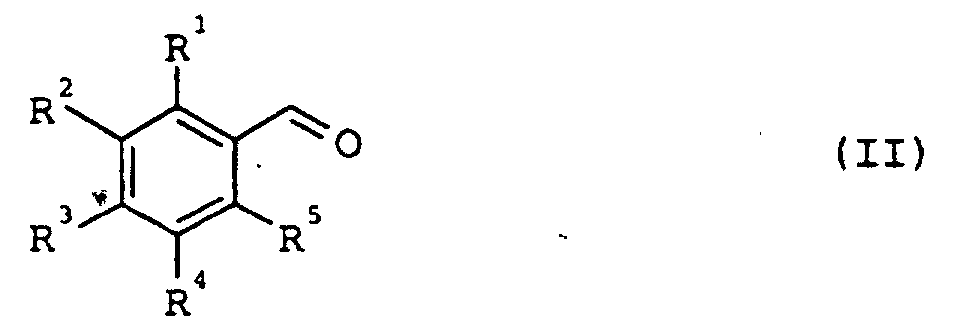
durch Umsetzung von Benzaldehydderivaten der allgemeinen Formel II

Im allgemeinen ist es von Vorteil, vor der Aufarbeitung des Reaktionsgemisches den basischen Katalysator durch Zugabe von anorganischen oder organischen Säuren, zumindest teilweise zu neutralisieren.
Die Reaktionstemperaturen liegen zwischen 10 und 160°C, bevorzugt zwischen 20 und 80°C, besonders bevorzugt zwischen 40 und 75°C.
Der Katalysator kann in metallischer und/oder oxidischer Form unter anderem auf Trägermaterialien eingesetzt werden. Als Trägermaterialien eignen sich beispielsweise SiO2, TiO2, ZrO2, Al2O3 oder Kohlenstoff wie Graphite, Ruße oder Aktivkohle, insbesondere bevorzugt wird Aktivkohle. Der Gehalt an Palladium liegt zwischen 0,1 und 10 Gew.-%, bevorzugt zwischen 1 und 7 Gew.-%.
Claims (21)
- Verfahren zurwobei R1 bis R6 die oben angegebene Bedeutung haben.(a) kontinuierlichen Herstellung von Zimtaldehydderivaten der allgemeinen Formelin der R1, R2, R3, R4, R5 und R6 unabhängig voneinander Wasserstoff, C1- bis C9-Alkylgruppen oder C1- C9-Alkoxygruppen bedeuten können, vorzugsweise von Zimtaldehydderivaten der allgemeinen Formel I, in der R1, R2, R3 und R6 unabhängig voneinander Wasserstoff oder C1-C9-Alkylgruppen und R4 und R5 Wasserstoff bedeuten,

durch Umsetzung von Benzaldehydderivaten der allgemeinen Formel IImit Alkanalen der allgemeinen Formel III in Gegenwart von Basen, das dadurch gekennzeichnet ist, daß die Reaktanten kontinuierlich in einer Anlage bestehend aus mehreren Reaktoren in Kaskadenschaltung zur Reaktion gebracht werden und daß das Alkanal dabei in mehr als einen der Reaktoren der Anlage eingebracht wird und
 (b) gegebenenfalls anschließender kontinuierlicher Hydrierung in einem Umlaufreaktor in Gegenwart eines Suspensionskatalysators und Wasserstoff zu Dihydrozimtaldehydderivaten der allgemeinen Formel IV,
- Verfahren gemäß Anspruch 1, dadurch gekennzeichnet, daß im Anschluß an Stufe (a) eine Hydrierung gemäß Stufe (b) stattfindet.
- Verfahren gemäß Anspruch 1 oder 2, dadurch gekennzeichnet, daß man als Benzaldehydderivat der Formel II, Benzaldehyd selbst, m-Isopropyl-benzaldehyd, p-Isopropyl-benzaldehyd, p-tert.-Butyl-benzaldehyd, m-tert.-Butyl-benzaldehyd, m-Methyl-benzaldehyd, p-Methyl-benzaldehyd, o-Methyl-benzaldehyd, m-Anisaldehyd oder p-Anisaldehyd, oder aber Gemische von 2 oder mehreren dieser Benzaldehydderivate verwendet.
- Verfahren gemäß einem der Ansprüche 1 bis 3, dadurch gekennzeichnet, daß die Zahl der unter (a) verwendeten Reaktoren in der Anlage zwischen 2 und 20 liegt.
- Verfahren gemäß einem der Anspürche 1 bis 4, dadurch gekennzeichnet, daß die Zahl der unter (a) verwendeten Reaktoren in der Anlage zwischen 2 und 5 liegt.
- Verfahren gemäß einem der Ansprüche 1 bis 5, dadurch gekennzeichnet, daß als Reaktoren unter (a) Rührkessel, Schlaufenreaktoren, Strahlschlaufenreaktoren, Strahldüsenreaktoren oder Rohrreaktoren gegebenenfalls mit Umpumpkreislauf verwendet werden.
- Verfahren gemäß einem der Ansprüche 1 bis 6, dadurch gekennzeichnet, daß Anteile des Alkanals in jeden der verwendeten Reaktoren eingebracht werden.
- Verfahren gemäß einem der Ansprüche 1 bis 7, dadurch gekennzeichnet, daß zwischen 20 % und 70 % der insgesamt zugegebenen Menge an Alkanal in den ersten Reaktor eingebracht werden.
- Verfahren gemäß einem der Ansprüche 1 bis 8, dadurch gekennzeichnet, daß das Verfahren so durchgeführt wird, daß der Umsatz des Benzaldehydderivates zwischen 20 % und 95 % beträgt.
- Verfahren gemäß einem der Ansprüche 1 bis 9, dadurch gekennzeichnet, daß wenigstens ein Teil des Alkanals in Mischung mit einem Teil oder der Gesamtmenge des Benzaldehydderivates vorgemischt eingesetzt wird.
- Verfahren gemäß einem der Ansprüche 1 bis 10, dadurch gekennzeichnet, daß das molare Verhältnis aus dem Benzaldehydderivat der Formel II und dem Alkanal der Formel III in der Reaktionsmischung zwischen 5 mol/mol und 100 mol/mol liegt.
- Verfahren gemäß einem der Ansprüche 1 bis 11, dadurch gekennzeichnet, daß der Dihydrozimtaldehyd ausgewählt ist aus der Gruppe Cyclamenaldehyd oder Lysmeral.
- Verfahren gemäß einem der Ansprüche 1 bis 12, dadurch gekennzeichnet, daß die Hydrierung des Zimtaldehydderivats ohne vorherige Reinigung in einem Suspensionsreaktor mit Einbauten durchgeführt wird.
- Verfahren gemäß einem der Ansprüche 1 bis 13, dadurch gekennzeichnet, daß die Katalysatorteilchen der Hydrierung (b) eine mittlere Korngröße von 0,0001 bis 2 mm besitzen.
- Verfahren gemäß einem der Ansprüche 1 bis 14, dadurch gekennzeichnet, daß als Einbauten im Hydrierreaktor unter (b) Gewebe- oder Blechpackungen verwendet werden.
- Verfahren gemäß einem der Ansprüche 1 bis 15, dadurch gekennzeichnet, daß die Querschnittsflächenbelastung von Gas- und Flüssigphase über 50 m3/m2h liegt.
- Verfahren gemäß einem der Ansprüche 1 bis 16, dadurch gekennzeichnet, daß als Reaktor unter (b) ein Strahldüsenreaktor, ein Blasensäulen- oder ein Rohrbündelreaktor verwendet wird.
- Verfahren gemäß einem der Ansprüche 1 bis 17, dadurch gekennzeichnet, daß der Suspensionskatalysator unter (b) als Aktivkomponente mindestens Palladium enthält.
- Verfahren gemäß Anspruch 18, dadurch gekennzeichnet, daß der Anteil an Palladium 0,1 bis 10 Gew.-% beträgt.
- Verfahren gemäß einem der Ansprüche 18 oder 19, dadurch gekennzeichnet, daß der Katalysator auf einem SiO2, TiO2, ZrO2, Al2O3 oder Kohlenstoff enthaltenden Träger verwendet wird.
- Verfahren gemäß einem der Ansprüche 18 bis 20, dadurch gekennzeichnet, daß der Katalysator auf einem Aktivkohle enthaltenden Träger verwendet wird.
Applications Claiming Priority (3)
| Application Number | Priority Date | Filing Date | Title |
|---|---|---|---|
| DE19949672A DE19949672A1 (de) | 1999-10-14 | 1999-10-14 | Kontinuierliches Verfahren zur Herstellung von Zimtaldehydderivaten |
| DE19949672 | 1999-10-14 | ||
| PCT/EP2000/009918 WO2001027061A1 (de) | 1999-10-14 | 2000-10-10 | Kontinuierliches verfahren zur herstellung von zimtaldehyd- und dihydrozimtaldehydderivaten |
Publications (2)
| Publication Number | Publication Date |
|---|---|
| EP1220824A1 EP1220824A1 (de) | 2002-07-10 |
| EP1220824B1 true EP1220824B1 (de) | 2004-02-11 |
Family
ID=7925714
Family Applications (1)
| Application Number | Title | Priority Date | Filing Date |
|---|---|---|---|
| EP00966145A Expired - Lifetime EP1220824B1 (de) | 1999-10-14 | 2000-10-10 | Kontinuierliches verfahren zur herstellung von zimtaldehyd- und dihydrozimtaldehydderivaten |
Country Status (8)
| Country | Link |
|---|---|
| US (1) | US6723883B1 (de) |
| EP (1) | EP1220824B1 (de) |
| JP (1) | JP4754142B2 (de) |
| CN (1) | CN1193972C (de) |
| AT (1) | ATE259342T1 (de) |
| DE (2) | DE19949672A1 (de) |
| ES (1) | ES2215730T3 (de) |
| WO (1) | WO2001027061A1 (de) |
Families Citing this family (18)
| Publication number | Priority date | Publication date | Assignee | Title |
|---|---|---|---|---|
| US7276632B2 (en) * | 2003-12-15 | 2007-10-02 | Basf Aktiengesellschaft | Method for the production of 2,3-cis-substituted 2-aryl propenals |
| DE102005032541A1 (de) * | 2005-07-12 | 2007-01-18 | Basf Ag | Verfahren zur Hydrierung von aldehydhaltigen Stoffströmen |
| DE102005049568A1 (de) | 2005-10-17 | 2007-04-19 | Basf Ag | Verfahren zur kontinuierlichen Hydrierung oder hydrierenden Aminierung |
| US8367875B2 (en) | 2010-02-11 | 2013-02-05 | Basf Se | Process for the preparation of m-substituted alkyltoluenes by isomerization with ionic liquids as catalysts |
| ES2522545T3 (es) | 2010-02-11 | 2014-11-17 | Basf Se | Procedimiento para la obtención de alquiltoluenos m-substituidos mediante isomerización con líquidos iónicos como catalizadores |
| CN103119014B (zh) | 2010-09-16 | 2016-01-20 | 巴斯夫欧洲公司 | 生产具有高对位异构纯度的2-甲基-3-(4-叔丁基苯基)丙醛的方法 |
| TWI408122B (zh) * | 2011-03-22 | 2013-09-11 | Ufc Corp | A method for the production of aromatic aldehydes |
| GB201308236D0 (en) | 2013-05-08 | 2013-06-12 | Givaudan Sa | Improvements in or relating to organic compounds |
| JP6491748B2 (ja) | 2014-11-10 | 2019-03-27 | ジボダン エス エー | 有機化合物におけるまたは関連する改善 |
| CN105152891B (zh) * | 2015-10-22 | 2018-03-16 | 山东国邦药业股份有限公司 | 一种肉桂醛的合成方法 |
| CN105541584A (zh) * | 2016-01-24 | 2016-05-04 | 唐山学院 | 无水体系合成肉桂醛的方法 |
| JP6449507B1 (ja) | 2017-12-12 | 2019-01-09 | 花王株式会社 | α、β−不飽和アルデヒドの製造方法 |
| CN108636455B (zh) * | 2018-04-20 | 2021-04-30 | 北京工业大学 | 一种以核壳结构mof为反应容器的负载型贵金属基催化剂的制备及应用 |
| CN108658742B (zh) * | 2018-04-27 | 2021-08-17 | 宿迁科思化学有限公司 | 一种铃兰醛关键中间体对叔丁基-α-甲基苯丙烯醛的制备方法 |
| CN110343035B (zh) * | 2019-06-18 | 2022-09-30 | 福建森美达生物科技有限公司 | 一种喷射连续水解制备天然苯甲醛的方法 |
| CN110449103B (zh) * | 2019-07-29 | 2021-06-01 | 浙江迪邦化工有限公司 | 一种带预混的一体化制备重氮盐的方法和装置 |
| LU103393B1 (de) * | 2024-10-01 | 2026-04-01 | Thyssenkrupp Ag | Herstellung chemischer Erzeugnisse durch heterogene enzymatische Katalyse |
| WO2026073808A1 (de) * | 2024-10-01 | 2026-04-09 | Thyssenkrupp Uhde Gmbh | Herstellung chemischer erzeugnisse durch heterogene enzymatische katalyse |
Family Cites Families (13)
| Publication number | Priority date | Publication date | Assignee | Title |
|---|---|---|---|---|
| US1844013A (en) * | 1929-10-18 | 1932-02-09 | Winthrop Chem Co Inc | Manufacture of para-isopropyl-alpha-methyl hydrocinnamic aldehyde |
| US2529186A (en) * | 1947-04-05 | 1950-11-07 | Us Rubber Co | Preparation of cinnamaldehyde |
| NL99111C (de) * | 1956-06-11 | |||
| US3280192A (en) * | 1965-05-04 | 1966-10-18 | Universal Oil Prod Co | Hydrogenation of cinnamic aldehydes and derivatives thereof |
| RO55309A (de) * | 1968-04-24 | 1973-07-20 | ||
| FR2153673A5 (en) * | 1971-09-20 | 1973-05-04 | Inst Neftechimichesk | Higher branched carboxylic acids prodn - by aldol condensation of beta-methyl branched aldehydes and oxidn |
| GB8908104D0 (en) * | 1989-04-11 | 1989-05-24 | Unilever Plc | Improvements in and relating to aldol condensation |
| NL9401708A (nl) * | 1994-10-17 | 1996-06-03 | Dsm Nv | Werkwijze voor de bereiding van 3-fenylpropanal. |
| BE1009764A3 (nl) * | 1995-11-06 | 1997-08-05 | Dsm Nv | Werkwijze voor de bereiding van een alpha-alkylkaneelaldehyde. |
| DE19611976A1 (de) * | 1996-03-26 | 1997-10-02 | Basf Ag | Verfahren und Reaktor zur Durchführung von Stoffumwandlungen mit in Flüssigkeiten suspendierten Katalysatoren |
| BE1011698A6 (fr) * | 1998-01-08 | 1999-12-07 | Pantochim Sa | Procede de production de tetrahydrofuranne, de gamma-butyrolactone et de butanediol. |
| JPH11228458A (ja) * | 1998-02-17 | 1999-08-24 | Mitsubishi Chemical Corp | シクロオレフィンの製造法 |
| JPH11246458A (ja) * | 1998-02-26 | 1999-09-14 | Mitsubishi Chemical Corp | ビスフェノールの製造方法 |
-
1999
- 1999-10-14 DE DE19949672A patent/DE19949672A1/de not_active Withdrawn
-
2000
- 2000-10-10 CN CNB008142750A patent/CN1193972C/zh not_active Expired - Lifetime
- 2000-10-10 JP JP2001530083A patent/JP4754142B2/ja not_active Expired - Lifetime
- 2000-10-10 AT AT00966145T patent/ATE259342T1/de not_active IP Right Cessation
- 2000-10-10 WO PCT/EP2000/009918 patent/WO2001027061A1/de not_active Ceased
- 2000-10-10 DE DE50005271T patent/DE50005271D1/de not_active Expired - Lifetime
- 2000-10-10 EP EP00966145A patent/EP1220824B1/de not_active Expired - Lifetime
- 2000-10-10 US US10/110,532 patent/US6723883B1/en not_active Expired - Lifetime
- 2000-10-10 ES ES00966145T patent/ES2215730T3/es not_active Expired - Lifetime
Also Published As
| Publication number | Publication date |
|---|---|
| US6723883B1 (en) | 2004-04-20 |
| JP2003511431A (ja) | 2003-03-25 |
| ATE259342T1 (de) | 2004-02-15 |
| DE19949672A1 (de) | 2001-04-19 |
| ES2215730T3 (es) | 2004-10-16 |
| CN1193972C (zh) | 2005-03-23 |
| WO2001027061A1 (de) | 2001-04-19 |
| DE50005271D1 (de) | 2004-03-18 |
| JP4754142B2 (ja) | 2011-08-24 |
| EP1220824A1 (de) | 2002-07-10 |
| CN1379750A (zh) | 2002-11-13 |
Similar Documents
| Publication | Publication Date | Title |
|---|---|---|
| EP1220824A1 (de) | Kontinuierliches verfahren zur herstellung von zimtaldehyd- und dihydrozimtaldehydderivaten | |
| DE19807018B4 (de) | Verfahren zur Herstellung von Phthalsäureanhydrid | |
| EP0070397B1 (de) | Verfahren und Katalysator zur Herstellung von cyclischen Iminen | |
| EP1103538B1 (de) | Verfahren zur Durchführung von Aldolkondensationen | |
| EP3429982B1 (de) | Verfahren zur herstellung von prenol und prenal aus isoprenol | |
| EP1256560A2 (de) | Verfahren zur Herstellung von höheren, alpha,beta-ungesättigten Alkoholen | |
| DE1923048B2 (de) | Verfahren zur Herstellung von Dicarbonylverbindungen durch Dampfphasenoxydation eines aliphatischen Diols bzw. von Cyclohexan-l,2-diol | |
| EP1456158B1 (de) | Verfahren zur isomerisierung von allylalkoholen | |
| EP1694621A1 (de) | Verfahren zur herstellung von tricyclodecandialdehyd | |
| DE3728222A1 (de) | Verfahren zur herstellung von ethercarbonsaeuren | |
| EP2883857A1 (de) | Verfahren zur Herstellung von Adipinsäure oder wenigstens einem Folgeprodukt davon | |
| EP0009590B1 (de) | Verfahren zur Herstellung von Aminen | |
| DE2905507A1 (de) | Substituierte aminoaromatische acetylene und verfahren zu ihrer herstellung | |
| EP3328820B1 (de) | Verfahren zur herstellung von monoethylenglykol | |
| DE10359026A1 (de) | Verfahren zur Herstellung von Tetrahydrogeranylaceton | |
| EP0476400B1 (de) | Verfahren zur Abtrennung von Cyclohexen aus Gemischen mit Benzol und Cyclohexan | |
| EP3672932B1 (de) | Verfahren zur herstellung von terpenaldehyden und -ketonen | |
| EP0008013B1 (de) | Verfahren zur Herstellung von Carbonylverbindungen | |
| EP3301084B1 (de) | Kontinuierliches herstellungsverfahren für 2-methylenalkanale | |
| DE19936208A1 (de) | Kontinuierliches Verfahren zur Herstellung von 2-Phenylethanol aus Styroloxid | |
| EP2822921A1 (de) | VERAHREN ZUR WÄRMEINTEGRATION BEI DER HYDRIERUNG UND DESTILLATION VON C³-C²º ALDEHYDEN | |
| DE10121058A1 (de) | Neues Verfahren zur Herstellung von ungesättigten Ketonen | |
| WO2004022515A1 (de) | Kontinuierliches verfahren zur herstellung von carbonylverbindungen | |
| DE68915694T2 (de) | Verfahren zur Herstellung von verzweigten 1,3-Glykolen und ihren Monoestern. | |
| EP0235532A1 (de) | Verfahren zur Herstellung von 4-Monoacetalen des 2-Methyl-2-buten-1,4-dials |
Legal Events
| Date | Code | Title | Description |
|---|---|---|---|
| PUAI | Public reference made under article 153(3) epc to a published international application that has entered the european phase |
Free format text: ORIGINAL CODE: 0009012 |
|
| 17P | Request for examination filed |
Effective date: 20020305 |
|
| AK | Designated contracting states |
Kind code of ref document: A1 Designated state(s): AT BE CH CY DE DK ES FI FR GB GR IE IT LI LU MC NL PT SE |
|
| AX | Request for extension of the european patent |
Free format text: AL;LT;LV;MK;RO PAYMENT 20020305;SI PAYMENT 20020305 |
|
| GRAH | Despatch of communication of intention to grant a patent |
Free format text: ORIGINAL CODE: EPIDOS IGRA |
|
| GRAS | Grant fee paid |
Free format text: ORIGINAL CODE: EPIDOSNIGR3 |
|
| GRAA | (expected) grant |
Free format text: ORIGINAL CODE: 0009210 |
|
| AK | Designated contracting states |
Kind code of ref document: B1 Designated state(s): AT BE CH CY DE DK ES FI FR GB GR IE IT LI LU MC NL PT SE |
|
| AX | Request for extension of the european patent |
Extension state: RO SI |
|
| PG25 | Lapsed in a contracting state [announced via postgrant information from national office to epo] |
Ref country code: CY Free format text: LAPSE BECAUSE OF FAILURE TO SUBMIT A TRANSLATION OF THE DESCRIPTION OR TO PAY THE FEE WITHIN THE PRESCRIBED TIME-LIMIT Effective date: 20040211 Ref country code: FI Free format text: LAPSE BECAUSE OF FAILURE TO SUBMIT A TRANSLATION OF THE DESCRIPTION OR TO PAY THE FEE WITHIN THE PRESCRIBED TIME-LIMIT Effective date: 20040211 Ref country code: IE Free format text: LAPSE BECAUSE OF FAILURE TO SUBMIT A TRANSLATION OF THE DESCRIPTION OR TO PAY THE FEE WITHIN THE PRESCRIBED TIME-LIMIT Effective date: 20040211 Ref country code: IT Free format text: LAPSE BECAUSE OF FAILURE TO SUBMIT A TRANSLATION OF THE DESCRIPTION OR TO PAY THE FEE WITHIN THE PRESCRIBED TIME-LIMIT;WARNING: LAPSES OF ITALIAN PATENTS WITH EFFECTIVE DATE BEFORE 2007 MAY HAVE OCCURRED AT ANY TIME BEFORE 2007. THE CORRECT EFFECTIVE DATE MAY BE DIFFERENT FROM THE ONE RECORDED. Effective date: 20040211 |
|
| REG | Reference to a national code |
Ref country code: GB Ref legal event code: FG4D Free format text: NOT ENGLISH |
|
| REG | Reference to a national code |
Ref country code: CH Ref legal event code: EP |
|
| REG | Reference to a national code |
Ref country code: IE Ref legal event code: FG4D Free format text: GERMAN |
|
| REF | Corresponds to: |
Ref document number: 50005271 Country of ref document: DE Date of ref document: 20040318 Kind code of ref document: P |
|
| GBT | Gb: translation of ep patent filed (gb section 77(6)(a)/1977) |
Effective date: 20040401 |
|
| PG25 | Lapsed in a contracting state [announced via postgrant information from national office to epo] |
Ref country code: DK Free format text: LAPSE BECAUSE OF FAILURE TO SUBMIT A TRANSLATION OF THE DESCRIPTION OR TO PAY THE FEE WITHIN THE PRESCRIBED TIME-LIMIT Effective date: 20040511 Ref country code: SE Free format text: LAPSE BECAUSE OF FAILURE TO SUBMIT A TRANSLATION OF THE DESCRIPTION OR TO PAY THE FEE WITHIN THE PRESCRIBED TIME-LIMIT Effective date: 20040511 Ref country code: GR Free format text: LAPSE BECAUSE OF FAILURE TO SUBMIT A TRANSLATION OF THE DESCRIPTION OR TO PAY THE FEE WITHIN THE PRESCRIBED TIME-LIMIT Effective date: 20040511 |
|
| LTIE | Lt: invalidation of european patent or patent extension |
Effective date: 20040211 |
|
| REG | Reference to a national code |
Ref country code: IE Ref legal event code: FD4D |
|
| PG25 | Lapsed in a contracting state [announced via postgrant information from national office to epo] |
Ref country code: LU Free format text: LAPSE BECAUSE OF NON-PAYMENT OF DUE FEES Effective date: 20041010 Ref country code: AT Free format text: LAPSE BECAUSE OF NON-PAYMENT OF DUE FEES Effective date: 20041010 |
|
| REG | Reference to a national code |
Ref country code: ES Ref legal event code: FG2A Ref document number: 2215730 Country of ref document: ES Kind code of ref document: T3 |
|
| PG25 | Lapsed in a contracting state [announced via postgrant information from national office to epo] |
Ref country code: MC Free format text: LAPSE BECAUSE OF NON-PAYMENT OF DUE FEES Effective date: 20041031 Ref country code: BE Free format text: LAPSE BECAUSE OF NON-PAYMENT OF DUE FEES Effective date: 20041031 |
|
| ET | Fr: translation filed | ||
| PLBE | No opposition filed within time limit |
Free format text: ORIGINAL CODE: 0009261 |
|
| STAA | Information on the status of an ep patent application or granted ep patent |
Free format text: STATUS: NO OPPOSITION FILED WITHIN TIME LIMIT |
|
| 26N | No opposition filed |
Effective date: 20041112 |
|
| BERE | Be: lapsed |
Owner name: *BASF A.G. Effective date: 20041031 |
|
| BERE | Be: lapsed |
Owner name: *BASF A.G. Effective date: 20041031 |
|
| PG25 | Lapsed in a contracting state [announced via postgrant information from national office to epo] |
Ref country code: PT Free format text: LAPSE BECAUSE OF NON-PAYMENT OF DUE FEES Effective date: 20040711 |
|
| REG | Reference to a national code |
Ref country code: FR Ref legal event code: PLFP Year of fee payment: 16 |
|
| REG | Reference to a national code |
Ref country code: FR Ref legal event code: PLFP Year of fee payment: 17 |
|
| REG | Reference to a national code |
Ref country code: FR Ref legal event code: PLFP Year of fee payment: 18 |
|
| REG | Reference to a national code |
Ref country code: FR Ref legal event code: PLFP Year of fee payment: 19 |
|
| PGFP | Annual fee paid to national office [announced via postgrant information from national office to epo] |
Ref country code: NL Payment date: 20191025 Year of fee payment: 20 |
|
| PGFP | Annual fee paid to national office [announced via postgrant information from national office to epo] |
Ref country code: FR Payment date: 20191025 Year of fee payment: 20 Ref country code: ES Payment date: 20191125 Year of fee payment: 20 |
|
| PGFP | Annual fee paid to national office [announced via postgrant information from national office to epo] |
Ref country code: CH Payment date: 20191025 Year of fee payment: 20 |
|
| PGFP | Annual fee paid to national office [announced via postgrant information from national office to epo] |
Ref country code: GB Payment date: 20191029 Year of fee payment: 20 Ref country code: DE Payment date: 20191227 Year of fee payment: 20 |
|
| REG | Reference to a national code |
Ref country code: DE Ref legal event code: R071 Ref document number: 50005271 Country of ref document: DE |
|
| REG | Reference to a national code |
Ref country code: NL Ref legal event code: MK Effective date: 20201009 |
|
| REG | Reference to a national code |
Ref country code: CH Ref legal event code: PL |
|
| REG | Reference to a national code |
Ref country code: GB Ref legal event code: PE20 Expiry date: 20201009 |
|
| REG | Reference to a national code |
Ref country code: ES Ref legal event code: FD2A Effective date: 20210126 |
|
| PG25 | Lapsed in a contracting state [announced via postgrant information from national office to epo] |
Ref country code: GB Free format text: LAPSE BECAUSE OF EXPIRATION OF PROTECTION Effective date: 20201009 |
|
| PG25 | Lapsed in a contracting state [announced via postgrant information from national office to epo] |
Ref country code: ES Free format text: LAPSE BECAUSE OF EXPIRATION OF PROTECTION Effective date: 20201011 |