EP1219331A2 - Objektdarstellung - Google Patents
Objektdarstellung Download PDFInfo
- Publication number
- EP1219331A2 EP1219331A2 EP01310667A EP01310667A EP1219331A2 EP 1219331 A2 EP1219331 A2 EP 1219331A2 EP 01310667 A EP01310667 A EP 01310667A EP 01310667 A EP01310667 A EP 01310667A EP 1219331 A2 EP1219331 A2 EP 1219331A2
- Authority
- EP
- European Patent Office
- Prior art keywords
- character
- event information
- selection
- voice
- display
- Prior art date
- Legal status (The legal status is an assumption and is not a legal conclusion. Google has not performed a legal analysis and makes no representation as to the accuracy of the status listed.)
- Withdrawn
Links
Images


Classifications
-
- A—HUMAN NECESSITIES
- A63—SPORTS; GAMES; AMUSEMENTS
- A63F—CARD, BOARD, OR ROULETTE GAMES; INDOOR GAMES USING SMALL MOVING PLAYING BODIES; VIDEO GAMES; GAMES NOT OTHERWISE PROVIDED FOR
- A63F13/00—Video games, i.e. games using an electronically generated display having two or more dimensions
- A63F13/40—Processing input control signals of video game devices, e.g. signals generated by the player or derived from the environment
- A63F13/42—Processing input control signals of video game devices, e.g. signals generated by the player or derived from the environment by mapping the input signals into game commands, e.g. mapping the displacement of a stylus on a touch screen to the steering angle of a virtual vehicle
- A63F13/424—Processing input control signals of video game devices, e.g. signals generated by the player or derived from the environment by mapping the input signals into game commands, e.g. mapping the displacement of a stylus on a touch screen to the steering angle of a virtual vehicle involving acoustic input signals, e.g. by using the results of pitch or rhythm extraction or voice recognition
-
- A—HUMAN NECESSITIES
- A63—SPORTS; GAMES; AMUSEMENTS
- A63F—CARD, BOARD, OR ROULETTE GAMES; INDOOR GAMES USING SMALL MOVING PLAYING BODIES; VIDEO GAMES; GAMES NOT OTHERWISE PROVIDED FOR
- A63F13/00—Video games, i.e. games using an electronically generated display having two or more dimensions
- A63F13/20—Input arrangements for video game devices
- A63F13/21—Input arrangements for video game devices characterised by their sensors, purposes or types
- A63F13/215—Input arrangements for video game devices characterised by their sensors, purposes or types comprising means for detecting acoustic signals, e.g. using a microphone
-
- A—HUMAN NECESSITIES
- A63—SPORTS; GAMES; AMUSEMENTS
- A63F—CARD, BOARD, OR ROULETTE GAMES; INDOOR GAMES USING SMALL MOVING PLAYING BODIES; VIDEO GAMES; GAMES NOT OTHERWISE PROVIDED FOR
- A63F13/00—Video games, i.e. games using an electronically generated display having two or more dimensions
- A63F13/80—Special adaptations for executing a specific game genre or game mode
- A63F13/822—Strategy games; Role-playing games
-
- A—HUMAN NECESSITIES
- A63—SPORTS; GAMES; AMUSEMENTS
- A63F—CARD, BOARD, OR ROULETTE GAMES; INDOOR GAMES USING SMALL MOVING PLAYING BODIES; VIDEO GAMES; GAMES NOT OTHERWISE PROVIDED FOR
- A63F13/00—Video games, i.e. games using an electronically generated display having two or more dimensions
- A63F13/55—Controlling game characters or game objects based on the game progress
- A63F13/58—Controlling game characters or game objects based on the game progress by computing conditions of game characters, e.g. stamina, strength, motivation or energy level
-
- A—HUMAN NECESSITIES
- A63—SPORTS; GAMES; AMUSEMENTS
- A63F—CARD, BOARD, OR ROULETTE GAMES; INDOOR GAMES USING SMALL MOVING PLAYING BODIES; VIDEO GAMES; GAMES NOT OTHERWISE PROVIDED FOR
- A63F13/00—Video games, i.e. games using an electronically generated display having two or more dimensions
- A63F13/80—Special adaptations for executing a specific game genre or game mode
- A63F13/837—Shooting of targets
-
- A—HUMAN NECESSITIES
- A63—SPORTS; GAMES; AMUSEMENTS
- A63F—CARD, BOARD, OR ROULETTE GAMES; INDOOR GAMES USING SMALL MOVING PLAYING BODIES; VIDEO GAMES; GAMES NOT OTHERWISE PROVIDED FOR
- A63F2300/00—Features of games using an electronically generated display having two or more dimensions, e.g. on a television screen, showing representations related to the game
- A63F2300/10—Features of games using an electronically generated display having two or more dimensions, e.g. on a television screen, showing representations related to the game characterized by input arrangements for converting player-generated signals into game device control signals
- A63F2300/1081—Input via voice recognition
-
- A—HUMAN NECESSITIES
- A63—SPORTS; GAMES; AMUSEMENTS
- A63F—CARD, BOARD, OR ROULETTE GAMES; INDOOR GAMES USING SMALL MOVING PLAYING BODIES; VIDEO GAMES; GAMES NOT OTHERWISE PROVIDED FOR
- A63F2300/00—Features of games using an electronically generated display having two or more dimensions, e.g. on a television screen, showing representations related to the game
- A63F2300/60—Methods for processing data by generating or executing the game program
- A63F2300/65—Methods for processing data by generating or executing the game program for computing the condition of a game character
-
- A—HUMAN NECESSITIES
- A63—SPORTS; GAMES; AMUSEMENTS
- A63F—CARD, BOARD, OR ROULETTE GAMES; INDOOR GAMES USING SMALL MOVING PLAYING BODIES; VIDEO GAMES; GAMES NOT OTHERWISE PROVIDED FOR
- A63F2300/00—Features of games using an electronically generated display having two or more dimensions, e.g. on a television screen, showing representations related to the game
- A63F2300/80—Features of games using an electronically generated display having two or more dimensions, e.g. on a television screen, showing representations related to the game specially adapted for executing a specific type of game
- A63F2300/8076—Shooting
Definitions
- the present invention relates to an object display method, an object display program to be executed on a computer, a computer-readable recording medium having recorded therein an object display program to be executed on a computer, a program execution apparatus for executing an object display program, all of which are suitable for, for instance, a video game unit, an entertainment apparatus with video game function and so forth.
- a character of being displayed on a display screen is made to manipulate in such a way as to manipulate a controller connected to a video game unit body, thus it is possible to take enjoyment in various video games such as for instance, RPG (roll playing game), AVG (adventure game), SLG (simulation game), and so forth.
- RPG roll playing game
- AVG venture game
- SLG simulation game
- the present invention has been made in consideration of the above-mentioned problem, and embodiments of the present invention can provide an object display method, an object display program to be executed on a computer, a computer-readable recording medium having recorded therein an object display program to be executed on a computer, a program execution apparatus for executing an object display program, all of which can be made to enhance sauce of the video game and/or enjoyment of manipulating the character.
- the present invention on the occasion that operations of the objects are made to control to be displayed, selects any one of a selection table from among a plurality of the selection tables of having a plurality of event information that indicate operations of the objects, and controls to display the objects so as to conduct the operations corresponding to the event information thus selected.
- the present invention controls to display the objects so as to conduct the operations of fastening to be configured respective information by executing repeatedly such selection operations of the selection table and the event information.
- the present invention on the occasion that predetermined voices are recognized, changes appropriately parameters regarding objects depending on the voice thus recognized, and controls to display the objects on the basis of the changed parameters. For that reason, for instance, it is possible to manipulate the objects by using a voice together with a manipulation unit of controller and so forth, thus it is possible to resolve the aforementioned problems.
- the present invention is applicable to the video game unit as illustrated in FIG. 1.
- the video game unit illustrated in this FIG. 1 has, for instance, an main unit 1 for executing the video game of battle type explained below, a controller 2 of being manipulated by a player, and a head set 3 into which a speaker device for producing sound such as effective sound of the video game and so forth and a microphone device for gathering together a voice of the player are integrated.
- the main unit 1 has an operational command input section 11 to which the manipulating command from the controller 2 of being operated by the player is supplied, a voice input section 12 to which a voice signal corresponding to a voice of the player gathered together by the microphone device of the head set 3 is supplied, and a voice recognition section 13 for recognizing meaning of the voice vocalized by the player on the basis of a voice signal from the voice input section 12 .
- the main unit 1 further comprises a parameter storage section 14 for storing therein a parameter such as the number of enemies read out from the optical disk 19 , apparent fearfulness, distance between the leading character and the enemy character and so forth, a selection/event table storage section 20 for storing therein a plurality of selection table consisting of an event table made up of a plurality of events of indicating operations of the leading character and the enemy character and a plurality of event tables of being classified in every respective categories, an optical disk regeneration section 15 for reading out the parameter, game program and so forth from the loaded optical disk 19 , a display processing section 16 for controlling to display a game screen to the display device 18 , and a control section 17 for controlling the whole of the video game unit.
- a parameter storage section 14 for storing therein a parameter such as the number of enemies read out from the optical disk 19 , apparent fearfulness, distance between the leading character and the enemy character and so forth
- a selection/event table storage section 20 for storing therein a plurality of selection table consisting of an
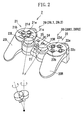
- FIG. 2 indicates appearance of the controller 2.
- the controller 2 has two grippers 20R, 20L, the player holds the controller 2 by gripping the respective grippers 20R , 20L using right-and-left defensive power.
- the controller 2 in the condition that the player holds each gripper 20R , 20L by using right-and-left defensive power, is provided with first, and second manipulating section 21 , 22 and analog manipulating sections 23R , 23 L at positions capable of being operated with player's respective thumbs.
- the first manipulating section 21 is one for conducting instruction of direction of character's movement.
- the first manipulating section 21 is provided with an upward instructing button 21a for instructing upward, a downward instructing button 21b for instructing downward, a rightward instructing button 21c for instructing rightward, and a leftward instructing button 21d for instructing leftward respectively.
- the second manipulating section 22 is provided with a ⁇ -button 22a incused ⁇ shaped punch mark, a ⁇ -button 22b incused ⁇ shaped punch mark, a ⁇ -button 22c incused ⁇ shaped punch mark, and a ⁇ -button 22d incused ⁇ shaped punch mark.
- no tilt condition reference position
- the user conducts tilt operation in connection with the analog manipulating section 23R , 23L while conducting press manipulation the analog manipulating section 23R , 23L , coordinate values on XY-coordinates depending on tilt amount and tilt direction to the above reference position are detected, then the coordinate values are supplied to the main unit 1 via a controller connecting section as manipulating output.
- the controller 2 is provided with a start button 24 for conducting specification of game start and so forth, a selection button 25 for conducting selection of predetermined item and so forth, and a mode selection switch 26 for selecting analog mode or digital mode.
- a start button 24 for conducting specification of game start and so forth
- a selection button 25 for conducting selection of predetermined item and so forth
- a mode selection switch 26 for selecting analog mode or digital mode.
- the controller 2 is provided with a right button 28 and a left button 29 at positions capable of being operated by using a first finger (or a second finger) of each hand in the condition that each gripper 20R, 20L is made to hold by using right hand and left hand.
- Each button 28, 29 has first and second right button 28R1, 28R2, and first and second left button 29L1, 29L2 all of which are provided in parallel to thickness direction of the controller 2.
- the player inputs manipulating command of the video game unit and the character while manipulating respective buttons.
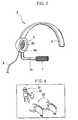
- the headset 3 is one ear specification as indicated in FIG. 3, and the headset 3 has a fixing arm 5 for fixing the headset 3 to the player's head, a sound production section 6 provided at one end of the fixing arm 5 , and a microphone 7 .
- the fixing arm 5 has curved shape along with head shape of centuries, and the headset 3 is made to fix on the head of the player in such a way that when the headset 3 is mounted on the head of the player, temporal region of head of the player is made to put between both end sections of the fixing arm 5 lightly.
- the sound production section 6 has a pad section 6a that takes a shape for covering wholly the player's right ear (or left ear) when the headset 3 is fixed to the head of the player, and a speaker device 6b for producing sound of effective sound of the video game and so forth.
- the pad section 6a is formed with soft material such as sponge and so forth so that ear of the player does not become pain even though the headset 3 is made to mount on the head during long time.
- the microphone 7 is provided at another end side of a microphone arm 7a whose one end side is connected to the above sound production section 6.
- the microphone 7 positions in close vicinity to a mouse of the player on the occasion that the headset 3 is made to mount on the head of the player, and gathers together voices vocalized by the player, thus voice signals corresponding to the gathered voices are made to supply to a voice input section 12 of the main unit 1 via a cable 8.
- the headset 3 is one ear specification, however, it may be suitable that the headset is both ears specification such as headphone device. In addition, it may be suitable that inner type earphone is used as the sound production section. It is possible to plan of miniaturization of headset and weight saving of headset in such a way that the headset is made to constitute by using this earphone.
- the headset 3 is fixed to the head of the player by using fixing arm 5 , however, it is also suitable that there will be provided a hook for hooking on one ear of the player instead of the fixing arm 5 , then the headset is made to fix on one ear side of the player by using this hook.
- the video game of the battle type is one in which the leading character moves from start to goal therebetween along predetermined route, and the leading character comes across the enemy character during this movement. For that reason, the player manipulates the controller 2 , as well as the player vocalizes a voice to the leading character within the display screen via the microphone 7 of the headset 3 to encourage the leading character, or the player causes the leading character to battle the enemy character while instructing battle procedure. And then, the game is one, by this battle, in which the leading character sets his sight on goal while bringing the enemy character down into the dust.
- the player loads the optical disk 19 in which game program of the video game of the battle type is recorded to the main unit 1 , followed by specifying game start while operating the start button 24 of the controller 2 .
- the manipulating command of specifying this game start is supplied to the control section 17 via the operational command input section 11 , then the optical disk reproduction section 15 is controlled by the control section 17 , thus reproductions are made to conduct, such as the game program, the leading character, the enemy character, and respective parameters of arms that the leading character possesses, all of which are recorded in the optical disk 19 , further a plurality of event tables in which a plurality of events are indicated in a table, which event indicates action of the leading character and the enemy character, and a plurality of selection table consisting of a plurality of event tables classified in every respective categories and so forth recorded in the optical disk 19 .
- the control section 17 causes respective parameters reproduced by the optical disk reproduction section 15 to be controlled to store in the storage section 14 and causes respective selection tables and respective event tables to be controlled to store in the selection/event table storage section 20 .
- control section 17 forms game screens of this battle type video game on the basis of the game program reproduced by the optical disk reproduction section 15 and manipulation of the controller 2 by the player, and then the control section 17 causes formed game screens to be controlled to display on a display device 18 via a display processing section 16 .
- FIG. 4 indicates one example of this game screen.
- the game screen of this FIG. 4 is one in which the leading character 31 comes across the enemy character 32 in the course of movement of the movement route, a scene is made to indicate in which the leading character 31 has a arms 3 3 such as for instance a laser rifle at the ready against to the enemy character 32.
- Parameter of changing in real time is set to the leading character 31 , the enemy character 32 and the arms 33 being used by the leading character 31 respectively.
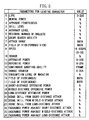
- FIG. 5 indicates parameters that are prepared for the leading character 31 , in which following items are set, such as for instance, life force (life), mental power, apparent fearfulness, skill level, accuracy level, the residual number of bullets of possessive arms 33 , enemy search ability, attack range, field of view (forward view), speed of motion (speed), terror, offensive power, defensive power, continuous shooting ability of arms 33 , the number of damage (damage counter), consumption level of magazine of arms 33 (consumption level of magazine) , field of view (angle), field of view (sense), short-distance offensive power, middle-distance offensive power, long-distance offensive power, power for overbearing the enemy's attack from short distance (dodge skill), power for overbearing the enemy's attack from middle distance, power for overbearing the enemy's attack from long distance, durability to the enemy's attack of short distance (endurance power), durability to the enemy's attack of middle distance, durability to the enemy's attack of long distance, and
- the life force, offensive power, defensive power and the number of damage among them are expressed by using values of 0 to 255, and the values decrease gradually depending on the damage of suffering from the enemy.
- the speed of motion (speed) is expressed with total 16 gradations of 0 to 15.
- the mental power to the enemy search ability, the terror, the consumption level of magazine, and the offensive power at short distance to the durability to the enemy attack of long distance are expressed with percentage (%).
- the continuous shooting ability is expressed by using the number of frame (FRAME) of conducting automatic fire depiction, and the attack range, the field of view(forward view), the field of view (angle) and field of view (sense) are expressed by using unit of "maya” respectively.
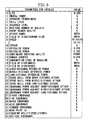
- FIG. 6 indicates parameters that are prepared for the enemy character 32 , in which following items are set, such as for instance, life force (life), mental power, apparent fearfulness, skill level, accuracy level, the residual number of bullets of possessive arms, enemy search ability, attack range, field of view (forward view), speed of motion (speed), terror, offensive power, defensive power, continuous shooting ability of arms, the number of damage (damage counter), consumption level of magazine of arms (consumption level of magazine), field of view (angle), field of view (sense), short-distance offensive power, middle-distance offensive power, long-distance offensive power, power for overbearing the leading character's attack from short distance (dodge skill), power for overbearing the leading character's attack from middle distance, power for overbearing the leading character's attack from long distance, durability to the leading character's attack of short distance (endurance power), durability to the leading character's attack of middle distance, durability to the leading character's attack of long distance, and so forth.
- life force
- the items are durability against stroke attack from the leading character (STROKE endurance), durability against flame projecting attack from the leading character (FIRE endurance), durability against water projecting attack (WATER endurance), durability against acid projecting attack (ACID endurance), weak point ID, competence of continuing to trace the leading character (persistency) and critical endurance and so forth.
- STROKE endurance durability against stroke attack from the leading character
- FIRE endurance durability against flame projecting attack from the leading character
- WATER endurance durability against water projecting attack
- ACID endurance durability against acid projecting attack
- weak point ID competence of continuing to trace the leading character (persistency) and critical endurance and so forth.
- the life force, offensive power, defensive power and the number of damage among them are expressed by using values of 0 to 255, and the values decrease gradually depending on the damage of suffering from the leading character.
- the speed of motion (speed) is expressed with total 16 gradations of 0 to 15.
- the mental power to the enemy search ability, the terror, the consumption level of magazine, and the offensive power at short distance to the durability to the enemy attack of long distance are expressed with percentage (%).
- the continuous shooting ability is expressed by using the number of frame (FRAME) of conducting automatic fire depiction, and the attack range, the field of view direction (forward view), the field of view (angle) and field of view (sense) are expressed by using unit of "maya” respectively.
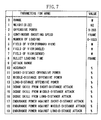
- FIG. 7 indicates parameters of the arms 33 of being possessed by the leading character, in which following items are set, such as for instance, range, weight (size), offensive power, continuous shooting speed, the number of loading, field of view (forward view), field of view (angle), field of view (sense), bullet loading time, attack range, accuracy, short-distance offensive power, middle-distance offensive power, long-distance offensive power, power for overbearing the enemy's attack from short distance (dodge skill), power for overbearing the enemy's attack from middle distance, power for overbearing the enemy's attack from long distance, durability to the enemy's attack of short distance (endurance power), durability to the enemy's attack of middle distance, durability to the enemy's attack of long distance, and so forth.
- the range, the field of view (forward view), the field of view (angle) and the field of view (sense) among them are expressed with meter (M), and the offensive power is expressed by using values of 0 to 255.
- the weight is expressed by kilo gram (Kg)
- the number of loading is expressed by numeral values of 0 to 1023
- the continuous shooting speed and the bullet loading time are expressed by the number of frames of conducting depiction (FRAME).
- the accuracy to the durability to the enemy attack of long distance are expressed by percentage (%) respectively.
- Such respective parameters are read out from the optical disk as described above, followed by being stored in a parameter storage section 14 indicated in FIG. 1, and a control section 17 reads out appropriately the parameter from the parameter storage section 14 depending on scene or conditions or so forth, in which display control of the leading character 31, the enemy character 32, operations of the arms 33 and so forth are conducted.
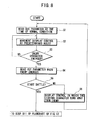
- control section 17 reads out parameter of the leading character 31 at the time of normal state from among respective parameters stored in the parameter storage section 14, and in STEP S2, the leading character 31 is made to move while conducting display control along the predetermined route under the state of mind depending on the parameter at the time of normal state.
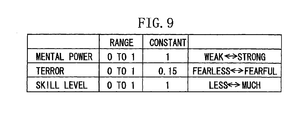
- Respective parameters of the mental power such as the terror, the skill level and so forth as indicated in FIG. 9 are read out from the parameter storage section 14 as the parameter of the leading character read out at the time of normal state.
- Values of the parameter of the leading character 31 at the time of normal state are values in which the mental power is "1", the terror is "0.15", the skill level is "1".
- the value of the parameter of the skill level changes between 0 to 1 (less to much) depending on accumulation of experience of the battle between the leading character 31 and the enemy character 32 depending on the number of times of being conducted the game and so forth.
- the control section 17 discriminates whether the enemy character 32 of breaking in on the leading character 31 emerges, in cases where the enemy character 32 does not emerge yet, operation of the control section 17 returns to the STEP S2, then the control section 17 controls to display the action of the leading character 31 on the basis of the parameter at the time of normal state. For that reason, the leading character 31 travels continuously on the predetermined route.
- control section 17, in STEP S4, reads out the parameter of the leading character 31 as the enemy character 32 emerges from the parameter storage section 14.
- respective parameters such as the parameter of the mental power of the leading character, the parameter of the apparent fearfulness against the enemy character 32, the parameter of the number of the enemies who are hanging around, the parameter of distance of the enemy character 32 therebetween, the parameter of the skill level and so forth are read out from the parameter storage section 14.
- the values of the respective parameters of the leading character 31 in cases where the enemy character 32 become values in which, for instance, the value of the parameter of the mental power is "0.25", the value of the parameter of the apparent fearfulness of the enemy character 32 is "0.1", the value of the parameter of the number of enemies who are hanging around is "0.1", the value of the parameter of the distance of the enemy character 32 therebetween is "0", the value of the parameter of the skill level is "0.1".
- the control section 17, in STEP S5 discriminates whether the battle is made to conduct against the enemy character 32.
- the discrimination whether the battle is made to conduct is performed on the basis of the respective parameters of the leading character 31 read out from the parameter storage section 14, for instance, in cases where the value of the parameter of the terror is smaller than the predetermined value, the battle of the enemy character 32 therebetween is made to start, while in cases where the value of the parameter of the terror is larger than the predetermined value, the leading character 31 runs away from the enemy character 32.
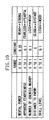
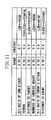
- FIG. 11 illustrates one example of values of respective parameters on the occasion that the leading character 31 runs away from the enemy character 32 who came across.
- the values of the respective parameters are one in which, for instance, hitting ratio of attack is "0.7", the terror is “0.5”, distance to the target is "0.4", the number of enemies who are hanging around is “0.5”, hit ratio of enemy's attack is "0.8", and the distance of the enemy therebetween is "0.6".
- the leading character 31 gets a long lead from the enemy character 32 in that the leading character 31 runs away from the enemy character 32, with the result that the value of the parameter of the terror of the leading character 31 becomes less than "0.4", at this time, operation of the control section 17 returns to STEP S1, thus, the control section 17 controls to move the leading character 31 along the predetermined route under state of mind depending on the parameter at the time of normal state as described above to display.
- control section 17 decides as opening of a battle at STEP S5 described above, followed by moving the operation to operation indicated in flowchart of FIG. 12 in order to cause the leading character 31 and the enemy character 32 to be battled.
- STEP S5 of the flowchart of FIG. 8 when the control section 17 discriminates as opening of a battle, the flowchart indicated in FIG. 12 starts, and operation of the control section 17 proceeds to STEP S11.
- the control section 17 discriminates whether voice input is conducted from the player, when there is no voice input, operation proceeds to STEP S12, while when there is a voice input, in STEP S22, the control section controls to display so as to conduct a battle depending on the voice input. In addition, a battle action depending on the voice input will be described later.
- control section 17 determines whether a turn is one in which the leading character 31 conducts the attack or a turn is one in which the enemy character 32 conducts the attack while using random numbers to proceeds to STEP S13.
- control section 17 discriminates whether the turn determined by use of the random numbers is one in which the leading character 31 conducts the attack or the turn determined by use of the random numbers is one in which the enemy character 32 conducts the attack, when the turn is one in which the leading character 31 conducts the attack, operation of the flow proceeds to STEP S14, while when the turn is one in which the enemy character 32 conducts the attack, operation of the flow proceeds to STEP S23.
- control section 17 determines a selection table corresponding to the attack of being conducted by the leading character 31 at this time while using random numbers, from among a plurality of tables formed in such a way as to classify the attack of the leading character 31 in every category, then the operation of the flow proceeds to STEP S15.
- the control section 17 discriminates whether the selection table determined by use the above random numbers is the selection table of the attack miss of the leading character 31 , when the selection table is not the selection table of the attack miss of the leading character 31 , the operation of the flow proceeds to STEP S16, while when the selection table is the selection table of the attack miss of the leading character 31 , the control section 17 , in STEP S20, controls to display the leading character 31 so as to execute any event of the selection table of the attack miss.
- the control section 17 discriminates whether the selection table determined by use of the random number again is the selection table of the attack hit of the leading character 31 , when the selection table is the selection table of the attack hit of the leading character 31 , the operation of the flow proceeds to STEP S18, then the control section 17 controls to display the leading character 31 so as to execute any event of the selection table of the attack hit, while when the selection table is not the selection table of the attack hit of the leading character 31 , the operation of the flow proceeds to STEP S19, then the control section 17 controls to display the leading character 31 so as to execute any event of the selection table in which the enemy character 32 protects against attack of the leading character.
- the control section 17 when discrimination is made that the turn is one in which the enemy character 32 conducts the attack, the control section 17 puts the operation of the flow to STEP S23.
- the control section 17 discriminates whether discrimination result in STEP S13 changes a space between the leading character 31 and the enemy character 32 , when the discrimination result is one in which the space is made to change between the leading character 31 and the enemy character 32, the control section 17, in STEP S25, controls to display so as to change the space by predetermined amount between the leading character 31 and the enemy character 32 , while when the discrimination result is not one in which the space is made to change between the leading character 31 and the enemy character 32 , the operation of the flow proceeds to STEP S24.
- control section 17 determines the selection table corresponding to the attack of being conducted by the enemy character 32 this time while using the random numbers, from among a plurality of selection tables formed in such a way as to classify the attack of the enemy character 32 in every category, then the operation of the flow proceeds to STEP S26.
- the selection table corresponding to the attack of being conducted by the enemy character 32 total three selection tables are provided such as "the selection table of attack miss (Attack NISS) of the enemy character 32 (STEP S27)", “the selection table of attack hit (Attack HIT) of the enemy character 32 (STEP S30)”, and "the selection table in which the leading character 31 protects against the attack of the enemy character 32 (STEP S31)”.
- the control section 17 discriminates whether the selection table determined by use the above random numbers is the selection table of the attack miss of the enemy character 32 , when the selection table is not the selection table of the attack miss of the enemy character 32 , the operation of the flow proceeds to STEP S28, while when the selection table is the selection table of the attack miss of the enemy character 32, the control section 17, in STEP S27, controls to display the enemy character 32 so as to execute any event of the selection table of the attack miss.
- the control section 17 discriminates whether the selection table determined by use of the random number again is the selection table of the attack hit of the enemy character 32 , when the selection table is the selection table of the attack hit of the enemy character 32 , the operation of the flow proceeds to STEP S30, then the control section 17 controls to display the enemy character 32 so as to execute any event of the selection table of the attack hit, while when the selection table is not the selection table of the attack hit of the enemy character 32 , the operation of the flow proceeds to STEP S31, then the control section 17 controls to display the enemy character 32 so as to execute any event of the selection table in which the leading character 31 protects against attack of the enemy character 32.
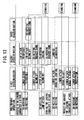
- FIG. 13 indicates events of "the selection table of the attack hit of the leading character 31 (success in the leading character's attack)" in STEP S18, events of “the selection table of the attack miss of the leading character 31 (dodging the leading character's attack)" in STEP S20, and events of "the selection table in which the enemy character 32 protects against the attack of the leading character 31 (protection against the leading character's attack)" in STEP S19.
- FIG. 13 displays the events of the leading character 31 and the events of the enemy character 32 while separating them into upper stand and lower stand respectively. For instance, letters of "do-nothing" as the events of preliminary operation of the selection table of success in leading character 31 attack are displayed above and below, in which the upper stand indicates event operations of "condition do-nothing” of the leading character 31 , and the lower stand indicates event operations of "condition do-nothing” of the enemy character 32 . Further, another event operations are the same as this example, namely, the upper stand indicates the event operations of the leading character 31 and the lower stand indicates the event operations of the enemy character 32 .
- control section 17 controls to execute respective event operations of the leading character 31 and the enemy character 32 depending on the number of battles and so forth between the leading character 31 and the enemy character 32.
- control section 17 controls to display the leading character 31 so as to attack lower body of the enemy character 32 with gun and so forth.
- the control section 17 controls to display the enemy character 32 so as to frighten the enemy character 32 in every time that the leading character 31 attacks the enemy character 32 , in the end, the control section 17 controls to display the enemy character 32 so that the enemy character 32 is blown off to be knocked down. Further, the control section 17 controls to display the leading character 31 so that the leading character 31 is in standing condition (condition of standing normally) after the enemy character 32 is knocked down.
- the control section 17 controls to display the leading character 31 so as to attack upper body of the enemy character 32 with, for instance, gun and so forth.
- control section 17 controls to display the enemy character 32 so that the enemy character 32 is blown off, followed by landing, through being subjected to attack of the leading character 31 , further the enemy character 32 is knocked down caused by the fact that the enemy character 32 is subjected to the attack from the leading character 31. And then, the control section 17 controls to display the leading character 31 so that the leading character 31 is in standing normally after the enemy character 32 is knocked down.
- the control section 17 controls to display the leading character 31 so that the leading character 31 conducts the attack to lower body of the enemy character 32 with, for instance, a gun and so forth.
- control section 17 controls to display the enemy character 32 so that the enemy character 32 gives a jump in every time that the leading character 31 attacks the enemy character 32 , or the enemy character 32 moves from side to side so as to dodge the attack of the leading character 31. And then, the control section 17 controls to display the both characters so that the leading character 31 and the enemy character 32 are in standing while coming face to face with each other after the enemy character 32 dodges the attack of the leading character 31.
- the control section 17 controls to display the leading character 31 so as to attack lower body of the enemy character 32 with, for instance, a gun and so forth, and the control section 17 controls to display the respective characters so that the enemy character 32 protects against the attack of the leading character 31.
- control section 17 controls to display the respective characters so that the leading character 31 and the enemy character 32 are in standing while coming face to face with each other after the enemy character 32 protects against the attack of the leading character 31.
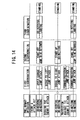
- FIG. 14 indicates events of "the selection table of the attack hit of the enemy character 32 (success in the enemy's attack)" in STEP S30, events of “the selection table of the attack miss of the enemy character 32 (dodging the enemy's attack)" in STEP S27, and events of "the selection table in which the leading character 31 protects against the attack of the enemy character 32 (protection against the enemy's attack)" in STEP S31.
- event operations at upper stand indicate event operations of the leading character 31, while event operations at power stand indicate event operations of the enemy character 32, which are the same as the case of FIG. 13.
- control section 17 controls to display the enemy character 32 so that it causes the enemy character 32 to give a jump to attack upper body of the leading character and the enemy character 32 gives a jump to land after the attack.
- control section 17 controls to display the leading character 31 so as to shake off the enemy character 32 who has conducted the attack, after the leading character is subjected to predetermined damage against the attack of the enemy character 32. And then, the control section 17 controls to display the respective characters so that the leading character and the enemy character 32 are in standing while coming face to face with each other after the enemy character 32 lands.
- the control section 17 controls to display the enemy character 32 so as to attack the leading character 31 while allowing the enemy character 32 to give a jump, and the control section 17 controls to display the respective characters so that the leading character 31 is made to move to display from side to side or to display so as to make a dive frontward in order to dodge the attack of the enemy character 32. And then, the control section 17 controls to display the respective characters so that the leading character 31 and the enemy character 32 are in standing while coming face to face with each other after the leading character 31 fends off the attack of the enemy character 32.
- the control section 17 controls to display the enemy character 32 so as to attack the leading character 31 while allowing the enemy character 32 to give a jump, and the control section 17 controls to display the leading character 31 so as to swing to shake off the enemy character 32 who has conducted the attack. And then, the control section 17 controls to display the respective characters so that the leading character 31 and the enemy character 32 are in standing while coming face to face with each other after the enemy character 32 lands at the time that the leading character 31 shakes off the enemy character 32.
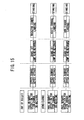
- FIG. 15 indicates an event operation of the case that a gun of being used by the leading character 31 is out of bullet and an event operation on the occasion that the leading character 31 changes arms to be used respectively.
- the control section 17 observes state of the arms 33 of being used by the leading character 31 on the basis of respective parameters as explained by using FIG. 7, when a gun which is used by the leading character 31 becomes out of bullet, the control section 17 executes an event of being out of bullet illustrated in FIG. 15.
- control section 17 controls to display the leading character 31 so as to change magazine of the gun when the parameter of the number of bullet of being loaded on the gun of being used by the leading character 31 became "0".
- control section 17 controls to display the enemy character 32 so as to attack upper body of the leading character 31 during period of the time the leading character 31 changes magazine, and controls to display the leading character 31 so as to shake off the enemy character 32 who has conducted the attack.
- control section 17 controls to display the respective characters so that the leading character 31 and the enemy character 32 are in standing while coming face to face with each other after completion of magazine change.
- the arms 33 of being used by the leading character 31 is capable of being changed at appropriate time.
- the control section 17 controls to display the leading character 31 so as to conduct action of changing the arms 33 from the gun to the knife as indicated in FIG. 15.
- the control section 17 controls to display the enemy character 32 so as to attack the upper body of the leading character 31 during period of the time the leading character 31 changes the arms, and controls to display the leading character 31 so as to shake off the enemy character 32 who has conducted the attack.
- the control section 17 controls to display the respective characters so that the leading character 31 and the enemy character 32 are in standing while coming face to face with each other after changing the arms from the gun to the knife.
- the control section 17 controls to display the leading character 31 so as to conduct operation of changing the arms 33 from the knife to the gun.
- the control section 17 controls to display the enemy character 32 so as to attack the upper body of the leading character 31 during period of the time the leading character 31 changes the arms, and controls to display the leading character 31 so as to shake off the enemy character 32 who has conducted the attack.
- the control section 17 controls to display the respective characters so that the leading character 31 and the enemy character 32 are in standing while coming face to face with each other after changing the arms from the knife to the gun.
- the video game unit of the embodiment is one in which a plurality of selection tables made up of respective plural events are made to classify in every category, on the occasion that battle between the leading character 31 and the enemy character 32 is started, turn is determined whether the turn is one of being exercised by the leading character 31 or the turn is one of being exercised by the enemy character 32 on the basis of the random number, further, selection is made whether the selection table is one of the leading character 31 or the selection table is one of the enemy character 32 on the basis of the random numbers, in which the respective characters are made to control to be displayed so as to correspond to the events within the selection table to cause the both to be battled with each other.
- control section 17 executes selecting operation of such event repeatedly until either the leading character 31 or the enemy character 32 is made to discriminate as being impossibility in the battle in STEP S21 of the flowchart illustrated in FIG. 12. For that reason, since it is possible to conduct display control while fastening event operations of the leading character 31 and the enemy character 32 in real time, it is possible to enable the battle to be displayed continuously and smoothly.
- the video game unit of the embodiment is capable of manipulating the leading character 31 depending on a voice input from the player.
- the leading character 31 and the enemy character 32 conduct the battle on the basis of respective events of the selection table, on this occasion, when a voice is vocalized by the player, the voice is gathered together by using the headset 3 illustrated in FIG. 1, and a voice signal corresponding to the voice is supplied to a voice recognition section 13 via a voice input section 12.
- the voice recognition section 13 analyzes meaning of phrases of the voice vocalized by the player from waveform pattern of the voice signal, to supply the analyzed result to the control section 17.
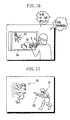
- FIG. 16 illustrates a scene of being in battle between the leading character 31 and the enemy character 32, in this example, the player gives instructions of "fire thrower! for instructing the arms of attacking the enemy character 32 and of "Aim at the belly!” for instructing weak point of the enemy character 32 to the leading character 31 by using voices respectively.
- control section 17 controls to display the leading character 31 so as to beat back the enemy character 32 while allowing the fire thrower of being the arms 33 to be possessed to the leading character 31 as illustrated in FIG. 17, in order to circumfuse flame projection to the enemy character 32 by using this fire thrower.
- the control section 17 controls to display the leading character 31 so as to improve the value of the parameter of the mental power of the leading character 31 and to decrease the value of the parameter of the damage counter so that the leading character 31 resumes.
- the voice recognition section 13 detects volume of the player's voice of this input voice as there is the voice input from the player to supply the voice-volume-information to the control section 17.
- the control section 17 controls to display the leading character 31 on the basis of the value of the parameter varied depending on voice-volume while varying change-amount of value of the parameter of the leading character 31 depending on the voice-volume.
- the control section 17 changes greatly the value of the parameter in the direction in which the parameter of the "mental power” of the leading character 31 is improved and changes greatly the value of the parameter in the direction in which the parameter of the "damage counter” decreases. And then, the control section 17 controls to display the leading character 31 on the basis of greatly changed values of the respective parameters of the "mental power” and the "damage counter".
- the leading character 31 gets back one's strength quickly because the value of the parameter of the mental power is greatly improved and the value of the parameter of the damage greatly decreases, thus the leading character 31 can conduct actively the battle against the enemy character 32 again.
- the control section 17 changes small the value of the parameter in the direction in which the parameter of the "mental power” of the leading character 31 is improved and changes small the value of the parameter in the direction in which the parameter of the "damage counter” decreases. And then, the control section 17 controls to display the leading character 31 on the basis of small changed values of the respective parameters of the "mental power” and the "damage counter".
- the leading character 31 gets back one's strength slowly because the value of the parameter of the mental power is small improved and the value of the parameter of the damage small decreases, thus the leading character 31 can conduct the battle against the enemy character 32 again with degree of small activity.
- the player since the leading character 31 is defeated by the enemy character 32, the player encourages the leading character 31 while vocalizing, for instance "Keep your chin up!” with loud voice this time, thus allowing the leading character 31 to battle against the enemy character 32.
- the video game unit of the embodiment is capable of manipulating the leading character 31 by using another voice input with the exception of "Keep your chin up!”.
- the player conducts discrimination on the basis of environmental land feature of the leading character 31 and circumferences to conduct instruction of movement such as "Move leftward!, or "Move rightward! or so forth by using the voice input.
- This voice input is analyzed by the voice recognition section 13 as described above, and the control section 17 moves to display the leading character 31 to leftward or moves to display the leading character 31 to rightward on the basis of analysis result. For that reason, the leading character 31 avoids the attack of the enemy character 32 in such a way as to move from side to side.
- the control section 17 vocalizes voice output, such as for instance, "It is impossible to move leftward!” and so forth to control or the control section 17 controls to display the leading character 31 so as to act operation of indicating that the leading character 31 can not move leftward. For that reason, the player recognizes that the voice instruction of one's own is error, then the player conducts correct voice instruction.
- the control section 17 controls to display the leading character 31 so as to run away from the enemy character 32, however, when the voice inputs such as "Keep your chin up!”, or "Don't run away! or so forth is made by the player as the leading character 31 ran away, the control section 17 changes the parameter value so as to reduce the parameter value of the terror of the leading character 31 corresponding to predetermined value. Then, when changed parameter value of the terror becomes not more than "0.4", the control section 17 controls to display the leading character 31 so as to stop from the enemy character 32 and to conduct the battle against the enemy character 32. For that reason, as explained using the flowchart of FIG. 12, the battle between the leading character 31 and the enemy character 32 is conducted.
- the control section 17 conducts continuously display control in which the leading character 31 runs away. Accordingly, in this case, the leading character 31 runs away continuously from the enemy character 32 without listening to the player says. And then, when the leading character 31 gets away from the enemy character 32 with some degrees in such a way as to run away from the enemy character 32, the control section 17 decreases the parameter value of the terror of the leading character 31 to control to display the leading character 31 so as to advance under the normal state of mind along the predetermined route.
- the video game unit of the embodiment is always capable of conducting voice input in spite of the time of being in battle, for instance, the player gives instruction to the leading character 31 within the display screen, such as for instance, "Watch out!, "Head up”, and so forth, in cases where the player who sees the scene in which the leading character 31 moves along the route has the foreboding that the enemy character 32 emerges suddenly.
- the control section 17 increases the parameter value of the terror of the leading character 31 up to the value corresponding to the predetermined value, and the control section 17 controls to display the action of the leading character 31 on the basis of the parameter value.
- the control section 17 controls to display footfall of the leading character 31 of walking along the route normally until that time, so as to lapse into footfall of advancing along the route carefully while paying attention to surrounding area.
- control section 17 controls to display the leading character 31 so as to run away from the enemy character 32 or so as to conduct the battle against the enemy character 32 on the basis of the respective parameter values of the leading character 31.
- the control section 17 controls to display the leading character 31 so as to advance along the predetermined route with normal footfall in accordance with the voice input.
- the video game unit of the embodiment classifies a plurality of selection table made up of respective plural events in every category, on the occasion that the battle between the leading character 31 and the enemy character 32 is stated, and determines whether the turn is one of being exercised by the leading character 31 or the turn is one of being exercised by the enemy character 32 on the basis of the random numbers, further selects selection table of either the leading character 31 or the enemy character 32 on the basis of the random numbers, thus controls to display respective characters so as to correspond to the event within the selection table to battle the both.
- the leading character 31 is capable of being manipulated by using both of the controller and the voice input.
- the control section 17 varies change-amount of the parameter value depending on voice-volume of the voice input, whereby, in some cases, it is not necessarily to reverse the action of the leading character 31 according to a way of the voice input. In such a case, the leading character 31 acts without listening to what the player says. Accordingly, the action of the character is not necessarily to become the action of following the voice input of the player. Also this point may be regarded as one of sauce of this video game.
- the explanation is made in which the leading character 31 is made to manipulate by using voice input, however, it is also preferable to manipulate the enemy character 32 by using voice input. For instance, if one player manipulates the leading character 31 while the other player manipulates the enemy character 32, it is possible to launch an offensive with each other while using the voice, thus the video game becomes one in which sauce is included.
- present invention is applied to the battle type video game
- present invention is capable of being applied to various kinds of video game such as, for instance, RPG (Roll Playing Game), AVG (Adventure Game), SLG (Simulation Game) and so forth except for the battle type video game.
- RPG Roll Playing Game
- AVG Advanced Game
- SLG Simulation Game
Landscapes
- Engineering & Computer Science (AREA)
- Multimedia (AREA)
- Human Computer Interaction (AREA)
- Physics & Mathematics (AREA)
- Acoustics & Sound (AREA)
- Processing Or Creating Images (AREA)
Applications Claiming Priority (4)
| Application Number | Priority Date | Filing Date | Title |
|---|---|---|---|
| JP2000389856 | 2000-12-22 | ||
| JP2000389856 | 2000-12-22 | ||
| JP2001349841 | 2001-11-15 | ||
| JP2001349841A JP2002248261A (ja) | 2000-12-22 | 2001-11-15 | オブジェクト表示プログラム、オブジェクト表示プログラムを記憶したコンピュータ読み取り可能な記憶媒体、オブジェクト表示プログラムを実行するプログラム実行装置、キャラクタ戦闘表示プログラム、キャラクタ戦闘表示プログラムを記憶したコンピュータ読み取り可能な記憶媒体、キャラクタ戦闘表示プログラムを実行するプログラム実行装置 |
Publications (2)
| Publication Number | Publication Date |
|---|---|
| EP1219331A2 true EP1219331A2 (de) | 2002-07-03 |
| EP1219331A3 EP1219331A3 (de) | 2004-11-10 |
Family
ID=26606335
Family Applications (1)
| Application Number | Title | Priority Date | Filing Date |
|---|---|---|---|
| EP01310667A Withdrawn EP1219331A3 (de) | 2000-12-22 | 2001-12-20 | Objektdarstellung |
Country Status (3)
| Country | Link |
|---|---|
| US (1) | US20030148810A9 (de) |
| EP (1) | EP1219331A3 (de) |
| JP (1) | JP2002248261A (de) |
Cited By (2)
| Publication number | Priority date | Publication date | Assignee | Title |
|---|---|---|---|---|
| WO2004024263A1 (ja) * | 2002-09-13 | 2004-03-25 | Konami Corporation | ゲーム装置、ゲーム装置の制御方法、プログラム、プログラム配信装置及び情報記憶媒体 |
| CN108404410A (zh) * | 2018-02-09 | 2018-08-17 | 腾讯科技(深圳)有限公司 | 对象的控制方法和装置、存储介质、电子装置 |
Families Citing this family (14)
| Publication number | Priority date | Publication date | Assignee | Title |
|---|---|---|---|---|
| JP4206015B2 (ja) | 2003-09-12 | 2009-01-07 | 任天堂株式会社 | ゲーム機用操作装置 |
| JP2005312758A (ja) | 2004-04-30 | 2005-11-10 | Nintendo Co Ltd | ゲームシステムおよびゲームプログラム |
| JP3741285B1 (ja) * | 2004-09-22 | 2006-02-01 | コナミ株式会社 | ゲーム装置、プログラム及びゲーム機の制御方法 |
| JP4616613B2 (ja) * | 2004-10-20 | 2011-01-19 | 株式会社カプコン | ゲームプログラム、記録媒体、及びゲームシステム |
| JP2006314705A (ja) * | 2005-05-16 | 2006-11-24 | Nintendo Co Ltd | ゲームプログラムおよびゲーム装置 |
| JP4722652B2 (ja) * | 2005-09-29 | 2011-07-13 | 株式会社コナミデジタルエンタテインメント | 音声情報処理装置、音声情報処理方法、ならびに、プログラム |
| US9694282B2 (en) * | 2011-04-08 | 2017-07-04 | Disney Enterprises, Inc. | Importing audio to affect gameplay experience |
| JP5781116B2 (ja) * | 2013-03-27 | 2015-09-16 | 株式会社コナミデジタルエンタテインメント | 情報処理装置、情報処理システム、及びプログラム |
| CN105204749A (zh) * | 2014-06-18 | 2015-12-30 | 腾讯科技(深圳)有限公司 | 一种应用的操控方法及终端设备 |
| JP6877995B2 (ja) | 2016-12-27 | 2021-05-26 | 任天堂株式会社 | 振動制御システム、振動制御装置、振動制御プログラムおよび振動制御方法 |
| JP6594920B2 (ja) | 2017-03-01 | 2019-10-23 | 任天堂株式会社 | ゲームシステム、ゲーム装置、ゲームプログラム、およびゲーム処理方法 |
| JP7221687B2 (ja) * | 2018-12-28 | 2023-02-14 | 株式会社コーエーテクモゲームス | 情報処理装置、情報処理方法及びプログラム |
| JP7510155B2 (ja) * | 2020-06-19 | 2024-07-03 | 国立大学法人電気通信大学 | 指示入力装置および指示入力プログラム |
| CN113457152B (zh) * | 2021-07-22 | 2023-11-03 | 腾讯科技(深圳)有限公司 | 一种游戏阵容生成方法、装置、设备及存储介质 |
Family Cites Families (9)
| Publication number | Priority date | Publication date | Assignee | Title |
|---|---|---|---|---|
| USRE33662E (en) * | 1983-08-25 | 1991-08-13 | TV animation interactively controlled by the viewer | |
| US4905147A (en) * | 1986-10-15 | 1990-02-27 | Logg George E | Collision detection system for video system |
| US5386494A (en) * | 1991-12-06 | 1995-01-31 | Apple Computer, Inc. | Method and apparatus for controlling a speech recognition function using a cursor control device |
| KR100534502B1 (ko) * | 1996-07-11 | 2006-11-10 | 가부시키가이샤 세가 | 음성인식장치,음성인식방법및이것을이용한게임기 |
| JP3260653B2 (ja) * | 1997-03-25 | 2002-02-25 | ヤマハ株式会社 | カラオケ装置 |
| JPH114969A (ja) * | 1997-06-16 | 1999-01-12 | Konami Co Ltd | ゲーム装置、ゲーム方法および可読記録媒体 |
| TW495710B (en) * | 1998-10-15 | 2002-07-21 | Primax Electronics Ltd | Voice control module for control of game controller |
| US6371856B1 (en) * | 1999-03-23 | 2002-04-16 | Square Co., Ltd. | Video game apparatus, video game method and storage medium |
| JP2000279637A (ja) * | 1999-03-30 | 2000-10-10 | Square Co Ltd | ゲーム装置、ゲーム表示制御方法、およびコンピュータ読取り可能な記録媒体 |
-
2001
- 2001-11-15 JP JP2001349841A patent/JP2002248261A/ja active Pending
- 2001-12-18 US US10/024,469 patent/US20030148810A9/en not_active Abandoned
- 2001-12-20 EP EP01310667A patent/EP1219331A3/de not_active Withdrawn
Cited By (3)
| Publication number | Priority date | Publication date | Assignee | Title |
|---|---|---|---|---|
| WO2004024263A1 (ja) * | 2002-09-13 | 2004-03-25 | Konami Corporation | ゲーム装置、ゲーム装置の制御方法、プログラム、プログラム配信装置及び情報記憶媒体 |
| US7753796B2 (en) | 2002-09-13 | 2010-07-13 | Konami Digital Entertainment Co., Ltd. | Game device, game device control method, program, program distribution device, information storage medium |
| CN108404410A (zh) * | 2018-02-09 | 2018-08-17 | 腾讯科技(深圳)有限公司 | 对象的控制方法和装置、存储介质、电子装置 |
Also Published As
| Publication number | Publication date |
|---|---|
| EP1219331A3 (de) | 2004-11-10 |
| US20030148810A9 (en) | 2003-08-07 |
| JP2002248261A (ja) | 2002-09-03 |
| US20020111211A1 (en) | 2002-08-15 |
Similar Documents
| Publication | Publication Date | Title |
|---|---|---|
| US20030148810A9 (en) | Object display program for conducting voice manipulation of character | |
| US6705945B2 (en) | Providing game information via characters in a game environment | |
| CA2495240A1 (en) | Computer game with emotion-based character interaction | |
| JPWO1998002223A1 (ja) | 音声認識装置、音声認識方法及びこれを用いたゲーム機 | |
| JP2022136259A (ja) | 遊技機 | |
| JP2023060279A (ja) | 遊技機 | |
| US8021220B2 (en) | Shooting game apparatus, storage medium storing a shooting game program, and target control method | |
| US20250121279A1 (en) | Data processing apparatus and method | |
| JP5323881B2 (ja) | ゲーム装置及びゲーム制御プログラム | |
| JP5705424B2 (ja) | ゲームプログラム、記録媒体、およびゲームシステム | |
| US6973430B2 (en) | Method for outputting voice of object and device used therefor | |
| EP1216731A2 (de) | Objektkontrollverfahren | |
| JP6122587B2 (ja) | ゲームプログラムおよびゲーム装置 | |
| JP7208174B2 (ja) | 遊技機 | |
| JP2008229290A (ja) | 戦闘システム | |
| JP2005000247A (ja) | ビデオゲームプログラム、ビデオゲーム装置及びビデオゲーム方法 | |
| JP2023060278A (ja) | 遊技機 | |
| JP4205118B2 (ja) | ゲームプログラム、ゲーム装置及びゲーム制御方法 | |
| JP7208175B2 (ja) | 遊技機 | |
| JP5008646B2 (ja) | ゲームプログラム、ゲーム装置、及びゲーム制御方法 | |
| JP2005000248A (ja) | ビデオゲームプログラム、ビデオゲーム装置及びビデオゲーム方法 | |
| US20240226751A1 (en) | Data processing apparatus and method | |
| JP4074324B2 (ja) | ゲームプログラム、ゲーム装置及びゲーム制御方法 | |
| JP7330904B2 (ja) | 遊技機 | |
| JP5350425B2 (ja) | ゲームシステム、ゲームシステムの制御方法、及びプログラム |
Legal Events
| Date | Code | Title | Description |
|---|---|---|---|
| PUAI | Public reference made under article 153(3) epc to a published international application that has entered the european phase |
Free format text: ORIGINAL CODE: 0009012 |
|
| AK | Designated contracting states |
Kind code of ref document: A2 Designated state(s): AT BE CH CY DE DK ES FI FR GB GR IE IT LI LU MC NL PT SE TR |
|
| AX | Request for extension of the european patent |
Free format text: AL;LT;LV;MK;RO;SI |
|
| PUAL | Search report despatched |
Free format text: ORIGINAL CODE: 0009013 |
|
| AK | Designated contracting states |
Kind code of ref document: A3 Designated state(s): AT BE CH CY DE DK ES FI FR GB GR IE IT LI LU MC NL PT SE TR |
|
| AX | Request for extension of the european patent |
Extension state: AL LT LV MK RO SI |
|
| AKX | Designation fees paid | ||
| REG | Reference to a national code |
Ref country code: DE Ref legal event code: 8566 |
|
| STAA | Information on the status of an ep patent application or granted ep patent |
Free format text: STATUS: THE APPLICATION IS DEEMED TO BE WITHDRAWN |
|
| 18D | Application deemed to be withdrawn |
Effective date: 20050511 |