EP1216849A2 - Gespeichtes Fahrrad-Rad - Google Patents
Gespeichtes Fahrrad-Rad Download PDFInfo
- Publication number
- EP1216849A2 EP1216849A2 EP01811167A EP01811167A EP1216849A2 EP 1216849 A2 EP1216849 A2 EP 1216849A2 EP 01811167 A EP01811167 A EP 01811167A EP 01811167 A EP01811167 A EP 01811167A EP 1216849 A2 EP1216849 A2 EP 1216849A2
- Authority
- EP
- European Patent Office
- Prior art keywords
- rim
- spokes
- hub
- wheel
- center plane
- Prior art date
- Legal status (The legal status is an assumption and is not a legal conclusion. Google has not performed a legal analysis and makes no representation as to the accuracy of the status listed.)
- Granted
Links
- 238000000034 method Methods 0.000 claims description 4
- 210000002445 nipple Anatomy 0.000 description 20
- 238000004873 anchoring Methods 0.000 description 10
- 239000000463 material Substances 0.000 description 5
- 238000012937 correction Methods 0.000 description 3
- 230000007423 decrease Effects 0.000 description 3
- 238000012360 testing method Methods 0.000 description 3
- 230000005540 biological transmission Effects 0.000 description 2
- 238000006073 displacement reaction Methods 0.000 description 2
- 230000008439 repair process Effects 0.000 description 2
- 239000007787 solid Substances 0.000 description 2
- 238000012546 transfer Methods 0.000 description 2
- 229910001369 Brass Inorganic materials 0.000 description 1
- 238000013459 approach Methods 0.000 description 1
- 239000010951 brass Substances 0.000 description 1
- 230000006378 damage Effects 0.000 description 1
- 230000001419 dependent effect Effects 0.000 description 1
- 238000013461 design Methods 0.000 description 1
- 230000003467 diminishing effect Effects 0.000 description 1
- 238000005553 drilling Methods 0.000 description 1
- 230000000694 effects Effects 0.000 description 1
- 230000001788 irregular Effects 0.000 description 1
- NLYAJNPCOHFWQQ-UHFFFAOYSA-N kaolin Chemical compound O.O.O=[Al]O[Si](=O)O[Si](=O)O[Al]=O NLYAJNPCOHFWQQ-UHFFFAOYSA-N 0.000 description 1
- 238000005259 measurement Methods 0.000 description 1
- 230000002035 prolonged effect Effects 0.000 description 1
- 230000009528 severe injury Effects 0.000 description 1
- 238000012549 training Methods 0.000 description 1
- 238000005303 weighing Methods 0.000 description 1
Images


Classifications
-
- B—PERFORMING OPERATIONS; TRANSPORTING
- B60—VEHICLES IN GENERAL
- B60B—VEHICLE WHEELS; CASTORS; AXLES FOR WHEELS OR CASTORS; INCREASING WHEEL ADHESION
- B60B1/00—Spoked wheels; Spokes thereof
- B60B1/02—Wheels with wire or other tension spokes
- B60B1/04—Attaching spokes to rim or hub
- B60B1/043—Attaching spokes to rim
- B60B1/044—Attaching spokes to rim by the use of spoke nipples
-
- B—PERFORMING OPERATIONS; TRANSPORTING
- B60—VEHICLES IN GENERAL
- B60B—VEHICLE WHEELS; CASTORS; AXLES FOR WHEELS OR CASTORS; INCREASING WHEEL ADHESION
- B60B1/00—Spoked wheels; Spokes thereof
- B60B1/02—Wheels with wire or other tension spokes
- B60B1/0207—Wheels with wire or other tension spokes characterised by non-standard number of spokes, i.e. less than 12 or more than 32 spokes
-
- B—PERFORMING OPERATIONS; TRANSPORTING
- B60—VEHICLES IN GENERAL
- B60B—VEHICLE WHEELS; CASTORS; AXLES FOR WHEELS OR CASTORS; INCREASING WHEEL ADHESION
- B60B1/00—Spoked wheels; Spokes thereof
- B60B1/02—Wheels with wire or other tension spokes
- B60B1/0215—Wheels with wire or other tension spokes characterised by specific grouping of spokes
- B60B1/0223—Wheels with wire or other tension spokes characterised by specific grouping of spokes the dominant aspect being the spoke arrangement pattern
-
- B—PERFORMING OPERATIONS; TRANSPORTING
- B60—VEHICLES IN GENERAL
- B60B—VEHICLE WHEELS; CASTORS; AXLES FOR WHEELS OR CASTORS; INCREASING WHEEL ADHESION
- B60B1/00—Spoked wheels; Spokes thereof
- B60B1/02—Wheels with wire or other tension spokes
- B60B1/0215—Wheels with wire or other tension spokes characterised by specific grouping of spokes
- B60B1/0223—Wheels with wire or other tension spokes characterised by specific grouping of spokes the dominant aspect being the spoke arrangement pattern
- B60B1/023—Wheels with wire or other tension spokes characterised by specific grouping of spokes the dominant aspect being the spoke arrangement pattern multiple exclusively parallel spokes arranged in a group
-
- B—PERFORMING OPERATIONS; TRANSPORTING
- B60—VEHICLES IN GENERAL
- B60B—VEHICLE WHEELS; CASTORS; AXLES FOR WHEELS OR CASTORS; INCREASING WHEEL ADHESION
- B60B1/00—Spoked wheels; Spokes thereof
- B60B1/02—Wheels with wire or other tension spokes
- B60B1/04—Attaching spokes to rim or hub
- B60B1/041—Attaching spokes to rim or hub of bicycle wheels
-
- B—PERFORMING OPERATIONS; TRANSPORTING
- B60—VEHICLES IN GENERAL
- B60Y—INDEXING SCHEME RELATING TO ASPECTS CROSS-CUTTING VEHICLE TECHNOLOGY
- B60Y2200/00—Type of vehicle
- B60Y2200/10—Road Vehicles
- B60Y2200/13—Bicycles; Tricycles
Definitions
- the invention relates to a spoked bicycle wheel, preferably an eccentric one spoked bicycle wheel, the spoke system in the axial section of the wheel Has depth of dish, so that the spoke tensions on both Wheel sides are different.
- This wheel can be used as a front or rear wheel in a bicycle.
- Such a conventional bicycle front wheel has a front hub, which in the Fork of the bicycle frame is attached and on one side e.g. a brake disc is attached as part of a disc brake.
- a conventional one Bicycle rear wheel has a rear wheel hub that attaches to the bicycle frame is and on one side a sprocket set for the driving chain is attached.
- the hub flanges on the sides of the front and rear hub are one conventional rim carrying a tire through live spokes connected.
- the sprocket set causes undesirable lateral displacement the center plane of the hub flanges from the rim center plane towards Sprocket opposite side. Due to this several millimeter displacement, which as Bowl depth is known, the tension of the sprocket-side spokes increases than the tension of the sprocket-opposite spokes in a mass that the Durability of the rear wheel is greatly reduced. It is therefore desirable equalize the spoke tensions of the rear wheel as much as possible.
- the lateral offset of the center plane is the hub flange caused by the lateral attachment of the brake disc to the hub and also here the balance of the spoke tensions on both sides of the wheel is desirable.
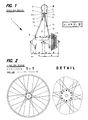
- Fig. 1 shows part of a conventional eccentrically stored bicycle rear wheel 1 in the axial sectional view according to the prior art.
- the tire 2 is on a conventional rim 3 with respect to the Rim center plane M symmetrical cross section and a simple rim base 4 attached.
- the rim 3 is through sprocket-side spokes 5 with the sprocket-side Hub flange in the anchoring points 6 and through spokes on the opposite side of the ring gear 7 with the hub flange on the opposite side of the ring gear in the anchoring points 8 connected.
- the spokes are usually anchored in the hub flanges in the spoke holes, the spokes ending in a right-angled arc with a spoke head. For the sake of clarity, this detail is not shown.
- the hub flanges are through a cylindrical hub body connected with each other.
- the spokes are anchored in the rim in the center of the rim by spoke nipples 9, 10 in points 11.
- the aim of such systems is to improve the lateral rigidity of the Wheel and the ratio of the spoke tensions on the wheel sides.
- the spoke nipples 9, 10 are sometimes in the hub flanges instead of in the rim appropriate.
- the hub flanges are not always ring-shaped, instead, the spokes, which are straight in their entire length, are opened anchored to the circumference of the hub in various tooth-shaped structures, so that there is no risk of breakage in the spoke arch.
- the spokes 5, 7 voltages T1, T2 which the material of the rim and the Stress the hub in the spoke anchor points 11, 6, 8.
- the very important ratio of the average spoke tensions on both Wheel sides is on the one hand the ratio of the angle between the spokes 5, 7 and the center plane of the anchorage points of the spokes in the rim, on the other hand dependent.
- the median plane is the Anchoring points of the spokes in the rim identical to the median plane of the Rim M. (But it is not identical for bikes with laterally offset anchoring points of the spokes in the rim.)
- the tensions of the spokes are in the Fig.
- the masses c and d can be easily measured and the conventional ratio of the spoke tensions. Then you can use a suitable spoke system choose with the help of the teaching discussed here.
- the ratio of spoke tensions afterwards on the wheel sides should be as far as possible and / or as far as desirable to approach the ratio of 1: 1.
- the one when centering the wheel arising horizontal force components P1 and P2 of the spoke tensions T1 and T2 can be smaller or larger depending on the size of T1 and T2 but inevitably always the same size for a bike.
- the anchoring points 11 lie in the center rim plane M the spoke nipple 9, 10. (However, this is not always the case, as is the case on page 2 patent mentioned below "rim for a spoked bicycle rear wheel” shows.) Die
- the center plane of the hub flanges F is from the rim center plane M in the direction of Sprocket opposite side of the hub by the dimension e laterally, whereby the System gets an eccentric shape.
- the measure e (h - f): 2 is the actual unwanted depth of dish of the spoke system and the cause of the imperfection of the wheel.
- Fig. 2 shows a conventional eccentrically spoked bicycle front wheel or Bicycle rear wheel in a side view according to the prior art.
- the rear wheel 1 this type was shown in the axial sectional view in Fig. 1.
- the sprocket or the brake disc has been omitted to only to show the essentials.
- the wheel has a total of 24 spokes and they are crossed twice on both sides of the wheel.
- the spokes on the wheel side facing the viewer are full Lines shown, the spokes on the other side of the wheel are dashed.
- the crossing the spokes on both sides serves for better transmission of the through the Chain drive or braking torque from both Flanges the hub through the spokes onto the rim.
- This additional tensile load is therefore distributed over more spokes than if a flange had only radial spokes which cannot transmit torque (with so-called hybrid - Impellers).
- a detail of the flange makes the spoke guide more visible. A similar detail can also be seen in FIGS. 4, 5, 6, 7, 8, 9 and 10.
- Fig. 3 shows part of an eccentrically stored bicycle rear wheel 1 'in the axial sectional view according to an embodiment of the invention.
- the graphic Representation of the wheel corresponds to FIG. 1 and is therefore for reasons of clarity no numbers and dashes for several components and only the changes compared to Fig. 1 emphasized.
- the important lateral rigidity of the wheel from the side of the ring gear - or from the side of the brake disc - has increased because the total spoke tension in the Wheel was increased and thus the horizontal force components P1 'and P2' the spoke tensions T1 'and T2'.
- the horizontal forces e.g. at the Driving in weighing step act on the wheel 1 'against the force component P1' relative to P1 'less than the same forces relative to P1 in Fig. 1. Only the The angle between the spokes 5 'and the rim center plane M has remained small. However, this lateral stiffness can be increased again by other means, as will be described later.
- Fig. 4 shows an eccentrically spoked bicycle front wheel or bicycle rear wheel in the side view according to an embodiment of the invention.
- a rear wheel 1 ' this type was shown in the axial sectional view in Fig. 3.
- the representation corresponds essentially to Fig. 2, wherein the wheel also has 24 spokes and these are also crossed on both sides of the wheel.
- FIG. 5 shows an eccentrically spoked bicycle front wheel or bicycle rear wheel in the side view according to another embodiment of the invention.
- the bike has a total of 27 spokes and the number of spokes ratio is again 2: 1 as in the Figure 4.
- the total number of spokes shown in the table are odd numbers and all divisible by 3. There is something like this with conventional saved wheels, there is only a total of 2 spokes by 2 divisible.
- the dimension c is the distance between the center plane of the anchorage points of the spokes in the rim and the axis the spoke (where the tensile force acts) at the point of the spoke hole in the Flange.
- FIG. 6 shows an eccentrically spoked bicycle front wheel or bicycle rear wheel in the side view according to a further embodiment of the invention.
- the bike has a total of 24 spokes again with the number of spokes ratio 2: 1 as in the Fig. 4 and 5. So there are 16 and 8 crossed spokes on both sides of the wheel.
- the Spokes are arranged in groups of three.
- They are very modern expensive Impellers where the spokes are arranged similarly here, but in pairs. On such a rear wheel e.g. you can see a pair of spokes that close in each other the rim are anchored, but you can't see that always one of the spokes in the pair has almost twice the tension as the other and accordingly the wheel cannot be stable enough.
- the dashed spokes could also be used radial insert, but with a corresponding change in the calculation of c: d, like 5 and with the poorer transmission of the torque with fewer spokes.
- FIG. 7 shows an eccentrically spoked bicycle front wheel or bicycle rear wheel in FIG the side view according to a further embodiment of the invention.
- the spoke tension ratios T1: T2 with conventionally stored wheels with some known hubs, which consist of the masses c and d on the hubs result, and which are particularly suitable for this spoke number ratio, are e.g. the following:
- dimension c remains because there are only crossed on this side of the wheel Spokes.
- Fig. 9 shows an eccentrically spoked bicycle front wheel or bicycle rear wheel in the side view according to a further embodiment of the invention.
- the total number of spokes in the table can be divided by 7.
- the change achieved in the spoke tension ratio on the wheel sides is relatively small and could also be achieved with an asymmetrical rim become.
- Corrections of T1: T2 using c: d are here as in FIG. 5 possible.
- the location of the spoke holes in The flanges are chosen so that the length of all spokes is the same on each side of the wheel is.
- the hub flanges must be approved for radial storage, similar as in FIG. 5.
- any Cannot use number of spokes left and right in a wheel you have to construct each type of spotting as we did in our figures to have. If you use any spoke ratio right and left would not be able to properly elevate such a wheel - and center it sideways, because the distances between the spoke anchors in the rim would be very different and the wheel would have an unbalance. This would result in fast departures cause dangerous vibrations of the impeller and the entire bicycle.
- the related spoke groups (with 3, 5, 7 or more spokes) must be on the circumference of the rim are regularly distributed and repeated several times. In short, the impeller with its storage must be rotationally symmetrical.
- FIG. 10 shows a centrally spoked bicycle front wheel in a side view an independent claim 11.
- This system also increases durability a wheel like the eccentrically stored systems described above.
- the wheel has a total of 20 spokes, 10 on each side, so that the number of spokes and that Spoke tension ratio is 1: 1. You can have an even number of spokes choose freely and they can be inserted into any conventional rim.
- This wheel can be compared to a conventional one on both sides of the wheel radially stored wheel, where the spokes from the Exit the flange and get to the rim by the shortest route. (Radial spokes are z. 5 and 9) radially stored on both sides Wheels are said to bring small aerodynamic advantages (no air turbulence the crossings of the spokes) and the spoke tensions are known here more regularly than with crossed spoke systems. These wheels are still used today often requested because they are visually interesting.
- This spoke system has the advantages of the radial system (aerodynamics, regular spoke tensions, interesting optics) but not its disadvantages.
- the wheel is even more elastic than any comparable conventionally stored wheel and therefore also durable and pleasant to drive, since the driver is not so fast fatigued. The reasons for this are longer spokes and the additional springy Effect of the hub body. The most important thing, however, is that the danger of being runaway Spoke holes do not exist here because each spoke tangentially touches the flange leaves and therefore it would need a lot more flange material in case of overload pull out as a spoke with radial storage. It does not matter whether the spokes inserted into the flanges from the space between the flanges 10 as shown in FIG. 10 (this brings more lateral rigidity) or from the outer side of the flanges (this is better aerodynamic).
- Another measure is to insert the conventional bent one at the end Spokes in the conventional flanges only from one side (see claim 12). This comes into question especially with radial storage (FIGS. 5, 9) with the crossed in the side view of the wheel, where the spokes cross far enough away from the flange (e.g. like the dashed spokes in 4 or 6). You can z. B. in both flanges from the outside or Insert from the inside or in one flange from the outside and in the other from Inside. Or one alternately sticks crossed spokes into a flange one side and only the other flange is spoked on one side.
- the lengths 2a and d must remain and only the dimension c is enlarged.
- the lateral stiffness of a wheel increases with the increasing distance between the flanges, namely in Direction from both sides of the wheel. It is surprising that this knowledge is still there is now ignored by well-known manufacturers or is unknown. nowadays With conventional rear wheels, this distance is based on a known rule about 54 ( ⁇ 1 millimeter) in size. If the distance is too small e.g. under The lateral stiffness and durability of the wheel decrease by 50 millimeters strong. Conversely, if the distance is too large, e.g.
- Deviations from zero to plus / minus 50% of the desired ratio of Spoke tensions of 1: 1 (in practice, these deviations become average make up less than about 20%), but mean great progress compared to the state of the art.
- Such bikes are with after various tests Distance more durable than conventional bikes.
- the deviations in the conditions the spoke tensions on the wheel sides from the ratio of 1: 1 are around 50%, 100% in today's conventional bikes (see Information on the hubs in explanations to Fig. 7 and 4) or even 150% (!), Depending on the existing hubs used.
- the holes for the spoke nipples in the rim should be as simple as possible. All holes should be in a line (no zigzag lines) and in a radial direction (vertical to the wheel axle). Directional orientations of the holes Front, back, left, or right are expensive, unnecessary, and expensive Storage confusing. Sufficient diameter of the holes must be guaranteed so that the nipples in the hole can tilt themselves as needed.
- the Bore diameter is the diameter of the cylindrical part of the used Nipples with an addition of about 0.4 to 0.5 millimeters depending on the thickness of the drilled material and not just 0.2 millimeters, as is the case with the directional Drilling is common.
- Prototypes for experimental purposes are easy to make because they are conventional Can use hubs, spokes, nipples and rims. Only the number and location the holes for the spokes in the hub and in the rim are now different. One must get conventional rims and hubs without holes and then the holes drill yourself in the right places. The position of the holes in the rim (to on Fig. 6) easy to determine (regular distances from each other on the Circumference of the rim with a known number of holes) and the holes be carried out according to the previous instructions. The exact location of the holes and the relationships between these positions in the two hub flanges you have to determine for yourself what is not a problem for an experienced technician should. The details in the figures can also help here.
- the spoke tension can also be eccentric saved bicycle wheels are standardized.
- the method according to the invention is the following: by the hub on each side of the rim center plane (M) with a correspondingly different number of anchored spokes is provided, the average tension of the spokes, as far as desired to be balanced.
- the whole Tension of the spokes which from the hub on one or on the opposite Lead the side of the rim center plane (M) towards the rim, different sized. Due to the different number of anchored spokes this will be offset.
Landscapes
- Engineering & Computer Science (AREA)
- Mechanical Engineering (AREA)
- Axle Suspensions And Sidecars For Cycles (AREA)
- Tires In General (AREA)
- Credit Cards Or The Like (AREA)
- Force Measurement Appropriate To Specific Purposes (AREA)
Abstract
Description
- Fig. 1
- einen Teil eines konventionellen exzentrisch gespeichten Fahrrad-Hinterrades in der axialen Schnittansicht nach dem Stand der Technik;
- Fig. 2
- ein konventionelles exzentrisch gespeichtes Fahrrad-Vorderrad oder Fahrrad-Hinterrad in der Seitenansicht nach dem Stand der Technik;
- Fig. 3
- einen Teil eines exzentrisch gespeichten Fahrrad-Hinterrades in der axialen Schnittansicht ähnlich wie in der Fig. 1 jedoch nach einer Ausführungsform der Erfindung;
- Fig. 4 - 9
- ein exzentrisch gespeichtes Fahrrad-Vorderrad oder Fahrrad-Hinterrad in der Seitenansicht ähnlich wie in der Fig. 2 jedoch nach verschiedenen Ausführungsformen der Erfindung.
- Fig. 10
- ein zentrisch gespeichtes Fahrrad- Vorderrad in der Seitenansicht ähnlich wie in der Fig. 2 nach einer weiteren Ausführungsform der Erfindung.
Claims (17)
- Gespeichtes Fahrradrad bestehend aus einer Nabe, die durch Speichen mit einer ringförmigen Felge unter Spannung verbunden ist, mit einer ungleichen Anzahl Speichen an den beiden Radseiten, bei welchem die Mittelebene der Verankerungsstellen der Speichen in der Felge von der Mittelebene der Nabenflansche oder von der Mittelebene der anders ausgebildeten Verankerungsstellen der Speichen an den Seiten der Nabe (F) seitlich versetzt ist, dadurch gekennzeichnet, dass die Anzahl der Speichen, welche von der Nabe an derjenigen Seite der Felgenmittelebene (M) in Richtung zur Felge führen, wo eine höhere Summe der Spannungen dieser Speichen vorhanden ist, und die Anzahl der Speichen, welche von der Nabe an der gegenüberliegenden Seite der Felgenmittelebene (M) in Richtung zur Felge führen, wo eine niedrigere Summe der Spannungen der Speichen vorhanden ist, im Verhältnis 3 : 1 oder 5 : 2 oder 2 : 1 oder 7 : 4 oder 5 : 3 oder 3 : 2 oder 4 : 3 steht.
- Gespeichtes Fahrradrad nach Anspruch 1, dadurch gekennzeichnet, dass das Verhältnis der Anzahl der Speichen von 3 : 1 oder 5 : 2 oder 2 : 1 oder 7 : 4 oder 5 : 3 oder 3 : 2 oder 4 : 3 von dem Verhältnis der Masse c : d, welche auf der verwendeten Nabe gemessen werden und eventuell mit den in den Patentansprüchen 11, 12 oder 13 beschriebenen Massnahmen bei der Berechnung von c : d korrigiert werden, um Null bis um plus oder minus 50 Prozent abweicht, wobei:c ist das Mass zwischen der radialen Mittelebene der Achsen der in der Nabe verankerten Speichen, welche von der Nabe an derjenigen Seite der Felgenmittelebene (M) in Richtung zur Felge führen, wo eine niedrigere gesamte Spannung dieser Speichen vorhanden ist, an den Stellen, wo die Speichen die Nabe verlassen und die Richtung zur Felge eben erreicht haben, und der radialen Mittelebene der Achsen aller in der Felge verankerten Speichen an den Stellen, wo die Speichen die Felge verlassen und die Richtung zur Nabe eben erreicht haben, undd ist das analoge Mass zu c an der gegenüberliegenden Seite der Felgenmittelebene (M) wo eine grössere gesamte Spannung der in der Nabe verankerten Speichen vorhanden ist,wodurch das Verhältnis der durchschnittlichen Spannung der Speichen, welche von der Nabe an der einen Seite der Felgenmittelebene (M) in Richtung zur Felge führen und der durchschnittlichen Spannung der Speichen, welche von der Nabe an der anderen Seite der Felgenmittelebene (M) in Richtung zur Felge führen, von dem Verhältnis 1 : 1 um Null bis um plus oder minus 50 Prozent abweicht.
- Gespeichtes Fahrradrad nach Anspruch 1 oder 2, dadurch gekennzeichnet, dass die Anzahl der Speichen, welche von der Nabe an der einen Seite der Felgenmittelebene (M) in Richtung zur Felge führen und die Anzahl der Speichen, welche von der Nabe an der anderen Seite der Felgenmittelebene (M) in Richtung zur Felge führen, in einem Verhältnis von c : d steht,
wodurch die durchschnittliche Spannung der Speichen, welche von der Nabe an der einen Seite der Felgenmittelebene (M) in Richtung zur Felge führen und die durchschnittliche Spannung der Speichen, welche von der Nabe an der anderen Seite der Felgenmittelebene (M) in Richtung zur Felge führen, in einem Verhältnis von 1 : 1 steht. - Gespeichtes Fahrradrad nach Anspruch 1 oder 2 bis 3, dadurch gekennzeichnet, dass die Anzahl der Speichen, welche von der Nabe an der einen Seite der Felgenmittelebene (M) in Richtung zur Felge führen und die Anzahl der Speichen, welche von der Nabe an der anderen Seite der Felgenmittelebene (M) zur Felge führen, im Verhältnis 3 : 1 steht.
- Gespeichtes Fahrradrad nach Anspruch 1 oder 2 bis 3, dadurch gekennzeichnet, dass die Anzahl der Speichen, welche von der Nabe an der einen Seite der Felgenmittelebene (M) in Richtung zur Felge führen und die Anzahl der Speichen, welche von der Nabe an der anderen Seite der Felgenmittelebene (M) zur Felge führen, im Verhältnis 5 : 2 steht.
- Gespeichtes Fahrradrad nach Anspruch 1 oder 2 bis 3, dadurch gekennzeichnet, dass die Anzahl der Speichen, welche von der Nabe an der einen Seite der Felgenmittelebene (M) in Richtung zur Felge führen und die Anzahl der Speichen, welche von der Nabe an der anderen Seite der Felgenmittelebene (M) zur Felge führen, im Verhältnis 2: 1 steht.
- Gespeichtes Fahrradrad nach Anspruch 1 oder 2 bis 3, dadurch gekennzeichnet, dass die Anzahl der Speichen, welche von der Nabe an der einen Seite der Felgenmittelebene (M) in Richtung zur Felge führen und die Anzahl der Speichen, welche von der Nabe an der anderen Seite der Felgenmittelebene (M) zur Felge führen, im Verhältnis 7 : 4 steht.
- Gespeichtes Fahrradrad nach Anspruch 1 oder 2 bis 3, dadurch gekennzeichnet, dass die Anzahl der Speichen, welche von der Nabe an der einen Seite der Felgenmittelebene (M) in Richtung zur Felge führen und die Anzahl der Speichen, welche von der Nabe an der anderen Seite der Felgenmittelebene (M) zur Felge führen, im Verhältnis 5 : 3 steht.
- Gespeichtes Fahrradrad nach Anspruch 1 oder 2 bis 3, dadurch gekennzeichnet, dass die Anzahl der Speichen, welche von der Nabe an der einen Seite der Felgenmittelebene (M) in Richtung zur Felge führen und die Anzahl der Speichen, welche von der Nabe an der anderen Seite der Felgenmittelebene (M) zur Felge führen, im Verhältnis 3 : 2 steht.
- Gespeichtes Fahrradrad nach Anspruch 1 oder 2 bis 3, dadurch gekennzeichnet, dass die Anzahl der Speichen, welche von der Nabe an der einen Seite der Felgenmittelebene (M) in Richtung zur Felge führen und die Anzahl der Speichen, welche von der Nabe an der anderen Seite der Felgenmittelebene (M) zur Felge führen, im Verhältnis 4 : 3 steht.
- Gespeichtes Fahrradrad nach Anspruch 1 oder einem der Ansprüche 2 bis 10,
dadurch gekennzeichnet, dass es eine Felge aufweist, bei welcher die Mittelebene der Verankerungsstellen der Speichen in der Felge von der Felgenmittelebene (M) seitlich versetzt ist. - Gespeichtes Fahrradrad nach Anspruch 1 oder einem der Ansprüche 2 bis 11, welches konventionelle Nabenflansche mit parallel zur Radachse verlaufenden Speichenlöchern und konventionellen am Ende gebogenen Speichen mit einem Speichenkopf aufweist, dadurch gekennzeichnet, dass alle in einem Flansch verankerten Speichen in der Richtung von nur einer Flanschseite in den Flansch eingesteckt sind, wobei auch verschiedene Kombinationen dieser Richtungen auf einem Rad entstehen können.
- Exzentrisch gespeichtes Fahrrad-Hinterrad nach Anspruch 1 oder einem der Ansprüche 2 bis 12, dadurch gekennzeichnet, dass es eine Hinterradnabe aufweist, bei welcher die Distanz der Mittelebenen der Nabenflansche oder der Mittelebenen der anders ausgebildeten Verankerungsstellen der Speichen an den Seiten der Nabe (c + d), 58 oder mehr Millimeter beträgt.
- Gespeichtes Fahrradrad nach Anspruch 1 oder einem der Ansprüche 2 bis 13, dadurch gekennzeichnet, dass es auf der Nabe und/oder auf der Felge einen Aufkleber mit einem geeigneten Text aufweist, der auf die ungewohnte und für das Einspeichen und das Zentrieren des Rades wichtige Anordnung und Anzahl der Speichen an den Radseiten aufmerksam macht.
- Ein Fahrrad mit wenigstens einem gespeichten Rad nach Anspruch 1 oder einem der Ansprüche 2 bis 14.
- Verfahren zur Vereinheitlichung der Speichenspannung bei exzentrisch gespeichten Fahrrad-Rädern, indem die durchschnittliche Spannung der Speichen, welche von der Nabe an derjenigen Seite der Felgenmittelebene (M) in Richtung zur Felge führen, wo eine grössere gesamte Spannung der verankerten Speichen vorhanden ist, mit der durchschnittlichen Spannung der Speichen, welche von der Nabe an der gegenüberliegenden Seite der Felgenmittelebene (M) in Richtung zur Felge führen, wo eine niedrigere gesamte Spannung der verankerten Speichen vorhanden ist, soweit als erwünscht ausgeglichen wird, indem die Nabe an den einzelnen Seiten der Felgenmittelebene (M) mit entsprechender nicht gleicher Anzahl der verankerten Speichen versehen wird.
- Zentrisch gespeichtes Fahrrad-Vorderrad bestehend aus einer Nabe, die durch Speichen mit einer ringförmigen Felge unter Spannung verbunden ist, mit gleicher Anzahl und Spannung der Speichen an den beiden Radseiten, dadurch gekennzeichnet, dass alle Speichen, welche von der Nabe an der einen Seite der Felgenmittelebene (M) in Richtung zur Felge führen, den Lochkreis des Flansches in der zum Lochkreis mehr oder weniger tangentialen Richtung verlassen und alle Speichen, welche von der Nabe an der anderen Seite der Felgenmittelebene (M) in Richtung zur Felge führen, auch den Lochkreis des Flansches in der zum Lochkreis mehr oder weniger tangentialen Richtung verlassen, jedoch in der entgegengesetzten Umfangsrichtung des Rades.
Applications Claiming Priority (4)
| Application Number | Priority Date | Filing Date | Title |
|---|---|---|---|
| CH247600 | 2000-12-19 | ||
| CH24762000 | 2000-12-19 | ||
| CH215101 | 2001-11-22 | ||
| CH21512001 | 2001-11-22 |
Publications (3)
| Publication Number | Publication Date |
|---|---|
| EP1216849A2 true EP1216849A2 (de) | 2002-06-26 |
| EP1216849A3 EP1216849A3 (de) | 2003-05-07 |
| EP1216849B1 EP1216849B1 (de) | 2004-08-18 |
Family
ID=25739043
Family Applications (1)
| Application Number | Title | Priority Date | Filing Date |
|---|---|---|---|
| EP01811167A Expired - Lifetime EP1216849B1 (de) | 2000-12-19 | 2001-12-03 | Gespeichtes Fahrrad-Rad |
Country Status (4)
| Country | Link |
|---|---|
| US (1) | US20020074853A1 (de) |
| EP (1) | EP1216849B1 (de) |
| DE (1) | DE50103307D1 (de) |
| TW (1) | TW533143B (de) |
Cited By (4)
| Publication number | Priority date | Publication date | Assignee | Title |
|---|---|---|---|---|
| DE20200044U1 (de) | 2002-01-03 | 2002-05-08 | Alex Machine Industrial Co., Ltd., Shan-Shang, Tainan | Fahrradrad zur Montage auf eine Radachse, die mit einem Freilaufrad montiert ist |
| FR2900869A1 (fr) * | 2006-05-12 | 2007-11-16 | Salomon Sa | Roue a rayons |
| CN102774233A (zh) * | 2012-08-22 | 2012-11-14 | 久裕交通器材(深圳)有限公司 | 一种自行车轮圈结构 |
| EP2712741A1 (de) * | 2012-10-01 | 2014-04-02 | Joy Cycle Parts (Shanzhen) Co Ltd | Fahrradradstruktur |
Families Citing this family (21)
| Publication number | Priority date | Publication date | Assignee | Title |
|---|---|---|---|---|
| ITBO20010092U1 (it) * | 2001-11-02 | 2003-05-02 | L F Internat Vuelta Italy | Ruota per bicletta da corsa e/o da montagna |
| ITBO20020700A1 (it) * | 2002-11-06 | 2004-05-07 | Vuelta Internat S P A | Ruota per bicicletta, particolarmente per bicicletta |
| TWD104513S1 (zh) * | 2003-03-18 | 2005-05-11 | 坎帕克諾羅公司 | 輪圈 |
| EP1459906B1 (de) * | 2003-03-18 | 2006-08-16 | Campagnolo Srl | Speichenrad für ein Fahrrad |
| EP1462274A1 (de) * | 2003-03-28 | 2004-09-29 | Campagnolo S.R.L. | Speichenrad für ein Fahrrad |
| FR2889998B1 (fr) * | 2005-08-31 | 2008-10-31 | Salomon Sa | Roue a rayons en tension |
| US7874625B2 (en) * | 2008-09-04 | 2011-01-25 | Trek Bicycle Corporation | Bicycle wheel assembly having dissimilar lateral spoke lacings |
| US20140084671A1 (en) * | 2012-09-27 | 2014-03-27 | Shih-Wei Chen | Bicycle Wheel Structure |
| TWI610828B (zh) | 2014-08-08 | 2018-01-11 | 巨大機械工業股份有限公司 | 自行車車輪輻條結構及其製造方法 |
| DE202015105622U1 (de) * | 2014-10-27 | 2016-01-05 | Back Forty Development LLC | Radanordnung |
| US20160272002A1 (en) | 2015-03-17 | 2016-09-22 | Praxis Works LLC | Cassette and bicycle wheel assembly |
| US9855794B1 (en) * | 2016-08-19 | 2018-01-02 | Shimano Inc. | Bicycle hub assembly |
| US10752320B2 (en) | 2017-09-22 | 2020-08-25 | Shimano Inc. | Bicycle rear hub assembly |
| TWI868953B (zh) * | 2017-05-30 | 2025-01-01 | 日商島野股份有限公司 | 自行車後輪轂總成及鏈輪支撐主體 |
| US11059541B2 (en) | 2017-05-30 | 2021-07-13 | Shimano Inc. | Bicycle hub assembly |
| US10946931B2 (en) | 2017-09-22 | 2021-03-16 | Shimano Inc. | Bicycle rear sprocket assembly and bicycle drive train |
| US11179967B2 (en) | 2017-05-30 | 2021-11-23 | Shimano Inc. | Bicycle hub assembly |
| US11332213B2 (en) | 2017-05-30 | 2022-05-17 | Shimano Inc. | Bicycle rear sprocket assembly and bicycle drive train |
| US11220309B2 (en) | 2017-05-30 | 2022-01-11 | Shimano Inc. | Bicycle rear sprocket assembly |
| CN116176167A (zh) * | 2022-12-29 | 2023-05-30 | 深圳市飞锐照明有限公司 | 一种车圈辐条编法、自行车轮圈以及自行车 |
| US12304236B2 (en) * | 2023-06-06 | 2025-05-20 | Rolf Dietrich | Bicycle hub and spoke arrangement |
Citations (2)
| Publication number | Priority date | Publication date | Assignee | Title |
|---|---|---|---|---|
| JPH03111074A (ja) | 1989-09-26 | 1991-05-10 | Niyuugin:Kk | パチンコ機 |
| EP0494277A1 (de) | 1990-07-25 | 1992-07-15 | Jiri Krampera | Felge für ein gespeichtes fahrrad-hinterrad. |
Family Cites Families (19)
| Publication number | Priority date | Publication date | Assignee | Title |
|---|---|---|---|---|
| US1313976A (en) * | 1919-08-26 | Charles s | ||
| US1179646A (en) * | 1915-09-18 | 1916-04-18 | Fredellia H Moyer | Wire wheel. |
| US1836818A (en) * | 1926-06-14 | 1931-12-15 | Sauzedde Claude | Wire spoke lacing for wheels |
| US1642207A (en) * | 1926-11-12 | 1927-09-13 | Christ Buettner | Wire wheel |
| US1923476A (en) * | 1928-11-03 | 1933-08-22 | Kelsey Hayes Wheel Corp | Method of forming suspension wire wheels |
| US1933178A (en) * | 1929-12-23 | 1933-10-31 | Kelsey Hayes Wheel Corp | Wire wheel |
| DE2963917D1 (en) * | 1978-02-28 | 1982-12-02 | Shimano Industrial Co | A wheel hub for a spoked wheel and use thereof |
| US5058959A (en) * | 1990-04-17 | 1991-10-22 | Samsonite Corporation | Identification system for wheeled suitcases |
| FR2736869B1 (fr) * | 1995-07-18 | 1997-10-24 | Frullani Guy | Roue destinee a equiper un vehicule de type cycle |
| CA2187695C (en) * | 1995-10-13 | 2005-09-06 | Rolf Dietrich | Cycle, tensioned spoked wheel assembly and hub therefor |
| BE1009937A6 (nl) * | 1996-01-31 | 1997-11-04 | Piminvest N V | Nippel voor een wielspaak. |
| US6145938A (en) * | 1996-10-11 | 2000-11-14 | Dietrich; Rolf | Cycle, tensioned spoked wheel assembly and hub therefor |
| FR2755399B1 (fr) * | 1996-11-07 | 1999-08-27 | Mavic Sa | Moyeu de roue de cycle et roue equipee d'un tel moyeu |
| US6068349A (en) * | 1997-08-04 | 2000-05-30 | Seismic Industries Corporation | Bicycle wheel hub housing, web, and flange assembly for bicycle et al, with maintenance of chain on sprocket cogs |
| US6024414A (en) * | 1997-08-25 | 2000-02-15 | Dietrich; Rolf | Tensioned spoked bicycle wheel assembly and hub therefor |
| FR2792250B1 (fr) * | 1999-04-16 | 2001-06-29 | Mavic Sa | Roue de bicyclette a rayons |
| EP1201458B1 (de) * | 2000-10-24 | 2003-07-23 | Campagnolo S.R.L. | Speichenrad für ein Fahrrad |
| IT1320727B1 (it) * | 2000-10-24 | 2003-12-10 | Campagnolo Srl | Ruota posteriore di bicicletta. |
| IT1321063B1 (it) * | 2000-11-14 | 2003-12-30 | Campagnolo Srl | Ruota per bicicletta. |
-
2001
- 2001-12-03 EP EP01811167A patent/EP1216849B1/de not_active Expired - Lifetime
- 2001-12-03 DE DE50103307T patent/DE50103307D1/de not_active Expired - Fee Related
- 2001-12-05 TW TW090130133A patent/TW533143B/zh not_active IP Right Cessation
- 2001-12-17 US US10/022,669 patent/US20020074853A1/en not_active Abandoned
Patent Citations (3)
| Publication number | Priority date | Publication date | Assignee | Title |
|---|---|---|---|---|
| JPH03111074A (ja) | 1989-09-26 | 1991-05-10 | Niyuugin:Kk | パチンコ機 |
| EP0494277A1 (de) | 1990-07-25 | 1992-07-15 | Jiri Krampera | Felge für ein gespeichtes fahrrad-hinterrad. |
| US5228756A (en) | 1990-07-25 | 1993-07-20 | Jiri Krampera | Rim for a spoked bicycle rear wheel |
Cited By (6)
| Publication number | Priority date | Publication date | Assignee | Title |
|---|---|---|---|---|
| DE20200044U1 (de) | 2002-01-03 | 2002-05-08 | Alex Machine Industrial Co., Ltd., Shan-Shang, Tainan | Fahrradrad zur Montage auf eine Radachse, die mit einem Freilaufrad montiert ist |
| FR2900869A1 (fr) * | 2006-05-12 | 2007-11-16 | Salomon Sa | Roue a rayons |
| WO2007135259A1 (fr) * | 2006-05-12 | 2007-11-29 | Salomon S.A. | Roue a rayons |
| US8162407B2 (en) | 2006-05-12 | 2012-04-24 | Salomon S.A.S. | Spoked wheel |
| CN102774233A (zh) * | 2012-08-22 | 2012-11-14 | 久裕交通器材(深圳)有限公司 | 一种自行车轮圈结构 |
| EP2712741A1 (de) * | 2012-10-01 | 2014-04-02 | Joy Cycle Parts (Shanzhen) Co Ltd | Fahrradradstruktur |
Also Published As
| Publication number | Publication date |
|---|---|
| US20020074853A1 (en) | 2002-06-20 |
| EP1216849B1 (de) | 2004-08-18 |
| EP1216849A3 (de) | 2003-05-07 |
| TW533143B (en) | 2003-05-21 |
| DE50103307D1 (de) | 2004-09-23 |
Similar Documents
| Publication | Publication Date | Title |
|---|---|---|
| EP1216849B1 (de) | Gespeichtes Fahrrad-Rad | |
| DE69715266T2 (de) | Fahrradnabe | |
| EP0494277B1 (de) | Felge für ein gespeichtes fahrrad-hinterrad | |
| EP1897701B1 (de) | Rad und Speichenbefestigungssystem, insbesondere für Fahrräder | |
| DE29700974U1 (de) | Nippel für eine Radspeiche | |
| DE69818113T2 (de) | Geflanschte Fahrradnabe | |
| DE602004011339T2 (de) | Felge für ein Fahrradspeichenrad, Rad und Verfahren zur Herstellung | |
| DE102012017115A1 (de) | Fahrradvorderradnabe mit Torsionsrohr | |
| DE60201470T2 (de) | Fahrradscheibenbremsnabe | |
| EP2882600B1 (de) | Radkonstruktion für ein automobil | |
| DE60100496T2 (de) | Speichenrad für ein Fahrrad | |
| EP0935536B1 (de) | Radkonstruktion, insbesondere für automobile | |
| CH639612A5 (de) | Fahrrad mit einer kettenschaltung. | |
| DE102009020123A1 (de) | Vorrichtung zum Verbinden einer Nabe und einer Felge an einem Laufrad | |
| DE102019002634B4 (de) | Rollbrett | |
| WO2005023563A1 (de) | Befestigungseinrichtung für eine speiche an einem einspurfahrzeuglaufrad | |
| DE3302267A1 (de) | Naben fuer fahrraeder | |
| DE102020106581A1 (de) | Hinterrad für ein motorisiertes Zweirad | |
| EP4140267B1 (de) | Bodenwalze für eine landwirtschaftliche bodenbearbeitungsmaschine | |
| DE500670C (de) | Drahtspeichenrad | |
| DE202018101684U1 (de) | Hinterradnabe eines Fahrrads | |
| CH666454A5 (en) | Bicycle rear hub with freewheel - has ratchet drive on inside edge of gear block and with separate bearings for block | |
| DE202012100062U1 (de) | Aufbau einer fahrradfelge | |
| DE9115070U1 (de) | Speichenrad für Fahrzeuge, insbesondere für Fahrräder | |
| DE202006002921U1 (de) | Nabe eines Rades eines Zweirads mit Zugspeichen und Rad eines Zweirads mit Speichen, welches mit einer derartigen Nabe ausgestattet ist |
Legal Events
| Date | Code | Title | Description |
|---|---|---|---|
| PUAI | Public reference made under article 153(3) epc to a published international application that has entered the european phase |
Free format text: ORIGINAL CODE: 0009012 |
|
| AK | Designated contracting states |
Kind code of ref document: A2 Designated state(s): AT BE CH CY DE DK ES FI FR GB GR IE IT LI LU MC NL PT SE TR |
|
| AX | Request for extension of the european patent |
Free format text: AL;LT;LV;MK;RO;SI |
|
| 17P | Request for examination filed |
Effective date: 20020808 |
|
| PUAL | Search report despatched |
Free format text: ORIGINAL CODE: 0009013 |
|
| AK | Designated contracting states |
Designated state(s): AT BE CH CY DE DK ES FI FR GB GR IE IT LI LU MC NL PT SE TR |
|
| AX | Request for extension of the european patent |
Extension state: AL LT LV MK RO SI |
|
| 17Q | First examination report despatched |
Effective date: 20030807 |
|
| AKX | Designation fees paid |
Designated state(s): CH DE FR GB IT LI |
|
| GRAP | Despatch of communication of intention to grant a patent |
Free format text: ORIGINAL CODE: EPIDOSNIGR1 |
|
| GRAS | Grant fee paid |
Free format text: ORIGINAL CODE: EPIDOSNIGR3 |
|
| GRAA | (expected) grant |
Free format text: ORIGINAL CODE: 0009210 |
|
| AK | Designated contracting states |
Kind code of ref document: B1 Designated state(s): CH DE FR GB IT LI |
|
| PG25 | Lapsed in a contracting state [announced via postgrant information from national office to epo] |
Ref country code: IT Free format text: LAPSE BECAUSE OF FAILURE TO SUBMIT A TRANSLATION OF THE DESCRIPTION OR TO PAY THE FEE WITHIN THE PRESCRIBED TIME-LIMIT;WARNING: LAPSES OF ITALIAN PATENTS WITH EFFECTIVE DATE BEFORE 2007 MAY HAVE OCCURRED AT ANY TIME BEFORE 2007. THE CORRECT EFFECTIVE DATE MAY BE DIFFERENT FROM THE ONE RECORDED. Effective date: 20040818 Ref country code: GB Free format text: LAPSE BECAUSE OF FAILURE TO SUBMIT A TRANSLATION OF THE DESCRIPTION OR TO PAY THE FEE WITHIN THE PRESCRIBED TIME-LIMIT Effective date: 20040818 Ref country code: FR Free format text: LAPSE BECAUSE OF FAILURE TO SUBMIT A TRANSLATION OF THE DESCRIPTION OR TO PAY THE FEE WITHIN THE PRESCRIBED TIME-LIMIT Effective date: 20040818 |
|
| REG | Reference to a national code |
Ref country code: GB Ref legal event code: FG4D Free format text: NOT ENGLISH |
|
| REG | Reference to a national code |
Ref country code: CH Ref legal event code: EP |
|
| REG | Reference to a national code |
Ref country code: IE Ref legal event code: FG4D Free format text: GERMAN |
|
| REF | Corresponds to: |
Ref document number: 50103307 Country of ref document: DE Date of ref document: 20040923 Kind code of ref document: P |
|
| PGFP | Annual fee paid to national office [announced via postgrant information from national office to epo] |
Ref country code: DE Payment date: 20041220 Year of fee payment: 4 |
|
| REG | Reference to a national code |
Ref country code: CH Ref legal event code: NV Representative=s name: FREI PATENTANWALTSBUERO |
|
| GBV | Gb: ep patent (uk) treated as always having been void in accordance with gb section 77(7)/1977 [no translation filed] |
Effective date: 20040818 |
|
| REG | Reference to a national code |
Ref country code: IE Ref legal event code: FD4D |
|
| PLAQ | Examination of admissibility of opposition: information related to despatch of communication + time limit deleted |
Free format text: ORIGINAL CODE: EPIDOSDOPE2 |
|
| PLBQ | Unpublished change to opponent data |
Free format text: ORIGINAL CODE: EPIDOS OPPO |
|
| PLBI | Opposition filed |
Free format text: ORIGINAL CODE: 0009260 |
|
| PLAQ | Examination of admissibility of opposition: information related to despatch of communication + time limit deleted |
Free format text: ORIGINAL CODE: EPIDOSDOPE2 |
|
| PLAR | Examination of admissibility of opposition: information related to receipt of reply deleted |
Free format text: ORIGINAL CODE: EPIDOSDOPE4 |
|
| PLBQ | Unpublished change to opponent data |
Free format text: ORIGINAL CODE: EPIDOS OPPO |
|
| PLAB | Opposition data, opponent's data or that of the opponent's representative modified |
Free format text: ORIGINAL CODE: 0009299OPPO |
|
| PLAQ | Examination of admissibility of opposition: information related to despatch of communication + time limit deleted |
Free format text: ORIGINAL CODE: EPIDOSDOPE2 |
|
| PLAR | Examination of admissibility of opposition: information related to receipt of reply deleted |
Free format text: ORIGINAL CODE: EPIDOSDOPE4 |
|
| PLAX | Notice of opposition and request to file observation + time limit sent |
Free format text: ORIGINAL CODE: EPIDOSNOBS2 |
|
| PLBQ | Unpublished change to opponent data |
Free format text: ORIGINAL CODE: EPIDOS OPPO |
|
| PLAB | Opposition data, opponent's data or that of the opponent's representative modified |
Free format text: ORIGINAL CODE: 0009299OPPO |
|
| 26 | Opposition filed |
Opponent name: CAMPAGNOLO S.R.L. Effective date: 20050518 Opponent name: SALOMON S.A. Effective date: 20050518 |
|
| R26 | Opposition filed (corrected) |
Opponent name: CAMPAGNOLO S.R.L. Effective date: 20050518 Opponent name: SALOMON S.A. Effective date: 20050518 |
|
| R26 | Opposition filed (corrected) |
Opponent name: CAMPAGNOLO S.R.L. Effective date: 20050518 Opponent name: SALOMON S.A Effective date: 20050518 |
|
| EN | Fr: translation not filed | ||
| PG25 | Lapsed in a contracting state [announced via postgrant information from national office to epo] |
Ref country code: LI Free format text: LAPSE BECAUSE OF NON-PAYMENT OF DUE FEES Effective date: 20051231 Ref country code: CH Free format text: LAPSE BECAUSE OF NON-PAYMENT OF DUE FEES Effective date: 20051231 |
|
| PG25 | Lapsed in a contracting state [announced via postgrant information from national office to epo] |
Ref country code: DE Free format text: LAPSE BECAUSE OF NON-PAYMENT OF DUE FEES Effective date: 20060701 |
|
| REG | Reference to a national code |
Ref country code: CH Ref legal event code: PL |
|
| PLBD | Termination of opposition procedure: decision despatched |
Free format text: ORIGINAL CODE: EPIDOSNOPC1 |
|
| PLBM | Termination of opposition procedure: date of legal effect published |
Free format text: ORIGINAL CODE: 0009276 |
|
| STAA | Information on the status of an ep patent application or granted ep patent |
Free format text: STATUS: OPPOSITION PROCEDURE CLOSED |
|
| 27C | Opposition proceedings terminated |
Effective date: 20131212 |