EP1214448B1 - A rapid quantitative measurement of soluble fibrin in opaque body fluids - Google Patents
A rapid quantitative measurement of soluble fibrin in opaque body fluids Download PDFInfo
- Publication number
- EP1214448B1 EP1214448B1 EP00961486A EP00961486A EP1214448B1 EP 1214448 B1 EP1214448 B1 EP 1214448B1 EP 00961486 A EP00961486 A EP 00961486A EP 00961486 A EP00961486 A EP 00961486A EP 1214448 B1 EP1214448 B1 EP 1214448B1
- Authority
- EP
- European Patent Office
- Prior art keywords
- soluble fibrin
- body fluid
- precipitates
- determining
- precipitating reagent
- Prior art date
- Legal status (The legal status is an assumption and is not a legal conclusion. Google has not performed a legal analysis and makes no representation as to the accuracy of the status listed.)
- Expired - Lifetime
Links
- BWGVNKXGVNDBDI-UHFFFAOYSA-N Fibrin monomer Chemical compound CNC(=O)CNC(=O)CN BWGVNKXGVNDBDI-UHFFFAOYSA-N 0.000 title claims abstract description 53
- 108010073385 Fibrin Proteins 0.000 title claims abstract description 51
- 102000009123 Fibrin Human genes 0.000 title claims abstract description 51
- 229950003499 fibrin Drugs 0.000 title claims abstract description 51
- 238000005259 measurement Methods 0.000 title claims description 28
- 210000001124 body fluid Anatomy 0.000 title claims description 26
- 239000010839 body fluid Substances 0.000 title claims description 26
- 238000000034 method Methods 0.000 claims abstract description 55
- 239000008280 blood Substances 0.000 claims abstract description 39
- 210000004369 blood Anatomy 0.000 claims abstract description 39
- 239000002244 precipitate Substances 0.000 claims abstract description 32
- 230000001376 precipitating effect Effects 0.000 claims abstract description 31
- 238000001514 detection method Methods 0.000 claims abstract description 10
- 230000004931 aggregating effect Effects 0.000 claims abstract 2
- 239000003153 chemical reaction reagent Substances 0.000 claims description 34
- 230000003287 optical effect Effects 0.000 claims description 13
- 102000007327 Protamines Human genes 0.000 claims description 8
- 108010007568 Protamines Proteins 0.000 claims description 8
- 229950008679 protamine sulfate Drugs 0.000 claims description 8
- 238000002156 mixing Methods 0.000 claims description 6
- 239000000203 mixture Substances 0.000 claims description 6
- 229920000209 Hexadimethrine bromide Polymers 0.000 claims description 4
- 238000001556 precipitation Methods 0.000 claims description 3
- 206010063045 Effusion Diseases 0.000 claims description 2
- 210000001175 cerebrospinal fluid Anatomy 0.000 claims description 2
- 239000012141 concentrate Substances 0.000 claims description 2
- 238000009877 rendering Methods 0.000 claims 1
- 239000012530 fluid Substances 0.000 abstract description 18
- 238000012360 testing method Methods 0.000 abstract description 18
- 238000001356 surgical procedure Methods 0.000 abstract description 8
- 208000014674 injury Diseases 0.000 abstract description 7
- 230000008733 trauma Effects 0.000 abstract description 7
- 108010049003 Fibrinogen Proteins 0.000 description 11
- 102000008946 Fibrinogen Human genes 0.000 description 11
- 229940012952 fibrinogen Drugs 0.000 description 11
- 108010058861 Fibrin Fibrinogen Degradation Products Proteins 0.000 description 8
- 239000000208 fibrin degradation product Substances 0.000 description 8
- 108090000190 Thrombin Proteins 0.000 description 7
- 238000004458 analytical method Methods 0.000 description 7
- 238000006243 chemical reaction Methods 0.000 description 7
- 229960004072 thrombin Drugs 0.000 description 7
- 238000003556 assay Methods 0.000 description 6
- 239000003154 D dimer Substances 0.000 description 5
- 108010052295 fibrin fragment D Proteins 0.000 description 5
- 210000004185 liver Anatomy 0.000 description 5
- 239000011541 reaction mixture Substances 0.000 description 5
- 230000002439 hemostatic effect Effects 0.000 description 4
- 238000002054 transplantation Methods 0.000 description 4
- 206010053567 Coagulopathies Diseases 0.000 description 3
- FAPWRFPIFSIZLT-UHFFFAOYSA-M Sodium chloride Chemical compound [Na+].[Cl-] FAPWRFPIFSIZLT-UHFFFAOYSA-M 0.000 description 3
- 238000005119 centrifugation Methods 0.000 description 3
- 230000035602 clotting Effects 0.000 description 3
- 230000002596 correlated effect Effects 0.000 description 3
- 238000004519 manufacturing process Methods 0.000 description 3
- 238000002360 preparation method Methods 0.000 description 3
- 230000015271 coagulation Effects 0.000 description 2
- 238000005345 coagulation Methods 0.000 description 2
- 238000010790 dilution Methods 0.000 description 2
- 239000012895 dilution Substances 0.000 description 2
- 239000000725 suspension Substances 0.000 description 2
- 230000000007 visual effect Effects 0.000 description 2
- 238000012935 Averaging Methods 0.000 description 1
- 208000007536 Thrombosis Diseases 0.000 description 1
- 230000035508 accumulation Effects 0.000 description 1
- 238000009825 accumulation Methods 0.000 description 1
- 238000013019 agitation Methods 0.000 description 1
- 230000002613 anti-polymerizing effect Effects 0.000 description 1
- 238000009534 blood test Methods 0.000 description 1
- 230000015556 catabolic process Effects 0.000 description 1
- 239000003795 chemical substances by application Substances 0.000 description 1
- 230000007423 decrease Effects 0.000 description 1
- 239000003085 diluting agent Substances 0.000 description 1
- 238000001035 drying Methods 0.000 description 1
- 108010073651 fibrinmonomer Proteins 0.000 description 1
- 239000011521 glass Substances 0.000 description 1
- 239000007788 liquid Substances 0.000 description 1
- 230000014759 maintenance of location Effects 0.000 description 1
- 239000000463 material Substances 0.000 description 1
- 238000000691 measurement method Methods 0.000 description 1
- 230000000379 polymerizing effect Effects 0.000 description 1
- 229920001184 polypeptide Polymers 0.000 description 1
- 102000004196 processed proteins & peptides Human genes 0.000 description 1
- 108090000765 processed proteins & peptides Proteins 0.000 description 1
- 238000011002 quantification Methods 0.000 description 1
- 230000010410 reperfusion Effects 0.000 description 1
- 238000011160 research Methods 0.000 description 1
- 239000011780 sodium chloride Substances 0.000 description 1
- 239000007787 solid Substances 0.000 description 1
- 239000000243 solution Substances 0.000 description 1
- 238000010998 test method Methods 0.000 description 1
- WFKWXMTUELFFGS-UHFFFAOYSA-N tungsten Chemical compound [W] WFKWXMTUELFFGS-UHFFFAOYSA-N 0.000 description 1
- 229910052721 tungsten Inorganic materials 0.000 description 1
- 239000010937 tungsten Substances 0.000 description 1
- 238000005303 weighing Methods 0.000 description 1
Images

Classifications
-
- G—PHYSICS
- G01—MEASURING; TESTING
- G01N—INVESTIGATING OR ANALYSING MATERIALS BY DETERMINING THEIR CHEMICAL OR PHYSICAL PROPERTIES
- G01N33/00—Investigating or analysing materials by specific methods not covered by groups G01N1/00 - G01N31/00
- G01N33/48—Biological material, e.g. blood, urine; Haemocytometers
- G01N33/50—Chemical analysis of biological material, e.g. blood, urine; Testing involving biospecific ligand binding methods; Immunological testing
- G01N33/86—Chemical analysis of biological material, e.g. blood, urine; Testing involving biospecific ligand binding methods; Immunological testing involving blood coagulating time or factors, or their receptors
-
- G—PHYSICS
- G01—MEASURING; TESTING
- G01N—INVESTIGATING OR ANALYSING MATERIALS BY DETERMINING THEIR CHEMICAL OR PHYSICAL PROPERTIES
- G01N21/00—Investigating or analysing materials by the use of optical means, i.e. using sub-millimetre waves, infrared, visible or ultraviolet light
- G01N21/17—Systems in which incident light is modified in accordance with the properties of the material investigated
- G01N21/47—Scattering, i.e. diffuse reflection
- G01N21/49—Scattering, i.e. diffuse reflection within a body or fluid
- G01N21/51—Scattering, i.e. diffuse reflection within a body or fluid inside a container, e.g. in an ampoule
-
- G—PHYSICS
- G01—MEASURING; TESTING
- G01N—INVESTIGATING OR ANALYSING MATERIALS BY DETERMINING THEIR CHEMICAL OR PHYSICAL PROPERTIES
- G01N33/00—Investigating or analysing materials by specific methods not covered by groups G01N1/00 - G01N31/00
- G01N33/48—Biological material, e.g. blood, urine; Haemocytometers
- G01N33/483—Physical analysis of biological material
- G01N33/487—Physical analysis of biological material of liquid biological material
- G01N33/49—Blood
- G01N33/4905—Determining clotting time of blood
Definitions
- the invention relates generally to optical blood hemostatic analysis methods and specifically to methods for quantitatively measuring the concentration of soluble fibrin molecules in opaque body fluids such as whole blood.
- Soluble fibrin (SF) molecules are generated from fibrinogen molecules when thrombin cleaves the alpha and beta polypeptide chains of the fibrinogen molecules.
- the presence of SF molecules in the blood stream is one of the most sensitive indicators of early disseminated intravascular clotting (DIC).
- DIC early disseminated intravascular clotting
- DIC poses a great threat to patients during major surgery and after severe trauma. Therefore, a technique for rapidly and quantitatively measuring levels of soluble fibrin in whole blood would be very useful during major surgery and after severe trauma.
- Plasma is prepared from whole blood by centrifugation, see for example J.U. Wieding and C. Hosias "Determination of soluble fibrin: a comparison of four different methods" THROMBOSIS RESEARCH 65, 745-756, 1992 .
- the centrifugation step typically requires the sample to be transported out of the operating room to an analytical laboratory. The minimum time for a test result thus becomes 30 - 45 minutes. Once the transport time has been added to the time required tor centrifugation and the time for analysis, the test result is useless in the context of the operating room as the patient's condition would have likely changed substantially in the meantime.
- For studying the kinetics of SF conducting a test that requires preparation of plasma is likewise problematic as the reaction of thrombin on fibrinogen takes place on the order of seconds and cannot be stopped without using anti-polymerizing agents that interfere with subsequent detection of SF.
- a method in accordance with the present invention provides a number of advantages.
- the methods of the present invention provide a rapid and quantitative measurement of soluble fibrin in opaque body fluids such as, but not limited to, whole blood.
- methods of the present invention make it possible to use optical endpoints to measure SF in whole blood. It is known in the art that optical endpoints are desirable for tests of the coagulation process as they typically permit the entire reaction chamber to be disposable.
- optical endpoints for SF in whole blood were typically useless owing to the opacity of the whole blood and the widely distributed nature of the SF precipitates.
- the present invention allows SF to form precipitates and to be collected in a small, predictable portion of the reaction mixture so that they can be readily detected optimally.
- SF precipitates exclude the opaque whole blood medium and become optically detectable from outside the reaction chamber.
- Methods of the present invention eliminate the plasma preparation steps, and provide rapid and effective SF measurements that are readily usable in the operating room under conditions of major surgery and in the presence of severe trauma where DIC is likely to supervene. Since the present invention can accurately detect and measure the amount of soluble fibrin in an opaque specimen fluid, the present invention provides an effective means to detect early disseminated intravascular clotting.
- the methods of the present invention are well suited for use during major surgery, after severe trauma, and similar circumstances where disseminated intravascular clotting poses its greatest threat.
- a method in accordance with the present invention can effectively detect DIC by rapidly and quantitatively measuring the soluble fibrin.
- One aspect of the present invention provides a method for determining the existence and the amount of soluble fibrin contained in an opaque body fluid.
- the opaque body fluid can be any body fluids that contain soluble fibrin.
- the inventions are, however, particularly applicable to opaque body fluids such as whole blood, bloody effusions, bloody cerebrospinal fluid and the like.
- the specimen fluid is whole blood.
- whole blood is diluted.
- the whole blood can be diluted by a diluent such as saline solution.
- a precipitating reagent is any reagent which can cause soluble fibrin to precipitate out of the soluble fibrin-containing specimen fluid.
- a precipitating reagent include, but are not limited to, protamine sulfate, polybrene, and the like.
- the precipitating reagent is protamine sulfate.
- the amount of a precipitating reagent is sufficient if it can cause substantially all of the soluble fibrin contained in a specimen fluid to precipitate out of the fluid.
- One skilled in the art can readily determine the amount of the precipitating reagent that should be used without undue experimentation in view of the instant disclosure.
- a portion of the opaque body fluid is mixed with a precipitating reagent under a condition that causes the soluble fibrin to precipitate.
- the mixing may take place at a pH of about 5.9 or below, and at a temperature of about 37°C.
- the soluble fibrin precipitates contained in a transparent container may be aggregated and concentrated to a limited region of the container by placing the transparent container to an apparatus of the present invention.
- the apparatus used in the present invention must have the characteristics of producing in the reaction mixture hydraulic flow patterns so that the apparatus will aggregate and concentrate the SF precipitates in a highly localized portion of the reaction mixture so as to render them visible in an opaque medium such as diluted whole blood.
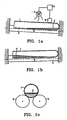
- an optical blood hemostatic analysis apparatus is capable of both rotating and rocking a transparent, approximately cylindrical specimen container (for example, a 12x75 mm glass test tube) while maintaining the container in a nearly horizontal position and at a temperature of approximately 37°C.
- Specimen fluid and a precipitating reagent are introduced into the open end of the container, and are then mixed and incubated by the apparatus.
- FIGS. la and 1 b show a specimen container containing specimen fluid 2, which is supported in a nearly horizontal position on a pair of rotating rollers 3.
- FIG. lc is an end-view of the apparatus shown in FIGS. la and 1b.
- the rollers 3 may be rotated by any convenient means, such as an electrical motor coupled to the rollers either directly or through a drive train (e.g., a belt, gears, or a friction drive).
- the specimen container is rocked longitudinally around an approximate mid-point pivot P through an angle of preferably about ⁇ 3°,as shown by comparing FIG. la with FIGS. lb.
- the rotational rate of the specimen container 1 is typically about 12 rpm, and the rocking rate is typically about 15 cycles per minute.
- the rocking motion may be imparted by a cam or any other convenient means.
- the specific rocking and rotation rates are not necessarily critical but the particular values described above have been found to be effective.
- the specimen fluid 2 does not run out of the open end of a small-diameter specimen container 1 when tilted forward because of the strong surface tension of the contained fluid, aided by the small radius of curvature of the rim of the container 1.
- the precipitating reagent causes the soluble fibrin contained in the diluted whole blood to precipitate out of solution.
- the rocking and rotating motion moves the not-yet-visible fibrin monomer (SF) clumps to a region where all of the SF in the entire sample will accumulate. As they reach this preferred region the clumps interact with SF material already there making the location even more attractive for SF accumulations that are still too small to be detected optically. If the amount of SF is sufficiently large, the SF precipitates will adhere to the inner tube surface and be lifted clear of the reaction mixture.
- the time the precipitates first become optically detectable is defined as the first end point.
- the time the precipitates stick to the tube and rotate with the tube is defined as the second end-point.
- the time that it takes from the start of the process to the first end-point, and to the second-end point are measured.
- the time measurements can be correlated to the quantity of SF by a standard curve.
- the SF standard curve is produced by adding known quantities of SF to native whole blood and analyzing the resulting mixtures.
- the time measurements or both may be used either of the time measurements or both to determine the quantity of SF with a standard curve.
- the time that it takes from the start of the process to the second-end point is easier to measure.
- the first end-point may be the only one available since the precipitates may not be concentrated enough to reach the second end-point.
- the temperature of the specimen fluid can be maintained, for example, by a tungsten filament light bulb 4 situated near the specimen container 1 and controlled by a thermostatic circuit 5 having a temperature sensor 6 adjacent to or in contact with the specimen container 1.
- the temperatures can be maintained by placing the specimen container 1 in an incubated chamber having the desired temperature.
- the time that it takes from the start of the process to the end-points can be measured by a variety of means that detect the end-points.
- a number of different types of end-point detectors can be used in the invention. Examples of types of end-point detectors include, but are not limited to, direct visual observation; a flying spot scanner; a charge couple device (CCD) camera, a detector consisting of a narrow beam of light (e.g., from a small, solid state laser) that is caused to sweep (e.g., by means of an oscillating mirror) the inner wall of the transparent specimen container from a position just outside the open end of the container; and a detector that uses a light beam and a time-delay discriminator circuit which distinguishes the presence of soluble fibrin precipitates from the rocking surface of the blood itself.
- CCD charge couple device
- optical blood hemostatic analysis apparatus described above has been chosen only for the purpose of describing a particular embodiment and function of the invention. Other types of optical apparatus may also be used as long as the apparatus can perform the same function as the one described above. Suitable apparatus would be evident to those of ordinary skill in the art in view of this disclosure.
- the measurement steps are repeated with a second precipitating reagent.
- the measurement method further includes the steps of mixing another portion of the opaque specimen fluid with a second precipitating reagent and repeating steps (a) to (d) described above to obtain a second timing measurement for elapsed time. Then the first timing measurement and the second timing measurement are related to respective standard curves prepared with respective first and second precipitating reagents. The quantity of soluble fibrin present in the opaque body sample is determined by an average of the two measurements.
- the first and the second precipitating reagents may be the same reagents at different concentrations or may be two different reagents.
- portions of an opaque body fluid may be mixed respectively with two or more different concentrations of a precipitating reagent to obtain two or more measurements, and the quantity of SF contained in the specimen fluid may be determined by averaging the measurements.
- portions of an opaque specimen fluid may be mixed with two or more different types of precipitating reagents to achieve the same results.
- a method of determining soluble fibrin with the present invention is used to measure the amount of SF in a whole blood sample treated with thrombin to determine the kinetics of the reaction.
- 2 ml of whole blood was mixed with 0.01 NIH units of thrombin at time zero and 150 ⁇ l aliquots were removed at the times noted.
- Each aliquot was suspended in about 450 ⁇ l of saline solution at pH 5.0 and was placed in a specimen container together with about 20 ⁇ lof the precipitating reagent, protamine sulfate.
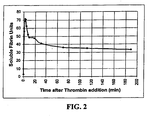
- the time of the appearance of precipitates was measured and recorded in SF units. The results is summarized in Table I.
- FIG. 2 is a plot of the kinetics of the production of SF in whole blood.
- thrombin is added to the reaction mixture.
- the present invention is utilized to perform analyses at intervals of 1-30 minutes. Over an initial period of 3-4 minutes after the addition of a small quantity of thrombin, the SF concentration titer rises.
- the early SF molecules produced can be carried by the fibrinogen and kept from polymerizing as a visible fibrin clot. Following a peak concentration reached at approximately three minutes, the SF present in excess of the carrying capacity of the fibrinogen precipitates out of the mixture in the form of a visible fibrin clot and over the next 30 minutes the level of SF decreases by about 50%. Over the ensuing hours, the SF level declines slightly but is essentially stable for periods in excess of 2 hours.
- the kinetics of the reaction require a test that can be completed within minutes, hence require that the test be performed in whole blood.
- a series of 150 ⁇ l whole blood samples were, at thirty minute intervals, removed from a patient undergoing liver transplantation. These samples were suspended in about 450 ⁇ l saline, and were placed in a specimen container together with about 20 ⁇ l of the precipitating reagent, protamine sulfate.
- the whole blood sample was taken from a patient at the start of the operation, then every 30 minutes with samples spaced more closely during the critical reperfusion phase of the transplantation process.
- the mixture of protamine sulfate and whole blood was placed in a hemostatic analysis apparatus as described in the '188 patent at a temperature of about 37°C to allow the mixture to react until precipitates formed and adhered to the inner tube surface. The time that it took from the start of the process to the first end point, and the second end-point were then measured, and the measurements were correlated to the quantity of SF by a standard curve.
- FIG. 3a is a series of fibrinogen measurements performed on samples from a patient undergoing liver transplantation.
- FIG. 3b shows three other assays performed on the same patient: measurements of D-dimer, fibrin degradation products (FDPs) and soluble fibrin (SF) in relation to the time of liver replacement. Only the SF tests were performed during the actual surgery. The remaining tests were performed on the following day since all of the remaining tests required the preparation of plasma from the whole blood samples and the patient's condition was changing so rapidly that the values were not useful to the operating surgeon. The close correlation of the various measures on all four test methods indicates that the information provide by the SF assay within minutes of the time the sample was drawn is useful for managing a very unstable patient.
- FDPs fibrin degradation products
- SF soluble fibrin
Landscapes
- Health & Medical Sciences (AREA)
- Life Sciences & Earth Sciences (AREA)
- Engineering & Computer Science (AREA)
- Chemical & Material Sciences (AREA)
- Biomedical Technology (AREA)
- Hematology (AREA)
- Immunology (AREA)
- Physics & Mathematics (AREA)
- General Health & Medical Sciences (AREA)
- Molecular Biology (AREA)
- Pathology (AREA)
- General Physics & Mathematics (AREA)
- Biochemistry (AREA)
- Analytical Chemistry (AREA)
- Urology & Nephrology (AREA)
- Food Science & Technology (AREA)
- Medicinal Chemistry (AREA)
- Biophysics (AREA)
- Ecology (AREA)
- Biotechnology (AREA)
- Cell Biology (AREA)
- Microbiology (AREA)
- Investigating Or Analysing Biological Materials (AREA)
- Measuring Or Testing Involving Enzymes Or Micro-Organisms (AREA)
- Absorbent Articles And Supports Therefor (AREA)
Applications Claiming Priority (3)
| Application Number | Priority Date | Filing Date | Title |
|---|---|---|---|
| US388796 | 1999-09-02 | ||
| US09/388,796 US6436655B1 (en) | 1998-02-09 | 1999-09-02 | Rapid quantitative measurement of soluble fibrin in opaque body fluids |
| PCT/US2000/024106 WO2001016360A1 (en) | 1999-09-02 | 2000-09-01 | A rapid quantitative measurement of soluble fibrin in opaque body fluids |
Publications (3)
| Publication Number | Publication Date |
|---|---|
| EP1214448A1 EP1214448A1 (en) | 2002-06-19 |
| EP1214448A4 EP1214448A4 (en) | 2004-12-08 |
| EP1214448B1 true EP1214448B1 (en) | 2008-07-30 |
Family
ID=23535563
Family Applications (1)
| Application Number | Title | Priority Date | Filing Date |
|---|---|---|---|
| EP00961486A Expired - Lifetime EP1214448B1 (en) | 1999-09-02 | 2000-09-01 | A rapid quantitative measurement of soluble fibrin in opaque body fluids |
Country Status (7)
| Country | Link |
|---|---|
| US (2) | US6436655B1 (enExample) |
| EP (1) | EP1214448B1 (enExample) |
| JP (1) | JP4693321B2 (enExample) |
| AT (1) | ATE403012T1 (enExample) |
| AU (1) | AU7343100A (enExample) |
| DE (1) | DE60039702D1 (enExample) |
| WO (1) | WO2001016360A1 (enExample) |
Families Citing this family (23)
| Publication number | Priority date | Publication date | Assignee | Title |
|---|---|---|---|---|
| US6436655B1 (en) * | 1998-02-09 | 2002-08-20 | Medical Devices Corporation | Rapid quantitative measurement of soluble fibrin in opaque body fluids |
| US8478386B2 (en) | 2006-01-10 | 2013-07-02 | Accuvein Inc. | Practitioner-mounted micro vein enhancer |
| US9492117B2 (en) | 2006-01-10 | 2016-11-15 | Accuvein, Inc. | Practitioner-mounted micro vein enhancer |
| US12295744B2 (en) | 2006-01-10 | 2025-05-13 | Accuvein, Inc. | Micro vein enhancer with two lasers and two optical detectors configured for removing surface topology |
| US9854977B2 (en) | 2006-01-10 | 2018-01-02 | Accuvein, Inc. | Scanned laser vein contrast enhancer using a single laser, and modulation circuitry |
| US10238294B2 (en) | 2006-06-29 | 2019-03-26 | Accuvein, Inc. | Scanned laser vein contrast enhancer using one laser |
| US8838210B2 (en) | 2006-06-29 | 2014-09-16 | AccuView, Inc. | Scanned laser vein contrast enhancer using a single laser |
| US12089951B2 (en) | 2006-01-10 | 2024-09-17 | AccuVeiw, Inc. | Scanned laser vein contrast enhancer with scanning correlated to target distance |
| US11253198B2 (en) | 2006-01-10 | 2022-02-22 | Accuvein, Inc. | Stand-mounted scanned laser vein contrast enhancer |
| US11278240B2 (en) | 2006-01-10 | 2022-03-22 | Accuvein, Inc. | Trigger-actuated laser vein contrast enhancer |
| US12471844B2 (en) | 2006-06-29 | 2025-11-18 | Accuvein, Inc. | Scanned laser vein contrast enhancer with full stopping of scanner movement during scan line reversals |
| US12408865B2 (en) | 2006-01-10 | 2025-09-09 | Accuvein Inc. | Vein imaging device with differential image resolution at the center and the extremities of the vein image |
| US8489178B2 (en) | 2006-06-29 | 2013-07-16 | Accuvein Inc. | Enhanced laser vein contrast enhancer with projection of analyzed vein data |
| US10813588B2 (en) | 2006-01-10 | 2020-10-27 | Accuvein, Inc. | Micro vein enhancer |
| US8594770B2 (en) | 2006-06-29 | 2013-11-26 | Accuvein, Inc. | Multispectral detection and presentation of an object's characteristics |
| US8730321B2 (en) | 2007-06-28 | 2014-05-20 | Accuvein, Inc. | Automatic alignment of a contrast enhancement system |
| US8463364B2 (en) | 2009-07-22 | 2013-06-11 | Accuvein Inc. | Vein scanner |
| US9061109B2 (en) | 2009-07-22 | 2015-06-23 | Accuvein, Inc. | Vein scanner with user interface |
| US9072426B2 (en) | 2012-08-02 | 2015-07-07 | AccuVein, Inc | Device for detecting and illuminating vasculature using an FPGA |
| US10376147B2 (en) | 2012-12-05 | 2019-08-13 | AccuVeiw, Inc. | System and method for multi-color laser imaging and ablation of cancer cells using fluorescence |
| CN203289635U (zh) | 2013-05-10 | 2013-11-13 | 瑞声声学科技(深圳)有限公司 | 弹簧板及应用该弹簧板的多功能发声器 |
| WO2016056647A1 (ja) * | 2014-10-10 | 2016-04-14 | 大陽工業株式会社 | 血液凝固の検査用カプセル及びこれを用いた検査方法 |
| CA3159293A1 (en) * | 2019-11-27 | 2021-06-03 | Brian S. Bull | Systems and methods for hemostatic analysis |
Family Cites Families (10)
| Publication number | Priority date | Publication date | Assignee | Title |
|---|---|---|---|---|
| US3915640A (en) * | 1974-08-06 | 1975-10-28 | Warner Lambert Co | Method and composition for detecting fibrin monomers and fibrin degradation products |
| US4210420A (en) | 1978-11-13 | 1980-07-01 | Ortho Diagnostics Inc. | Detection of fibrin monomer and composition therefor |
| WO1985004426A1 (en) * | 1984-03-26 | 1985-10-10 | International Health Services | A method of determining the clotting time of blood and particulate reagents therefor |
| IT1209604B (it) * | 1984-11-27 | 1989-08-30 | Instrumentation Lab Spa | Metodo ed apparecchiatura per la misura di parametri di coagulazione. |
| DD261844A1 (de) | 1986-07-09 | 1988-11-09 | Adw Ddr | Verfahren zur praezipitation von fibrinmonomeren |
| US5716796A (en) | 1990-01-23 | 1998-02-10 | Medical Devices Corporation | Optical blood hemostatic analysis apparatus and method |
| US5184188A (en) | 1990-01-23 | 1993-02-02 | Medical Devices Corporation | Optical blood hemostatic analysis apparatus and method |
| DE4133946A1 (de) * | 1991-10-14 | 1993-04-15 | Behringwerke Ag | Funktioneller test und reagenz zur bestimmung von fibrinogen |
| ATE203824T1 (de) * | 1992-06-09 | 2001-08-15 | Medical Devices Corp | Vorrichtung und verfahren zur optischen, hämostatischen blutanalyse |
| US6436655B1 (en) * | 1998-02-09 | 2002-08-20 | Medical Devices Corporation | Rapid quantitative measurement of soluble fibrin in opaque body fluids |
-
1999
- 1999-09-02 US US09/388,796 patent/US6436655B1/en not_active Expired - Lifetime
-
2000
- 2000-09-01 DE DE60039702T patent/DE60039702D1/de not_active Expired - Lifetime
- 2000-09-01 WO PCT/US2000/024106 patent/WO2001016360A1/en not_active Ceased
- 2000-09-01 AU AU73431/00A patent/AU7343100A/en not_active Abandoned
- 2000-09-01 JP JP2001520905A patent/JP4693321B2/ja not_active Expired - Lifetime
- 2000-09-01 AT AT00961486T patent/ATE403012T1/de not_active IP Right Cessation
- 2000-09-01 EP EP00961486A patent/EP1214448B1/en not_active Expired - Lifetime
-
2002
- 2002-04-29 US US10/136,037 patent/US6777199B2/en not_active Expired - Lifetime
Also Published As
| Publication number | Publication date |
|---|---|
| DE60039702D1 (de) | 2008-09-11 |
| EP1214448A1 (en) | 2002-06-19 |
| EP1214448A4 (en) | 2004-12-08 |
| AU7343100A (en) | 2001-03-26 |
| JP2003508060A (ja) | 2003-03-04 |
| ATE403012T1 (de) | 2008-08-15 |
| WO2001016360A1 (en) | 2001-03-08 |
| US6777199B2 (en) | 2004-08-17 |
| US6436655B1 (en) | 2002-08-20 |
| JP4693321B2 (ja) | 2011-06-01 |
| US20030059836A1 (en) | 2003-03-27 |
Similar Documents
| Publication | Publication Date | Title |
|---|---|---|
| EP1214448B1 (en) | A rapid quantitative measurement of soluble fibrin in opaque body fluids | |
| JP3547894B2 (ja) | 血液の沈降速度決定法及びその装置 | |
| CA2303157A1 (en) | Device for receiving and processing a sample | |
| JP2002519635A (ja) | エカリンと磁性粒子を含む乾式化学試薬を用いてフィブリノーゲンアッセイを行う方法 | |
| WO1989010788A1 (en) | Coagulation assay systems which utilize paramagnetic particles | |
| JP2003508060A5 (enExample) | ||
| US20120003745A1 (en) | Method for measuring physiologically active substance of biological origin, program for implementing the same, and apparatus for measuring physiologically active substance of biological origin | |
| CN103487377B (zh) | 一种全血凝血功能检测仪及检测方法 | |
| CN112969922B (zh) | 用于防止自动分析装置的免疫测定中的异常检测的方法,及免疫测定试剂 | |
| JPS6360862B2 (enExample) | ||
| JP2980468B2 (ja) | フィブリノゲンの定量方法 | |
| Inada et al. | Faster determination of clottable fibrinogen in human plasma: an improved method and kinetic study. | |
| WO2021199178A1 (ja) | ラテックス凝集法による目的物質の測定方法、およびその試薬 | |
| EP0645012B1 (en) | Optical blood hemostatic analysis apparatus and method | |
| JP7327944B2 (ja) | ラテックス凝集法による目的物質の測定方法、およびその試薬 | |
| JPS58172537A (ja) | 光散乱測定装置 | |
| CN203502341U (zh) | 一种全血凝血功能检测仪 | |
| EP0059277A1 (en) | Rapid quantative measurement of fibrinogen in blood plasma | |
| WO2024194898A1 (en) | A multi parameter detection sytem for human and veternary blood samples thereof | |
| CN104977229A (zh) | 全血凝血和粘附功能检测仪及检测方法 | |
| Harmoinen et al. | Fibrinogen: a comparison of an immunoturbidimetric method with four conventional methods | |
| JPS6093353A (ja) | Fdpの免疫学的測定方法 | |
| JPH0694725A (ja) | フィブリノゲン定量乾燥試薬 | |
| CN114942321A (zh) | 用于在单一凝血反应中确定狼疮抗凝物的方法 | |
| JPH0354465A (ja) | 免疫学的測定用希釈液 |
Legal Events
| Date | Code | Title | Description |
|---|---|---|---|
| PUAI | Public reference made under article 153(3) epc to a published international application that has entered the european phase |
Free format text: ORIGINAL CODE: 0009012 |
|
| 17P | Request for examination filed |
Effective date: 20020402 |
|
| AK | Designated contracting states |
Kind code of ref document: A1 Designated state(s): AT BE CH CY DE DK ES FI FR GB GR IE IT LI LU MC NL PT SE |
|
| AX | Request for extension of the european patent |
Free format text: AL;LT;LV;MK;RO;SI |
|
| A4 | Supplementary search report drawn up and despatched |
Effective date: 20041026 |
|
| RIC1 | Information provided on ipc code assigned before grant |
Ipc: 7G 01N 33/49 B Ipc: 7G 01N 21/82 B Ipc: 7C 12Q 1/56 A |
|
| 17Q | First examination report despatched |
Effective date: 20050309 |
|
| GRAP | Despatch of communication of intention to grant a patent |
Free format text: ORIGINAL CODE: EPIDOSNIGR1 |
|
| GRAS | Grant fee paid |
Free format text: ORIGINAL CODE: EPIDOSNIGR3 |
|
| GRAA | (expected) grant |
Free format text: ORIGINAL CODE: 0009210 |
|
| AK | Designated contracting states |
Kind code of ref document: B1 Designated state(s): AT BE CH CY DE DK ES FI FR GB GR IE IT LI LU MC NL PT SE |
|
| REG | Reference to a national code |
Ref country code: GB Ref legal event code: FG4D |
|
| REG | Reference to a national code |
Ref country code: CH Ref legal event code: EP |
|
| REF | Corresponds to: |
Ref document number: 60039702 Country of ref document: DE Date of ref document: 20080911 Kind code of ref document: P |
|
| REG | Reference to a national code |
Ref country code: IE Ref legal event code: FG4D |
|
| PG25 | Lapsed in a contracting state [announced via postgrant information from national office to epo] |
Ref country code: PT Free format text: LAPSE BECAUSE OF FAILURE TO SUBMIT A TRANSLATION OF THE DESCRIPTION OR TO PAY THE FEE WITHIN THE PRESCRIBED TIME-LIMIT Effective date: 20081230 Ref country code: ES Free format text: LAPSE BECAUSE OF FAILURE TO SUBMIT A TRANSLATION OF THE DESCRIPTION OR TO PAY THE FEE WITHIN THE PRESCRIBED TIME-LIMIT Effective date: 20081110 Ref country code: NL Free format text: LAPSE BECAUSE OF FAILURE TO SUBMIT A TRANSLATION OF THE DESCRIPTION OR TO PAY THE FEE WITHIN THE PRESCRIBED TIME-LIMIT Effective date: 20080730 |
|
| PG25 | Lapsed in a contracting state [announced via postgrant information from national office to epo] |
Ref country code: AT Free format text: LAPSE BECAUSE OF FAILURE TO SUBMIT A TRANSLATION OF THE DESCRIPTION OR TO PAY THE FEE WITHIN THE PRESCRIBED TIME-LIMIT Effective date: 20080730 Ref country code: FI Free format text: LAPSE BECAUSE OF FAILURE TO SUBMIT A TRANSLATION OF THE DESCRIPTION OR TO PAY THE FEE WITHIN THE PRESCRIBED TIME-LIMIT Effective date: 20080730 |
|
| PG25 | Lapsed in a contracting state [announced via postgrant information from national office to epo] |
Ref country code: BE Free format text: LAPSE BECAUSE OF FAILURE TO SUBMIT A TRANSLATION OF THE DESCRIPTION OR TO PAY THE FEE WITHIN THE PRESCRIBED TIME-LIMIT Effective date: 20080730 |
|
| PG25 | Lapsed in a contracting state [announced via postgrant information from national office to epo] |
Ref country code: DK Free format text: LAPSE BECAUSE OF FAILURE TO SUBMIT A TRANSLATION OF THE DESCRIPTION OR TO PAY THE FEE WITHIN THE PRESCRIBED TIME-LIMIT Effective date: 20080730 Ref country code: MC Free format text: LAPSE BECAUSE OF NON-PAYMENT OF DUE FEES Effective date: 20080930 |
|
| REG | Reference to a national code |
Ref country code: CH Ref legal event code: PL |
|
| PLBE | No opposition filed within time limit |
Free format text: ORIGINAL CODE: 0009261 |
|
| STAA | Information on the status of an ep patent application or granted ep patent |
Free format text: STATUS: NO OPPOSITION FILED WITHIN TIME LIMIT |
|
| REG | Reference to a national code |
Ref country code: IE Ref legal event code: MM4A |
|
| 26N | No opposition filed |
Effective date: 20090506 |
|
| PG25 | Lapsed in a contracting state [announced via postgrant information from national office to epo] |
Ref country code: IE Free format text: LAPSE BECAUSE OF NON-PAYMENT OF DUE FEES Effective date: 20080901 |
|
| PG25 | Lapsed in a contracting state [announced via postgrant information from national office to epo] |
Ref country code: IT Free format text: LAPSE BECAUSE OF FAILURE TO SUBMIT A TRANSLATION OF THE DESCRIPTION OR TO PAY THE FEE WITHIN THE PRESCRIBED TIME-LIMIT Effective date: 20080730 |
|
| PG25 | Lapsed in a contracting state [announced via postgrant information from national office to epo] |
Ref country code: LI Free format text: LAPSE BECAUSE OF NON-PAYMENT OF DUE FEES Effective date: 20080930 Ref country code: CH Free format text: LAPSE BECAUSE OF NON-PAYMENT OF DUE FEES Effective date: 20080930 |
|
| PG25 | Lapsed in a contracting state [announced via postgrant information from national office to epo] |
Ref country code: SE Free format text: LAPSE BECAUSE OF FAILURE TO SUBMIT A TRANSLATION OF THE DESCRIPTION OR TO PAY THE FEE WITHIN THE PRESCRIBED TIME-LIMIT Effective date: 20081030 |
|
| PG25 | Lapsed in a contracting state [announced via postgrant information from national office to epo] |
Ref country code: LU Free format text: LAPSE BECAUSE OF NON-PAYMENT OF DUE FEES Effective date: 20080901 Ref country code: CY Free format text: LAPSE BECAUSE OF FAILURE TO SUBMIT A TRANSLATION OF THE DESCRIPTION OR TO PAY THE FEE WITHIN THE PRESCRIBED TIME-LIMIT Effective date: 20080730 |
|
| PG25 | Lapsed in a contracting state [announced via postgrant information from national office to epo] |
Ref country code: GR Free format text: LAPSE BECAUSE OF FAILURE TO SUBMIT A TRANSLATION OF THE DESCRIPTION OR TO PAY THE FEE WITHIN THE PRESCRIBED TIME-LIMIT Effective date: 20081031 |
|
| REG | Reference to a national code |
Ref country code: FR Ref legal event code: PLFP Year of fee payment: 17 |
|
| REG | Reference to a national code |
Ref country code: FR Ref legal event code: PLFP Year of fee payment: 18 |
|
| REG | Reference to a national code |
Ref country code: FR Ref legal event code: PLFP Year of fee payment: 19 |
|
| PGFP | Annual fee paid to national office [announced via postgrant information from national office to epo] |
Ref country code: DE Payment date: 20190820 Year of fee payment: 20 Ref country code: FR Payment date: 20190815 Year of fee payment: 20 |
|
| PGFP | Annual fee paid to national office [announced via postgrant information from national office to epo] |
Ref country code: GB Payment date: 20190830 Year of fee payment: 20 |
|
| REG | Reference to a national code |
Ref country code: DE Ref legal event code: R071 Ref document number: 60039702 Country of ref document: DE |
|
| REG | Reference to a national code |
Ref country code: GB Ref legal event code: PE20 Expiry date: 20200831 |
|
| PG25 | Lapsed in a contracting state [announced via postgrant information from national office to epo] |
Ref country code: GB Free format text: LAPSE BECAUSE OF EXPIRATION OF PROTECTION Effective date: 20200831 |