EP1201508A2 - Sicherheitsnetz zur lösbaren Anbringung in einem Fahrzeug - Google Patents
Sicherheitsnetz zur lösbaren Anbringung in einem Fahrzeug Download PDFInfo
- Publication number
- EP1201508A2 EP1201508A2 EP01120833A EP01120833A EP1201508A2 EP 1201508 A2 EP1201508 A2 EP 1201508A2 EP 01120833 A EP01120833 A EP 01120833A EP 01120833 A EP01120833 A EP 01120833A EP 1201508 A2 EP1201508 A2 EP 1201508A2
- Authority
- EP
- European Patent Office
- Prior art keywords
- locking element
- section
- parts
- spring element
- handrail
- Prior art date
- Legal status (The legal status is an assumption and is not a legal conclusion. Google has not performed a legal analysis and makes no representation as to the accuracy of the status listed.)
- Granted
Links
- 239000002184 metal Substances 0.000 claims 1
- 238000010276 construction Methods 0.000 description 4
- 238000006073 displacement reaction Methods 0.000 description 2
- 238000004049 embossing Methods 0.000 description 2
- 230000001133 acceleration Effects 0.000 description 1
- 230000015572 biosynthetic process Effects 0.000 description 1
- 210000000078 claw Anatomy 0.000 description 1
- 230000002093 peripheral effect Effects 0.000 description 1
- 238000000926 separation method Methods 0.000 description 1
- 239000000725 suspension Substances 0.000 description 1
Images



Classifications
-
- B—PERFORMING OPERATIONS; TRANSPORTING
- B60—VEHICLES IN GENERAL
- B60R—VEHICLES, VEHICLE FITTINGS, OR VEHICLE PARTS, NOT OTHERWISE PROVIDED FOR
- B60R21/00—Arrangements or fittings on vehicles for protecting or preventing injuries to occupants or pedestrians in case of accidents or other traffic risks
- B60R21/02—Occupant safety arrangements or fittings, e.g. crash pads
- B60R21/06—Safety nets, transparent sheets, curtains, or the like, e.g. between occupants and glass
Definitions
- the invention relates to a safety net for detachable attachment in a vehicle according to the preamble of claim 1.
- Such safety nets have an upper and a lower one Holding rod on, which are usually provided in the vehicle-side mounting holes are attachable. If necessary, such a safety net be spanned, for example, a separation to reach between a cargo hold and a passenger compartment, and to prevent objects, for example during a Accident or other strong acceleration from the hold in be thrown into the passenger compartment.
- the two handrails are regularly about as long as that Vehicle is wide, and take in case the safety net is not set up, but kept in the vehicle interior should take up a relatively large amount of space due to its length. It it is therefore already known that the handrails can be folded, i.e. collapsible train.
- the articulation In the case of one that has become known but cannot be documented in writing foldable support rod, the articulation consists of two Articulated disks, each containing two holes. In collapsed Position as well as come apart two different bores in the joint discs with each other in flight. In both positions, the handrails can go through two different locking elements are locked, the two Axial washers, i.e. Reach through parallel to the swivel axis. Each locking element is spring-loaded and works with a counter-locking element together, which is also spring-loaded. The counter bolt element is used for manual actuation of the locking element to shift the latter from its locked position to its release position.
- the known arrangement is due to the large number of items relatively complicated training.
- the invention is based on the object of the prior art Security network according to the preamble of claim 1 to further develop that this is constructed more simply.
- the invention solves this problem with the features of the claim 1, in particular those of the identification part, and is accordingly characterized in that the locking element and an actuating section are formed in one piece for releasing the locking element.
- the principle of the invention is essentially instead the two locking elements required in the prior art as well two counter-bolt elements and a total of four spring elements now only provide a locking element, which the support rod secures in their unfolded position. Furthermore is provided for the locking element and the actuating section Loosening the locking element in one piece, creating the possibility is created that only a single spring element for Preloading the locking element into its locked position is necessary is. So there is the possibility of significantly reducing the number of individual parts to reduce.
- the locking element by means of a control surface arranged on one of the two parts controllable.
- This control surface now offers the possibility for a largely automatic displacement of the locking element to ensure from its locked position to its release position that at a pivoting of one part relative to the other part, for example from a folded position to an unfolded position Position, the locking element now automatically off its locking position is pivoted into its release position.
- control surface is arranged in the edge area of one of the two parts. This offers special advantages due to the arrangement on the edge with regard to the generation of the greatest possible torque little effort. There is also the possibility of a Control surface by embossing a, for example, as a joint disc to achieve the trained part. This construction is special simply designed.
- control surface is only along a limited circumferential area one of the two parts arranged.
- This version has the advantage that during the pivoting movement of one part relative to the others the locking element are held in the disengaged position can. As soon as the holes or holes provided in the two parts Recesses for receiving the locking element with each other in When escaping, the locking element can automatically move into its locked position fall in.
- the control surface thus extends to a maximum of in an area of one of the two parts, in which the corresponding Hole for receiving the locking element is.
- the spring element comprises a fastening section for Attachment of the locking element to one of the two parts.
- the Spring element can thus now the function of attachment with take over, it is an indirect attachment of the actual bolt on the spring element on one of the two parts can act. This further reduces the number of individual parts required.
- the spring element comprises the actuating section.
- This Version offers the possibility of a further reduced number of individual parts such that now practically only the leaf spring element is provided, this can also carry the actual bolt and is attached at one end to one of the two parts, and thus also fastened the latch to one of the two parts. At the same time with formed at its other end the operating section. The number the individual parts is thus practically on a single necessary functional part reduced.
- the locking element has a substantially polygonal cross section on.
- a pin-shaped section of the locking element which in Cross section is smaller than the locking element.
- This construction offers the advantage that the pin now axially the two parts can reach through, the locking element at one end of the cone-shaped section can be arranged. Still offers now the possibility at the other end of the cone-shaped Section to provide the operating section, a particular simple construction and assembly becomes possible. For assembly only the pin-shaped section is axially through the entire here Articulated connection inserted and for example the operating section attached to the inserted end. To this The pin-shaped section can thus also the locking element secure to the articulation.
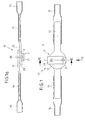
- the two joint disks 12, 13 and thus also the corresponding ones Handrail parts 14, 15, 16, 17 are unfolded between one Position (Fig. 1) and a folded position (Fig. 2) pivotable. For this purpose, they have recesses 29, 30 which are penetrated by a pivot pin 26.
- the longitudinal axis this pivot pin 26 corresponds to a pivot axis A as Geometric swivel axis for swiveling the two joint disks 12, 13 relative to each other.
- a locking element 18 is arranged. This is an axially short one Pin with its right 22 with respect to Figure 3 on the spring element 21 is attached.
- free End 23 of the locking element 18 has control slopes and is, for example chamfered. Alternatively, the left end 23 of the locking element 18 can also be rounded.
- FIG. 3 it can be seen that in relation to FIG right joint disc 12 has a bore 24 and in the with respect to FIG. 3rd left joint disc 13 a bore 25 is arranged.
- Both holes are, as can be seen for example from Fig. 2, as an elongated hole formed and accordingly have a cross section, which is larger than at least in the vertical direction with respect to FIG. 3 Cross section of the locking element 18, which will be explained later.
- Fig. 2 As can be seen indirectly from Fig. 2, is located in in folded position of the holding rod 10, the locking element 18 in its locked position.
- the joint disk 13 is namely 2 pivoted lower joint disc 12 so far that no surfaces of the flexible disc 13 with the locking element 18 are in contact.
- the slot-like design of the two recesses 24, 25 owns the advantage that when swiveling around the axis Z, which due to the very short web length is essentially one represents axial movement, i.e. a movement along essentially an axis parallel to the pivot axis A, the locking element 18th without guidance and without other obstacles from the recess 25 of the flexible disc 13 can emerge.
- the articulated connection 11 in turn comprises two joint-disk-like parts 12, 13 which are essentially circular disk-shaped are trained.
- the two parts 12, 13 are in FIGS. 5 and 6 shown in individual representations in a schematic view.
- Fig. 5 shows the joint disc 15 and illustrates that this is essentially is claw-shaped and has a central recess 35, which has a square cross section.
- the joint disk 13 has, as can be seen in particular from Fig. 6a, a double arrangement of joint disks 13a, 13b, which have an interior space between them I train that serves to accommodate the joint disc 12.
- a recess 34b has a recess 34 arranged therein equally as the recess 35 square cross section having.
- a recess 36 is arranged in the joint disc half 13a, which has a much smaller cross section.
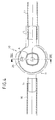
- FIG. 4 shows the assembled joint 11 Joint disks 12, 13, 13a, 13b according to a representation according to Fig. 1.
- the joint disks 12 and 13 can be pivoted relative to one another about an axis A.
- the Articulated disks 12, 13 recesses 29, 30 arranged by be passed through a pivot pin 26.
- a locking element 18 provided which is a substantially square Has cross-section that corresponds to the cross-section of the recess 34 and 35 is adjusted.
- the actual locking element 18 adjoins integrally a peg-shaped section 31, which when viewing the Fig. 8 first penetrates a recess 36 in the joint disc 13.
- the peg-shaped section 31 extends from the joint disk 13a to the left and ends in an operating section 19, which in the embodiment according to FIGS. 7 and 8 as essentially cuboid body is formed.
- the operating section 19 also includes an actuating surface 20, on the one User against the force of a spring element 21 a force in Can exercise direction R.
- the spring element 21 is supported with its one end 32 on the actuating section 19 and with its other end 33 the joint disc 13a.
Landscapes
- Engineering & Computer Science (AREA)
- Mechanical Engineering (AREA)
- Vehicle Step Arrangements And Article Storage (AREA)
- Pivots And Pivotal Connections (AREA)
Abstract
Description
- Fig. 1
- in schematischer, geschnittener Ansicht eine Haltestange eines erfindungsgemäßen Sicherheitsnetzes im Bereich ihrer Gelenkverbindung, wobei die Haltestange in auseinander gefalteter Position dargestellt ist,
- Fig. 1a
- in Unteransicht die Haltestange aus Fig. 1 gemäß Ansichtspfeil 1a,
- Fig. 2
- die Haltestange gemäß Fig. 1 in zusammengeklappter Position,
- Fig. 3
- die Gelenkverbindung der Haltestange gemäß Fig. 1 in Schnittdarstellung gemäß Schnittlinie III-III in einer Darstellung gemäß Fig. 1,
- Fig. 4
- die Gelenkverbindung einer Haltestange gemäß einem zweiten Ausführungsbeispiel der Erfindung,
- Fig. 5
- das gemäß Fig. 4 linke Teil der Gelenkverbindung in Ansicht in Einzeldarstellung,
- Fig. 6
- das gemäß Fig. 4 rechte Teil der Gelenkverbindung in Einzeldarstellung,
- Fig. 6a
- das Teil aus Fig. 6 in teilgeschnittener Ansicht gemäß Schnittlinie VI a-VI a,
- Fig. 7
- die zusammengebaute Gelenkverbindung gemäß Fig. 4 im Schnitt gemäß Schnittlinie VII-VII in Fig. 4 und
- Fig. 8
- die Gelenkverbindung gemäß Fig. 7 mit in Sperrstellung befindlichem Riegelelement.
Claims (20)
- Sicherheitsnetz zur lösbaren Anbringung in einem Fahrzeug, insbesondere in einem KFZ, mit wenigstens einer Haltestange (10), insbesondere einer unteren und einer oberen Haltestange, für das Sicherheitsnetz, die fahrzeugseitig befestigt, insbesondere eingehängt wird, wobei die Haltestange (10) mittels einer zwei um eine gemeinsame Achse (A) gegeneinander verschwenkbare Teile (12, 13, 13a, 13b) umfassenden Gelenkverbindung (11) faltbar ausgebildet ist, und wobei ein Riegelelement (18) zur Sicherung der Haltestange (10) in der auseinandergefalteten Position vorgesehen ist, welches im wesentlichen axial, d.h. im wesentlichen parallel zur Schwenkachse (A), verlagerbar ist, dadurch gekennzeichnet, daß das Riegelelement (18) und ein Betätigungsabschnitt (19) zum Lösen des Riegelelementes (18) einstückig ausgebildet sind.
- Vorrichtung nach Anspruch 1, dadurch gekennzeichnet, daß das Riegelelement (18), mittels einer an einem der beiden Teile (12, 13, 13a, 13b) angeordneten Steuerfläche (28) steuerbar ist.
- Vorrichtung nach Anspruch 2, dadurch gekennzeichnet, daß die Steuerfläche (28) im Randbereich eines der beiden Teile (12, 13, 13a, 13b) angeordnet ist.
- Vorrichtung nach Anspruch 2 oder 3, dadurch gekennzeichnet, daß die Steuerfläche (28) nur entlang einem begrenzten Umfangsbereich eines der beiden Teile (12, 13, 13a,13b) angeordnet ist.
- Vorrichtung nach einem der vorangegangenen Ansprüche, dadurch gekennzeichnet, daß der Riegelbolzen (28) in seine Sperrstellung hinein mittels eines Federelementes (21) federbelastet ist.
- Vorrichtung nach einem der vorangegangenen Ansprüche, dadurch gekennzeichnet, daß das Federelement (21) einen Befestigungsabschnitt (27) zur Befestigung des Riegelelementes (18) an einem der beiden Teile (12, 13, 13a, 13b) umfasst.
- Vorrichtung nach Anspruch 5 oder 6, dadurch gekennzeichnet, daß das Federelement (21) als Blattfederelement ausgebildet ist.
- Vorrichtung nach einem der Ansprüche 5 bis 7, dadurch gekennzeichnet, daß das Federelement (21) das Riegelelement (18) trägt.
- Vorrichtung nach einem der Ansprüche 5 bis 8, dadurch gekennzeichnet, daß das Federelement (21) den Betätigungsabschnitt (19) umfasst.
- Vorrichtung nach einem der Ansprüche 5 bis 9, dadurch gekennzeichnet, daß das Federelement (21) im Bereich der Schwenkachse (A) an einem der beiden Teile (12, 13, 13a, 13b) befestigt ist.
- Vorrichtung nach einem der vorangegangenen Ansprüche, dadurch gekennzeichnet, daß das Riegelelement (18) entlang einer Kurvenbahn verlagerbar ist.
- Vorrichtung nach Anspruch 11, dadurch gekennzeichnet, daß die Kurvenbahn eine Kurvenachse (Z) aufweist, die im wesentlichen senkrecht zu der Schwenkachse (A) steht.
- Vorrichtung nach einem der vorangegangenen Ansprüche, dadurch gekennzeichnet, daß in dem ersten Teil (12) und dem zweiten Teil (13, 13a, 13b) Ausnehmungen (34, 35) angeordnet sind, die einen auf den Querschnitt des Riegelelementes (18) abgestimmten Querschnitt aufweisen.
- Vorrichtung nach einem der vorangegangenen Ansprüche, dadurch gekennzeichnet, daß das Riegelelement (18) einen im wesentlichen polygonalen Querschnitt aufweist
- Vorrichtung nach einem der vorangegangenen Ansprüche, dadurch gekennzeichnet, daß wenigstens eines der beiden Teile (12, 13, 13a, 13b) als Gelenkscheibe ausgebildet ist.
- Vorrichtung nach einem der vorangegangenen Ansprüche, dadurch gekennzeichnet, daß eines der beiden Teile (12, 13, 13a, 13b) spangenförmig ausgebildet ist und das andere Teil (12) umgreift.
- Vorrichtung nach einem der vorangegangenen Ansprüche, dadurch gekennzeichnet, daß dem Riegelelement (18) ein zapfenförmiger Abschnitt (31) zugeordnet ist, der im Querschnitt kleiner ausgebildet ist als das Riegelelement (18).
- Vorrichtung nach Anspruch 17, dadurch gekennzeichnet, daß das der zapfenförmige Abschnitt (31) an seinem einem Ende das Riegelelement (18) und an seinem anderen Ende den Betätigungsabschnitt (19) trägt.
- Vorrichtung nach Anspruch 18, dadurch gekennzeichnet, daß zwischen dem Betätigungsabschnitt (19) und einer Außenfläche eines der beiden Teile (13a) ein Federelement (21) angeordnet ist.
- Vorrichtung nach einem der vorangegangenen Ansprüche, dadurch gekennzeichnet, daß das Riegelelement (18) aus Metall besteht.
Applications Claiming Priority (2)
| Application Number | Priority Date | Filing Date | Title |
|---|---|---|---|
| DE10054080 | 2000-10-31 | ||
| DE10054080A DE10054080C1 (de) | 2000-10-31 | 2000-10-31 | Sicherheitsnetz zur lösbaren Anbringung in einem Fahrzeug |
Publications (3)
| Publication Number | Publication Date |
|---|---|
| EP1201508A2 true EP1201508A2 (de) | 2002-05-02 |
| EP1201508A3 EP1201508A3 (de) | 2003-11-26 |
| EP1201508B1 EP1201508B1 (de) | 2005-03-02 |
Family
ID=7661753
Family Applications (1)
| Application Number | Title | Priority Date | Filing Date |
|---|---|---|---|
| EP01120833A Expired - Lifetime EP1201508B1 (de) | 2000-10-31 | 2001-08-30 | Sicherheitsnetz zur lösbaren Anbringung in einem Fahrzeug |
Country Status (2)
| Country | Link |
|---|---|
| EP (1) | EP1201508B1 (de) |
| DE (2) | DE10054080C1 (de) |
Families Citing this family (1)
| Publication number | Priority date | Publication date | Assignee | Title |
|---|---|---|---|---|
| DE102007052228A1 (de) * | 2007-10-23 | 2009-06-10 | Bos Gmbh & Co. Kg | Zusammenlegbare Trenneinrichtung für ein Kraftfahrzeug |
Family Cites Families (7)
| Publication number | Priority date | Publication date | Assignee | Title |
|---|---|---|---|---|
| DE3909397A1 (de) * | 1989-03-22 | 1990-10-04 | Bayerische Motoren Werke Ag | Fahrzeugsitz mit einer rueckenlehne |
| US5288122A (en) * | 1990-02-16 | 1994-02-22 | Ab Volvo | Load restraining device |
| DE4010209C2 (de) * | 1990-03-30 | 1994-03-10 | Baumeister & Ostler Gmbh Co | Sicherheitsnetz |
| DE4128701A1 (de) * | 1990-09-08 | 1992-03-12 | Volkswagen Ag | Schutzwand zur abtrennung des fahrgastraumes eines kraftfahrzeuges von einem dahinter gelegenen laderaum |
| DE19540934C2 (de) * | 1995-11-03 | 1998-10-29 | Opel Adam Ag | Trennwand zum variablen Abtrennen eines Ladebereiches eines Kraftfahrzeuges von einem Fahrgastraum |
| FR2741019B1 (fr) * | 1995-11-13 | 1998-01-30 | Soie | Dispositif de retenue de charges hautes dans un vehicule |
| DE19944003C1 (de) * | 1999-09-14 | 2001-03-22 | Baumeister & Ostler Gmbh Co | Faltbare Trenneinrichtung |
-
2000
- 2000-10-31 DE DE10054080A patent/DE10054080C1/de not_active Expired - Lifetime
-
2001
- 2001-08-30 EP EP01120833A patent/EP1201508B1/de not_active Expired - Lifetime
- 2001-08-30 DE DE50105459T patent/DE50105459D1/de not_active Expired - Lifetime
Non-Patent Citations (1)
| Title |
|---|
| None |
Also Published As
| Publication number | Publication date |
|---|---|
| DE10054080C1 (de) | 2001-11-08 |
| DE50105459D1 (de) | 2005-04-07 |
| EP1201508B1 (de) | 2005-03-02 |
| EP1201508A3 (de) | 2003-11-26 |
Similar Documents
| Publication | Publication Date | Title |
|---|---|---|
| DE4118683C1 (de) | ||
| DE4012860A1 (de) | Fahrzeugsitz, insbesondere kraftfahrzeugsitz | |
| DE3402065C1 (de) | Schutzeinrichtung zum Verhindern der Beruehrung mindestens eines sich drehenden Teiles | |
| EP1449711A2 (de) | Klappbarer Fahrzeugsitz | |
| DE68902445T2 (de) | Anhaengerkupplung. | |
| DE19740776C1 (de) | Umklappbare Rückenlehne für eine Sitzbank | |
| DE69022231T2 (de) | Drehbare leiter. | |
| DE202007019498U1 (de) | Sicherungseinrichtung | |
| DE3105142A1 (de) | Verriegelungsvorrichtung fuer die kopfstuetze von kraftfahrzeugen | |
| DE69502143T2 (de) | Vorrichtung zum Schnellverbinden eines Kindersitzes mit einem Kraftwagensitz | |
| DE2819763C2 (de) | Abnehmbare Fahrzeug-Anhängerkupplung | |
| EP0342262A1 (de) | Zusammenklappbare Stange, insbesondere zum Schleppen von Fahrzeugen | |
| EP3549417A1 (de) | Lenkeranordnung für einen dreipunkt-kraftheber eines traktors oder einer sonstigen landwirtschaftlichen arbeitsmaschine sowie dreipunkt-kraftheber | |
| DE69111690T2 (de) | Vorrichtung zum automatischen Kuppeln einer Sicherheitsgurtverankerung mit dem Boden eines Fahrzeuges. | |
| DE10054080C1 (de) | Sicherheitsnetz zur lösbaren Anbringung in einem Fahrzeug | |
| DE10063466A1 (de) | Vorrichtung zur Aufnahme einer flexiblen, insbesondere von einer Wickelwelle entgegen der Wirkung eines Federmotors abziehbaren Werkstoffbahn einer Kfz-Sicherheitseinrichtung | |
| DE7411475U (de) | Abschleppstange für Kraftfahrzeuge | |
| EP1101634B1 (de) | Anhängevorrichtung und Verfahren zur Herstellung einer solchen | |
| DE60204084T2 (de) | Pflugscharanker | |
| DE2723073C2 (de) | ||
| DE10104186A1 (de) | Anhängerkupplung | |
| DE69919570T2 (de) | Befestigungsvorrichtung eines abnehmbaren sitzes an einem kraftfahrzeugboden | |
| DE3443852A1 (de) | Geraet fuer das ausbringen einer leine oder dergleichen flexiblen stranges | |
| DE10056083B4 (de) | Vorrichtung zur Entriegelung und Verriegelung | |
| EP1201507B1 (de) | Sicherheitsnetz zur lösbaren Anbringung in einem Fahrzeug |
Legal Events
| Date | Code | Title | Description |
|---|---|---|---|
| PUAI | Public reference made under article 153(3) epc to a published international application that has entered the european phase |
Free format text: ORIGINAL CODE: 0009012 |
|
| AK | Designated contracting states |
Kind code of ref document: A2 Designated state(s): AT BE CH CY DE DK ES FI FR GB GR IE IT LI LU MC NL PT SE TR |
|
| AX | Request for extension of the european patent |
Free format text: AL;LT;LV;MK;RO;SI |
|
| PUAL | Search report despatched |
Free format text: ORIGINAL CODE: 0009013 |
|
| AK | Designated contracting states |
Kind code of ref document: A3 Designated state(s): AT BE CH CY DE DK ES FI FR GB GR IE IT LI LU MC NL PT SE TR |
|
| AX | Request for extension of the european patent |
Extension state: AL LT LV MK RO SI |
|
| RAP1 | Party data changed (applicant data changed or rights of an application transferred) |
Owner name: BOS GMBH & CO. KG |
|
| 17P | Request for examination filed |
Effective date: 20031205 |
|
| AKX | Designation fees paid |
Designated state(s): DE FR GB SE |
|
| GRAP | Despatch of communication of intention to grant a patent |
Free format text: ORIGINAL CODE: EPIDOSNIGR1 |
|
| GRAS | Grant fee paid |
Free format text: ORIGINAL CODE: EPIDOSNIGR3 |
|
| GRAA | (expected) grant |
Free format text: ORIGINAL CODE: 0009210 |
|
| AK | Designated contracting states |
Kind code of ref document: B1 Designated state(s): DE FR GB SE |
|
| REG | Reference to a national code |
Ref country code: GB Ref legal event code: FG4D Free format text: NOT ENGLISH |
|
| REG | Reference to a national code |
Ref country code: SE Ref legal event code: TRGR |
|
| REG | Reference to a national code |
Ref country code: IE Ref legal event code: FG4D Free format text: GERMAN |
|
| REF | Corresponds to: |
Ref document number: 50105459 Country of ref document: DE Date of ref document: 20050407 Kind code of ref document: P |
|
| GBT | Gb: translation of ep patent filed (gb section 77(6)(a)/1977) |
Effective date: 20050621 |
|
| ET | Fr: translation filed | ||
| PLBE | No opposition filed within time limit |
Free format text: ORIGINAL CODE: 0009261 |
|
| STAA | Information on the status of an ep patent application or granted ep patent |
Free format text: STATUS: NO OPPOSITION FILED WITHIN TIME LIMIT |
|
| 26N | No opposition filed |
Effective date: 20051205 |
|
| PGFP | Annual fee paid to national office [announced via postgrant information from national office to epo] |
Ref country code: GB Payment date: 20080822 Year of fee payment: 8 |
|
| GBPC | Gb: european patent ceased through non-payment of renewal fee |
Effective date: 20090830 |
|
| PG25 | Lapsed in a contracting state [announced via postgrant information from national office to epo] |
Ref country code: GB Free format text: LAPSE BECAUSE OF NON-PAYMENT OF DUE FEES Effective date: 20090830 |
|
| PGFP | Annual fee paid to national office [announced via postgrant information from national office to epo] |
Ref country code: SE Payment date: 20120823 Year of fee payment: 12 |
|
| PGFP | Annual fee paid to national office [announced via postgrant information from national office to epo] |
Ref country code: FR Payment date: 20120831 Year of fee payment: 12 |
|
| REG | Reference to a national code |
Ref country code: SE Ref legal event code: EUG |
|
| PG25 | Lapsed in a contracting state [announced via postgrant information from national office to epo] |
Ref country code: SE Free format text: LAPSE BECAUSE OF NON-PAYMENT OF DUE FEES Effective date: 20130831 |
|
| REG | Reference to a national code |
Ref country code: FR Ref legal event code: ST Effective date: 20140430 |
|
| PG25 | Lapsed in a contracting state [announced via postgrant information from national office to epo] |
Ref country code: FR Free format text: LAPSE BECAUSE OF NON-PAYMENT OF DUE FEES Effective date: 20130902 |
|
| PGFP | Annual fee paid to national office [announced via postgrant information from national office to epo] |
Ref country code: DE Payment date: 20150907 Year of fee payment: 15 |
|
| REG | Reference to a national code |
Ref country code: DE Ref legal event code: R119 Ref document number: 50105459 Country of ref document: DE |
|
| PG25 | Lapsed in a contracting state [announced via postgrant information from national office to epo] |
Ref country code: DE Free format text: LAPSE BECAUSE OF NON-PAYMENT OF DUE FEES Effective date: 20170301 |