EP1183504B1 - Method of ion trapping and mass spectrometric analysis with enhanced sensitivity - Google Patents
Method of ion trapping and mass spectrometric analysis with enhanced sensitivity Download PDFInfo
- Publication number
- EP1183504B1 EP1183504B1 EP00930931A EP00930931A EP1183504B1 EP 1183504 B1 EP1183504 B1 EP 1183504B1 EP 00930931 A EP00930931 A EP 00930931A EP 00930931 A EP00930931 A EP 00930931A EP 1183504 B1 EP1183504 B1 EP 1183504B1
- Authority
- EP
- European Patent Office
- Prior art keywords
- ions
- mass
- ion
- precursor
- mass analyzer
- Prior art date
- Legal status (The legal status is an assumption and is not a legal conclusion. Google has not performed a legal analysis and makes no representation as to the accuracy of the status listed.)
- Expired - Lifetime
Links
Images




Classifications
-
- H—ELECTRICITY
- H01—ELECTRIC ELEMENTS
- H01J—ELECTRIC DISCHARGE TUBES OR DISCHARGE LAMPS
- H01J49/00—Particle spectrometers or separator tubes
- H01J49/004—Combinations of spectrometers, tandem spectrometers, e.g. MS/MS, MSn
-
- H—ELECTRICITY
- H01—ELECTRIC ELEMENTS
- H01J—ELECTRIC DISCHARGE TUBES OR DISCHARGE LAMPS
- H01J49/00—Particle spectrometers or separator tubes
- H01J49/26—Mass spectrometers or separator tubes
- H01J49/34—Dynamic spectrometers
- H01J49/42—Stability-of-path spectrometers, e.g. monopole, quadrupole, multipole, farvitrons
- H01J49/4205—Device types
- H01J49/422—Two-dimensional RF ion traps
- H01J49/4225—Multipole linear ion traps, e.g. quadrupoles, hexapoles
Definitions
- This invention relates to a method of and apparatus for enhancing the performance of MS/MS mass spectrometers that involve two sequential mass analyzing steps. This invention more particularly relates to such a technique effective in a mass spectrometer with axial ejection from a linear ion trap with axial ejection.
- MS1 mass spectrometer
- MS2 mass resolving quadrupole
- MS2 mass resolving quadrupole
- Q1, Q2 and Q3 are commonly referred to as Q1, Q2 and Q3 respectively and the ion path is often referred to as QqQ, where Q denotes a quadrupole rod set that can be operated in a mass resolving mode, and q a rod set used for collision induced dissociation and fragmentation.
- Q0 a further upstream rod set, commonly denoted Q0, which is operated just as an ion guide. It serves to focus the ions and further eliminate gas from the ion stream, usually generated by an atmospheric source.
- MS/MS experiments can be carried out in such instruments and involve choosing specific precursor ions with Q1, fragmenting the precursor ions in a pressurized Q2 via collisions with neutral gas molecules to produce fragment or product ions, and mass resolving the product ions with Q3.
- This technique has proven to be very valuable for identifying compounds in complex mixtures and in determining structures of unknown substances.
- Several possible scanning modes of MS/MS operation are well known and these are:
- m/z value of a precursor ion, a product ion, or an ion generating a given neutral fragment ion can be determined using MS/MS techniques.
- MS/MS techniques generally provide better detection limits than a single stage of mass analysis due to the reduction of chemical noise which is the signal due to generation of ions from other components within the sample, the solute, or the environment surrounding the ion source or within the mass spectrometer itself. MS/MS reduces this nonspecific ion signal and results in better signal-to-noise even though there are two stages of mass resolution which reduce the total number of ions at the detector.
- MS/MS instruments based on scanning mass spectrometers, such as quadrupoles, reject the majority of ions formed at any given time within the scan cycle; the essence of scanning is to select a narrow m/z range for further analysis and reject all other ions. Thus, these instruments have inherently poor duty cycles.
- Triple quadrupole mass spectrometers are often referred to as "tandem in space” devices since the precursor ion isolation, fragmentation, and fragment ion mass resolution are effected with different ion optical elements located at physically different locations in the ion path.
- Ion trap mass spectrometers have potentially much greater duty cycles than such tandem in space quadrupole mass spectrometers since all of the ions within the mass spectrometer can be scanned out and detected.
- the origin of this duty cycle enhancement arises from the fact that ion trap mass spectrometers are typically filled with a short pulse (typically 5-25 ms) of ions from which a complete mass spectrum is generated.
- a conventional beam type or tandem in space quadrupole mass spectrometer can only acquire mass spectral information over a very small mass range.
- Hybrid MS/MS instruments such as QqTOF instruments, in which the final stage of mass analysis (MS2) is accomplished via a non-scanning time of flight (TOF) mass spectrometer have a duty cycle advantage over QqQ instruments in that the TOF section is not a scanning mass spectrometer, and all of the ions in the product ion mode are collected within a few hundred microseconds. These instruments are typically 10-100 times more sensitive than conventional QqQ instruments in the product ion scan mode of operation.
- the technique relies upon emitting ions into the entrance of a rod set, for example a quadrupole rod set and trapping the ions at the far end by producing a barrier field at an exit member.
- An RF field is applied to the rods, at least adjacent to the barrier member.
- the barrier member is supplied with a barrier field to trap ions, and the barrier and RF fields interact in an extraction region adjacent to the exit end of the rod set and the barrier member, to produce a fringing field. Ions in the extraction region are energized, to eject, mass selectively, at least some ions of a selected mass-to-charge ratio axially from the rod set and past the barrier field. The ejected ions can then be detected.
- Ions exiting from the collision cell are detected with a time of flight mass spectrometer.
- the time of flight mass spectrometer is advantageously arranged orthogonally to the collision cell.
- the ions can be pre-trapped in a first quadrupole rod set upstream of the first mass analyzer, so that the ions can then be admitted as pulses into the first mass analyzer. Then, a further quadrupole rod set can be provided as the first mass analyzer, for selecting the precursor ions.
- the method of the present invention can include effecting a precursor scan by scanning the fragment ions out of the collision cell and detecting a selected ion or ions and stepping the first mass analyzer through a range of mass-to-charge ratios to select a range of precursor ions for recording against the selected ion or ions detected.
- the method can be used to effect a neutral loss scan, the method comprising selecting a precursor ion in the first mass analyzer having a first mass-to-charge ratio and detecting fragment ions having a second mass-to-charge ratio leaving the collision cell, wherein the method comprises maintaining a fixed neutral mass difference between the first and second mass-to-charge ratios and stepping the first and second mass-to-charge ratios through desired ranges.
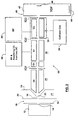
- an apparatus for use with the present invention is indicated generally by the reference 10.
- the apparatus 10 includes an ion source 12, which may be an electrospray, an ion spray, a corona discharge device or any other known ion source. Ions from source 12 are directed through an aperture 14 in an aperture plate 16.
- a current gas chamber 18 On the other side of the plate 16, there is a current gas chamber 18 which is supplied with curtain gas from a source (not shown).
- the curtain gas can be argon, nitrogen or other inert gas, such as described in U.S. patent 4,861,988 , Cornell Research Foundation Inc., which also discloses a suitable ion spray device.
- the ions then pass through an orifice 19 in an orifice plate 20 into a differentially pumped vacuum chamber 21.
- the ions then pass through an aperture 22 in a skimmer plate 24 into a first chamber 26.
- Standard auxiliary equipment, such as pumps, is not shown in any of the drawings, for simplicity.
- the chamber 26 there is a standard RF-only multipole ion guide Q0. Its function is to cool and focus the ions, and it is assisted by the relatively high gas pressure present in this chamber 26.
- This chamber 26 also serves to provide an interface between the atmospheric pressure ion source and the lower pressure vacuum chambers, thereby serving to remove more of the gas from the ion stream, before further processing.
- An interquad aperture IQ1 separates the chamber 26 from the second main vacuum chamber 30.
- the main chamber 30 there are RF-only rods labelled ST (short for "stubbies", to indicate rods of short axial extent) which serve as a Brubaker lens.
- a quadrupole rod set Q1 is located in the vacuum chamber 30, and this is evacuated to less than 5 x 10 -5 torr, preferably approximately 1 x 10 -5 torr.
- a second quadrupole rod set Q2 is located in a collision cell 32, supplied with collision gas at 34, such as nitrogen.
- the cell 32 is within the chamber 30 and includes interquad apertures IQ2, IQ3 at either end.
- the collision cell 32 As the collision cell 32 is used for trapping, as detailed below, it is maintained at a pressure of around 5 x 10 -4 torr.
- Power supplies 36, for RF and resolving DC, and 38, for RF, resolving DC and auxiliary AC are provided, connected to the quadrupoles Q1, Q2 respectively.
- Q1 is a standard resolving RFIDC quadrupole.
- the RF and DC voltages are chosen to transmit only the ions of interest into Q2.
- Q2 is a linear rod type ion trap with axial ejection as disclosed in WO 99/63578 and WO97/47025 .
- Q2 is supplied with collision gas from source 34 to dissociate precursor ions or fragment them to produce fragment or product ions.
- the product ions and residual precursor ions are trapped in Q2 by a suitably repulsive DC voltage applied to IQ3.
- RF a small amount of resolving DC (if desired), and AC voltages from power supply 38 are applied to the Q2 rods.
- the fringing fields at the exit of the Q2 linear ion trap couple the radial and axial degrees of freedom so that they are no longer orthogonal.
- scanning the RF voltage, i.e, increasing the RF voltage in amplitude, applied to the Q2 rods results in ions being ejected from the Q2 linear trap when they come into resonance
- the auxiliary AC voltage also applied to the Q2 rods.
- the AC voltage may be chosen to be phase locked and synchronized so that of the RF voltage, although this is not necessary.
- ions may be scanned out of the linear ion trap in the absence of an auxiliary AC field by making use of the high q-value cutoff near 0.9. Note that, in this later case using scanning at the q-value cutoff at 0.9 and also when a fixed AC signal is applied to the rods and the RF signal scanned in amplitude, ions are ejected axially and radially. It has been found that approximately 18% of ions are ejected axially, which gives an acceptable efficiency.
- a precursor ion scan function is carried out in the following fashion.
- a pulse of ions is extracted from Q0 by applying a suitable DC voltage pulse to lens IQ1 and are allowed to pass through Q1.
- Q1 is a standard RF/DC quadrupole mass analyzer as mentioned above; it is not operated as an ion trap, but it does mass select a precursor ion of interest.
- the precursor ions that have been mass selected by Q1 are accelerated by a predetermined voltage difference into the Q2 linear ion trap which is pressurized with collision gas.
- the energy of the precursor ions causes them to collide with the gas and dissociate into fragment ions.
- the fragment ions and residual precursor ions are trapped in Q2 by a suitably repulsive DC voltage applied to lens IQ3.
- the fragment ions of interest are then mass resolved by the Q2 linear ion trap preferably by scanning the RF voltage applied to the Q2 rods in the presence of a fixed frequency AC voltage also applied to the Q2 rods.
- a fixed frequency AC voltage also applied to the Q2 rods.
- the resonantly excited ions in the exit fringing field region gain sufficient energy to overcome the DC repulsive voltage on IQ3 and are ejected axially toward the TOF.
- ions may be mass selectively ejected from the linear ion trap in the axial direction using several other techniques.
- the frequency of the auxiliary AC field applied either to rods comprising the linear ion trap or to the barrier of IQ3 can be scanned in the presence of fixed RF voltage.
- Ions can also be mass selectively ejected toward the TOF by scanning the RF voltage on the rods of the linear ion trap without auxiliary AC. In this case ions are ejected at a q-value near 0.9.
- the Q1 mass is incremented by a predetermined amount and then the process is repeated.
- the scan speed of this approach can be estimated from the fact that the filling and scanning out of the ion(s) of interest from the Q2 ion trap requires a minimum of about 10-20 ms. Thus for a scan range of 1000 amu and a Q1 scanning step size of 1 amu the scan will require 10 to 20 seconds. It is sometimes desirable to include an additional step of emptying any remaining ions within the Q2 linear trap by suitably reducing the RF voltage applied to the Q2 rods. This can be done very rapidly (less than 2 ms) and will only slightly affect the time of the experiment.
- the TOF stage 40 can be operated in the mass independent "total ion" mode in which the TOF ion extraction voltage is not pulsed but rather simply used to redirect ions to detector 44.
- the ions can still be routed through the TOF section while it is operating in resolving mode which allows the efficient mass resolution powers of the TOF to be used at the expense of signal intensity. It is desirable in this mode of operation to synchronize the TOF ion extraction pulsing electronics with the scanning of the Q1 linear ion trap. For example the TOF extraction electronics should be pulsed at every Q2 scan increment to achieve maximum sensitivity.
- Enhanced sample utilization efficiency also results from operation of the collision cell as a linear ion trap since the mass spectral response of the predetermined product ions can be generated for each short pulse of ions emerging from Q0.
- a 25 ms pulse of ions emerging from Q0 being mass selected by Q1 and fragmented by accelerating these ions by the voltage drop between Q1 and the linear ion trap Q2.
- Neutral loss scans can be accomplished in a similar fashion with similar performance enhancements.
- a pulse of ions is extracted from Q0 by applying a suitable DC voltage pulse to lens IQ1 and is allowed to pass through Q1 into the Q2 linear ion trap which is pressurized with collision gas to dissociate precursor ions into fragment ions.
- Q1 is operated in a mass resolving mode.
- the fragment ions and any residual precursor ions are trapped in Q2 by a suitably repulsive DC voltage applied to lens IQ3.
- the fragment ions with a pre-selected mass difference relative to the precursor ion are then scanned axially out of Q2 mass selectively toward the orthogonal TOF 40, which is operated in total ion mode.
- the ions are scanned out of the linear ion trap preferably by applying an auxiliary AC signal to the Q2 rods and scanning the RF voltage.
- the other alternative techniques described above for mass selective axial ejection from a linear ion trap are also applicable for this enhanced neutral loss method.
- the mass selected in Q1 and mass scanned out of the trap Q2 are incremented by the same predetermined amount to maintain a neutral ion scan and the process is repeated.
- the TOF section 40 can again be bypassed using the straight through detector 46, which does not form part of the invention as claimed, to obtain maximum ion signal intensity; or as detailed above the TOF can be in total ion mode with the TOF extraction electronics operated continuously detecting ions at detector 44. Alternatively, the ions can still be routed through the TOF section while it is operating in resolving mode which allows the excellent mass resolution powers of the TOF to be used at the expense of signal intensity. Again synchronization of the ion extraction pulses of the TOF and the Q2 linear ion trap scanning increment will produce the best results.
- the duty cycle and sample utilization advantages from using the collision cell as a mass selective linear ion trap discussed above for a precursor/parent ion scan are also applicable to the neutral loss scan mode and will further enhance instrument sensitivity and thus enhanced scan speeds.
- the intention of the present invention is to operate the collision cell as a mass resolving device allowing the downstream mass spectrometer to be operated in total ion mode leading to enhanced sensitivity and ultimately greater scan speeds.
- a multipole ion guide that can be configured as an ion trap, to improve the duty cycle by storing ions and releasing their pulses as taught by U.S. patent 5,179,278 .
- QO is a standard RF-only multipole ion guide in a chamber evacuated to a pressure of about 7mTorr.
- the RF-only rods labelled ST serve as a Brubaker lens.
- Q1 and Q2 are located in the downstream vacuum chamber 30 again evacuated to about 10 -5 torr.
- a power supply 62, for RF, resolving DC and auxiliary AC is connected to the rod set Q1 and a power supply 64 just for RF is connected to the rod set Q2.
- Q1 is operated as a low pressure rod type linear ion trap with axial ejection as is disclosed in WO 99/63578 , and again a pressure of less than 5 x 10 -5 torr.
- the Q1 linear ion trap rods are supplied with RF voltage, low level resolving DC, (if desired) and AC voltage (if desired) from power supply 67
- Q2 is operated as a standard Ref only collision cell with RF voltage supplied by power supply 64 and collision gas from supply 34, i.e. without resolving DC and without any auxiliary AC signal.
- the collision cell is maintained at a pressure of 5 mTorr.
- a precursor ion scan function is carried out in the following fashion. Ions are pre-trapped in QO by a suitable repulsive voltage on lens IQ1, into Q1 with a concurrently applied repulsive voltage to lens IQ2 thereby trapping the ions in Q1. These trapped ions within Q1 are then mass selectively scanned out of the Q1 trap by screening the RF voltage applied to the Q1 rods. The extracted ions are then accelerated into the pressurized Q2 to dissociate precursor ions into fragment ions. It is desirable to operate the Q2 collision cell with an axial field to maintain good temporal characteristics of the ions through the neutral gas.
- the residual precursor and fragment ions are then mass resolved with the TOF mass spectrometer 40 and the intensity of the product ion of interest is plotted vs. Q1 mass scale to provide a precursor ion scan. Since the TOF 40 provides the final stage of mass analysis and because a complete product ion mass spectrum is acquired at each mass position of Q1 a complete set of precursor ion, product ion, and neutral loss spectra are obtained.
- the TOF extraction electronics should be pulsed at every Q1 scan increment to achieve maximum sensitivity.
- This mode of operation and performance enhancements are generally applicable to Qq(MS) instruments such as conventional QqQ triple quadrupole mass spectrometers, although the complete set of precursor ion, product ion, and neutral loss spectra re only obtained if the second stage of mass spectrometry is carried out by a non-scanning mass spectrometer such as a time of flight mass spectrometer.
- Ions are directed from ion source 12 through the aperture 14 into the curtain gas chamber 18 into a differentially pumped region 21 maintained at a pressure of about 2 torr.
- the ions then pass through a skimmer orifice 22 in the skimmer plate 24 and into the first main vacuum chamber 26 evacuated to a pressure of about 7 mTorr and containing the rod set QO. Following this is the second vacuum chamber 30.
- the main vacuum chamber 30 houses four rod arrays: ST, Q1, Q2 and Q3, and a conventional ion detector, here indicated at 76. Interquad apertures IQ1, 102, IQ3 are provided, as before and Q2 is located in collision cell 32.
- power supplies 72 for RF, resolving DC and auxiliary AC, and 74, for RF and DC are connected to quadrupole rod sets Q1, Q3. Again Q1 and also Q3, are at less than 5 x 10 -5 torr and the collision cell 32 is again at 5 mTorr.
- the pressure in the QO region is typically 1 X 10 -4 to 1 X 10 -2 torr.
- the ions passing through skimmer aperture 22 are transmitted through lens IQ1 using the QO rod array, operated in RF-only mode (as for other figures, the power supply is not shown).
- Ions passing through IQ1 and rods ST enter the Q1 rod array which is operated as linear ion trap as discussed in the WO 99/63578 , and provided with RF, resolving DC and auxiliary AC voltages.
- Downstream of Q1 is the RF-only Q2 pressurized collision cell.
- this mass spectrometer 70 there is the third quadrupole Q3 which is a standard RF/DC resolving quadrupole mass spectrometer, having an output connected to a detector 76.
- the precursor ion scan function for the apparatus in Figure 3 is carried out in the following fashion. Ions are pre-trapped in QO by a suitable repulsive voltage on lens IQ1, and then at appropriate times released as pulses into Q1 with a concurrently applied repulsive voltage to lens IQ2 thereby trapping the ions. These trapped ions within Q1 are then mass selectively scanned out of the Q1 trap by scanning the RF voltage applied to the Q1 rods. The extracted ions are then accelerated into the pressurized Q2 to dissociate precursor ions into fragment ions. The residual precursor and fragment ions are then mass resolved with the Q3 quadrupole mass spectrometer and the intensity of the product ion of interest is plotted vs. Q1 mass scale to provide a precursor ion scan. The RF and DC voltages applied to the Q3 rod array are chosen to transmit a m/z window corresponding to a predetermined product ion.
- This scan method has the sample utilization efficiency and sensitivity advantages that ions from the source are accumulated in QO while the linear ion trap (here Q1) is scanning thereby wasting few of the ions generated by ion source 14.
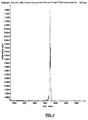
- Figure 4 is a precursor ion MS/MS spectrum obtained with the apparatus in Figure 3 and the scan method discussed above.
- a solution of 100 pg/ ⁇ L of reserpine (m/z 609) was ionized with an electrospray source.
- the Q1 linear ion trap was operated with a very small amount of resolving DC ( ⁇ 3V) and no AC voltage.
- ⁇ 3V resolving DC
- Q3 was tuned to transmit a 3 dalton wide window at the known product ion located at m/z 397.
- Figure 4 is a precursor ion MS/MS spectrum obtained with the apparatus in Figure 3 and the scan method discussed above.
- a solution of 100 pg/ ⁇ L of reserpine (m/z 609) was ionized with an electrospray source.
- the Q1 linear ion trap was operated with a very small amount of resolving DC ( ⁇ 3V) and no auxiliary AC voltage.
- ⁇ 3V resolving DC
- Q3 was tuned to transmit a 3 amu wide window at the known product ion located at m/z 397.
- the precursor mass spectrum in figure 4 was obtained from a 100 ms pulse of ions allowed to pass into the Q1 linear ion trap.
- the ions trapped in Q1 were mass selectively ejected by scanning the RF voltage applied to the Q1 rods at 5000 amu/s and accelerated by a 30V drop into the pressurized Q2 thus inducing fragmentation into product ions.
- the product ions were then directed into the RF/DC Q3 tuned to the m/z 397 product
- the spectrum in Figure 4 corresponds to the m/z 397 product ion intensity as a function of Q1 mass.
- the sensitivity of the spectrum shown in Figure 4 is approximately 5 times greater than that obtainable for the apparatus in Figure 3 operated in conventional RF/DC mode due to the duty cycle enhancement for the Q1 linear ion trap.
- Such a conventional mode RF/DC precursor mass spectrum is shown in Figure 5 for comparison purposes. Proportionately greater signal intensities than that in Figure 4 can be achieved with the apparatus in Figure 3 by simply filling the Q1 ion trap for longer periods of time.
- Figure 6 shows another example not forming part of the present invention, based on a standard QqQ triple quadrupole mass spectrometer. For simplicity like components are given the same reference number as in Figure 3 .
- Q0 is a standard RF-only multipole ion guide in a chamber evacuated to a pressure of about 7mTorr.
- the RF-only rods labelled ST serve as a Brubaker lens.
- Q1, Q2, and Q3 are located in the downstream vacuum chamber 30. Other pressures correspond to Figure 3 .
- a power supply 82, for RF and resolving DC is connected to the rod set Q1 and a power supply 84 for RF resolving DC, and auxiliary AC is connected to the rod set Q3 and capacitively coupled to Q2 (coupling not shown).
- Q1 is operated as a standard RF/DC quadrupole mass filter.
- the RF and DC voltages are chosen to transmit only the ions of interest into Q2.
- Q2 is a standard pressurized RF-only collision cell with no ion trapping.
- Q3 is operated as a low pressure rod type ion trap with axial ejection as is disclosed in WO 99/63578 .
- the Q3 linear ion trap rods are supplied with RF voltage, low level DC voltage (if desired), and AC voltage (if desired) from power supply 84.
- Product ion information can obtained in the following fashion.
- a pulse of ions from Q0 is released, by changing the normally repulsive voltage on lens IQ1 and is allowed to pass through Q1.
- Q1 is a standard RF/DC quadrupole mass spectrometer; it is not operated as an ion trap, but does select the precursor ion of interest.
- the precursor ions of interest are accelerated by a predetermined voltage difference into Q2.
- the energy of the precursor ions causes them to collide with the gas within Q2 and dissociates them into fragment ions.
- the fragment ions are then trapped in Q3 which is operated as a low pressure ion trap by suitably repulsive voltage on lens 85.
- the pressure in Q3 is typically around 10 -5 torr.
- the fragment ions of interest are then mass resolved by the Q3 linear ion trap preferably by scanning the amplitude of the RF voltage applied to the Q3 rods in the presence of a fixed frequency AC voltage also applied to the Q3 rods.
- a fixed frequency AC voltage also applied to the Q3 rods.
- the resonantly excited ions in the exit fringing field region gain sufficient energy to overcome the repulsive DC voltage on lens 85, and are ejected toward the ion detector 76.
- ions may be mass selectively ejected from the Q3 linear ion trap in the axial direction using several other techniques.
- the frequency of the AC field applied either to the rods comprising the ion trap or to lens 85 can be scanned in the presence of fixed RF voltage. Ions can also be scanned out toward the ion detector 76 without the auxiliary AC, in other words at the stability boundary near the q-value of 0.9.
- Figure 7 is a product ion MS/MS spectrum obtained with the apparatus in Figure 6 and the scan method discussed above.
- a solution of 5 pmol/ ⁇ L of renin substrate tetradecapeptide (Angiotensinogen 1-14) with a formula weight of 1757.0 was ionized with an electrospray source.
- the Q3 linear ion trap was operated no resolving DC and an AC frequency of 869 kHz at 1.04 volts (peak-to-peak) applied in a quadrupolar fashion.
- Q1 was tuned to transmit a 2 amu wide window at the known doubly protonated parent ion mass of m/z ⁇ 880.
- the product ion mass spectrum in Figure 7 was obtained from a 10 ms pulse of ions, which was allowed to pass through the conventional RF/DC Q1 mass filter and accelerated by a 40 volt drop into Q2 in the pressurized collision cell, and then into Q2 into the Q3 linear ion trap.
- the fragment and residual parent ions trapped in Q3 were mass selectively ejected by scanning the RF voltage applied to the Q3 rods at 2000 amu/s.
- the ions that were axially ejected from the Q3 ion trap were detected with the conventional pulse counting ion detector 76.
- the sensitivity of the spectrum shown in Figure 7 is approximately 8 times greater than that obtainable for the apparatus in Figure 6 operated in conventional RF/DC mode due to the duty cycle enhancement for the Q3 linear ion trap. Proportionately greater signal intensities than those in Figure 7 can be achieved with the apparatus in Figure 6 by simply filling the Q3 ion trap for longer periods of time.
Landscapes
- Chemical & Material Sciences (AREA)
- Analytical Chemistry (AREA)
- Other Investigation Or Analysis Of Materials By Electrical Means (AREA)
- Electron Tubes For Measurement (AREA)
Applications Claiming Priority (3)
| Application Number | Priority Date | Filing Date | Title |
|---|---|---|---|
| US09/320,668 US6504148B1 (en) | 1999-05-27 | 1999-05-27 | Quadrupole mass spectrometer with ION traps to enhance sensitivity |
| US320668 | 1999-05-27 | ||
| PCT/CA2000/000615 WO2000073750A2 (en) | 1999-05-27 | 2000-05-26 | Quadrupole mass spectrometer with ion traps to enhance sensitivity |
Publications (2)
| Publication Number | Publication Date |
|---|---|
| EP1183504A2 EP1183504A2 (en) | 2002-03-06 |
| EP1183504B1 true EP1183504B1 (en) | 2011-09-21 |
Family
ID=23247415
Family Applications (1)
| Application Number | Title | Priority Date | Filing Date |
|---|---|---|---|
| EP00930931A Expired - Lifetime EP1183504B1 (en) | 1999-05-27 | 2000-05-26 | Method of ion trapping and mass spectrometric analysis with enhanced sensitivity |
Country Status (7)
| Country | Link |
|---|---|
| US (1) | US6504148B1 (enExample) |
| EP (1) | EP1183504B1 (enExample) |
| JP (1) | JP2003501790A (enExample) |
| AT (1) | ATE525626T1 (enExample) |
| AU (1) | AU780291B2 (enExample) |
| CA (1) | CA2375194C (enExample) |
| WO (1) | WO2000073750A2 (enExample) |
Families Citing this family (94)
| Publication number | Priority date | Publication date | Assignee | Title |
|---|---|---|---|---|
| CA2255188C (en) * | 1998-12-02 | 2008-11-18 | University Of British Columbia | Method and apparatus for multiple stages of mass spectrometry |
| US6545268B1 (en) * | 2000-04-10 | 2003-04-08 | Perseptive Biosystems | Preparation of ion pulse for time-of-flight and for tandem time-of-flight mass analysis |
| US6720554B2 (en) * | 2000-07-21 | 2004-04-13 | Mds Inc. | Triple quadrupole mass spectrometer with capability to perform multiple mass analysis steps |
| US7060972B2 (en) * | 2000-07-21 | 2006-06-13 | Mds Inc. | Triple quadrupole mass spectrometer with capability to perform multiple mass analysis steps |
| EP2317539B1 (en) | 2001-11-22 | 2013-07-03 | Micromass UK Limited | Mass spectrometer |
| EP1481416B1 (de) * | 2002-02-28 | 2016-06-15 | Metanomics GmbH & Co. KGaA | Massenspektrometrisches verfahren zur analyse von substanzgemischen |
| US7049580B2 (en) * | 2002-04-05 | 2006-05-23 | Mds Inc. | Fragmentation of ions by resonant excitation in a high order multipole field, low pressure ion trap |
| US20030189168A1 (en) * | 2002-04-05 | 2003-10-09 | Frank Londry | Fragmentation of ions by resonant excitation in a low pressure ion trap |
| US6703607B2 (en) * | 2002-05-30 | 2004-03-09 | Mds Inc. | Axial ejection resolution in multipole mass spectrometers |
| DE60309700T2 (de) * | 2002-05-30 | 2007-09-13 | MDS Inc., doing business as MDS Sciex, Concord | Verfahren und vorrichtung zur verringerung von artefakten in massenspektrometern |
| AU2003249685A1 (en) * | 2002-05-31 | 2003-12-19 | Analytica Of Branford, Inc. | Mass spectrometry with segmented rf multiple ion guides in various pressure regions |
| US7034292B1 (en) | 2002-05-31 | 2006-04-25 | Analytica Of Branford, Inc. | Mass spectrometry with segmented RF multiple ion guides in various pressure regions |
| US7045797B2 (en) * | 2002-08-05 | 2006-05-16 | The University Of British Columbia | Axial ejection with improved geometry for generating a two-dimensional substantially quadrupole field |
| US6897438B2 (en) * | 2002-08-05 | 2005-05-24 | University Of British Columbia | Geometry for generating a two-dimensional substantially quadrupole field |
| US7102126B2 (en) * | 2002-08-08 | 2006-09-05 | Micromass Uk Limited | Mass spectrometer |
| US6875980B2 (en) * | 2002-08-08 | 2005-04-05 | Micromass Uk Limited | Mass spectrometer |
| US7049583B2 (en) * | 2002-08-08 | 2006-05-23 | Micromass Uk Limited | Mass spectrometer |
| US6835928B2 (en) * | 2002-09-04 | 2004-12-28 | Micromass Uk Limited | Mass spectrometer |
| US7846748B2 (en) | 2002-12-02 | 2010-12-07 | The University Of North Carolina At Chapel Hill | Methods of quantitation and identification of peptides and proteins |
| GB2418775B (en) * | 2003-03-19 | 2008-10-15 | Thermo Finnigan Llc | Obtaining tandem mass spectrometry data for multiple parent ions in an ion population |
| US7041968B2 (en) * | 2003-03-20 | 2006-05-09 | Science & Technology Corporation @ Unm | Distance of flight spectrometer for MS and simultaneous scanless MS/MS |
| US7064319B2 (en) * | 2003-03-31 | 2006-06-20 | Hitachi High-Technologies Corporation | Mass spectrometer |
| US7019290B2 (en) * | 2003-05-30 | 2006-03-28 | Applera Corporation | System and method for modifying the fringing fields of a radio frequency multipole |
| US7227133B2 (en) * | 2003-06-03 | 2007-06-05 | The University Of North Carolina At Chapel Hill | Methods and apparatus for electron or positron capture dissociation |
| US6977371B2 (en) * | 2003-06-10 | 2005-12-20 | Micromass Uk Limited | Mass spectrometer |
| JP4690641B2 (ja) * | 2003-07-28 | 2011-06-01 | 株式会社日立ハイテクノロジーズ | 質量分析計 |
| CA2539221A1 (en) * | 2003-09-25 | 2005-03-31 | Mds Inc., Doing Business As Mds Sciex | Method and apparatus for providing two-dimensional substantially quadrupole fields having selected hexapole components |
| JP4223937B2 (ja) * | 2003-12-16 | 2009-02-12 | 株式会社日立ハイテクノロジーズ | 質量分析装置 |
| GB0514964D0 (en) | 2005-07-21 | 2005-08-24 | Ms Horizons Ltd | Mass spectrometer devices & methods of performing mass spectrometry |
| JP2005276787A (ja) * | 2004-03-26 | 2005-10-06 | Tsutomu Masujima | 質量分析装置 |
| JP4872088B2 (ja) * | 2004-05-05 | 2012-02-08 | ディーエイチ テクノロジーズ ディベロップメント ピーティーイー リミテッド | 質量分析計用イオンガイド |
| US7227130B2 (en) * | 2004-05-20 | 2007-06-05 | Mds Inc. | Method for providing barrier fields at the entrance and exit end of a mass spectrometer |
| JP2008500684A (ja) * | 2004-05-24 | 2008-01-10 | エムディーエス インコーポレイテッド ドゥーイング ビジネス アズ エムディーエス サイエックス | トラップイオン用の装置および方法 |
| JP4659395B2 (ja) * | 2004-06-08 | 2011-03-30 | 株式会社日立ハイテクノロジーズ | 質量分析装置及び質量分析方法 |
| GB0511083D0 (en) * | 2005-05-31 | 2005-07-06 | Thermo Finnigan Llc | Multiple ion injection in mass spectrometry |
| US7323683B2 (en) * | 2005-08-31 | 2008-01-29 | The Rockefeller University | Linear ion trap for mass spectrometry |
| WO2007052372A1 (ja) * | 2005-10-31 | 2007-05-10 | Hitachi, Ltd. | 質量分析計及び質量分析方法 |
| JP5424085B2 (ja) * | 2005-11-30 | 2014-02-26 | エムディーエス インコーポレイテッド | パルス軸方向場を使用した質量選択的軸方向輸送のための方法および装置 |
| EP1955077B1 (en) | 2005-12-02 | 2012-06-13 | Sirtris Pharmaceuticals, Inc. | Mass spectrometry assays for acetyltransferase/deacetylase activity |
| US7582864B2 (en) * | 2005-12-22 | 2009-09-01 | Leco Corporation | Linear ion trap with an imbalanced radio frequency field |
| WO2007079589A1 (en) * | 2006-01-11 | 2007-07-19 | Mds Inc., Doing Business Through Its Mds Sciex Division | Fragmenting ions in mass spectrometry |
| KR100659261B1 (ko) | 2006-02-07 | 2006-12-20 | 한국기초과학지원연구원 | 탠덤 푸리에변환 이온 사이클로트론 공명 질량 분석기 |
| JP4692310B2 (ja) * | 2006-02-09 | 2011-06-01 | 株式会社日立製作所 | 質量分析装置 |
| GB0607542D0 (en) | 2006-04-13 | 2006-05-24 | Thermo Finnigan Llc | Mass spectrometer |
| US7858929B2 (en) | 2006-04-13 | 2010-12-28 | Thermo Fisher Scientific (Bremen) Gmbh | Ion energy spread reduction for mass spectrometer |
| JP2009544122A (ja) * | 2006-07-19 | 2009-12-10 | エムディーエス アナリティカル テクノロジーズ, ア ビジネス ユニット オブ エムディーエス インコーポレイテッド, ドゥーイング ビジネス スルー イッツ サイエックス ディビジョン | 共鳴励起イオン移動を提供するために質量分析計を動作する方法 |
| JP5180217B2 (ja) * | 2006-09-28 | 2013-04-10 | ディーエイチ テクノロジーズ デベロップメント プライベート リミテッド | 多重極質量分析計において補助電極を用いた軸方向の放出およびイントラップフラグメント化の方法 |
| US7511267B2 (en) * | 2006-11-10 | 2009-03-31 | Thermo Finnigan Llc | Data-dependent accurate mass neutral loss analysis |
| GB0622780D0 (en) * | 2006-11-15 | 2006-12-27 | Micromass Ltd | Mass spectrometer |
| US7692142B2 (en) * | 2006-12-13 | 2010-04-06 | Thermo Finnigan Llc | Differential-pressure dual ion trap mass analyzer and methods of use thereof |
| US8853622B2 (en) | 2007-02-07 | 2014-10-07 | Thermo Finnigan Llc | Tandem mass spectrometer |
| US7633060B2 (en) | 2007-04-24 | 2009-12-15 | Thermo Finnigan Llc | Separation and axial ejection of ions based on m/z ratio |
| US7557344B2 (en) * | 2007-07-09 | 2009-07-07 | Mds Analytical Technologies, A Business Unit Of Mds Inc. | Confining ions with fast-oscillating electric fields |
| GB0713590D0 (en) * | 2007-07-12 | 2007-08-22 | Micromass Ltd | Mass spectrometer |
| JP5262010B2 (ja) * | 2007-08-01 | 2013-08-14 | 株式会社日立製作所 | 質量分析計及び質量分析方法 |
| US7569813B2 (en) * | 2007-08-21 | 2009-08-04 | Mds Analytical Technologies, A Business Unit Of Mds Inc. | Method for enhancing mass assignment accuracy |
| US8334506B2 (en) * | 2007-12-10 | 2012-12-18 | 1St Detect Corporation | End cap voltage control of ion traps |
| JP5124293B2 (ja) * | 2008-01-11 | 2013-01-23 | 株式会社日立ハイテクノロジーズ | 質量分析計および質量分析方法 |
| US7932487B2 (en) * | 2008-01-11 | 2011-04-26 | Thermo Finnigan Llc | Mass spectrometer with looped ion path |
| JP5111123B2 (ja) * | 2008-01-16 | 2012-12-26 | 株式会社日立製作所 | 質量分析計及び質量分析方法 |
| WO2009095952A1 (ja) * | 2008-01-30 | 2009-08-06 | Shimadzu Corporation | Ms/ms型質量分析装置 |
| US7973277B2 (en) * | 2008-05-27 | 2011-07-05 | 1St Detect Corporation | Driving a mass spectrometer ion trap or mass filter |
| EP2308077B1 (en) * | 2008-06-09 | 2019-09-11 | DH Technologies Development Pte. Ltd. | Method of operating tandem ion traps |
| JP2009146913A (ja) * | 2009-03-30 | 2009-07-02 | Hitachi High-Technologies Corp | 質量分析計 |
| JP5314603B2 (ja) * | 2010-01-15 | 2013-10-16 | 日本電子株式会社 | 飛行時間型質量分析装置 |
| GB201007210D0 (en) | 2010-04-30 | 2010-06-16 | Verenchikov Anatoly | Time-of-flight mass spectrometer with improved duty cycle |
| GB2510837B (en) * | 2013-02-14 | 2017-09-13 | Thermo Fisher Scient (Bremen) Gmbh | Method of operating a mass filter in mass spectrometry |
| DE112014002092B4 (de) | 2013-04-23 | 2021-10-14 | Leco Corporation | Multireflektierendes Massenspektrometer mit hohem Durchsatz |
| EP3087581A4 (en) * | 2013-12-23 | 2017-07-26 | DH Technologies Development PTE. Ltd. | Mass spectrometer |
| US9972480B2 (en) | 2015-01-30 | 2018-05-15 | Agilent Technologies, Inc. | Pulsed ion guides for mass spectrometers and related methods |
| EP3286557B1 (en) * | 2015-04-23 | 2021-09-01 | Micromass UK Limited | Separating ions in an ion trap |
| GB201613988D0 (en) | 2016-08-16 | 2016-09-28 | Micromass Uk Ltd And Leco Corp | Mass analyser having extended flight path |
| GB2559395B (en) | 2017-02-03 | 2020-07-01 | Thermo Fisher Scient Bremen Gmbh | High resolution MS1 based quantification |
| GB2567794B (en) | 2017-05-05 | 2023-03-08 | Micromass Ltd | Multi-reflecting time-of-flight mass spectrometers |
| GB2563571B (en) | 2017-05-26 | 2023-05-24 | Micromass Ltd | Time of flight mass analyser with spatial focussing |
| EP3958290B1 (en) | 2017-06-02 | 2024-09-25 | Thermo Fisher Scientific (Bremen) GmbH | Hybrid mass spectrometer |
| US11295944B2 (en) | 2017-08-06 | 2022-04-05 | Micromass Uk Limited | Printed circuit ion mirror with compensation |
| WO2019030473A1 (en) | 2017-08-06 | 2019-02-14 | Anatoly Verenchikov | FIELDS FOR SMART REFLECTIVE TOF SM |
| WO2019030471A1 (en) | 2017-08-06 | 2019-02-14 | Anatoly Verenchikov | ION GUIDE INSIDE PULSED CONVERTERS |
| WO2019030477A1 (en) | 2017-08-06 | 2019-02-14 | Anatoly Verenchikov | ACCELERATOR FOR MASS SPECTROMETERS WITH MULTIPASSES |
| US11211238B2 (en) | 2017-08-06 | 2021-12-28 | Micromass Uk Limited | Multi-pass mass spectrometer |
| WO2019030472A1 (en) | 2017-08-06 | 2019-02-14 | Anatoly Verenchikov | IONIC MIRROR FOR MULTI-REFLECTION MASS SPECTROMETERS |
| US11205568B2 (en) | 2017-08-06 | 2021-12-21 | Micromass Uk Limited | Ion injection into multi-pass mass spectrometers |
| GB201806507D0 (en) | 2018-04-20 | 2018-06-06 | Verenchikov Anatoly | Gridless ion mirrors with smooth fields |
| GB201807626D0 (en) | 2018-05-10 | 2018-06-27 | Micromass Ltd | Multi-reflecting time of flight mass analyser |
| GB201807605D0 (en) | 2018-05-10 | 2018-06-27 | Micromass Ltd | Multi-reflecting time of flight mass analyser |
| GB201808530D0 (en) | 2018-05-24 | 2018-07-11 | Verenchikov Anatoly | TOF MS detection system with improved dynamic range |
| GB201810573D0 (en) | 2018-06-28 | 2018-08-15 | Verenchikov Anatoly | Multi-pass mass spectrometer with improved duty cycle |
| US10665441B2 (en) * | 2018-08-08 | 2020-05-26 | Thermo Finnigan Llc | Methods and apparatus for improved tandem mass spectrometry duty cycle |
| US11562895B2 (en) * | 2018-09-07 | 2023-01-24 | Dh Technologies Development Pte. Ltd. | RF ion trap ion loading method |
| GB201901411D0 (en) | 2019-02-01 | 2019-03-20 | Micromass Ltd | Electrode assembly for mass spectrometer |
| GB201903779D0 (en) | 2019-03-20 | 2019-05-01 | Micromass Ltd | Multiplexed time of flight mass spectrometer |
| CN113066713A (zh) | 2020-01-02 | 2021-07-02 | 株式会社岛津制作所 | 离子光学装置、质谱仪以及离子操作方法 |
| WO2024211757A1 (en) * | 2023-04-06 | 2024-10-10 | University Of Maryland, College Park | Systems and methods of electrophoresis-correlative (eco) mass spectrometry (ms) |
Family Cites Families (9)
| Publication number | Priority date | Publication date | Assignee | Title |
|---|---|---|---|---|
| US5179278A (en) | 1991-08-23 | 1993-01-12 | Mds Health Group Limited | Multipole inlet system for ion traps |
| JP3404849B2 (ja) * | 1993-12-29 | 2003-05-12 | 株式会社島津製作所 | Ms/ms型質量分析装置 |
| US6011259A (en) | 1995-08-10 | 2000-01-04 | Analytica Of Branford, Inc. | Multipole ion guide ion trap mass spectrometry with MS/MSN analysis |
| US5576540A (en) | 1995-08-11 | 1996-11-19 | Mds Health Group Limited | Mass spectrometer with radial ejection |
| CA2229070C (en) * | 1995-08-11 | 2007-01-30 | Mds Health Group Limited | Spectrometer with axial field |
| JPH09326243A (ja) * | 1996-06-05 | 1997-12-16 | Shimadzu Corp | Maldi−tof質量分析装置 |
| US6177668B1 (en) * | 1996-06-06 | 2001-01-23 | Mds Inc. | Axial ejection in a multipole mass spectrometer |
| JP3818671B2 (ja) | 1996-06-06 | 2006-09-06 | エムディーエス インコーポレーテッド | 多重極子質量分光計の軸方向射出方法 |
| US6093929A (en) * | 1997-05-16 | 2000-07-25 | Mds Inc. | High pressure MS/MS system |
-
1999
- 1999-05-27 US US09/320,668 patent/US6504148B1/en not_active Expired - Lifetime
-
2000
- 2000-05-26 AT AT00930931T patent/ATE525626T1/de not_active IP Right Cessation
- 2000-05-26 EP EP00930931A patent/EP1183504B1/en not_active Expired - Lifetime
- 2000-05-26 WO PCT/CA2000/000615 patent/WO2000073750A2/en not_active Ceased
- 2000-05-26 AU AU49058/00A patent/AU780291B2/en not_active Expired
- 2000-05-26 CA CA002375194A patent/CA2375194C/en not_active Expired - Lifetime
- 2000-05-26 JP JP2001500825A patent/JP2003501790A/ja active Pending
Also Published As
| Publication number | Publication date |
|---|---|
| WO2000073750A3 (en) | 2001-08-02 |
| AU4905800A (en) | 2000-12-18 |
| WO2000073750A2 (en) | 2000-12-07 |
| AU780291B2 (en) | 2005-03-17 |
| US6504148B1 (en) | 2003-01-07 |
| JP2003501790A (ja) | 2003-01-14 |
| CA2375194C (en) | 2009-07-21 |
| EP1183504A2 (en) | 2002-03-06 |
| CA2375194A1 (en) | 2000-12-07 |
| ATE525626T1 (de) | 2011-10-15 |
Similar Documents
| Publication | Publication Date | Title |
|---|---|---|
| US6504148B1 (en) | Quadrupole mass spectrometer with ION traps to enhance sensitivity | |
| US6720554B2 (en) | Triple quadrupole mass spectrometer with capability to perform multiple mass analysis steps | |
| EP1502280B1 (en) | Broad ion fragmentation coverage in mass spectrometry by varying the collision energy | |
| US6093929A (en) | High pressure MS/MS system | |
| EP1342257B1 (en) | APPARATUS AND METHOD FOR MSnth IN A TANDEM MASS SPECTROMETER SYSTEM | |
| US7932487B2 (en) | Mass spectrometer with looped ion path | |
| EP1051731B1 (en) | Method of analyzing ions in an apparatus including a time of flight mass spectrometer and a linear ion trap | |
| US6967323B2 (en) | Mass spectrometer | |
| EP1051733B1 (en) | Method of and apparatus for selective collision-induced dissociation of ions in a quadrupole ion guide | |
| AU2001270399A1 (en) | Triple quadrupole mass spectrometer with capability to perform multiple mass analysis steps | |
| US7060972B2 (en) | Triple quadrupole mass spectrometer with capability to perform multiple mass analysis steps | |
| US20040164240A1 (en) | Mass spectrometer and method of use | |
| EP2047244A1 (en) | Method of operating a mass spectrometer to provide resonant excitation ion transfer | |
| CA2236199C (en) | High pressure ms/ms system |
Legal Events
| Date | Code | Title | Description |
|---|---|---|---|
| PUAI | Public reference made under article 153(3) epc to a published international application that has entered the european phase |
Free format text: ORIGINAL CODE: 0009012 |
|
| 17P | Request for examination filed |
Effective date: 20011217 |
|
| AK | Designated contracting states |
Kind code of ref document: A2 Designated state(s): AT BE CH CY DE DK ES FI FR GB GR IE IT LI LU MC NL PT SE |
|
| AX | Request for extension of the european patent |
Free format text: AL;LT;LV;MK;RO;SI |
|
| 17Q | First examination report despatched |
Effective date: 20061107 |
|
| GRAP | Despatch of communication of intention to grant a patent |
Free format text: ORIGINAL CODE: EPIDOSNIGR1 |
|
| RTI1 | Title (correction) |
Free format text: METHOD OF ION TRAPPING AND MASS SPECTROMETRIC ANALYSIS WITH ENHANCED SENSITIVITY |
|
| GRAS | Grant fee paid |
Free format text: ORIGINAL CODE: EPIDOSNIGR3 |
|
| GRAA | (expected) grant |
Free format text: ORIGINAL CODE: 0009210 |
|
| AK | Designated contracting states |
Kind code of ref document: B1 Designated state(s): AT BE CH CY DE DK ES FI FR GB GR IE IT LI LU MC NL PT SE |
|
| REG | Reference to a national code |
Ref country code: GB Ref legal event code: FG4D |
|
| REG | Reference to a national code |
Ref country code: CH Ref legal event code: EP |
|
| REG | Reference to a national code |
Ref country code: IE Ref legal event code: FG4D |
|
| REG | Reference to a national code |
Ref country code: DE Ref legal event code: R096 Ref document number: 60046460 Country of ref document: DE Effective date: 20111117 |
|
| RAP2 | Party data changed (patent owner data changed or rights of a patent transferred) |
Owner name: DH TECHNOLOGIES DEVELOPMENT PTE. LTD. |
|
| REG | Reference to a national code |
Ref country code: NL Ref legal event code: VDEP Effective date: 20110921 |
|
| PG25 | Lapsed in a contracting state [announced via postgrant information from national office to epo] |
Ref country code: FI Free format text: LAPSE BECAUSE OF FAILURE TO SUBMIT A TRANSLATION OF THE DESCRIPTION OR TO PAY THE FEE WITHIN THE PRESCRIBED TIME-LIMIT Effective date: 20110921 Ref country code: SE Free format text: LAPSE BECAUSE OF FAILURE TO SUBMIT A TRANSLATION OF THE DESCRIPTION OR TO PAY THE FEE WITHIN THE PRESCRIBED TIME-LIMIT Effective date: 20110921 |
|
| PG25 | Lapsed in a contracting state [announced via postgrant information from national office to epo] |
Ref country code: AT Free format text: LAPSE BECAUSE OF FAILURE TO SUBMIT A TRANSLATION OF THE DESCRIPTION OR TO PAY THE FEE WITHIN THE PRESCRIBED TIME-LIMIT Effective date: 20110921 Ref country code: GR Free format text: LAPSE BECAUSE OF FAILURE TO SUBMIT A TRANSLATION OF THE DESCRIPTION OR TO PAY THE FEE WITHIN THE PRESCRIBED TIME-LIMIT Effective date: 20111222 Ref country code: CY Free format text: LAPSE BECAUSE OF FAILURE TO SUBMIT A TRANSLATION OF THE DESCRIPTION OR TO PAY THE FEE WITHIN THE PRESCRIBED TIME-LIMIT Effective date: 20110921 |
|
| REG | Reference to a national code |
Ref country code: AT Ref legal event code: MK05 Ref document number: 525626 Country of ref document: AT Kind code of ref document: T Effective date: 20110921 |
|
| PG25 | Lapsed in a contracting state [announced via postgrant information from national office to epo] |
Ref country code: BE Free format text: LAPSE BECAUSE OF FAILURE TO SUBMIT A TRANSLATION OF THE DESCRIPTION OR TO PAY THE FEE WITHIN THE PRESCRIBED TIME-LIMIT Effective date: 20110921 |
|
| REG | Reference to a national code |
Ref country code: DE Ref legal event code: R081 Ref document number: 60046460 Country of ref document: DE Owner name: DH TECHNOLOGIES DEVELOPMENT PTE. LTD., SG Free format text: FORMER OWNER: MDS INC., ETOBICOKE, CA Effective date: 20110922 Ref country code: DE Ref legal event code: R081 Ref document number: 60046460 Country of ref document: DE Owner name: DH TECHNOLOGIES DEVELOPMENT PTE. LTD., SG Free format text: FORMER OWNER: MDS INC., ETOBICOKE, ONTARIO, CA Effective date: 20110922 Ref country code: DE Ref legal event code: R081 Ref document number: 60046460 Country of ref document: DE Owner name: DH TECHNOLOGIES DEVELOPMENT PTE. LTD., SG Free format text: FORMER OWNER: MDS INC., ETOBICOKE, ONTARIO, CA Effective date: 20120215 Ref country code: DE Ref legal event code: R081 Ref document number: 60046460 Country of ref document: DE Owner name: DH TECHNOLOGIES DEVELOPMENT PTE. LTD., SG Free format text: FORMER OWNER: MDS INC., ETOBICOKE, CA Effective date: 20120215 |
|
| PG25 | Lapsed in a contracting state [announced via postgrant information from national office to epo] |
Ref country code: IT Free format text: LAPSE BECAUSE OF FAILURE TO SUBMIT A TRANSLATION OF THE DESCRIPTION OR TO PAY THE FEE WITHIN THE PRESCRIBED TIME-LIMIT Effective date: 20110921 Ref country code: PT Free format text: LAPSE BECAUSE OF FAILURE TO SUBMIT A TRANSLATION OF THE DESCRIPTION OR TO PAY THE FEE WITHIN THE PRESCRIBED TIME-LIMIT Effective date: 20120123 Ref country code: NL Free format text: LAPSE BECAUSE OF FAILURE TO SUBMIT A TRANSLATION OF THE DESCRIPTION OR TO PAY THE FEE WITHIN THE PRESCRIBED TIME-LIMIT Effective date: 20110921 |
|
| PLBE | No opposition filed within time limit |
Free format text: ORIGINAL CODE: 0009261 |
|
| STAA | Information on the status of an ep patent application or granted ep patent |
Free format text: STATUS: NO OPPOSITION FILED WITHIN TIME LIMIT |
|
| PG25 | Lapsed in a contracting state [announced via postgrant information from national office to epo] |
Ref country code: DK Free format text: LAPSE BECAUSE OF FAILURE TO SUBMIT A TRANSLATION OF THE DESCRIPTION OR TO PAY THE FEE WITHIN THE PRESCRIBED TIME-LIMIT Effective date: 20110921 |
|
| 26N | No opposition filed |
Effective date: 20120622 |
|
| REG | Reference to a national code |
Ref country code: DE Ref legal event code: R097 Ref document number: 60046460 Country of ref document: DE Effective date: 20120622 |
|
| PG25 | Lapsed in a contracting state [announced via postgrant information from national office to epo] |
Ref country code: MC Free format text: LAPSE BECAUSE OF NON-PAYMENT OF DUE FEES Effective date: 20120531 |
|
| REG | Reference to a national code |
Ref country code: CH Ref legal event code: PL |
|
| PG25 | Lapsed in a contracting state [announced via postgrant information from national office to epo] |
Ref country code: LI Free format text: LAPSE BECAUSE OF NON-PAYMENT OF DUE FEES Effective date: 20120531 Ref country code: CH Free format text: LAPSE BECAUSE OF NON-PAYMENT OF DUE FEES Effective date: 20120531 |
|
| REG | Reference to a national code |
Ref country code: IE Ref legal event code: MM4A |
|
| PG25 | Lapsed in a contracting state [announced via postgrant information from national office to epo] |
Ref country code: ES Free format text: LAPSE BECAUSE OF FAILURE TO SUBMIT A TRANSLATION OF THE DESCRIPTION OR TO PAY THE FEE WITHIN THE PRESCRIBED TIME-LIMIT Effective date: 20120101 Ref country code: IE Free format text: LAPSE BECAUSE OF NON-PAYMENT OF DUE FEES Effective date: 20120526 |
|
| PG25 | Lapsed in a contracting state [announced via postgrant information from national office to epo] |
Ref country code: LU Free format text: LAPSE BECAUSE OF NON-PAYMENT OF DUE FEES Effective date: 20120526 |
|
| REG | Reference to a national code |
Ref country code: FR Ref legal event code: PLFP Year of fee payment: 17 |
|
| REG | Reference to a national code |
Ref country code: FR Ref legal event code: PLFP Year of fee payment: 18 |
|
| REG | Reference to a national code |
Ref country code: FR Ref legal event code: PLFP Year of fee payment: 19 |
|
| PGFP | Annual fee paid to national office [announced via postgrant information from national office to epo] |
Ref country code: DE Payment date: 20190530 Year of fee payment: 20 |
|
| PGFP | Annual fee paid to national office [announced via postgrant information from national office to epo] |
Ref country code: FR Payment date: 20190527 Year of fee payment: 20 |
|
| PGFP | Annual fee paid to national office [announced via postgrant information from national office to epo] |
Ref country code: GB Payment date: 20190528 Year of fee payment: 20 |
|
| REG | Reference to a national code |
Ref country code: DE Ref legal event code: R071 Ref document number: 60046460 Country of ref document: DE |
|
| REG | Reference to a national code |
Ref country code: GB Ref legal event code: PE20 Expiry date: 20200525 |
|
| PG25 | Lapsed in a contracting state [announced via postgrant information from national office to epo] |
Ref country code: GB Free format text: LAPSE BECAUSE OF EXPIRATION OF PROTECTION Effective date: 20200525 |