EP1180300B1 - Acoustic echo cancellation - Google Patents
Acoustic echo cancellation Download PDFInfo
- Publication number
- EP1180300B1 EP1180300B1 EP00927602A EP00927602A EP1180300B1 EP 1180300 B1 EP1180300 B1 EP 1180300B1 EP 00927602 A EP00927602 A EP 00927602A EP 00927602 A EP00927602 A EP 00927602A EP 1180300 B1 EP1180300 B1 EP 1180300B1
- Authority
- EP
- European Patent Office
- Prior art keywords
- signal
- estimate
- echo
- audio
- echo path
- Prior art date
- Legal status (The legal status is an assumption and is not a legal conclusion. Google has not performed a legal analysis and makes no representation as to the accuracy of the status listed.)
- Expired - Lifetime
Links
Images


Classifications
-
- H—ELECTRICITY
- H04—ELECTRIC COMMUNICATION TECHNIQUE
- H04M—TELEPHONIC COMMUNICATION
- H04M9/00—Arrangements for interconnection not involving centralised switching
- H04M9/08—Two-way loud-speaking telephone systems with means for conditioning the signal, e.g. for suppressing echoes for one or both directions of traffic
- H04M9/082—Two-way loud-speaking telephone systems with means for conditioning the signal, e.g. for suppressing echoes for one or both directions of traffic using echo cancellers
Definitions
- This invention relates to a method for multiple channel acoustic echo cancellation (AEC), applicable to systems that derive a multi-channel spatialised signal from a monophonic signal, each channel of which is applied to a respective member of an array of loudspeakers at differing gains to give the percept or audible illusion of directionality.
- This class of spatialised signal will be termed here as steered mono.
- a steered mono system uses two or more gain elements to represent the spatialisation, which is mapped to a panning processor to generate corresponding loudspeaker outputs.
- a two-channel stereophonic signal is used, with two loudspeakers - a system known as "stereo from steered mono" (SSM), but the principles of the invention can be applied to systems with more than two channels.
- SSM stereo from steered mono
- the invention has application in teleconferencing systems where each talker's voice is artificially given spatial positioning for the benefit of the listener.
- a method of acoustic echo cancellation is required.
- AEC acoustic echo cancellation
- the topology shown in Figure 1 can be used with a number of different adaptive processes such as least mean square (LMS), recursive least squares (RLS) or fast affine projection (FAP).
- LMS least mean square
- RLS recursive least squares
- FAP fast affine projection
- h 1 and h 2 which include the microphone and loudspeaker impulse responses
- the number of echo paths is the product of the number of loudspeakers with the number of microphones).
- Equation (3) no longer holds (unless Equation (2) is also met).
- Equation (3) the echo canceller no longer produces a convergent solution and the echo heard by the talker rises in level.
- a method of acoustic echo cancellation for a multiple channel steered spatialised signal the steered spatialised signal being generated from a signal input modified according to respective spatialisation gain functions to generate a plurality of audio channels, the echo cancellation process using a combined spatialisation and echo path estimate, the estimate being derived from the gain functions applied to the respective channels, whereby when the gain functions applied in the respective channels are changed, an estimate of the echo paths is generated, the estimate being based on a previous estimate of the echo path and on the gain functions, the echo path estimates being used to generate an echo cancellation signal.
- apparatus for acoustic echo cancellation in a multiple channel steered spatialised audio system comprising
- This invention is an adaptation of the monophonic LMS process.
- the invention avoids multiple updates of two of more echo path estimates, such as ⁇ 1 and ⁇ 2 , and reduces the number of filter operations required when compared with existing stereo echo cancellation processes, such as ⁇ 1 * x 1 and ⁇ 2 * x 2 .
- the invention uses the spatialisation parameters in the adaptive process, unlike existing stereo echo cancellation processes.
- the LMS update is modified to take into account the spatialisation parameters that are used to update the aggregated echo path estimate each time the spatialisation changes.
- the aggregated echo path estimate converges towards the aggregate echo path for future changes in spatialisation. Prior to the N th spatialisation change the process converges to a local solution for the aggregated echo path estimate so that some echo signal reduction is still given in the learning stage of the process.
- the learning stage can be made part of a set-up phase prior to use of the system for live traffic.
- the required number of spatialisation changes can be achieved by operating the monophonic LMS process for each channel in turn, by setting the gains of the other channels to zero.
- the monophonic system illustrated in Figure 1 comprises an input path 12 connected to the source (microphone 11 and speaker 10) of the original signal s(t).
- This signal s ( t ) is modified by the transmission path 12 to generate a loudspeaker signal x (t) which is fed to the loudspeaker 13.
- the return path consists of a microphone 21, return transmission path 22 and loudspeaker 23.
- An acoustic path h 1 exists between the loudspeaker 13 of one path and the microphone 21 of the other path. Hence, some sound originating with the speaker 10 will be returned to the loudspeaker 23 and will be heard by the speaker 10 as echo. This effect can be intrusive, especially as the transmission paths 12, 22 can introduce delays, so an echo cancellation processor 24, 25, 26 is installed to eliminate this signal.
- An adaptive processor 24 compares the signal e(t) to be transmitted over the return path 22 with the signal x(t) arriving over the input path 12 and identifies correlations between them. This is used to control an adaptive filter bank 25, to generate a vector ⁇ 1 . This vector is an estimate of the acoustic path h 1 This vector is applied to the input signal x(t) by the filter and the result subtracted from the input y(t) from the microphone 21 in a combiner 26 to generate a return signal e ( t ) . If the adaptive filter 25 generates an accurate estimate ⁇ 1 of the function h 1 , the echo signal y(t) should therefore be cancelled out by the output from the adaptive filter 25 and e(t) should therefore be zero. Therefore the only signals transmitted over the return path 22 will be sounds generated near the microphone 21 and not received from the loudspeaker 13.
- FIG. 2 illustrates a generalised stereophonic system. The situation is similar to that of Figure 1, except that there are now two loudspeakers and two microphones (indicated by the suffixes "L” and “R” in Figure 2) at each end. Only one channel 22L of the return path is shown. For each return path 22L, (22R) there are two echo path estimates ⁇ 1 L , ⁇ 2 L , one for each outward path 12 L , 12 R , because each microphone 21 L, (21 R) is capable of receiving acoustic feedback from both loudspeakers 13L, 13R. Because the two outward paths 12 L , 12 R are carrying signals from the same source 10, there is significant correlation between the two estimates ⁇ 1 L , ⁇ 2 L and the processes generating the adaptive filter values 25LL, 25RL are therefore not independent.
- a monophonic source 11 is used and the functions g 1 , g 2 become scalar values g 1 , g 2 representing gain. Consequently, there is only one transmit path 12, 22 in each direction.
- Control information is used to control variable gain amplifiers 14L, 14R to vary the gain functions g 1 , g 2 defining the spatialisation at the receive end, to emulate a stereophonic source.
- the fact that the gain functions g 1 , g 2 are known at the receive end allows them to be used in the adaptive processor 24, 25.
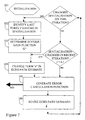
- values k 1 , k 2 , k 3 are set (step 102). These identify the last three sampling periods at which the spatialisation values g 1 , g 2 changed. If the spatialisation gain values g 1 , g 2 have not changed since the previous sample n -1 , the values of k 1 , k 2 , k 3 are the same as for the previous sample. However, if the values have changed, then k 3 is set to the previous value of k 2 , k 2 is set to the previous value of k 1 , and k 1 is set to n-1.
- this matrix is also unchanged and does not need to be recalculated.
- ⁇ n -1 is the specific instance of the estimated echo path function h from the previous iteration). All other terms ⁇ n -1 (0) ... ⁇ n-1 ( r -1 ) and ⁇ n-1 (r+ 1 )... ⁇ n- 1 ( L- 1) remain unchanged
- the error cancellation signal s n T h ⁇ n ⁇ 1 (where s n is the vector representing the last L samples of the input signal s ( n )) is then generated using the revised estimate echo path vector ⁇ n -1 (step 105) and subtracted from the signal y ( n ) to generate the output signal e ( n ) .
- the estimated echo path vector ⁇ n-1 is then adapted in response to the echo signal e(n) (step 106) for use in the next iteration.
- h ⁇ n h ⁇ n ⁇ 1 + ⁇ s n ⁇ ( n )
- ⁇ ( n ) s n T s n e ( n )
- ⁇ is the step size.
- the progress is stable provided that the spatialisation changes on a longer timescale than the period L, and that 0 ⁇ ⁇ ⁇ 2 .
- steps 105-106 in the above process is the same as the normalised LMS process which is of the order 2 L .
- the number of computations is of the order of two multiplications and one division for the matrix inversion used in step 103. As this is only performed once after each change in spatialisation it adds little to the complexity of the process for large L .
- Step 104 is only calculated in the first L samples after a spatialisation change and is insignificant for large L.
- the two microphone impulse response paths 12L, 12R are replaced by two artificially generated impulse responses g 1 and g 2 that act upon a single microphone signal s(t) received over the monophonic path 12 to generate the percept or illusion of spatialisation.
- the functions g 1 and g 2 are further simplified by representing them as simple gain functions rather than impulse responses.
- This system works in a completely different manner from the prior art system of Figure 2 as, rather than trying to decorrelate the signals x 1 and x 2 to help the convergence, the method presented here relies upon the inherent highly correlated nature of the signals x 1 and x 2 .
- the method uses the knowledge of the functions g 1 and g 2 (which are unknown in the prior art systems) to achieve a convergent echo cancellation.
- [ y n y n + a ] ( G n , n + a ⁇ I L ) [ S n S n + a ] [ h 1 h 2 ]
- I L is the L ⁇ L identity matrix
- G n , n + a [ g 1 ( n ) g 2 ( n ) g 1 ( n + a ) g 2 ( n + a )
- ⁇ is the Kronecker product.
- the Kronecker product of two matrices A and B is given by multiplying matrix B separately by each individual term in matrix A and forming a new matrix, (whose order is the product of the original two matrices) with the resulting terms).
- a solution for h 1 and h 2 exists if the signal s is persistently exciting (i.e. it has a full spectral content) and the matrix G n . n + a is non-singular, that is, it has an inverse matrix.
- the non-singular condition for G n . n + a is met if the spatialisation values at sample times n and n + a are different and not scalar multiples of each other ( i.e. g 1 ( n )/g 2 ( n ) ⁇ g 1 ( n+a )/ g 2 (n+a )) .
- the values should be sufficiently different such that the solution of Equation (9) is well conditioned.
- e(n) is the echo signal
- ⁇ is the step size parameter
- ⁇ n is the echo path estimate at the n th sample instance.
- ⁇ 1 (t) and ⁇ 2 (t) are functions representing the two echo path estimates at sample interval n .
- h T [ h 1 ( 0 ) g 1 ( n ) + h 2 ( 0 ) g 2 ( n ) , ... , h 1 ( L ⁇ 1 ) g 1 ( n ⁇ ( L ⁇ 1 ) ) + h 2 ( L ⁇ 1 ) g 2 ( n ⁇ ( L ⁇ 1 ) ]
- Equation 10 the normalised LMS updates of equations 10, 11 and 12 are used for the echo cancellation rather than using two echo path estimates explicitly. If the values of g 1 (n) and g 2 (n) are constant for all n then the updates in Equation 10, 11 and 12 can be used unchanged to determine an estimate of h , as h is constant over time. However, if g 1 ( n ) and g 2 ( n ) change over time then this solution can not be used as a change in h is not taken into account in the LMS updates of Equations 10, 11 and 12.
- the process can be extended to a system that has more than two channels, by making a small modification to the process.
- N - channel system the previous N + 1 changes in the spatialisation position are recorded in variables k N+1 ,...,k 1 from the least to most recent respectively.
- Figure 5 shows that initially the Normalised LMS process ( Figure 5a) and the Stereo Normalised LMS process according to the invention ( Figure 5b) have identical performance up until sample 40000. Note that the error in both processes falls initially as the adaptive filters converge to the static value of the aggregate path vector h . However, at sample period 19000 the spatialisation changes, such that h changes and consequently the error rises suddenly in both processes.
- the normalised LMS process ( Figure 5a) does not yet have enough information to form the correct aggregate path vector h as it requires two spatialisation positions to determine the individual path vectors h 1 and h 2 . However, after the second spatialisation position the process according to the invention can make an estimate of the value of the changed h . This can be observed in Figure 5 as the error does not rise after sample 40000 for the error curve in b) unlike that for the normalised LMS process in a) which demonstrates increases in the error each time the spatialisation changes.
- the process described uses the normalised least mean square adaptive filter to form the update of the combined echo path estimate.
- any current or future adaptive process that updates an estimate of an unknown filter on a sample by sample basis can be used in place of the described normalised least mean square algorithm.
- the only modification required is to replace the process step 106 with another filter update.
- Suitable existing examples are fast affine projection, least mean squares or recursive least mean squares adaptive filters.
Landscapes
- Engineering & Computer Science (AREA)
- Signal Processing (AREA)
- Cable Transmission Systems, Equalization Of Radio And Reduction Of Echo (AREA)
- Filters That Use Time-Delay Elements (AREA)
- Interconnected Communication Systems, Intercoms, And Interphones (AREA)
Priority Applications (1)
| Application Number | Priority Date | Filing Date | Title |
|---|---|---|---|
| EP00927602A EP1180300B1 (en) | 1999-05-25 | 2000-05-18 | Acoustic echo cancellation |
Applications Claiming Priority (4)
| Application Number | Priority Date | Filing Date | Title |
|---|---|---|---|
| EP99304040 | 1999-05-25 | ||
| EP99304040 | 1999-05-25 | ||
| EP00927602A EP1180300B1 (en) | 1999-05-25 | 2000-05-18 | Acoustic echo cancellation |
| PCT/GB2000/001904 WO2000072567A1 (en) | 1999-05-25 | 2000-05-18 | Acoustic echo cancellation |
Publications (2)
| Publication Number | Publication Date |
|---|---|
| EP1180300A1 EP1180300A1 (en) | 2002-02-20 |
| EP1180300B1 true EP1180300B1 (en) | 2006-07-19 |
Family
ID=8241410
Family Applications (1)
| Application Number | Title | Priority Date | Filing Date |
|---|---|---|---|
| EP00927602A Expired - Lifetime EP1180300B1 (en) | 1999-05-25 | 2000-05-18 | Acoustic echo cancellation |
Country Status (9)
| Country | Link |
|---|---|
| US (1) | US7660425B1 (enExample) |
| EP (1) | EP1180300B1 (enExample) |
| JP (1) | JP2003500937A (enExample) |
| CN (1) | CN1351795A (enExample) |
| AU (1) | AU4599300A (enExample) |
| CA (1) | CA2373114C (enExample) |
| DE (1) | DE60029436T2 (enExample) |
| ES (1) | ES2269137T3 (enExample) |
| WO (1) | WO2000072567A1 (enExample) |
Families Citing this family (24)
| Publication number | Priority date | Publication date | Assignee | Title |
|---|---|---|---|---|
| JP3506138B2 (ja) * | 2001-07-11 | 2004-03-15 | ヤマハ株式会社 | 複数チャンネルエコーキャンセル方法、複数チャンネル音声伝送方法、ステレオエコーキャンセラ、ステレオ音声伝送装置および伝達関数演算装置 |
| US7903137B2 (en) * | 2004-10-15 | 2011-03-08 | Lifesize Communications, Inc. | Videoconferencing echo cancellers |
| NO328256B1 (no) * | 2004-12-29 | 2010-01-18 | Tandberg Telecom As | Audiosystem |
| KR101277041B1 (ko) | 2005-09-01 | 2013-06-24 | 파나소닉 주식회사 | 멀티 채널 음향 신호 처리 장치 및 방법 |
| JP4688701B2 (ja) * | 2006-03-09 | 2011-05-25 | 富士通東芝モバイルコミュニケーションズ株式会社 | 通信端末 |
| US8385557B2 (en) * | 2008-06-19 | 2013-02-26 | Microsoft Corporation | Multichannel acoustic echo reduction |
| US8208649B2 (en) * | 2009-04-28 | 2012-06-26 | Hewlett-Packard Development Company, L.P. | Methods and systems for robust approximations of impulse responses in multichannel audio-communication systems |
| JP4924652B2 (ja) * | 2009-05-07 | 2012-04-25 | 株式会社デンソー | 音声認識装置及びカーナビゲーション装置 |
| BRPI1008266B1 (pt) * | 2009-06-02 | 2020-08-04 | Mediatek Inc | Disposição canceladora de eco acústico de múltiplos canais e método de cancelamento de eco acústico de múltiplos canais |
| US8634569B2 (en) | 2010-01-08 | 2014-01-21 | Conexant Systems, Inc. | Systems and methods for echo cancellation and echo suppression |
| CN102223456B (zh) * | 2010-04-14 | 2013-09-11 | 华为终端有限公司 | 回声信号处理方法及装置 |
| CN102387269B (zh) * | 2010-08-27 | 2013-12-04 | 华为终端有限公司 | 一种单讲状态下回声抵消的方法、装置及系统 |
| JP5017441B2 (ja) * | 2010-10-28 | 2012-09-05 | 株式会社東芝 | 携帯型電子機器 |
| WO2012094528A1 (en) | 2011-01-05 | 2012-07-12 | Conexant Systems, Inc., A Delaware Corporation | Systems and methods for stereo echo cancellation |
| EP2487891B1 (de) * | 2011-02-11 | 2018-09-05 | Deutsche Telekom AG | Vermeiden eines akustischen Echos bei Vollduplexsystemen |
| CN102646418B (zh) * | 2012-03-29 | 2014-07-23 | 北京华夏电通科技股份有限公司 | 一种远程音频交互的多路声学回音消除方法及系统 |
| CN102820036B (zh) | 2012-09-07 | 2014-04-16 | 歌尔声学股份有限公司 | 一种自适应消除噪声的方法和装置 |
| CN104392727A (zh) * | 2014-11-12 | 2015-03-04 | 华为技术有限公司 | 音频信号处理方法和相关装置 |
| CN107251134B (zh) * | 2014-12-28 | 2021-12-03 | 静公司 | 在噪声受控体积内控制噪声的装置、系统和方法 |
| CN105407243B (zh) * | 2015-10-26 | 2019-02-19 | 南京邮电大学 | 一种Android平台上使用改进仿射投影算法的回声消除VOIP系统 |
| DE102015222105A1 (de) * | 2015-11-10 | 2017-05-11 | Volkswagen Aktiengesellschaft | Audiosignalverarbeitung in einem Fahrzeug |
| CN110956973A (zh) * | 2018-09-27 | 2020-04-03 | 深圳市冠旭电子股份有限公司 | 一种回声消除方法、装置及智能终端 |
| CN111756943B (zh) * | 2020-06-05 | 2021-04-20 | 中原工学院 | 一种增广复值成比例子带自适应立体声学回声消除方法 |
| CN112700788B (zh) * | 2020-12-23 | 2024-05-03 | 普联国际有限公司 | 回声消除中回声路径的建模方法、装置、设备及存储介质 |
Family Cites Families (23)
| Publication number | Priority date | Publication date | Assignee | Title |
|---|---|---|---|---|
| JP2635684B2 (ja) | 1988-05-31 | 1997-07-30 | 株式会社東芝 | ステレオ音声伝送システム |
| JP2792311B2 (ja) | 1992-01-31 | 1998-09-03 | 日本電気株式会社 | 多チャンネルエコー除去方法および装置 |
| JPH05316239A (ja) | 1992-05-08 | 1993-11-26 | Toshiba Corp | 会議システム |
| GB9211756D0 (en) * | 1992-06-03 | 1992-07-15 | Gerzon Michael A | Stereophonic directional dispersion method |
| JP2523258B2 (ja) | 1993-06-17 | 1996-08-07 | 沖電気工業株式会社 | 多地点間エコ―キャンセラ |
| FR2713417B1 (fr) * | 1993-12-02 | 1996-02-02 | Europ Agence Spatiale | Procédé de réglage adaptatif d'un suppresseur d'écho. |
| DE69532394T2 (de) * | 1994-02-10 | 2004-11-04 | Nippon Telegraph And Telephone Corp. | Verfahren und Vorrichtung zur Echokompensation mit Anwendung der "fast projection scheme" |
| JP3397269B2 (ja) * | 1994-10-26 | 2003-04-14 | 日本電信電話株式会社 | 多チャネル反響消去方法 |
| US5828756A (en) * | 1994-11-22 | 1998-10-27 | Lucent Technologies Inc. | Stereophonic acoustic echo cancellation using non-linear transformations |
| US5745564A (en) | 1995-01-26 | 1998-04-28 | Northern Telecom Limited | Echo cancelling arrangement |
| US5734724A (en) | 1995-03-01 | 1998-03-31 | Nippon Telegraph And Telephone Corporation | Audio communication control unit |
| EP0766446B1 (en) * | 1995-09-26 | 2003-06-11 | Nippon Telegraph And Telephone Corporation | Method and apparatus for multi-channel acoustic echo cancellation |
| JP3625325B2 (ja) | 1995-10-31 | 2005-03-02 | 株式会社東芝 | 拡声通話装置およびエコーキャンセラ |
| US7012630B2 (en) * | 1996-02-08 | 2006-03-14 | Verizon Services Corp. | Spatial sound conference system and apparatus |
| JP3483086B2 (ja) | 1996-03-22 | 2004-01-06 | 日本電信電話株式会社 | 音声電話会議装置 |
| JPH09307651A (ja) | 1996-05-17 | 1997-11-28 | Hitachi Ltd | 簡易ステレオ伝送方式 |
| JP3654470B2 (ja) * | 1996-09-13 | 2005-06-02 | 日本電信電話株式会社 | サブバンド多チャネル音声通信会議用反響消去方法 |
| FR2762467B1 (fr) * | 1997-04-16 | 1999-07-02 | France Telecom | Procede d'annulation d'echo acoustique multi-voies et annuleur d'echo acoustique multi-voies |
| US6895093B1 (en) * | 1998-03-03 | 2005-05-17 | Texas Instruments Incorporated | Acoustic echo-cancellation system |
| US6553122B1 (en) * | 1998-03-05 | 2003-04-22 | Nippon Telegraph And Telephone Corporation | Method and apparatus for multi-channel acoustic echo cancellation and recording medium with the method recorded thereon |
| DE69942944D1 (de) | 1998-04-08 | 2010-12-30 | British Telecomm | Telekonferenzsystem |
| US6990205B1 (en) * | 1998-05-20 | 2006-01-24 | Agere Systems, Inc. | Apparatus and method for producing virtual acoustic sound |
| US6707912B2 (en) * | 1999-03-11 | 2004-03-16 | Motorola, Inc. | Method and apparatus for setting a step size for an adaptive filter coefficient of an echo canceller |
-
2000
- 2000-05-18 JP JP2000619910A patent/JP2003500937A/ja not_active Withdrawn
- 2000-05-18 US US09/959,450 patent/US7660425B1/en not_active Expired - Fee Related
- 2000-05-18 DE DE60029436T patent/DE60029436T2/de not_active Expired - Lifetime
- 2000-05-18 CN CN00807985.4A patent/CN1351795A/zh active Pending
- 2000-05-18 WO PCT/GB2000/001904 patent/WO2000072567A1/en not_active Ceased
- 2000-05-18 AU AU45993/00A patent/AU4599300A/en not_active Abandoned
- 2000-05-18 CA CA002373114A patent/CA2373114C/en not_active Expired - Fee Related
- 2000-05-18 EP EP00927602A patent/EP1180300B1/en not_active Expired - Lifetime
- 2000-05-18 ES ES00927602T patent/ES2269137T3/es not_active Expired - Lifetime
Also Published As
| Publication number | Publication date |
|---|---|
| WO2000072567A1 (en) | 2000-11-30 |
| DE60029436D1 (de) | 2006-08-31 |
| DE60029436T2 (de) | 2006-12-28 |
| US7660425B1 (en) | 2010-02-09 |
| CN1351795A (zh) | 2002-05-29 |
| CA2373114A1 (en) | 2000-11-30 |
| EP1180300A1 (en) | 2002-02-20 |
| JP2003500937A (ja) | 2003-01-07 |
| ES2269137T3 (es) | 2007-04-01 |
| AU4599300A (en) | 2000-12-12 |
| CA2373114C (en) | 2007-03-27 |
Similar Documents
| Publication | Publication Date | Title |
|---|---|---|
| US7660425B1 (en) | Acoustic echo cancellation | |
| US6895093B1 (en) | Acoustic echo-cancellation system | |
| EP1070417B1 (en) | Echo cancellation | |
| EP1406397B1 (en) | MULTI−CHANNEL ECHO CANCEL METHOD, MULTI−CHANNEL SOUND TRANSFER METHOD, STEREO ECHO CANCELLER, STEREO SOUND TRANSFER APPARATUS, AND TRANSFER FUNCTION CALCULATION APPARATUS | |
| EP0766446B1 (en) | Method and apparatus for multi-channel acoustic echo cancellation | |
| US9008327B2 (en) | Acoustic multi-channel cancellation | |
| JP5288723B2 (ja) | マルチチャネルの反響補償 | |
| US7693291B2 (en) | Multi-channel frequency-domain adaptive filter method and apparatus | |
| EP1700465B1 (en) | System and method for enchanced subjective stereo audio | |
| JP2004349806A (ja) | 多チャネル音響エコー消去方法、その装置、そのプログラム及びその記録媒体 | |
| Gänsler et al. | Stereophonic acoustic echo cancellation and two‐channel adaptive filtering: an overview | |
| Takatani et al. | High-fidelity blind separation of acoustic signals using SIMO-model-based ICA with information-geometric learning | |
| US6694020B1 (en) | Frequency domain stereophonic acoustic echo canceller utilizing non-linear transformations | |
| Papp et al. | Hands-free voice communication with TV | |
| Buchner et al. | Full-duplex communication systems using loudspeaker arrays and microphone arrays | |
| JP3402427B2 (ja) | 多チャネル反響消去方法及び装置 | |
| Buchner et al. | An acoustic human-machine interface with multi-channel sound reproduction | |
| Halimeh et al. | Beam-specific system identification | |
| Reed et al. | Acoustic echo cancellation for stereophonic systems derived from pairwise panning of monophonic speech | |
| Khasawneh et al. | A combined TDA/FDA adaptive schema for stereophonic acoustic echo cancellation | |
| KR20050025003A (ko) | 합성 입체 음향 반향의 제거 방법 | |
| Goetze et al. | System identification of equalized room impulse responses by an acoustic echo canceller using proportionate LMS algorithms | |
| Edamakanti et al. | Master Thesis Electrical Engineering May 2014 | |
| Chiucchi et al. | A virtual stereo approach to stereophonic acoustic echo cancellation | |
| Edamakanti et al. | Subband Adaptive Filtering Technique employing APA For Stereo Echo Cancellation over Audio Signals |
Legal Events
| Date | Code | Title | Description |
|---|---|---|---|
| PUAI | Public reference made under article 153(3) epc to a published international application that has entered the european phase |
Free format text: ORIGINAL CODE: 0009012 |
|
| 17P | Request for examination filed |
Effective date: 20011029 |
|
| AK | Designated contracting states |
Kind code of ref document: A1 Designated state(s): AT BE CH CY DE DK ES FI FR GB GR IE IT LI LU MC NL PT SE |
|
| AX | Request for extension of the european patent |
Free format text: AL;LT;LV;MK;RO;SI |
|
| RBV | Designated contracting states (corrected) |
Designated state(s): DE ES FR GB IT |
|
| GRAP | Despatch of communication of intention to grant a patent |
Free format text: ORIGINAL CODE: EPIDOSNIGR1 |
|
| GRAS | Grant fee paid |
Free format text: ORIGINAL CODE: EPIDOSNIGR3 |
|
| GRAA | (expected) grant |
Free format text: ORIGINAL CODE: 0009210 |
|
| AK | Designated contracting states |
Kind code of ref document: B1 Designated state(s): DE ES FR GB IT |
|
| PG25 | Lapsed in a contracting state [announced via postgrant information from national office to epo] |
Ref country code: IT Free format text: LAPSE BECAUSE OF FAILURE TO SUBMIT A TRANSLATION OF THE DESCRIPTION OR TO PAY THE FEE WITHIN THE PRESCRIBED TIME-LIMIT;WARNING: LAPSES OF ITALIAN PATENTS WITH EFFECTIVE DATE BEFORE 2007 MAY HAVE OCCURRED AT ANY TIME BEFORE 2007. THE CORRECT EFFECTIVE DATE MAY BE DIFFERENT FROM THE ONE RECORDED. Effective date: 20060719 |
|
| REG | Reference to a national code |
Ref country code: GB Ref legal event code: FG4D |
|
| REF | Corresponds to: |
Ref document number: 60029436 Country of ref document: DE Date of ref document: 20060831 Kind code of ref document: P |
|
| ET | Fr: translation filed | ||
| REG | Reference to a national code |
Ref country code: ES Ref legal event code: FG2A Ref document number: 2269137 Country of ref document: ES Kind code of ref document: T3 |
|
| PLBE | No opposition filed within time limit |
Free format text: ORIGINAL CODE: 0009261 |
|
| STAA | Information on the status of an ep patent application or granted ep patent |
Free format text: STATUS: NO OPPOSITION FILED WITHIN TIME LIMIT |
|
| 26N | No opposition filed |
Effective date: 20070420 |
|
| PGFP | Annual fee paid to national office [announced via postgrant information from national office to epo] |
Ref country code: ES Payment date: 20080512 Year of fee payment: 9 |
|
| PGFP | Annual fee paid to national office [announced via postgrant information from national office to epo] |
Ref country code: IT Payment date: 20080424 Year of fee payment: 9 |
|
| REG | Reference to a national code |
Ref country code: ES Ref legal event code: FD2A Effective date: 20090519 |
|
| PG25 | Lapsed in a contracting state [announced via postgrant information from national office to epo] |
Ref country code: ES Free format text: LAPSE BECAUSE OF NON-PAYMENT OF DUE FEES Effective date: 20090519 |
|
| PG25 | Lapsed in a contracting state [announced via postgrant information from national office to epo] |
Ref country code: IT Free format text: LAPSE BECAUSE OF NON-PAYMENT OF DUE FEES Effective date: 20090518 |
|
| REG | Reference to a national code |
Ref country code: FR Ref legal event code: PLFP Year of fee payment: 17 |
|
| REG | Reference to a national code |
Ref country code: FR Ref legal event code: PLFP Year of fee payment: 18 |
|
| REG | Reference to a national code |
Ref country code: FR Ref legal event code: PLFP Year of fee payment: 19 |
|
| PGFP | Annual fee paid to national office [announced via postgrant information from national office to epo] |
Ref country code: DE Payment date: 20190521 Year of fee payment: 20 |
|
| PGFP | Annual fee paid to national office [announced via postgrant information from national office to epo] |
Ref country code: FR Payment date: 20190522 Year of fee payment: 20 |
|
| PGFP | Annual fee paid to national office [announced via postgrant information from national office to epo] |
Ref country code: GB Payment date: 20190521 Year of fee payment: 20 |
|
| REG | Reference to a national code |
Ref country code: DE Ref legal event code: R071 Ref document number: 60029436 Country of ref document: DE |
|
| REG | Reference to a national code |
Ref country code: GB Ref legal event code: PE20 Expiry date: 20200517 |
|
| PG25 | Lapsed in a contracting state [announced via postgrant information from national office to epo] |
Ref country code: GB Free format text: LAPSE BECAUSE OF EXPIRATION OF PROTECTION Effective date: 20200517 |