EP1176987B1 - Kurzkettige peptid-farbstoffkonjugate als kontrastmittel für die optische diagnostik - Google Patents
Kurzkettige peptid-farbstoffkonjugate als kontrastmittel für die optische diagnostik Download PDFInfo
- Publication number
- EP1176987B1 EP1176987B1 EP00922560A EP00922560A EP1176987B1 EP 1176987 B1 EP1176987 B1 EP 1176987B1 EP 00922560 A EP00922560 A EP 00922560A EP 00922560 A EP00922560 A EP 00922560A EP 1176987 B1 EP1176987 B1 EP 1176987B1
- Authority
- EP
- European Patent Office
- Prior art keywords
- dye
- peptide
- mmol
- conh
- vip
- Prior art date
- Legal status (The legal status is an assumption and is not a legal conclusion. Google has not performed a legal analysis and makes no representation as to the accuracy of the status listed.)
- Expired - Lifetime
Links
- 0 CCC=C1C(C)(C)c(cc(C2(*C2)N*)cc2)c2C=C[C@@]1C* Chemical compound CCC=C1C(C)(C)c(cc(C2(*C2)N*)cc2)c2C=C[C@@]1C* 0.000 description 6
Images



Classifications
-
- A—HUMAN NECESSITIES
- A61—MEDICAL OR VETERINARY SCIENCE; HYGIENE
- A61K—PREPARATIONS FOR MEDICAL, DENTAL OR TOILETRY PURPOSES
- A61K49/00—Preparations for testing in vivo
- A61K49/001—Preparation for luminescence or biological staining
- A61K49/0013—Luminescence
- A61K49/0017—Fluorescence in vivo
- A61K49/005—Fluorescence in vivo characterised by the carrier molecule carrying the fluorescent agent
- A61K49/0056—Peptides, proteins, polyamino acids
-
- A—HUMAN NECESSITIES
- A61—MEDICAL OR VETERINARY SCIENCE; HYGIENE
- A61K—PREPARATIONS FOR MEDICAL, DENTAL OR TOILETRY PURPOSES
- A61K49/00—Preparations for testing in vivo
-
- A—HUMAN NECESSITIES
- A61—MEDICAL OR VETERINARY SCIENCE; HYGIENE
- A61K—PREPARATIONS FOR MEDICAL, DENTAL OR TOILETRY PURPOSES
- A61K49/00—Preparations for testing in vivo
- A61K49/001—Preparation for luminescence or biological staining
- A61K49/0013—Luminescence
- A61K49/0017—Fluorescence in vivo
- A61K49/0019—Fluorescence in vivo characterised by the fluorescent group, e.g. oligomeric, polymeric or dendritic molecules
- A61K49/0021—Fluorescence in vivo characterised by the fluorescent group, e.g. oligomeric, polymeric or dendritic molecules the fluorescent group being a small organic molecule
- A61K49/0032—Methine dyes, e.g. cyanine dyes
-
- C—CHEMISTRY; METALLURGY
- C07—ORGANIC CHEMISTRY
- C07K—PEPTIDES
- C07K1/00—General methods for the preparation of peptides, i.e. processes for the organic chemical preparation of peptides or proteins of any length
- C07K1/107—General methods for the preparation of peptides, i.e. processes for the organic chemical preparation of peptides or proteins of any length by chemical modification of precursor peptides
- C07K1/1072—General methods for the preparation of peptides, i.e. processes for the organic chemical preparation of peptides or proteins of any length by chemical modification of precursor peptides by covalent attachment of residues or functional groups
- C07K1/1077—General methods for the preparation of peptides, i.e. processes for the organic chemical preparation of peptides or proteins of any length by chemical modification of precursor peptides by covalent attachment of residues or functional groups by covalent attachment of residues other than amino acids or peptide residues, e.g. sugars, polyols, fatty acids
-
- C—CHEMISTRY; METALLURGY
- C07—ORGANIC CHEMISTRY
- C07K—PEPTIDES
- C07K14/00—Peptides having more than 20 amino acids; Gastrins; Somatostatins; Melanotropins; Derivatives thereof
- C07K14/435—Peptides having more than 20 amino acids; Gastrins; Somatostatins; Melanotropins; Derivatives thereof from animals; from humans
- C07K14/575—Hormones
- C07K14/57563—Vasoactive intestinal peptide [VIP]; Related peptides
-
- C—CHEMISTRY; METALLURGY
- C07—ORGANIC CHEMISTRY
- C07K—PEPTIDES
- C07K14/00—Peptides having more than 20 amino acids; Gastrins; Somatostatins; Melanotropins; Derivatives thereof
- C07K14/435—Peptides having more than 20 amino acids; Gastrins; Somatostatins; Melanotropins; Derivatives thereof from animals; from humans
- C07K14/575—Hormones
- C07K14/655—Somatostatins
-
- C—CHEMISTRY; METALLURGY
- C07—ORGANIC CHEMISTRY
- C07K—PEPTIDES
- C07K7/00—Peptides having 5 to 20 amino acids in a fully defined sequence; Derivatives thereof
- C07K7/04—Linear peptides containing only normal peptide links
- C07K7/08—Linear peptides containing only normal peptide links having 12 to 20 amino acids
- C07K7/083—Neurotensin
-
- C—CHEMISTRY; METALLURGY
- C09—DYES; PAINTS; POLISHES; NATURAL RESINS; ADHESIVES; COMPOSITIONS NOT OTHERWISE PROVIDED FOR; APPLICATIONS OF MATERIALS NOT OTHERWISE PROVIDED FOR
- C09B—ORGANIC DYES OR CLOSELY-RELATED COMPOUNDS FOR PRODUCING DYES, e.g. PIGMENTS; MORDANTS; LAKES
- C09B23/00—Methine or polymethine dyes, e.g. cyanine dyes
- C09B23/02—Methine or polymethine dyes, e.g. cyanine dyes the polymethine chain containing an odd number of >CH- or >C[alkyl]- groups
Definitions
- the invention relates to compounds for tumor diagnosis, consisting of conjugates of dyes with short chain Peptides derived from the vasoactive intestinal peptide, from Somatostatin or are derived from neurotensin Use of these compounds as optical diagnostics, and diagnostic agents containing these compounds.
- Heptahelical receptors are target molecules of many pharmacological agents (e.g. ⁇ -blockers, H2-acid blockers, antihistamines).
- pharmacological agents e.g. ⁇ -blockers, H2-acid blockers, antihistamines.
- radioactively labeled agonistic ligands of these receptors are used diagnostically for so-called receptor scintigraphy for the in vivo detection and localization of tumors.
- the somatostatin analogue 111 In-DTPA-pentetreotide (Octreoscan®) is clinically approved for routine scintigraphic diagnostics; Literature: J. Steroid Biochem.
- Another approach is to use radiolabelled VIP and VIP analogues that bind to the VIP receptor.
- the VIP receptor is increasingly expressed by a wide range of tumors (including adenocarcinomas).
- WO 96/30055 describes radiodiagnostic and radiotherapeutic reagents, especially VIP receptor-binding peptides, which are radioactively labeled and can be used for radiodiagnostics and therapy.
- VIP receptor-binding peptides that can be labeled with Tc-99m are described with particular advantage for scintigraphy. Further literature: Cancer Research 54, 690-700, 1994; Endocrinology 136, 2662-80, 1994, J. Nucl. Med. 40, 353-361, 1999.
- the invention is based on the problem of new connections to provide a sensitive diagnosis of tumors by detection of fluorescent radiation using a receptor-specific binding of the Enable connections to the target tissue.
- special dye molecules coupled to biomolecules are a highly sensitive detectable fluorescence signal deliver.
- connections which contain fluorescent dyes, which are covalent are coupled to short-chain peptides.
- These conjugates have a high affinity for binding to heptahelical Receptors, especially the somatostatin receptor, the VIP receptor (vasoactive intestinal peptide) and the Neurotensin receptor, and may be mediated by receptor Endocytosis recorded intracellularly.
- the invention Connections are therefore suitable for the technically simple, harmless optical diagnostics from Tumor cells and tumor tissues, the somatostatin receptors, VIP receptors or neurotensin receptors compared to express healthy cells increased.
- Particularly preferred dyes are characterized by this from that they have certain photophysical and chemical Meet requirements. From a photophysical point of view the dyes have high absorption coefficients and possess high fluorescence quantum yields in order to be effective Signal even at the lowest tissue concentrations produce. The absorption maxima must be freely selectable cover a wide spectral range. So is for detection in deeper tissue layers (several centimeters below the surface) the spectral range between 600 and 900 nm essential while for superficial detection Absorption wavelengths of 400 to 600 nm are sufficient. From a chemical point of view, the dyes have a high Have photostability and no signs of decomposition (Photobleaching) during the excitation.
- the dyes must be used as a synthetic building block in the solid phase Production of the peptides can be used be, and thus under the usual synthesis conditions be stable so that simple, cheap production structurally defined dye-peptide conjugates with fixed stoichiometric ratio between dye and peptide is guaranteed.
- the requirements will be met on best of polymethine dyes, especially cyanine, Merocyanine, oxonol and Squarilium dyes met.
- the invention therefore relates to cyanine dyes meet these requirements.
- cyanine dyes From the class of polymethine dyes are the cyanine dyes, z. B. those based on the indole structure Indocarbo-, Indodicarbo- and Indotricarbocyanine especially advantageous. These structures are characterized by high chemical and photochemical stability. By cheap synthesis derivatives are available, whichever absorb and fluoresce between 400 and 1000 nm, by substitution with suitable linkers and functional groups, preferably carboxyl groups Peptides can be coupled and high water solubility, preferably by sulfonate groups. In contrast to cyanine dyes known from the literature the compounds used according to the invention only a reactive group that defined a stoichiometric coupling to the peptide in the course of resin synthesis of the conjugate.
- the substances labeled with the cyanine dyes according to the invention have various advantages over radioactive labeled substances. Fluorescent dyes can can be excited to fluorescence emission as often as required. There is no continuous signal to decay with the corresponding half-life. Accordingly, the timing of the diagnosis is arbitrary selectable and repeatable any number of times and not by the Half-life of an isotope limited. The patient is not exposed to ionizing radiation that used Light radiation is harmless in the cans used. The optical detection technology allows the highly sensitive Detection of fewer photons and is therefore related to Sensitivity comparable to radio diagnostics.
- the main problem when using light for fluorescence excitation is the limited depth of penetration of light, which is in the submillimeter range in the VIS, but in the NIR Can be centimeters.
- Detection methods in superficial are unproblematic Tissue diseases, as well as soft tissues.
- the subject of the invention is therefore mammographic methods, endoscopic procedures and intraoperative procedures, where those using the dye-peptide conjugates containing the compounds of the invention diseased tissue areas by detection of fluorescence or the unabsorbed radiation.
- a particular subject of the invention is the use the dye-peptide conjugates containing the inventive Connections in endoscopic procedures, e.g. B.
- the compounds of the invention carry by generating a tissue-specific signal a decisive improvement in the process, especially when diagnosing early, visually tissue changes that cannot be detected (e.g. dysplasia of the colon).
- the invention therefore also relates to a method for endoscopic fluorescence diagnostics, especially the Gastrointestinal tract, using the invention Links.
- the tissue is one or several of the substances, preferably intravenously, or topically supplied by spraying and light from the corresponding Spectral range for electronic excitation of the dye used.
- the reflected or the fluorescent radiation emitted by the dye is registered.
- Preferred are the methods in which the tissue is irradiated over a large area and the fluorescent radiation locally resolved by recording with a CCD camera is shown or the tissue areas to be imaged scanned with a light guide and the obtained Calculated signals converted into a synthetic image become.
- the fluorescence can be spectral and / or phase-selective as well as detected stationary and / or time-resolved and be evaluated.
- the fluorescence images obtained can be generated simultaneously with white light images and one above the other for data evaluation being represented.
- the compounds of the invention are synthesized based on methods known from the literature.
- the peptides are synthesized in solid phase on polymer resins. Details are known to the person skilled in the art.
- Literature Peptide chemistry - A practical textbook (M. Bodanszky), 2nd edition, Springer-Verlag Heidelberg 1993; Anti-Cancer Drug Design 12, 145-167, 1997; J. Am. Chem. Soc. 117, 11821-2, 1995.
- the dyes are prepared separately and then coupled to the peptides in the course of the solid-phase synthesis and the compounds according to the invention are obtained as high-purity compounds after cleavage from the resin and purification.
- Preferred dyes are those which contain carboxyl groups which, after activation by means of common reagents, are coupled to amino groups of the peptide, in particular the ⁇ -amino group of lysine or the N-terminal peptide amino group.
- Dyes with haloalkyl or haloacetyl radicals which are coupled to thiol groups of the peptide, in particular the amino acid cysteine or homocysteine, are furthermore preferred.
- Literature for the synthesis of polymethine dyes Bioconjugate Chem.
- the advantage of only one group that can be activated e.g. one Carboxyl group, or an already activated group, such as. an isothiocyanate, a haloalkyl group or a haloacetyl group is that a chemically uniform coupling can take place.
- the haloacetyl group has the particular advantage that a chemically uniform coupling to the mercapto group of the Cysteins or homocysteins are made. This coupling can in solution to the unbound and freed from protective groups Peptide done. Through the activated groups is coupling to peptides possible without side reactions occur. Show to increase water solubility the peptide-dye conjugates on the dye increased Number of hydroxyl groups.
- the synthesis is generally based on 1- (4-sulfobutyl) -2,3,3-trimethyl- 3H- indolenine and 1- (4-sulfobutyl) -2,3,3-trimethyl-5-carboxy- 3H- indolenine ( Cytometry 10, 11-19, 1989, Talanta 39, 505-510, 1992).
- the synthesis takes place by amidation of the dyes 1-3 with ⁇ -alanine t-butyl ester and acidic cleavage of the t-butyl ester group.
- a solution of 0.5 mmol of the dye 1-3 and 0.1 g (1.0 mmol) of triethylamine in 20 ml of dimethylformamide is mixed with 0.5 mmol of TBTU in 10 ml of dimethylformamide at 0 ° C. and for 15 min at 0 ° C stirred.
- a solution of 0.11 g (0.6 mmol) of ⁇ -alanine t-butyl ester hydrochloride and 0.6 mmol of triethylamine in 5 ml of dimethylformamide is then added dropwise and the reaction mixture is kept at room temperature for 2 h. touched.
- the synthesis takes place by amidation of the dyes 1-3 with 3-aminopropanol and subsequent transfer of the Alcohol group in a bromide.
- a solution of 0.5 mmol of the dye 1-3 and 0.1 g (1.0 mmol) of triethylamine in 20 ml of dimethylformamide is mixed with 0.5 mmol of TBTU in 10 ml of dimethylformamide at 0 ° C. and for 15 min at 0 ° C stirred.
- a solution of 850 mg (1.2 mmol) of 3-aminopropanol and 1.2 mmol of triethylamine in 5 ml of dimethylformamide is then added dropwise and the reaction mixture at room temperature for 6 h. touched. After addition of 100 ml of diethyl ether, the precipitated solid is filtered off and purified by chromatography as described in Example 1 and lyophilized.
- the conversion to the bromides 10-12 is carried out by stirring 0.3 mmol of the intermediates with 55 mg (0.5 mmol) of N-bromosuccinimide and 130 mg (0.5 mmol) of triphenylphosphine in a mixture of 4 ml of dichloromethane and 4 ml Dimethylformamide for 48 h at 4 ° C. By adding 3 ml of ether, the products are precipitated, filtered off and used as crude products in the peptide coupling.
- Examples 14-16 and 18-27 Resin synthesis of peptide conjugates from VIP receptor binding peptides and the dyes 1-9 and 13.
- Example 17 Resin synthesis of peptide conjugates from VIP receptor binding peptides and the dyes 10-12.
- a cysteine or homocysteine with an orthogonal protective group must be incorporated into the peptide.
- the solid phase peptide synthesis is carried out as described for Examples 14-16 / 18-27 and the building block Fmoc-cys (Mmt) -OH is used.
- the monomethoxytrityl group (Mmt) can be split off with 1% TFA / 5% triisobutylsilane in dichloromethane while maintaining the other side protecting groups.
- the resin is incubated 3 times with 1 ml of the above solution for 10 min.
- Examples 28 to 32 Resin synthesis of peptide conjugates from somatostatin receptor binding peptides and dyes 1-9 and 13.
- the syntheses were carried out on 500 mg TCP-Thr (But) fmoc resin (Pepchem Tübingen) with a loading of 0.49 mmol / g carried out.
- the peptide is used "step by step” the following temporary protecting groups are synthesized: tert-butyl for Thr and Ser, trityl for Cys and Asp, Boc for Trp and Lys.
- HBTU is used as the condensation reagent.
- the dye 1-9, 13 is condensed in a separate synthesis step.
- 255 mg of resin is suspended in approx. 2 ml of DMF and mixed with 0.5 mmol of dye, 0.5 mmol of HBTU and 0.17 ml of DIEA. It gets 18 h at room temp. stirred, the resin filtered off, washed with dichloromethane and dried.
- the dye-peptide conjugate was split off from the resin with 95% trifluoroacetic acid with the addition of triisopropylsilane with subsequent lyophilization from 10% acetic acid.
- the crude product is cyclized using activated carbon and purified by chromatography (50x300mm VYDAC RP-18, gradient: water / acetonitrile).
- Examples 33 to 38 Synthesis of peptide conjugates from Neurotensin peptides and the dye 3.
- Example 37 to 38 Conjugate of dye 10-11 with D-Tyr 11 -neuro-tensin (5-13) -Cys
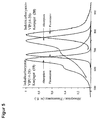
- Fig. 5 are typical absorption and Fluorescence emission spectra shown as examples.
- Example 40 Determination of cell uptake using fluorescence microscopy
- the binding and uptake of the compounds according to the invention were investigated in vitro on human tumor cells which express receptors for vasoactive intestinal peptide and / or somatostatin and / or neurotensin.
- human tumor cells which express receptors for vasoactive intestinal peptide and / or somatostatin and / or neurotensin.
- 5 ⁇ 10 5 tumor cells were incubated in 1.5 ml of medium which contained the test substance. Different concentrations of the substances (10 nM-10 ⁇ M) were used and the incubation period varied (1 min-24 h). After the incubation, the cells were fixed and microscopic preparations were made.
- the evaluation was carried out on a Zeiss Axiovert 135 fluorescence microscope using a Cy 7- (Exciter HQ 710 / 70nm, Emitter 810 / 90nm, Beamsplitter 750nm LP), Cy5- (Exciter 575-625 nm, Emitter 660-710nm BP, Beamsplitter 645nm) and Cy3 filter set (Exciter 546 / 12nm, Emitter 590nm LP, Beamsplitter 580nm).
- White light and fluorescence images of all specimens were recorded with a CCD camera (Visitron RTE / CCD-576) and stored digitally.
- fluorescence recordings were obtained in an analogous implementation with the following compounds: ( ⁇ -amino-indotricarbocyanine) -Lys 25 -VIP (14-25) conjugate 24, 10 ⁇ M, RIN38-VIP1 cells, Cy7 filter set.
- the fluorescence image shows a homogeneous, intracellular fluorescence close to the nucleus.
- the fluorescence image shows intracellular fluorescence areas with a vesicular pattern in the membrane area of the cell.
- the fluorescence image shows intracellular fluorescence areas with a vesicular pattern in the membrane area of the cell.
- Example 41 Examination of tumor accumulation using In vivo fluorescence imaging on tumor-bearing mice
- the imaging properties of the compounds according to the invention were in vivo after injection into tumor bearing Nude mice examined. For this purpose 0.1 ⁇ mol / kg to 2 ⁇ mol / kg of the substance administered intravenously and the enrichment in the tumor region over a period of 0 to 48 Hours watched.
- the fluorescence of the substances was by irradiating the animals with near-infrared light Wavelength 640 nm (indodicarbocyanines) or 740 nm (indotricarbocyanines), that is generated with a Nd: YAG laser was stimulated.
- the fluorescence radiation was at one Wavelength of> 700nm or> 800 nm through an intensified CCD camera detects and the fluorescence images stored digitally.
- Example 43 Substitution analysis of VIP using spot synthesis
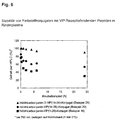
- Figure 7 shows relative fluorescence intensities of RIN38 VPAC1 cells after incubation in the presence of 150 nM dye-labeled peptides for 1 h at 37 ° C. Information in Percentage based on the native peptide of the respective series.
- the crystals are suctioned off and used in the next reaction without further purification.
- the crystals are dissolved in anhydrous ethanol and 4.4 g (10 mmol) of 5-N- (1,3,4-trihydroxybut-2-yl) -N-methylaminocarbonyl-1- (4-sulfobutyl) -2 are added. 3,3-trimethyl (3H) indolenine (see Example 45) and 0.8 g of anhydrous sodium acetate.
- the mixture is heated under reflux for one hour, the solid is filtered off and the filtrate is evaporated to dryness.
- the residue is chromatographed for purification. Yield: 3.25 g (58% of theory) Analysis (based on solvent-free substance): calc. C 54.90 H 6.14 Cl 3.18 N 5.02 S 5.75 O 22.94 Na 2.06 gef. C 54.76 H 6.03 Cl 2.99 N 4.91 S 5.60 Na 1.83
Landscapes
- Health & Medical Sciences (AREA)
- Chemical & Material Sciences (AREA)
- Life Sciences & Earth Sciences (AREA)
- Organic Chemistry (AREA)
- General Health & Medical Sciences (AREA)
- Proteomics, Peptides & Aminoacids (AREA)
- Medicinal Chemistry (AREA)
- Molecular Biology (AREA)
- Biochemistry (AREA)
- Biophysics (AREA)
- Genetics & Genomics (AREA)
- Animal Behavior & Ethology (AREA)
- Veterinary Medicine (AREA)
- Public Health (AREA)
- Epidemiology (AREA)
- Biomedical Technology (AREA)
- Engineering & Computer Science (AREA)
- Endocrinology (AREA)
- Toxicology (AREA)
- Zoology (AREA)
- Gastroenterology & Hepatology (AREA)
- Analytical Chemistry (AREA)
- Chemical Kinetics & Catalysis (AREA)
- General Chemical & Material Sciences (AREA)
- Vascular Medicine (AREA)
- Peptides Or Proteins (AREA)
- Medicines Containing Antibodies Or Antigens For Use As Internal Diagnostic Agents (AREA)
- Macromolecular Compounds Obtained By Forming Nitrogen-Containing Linkages In General (AREA)
- Investigating Or Analysing Biological Materials (AREA)
- Investigating Or Analysing Materials By The Use Of Chemical Reactions (AREA)
- Indole Compounds (AREA)
- Investigating Or Analysing Materials By Optical Means (AREA)
- Testing Of Optical Devices Or Fibers (AREA)
- Optical Modulation, Optical Deflection, Nonlinear Optics, Optical Demodulation, Optical Logic Elements (AREA)
- Electrochromic Elements, Electrophoresis, Or Variable Reflection Or Absorption Elements (AREA)
Description
WO 96/30055 beschreibt radiodiagnostische und radiotherapeutische Reagenzien, speziell VIP-rezeptorbindende Peptide, die radioaktiv markiert sind und für die Radiodiagnostik und -therapie eingesetzt werden können. Mit besonderem Vorteil beschrieben sind VIP-rezeptorbindende, mit Tc-99m markierbare Peptide für die Szintigraphie. Weitere Literatur: Cancer Research 54, 690-700, 1994; Endocrinology 136, 2662-80, 1994, J. Nucl. Med. 40, 353-361, 1999.
Literatur: EP 588754, US 5650134; US 5620675; US 5225180; WO 96/23527; J. Steroid Biochem. Mol. Biol. 37, 1083-87, 1990; Lancet 242-4, 1989, J. Nucl. Med. 39, 1913-17, 1998.
- daß das Farbstoffmolekül A1 und/oder A2 für einen Indocarbocyanin-, einen Indodicarbocyanin- oder einen Indotricarbocyaninfarbstoff steht,
- daß das Farbstoffmolekül A1 und/oder A2 für einen Indocarbocyanin-,
einen Indodicarbocyanin- oder einen Indotricarbocyaninfarbstoff
der allgemeinen Formel XIII
oder XIV


p für 1, 2 oder 3,
n für eine Zahl von 1, 2, 3, 4 oder 10 steht,
R1 und R2 unabhängig voneinander für einen 4-Sulfobutyl-, 3-Sulfopropyl-, 2-Sulfoethyl-, 3-Methyl-3-sulfopropyl-, Methyl-, Ethyl- oder Propylrest stehen, und
R3 für Wasserstoff, ein Chlor-, Brom-, Iodatom oder eine Nitrogruppe oder für einen Rest -COOE1, -CONE1E2, -NHCOE1, -NHCONHE1, -NE1E2, -OE1, -OSO3E1, -SO3E1, -SO2NHE1,
wobei E1 und E2 unabhängig voneinander für ein Wasserstoffatom oder für einen Methyl-, Ethyl- oder einen C3-C6-Alkylrest, der von 0 bis 2 Sauerstoffatomen und/oder von 0 bis 1 Carbonylgruppen unterbrochen ist und/oder mit 0 bis 5 Hydroxygruppen substituiert ist, oder für einen Poly(oxyethylen)glykolrest mit 2 bis 30 -CH2CH2O-Einheiten stehen,
steht,
- daß das Farbstoffmolekül A1 und/oder A2 für einen Indocarbocyanin-,
einen Indodicarbocyanin- oder einen Indotricarbocyaninfarbstoff
der allgemeinen Formel XIII
oder XIV

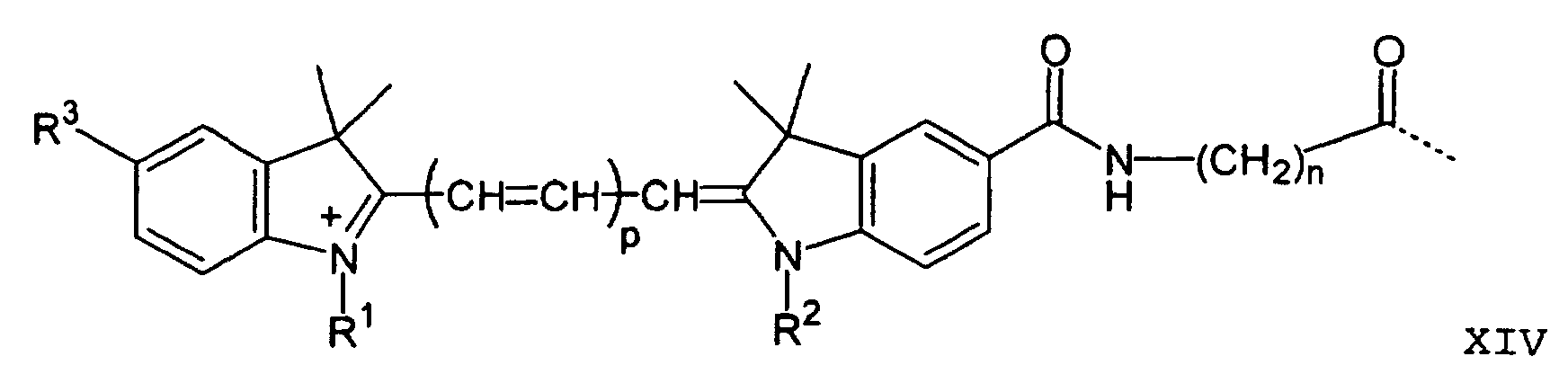
p für 1, 2 oder 3,
n für 1, 2 oder 4,
R1 und R2 unabhängig voneinander für einen 4-Sulfobutyl- oder 3-Sulfopropylrest,
R3 für Wasserstoff oder für einen Rest -COOE1 oder -CONHE1,
wobei E1 ein Wasserstoffatom oder ein Methyl-, Ethyloder ein C3-C6-Alkylrest, der von '0 bis 2 Sauerstoffatomen und/oder von 0 bis 1 Carbonylgruppen unterbrochen ist und/oder mit 0 bis 5 Hydroxygruppen substituiert ist, bedeutet,
steht,
- daß das Farbstoffmolekül A1 und/oder A2 für einen Indotricarbocyaninfarbstoff
der allgemeinen Formel XV
oder XVI steht:
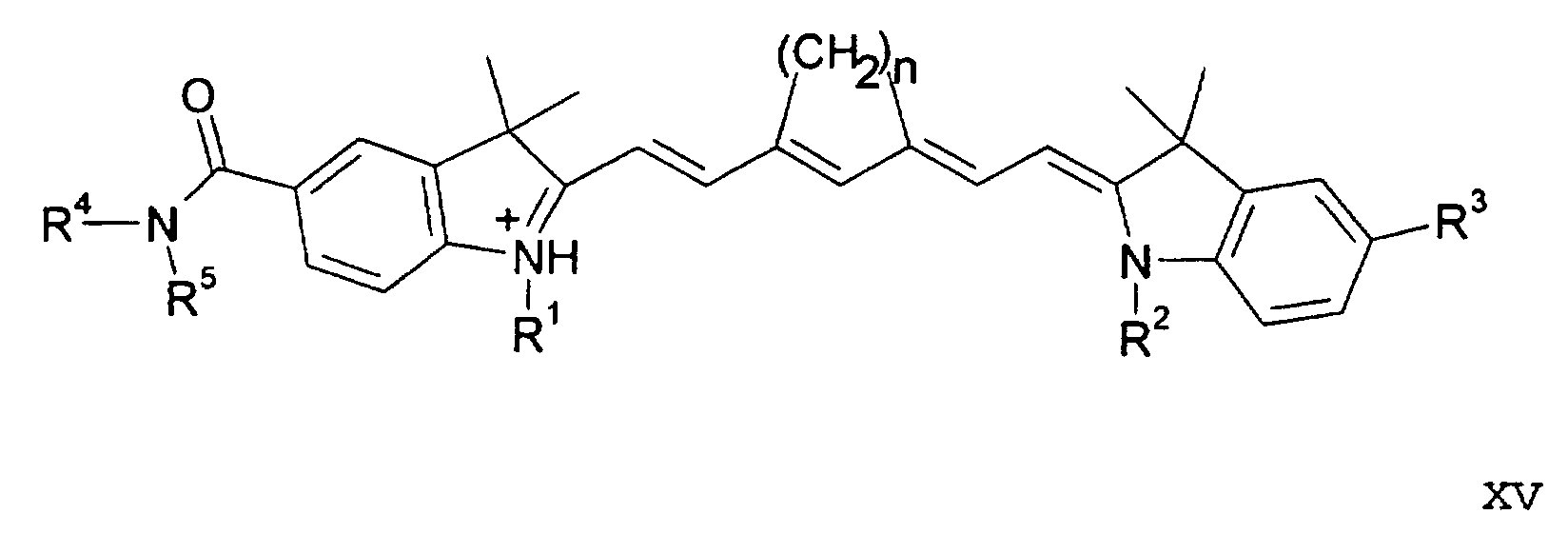
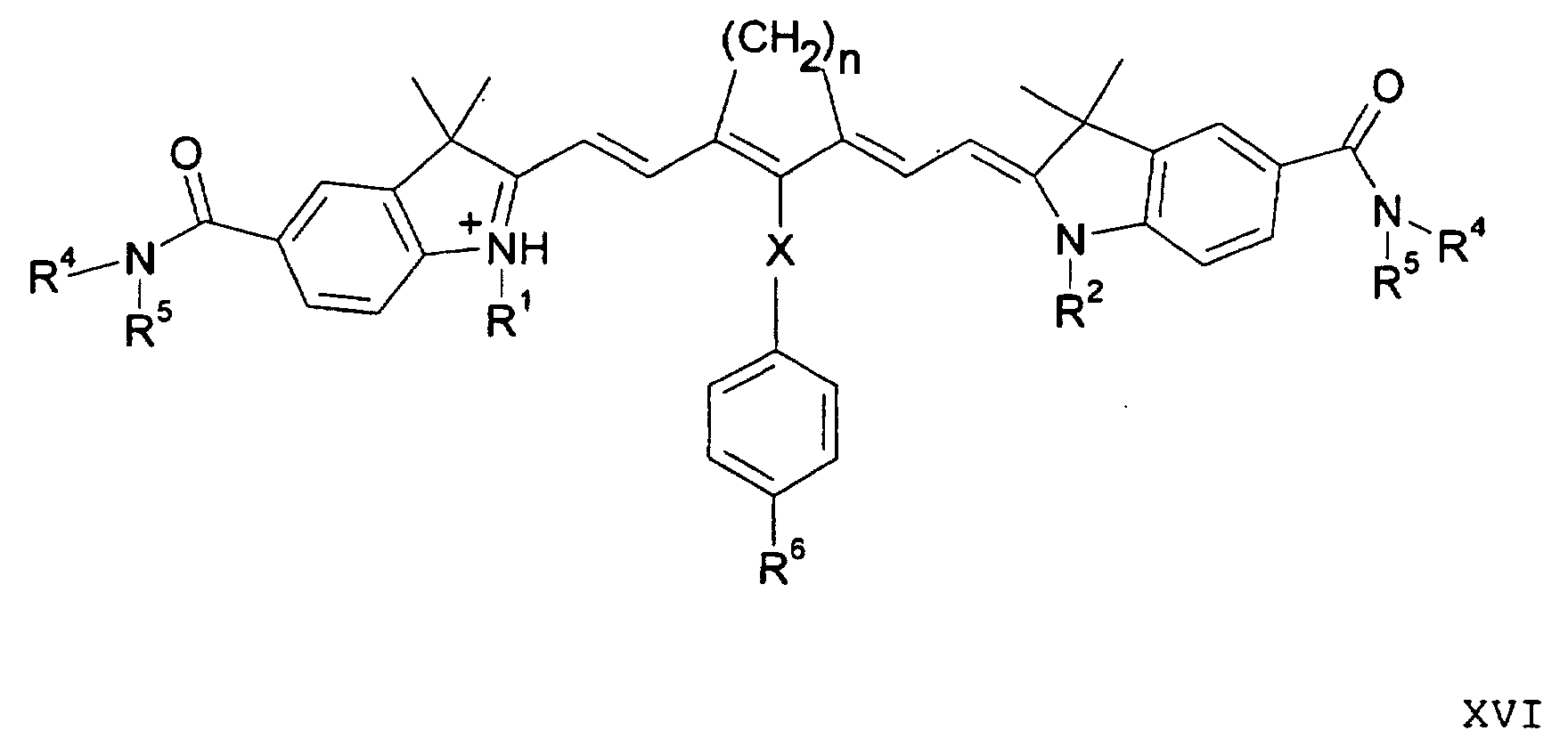
n für 2 oder 3 steht,
R1 und R2 unabhängig voneinander einen 4-Sulfobutyl-, 3-Sulfopropyl- oder 2-Sulfoethylrest darstellen,
R3 für einen Rest -CONH-Peptid, -CONH-(CH2)m-CONH-Peptid, - CONH-(CH2)n-NH-CS-NH-Peptid oder -CONH-(CH2)n-NHCO-CH2-Peptid mit m = 1 bis 10 und n = 2 oder 3 steht,
oder eine folgende Gruppe darstellt:

R6 für eine der folgenden Gruppen steht:
- -(CH2)m-CONH-Peptid mit m = 0 bis 2,
- -(CH2)m-NH-CS-NH-Peptid mit m = 0 bis 2,
- daß das Farbstoffmolekül A1 und/oder A2 für einen Indotricarbocyaninfarbstoff
der allgemeinen Formel XVII
steht:
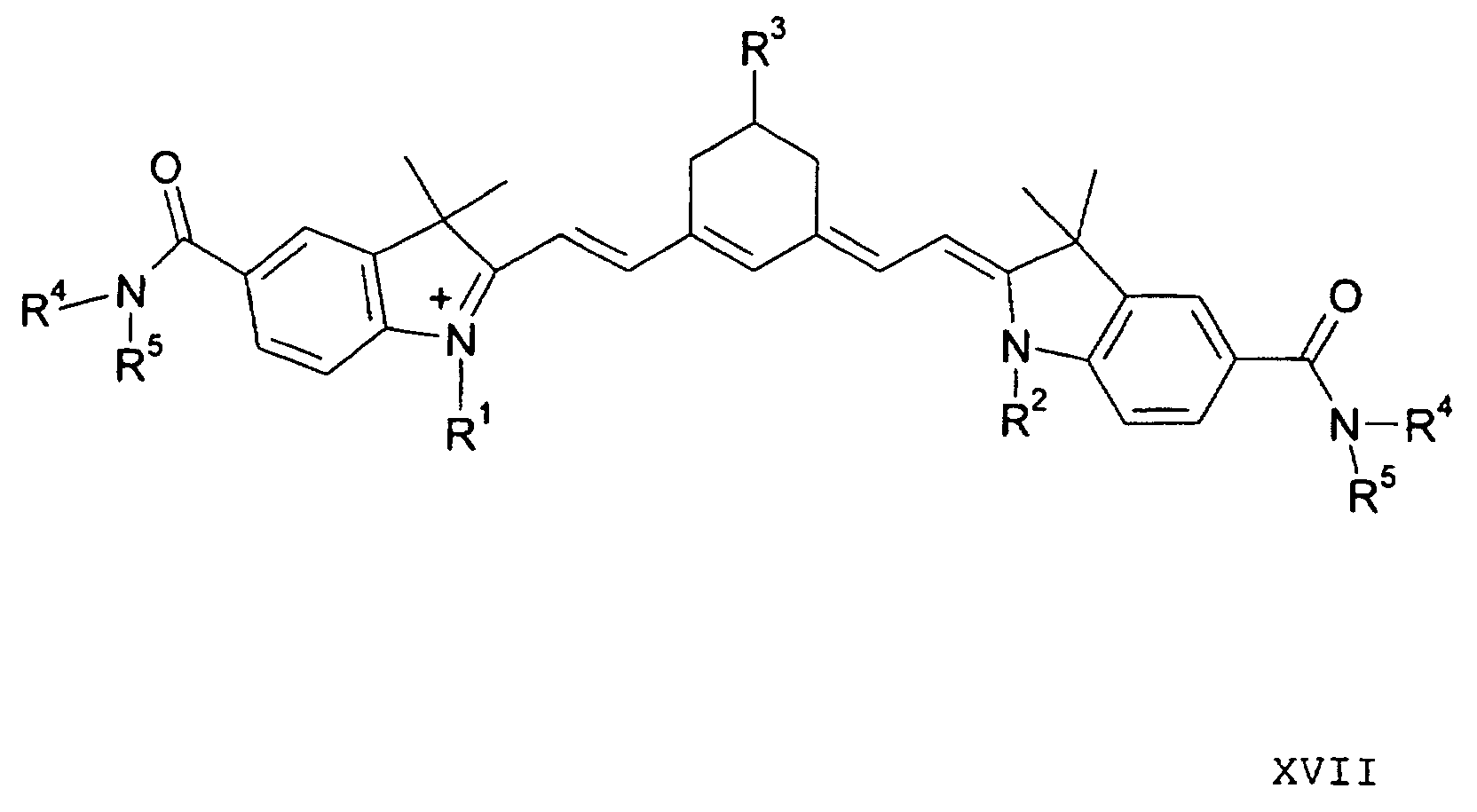
R1 und R2 unabhängig voneinander für einen 4-Sulfobutyloder 3-Sulfopropylrest darstellen,
R3 für einen Rest -CONH-Peptid, -CONH-(CH2)m-CONH-Peptid, -CONH-(CH2)n-NH-CS-NH-Peptid oder -CONH-(CH2)n-NHCO-CH2-Peptid mit m = 1 bis 10 und n = 2 oder 3 steht,
oder eine folgende Gruppe darstellt:

Literatur: Peptide chemistry - A practical textbook (M. Bodanszky), 2nd edition, Springer-Verlag Heidelberg 1993; Anti-Cancer Drug Design 12, 145-167, 1997; J. Am. Chem. Soc. 117, 11821-2, 1995.
Literatur zur Synthese von Polymethinfarbstoffen: Bioconjugate Chem. 4, 105-111, 1993; Bioconjugate Chem. 7, 356-62, 1996; Bioconjugate Chem. 8, 751-56, 1997; Cytometry 10, 11-19, 1989 und 11, 418-30, 1990; J. Heterocycl. Chem. 33, 1871-6, 1996; J. Org. Chem. 60, 2391-5, 1995; Dyes and Pigments 17, 19-27, 1991, Dyes and Pigments 21, 227-34, 1993; J. Fluoresc. 3, 153-155, 1993; Anal. Biochem. 217, 197-204, 1994; US 4981977; US 5688966; US 5808044; WO 97/42976; WO 97/42978; WO 98/22146; WO 98/26077; EP 0800831.

p für 1, 2 oder 3,
n für 1, 2, 3, 4 oder 10 steht,
R1 und R2 unabhängig voneinander für einen 4-Sulfobutyl-, 3-Sulfopropyl-, 2-Sulfoethyl-, 3-Methyl-3-sulfopropyl-, Methyl-, Ethyl- oder Propylrest stehen, und
R3 für Wasserstoff oder für einen Rest -COOE1, -CONE1E2, -NHCOE1, -NHCONHE1, -NE1E2, -OE1, -OSO3E1, -SO3E1, -SO2NHE1,
wobei E1 und E2 unabhängig voneinander für ein Wasserstoffatom oder für einen Methyl-, Ethyl- oder einen C3-C6-Alkylrest, der von 0 bis 2 Sauerstoffatomen und/oder von 0 bis 1 Carbonylgruppen unterbrochen ist und/oder mit 0 bis 5 Hydroxygruppen substituiert ist, stehen,
steht,
oder Cyaninfarbstoffe der allgemeinen Formel XIX oder XX


n für 2 oder 3 steht,
R1 und R2 unabhängig voneinander einen 4-Sulfobutyl-, 3-Sulfopropyl- oder 2-Sulfoethylrest darstellen,
R3 für eine -COOH-Gruppe oder einen der folgenden Reste steht:
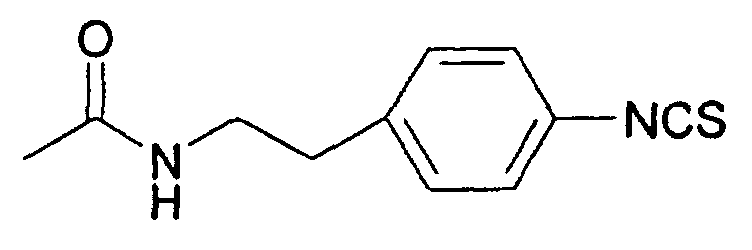
R6 für eine der folgenden Gruppen steht:
- - (CH2)m-COOH mit m = 0 bis 2,
- - (CH2)m-NCS mit m = 0 bis 2,
oder Cyaninfarbstoffe der allgemeinen Formel XXI
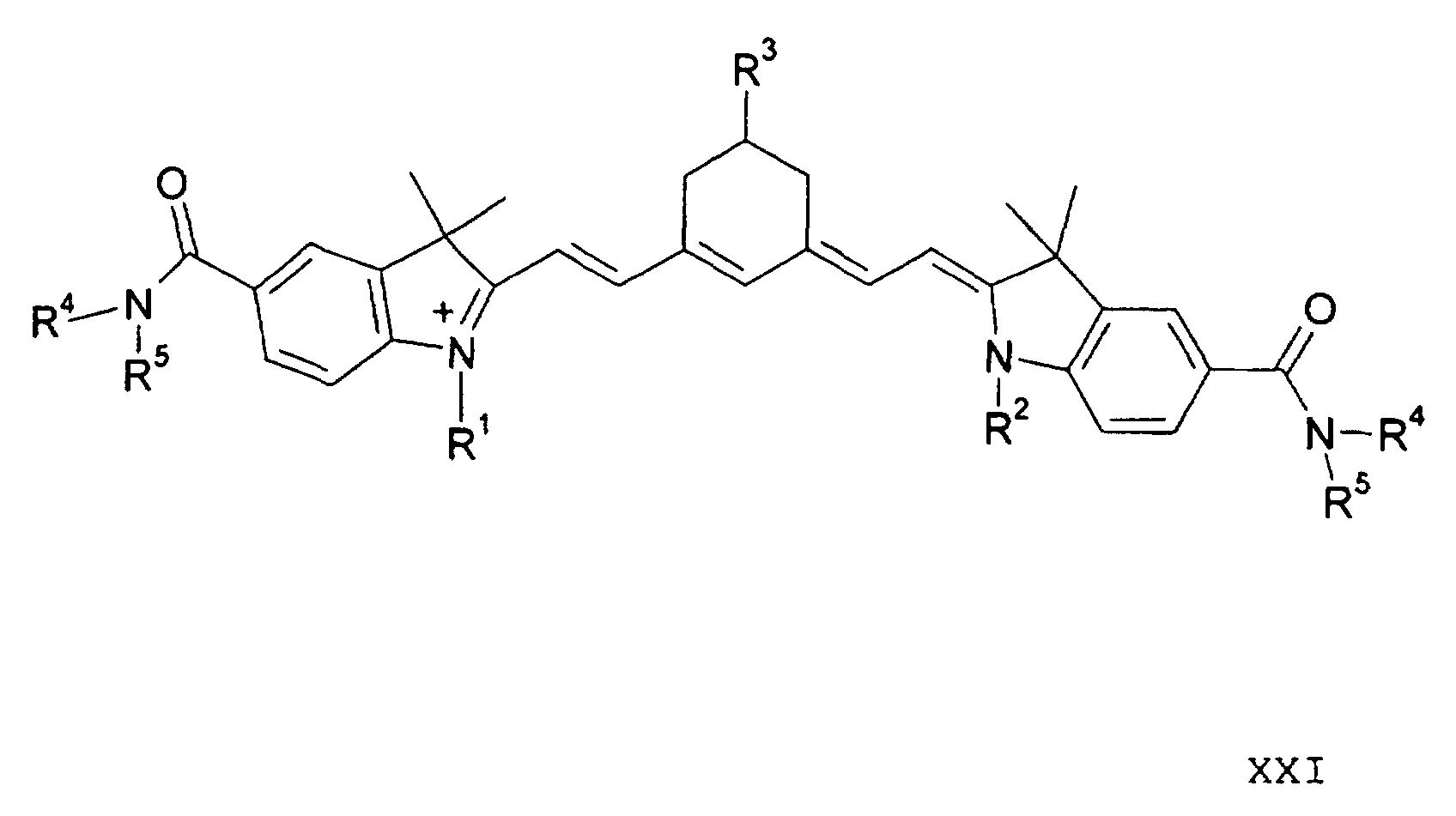
R1 und R2 unabhängig voneinander für einen 4-Sulfobutyl-, 3-Sulfopropyl- oder 2-Sulfoethylrest darstellen,
R3 für eine -COOH-Gruppe oder einen der folgenden Reste steht:
- -CONH-(CH2)n-COOH mit n = 2 oder 3,
- -CONH-(CH2)n-NCS mit n = 2 oder 3,
- -CONH-(CH2)n-NHCO-CH2-X1 mit n = 2 oder 3 und X1 = Cl, Br, I

Die Umsetzung zu den Bromiden 10-12 erfolgt durch Rühren von 0,3 mmol der Zwischenprodukte mit 55 mg (0,5 mmol) N-Bromsuccinimid und 130 mg (0,5 mmol) Triphenylphosphin in einem Gemisch von 4 ml Dichlormethan und 4 ml Dimethylformamid für 48 h bei 4 °C. Durch Zugabe von 3 ml Ether werden die Produkte ausgefällt, abfiltriert und als Rohprodukte in der Peptidkopplung eingesetzt.

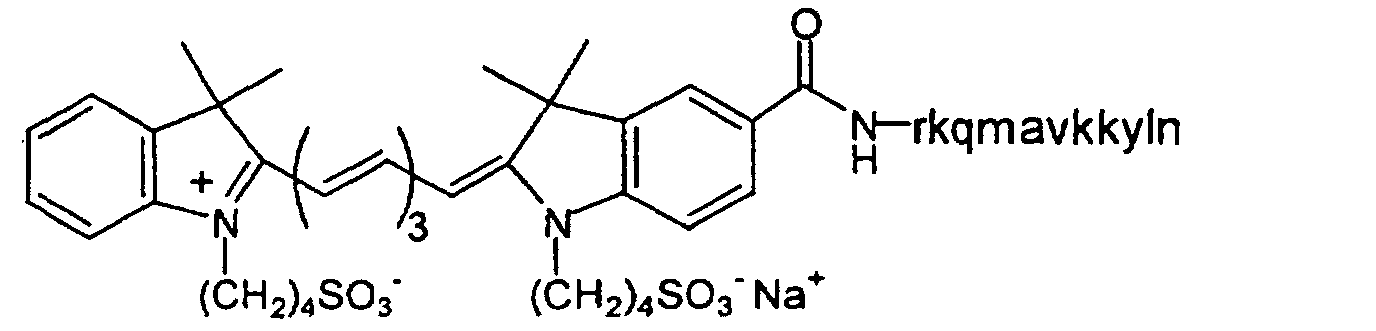
n = 2: Indodicarbocyanin-VIP(1-28)-Konjugat 15
n = 3: Indotricarbocyanin-VIP(1-28)-Konjugat 16
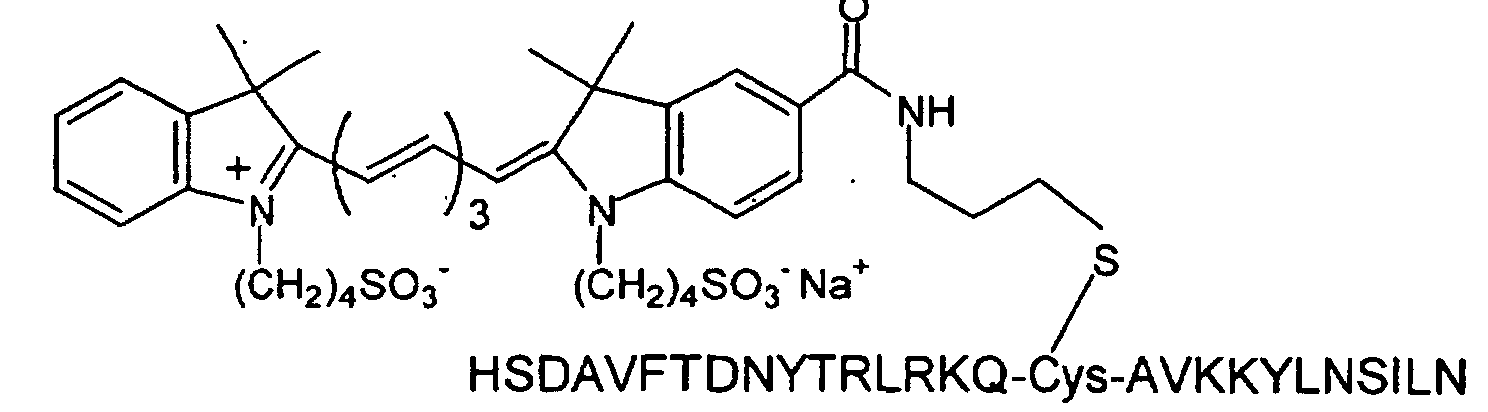
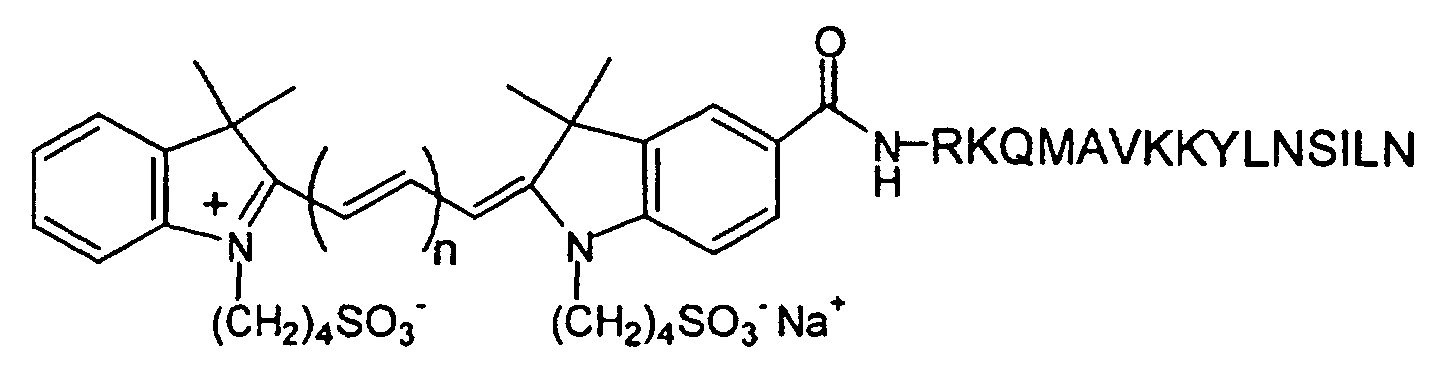
n = 2: Indodicarbocyanin-VIP(14-28)-Konjugat 19
n = 3: Indotricarbocyanin-VIP(14-28)-Konjugat 20
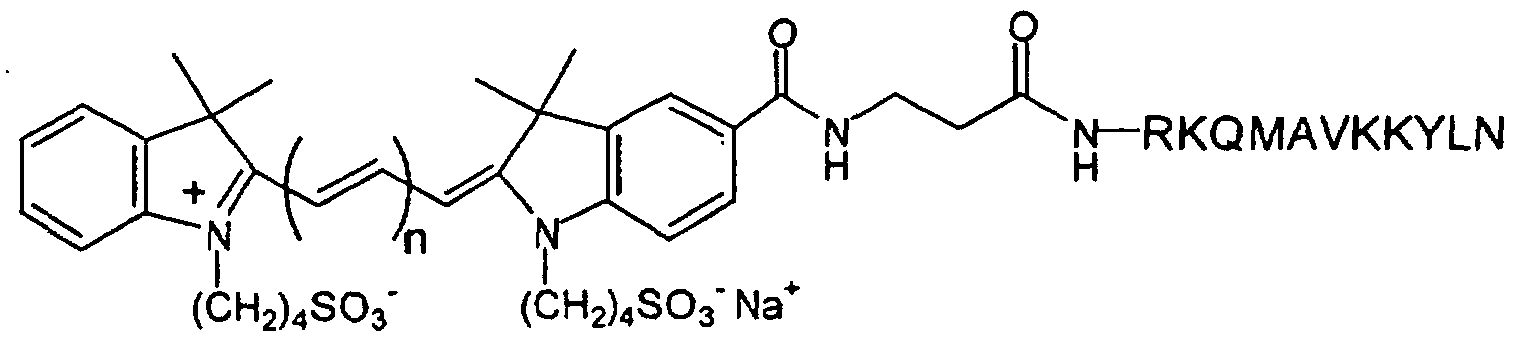
n = 2: Indodicarbocyanin-β-Alanin-VIP(14-24)-Konjugat 22
n = 3: Indotricarbocyanin-β-Alanin-VIP(14-24)-Konjugat 23
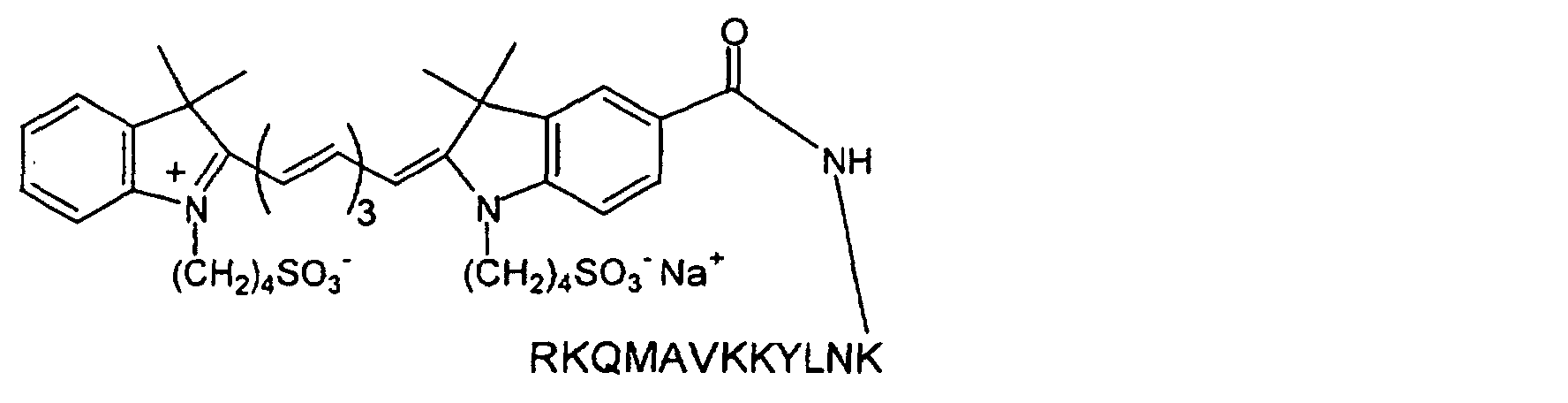
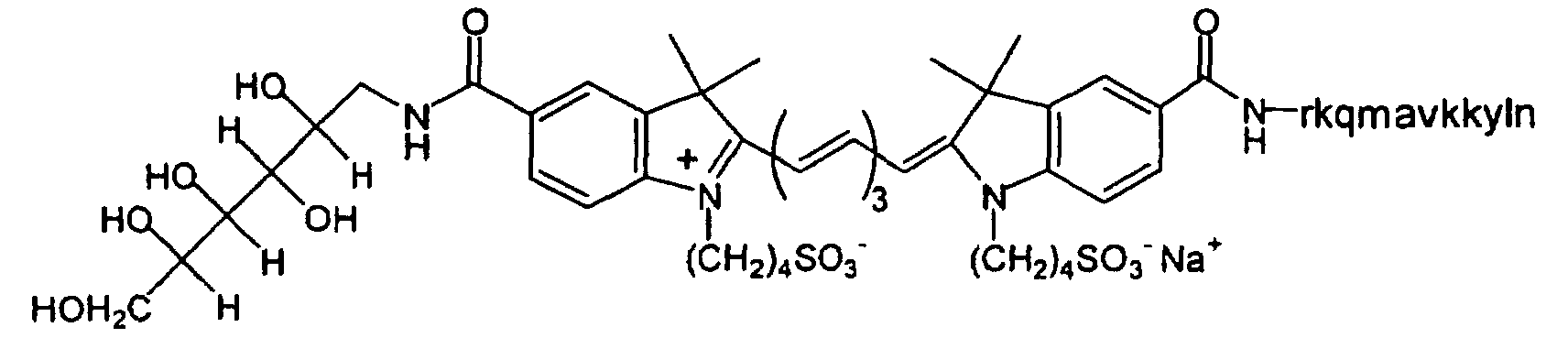

n = 2: Indodicarbocyanin-pentetreotid 29
n = 3: Indotricarbocyanin-pentetreotid 30


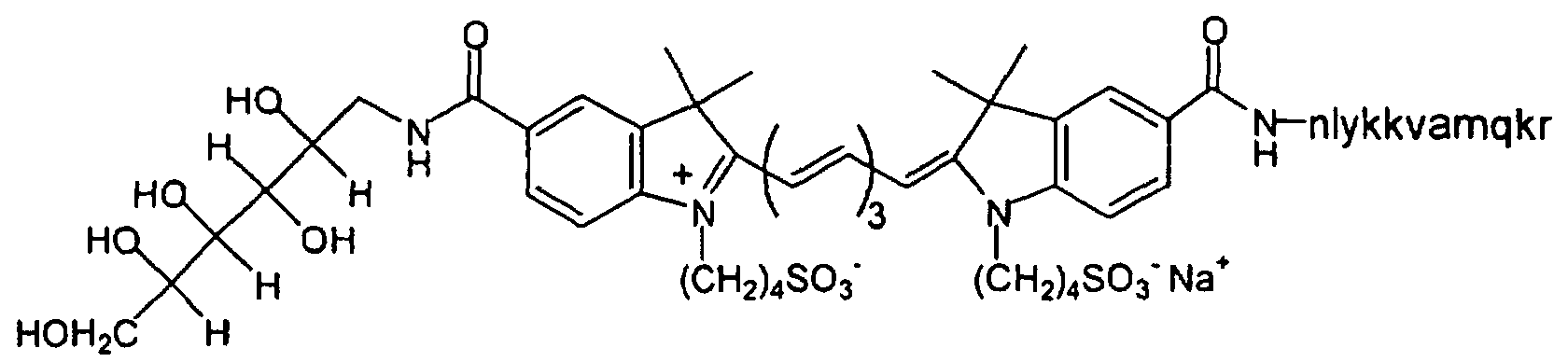
n = 2: Indodicarbocyanin-D-Tyr11-Neurotensin(7-13)-Konjugat 34
n = 3: Indotricarbocyanin-D-Tyr11-Neurotensin(7-13)-Konjugat 35

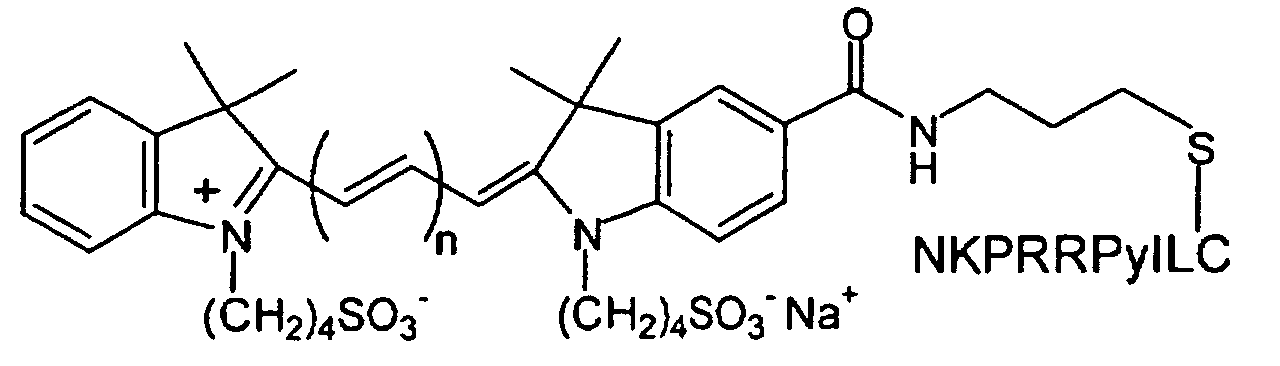
n = 2: Indodicarbocyanin-D-Tyr11-Neurotensin(5-13)-Cys-Konjugat 38.
Indotricarbocyanin-VIP(14-28)-Konjugat 20, 10 µM, HT29-Zellen. Homogen über die Zelle verteilte Fluoreszenz, gute Korrelation mit dem Weisslichtbild.
Indotricarbocyanin-retro-D-VIP(24-14) 25, 10 µM, HT29-Zellen. Homogen über die Zelle verteilte Fluoreszenz, gute Korrelation mit dem Weisslichtbild.
Indotricarbocyanin-pentetreotid-Konjugat 30, 10 µM, RIN38-VIP1-Zellen. Fluoreszenzareale mit vesikulärem Muster im Membranbereich der Zelle, gute Korrelation mit dem Weisslichtbild.
Indodicarbocyanin-VIP(1-28)-Konjugat 15, 10 µM, RIN38-VIP1-Zellen, Cy5-Filtersatz. Das Fluoreszenzbild zeigt intrazelluläre Fluoreszenzareale mit vesikulärem Muster im Membranbereich der Zelle.
Zu verschiedenen Zeitpunkten (0,5; 1; 2; 4; 6; 24 h) erfolgte die Aufarbeitung der Proben, indem 1 ml der Plasmalösung mit 1 ml MeOH versetzt wird und die ausgefallenen Proteine abzentrifugiert werden.
Die Analyse des Überstandes erfolgte mittels HPLC durch Bestimmung des Gehaltes bei' 750 nm bezogen auf den Gehalt nach 1 min Inkubation bei 0 °C (Kontrolle).
B: 10% H2O(+0.5%TFA)/90% MeOH
Um die Peptide auf Rezeptorbindung untersuchen zu können, mußten die Peptide von der Zellulose abgespalten werden. Dafür wurde eine Methode entwickelt, bei der es erstmalig gelungen ist, Peptide mit authentischen C-Terminus von der Zellulose abzuspalten.
- Eine 20 x 30 cm große Zellulose-Membran (Whatman 50) wurde für 2 min. mit Methanol/1.2 % Perchloressigsäure inkubiert und anschließend getrocknet.
- Nach dreistündiger Inkubation mit 10%Epibromhydrin in Dioxan/1,2 % Perchloressigsäure wurde für 30 min. mit Methanol abreagiert und danach zweimal mit Methanol gewaschen.
- Anschließend wurde 3 x mit Dimethylformamid (DMF) gewaschen und über Nacht mit 50 % 1,3-Diaminopropan (v/v) in DMF inkubiert. Danach wurde wie folgt gewaschen: 3 x DMF, 2 x Ethanol, 2 x Aqua dest., 2 x Ethanol, 15 min. mit 5 M Natriummethanolat, 3 x Methanol, 4 x Aqua dest., 3 x Ethanol, 1 x Diethylether
- Für die Spotdefinition wurde 1.3 µl 0.6 M Fmoc-β-Alanin-Opfp-Lösung mit dem Auto-Spot Robot 222 XL (Abimed, Langenfeld) bei einer Reaktionszeit von 15 min. auf bestimmte Punkte der Zellulose-Membran doppelt aufpipettiert.
- Die Membran wurde 2 min. mit 2 % Acetanhydridlösung und 30 min. mit 20 % Acetanhydrid/10 % Diisopropylethylamin acetyliert.
- Für die Abspaltung der Fmoc-Schutzgruppe wurde die Membran 3 x mit DMF gewaschen, 2 x 10 min. mit 2:0 % Piperidin-Lösung inkubiert, 5 x mit DMF und 1 x mit Ethanol gewaschen. Die freien Aminogruppen konnten mit Bromphenolyblau sichtbar gemacht werden. Nach wiederholtem Waschen mit Ethanol wurde die Membran getrocknet.
- Es wurde 0.6 M Mercaptopropionsäure bei einer Reaktionszeit von 15 min. doppelt auf die definierten Spots pipettiert. Anschließend wurde 3 x mit DMF und 3 x mit Dichlormethan (DCM) gewaschen..
- Die Abspaltung der Mmt-Schutzgruppe erfolgte mit Inkubation für 2 min. mit 10 % Dichloressigsäure/0.5% Trifluoressigsäure und 3 x 5 min. mit 10 % Dichloressisäure/0,5 % trifluoressigsäure/5 % Triisobutylsilan. Folgende Waschschritte wurden durchgeführt: 1x DCM, 2 x Ethanol, 1 x Aqua dest., 1-2 min. mit 10 % Cäsiumcarbonat, 1 x Aqua dest., 2 x Ethanol, 1 x Diethylether
- Die jeweiligen Fmoc-brompropyl-aminosäureester wurden 3 x bei einer Konzentration von 0.6 M und Reaktionszeit von 15 min. gekoppelt. Die Abspaltung der Fmoc-Schutzgruppe wurde wie bei 1b durchgeführt.
- Die Peptide wurden durch wiederholtes Aufpipettieren von 0.6 M Aminosäurelösungen in N-Methylpyrrolidon auf die Spots und anschließender Abspaltung der Fmoc-Schutzgruppen aufgebaut.
- Es wurde eine 0.3 M Lösung des Indodicarcocyaninfarbstoffes mit 0.3 M TBTU und 0.6 M Diisopropylethylamin aktiviert und 4 x bei einer Reaktionszeit von 15 min. auf die Spots aufpipettiert.
- Die Abspaltung der Seitenschutzgruppen erfolgte durch nacheinanderfolgende Behandlung der Membran mit 90 % Trifluoressigsäure/3 % Triisobutylsilan/2 % Aqua dest./1 % Phenol für 30 min. und mit 50 % Trifluoressigsäure/3 % Triisobutylsilan/2 % Aqua dest./1 % Phenol für 2,5 h. Anschließend wurde 4 x mit Dichlormethan, 3 x mit DMF und 1 x mit Ethanol gewaschen.
- Die Spots wurden ausgestanzt und mit Methanol gewaschen. Für die Abspaltung wurde 30 min. mit 70 mM Natriummethanolat in Methanol inkubiert. Der pH konnte durch Zugabe von 37%iger Salzsäure korrigiert werden. Anschließend wurden die Peptide in einer Speed-Vac getrocknet.
- Nach dem Trocknen wurden die Peptide in Aqua dest. aufgenommen und mittels Reversed-Phase-HPLC und MALDI-TOF analysiert.
- Die Konzentration der VIP-Derivate wurde photometrisch über den Farbstoff ermittelt. In dem Zellassay wurden die Peptide mit einer Endkonzentration von 150 mM eingesetzt. Dabei wurden 1 x 10⁵ RIN38(VAPC1)-Zellen mit den VIP-Derivaten für eine Stunde bei 37° C in Bindungspuffer (50 mM Tris/HCL, pH 7,5 , 5 nM MgCl2, 1 mM CaCl2, 100 mM NaCl, 4 % BSA) inkubiert.
- Anschließend wurden die Zellen 2 x mit PBS gewaschen, in FACS-Röhrchen überführt und 5 min. bei 377 g zentrifugiert. Das Zellpellet wurde in 300 µl Cellfix resuspendiert am FACS-Calibur (Becton Dickinson) mit FL4-Optik gemessen.
- Die Fluoreszenzintensitäten der in der Durchflußzytometrie gemessenen nativen, nätürlich vorkommenden, humanen VIP-Peptide wurde 100 % gesetzt. Die Standardabweichung von 28 nativen VIP-peptiden betrug 11%. Die weiteren VIP-Derivate wurden diesen 100 % angeglichen.
| Analyse (bezogen auf lösungsmittelfreie Substanz): | |||||
| ber. | C 55,32 | H 6,84 | N 6,79 | S 7,77 | O 23,27 |
| gef. | C 55,39 | H 6,95 | N 6,57 | S 7,58 |
Ausbeute: 0,58 g (59 % d. Th.)
| Analyse (bezogen auf lösungsmittelfreie Substanz): | |||||||
| ber. | C 56,17 | H 6,15 | Cl 3,60 | N 6,79 | S 7,77 | 0 23,27 | Na 2,34 |
| gef. | C 55,99 | H 6,30 | Cl 3,41 | N 6,87 | S 7,64 | Na 2,17 |
Ausbeute: 85 mg (54 % d. Th.)
| Analyse (bezogen auf lösungsmittelfreie Substanz): | ||||||
| ber. | C 58,65 | H 6,09 | N 6,22 | S 8,54 | 0 18,47 | Na 2,04 |
| gef. | C 58,53 | H 6,17 | N 6,11 | S 8,63 | Na 1,83 |
Ausbeute: 0,67 g (74 % d. Th.)
| Analyse (bezogen auf lösungsmittelfreie Substanz): | |||||
| ber. | C 52,58 | H 6,82 | N 5,57 | S 6,38 | O 28,65 |
| gef. | C 52,47 | H 6,91 | N 5,39 | S 6,44 |
Ausbeute: 0,31 g (53 % d. Th.)
| Analyse (bezogen auf lösungsmittelfreie Substanz) : | |||||||
| ber. | C 54,05 | H 6,33 | Cl 3,01 | N 4,76 | S 5,44 | O 24,45 | Na 1,95 |
| gef. | C 53,89 | H 6,20 | Cl 2,87 | N 4,83 | S 5,29 | Na 1,72 |
Ausbeute: 78 mg (43 % d. Th.)
| Analyse (bezogen auf lösungsmittelfreie Substanz): | ||||||
| ber. | C 55,07 | H 6,01 | N 5,35 | S 9,80 | O 22,01 | Na 1,76 |
| gef. | C 54,89 | H 6,20 | N 5,24 | S 9,58 | Na 1,54 |
Ausbeute: 1,9 g (40 % d. Th.)
| Analyse (bezogen auf lösungsmittelfreie Substanz): | ||||||
| ber. | C 54,47 | H 6,03 | N 5,03 | S 7,67 | O 21,05 | Na 2,75 |
| gef. | C 54,26 | H 6,12 | N 5,00 | S 7,49 | Na 2,48 |
Ausbeute: 3,25 g (58 % d. Th.)
| Analyse (bezogen auf lösungsmittelfreie Substanz): | |||||||
| ber. | C 54,90 | H 6,14 | Cl 3,18 | N 5,02 | S 5,75 | O 22,94 | Na 2,06 |
| gef. | C 54,76 | H 6,03 | Cl 2,99 | N 4,91 | S 5,60 | Na 1,83 |
Ausbeute: 75 mg (67 % d. Th.)
| Analyse (bezogen auf lösungsmittelfreie Substanz): | ||||||
| ber. | C 56,27 | H 6,33 | N 5,25 | S 6,01 | O 23,99 | Na 2,15 |
| gef. | C 56,13 | H 6,46 | N 5,12 | S 5,87 | Na 1,88 |
Ausbeute: 60 mg (86 % d. Th.)
| Analyse (bezogen auf lösungsmittelfreie Substanz): | ||||||
| ber. | C 55,71 | H 6,06 | N 6,02 | S 5,51 | O 24,73 | Na 1,97 |
| gef. | C 55,59 | H 6,21 | N 5,93 | S 5,37 | Na 1,75 |
Ausbeute: 0,37 g (71 % d. Th.)
| Analyse (bezogen auf lösungsmittelfreie Substanz): | |||||
| ber. | C 62,04 | H 8,10 | N 5,36 | S 6,13 | O 18,37 |
| gef. | C 61,88 | H 8,23 | N 5,17 | S 6,02 |
| Analyse (bezogen auf lösungsmittelfreie Substanz): | ||||||
| ber. | C 60,10 | H 7,02 | N 5,50 | S 6,29 | O 18,84 | Na 2,26 |
| gef. | C 59,96 | H 7,14 | N 5,33 | S 6,15 | Na 2,11 |
Ausbeute: 3,2 g (75 % d. Th.)
| Analyse (bezogen auf lösungsmittelfreie Substanz): | |||||
| ber. | C 40,69 | H 6,49 | Br 27,07 | N 9,49 | O 16,26 |
| gef. | C 40,50 | H 6,37 | Br 26,89 | N 9,58 |
Ausbeute: 2,3 g (95 % d. Th.)
| Analyse (bezogen auf lösungsmittelfreie Substanz): | ||||||
| ber. | C 25,94 | H 5,22 | Cl 15,31 | Br 34,51 | N 12,10 | O 6,91 |
| gef. | C 25,76 | H 5,41 | Cl 15,55 | Br 34,34 | N 11,97 |
Man rührt vier Stunden bei 60°C, kühlt anschließend auf Raumtemperatur ab und fällt das Produkt mit Diethylether. Der Feststoff wird abgesaugt und mit reichlich Diethylether gewaschen.
Ausbeute: 0,11 mg (80 % d. Th.)
| Analyse (bezogen auf lösungsmittelfreie Substanz): | |||||||
| ber. | C 56,17 | H 6,18 | Br 6,13 | N 6,44 | S 4,92 | Na 1,76 | O 18,40 |
| gef. | C 55,96 | H 6,26 | Br 6,01 | N 6,27 | S 4,81 | Na 1,53 |
Claims (3)
- Cyaninfarbstoffe der allgemeinen Formel XVIII,worin
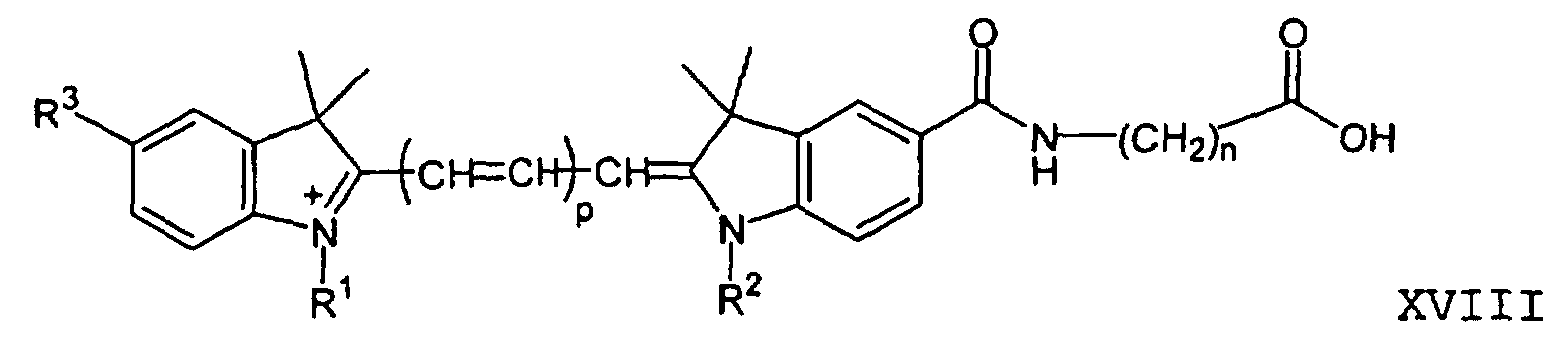
p für 1, 2 oder 3,
n für 1, 2, 3, 4 oder 10 steht,
R1 und R2 unabhängig voneinander für einen 4-Sulfobutyl-, 3-Sulfopropyl-, 2-Sulfoethyl-, 3-Methyl-3-sulfopropyl-, Methyl-, Ethyl- oder Propylrest stehen, und
R3 für Wasserstoff oder für einen Rest -COOE1, -CONE1E2, -NHCOE1, -NHCONHE1, -NE1E2, -OE1, -OSO3E1, -SO3E1, -SO2NHE1,
wobei E1 und E2 unabhängig voneinander für ein Wasserstoffatom oder für einen Methyl-, Ethyl- oder einen C3-C6-Alkylrest, der von 0 bis 2 Sauerstoffatomen und/oder von 0 bis 1 Carbonylgruppen unterbrochen ist und/oder mit 0 bis 5 Hydroxygruppen substituiert ist, stehen,
steht. - Cyaninfarbstoffe der allgemeinen Formel XIX oder XX
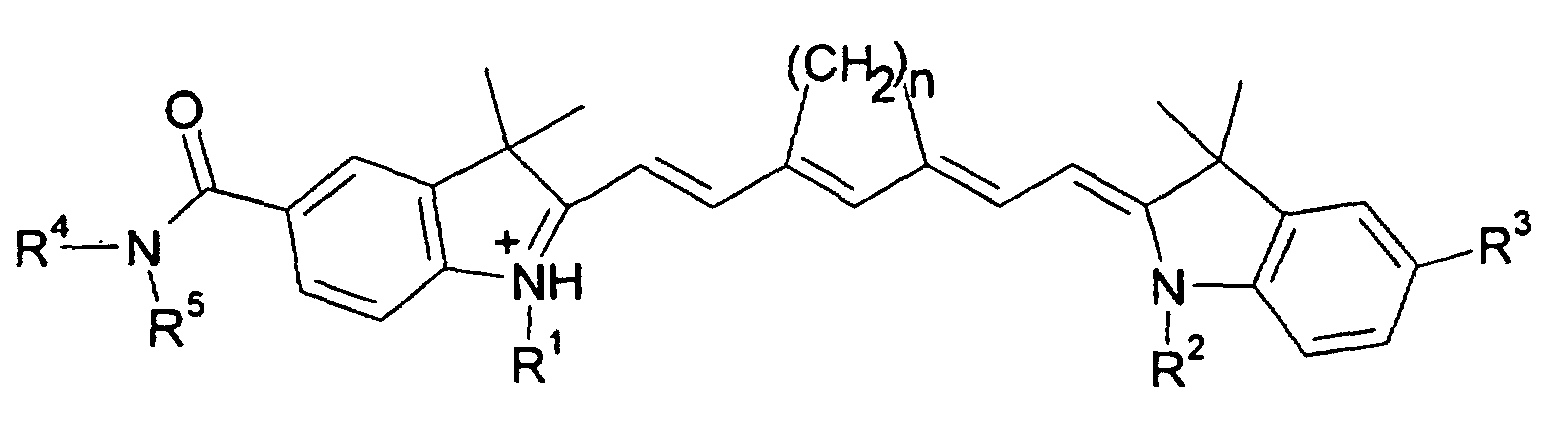 worin
worin
n für 2 oder 3 steht,
R1 und R2 unabhängig voneinander einen 4-Sulfobutyl-, 3-Sulfopropyl- oder 2-Sulfoethylrest darstellen,
R3 für eine -COOH-Gruppe oder einen der folgenden Reste steht:-CONH-(CH2)n-COOH mit n = 2 oder 3,-CONH-(CH2)n-NCS mit n = 2 oder 3,-CONH-(CH2)n-NHCO-CH2-X1 mit n = 2 oder 3 und X1 = Cl, Br, IR4 und R5 unabhängig voneinander für ein Wasserstoffatom, einen Methylrest oder einen hydroxylierten Alkylrest wie z.B. 1-Hydroxyethyl, 1-Hydroxypropyl, 2,3-Dihydroxypropyl, 1,3-Dihydroxy-2-propyl, 1,2,3-Trihydroxybutyl, 1,3,4-Trihydroxy-2-butyl, 1,2,3,4,5-Pentahydroxyhexyl stehen,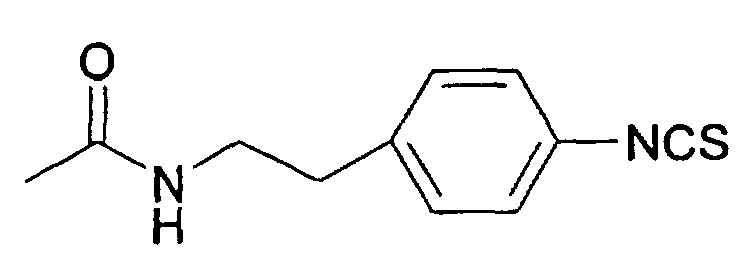
R6 für eine der folgenden Gruppen steht:und X für ein Sauerstoffatom oder ein Schwefelatom steht.-(CH2)m-COOH mit m = 0 bis 2,-(CH2)m-NCS mit m = 0 bis 2,-(CH2)m-CONH-Peptid mit m = 0 bis 2,-(CH2)m-NH-CS-NH-Peptid mit m = 0 bis 2, - Cyaninfarbstoffe der allgemeinen Formel XXIworin

R1 und R2 unabhängig voneinander für einen 4-Sulfobutyloder 3-Sulfopropylrest darstellen,
R3 für eine -COOH-Gruppe oder einen der folgenden Reste steht:-CONH-(CH2)n-COOH mit n = 2 oder 3,-CONH-(CH2)n-NCS mit n = 2 oder 3,-CONH-(CH2)n-NHCO-CH2-X1 mit n = 2 oder 3 und X1 = Cl, Br, Iund R4 und R5 unabhängig voneinander für ein Wasserstoffatom, einen Methylrest oder einen hydroxylierten Alkylrest wie z.B. 1-Hydroxyethyl, 1-Hydroxypropyl, 2,3-Dihydroxypropyl, 1,3-Dihydroxy-2-propyl, 1,2,3-Trihydroxybutyl, 1,3,4-Trihydroxy-2-butyl, 1,2,3,4,5-Pentahydroxyhexyl stehen.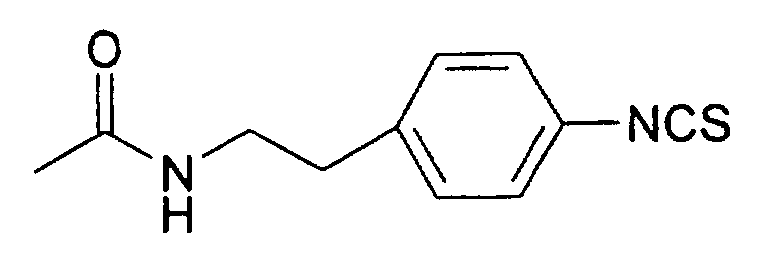
Priority Applications (1)
| Application Number | Priority Date | Filing Date | Title |
|---|---|---|---|
| EP02090268A EP1281405B1 (de) | 1999-04-09 | 2000-03-28 | Kurzkettige Peptid-Farbstoffkonjugate als Kontrastmittel für die optische Diagnostik |
Applications Claiming Priority (3)
| Application Number | Priority Date | Filing Date | Title |
|---|---|---|---|
| DE19917713 | 1999-04-09 | ||
| DE19917713A DE19917713A1 (de) | 1999-04-09 | 1999-04-09 | Kurzkettige Peptid-Farbstoffkonjugate als Konstrastmittel für die optische Diagnostik |
| PCT/EP2000/002697 WO2000061194A2 (de) | 1999-04-09 | 2000-03-28 | Kurzkettige peptid-farbstoffkonjugate als kontrastmittel für die optische diagnostik |
Related Child Applications (1)
| Application Number | Title | Priority Date | Filing Date |
|---|---|---|---|
| EP02090268A Division EP1281405B1 (de) | 1999-04-09 | 2000-03-28 | Kurzkettige Peptid-Farbstoffkonjugate als Kontrastmittel für die optische Diagnostik |
Publications (2)
| Publication Number | Publication Date |
|---|---|
| EP1176987A2 EP1176987A2 (de) | 2002-02-06 |
| EP1176987B1 true EP1176987B1 (de) | 2004-02-11 |
Family
ID=7905136
Family Applications (2)
| Application Number | Title | Priority Date | Filing Date |
|---|---|---|---|
| EP00922560A Expired - Lifetime EP1176987B1 (de) | 1999-04-09 | 2000-03-28 | Kurzkettige peptid-farbstoffkonjugate als kontrastmittel für die optische diagnostik |
| EP02090268A Expired - Lifetime EP1281405B1 (de) | 1999-04-09 | 2000-03-28 | Kurzkettige Peptid-Farbstoffkonjugate als Kontrastmittel für die optische Diagnostik |
Family Applications After (1)
| Application Number | Title | Priority Date | Filing Date |
|---|---|---|---|
| EP02090268A Expired - Lifetime EP1281405B1 (de) | 1999-04-09 | 2000-03-28 | Kurzkettige Peptid-Farbstoffkonjugate als Kontrastmittel für die optische Diagnostik |
Country Status (28)
| Country | Link |
|---|---|
| EP (2) | EP1176987B1 (de) |
| JP (1) | JP2002541219A (de) |
| KR (1) | KR20020000555A (de) |
| CN (1) | CN1351505A (de) |
| AT (2) | ATE421341T1 (de) |
| AU (1) | AU769392B2 (de) |
| BG (1) | BG105988A (de) |
| BR (1) | BR0009658A (de) |
| CA (1) | CA2368490A1 (de) |
| CZ (1) | CZ20013562A3 (de) |
| DE (3) | DE19917713A1 (de) |
| DK (1) | DK1176987T3 (de) |
| EE (1) | EE200100521A (de) |
| ES (2) | ES2215641T3 (de) |
| HK (1) | HK1046867A1 (de) |
| HR (1) | HRP20010833A2 (de) |
| HU (1) | HUP0202990A3 (de) |
| IL (1) | IL145596A0 (de) |
| MX (1) | MXPA01010174A (de) |
| NO (1) | NO20014911L (de) |
| NZ (2) | NZ522136A (de) |
| PL (1) | PL351766A1 (de) |
| PT (1) | PT1176987E (de) |
| RU (1) | RU2001129707A (de) |
| SK (1) | SK14152001A3 (de) |
| WO (1) | WO2000061194A2 (de) |
| YU (1) | YU70501A (de) |
| ZA (1) | ZA200109238B (de) |
Families Citing this family (20)
| Publication number | Priority date | Publication date | Assignee | Title |
|---|---|---|---|---|
| AU2002220720B2 (en) | 2000-11-28 | 2006-09-14 | Mondobiotech Ag | Compounds with the biological activity of vasoactive intestinal peptide for the treatment of pulmonary and arteriolar hypertension |
| KR100406460B1 (ko) * | 2001-09-29 | 2003-11-19 | 한국과학기술연구원 | 커플링된 스티릴시아닌 색소 및 그의 제조 방법 |
| IL148921A0 (en) * | 2002-03-26 | 2002-09-12 | Peptor Ltd | Photo active backbone cyclized somatostatin analogs for optical imaging and photodynamic therapy |
| JP4599948B2 (ja) * | 2003-09-18 | 2010-12-15 | チッソ株式会社 | α−フルオロアクリレート化合物、組成物およびその重合体 |
| GB0328060D0 (en) * | 2003-12-04 | 2004-01-07 | Sod Conseils Rech Applic | Botulinum toxin treatment |
| NO20035683D0 (no) * | 2003-12-18 | 2003-12-18 | Amersham Health As | Optisk avbildning av prostatakreft |
| NO20035682D0 (no) * | 2003-12-18 | 2003-12-18 | Amersham Health As | Optisk avbildning av ösofagkreft og Barretts ösofag |
| NO20035681D0 (no) * | 2003-12-18 | 2003-12-18 | Amersham Health As | Optisk avbildning av lungekreft |
| PL1765863T3 (pl) * | 2004-06-16 | 2012-05-31 | Ge Healthcare As | Związki oparte na peptydach |
| EP1679082A1 (de) * | 2005-01-07 | 2006-07-12 | Schering AG | Benutzung von Cyaninfarbstoffen für die Diagnose von proliferierenden Krankheiten |
| SI1836239T1 (sl) | 2005-01-13 | 2009-04-30 | Cinv Ag | Kompozitni materiali, ki vsebujejo ogljikove nanodelce |
| KR100716840B1 (ko) * | 2005-08-29 | 2007-05-09 | 삼성전기주식회사 | 노트북 컴퓨터 자동개폐장치 |
| GB0615211D0 (en) * | 2006-07-31 | 2006-09-06 | Ge Healthcare Uk Ltd | Asymmetric flouro-substituted polymethine dyes |
| GB0718957D0 (en) * | 2007-09-28 | 2007-11-07 | Ge Healthcare Ltd | Optical imaging agents |
| WO2009140757A1 (en) | 2008-05-20 | 2009-11-26 | University Health Network | Device and method for fluorescence-based imaging and monitoring |
| CZ304948B6 (cs) * | 2013-01-02 | 2015-02-04 | Vysoká škola chemicko-technologická v Praze | Využití polymethiniových solí jako senzorů pro nádorové markery |
| EP3171765B1 (de) | 2014-07-24 | 2021-09-01 | University Health Network | Sammlung und analyse von daten für diagnostische zwecke |
| JP2020066637A (ja) * | 2017-02-27 | 2020-04-30 | 富士フイルム株式会社 | 病理診断用染色剤、細胞核染色方法、病理標本の製造方法、及び色素 |
| DK4168492T3 (da) * | 2020-06-23 | 2026-03-16 | Bracco Imaging Spa | Nær-infrarøde cyaninfarvestoffer og konjugater deraf |
| CN118048050B (zh) * | 2024-04-16 | 2024-06-25 | 南京诺源医疗器械有限公司 | 一种七甲川菁近红外荧光染料及其制备方法和应用 |
Family Cites Families (18)
| Publication number | Priority date | Publication date | Assignee | Title |
|---|---|---|---|---|
| US5627027A (en) * | 1986-04-18 | 1997-05-06 | Carnegie Mellon University | Cyanine dyes as labeling reagents for detection of biological and other materials by luminescence methods |
| JPS6488537A (en) * | 1987-09-30 | 1989-04-03 | Fuji Photo Film Co Ltd | Silver halide photographic sensitive material |
| JPS6491134A (en) * | 1987-10-02 | 1989-04-10 | Fuji Photo Film Co Ltd | Silver halide photographic sensitive material |
| MY106120A (en) * | 1988-12-05 | 1995-03-31 | Novartis Ag | Peptide derivatives. |
| US5382654A (en) * | 1992-02-05 | 1995-01-17 | Mallinckrodt Medical, Inc. | Radiolabelled peptide compounds |
| US5849261A (en) * | 1991-02-08 | 1998-12-15 | Diatide, Inc. | Radiolabeled vasoactive intestinal peptides for diagnosis and therapy |
| JP3137349B2 (ja) * | 1991-03-27 | 2001-02-19 | 生化学工業株式会社 | ペプチド誘導体 |
| EP0591820A1 (de) * | 1992-10-05 | 1994-04-13 | E.I. Du Pont De Nemours And Company | Aus Stenhouse-salzen hergestellte, im nahen Infrarot absorbierende Farbstoffe |
| JPH06172212A (ja) * | 1992-12-10 | 1994-06-21 | Tsumura & Co | 医薬組成物 |
| JPH06202260A (ja) * | 1993-01-07 | 1994-07-22 | Konica Corp | ハロゲン化銀写真感光材料及びその処理方法 |
| DE4445065A1 (de) * | 1994-12-07 | 1996-06-13 | Diagnostikforschung Inst | Verfahren zur In-vivo-Diagnostik mittels NIR-Strahlung |
| US5824772A (en) * | 1995-04-04 | 1998-10-20 | Advanced Bioconcept, Inc. | Fluorescent somatostatin |
| EP0898596B1 (de) * | 1996-04-19 | 2001-08-29 | Amersham Pharmacia Biotech UK Limited | Quadratfarbstoffe und deren verwendung in einem fluorescenzsequenzierungsverfahren |
| DE19649971A1 (de) * | 1996-11-19 | 1998-05-28 | Diagnostikforschung Inst | Optische Diagnostika zur Diagnostik neurodegenerativer Krankheiten mittels Nahinfrarot-Strahlung (NIR-Strahlung) |
| DE19717904A1 (de) * | 1997-04-23 | 1998-10-29 | Diagnostikforschung Inst | Säurelabile und enzymatisch spaltbare Farbstoffkonstrukte zur Diagnostik mit Nahinfrarotlicht und zur Therapie |
| GB9712524D0 (en) * | 1997-06-16 | 1997-08-20 | Nycomed Imaging As | Method |
| DE19817517A1 (de) * | 1998-04-09 | 1999-10-14 | Diagnostikforschung Inst | Neue Benzylguanidinderivate für die Therapie, In-vivo- und In-vitro-Diagnostik |
| US6284223B1 (en) * | 1998-10-15 | 2001-09-04 | Fluoroprobe, Inc. | Method for viewing tumor tissue located within a body cavity |
-
1999
- 1999-04-09 DE DE19917713A patent/DE19917713A1/de not_active Ceased
-
2000
- 2000-03-28 NZ NZ522136A patent/NZ522136A/en unknown
- 2000-03-28 AT AT02090268T patent/ATE421341T1/de not_active IP Right Cessation
- 2000-03-28 CA CA002368490A patent/CA2368490A1/en not_active Abandoned
- 2000-03-28 AU AU42911/00A patent/AU769392B2/en not_active Ceased
- 2000-03-28 BR BR0009658-0A patent/BR0009658A/pt not_active IP Right Cessation
- 2000-03-28 HK HK02108542.4A patent/HK1046867A1/zh unknown
- 2000-03-28 DE DE50015530T patent/DE50015530D1/de not_active Expired - Fee Related
- 2000-03-28 NZ NZ514533A patent/NZ514533A/en unknown
- 2000-03-28 HR HR20010833A patent/HRP20010833A2/hr not_active Application Discontinuation
- 2000-03-28 PT PT00922560T patent/PT1176987E/pt unknown
- 2000-03-28 DE DE50005261T patent/DE50005261D1/de not_active Expired - Fee Related
- 2000-03-28 RU RU2001129707/04A patent/RU2001129707A/ru not_active Application Discontinuation
- 2000-03-28 EE EEP200100521A patent/EE200100521A/xx unknown
- 2000-03-28 CZ CZ20013562A patent/CZ20013562A3/cs unknown
- 2000-03-28 EP EP00922560A patent/EP1176987B1/de not_active Expired - Lifetime
- 2000-03-28 MX MXPA01010174A patent/MXPA01010174A/es unknown
- 2000-03-28 CN CN00806087A patent/CN1351505A/zh active Pending
- 2000-03-28 JP JP2000610526A patent/JP2002541219A/ja active Pending
- 2000-03-28 ES ES00922560T patent/ES2215641T3/es not_active Expired - Lifetime
- 2000-03-28 WO PCT/EP2000/002697 patent/WO2000061194A2/de not_active Ceased
- 2000-03-28 HU HU0202990A patent/HUP0202990A3/hu unknown
- 2000-03-28 EP EP02090268A patent/EP1281405B1/de not_active Expired - Lifetime
- 2000-03-28 ES ES02090268T patent/ES2321586T3/es not_active Expired - Lifetime
- 2000-03-28 PL PL00351766A patent/PL351766A1/xx not_active Application Discontinuation
- 2000-03-28 KR KR1020017012861A patent/KR20020000555A/ko not_active Withdrawn
- 2000-03-28 AT AT00922560T patent/ATE259246T1/de not_active IP Right Cessation
- 2000-03-28 SK SK1415-2001A patent/SK14152001A3/sk unknown
- 2000-03-28 IL IL14559600A patent/IL145596A0/xx unknown
- 2000-03-28 DK DK00922560T patent/DK1176987T3/da active
- 2000-03-28 YU YU70501A patent/YU70501A/sh unknown
-
2001
- 2001-10-08 BG BG105988A patent/BG105988A/xx unknown
- 2001-10-09 NO NO20014911A patent/NO20014911L/no not_active Application Discontinuation
- 2001-11-08 ZA ZA200109238A patent/ZA200109238B/en unknown
Also Published As
Similar Documents
| Publication | Publication Date | Title |
|---|---|---|
| EP1281405B1 (de) | Kurzkettige Peptid-Farbstoffkonjugate als Kontrastmittel für die optische Diagnostik | |
| US7175953B2 (en) | Short-warp peptide-dye conjugate as contrast agent for optical diagnostic | |
| US6630570B1 (en) | Short-chain peptide-dye conjugates as contrast media for optical diagnosis | |
| CN105228628B (zh) | 与用于使肿瘤靶向成像的化合物缀合的氨基酸连接基的合成和组合物 | |
| US20040171827A1 (en) | Phthalocyanine dyes | |
| CN116209722B (zh) | 近红外花青染料及其缀合物 | |
| WO2024017317A1 (zh) | 一种her2靶向肽分子及其应用 | |
| CN112480212A (zh) | 靶向肝细胞生长因子的高亲和肽及其应用 | |
| CN116731104A (zh) | 肿瘤高亲和肽yqp-3及其应用 | |
| CN110845572A (zh) | 肿瘤靶向的grp类似物及其应用 | |
| CN114933633A (zh) | 一种特异性识别fgfr4的天然肽探针及其应用 | |
| CN116554274A (zh) | 一种用于肿瘤靶向成像的近红外荧光探针的制备法与应用 | |
| CN116034139A (zh) | 制备和合成荧光染料化合物的方法及其用途 | |
| Licha et al. | Synthesis and characterization of cyanine dyes as contrast agents for near-infrared imaging | |
| RS20050561A (sr) | HIDROFILNE, TIOL-REAKTIVNE CIJANIN BOJE I NjIHOVI KONjUGATI SA BIOMOLEKULIMA ZA FLUORESCENTNU DIJAGNOZU | |
| NZ522135A (en) | Somatostatin dye conjugates used as contrast agents for optical diagnostics | |
| CN118666950A (zh) | Her2靶向肽及其应用 | |
| CN121930215A (zh) | 一种靶向成纤维激活蛋白的抑制剂类近红外荧光探针、制备方法及其应用 | |
| CN120173056A (zh) | 一类双唾液酸神经节苷脂gd2亲和肽及其应用 | |
| CN116478153A (zh) | 一种检测二肽基肽酶iv的近红外荧光探针及其制备方法和应用 | |
| CN118047766A (zh) | 一种花菁类近红外荧光标记试剂及其制备方法和应用 | |
| HK1219675B (zh) | 与用於使肿瘤靶向成像的化合物缀合的氨基酸连接基的合成和组合物 | |
| HK1219675A1 (en) | Synthesis and composition of amino acid linking groups conjugated to compounds used for the targeted imaging of tumors |
Legal Events
| Date | Code | Title | Description |
|---|---|---|---|
| PUAI | Public reference made under article 153(3) epc to a published international application that has entered the european phase |
Free format text: ORIGINAL CODE: 0009012 |
|
| 17P | Request for examination filed |
Effective date: 20010824 |
|
| AK | Designated contracting states |
Kind code of ref document: A2 Designated state(s): AT BE CH CY DE DK ES FI FR GB GR IE IT LI LU MC NL PT SE |
|
| AX | Request for extension of the european patent |
Free format text: AL;LT;LV;MK;RO;SI |
|
| RIN1 | Information on inventor provided before grant (corrected) |
Inventor name: SEMMLER, WOLFHARD Inventor name: BECKER, ANDREAS Inventor name: LICHA, KAI Inventor name: SCHNEIDER-MERGENER, JENS Inventor name: WIEDENMANN, BERTRAM Inventor name: BHARGAVA, SARAH Inventor name: VOLKMER-ENGERT, RUDOLF Inventor name: HESSENIUS, CARSTEN |
|
| 17Q | First examination report despatched |
Effective date: 20020429 |
|
| RAP1 | Party data changed (applicant data changed or rights of an application transferred) |
Owner name: INSTITUT FUER DIAGNOSTIKFORSCHUNG GMBH AN DER FREI |
|
| GRAH | Despatch of communication of intention to grant a patent |
Free format text: ORIGINAL CODE: EPIDOS IGRA |
|
| GRAS | Grant fee paid |
Free format text: ORIGINAL CODE: EPIDOSNIGR3 |
|
| GRAA | (expected) grant |
Free format text: ORIGINAL CODE: 0009210 |
|
| AK | Designated contracting states |
Kind code of ref document: B1 Designated state(s): AT BE CH CY DE DK ES FI FR GB GR IE IT LI LU MC NL PT SE |
|
| PG25 | Lapsed in a contracting state [announced via postgrant information from national office to epo] |
Ref country code: CY Free format text: LAPSE BECAUSE OF FAILURE TO SUBMIT A TRANSLATION OF THE DESCRIPTION OR TO PAY THE FEE WITHIN THE PRESCRIBED TIME-LIMIT Effective date: 20040211 |
|
| REG | Reference to a national code |
Ref country code: GB Ref legal event code: FG4D Free format text: NOT ENGLISH |
|
| REG | Reference to a national code |
Ref country code: CH Ref legal event code: EP |
|
| REG | Reference to a national code |
Ref country code: IE Ref legal event code: FG4D Free format text: GERMAN |
|
| REF | Corresponds to: |
Ref document number: 50005261 Country of ref document: DE Date of ref document: 20040318 Kind code of ref document: P |
|
| PG25 | Lapsed in a contracting state [announced via postgrant information from national office to epo] |
Ref country code: LU Free format text: LAPSE BECAUSE OF NON-PAYMENT OF DUE FEES Effective date: 20040328 |
|
| PG25 | Lapsed in a contracting state [announced via postgrant information from national office to epo] |
Ref country code: MC Free format text: LAPSE BECAUSE OF NON-PAYMENT OF DUE FEES Effective date: 20040331 |
|
| PG25 | Lapsed in a contracting state [announced via postgrant information from national office to epo] |
Ref country code: GR Free format text: LAPSE BECAUSE OF FAILURE TO SUBMIT A TRANSLATION OF THE DESCRIPTION OR TO PAY THE FEE WITHIN THE PRESCRIBED TIME-LIMIT Effective date: 20040511 |
|
| REG | Reference to a national code |
Ref country code: SE Ref legal event code: TRGR |
|
| REG | Reference to a national code |
Ref country code: DK Ref legal event code: T3 |
|
| REG | Reference to a national code |
Ref country code: PT Ref legal event code: SC4A Free format text: AVAILABILITY OF NATIONAL TRANSLATION Effective date: 20040507 |
|
| GBT | Gb: translation of ep patent filed (gb section 77(6)(a)/1977) |
Effective date: 20040616 |
|
| LTIE | Lt: invalidation of european patent or patent extension |
Effective date: 20040211 |
|
| REG | Reference to a national code |
Ref country code: ES Ref legal event code: FG2A Ref document number: 2215641 Country of ref document: ES Kind code of ref document: T3 |
|
| ET | Fr: translation filed | ||
| PLBE | No opposition filed within time limit |
Free format text: ORIGINAL CODE: 0009261 |
|
| STAA | Information on the status of an ep patent application or granted ep patent |
Free format text: STATUS: NO OPPOSITION FILED WITHIN TIME LIMIT |
|
| 26N | No opposition filed |
Effective date: 20041112 |
|
| PGFP | Annual fee paid to national office [announced via postgrant information from national office to epo] |
Ref country code: FI Payment date: 20080214 Year of fee payment: 9 Ref country code: IE Payment date: 20080218 Year of fee payment: 9 Ref country code: NL Payment date: 20080214 Year of fee payment: 9 Ref country code: PT Payment date: 20080213 Year of fee payment: 9 Ref country code: SE Payment date: 20080218 Year of fee payment: 9 |
|
| PGFP | Annual fee paid to national office [announced via postgrant information from national office to epo] |
Ref country code: DK Payment date: 20090313 Year of fee payment: 10 Ref country code: ES Payment date: 20090327 Year of fee payment: 10 Ref country code: AT Payment date: 20090317 Year of fee payment: 10 |
|
| PGFP | Annual fee paid to national office [announced via postgrant information from national office to epo] |
Ref country code: GB Payment date: 20090325 Year of fee payment: 10 Ref country code: CH Payment date: 20090316 Year of fee payment: 10 |
|
| PGFP | Annual fee paid to national office [announced via postgrant information from national office to epo] |
Ref country code: DE Payment date: 20090320 Year of fee payment: 10 Ref country code: IT Payment date: 20090325 Year of fee payment: 10 |
|
| PGFP | Annual fee paid to national office [announced via postgrant information from national office to epo] |
Ref country code: BE Payment date: 20090430 Year of fee payment: 10 |
|
| REG | Reference to a national code |
Ref country code: PT Ref legal event code: MM4A Free format text: LAPSE DUE TO NON-PAYMENT OF FEES Effective date: 20090928 |
|
| PG25 | Lapsed in a contracting state [announced via postgrant information from national office to epo] |
Ref country code: FI Free format text: LAPSE BECAUSE OF NON-PAYMENT OF DUE FEES Effective date: 20090328 Ref country code: PT Free format text: LAPSE BECAUSE OF NON-PAYMENT OF DUE FEES Effective date: 20090928 |
|
| PGFP | Annual fee paid to national office [announced via postgrant information from national office to epo] |
Ref country code: FR Payment date: 20090312 Year of fee payment: 10 |
|
| EUG | Se: european patent has lapsed | ||
| NLV4 | Nl: lapsed or anulled due to non-payment of the annual fee |
Effective date: 20091001 |
|
| REG | Reference to a national code |
Ref country code: IE Ref legal event code: MM4A |
|
| PG25 | Lapsed in a contracting state [announced via postgrant information from national office to epo] |
Ref country code: IE Free format text: LAPSE BECAUSE OF NON-PAYMENT OF DUE FEES Effective date: 20090330 |
|
| PG25 | Lapsed in a contracting state [announced via postgrant information from national office to epo] |
Ref country code: NL Free format text: LAPSE BECAUSE OF NON-PAYMENT OF DUE FEES Effective date: 20091001 |
|
| BERE | Be: lapsed |
Owner name: *INSTITUT FUR DIAGNOSTIKFORSCHUNG G.M.B.H. AN DER Effective date: 20100331 |
|
| REG | Reference to a national code |
Ref country code: CH Ref legal event code: PL |
|
| REG | Reference to a national code |
Ref country code: DK Ref legal event code: EBP |
|
| GBPC | Gb: european patent ceased through non-payment of renewal fee |
Effective date: 20100328 |
|
| PG25 | Lapsed in a contracting state [announced via postgrant information from national office to epo] |
Ref country code: AT Free format text: LAPSE BECAUSE OF NON-PAYMENT OF DUE FEES Effective date: 20100328 |
|
| REG | Reference to a national code |
Ref country code: FR Ref legal event code: ST Effective date: 20101130 |
|
| PG25 | Lapsed in a contracting state [announced via postgrant information from national office to epo] |
Ref country code: FR Free format text: LAPSE BECAUSE OF NON-PAYMENT OF DUE FEES Effective date: 20100331 |
|
| PG25 | Lapsed in a contracting state [announced via postgrant information from national office to epo] |
Ref country code: BE Free format text: LAPSE BECAUSE OF NON-PAYMENT OF DUE FEES Effective date: 20100331 Ref country code: CH Free format text: LAPSE BECAUSE OF NON-PAYMENT OF DUE FEES Effective date: 20100331 Ref country code: DE Free format text: LAPSE BECAUSE OF NON-PAYMENT OF DUE FEES Effective date: 20101001 Ref country code: LI Free format text: LAPSE BECAUSE OF NON-PAYMENT OF DUE FEES Effective date: 20100331 |
|
| PG25 | Lapsed in a contracting state [announced via postgrant information from national office to epo] |
Ref country code: IT Free format text: LAPSE BECAUSE OF NON-PAYMENT OF DUE FEES Effective date: 20100328 Ref country code: GB Free format text: LAPSE BECAUSE OF NON-PAYMENT OF DUE FEES Effective date: 20100328 |
|
| REG | Reference to a national code |
Ref country code: ES Ref legal event code: FD2A Effective date: 20110415 |
|
| PG25 | Lapsed in a contracting state [announced via postgrant information from national office to epo] |
Ref country code: DK Free format text: LAPSE BECAUSE OF NON-PAYMENT OF DUE FEES Effective date: 20100331 |
|
| PG25 | Lapsed in a contracting state [announced via postgrant information from national office to epo] |
Ref country code: SE Free format text: LAPSE BECAUSE OF NON-PAYMENT OF DUE FEES Effective date: 20090329 |
|
| PG25 | Lapsed in a contracting state [announced via postgrant information from national office to epo] |
Ref country code: ES Free format text: LAPSE BECAUSE OF NON-PAYMENT OF DUE FEES Effective date: 20110404 |
|
| PG25 | Lapsed in a contracting state [announced via postgrant information from national office to epo] |
Ref country code: ES Free format text: LAPSE BECAUSE OF NON-PAYMENT OF DUE FEES Effective date: 20100329 |