EP1174392B1 - Titanium oxide, and photocatalyst and photocatalyst coating composition using the same - Google Patents
Titanium oxide, and photocatalyst and photocatalyst coating composition using the same Download PDFInfo
- Publication number
- EP1174392B1 EP1174392B1 EP01306035A EP01306035A EP1174392B1 EP 1174392 B1 EP1174392 B1 EP 1174392B1 EP 01306035 A EP01306035 A EP 01306035A EP 01306035 A EP01306035 A EP 01306035A EP 1174392 B1 EP1174392 B1 EP 1174392B1
- Authority
- EP
- European Patent Office
- Prior art keywords
- titanium oxide
- photocatalyst
- selected ion
- ion chromatogram
- ratio
- Prior art date
- Legal status (The legal status is an assumption and is not a legal conclusion. Google has not performed a legal analysis and makes no representation as to the accuracy of the status listed.)
- Expired - Lifetime
Links
Images


Classifications
-
- C—CHEMISTRY; METALLURGY
- C01—INORGANIC CHEMISTRY
- C01G—COMPOUNDS CONTAINING METALS NOT COVERED BY SUBCLASSES C01D OR C01F
- C01G23/00—Compounds of titanium
- C01G23/04—Oxides; Hydroxides
-
- B—PERFORMING OPERATIONS; TRANSPORTING
- B01—PHYSICAL OR CHEMICAL PROCESSES OR APPARATUS IN GENERAL
- B01J—CHEMICAL OR PHYSICAL PROCESSES, e.g. CATALYSIS OR COLLOID CHEMISTRY; THEIR RELEVANT APPARATUS
- B01J21/00—Catalysts comprising the elements, oxides, or hydroxides of magnesium, boron, aluminium, carbon, silicon, titanium, zirconium, or hafnium
- B01J21/06—Silicon, titanium, zirconium or hafnium; Oxides or hydroxides thereof
- B01J21/063—Titanium; Oxides or hydroxides thereof
-
- B—PERFORMING OPERATIONS; TRANSPORTING
- B01—PHYSICAL OR CHEMICAL PROCESSES OR APPARATUS IN GENERAL
- B01J—CHEMICAL OR PHYSICAL PROCESSES, e.g. CATALYSIS OR COLLOID CHEMISTRY; THEIR RELEVANT APPARATUS
- B01J35/00—Catalysts, in general, characterised by their form or physical properties
- B01J35/30—Catalysts, in general, characterised by their form or physical properties characterised by their physical properties
- B01J35/39—Photocatalytic properties
-
- B—PERFORMING OPERATIONS; TRANSPORTING
- B01—PHYSICAL OR CHEMICAL PROCESSES OR APPARATUS IN GENERAL
- B01J—CHEMICAL OR PHYSICAL PROCESSES, e.g. CATALYSIS OR COLLOID CHEMISTRY; THEIR RELEVANT APPARATUS
- B01J37/00—Processes, in general, for preparing catalysts; Processes, in general, for activation of catalysts
- B01J37/02—Impregnation, coating or precipitation
- B01J37/03—Precipitation; Co-precipitation
- B01J37/031—Precipitation
-
- C—CHEMISTRY; METALLURGY
- C01—INORGANIC CHEMISTRY
- C01G—COMPOUNDS CONTAINING METALS NOT COVERED BY SUBCLASSES C01D OR C01F
- C01G23/00—Compounds of titanium
- C01G23/04—Oxides; Hydroxides
- C01G23/047—Titanium dioxide
- C01G23/053—Producing by wet processes, e.g. hydrolysing titanium salts
- C01G23/0532—Producing by wet processes, e.g. hydrolysing titanium salts by hydrolysing sulfate-containing salts
-
- B—PERFORMING OPERATIONS; TRANSPORTING
- B01—PHYSICAL OR CHEMICAL PROCESSES OR APPARATUS IN GENERAL
- B01J—CHEMICAL OR PHYSICAL PROCESSES, e.g. CATALYSIS OR COLLOID CHEMISTRY; THEIR RELEVANT APPARATUS
- B01J2235/00—Indexing scheme associated with group B01J35/00, related to the analysis techniques used to determine the catalysts form or properties
-
- C—CHEMISTRY; METALLURGY
- C01—INORGANIC CHEMISTRY
- C01P—INDEXING SCHEME RELATING TO STRUCTURAL AND PHYSICAL ASPECTS OF SOLID INORGANIC COMPOUNDS
- C01P2006/00—Physical properties of inorganic compounds
- C01P2006/60—Optical properties, e.g. expressed in CIELAB-values
- C01P2006/62—L* (lightness axis)
-
- C—CHEMISTRY; METALLURGY
- C01—INORGANIC CHEMISTRY
- C01P—INDEXING SCHEME RELATING TO STRUCTURAL AND PHYSICAL ASPECTS OF SOLID INORGANIC COMPOUNDS
- C01P2006/00—Physical properties of inorganic compounds
- C01P2006/60—Optical properties, e.g. expressed in CIELAB-values
- C01P2006/63—Optical properties, e.g. expressed in CIELAB-values a* (red-green axis)
Definitions
- the present invention relates to a titanium oxide, a photocatalyst using the titanium oxide and a photocatalyst coating composition using the titanium oxide.
- Ultraviolet irradiation to a semiconductor generates electrons having a strong reduction activity and positive holes having a strong oxidation activity, to decompose a molecular species that comes in contact with the semiconductor by an oxidation-reduction activity.
- Such an activity is called a photocatalytic activity.
- the photocatalytic activity bad-smelling substances in a living or working space are decomposed and removed, and substances such as organic solvents, agrochemicals and surfactants in water are decomposed and removed.
- titanium oxide is attracting much attention and photocatalysts made of titanium oxide are in the market.
- the objects of the present invention are to provide a titanium oxide that shows sufficiently high photocatalytic activities by irradiation of visible light, to provide a photocatalyst using the titanium oxide as a catalyst component and to provide a photocatalyst coating composition using the titanium oxide.
- the present inventors have studied on titanium oxide in order to achieve such objects. As a result, the present inventors have got a titanium oxide which shows sufficiently high photocatalytic activities by irradiation of visible light, and have completed the present invention.
- the present invention provides a titanium oxide having a selected ion chromatogram in which an evolution gas having a ratio of mass number to electric charge quantity of 28 exhibits at least one peak at about 600°C or higher, and further having a selected ion chromatogram in which an evolution gas having a ratio of mass number to electric charge quantity of 64 exhibits a peak at about 800°C or higher, the selected ion chromatograms being measured by thermogravimetry-mass-spectroscopy.
- the present invention also provides a photocatalyst comprising the above-described titanium oxide as a catalyst component.
- the invention further provides a photocatalyst coating composition comprising the above-described titanium oxide and a solvent.
- a titanium oxide of the present invention usually has a chemical formula of TiO 2 and contains a component which leaves the titanium oxide at a high temperature.
- the titanium oxide of the present invention has a selected ion chromatogram in which an evolution gas having 28 of a ratio "m/e" of mass number "m” to electric charge quantity "e” exhibits a peak at about 600°C or higher, the selected ion chromatogram being measured in a thermogravimetry-mass-spectroscopy (hereinafter, referred to as "TG-MS").
- TG-MS thermogravimetry-mass-spectroscopy
- such a selected ion chromatogram shows that the titanium oxide contains the component having such a physical property and/or the precursor of the component.
- the selected ion chromatogram is preferably measured under a condition of applying a Channeltron Electron Multiplier (hereinafter, referred to as "CEM") voltage of 1000V or 1500V.
- CEM Channeltron Electron Multiplier
- the titanium oxide of the present invention shows a peak of the evolution gas having 28 of the m/e ratio at a high temperature in its selected ion chromatogram measured in TG-MS.
- the peak of the evolution gas having 28 of the m/e ratio may appear at about 600°C or higher, and preferably appears at about 670°C or higher.
- the peak of the evolution gas having 28 of the m/e ratio preferably appears at about 950°C or lower, and more preferably appears at about 900°C or lower.
- the evolution gas having 28 of the m/e ratio may be nitrogen molecule (N 2 ).
- the titanium oxide of the present invention may further have a selected ion chromatogram in which an evolution gas having 14 of the m/e ratio exhibits a peak at about 600°C or higher, the selected ion chromatogram being measured in a TG-MS
- the titanium oxide of the present invention may show a peak of the evolution gas having 14 of the m/e ratio at a high temperature in its selected ion chromatogram measured in TG-MS.
- the peak of the evolution gas having 14 of the m/e ratio preferably appears at about 600°C or higher, and more preferably appears at about 670°C or higher.
- the peak of the evolution gas having 14 of the m/e ratio preferably appears at about 950°C or lower, and more preferably appears at about 900°C or lower.
- the evolution gas having 14 of the m/e ratio may be nitrogen atom (N).
- the titanium oxide of the present invention further has a selected ion chromatogram in which an evolution gas having 64 of the m/e ratio exhibits a peak at about 800°C or higher, the selected ion chromatogram being measured in a TG-MS.
- the evolution gas having 64 of the m/e ratio may be sulfur dioxide (SO 2 ).
- the titanium oxide of the present invention may have an a* value of -1 or less and a b* value of 4 or more.
- the a* value is preferably -1.2 or less, and more preferably -2 or less, and preferably -6 or more.
- the b* value is preferably 8 or more, and more preferably 15 or more. It is noted that the a* value and b* value are the hue and the saturation, respectively, and are defined with JIS Z-8729 in Japan.
- the shape of the titanium oxide in the present invention may vary depending on how to use it and it is not limited. Examples of the shape may include particulate shape and fibrous shape. Inorganic compound(s) other than titanium oxide may be mixed with the titanium oxide of the preset invention as long as the compound(s) does/do not give adverse effects to the photocatalytic activity of the titanium oxide . After the mixing, the resulting titanium oxide may be subjected to a heating treatment or the like so as to produce a composite product thereof.
- examples of such inorganic compound(s) may include silica (SiO 2 ), alumina (Al 2 O 3 ), zirconia (ZrO 2 ), magnesia (MgO), zinc oxide (ZnO), iron oxide (Fe 2 O 3 , Fe 3 O 4 ), zeolite and molecursieve.
- silica SiO 2
- alumina Al 2 O 3
- zirconia ZrO 2
- magnesia MgO
- zinc oxide ZnO
- iron oxide Fe 2 O 3 , Fe 3 O 4
- zeolite zeolite and molecursieve.
- the titanium oxide in the present invention can be produced, for example, as follows:
- a photocatalyst in the present invention contains the above-described titanium oxide as a catalyst component.
- the photocatalyst examples include a sheet-shaped photocatalyst obtained by adding a bonding agent, an inorganic compound (such as silica, alumina, zirconia, magnesia, zinc oxide, iron oxide, zeolite and molecursieve) and/or a commercially available titanium oxide, into a particulate titanium oxide and then conducting an extrusion molding of the resulting mixture; a sheet-shaped photocatalyst obtained by entangling a fibrous titanium oxide and organic fibers; and a photocatalyst obtained by applying a titanium oxide onto a metallic or resinous substrate or coating such a substrate with the titanium oxide.
- an inorganic compound such as silica, alumina, zirconia, magnesia, zinc oxide, iron oxide, zeolite and molecursieve
- a commercially available titanium oxide such as silica, alumina, zirconia, magnesia, zinc oxide, iron oxide, zeolite and molecur
- the bonding agent examples include an organic bonding agent such as a cellulose derivative and a polyvinyl alcohol and an inorganic bonding agent such as a silica sol, an alumina sol, a titania sol, a silica-alumina sol and a zirconia sol.
- an organic bonding agent such as a cellulose derivative and a polyvinyl alcohol
- an inorganic bonding agent such as a silica sol, an alumina sol, a titania sol, a silica-alumina sol and a zirconia sol.
- Each amount of the bonding agent and the inorganic compound to be added to the titanium oxide may be determined depending on the method of using the photocatalyst.
- the photocatalyst may contain a molding assistant, a polymer resin, an antistatic agent, an adsorbent and the like.
- the photocatalyst may be put in a visible-light-transmitting glass tube or container together with a liquid or gas to be treated, and then be irradiated with visible light using a light source.
- a light source In the irradiation of visible light to the photocatalyst, the liquid or gas in the tube or container may be oxidized, reduced or decomposed.
- the light source is not particularly limited as long as it can emit visible light having a wavelength of 430 nm or more.
- Example of the light source include solar rays, a fluorescent lamp, a halogen lamp, a black light, a xenon lamp, a mercury arc lamp and a sodium lamp.
- the light source may be equipped with an ultraviolet-cutting filter and/or an infrared-cutting filter, if necessary.
- Irradiation time of light may be determined depending on light intensity of the light source, and the kind and amount of the liquid or gas to be treated.
- the irradiation time may be a period of time for irradiating light onto the photocatalyst to conduct the photocatalytic reaction.
- the irradiation time may be an average residence time of the liquid or gas to be treated in the tube or container.
- a photocatalyst coating composition in the present invention comprises the above-described titanium oxide and a solvent.
- the photocatalyst coating composition makes it possible to easily apply the titanium oxide onto various materials such as a construction material and an automobile material, to coat such various materials with the titanium oxide and to impart a high photocatalytic activity into such various materials.
- a preferable solvent to be contained in the photocatalyst coating composition is a solvent which evaporates and does not remain with titanium oxide after the applying or coating of the composition. Examples of the solvent include water, hydrochloric acid, alcohols and ketones.
- the photocatalyst coating composition can be produced, for example, by a method in which a titanium oxide is dispersed in water to obtain a slurry thereof or a method in which a titanium oxide is peptized with an acid. Upon dispersion, a dispersing agent may be added thereto, if necessary.
- the titanium oxide in the present invention exhibits a high photocatalytic activity by irradiation of visible light having a wavelength of 430 nm or more. Due to such photocatalytic activity of the titanium oxide, the photocatalyst in the present invention can effectively decompose various organic compounds such as ketones (for example, acetone or the like), while the photocatalyst may be the titanium oxide itself of the present invention.
- the photocatalyst coating composition in the present invention makes it possible to easily apply the titanium oxide onto various materials such as a construction material and an automobile material, to coat such various materials with the titanium oxide and to impart a high photocatalytic activity into such various materials.
- the titanium oxide, and the photocatalyst and the photocatalyst coating composition using the titanium oxide in the present invention are described in Japanese application nos. 2000-215483, filed July 17, 2000 and/or 2000-381723, filed December 15, 2000, which are the priority-documents of the present application.
- thermogravimetry-mass-spectroscopy A selected ion chromatogram of the sample titanium oxide was measured with a thermogravimetry-mass-spectroscopy as follows:
- the hue value a* and the saturation value b* of the sample titanium oxide are obtained using a color-difference meter (trade name: "Z-300A", manufactured by Nippon Denshoku Industries Co., Ltd.) in accordance with JIS Z-8729 (1994).
- a color-difference meter (trade name: "Z-300A", manufactured by Nippon Denshoku Industries Co., Ltd.) in accordance with JIS Z-8729 (1994).
- a titanium oxysulfate (200 g) (manufactured by Soekawa Chemical Co., Ltd.) was added and dissolved therein, while stirring.
- the resulting solution was condensed using a evaporator at 80°C to remove water and obtain a concentrate.
- the content of TiOSO 4 in the concentrate was 65 % by weight.
- a 25% ammonia water (900g) (Special grade, manufactured by Wako Pure Chemical Industries, Ltd.) was cooled with a refrigerant having a temperature of -30°C, while stirring at 400 rpm.
- the above-obtained concentrate was added, to obtain a solid in the resulting mixture. After stopping the stirring to precipitate the solid, the mixture was filtered to obtain the solid therein. The solid was washed, dried and then calcined at 400°C in air for one hour to obtain a particulate titanium oxide.
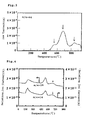
- the selected ion chromatograms of the obtained titanium oxide were measured in applying a CEM voltage of 1500V (shown in Figs. 1 to 3) and in applying a CEM voltage of 1000V (shown in Fig. 4).
- Fig. 1 shows that the selected ion chromatogram of the evolution gas having 28 of the m/e ratio exhibits peaks at 697°C and at 837°C in applying a CEM voltage of 1500V.
- Fig. 2 shows that the selected ion chromatogram of the evolution gas having 14 of the m/e ratio exhibits peaks at 697°C and at 837°C in applying a CEM voltage of 1500V.
- Fig. 3 shows that the selected ion chromatogram of the evolution gas having 64 of the m/e ratio exhibits peaks at 560°C, at 680°C and at 846°C in applying a CEM voltage of 1500V.
- Fig. 1 shows that the selected ion chromatogram of the evolution gas having 28 of the m/e ratio exhibits peaks at 697°C and at 837°C in applying a CEM voltage of 1500V.
- Fig. 2 shows that the selected ion chromatogram of the evolution gas having 14 of the m/e ratio exhibit
- FIG. 4 shows that the selected ion chromatogram of the evolution gas having 28 of the m/e ratio exhibits peaks at 688°C in applying a CEM voltage of 1000V.
- Fig. 4 also shows that the selected ion chromatogram of the evolution gas having 14 of the m/e ratio exhibits peaks at 688°C in applying a CEM voltage of 1000V.
- the obtained titanium oxide had an a* value of -2.58 and a b* value of 41.00.
- a sealed-type glass reaction vessel (diameter: 8 cm, height: 10 cm, volume: about 0.5 L), was placed a 5-cm diameter glass Petri dish on which 0.3g of photocatalyst made only of the particulate titanium oxide obtained above.
- the reaction vessel was filled with a mixed gas having an oxygen content of 20 % by volume and a nitrogen content of 80 % by volume, was sealed with 13.4 ⁇ mol of acetone and was then irradiated with visible light from outside of the vessel.
- the visible light irradiation was carried out using a light source device (manufactured by USHIO INC., trade name: Optical Modulex SX-UI500XQ) which is equipped with a 500 W xenon lamp (manufactured by USHIO INC., trade name: Lamp UXL-500SX), an ultraviolet cutting filter (manufactured by Asahi Techno Glass Co., Ltd., trade name: Y-45) cutting off ultraviolet light having a wavelength of about 430nm or shorter and an infrared light cutting filter (manufactured by USHIO INC., trade name: SupercoldFilter) cutting off infrared light having a wavelength of about 830nm or longer.
- a light source device manufactured by USHIO INC., trade name: Optical Modulex SX-UI500XQ
- a 500 W xenon lamp manufactured by USHIO INC., trade name: Lamp UXL-500SX
- an ultraviolet cutting filter manufactured by Asah
- the photocatalytic activity of the photocatalyst was evaluated by measurement of a concentration of carbon dioxide , that is the decomposition product of acetone and is generated by the irradiation of visible light.
- the carbon dioxide concentration was measured using a photoacoustic multigas monitor (Model: 1312, manufactured by INNOVA) with the passage of time.
- the producing rate of carbon dioxide was 14.63 ⁇ mol/h per one gram of the photocatalyst.
- Example 2 The same processes as in Example 1 were carried out except that, instead of the photocatalyst made only of the particulate titanium oxide obtained in Example 1, a photocatalyst made only of a commercially available titanium oxide (manufactured by Ishihara Sangyo Kaisha, Ltd., trade name: ST-01) was used. As a result, the producing rate of carbon dioxide was 0. 66 ⁇ mol/h per one gram of the photocatalyst.
- a photocatalyst made only of the particulate titanium oxide obtained in Example 1 a photocatalyst made only of a commercially available titanium oxide (manufactured by Ishihara Sangyo Kaisha, Ltd., trade name: ST-01) was used.
- the producing rate of carbon dioxide was 0. 66 ⁇ mol/h per one gram of the photocatalyst.
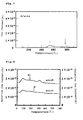
- the selected ion chromatograms of the commercially available titanium oxide were measured in applying a CEM voltage of 1500V (shown in Figs. 5 to 7) and in applying a CEM voltage of 1000V (shown in Fig. 8).
- Fig. 5 shows that the selected ion chromatogram of the evolution gas having 28 of the m/e ratio exhibits no peak at 600°C or higher in applying a CEM voltage of 1500V.
- Fig. 6 shows that the selected ion chromatogram of the evolution gas having 14 of the m/e ratio exhibits no peak at 600°C or higher in applying a CEM voltage of 1500V.
- Fig. 7 shows that the selected ion chromatogram of the evolution gas having 64 of the m/e ratio exhibits peaks at 540°C and at 777°C in applying a CEM voltage of 1500V.
- Fig. 5 shows that the selected ion chromatogram of the evolution gas having 28 of the m/e ratio exhibits no peak at 600°C or higher in applying a CEM voltage of 1500V.
- Fig. 6 shows that the selected ion chromatogram of the evolution gas having 14 of the m/e ratio exhibits no peak at 600°C or higher in applying a CEM voltage of 1500V.
- Fig. 8 shows that the selected ion chromatogram of the evolution gas having 28 of the m/e ratio exhibits no peak at 600°C or higher in applying a CEM voltage of 1000V.
- Fig. 8 also shows that the selected ion chromatogram of the evolution gas having 14 of the m/e ratio exhibits no peak at 600°C or higher in applying a CEM voltage of 1000V.
- the commercially available titanium oxide had an a* value of -0.74 and a b* value of 2.67.
Landscapes
- Chemical & Material Sciences (AREA)
- Organic Chemistry (AREA)
- Engineering & Computer Science (AREA)
- Materials Engineering (AREA)
- Chemical Kinetics & Catalysis (AREA)
- Environmental & Geological Engineering (AREA)
- Life Sciences & Earth Sciences (AREA)
- General Life Sciences & Earth Sciences (AREA)
- Geology (AREA)
- Inorganic Chemistry (AREA)
- Catalysts (AREA)
- Inorganic Compounds Of Heavy Metals (AREA)
- Paints Or Removers (AREA)
- Exhaust Gas Treatment By Means Of Catalyst (AREA)
Applications Claiming Priority (4)
| Application Number | Priority Date | Filing Date | Title |
|---|---|---|---|
| JP2000215483 | 2000-07-17 | ||
| JP2000215483 | 2000-07-17 | ||
| JP2000381723A JP3949374B2 (ja) | 2000-07-17 | 2000-12-15 | 酸化チタン、それを用いてなる光触媒体および光触媒体コーティング剤 |
| JP2000381723 | 2000-12-15 |
Publications (2)
| Publication Number | Publication Date |
|---|---|
| EP1174392A1 EP1174392A1 (en) | 2002-01-23 |
| EP1174392B1 true EP1174392B1 (en) | 2006-08-30 |
Family
ID=26596117
Family Applications (1)
| Application Number | Title | Priority Date | Filing Date |
|---|---|---|---|
| EP01306035A Expired - Lifetime EP1174392B1 (en) | 2000-07-17 | 2001-07-13 | Titanium oxide, and photocatalyst and photocatalyst coating composition using the same |
Country Status (9)
| Country | Link |
|---|---|
| US (1) | US7011808B2 (enExample) |
| EP (1) | EP1174392B1 (enExample) |
| JP (1) | JP3949374B2 (enExample) |
| KR (1) | KR100833085B1 (enExample) |
| CN (1) | CN1334242A (enExample) |
| AU (1) | AU784242B2 (enExample) |
| CA (1) | CA2353009A1 (enExample) |
| DE (1) | DE60122630T2 (enExample) |
| TW (1) | TWI290909B (enExample) |
Families Citing this family (27)
| Publication number | Priority date | Publication date | Assignee | Title |
|---|---|---|---|---|
| JP2002370026A (ja) * | 2001-06-14 | 2002-12-24 | Sumitomo Chem Co Ltd | 光触媒体およびそれを用いる光触媒機能製品 |
| US7045005B2 (en) * | 2001-07-19 | 2006-05-16 | Sumitomo Chemical Company, Limited | Ceramics dispersion liquid, method for producing the same, and hydrophilic coating agent using the same |
| JP4048775B2 (ja) * | 2001-12-26 | 2008-02-20 | 住友化学株式会社 | 酸化チタン、それを用いてなる光触媒体及び光触媒体コーティング剤 |
| JP2003246622A (ja) * | 2002-02-25 | 2003-09-02 | Sumitomo Chem Co Ltd | 酸化チタン前駆体、その製造方法およびそれを用いる酸化チタンの製造方法 |
| FI113015B (fi) | 2002-04-02 | 2004-02-27 | Kemira Pigments Oy | Titaanidioksidia sisältävä fotokatalyytti, sen valmistusmenetelmä sekä sen käyttö |
| JP4374869B2 (ja) * | 2002-05-27 | 2009-12-02 | 住友化学株式会社 | セラミックス分散液の製造方法 |
| JP2004026553A (ja) * | 2002-06-25 | 2004-01-29 | Sumitomo Chem Co Ltd | 酸化チタン分散液およびその保存容器 |
| JP4269621B2 (ja) * | 2002-10-04 | 2009-05-27 | 住友化学株式会社 | 酸化チタンの製造方法 |
| JP2004196626A (ja) * | 2002-12-20 | 2004-07-15 | Sumitomo Chem Co Ltd | 酸化チタンの製造方法 |
| TWI229011B (en) * | 2002-12-31 | 2005-03-11 | Ind Tech Res Inst | Visible light-induced strong oxidation strong reduction photo catalyst |
| JP4022167B2 (ja) * | 2003-05-06 | 2007-12-12 | 株式会社不二機販 | 光触媒コーティング方法 |
| JP4393963B2 (ja) | 2004-03-17 | 2010-01-06 | 住友化学株式会社 | 光触媒体コーティング液 |
| JP2006191947A (ja) * | 2005-01-11 | 2006-07-27 | Sumitomo Chemical Co Ltd | 有機ハロゲン化物の脱ハロゲン化方法 |
| TWI324948B (en) * | 2005-12-22 | 2010-05-21 | Ind Tech Res Inst | Photocatalystic composite material, method for producing the same and application thereof |
| CN101460244A (zh) | 2006-03-30 | 2009-06-17 | 株式会社大阪钛技术 | 可见光响应型氧化钛光催化剂及其制造方法和用途 |
| JP2007289933A (ja) * | 2006-03-30 | 2007-11-08 | Sumitomo Metal Ind Ltd | 可視光応答型酸化チタン光触媒とその製造方法および用途 |
| TWM308325U (en) * | 2006-05-09 | 2007-03-21 | Taiwan Fluorescent Lamp Co Ltd | Photocatalyst synthetic fibers product |
| US8101130B2 (en) * | 2006-09-15 | 2012-01-24 | Applied Nanotech Holdings, Inc. | Gas ionization source |
| US8551906B2 (en) * | 2007-08-16 | 2013-10-08 | The University Of Queensland | Titanate photocatalyst |
| JP2010115635A (ja) | 2008-06-05 | 2010-05-27 | Sumitomo Chemical Co Ltd | 光触媒体分散液、その製造方法およびその用途 |
| DE102009011117A1 (de) * | 2009-03-03 | 2010-09-23 | Kronos International, Inc. | Photokatalytisch abscheidbare Dispersion |
| JP2011036770A (ja) | 2009-08-07 | 2011-02-24 | Hokkaido Univ | 貴金属担持光触媒体粒子の製造方法 |
| JP2011224534A (ja) | 2009-09-16 | 2011-11-10 | Sumitomo Chemical Co Ltd | 光触媒複合体、およびこれを用いた光触媒機能製品 |
| CN105445308B (zh) * | 2014-08-28 | 2019-10-15 | 中国科学院上海硅酸盐研究所 | 一种薄膜材料的原位热分析-质谱测量方法 |
| CN105929048B (zh) * | 2016-04-19 | 2018-04-24 | 山东亿康环保科技有限公司 | 一种光催化空气净化材料性能的测试方法 |
| FR3053897B1 (fr) | 2016-07-13 | 2022-05-20 | Commissariat Energie Atomique | Gel de decontamination adsorbant et photocatalytique et procede de decontamination de surfaces utilisant ce gel |
| CN119100411B (zh) * | 2024-09-09 | 2025-08-15 | 山东洲蓝环保科技有限公司 | 一种分子筛改性微晶材料的制备方法及其制备方法和应用 |
Family Cites Families (16)
| Publication number | Priority date | Publication date | Assignee | Title |
|---|---|---|---|---|
| GB1189746A (en) * | 1967-06-26 | 1970-04-29 | Nat Lead Co | Improvements in or relating to a Photosensitive Titanium Dioxide |
| JPH01301518A (ja) | 1988-05-28 | 1989-12-05 | Sakai Chem Ind Co Ltd | 酸化チタンの製造方法 |
| JP2938376B2 (ja) | 1995-08-31 | 1999-08-23 | 佐賀県 | チタニア膜形成用液体およびチタニア膜およびその製造方法 |
| DE19543204C2 (de) * | 1995-11-20 | 1997-09-18 | Bayer Ag | Verfahren zur Herstellung von nanodispersem Titandioxid und seine Verwendung |
| JP3690864B2 (ja) | 1996-03-29 | 2005-08-31 | 株式会社ティオテクノ | 光触媒体の製造法 |
| US6908881B1 (en) | 1998-08-21 | 2005-06-21 | Ecodevice Laboratory Co., Ltd. | Visible radiation type photocatalyst and production method thereof |
| JP3887499B2 (ja) | 1998-11-10 | 2007-02-28 | シャープ株式会社 | 光触媒体の形成方法 |
| JP3959213B2 (ja) * | 1999-06-30 | 2007-08-15 | 住友化学株式会社 | 酸化チタン、それを用いてなる光触媒体及び光触媒体コーティング剤 |
| EP1205245A4 (en) | 1999-08-05 | 2005-01-19 | Toyoda Chuo Kenkyusho Kk | PHOTOCATALYTIC MATERIAL AND PHOTOCATALYTIC ARTICLE |
| TWI279254B (en) | 1999-10-29 | 2007-04-21 | Sumitomo Chemical Co | Titanium oxide, and photocatalyst and photocatalyst coating composition using the same |
| KR20020080397A (ko) | 2000-01-31 | 2002-10-23 | 유겐가이샤 칸코우 데바이스 켄큐쇼 | 가시광 응답 재료 및 그 제조방법 |
| JP2001246247A (ja) | 2000-03-08 | 2001-09-11 | Mitsubishi Heavy Ind Ltd | 光触媒の製造方法 |
| KR20010095089A (ko) | 2000-03-31 | 2001-11-03 | 고오사이 아끼오 | 산화티탄의 제조방법 |
| JP2001294425A (ja) | 2000-04-11 | 2001-10-23 | Tayca Corp | 可視光線に応答して光触媒活性を発現する酸化チタンおよびその酸化チタンを有効成分とする有害物質除去剤 |
| JP2001335321A (ja) | 2000-05-24 | 2001-12-04 | Sumitomo Chem Co Ltd | 水酸化チタン、それを用いてなる光触媒体およびコーティング剤 |
| EP1178011B1 (en) | 2000-07-31 | 2006-07-05 | Sumitomo Chemical Company, Limited | Titanium oxide production process |
-
2000
- 2000-12-15 JP JP2000381723A patent/JP3949374B2/ja not_active Expired - Fee Related
-
2001
- 2001-07-05 TW TW090116430A patent/TWI290909B/zh not_active IP Right Cessation
- 2001-07-06 AU AU54243/01A patent/AU784242B2/en not_active Ceased
- 2001-07-11 US US09/901,609 patent/US7011808B2/en not_active Expired - Fee Related
- 2001-07-13 CA CA002353009A patent/CA2353009A1/en not_active Abandoned
- 2001-07-13 EP EP01306035A patent/EP1174392B1/en not_active Expired - Lifetime
- 2001-07-13 KR KR1020010042294A patent/KR100833085B1/ko not_active Expired - Fee Related
- 2001-07-13 DE DE60122630T patent/DE60122630T2/de not_active Expired - Lifetime
- 2001-07-17 CN CN01125908A patent/CN1334242A/zh not_active Ceased
Also Published As
| Publication number | Publication date |
|---|---|
| TWI290909B (en) | 2007-12-11 |
| EP1174392A1 (en) | 2002-01-23 |
| KR20020008015A (ko) | 2002-01-29 |
| AU5424301A (en) | 2002-01-24 |
| DE60122630T2 (de) | 2007-09-20 |
| DE60122630D1 (de) | 2006-10-12 |
| CN1334242A (zh) | 2002-02-06 |
| JP2002097019A (ja) | 2002-04-02 |
| US7011808B2 (en) | 2006-03-14 |
| US20020021999A1 (en) | 2002-02-21 |
| KR100833085B1 (ko) | 2008-05-29 |
| CA2353009A1 (en) | 2002-01-17 |
| AU784242B2 (en) | 2006-02-23 |
| JP3949374B2 (ja) | 2007-07-25 |
Similar Documents
| Publication | Publication Date | Title |
|---|---|---|
| US7011808B2 (en) | Titanium oxide and photocatalyst | |
| KR100642973B1 (ko) | 산화티탄, 이를 포함하는 광촉매 및 광촉매 피복제 | |
| US6830741B1 (en) | Titanium-oxide and photocatalyst and photocatalyst coating composition | |
| AU783565B2 (en) | Photocatalyst, process for producing the same and photocatalyst coating composition comprising the same | |
| US6645460B2 (en) | Titanium hydroxide and photocatalytic coating agent | |
| JP2002126517A (ja) | 光触媒体、その製造方法およびそれを用いてなる光触媒体コーティング剤 | |
| JP4048775B2 (ja) | 酸化チタン、それを用いてなる光触媒体及び光触媒体コーティング剤 | |
| JP4265685B2 (ja) | 光触媒体、その製造方法およびそれを用いてなる光触媒体コーティング剤 | |
| JP4103324B2 (ja) | 酸化チタン、それを用いてなる光触媒体及び光触媒体コーティング剤 | |
| JP3959226B2 (ja) | 光触媒体および光触媒体コーティング剤 | |
| JP3981757B2 (ja) | 光触媒体およびそれを用いてなる光触媒体コーティング剤 | |
| JP4019679B2 (ja) | 光触媒体の製造方法 | |
| JP2004075528A (ja) | 酸化チタン、それを用いてなる光触媒体および光触媒体コーティング剤 | |
| JP2003300729A (ja) | 酸化チタン | |
| JP2003335521A (ja) | 酸化チタン、それを用いてなる光触媒体及び光触媒体コーティング剤 |
Legal Events
| Date | Code | Title | Description |
|---|---|---|---|
| PUAI | Public reference made under article 153(3) epc to a published international application that has entered the european phase |
Free format text: ORIGINAL CODE: 0009012 |
|
| AK | Designated contracting states |
Kind code of ref document: A1 Designated state(s): DE FR GB IT Kind code of ref document: A1 Designated state(s): AT BE CH CY DE DK ES FI FR GB GR IE IT LI LU MC NL PT SE TR |
|
| AX | Request for extension of the european patent |
Free format text: AL;LT;LV;MK;RO;SI |
|
| 17P | Request for examination filed |
Effective date: 20020704 |
|
| AKX | Designation fees paid |
Free format text: DE FR GB IT |
|
| 17Q | First examination report despatched |
Effective date: 20021001 |
|
| RAP1 | Party data changed (applicant data changed or rights of an application transferred) |
Owner name: SUMITOMO CHEMICAL COMPANY, LIMITED |
|
| GRAP | Despatch of communication of intention to grant a patent |
Free format text: ORIGINAL CODE: EPIDOSNIGR1 |
|
| GRAS | Grant fee paid |
Free format text: ORIGINAL CODE: EPIDOSNIGR3 |
|
| GRAA | (expected) grant |
Free format text: ORIGINAL CODE: 0009210 |
|
| AK | Designated contracting states |
Kind code of ref document: B1 Designated state(s): DE FR GB IT |
|
| PG25 | Lapsed in a contracting state [announced via postgrant information from national office to epo] |
Ref country code: IT Free format text: LAPSE BECAUSE OF FAILURE TO SUBMIT A TRANSLATION OF THE DESCRIPTION OR TO PAY THE FEE WITHIN THE PRESCRIBED TIME-LIMIT;WARNING: LAPSES OF ITALIAN PATENTS WITH EFFECTIVE DATE BEFORE 2007 MAY HAVE OCCURRED AT ANY TIME BEFORE 2007. THE CORRECT EFFECTIVE DATE MAY BE DIFFERENT FROM THE ONE RECORDED. Effective date: 20060830 |
|
| REG | Reference to a national code |
Ref country code: GB Ref legal event code: FG4D |
|
| REF | Corresponds to: |
Ref document number: 60122630 Country of ref document: DE Date of ref document: 20061012 Kind code of ref document: P |
|
| ET | Fr: translation filed | ||
| PLBE | No opposition filed within time limit |
Free format text: ORIGINAL CODE: 0009261 |
|
| STAA | Information on the status of an ep patent application or granted ep patent |
Free format text: STATUS: NO OPPOSITION FILED WITHIN TIME LIMIT |
|
| 26N | No opposition filed |
Effective date: 20070531 |
|
| PGFP | Annual fee paid to national office [announced via postgrant information from national office to epo] |
Ref country code: FR Payment date: 20110727 Year of fee payment: 11 |
|
| PGFP | Annual fee paid to national office [announced via postgrant information from national office to epo] |
Ref country code: GB Payment date: 20110713 Year of fee payment: 11 Ref country code: DE Payment date: 20110706 Year of fee payment: 11 |
|
| PGFP | Annual fee paid to national office [announced via postgrant information from national office to epo] |
Ref country code: IT Payment date: 20110715 Year of fee payment: 11 |
|
| GBPC | Gb: european patent ceased through non-payment of renewal fee |
Effective date: 20120713 |
|
| REG | Reference to a national code |
Ref country code: FR Ref legal event code: ST Effective date: 20130329 |
|
| PG25 | Lapsed in a contracting state [announced via postgrant information from national office to epo] |
Ref country code: DE Free format text: LAPSE BECAUSE OF NON-PAYMENT OF DUE FEES Effective date: 20130201 Ref country code: FR Free format text: LAPSE BECAUSE OF NON-PAYMENT OF DUE FEES Effective date: 20120731 Ref country code: GB Free format text: LAPSE BECAUSE OF NON-PAYMENT OF DUE FEES Effective date: 20120713 |
|
| PG25 | Lapsed in a contracting state [announced via postgrant information from national office to epo] |
Ref country code: IT Free format text: LAPSE BECAUSE OF NON-PAYMENT OF DUE FEES Effective date: 20120713 |
|
| REG | Reference to a national code |
Ref country code: DE Ref legal event code: R119 Ref document number: 60122630 Country of ref document: DE Effective date: 20130201 |