EP1169630B1 - Cassette for facilitating optical sectioning of a retained tissue specimen - Google Patents
Cassette for facilitating optical sectioning of a retained tissue specimen Download PDFInfo
- Publication number
- EP1169630B1 EP1169630B1 EP00913499.0A EP00913499A EP1169630B1 EP 1169630 B1 EP1169630 B1 EP 1169630B1 EP 00913499 A EP00913499 A EP 00913499A EP 1169630 B1 EP1169630 B1 EP 1169630B1
- Authority
- EP
- European Patent Office
- Prior art keywords
- cassette
- window
- membrane
- tissue specimen
- base member
- Prior art date
- Legal status (The legal status is an assumption and is not a legal conclusion. Google has not performed a legal analysis and makes no representation as to the accuracy of the status listed.)
- Expired - Lifetime
Links
Images




Classifications
-
- B—PERFORMING OPERATIONS; TRANSPORTING
- B01—PHYSICAL OR CHEMICAL PROCESSES OR APPARATUS IN GENERAL
- B01L—CHEMICAL OR PHYSICAL LABORATORY APPARATUS FOR GENERAL USE
- B01L3/00—Containers or dishes for laboratory use, e.g. laboratory glassware; Droppers
- B01L3/50—Containers for the purpose of retaining a material to be analysed, e.g. test tubes
- B01L3/508—Rigid containers without fluid transport within
-
- G—PHYSICS
- G02—OPTICS
- G02B—OPTICAL ELEMENTS, SYSTEMS OR APPARATUS
- G02B21/00—Microscopes
- G02B21/36—Microscopes arranged for photographic purposes or projection purposes or digital imaging or video purposes including associated control and data processing arrangements
- G02B21/368—Microscopes arranged for photographic purposes or projection purposes or digital imaging or video purposes including associated control and data processing arrangements details of associated display arrangements, e.g. mounting of LCD monitor
-
- G—PHYSICS
- G02—OPTICS
- G02B—OPTICAL ELEMENTS, SYSTEMS OR APPARATUS
- G02B21/00—Microscopes
- G02B21/0004—Microscopes specially adapted for specific applications
- G02B21/0012—Surgical microscopes
-
- G—PHYSICS
- G02—OPTICS
- G02B—OPTICAL ELEMENTS, SYSTEMS OR APPARATUS
- G02B21/00—Microscopes
- G02B21/24—Base structure
- G02B21/26—Stages; Adjusting means therefor
-
- G—PHYSICS
- G02—OPTICS
- G02B—OPTICAL ELEMENTS, SYSTEMS OR APPARATUS
- G02B21/00—Microscopes
- G02B21/33—Immersion oils, or microscope systems or objectives for use with immersion fluids
-
- G—PHYSICS
- G02—OPTICS
- G02B—OPTICAL ELEMENTS, SYSTEMS OR APPARATUS
- G02B21/00—Microscopes
- G02B21/34—Microscope slides, e.g. mounting specimens on microscope slides
-
- B—PERFORMING OPERATIONS; TRANSPORTING
- B01—PHYSICAL OR CHEMICAL PROCESSES OR APPARATUS IN GENERAL
- B01L—CHEMICAL OR PHYSICAL LABORATORY APPARATUS FOR GENERAL USE
- B01L2200/00—Solutions for specific problems relating to chemical or physical laboratory apparatus
- B01L2200/06—Fluid handling related problems
- B01L2200/0642—Filling fluids into wells by specific techniques
-
- B—PERFORMING OPERATIONS; TRANSPORTING
- B01—PHYSICAL OR CHEMICAL PROCESSES OR APPARATUS IN GENERAL
- B01L—CHEMICAL OR PHYSICAL LABORATORY APPARATUS FOR GENERAL USE
- B01L2300/00—Additional constructional details
- B01L2300/02—Identification, exchange or storage of information
- B01L2300/021—Identification, e.g. bar codes
-
- B—PERFORMING OPERATIONS; TRANSPORTING
- B01—PHYSICAL OR CHEMICAL PROCESSES OR APPARATUS IN GENERAL
- B01L—CHEMICAL OR PHYSICAL LABORATORY APPARATUS FOR GENERAL USE
- B01L2300/00—Additional constructional details
- B01L2300/04—Closures and closing means
- B01L2300/041—Connecting closures to device or container
- B01L2300/043—Hinged closures
-
- B—PERFORMING OPERATIONS; TRANSPORTING
- B01—PHYSICAL OR CHEMICAL PROCESSES OR APPARATUS IN GENERAL
- B01L—CHEMICAL OR PHYSICAL LABORATORY APPARATUS FOR GENERAL USE
- B01L2300/00—Additional constructional details
- B01L2300/04—Closures and closing means
- B01L2300/041—Connecting closures to device or container
- B01L2300/044—Connecting closures to device or container pierceable, e.g. films, membranes
-
- B—PERFORMING OPERATIONS; TRANSPORTING
- B01—PHYSICAL OR CHEMICAL PROCESSES OR APPARATUS IN GENERAL
- B01L—CHEMICAL OR PHYSICAL LABORATORY APPARATUS FOR GENERAL USE
- B01L2300/00—Additional constructional details
- B01L2300/06—Auxiliary integrated devices, integrated components
- B01L2300/0609—Holders integrated in container to position an object
-
- B—PERFORMING OPERATIONS; TRANSPORTING
- B01—PHYSICAL OR CHEMICAL PROCESSES OR APPARATUS IN GENERAL
- B01L—CHEMICAL OR PHYSICAL LABORATORY APPARATUS FOR GENERAL USE
- B01L2300/00—Additional constructional details
- B01L2300/08—Geometry, shape and general structure
- B01L2300/0809—Geometry, shape and general structure rectangular shaped
- B01L2300/0822—Slides
-
- B—PERFORMING OPERATIONS; TRANSPORTING
- B01—PHYSICAL OR CHEMICAL PROCESSES OR APPARATUS IN GENERAL
- B01L—CHEMICAL OR PHYSICAL LABORATORY APPARATUS FOR GENERAL USE
- B01L2300/00—Additional constructional details
- B01L2300/12—Specific details about materials
- B01L2300/123—Flexible; Elastomeric
-
- G—PHYSICS
- G01—MEASURING; TESTING
- G01N—INVESTIGATING OR ANALYSING MATERIALS BY DETERMINING THEIR CHEMICAL OR PHYSICAL PROPERTIES
- G01N1/00—Sampling; Preparing specimens for investigation
- G01N1/28—Preparing specimens for investigation including physical details of (bio-)chemical methods covered elsewhere, e.g. G01N33/50, C12Q
- G01N1/30—Staining; Impregnating ; Fixation; Dehydration; Multistep processes for preparing samples of tissue, cell or nucleic acid material and the like for analysis
- G01N1/31—Apparatus therefor
- G01N2001/315—Basket-type carriers for tissues
Definitions
- the present invention relates to a cassette for retaining a tissue specimen, and relates particularly to a cassette for retaining a specimen of surgically exposed tissue from a patient in an orientation that facilitates optical sectioning of the tissue by a confocal microscope, or other optical imaging microscope, for Mohs micrographic surgery.
- the invention further relates to a method of using the cassette for preparing a tissue specimen for examination by a confocal microscope or other optical imaging microscope, and a system for optically sectioning a tissue specimen retained in a cassette.
- tissue having a tumor is excised from a patient under microscopic control.
- the excised tissue specimen often called a biopsy, is horizontally sliced to provide tissue sections which are then histologically prepared on slides. The slides are reviewed under a microscope to determine whether the tumor is fully contained in the excised tissue. This is indicated by the absence of the tumor in the edges or margins of the excised tissue. If the tumor is not fully contained in the excised tissue, additional tissue from the patient is excised and the procedure repeated until all tissue sections taken indicate the tumor has been removed from the patient.
- Mohs surgery permits removal of a tumor with maximum preservation of normal surrounding tissue. Mohs surgery is described in the book entitled MOHS SURGERY FUNDAMENTALS AND TECHNIQUES (Kenneth G. Gross, M.D. et al. eds., 1999 ).
- each section is planar and parallel to each other.
- tissue specimen is first frozen to make the tissue easier to manipulate and cut by the microtome.
- this procedure is both tedious and time consuming.
- U.S. Patent No. 4,752,347 provides a method and apparatus for preparing a tissue specimen for sectioning for Mohs surgery.
- the patent describes placing an excised tissue specimen on a platform, applying a flexible plastic membrane over the tissue specimen, and evacuating the area between the membrane and the tissue specimen. This retracts the membrane onto the platform and pushes the edges of the tissue specimen into a planar orientation parallel to the platform. While under the pressure of the membrane, the tissue sections may be manipulated by an operator through the membrane until the desired orientation is obtained. The edges of the tissue specimen are thus oriented to flatten the edges of the specimen down. The specimen is then frozen, peeled away from the platform, and sectioned by a microtome.
- edges of the specimen are oriented planar when sectioned by the microtome, a single section can be made having the edges of interest in Mohs surgery. This procedure is adequate for obtaining a section which can be placed on a slide for review under a microscope, but is not useful with optical imaging techniques, such as provided by confocal microscopes, which can examine a surgically exposed tissue specimen without the need for traditional microtome sectioning or slide preparation.
- Confocal microscopes optically section naturally or surgically exposed tissue to produce microscopic images of tissue sections.
- An example of a confocal microscope is the "VivaScope” manufactured by Lucid Inc. of Henrietta, New York.
- Other examples of confocal microscopes are described in U.S. Patent No. 5,788,639 , published International Patent Application WO 96/21938 , and in articles by Milind Rajadhyaksha et al., "In vivo Confocal Scanning Laser Microscopy of Human Skin: Melanin provides strong contrast," The Journal of Investigative Dermatology, Volume 104, No. 6, June 1995 , and Milind Rajadhyaksha and James M.
- Zavislan "Confocal laser microscope images tissue in vivo,” Laser Focus World, February 1997, pages 119-127 .
- optically sectioned microscopic images of tissue can be produced by optical coherence tomography or interferometry, such as described in Schmitt et al., "Optical characterization of disease tissues using low-coherence interferometry," Proc. of SPIE, Volume 1889 (1993 ), or by a two-photon laser microscope, such as described in U.S. Patent No. 5,034,613 .
- tissue specimen is generally too thick, for example 2-3 mm, to enable optically imaging of the edges of the specimen to determine if the specimen contains all of the tumor.
- a confocal microscope is limited to producing adequate images of tissue sections at 100-200 microns.
- optical imaging systems such as confocal microscopes
- confocal microscopes generally require the use of a liquid immersion objective lens directed toward the tissue specimen. This necessitates that the tissue specimen be wetted or immersed in a fluid having an optical index suitable for the objective lens, otherwise, the imaging performance of the system is severely degraded. It is thus also desirable that fluids may be insertable to a properly oriented tissue specimen, and further removable, such that the fluid may be replaced with another fluid to change the imaging characteristics of the tissue.
- U.S. Patent No. 4,752,347 describes positioning the edges of a tissue specimen planar on a platform under a plastic membrane held by vacuum to the platform, the tissue specimen described in this patent is mechanically sectioned, rather than optically sectioned. Further, prior to mechanical sectioning, such a specimen is incompatible with optical imaging techniques since fluid cannot be present with a tissue specimen in a vacuum, and the platform does not provide a surface through which optical imaging can be performed. For example, liquids under a vacuum would be suctioned away from the specimen, while gases, under the reduced pressure, would dissolve in any liquids to form bubbles, or such gases may boil or evaporate.
- U.S. Patent No. 5,503,741 describes a device having a sealed vacant chamber formed between two parallel dialysis membranes affixed to each side of a gasket. A needle may be inserted through the gasket to delivery or withdraw a sample from the chamber. The device is used for permitting dialysis, i.e., molecular exchange, between the sample in the chamber and an external solution. Such a device is limited to dialysis and provides no mechanism for retaining a tissue specimen in a planar orientation for optical sectioning.
- a cassette for retaining a specimen of surgically exposed tissue from a patient which facilitates optical examination of the tissue by a confocal microscopic or other optical imaging microscope.
- a still further feature of the present invention is to provide a cassette for retaining a tissue specimen which allows the entire sample to be observable in the cassette through the top and bottom of the cassette.
- the present invention embodies a cassette having a base member with a rigid optically transparent window upon which a tissue specimen is situated, a pliable plastic membrane which is locatable over a substantial portion of the base member including the window, and an upper member, having an aperture therethrough, locatable over the base member to provide an enclosed cavity between the membrane and the window sealing the tissue specimen therein.
- the edges of the tissue specimen may be positioned through the aperture of the upper member and the membrane such that they lie planar against the window. The edges may be retained in that position by multiple bonds formed between the membrane and window at points or locations around the tissue specimen.
- the specimen is observable through the aperture of the upper member and imagible by an optical imaging microscope through the window of the base member.
- the base member may has at least one injection port through which fluids, via a syringe needle, may be inserted and removed from the tissue specimen retained in the cavity of the cassette.
- fluids can facilitate imaging of the specimen by the optical imaging microscope, or can be used to place the specimen in a preservative for archiving purposes.
- a label with indicia identifying the tissue specimen may be applied to the cassette.
- the lower surface of the upper member may have an adhesive, such as double-sided tape, which produces a seal between the upper and base members when the upper member is located over the base member.
- the base member may have walls extending about its periphery into which the upper member may be received.
- the upper member has an annular ridge extending along its outer edge which is received in an annular grove along the inside of the wall of the base member, thereby forming a seal between the upper and base members.
- the membrane When the cassette is closed, i.e., the tissue specimen is sealed in the cavity between the membrane and window, the membrane is held tightly by the upper member against the base member over the tissue specimen.
- the pressure of the membrane may compresse the tissue specimen toward the window of the base member.
- the top of the tissue specimen can be cut or scored prior to closure of the cassette to facilitate movement of the edges of the tissue specimen toward the window when the specimen is compressed by the membrane.
- a user such as a physician or trained operator, with a first probe may manipulate under the tension of the membrane each of the edges of the specimen planar against the window, and then with a second probe retain the edge in that planar position by bonding the membrane and window together at one or more points near the specimen's edge.
- the second probe pushes the membrane adjacent the window and then conducts heat to join the window and membrane together.
- the edges of the tissue specimen are oriented planar against an optically transmissive surface provided by the window of the cassette.
- Fluids can be inserted and removed from the tissue specimen through the injection port, since the multiple bonds do not seal the specimen within the cavity between the membrane and the window.
- Other bond actuating means may also be used such as sonic welding, or by the use of a contact, or UV cure, adhesive.
- Such an adhesive may be applied to lower surface of the membrane or upper surface of window facing the membrane, or both, prior to placement of the tissue specimen in the cassette, such that contact of the membrane and window by the second probe forms an adhesive bond.
- the cassette having a properly oriented tissue specimen may be part of a confocal imaging system for producing microscopic images of sections of the tissue contained in the cassette.
- the system includes a confocal imaging head, a stage supporting the cassette which presents the window of the cassette to an objective lens of the confocal imaging head, and a camera which can capture images of the specimen through the aperture of the cassette's upper member.
- a control system is coupled to a display, the confocal imaging head and the camera to visualize on the display both images of microscope sections of the tissue specimen produced by the confocal imaging head and macroscopic images of the tissue captured by the camera.
- the images from the camera can be used to identify the location of the microscopic images of sections with respect to the specimen.
- the present invention further embodies a method using a cassette for preparing a tissue specimen for examination by a confocal microscope or other optical imaging microscope.
- the method includes the steps of locating a tissue specimen on a rigid optically transparent window of a base member, placing a pliable optically transparent membrane over at least a substantial portion of the base member including the window, sealingly engaging the membrane to the base member to produce a cavity between the membrane and the window, positioning edges of the tissue specimen against the window, and fixing the location of the edges positioned against the window by connecting the membrane to the window at multiple points.
- a cassette 10 of the present invention having a base member 12 and an upper member 14.
- Base member 12 has an aperture 18 and a rigid optically transparent window 16 situated in aperture 18.
- the upper member 14 has an aperture 20 preferably substantially greater in size than the aperture 18 of base member 12.
- Base and upper members 12 and 14 are hinged at a hinge 24 which allows cassette 10 to have an open state, as shown in FIG. 1 , and a closed state, as shown in FIG. 2 , where upper member 14 covers base member 12.
- a hinge 24 which allows cassette 10 to have an open state, as shown in FIG. 1 , and a closed state, as shown in FIG. 2 , where upper member 14 covers base member 12.
- the base member has an annular shelf 22 in communication with aperture 18.
- Window 16 is inset on shelf 22, such that bottom surface 12a of the base member is planar with the lower surface 16a of window 16.
- Window 16 may be held by an adhesive, such as glue, upon shelf 22, or may be insert molded with base member 12.
- window 16 may be attached to bottom surface 12a underneath aperture 18 without shelf 22, such as by an adhesive or glue along the part of bottom surface 12a which interfaces with window 16, as shown in FIG. 4 .
- the window 16 may be composed of a cut out sheet of thin glass or amorphous polyolefin, such as Zeonex plastic, or other optically homogeneous material through which optical imaging can be performed.
- window 16 is of 152.4 micrometer (0.006 inch) thick Zeonex plastic film which is rigidly attached to the base member 12 in either the configuration of FIGS. 3 or 4 .
- the attachment of window 16 in cassette 10 should not be limited to that described herein. Any means for attaching an optical transparent window to form part of base member 12 may be used. The thickness of the window 16 depends on the working distance of the optical image system which will image the tissue specimen through the window.
- the base member 12 may itself be composed of an optically transmissive material, such as 1 millimeter thick Zeonex plastic, without aperture 18. Window 16 in FIG. 5 represents the part of the base member 12 below aperture 20 when the cassette 10 is in a closed state.
- a pliable plastic membrane or film 26 ( FIGS. 1 and 1A ) is attached to bottom surface 14a of upper member 12 across aperture 20. Membrane 26 does not extend to the outer edge 14b of upper member 14, thereby leaving a region 14c near the outer edge of the upper member.
- An adhesive such as double-sided tape, may fix membrane 26 to upper member 12 along bottom surface 14a outside region 14c.
- membrane 26 may be separate from upper member 12, as shown in FIG. 1A , in which the membrane is held along one side by hinge 24.
- the membrane 26 may be, for example, a thin layer of plastic, such as plastic wrap typically used for food preservation, and should be sufficiently transparent to provide viewing therethrough by a user or camera.
- Base member 12 further includes an injection port 28, as best shown in FIG. 1B .
- the injection port 28 is defined by an opening 28a which extends from the lower surface 12a of the base member 12 partially through the base member, a channel 28b which extends from the opening 28a to the upper surface 12b of the base member 12, and a self-sealing member 28c which is received in opening 28a from the bottom surface 12a of the base member. Between self-sealing member 28c and channel 28b is a passageway 28d in communication with channel 28b.
- Self-sealing member 28c may be composed of rubber, and may be similar to the self-sealing members used with medical vials for enabling a syringe needle to be inserted without loss of vial containment after removal of the syringe needle.
- An alternative side injection port 33 from the side of base member 12 is shown in FIG. 1C .
- Injection port 33 has an opening 33a partially through the base member, a channel 33b which extend from opening 33a to the wall of aperture 18, a self-sealing member 33c which is received in opening 33a, and a passageway 33d between the self-sealing member 33c and channel 33b.
- a syringe needle may be inserted into the injection port 28 or 33 through self-sealing member 28c or 33c to passageway 28d or 33d to insert or remove fluid from a cavity in the cassette 10 containing the tissue specimen, via channel 28b or 33b, when the cassette 10 is in a closed state.
- a syringe needle may be inserted into the injection port 28 or 33 through self-sealing member 28c or 33c to passageway 28d or 33d to insert or remove fluid from a cavity in the cassette 10 containing the tissue specimen, via channel 28b or 33b, when the cassette 10 is in a closed state.
- FIGS. 1, 1B and 1C multiple ones of the injection ports may be provided in cassette 10.
- the base and upper members 12 and 14 may be composed of rigid material, such as plastic.
- Hinge 24 may also be made of plastic, or can be provided by a strip of adhesive material, such as tape, along the one side of members 12 and 14.
- Member 12 and 14, and hinge 24 may be a single molded piece, or separately molded.
- the dimensions of the cassette 10 are such that window 16 has a diameter larger than the width of the tissue specimen to be located on the window.
- the cassette may have an aperture 18 having a 2 cm diameter and a 3 mm depth to window 16, and when closed the cassette may be 2.5 cm in length by 2.5 cm in width with a height of 7 mm.
- the cassette 10 may be larger than these dimensions to accommodate larger tissue specimens.
- Apertures 18 and 20 are circular, but may be rectangular, or other shape.
- a surgically exposed tissue specimen 13 is situated on window 16, as shown for example in FIGS. 1 and 1A .
- the tissue specimen is elliptical in shape with curved, sloping sides.
- upper member 14 is located over the base member 12 to cover the base member, such that membrane 26 lies between the base member and upper member over aperture 18 of the base member.
- the cassette 10 in this closed state i.e., a closed cassette, is shown for example in FIG. 2 .
- FIG. 6 shows upper member 14 and membrane 26 rotating along an arc defined by hinge 24 to provide a closed cassette, as indicated by arrows 30.
- a hermetic seal is formed between the upper member 14 and base member 12 to define an enclosed cavity or compartment 27 between the membrane 26 and window 16 containing tissue specimen 13 ( FIGS. 2 and 7 ).
- the seal may be provided by an adhesive, such as double-sided tape, along the region 14c of upper member 14 ( FIGS. 1 and 1A ).
- the seal may also be provided by region 14c of upper member 14 having a continuous raised ridge which may be received is a corresponding continuous groove on the top surface 12b of the base member 12, such that the raised ridge of the upper member snap fits in the groove of the base member.
- Other sealing means may alternatively be used, such as a gasket between the upper and base members, UV cure adhesive, sonic welding, or thermal welding.
- the tissue specimen 13 is observable through both window 14, and membrane 26 through aperture 20 of upper member 14.
- aperture 20 is preferably larger than aperture 18, it may be the same size or smaller than aperture 18 so long as when the cassette is closed both the tissue specimen 13 a gap or space 29 ( FIG. 2 ) is viewable around the edges 13a of the tissue specimen through aperture 20.
- the injection port 28 (and/or injection port 33) enables fluids to be inserted or removed from the tissue specimen retained in the cavity 27.
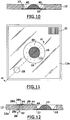
- a label 31 with indicia identifying the tissue specimen 13 may be applied to the top surface 32 of the cassette 10, or along the bottom surface 12a of cassette 10, or both, such as shown in FIGS. 2 and 11 .
- the indicia may represent a bar code or alphanumeric numerals identifying the tissue specimen, such as the patient name, date, physician, or other references to the surgical procedure.
- tissue specimen 13 on window 16 in a closed cassette will now be described. If prior to closure of cassette 10, the tissue specimen 13 on upper surface 16b of window 16 in aperture 18 extends beyond the top surface 12b of base member 12, membrane 26 compresses the tissue specimen, as shown in FIG. 7 .
- the top of the tissue specimen 13 may be scored prior to the closure of the cassette 10 to facilitate movement of the edges 13a of the tissue specimen 13 toward window 16.
- One or more scoring incisions along the top surface of the tissue may be needed when the specimen's edges are at a steep angle with respect to the surface of window 16. Such incisions should not extend through the specimen, and may be in a cross-pattern or other pattern which relaxes tension of the tissue such that the tissue edges may be moved to flatten them against window 16.
- a user such as a physician or trained operator, using a probe 34 manipulates one of the edges 13a of the tissue downwards against the window 16 under the tension of membrane 26, such that the edge is planar with upper surface 16b of window 16.
- the user manipulates another probe 36 against the membrane 26 in gap 29 until reaching window 16 at a location near the first probe which will hold the edge 13a in the desired position when probe 34 is removed, as shown in FIG. 9 .
- the probe 36 is then actuated by the user to conduct heat though thermal bond actuating means 38 to produce a bond (weld or joint) between the membrane 26 and the window 16 at a point or location 40 ( FIG.
- Thermal bond actuating means 38 may be similar to a soldering iron operating at a low temperature to weld the material of the plastic membrane and window together without affecting the integrity of the cavity. Other bond actuating means may also be used, such as sonic welding. If needed, more than one bond at different locations 40 in gap 29 may be used to retain edge 14a. This is repeated around the tissue specimen 13 until all of the edges 13a are held in a planar orientation against the window 16 by multiple bonds 40 between membrane 26 and window 16.
- FIGS. 10 and 11 show multiple bonds 40 retaining the tissue specimen 13 is the desired planar orientation. Probes 34 and 36 have sufficiently blunt ends to avoid puncturing membrane 26 during this procedure. In this manner, tissue specimen 13 is oriented in a closed cassette 10 such that the edges 13a of the tissue specimen are positioned planar against the window 16 and are retained in that position by bonds formed between the membrane 26 and window 16 at multiple points or locations 40 around the tissue specimen.
- a contact adhesive may be applied to the upper surface 16a of window 16 or the surface of membrane 26 facing window 16, or both, prior to placement of the tissue specimen in the cassette, such that probe 36 by contacting membrane 26 to window 16 adhesively bonds them to each other at a point 40.
- the contact adhesive may be a UV light cure adhesive, such that after the bonds are formed they may be exposed to UV light to harden them.
- a syringe (not shown) with a needle 42 may be inserted into injection port 28 through self-sealing member 28c to force fluid into cavity 27 through passage 28d and channel 28b. Since multiple bonds do not seal tissue specimen 13 within cavity 27, the fluid freely flows to the tissue specimen 13, thereby immersing the tissue specimen in fluid, as shown by arrows 44.
- the fluid may represent an optical index matching fluid to facilitate imaging of the specimen by an optical imaging microscope.
- the fluid may be withdrawn by the use of a syringe with needle 42 to suction the fluid from cavity 27.
- the self-sealing member 28c allows the insertion of the needle without compromising the integrity of the cavity 27.
- the tissue specimen is retained in the cassette in the desired orientation, while being permeable to fluids inserted through the injection port 28.
- the fluid inserted flows between the tissue specimen 13 and window 16 due to the elasticity of the membrane 26 and the pressure of the fluid.
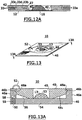
- FIG. 12A shows the needle 42 inserted into injection port 33 through self-sealing member 33c to insert fluid to, or withdraw fluid from, cavity 27 through passage 33d and channel 33b.
- FIG. 12A also shows another side injection port 33a identical to injection port 33, but oriented opposite injection port 33 in base member 12, such that the cassette has two injection ports 33 and 33a. This may facilitate the flow of fluid through cavity 27 by simultaneously inserting a fluid through port 33 and removing the fluid through port 33a, or vise versa.
- the second injection port 33a may also serve as a backup port if the first injection port 33 fails to function.
- FIGS. 13 and 13A another embodiment is shown for sealing the upper and base members of cassette 10 together.
- the base and upper members of cassette 10 are denoted as 46 and 48, respectively, and the base member of FIG. 5 is shown.
- Base member 46 has an annular wall 46a which extends about its periphery into which the upper member 48 can be received.
- the upper member 48 has an aperture 49 and an annular ridge or tongue 48a which extends along its outer edge.
- Upper member 48 is insertable into the base member 46 such that ridge 48a fits into an annular groove 46b of base member 46 along the inside of wall 46a, thereby sealing the upper member 48 to the lower member 46 to define an enclosed cavity 56 between the membrane 53 and the base member 46.
- edges 13a of the tissue specimen orients such edges planar against a window 54, which is defined by the part of the optically transmissive base member 46 below aperture 49 of upper member 48.
- Upper member 48 is attached to base member 46 by a loop member 52, which may be composed of plastic.
- Aperture 49 may be sized sufficiently larger that the tissue specimen 13 to enable multiple bonds to be made between membrane 53 and window 54 to hold the edges positioned planar to the window, such as described earlier.
- Membrane 53 is similar to membrane 26, and injection port 50 is similar to injection port 28 with a self-sealing member 59 and a channel 58 through wall 46a to enable fluids to be insertable and removable from the tissue specimen 13 in cavity 56.
- Upper member 48 may have circular or disc-like shape with a circular, curved lower surface 48b.
- a second injection port 50a may be provided from the top surface of base member 46 in addition to, or instead of, injection port 50.
- injection port 50 has a self-sealing member 59a and a channel 58a through wall 46a to enable fluids, via a syringe needle, to be insertable and removable from the tissue specimen 13 in cavity 56.
- the two ports 50 and 50a have channels 58 and 58a, respectively, which may be located long opposite sides of base member 46.
- FIG. 13C A variation of the injection port 50 and 50a is shown in which a side injection port 50b is provided through the side of base member 46. Like injection ports 50 and 50a, injection port 50b has a self-sealing member 59b and a channel 58b through wall 46a to enable fluids, via a syringe needle, to be insertable and removable from the tissue specimen 13 in cavity 56. Multiple ones of side injection port 50b, such as two, may be provided at opposite sides of the base member 46.
- Confocal imaging system 60 includes a computer control system 62 having a confocal imaging head 64 with a liquid immersion objective lens 64a, and a display 66 and user interface 68 coupled to control system 62.
- the confocal imaging head 64 and control system 62 provides confocal microscopic images of optically sectioned tissue on the display 66 as described, for example, in U.S. Patent No. 5,788,639 , or in published International Patent Application WO 96/21938 .
- the confocal imaging head 64, control system 62, display 66, and user interface 68 may represent a confocal microscope, such as the "VivaScope” manufactured by Lucid, Inc. of Henrietta, New York.
- a z-actuator 70 can move the confocal imaging head 64 (or alternately, only objective lens 64a) in a z direction, via signals from control system 62, to control the depth of imaging in tissue, i.e., the distance of objective lens 64a to window 16 of cassette 10.
- the confocal imaging system 60 further includes an x-y stage 72 which supports cassette 10 and presents the window 16 of the cassette to a liquid immersion objective lens 64a of the confocal imaging head 64.
- Stage 72 has actuators (not shown) which can move the cassette 10 in x,y orthogonal directions in response to signals from control system 62.
- User interface 68 may represent a keyboard, mouse, joystick, or combinations thereof, which enable a user, via control system 62, to control the z-actuator 70 and x-y stage 72 such that different parts of the tissue specimen may be imaged by the confocal imaging head 64.
- a fluid which is matched to the optical index of the immersion objective lens 64a is inserted into the cavity of the cassette 10 via the injection port 28 or 33.
- an optical coupling fluid 71 may be placed between lens 64a and window 16 of cassette 10 to optically couple the lens 64a to window 16.
- the fluid 71 may have the same optical index as the fluid inserted in the cavity of cassette 10.
- the cassette 10 may that than shown in FIGS. 11 or 13 .
- An optional camera 74 in the confocal imaging system 60 is provided to capture images of the tissue specimen through a lens 74a directed to aperture 20 in upper member 14 of the cassette 10.
- Camera 74 may be a digital camera which captures still images, or may be a video camera.
- the control system may also send signals to the camera 74 to control its operation, such as enabling the camera to capture an image or focusing the camera. Signals representing captured images from camera 74 are received by the control system 62.
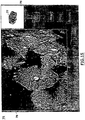
- FIG. 15 shown an example of a screen (denoted as 75) of display 66 during confocal imaging, where image 76 represents a macroscopic image of a tissue specimen in cassette 10 from camera 74, and image 78 represents an optical section of the tissue specimen imaged through confocal imaging head 64.
- Image 76 may be maintained on the screen 75 during optical sectioning to guide the user as to the location of microscopic section 78 with respect to the tissue specimen.
- a box 77 may indicate the relative location of the microscopic image 78 with respect to the macroscopic image 76.
- the x-y stage 72 is positioned with respect to camera lens 74a such that a marker, such as a cross-hair, may be overlaid by control system 62 on macroscopic image 76 showing the relative location of the confocal imaging head 64 with respect to the tissue specimen. Since the edges of the tissue specimen are planar against window 16 of cassette 10, optical sections imaged on display 66 from along the edges of the tissue specimen can provide information determining whether a tumor is fully contained in the tissue specimen for Mohs surgery. If desired, images of optical sections from different parts of the tissue specimen may be scanned automatically by the control system 62 by controlling the movement of x,y stage 72.
- the scanned images of optical sections are electronically combined in memory of the control system 62 to provide an optical section having a larger field of view to the user. If imaging by another confocal imaging head is desired, the fluid can be replaced with a different optical index matching fluid, via injection port 28 of the cassette.
- a confocal imaging head 64 is described herein, other optical imaging techniques may also be used in head 64, such as optical coherence tomography, such as described in Schmitt et al., "Optical characterization of disease tissues using low-coherence interferometry," Proc. of SPIE, Volume 1889 (1993 ), or a two-photon laser microscope, as described in U.S. Patent No. 5,034,613 .
- the tissue specimen can be removed from stage 72 and archived in cassette 10.
- a preservative fluid such as formalin
- formalin may be inserted in the cavity of the cassette, via injection port 28, after any fluid in the cavity is removed.
- the entire cassette with the tissue specimen from Mohs surgery can thus be stored intact with indicia 31 on the cassette referencing the procedure.
- Optical sectioning of tissue specimens can facilitate their archiving since intact specimens may require less storage space than traditional slides, and can easily be labeled with indicia 31 on the cassette.
- the particular immersion fluid inserted through an injection port into the cavity of the cassette 10 containing the tissue specimen 13 may be selected as follows to enhance imaging.
- Surface corrugations at the interface between the tissue specimen 13 and the window 16 are filled with the immersion fluid, which produces optical corrugations in the wavefront of the beam focused into the specimen. These corrugations reduce the fidelity of the images.
- the effect of the corrugations can be reduced by matching the refractive index of the immersion liquid with the tissue.
- the corrugations due to the surface texture of the specimen 13 creates corrugations having a depth (h) (from the apex of the corrugation peaks to the bottom of the valleys of the corrugations) which may be approximately 200 microns in length.
- the index of refraction of the tissue is n T
- the index of refraction of the immersion fluid which fills the corrugations providing the surface texture of the specimen 13
- the beam is focused at a focus f in the section to be imaged.
- the wavefront which may be spherical, can be distorted due to an optical path difference ⁇ imprinted on the wavefront which converges to the focus F.
- This path difference is a function of the product of the corrugation height h and the difference between n T and n I .
- the use of the index matching fluid reduces the optical path difference so that the imprint is minimized.
- the optical path difference ⁇ is shown enlarged at 80 in FIG. 16 .
- This optical path difference may also be viewed as the wavefront which is propagating to the focus F.
- This wavefront may be spherical and part of a sphere as shown at 82 prior to passing through corrugations at the surface of the specimen 13.
- the immersion medium 84 is selected for the tissue type which is placed in the cassette and substantially corrects for optical distortion due to the surface texture of the tissue specimen.
Landscapes
- Physics & Mathematics (AREA)
- Chemical & Material Sciences (AREA)
- Analytical Chemistry (AREA)
- Optics & Photonics (AREA)
- General Physics & Mathematics (AREA)
- Health & Medical Sciences (AREA)
- General Health & Medical Sciences (AREA)
- Hematology (AREA)
- Chemical Kinetics & Catalysis (AREA)
- Clinical Laboratory Science (AREA)
- Oil, Petroleum & Natural Gas (AREA)
- Surgery (AREA)
- Engineering & Computer Science (AREA)
- Multimedia (AREA)
- Sampling And Sample Adjustment (AREA)
- Microscoopes, Condenser (AREA)
Applications Claiming Priority (3)
| Application Number | Priority Date | Filing Date | Title |
|---|---|---|---|
| US12053499P | 1999-02-17 | 1999-02-17 | |
| US120534P | 1999-02-17 | ||
| PCT/US2000/004070 WO2000049392A1 (en) | 1999-02-17 | 2000-02-17 | Cassette for facilitating optical sectioning of a retained tissue specimen |
Publications (3)
| Publication Number | Publication Date |
|---|---|
| EP1169630A1 EP1169630A1 (en) | 2002-01-09 |
| EP1169630A4 EP1169630A4 (en) | 2007-10-24 |
| EP1169630B1 true EP1169630B1 (en) | 2017-02-01 |
Family
ID=22390917
Family Applications (1)
| Application Number | Title | Priority Date | Filing Date |
|---|---|---|---|
| EP00913499.0A Expired - Lifetime EP1169630B1 (en) | 1999-02-17 | 2000-02-17 | Cassette for facilitating optical sectioning of a retained tissue specimen |
Country Status (5)
| Country | Link |
|---|---|
| US (4) | US6411434B1 (enExample) |
| EP (1) | EP1169630B1 (enExample) |
| JP (1) | JP4564664B2 (enExample) |
| AU (1) | AU3493800A (enExample) |
| WO (1) | WO2000049392A1 (enExample) |
Families Citing this family (76)
| Publication number | Priority date | Publication date | Assignee | Title |
|---|---|---|---|---|
| EP1121052B1 (en) * | 1998-09-14 | 2018-07-25 | Lucid, Inc. | Imaging of surgical biopsies |
| US7227630B1 (en) * | 1998-09-14 | 2007-06-05 | Lucid, Inc. | Imaging of surgical biopsies |
| EP1169630B1 (en) | 1999-02-17 | 2017-02-01 | Lucid, Inc. | Cassette for facilitating optical sectioning of a retained tissue specimen |
| WO2000049447A1 (en) | 1999-02-17 | 2000-08-24 | Lucid, Inc. | Tissue specimen holder |
| US7194118B1 (en) | 2000-11-10 | 2007-03-20 | Lucid, Inc. | System for optically sectioning and mapping surgically excised tissue |
| US6693767B1 (en) * | 2001-07-31 | 2004-02-17 | Western Digital Technologies, Inc. | Disk drive having a head disk assembly enclosure including an integrated hinge |
| US20070255169A1 (en) * | 2001-11-19 | 2007-11-01 | Dune Medical Devices Ltd. | Clean margin assessment tool |
| US20040133112A1 (en) * | 2002-03-08 | 2004-07-08 | Milind Rajadhyaksha | System and method for macroscopic and confocal imaging of tissue |
| CN100439894C (zh) | 2002-09-26 | 2008-12-03 | 比欧帕斯自动化公司 | 用于自动处理和包埋组织标本的设备和方法 |
| US7179424B2 (en) | 2002-09-26 | 2007-02-20 | Biopath Automation, L.L.C. | Cassette for handling and holding tissue samples during processing, embedding and microtome procedures, and methods therefor |
| WO2004028693A1 (en) | 2002-09-26 | 2004-04-08 | Biopath Automation, L.L.C. | Cassette and embedding assembly, staging devices, and methods for handling tissue samples |
| DE10250247B4 (de) * | 2002-10-28 | 2006-06-01 | Leica Microsystems Cms Gmbh | Probenträger für die Mikroskopie und Verfahren zum Anfertigen eines Probenträgers |
| EP2256535B1 (en) * | 2004-02-16 | 2012-07-04 | Olympus Corporation | retention mechanism for immersion medium, and manufacturing method thereof |
| US7215431B2 (en) * | 2004-03-04 | 2007-05-08 | Therma-Wave, Inc. | Systems and methods for immersion metrology |
| EP1774389B1 (de) * | 2004-08-05 | 2014-06-18 | JPK Instruments AG | Vorrichtung zum aufnehmen einer messprobe |
| JP4585329B2 (ja) * | 2005-02-10 | 2010-11-24 | 東芝機械株式会社 | 薄切片標本の作製方法及び薄切片標本 |
| US20060227108A1 (en) * | 2005-03-31 | 2006-10-12 | Ikey, Ltd. | Computer mouse for harsh environments and method of fabrication |
| US20070116612A1 (en) * | 2005-11-02 | 2007-05-24 | Biopath Automation, L.L.C. | Prefix tissue cassette |
| US7864996B2 (en) * | 2006-02-17 | 2011-01-04 | Lucid, Inc. | System for macroscopic and confocal imaging of tissue |
| US8260401B2 (en) * | 2006-07-26 | 2012-09-04 | University Of Rochester | Non-invasive in-vivo imaging of mechanoreceptors in skin using confocal microscopy |
| US8383067B2 (en) * | 2006-12-12 | 2013-02-26 | Biopath Automation, L.L.C. | Biopsy support with sectionable resilient cellular material |
| WO2010007509A1 (en) * | 2008-07-18 | 2010-01-21 | Leica Biosystems Newcastle Limited | Method for preparing cell standard |
| US20100081924A1 (en) * | 2008-09-29 | 2010-04-01 | Searete Llc, A Limited Liability Corporation Of The State Of Delaware | Histological facilitation systems and methods |
| US20100081190A1 (en) * | 2008-09-29 | 2010-04-01 | Searete Llc, A Limited Liability Corporation Of The State Of Delaware | Histological facilitation systems and methods |
| US20100081919A1 (en) * | 2008-09-29 | 2010-04-01 | Searete Llc, A Limited Liability Corporation Of The State Of Delaware | Histological facilitation systems and methods |
| US20100081923A1 (en) * | 2008-09-29 | 2010-04-01 | Searete Llc, A Limited Liability Corporation Of The State Of Delaware | Histological facilitation systems and methods |
| US20100081925A1 (en) * | 2008-09-29 | 2010-04-01 | Searete Llc, A Limited Liability Corporation Of The State Of Delaware | Histological facilitation systems and methods |
| US8384895B2 (en) * | 2009-01-20 | 2013-02-26 | Spectro, Inc. | Spectrometer flip top sample head |
| US9791386B2 (en) | 2009-01-20 | 2017-10-17 | Spectro Scientific, Inc. | Integrated, portable sample analysis system and method |
| AU2010206709B2 (en) | 2009-01-22 | 2013-01-24 | Biopath Automation, L.L.C. | Microtome sectionable biopsy support for orienting tissue samples |
| WO2011053631A1 (en) | 2009-10-28 | 2011-05-05 | Alentic Microscience Inc. | Microscopy imaging |
| US20140152801A1 (en) | 2009-10-28 | 2014-06-05 | Alentic Microscience Inc. | Detecting and Using Light Representative of a Sample |
| US9075225B2 (en) | 2009-10-28 | 2015-07-07 | Alentic Microscience Inc. | Microscopy imaging |
| WO2011094659A2 (en) * | 2010-02-01 | 2011-08-04 | Clear-Cut Medical Ltd. | Tumor margin assessment of ex -vivo sample |
| US9795340B2 (en) * | 2010-12-13 | 2017-10-24 | National Taiwan University | Vacuum-pump sucker |
| US8661878B2 (en) | 2011-01-18 | 2014-03-04 | Spectro, Inc. | Kinematic viscometer and method |
| CN202281862U (zh) * | 2011-08-31 | 2012-06-20 | 清华大学 | 体视显微镜 |
| ES2925001T3 (es) * | 2012-01-16 | 2022-10-13 | Mavig Gmbh | Método para preparar una muestra de tejido |
| ES2878548T3 (es) * | 2012-02-26 | 2021-11-19 | Caliber Imaging & Diagnostics Inc | Platina para muestras de tejido para un microscopio de seccionamiento óptico |
| WO2013142459A2 (en) * | 2012-03-21 | 2013-09-26 | Clear-Cut Medical Ltd. | Mri system for margin assessment of ex-vivo sample |
| US9797816B2 (en) | 2012-08-13 | 2017-10-24 | Memorial Sloan-Kettering Cancer Center | Devices applicable to tissue(s) which facilitates confocal microscopy, optical microscopy, spectroscopy and/or imaging |
| US8741232B2 (en) * | 2012-09-05 | 2014-06-03 | Faxitron Bioptics, Llc | Specimen imaging device and methods for use thereof |
| US9677869B2 (en) | 2012-12-05 | 2017-06-13 | Perimeter Medical Imaging, Inc. | System and method for generating a wide-field OCT image of a portion of a sample |
| US10502666B2 (en) | 2013-02-06 | 2019-12-10 | Alentic Microscience Inc. | Sample processing improvements for quantitative microscopy |
| US9518920B2 (en) * | 2013-06-26 | 2016-12-13 | Alentic Microscience Inc. | Sample processing improvements for microscopy |
| US9885862B2 (en) * | 2013-05-01 | 2018-02-06 | Bio-Rad Laboratories, Inc. | Adjustable digital microscope display |
| JP6446780B2 (ja) * | 2013-12-20 | 2019-01-09 | 東洋紡株式会社 | 検鏡プレート、検鏡プレートの半製品および検鏡プレートの製造方法 |
| US12620548B2 (en) | 2014-01-27 | 2026-05-05 | Mochii, Inc. | Transmission electron microscopy |
| GB2523774B (en) * | 2014-03-04 | 2019-07-17 | Calamat Ltd | Microscope slide |
| AU2015256153B2 (en) * | 2014-05-05 | 2020-04-23 | AURAD GmbH | System and method for mapping the locations of captured confocal images of a lesion in skin tissue |
| WO2016001126A1 (en) | 2014-06-30 | 2016-01-07 | Koninklijke Philips N.V. | Sample holder for biological samples |
| CN107110772B (zh) * | 2014-11-25 | 2020-05-19 | 松下知识产权经营株式会社 | 电子标本保持部件、及其组装方法 |
| KR101689879B1 (ko) | 2015-08-31 | 2016-12-26 | 재단법인 의약바이오컨버젼스연구단 | 생체 내 유방조직 미세영상 획득을 위한 윈도우 장치 및 이를 이용한 영상 획득 방법 |
| KR101743283B1 (ko) * | 2015-08-31 | 2017-06-02 | 재단법인 의약바이오컨버젼스연구단 | 생체 내 폐조직 미세영상 획득을 위한 미세흡인 기반 폐 윈도우 장치 및 이를 이용한 영상 획득 방법 |
| WO2017053825A1 (en) | 2015-09-25 | 2017-03-30 | The Regents Of The University Of Michigan | Biopsy device for coherent raman imaging |
| US10514532B1 (en) | 2015-09-27 | 2019-12-24 | Caliber Imaging & Diagnostics, Inc. | Confocal microscope having a positionable imaging head mounted on a boom stand |
| JP6550348B2 (ja) * | 2016-04-07 | 2019-07-24 | 一般社団法人白亜会 | 生検材料デジタル画像化装置 |
| EP3865927B1 (en) | 2016-04-21 | 2023-08-02 | President And Fellows Of Harvard College | Tape for collecting tissue samples |
| BR112019009597B1 (pt) | 2016-11-12 | 2023-11-28 | Caliber Imaging & Diagnostics, Inc. | Microscópio, e, método para formação de imagem de tecido |
| KR101940399B1 (ko) * | 2017-04-25 | 2019-01-18 | 가톨릭대학교 산학협력단 | 의료용 검사 슬라이드 유닛 |
| US11774361B2 (en) | 2017-05-04 | 2023-10-03 | The Regents Of The University Of California | Waveguide-based side-illumination technique for muse microscopy and associated histology cassettes |
| DE102018210556A1 (de) * | 2017-07-11 | 2019-01-17 | Carl Zeiss Microscopy Gmbh | Adapter zur Verwendung mit einem Probenhalter sowie Verfahren zum Anordnen einer Probe in einem Detektionsstrahlengang eines Mikroskops |
| EP3655748B1 (en) | 2017-07-18 | 2023-08-09 | Perimeter Medical Imaging, Inc. | Sample container for stabilizing and aligning excised biological tissue samples for ex vivo analysis |
| JP7092294B2 (ja) * | 2017-12-13 | 2022-06-28 | 学校法人東海大学 | 超薄膜から成る生体組織被覆用材料、及びそれで被覆された生体組織 |
| CN112534259A (zh) * | 2017-12-14 | 2021-03-19 | Essenlix公司 | 监测毛发的装置,系统和方法 |
| CN112136071B (zh) * | 2018-02-26 | 2023-08-11 | 凯利博成像和诊断公司 | 用于对体外组织进行宏观和微观成像的系统和方法 |
| US10527528B2 (en) * | 2018-05-22 | 2020-01-07 | Applikate Technologies Llc | Tissue chamber |
| DE102018221670A1 (de) * | 2018-12-13 | 2020-06-18 | Karlsruher Institut für Technologie | Vorrichtung und Verfahren zur optischen Charakterisierung oder Bearbeitung eines Objekts |
| KR20220050892A (ko) * | 2019-07-17 | 2022-04-25 | 유이 라이프사이언시스 인코포레이티드 | 용량성 촉각 센서의 사용에 의해 조직 파라미터들을 측정하기 위한 시스템 및 방법 |
| DE102019120201B3 (de) * | 2019-07-25 | 2020-06-04 | Leica Biosystems Nussloch Gmbh | Anordnung mit Objektplatte und transparentem Markierungsrahmen |
| CN110646274B (zh) * | 2019-09-18 | 2022-04-22 | 山东省立医院 | 一种一次性术中冰冻病理组织取材收集装置及其应用 |
| US11498077B2 (en) * | 2019-11-12 | 2022-11-15 | Biopath Automation, Llc | Sectionable cassette and embedding frame with connectors, and methods for preparing biopsy tissue samples |
| JP7365887B2 (ja) * | 2019-12-17 | 2023-10-20 | 浜松ホトニクス株式会社 | 生体試料保持容器及び生体試料保持方法 |
| JP2023517036A (ja) | 2020-03-06 | 2023-04-21 | アレンティック マイクロサイエンス インコーポレイテッド | 携帯型撮像デバイス |
| CN120752091A (zh) * | 2023-02-14 | 2025-10-03 | 艾普利凯特科技股份有限公司 | 组织腔室 |
| DE102023208575A1 (de) | 2023-09-06 | 2025-03-06 | Robert Bosch Gesellschaft mit beschränkter Haftung | Mikrofluidische Vorrichtung, Auswertevorrichtung, Verfahren zur Herstellung einer mikrofluidischen Vorrichtung sowie Steuergerät |
Citations (1)
| Publication number | Priority date | Publication date | Assignee | Title |
|---|---|---|---|---|
| US3990850A (en) * | 1976-01-06 | 1976-11-09 | Akzona Incorporated | Diagnostic test card |
Family Cites Families (43)
| Publication number | Priority date | Publication date | Assignee | Title |
|---|---|---|---|---|
| US1002910A (en) * | 1911-01-21 | 1911-09-12 | Foote Mineral Co | Display-mount. |
| US2942520A (en) * | 1955-12-20 | 1960-06-28 | George G Rose | Tissue culture device |
| US3031924A (en) * | 1959-03-12 | 1962-05-01 | James C Lamal | Observation slide |
| US3510194A (en) * | 1965-08-09 | 1970-05-05 | Robert F Connelly | Particle count membrane filter mount |
| US3551023A (en) * | 1969-01-17 | 1970-12-29 | Ibm | Pathology specimen processing method and article |
| US3556633A (en) * | 1969-01-17 | 1971-01-19 | Winifred Liu Mutschmann | Specimen carrying slide with runoff trough |
| US3532412A (en) * | 1969-01-17 | 1970-10-06 | Ibm | Package for and method of packaging pathology specimens |
| US3736042A (en) * | 1971-05-05 | 1973-05-29 | Clinical Sciences Inc | Microscope slide assembly |
| US3879106A (en) * | 1973-04-11 | 1975-04-22 | Pelam Inc | Microscope slide cover slip |
| DE2655041C2 (de) * | 1976-12-04 | 1982-04-15 | Fa. Carl Zeiss, 7920 Heidenheim | Immersionsobjektiv zum Gebrauch mit mehreren optisch verschiedenen Immersionsmitteln |
| US4565783A (en) * | 1981-01-27 | 1986-01-21 | Minnesota Mining And Manufacturing Company | Dry culture media |
| US4545831A (en) * | 1982-09-13 | 1985-10-08 | The Mount Sinai School Of Medicine | Method for transferring a thin tissue section |
| SE455736B (sv) | 1984-03-15 | 1988-08-01 | Sarastro Ab | Forfaringssett och anordning for mikrofotometrering och efterfoljande bildsammanstellning |
| US4752347A (en) | 1986-10-03 | 1988-06-21 | Rada David C | Apparatus for preparing tissue sections |
| FR2626383B1 (fr) | 1988-01-27 | 1991-10-25 | Commissariat Energie Atomique | Procede de microscopie optique confocale a balayage et en profondeur de champ etendue et dispositifs pour la mise en oeuvre du procede |
| US4974952A (en) | 1988-03-31 | 1990-12-04 | Focht Daniel C | Live cell chamber for microscopes |
| US5002735A (en) * | 1988-07-12 | 1991-03-26 | Mark T. Alberhasky | Tissue analysis device |
| DE02012428T1 (de) | 1988-07-13 | 2005-12-15 | Optiscan Pty. Ltd., Toorak | Konfokales Rastermikroskop |
| JPH0641948B2 (ja) * | 1988-09-21 | 1994-06-01 | フクビ化学工業株式会社 | 観察用プレートおよびその製造方法 |
| JPH0378720A (ja) | 1989-08-22 | 1991-04-03 | Nikon Corp | 共焦点型レーザ走査顕微鏡 |
| US5034613A (en) | 1989-11-14 | 1991-07-23 | Cornell Research Foundation, Inc. | Two-photon laser microscopy |
| US5719700A (en) | 1991-10-11 | 1998-02-17 | L'oreal | Apparatus for in vivo observation of the microscopic structure of the skin or of a similar tissue |
| US5889881A (en) | 1992-10-14 | 1999-03-30 | Oncometrics Imaging Corp. | Method and apparatus for automatically detecting malignancy-associated changes |
| GB2273994A (en) | 1992-12-18 | 1994-07-06 | Morphometrix Inc | Process microscopy system |
| US5364790A (en) * | 1993-02-16 | 1994-11-15 | The Perkin-Elmer Corporation | In situ PCR amplification system |
| US5383472A (en) * | 1993-07-22 | 1995-01-24 | Devlin; Mark T. | Method and apparatus for handling of biopsy tissue specimen |
| PT720508E (pt) | 1993-09-22 | 2000-09-29 | Pierce Chemical Co | Dispositivo para dialisar amostras |
| DE4423935C2 (de) * | 1994-07-07 | 1998-02-05 | Deutsche Forsch Luft Raumfahrt | Küvette zur mikroskopischen oder makroskopischen Beobachtung einer biologischen Probe |
| WO1996021938A1 (en) | 1995-01-13 | 1996-07-18 | The General Hospital Corporation | Video-rate confocal scanning laser microscope |
| US5880880A (en) | 1995-01-13 | 1999-03-09 | The General Hospital Corp. | Three-dimensional scanning confocal laser microscope |
| US5788639A (en) | 1995-07-13 | 1998-08-04 | Lucid Technologies, Inc. | Confocal imaging through thick dermal tissue |
| US5939251A (en) * | 1996-07-12 | 1999-08-17 | Hu; Min | Apparatus and method for simplifying the processes in creating a sealed space on slides to conduct molecular biological reactions therein |
| US5870223A (en) * | 1996-07-22 | 1999-02-09 | Nikon Corporation | Microscope system for liquid immersion observation |
| US6272235B1 (en) | 1997-03-03 | 2001-08-07 | Bacus Research Laboratories, Inc. | Method and apparatus for creating a virtual microscope slide |
| US5836877A (en) * | 1997-02-24 | 1998-11-17 | Lucid Inc | System for facilitating pathological examination of a lesion in tissue |
| US5812312A (en) * | 1997-09-04 | 1998-09-22 | Lorincz; Andrew Endre | Microscope slide |
| US6048723A (en) * | 1997-12-02 | 2000-04-11 | Flexcell International Corporation | Flexible bottom culture plate for applying mechanical load to cell cultures |
| US6358475B1 (en) * | 1998-05-27 | 2002-03-19 | Becton, Dickinson And Company | Device for preparing thin liquid for microscopic analysis |
| WO2000049447A1 (en) | 1999-02-17 | 2000-08-24 | Lucid, Inc. | Tissue specimen holder |
| EP1169630B1 (en) * | 1999-02-17 | 2017-02-01 | Lucid, Inc. | Cassette for facilitating optical sectioning of a retained tissue specimen |
| US20040133112A1 (en) * | 2002-03-08 | 2004-07-08 | Milind Rajadhyaksha | System and method for macroscopic and confocal imaging of tissue |
| GB0219642D0 (en) * | 2002-08-23 | 2002-10-02 | Gauthier Pierre | Method and device for preparing tissues sections |
| US7864996B2 (en) * | 2006-02-17 | 2011-01-04 | Lucid, Inc. | System for macroscopic and confocal imaging of tissue |
-
2000
- 2000-02-17 EP EP00913499.0A patent/EP1169630B1/en not_active Expired - Lifetime
- 2000-02-17 US US09/502,252 patent/US6411434B1/en not_active Expired - Lifetime
- 2000-02-17 WO PCT/US2000/004070 patent/WO2000049392A1/en not_active Ceased
- 2000-02-17 AU AU34938/00A patent/AU3493800A/en not_active Abandoned
- 2000-02-17 JP JP2000600084A patent/JP4564664B2/ja not_active Expired - Fee Related
-
2002
- 2002-06-04 US US10/162,317 patent/US8149506B2/en not_active Expired - Fee Related
-
2012
- 2012-03-19 US US13/385,980 patent/US9052523B2/en not_active Expired - Fee Related
-
2015
- 2015-06-04 US US14/730,799 patent/US9772486B2/en not_active Expired - Fee Related
Patent Citations (1)
| Publication number | Priority date | Publication date | Assignee | Title |
|---|---|---|---|---|
| US3990850A (en) * | 1976-01-06 | 1976-11-09 | Akzona Incorporated | Diagnostic test card |
Also Published As
| Publication number | Publication date |
|---|---|
| AU3493800A (en) | 2000-09-04 |
| US9052523B2 (en) | 2015-06-09 |
| US20150277094A1 (en) | 2015-10-01 |
| EP1169630A4 (en) | 2007-10-24 |
| WO2000049392A1 (en) | 2000-08-24 |
| JP4564664B2 (ja) | 2010-10-20 |
| JP2002537573A (ja) | 2002-11-05 |
| US6411434B1 (en) | 2002-06-25 |
| US20020154399A1 (en) | 2002-10-24 |
| US8149506B2 (en) | 2012-04-03 |
| US20130182318A1 (en) | 2013-07-18 |
| EP1169630A1 (en) | 2002-01-09 |
| US9772486B2 (en) | 2017-09-26 |
| WO2000049392A9 (en) | 2002-06-20 |
Similar Documents
| Publication | Publication Date | Title |
|---|---|---|
| US6411434B1 (en) | Cassette for facilitating optical sectioning of a retained tissue specimen | |
| US6330106B1 (en) | Tissue specimen holder | |
| ES2399327T3 (es) | Método para recolectar y manipular muestras de tejido para análisis de biopsia | |
| JP4750672B2 (ja) | 事前固定式組織カセット | |
| US7156814B1 (en) | Apparatus and method for harvesting and handling tissue samples for biopsy analysis | |
| US20070166834A1 (en) | Apparatus and method for harvesting and handling tissue samples for biopsy analysis | |
| JP6255441B2 (ja) | 生物組織ハンドリング装置および方法 | |
| US10092905B2 (en) | Tissue sample container and methods | |
| US20100000383A1 (en) | Microscope coupled tissue sectioning system | |
| EP1121052B1 (en) | Imaging of surgical biopsies |
Legal Events
| Date | Code | Title | Description |
|---|---|---|---|
| PUAI | Public reference made under article 153(3) epc to a published international application that has entered the european phase |
Free format text: ORIGINAL CODE: 0009012 |
|
| 17P | Request for examination filed |
Effective date: 20010827 |
|
| AK | Designated contracting states |
Kind code of ref document: A1 Designated state(s): AT BE CH CY DE DK ES FI FR GB GR IE IT LI LU MC NL PT SE |
|
| AX | Request for extension of the european patent |
Free format text: AL;LT;LV;MK;RO;SI |
|
| RIC1 | Information provided on ipc code assigned before grant |
Ipc: B01L 3/00 20060101ALI20070504BHEP Ipc: G01N 21/01 20060101AFI20000830BHEP Ipc: G02B 21/34 20060101ALI20070504BHEP |
|
| A4 | Supplementary search report drawn up and despatched |
Effective date: 20070920 |
|
| RIC1 | Information provided on ipc code assigned before grant |
Ipc: G01N 21/01 20060101AFI20000830BHEP Ipc: B01L 3/00 20060101ALI20070914BHEP Ipc: G02B 21/00 20060101ALI20070914BHEP Ipc: G02B 21/34 20060101ALI20070914BHEP |
|
| 17Q | First examination report despatched |
Effective date: 20080304 |
|
| RAP1 | Party data changed (applicant data changed or rights of an application transferred) |
Owner name: LUCID, INC. |
|
| GRAP | Despatch of communication of intention to grant a patent |
Free format text: ORIGINAL CODE: EPIDOSNIGR1 |
|
| INTG | Intention to grant announced |
Effective date: 20160818 |
|
| GRAS | Grant fee paid |
Free format text: ORIGINAL CODE: EPIDOSNIGR3 |
|
| GRAA | (expected) grant |
Free format text: ORIGINAL CODE: 0009210 |
|
| AK | Designated contracting states |
Kind code of ref document: B1 Designated state(s): AT BE CH CY DE DK ES FI FR GB GR IE IT LI LU MC NL PT SE |
|
| REG | Reference to a national code |
Ref country code: GB Ref legal event code: FG4D |
|
| REG | Reference to a national code |
Ref country code: CH Ref legal event code: EP Ref country code: AT Ref legal event code: REF Ref document number: 865992 Country of ref document: AT Kind code of ref document: T Effective date: 20170215 |
|
| REG | Reference to a national code |
Ref country code: IE Ref legal event code: FG4D |
|
| REG | Reference to a national code |
Ref country code: FR Ref legal event code: PLFP Year of fee payment: 18 |
|
| REG | Reference to a national code |
Ref country code: DE Ref legal event code: R096 Ref document number: 60049538 Country of ref document: DE |
|
| REG | Reference to a national code |
Ref country code: NL Ref legal event code: MP Effective date: 20170201 |
|
| REG | Reference to a national code |
Ref country code: AT Ref legal event code: MK05 Ref document number: 865992 Country of ref document: AT Kind code of ref document: T Effective date: 20170201 |
|
| PG25 | Lapsed in a contracting state [announced via postgrant information from national office to epo] |
Ref country code: GR Free format text: LAPSE BECAUSE OF FAILURE TO SUBMIT A TRANSLATION OF THE DESCRIPTION OR TO PAY THE FEE WITHIN THE PRESCRIBED TIME-LIMIT Effective date: 20170502 Ref country code: FI Free format text: LAPSE BECAUSE OF FAILURE TO SUBMIT A TRANSLATION OF THE DESCRIPTION OR TO PAY THE FEE WITHIN THE PRESCRIBED TIME-LIMIT Effective date: 20170201 |
|
| PG25 | Lapsed in a contracting state [announced via postgrant information from national office to epo] |
Ref country code: NL Free format text: LAPSE BECAUSE OF FAILURE TO SUBMIT A TRANSLATION OF THE DESCRIPTION OR TO PAY THE FEE WITHIN THE PRESCRIBED TIME-LIMIT Effective date: 20170201 Ref country code: AT Free format text: LAPSE BECAUSE OF FAILURE TO SUBMIT A TRANSLATION OF THE DESCRIPTION OR TO PAY THE FEE WITHIN THE PRESCRIBED TIME-LIMIT Effective date: 20170201 Ref country code: PT Free format text: LAPSE BECAUSE OF FAILURE TO SUBMIT A TRANSLATION OF THE DESCRIPTION OR TO PAY THE FEE WITHIN THE PRESCRIBED TIME-LIMIT Effective date: 20170601 Ref country code: SE Free format text: LAPSE BECAUSE OF FAILURE TO SUBMIT A TRANSLATION OF THE DESCRIPTION OR TO PAY THE FEE WITHIN THE PRESCRIBED TIME-LIMIT Effective date: 20170201 Ref country code: ES Free format text: LAPSE BECAUSE OF FAILURE TO SUBMIT A TRANSLATION OF THE DESCRIPTION OR TO PAY THE FEE WITHIN THE PRESCRIBED TIME-LIMIT Effective date: 20170201 |
|
| REG | Reference to a national code |
Ref country code: CH Ref legal event code: PL |
|
| PG25 | Lapsed in a contracting state [announced via postgrant information from national office to epo] |
Ref country code: CH Free format text: LAPSE BECAUSE OF NON-PAYMENT OF DUE FEES Effective date: 20170228 Ref country code: LI Free format text: LAPSE BECAUSE OF NON-PAYMENT OF DUE FEES Effective date: 20170228 |
|
| REG | Reference to a national code |
Ref country code: DE Ref legal event code: R097 Ref document number: 60049538 Country of ref document: DE |
|
| REG | Reference to a national code |
Ref country code: IE Ref legal event code: MM4A |
|
| PG25 | Lapsed in a contracting state [announced via postgrant information from national office to epo] |
Ref country code: MC Free format text: LAPSE BECAUSE OF FAILURE TO SUBMIT A TRANSLATION OF THE DESCRIPTION OR TO PAY THE FEE WITHIN THE PRESCRIBED TIME-LIMIT Effective date: 20170201 Ref country code: DK Free format text: LAPSE BECAUSE OF FAILURE TO SUBMIT A TRANSLATION OF THE DESCRIPTION OR TO PAY THE FEE WITHIN THE PRESCRIBED TIME-LIMIT Effective date: 20170201 |
|
| PLBE | No opposition filed within time limit |
Free format text: ORIGINAL CODE: 0009261 |
|
| STAA | Information on the status of an ep patent application or granted ep patent |
Free format text: STATUS: NO OPPOSITION FILED WITHIN TIME LIMIT |
|
| PG25 | Lapsed in a contracting state [announced via postgrant information from national office to epo] |
Ref country code: LU Free format text: LAPSE BECAUSE OF NON-PAYMENT OF DUE FEES Effective date: 20170217 |
|
| 26N | No opposition filed |
Effective date: 20171103 |
|
| REG | Reference to a national code |
Ref country code: BE Ref legal event code: MM Effective date: 20170228 |
|
| REG | Reference to a national code |
Ref country code: FR Ref legal event code: PLFP Year of fee payment: 19 |
|
| PG25 | Lapsed in a contracting state [announced via postgrant information from national office to epo] |
Ref country code: IE Free format text: LAPSE BECAUSE OF NON-PAYMENT OF DUE FEES Effective date: 20170217 |
|
| PG25 | Lapsed in a contracting state [announced via postgrant information from national office to epo] |
Ref country code: BE Free format text: LAPSE BECAUSE OF NON-PAYMENT OF DUE FEES Effective date: 20170228 |
|
| PGFP | Annual fee paid to national office [announced via postgrant information from national office to epo] |
Ref country code: GB Payment date: 20190226 Year of fee payment: 20 Ref country code: IT Payment date: 20190222 Year of fee payment: 20 Ref country code: DE Payment date: 20190227 Year of fee payment: 20 |
|
| PGFP | Annual fee paid to national office [announced via postgrant information from national office to epo] |
Ref country code: FR Payment date: 20190226 Year of fee payment: 20 |
|
| PG25 | Lapsed in a contracting state [announced via postgrant information from national office to epo] |
Ref country code: CY Free format text: LAPSE BECAUSE OF NON-PAYMENT OF DUE FEES Effective date: 20170201 |
|
| REG | Reference to a national code |
Ref country code: DE Ref legal event code: R082 Ref document number: 60049538 Country of ref document: DE Representative=s name: SCHWARZ, CLAUDIA, DR., DE |
|
| REG | Reference to a national code |
Ref country code: DE Ref legal event code: R071 Ref document number: 60049538 Country of ref document: DE |
|
| REG | Reference to a national code |
Ref country code: GB Ref legal event code: PE20 Expiry date: 20200216 |
|
| PG25 | Lapsed in a contracting state [announced via postgrant information from national office to epo] |
Ref country code: GB Free format text: LAPSE BECAUSE OF EXPIRATION OF PROTECTION Effective date: 20200216 |
|
| P01 | Opt-out of the competence of the unified patent court (upc) registered |
Effective date: 20230524 |