EP1162265A2 - Humanes PEM als Target für die Fertilitätskontrolle und die Alzheimertherapie - Google Patents
Humanes PEM als Target für die Fertilitätskontrolle und die Alzheimertherapie Download PDFInfo
- Publication number
- EP1162265A2 EP1162265A2 EP01250175A EP01250175A EP1162265A2 EP 1162265 A2 EP1162265 A2 EP 1162265A2 EP 01250175 A EP01250175 A EP 01250175A EP 01250175 A EP01250175 A EP 01250175A EP 1162265 A2 EP1162265 A2 EP 1162265A2
- Authority
- EP
- European Patent Office
- Prior art keywords
- pem
- human
- nucleic acid
- fertility
- sequence
- Prior art date
- Legal status (The legal status is an assumption and is not a legal conclusion. Google has not performed a legal analysis and makes no representation as to the accuracy of the status listed.)
- Withdrawn
Links
- 230000035558 fertility Effects 0.000 title claims abstract description 20
- 238000002560 therapeutic procedure Methods 0.000 title 1
- 102100034256 Mucin-1 Human genes 0.000 claims abstract description 83
- 230000014509 gene expression Effects 0.000 claims abstract description 21
- 108090000623 proteins and genes Proteins 0.000 claims abstract description 20
- 150000007523 nucleic acids Chemical class 0.000 claims abstract description 18
- 208000024827 Alzheimer disease Diseases 0.000 claims abstract description 16
- 210000004027 cell Anatomy 0.000 claims abstract description 16
- 108020004707 nucleic acids Proteins 0.000 claims abstract description 15
- 102000039446 nucleic acids Human genes 0.000 claims abstract description 15
- 239000002773 nucleotide Substances 0.000 claims abstract description 14
- 125000003729 nucleotide group Chemical group 0.000 claims abstract description 14
- 239000003795 chemical substances by application Substances 0.000 claims abstract description 11
- 239000012634 fragment Substances 0.000 claims abstract description 8
- 230000001105 regulatory effect Effects 0.000 claims abstract description 7
- 125000003275 alpha amino acid group Chemical group 0.000 claims abstract description 6
- 108700028369 Alleles Proteins 0.000 claims abstract description 5
- 230000002950 deficient Effects 0.000 claims abstract description 5
- 230000002068 genetic effect Effects 0.000 claims abstract description 5
- 210000005260 human cell Anatomy 0.000 claims abstract description 5
- 102000004196 processed proteins & peptides Human genes 0.000 claims abstract description 5
- 108090000765 processed proteins & peptides Proteins 0.000 claims abstract description 5
- 229920001184 polypeptide Polymers 0.000 claims abstract description 4
- 238000000034 method Methods 0.000 claims description 20
- 238000012360 testing method Methods 0.000 claims description 17
- 239000000126 substance Substances 0.000 claims description 12
- 230000005764 inhibitory process Effects 0.000 claims description 7
- 239000003814 drug Substances 0.000 claims description 6
- 239000013076 target substance Substances 0.000 claims description 5
- 108091028043 Nucleic acid sequence Proteins 0.000 claims description 4
- 230000004913 activation Effects 0.000 claims description 4
- 230000007850 degeneration Effects 0.000 claims description 4
- 108091026890 Coding region Proteins 0.000 claims description 3
- 238000002360 preparation method Methods 0.000 claims description 3
- GOJUJUVQIVIZAV-UHFFFAOYSA-N 2-amino-4,6-dichloropyrimidine-5-carbaldehyde Chemical group NC1=NC(Cl)=C(C=O)C(Cl)=N1 GOJUJUVQIVIZAV-UHFFFAOYSA-N 0.000 claims 1
- 108010026552 Proteome Proteins 0.000 claims 1
- 150000001875 compounds Chemical class 0.000 claims 1
- 238000009472 formulation Methods 0.000 claims 1
- 230000002401 inhibitory effect Effects 0.000 claims 1
- 239000000203 mixture Substances 0.000 claims 1
- 230000000897 modulatory effect Effects 0.000 claims 1
- 239000003550 marker Substances 0.000 description 12
- 230000000692 anti-sense effect Effects 0.000 description 10
- 210000004556 brain Anatomy 0.000 description 10
- 239000002299 complementary DNA Substances 0.000 description 8
- 102000004169 proteins and genes Human genes 0.000 description 8
- 210000001652 frontal lobe Anatomy 0.000 description 7
- 210000003478 temporal lobe Anatomy 0.000 description 7
- 108020004414 DNA Proteins 0.000 description 6
- 206010028980 Neoplasm Diseases 0.000 description 5
- 108091023040 Transcription factor Proteins 0.000 description 4
- 102000040945 Transcription factor Human genes 0.000 description 4
- 238000004519 manufacturing process Methods 0.000 description 4
- 230000035800 maturation Effects 0.000 description 4
- 102000053642 Catalytic RNA Human genes 0.000 description 3
- 108090000994 Catalytic RNA Proteins 0.000 description 3
- 241001465754 Metazoa Species 0.000 description 3
- 239000003098 androgen Substances 0.000 description 3
- 229940030486 androgens Drugs 0.000 description 3
- 239000005557 antagonist Substances 0.000 description 3
- 238000001415 gene therapy Methods 0.000 description 3
- 238000009396 hybridization Methods 0.000 description 3
- 230000035772 mutation Effects 0.000 description 3
- 108091092562 ribozyme Proteins 0.000 description 3
- 238000012216 screening Methods 0.000 description 3
- 102000007469 Actins Human genes 0.000 description 2
- 108010085238 Actins Proteins 0.000 description 2
- -1 FA-2 Proteins 0.000 description 2
- 241001295925 Gegenes Species 0.000 description 2
- 238000012408 PCR amplification Methods 0.000 description 2
- 101100140984 Rattus norvegicus Rhox5 gene Proteins 0.000 description 2
- 239000013543 active substance Substances 0.000 description 2
- 239000011543 agarose gel Substances 0.000 description 2
- 238000013459 approach Methods 0.000 description 2
- 230000033228 biological regulation Effects 0.000 description 2
- 238000003745 diagnosis Methods 0.000 description 2
- 210000000918 epididymis Anatomy 0.000 description 2
- 201000010063 epididymitis Diseases 0.000 description 2
- 230000001605 fetal effect Effects 0.000 description 2
- 238000002649 immunization Methods 0.000 description 2
- 230000003053 immunization Effects 0.000 description 2
- 208000000509 infertility Diseases 0.000 description 2
- 230000036512 infertility Effects 0.000 description 2
- 231100000535 infertility Toxicity 0.000 description 2
- 239000003112 inhibitor Substances 0.000 description 2
- 210000005001 male reproductive tract Anatomy 0.000 description 2
- 102000054765 polymorphisms of proteins Human genes 0.000 description 2
- 230000021595 spermatogenesis Effects 0.000 description 2
- 230000002123 temporal effect Effects 0.000 description 2
- 210000001550 testis Anatomy 0.000 description 2
- 210000001519 tissue Anatomy 0.000 description 2
- XLYOFNOQVPJJNP-UHFFFAOYSA-N water Substances O XLYOFNOQVPJJNP-UHFFFAOYSA-N 0.000 description 2
- 108091032973 (ribonucleotides)n+m Proteins 0.000 description 1
- 101100116570 Caenorhabditis elegans cup-2 gene Proteins 0.000 description 1
- 241000702421 Dependoparvovirus Species 0.000 description 1
- 101100116572 Drosophila melanogaster Der-1 gene Proteins 0.000 description 1
- 108010028554 LDL Cholesterol Proteins 0.000 description 1
- 208000007466 Male Infertility Diseases 0.000 description 1
- 241000124008 Mammalia Species 0.000 description 1
- 101100140982 Mus musculus Rhox5 gene Proteins 0.000 description 1
- 238000009004 PCR Kit Methods 0.000 description 1
- 238000010222 PCR analysis Methods 0.000 description 1
- 206010035226 Plasma cell myeloma Diseases 0.000 description 1
- 244000078856 Prunus padus Species 0.000 description 1
- 238000002105 Southern blotting Methods 0.000 description 1
- 241000700618 Vaccinia virus Species 0.000 description 1
- 150000001413 amino acids Chemical class 0.000 description 1
- 238000010171 animal model Methods 0.000 description 1
- 239000000427 antigen Substances 0.000 description 1
- 108091007433 antigens Proteins 0.000 description 1
- 102000036639 antigens Human genes 0.000 description 1
- 230000015572 biosynthetic process Effects 0.000 description 1
- 210000005013 brain tissue Anatomy 0.000 description 1
- 201000011510 cancer Diseases 0.000 description 1
- 230000001413 cellular effect Effects 0.000 description 1
- 238000012512 characterization method Methods 0.000 description 1
- 239000003433 contraceptive agent Substances 0.000 description 1
- 230000002254 contraceptive effect Effects 0.000 description 1
- 238000011161 development Methods 0.000 description 1
- 230000018109 developmental process Effects 0.000 description 1
- 238000002405 diagnostic procedure Methods 0.000 description 1
- 201000010099 disease Diseases 0.000 description 1
- 208000037265 diseases, disorders, signs and symptoms Diseases 0.000 description 1
- 229940079593 drug Drugs 0.000 description 1
- 230000000694 effects Effects 0.000 description 1
- 210000002919 epithelial cell Anatomy 0.000 description 1
- ZMMJGEGLRURXTF-UHFFFAOYSA-N ethidium bromide Chemical compound [Br-].C12=CC(N)=CC=C2C2=CC=C(N)C=C2[N+](CC)=C1C1=CC=CC=C1 ZMMJGEGLRURXTF-UHFFFAOYSA-N 0.000 description 1
- 229960005542 ethidium bromide Drugs 0.000 description 1
- 238000002474 experimental method Methods 0.000 description 1
- 239000000284 extract Substances 0.000 description 1
- 230000004927 fusion Effects 0.000 description 1
- 230000036541 health Effects 0.000 description 1
- 230000003054 hormonal effect Effects 0.000 description 1
- 230000028993 immune response Effects 0.000 description 1
- 230000002055 immunohistochemical effect Effects 0.000 description 1
- 238000001727 in vivo Methods 0.000 description 1
- 208000021267 infertility disease Diseases 0.000 description 1
- 230000003993 interaction Effects 0.000 description 1
- 108010045069 keyhole-limpet hemocyanin Proteins 0.000 description 1
- 238000011813 knockout mouse model Methods 0.000 description 1
- 210000002540 macrophage Anatomy 0.000 description 1
- 210000004962 mammalian cell Anatomy 0.000 description 1
- 238000005259 measurement Methods 0.000 description 1
- 108020004999 messenger RNA Proteins 0.000 description 1
- 238000010369 molecular cloning Methods 0.000 description 1
- 108700023789 mouse Pem Proteins 0.000 description 1
- 210000003205 muscle Anatomy 0.000 description 1
- 201000000050 myeloid neoplasm Diseases 0.000 description 1
- 210000000056 organ Anatomy 0.000 description 1
- 230000008520 organization Effects 0.000 description 1
- 239000013612 plasmid Substances 0.000 description 1
- 230000008488 polyadenylation Effects 0.000 description 1
- 230000008092 positive effect Effects 0.000 description 1
- 230000008569 process Effects 0.000 description 1
- 238000003753 real-time PCR Methods 0.000 description 1
- 230000006798 recombination Effects 0.000 description 1
- 238000005215 recombination Methods 0.000 description 1
- 238000011084 recovery Methods 0.000 description 1
- 230000009467 reduction Effects 0.000 description 1
- 230000008844 regulatory mechanism Effects 0.000 description 1
- 230000006965 reversible inhibition Effects 0.000 description 1
- 210000000717 sertoli cell Anatomy 0.000 description 1
- 210000004989 spleen cell Anatomy 0.000 description 1
- 238000013518 transcription Methods 0.000 description 1
- 230000035897 transcription Effects 0.000 description 1
- 238000011222 transcriptome analysis Methods 0.000 description 1
- 238000012546 transfer Methods 0.000 description 1
- 241000701161 unidentified adenovirus Species 0.000 description 1
- 241001430294 unidentified retrovirus Species 0.000 description 1
- 229960005486 vaccine Drugs 0.000 description 1
- 239000013598 vector Substances 0.000 description 1
- 239000013603 viral vector Substances 0.000 description 1
- 238000005406 washing Methods 0.000 description 1
Images
Classifications
-
- C—CHEMISTRY; METALLURGY
- C07—ORGANIC CHEMISTRY
- C07K—PEPTIDES
- C07K14/00—Peptides having more than 20 amino acids; Gastrins; Somatostatins; Melanotropins; Derivatives thereof
- C07K14/435—Peptides having more than 20 amino acids; Gastrins; Somatostatins; Melanotropins; Derivatives thereof from animals; from humans
- C07K14/46—Peptides having more than 20 amino acids; Gastrins; Somatostatins; Melanotropins; Derivatives thereof from animals; from humans from vertebrates
- C07K14/47—Peptides having more than 20 amino acids; Gastrins; Somatostatins; Melanotropins; Derivatives thereof from animals; from humans from vertebrates from mammals
- C07K14/4701—Peptides having more than 20 amino acids; Gastrins; Somatostatins; Melanotropins; Derivatives thereof from animals; from humans from vertebrates from mammals not used
- C07K14/4702—Regulators; Modulating activity
-
- A—HUMAN NECESSITIES
- A61—MEDICAL OR VETERINARY SCIENCE; HYGIENE
- A61P—SPECIFIC THERAPEUTIC ACTIVITY OF CHEMICAL COMPOUNDS OR MEDICINAL PREPARATIONS
- A61P15/00—Drugs for genital or sexual disorders; Contraceptives
- A61P15/08—Drugs for genital or sexual disorders; Contraceptives for gonadal disorders or for enhancing fertility, e.g. inducers of ovulation or of spermatogenesis
-
- A—HUMAN NECESSITIES
- A61—MEDICAL OR VETERINARY SCIENCE; HYGIENE
- A61P—SPECIFIC THERAPEUTIC ACTIVITY OF CHEMICAL COMPOUNDS OR MEDICINAL PREPARATIONS
- A61P15/00—Drugs for genital or sexual disorders; Contraceptives
- A61P15/16—Masculine contraceptives
-
- A—HUMAN NECESSITIES
- A61—MEDICAL OR VETERINARY SCIENCE; HYGIENE
- A61P—SPECIFIC THERAPEUTIC ACTIVITY OF CHEMICAL COMPOUNDS OR MEDICINAL PREPARATIONS
- A61P25/00—Drugs for disorders of the nervous system
- A61P25/28—Drugs for disorders of the nervous system for treating neurodegenerative disorders of the central nervous system, e.g. nootropic agents, cognition enhancers, drugs for treating Alzheimer's disease or other forms of dementia
-
- C—CHEMISTRY; METALLURGY
- C07—ORGANIC CHEMISTRY
- C07K—PEPTIDES
- C07K14/00—Peptides having more than 20 amino acids; Gastrins; Somatostatins; Melanotropins; Derivatives thereof
- C07K14/435—Peptides having more than 20 amino acids; Gastrins; Somatostatins; Melanotropins; Derivatives thereof from animals; from humans
- C07K14/46—Peptides having more than 20 amino acids; Gastrins; Somatostatins; Melanotropins; Derivatives thereof from animals; from humans from vertebrates
- C07K14/47—Peptides having more than 20 amino acids; Gastrins; Somatostatins; Melanotropins; Derivatives thereof from animals; from humans from vertebrates from mammals
- C07K14/4701—Peptides having more than 20 amino acids; Gastrins; Somatostatins; Melanotropins; Derivatives thereof from animals; from humans from vertebrates from mammals not used
- C07K14/4711—Alzheimer's disease; Amyloid plaque core protein
-
- A—HUMAN NECESSITIES
- A61—MEDICAL OR VETERINARY SCIENCE; HYGIENE
- A61K—PREPARATIONS FOR MEDICAL, DENTAL OR TOILETRY PURPOSES
- A61K38/00—Medicinal preparations containing peptides
-
- A—HUMAN NECESSITIES
- A61—MEDICAL OR VETERINARY SCIENCE; HYGIENE
- A61K—PREPARATIONS FOR MEDICAL, DENTAL OR TOILETRY PURPOSES
- A61K48/00—Medicinal preparations containing genetic material which is inserted into cells of the living body to treat genetic diseases; Gene therapy
Definitions
- the invention relates to the human PEM polypeptide, which for Sperm maturation plays an essential role and the coding for it Nucleic acid.
- the invention includes the use of PEM as a target in of male fertility control and for the treatment and diagnosis of male infertility and Alzheimer's disease.
- the invention also belongs a selection process for PEM antagonists and the production of Binding molecules that specifically recognize PEM.
- genes are the regulated by the PEM gene, part of this invention.
- PEM is a transcription factor that belongs to the homeobox family.
- the the corresponding cDNA was obtained from the mouse (M.F. Wilkinson et al., Dev. Biol., 1990, 141: 451-455) and from the rat (S. Maiti et al., J. Biol. Chem., 1996, 271: 17536-17546).
- PEM transcripts are abundant and selective in the male genital tract expressed.
- PEM expression in the mouse mainly detected in the testes, while in the rat PEM mainly found in the epididymis (K.A. Sutton et al., J. Androl., 1998, 19: 21-30).
- PEM in vivo expression of the PEM gene is in these organs regulated by androgens. Furthermore, PEM transcripts in muscle and described in macrophages, but in these cases PEM expression appears not being regulated by androgens, which affects the Use of different promoters (S. Maiti et al., J. Biol. Chem., 1996, 271: 17536-17546). Despite the unremarkable phenotype of the PEM knock-out mouse (J.L. Pitman et al., Dev. Biol., 1998, 202: 196-214) it can be assumed that human PEM plays an essential role in the Spermatogenesis or / and in sperm maturation plays. PEM is the only one known transcription factor, the expression of which is regulated by androgens (S. Maiti et al., J. Biol. Chem., 1996, 271: 17536-17546).
- the invention relates to the identification of human PEM. It could be both the complete coding PEM cDNA sequence as well as the structure of the PEM gene can be determined.
- the human PEM amino acid sequence has only 30% identity with the sequence from the mouse and only 32% identity with the Sequence from rat.
- the human genomic locus could be at Xq 25-26 To be defined.
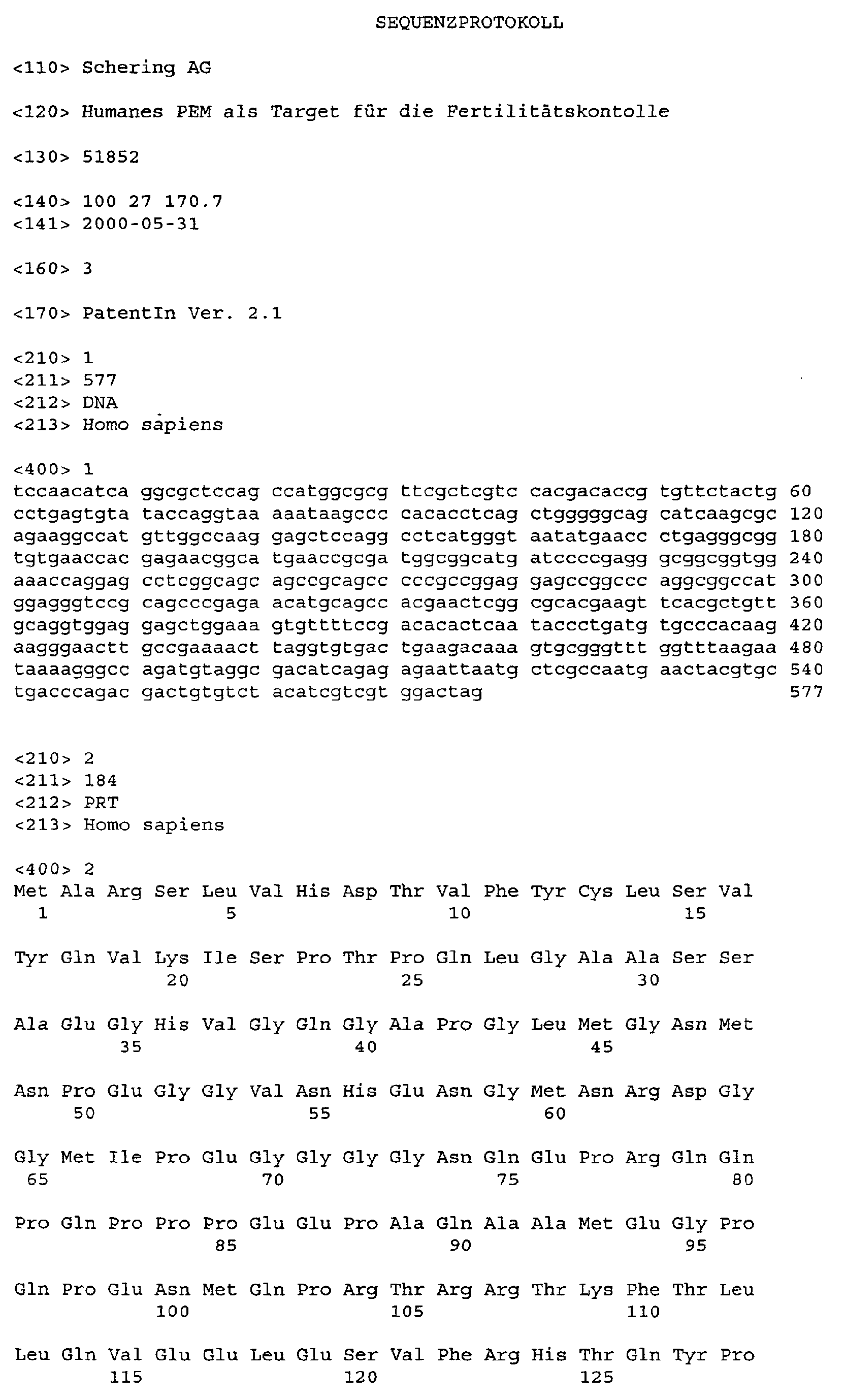
- the identified cDNA sequence is in SEQ ID No. 1 and the protein coding Sequence is in SEQ ID No. 2 shown.
- the genomic sequence could also be identified and is in SEQ ID No. 3 shown (corresponding to a section of nucleotides 16000-170967 from Genbank Accession No. AC005023).
- the initial exon ranges from nucleotide 168 439 to 168 042.
- An internal exon ranges from nucleotide 165 491 to 165 446 and that terminal exon ranges from nucleotide 161 927 to 161 817 (111 nucleotides).
- in the A range of nucleotides 161 698 to 161 693 is located Polyadenylation signal.
- the human PEM is from (a) the coding region of the in SEQ ID No. 1 shown nucleic acid sequence, (b) one according to the sequence (a) in the context of the degeneration of the genetic code or / and (c) one with the sequences according to (a) or / and (b) under stringent conditions encoding hybridizing nucleic acid sequence.
- the human PEM is the amino acid sequence shown in SEQ ID No 2 or one plus at least 80%, preferably at least 90%, identical Amino acid sequence.
- stringent hybridization is as with Sambrook et al. (Molecular Cloning, A Laboratory Manual, Cold Spring Harbor, Laboratory Press (1989), 1.101-1.104). Therefore one speaks of hybridization under stringent conditions if after Wash for 1 hour with 1 x SSC and 0.1% SDS at 55 ° C, preferably at 62 ° C and particularly preferably at 68 ° C, especially for one hour with 0.2 X SSC and 0.1% SDS at 55 ° C, preferably at 62 ° C and particularly preferably at 68 ° C., a positive hybridization signal is observed.
- One under such washing conditions with one in SEQ ID No. 1 nucleotide sequence shown or one of them within the scope of Degeneration of the genetic code corresponding nucleotide sequence hybridizing sequence is covered by the present invention.
- the present invention encompasses natural allelic Variations of PEM, which may also be functional Mutations can act. They also become recombinant Variants, for example functional partial fragments (such as the "divergent Paired class "home domain as for the mouse by Rayle (Develop. Biol. 146 (1991), 255-257)) is covered by the present invention.
- the human PEM particularly preferably has the sequence shown in SEQ ID No. 2 shown amino acid sequence or at least 80% and in particular at least 90% identical sequence.
- the inhibition of PEM can inhibit sperm formation or Maturation lead and thus represents a new way for contraceptive approaches Furthermore, the screening for functional mutations in the PEM gene as a diagnostic tool to determine the causes of infertility be used. By restoring the PEM function (e.g. by Gene therapy) the patient's fertility can be restored.
- the invention therefore relates to the use of human PEM or a nucleic acid coding therefor as the target substance for production an agent for fertility control.
- PEM can inhibit fertility and especially to inhibit spermatogenesis in male mammals be used. This is of great importance in human Contraception, but also in veterinary medicine Population control.
- PEM can be inhibited by Expression reduction using antisense nucleic acids or ribozymes or at the protein level by using inhibitors such as anti-PEM antibodies or low molecular weight antagonists.
- the production of antisense molecules and ribozymes can, for example, as in Sczakiel (Antisense Nucleic Acid Drug Dev. 7 (1997), 439-444, Lavrovsky et al. (Biochem. Mol. Med. 62 (1997), 11-22) and Thompson (Methods Enzymol. 306 (1999), 241-260).
- Polyclonal antibodies against human PEM can be immunized with laboratory animals human PEM or fragments thereof, optionally on a support such as Keyhole limpet hemocyanin, and recovery of the resulting antibodies from the immunized experimental animal.
- Monoclonal antibodies can for example by fusion of spleen cells of the immunized test animal with myeloma cells according to the method of Köhler and Milstein or Further developments of it can be obtained.
- Low molecular weight inhibitors PEM can be screened through a screening procedure as detailed below explained, identified.
- Activation of human PEM can increase the Fertility.
- applications are both in the Human medicine as well as in veterinary medicine possible.
- Activation of PEM can be achieved, for example, by increasing PEM expression in target cells, e.g. Sertoli cells in the testicles and / or epithelial cells in the epididymis, by means of gene therapy methods.
- target cells e.g. Sertoli cells in the testicles and / or epithelial cells in the epididymis
- a coding for PEM Nucleic acid under the control of a promoter active in the target cell suitable gene transfer vectors, e.g. viral vectors such as adenoviruses Retroviruses, adeno-associated viruses or vaccinia viruses, or plasmids, in the target cell is introduced and expressed there.
- Suitable Gene therapy methods are e.g. in Gomez-Navarro et al. (Eur. J. Cancer, 35 (1999), 867-885). Furthermore, an activation of PEM by low molecular weight active substances, which by a like screening method described below can be identified can.
- Another object of the invention is a method for providing new means for fertility control.
- the identification of these new means is done by using the ability of test substances to modulate determined by human PEM. This determination can be used as a high throughput test be carried out in which a large number of test substances in parallel is examined.
- the test can be done on a cellular basis, whereby cells can be used which are compatible with the human gene PEM are transfected and are able to overexpress this gene to effect.
- cells that have a contain completely or partially defective PEM, for example cells that in at least one allele, preferably a defective one in both alleles, contain human PEM gene.
- the one for identifying new ones Active substances used as test substances are preferably mammalian cells, especially human cells.
- a test on a molecular basis be carried out, the human PEM in the form of cell extracts or in an essentially isolated and purified form, if appropriate also in the form of an active fragment.
- the inventive method for identifying new means for Fertility control can continue to be formulated on human PEM modulatory test substances or those derived from them Connections to a drug include.
- Yet another object of the invention is a diagnostic method in which the expression and / or the functionality of human PEM in one Sample is determined.
- the sample is preferably from a patient which is to be subjected to a fertility assessment or by a Patients suspected of having Alzheimer's disease PEM can be determined at the nucleic acid level, e.g. at the DNA level for example by Southern blot or determination of single nucleotide polymorphisms, at transcript level by determining the Expression level, expression pattern or transcript length or on Protein level, e.g. by immunohistochemical or immuncytochemical Methods or by functional measurements.
- the determination of Single nucleotide polymorphisms allow identification and diagnosis functional mutations that cause infertility in patients can.
- human PEM In addition to the role in sperm maturation, human PEM also has a function in Alzheimer's disease. Human PEM is found in the brain of Alzheimer's patients expressed increased compared to brains by healthy people. The inhibition of PEM can have a positive effect on the Affect the course of Alzheimer's disease and thus represents a new one Approach to the treatment of this disease
- the invention is therefore the use of human PEM or one for it coding nucleic acid as target substance for the preparation of an agent for Treating Alzheimer's Disease.
- PEM can be inhibited by the expression of PEM is reduced. This can be done by Antisense nucleic acids, ribozymes or by substances contained in the Regulatory mechanism of PEM gene expression intervene. Such substances can be identified using a test system that measures PEM gene expression measures, identify. For example, Cells made with the PEM DNA are transfected into contact with the substances to be tested and expression of the PEM protein e.g. with the help of antibodies be detected.
- PEM can also be inhibited at the protein level, e.g. by Antibodies, peptides or low molecular weight antagonists. Because PEM one Is transcription factor, it is possible to bind PEM to DNA or the To inhibit interaction with the transcription machinery.
- the invention also relates to a method for providing new ones Agents for the treatment of Alzheimer's disease. Identifying this new means is achieved by the ability of test substances to Inhibition of human PEM is determined. The function is measured of the PEM as a transcription factor. It can bind PEM to DNA be measured. On the other hand, cells can also be used that are transfected with the gene for human PEM. In these cells it is PEM protein for gene regulation of other genes, so-called target genes, responsible. Inhibition of PEM by the test substances leads to a decrease in expression of the target genes.
- Another object of the invention is a cell with one for human PEM encoding DNA or a fragment thereof is transfected and contains at least one exogenous copy of this DNA.
- Another one The invention relates to a cell that is in at least one allele contains a defective PEM gene, for example one using a homologue Recombination disrupted PEM gene.
- These cells can be just like that Nucleic acids encoding human PEM or a fragment thereof, or the human PEM protein itself or a fragment thereof for identification and characterization of fertility control and treatment agents Alzheimer's disease.
- the invention relates to a method for identifying genes, which are regulated by the human PEM gene, taking into account the influence of human PEM tested for gene expression in human cells.
- This Testing can be done, for example, by transcriptome analysis, e.g. according to those of Kozian and Kirschbaum (Trends Biotechnol. 17 (1999), 73-78) Methods or by proteomalysis according to that of Dutt and Lee (Curr. Opin. Biotechnol. 11 (2000), 176-179).
- transcriptome analysis e.g. according to those of Kozian and Kirschbaum (Trends Biotechnol. 17 (1999), 73-78) Methods or by proteomalysis according to that of Dutt and Lee (Curr. Opin. Biotechnol. 11 (2000), 176-179).
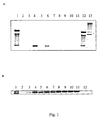
- the expression of human PEM in various brain tissues was analyzed by semi-quantitative PCR.
- the following primers were used for this: Sense 5'-ATGGCGCGTTCGCTCGTCCACGAC-3 ', Antisense 5'-TAGTCCACGACGATGTAGACACAG-3 '.
- specific primers for beta-actin were used: Sense Primer 5'-CTAGAAGCATTTGCGGTGGACGATGGAGGG-3 ', Antisense Primer 5'-CTAGAAGCATTTGCGGTGGACGATGGAGGG-3'.
- the cDNA was purchased from Invitrogen (Carlsbad, CA, USA). The PCR analysis was carried out with the Advantage-2 PCR kit (Clontech).
- the reaction conditions were as follows: initial 5 min 95 ° C; then 30 cycles at 95 ° C for 30 sec, 62 ° C for 30 sec and 72 ° C for 1 min; finally 72 ° C 7 min.
- the results show an increased expression of human PEM in the frontal and temporal lobe in Alzheimer's patients compared to healthy tissue.
Landscapes
- Health & Medical Sciences (AREA)
- Chemical & Material Sciences (AREA)
- Life Sciences & Earth Sciences (AREA)
- Organic Chemistry (AREA)
- General Health & Medical Sciences (AREA)
- Medicinal Chemistry (AREA)
- Engineering & Computer Science (AREA)
- Proteomics, Peptides & Aminoacids (AREA)
- Genetics & Genomics (AREA)
- Molecular Biology (AREA)
- Biophysics (AREA)
- Neurology (AREA)
- Biochemistry (AREA)
- Toxicology (AREA)
- Gastroenterology & Hepatology (AREA)
- Biomedical Technology (AREA)
- Zoology (AREA)
- Bioinformatics & Cheminformatics (AREA)
- Chemical Kinetics & Catalysis (AREA)
- Reproductive Health (AREA)
- Public Health (AREA)
- Animal Behavior & Ethology (AREA)
- Pharmacology & Pharmacy (AREA)
- Nuclear Medicine, Radiotherapy & Molecular Imaging (AREA)
- General Chemical & Material Sciences (AREA)
- Veterinary Medicine (AREA)
- Neurosurgery (AREA)
- Endocrinology (AREA)
- Hospice & Palliative Care (AREA)
- Psychiatry (AREA)
- Gynecology & Obstetrics (AREA)
- Pregnancy & Childbirth (AREA)
- Medicines That Contain Protein Lipid Enzymes And Other Medicines (AREA)
- Measuring Or Testing Involving Enzymes Or Micro-Organisms (AREA)
- Peptides Or Proteins (AREA)
- Micro-Organisms Or Cultivation Processes Thereof (AREA)
- Pharmaceuticals Containing Other Organic And Inorganic Compounds (AREA)
- Medicines Containing Material From Animals Or Micro-Organisms (AREA)
- Investigating Or Analysing Biological Materials (AREA)
Abstract
Description
Antisense 5'-TAGTCCACGACGATGTAGACACAG-3'.
In der Kontrolle wurden spezifische Primer für Beta-Actin verwendet: Sense Primer 5'-CTAGAAGCATTTGCGGTGGACGATGGAGGG-3', Antisense Primer 5'-CTAGAAGCATTTGCGGTGGACGATGGAGGG-3'. Die cDNA wurde von Invitrogen (Carlsbad, CA, USA) erworben. Die PCR Analyse wurde mit dem Advantage-2 PCR kit (Clontech) durchgeführt. Die Reaktionsbedingungen waren wie folgt: Initial 5 min 95°C; anschließend 30 Zyklen mit 95°C für 30 sec, 62°C 30 sec sowie 72°C für 1 min; abschließend 72°C 7 min. Die Ergebnisse zeigen eine erhöhte Expression von humanem PEM im frontalen- sowie temporalen lobe bei Alzheimer Patienten im Vergleich zu gesunden Gewebe.



Claims (17)
- Nukleinsäure mit einer (a) in Seq ID No 1 dargestellten Nukleotidsequenz, (b) einer der Sequenz aus (a) im Rahmen der Degeneration des genetischen Codes entsprechenden Nukleotidsequenz oder (c) einer mit den Sequenzen aus (a) oder (b) unter stringenten Bedingungen hybridisierende Nukleotidsequenz.
- Polypeptid mit einer in Seq ID No 2 dargestellten Aminosäuresequenz.
- Verwendung von humanem PEM oder einer dafür kodierenden Nukleinsäure als Zielsubstanz zur Herstellung eines Mittels für die Fertilitätskontrolle.
- Verwendung von humanem PEM oder einer dafür kodierenden Nukleinsäure als Zielsubstanz zur Herstellung eines Mittel für die Behandlung der Alzheimer-Krankheit.
- Verwendung nach Anspruch 3 oder 4, dadurch gekennzeichnet, dass das humane PEM von (a) dem kodierenden Bereich der in SEQ ID No. 1 gezeigten Nukleinsäuresequenz , (b) einer der Sequenz gemäß (a) im Rahmen der Degeneration des genetischen Codes oder/und (c) einer mit den Sequenzen gemäß (a) oder/und (b) unter stringenten Bedingungen hybridisierenden Nukleinsäuresquenz kodiert ist.
- Verwendung nach Anspruch 3, 4 oder 5,
dadurch gekennzeichnet, dass das humane PEM die in SEQ ID No. 2 gezeigte Aminosäuresequenz oder eine dazu mindestens 80 % identische Aminosäuresequenz aufweist. - Verwendung nach einem der Ansprüche 3, 5 oder 6,
dadurch gekennzeichnet, dass eine Hemmung von PEM zur Verringerung der Fertilität eingesetzt wird. - Verwendung nach einem der Ansprüche 3, 5 oder 6,
dadurch gekennzeichnet, dass eine Aktivierung von PEM zur Erhöhung der Fertilität eingesetzt wird. - Verfahren zur Identifizierung von Mitteln für die Fertilitätskontrolle,
dadurch gekennzeichnet, dass man die Fähigkeit von Testsubstanzen zur Modulation von PEM bestimmt. - Verwendung nach Anspruch 4, 5 oder 6 dadurch gekennzeichnet, dass eine Hemmung von PEM zur Behandlung der Alzheimer-Krankheit eingesetzt wird.
- Verfahren zur Identifizierung von Mitteln zur Behandlung der Alzheimer-Krankheit, dadurch gekennzeichnet, dass die Fähigkeit von Testsubstanzen zur Hemmung von PEM bestimmt wird.
- Verfahren nach einem der Ansprüche 9 oder 11,
weiterhin umfassend die Formulierung der modulatorisch oder inhibitorisch wirkenden Testsubstanzen oder davon abgeleitete Verbindungen zu einem Arzneimittel. - Verfahren zur Fertilitätsdiagnostik,
dadurch gekennzeichnet, dass man die Expression oder/und Funktionalität von humanem PEM in einer Probe bestimmt. - Zelle,
dadurch gekennzeichnet, dass sie mit einer für humanes PEM oder ein Fragment davon kodierenden Nukleinsäure transfiziert ist. - Humane Zelle,
dadurch gekennzeichnet, dass sie in mindestens einem Allel ein defektes PEM-Gen enthält. - Verfahren zur Identifizierung von Genen, die durch das humane PEM-Gen reguliert sind,
dadurch gekennzeichnet, dass man den Einfluss von humanen PEM auf die Genexpression in humanen Zellen testet. - Verfahren nach Anspruch 16,
dadurch gekennzeichnet, dass man eine Transkriptoren- oder Proteomanalyse durchführt.
Applications Claiming Priority (2)
| Application Number | Priority Date | Filing Date | Title |
|---|---|---|---|
| DE10027170A DE10027170A1 (de) | 2000-05-31 | 2000-05-31 | Humanes PEM als Target für die Fertilitätskontrolle |
| DE10027170 | 2000-05-31 |
Publications (2)
| Publication Number | Publication Date |
|---|---|
| EP1162265A2 true EP1162265A2 (de) | 2001-12-12 |
| EP1162265A3 EP1162265A3 (de) | 2004-01-07 |
Family
ID=7644341
Family Applications (1)
| Application Number | Title | Priority Date | Filing Date |
|---|---|---|---|
| EP01250175A Withdrawn EP1162265A3 (de) | 2000-05-31 | 2001-05-17 | Humanes PEM als Target für die Fertilitätskontrolle und die Alzheimertherapie |
Country Status (4)
| Country | Link |
|---|---|
| US (1) | US6825329B2 (de) |
| EP (1) | EP1162265A3 (de) |
| JP (1) | JP2002330771A (de) |
| DE (1) | DE10027170A1 (de) |
Families Citing this family (1)
| Publication number | Priority date | Publication date | Assignee | Title |
|---|---|---|---|---|
| WO2003039585A1 (en) * | 2001-11-09 | 2003-05-15 | Novo Nordisk Health Care Ag | Pharmaceutical composition comprising factor vii polypeptides and protein c inhibitors |
Citations (2)
| Publication number | Priority date | Publication date | Assignee | Title |
|---|---|---|---|---|
| WO2001053312A1 (en) * | 1999-12-23 | 2001-07-26 | Hyseq, Inc. | Novel nucleic acids and polypeptides |
| WO2001055322A2 (en) * | 2000-01-31 | 2001-08-02 | Human Genome Sciences, Inc. | Nucleic acids, proteins, and antibodies |
Family Cites Families (1)
| Publication number | Priority date | Publication date | Assignee | Title |
|---|---|---|---|---|
| US20020132753A1 (en) * | 2000-01-31 | 2002-09-19 | Rosen Craig A. | Nucleic acids, proteins, and antibodies |
-
2000
- 2000-05-31 DE DE10027170A patent/DE10027170A1/de not_active Withdrawn
-
2001
- 2001-05-17 EP EP01250175A patent/EP1162265A3/de not_active Withdrawn
- 2001-05-31 JP JP2001164593A patent/JP2002330771A/ja active Pending
- 2001-05-31 US US09/867,753 patent/US6825329B2/en not_active Expired - Fee Related
Patent Citations (2)
| Publication number | Priority date | Publication date | Assignee | Title |
|---|---|---|---|---|
| WO2001053312A1 (en) * | 1999-12-23 | 2001-07-26 | Hyseq, Inc. | Novel nucleic acids and polypeptides |
| WO2001055322A2 (en) * | 2000-01-31 | 2001-08-02 | Human Genome Sciences, Inc. | Nucleic acids, proteins, and antibodies |
Also Published As
| Publication number | Publication date |
|---|---|
| DE10027170A1 (de) | 2001-12-13 |
| JP2002330771A (ja) | 2002-11-19 |
| US6825329B2 (en) | 2004-11-30 |
| US20020048764A1 (en) | 2002-04-25 |
| EP1162265A3 (de) | 2004-01-07 |
Similar Documents
| Publication | Publication Date | Title |
|---|---|---|
| DE3752360T2 (de) | Menschliche DNS zum Nachweis von Retinoblastoma | |
| DE69534351T2 (de) | Motorneuronlebenserhaltungsgen: ein Gen für spinale Muskelatrophie | |
| EP1923465A1 (de) | Inhibitor-Protein des WNT-Signalwegs | |
| DE19824230A1 (de) | Neues Endometriose-assoziiertes Gen | |
| DE60214867T2 (de) | Histonedeacetylase 9 | |
| DE69836482T2 (de) | Menschliches recq4 gen, das für eine helikase kodiert | |
| DE69705017T2 (de) | Medikamente bindendes Protein | |
| DE69718052T2 (de) | Menschliches wachstumsgen und minderwuchse gen bereich | |
| EP0805204B1 (de) | Nebenhoden-spezifisches Rezeptorprotein und dessen Verwendung | |
| DE69838565T2 (de) | Nukleinsäuren von CIITA Genen | |
| DE60117788T2 (de) | Menschliche wingless-ähnliche gene | |
| EP1007671B1 (de) | Fanconi-gen ii | |
| DE10027170A1 (de) | Humanes PEM als Target für die Fertilitätskontrolle | |
| DE10139874A1 (de) | Humane Mater-Proteine | |
| DE69929876T2 (de) | Für hm1.24 antigen kodierendes gen und dessen promotor | |
| WO2001062913A1 (de) | Vertebraten globin | |
| DE60024862T2 (de) | "insulinabhängiges sequenz dna bindendes protein-1" (irsdbp-1), dafür kodierendes gen und ihre verwendungen | |
| WO2001027265A1 (de) | Nukleinsäuresequenzen von hyperplasien und tumoren der schilddrüse | |
| DE19817118C1 (de) | Dyskerin und dafür codierende DNA-Moleküle, diese enthaltende Vektoren, Antikörper gegen Dyskerin und die Verwendung dieser Gegenstände | |
| DE10001377A1 (de) | bHLH-Transkriptionsfaktor ASCL3 und diesen enthaltendes Arzneimittel | |
| DE19856882C1 (de) | Spermatogenese-Protein | |
| DE19845277C1 (de) | Transmembran-Protein | |
| WO2001040461A2 (de) | cDNA-SEQUENZEN VON ZWEI INTERAKTOREN FANCIP4 UND FANCIP5 DER FANCONI-ANÄMIE-PROTEINE DER KOMPLEMENTATIONSGRUPPEN A UND C | |
| EP0939813A1 (de) | Mammakarzinom-assoziiertes gen | |
| WO2001012818A1 (de) | Neutrale hirn-sphingomyelinase |
Legal Events
| Date | Code | Title | Description |
|---|---|---|---|
| PUAI | Public reference made under article 153(3) epc to a published international application that has entered the european phase |
Free format text: ORIGINAL CODE: 0009012 |
|
| 17P | Request for examination filed |
Effective date: 20010517 |
|
| AK | Designated contracting states |
Kind code of ref document: A2 Designated state(s): AT BE CH CY DE DK ES FI FR GB GR IE IT LI LU MC NL PT SE TR |
|
| AX | Request for extension of the european patent |
Free format text: AL;LT;LV;MK;RO;SI |
|
| PUAL | Search report despatched |
Free format text: ORIGINAL CODE: 0009013 |
|
| AK | Designated contracting states |
Kind code of ref document: A3 Designated state(s): AT BE CH CY DE DK ES FI FR GB GR IE IT LI LU MC NL PT SE TR |
|
| AX | Request for extension of the european patent |
Extension state: AL LT LV MK RO SI |
|
| AKX | Designation fees paid |
Designated state(s): AT BE CH CY DE DK ES FI FR GB GR IE IT LI LU MC NL PT SE TR |
|
| RAP1 | Party data changed (applicant data changed or rights of an application transferred) |
Owner name: BAYER SCHERING PHARMA AG |
|
| RAP1 | Party data changed (applicant data changed or rights of an application transferred) |
Owner name: BAYER SCHERING PHARMA AKTIENGESELLSCHAFT |
|
| 17Q | First examination report despatched |
Effective date: 20071128 |
|
| STAA | Information on the status of an ep patent application or granted ep patent |
Free format text: STATUS: THE APPLICATION IS DEEMED TO BE WITHDRAWN |
|
| 18D | Application deemed to be withdrawn |
Effective date: 20080409 |