EP1154887B1 - Verfahren zur herstellung von haftverschlussteilen aus strahlengehärteten kunststoffen - Google Patents
Verfahren zur herstellung von haftverschlussteilen aus strahlengehärteten kunststoffen Download PDFInfo
- Publication number
- EP1154887B1 EP1154887B1 EP00903613A EP00903613A EP1154887B1 EP 1154887 B1 EP1154887 B1 EP 1154887B1 EP 00903613 A EP00903613 A EP 00903613A EP 00903613 A EP00903613 A EP 00903613A EP 1154887 B1 EP1154887 B1 EP 1154887B1
- Authority
- EP
- European Patent Office
- Prior art keywords
- radiation
- acrylates
- acrylate
- formulation
- prepolymers
- Prior art date
- Legal status (The legal status is an assumption and is not a legal conclusion. Google has not performed a legal analysis and makes no representation as to the accuracy of the status listed.)
- Expired - Lifetime
Links
- 230000005855 radiation Effects 0.000 title claims abstract description 19
- 238000004519 manufacturing process Methods 0.000 title description 16
- 239000004033 plastic Substances 0.000 title description 10
- 229920003023 plastic Polymers 0.000 title description 10
- 239000000463 material Substances 0.000 title description 5
- 239000000203 mixture Substances 0.000 claims abstract description 42
- 238000009472 formulation Methods 0.000 claims abstract description 36
- 238000000034 method Methods 0.000 claims abstract description 22
- 230000008569 process Effects 0.000 claims abstract description 13
- 238000003847 radiation curing Methods 0.000 claims abstract description 8
- 238000007493 shaping process Methods 0.000 claims abstract description 5
- 238000010894 electron beam technology Methods 0.000 claims abstract description 3
- NIXOWILDQLNWCW-UHFFFAOYSA-N acrylic acid group Chemical group C(C=C)(=O)O NIXOWILDQLNWCW-UHFFFAOYSA-N 0.000 claims abstract 2
- 238000007906 compression Methods 0.000 claims abstract 2
- 230000006835 compression Effects 0.000 claims abstract 2
- 150000001252 acrylic acid derivatives Chemical class 0.000 claims description 22
- 239000000178 monomer Substances 0.000 claims description 16
- DAKWPKUUDNSNPN-UHFFFAOYSA-N Trimethylolpropane triacrylate Chemical compound C=CC(=O)OCC(CC)(COC(=O)C=C)COC(=O)C=C DAKWPKUUDNSNPN-UHFFFAOYSA-N 0.000 claims description 11
- FIHBHSQYSYVZQE-UHFFFAOYSA-N 6-prop-2-enoyloxyhexyl prop-2-enoate Chemical compound C=CC(=O)OCCCCCCOC(=O)C=C FIHBHSQYSYVZQE-UHFFFAOYSA-N 0.000 claims description 10
- UHESRSKEBRADOO-UHFFFAOYSA-N ethyl carbamate;prop-2-enoic acid Chemical class OC(=O)C=C.CCOC(N)=O UHESRSKEBRADOO-UHFFFAOYSA-N 0.000 claims description 8
- FWWXYLGCHHIKNY-UHFFFAOYSA-N 2-ethoxyethyl prop-2-enoate Chemical compound CCOCCOC(=O)C=C FWWXYLGCHHIKNY-UHFFFAOYSA-N 0.000 claims description 7
- LVGFPWDANALGOY-UHFFFAOYSA-N 8-methylnonyl prop-2-enoate Chemical compound CC(C)CCCCCCCOC(=O)C=C LVGFPWDANALGOY-UHFFFAOYSA-N 0.000 claims description 7
- 230000001588 bifunctional effect Effects 0.000 claims description 6
- -1 ethyl diglycol Chemical compound 0.000 claims description 5
- LEJBBGNFPAFPKQ-UHFFFAOYSA-N 2-(2-prop-2-enoyloxyethoxy)ethyl prop-2-enoate Chemical compound C=CC(=O)OCCOCCOC(=O)C=C LEJBBGNFPAFPKQ-UHFFFAOYSA-N 0.000 claims description 4
- INQDDHNZXOAFFD-UHFFFAOYSA-N 2-[2-(2-prop-2-enoyloxyethoxy)ethoxy]ethyl prop-2-enoate Chemical compound C=CC(=O)OCCOCCOCCOC(=O)C=C INQDDHNZXOAFFD-UHFFFAOYSA-N 0.000 claims description 4
- 125000001931 aliphatic group Chemical group 0.000 claims description 4
- XMLYCEVDHLAQEL-UHFFFAOYSA-N 2-hydroxy-2-methyl-1-phenylpropan-1-one Chemical compound CC(C)(O)C(=O)C1=CC=CC=C1 XMLYCEVDHLAQEL-UHFFFAOYSA-N 0.000 claims description 3
- 238000005266 casting Methods 0.000 claims description 3
- 229920000728 polyester Polymers 0.000 claims description 3
- ZDQNWDNMNKSMHI-UHFFFAOYSA-N 1-[2-(2-prop-2-enoyloxypropoxy)propoxy]propan-2-yl prop-2-enoate Chemical compound C=CC(=O)OC(C)COC(C)COCC(C)OC(=O)C=C ZDQNWDNMNKSMHI-UHFFFAOYSA-N 0.000 claims description 2
- GOXQRTZXKQZDDN-UHFFFAOYSA-N 2-Ethylhexyl acrylate Chemical compound CCCCC(CC)COC(=O)C=C GOXQRTZXKQZDDN-UHFFFAOYSA-N 0.000 claims description 2
- OMIGHNLMNHATMP-UHFFFAOYSA-N 2-hydroxyethyl prop-2-enoate Chemical compound OCCOC(=O)C=C OMIGHNLMNHATMP-UHFFFAOYSA-N 0.000 claims description 2
- QZPSOSOOLFHYRR-UHFFFAOYSA-N 3-hydroxypropyl prop-2-enoate Chemical compound OCCCOC(=O)C=C QZPSOSOOLFHYRR-UHFFFAOYSA-N 0.000 claims description 2
- NDWUBGAGUCISDV-UHFFFAOYSA-N 4-hydroxybutyl prop-2-enoate Chemical compound OCCCCOC(=O)C=C NDWUBGAGUCISDV-UHFFFAOYSA-N 0.000 claims description 2
- NIXOWILDQLNWCW-UHFFFAOYSA-M Acrylate Chemical compound [O-]C(=O)C=C NIXOWILDQLNWCW-UHFFFAOYSA-M 0.000 claims description 2
- 239000004593 Epoxy Substances 0.000 claims description 2
- 239000004721 Polyphenylene oxide Substances 0.000 claims description 2
- HVVWZTWDBSEWIH-UHFFFAOYSA-N [2-(hydroxymethyl)-3-prop-2-enoyloxy-2-(prop-2-enoyloxymethyl)propyl] prop-2-enoate Chemical compound C=CC(=O)OCC(CO)(COC(=O)C=C)COC(=O)C=C HVVWZTWDBSEWIH-UHFFFAOYSA-N 0.000 claims description 2
- CQEYYJKEWSMYFG-UHFFFAOYSA-N butyl acrylate Chemical compound CCCCOC(=O)C=C CQEYYJKEWSMYFG-UHFFFAOYSA-N 0.000 claims description 2
- 239000003085 diluting agent Substances 0.000 claims description 2
- 238000000465 moulding Methods 0.000 claims description 2
- FSDNTQSJGHSJBG-UHFFFAOYSA-N piperidine-4-carbonitrile Chemical compound N#CC1CCNCC1 FSDNTQSJGHSJBG-UHFFFAOYSA-N 0.000 claims description 2
- 229920000570 polyether Polymers 0.000 claims description 2
- 229920001296 polysiloxane Polymers 0.000 claims description 2
- RAWPGIYPSZIIIU-UHFFFAOYSA-N [benzoyl(phenyl)phosphoryl]-phenylmethanone Chemical class C=1C=CC=CC=1C(=O)P(=O)(C=1C=CC=CC=1)C(=O)C1=CC=CC=C1 RAWPGIYPSZIIIU-UHFFFAOYSA-N 0.000 claims 1
- WURBFLDFSFBTLW-UHFFFAOYSA-N benzil Chemical compound C=1C=CC=CC=1C(=O)C(=O)C1=CC=CC=C1 WURBFLDFSFBTLW-UHFFFAOYSA-N 0.000 claims 1
- 238000000748 compression moulding Methods 0.000 claims 1
- 230000001070 adhesive effect Effects 0.000 description 27
- 239000000853 adhesive Substances 0.000 description 25
- 239000000126 substance Substances 0.000 description 12
- 239000012876 carrier material Substances 0.000 description 9
- 229920000642 polymer Polymers 0.000 description 8
- 238000006116 polymerization reaction Methods 0.000 description 8
- RIWRBSMFKVOJMN-UHFFFAOYSA-N 2-methyl-1-phenylpropan-2-ol Chemical compound CC(C)(O)CC1=CC=CC=C1 RIWRBSMFKVOJMN-UHFFFAOYSA-N 0.000 description 7
- 239000007789 gas Substances 0.000 description 6
- 229920001169 thermoplastic Polymers 0.000 description 6
- 238000004132 cross linking Methods 0.000 description 5
- ZDHCZVWCTKTBRY-UHFFFAOYSA-N omega-Hydroxydodecanoic acid Natural products OCCCCCCCCCCCC(O)=O ZDHCZVWCTKTBRY-UHFFFAOYSA-N 0.000 description 5
- 230000001681 protective effect Effects 0.000 description 5
- 238000010521 absorption reaction Methods 0.000 description 4
- 238000006243 chemical reaction Methods 0.000 description 4
- 239000012815 thermoplastic material Substances 0.000 description 4
- 239000004416 thermosoftening plastic Substances 0.000 description 4
- OWYWGLHRNBIFJP-UHFFFAOYSA-N Ipazine Chemical compound CCN(CC)C1=NC(Cl)=NC(NC(C)C)=N1 OWYWGLHRNBIFJP-UHFFFAOYSA-N 0.000 description 3
- 238000004140 cleaning Methods 0.000 description 3
- 239000011888 foil Substances 0.000 description 3
- VOBUAPTXJKMNCT-UHFFFAOYSA-N 1-prop-2-enoyloxyhexyl prop-2-enoate Chemical compound CCCCCC(OC(=O)C=C)OC(=O)C=C VOBUAPTXJKMNCT-UHFFFAOYSA-N 0.000 description 2
- FTALTLPZDVFJSS-UHFFFAOYSA-N 2-(2-ethoxyethoxy)ethyl prop-2-enoate Chemical compound CCOCCOCCOC(=O)C=C FTALTLPZDVFJSS-UHFFFAOYSA-N 0.000 description 2
- 239000004952 Polyamide Substances 0.000 description 2
- 238000003848 UV Light-Curing Methods 0.000 description 2
- 230000008901 benefit Effects 0.000 description 2
- 230000015572 biosynthetic process Effects 0.000 description 2
- 238000001723 curing Methods 0.000 description 2
- 230000000694 effects Effects 0.000 description 2
- 238000001125 extrusion Methods 0.000 description 2
- 238000000227 grinding Methods 0.000 description 2
- 239000007788 liquid Substances 0.000 description 2
- 229920002647 polyamide Polymers 0.000 description 2
- 229920001225 polyester resin Polymers 0.000 description 2
- 239000004645 polyester resin Substances 0.000 description 2
- 238000003825 pressing Methods 0.000 description 2
- 230000009467 reduction Effects 0.000 description 2
- 239000002904 solvent Substances 0.000 description 2
- 229920001187 thermosetting polymer Polymers 0.000 description 2
- QUASZQPLPKGIJY-UHFFFAOYSA-N 2-[2-[2-(2-hydroxyethoxy)ethoxy]ethoxy]ethyl prop-2-enoate Chemical compound OCCOCCOCCOCCOC(=O)C=C QUASZQPLPKGIJY-UHFFFAOYSA-N 0.000 description 1
- 241000251730 Chondrichthyes Species 0.000 description 1
- 206010021639 Incontinence Diseases 0.000 description 1
- 240000002853 Nelumbo nucifera Species 0.000 description 1
- 235000006508 Nelumbo nucifera Nutrition 0.000 description 1
- 235000006510 Nelumbo pentapetala Nutrition 0.000 description 1
- 229940123973 Oxygen scavenger Drugs 0.000 description 1
- 239000004698 Polyethylene Substances 0.000 description 1
- 239000004743 Polypropylene Substances 0.000 description 1
- 206010040880 Skin irritation Diseases 0.000 description 1
- 239000000654 additive Substances 0.000 description 1
- 239000002313 adhesive film Substances 0.000 description 1
- QVGXLLKOCUKJST-UHFFFAOYSA-N atomic oxygen Chemical compound [O] QVGXLLKOCUKJST-UHFFFAOYSA-N 0.000 description 1
- 239000011324 bead Substances 0.000 description 1
- 125000002091 cationic group Chemical group 0.000 description 1
- 239000007795 chemical reaction product Substances 0.000 description 1
- 230000000295 complement effect Effects 0.000 description 1
- 239000011353 cycloaliphatic epoxy resin Substances 0.000 description 1
- 230000001419 dependent effect Effects 0.000 description 1
- MTHSVFCYNBDYFN-UHFFFAOYSA-N diethylene glycol Chemical compound OCCOCCO MTHSVFCYNBDYFN-UHFFFAOYSA-N 0.000 description 1
- 239000000975 dye Substances 0.000 description 1
- 238000001227 electron beam curing Methods 0.000 description 1
- 238000000295 emission spectrum Methods 0.000 description 1
- 238000005265 energy consumption Methods 0.000 description 1
- 125000001495 ethyl group Chemical group [H]C([H])([H])C([H])([H])* 0.000 description 1
- 238000002474 experimental method Methods 0.000 description 1
- 238000001914 filtration Methods 0.000 description 1
- 230000004992 fission Effects 0.000 description 1
- 239000012530 fluid Substances 0.000 description 1
- 238000003682 fluorination reaction Methods 0.000 description 1
- 238000010438 heat treatment Methods 0.000 description 1
- XXMIOPMDWAUFGU-UHFFFAOYSA-N hexane-1,6-diol Chemical compound OCCCCCCO XXMIOPMDWAUFGU-UHFFFAOYSA-N 0.000 description 1
- 239000011261 inert gas Substances 0.000 description 1
- 230000007246 mechanism Effects 0.000 description 1
- 239000012528 membrane Substances 0.000 description 1
- QSHDDOUJBYECFT-UHFFFAOYSA-N mercury Chemical compound [Hg] QSHDDOUJBYECFT-UHFFFAOYSA-N 0.000 description 1
- 229910052753 mercury Inorganic materials 0.000 description 1
- 239000001301 oxygen Substances 0.000 description 1
- 229910052760 oxygen Inorganic materials 0.000 description 1
- 238000004806 packaging method and process Methods 0.000 description 1
- 229920000573 polyethylene Polymers 0.000 description 1
- 229920005862 polyol Polymers 0.000 description 1
- 229920000098 polyolefin Polymers 0.000 description 1
- 229920001155 polypropylene Polymers 0.000 description 1
- 239000000843 powder Substances 0.000 description 1
- 230000002028 premature Effects 0.000 description 1
- 239000000047 product Substances 0.000 description 1
- 230000036632 reaction speed Effects 0.000 description 1
- 238000000926 separation method Methods 0.000 description 1
- 230000036556 skin irritation Effects 0.000 description 1
- 231100000475 skin irritation Toxicity 0.000 description 1
- 238000010583 slow cooling Methods 0.000 description 1
- 239000003381 stabilizer Substances 0.000 description 1
- 239000007858 starting material Substances 0.000 description 1
- 238000004381 surface treatment Methods 0.000 description 1
- 239000004753 textile Substances 0.000 description 1
- 229920002397 thermoplastic olefin Polymers 0.000 description 1
- 150000003673 urethanes Chemical class 0.000 description 1
- 229910000859 α-Fe Inorganic materials 0.000 description 1
Images

Classifications
-
- B—PERFORMING OPERATIONS; TRANSPORTING
- B29—WORKING OF PLASTICS; WORKING OF SUBSTANCES IN A PLASTIC STATE IN GENERAL
- B29C—SHAPING OR JOINING OF PLASTICS; SHAPING OF MATERIAL IN A PLASTIC STATE, NOT OTHERWISE PROVIDED FOR; AFTER-TREATMENT OF THE SHAPED PRODUCTS, e.g. REPAIRING
- B29C43/00—Compression moulding, i.e. applying external pressure to flow the moulding material; Apparatus therefor
- B29C43/22—Compression moulding, i.e. applying external pressure to flow the moulding material; Apparatus therefor of articles of indefinite length
- B29C43/28—Compression moulding, i.e. applying external pressure to flow the moulding material; Apparatus therefor of articles of indefinite length incorporating preformed parts or layers, e.g. compression moulding around inserts or for coating articles
-
- A—HUMAN NECESSITIES
- A44—HABERDASHERY; JEWELLERY
- A44B—BUTTONS, PINS, BUCKLES, SLIDE FASTENERS, OR THE LIKE
- A44B18/00—Fasteners of the touch-and-close type; Making such fasteners
- A44B18/0046—Fasteners made integrally of plastics
- A44B18/0049—Fasteners made integrally of plastics obtained by moulding processes
-
- B—PERFORMING OPERATIONS; TRANSPORTING
- B29—WORKING OF PLASTICS; WORKING OF SUBSTANCES IN A PLASTIC STATE IN GENERAL
- B29C—SHAPING OR JOINING OF PLASTICS; SHAPING OF MATERIAL IN A PLASTIC STATE, NOT OTHERWISE PROVIDED FOR; AFTER-TREATMENT OF THE SHAPED PRODUCTS, e.g. REPAIRING
- B29C39/00—Shaping by casting, i.e. introducing the moulding material into a mould or between confining surfaces without significant moulding pressure; Apparatus therefor
- B29C39/14—Shaping by casting, i.e. introducing the moulding material into a mould or between confining surfaces without significant moulding pressure; Apparatus therefor for making articles of indefinite length
- B29C39/148—Shaping by casting, i.e. introducing the moulding material into a mould or between confining surfaces without significant moulding pressure; Apparatus therefor for making articles of indefinite length characterised by the shape of the surface
-
- B—PERFORMING OPERATIONS; TRANSPORTING
- B29—WORKING OF PLASTICS; WORKING OF SUBSTANCES IN A PLASTIC STATE IN GENERAL
- B29C—SHAPING OR JOINING OF PLASTICS; SHAPING OF MATERIAL IN A PLASTIC STATE, NOT OTHERWISE PROVIDED FOR; AFTER-TREATMENT OF THE SHAPED PRODUCTS, e.g. REPAIRING
- B29C43/00—Compression moulding, i.e. applying external pressure to flow the moulding material; Apparatus therefor
- B29C43/22—Compression moulding, i.e. applying external pressure to flow the moulding material; Apparatus therefor of articles of indefinite length
- B29C43/222—Compression moulding, i.e. applying external pressure to flow the moulding material; Apparatus therefor of articles of indefinite length characterised by the shape of the surface
-
- B—PERFORMING OPERATIONS; TRANSPORTING
- B29—WORKING OF PLASTICS; WORKING OF SUBSTANCES IN A PLASTIC STATE IN GENERAL
- B29C—SHAPING OR JOINING OF PLASTICS; SHAPING OF MATERIAL IN A PLASTIC STATE, NOT OTHERWISE PROVIDED FOR; AFTER-TREATMENT OF THE SHAPED PRODUCTS, e.g. REPAIRING
- B29C48/00—Extrusion moulding, i.e. expressing the moulding material through a die or nozzle which imparts the desired form; Apparatus therefor
- B29C48/03—Extrusion moulding, i.e. expressing the moulding material through a die or nozzle which imparts the desired form; Apparatus therefor characterised by the shape of the extruded material at extrusion
- B29C48/07—Flat, e.g. panels
- B29C48/08—Flat, e.g. panels flexible, e.g. films
-
- B—PERFORMING OPERATIONS; TRANSPORTING
- B29—WORKING OF PLASTICS; WORKING OF SUBSTANCES IN A PLASTIC STATE IN GENERAL
- B29C—SHAPING OR JOINING OF PLASTICS; SHAPING OF MATERIAL IN A PLASTIC STATE, NOT OTHERWISE PROVIDED FOR; AFTER-TREATMENT OF THE SHAPED PRODUCTS, e.g. REPAIRING
- B29C59/00—Surface shaping of articles, e.g. embossing; Apparatus therefor
- B29C59/02—Surface shaping of articles, e.g. embossing; Apparatus therefor by mechanical means, e.g. pressing
- B29C59/022—Surface shaping of articles, e.g. embossing; Apparatus therefor by mechanical means, e.g. pressing characterised by the disposition or the configuration, e.g. dimensions, of the embossments or the shaping tools therefor
- B29C59/025—Fibrous surfaces with piles or similar fibres substantially perpendicular to the surface
-
- B—PERFORMING OPERATIONS; TRANSPORTING
- B29—WORKING OF PLASTICS; WORKING OF SUBSTANCES IN A PLASTIC STATE IN GENERAL
- B29C—SHAPING OR JOINING OF PLASTICS; SHAPING OF MATERIAL IN A PLASTIC STATE, NOT OTHERWISE PROVIDED FOR; AFTER-TREATMENT OF THE SHAPED PRODUCTS, e.g. REPAIRING
- B29C35/00—Heating, cooling or curing, e.g. crosslinking or vulcanising; Apparatus therefor
- B29C35/02—Heating or curing, e.g. crosslinking or vulcanizing during moulding, e.g. in a mould
- B29C35/08—Heating or curing, e.g. crosslinking or vulcanizing during moulding, e.g. in a mould by wave energy or particle radiation
- B29C35/0805—Heating or curing, e.g. crosslinking or vulcanizing during moulding, e.g. in a mould by wave energy or particle radiation using electromagnetic radiation
- B29C2035/0827—Heating or curing, e.g. crosslinking or vulcanizing during moulding, e.g. in a mould by wave energy or particle radiation using electromagnetic radiation using UV radiation
-
- B—PERFORMING OPERATIONS; TRANSPORTING
- B29—WORKING OF PLASTICS; WORKING OF SUBSTANCES IN A PLASTIC STATE IN GENERAL
- B29C—SHAPING OR JOINING OF PLASTICS; SHAPING OF MATERIAL IN A PLASTIC STATE, NOT OTHERWISE PROVIDED FOR; AFTER-TREATMENT OF THE SHAPED PRODUCTS, e.g. REPAIRING
- B29C35/00—Heating, cooling or curing, e.g. crosslinking or vulcanising; Apparatus therefor
- B29C35/02—Heating or curing, e.g. crosslinking or vulcanizing during moulding, e.g. in a mould
- B29C35/08—Heating or curing, e.g. crosslinking or vulcanizing during moulding, e.g. in a mould by wave energy or particle radiation
- B29C35/0866—Heating or curing, e.g. crosslinking or vulcanizing during moulding, e.g. in a mould by wave energy or particle radiation using particle radiation
- B29C2035/0877—Heating or curing, e.g. crosslinking or vulcanizing during moulding, e.g. in a mould by wave energy or particle radiation using particle radiation using electron radiation, e.g. beta-rays
-
- B—PERFORMING OPERATIONS; TRANSPORTING
- B29—WORKING OF PLASTICS; WORKING OF SUBSTANCES IN A PLASTIC STATE IN GENERAL
- B29C—SHAPING OR JOINING OF PLASTICS; SHAPING OF MATERIAL IN A PLASTIC STATE, NOT OTHERWISE PROVIDED FOR; AFTER-TREATMENT OF THE SHAPED PRODUCTS, e.g. REPAIRING
- B29C48/00—Extrusion moulding, i.e. expressing the moulding material through a die or nozzle which imparts the desired form; Apparatus therefor
- B29C48/15—Extrusion moulding, i.e. expressing the moulding material through a die or nozzle which imparts the desired form; Apparatus therefor incorporating preformed parts or layers, e.g. extrusion moulding around inserts
-
- B—PERFORMING OPERATIONS; TRANSPORTING
- B29—WORKING OF PLASTICS; WORKING OF SUBSTANCES IN A PLASTIC STATE IN GENERAL
- B29K—INDEXING SCHEME ASSOCIATED WITH SUBCLASSES B29B, B29C OR B29D, RELATING TO MOULDING MATERIALS OR TO MATERIALS FOR MOULDS, REINFORCEMENTS, FILLERS OR PREFORMED PARTS, e.g. INSERTS
- B29K2033/00—Use of polymers of unsaturated acids or derivatives thereof as moulding material
- B29K2033/04—Polymers of esters
- B29K2033/08—Polymers of acrylic acid esters, e.g. PMA, i.e. polymethylacrylate
-
- B—PERFORMING OPERATIONS; TRANSPORTING
- B29—WORKING OF PLASTICS; WORKING OF SUBSTANCES IN A PLASTIC STATE IN GENERAL
- B29L—INDEXING SCHEME ASSOCIATED WITH SUBCLASS B29C, RELATING TO PARTICULAR ARTICLES
- B29L2031/00—Other particular articles
- B29L2031/727—Fastening elements
- B29L2031/729—Hook and loop-type fasteners
Definitions
- the present invention relates to a method for manufacturing of fastener parts that have a variety of hooking means.
- thermoplastic polyolefins Extrusion manufactured
- the thermoplastic is plastic or liquid state, for example, a gap between a pressure roller and fed to a forming roll, the forming roll being a plurality of radial extending recesses open on both sides.
- the thermoplastic Plastic penetrates into the recesses due to the line squeezing pressure largely hardens, so that the adhesive fastener parts as a three-dimensional structure can be detached from the form roller.
- the adhesive fastener body with which the interlocking means, namely the hooks formed in the recesses and the interlocking heads formed are integrally connected.
- Thermoplastic materials are preferred as materials in the conventional processes Plastics such as polypropylene, polyamide or polyethylene are used.
- Such a method is known for example from WO 98/20767.
- thermoplastic polymers on an approx. 400 mm wide forming roller only Produce small numbers of meters of the three-dimensional adhesive film.
- thermoplastic materials required by heating the thermoplastic mass up to 300 ° C a considerable amount of energy.
- the object of the present invention is a new method to indicate the manufacture of fastener parts, which at reduced energy consumption an increase in manufacturing speed allows. Furthermore, the present invention is intended to provide thermal allow more durable adhesive fastener parts and film structures with extremely small thickness, with a large number of protruding elements or hooking means is provided.
- Thermoplastic materials can by the inventive method Roll rotation speed and thus the produced per unit of time Length of the three-dimensional orbits can be increased tenfold.
- Radiation curing also has the advantage that the polymerization without Release of fission products occurs.
- the radiation crosslinkable, in particular acrylated prepolymers are rather almost quantitative with each other and optionally also crosslinked with existing reactive solvents.
- thermoly resistant fastener parts for example also as adhesive fastener parts for grinding wheels or other work equipment can be used.
- These polymers which in Contrary to the known polyolefins, polyamides and polyesters also in Temperatures of greater than 300 ° C can essentially be used Thermosets.
- the properties of the polymers naturally also depend on the chain length and the degree of crosslinking of the prepolymers used.
- polyester acrylates epoxy acrylates, polyether acrylates, silicone acrylates or Urethane acrylates are used.
- urethane acrylates are preferred, since these contain no protective gas are radiation-crosslinkable.
- Preferred urethane acrylates are the aliphatic mono-, bi- or trifunctional urethane acrylates, with the aliphatic groups for flexibility of the plastic.
- Bifunctional aliphatic are preferred Urethane acrylates used.
- aromatic urethane acrylates of various functions. Prefers the viscosity of the prepolymers used should be between 3,000 and 60,000 mPa s.
- the formulation is usually necessary by adding reactive diluents, especially monomers, to the appropriate one Dilute viscosity.
- reactive diluents especially monomers
- the monomers are built into the network, so that the polymer releases almost no solvents.
- Reactive thinner acrylates are used, which have a variety of functions.
- monofunctional acrylates will reduce hardness, increase which achieves flexibility and good adhesion properties of the polymer. Monofunctional monomers also cause less shrinkage in the Polymerization. In principle, all known monofunctional acrylates can be used become.
- the monofunctional acrylates are preferably made from Butyl acrylate, 2-ethylhexyl acrylate, hydroxyethyl acrylate, hydroxypropyl acrylate, 4-hydroxybutyl acrylate, Ethyl diglycol acrylate, isodecyl acrylate and 2-ethoxyethyl acrylate existing group selected, being ethoxyethyl acrylate and isodecyl acrylate are particularly preferred.
- bi- or trifunctional acrylates also adjusts the desired properties such as hardness and flexibility.
- bifunctional monomers are preferably diethylene glycol diacrylate, dipropylene glycol diacrylate, triethylene glycol diacrylate, Tripropylene glycol diacrylate or 1,6-hexanediol diacrylate used, 1,6-hexanediol diacrylate being particularly preferred.
- trifunctional acrylates such as trimethylolpropane triacrylate can also be used or pentaerythritol triacrylate or higher functional acrylates become.
- propoxylated monomers which are characterized by a distinguish less skin irritation.
- a monomer mixture of mono- and bifunctional acrylates is preferred used, in particular a mixture of 2-ethoxyethyl acrylate and 1.6 Hexanediol.
- concentrations of the added monomers too the formulation depend on the required viscosity of the formulation and the desired hardness, flexibility, the adhesive properties of the polymer, the reaction speed etc.
- a mixture of mono- and bifunctional acrylates, especially ethoxyethyl acrylate or isodecyl acrylate with trimethylolpropane triacrylate has also been found proven.
- Another advantage of producing the adhesive fastener parts from radiation-crosslinkable Prepolymers and monomers consist in the fact that the choice of used monomers to control the adhesive properties of the plastic and that without the additional required in the known thermoplastics Surface treatment steps by corona discharge, gas flame treatment or fluorination is sufficient adhesion of the plastic on a desired carrier can be achieved. Thus, the inventive Procedure one step can be saved.
- UV-curable formulations To achieve sufficient polymerization, it is necessary to use of UV-curable formulations to add a photoinitiator which, when excited by UV radiation which forms the primary radicals that start the chain reaction.
- photoinitiators with UV absorption Radical-releasing molecules
- UV absorption Radical-releasing molecules such as ⁇ -hydroxyketone, ⁇ -aminoketones, benzil dimethyl ketals, bis-benzoylphenylphoshinoxides, Metallocenes and their derivatives.
- a 2-hydroxy-2-methyl-1-phenyl-propan-1-one Photoinitiator for example Darocur 1173 from Ciba Geigy.
- the wording can of course include other common additives such as Dyes, stabilizers, oxygen scavengers, ferrite powder can be added.
- the viscosity of the radiation-crosslinkable formulation depends on the special manufacturing conditions, for example the line squeeze pressure between the Form rollers, dependent.
- the viscosity of the formulation should be between 150 and 20,000 mPa s, viscosities are particularly preferred between 300 and 5,000 mPa s.
- the percentage of prepolymers added to the radiation curable formulation depends on the required viscosity of the formulation, the properties of the Prepolymers and monomers and the desired properties of the manufactured Plastic material.
- the proportion of prepolymers is generally in the formulation about 60 to 95%, preferably about 80%.
- the adhesive fastener parts produced according to the invention can be used in many different ways are used: in the baby diaper area or for incontinence diapers, as temperature-resistant Adhesive fastener parts for fastening grinding wheels or other Tools for large area fastening of carpets, wall hangings, for seat covers and seat elements, packaging or fly screens and for self-cleaning surfaces.
- the thickness of the fastener base body and the number of hooking means per cm 2 depend on the use of the finished fastener parts.
- the method according to the invention can also other foils, the at least one-sided protruding elements or ribs include, such as riblet films, are produced. Show riblet slides a number of such protruding elements on one side; which is a diminution wall shear stress and / or control of boundary layer detachment cause.
- the protruding elements can be made accordingly the desired effects of the surface structure in the manner of a shark skin or a lotus flower shaped to reduce drag effect and / or are self-cleaning.
- Such surface structures are for example in "Biological Surfaces and their Technological Application - Laboratory and Flight Experiments on Drag Reduction and Separation Control "by D. W. Bechert, M. Bruse, W. Hage and R. Meyer in "Fluid Mech. (1997) Vol. 338, pp. 59-87 Cambridge University Press ".
- Riblet films of this type are also produced using the radiation-crosslinkable in particular formulations comprising acrylated prepolymers, where this also between a forming roller and a counter-pressure roller accordingly molded and then radiation cured, the molding roll a variety has recesses complementary to the riblet structure. From radiation-curable formulations that can be produced by Riblet films are distinguished also by a high production speed and an extraordinary great temperature resistance.
- the riblet films are used, for example Reduction of flow resistance in aircraft and trains or in Pipelines, to prevent ice formation on aircraft or as self-cleaning Foil inserted.
- a film made of plastic e.g. B. from Hostaphan Fleece, a textile material or any other suitable carrier material become.
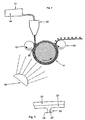
- the film 15 from the formulation to be polymerized on the carrier material 13 then becomes a gap 16 between a forming roll 11 and a counter-pressure roll 12 fed.
- the form roller 11 has a plurality of radial running on both sides open recesses 17.
- the viscous formulation is through the gap 16 in the form of an adhesive fastener body 21 and in the Recesses in the shape of the interlocking webs 22 and interlocking heads 23 comprehensive hooking means 24 (see also Figure 3) and then pressed irradiated by irradiation by means of UV light 19 of a suitable wavelength.
- the hooking means can be of various shapes, for example have a round, triangular, quadrangular, pentagonal or hexagonal cross-sectional area.
- the interlocking heads 23 can also be shaped differently, for example plate-shaped, pointed, curved or hook-shaped. Related configurations are described in the subsequently published DE 198 28 856.5.
- the UV-sensitive photoinitiator sets radicals by absorbing the UV light free that start the radical chain polymerization.
- the reaction rate of the polymerization reaction is extraordinary high, so that the adhesive fastener body 21 and the hooking means 24 existing fastener parts 26 on the carrier material 13 from the Form roller 11 in a fraction of the conventional curing time by means of Take-off roller 20 can be solved. Approx. 20 to 30 m adhesive foil can be used per minute getting produced. Since less than the known methods Line squeeze pressures are required, the device can remain the same Accuracy wider rollers 11, 12, 20 have.
- the counter-pressure roller 12 and the roller 20 have one of the direction of rotation Forming roller 11 in the opposite direction of rotation.
- a medium-pressure mercury lamp can be used as the UV source 19. It however, other UV radiation sources are also possible. Depending on the the absorption band of the photoinitiator causing radical formation is also UV light in the wavelength range between 180 and 400 nm corresponding to approximately 3 irradiated to 6 eV.
- the radiation wavelength depends on the emission spectrum of the used UV radiation source and according to the absorption band of the photoinitiators.
- the carrier material 13 used should of course be exposed to UV radiation be largely stable. In addition, despite the need for Carrier material caused filtering and scattering of UV radiation ensured be that enough to set the chain reaction in motion in the layer to be hardened photochemically generated primary radicals are formed.
- the device shown in FIG. 2 serves in detail described device for producing adhesive fastener parts without additional Support material.
- the radiation-crosslinkable formulation 14 is located in a reservoir 31 and the gap 16 between a nozzle 32 the form roller 11 and the back pressure roller 12 added, the addition as in the device described in Figure 1 in a slight excess he follows.
- a device for producing adhesive fastener parts by electron beam curing is instead of the UV source 19 in those described in Figures 1 and 2
- Devices used an electron radiation source and for example one of the formulations B1 or B2 used as radiation-crosslinkable mass.
- the energy range of electron radiation is usually between 150 and 300 keV.
- the manufacture of the fastener parts from radiation-crosslinkable, in particular Acrylated prepolymers can also be used continuously or discontinuously in others working devices take place, the means for shaping, casting and / or pressing radiation-crosslinkable, in particular acrylated, prepolymers comprehensive formulations in the form of an adhesive base body with it arranged hooking means and which have a UV or an electron radiation source for radiation curing include.
Landscapes
- Engineering & Computer Science (AREA)
- Mechanical Engineering (AREA)
- Adhesives Or Adhesive Processes (AREA)
- Casting Or Compression Moulding Of Plastics Or The Like (AREA)
- Slide Fasteners, Snap Fasteners, And Hook Fasteners (AREA)
- Lining Or Joining Of Plastics Or The Like (AREA)
- Slide Fasteners (AREA)
- Manufacture Of Macromolecular Shaped Articles (AREA)
- Sealing Material Composition (AREA)
Applications Claiming Priority (3)
| Application Number | Priority Date | Filing Date | Title |
|---|---|---|---|
| DE19906008 | 1999-02-15 | ||
| DE19906008A DE19906008A1 (de) | 1999-02-15 | 1999-02-15 | Verfahren und Vorrichtung zur Herstellung von Haftverschlußteilen aus strahlengehärteten Kunststoffen |
| PCT/EP2000/000486 WO2000048812A1 (de) | 1999-02-15 | 2000-01-22 | Verfahren und vorrichtung zur herstellung von haftverschlussteilen aus strahlengehärteten kunststoffen |
Publications (2)
| Publication Number | Publication Date |
|---|---|
| EP1154887A1 EP1154887A1 (de) | 2001-11-21 |
| EP1154887B1 true EP1154887B1 (de) | 2004-05-06 |
Family
ID=7897382
Family Applications (1)
| Application Number | Title | Priority Date | Filing Date |
|---|---|---|---|
| EP00903613A Expired - Lifetime EP1154887B1 (de) | 1999-02-15 | 2000-01-22 | Verfahren zur herstellung von haftverschlussteilen aus strahlengehärteten kunststoffen |
Country Status (12)
| Country | Link |
|---|---|
| US (1) | US7008589B1 (enExample) |
| EP (1) | EP1154887B1 (enExample) |
| JP (1) | JP4485692B2 (enExample) |
| AT (1) | ATE265918T1 (enExample) |
| BR (1) | BR0008229B1 (enExample) |
| CA (1) | CA2362063C (enExample) |
| DE (2) | DE19906008A1 (enExample) |
| DK (1) | DK1154887T3 (enExample) |
| ES (1) | ES2219306T3 (enExample) |
| MX (1) | MXPA01008231A (enExample) |
| PT (1) | PT1154887E (enExample) |
| WO (1) | WO2000048812A1 (enExample) |
Families Citing this family (21)
| Publication number | Priority date | Publication date | Assignee | Title |
|---|---|---|---|---|
| US6180205B1 (en) * | 1999-04-01 | 2001-01-30 | Velcro Industries B.V. | Touch fasteners having portions with different properties and methods of making same |
| DE19952417A1 (de) * | 1999-10-30 | 2001-05-03 | Binder Gottlieb Gmbh & Co | Verfahren zur Herstellung eines Haftverschlußteiles |
| PT1343396E (pt) | 2000-12-22 | 2010-01-07 | Binder Gottlieb Gmbh & Co Kg | Processo para o fabrico de peças para fechos adesivos |
| DE10123205A1 (de) * | 2001-05-12 | 2002-11-28 | Binder Gottlieb Gmbh & Co | Verfahren zur Herstellung eines Haftverschlußteils |
| DE10158347A1 (de) * | 2001-11-28 | 2003-06-12 | Tesa Ag | Verfahren zur Erzeugung von nano- und mikrostrukturierten Polymerfolien |
| US7462313B2 (en) | 2005-10-12 | 2008-12-09 | Velcro Industries B.V. | Snap closures |
| DE102006028581A1 (de) * | 2006-06-22 | 2007-12-27 | Gottlieb Binder Gmbh & Co. Kg | Verfahren und Vorrichtung zur Oberflächenfunktionalisierung von Haftverschlußteilen |
| EP2083982A1 (en) * | 2006-11-10 | 2009-08-05 | The Procter and Gamble Company | Method for rotary press forming |
| US20080136064A1 (en) * | 2006-12-12 | 2008-06-12 | Husky Injection Molding Systems Ltd. | Molding apparatus and a molding method |
| US8992818B2 (en) * | 2010-07-13 | 2015-03-31 | Xerox Corporation | Seamless intermediate transfer member process |
| US8323781B2 (en) | 2010-11-02 | 2012-12-04 | Xerox Corporation | Intermediate transfer member and method of manufacture |
| EP2906070B1 (en) | 2012-10-15 | 2016-06-29 | Velcro Bvba | Touch fastening |
| WO2015144174A1 (en) * | 2014-03-24 | 2015-10-01 | Inmold A/S | Method and apparatus for producing a high aspect ratio nanostructured foil by extrusion coating or extrusion casting |
| EP3115421B1 (de) * | 2015-07-06 | 2021-03-03 | Airbus Defence and Space GmbH | Aktive anti-eis-beschichtung, beschichtungsmaterial sowie herstellverfahren zum herstellen derselben |
| CN108244772B (zh) * | 2016-12-29 | 2020-12-15 | Ykk株式会社 | 标记机构、拉链链条的处理装置及加工方法 |
| WO2018124992A1 (en) * | 2016-12-29 | 2018-07-05 | Hayat Kimya San. A. Ş. | Method and apparatus for producing hook fasteners |
| DE112017007389T5 (de) | 2017-04-03 | 2019-12-12 | Ykk Corporation | Formvorrichtung, Herstellungsverfahren für geformtes Oberflächenbefestigungsmittel und geformtes Oberflächenbefestigungsmittel |
| WO2022271270A1 (en) * | 2021-06-23 | 2022-12-29 | Smart Pad LLC | Polishing pad with protruded polishing structures, system for manufacturing the same, and method for manufacturing the same |
| CN115157522B (zh) * | 2022-07-13 | 2023-04-04 | 山东路德新材料股份有限公司 | 一种一步法成型排水复合土工膜的加工方法及加工设备 |
| DE102024205551A1 (de) * | 2023-12-22 | 2025-06-26 | Gottlieb Binder Gmbh & Co. Kg | Verfahren und Vorrichtung zum Herstellen eines Haftverschlussteils und Haftverschlussteil |
| EP4573961A1 (de) * | 2023-12-22 | 2025-06-25 | Gottlieb Binder GmbH & Co. KG | Verfahren und vorrichtung zum herstellen eines haftverschlussteils und haftverschlussteil |
Family Cites Families (23)
| Publication number | Priority date | Publication date | Assignee | Title |
|---|---|---|---|---|
| US4477405A (en) * | 1981-12-31 | 1984-10-16 | Ppg Industries, Inc. | Method of in-mold coating |
| US4550060A (en) * | 1981-12-31 | 1985-10-29 | Ppg Industries, Inc. | Coated article |
| US4794028A (en) * | 1984-04-16 | 1988-12-27 | Velcro Industries B.V. | Method for continuously producing a multi-hook fastner member and product of the method |
| US5011642A (en) * | 1987-06-05 | 1991-04-30 | Minnesota Mining And Manufacturing Company | Method of making extruded article |
| US5087476A (en) * | 1989-03-17 | 1992-02-11 | Matsushita Electric Industrial Co., Ltd. | Method of producing thin film |
| US5057259A (en) * | 1989-05-25 | 1991-10-15 | Erblok Associates | Method and apparatus for injection molding continuous products |
| US5096401A (en) * | 1989-06-26 | 1992-03-17 | Canon Kabushiki Kaisha | Apparatus for producing a substrate sheet for optical recording media |
| EP0408283B1 (en) * | 1989-07-12 | 1995-09-27 | Canon Kabushiki Kaisha | Apparatus for producing substrate sheet for optical recording mediums and process for producing substrate sheet for optical recording mediums making use of it, apparatus for producing optical recording medium and process for producing optical recording medium making use of it. |
| US5281371A (en) * | 1990-11-16 | 1994-01-25 | Canon Kabushiki Kaisha | Method and apparatus for forming substrate sheet for optical recording medium |
| JPH0647883A (ja) * | 1992-07-29 | 1994-02-22 | Toppan Printing Co Ltd | 電離放射線照射によるエンボスシート製造方法 |
| JPH07195514A (ja) * | 1993-12-29 | 1995-08-01 | Japan Vilene Co Ltd | 平面先端突起群を有するフロアーマットの製造装置及び製造方法 |
| TW317223U (en) * | 1994-01-13 | 1997-10-01 | Minnesota Mining & Mfg | Abrasive article |
| US5785784A (en) * | 1994-01-13 | 1998-07-28 | Minnesota Mining And Manufacturing Company | Abrasive articles method of making same and abrading apparatus |
| DE4431622C2 (de) * | 1994-09-05 | 1998-04-02 | Benecke Kaliko Ag | Verfahren zur Herstellung eines Bauteils und Bauteil für den Kraftfahrzeug-Innenbereich |
| DE19705303C2 (de) * | 1996-02-16 | 2002-11-21 | Karlsruhe Forschzent | Verfahren zur Herstellung von Klein- und Mikroteilen |
| US5908680A (en) * | 1996-03-05 | 1999-06-01 | Minnesota Mining And Manufacturing Company | Replaceable roll covers with repositionable pressure sensitive adhesive |
| DE19646318A1 (de) * | 1996-11-09 | 1998-05-14 | Binder Gottlieb Gmbh & Co | Rationelles Verfahren zur Herstellung eines Haftverschlußteils aus thermoplatischem Kunststoff |
| DE19647898C2 (de) * | 1996-11-20 | 1999-05-12 | Karl Beiss | Verfahren zum Härten von duroplastischem Kunststoff in Formteilen |
| KR20000070504A (ko) * | 1997-01-27 | 2000-11-25 | 버젤 케이스 지. | 연신된 파스너 |
| US5945131A (en) * | 1997-04-16 | 1999-08-31 | Velcro Industries B.V. | Continuous molding of fastener products and the like and products produced thereby |
| US5884374A (en) * | 1997-11-20 | 1999-03-23 | Velcro Industries B.V. | Fastener members and apparatus for their fabrication |
| US6451239B1 (en) * | 1999-08-23 | 2002-09-17 | Robert B. Wilson | Process of making a hook fastener using radio frequency heating |
| DE19952417A1 (de) * | 1999-10-30 | 2001-05-03 | Binder Gottlieb Gmbh & Co | Verfahren zur Herstellung eines Haftverschlußteiles |
-
1999
- 1999-02-15 DE DE19906008A patent/DE19906008A1/de not_active Withdrawn
-
2000
- 2000-01-22 EP EP00903613A patent/EP1154887B1/de not_active Expired - Lifetime
- 2000-01-22 BR BRPI0008229-5A patent/BR0008229B1/pt not_active IP Right Cessation
- 2000-01-22 JP JP2000599577A patent/JP4485692B2/ja not_active Expired - Lifetime
- 2000-01-22 MX MXPA01008231A patent/MXPA01008231A/es active IP Right Grant
- 2000-01-22 WO PCT/EP2000/000486 patent/WO2000048812A1/de not_active Ceased
- 2000-01-22 AT AT00903613T patent/ATE265918T1/de active
- 2000-01-22 ES ES00903613T patent/ES2219306T3/es not_active Expired - Lifetime
- 2000-01-22 DK DK00903613T patent/DK1154887T3/da active
- 2000-01-22 DE DE50006326T patent/DE50006326D1/de not_active Expired - Lifetime
- 2000-01-22 PT PT00903613T patent/PT1154887E/pt unknown
- 2000-01-22 CA CA002362063A patent/CA2362063C/en not_active Expired - Lifetime
- 2000-01-22 US US09/913,403 patent/US7008589B1/en not_active Expired - Lifetime
Also Published As
| Publication number | Publication date |
|---|---|
| DE50006326D1 (de) | 2004-06-09 |
| US7008589B1 (en) | 2006-03-07 |
| JP2002537045A (ja) | 2002-11-05 |
| BR0008229A (pt) | 2001-10-30 |
| BR0008229B1 (pt) | 2010-11-30 |
| ATE265918T1 (de) | 2004-05-15 |
| PT1154887E (pt) | 2004-09-30 |
| CA2362063A1 (en) | 2000-08-24 |
| WO2000048812A1 (de) | 2000-08-24 |
| CA2362063C (en) | 2008-04-01 |
| EP1154887A1 (de) | 2001-11-21 |
| DK1154887T3 (da) | 2004-08-30 |
| JP4485692B2 (ja) | 2010-06-23 |
| DE19906008A1 (de) | 2000-08-17 |
| MXPA01008231A (es) | 2002-10-23 |
| ES2219306T3 (es) | 2004-12-01 |
Similar Documents
| Publication | Publication Date | Title |
|---|---|---|
| EP1154887B1 (de) | Verfahren zur herstellung von haftverschlussteilen aus strahlengehärteten kunststoffen | |
| DE2422378C3 (de) | Verfahren zur Herstellung von Kunststoff gießlingen | |
| DE69420008T2 (de) | Verfahren zum Herstellen faserverstärkter thermoplastischer Schaumformkörper | |
| EP1961545B1 (de) | Verfahren zur Erzeugung von nano- und/oder mikrostrukturierten Oberflächen in einer klebenden, insbesondere selbstklebenden Schicht | |
| DE19939073A1 (de) | Verfahren zur kontinuierlichen, lösungsmittel- und mastikationsfreien Herstellung von druckempfindlichen Selbstklebemassen auf Basis von nicht-thermoplastischen Elastomeren sowie deren Beschichtung zur Herstellung von selbstklebenden Artikeln | |
| AT393650B (de) | Verfahren zum ausruesten der oberflaeche einer folie aus thermoplastischem polymerwerkstoff mit vorspruengen sowie nach diesem verfahren hergestellte folie | |
| EP2721076B1 (de) | Verfahren zur kontinuierlichen inline herstellung von beschichteten polymeren substraten oder laminaten | |
| EP3890944B1 (de) | Mittels 3d-druck funktionalisierte folienflächen zur ausrüstung von werkstückoberflächen | |
| DE19939075A1 (de) | Selbstklebendes Abdeckband unter Verwendung eines bahnförmigen Trägers auf Papier- oder Vliesbasis und einer lösungsmittelfrei und mastikationsfrei hergestellten und beschichteten druckempfindlichen Selbstklebemasse auf Basis nicht thermoplastischer Elastomere | |
| DE3816855A1 (de) | Verfahren zur herstellung kratzfest beschichteter kunststoffbahnen | |
| DE1225847B (de) | Verfahren und Vorrichtung zur kontinuierlichen Verarbeitung von aus Duesen ausgepressten, verschaeumbaren thermoplastischen Kunststoffen | |
| EP2243618B1 (de) | Verfahren zur Herstellung einer thermoplastischen Folie mit einer dreidimensional strukturierten Oberfläche | |
| DE2402096B2 (de) | Verfahren zur kontinuierlichen herstellung einer polymethylmethacrylat- platte | |
| WO2001083212A1 (de) | Verfahren zum herstellen eines mehrschichtigen coextrudates und danach hergestellter folienaufbau | |
| EP0536145A1 (de) | Verfahren und anlage zur herstellung von formteilen aus vernetzten reaktionskunststoffen. | |
| DE102005060731A1 (de) | Prismenfilme für optische Anwendungen | |
| EP0015312A1 (de) | Extrudierter Hohlprofilstrang aus thermoplastischem Kunststoff mit Oberflächenstruktur und Verfahren zu seiner Herstellung | |
| EP0597227B1 (de) | Verfahren zur Herstellung von faserverstärktem, thermoplastischem Material und Vorrichtung zur Durchführung des Verfahrens | |
| DE69714972T2 (de) | Verfahren zur Herstellung eines Linsenblatts | |
| EP0010579A1 (de) | Verfahren zur Herstellung von Hochdruckschläuchen und Vorrichtung zur Durchführung des Verfahrens | |
| EP2985327B1 (de) | Verfahren und Vorrichtung zur Herstellung einer Haftklebeschicht | |
| DE102007061859A1 (de) | Verfahren zur Herstellung eines verstärkten Klebebandes | |
| EP3680301B1 (de) | Verfahren zum herstellen eines klebstofffilaments und klebstofffilament | |
| DE2432778A1 (de) | Verfahren und vorrichtung zum herstellen von aus thermoplasten extrudierten folienmaterialien | |
| EP0341236B1 (de) | Verfahren zum Herstellen eines Laufflächenbauteils für Skier sowie Ski mit einem nach diesem Verfahren hergestellten Laufflächenbauteil |
Legal Events
| Date | Code | Title | Description |
|---|---|---|---|
| PUAI | Public reference made under article 153(3) epc to a published international application that has entered the european phase |
Free format text: ORIGINAL CODE: 0009012 |
|
| 17P | Request for examination filed |
Effective date: 20010917 |
|
| AK | Designated contracting states |
Kind code of ref document: A1 Designated state(s): AT BE CH CY DE DK ES FI FR GB GR IE IT LI LU MC NL PT SE |
|
| 17Q | First examination report despatched |
Effective date: 20020318 |
|
| GRAP | Despatch of communication of intention to grant a patent |
Free format text: ORIGINAL CODE: EPIDOSNIGR1 |
|
| RTI1 | Title (correction) |
Free format text: METHOD FOR PRODUCING FASTENER PARTS FROM RADIATION CURED PLASTIC MATERIALS |
|
| RTI1 | Title (correction) |
Free format text: METHOD FOR PRODUCING FASTENER PARTS FROM RADIATION CURED PLASTIC MATERIALS |
|
| GRAS | Grant fee paid |
Free format text: ORIGINAL CODE: EPIDOSNIGR3 |
|
| GRAA | (expected) grant |
Free format text: ORIGINAL CODE: 0009210 |
|
| AK | Designated contracting states |
Kind code of ref document: B1 Designated state(s): AT BE CH CY DE DK ES FI FR GB GR IE IT LI LU MC NL PT SE |
|
| PG25 | Lapsed in a contracting state [announced via postgrant information from national office to epo] |
Ref country code: IE Free format text: LAPSE BECAUSE OF FAILURE TO SUBMIT A TRANSLATION OF THE DESCRIPTION OR TO PAY THE FEE WITHIN THE PRESCRIBED TIME-LIMIT Effective date: 20040506 |
|
| REG | Reference to a national code |
Ref country code: GB Ref legal event code: FG4D Free format text: NOT ENGLISH |
|
| REG | Reference to a national code |
Ref country code: CH Ref legal event code: EP |
|
| REF | Corresponds to: |
Ref document number: 50006326 Country of ref document: DE Date of ref document: 20040609 Kind code of ref document: P |
|
| REG | Reference to a national code |
Ref country code: IE Ref legal event code: FG4D Free format text: GERMAN |
|
| REG | Reference to a national code |
Ref country code: CH Ref legal event code: NV Representative=s name: ISLER & PEDRAZZINI AG |
|
| PG25 | Lapsed in a contracting state [announced via postgrant information from national office to epo] |
Ref country code: GR Free format text: LAPSE BECAUSE OF FAILURE TO SUBMIT A TRANSLATION OF THE DESCRIPTION OR TO PAY THE FEE WITHIN THE PRESCRIBED TIME-LIMIT Effective date: 20040806 |
|
| REG | Reference to a national code |
Ref country code: SE Ref legal event code: TRGR |
|
| GBT | Gb: translation of ep patent filed (gb section 77(6)(a)/1977) |
Effective date: 20040721 |
|
| REG | Reference to a national code |
Ref country code: DK Ref legal event code: T3 |
|
| REG | Reference to a national code |
Ref country code: PT Ref legal event code: SC4A Free format text: AVAILABILITY OF NATIONAL TRANSLATION Effective date: 20040804 |
|
| REG | Reference to a national code |
Ref country code: ES Ref legal event code: FG2A Ref document number: 2219306 Country of ref document: ES Kind code of ref document: T3 |
|
| REG | Reference to a national code |
Ref country code: IE Ref legal event code: FD4D |
|
| ET | Fr: translation filed | ||
| PG25 | Lapsed in a contracting state [announced via postgrant information from national office to epo] |
Ref country code: CY Free format text: LAPSE BECAUSE OF FAILURE TO SUBMIT A TRANSLATION OF THE DESCRIPTION OR TO PAY THE FEE WITHIN THE PRESCRIBED TIME-LIMIT Effective date: 20050122 Ref country code: LU Free format text: LAPSE BECAUSE OF NON-PAYMENT OF DUE FEES Effective date: 20050122 |
|
| PG25 | Lapsed in a contracting state [announced via postgrant information from national office to epo] |
Ref country code: MC Free format text: LAPSE BECAUSE OF NON-PAYMENT OF DUE FEES Effective date: 20050131 |
|
| PLBE | No opposition filed within time limit |
Free format text: ORIGINAL CODE: 0009261 |
|
| STAA | Information on the status of an ep patent application or granted ep patent |
Free format text: STATUS: NO OPPOSITION FILED WITHIN TIME LIMIT |
|
| 26N | No opposition filed |
Effective date: 20050208 |
|
| REG | Reference to a national code |
Ref country code: CH Ref legal event code: PCAR Free format text: ISLER & PEDRAZZINI AG;POSTFACH 1772;8027 ZUERICH (CH) |
|
| PGFP | Annual fee paid to national office [announced via postgrant information from national office to epo] |
Ref country code: FI Payment date: 20080115 Year of fee payment: 9 Ref country code: PT Payment date: 20080108 Year of fee payment: 9 |
|
| REG | Reference to a national code |
Ref country code: PT Ref legal event code: MM4A Free format text: LAPSE DUE TO NON-PAYMENT OF FEES Effective date: 20090722 |
|
| PG25 | Lapsed in a contracting state [announced via postgrant information from national office to epo] |
Ref country code: FI Free format text: LAPSE BECAUSE OF NON-PAYMENT OF DUE FEES Effective date: 20090122 Ref country code: PT Free format text: LAPSE BECAUSE OF NON-PAYMENT OF DUE FEES Effective date: 20090722 |
|
| REG | Reference to a national code |
Ref country code: FR Ref legal event code: PLFP Year of fee payment: 17 |
|
| REG | Reference to a national code |
Ref country code: FR Ref legal event code: PLFP Year of fee payment: 18 |
|
| REG | Reference to a national code |
Ref country code: FR Ref legal event code: PLFP Year of fee payment: 19 |
|
| PGFP | Annual fee paid to national office [announced via postgrant information from national office to epo] |
Ref country code: BE Payment date: 20181217 Year of fee payment: 20 Ref country code: FR Payment date: 20181213 Year of fee payment: 20 |
|
| PGFP | Annual fee paid to national office [announced via postgrant information from national office to epo] |
Ref country code: GB Payment date: 20190116 Year of fee payment: 20 Ref country code: ES Payment date: 20190201 Year of fee payment: 20 Ref country code: IT Payment date: 20190121 Year of fee payment: 20 Ref country code: NL Payment date: 20190116 Year of fee payment: 20 Ref country code: CH Payment date: 20190115 Year of fee payment: 20 Ref country code: DE Payment date: 20190123 Year of fee payment: 20 |
|
| PGFP | Annual fee paid to national office [announced via postgrant information from national office to epo] |
Ref country code: DK Payment date: 20190110 Year of fee payment: 20 Ref country code: SE Payment date: 20190110 Year of fee payment: 20 Ref country code: AT Payment date: 20181221 Year of fee payment: 20 |
|
| REG | Reference to a national code |
Ref country code: NL Ref legal event code: MK Effective date: 20200121 Ref country code: DE Ref legal event code: R071 Ref document number: 50006326 Country of ref document: DE |
|
| REG | Reference to a national code |
Ref country code: DK Ref legal event code: EUP Effective date: 20200122 |
|
| REG | Reference to a national code |
Ref country code: CH Ref legal event code: PL |
|
| REG | Reference to a national code |
Ref country code: GB Ref legal event code: PE20 Expiry date: 20200121 |
|
| REG | Reference to a national code |
Ref country code: SE Ref legal event code: EUG |
|
| REG | Reference to a national code |
Ref country code: AT Ref legal event code: MK07 Ref document number: 265918 Country of ref document: AT Kind code of ref document: T Effective date: 20200122 |
|
| REG | Reference to a national code |
Ref country code: BE Ref legal event code: MK Effective date: 20200122 |
|
| PG25 | Lapsed in a contracting state [announced via postgrant information from national office to epo] |
Ref country code: GB Free format text: LAPSE BECAUSE OF EXPIRATION OF PROTECTION Effective date: 20200121 |
|
| REG | Reference to a national code |
Ref country code: ES Ref legal event code: FD2A Effective date: 20200902 |
|
| PG25 | Lapsed in a contracting state [announced via postgrant information from national office to epo] |
Ref country code: ES Free format text: LAPSE BECAUSE OF EXPIRATION OF PROTECTION Effective date: 20200123 |