EP1151668A2 - Plant-activating agent - Google Patents
Plant-activating agent Download PDFInfo
- Publication number
- EP1151668A2 EP1151668A2 EP01110053A EP01110053A EP1151668A2 EP 1151668 A2 EP1151668 A2 EP 1151668A2 EP 01110053 A EP01110053 A EP 01110053A EP 01110053 A EP01110053 A EP 01110053A EP 1151668 A2 EP1151668 A2 EP 1151668A2
- Authority
- EP
- European Patent Office
- Prior art keywords
- plant
- activating agent
- derivatives
- acid
- less
- Prior art date
- Legal status (The legal status is an assumption and is not a legal conclusion. Google has not performed a legal analysis and makes no representation as to the accuracy of the status listed.)
- Withdrawn
Links
Classifications
-
- C—CHEMISTRY; METALLURGY
- C05—FERTILISERS; MANUFACTURE THEREOF
- C05G—MIXTURES OF FERTILISERS COVERED INDIVIDUALLY BY DIFFERENT SUBCLASSES OF CLASS C05; MIXTURES OF ONE OR MORE FERTILISERS WITH MATERIALS NOT HAVING A SPECIFIC FERTILISING ACTIVITY, e.g. PESTICIDES, SOIL-CONDITIONERS, WETTING AGENTS; FERTILISERS CHARACTERISED BY THEIR FORM
- C05G3/00—Mixtures of one or more fertilisers with additives not having a specially fertilising activity
-
- A—HUMAN NECESSITIES
- A01—AGRICULTURE; FORESTRY; ANIMAL HUSBANDRY; HUNTING; TRAPPING; FISHING
- A01N—PRESERVATION OF BODIES OF HUMANS OR ANIMALS OR PLANTS OR PARTS THEREOF; BIOCIDES, e.g. AS DISINFECTANTS, AS PESTICIDES OR AS HERBICIDES; PEST REPELLANTS OR ATTRACTANTS; PLANT GROWTH REGULATORS
- A01N37/00—Biocides, pest repellants or attractants, or plant growth regulators containing organic compounds containing a carbon atom having three bonds to hetero atoms with at the most two bonds to halogen, e.g. carboxylic acids
- A01N37/02—Saturated carboxylic acids or thio analogues thereof; Derivatives thereof
-
- A—HUMAN NECESSITIES
- A01—AGRICULTURE; FORESTRY; ANIMAL HUSBANDRY; HUNTING; TRAPPING; FISHING
- A01N—PRESERVATION OF BODIES OF HUMANS OR ANIMALS OR PLANTS OR PARTS THEREOF; BIOCIDES, e.g. AS DISINFECTANTS, AS PESTICIDES OR AS HERBICIDES; PEST REPELLANTS OR ATTRACTANTS; PLANT GROWTH REGULATORS
- A01N61/00—Biocides, pest repellants or attractants, or plant growth regulators containing substances of unknown or undetermined composition, e.g. substances characterised only by the mode of action
-
- C—CHEMISTRY; METALLURGY
- C05—FERTILISERS; MANUFACTURE THEREOF
- C05F—ORGANIC FERTILISERS NOT COVERED BY SUBCLASSES C05B, C05C, e.g. FERTILISERS FROM WASTE OR REFUSE
- C05F11/00—Other organic fertilisers
Definitions
- the present invention relates to a plant-activating agent which is given and used in the state of solution, paste or solid to roots, stems, phylloplanes or fruits of a plant by methods such as spraying onto phylloplanes, spraying onto soil, water-introduction into soil, irrigating into soil and the like, or a method of adding to a culturing solution of hydroponics etc.
- plant means products that can be recognized from the term itself, vegetables, fruits, fruit trees, crops, seeds, bulbs, flowers, grass, herbs, plants defined in taxonomy, and so on.
- Various nutrient elements are necessary for growth of plants. It is known that lack of some of the elements causes the hindrance of the growth of the plants.
- the big three fertilizer components function as follows. Nitrogen is a component element of proteins, and phosphorus not only is a formation element of nucleic acid or phospholipid but also plays an important part in energy metabolism and synthetic or decomposing reaction of a substance. Potassium has a physiological action of substance metabolism or substance migration. If these main components lack, the growth of plants generally becomes poor. Calcium is an important component constituting plants and cells, and further plays an important part in maintenance of the balance of the metabolic system. The lacking state of calcium causes physiological troubles. Besides, various nutrients as follows are necessary for plants: Mg, Fe, S, B, Mn, Cu, Zn, Mo, Cl, Si, Na and the like.
- Nutritious components such as nitrogen, phosphorus and potassium are applied as basal fertilizer or additional fertilizer. Alternatively, they are applied by diluting liquid fertilizer and irrigating the diluted fertilizer into soil or by spraying the diluted fertilizer onto phylloplanes. These fertilizers are necessary and/or essential for the growth of plants. However, even if they are applied at larger concentrations than some values, the growth of plants and the yield of the plants cannot be further improved.
- plant growth regulators being necessary for this theme have been developed and used.
- the plant growth regulators the typical examples of which include gibberellin, cytokinin, abscisic acid, brassinolide, auxin and ethylene are used to regulate growth reaction or form-producing reaction such as germination, rooting, expansion, flowering and bearing.
- the actions of these substances are many-sided and complicated. The uses thereof are restrictive.
- the above-mentioned substance has not less than 5 % of a standard improved degree in reproduction of chlorella (whose measuring method is described in this description).
- the above-mentioned substance is specifically at least one selected from the group consisting of (1) fatty acids or derivatives thereof, (2) organic acids or derivatives thereof, (3) lipids or derivatives thereof, (4) alcohols or derivatives thereof, (5) amines or derivatives thereof, (6) amino acids or derivatives thereof, (7) proteins or derivatives thereof, (8) nucleic acids or derivatives thereof, (9) terpenes or derivatives thereof, (A) natural extracts, (B) fermentation products, (C) fermentation residues and (I) vitamins.
- a plant-activating composition comprising the above-described substance and at least one selected from surfactants and chelating agents.
- the present invention relates to use of the above-described substance as a plant-activating agent and relates to a method of activating a plant, which comprises applying the above-described substance to the plant.
- the improved degree in reproduction is measured by the reproduction amount of cells when green cells are cultivated under the same condition, namely, by the number and weight of cells.
- green cell is a cell which has chloroplast and which can photosynthesize, and may be derived from any of unicellular organisms and multicellular organisms, however, does not include an individual itself of a multicellular organism. In case of a unicellular organism, an individual of this organism can be used itself as a green cell.
- a unicellular green cell e.g. algae
- chlorella Chlorella vulgaris
- test substance acting as a plant-activating agent is added to an inorganic salt medium for chlorella (test area), and the number of cells (cells/ml) when cultivation is conducted for a certain period can be compared with the number of cells (cells/ml) in the non-added system cultivated under the same condition (control area), for calculation. Further, cells in the form of callus can also be used. As the callus, a liverwort ( Marchantia polymorpha L.) callus may be exemplified. When a callus is used, the test substance acting as a plant-activating agent is added to e.g.
- test area a sterilized medium for calluses
- control area the weight of callus when cultivation is conducted for a certain period
- concentration of the test substance in the test area is not limited but suitably from 0.1 to 1000 ppm in terms of effective components.
- reproduction amounts of cells in the test area and control area are measured per cultivation time and, when the difference between the reproduction amounts of cells is largest, the reproduction amounts of cells are compared to calculate the improved degree in reproduction of green cells.
- a substance acting as a plant-activating agent which is given in the form of an aqueous solution or an aqueous dispersion in an amount of 0.01 to 5000 ppm, further 0.1 to 1000 ppm and particularly 1 to 500 ppm in terms of an effective (or active) component per a culturing solution of green cells to show not less than 5 % of the above-mentioned improved degree in reproduction of green cells.
- a substance which shows not less than 5 % of the improved degree in reproduction of green cells within 15 days after starting giving at this concentration is further preferable.
- a substance which shows not less than 5 % of the improved degree in reproduction of green cells is sprayed in the form of a solid agent such as a granule and a dust formulation, an aqueous solution or an aqueous dispersion of the plant-activating agent, when it is given as an active component in a proportion of 0.001 to 3000 kg, further 0.01 to 1000 kg and particularly 0.05 to 100 kg per 1000 m 2 (10 a), it is preferably a substance satisfying at least one of (a), (b), (c), (d) and (e) within 50 days.
- the SPAD value (a) is measured as described later, and the improved degree of the SPAD value is preferably not less than 2 points, more preferably not less than 3 points and most preferably not less than 4 points.
- test areas systems using the substance acting as the plant-activating agent
- control areas systems using no such substance
- this substance is added to a soil or a culturing solution of hydroponics or sprayed onto phylloplanes.
- the environmental conditions such as temperature, humidity, light intensity and carbon dioxide concentration, conditions such as kind and composition of the soil, growth conditions such as an applied amount of fertilizers given, and growth period are made same in the test area and the control area.
- the individuals are grown for a certain period under the same conditions except for the addition of the substance acting as the plant-activating agent.
- Specific values of the conditions of the pre-treatment may be appropriately determined concerning a kind of the plant, the growth stage and the like. Plants in the test area and control area on which the pre-treatments were thus performed are used for the following measurement of the SPAD value.
- Minolta Chlorophyll Meter SPAD 502 supplied by Minolta Co., Ltd. This is an apparatus to measure the amount of chlorophyll of plants (leaves) without destruction. Raw leaves are inserted into this apparatus and irradiated with light (stroboscopic emission by a xenon lamp). The transmission light is passed through a filter having 670 nm of the maximum wavelength to be absorbed by chlorophyll and another filter having 750 nm of the non-specific absorption band of a polymer such as protein, the difference in light absorption amounts at both wavelengths is measured by an integrated circuit and converted digitally, and then the value is expressed.
- the value is indicated in terms of numerical values between zero to 80 (SPAD value).
- the SPAD value has a high correlation with the chlorophyll content per unit area of a leaf.
- the following regression formula is satisfied between the value (X) measured by SPAD 502 and the chlorophyll content (Y) (mg/100 cm 2 ) (Shokubutsu Eiyo Jikken Ho (translated as Method for testing nutrition of plants), 2 nd press., pp. 366-367 issued on April 20 th 1991 by Hakuyu Sha K.K.).
- Y 0.0996X-0.152
- the measuring time of the SPAD is not limited but only necessitates that the area of a leaf of the plant reaches to an area (about 5mm ⁇ 5mm or more) measurable by a SPAD meter after a treatment with the substance acting as the plantactivating agent.
- the measurement of the SPAD value is carried out at least 20 times on the same leaf position of a plant treated with the substance acting as the plant-activating agent and of another plant not treated with the substance acting as a plant-activating agent, and the average value thereof is used.
- the increased amount in weight of a plant (b) is calculated from fresh weights or dry weights in the test area and control area in which plants have been grown under the same conditions, like in the above-mentioned [i].
- the increased amount is preferably not less than 10 %, more preferably not less than 15 % and most preferably not less than 20 %.
- the weight of a plant is measured as follows. Each and all plants treated with the substance acting as the plant-activating agent (test area) and not treated with the substance acting as the plant-activating agent (control area) are taken out of a cultivation apparatus (e.g. a pot), soil and contaminations adhering to roots are washed away by running water sufficiently, and respective weights are measured (fresh weight).
- each of the plants is dried at 70°C for 5 days and the weight thereof after the drying is measured (dry weight).
- Increased amounts in weight of plants are calculated respectively by the following manner.
- the dry weight is preferably calculated for directly reflecting the net weight of an anabolite (assimilate).
- Increased amount (%) in weight (fresh weight) of a plant [(fresh weight in test area - fresh weight in control area)/(fresh weight in control area)] ⁇ 100
- Increased amount (%) in weight (dry weight) of a plant [(dry weight in test area - dry weight in control area)/(dry weight in control area)] ⁇ 100
- This increased amount in weight of a plant represents increase in substance production and weight and is a direct index of growth of the plant.
- the improved degree of leaf-area of a plant (c) is calculated from leaf-area of whole plants in the test area and control area in which plants have been grown in the same conditions, like in the above-mentioned [i].
- the improved degree is preferably not less than 5 %, more preferably not less than 7 % and most preferably not less than 9 %.
- the improved degree of leaf-area is measured using an automatic planimeter AAC-400 model (supplied by Hayashi Denko K.K.).
- This automatic planimeter is a device to detect, by a photo-electric element, the extent of blockage of scanning beam by a sample. According to this device, the minimum unit is 1 mm 2 , the maximum display number can be shown up to 99999.99 cm 2 .
- a power source switch of the device is turned on, warming up is carried out for at least about 15 minutes, a test plate (with the already-known area of 99.8 cm 2 ) is inserted, and the error range is controlled within 1%. Blade parts of plants in the test area or control area are cut and these cut pieces are used as samples which are inserted at the center position of a film inlet and transported to an outlet, and then the leaf-area 'is indicated in mm 2 unit. It is good to use, as the plant used for measurement, one having little round form or strain in the blade part (for example, tomato, cucumber and spinach).
- the improved degree of leaf-area is calculated by the following formula from respective leaf-areas in the test area and the control area.
- the improved degree of leaf-area (%) [(leaf-area in test area - leaf-area in control area)/(leaf-area in control area)] ⁇ 100
- leaf-area enables a plant to receive an optical energy, to photosynthesize and to produce more substances.
- the larger improved degree of leaf-area is an index showing more progress of growth of the plant.
- the increased amount in concentration of ascorbic acid in the blade part (d) is calculated from concentrations of ascorbic acid in the blade parts of plants in the test area and control area in which plants have been grown under the same conditions, like in the above-mentioned [i].
- concentration of ascorbic acid in the blade part RQ flex (supplied by Merk) is used.
- Ascorbic acid reduces yellow molybdophosphoric acid to produce phosphorus molybdenum blue.
- coloring part of this test paper is irradiated with light, and concentration of ascorbic acid in the sample is measured by intensity of the reflected light.
- a specific measuring method is as follows.
- the blade parts are cut off from a plant treated with the substance acting as the plant-activating agent (test area) and another plant not treated with the substance acting as the plant-activating agent (control area).
- test area the same leaf portion is cut, and in the case of leaf vegetables, the whole plant is cut as the blade part of an object to be measured.
- Distilled water in 20-fold weight based on weight of the sampled blade part is added, ground in a mortar while cooling with ice, filtrated through double gauzes, and the filtrate is subjected to RQ Flex (supplied by Merk) to measure the concentration of ascorbic acid in the blade part.
- RQ Flex supplied by Merk
- the obtained filtrate is stored with ice water until the time for measurement.
- Increased amount (%) is calculated by the following formula from concentrations of ascorbic acid in respective blade parts in the test area and the control area.
- Increased amount (%) in concentration of ascorbic acid in the blade part [(concentration of ascorbic acid in blade part in test area - concentration of ascorbic acid in blade part in control area)/(concentration of ascorbic acid in blade part in control area)] ⁇ 100
- High concentration of ascorbic acid in the blade part means that vitamin C content in edible part is large in the case of leaf vegetables and has signification in view of improving the quality.
- Ascorbic acid is also supposed to perform a role of a scavenger for harmful oxygen radicals generated in plants due to increase in photosynthesis in fruit vegetables and leaf vegetables and is believed to be useful.
- the decreased degree in concentration of nitrate ion in the blade part (e) is calculated from concentrations of nitrate ion in the blade parts in the test area and control area in which plants have been grown under the same conditions, like in the above-mentioned [i].
- RQ flex supplied by Merk
- Nitric acid in a sample is converted into nitrous acid by a reducing agent, and nitrous acid generated and an aromatic amine react in an acidic buffer, to form a diazonium salt.
- the diazonium salt azo-couples with N-(1-naphthyl)-ethylenediamine to produce a purple azo compound.
- the coloring part of this test paper is irradiated with light, and concentration of nitrate ion in the sample is measured by intensity of the reflected light.
- a specific measuring method is as follows. The blade parts are cut off from a plant treated with the substance acting as the plant-activating agent (test area) and another plant not treated with the substance acting as the plant-activating agent (control area). In the case of fruit vegetables, the same leaf portion is cut, and in the case of leaf vegetables, the whole plant is cut as the blade part of an object to be measured.
- Distilled water in 20-fold weight based on weight of the sampled blade part is added, ground in a mortar while cooling with ice, filtrated through double gauzes, and the filtrate is subjected to RQ Flex (supplied by Merk) to measure concentration of ascorbic acid in the blade part.
- the filtration temperature in measurement is room temperature (15 to 20° C), and measurement is conducted within 1 hour from generation of the filtrate.
- Decreased degree (%) is calculated by the following formula from concentrations of nitrate ion in respective blade parts in the test area and the control area.
- Nitric acid intaken into human is absorbed in digestive tracts, and then about 25 % thereof are re-secreted in saliva and converted into nitrous acid by microorganisms in saliva.
- nitrous acid generated in oral cavity is transferred into stomach, a nitroso compound is produced under acidic condition.
- Reduction in intake of nitric acid which is converted into highly toxic substances such as nitrous acid and nitroso compound is important for safety of food, and a low concentration thereof is significant particularly in the case of agricultural crops.
- the plant-activating agent of the present invention preferably comprises the substance having not less than 5 % of the standard improved degree in reproduction of chlorella described below.
- a substance having not less than 5 % of this standard improved degree in reproduction of chlorella can improve more efficiently activity (or vitality) of many plants, particularly plants used as agricultural crops.
- the substance acting as the plant-activating agent of the present invention it is more preferable that at least one of the above-mentioned (a), (b), (c), (d) and (e) satisfies the above-mentioned range provided that a measurement is conducted under a standard condition shown below.
- control area there is prepared, as the control area, one treated in the same manner only by a 3000-fold solution of "Otsuka OKF2" supplied by Otsuka Chemical K.K. (control area).
- control area Third day after completion of the 7 th treatment, the above-mentioned (a), (b), (c), (d) and (e) are measured.
- plural individuals are prepared and three individuals selected arbitrarily are respectively used, and the values of (a), (c), (d) and (e) are calculated using average values thereof. Further, for calculation of (b), other three individuals are used.
- the SPAD value is made as an average value obtained respectively by 20-times measurements (data number: 20) for each individual and other values are made respectively as an average value of three individuals (data number: 3).
- the substance activating as the plant-activating agent of the present invention includes the following compounds for example.
- a monohydric fatty acid represented by the following formula, salts thereof and monohydric fatty acid esters thereof.
- R represents a hydrogen atom or an alkyl or alkenyl group having 1 to 29 carbon atoms, preferably 5 to 25 carbon atoms and more preferably 13 to 21 carbon atoms
- X represents a hydrogen atom, an alkyl, alkenyl or acyl group having 1 to 30 carbon atoms, or a counter ion. It is preferably a hydrogen atom or an alkyl, alkenyl or acryl group having 14 to 22 carbon atoms.
- the counter ion may be any of an alkali metal such as sodium and potassium, an alkaline earth metal such as calcium and magnesium, an alkylamine salt such as trimethylamine, triethylamine and a long chain alkylamine salt, an alkanolamine salt such as ethanolamine, and an ammonium salt. It is preferably an alkali metal or an alkaline earth metal.
- the hydrocarbon group of the monohydric fatty acid and esters thereof may be saturated or unsaturated and is preferably saturated, and may be any of linear, branched and cyclic, is - preferably linear or branched, and is more preferably linear.
- AO represents an oxyalkylene group, is preferably at least one group selected from oxyethylene group, oxypropylene group and oxybutylene group and may be random or block.
- n represents an average number of moles added and is from zero to 30, preferably from zero to 10, and particularly preferably from zero to 5.
- the fatty acid derivatives include sugar ester derivatives such as pentaerythritol fatty acid ester, polyglycerol fatty acid ester, sorbitan fatty acid ester and sucrose fatty acid ester.
- HLB Hydrophilic-Lipophile-Balance
- hydroxycarboxylic acids and polycarboxylic acids such as citric acid, gluconic acid, malic acid, heptonic acid, oxalic acid, malonic acid, lactic acid, tartaric acid, succinic acid, fumaric acid, maleic acid, adipic acid, glutaric acid and glyceric acid, and salts thereof, for example, potassium salts, sodium salts, ammonium salts, alkanolamine salts and fatty amine salts.
- hydroxycarboxylic acid esters or amides such as alkyl citrates and alkyl citric acid amides, polyvalent carboxylates or carboxamides, glyceric acid alkyl esters, glyceric acid alkyl amides.
- animal fats and oils such as tallow, lard, fish oil and whale oil; vegetable fats and oils such as coconut oil, palm oil, palm-stearin oil, castor oil, soybean oil and olive oil; fat and/or oil derivatives such as monoacyl glycerol and diacyl glycerol; phospholipid such as phosphatidylcholines, pohsphatidylserines, phosphatidylethanolamines, sphingomyelin and phosphatidic acid; sphingolipid; glycolipid; terpenoid; and sterols.
- animal fats and oils such as tallow, lard, fish oil and whale oil
- vegetable fats and oils such as coconut oil, palm oil, palm-stearin oil, castor oil, soybean oil and olive oil
- fat and/or oil derivatives such as monoacyl glycerol and diacyl glycerol
- phospholipid such as phosphatidylcholines, pohsphati
- the derivatives of fat and/or oil includes alkylene oxide adducts to a mixture of fat and/or oil and glycerol, and the average number of moles added of alkylene oxide is from 1 to 30, preferably from 1 to 10, and particularly preferably from 1 to 5.
- its HLB measured by Griffin's method is preferably 10 or less, more preferably 8 or less, and most preferably 5 or less.
- R represents an alkyl or alkenyl group having 1 to 30 carbon atoms, preferably 12 to 26 carbon atoms and particularly preferably 14 to 22 carbon atoms, may be saturated or unsaturated, and may be any of linear, branched or cyclic. There is preferably a linear or branched one, and particularly preferably a linear alkyl group.
- X represents a hydrogen atom or an alkyl or alkenyl group having 1 to 30 carbon atoms, preferably 12 to 26 carbon atoms and particularly preferably 14 to 22 carbon atom, may be saturated or unsaturated, and may be any of linear, branched or cyclic. It is preferably a linear or branched one, and particularly preferably a linear alkyl group.
- AO represents an oxyalkylene group, is preferably at least one group selected from oxyethylene group, oxypropylene group and oxybutylene group, and may be random or block.
- n represents an average number of moles added and is from zero to 30, preferably from zero to 10, and particularly preferably from zero to 5.
- monohydric alcohols such as methanol, ethanol, propanol, butanol, lauryl alcohol, myristyl alcohol, cetyl alcohol, stearyl alcohol, eicosanol, behenyl alcohol, phytol and oleyl alcohol
- polyoxyalkylene monoalkyl ethers such as POE
- polyhydric alcohol examples include glycols such as ethylene glycol, diethylene glycol and polyethylene glycol; sugar alcohols such as sorbitol, mannitol and glucose; erythritol, pentaerythritol, pentitol and glycerol or derivatives thereof.
- condensed product of the polyhydric alcohol includes polyglycerol of the following formula and derivatives thereof.
- n represents a number selected from 2 to 50
- R is a hydrogen atom or an acyl group having 2 to 31 carbon atoms
- X represents an alkylene group having 2 to 4 carbon atoms
- each of m 1 , m 2 and m 3 represents a number selected from zero to 30.
- the condensed product of the monohydric alcohol and the polyhydric alcohol includes alkyl glyceryl ethers such as batyl alcohol, isostearyl glyceryl ether and behenyl glyceryl ether.
- the condensed product of the monohydric alcohol and the sugar or sugar alcohol includes alkyl polyglycosides such as decyl polyglucoside and stearyl polyglucoside.
- polyhydric alcohol fatty acid amides such as N-lauroyl N-methylglucamide and N-stearoyl N-methylglucamide.
- alkylene oxide adducts of these polyhydric alcohols and derivatives thereof may be exemplified.
- the alkylene oxide is preferably at least one selected from ethylene oxide, propylene oxide and butylene oxide, and may be added at random or in block.
- the average number of moles added is from zero to 30, preferably from zero to 10, and particularly preferably from zero to 5 moles.
- its HLB measured by Griffin's method is preferably 10 or less, more preferably 8 or less, and most particularly preferably 5 or less.
- amines including a primary, secondary or tertiary lower amine having a C 1-7 hydrocarbon group, preferably an alkyl group, such as monomethylamine, dimethylamine and trimethylamine and including a polyamine such as a primary, secondary or tertiary long chain amine, diamine or triamine having a C 8-30 hydrocarbon group, preferably an alkyl group, or a salt thereof.
- the derivative includes a quaternary ammonium salt, choline or a salt thereof, and a fatty acid salt of choline.
- D,L-amino acids such as aspartic acid, threonine, serine, glutamic acid, glutamine, proline, glycine, alanine, cysteine, valine, methionine, isoleucine, leucine, tyrosine, phenylalanine, lysine, histidine, tryptophane and arginine.
- D,L-amino acids such as aspartic acid, threonine, serine, glutamic acid, glutamine, proline, glycine, alanine, cysteine, valine, methionine, isoleucine, leucine, tyrosine, phenylalanine, lysine, histidine, tryptophane and arginine.
- peptides'or polypeptides which are composed of connected amino acids and which include glutathione and oxytocin, proteins and glycoproteins such as casein, keratin, hemoglobin, albumin and collagen, enzymes which catalyze a vital reaction.
- ribonucleic acids there may be exemplified ribonucleic acids, deoxyribonucleic acids, decomposed products thereof, nucleoside phosphates such as adenosine triphosphate, and nucleotides which are constituent units thereof.
- terpenes such as orange oil, turpentine oil, peppermint oil, eucalyptus oil, d-camphor, dl-camphor, 1-menthol, dl-menthol and thymol or derivatives thereof.
- natural extracts such as hinokitiol, chitin, chitosan, chlorella-decomposed products and wood vinegar.
- water-soluble vitamins such as thiamine, riboflavin, nicotinic acid, pantothenic acid, pyridoxine, biotin, folic acid, vitamin B 12 and ascorbic acid, or coenzymes thereof, and oil-soluble vitamins such as vitamins A, D, E and K.
- substances selected from the above-mentioned (1), (2), (3) and (4) are preferable, substances selected from the above-mentioned (1), (3) and (4) are more preferable, and substances selected from the above-mentioned (4) are most preferable.
- the plant-activating agent of the present invention may comprise the above-mentioned substance of the present invention alone or may comprise other components.
- the components include surfactants and chelating agents.
- the surfactants and chelating agents may also satisfy the above-mentioned improved degree in reproduction of green cells, the conditions (a), (b), (c), (d) and (e), and the standard improved degree in reproduction of chlorella.
- the surfactant is preferably at lest one selected from nonionic surfactants, cationic surfactants, amphoteric surfactants and anionic surfactants.
- nonionic surfactant examples include sorbitan fatty acid esters, polyoxyalkylene sorbitan fatty acid esters, polyoxyalkylene fatty acid esters, glycerol fatty acid esters, polyoxyalkylene glycerol fatty acid esters, polyglycerol fatty acid esters, polyoxyalkylene polyglycerol fatty acid esters, sucrose fatty acid esters, resin acid esters, polyoxyalkylene resin acid esters, polyoxyalkylene alkyl ethers, polyoxyalkylene alkylphenyl ethers, alkyl(poly)glycosides and polyoxyalkylene alkyl(poly)glycosides. They preferably include an ether group-containing nonionic surfactants having no nitrogen atom and an ester group-containing nonionic surfactant.
- anionic surfactants include carboxylic, sulfonic, sulfuric ester group-containing and phosphoric ester group-containing surfactants.
- the carboxylic and phosphate group-containing surfactants are preferable.
- the carboxylic surfactants include fatty acids having 6 to 30 carbon atoms or salts thereof, polyhydric carboxylic acid salts, polyoxyalkylene alkyl ether carboxylic acid salts, polyoxyalkylene alkylamide ether carboxylic acid salts, rhodinic acid salts, dimer acid salts, polymer acid salts and tall oil fatty acid salts.
- sulfonic surfactants examples include alkylbenzensulfonates, alkylsulfonates, alkylnaphthalenesulfonates, naphthalenesulfonates, diphenyl ether sulfonic acid salts, condensates of alkylnaphthalenesulfonates and condensates of naphthalenesulfonates.
- sulfuric ester group-containing surfactant examples include alkylsulfates, polyoxyalkylene alkylsulfates, polyoxyalkylene alkyl phenyl ether surfuric acid salts, tristyrenized phenol sulfuric acid salts, polyoxyalkylene distyrenized phenol sulfuric acid ester salts and alkylpolyglycoside sulfuric acid salts.
- phosphoric acid group-containing surfactant include alkylphosphoric acid ester salts, alkylphenylphosphoric acid ester salts, polyoxyalkylene alkylphosphoric acid ester salts and polyoxyalkylene alkylphenylphosphoric acid ester salts.
- the salts include salts of metals (such as Na, K, Ca, Mg and Zn), ammonium salts, alkanolamine salts and aliphatic amine salts.
- amphoteric surfactant examples include amino acid group-containing, betaine-containing, imidazoline-containing, amine oxide-containing surfactants.
- amino acid group-containing surfactants include acylamino acid salts, acylsarcosinic acid salts, acyloylmethylaminopropionic acid salts, alkylaminopropionic acid salts and acylamide ethylhydroxyethylmethylcarboxylic acid salts.
- betaine group-surfactants examples include alkyldimethylbetaine, alkylhydroxyethylbetaine, acylamide propylhydroxypropylammonia sulfobetaine, acylamide propylhydroxypropylammonia sulfobetaine and ricinoleic acid amide propyl dimethylcarboxy methylammonia betaine.
- imidazoline group-containing surfactants include alkylcarboxy methylhydroxy ethylimidazolinium betaine and alkylethoxy carboxy methylimdazolinium betaine.
- amine oxide group-containing surfactants examples include alkyldimethylamine oxide, alkyldiethanolamine oxide and alkylamidepropylamine oxide.
- the above-mentioned surfactant is desirably a highly hydrophilic surfactant.
- its HLB measured by Griffin's method is preferably not less than 10 and more preferably not less than 12.
- these surfactants contain a polyoxyalkylene group, it is preferably polyoxyethylene group and the average number of moles added may be mentioned as from 1 to 50. The average number of moles added is more preferably from 5 to 30 and most preferably from 10 to 30.
- the surfactant is preferably at least one selected from ester group-containing nonionic surfactants, ether group-containing nonionic surfactants having no nitrogen atom, amphoteric surfactants, carboxylic anionic surfactants and phosphoric acid group-containing anionic surfactants. There is particularly preferable at least one selected from ester group-containing nonionic surfactants and ether group-containing nonionic surfactants having no nitrogen atom.
- the ratio by weight of the surfactants to the active components is preferably from 0.01 to 100, more preferably from 0.05 to 50 and most preferably from 0.1 to 30 in view of efficiently permeating the active components into plants.
- the chelating agents may be aminopolycarboxylic acid group-containing chelating agents, aromatic or aliphatic carboxylic acid group-containing chelating agents, amino acid group-containing chelating agents, ether polycarboxylic acid group-containing chelating agent, phosphonic acid group-containing chelating agent (such as iminodimethylphosphonic acid (IDP) and alkyldiphosphonic acid (ADPA)) or dimethylglyoxime (DG). These may be in the form of an acid itself or a salt with sodium, potassium or ammonium.
- IDP iminodimethylphosphonic acid
- ADPA alkyldiphosphonic acid
- DG dimethylglyoxime
- aminopolycarboxylic acid group-containing chelating agent there can be used all of
- the aromatic or aliphatic carboxylic acid group-containing chelating agents include citric acid, oxalic acid, glycolic acid, pyruvic acid or anthranilic acid and salts thereof.
- the amino acid group-containing chelating agents may be glycine, serine, alanine, lysine, cystine, cysteine, ethionine, tyrosine or methionine and salts and derivatives thereof.
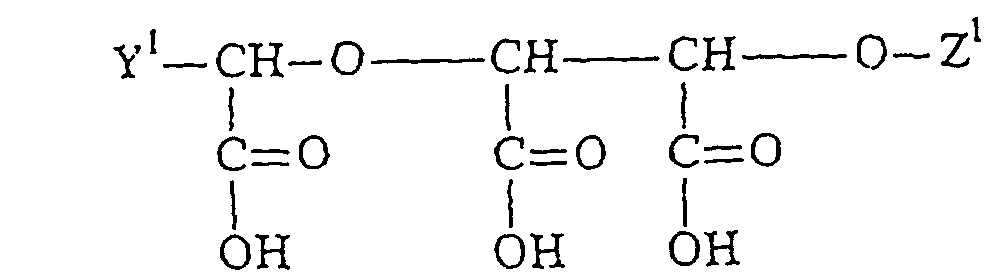
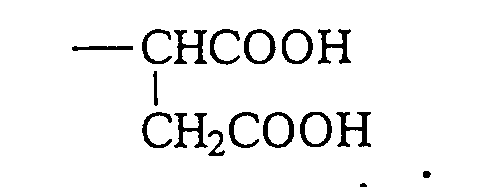
- the ether polycarboxylic acid group-containing chelating agent which can be used in the present invention may be compounds represented by the following formula and analogous compounds and salts (particularly, Na salt, etc.) thereof, for instance.
- the form of the plant-activating agent in the present invention may be any one of liquid, flowable, paste, wettable powder, granule, dust formulation and tablet.
- the agent is diluted with water to be used, the diluted one as an aqueous solution, aqueous dispersion or emulsion is generally sprayed onto phylloplanes or roots of plants in a concentration of the effective components of the plant-activating agent of 0.01 to 5000 ppm.
- the present invention provides a method of improving activity of a plant, comprising supplying the above-mentioned plant-activating agent of the present invention to the plant.
- the method of supplying the plant-activating agent in the present invention to a plant various techniques may be used.
- it includes a method of giving directly a dust formulation or a granule as a solid fertilizer such as a chemical fertilizer, a method of spraying a diluted aqueous solution directly on phylloplanes, stems or fruits of a plant, a method of injecting a diluted aqueous solution into soil, and a method of supplying to dilute and to mix into a liquid for hydroponics and a supplying water which are contacted with roots, such as hydroponics and a rock wool.
- a method of giving directly a dust formulation or a granule as a solid fertilizer such as a chemical fertilizer
- a method of spraying a diluted aqueous solution directly on phylloplanes, stems or fruits of a plant a method of injecting a diluted aqueous solution into soil
- Plants which can be treated with the plant-activating agent of the present invention, may be fruit vegetables such as a cucumber, a pumpkin, a watermelon-plant, a melon, a tomato, an eggplant, a green pepper, a strawberry, an okra, kidney beans in a pod, a broad bean, a pea, green soybeans in a pod and a corn; leaf vegetables such as a Chinese cabbage, greens for pickling, a Brassica campestris (a Chinese spinach-like green vegetable), a cabbage, a cauliflower, a broccoli, a Brussels sprout, an onion, a Welsh onion, a garlic, a scallion, a leek, an asparagus, a lettuce, a green for salad (which is called Saladana in Japan), a celery, a spinach, a crown daisy, a parsley, a trefoil (which is called Mitsuba in Japan and is useful as herb), a dropwort, an udo (which is an Aralia cordata),
- the activity of a plant can be efficiently improved without a chemical injury to the plant.
- the plant-activating agent can be used for various farm products.
- the present invention causes improvement seen in plant-growth, such as promotion of taking root of a plant, increase in weight, increase of SPAD value, increase of leaf-area, increase in concentration of ascorbic acid in the blade part and decrease in concentration of nitrate ion in the blade.
- the soil was permeated with the treated amount of about 50 ml per one pot.
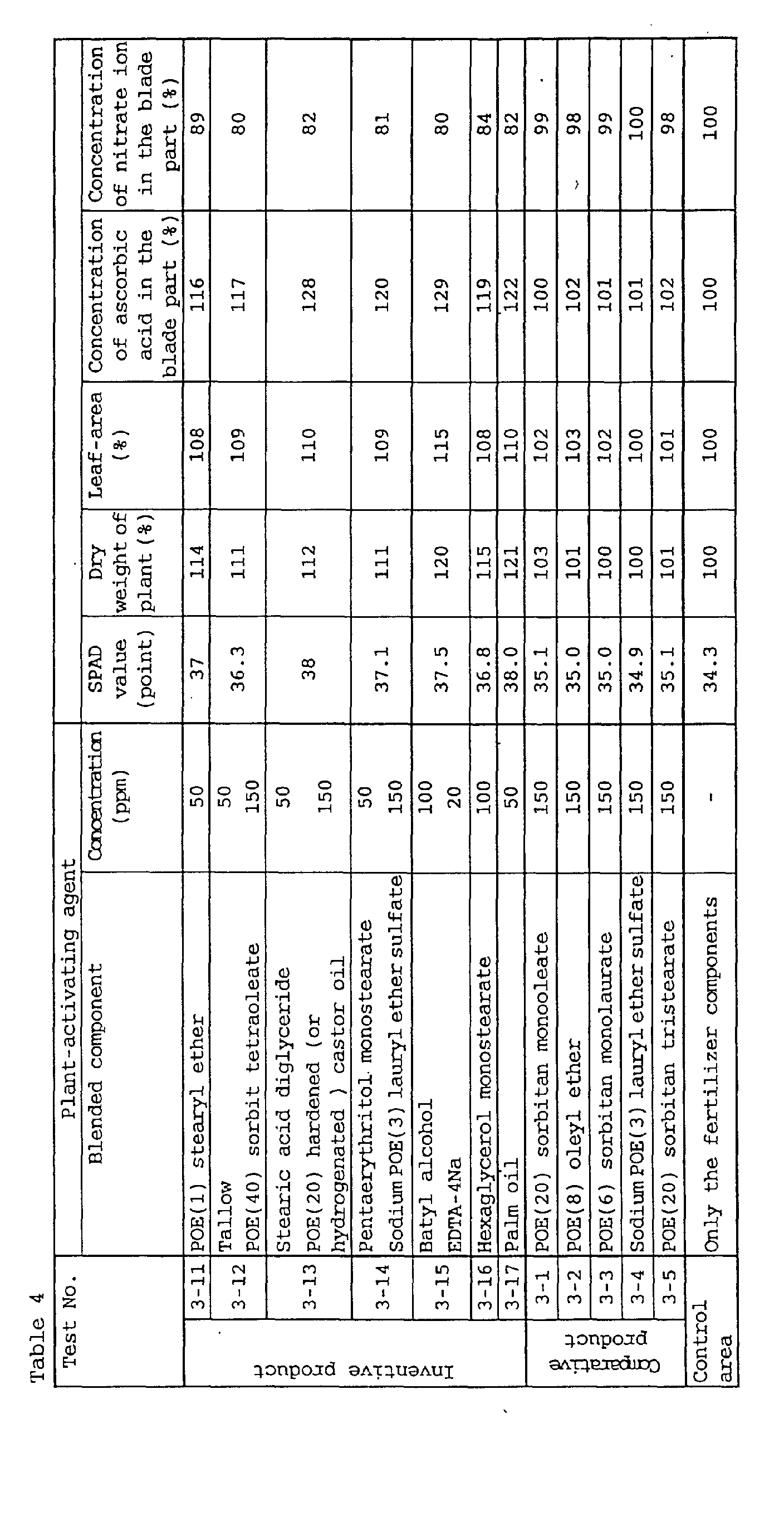
- the SPAD value, the improved degree of leaf-area, the increased amount in concentration of ascorbic acid in the blade part and the decreased degree in concentration of nitrate ion in the blade part were measured by the above-mentioned methods.
- plural individuals were prepared and three individuals selected arbitrarily were used for the measurement.
- the results are shown in Tables 3 and 4, and the SPAD value is an average value obtained respectively for the 3 individuals by 20-times measurements (data number: 60), and other values are an average value of the 3 individuals (data number: 3).
- POE is an abbreviation for polyoxyethylene, and the number in parentheses indicates an average number of moles added of ethylene oxide (this is the same hereinafter).
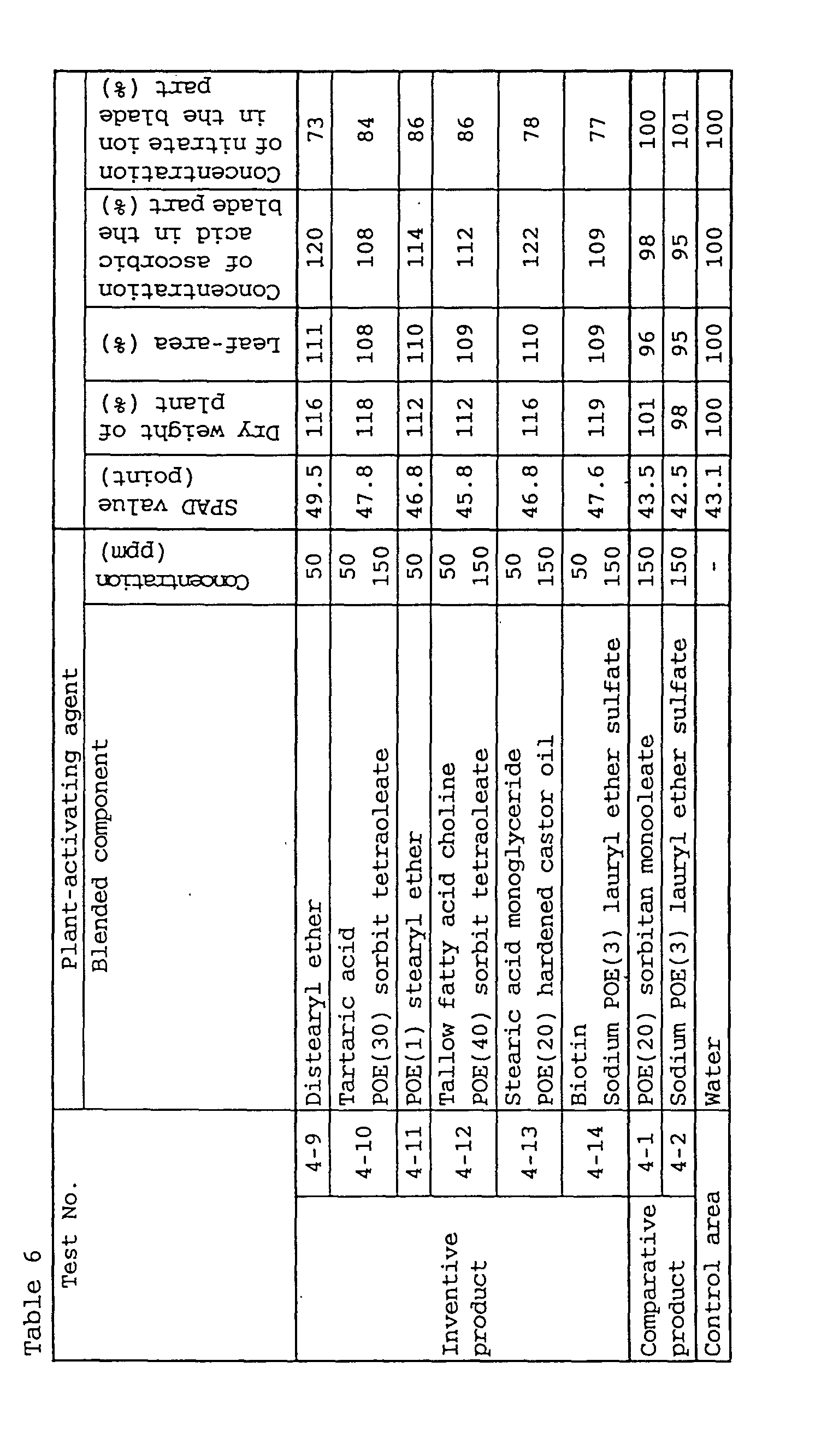
- Kureha Engei Baido was used in an amount of 1.3 L (1.5 kg) per one pot, and seeds were sown thereon. From 12 days after seeding, the treatments were initiated. With the plant-activating agents as shown in Tables 5 and 6, the soil was treated five times in total every week. The concentrations of the plant-activating agents are shown in Tables 5 and 6. The balance therein is water. The soil was permeated with the treated amount of about 150 ml per one pot.
- the SPAD value is an average value obtained respectively for the 3 individuals by 20-times measurements (data number: 60), and other values are an average value of the 3 individuals (data number: 3).
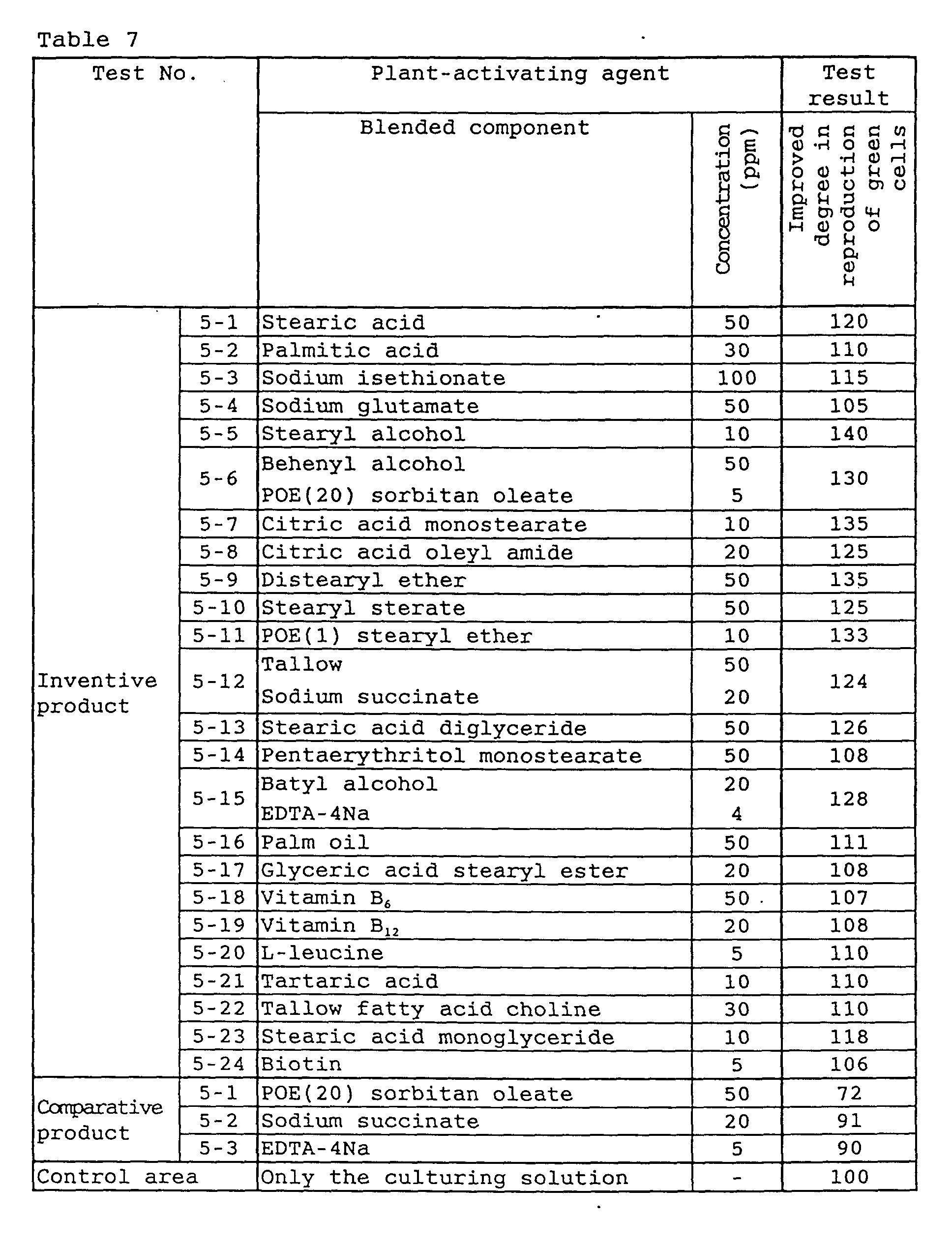
- the medium (MSK2 medium) for liverworts 100 ml of the medium (MSK2 medium) for liverworts were placed into a 500-ml Erlenmeyer flask, and the flask was capped with a silicon cap having its ventilative property and placed into an autoclave (at a high temperature, under a high pressure, and a sterilized oven) to sterilize the medium (for 20 minutes).
- the substance acting as the plant-activating agent was added in a concentration shown in Table 7 into a culturing solution in the test area. After sterilization, the temperature of the medium was returned to a normal temperature.
Landscapes
- Life Sciences & Earth Sciences (AREA)
- Pest Control & Pesticides (AREA)
- Dentistry (AREA)
- Plant Pathology (AREA)
- Health & Medical Sciences (AREA)
- Engineering & Computer Science (AREA)
- Agronomy & Crop Science (AREA)
- General Health & Medical Sciences (AREA)
- Wood Science & Technology (AREA)
- Zoology (AREA)
- Environmental Sciences (AREA)
- Chemical & Material Sciences (AREA)
- Organic Chemistry (AREA)
- Agricultural Chemicals And Associated Chemicals (AREA)
- Cultivation Of Plants (AREA)
Abstract
Description
Y=0.0996X-0.152
N:P:K=0.4:1.9:0.6 (g)/soil 1 kg) supplied by Kureha Chemical Industry Co., Ltd. is charged into a cell tray having 50 holes, seeds of tomato "Zuiken" are sown thereon, Kureha Engei Baido is covered thereon to form a thin layer, and the soil is irrigated sufficiently with water to cause germination. Two weeks after germination, seedlings of the tomato are transplanted to a 15-cm (diameter) pot charged with Kureha Engei Baido. The substance acting as the plant-activating agent diluted with a 3000-fold solution of "Otsuka OKF2" supplied by Otsuka Chemical K.K. (fertilizer components: N:P:K:Ca:Mg=14:8:16:6:2), so that a concentration thereof may be 50 ppm in terms of effective components, is allowed to permeate ( or penetrate) into the soil seven times every week from 7th day after transplantation (at the period for expansion of true leaves) in an amount of about 50 ml per one pot (test area). Further, there is prepared, as the control area, one treated in the same manner only by a 3000-fold solution of "Otsuka OKF2" supplied by Otsuka Chemical K.K. (control area). Third day after completion of the 7th treatment, the above-mentioned (a), (b), (c), (d) and (e) are measured. For both of the test area and control area, plural individuals are prepared and three individuals selected arbitrarily are respectively used, and the values of (a), (c), (d) and (e) are calculated using average values thereof. Further, for calculation of (b), other three individuals are used. Herein, the SPAD value is made as an average value obtained respectively by 20-times measurements (data number: 20) for each individual and other values are made respectively as an average value of three individuals (data number: 3).




Claims (7)
- A plant-activating agent comprising a substance having not less than 5% of an improved degree in reproduction of green cells calculated by the following formula:P0: Reproduction amount of green cells when the substance acting as the plant-activating agent is not used, andP1: Reproduction amount of green cells when the substance acting as the plant-activating agent is used.
- The plant-activating agent as claimed in the claim 1, satisfying at least one of the following (a), (b), (c), (d) and (e):(a) Improvement degree of the chlorophyll count value (SPAD value) is not less than 2 points,(b) Increased amount in weight of a plant (fresh weight or dry weight) is not less than 10%,(c) Improved degree in leaf-area of a plant is not less than 5%,(d) Increased amount in concentration of ascorbic acid in the blade part is not less than 5%, and(e) Decreased degree in concentration of nitrate ion in the blade part is not less than 10%.
- The plant-activating agent as claimed in the claim 1 or 2, wherein the above-mentioned substance has not less than 5% of a standard improved degree in reproduction of chlorella (whose measuring method is described in Description).
- The plant-activating agent as claimed in the claim 1 or 2, wherein the above-mentioned substance is at least one selected from the group consisting of (1) fatty acids or derivatives thereof, (2) organic acids or derivatives thereof, (3) lipids or derivatives thereof, (4) alcohols or derivatives thereof, (5) amines or derivatives thereof, (6) amino acids or derivatives thereof, (7) proteins or derivatives thereof, (8) nucleic acids or derivatives thereof, (9) terpenes or derivatives thereof, (A) natural extracts, (B) fermentation products, (C) fermentation residues and (I) vitamins.
- The plant-activating agent as claimed in the claim 1 or 2, further comprising at least one selected from surfactants and chelating agents.
- Use of the substance as defined in the claim 1 for a plant-activating agent.
- A method of activating a plant, which comprises applying the substance as defined in the claim 1 to the plant.
Applications Claiming Priority (2)
| Application Number | Priority Date | Filing Date | Title |
|---|---|---|---|
| JP2000131670 | 2000-04-28 | ||
| JP2000131670A JP2001316204A (en) | 2000-04-28 | 2000-04-28 | Plant vitalizer |
Publications (2)
| Publication Number | Publication Date |
|---|---|
| EP1151668A2 true EP1151668A2 (en) | 2001-11-07 |
| EP1151668A3 EP1151668A3 (en) | 2003-07-02 |
Family
ID=18640534
Family Applications (1)
| Application Number | Title | Priority Date | Filing Date |
|---|---|---|---|
| EP01110053A Withdrawn EP1151668A3 (en) | 2000-04-28 | 2001-04-27 | Plant-activating agent |
Country Status (3)
| Country | Link |
|---|---|
| US (1) | US6849576B2 (en) |
| EP (1) | EP1151668A3 (en) |
| JP (1) | JP2001316204A (en) |
Cited By (3)
| Publication number | Priority date | Publication date | Assignee | Title |
|---|---|---|---|---|
| EP1421849A4 (en) * | 2001-08-30 | 2004-11-10 | Kao Corp | Powdery plant vitalizers |
| EP1623624A3 (en) * | 2004-08-06 | 2011-07-27 | Kao Corporation | Method of cultivating potato in an increased yield |
| CN103113255A (en) * | 2013-02-25 | 2013-05-22 | 中国科学院华南植物园 | New plant defence inducer 2-[(6-ethyl-1-oxoindane-4-carbonyl)amio]-acetic acid methyl ester as well as preparation method and application thereof |
Families Citing this family (34)
| Publication number | Priority date | Publication date | Assignee | Title |
|---|---|---|---|---|
| GB9816784D0 (en) * | 1998-07-31 | 1998-09-30 | Allied Colloids Ltd | Soil treatment compositions and their use |
| EP1151667B1 (en) * | 2000-04-28 | 2005-06-29 | Kao Corporation | Plant-activating agent |
| NO312701B1 (en) * | 2000-07-28 | 2002-06-24 | Algea As | Agricultural chemical composition and method of treatment of plants thereby |
| SE521121C2 (en) * | 2001-03-19 | 2003-09-30 | Norogard Ab | Composition for resorption of micronutrients in plants and process for its preparation and use |
| JP4318906B2 (en) * | 2002-11-14 | 2009-08-26 | 花王株式会社 | Plant vital agent granule |
| JP2004315384A (en) * | 2003-04-14 | 2004-11-11 | Kyowa Hakko Kogyo Co Ltd | Whitening agent |
| RU2257711C2 (en) * | 2003-10-06 | 2005-08-10 | Всероссийский научно-исследовательский институт защиты растений | Chitosan-base composition reducing nitrate content in plant growing production |
| US20080044529A1 (en) * | 2004-01-15 | 2008-02-21 | Shigenobu Yamashita | Method of Preserving Ipomoea Aquatica, Method of Preserving Vegetables and Processed Food |
| DE102004009962A1 (en) * | 2004-03-01 | 2005-09-22 | Degussa Ag | Use of guanidine compounds as physiological restorative in the form of nutritional supplements, feed additives, in cosmetic preparations and as plant strengthening agents |
| JP4485304B2 (en) * | 2004-09-22 | 2010-06-23 | 株式会社 伊藤園 | Tea leaf contained amino acid enhancer, tea leaf cultivation method, tea leaf and tea extract |
| JP5153997B2 (en) * | 2005-02-02 | 2013-02-27 | 花王株式会社 | Plant vitality agent |
| RU2370957C1 (en) * | 2008-05-22 | 2009-10-27 | Сергей Ананьевич Тюрин | Preparation "bios" - stimulator of plants growing and developing |
| IT1391095B1 (en) * | 2008-08-04 | 2011-11-18 | Valagro Spa | A COMPOSITION FOR USE IN AGRICULTURE, METHOD FOR ITS PREPARATION AND ITS USE IN TREATMENT OF CROPS |
| JP2010067194A (en) * | 2008-09-12 | 2010-03-25 | Fujitsu Ltd | Electronic apparatus |
| EP2654433B1 (en) | 2010-12-21 | 2017-08-30 | Bayer Cropscience LP | Sandpaper mutants of bacillus and methods of their use to enhance plant growth, promote plant health and control diseases and pests |
| ES2361432B9 (en) | 2011-03-18 | 2012-04-24 | Biofungitek, Sociedad Limitada | PHYTOSANITARY COMPOSITION THAT INCLUDES ESSENTIAL OILS POTENTIATING THE ANTIFUNGICAL ACTIVITY. |
| US10820597B2 (en) | 2011-03-18 | 2020-11-03 | Biofungitek, S.L. | Phytosanitary composition comprising essential oils that potentiate antifungal activity |
| RU2611199C2 (en) | 2011-03-31 | 2017-02-21 | Новозаймз Байолоджикалз, Инк | Competitive and effective strains of bacteria |
| EP3058826A1 (en) | 2011-09-08 | 2016-08-24 | Novozymes BioAG A/S | Seed treatment methods and compositions |
| MX2014002890A (en) | 2011-09-12 | 2015-01-19 | Bayer Cropscience Lp | Methods of enhancing health and/or promoting growth of a plant and/or of improving fruit ripening. |
| PL2748123T3 (en) | 2011-09-14 | 2024-05-13 | Novozymes Bioag A/S | Use of lipochito-oligosaccharides and/or chito-oligosaccharides in combination with phosphate-solubilizing microorganisms for improving plant growth |
| AU2012312006B2 (en) | 2011-09-23 | 2015-10-29 | Novozymes Bioag A/S | Chitooligosaccharides and methods for use in enhancing corn growth |
| CA2849898C (en) | 2011-09-23 | 2020-10-27 | Novozymes Bioag A/S | Chitooligosaccharides and methods for use in enhancing plant growth |
| CA2849889C (en) | 2011-09-23 | 2020-01-07 | Novozymes Biologicals, Inc. | Combinations of lipo-chitooligosaccharides and methods for use in enhancing plant growth |
| CN105746517A (en) | 2011-09-23 | 2016-07-13 | 诺维信生物农业公司 | Chitooligosaccharides And Methods For Use In Enhancing Soybean Growth |
| AU2012351899B2 (en) | 2011-12-16 | 2015-04-23 | Novozymes Bioag A/S | Bradyrhizobium strains |
| JP5995357B2 (en) * | 2012-08-21 | 2016-09-21 | 有限会社長浜商店 | Plant nutrition |
| US9428425B2 (en) | 2012-09-20 | 2016-08-30 | Core Intellectual Properties Holdings, Llc | Methods and compositions for treating soil and plants |
| SI3148319T1 (en) * | 2014-05-29 | 2022-04-29 | Rockwool International A/S | Growth substrate product |
| JP6800834B2 (en) * | 2016-12-20 | 2020-12-16 | アース製薬株式会社 | Methods for increasing plant chlorophyll, methods for inhibiting pest colonization, and compositions applicable to these methods. |
| CN110519987A (en) | 2017-05-12 | 2019-11-29 | 马罗内生物创新公司 | The composite of octadecanol |
| CN110199854A (en) * | 2019-07-16 | 2019-09-06 | 上海市农业科学院 | A kind of identification method of Seedling Stage Salt Tolerance of Barley |
| JP2024018664A (en) * | 2022-07-29 | 2024-02-08 | イビデン株式会社 | plant activator |
| CN121248343A (en) * | 2025-10-20 | 2026-01-02 | 成都苏坤环保科技有限公司 | Organic water-soluble fertilizer using wood vinegar as raw material and preparation method thereof |
Family Cites Families (88)
| Publication number | Priority date | Publication date | Assignee | Title |
|---|---|---|---|---|
| JPS4935977B2 (en) * | 1972-02-03 | 1974-09-27 | ||
| JPS4885353A (en) * | 1972-02-28 | 1973-11-12 | ||
| WO1979000838A1 (en) * | 1978-03-28 | 1979-10-18 | Michael James Sampson | New plant technique |
| DE2936038A1 (en) | 1979-09-06 | 1981-03-26 | Bayer Ag, 51373 Leverkusen | METHOD FOR PRODUCING 1-AMINOCYCLOPROPANE-CARBONIC ACID AND THEIR DERIVATIVES |
| GB2118158B (en) * | 1982-03-03 | 1985-09-11 | Biochemical Marketing Corp | Plant growth stimulators comprising metal ions and long-chain alkyl carboxylic acids and salts and derivatives thereof |
| DE3234610A1 (en) | 1982-09-16 | 1984-03-22 | Schering AG, 1000 Berlin und 4709 Bergkamen | Benzyl ether derivatives of glycerol, processes for the preparation of these compounds, and plant-growth-regulating agents containing them |
| US4481202A (en) | 1982-12-27 | 1984-11-06 | Merek & Co., Inc. | 2-Amino-3-carboxylate-5-halo-6-(substituted)pyrazine antimicrobial compounds |
| US4863506A (en) | 1983-07-06 | 1989-09-05 | Union Oil Company Of California | Methods for regulating the growth of plants and growth regulant compositions |
| JPS6072802A (en) * | 1983-09-29 | 1985-04-24 | Tomoe Kagaku Kogyo Kk | Platen growth regulating agent |
| JPS60149510A (en) * | 1984-01-13 | 1985-08-07 | Kao Corp | Agent for promoting activity of biocide |
| GB8412049D0 (en) | 1984-05-11 | 1984-06-20 | Unilever Plc | Treatment |
| JPS611602A (en) | 1984-06-12 | 1986-01-07 | Kanesho Kk | Plant growth regulator |
| JPS61183202A (en) | 1985-02-12 | 1986-08-15 | Ichiro Yamashita | Production of agent effective to control blight and vermin of agricultural crop and harmless to man and animal |
| JPS61215305A (en) * | 1985-03-20 | 1986-09-25 | Tomoe Kagaku Kogyo Kk | Plant growth regulator |
| US4818274A (en) | 1985-12-23 | 1989-04-04 | Wake Forest University | Method and composition for regulating the flowering of plants |
| JPS62230707A (en) * | 1986-03-31 | 1987-10-09 | Toshio Yamada | Plant activation agent |
| JPS6345211A (en) * | 1986-04-21 | 1988-02-26 | Sanyo Kokusaku Pulp Co Ltd | Method for increasing yield of rice, fruit and vegetable, edible root, flower and ornamental plant, fruit tree, or the like |
| JPS6333310A (en) * | 1986-07-29 | 1988-02-13 | Ihara Chem Ind Co Ltd | plant growth promoter |
| US4813997B1 (en) * | 1987-04-06 | 1995-07-18 | Cpc International Inc | Method for regulating plant growth |
| DE3724595A1 (en) * | 1987-07-24 | 1989-02-02 | Cham Biotechnik Btc | Process for improving the photosynthesis rate of plants and their defence mechanism against parasites of weak plants |
| JPH01305004A (en) * | 1988-06-01 | 1989-12-08 | Meiji Seika Kaisha Ltd | Culture of plant |
| JPH0651610B2 (en) * | 1988-07-15 | 1994-07-06 | 中外製薬株式会社 | Plant growth promoter |
| US5549729A (en) * | 1988-09-09 | 1996-08-27 | Yamashita; Thomas T. | Method and composition for promoting and controlling growth of plants |
| JPH0297341A (en) * | 1988-10-01 | 1990-04-09 | Mitsui Petrochem Ind Ltd | Multiplication of plant body and seedling |
| JPH0297340A (en) * | 1988-10-01 | 1990-04-09 | Mitsui Petrochem Ind Ltd | Multiplication of plant body and seedling |
| JPH02178203A (en) * | 1988-12-28 | 1990-07-11 | Hokko Chem Ind Co Ltd | Yield increase agent for crops and yield increase |
| JP2725361B2 (en) * | 1989-03-29 | 1998-03-11 | 三菱瓦斯化学株式会社 | Rooting promoter composition |
| JPH03218302A (en) * | 1989-11-22 | 1991-09-25 | Nippon Shokubai Kagaku Kogyo Co Ltd | Reproducing agent for seaweeds |
| JPH0446104A (en) * | 1990-06-12 | 1992-02-17 | Kankyo Riyokuka Shigen Kaihatsu Center:Kk | Plant growth promoter |
| JP2980346B2 (en) * | 1990-06-14 | 1999-11-22 | トモエ化学工業株式会社 | Method for reducing phytotoxicity of agricultural and horticultural crops with growth activators and herbicides |
| IT1249004B (en) * | 1990-06-27 | 1995-02-11 | Stoppani Luigi Spa | METHOD AND COMPOSITION FOR STIMULATION OF VEGETABLE GROWTH |
| JPH0678210B2 (en) * | 1990-10-04 | 1994-10-05 | 隆介 飯島 | Plant activator |
| JP2613136B2 (en) * | 1991-05-14 | 1997-05-21 | 株式会社コスモ総合研究所 | Plant growth promoter |
| JP3078893B2 (en) * | 1991-08-30 | 2000-08-21 | 中島 滋江 | Plant growth promotion, freshness maintenance agent |
| JPH0751489B2 (en) * | 1992-02-07 | 1995-06-05 | 株式会社ビー・エヌ有機農法研究所 | Agrochemical composition consisting of natural products |
| UA41324C2 (en) * | 1992-06-19 | 2001-09-17 | Артур М. Нономура | method for the improvement of plants growth (variants), composition improving plants growth (variants) |
| US5846908A (en) | 1992-06-19 | 1998-12-08 | Nonomura; Arthur M. | Methods and compositions for enhancing plant growth with p-amino- or p-nitro-benzoic acids |
| US6020288A (en) | 1992-06-19 | 2000-02-01 | Nonomura; Arthur M. | Methods and compositions for enhancing cytochrome P450 in plants |
| JP3210750B2 (en) * | 1992-11-27 | 2001-09-17 | 中外製薬株式会社 | Plant growth regulator |
| US5391542A (en) | 1993-06-10 | 1995-02-21 | Browning; Henry A. | Method of enhancing the growth of plants using alkyloxypolyethyleneoxyethanols |
| JP2887555B2 (en) * | 1993-08-19 | 1999-04-26 | 株式会社コスモ総合研究所 | Nitrate nitrogen content reducing agent for plants |
| CN1170338A (en) | 1994-11-15 | 1998-01-14 | Ab托尔控股有限公司 | Osmoregulator |
| JPH08143406A (en) * | 1994-11-16 | 1996-06-04 | Ikeda Shokken Kk | Plant growth promoter |
| JP3377873B2 (en) * | 1994-12-05 | 2003-02-17 | 三井化学株式会社 | How to increase the drought or salt tolerance of plants |
| DE4445546A1 (en) | 1994-12-20 | 1996-06-27 | Bayer Ag | Use of lauric acid esters as substances that increase activity |
| EP0718405B1 (en) | 1994-12-20 | 2002-10-02 | Cosmo Research Institute | 5-Aminolevulinic acid producing microorganism |
| WO1996028026A1 (en) | 1995-03-15 | 1996-09-19 | Consejo Superior Investigaciones Cientificas | Utilization of compositions which contain menadione for the biostimulation of plant metabolism in order to induce their resistance to pathogens and pests and/or accelerate their blooming |
| AU3673495A (en) * | 1995-04-12 | 1996-10-30 | Kyowa Hakko Kogyo Co. Ltd. | Plant cell growth factor |
| AUPN309995A0 (en) * | 1995-05-23 | 1995-06-15 | Sst Australia Pty Ltd | Plant growth regulating method and composition |
| FI98513C (en) | 1995-06-09 | 1997-07-10 | Cultor Oy | Improving crop yield in plants |
| FI98514C (en) | 1995-06-09 | 1997-07-10 | Cultor Oy | Improving crop yield in plants |
| FI98512C (en) | 1995-06-09 | 1997-07-10 | Cultor Oy | Improving crop yield in plants |
| NL1001620C2 (en) * | 1995-06-22 | 1996-12-24 | Instituut Voor Agrobiologisch | Improvement in activity of plant growth regulators |
| RU2101953C1 (en) | 1995-08-14 | 1998-01-20 | Иркутская государственная сельскохозяйственная академия | Agent for presowing seed treatment |
| EP0863703A1 (en) | 1995-09-07 | 1998-09-16 | Cultor Oy | Improving the yield of plants |
| JPH0995407A (en) * | 1995-10-02 | 1997-04-08 | Kurorera Kogyo Kk | Growth promoting substance |
| JP3725923B2 (en) * | 1995-11-20 | 2005-12-14 | 焼津水産化学工業株式会社 | Plant vitality agent |
| JPH08225408A (en) * | 1995-12-26 | 1996-09-03 | Cosmo Sogo Kenkyusho:Kk | Method for improving chlorophyll content in plants |
| ATE241903T1 (en) | 1996-03-04 | 2003-06-15 | Shiseido Co Ltd | TRIGGER FOR BLOOD USE |
| JP2986015B2 (en) * | 1996-05-20 | 1999-12-06 | 株式会社 伊藤園 | Method for maintaining greenness of perennial plants that dormantly fade in winter, greenness-maintaining agent, and method for promoting greenness recovery |
| CN1177582A (en) | 1996-09-25 | 1998-04-01 | 李维清 | Concentrated toxicity-free compound fertilizer |
| CA2209591A1 (en) | 1997-07-03 | 1999-01-03 | Universite Du Quebec A Montreal | Methods for improving cold or freezing tolerance, reducing the growth rate, or inhibiting the growth of plants, and for improving the germination rate of plant seeds |
| US6169057B1 (en) | 1997-09-04 | 2001-01-02 | The Regents Of The University Of California | Use of tryptophan and analogs as plant growth regulators |
| JPH11106276A (en) * | 1997-09-30 | 1999-04-20 | Planning Shizuoka:Kk | Useful composition comprising fermented product of soybean |
| JP3493392B2 (en) * | 1998-03-20 | 2004-02-03 | 大日精化工業株式会社 | Plant growing agent |
| WO1999063819A1 (en) | 1998-06-08 | 1999-12-16 | Donlar Corporation | Plants grown utilizing poly (organic acid) as a nutrient absorption enhancer |
| EP1094708B1 (en) | 1998-07-07 | 2003-06-04 | Basf Aktiengesellschaft | Plant growth regulating formulations |
| FR2780972A1 (en) | 1998-07-08 | 2000-01-14 | Besnard Olivier | New 4-alkyl-gamma-lactone derivatives that stimulate plant growth and defense and have antifungal activity against pathogenic fungi |
| AU4903599A (en) | 1998-07-10 | 2000-02-01 | Cognis Deutschland Gmbh | Plant growth enhancement against phytopathogenic fungi and/or soil borne pests |
| JP2000159591A (en) | 1998-09-21 | 2000-06-13 | Masahiro Nagahama | Fertilizer composition containing vitamins, sulfur- containing amino acid and saccharide as organic substances |
| US6124241A (en) | 1998-10-29 | 2000-09-26 | Auxien Corporation | Method for increasing plant productivity using glutamic acid and glycolic acid |
| US6331505B1 (en) | 1998-10-29 | 2001-12-18 | Emerald Bioagriculture Corporation | Method for increasing plant productivity using glutamic acid and glycolic acid |
| MY123201A (en) * | 1998-11-06 | 2006-05-31 | Kao Corp | Plant-activating agent |
| JP3545661B2 (en) * | 1998-11-06 | 2004-07-21 | 花王株式会社 | Plant vitalizer |
| FR2789550B1 (en) | 1999-02-15 | 2003-04-11 | Goemar Lab Sa | PROCESS FOR INCREASING YIELD OF CROPS OF AGRONOMIC PLANTS BY STIMULATION OF GERMINATION OF POLLEN GRAINS |
| US6241795B1 (en) | 1999-04-16 | 2001-06-05 | Miller Chemical And Fertilizer Corporation | Soluble fertilizer formulation |
| EP1046625A2 (en) | 1999-04-22 | 2000-10-25 | Arconia GmbH | Non-toxic biological composition for promoting growth and strengthening of plants and process for treating plant substrates |
| JP2001026505A (en) | 1999-07-12 | 2001-01-30 | Sana:Kk | Plant growing agent and method for promoting plant growth |
| JP2001058910A (en) | 1999-08-20 | 2001-03-06 | Tsunetaka Yokoyama | Use of sildenafil citrate as plant growth regulator |
| AU2001236906A1 (en) | 2000-02-11 | 2001-08-20 | The Ohio State University Research Foundation | Methods of inducing production of isoflavones in plants using nuclear receptor ligands |
| DE10190743D2 (en) | 2000-02-28 | 2003-05-15 | Miklos Ghyczy | Composition for use in plants |
| JP3805599B2 (en) * | 2000-04-10 | 2006-08-02 | 花王株式会社 | Plant vitality agent |
| JP2001288011A (en) * | 2000-04-10 | 2001-10-16 | Kao Corp | Plant vitalizer |
| JP3768380B2 (en) * | 2000-04-28 | 2006-04-19 | 花王株式会社 | Plant vitality agent |
| JP3768379B2 (en) * | 2000-04-28 | 2006-04-19 | 花王株式会社 | Plant vitality agent |
| JP3768378B2 (en) * | 2000-04-28 | 2006-04-19 | 花王株式会社 | Plant vitality agent |
| EP1351922A2 (en) | 2001-01-16 | 2003-10-15 | Max-Planck-Gesellschaft zur Förderung der Wissenschaften e.V. | 6-substituted indanoyl amino acid conjugates as mimics to the biological activity of coronatine |
| WO2007018405A1 (en) | 2005-08-10 | 2007-02-15 | Recotech Co. Ltd. | Receiving device structure for receiving computer peripherals and computer main body |
-
2000
- 2000-04-28 JP JP2000131670A patent/JP2001316204A/en active Pending
-
2001
- 2001-04-27 EP EP01110053A patent/EP1151668A3/en not_active Withdrawn
- 2001-04-27 US US09/842,770 patent/US6849576B2/en not_active Expired - Lifetime
Cited By (4)
| Publication number | Priority date | Publication date | Assignee | Title |
|---|---|---|---|---|
| EP1421849A4 (en) * | 2001-08-30 | 2004-11-10 | Kao Corp | Powdery plant vitalizers |
| US7820593B2 (en) | 2001-08-30 | 2010-10-26 | Kao Corporation | Powdery plant vitalizers |
| EP1623624A3 (en) * | 2004-08-06 | 2011-07-27 | Kao Corporation | Method of cultivating potato in an increased yield |
| CN103113255A (en) * | 2013-02-25 | 2013-05-22 | 中国科学院华南植物园 | New plant defence inducer 2-[(6-ethyl-1-oxoindane-4-carbonyl)amio]-acetic acid methyl ester as well as preparation method and application thereof |
Also Published As
| Publication number | Publication date |
|---|---|
| EP1151668A3 (en) | 2003-07-02 |
| JP2001316204A (en) | 2001-11-13 |
| US20020006872A1 (en) | 2002-01-17 |
| US6849576B2 (en) | 2005-02-01 |
Similar Documents
| Publication | Publication Date | Title |
|---|---|---|
| US6849576B2 (en) | Plant-activating agent | |
| JP2001288011A (en) | Plant vitalizer | |
| JP7541146B2 (en) | Formulations and methods for treating photosynthetic organisms with glycan composite formulations to enhance crop quality and quantity | |
| US20080139391A1 (en) | Plant-Activating Agent | |
| KR100665875B1 (en) | Plant vitality | |
| US20250136524A1 (en) | Method of using/applying a keratin hydrolysis peptide solution to improve the fertilizer usage efficiency in wheat plants | |
| JP3805599B2 (en) | Plant vitality agent | |
| JP2002058342A (en) | Plant vitalizer | |
| EP1911349A2 (en) | Methods for improvement of farm products | |
| CN104381256B (en) | A reagent for attracting flower thrips | |
| US20250275538A1 (en) | Compositions containing l-carnitine and seaweed extract for mitigating abiotic stress in plants | |
| WO2023210780A1 (en) | Plant growth promoter | |
| EP4573904A1 (en) | Biostimulant composition and methods of use | |
| JP5153997B2 (en) | Plant vitality agent | |
| CN108863580A (en) | A kind of foliar fertilizer and application method containing L-Glutimic acid | |
| Konishi et al. | Promotion of tea pollen tube growth by incubated solution of rapeseed cakes | |
| CA2263852A1 (en) | Organic liquid nutrition source for plants and manufacturing method for same | |
| WO2025094250A1 (en) | Plant growth promoter | |
| Le Gall et al. | Sunflower Associated With Legumes-Based Cover Crop: A Way To Increase Nitrogen Availability For The Following Winter Wheat? | |
| JP2025010038A (en) | Plant growth promoter composition contained in a container and container containing the same | |
| RU2337547C1 (en) | Herbicidal compound and weed vegetation control method | |
| CN121969237A (en) | Biostimulant compositions and methods of use | |
| CN119453244A (en) | Application of orange peel extract in promoting plant growth | |
| CN121218874A (en) | Environmental stress tolerance enhancer | |
| CN111213656A (en) | Aqueous emulsion composition containing amino-oligosaccharin and preparation method thereof |
Legal Events
| Date | Code | Title | Description |
|---|---|---|---|
| PUAI | Public reference made under article 153(3) epc to a published international application that has entered the european phase |
Free format text: ORIGINAL CODE: 0009012 |
|
| AK | Designated contracting states |
Kind code of ref document: A2 Designated state(s): AT BE CH CY DE DK ES FI FR GB GR IE IT LI LU MC NL PT SE TR |
|
| AX | Request for extension of the european patent |
Free format text: AL;LT;LV;MK;RO;SI |
|
| PUAL | Search report despatched |
Free format text: ORIGINAL CODE: 0009013 |
|
| AK | Designated contracting states |
Designated state(s): AT BE CH CY DE DK ES FI FR GB GR IE IT LI LU MC NL PT SE TR |
|
| AX | Request for extension of the european patent |
Extension state: AL LT LV MK RO SI |
|
| 17P | Request for examination filed |
Effective date: 20031230 |
|
| AKX | Designation fees paid |
Designated state(s): DE ES FR GB IT NL |
|
| 17Q | First examination report despatched |
Effective date: 20050510 |
|
| STAA | Information on the status of an ep patent application or granted ep patent |
Free format text: STATUS: THE APPLICATION HAS BEEN WITHDRAWN |
|
| 18W | Application withdrawn |
Effective date: 20080415 |