EP1151090B1 - Multiple enzyme assays - Google Patents
Multiple enzyme assays Download PDFInfo
- Publication number
- EP1151090B1 EP1151090B1 EP99965243A EP99965243A EP1151090B1 EP 1151090 B1 EP1151090 B1 EP 1151090B1 EP 99965243 A EP99965243 A EP 99965243A EP 99965243 A EP99965243 A EP 99965243A EP 1151090 B1 EP1151090 B1 EP 1151090B1
- Authority
- EP
- European Patent Office
- Prior art keywords
- enzyme
- assay
- reporter
- substrate
- activity
- Prior art date
- Legal status (The legal status is an assumption and is not a legal conclusion. Google has not performed a legal analysis and makes no representation as to the accuracy of the status listed.)
- Expired - Lifetime
Links
- 238000001952 enzyme assay Methods 0.000 title abstract description 17
- 102000004190 Enzymes Human genes 0.000 claims abstract description 461
- 108090000790 Enzymes Proteins 0.000 claims abstract description 461
- 239000000758 substrate Substances 0.000 claims abstract description 186
- 230000000694 effects Effects 0.000 claims abstract description 125
- 238000001514 detection method Methods 0.000 claims abstract description 34
- 230000015556 catabolic process Effects 0.000 claims abstract description 33
- 238000006731 degradation reaction Methods 0.000 claims abstract description 32
- 239000000284 extract Substances 0.000 claims abstract description 29
- 238000011002 quantification Methods 0.000 claims abstract description 25
- 238000003556 assay Methods 0.000 claims description 125
- 210000004027 cell Anatomy 0.000 claims description 74
- BVTJGGGYKAMDBN-UHFFFAOYSA-N Dioxetane Chemical compound C1COO1 BVTJGGGYKAMDBN-UHFFFAOYSA-N 0.000 claims description 64
- -1 poly(benzyldimethylvinylbenzyl) Polymers 0.000 claims description 63
- 102000002260 Alkaline Phosphatase Human genes 0.000 claims description 55
- 108020004774 Alkaline Phosphatase Proteins 0.000 claims description 55
- 108060001084 Luciferase Proteins 0.000 claims description 52
- 239000005089 Luciferase Substances 0.000 claims description 52
- 239000003623 enhancer Substances 0.000 claims description 52
- 108010005774 beta-Galactosidase Proteins 0.000 claims description 38
- 102000005936 beta-Galactosidase Human genes 0.000 claims description 30
- NLXLAEXVIDQMFP-UHFFFAOYSA-N Ammonia chloride Chemical compound [NH4+].[Cl-] NLXLAEXVIDQMFP-UHFFFAOYSA-N 0.000 claims description 29
- 230000003247 decreasing effect Effects 0.000 claims description 21
- 238000006243 chemical reaction Methods 0.000 claims description 17
- 125000004432 carbon atom Chemical group C* 0.000 claims description 14
- 108010060309 Glucuronidase Proteins 0.000 claims description 13
- 102000053187 Glucuronidase Human genes 0.000 claims description 13
- 235000019270 ammonium chloride Nutrition 0.000 claims description 13
- 150000003839 salts Chemical class 0.000 claims description 13
- 239000000126 substance Substances 0.000 claims description 13
- 239000000872 buffer Substances 0.000 claims description 12
- 230000001965 increasing effect Effects 0.000 claims description 12
- 125000003118 aryl group Chemical group 0.000 claims description 11
- 125000000217 alkyl group Chemical group 0.000 claims description 10
- 108010051457 Acid Phosphatase Proteins 0.000 claims description 9
- 102000013563 Acid Phosphatase Human genes 0.000 claims description 9
- 229920000642 polymer Polymers 0.000 claims description 9
- 102000004366 Glucosidases Human genes 0.000 claims description 8
- 108010056771 Glucosidases Proteins 0.000 claims description 8
- 108091005804 Peptidases Proteins 0.000 claims description 8
- NJDNXYGOVLYJHP-UHFFFAOYSA-L disodium;2-(3-oxido-6-oxoxanthen-9-yl)benzoate Chemical compound [Na+].[Na+].[O-]C(=O)C1=CC=CC=C1C1=C2C=CC(=O)C=C2OC2=CC([O-])=CC=C21 NJDNXYGOVLYJHP-UHFFFAOYSA-L 0.000 claims description 8
- 239000001963 growth medium Substances 0.000 claims description 8
- 230000003301 hydrolyzing effect Effects 0.000 claims description 8
- GZCWLCBFPRFLKL-UHFFFAOYSA-N 1-prop-2-ynoxypropan-2-ol Chemical compound CC(O)COCC#C GZCWLCBFPRFLKL-UHFFFAOYSA-N 0.000 claims description 7
- 102000013392 Carboxylesterase Human genes 0.000 claims description 7
- 108010051152 Carboxylesterase Proteins 0.000 claims description 7
- 102000002464 Galactosidases Human genes 0.000 claims description 7
- 108010093031 Galactosidases Proteins 0.000 claims description 7
- 239000004365 Protease Substances 0.000 claims description 7
- 108091003079 Bovine Serum Albumin Proteins 0.000 claims description 6
- 108090000371 Esterases Proteins 0.000 claims description 6
- 108091006905 Human Serum Albumin Proteins 0.000 claims description 6
- 102000008100 Human Serum Albumin Human genes 0.000 claims description 6
- 102000035195 Peptidases Human genes 0.000 claims description 6
- 229940098773 bovine serum albumin Drugs 0.000 claims description 6
- 230000002255 enzymatic effect Effects 0.000 claims description 6
- 229910052739 hydrogen Inorganic materials 0.000 claims description 6
- 239000001257 hydrogen Substances 0.000 claims description 6
- 125000003710 aryl alkyl group Chemical group 0.000 claims description 5
- 230000001580 bacterial effect Effects 0.000 claims description 4
- CADWTSSKOVRVJC-UHFFFAOYSA-N benzyl(dimethyl)azanium;chloride Chemical compound [Cl-].C[NH+](C)CC1=CC=CC=C1 CADWTSSKOVRVJC-UHFFFAOYSA-N 0.000 claims description 4
- USJRLGNYCQWLPF-UHFFFAOYSA-N chlorophosphane Chemical compound ClP USJRLGNYCQWLPF-UHFFFAOYSA-N 0.000 claims description 4
- 125000004404 heteroalkyl group Chemical group 0.000 claims description 4
- 230000000415 inactivating effect Effects 0.000 claims description 4
- 125000002877 alkyl aryl group Chemical group 0.000 claims description 3
- 125000000753 cycloalkyl group Chemical group 0.000 claims description 3
- 125000004435 hydrogen atom Chemical group [H]* 0.000 claims description 3
- 239000003112 inhibitor Substances 0.000 claims description 3
- 125000005592 polycycloalkyl group Chemical group 0.000 claims description 3
- 229920002554 vinyl polymer Polymers 0.000 claims description 3
- 210000005253 yeast cell Anatomy 0.000 claims description 3
- QLULGSLAHXLKSR-UHFFFAOYSA-N azane;phosphane Chemical group N.P QLULGSLAHXLKSR-UHFFFAOYSA-N 0.000 claims description 2
- 125000001072 heteroaryl group Chemical group 0.000 claims description 2
- 125000002887 hydroxy group Chemical group [H]O* 0.000 claims description 2
- OTYNBGDFCPCPOU-UHFFFAOYSA-N phosphane sulfane Chemical compound S.P[H] OTYNBGDFCPCPOU-UHFFFAOYSA-N 0.000 claims description 2
- 125000003003 spiro group Chemical group 0.000 claims description 2
- FZVBSYTWAMIINE-UHFFFAOYSA-M tributylsulfanium;chloride Chemical compound [Cl-].CCCC[S+](CCCC)CCCC FZVBSYTWAMIINE-UHFFFAOYSA-M 0.000 claims description 2
- 239000013592 cell lysate Substances 0.000 claims 1
- KLBOFRLEHJAXIU-UHFFFAOYSA-N tributylazanium;chloride Chemical compound Cl.CCCCN(CCCC)CCCC KLBOFRLEHJAXIU-UHFFFAOYSA-N 0.000 claims 1
- 238000000034 method Methods 0.000 abstract description 45
- 238000005259 measurement Methods 0.000 description 24
- 108700008625 Reporter Genes Proteins 0.000 description 22
- 239000000243 solution Substances 0.000 description 22
- UKWLRLAKGMZXJC-QIECWBMSSA-L disodium;[4-chloro-3-[(3r,5s)-1-chloro-3'-methoxyspiro[adamantane-4,4'-dioxetane]-3'-yl]phenyl] phosphate Chemical compound [Na+].[Na+].O1OC2([C@@H]3CC4C[C@H]2CC(Cl)(C4)C3)C1(OC)C1=CC(OP([O-])([O-])=O)=CC=C1Cl UKWLRLAKGMZXJC-QIECWBMSSA-L 0.000 description 16
- 108090000623 proteins and genes Proteins 0.000 description 15
- 102000006995 beta-Glucosidase Human genes 0.000 description 14
- 108010047754 beta-Glucosidase Proteins 0.000 description 14
- 239000003153 chemical reaction reagent Substances 0.000 description 14
- 230000009977 dual effect Effects 0.000 description 14
- 238000000354 decomposition reaction Methods 0.000 description 13
- XLYOFNOQVPJJNP-UHFFFAOYSA-N water Substances O XLYOFNOQVPJJNP-UHFFFAOYSA-N 0.000 description 13
- 239000000047 product Substances 0.000 description 12
- 102100024321 Alkaline phosphatase, placental type Human genes 0.000 description 11
- IGXWBGJHJZYPQS-SSDOTTSWSA-N D-Luciferin Chemical compound OC(=O)[C@H]1CSC(C=2SC3=CC=C(O)C=C3N=2)=N1 IGXWBGJHJZYPQS-SSDOTTSWSA-N 0.000 description 11
- CYCGRDQQIOGCKX-UHFFFAOYSA-N Dehydro-luciferin Natural products OC(=O)C1=CSC(C=2SC3=CC(O)=CC=C3N=2)=N1 CYCGRDQQIOGCKX-UHFFFAOYSA-N 0.000 description 11
- BJGNCJDXODQBOB-UHFFFAOYSA-N Fivefly Luciferin Natural products OC(=O)C1CSC(C=2SC3=CC(O)=CC=C3N=2)=N1 BJGNCJDXODQBOB-UHFFFAOYSA-N 0.000 description 11
- DDWFXDSYGUXRAY-UHFFFAOYSA-N Luciferin Natural products CCc1c(C)c(CC2NC(=O)C(=C2C=C)C)[nH]c1Cc3[nH]c4C(=C5/NC(CC(=O)O)C(C)C5CC(=O)O)CC(=O)c4c3C DDWFXDSYGUXRAY-UHFFFAOYSA-N 0.000 description 11
- 108010031345 placental alkaline phosphatase Proteins 0.000 description 11
- 230000014509 gene expression Effects 0.000 description 10
- 238000011534 incubation Methods 0.000 description 10
- QXNVGIXVLWOKEQ-UHFFFAOYSA-N Disodium Chemical class [Na][Na] QXNVGIXVLWOKEQ-UHFFFAOYSA-N 0.000 description 9
- 230000004663 cell proliferation Effects 0.000 description 9
- 150000001875 compounds Chemical class 0.000 description 9
- 230000003013 cytotoxicity Effects 0.000 description 9
- 231100000135 cytotoxicity Toxicity 0.000 description 9
- DIOQZVSQGTUSAI-UHFFFAOYSA-N decane Chemical compound CCCCCCCCCC DIOQZVSQGTUSAI-UHFFFAOYSA-N 0.000 description 9
- 125000001424 substituent group Chemical group 0.000 description 9
- WQZGKKKJIJFFOK-FPRJBGLDSA-N beta-D-galactose Chemical compound OC[C@H]1O[C@@H](O)[C@H](O)[C@@H](O)[C@H]1O WQZGKKKJIJFFOK-FPRJBGLDSA-N 0.000 description 8
- 238000004519 manufacturing process Methods 0.000 description 8
- 230000001105 regulatory effect Effects 0.000 description 8
- 238000003571 reporter gene assay Methods 0.000 description 8
- 210000002966 serum Anatomy 0.000 description 8
- 239000006144 Dulbecco’s modified Eagle's medium Substances 0.000 description 7
- 230000001413 cellular effect Effects 0.000 description 7
- 102000004169 proteins and genes Human genes 0.000 description 7
- 230000035945 sensitivity Effects 0.000 description 7
- 238000012360 testing method Methods 0.000 description 7
- 239000013504 Triton X-100 Substances 0.000 description 6
- 229920004890 Triton X-100 Polymers 0.000 description 6
- 238000010606 normalization Methods 0.000 description 6
- 229910052760 oxygen Inorganic materials 0.000 description 6
- 239000013612 plasmid Substances 0.000 description 6
- 210000001519 tissue Anatomy 0.000 description 6
- 230000017455 cell-cell adhesion Effects 0.000 description 5
- 238000006911 enzymatic reaction Methods 0.000 description 5
- 239000000203 mixture Substances 0.000 description 5
- 229910052757 nitrogen Inorganic materials 0.000 description 5
- 239000001301 oxygen Substances 0.000 description 5
- 125000001997 phenyl group Chemical group [H]C1=C([H])C([H])=C(*)C([H])=C1[H] 0.000 description 5
- 239000011535 reaction buffer Substances 0.000 description 5
- 229910052717 sulfur Inorganic materials 0.000 description 5
- IJGRMHOSHXDMSA-UHFFFAOYSA-N Atomic nitrogen Chemical compound N#N IJGRMHOSHXDMSA-UHFFFAOYSA-N 0.000 description 4
- 241000819038 Chichester Species 0.000 description 4
- VEXZGXHMUGYJMC-UHFFFAOYSA-M Chloride anion Chemical compound [Cl-] VEXZGXHMUGYJMC-UHFFFAOYSA-M 0.000 description 4
- CSNNHWWHGAXBCP-UHFFFAOYSA-L Magnesium sulfate Chemical compound [Mg+2].[O-][S+2]([O-])([O-])[O-] CSNNHWWHGAXBCP-UHFFFAOYSA-L 0.000 description 4
- 229910019142 PO4 Inorganic materials 0.000 description 4
- 108010064785 Phospholipases Proteins 0.000 description 4
- 102000015439 Phospholipases Human genes 0.000 description 4
- 150000001450 anions Chemical class 0.000 description 4
- 238000005415 bioluminescence Methods 0.000 description 4
- 230000029918 bioluminescence Effects 0.000 description 4
- 230000007423 decrease Effects 0.000 description 4
- 238000004020 luminiscence type Methods 0.000 description 4
- 239000010452 phosphate Substances 0.000 description 4
- 238000012216 screening Methods 0.000 description 4
- 230000003381 solubilizing effect Effects 0.000 description 4
- 238000001890 transfection Methods 0.000 description 4
- UMTZYGZMIJRCFG-UHFFFAOYSA-N 3-phenyldioxetane Chemical compound C1OOC1C1=CC=CC=C1 UMTZYGZMIJRCFG-UHFFFAOYSA-N 0.000 description 3
- QTBSBXVTEAMEQO-UHFFFAOYSA-N Acetic acid Chemical compound CC(O)=O QTBSBXVTEAMEQO-UHFFFAOYSA-N 0.000 description 3
- 241000579895 Chlorostilbon Species 0.000 description 3
- DGAQECJNVWCQMB-PUAWFVPOSA-M Ilexoside XXIX Chemical compound C[C@@H]1CC[C@@]2(CC[C@@]3(C(=CC[C@H]4[C@]3(CC[C@@H]5[C@@]4(CC[C@@H](C5(C)C)OS(=O)(=O)[O-])C)C)[C@@H]2[C@]1(C)O)C)C(=O)O[C@H]6[C@@H]([C@H]([C@@H]([C@H](O6)CO)O)O)O.[Na+] DGAQECJNVWCQMB-PUAWFVPOSA-M 0.000 description 3
- QWXOJIDBSHLIFI-UHFFFAOYSA-N [3-(1-chloro-3'-methoxyspiro[adamantane-4,4'-dioxetane]-3'-yl)phenyl] dihydrogen phosphate Chemical compound O1OC2(C3CC4CC2CC(Cl)(C4)C3)C1(OC)C1=CC=CC(OP(O)(O)=O)=C1 QWXOJIDBSHLIFI-UHFFFAOYSA-N 0.000 description 3
- 125000005073 adamantyl group Chemical group C12(CC3CC(CC(C1)C3)C2)* 0.000 description 3
- 150000001299 aldehydes Chemical class 0.000 description 3
- 125000003545 alkoxy group Chemical group 0.000 description 3
- 238000004458 analytical method Methods 0.000 description 3
- QVGXLLKOCUKJST-UHFFFAOYSA-N atomic oxygen Chemical group [O] QVGXLLKOCUKJST-UHFFFAOYSA-N 0.000 description 3
- 230000008901 benefit Effects 0.000 description 3
- 125000001797 benzyl group Chemical group [H]C1=C([H])C([H])=C(C([H])=C1[H])C([H])([H])* 0.000 description 3
- 244000309466 calf Species 0.000 description 3
- 230000021164 cell adhesion Effects 0.000 description 3
- 238000003776 cleavage reaction Methods 0.000 description 3
- 229910052876 emerald Inorganic materials 0.000 description 3
- 239000010976 emerald Substances 0.000 description 3
- 230000007515 enzymatic degradation Effects 0.000 description 3
- 210000002950 fibroblast Anatomy 0.000 description 3
- 102000034238 globular proteins Human genes 0.000 description 3
- 108091005896 globular proteins Proteins 0.000 description 3
- 150000002431 hydrogen Chemical group 0.000 description 3
- 230000002209 hydrophobic effect Effects 0.000 description 3
- 238000002347 injection Methods 0.000 description 3
- 239000007924 injection Substances 0.000 description 3
- 239000000178 monomer Substances 0.000 description 3
- NBIIXXVUZAFLBC-UHFFFAOYSA-K phosphate Chemical compound [O-]P([O-])([O-])=O NBIIXXVUZAFLBC-UHFFFAOYSA-K 0.000 description 3
- 229910052698 phosphorus Inorganic materials 0.000 description 3
- 238000010791 quenching Methods 0.000 description 3
- 230000007017 scission Effects 0.000 description 3
- 239000011734 sodium Substances 0.000 description 3
- 229910052708 sodium Inorganic materials 0.000 description 3
- 238000013518 transcription Methods 0.000 description 3
- 230000035897 transcription Effects 0.000 description 3
- 230000002103 transcriptional effect Effects 0.000 description 3
- ZIOCTOWDUYBVCA-ZOWZHXDVSA-N (3r,4s,5r,6r)-6-(hydroxymethyl)-3-[3-(3'-methoxyspiro[adamantane-2,4'-dioxetane]-3'-yl)phenyl]oxane-2,3,4,5-tetrol Chemical compound O1OC2(C3CC4CC(C3)CC2C4)C1(OC)C(C=1)=CC=CC=1[C@]1(O)C(O)O[C@H](CO)[C@H](O)[C@@H]1O ZIOCTOWDUYBVCA-ZOWZHXDVSA-N 0.000 description 2
- NHBKXEKEPDILRR-UHFFFAOYSA-N 2,3-bis(butanoylsulfanyl)propyl butanoate Chemical class CCCC(=O)OCC(SC(=O)CCC)CSC(=O)CCC NHBKXEKEPDILRR-UHFFFAOYSA-N 0.000 description 2
- 102000009027 Albumins Human genes 0.000 description 2
- 108010088751 Albumins Proteins 0.000 description 2
- 101100297347 Caenorhabditis elegans pgl-3 gene Proteins 0.000 description 2
- 102000004031 Carboxy-Lyases Human genes 0.000 description 2
- 108090000489 Carboxy-Lyases Proteins 0.000 description 2
- LZZYPRNAOMGNLH-UHFFFAOYSA-M Cetrimonium bromide Chemical compound [Br-].CCCCCCCCCCCCCCCC[N+](C)(C)C LZZYPRNAOMGNLH-UHFFFAOYSA-M 0.000 description 2
- ZAMOUSCENKQFHK-UHFFFAOYSA-N Chlorine atom Chemical compound [Cl] ZAMOUSCENKQFHK-UHFFFAOYSA-N 0.000 description 2
- LFQSCWFLJHTTHZ-UHFFFAOYSA-N Ethanol Chemical compound CCO LFQSCWFLJHTTHZ-UHFFFAOYSA-N 0.000 description 2
- KFZMGEQAYNKOFK-UHFFFAOYSA-N Isopropanol Chemical compound CC(C)O KFZMGEQAYNKOFK-UHFFFAOYSA-N 0.000 description 2
- SKCKOFZKJLZSFA-UHFFFAOYSA-N L-Gulomethylit Natural products CC(O)C(O)C(O)C(O)CO SKCKOFZKJLZSFA-UHFFFAOYSA-N 0.000 description 2
- QUOGESRFPZDMMT-UHFFFAOYSA-N L-Homoarginine Natural products OC(=O)C(N)CCCCNC(N)=N QUOGESRFPZDMMT-UHFFFAOYSA-N 0.000 description 2
- QUOGESRFPZDMMT-YFKPBYRVSA-N L-homoarginine Chemical compound OC(=O)[C@@H](N)CCCCNC(N)=N QUOGESRFPZDMMT-YFKPBYRVSA-N 0.000 description 2
- 102000016267 Leptin Human genes 0.000 description 2
- 108010092277 Leptin Proteins 0.000 description 2
- AFVFQIVMOAPDHO-UHFFFAOYSA-N Methanesulfonic acid Chemical compound CS(O)(=O)=O AFVFQIVMOAPDHO-UHFFFAOYSA-N 0.000 description 2
- 108010057466 NF-kappa B Proteins 0.000 description 2
- 102000003945 NF-kappa B Human genes 0.000 description 2
- NEZJDVYDSZTRFS-RMPHRYRLSA-N Phenyl beta-D-glucopyranoside Chemical compound O[C@@H]1[C@@H](O)[C@H](O)[C@@H](CO)O[C@H]1OC1=CC=CC=C1 NEZJDVYDSZTRFS-RMPHRYRLSA-N 0.000 description 2
- 102000011420 Phospholipase D Human genes 0.000 description 2
- 108090000553 Phospholipase D Proteins 0.000 description 2
- 102100037486 Reverse transcriptase/ribonuclease H Human genes 0.000 description 2
- NINIDFKCEFEMDL-UHFFFAOYSA-N Sulfur Chemical compound [S] NINIDFKCEFEMDL-UHFFFAOYSA-N 0.000 description 2
- 102000004142 Trypsin Human genes 0.000 description 2
- 108090000631 Trypsin Proteins 0.000 description 2
- XYIPYISRNJUPBA-UHFFFAOYSA-N [3-(3'-methoxyspiro[adamantane-2,4'-dioxetane]-3'-yl)phenyl] dihydrogen phosphate Chemical compound O1OC2(C3CC4CC(C3)CC2C4)C1(OC)C1=CC=CC(OP(O)(O)=O)=C1 XYIPYISRNJUPBA-UHFFFAOYSA-N 0.000 description 2
- 230000003213 activating effect Effects 0.000 description 2
- 102000005840 alpha-Galactosidase Human genes 0.000 description 2
- 108010030291 alpha-Galactosidase Proteins 0.000 description 2
- 108010012864 alpha-Mannosidase Proteins 0.000 description 2
- 102000019199 alpha-Mannosidase Human genes 0.000 description 2
- 239000007864 aqueous solution Substances 0.000 description 2
- 125000005228 aryl sulfonate group Chemical group 0.000 description 2
- IOJUPLGTWVMSFF-UHFFFAOYSA-N benzothiazole Chemical compound C1=CC=C2SC=NC2=C1 IOJUPLGTWVMSFF-UHFFFAOYSA-N 0.000 description 2
- 108010035613 beta-D-fucosidase Proteins 0.000 description 2
- 108010051210 beta-Fructofuranosidase Proteins 0.000 description 2
- 230000033228 biological regulation Effects 0.000 description 2
- 125000002915 carbonyl group Chemical group [*:2]C([*:1])=O 0.000 description 2
- 230000003915 cell function Effects 0.000 description 2
- 229910052801 chlorine Inorganic materials 0.000 description 2
- 239000000460 chlorine Substances 0.000 description 2
- 125000001309 chloro group Chemical group Cl* 0.000 description 2
- 230000001276 controlling effect Effects 0.000 description 2
- 229920001577 copolymer Polymers 0.000 description 2
- 231100000433 cytotoxic Toxicity 0.000 description 2
- 230000001472 cytotoxic effect Effects 0.000 description 2
- 230000022811 deglycosylation Effects 0.000 description 2
- 238000007876 drug discovery Methods 0.000 description 2
- 125000004185 ester group Chemical group 0.000 description 2
- 150000002148 esters Chemical class 0.000 description 2
- 108010038658 exo-1,4-beta-D-xylosidase Proteins 0.000 description 2
- GNBHRKFJIUUOQI-UHFFFAOYSA-N fluorescein Chemical compound O1C(=O)C2=CC=CC=C2C21C1=CC=C(O)C=C1OC1=CC(O)=CC=C21 GNBHRKFJIUUOQI-UHFFFAOYSA-N 0.000 description 2
- 125000004407 fluoroaryl group Chemical group 0.000 description 2
- 125000005842 heteroatom Chemical group 0.000 description 2
- 230000002779 inactivation Effects 0.000 description 2
- 230000001939 inductive effect Effects 0.000 description 2
- 150000002576 ketones Chemical class 0.000 description 2
- NRYBAZVQPHGZNS-ZSOCWYAHSA-N leptin Chemical compound O=C([C@H](CO)NC(=O)[C@H](CC(C)C)NC(=O)[C@H](CC(O)=O)NC(=O)[C@H](CC(C)C)NC(=O)[C@H](CCC(N)=O)NC(=O)[C@H](CC=1C2=CC=CC=C2NC=1)NC(=O)[C@H](CC(C)C)NC(=O)[C@@H](NC(=O)[C@H](CC(O)=O)NC(=O)[C@H](CCC(N)=O)NC(=O)[C@H](CC(C)C)NC(=O)[C@H](CO)NC(=O)CNC(=O)[C@H](CCC(N)=O)NC(=O)[C@@H](N)CC(C)C)CCSC)N1CCC[C@H]1C(=O)NCC(=O)N[C@@H](CS)C(O)=O NRYBAZVQPHGZNS-ZSOCWYAHSA-N 0.000 description 2
- 229940039781 leptin Drugs 0.000 description 2
- 229910052943 magnesium sulfate Inorganic materials 0.000 description 2
- 238000013507 mapping Methods 0.000 description 2
- 230000007246 mechanism Effects 0.000 description 2
- VNWKTOKETHGBQD-UHFFFAOYSA-N methane Chemical group C VNWKTOKETHGBQD-UHFFFAOYSA-N 0.000 description 2
- 230000007935 neutral effect Effects 0.000 description 2
- CMPQUABWPXYYSH-UHFFFAOYSA-N phenyl phosphate Chemical compound OP(O)(=O)OC1=CC=CC=C1 CMPQUABWPXYYSH-UHFFFAOYSA-N 0.000 description 2
- 125000002924 primary amino group Chemical group [H]N([H])* 0.000 description 2
- 235000019419 proteases Nutrition 0.000 description 2
- 230000019491 signal transduction Effects 0.000 description 2
- 239000001488 sodium phosphate Substances 0.000 description 2
- 229910000162 sodium phosphate Inorganic materials 0.000 description 2
- 239000011593 sulfur Substances 0.000 description 2
- 108010058651 thioglucosidase Proteins 0.000 description 2
- 230000001960 triggered effect Effects 0.000 description 2
- RYFMWSXOAZQYPI-UHFFFAOYSA-K trisodium phosphate Chemical compound [Na+].[Na+].[Na+].[O-]P([O-])([O-])=O RYFMWSXOAZQYPI-UHFFFAOYSA-K 0.000 description 2
- 239000012588 trypsin Substances 0.000 description 2
- WQZGKKKJIJFFOK-SVZMEOIVSA-N (+)-Galactose Chemical group OC[C@H]1OC(O)[C@H](O)[C@@H](O)[C@H]1O WQZGKKKJIJFFOK-SVZMEOIVSA-N 0.000 description 1
- 0 *C1(*N)OOC1I Chemical compound *C1(*N)OOC1I 0.000 description 1
- BCMCBBGGLRIHSE-UHFFFAOYSA-N 1,3-benzoxazole Chemical compound C1=CC=C2OC=NC2=C1 BCMCBBGGLRIHSE-UHFFFAOYSA-N 0.000 description 1
- ZIIUUSVHCHPIQD-UHFFFAOYSA-N 2,4,6-trimethyl-N-[3-(trifluoromethyl)phenyl]benzenesulfonamide Chemical compound CC1=CC(C)=CC(C)=C1S(=O)(=O)NC1=CC=CC(C(F)(F)F)=C1 ZIIUUSVHCHPIQD-UHFFFAOYSA-N 0.000 description 1
- 125000004215 2,4-difluorophenyl group Chemical group [H]C1=C([H])C(*)=C(F)C([H])=C1F 0.000 description 1
- JKMHFZQWWAIEOD-UHFFFAOYSA-N 2-[4-(2-hydroxyethyl)piperazin-1-yl]ethanesulfonic acid Chemical compound OCC[NH+]1CCN(CCS([O-])(=O)=O)CC1 JKMHFZQWWAIEOD-UHFFFAOYSA-N 0.000 description 1
- JASZYIXUTPHLTJ-UHFFFAOYSA-N 4-cyano-7-(diethylamino)-2-oxochromene-3-carboxylic acid Chemical compound N#CC1=C(C(O)=O)C(=O)OC2=CC(N(CC)CC)=CC=C21 JASZYIXUTPHLTJ-UHFFFAOYSA-N 0.000 description 1
- OVPVVOAYSGVQSZ-UHFFFAOYSA-N 6-amino-2-(hydrazinecarbonylamino)-1,3-dioxobenzo[de]isoquinoline-5,8-disulfonic acid Chemical compound OS(=O)(=O)C1=CC(C(N(NC(=O)NN)C2=O)=O)=C3C2=CC(S(O)(=O)=O)=CC3=C1N OVPVVOAYSGVQSZ-UHFFFAOYSA-N 0.000 description 1
- ZCYVEMRRCGMTRW-UHFFFAOYSA-N 7553-56-2 Chemical compound [I] ZCYVEMRRCGMTRW-UHFFFAOYSA-N 0.000 description 1
- QTBSBXVTEAMEQO-UHFFFAOYSA-M Acetate Chemical compound CC([O-])=O QTBSBXVTEAMEQO-UHFFFAOYSA-M 0.000 description 1
- 102000007592 Apolipoproteins Human genes 0.000 description 1
- 108010071619 Apolipoproteins Proteins 0.000 description 1
- 201000001320 Atherosclerosis Diseases 0.000 description 1
- 108090001008 Avidin Proteins 0.000 description 1
- 241000894006 Bacteria Species 0.000 description 1
- CPELXLSAUQHCOX-UHFFFAOYSA-M Bromide Chemical compound [Br-] CPELXLSAUQHCOX-UHFFFAOYSA-M 0.000 description 1
- WKBOTKDWSSQWDR-UHFFFAOYSA-N Bromine atom Chemical compound [Br] WKBOTKDWSSQWDR-UHFFFAOYSA-N 0.000 description 1
- 102100034808 CCAAT/enhancer-binding protein alpha Human genes 0.000 description 1
- 101710168309 CCAAT/enhancer-binding protein alpha Proteins 0.000 description 1
- 208000031968 Cadaver Diseases 0.000 description 1
- 108091026890 Coding region Proteins 0.000 description 1
- 108020004414 DNA Proteins 0.000 description 1
- KRHYYFGTRYWZRS-UHFFFAOYSA-M Fluoride anion Chemical compound [F-] KRHYYFGTRYWZRS-UHFFFAOYSA-M 0.000 description 1
- PXGOKWXKJXAPGV-UHFFFAOYSA-N Fluorine Chemical compound FF PXGOKWXKJXAPGV-UHFFFAOYSA-N 0.000 description 1
- 241001481828 Glyptocephalus cynoglossus Species 0.000 description 1
- 239000007995 HEPES buffer Substances 0.000 description 1
- RAXXELZNTBOGNW-UHFFFAOYSA-O Imidazolium Chemical compound C1=C[NH+]=CN1 RAXXELZNTBOGNW-UHFFFAOYSA-O 0.000 description 1
- 108090001060 Lipase Proteins 0.000 description 1
- 102000004882 Lipase Human genes 0.000 description 1
- 239000004367 Lipase Substances 0.000 description 1
- 108090001030 Lipoproteins Proteins 0.000 description 1
- 102000004895 Lipoproteins Human genes 0.000 description 1
- AFVFQIVMOAPDHO-UHFFFAOYSA-M Methanesulfonate Chemical compound CS([O-])(=O)=O AFVFQIVMOAPDHO-UHFFFAOYSA-M 0.000 description 1
- NEZJDVYDSZTRFS-UHFFFAOYSA-N O-phenyl beta-D-glucopyranoside Natural products OC1C(O)C(O)C(CO)OC1OC1=CC=CC=C1 NEZJDVYDSZTRFS-UHFFFAOYSA-N 0.000 description 1
- 108010016731 PPAR gamma Proteins 0.000 description 1
- 102000012132 Peroxisome proliferator-activated receptor gamma Human genes 0.000 description 1
- NEZJDVYDSZTRFS-YBXAARCKSA-N Phenylgalactoside Chemical compound O[C@@H]1[C@@H](O)[C@@H](O)[C@@H](CO)O[C@H]1OC1=CC=CC=C1 NEZJDVYDSZTRFS-YBXAARCKSA-N 0.000 description 1
- 239000004372 Polyvinyl alcohol Substances 0.000 description 1
- 240000004808 Saccharomyces cerevisiae Species 0.000 description 1
- QAOWNCQODCNURD-UHFFFAOYSA-L Sulfate Chemical compound [O-]S([O-])(=O)=O QAOWNCQODCNURD-UHFFFAOYSA-L 0.000 description 1
- 102000040945 Transcription factor Human genes 0.000 description 1
- 108091023040 Transcription factor Proteins 0.000 description 1
- 108010046334 Urease Proteins 0.000 description 1
- 150000001241 acetals Chemical class 0.000 description 1
- 125000000738 acetamido group Chemical group [H]C([H])([H])C(=O)N([H])[*] 0.000 description 1
- 239000002253 acid Substances 0.000 description 1
- 150000007513 acids Chemical class 0.000 description 1
- 230000009471 action Effects 0.000 description 1
- 230000004913 activation Effects 0.000 description 1
- 150000001298 alcohols Chemical class 0.000 description 1
- 150000008052 alkyl sulfonates Chemical class 0.000 description 1
- 150000001412 amines Chemical class 0.000 description 1
- SWLVFNYSXGMGBS-UHFFFAOYSA-N ammonium bromide Chemical compound [NH4+].[Br-] SWLVFNYSXGMGBS-UHFFFAOYSA-N 0.000 description 1
- 230000008485 antagonism Effects 0.000 description 1
- 239000012736 aqueous medium Substances 0.000 description 1
- 125000004104 aryloxy group Chemical group 0.000 description 1
- 239000012131 assay buffer Substances 0.000 description 1
- 238000002820 assay format Methods 0.000 description 1
- 125000004429 atom Chemical group 0.000 description 1
- 125000005605 benzo group Chemical group 0.000 description 1
- VJGNLOIQCWLBJR-UHFFFAOYSA-M benzyl(tributyl)azanium;chloride Chemical compound [Cl-].CCCC[N+](CCCC)(CCCC)CC1=CC=CC=C1 VJGNLOIQCWLBJR-UHFFFAOYSA-M 0.000 description 1
- 108010055059 beta-Mannosidase Proteins 0.000 description 1
- GDTBXPJZTBHREO-UHFFFAOYSA-N bromine Substances BrBr GDTBXPJZTBHREO-UHFFFAOYSA-N 0.000 description 1
- 229910052794 bromium Inorganic materials 0.000 description 1
- UHOVQNZJYSORNB-UHFFFAOYSA-N c1ccccc1 Chemical compound c1ccccc1 UHOVQNZJYSORNB-UHFFFAOYSA-N 0.000 description 1
- 150000001728 carbonyl compounds Chemical class 0.000 description 1
- 150000001735 carboxylic acids Chemical class 0.000 description 1
- 238000006555 catalytic reaction Methods 0.000 description 1
- 238000004113 cell culture Methods 0.000 description 1
- 230000010261 cell growth Effects 0.000 description 1
- 230000006037 cell lysis Effects 0.000 description 1
- 230000019522 cellular metabolic process Effects 0.000 description 1
- 239000007795 chemical reaction product Substances 0.000 description 1
- 238000012790 confirmation Methods 0.000 description 1
- 125000000113 cyclohexyl group Chemical group [H]C1([H])C([H])([H])C([H])([H])C([H])(*)C([H])([H])C1([H])[H] 0.000 description 1
- 125000000640 cyclooctyl group Chemical group [H]C1([H])C([H])([H])C([H])([H])C([H])([H])C([H])(*)C([H])([H])C([H])([H])C1([H])[H] 0.000 description 1
- 230000009089 cytolysis Effects 0.000 description 1
- 230000000593 degrading effect Effects 0.000 description 1
- 238000012217 deletion Methods 0.000 description 1
- 230000037430 deletion Effects 0.000 description 1
- 238000013461 design Methods 0.000 description 1
- ZBCBWPMODOFKDW-UHFFFAOYSA-N diethanolamine Chemical compound OCCNCCO ZBCBWPMODOFKDW-UHFFFAOYSA-N 0.000 description 1
- 238000010790 dilution Methods 0.000 description 1
- 239000012895 dilution Substances 0.000 description 1
- 230000003292 diminished effect Effects 0.000 description 1
- YADDZULXACVKHE-UHFFFAOYSA-L disodium;[3-(3'-methoxyspiro[adamantane-2,4'-dioxetane]-3'-yl)phenyl] phosphate Chemical compound [Na+].[Na+].O1OC2(C3CC4CC(C3)CC2C4)C1(OC)C1=CC=CC(OP([O-])([O-])=O)=C1 YADDZULXACVKHE-UHFFFAOYSA-L 0.000 description 1
- 239000003814 drug Substances 0.000 description 1
- 229940079593 drug Drugs 0.000 description 1
- 238000007877 drug screening Methods 0.000 description 1
- 239000003596 drug target Substances 0.000 description 1
- 230000008482 dysregulation Effects 0.000 description 1
- 230000001819 effect on gene Effects 0.000 description 1
- 239000012636 effector Substances 0.000 description 1
- 210000002257 embryonic structure Anatomy 0.000 description 1
- 230000002708 enhancing effect Effects 0.000 description 1
- 230000007613 environmental effect Effects 0.000 description 1
- CCIVGXIOQKPBKL-UHFFFAOYSA-M ethanesulfonate Chemical compound CCS([O-])(=O)=O CCIVGXIOQKPBKL-UHFFFAOYSA-M 0.000 description 1
- 125000001495 ethyl group Chemical group [H]C([H])([H])C([H])([H])* 0.000 description 1
- 230000005281 excited state Effects 0.000 description 1
- 229910052731 fluorine Inorganic materials 0.000 description 1
- 239000011737 fluorine Substances 0.000 description 1
- 125000001153 fluoro group Chemical group F* 0.000 description 1
- 238000009472 formulation Methods 0.000 description 1
- 239000012634 fragment Substances 0.000 description 1
- 230000006870 function Effects 0.000 description 1
- 238000001502 gel electrophoresis Methods 0.000 description 1
- 229930182480 glucuronide Natural products 0.000 description 1
- 150000008134 glucuronides Chemical class 0.000 description 1
- 239000003102 growth factor Substances 0.000 description 1
- 230000009036 growth inhibition Effects 0.000 description 1
- 150000004820 halides Chemical class 0.000 description 1
- 229910052736 halogen Inorganic materials 0.000 description 1
- 230000026030 halogenation Effects 0.000 description 1
- 238000005658 halogenation reaction Methods 0.000 description 1
- 150000002367 halogens Chemical group 0.000 description 1
- 230000036541 health Effects 0.000 description 1
- 238000013537 high throughput screening Methods 0.000 description 1
- 229920001519 homopolymer Polymers 0.000 description 1
- XMBWDFGMSWQBCA-UHFFFAOYSA-N hydrogen iodide Chemical compound I XMBWDFGMSWQBCA-UHFFFAOYSA-N 0.000 description 1
- 125000006289 hydroxybenzyl group Chemical group 0.000 description 1
- 238000000338 in vitro Methods 0.000 description 1
- 230000002452 interceptive effect Effects 0.000 description 1
- 229910052740 iodine Inorganic materials 0.000 description 1
- 239000011630 iodine Substances 0.000 description 1
- 230000000155 isotopic effect Effects 0.000 description 1
- 235000019421 lipase Nutrition 0.000 description 1
- 238000007422 luminescence assay Methods 0.000 description 1
- 239000006166 lysate Substances 0.000 description 1
- 210000004962 mammalian cell Anatomy 0.000 description 1
- 239000003550 marker Substances 0.000 description 1
- 239000000463 material Substances 0.000 description 1
- 230000001404 mediated effect Effects 0.000 description 1
- 239000002609 medium Substances 0.000 description 1
- 108020004999 messenger RNA Proteins 0.000 description 1
- 229940098779 methanesulfonic acid Drugs 0.000 description 1
- 125000000956 methoxy group Chemical group [H]C([H])([H])O* 0.000 description 1
- 125000002496 methyl group Chemical group [H]C([H])([H])* 0.000 description 1
- 238000012544 monitoring process Methods 0.000 description 1
- 125000004108 n-butyl group Chemical group [H]C([H])([H])C([H])([H])C([H])([H])C([H])([H])* 0.000 description 1
- 125000001624 naphthyl group Chemical group 0.000 description 1
- 229930014626 natural product Natural products 0.000 description 1
- QJGQUHMNIGDVPM-UHFFFAOYSA-N nitrogen group Chemical group [N] QJGQUHMNIGDVPM-UHFFFAOYSA-N 0.000 description 1
- 125000004430 oxygen atom Chemical group O* 0.000 description 1
- 239000006174 pH buffer Substances 0.000 description 1
- 125000000913 palmityl group Chemical group [H]C([*])([H])C([H])([H])C([H])([H])C([H])([H])C([H])([H])C([H])([H])C([H])([H])C([H])([H])C([H])([H])C([H])([H])C([H])([H])C([H])([H])C([H])([H])C([H])([H])C([H])([H])C([H])([H])[H] 0.000 description 1
- 125000000538 pentafluorophenyl group Chemical group FC1=C(F)C(F)=C(*)C(F)=C1F 0.000 description 1
- VLTRZXGMWDSKGL-UHFFFAOYSA-M perchlorate Inorganic materials [O-]Cl(=O)(=O)=O VLTRZXGMWDSKGL-UHFFFAOYSA-M 0.000 description 1
- VLTRZXGMWDSKGL-UHFFFAOYSA-N perchloric acid Chemical compound OCl(=O)(=O)=O VLTRZXGMWDSKGL-UHFFFAOYSA-N 0.000 description 1
- 125000006187 phenyl benzyl group Chemical group 0.000 description 1
- 150000004714 phosphonium salts Chemical class 0.000 description 1
- 230000003169 placental effect Effects 0.000 description 1
- 229920002451 polyvinyl alcohol Polymers 0.000 description 1
- 235000019422 polyvinyl alcohol Nutrition 0.000 description 1
- 235000019833 protease Nutrition 0.000 description 1
- 230000006916 protein interaction Effects 0.000 description 1
- 244000000040 protozoan parasite Species 0.000 description 1
- 125000003226 pyrazolyl group Chemical group 0.000 description 1
- 125000000168 pyrrolyl group Chemical group 0.000 description 1
- 238000006862 quantum yield reaction Methods 0.000 description 1
- 125000001453 quaternary ammonium group Chemical group 0.000 description 1
- 150000003242 quaternary ammonium salts Chemical class 0.000 description 1
- 230000000171 quenching effect Effects 0.000 description 1
- 230000009467 reduction Effects 0.000 description 1
- 238000011160 research Methods 0.000 description 1
- 230000001177 retroviral effect Effects 0.000 description 1
- 229920006395 saturated elastomer Polymers 0.000 description 1
- 238000001374 small-angle light scattering Methods 0.000 description 1
- 150000003460 sulfonic acids Chemical class 0.000 description 1
- RWSOTUBLDIXVET-UHFFFAOYSA-O sulfonium Chemical compound [SH3+] RWSOTUBLDIXVET-UHFFFAOYSA-O 0.000 description 1
- 239000004094 surface-active agent Substances 0.000 description 1
- 125000000999 tert-butyl group Chemical group [H]C([H])([H])C(*)(C([H])([H])[H])C([H])([H])[H] 0.000 description 1
- JOXIMZWYDAKGHI-UHFFFAOYSA-N toluene-4-sulfonic acid Chemical compound CC1=CC=C(S(O)(=O)=O)C=C1 JOXIMZWYDAKGHI-UHFFFAOYSA-N 0.000 description 1
- 125000003944 tolyl group Chemical group 0.000 description 1
- 238000012546 transfer Methods 0.000 description 1
- 125000003652 trifluoroethoxy group Chemical group FC(CO*)(F)F 0.000 description 1
- 125000004205 trifluoroethyl group Chemical group [H]C([H])(*)C(F)(F)F 0.000 description 1
- 125000002023 trifluoromethyl group Chemical group FC(F)(F)* 0.000 description 1
- 125000000725 trifluoropropyl group Chemical group [H]C([H])(*)C([H])([H])C(F)(F)F 0.000 description 1
- 125000004385 trihaloalkyl group Chemical group 0.000 description 1
- 210000004509 vascular smooth muscle cell Anatomy 0.000 description 1
- 238000003139 vital dye staining Methods 0.000 description 1
Images




Classifications
-
- C—CHEMISTRY; METALLURGY
- C12—BIOCHEMISTRY; BEER; SPIRITS; WINE; VINEGAR; MICROBIOLOGY; ENZYMOLOGY; MUTATION OR GENETIC ENGINEERING
- C12Q—MEASURING OR TESTING PROCESSES INVOLVING ENZYMES, NUCLEIC ACIDS OR MICROORGANISMS; COMPOSITIONS OR TEST PAPERS THEREFOR; PROCESSES OF PREPARING SUCH COMPOSITIONS; CONDITION-RESPONSIVE CONTROL IN MICROBIOLOGICAL OR ENZYMOLOGICAL PROCESSES
- C12Q1/00—Measuring or testing processes involving enzymes, nucleic acids or microorganisms; Compositions therefor; Processes of preparing such compositions
- C12Q1/68—Measuring or testing processes involving enzymes, nucleic acids or microorganisms; Compositions therefor; Processes of preparing such compositions involving nucleic acids
- C12Q1/6897—Measuring or testing processes involving enzymes, nucleic acids or microorganisms; Compositions therefor; Processes of preparing such compositions involving nucleic acids involving reporter genes operably linked to promoters
-
- C—CHEMISTRY; METALLURGY
- C12—BIOCHEMISTRY; BEER; SPIRITS; WINE; VINEGAR; MICROBIOLOGY; ENZYMOLOGY; MUTATION OR GENETIC ENGINEERING
- C12Q—MEASURING OR TESTING PROCESSES INVOLVING ENZYMES, NUCLEIC ACIDS OR MICROORGANISMS; COMPOSITIONS OR TEST PAPERS THEREFOR; PROCESSES OF PREPARING SUCH COMPOSITIONS; CONDITION-RESPONSIVE CONTROL IN MICROBIOLOGICAL OR ENZYMOLOGICAL PROCESSES
- C12Q1/00—Measuring or testing processes involving enzymes, nucleic acids or microorganisms; Compositions therefor; Processes of preparing such compositions
-
- C—CHEMISTRY; METALLURGY
- C12—BIOCHEMISTRY; BEER; SPIRITS; WINE; VINEGAR; MICROBIOLOGY; ENZYMOLOGY; MUTATION OR GENETIC ENGINEERING
- C12Q—MEASURING OR TESTING PROCESSES INVOLVING ENZYMES, NUCLEIC ACIDS OR MICROORGANISMS; COMPOSITIONS OR TEST PAPERS THEREFOR; PROCESSES OF PREPARING SUCH COMPOSITIONS; CONDITION-RESPONSIVE CONTROL IN MICROBIOLOGICAL OR ENZYMOLOGICAL PROCESSES
- C12Q1/00—Measuring or testing processes involving enzymes, nucleic acids or microorganisms; Compositions therefor; Processes of preparing such compositions
- C12Q1/34—Measuring or testing processes involving enzymes, nucleic acids or microorganisms; Compositions therefor; Processes of preparing such compositions involving hydrolase
-
- C—CHEMISTRY; METALLURGY
- C12—BIOCHEMISTRY; BEER; SPIRITS; WINE; VINEGAR; MICROBIOLOGY; ENZYMOLOGY; MUTATION OR GENETIC ENGINEERING
- C12Q—MEASURING OR TESTING PROCESSES INVOLVING ENZYMES, NUCLEIC ACIDS OR MICROORGANISMS; COMPOSITIONS OR TEST PAPERS THEREFOR; PROCESSES OF PREPARING SUCH COMPOSITIONS; CONDITION-RESPONSIVE CONTROL IN MICROBIOLOGICAL OR ENZYMOLOGICAL PROCESSES
- C12Q1/00—Measuring or testing processes involving enzymes, nucleic acids or microorganisms; Compositions therefor; Processes of preparing such compositions
- C12Q1/34—Measuring or testing processes involving enzymes, nucleic acids or microorganisms; Compositions therefor; Processes of preparing such compositions involving hydrolase
- C12Q1/42—Measuring or testing processes involving enzymes, nucleic acids or microorganisms; Compositions therefor; Processes of preparing such compositions involving hydrolase involving phosphatase
-
- C—CHEMISTRY; METALLURGY
- C12—BIOCHEMISTRY; BEER; SPIRITS; WINE; VINEGAR; MICROBIOLOGY; ENZYMOLOGY; MUTATION OR GENETIC ENGINEERING
- C12Q—MEASURING OR TESTING PROCESSES INVOLVING ENZYMES, NUCLEIC ACIDS OR MICROORGANISMS; COMPOSITIONS OR TEST PAPERS THEREFOR; PROCESSES OF PREPARING SUCH COMPOSITIONS; CONDITION-RESPONSIVE CONTROL IN MICROBIOLOGICAL OR ENZYMOLOGICAL PROCESSES
- C12Q1/00—Measuring or testing processes involving enzymes, nucleic acids or microorganisms; Compositions therefor; Processes of preparing such compositions
- C12Q1/66—Measuring or testing processes involving enzymes, nucleic acids or microorganisms; Compositions therefor; Processes of preparing such compositions involving luciferase
-
- G—PHYSICS
- G01—MEASURING; TESTING
- G01N—INVESTIGATING OR ANALYSING MATERIALS BY DETERMINING THEIR CHEMICAL OR PHYSICAL PROPERTIES
- G01N2333/00—Assays involving biological materials from specific organisms or of a specific nature
- G01N2333/90—Enzymes; Proenzymes
- G01N2333/914—Hydrolases (3)
- G01N2333/916—Hydrolases (3) acting on ester bonds (3.1), e.g. phosphatases (3.1.3), phospholipases C or phospholipases D (3.1.4)
-
- G—PHYSICS
- G01—MEASURING; TESTING
- G01N—INVESTIGATING OR ANALYSING MATERIALS BY DETERMINING THEIR CHEMICAL OR PHYSICAL PROPERTIES
- G01N2333/00—Assays involving biological materials from specific organisms or of a specific nature
- G01N2333/90—Enzymes; Proenzymes
- G01N2333/914—Hydrolases (3)
- G01N2333/924—Hydrolases (3) acting on glycosyl compounds (3.2)
-
- G—PHYSICS
- G01—MEASURING; TESTING
- G01N—INVESTIGATING OR ANALYSING MATERIALS BY DETERMINING THEIR CHEMICAL OR PHYSICAL PROPERTIES
- G01N2333/00—Assays involving biological materials from specific organisms or of a specific nature
- G01N2333/90—Enzymes; Proenzymes
- G01N2333/914—Hydrolases (3)
- G01N2333/948—Hydrolases (3) acting on peptide bonds (3.4)
- G01N2333/95—Proteinases, i.e. endopeptidases (3.4.21-3.4.99)
Definitions
- This invention discloses multiple enzyme assays which measure the activity of at least one endogenous enzyme in a single aliquot of a sample or population of cells and multiple enzymes in a single aliquot of a sample provided that at least one of the enzymes is an endogenous enzyme.
- reporter gene assays are used in both biomedical and pharmaceutical research for the study of gene regulation and identification of cellular factors and chemical compounds that affect gene expression. Alam and Cook, Anal Biochem, 1990; 188:245-54 ; Bronstein, et al., Anal Biochem., 1994; 219:169-81 . Reporter gene assays are useful in the study of gene regulatory elements because reporter gene activity, i.e., production of the reporter protein, is directly proportional to the transcriptional activity of the regulatory elements of the gene.
- a reporter gene construct for use in these assays contains one or more gene regulatory elements which are of interest, the minimal sequence requirements for transcription of a functional mRNA, and the coding sequence for a reporter protein. Alam. et al.. Anal. Biochem., 188:245-254, 1990 . Analysis of constructs containing various deletions within the regulatory region enables mapping of regulatory sequences necessary for transcription and cell specific expression.
- reporter gene constructs introduction of a reporter gene construct into cells, followed by quantitation of the expressed protein or its activity, provides an indirect measure of gene expression.
- the sensitive quantitation of reporter gene products is important for analysis of gene expression, signal transduction pathways, identification of protein interactions, and drug discovery.
- quantitation of the reporter gene enables mapping of the gene promoter and enhancer regions, analysis of gene expression mechanisms, and screening of chemical and natural product libraries for effectors of gene expression.
- Chemiluminescent reporter gene assays combine high sensitivity with broad dynamic range, typically 6-7 orders of magnitude.
- Chemiluminescent -1,2-dioxctane substrates for several reporter enzymes including ⁇ -galactosidase ( ⁇ -Gal), ⁇ -glucuronidase and alkaline phosphatase (AP) are used in highly sensitive assays. These chemiluminescent assays provide superior alternatives to traditional colorimetric; fluorescent, and radioisotopic detection methods.
- 1,2-dioxetane chemiluminescent substrates have also been used in a dual assay for luciferase and ⁇ -galactosidase reporter enzymes. Enzymatic cleavage of each chemiluminescent substrate produces a destabilized dioxetane anion, which fragments and emits light.
- Sensitive chemiluminescent assays not limited to reporter gene assays, have been described using dioxetane substrates. Bronstein, U.S. Patent No. 4,978,614 .
- dioxetane substrates emit visible light following enzyme induced degradation. Enhancement of the chemiluminescent degradation of 1,2-dioxetanes by enhancer substances comprising certain water soluble molecules, such as globular proteins or synthetic polymers that have hydrophobic regions, has been described. Vovta, et al., U.S. Patent No. 5,145.772 . These dioxetane substrates are also used in reporter gene assays for alkaline phosphatase, ⁇ -galactosidase, and ⁇ -glucuronidase. See e.g., Bronstein. et al., Anal. Biochem., 219:169-181, 1994 .
- 1,2-dioxetane substrates have been incorporated into the GALACTO-LIGHTTM, GALACTO-LIGHT PLUSTM and GALACTO-STARTM assay systems available from Tropix, Inc., for quantitation of ⁇ -galactosidase reporter enzyme activity and have been used with mammalian cell cultures, tissue extracts, microinjected frog embryos, protozoan parasites, yeast and bacteria. Jain, et al., Anal Biochem., 1991, 199:199-24 ; Bronstein, et al.
- Bioluminescence and Chemiluminescence Fundamental and Applied Aspects, (Campbell, et al., eds) Chichester:Wiley, 1994, 20-3 ; Martin, et al., Bioluminescence and Chemiluminescence: Molecular Reporting with Photons, (Hastings, et al., eds.), Chichester:Wiley, 1997, 525-8 ; Bronstein et al., Clin. Chem., 1996, 42:1542-6 .
- the GUS-LIGHTTM system is used for ⁇ -glucuronidase reporter detection. Bronstein, et al., BioTecbniques., 1994, 17:172-7 .
- CSPD® substrate is utilized in the PHOSPHA-LIGHTTM assay system for quantitation of either secreted or non-secreted forms of the human placental alkaline phosphatase (PLAP) reporter enzyme.
- PLAP placental alkaline phosphatase
- WO 96/40988 relates to single and dual-reporter luminescence assays utilizing general and specific reagents to quench enzyme-mediated reactions.
- WO 97/24460 discloses a method of measuring the activity of at least two reporter gene products in an aliquot of a sample extract.
- the activities of a first and second reporter enzyme are quantified by measuring the light signal produced by degradation of a first substrate by the first reporter enzyme and the light signal produced by the degradation of a second substrate by a second reporter enzyme.
- US-A-5 582 980 relates to spiroadamantyl dioxetanes beraing an alkoxy substituent in a phenyl substituted on the dioxetane ring and the use of being activated to chemiluminescence.
- US-A-5 112 960 relates to enzymatically cleavable chemiluminescent 1,2-dioxetane compounds capable of producing light energy when decomposed, substantially stable at room temperature before a bond by which an enzymatically cleavable labile substituent thereof is intentionally cleaved.
- US-A-4 978 614 discloses an assay method in which a member of a specific blinding pair is detected by means of optically detectable reaction, wherein the optically detectable reaction includes the reaction with an enzyme of a dioxetane having a specific formula.
- reporter gene assays are commonly used to provide controls for efficiency of transfection.
- cells are transfected with a mixture of two separate plasmids, each having a different reporter gene.
- the expression of one reporter gene is controlled by different regulatory regions being studies while the other reporter gene, acting as a control, is generally constitutively expressed by a standard promoter or enhancer.
- the activity of the experimental reporter enzyme is normalized to the activity of the control reporter enzyme.
- reporter enzyme expression is useful for measuring gene regulation, it is also desirable to have a mechanism to measure cell number, cell adhesion, cytotoxicity, and cell proliferation. Reporter enzymes may have limited usefulness for performing these measurements because the promoter used for controlling such a reporter gene preferably acts independent of the exogenous compounds added to the cells for testing gene expression.
- One skilled in the art would need a gene construct that is expressed at a constant level by the cell regardless of what is added to the test cells. For example, one would have to use a reporter enzyme linked to a strong promoter that is not affected by the test compounds.
- the measurement of both a reporter enzyme and endogenous cellular enzyme activity provides assays for normalization of reporter enzyme activity to cellular proteins, or potentially enabling simultaneous quantitation of the reporter activity and cell number, cell proliferation, cell adhesion, or cytotoxicity. It would be desirable to have a method for measuring cell number, cell proliferation, cell adhesion, and cell health that does not require the use of a reporter enzyme to make such measurements.
- U.S. Patent No. 5,744,320, to Sherf, et al. describes a dual-enzyme reporter system which measures two individual reporter enzymes produced by cells genetically manipulated to simultaneously express two different reporter enzymes. Sherf, et al. , describe the use of dual luciferase reporter enzymes and the use of a quench and activate reagent for measuring the activity of those enzymes. However, Sherf et al. fail to describe a method that measures an endogenous enzyme.
- the use of 1,2-dioxetane substrates provide sensitive, versatile, and facile chemiluminescent assay systems for quantification of endogenous cellular enzymes.
- the method comprises quantifying the activity of a first enzymes by measuring the light signal produced by degradation of a first enzyme substrate by the first enzyme, and then quantifying the activity of a second enzyme by measuring the light signal produced by the degradation of a second substrate by the second enzyme, etc. All quantifications are performed on the same aliquot of sample extract.
- the measurement of multiple enzyme activities in a single assay provides advantages. Measurement of both a reporter enzyme and an endogenous cellular enzyme activity is advantageous because it provides assays for normalization of reporter enzyme activity to cellular protein, or potentially enabling simultaneous quantitation of the reporter activity and cell number, cell proliferation, cell adhesion or cytotoxicity.
- the activity of the multiple enzymes can each be detected sequentially or simultaneously, depending on the instrumentation or detection device used.
- an assay for measuring the activity of multiple enzymes in a single aliquot of a sample comprising mammalian, bacterial or yeast cells, or extracts of said cells comprising:
- dioxetanes are molecules that have a 4-membered ring in which two of the members are adjacent oxygen atoms.
- Dioxetanes can be thermally, chemically, or photochemically decomposed to form carbonyl products, e.g., esters, ketones, or aldehydes. The decomposition releases energy in the form of light (i.e., luminescence).
- the dioxetane substrates each contain an enzyme-cleavable group that can be cleaved by a corresponding enzyme.
- a negatively charged group e.g., an oxygen anion
- This dioxetane anion destabilizes the dioxetane which then decomposes to form a luminescent substance that produces light.
- the light signal is detected as an indication of the presence and the amount of the enzyme.
- the concentration of the corresponding enzyme can be determined.
- the present invention relates to multiple enzyme detection assays that enable the detection of multiple enzymes, e.g., both reporter enzyme activity and endogenous enzyme activity, such as luciferase/AP, ⁇ -galactosidase/AP, and luciferase/ ⁇ -galactosdase/AP.
- multiple enzyme assays optimize detection sensitivity for both enzyme activities and further simplify assay performance.
- the activity of the endogenous enzyme is independent of the factor that is manipulated or added to the cells to affect the reporter enzyme activity. Consequently, the activity of the endogenous enzyme provides a marker for cell number which is not linked to the reporter enzyme.
- This multiple detection capability provides simultaneous measurement of at least one promoter activity with a cell quantitation read-out normalization of cell number, cell growth or proliferation, cell adhesion, or cytotoxicity that is independent of the transcriptional activity of the reporter enzyme.
- Such a measurement is useful in any type of assay that uses reporter enzymes, from basic laboratory studies of cell function using reporter enzymes to complicated assays used for drug screening.
- the assays of the present invention allow the detection of multiple enzymes in a single aliquot of sample comprising mammalian, bacterial or yeast cells, or extracts of said cells.
- Multiple enzymes can be selected from any combination of reporter and endogenous enzymes as long as at least one enzyme is an endogenous enzyme and at least one enzyme is a reporter enzyme.
- the first enzyme is a reporter enzyme and the second enzyme is an endogenous enzyme.
- first and second enzymes are reporter enzymes and the third enzyme is an endogenous enzyme.
- first enzyme is an endogenous enzyme and the second enzyme is a reporter enzyme.
- Enzymes that are useful in the present invention comprise any protein that is produced from any gene that exhibits enzymatic activity and degrades a substrate to produce a light signal.
- Examples of such enzymes include luciferase, alkaline phosphatase, ⁇ -galactosidase ⁇ -glucuronidase, carboxylesterase, lipases, phospholipases, sulphatases, ureases, peptidases, proteases and others.
- at least one of the enzymes is a hydrolytic enzyme.
- the second reporter enzyme is the hydrolytic enzyme.
- all of the enzymes are hydrolytic enzymes.
- hydrolytic enzymes include alkaline and acid phosphatases, esterases, decarboxylases, phospholipase D, ⁇ -xylosidase, ⁇ -D-fucosidase, thioglucosidase, ⁇ -D-galactosidase, ⁇ -D-galactosidase, ⁇ -D-glucosidase, ⁇ -D-glucosidase, ⁇ -D-glucitmnidase, ⁇ -D-mannosidase, ⁇ -D-mamosidase, ⁇ -D-fructofuranosidase, ⁇ -D-glucosiduronase, and trypsin.
- the substrate comprises a phosphate-containing dioxetane, such as 3-(2'-spiroadamantane)-4-methoxy4-(3"-phosphoryloxy)phenyl-1,2-dioxetane, disodium salt, or disodium 3-(4-methoxyspiro[1,2-dioxetane-3,2'(5'-chloro)-tricyclo-[3.3.1.1 3.7 ]decan]-4-yl]phenyl phosphate, or disodium 2-chloro-5-(4-methoxyspiro ⁇ 1,2-dioxetane-3,2'-( 5 '-chloro)-tricyclo ⁇ 3.3.1.13,7]decan ⁇ -4-yl)-1-phenyl phosphate or disodium 2-chloro-5-( 4 -methoxyspiro ⁇ 1,2-dioxetane-3,2'
- the substrate preferably comprises a dioxetane containing galactosidase-cleavable or galactopyranoside groups.
- the luminescence in the assay results from the enzymatic cleavage of the sugar moiety from the dioxetane substrate.
- substrates examples include 3-(2'-spiroadamantane)-4-methoxy-4-(3"- ⁇ -D-galactopyranosyl)phenyl-1,2-dioxetane (AMPGD), 3-(4-methoxyspiro[1,2-dioxetane-3,2'-(5'-chloro)tricyclo[3.3.1.1 3.7 ]-decan]-4-yl-phenyl- ⁇ -D-galactopyranoside (Galacton®), 5-chloro-3-(methoxyspiro[1,2-dioxetane-3,2'-(5'-chloro)tricyclo[3.3.1 3,7 ]decan-4-yl-phenyl- ⁇ -D-galactopyranoside (Galacton-Plus®), and 2-chloro-5-(4-methoxyspiro[1,2-dioxetane-3,2'(5'-chloro)-tri
- the substrate comprises a dioxetane containing ⁇ -glucuronidase-cleavable groups such as a glucuronide, e.g., sodium 3-(4-methoxyspiro ⁇ 1,2-dioxetane-3,2'-(5'-chloro)-tricyclo[3.3.1.1 3,7 ]decan ⁇ -4-yl)phenyl- ⁇ -D-glucuronate (GlucuronTM).
- a glucuronide e.g., sodium 3-(4-methoxyspiro ⁇ 1,2-dioxetane-3,2'-(5'-chloro)-tricyclo[3.3.1.1 3,7 ]decan ⁇ -4-yl)phenyl- ⁇ -D-glucuronate (GlucuronTM).
- GlucuronTM e.g., sodium 3-(4-methoxyspiro ⁇ 1,2-dioxetane-3,2'-(5'-chloro)-
- the substrate comprises a dioxetane containing ⁇ -glucosidase-cleavable groups such as a glucosidase, e.g., sodium 3-(4-methoxyspiro ⁇ 1,2-dioxetane-3,2'-(5'-chloro)-tricyclo[3.3.1.1 3,7 ]decan ⁇ -4-yl)phenyl- ⁇ -D-glucuronate (GlucuronTM).
- a glucosidase e.g., sodium 3-(4-methoxyspiro ⁇ 1,2-dioxetane-3,2'-(5'-chloro)-tricyclo[3.3.1.1 3,7 ]decan ⁇ -4-yl)phenyl- ⁇ -D-glucuronate (GlucuronTM).
- GlucuronTM e.g., sodium 3-(4-methoxyspiro ⁇ 1,2-dioxetane-3,2'-(5'-
- reporter enzyme When a reporter enzyme is used, it is preferably selected from the group consisting of luciferase, galactosidase, glucuronidase, alkaline phosphatase, carboxyl esterase, acid phosphatase and glucosidase. In more preferred assays, the reporter enzyme is luciferase, ⁇ -galactosidase, or alkaline phosphatase.
- the endogenous enzyme detected is produced by the cells in an amount that is detectable by the specific chemiluminescent system and instrumentation that is used.
- useful endogenous enzymes include: alkaline phosphatase, acid phosphatase, glucosidase, glucuronidase, galactosidase, proteases and esterases.
- Preferred endogenous enzymes are alkaline phosphatase, glucosidase, glucuronidase, and galactosidase. The most preferred endogenous enzyme is glucosidase.
- assays in which all of the enzymes measured are endogenous enzymes include: alkaline phosphatase and esterase; acid phosphatase and alkaline phosphatase; protease and alkaline phosphatase, and phospholipase and alkaline phosphatase.
- substrates for enzymes i.e., the reporter enzymes and endogenous enzymes
- the substrates for each enzyme are different and at least one substrate is a dioxetane that contains a substituted or unsubstituted adamantyl group, a Y group which may be substituted or unsubstituted and an enzyme cleavable group.
- Examples of preferred dioxetanes comprise 3-(4-methoxyspiro [1.2-dioxetane-3,2'-(5'-chloro) tricyclo [3.3.1.1 3,7 ]-decan]-4-yl-phenyl- ⁇ -D-galactopyranoside (Galacton®), 5-chloro-3-(methoxyspiro[1,2-dioxetane-3,2'-(5'chloro)tricyclo[3.3.1 3,7 ]decan-4-yl-phenyl- ⁇ -D-galactopyranoside (Galacton-Plus®), disodium 6-(4-methoxyspiro-[1,2-dioxetane-3,2'-tricyclo[3.3.1.1 3,7 ]decan]-4-yl)-2-phenylbenzothiazolyl-4-phosphate, disodium 2-chloro-5-(4-methoxyspiro ⁇ 1,2-diox
- the dioxetane-containing substrate has formula I wherein T is a substituted or unsubstituted cycloalkyl ring having between 6 and 12 carbon atoms, inclusive, in the ring or a polycycloalkyl group having 2 or more fused rings, each ring independently having between 5 and 12 carbon atoms, inclusive, wherein T is bonded to the 4-membered dioxetane ring by a spiro linkage (e.g., a chloroadamantyl or an adamantyl group); Y is a fluorescent chromophore; X is hydrogen, a straight or branched chain alkyl or heteroalkyl group having between 1 and 7 carbon atoms, inclusive, (e.g., methoxy, trifluoromethoxy, hydroxyethyl, trifluoroethoxy or hydroxypropyl), an aryl group having at least 1 ring (e.g., phenyl), a
- R is a straight or branched alkyl, aryl, cycloalkyl or arylalkyl of 1-20 carbon atoms.
- R may include 1 or 2 heteroatoms which may be P, N, S or O.
- the substituent R is halogenated. The degree of halogenation will vary depending on the selection of substituents on the adamantyl group, on the aryl group, and on the desired enzyme kinetics for the particular application envisioned. Most preferably, R is a trihaloalkyl moiety.
- Preferred groups include trihalo lower alkyls, including trifluoroethyl, trifluoropropyl, heptafluoro butyrol, hexafluoro-2-propyl, ⁇ -trifluoromethyl benzyl. ⁇ -trifluoromethyl ethyl, and difluorochloro butyl moieties.
- the carbon atoms of substituent R may be partially or fully substituted with halogens.
- R is aryl
- the preferred groups include a phenyl ring substituted with one or more chloro, fluoro, or trifluoromethyl groups, e.g., 2,5-dichlorophenyl, 2,4-difluorophenyl, 2,3,5-trifluorophenyl, 2-chloro-4-fluoro phenyl or 3-trifluoromethyl phenyl.
- Fluorine and chlorine are particularly preferred substituents, although bromine and iodine may be employed in special circumstances.
- Group Y is a fluorescent chromophore or fluorophore bonded to the enzyme-cleavable group Z. Y becomes luminescent upon the dioxetane decomposition caused by the enzyme cleaving of group Z. When Z is cleaved, an electron-rich moiety is formed which destabilizes the dioxetane, leading to its decomposition. This decomposition produces two individual carbonyl compounds, one of which contains group T, and the other of which contains groups X and Y. The energy released from the decomposition causes compounds containing the X and the Y groups to luminesce (if group X is hydrogen, an aldehyde is produced). Y preferably is phenyl or aryl. The aryl moiety bears group Z, as in formula I, and additionally 1-3 electron active groups, such as chlorine or methoxy, as described in U.S. Patent No. 5,582,980 .
- Any chromophore can be used as Y.
- Y usually contains aromatic groups. Examples of suitable chromophores are further described in U.S. Patent No. 4,978,614 .
- Group Z bonded is an enzyme cleavable group. Upon contact with an enzyme, group Z is cleaved, thereby yielding an electron-rich moiety bonded to the chromophore Y. This etectron-rich moiety initiates the decomposition of the dioxetane into two individual carbonyl containing compounds, e.g., into a ketone or an ester and an aldehyde if group X is hydrogen.
- electron-rich moieties include oxygen, sulfur, and amine or amino anions. The most preferred moiety is an oxygen anion. Examples of suitable Z groups, and the enzymes specific to these groups are given in Table 1 of U.S. Patent No. 4,978,614 .
- Such enzymes include alkaline and acid phosphatases, esterases, decarboxylases, phospholipase D, ⁇ -xylosidase, ⁇ -D-fucosidase, thioglucosidase, ⁇ -D-"galactosidase, ⁇ -D-galactosidase, ⁇ -D-glucosidase, ⁇ -D-glucosidase, ⁇ -D-glucuronidase, ⁇ -D-mannosidase, ⁇ -D-mannosidase, ⁇ -D-fructofuranosidase, ⁇ -D-glucosiduronase, and trypsin.
- the dioxetanes of the present invention may also contain one or more solubilizing substituents attached to any of groups T, Y and X.
- Solubilizing substituents are substituents which enhance the solubility of the dioxetane in aqueous solution.
- solubilizing substituents include carboxylic acids, e.g., acetic acid; sulfonic acids, e.g., methanesulfonic acid; and quaternary amino salts, e.g., ammonium bromide.
- the most preferred solubilizing substituent is methane or ethanesulfonic acid.
- the order of adding the substrates of the assays of the present invention will vary depending upon the enzymes used.
- the first reporter enzyme substrate and the substrate of the endogenous enzyme are added simultaneously.
- the substrate of the endogenous enzyme is added subsequent to the first reporter enzyme substrate.
- the activity of the first enzyme measured is decreased prior to quantifying the activity of the second enzyme measured.
- Decreasing the activity of the first enzyme comprises substantially inactivating the first enzyme or decreasing the amount of the first enzyme substrate.
- the light signal produced by the degradation of the first enzyme substrate must not interfere with the quantification of the light signal produced by the degradation of the second enzyme substrate by the second enzyme. This is accomplished by decreasing the signal produced by the substrate for the first enzyme after measuring the light signal produced by degradation of the first substrate and prior to quantifying the activity of the second enzyme.
- the signal produced from the substrate for the first enzyme is decreased by decreasing the activity of the first enzyme, e.g., by allowing the reaction between the first enzyme and its substrate to proceed until the substrate for the first enzyme is substantially degraded. That is, the light signal produced by degradation of the first substrate is allowed to decay prior to activation or enhancement of the second enzyme, e.g., the endogenous enzyme.
- the signal produced by the substrate for the first enzyme is decreased by decreasing the amount of the first substrate.
- the appropriate method can be chosen by one skilled in the art based upon the specific enzyme and substrate used.
- the substrate concentration is preferably decreased by adding an additional amount of the first enzyme sufficient to degrade the residual first substrate remaining after quantification of the first reporter enzyme. For example, after measuring the light signal produced from the degradation of the first substrate by the first enzyme, e.g., alkaline phosphatase, an amount of alkaline phosphatase is added to the aliquot sufficient to degrade any residual substrate and to prevent any potentially interfering light signal. Since the second substrate is unique to the second enzyme, the presence of the first enzyme in excess will not interfere with the detection of the second light signal. This is useful when dioxetane substrates are used for all the enzymes.
- decreasing the amount of the first substrate comprises cheating the aliquot to degrade the first substrate.
- Heat inactivation is preferably utilized in embodiments in which the second substrate is added subsequent to inactivation of the first substrate.
- simultaneous measurement of signals can be effected using appropriate instrumentation, such as the NorthStarTM instrument of the assignee, disclosed in U.S. Patent Application Serial No. 60/144,891 .
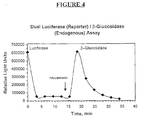
- the luciferase signal is first measured after the addition of the substrate, luciferin (Dual-Light® reagents). Following decay of the luciferase signal, an endogenous enzyme (AP) detection buffer, containing the substrate for AP and an appropriate enhancer (CDP- Sta r® substrate/Sapphire-IITM enhancer solution) is added and endogenous AP-catalyzed light emission is measured. Maximum flight emission from AP reaction is reached within 15 minutes after reagent addition. The results of this assay are shown in Figure 1 .
- the AP detection buffer can be added earlier, for example, immediately after the luciferase is measured in order to diminish the luciferase signal (not shown).
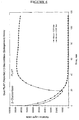
- the substrate for the reporter enzyme is added (Galacton® substrate) to each well and incubated for 15 min.
- An enhancer - (Sapphire-IITM) containing accelerator is then injected into each well and the ⁇ -galactosidase-catalyzed light emission is measured.
- the substrate for AP CDP- Star ®
- the endogenous AP-catalyzed light emission is measured. The results of this assay are shown in Figure 2 .
- the first and second reporter substrates are both present in the aliquot during quantification of the activity of the first reporter enzyme.
- the presence of the second reporter enzyme, as well as its substrate does not interfere with the activity of the first reporter enzyme or measurement of the light signal produced by degradation of the first substrate by the first reporter enzyme.
- light produced by the degradation of the first substrate occurs at a pH at which the product of the degradation of the second substrate does not produce light.
- the product of the enzymatic reaction with the second substrate does not generate a measurable signal during the first quantification because the environment of the aliquot inhibits light production by the product of this second enzymatic reaction.
- the measurement of light production by the degradation of the first substrate preferably occurs at a neutral pH.
- the second reporter enzyme acts on its substrate during the time that the first reporter enzyme acts on its substrate. However, at this pH, no significant production of light from the reaction of the second reporter enzyme and its substrate occurs. It is preferable to allow a predetermined period of time to elapse prior to increasing the pH and measuring light production of the second enzymatic reaction to allow the product of that reaction to accumulate, thereby producing a more intense light signal.
- the presence of the second enzyme does not interfere with the measurement of the light signal from the first enzymatic reaction because the substrate of the second enzyme is absent from the aliquot during this measurement.
- the second enzyme is active but there is no substrate on which it can act.
- the activity of the second enzyme is induced by the addition of the second substrate after decreasing the activity of the first reporter enzyme or after reduction in the signal produced by the first enzymatic reaction. For example, in an assay using ⁇ -galactosidase as the first enzyme and alkaline phosphatase as the second enzyme, light production as a result of the ⁇ -galactosidase reaction is optimized at a higher than neutral pH.
- the second substrate is added subsequent to the first quantification and most preferably, after that light signal has abated. This addition is readily accomplished and is especially easy when using a detection device as is commonly known in the art.
- the substrate for the endogenous enzyme is added subsequent to the decay of light emission from the second reporter enzyme substrate.
- the substrate for the endogenous enzyme initiates light emission.
- the substrate for the endogenous enzyme is added at a point prior to measurement of the second reporter enzyme and the activity of the endogenous enzyme is increased by methods set forth above, such as altering pH.
- a water soluble polymeric enhancer molecule is added to the light signal produced by enzymatic degradation of the substrate.
- Preferred polymeric enhancers include bovine serum albumin, human serum albumin, and polymeric quaternary onium salts.
- Examples of preferred polymeric quaternary onium salts include polyvinylbenzyltrimethyl-ammonium chloride (TMQ), polyvinyl benzyl tributyl ammonium chloride (TBQ) (Sapphire-IITM), polyvinylbenzyl benzyldimethylammonium chloride (BDMQ) (Sapphire-ITM), polyvinylbenzyltributylphosphonium chloride, and polyvinyl tributyl sulfonium chloride.
- TMQ polyvinylbenzyltrimethyl-ammonium chloride
- TBQ polyvinyl benzyl tributyl ammonium chloride
- BDMQ polyvinylbenzyl benzyldimethylammonium chloride
- polymeric enhancers include poly(benzyldimethylvinylbenzyl)ammonium chloride and sodium fluorescein (EmeraldTM), poly(benzyltributyl)ammonium chloride and sodium fluorescein (Emerald IITM). These enhancers are available from Tropix, Inc., Bedford, MA.
- an accelerator solution is added prior to quantifying the activity of the second enzyme.
- Preferred accelerator solutions comprise a water soluble polymeric enhancer molecule at a pH from about 8 to about 14 which is capable of activating the signal production from the degradation of the substrate by the enzyme.
- the accelerator solution activates the signal produced by the degradation of the endogenous substrate by the endogenous enzyme and inactivates the first reporter enzyme.
- an accelerator solution is added prior to the quantification of the second reporter enzyme, which activates the signal produced by the degradation of the second reporter enzyme substrate and inactivates the first reporter enzyme.
- the cells When measuring certain endogenous enzymes it may be necessary to further treat the cells. For example, when measuring endogenous enzymes that are present in the cell or serum in large amounts, the background level may be too high to produce an accurate reading. In such a case, it is preferable to wash the cells prior to the assay.
- One of ordinary skill in the art can readily determine which endogenous enzymes will require a wash, and will be able to determine the appropriate wash solution, e.g., PBS. For example, in assays that measure AP, the cells are washed once with PBS just prior to the assay.
- the presence of the first substrate enhances the light signal produced by the degradation of the substrate for the second reporter enzyme or the endogenous enzyme. This enhanced signal provides a more sensitive assay.
- the first substrate is luciferin.
- the substrate for the second enzyme is preferably a dioxetane substrate. It is believed that luciferin is a very efficient energy acceptor and emits a light signal as a result of energy transfer from the excited state generated from the dioxetane decomposition. This produces a greater signal intensity.
- Certain preferred embodiments of the present invention further comprise adding a water soluble enhancer molecule which enhances the light signal produced from the enzymatic degradation of the dioxetane substrates by the reporter enzymes or the endogenous enzymes.
- Certain water soluble naturally-occurring and synthetic substances enhance the chemiluminescent signal intensity in part by providing a hydrophobic environment.
- these substances for example, water soluble globular proteins that contain hydrophobic regions: mammalian serum albumins such as bovine serum albumin (BSA) and human serum albumin (HSA), or water soluble polymeric quaternary onium salts: polyvinylbenzyltrimethyl ammonium chloride (TMQ), polyvinylbenzyltributyl ammonium chloride (TBQ) (Sapphire-IITM), polyvinylbenzylbenzyldimethyl ammonium chloride (BDMQ) (Sapphire-ITM), and polyvinylbenzyltributyl phosphonium chloride increase the chemiluminescent signal intensity produced by the decomposition of enzymatically cleavable 1,2-dioxetanes in aqueous solutions.
- mammalian serum albumins such as bovine serum
- Copolymers such as water soluble quaternary ammonium-phosphonium, ammonium-sulfonium, and sulfonium-phosphonium polymers are useful as enhancer molecules.
- Other preferred enhancers include poly(benzyldimethylvinylbenzyl)ammonium chloride, sodium fluorescein (EmeraldTM ), poly(benzyltributyl)ammonium chloride, and sodium fluorescein (Emerald IITM).
- an enhancer substance or substances By virtue of the presence of effective amounts of an enhancer substance or substances the intensity of the light emitted in an aqueous medium is increased significantly as compared to the intensity of light emitted in the absence of such enhancers.
- These compounds enhance the intensity of the chemiluminescent signal from 1,2-dioxetanes by a factor of at least 10%, but usually at least tenfold, and oftentimes by factors of at least 10 to 1,000.
- macromolecular globular protein that include hydrophobic regions, generally ones having molecular weights ranging from about 1000 to about 600,000 daltons, as determined by SDS gel electrophoresis.
- Such substances include mammalian serum albumins such as BSA, HSA and the like; globular proteins such as mammalian IgG, IgE, Protein A, avidins, and the like; and serum lipoproteins, apolipoproteins, and the like.
- Synthetic oligomeric or polymeric enhancer substances that can be used in practicing this invention include water soluble polyvinylaryl quaternary onium salts, such as polyvinylbenzyl quaternary ammonium, sulfonium and phosphonium salts having the general formula II: where E+ can be P, N or S.
- each of R 1, R 2 and R 3 can be a straight or branched chain unsubstituted alkyl group having from 1 to 20 carbon atoms, inclusive, e.g., benzyl, methyl, ethyl, n-butyl, t-butyl, cetyl, or the like, a straight or branched chain alkyl group having from 1 to 20 carbon atoms, inclusive, substituted with one or more hydroxzy, alkoxy, e.g., methoxy, ethoxy, benzyloxy or polyoxethylethoxy, aryloxy, e.g., phenoxy, amino or substituted amino, e.g., methylamino, amino, e.g., acetamido or cholesteryloxycarbonylamido, or fluoroalkane or fluoroaryl, e.g., heptafluorobutyl groups, an unsubstituted monocycl
- n represents a number such that the molecular weight of such polyvinylbenzyl quaternary onium salts will range from about 800 to about 200,000, and preferably from about 20,000 to about 70,000, as determined by intrinsic viscosity or LALLS techniques.
- TMQ water soluble poly(vinylbenzyl quaternary ammonium salts)
- BDMQ water soluble poly(vinylbenzyl quaternary ammonium salts)
- Water soluble acetals of a polyvinylalcohol and a formylbenzyl quaternary onium salt having the formula III: wherein E+ can be P, N or S and each R 4 is the same or a different aliphatic substituent and X - is an anion, as disclosed and claimed in Bronstein-Bonte et al., U.S. Patent No. 4,124,388 .
- the individual vinylbenzyl quaternary onium salt monomers used to prepare the polyvinylbenzyl quaternary onium salts of formula II above can also be copolymerized with other vinylbenzyl quaternary onium salt monomers whose polymers are depicted in formula III, or with other ethylenicaly unsaturated monomers having no quaternary onium functionality, to give polymers such as those disclosed and claimed in Land et al., U.S. Patent No. 4,322,489 ; Bronstein-Bonte et al., U.S. Patent No. 4,340,522 ; Land et al., U.S. Patent No.
- the amount of enhancer substance used varies depending on the particular enhancer chosen and the amount and type of chemiluminescent compounds present. The necessary amount can be readily determined by one ordinarily skilled in the art based upon the present teachings. Furthermore, the disclosure contained within U.S. Patent No. 5.145,772 would assist one skilled in the art in practicing this invention.
- the enhancer molecule can be added at any point in the present invention. If the first substrate, but not the second substrate, is a dioxetane, the enhancer is preferably added prior to or simultaneous to the quantification of the first enzyme. If the second substrate, but not the first substrate, is a dioxetane, the enhancer can be added at any time, but is preferably added subsequent to the quantification of the first enzyme and prior to or simultaneous to the quantification of the second enzyme. If both the first and second substrates are dioxetanes, the enhancer molecule is preferably added prior to any quantification or simultaneous to the first quantification. In this last embodiment, one enhancer can be used to enhance the light signals produced by the decomposition of both enzyme substrates. Alternatively, a different enhancer is used for each enzyme substrate.
- an incubation period subsequent to the quantification of the light signal produced by the substrate for the first enzyme in part, to allow the light signal produced by the first substrate to diminish.
- the length of the incubation period will vary depending on the concentration of the first reporter enzyme and the half-life of the light signal produced by the substrate. If the first enzyme is present in high concentrations, it may interfere with the quantification of low levels of the subsequent enzymes. A longer incubation period will decrease the residual light signal from the substrate for the first reporter enzyme. Taking into account the teachings of the present invention, the appropriate length of the incubation period can readily be determined by one ordinarily skilled in the art.
- the methods according to the present invention provide a rapid, highly sensitive, non-isotopic method for sequentially detecting multiple enzyme activities in a single aliquot of a sample.
- the present invention also relates to a method of measuring the activity of multiple enzymes, at least one of which is an endogenous enzyme, in a single aliquot of a sample.
- the method comprises quantifying the activity of a first enzyme by measuring the light signal produced by degradation of a first enzyme substrate by the first enzyme, and then quantifying the activity of the second enzyme by measuring the light signal produced by the degradation of a second substrate by the endogenous enzyme, wherein both quantifications are performed on the same aliquot of sample extract.
- the intensity of the luminescent signal produced from the substrates is a function of the activity of the enzyme, i.e., the effectiveness of the enzyme in terms of its ability to degrade its substrate and/or the amount of enzyme present.
- the method of measuring the activity of multiple enzymes in an aliquot of a sample extract wherein the enzymes are at least one reporter gene product and at least one endogenous enzyme comprises adding a first substrate, which is the substrate of a first reporter enzyme, and a second substrate, which is the substrate of the endogenous enzyme, to an aliquot of the cell extract.
- the first substrate is luciferin
- the second substrate comprises a dioxetane
- the endogenous enzyme is a hydrolytic enzyme.
- the substrate for the endogenous enzyme is added and the activity of the endogenous enzyme is measured.
- the first reporter enzyme is luciferase and the endogenous enzyme is selected from the group consisting of alkaline phosphatase, acid phosphatase, galactosidase, glucosidase, glucuronidase, protease and esterases.
- a more preferred endogenous enzyme is alkaline phosphatase.
- the methods of the present invention are particularly useful in measuring the transcriptional activity of cells transfected with at least one reporter gene and allowing the measurement of cell number, cell proliferation, cell adhesion or cytotoxicity by measuring at least one enzyme endogenous to the cell.
- Transfection of cells is accomplished by methods known in the art. See e.g., Alam, J. and Cook, J.K., Anal. Bioch. 188: 245-254 (1990 ).
- cells are co-transfected with a DNA mixture of two separate plasmids, each having a different reporter gene.
- One plasmid has a reporter gene which is regulated by a known control promoter. This reporter gene acts as a control.
- the second plasmid has a second reporter gene which is controlled by the regulatory region being studied. Transcription of each reporter gene is analyzed by measuring the activity of its product, i.e., a "reporter enzyme".
- the activity of the second reporter enzyme is typically normalized to the activity of the first reporter enzyme. Id . at 249.
- the activity of the second enzyme is modulated prior to measuring the light signal produced by the degradation of its substrate.
- the activity of the second enzyme is modulated by adding the substrate for the endogenous enzyme or activating the endogenous enzyme.
- the activity of the second enzyme is modulated by increasing the pH of the aliquot, as discussed above.
- the method of measuring the activity of multiple enzymes further comprises adding an enzyme detection buffer subsequent to the quantification of the first reporter enzyme.
- the enzyme detection buffer comprises the substrate for the second enzyme and an enhancer.
- the enzyme detection buffer may also contain an accelerator solution, i.e., an enhancer in a high pH buffer, as described further below.
- the present invention provides a method of measuring the activity of multiple enzymes, wherein the enzymes comprise more than two reporter gene products and an endogenous enzyme in the same aliquot of sample extract.
- a number of factors determine the volume of the aliquot of cell extract used, such as, the availability of the sample, instrumentation, and availability of reagent.
- the volume of the aliquot of cell extract will be determined on the basis of size of the apparatus or plate used to hold extract, the apparatus for determining the signal, environmental conditions, and other parameters familiar to those of ordinary skill in the art.
- the methods of the present invention may be performed in any luminometer, but preferably in luminometers that have automatic injectors, or other instrumentation which enables the measurement of light emission.
- the method can also be performed in a luminometer equipped with a single injector.
- the method can be performed using manual injection if the light signal of each sample is measured after approximately the same time interval subsequent to the addition of the reagent to the samples.
- the activity of the enzymes can be detected sequentially, or simultaneously, depending on the instrumentation used.
- the method comprises first quantifying the activity of a first reporter enzyme in an aliquot of the cell extract by measuring the light signal produced by degradation of a first substrate and then decreasing the activity of the first reporter enzyme.
- the activity of a second reporter enzyme in the aliquot of the cell extract is quantified by measuring the light signal produced by degradation of a second substrate.
- the second enzyme is a hydrolytic enzyme capable of reacting with a dioxetane.
- the second enzyme can be any enzyme, but is preferably selected from the following enzymes: ⁇ -galactosidase, ⁇ -glucuronidase, alkaline phosphatase, and carboxyl esterase.
- the most preferable embodiment is where the second enzyme comprises ⁇ -galactosidase.
- the activity of an endogenous enzyme in the same aliquot of the cell extract is then quantified by measuring the light signal produced by degradation of the substrate for the endogenous enzyme. All quantifications are sequentially performed on the same aliquot of sample extract.
- the first and second reporter substrates and endogenous enzyme substrate are different and at least one of the substrates is a dioxetane.
- the present invention includes methods that further comprise inducing the signal produced by the degradation of the second reporter substrate by the second reporter enzyme and then inducing the activity of the endogenous enzyme.
- the substrate for a first reporter enzyme and a second substrate which is the substrate for a second reporter enzyme are added to an aliquot of the cell extract.
- the first enzyme is a luciferase
- the second enzyme is a hydrolytic enzyme
- the first substrate is luciferin
- the second substrate is a dioxetane.
- the reporter enzyme is preferably selected from ⁇ -galactosidase, ⁇ -glucuronidase, alkaline phosphatase, carboxyl esterase, and luciferase.
- a more preferred reporter enzyme is luciferase.
- the substrate for the first enzyme is added at the same time as the substrate for the second enzyme and the chemiluminescent signal produced by the substrate for the first reporter enzyme is measured by measuring the light signal produced from luciferase-luciferin reaction while simultaneously adding the substrate for the second enzyme.
- An accelerator solution which substantially inactivates the first reporter enzyme by increasing the pH of the aliquot is then added. Then the increased pH of the aliquot activates the light production from the accumulated product of the second reporter enzyme-second substrate reaction.
- the accelerator solution includes an enhancer, such as polyvinylbenzyltributyl ammonium chloride, which, as stated above, enhances the light signal produced by the decomposition of the dioxetane substrate for the second reporter enzyme.
- the activity of the second reporter enzyme is then measured by reading the chemiluminescent signal intensity in the same aliquot of the cell extract.
- the presence of this substrate further enhances the light signal produced by the second substrate.
- a 1,2-dioxetane substrate is added to initiate light emission from the endogenous enzyme, e.g., alkaline phosphatase.
- the substrate is CDP- Star ® 1,2-dioxetane.
- Figure 3 demonstrates the sequential detection of luciferase, ⁇ -galactosidase, and alkaline phosphatase activities, with luciferin, Galacton®, and CDP- Star ®, respectively.
- the assay was performed with a mixture of ⁇ 2BAG ⁇ and NIH/3T3 cell extracts, which contains ⁇ -galactosidase reporter enzyme and endogenous alkaline phosphatase activity, with added purified luciferase, as described below in Example 3.
- the extract mixture and amount of luciferase added were adjusted to generate similar light intensities for each enzyme. Luciferase-catalyzed light emission is measured first, following the addition of both luciferin substrate and GalactonTM substrate.
- ⁇ -galactosidase-catalyzed cleavage of Galacton® substrate proceeds during the decay of the luciferase signal, and light emission from the breakdown of the Galacton® anion intermediate is triggered by the addition of an accelerator, a high pH solution containing enhancer.
- an accelerator a high pH solution containing enhancer.
- CDP -Star ® is added, which initiates a glow light emission reaction catalyzed by alkaline phosphatase. Detection of luciferase followed immediately by endogenous alkaline phosphatase was also performed ( Figure 1 ).
- the presence of the second reporter enzyme in the aliquot must not interfere with the activity of the first reporter enzyme or measurement of the light signal produced by that first enzyme.
- the method further comprises increasing the enzymatic activity of the second reporter enzyme subsequent to quantifying the activity of the first enzyme. This can be accomplished by methods known in the art to activate enzyme activity.
- the pH of the aliquot is adjusted to create an environment in which the second enzyme is active prior to the second quantification. For example, in some embodiments, using alkaline phosphatase as the second reporter enzyme, the pH of the aliquot is raised because the activity of alkaline phosphatase is increased at alkaline pH.
- the signal produced from the substrate for the first enzyme is decreased by substantially inactivating the first reporter enzyme.
- Methods of substantially inactivating the first enzyme are known in the art. However, these methods must not interfere with the measurement of the activity of the second enzyme.
- the first enzyme is substantially inactivated by altering the pH of the aliquot.
- the pH can be altered by adding acids or bases to the aliquot, depending on the enzyme, to provide an environment which is inhospitable to the first enzyme.
- the pH of the aliquot is increased. This increased pH inactivates the first enzyme, thereby preventing it from further degrading its substrate and producing a light signal.
- the aliquot is heated to degrade the first enzyme.
- inhibitors can be added to inactivate the first enzyme.
- examples of inhibitors include alcohols such as isopropanol or ethanol, surfactants such as cetyl trimethyl ammonium bromide (CTAB) or substrate analogs which bind to, and inactivate the enzyme.
- CTAB cetyl trimethyl ammonium bromide
- the methods of the present invention measure the activity of an endogenous enzyme. They enable the normalization of cells in an assay by providing a measurement of cell number independent of the activity of reporter enzyme or enzymes present in the sample.
- the present methods also enable the monitoring of cell proliferation, which may be affected by the test conditions, also independent of the activity of reporter enzymes. For example, when certain compounds are added to the cells that produce a non-specific effect, e.g., growth factor, are added to the cells, it is desirable to confirm that regular cell functions are occurring, as opposed to those that are controlling the reporter construct.
- the methods of the present invention enable that confirmation.
- cytotoxic effects of test conditions i.e., potential drugs, changes in temperature or pH, etc.
- One measure of cytotoxicity can be obtained by measuring the amount or changes in activity of endogenous enzymes that are released from the cells into the culture medium.
- cytotoxicity can potentially be determined by measuring enzyme activity within cells as an indicator of viable cells present. This provides a measure of cell lysis, which is one measurement of cytotoxicity.
- Such an assay can be performed using the methods of the present invention with the cells present in the medium.
- kits for detecting the activity of multiple enzymes in a single aliquot of a sample extract provided that at least one of the enzymes is an endogenous enzyme.
- a kit comprises the reagents for quantifying each of the enzymes and the substrates for each of the enzymes, wherein at least one of the substrates is a dioxetane.
- the kit can also comprise an accelerator solution containing a water soluble polymeric enhancer molecule.
- the accelerator solution comprises a water soluble polymeric enhancer molecule at a pH from about 8 to about 14, to raise the pH, to decrease the activity of the first enzyme, and to increase the signal produced from the enzymatic degradation of the second substrate by the second enzyme (e.g., in a three enzyme assay), or to decrease the activity of a first reporter enzyme and increase the signal produced by degradation of the substrate of the endogenous enzyme (e.g., in a reporter/endogenous enzyme assay).
- a water soluble polymeric enhancer molecule at a pH from about 8 to about 14, to raise the pH, to decrease the activity of the first enzyme, and to increase the signal produced from the enzymatic degradation of the second substrate by the second enzyme (e.g., in a three enzyme assay), or to decrease the activity of a first reporter enzyme and increase the signal produced by degradation of the substrate of the endogenous enzyme (e.g., in a reporter/endogenous enzyme assay).
- the polymeric enhancer preferably comprises bovine serum albumin, human serum albumin or polymeric quaternary onium salts.
- the polymeric quaternary onium salts comprise polyvinylbenzyltrimethyl-ammonium chloride (TMQ), polyvinylbenzyltributylammonium chloride (TBQ) (Sapphire-IITM), polyvinylbenzyl benzyldimethylammonium chloride (BDMQ) (SapphireTM), or polyvinylbenzyltributyl phosphonium chloride, poly(benzyldimethylvinylbenzyl)ammonium chloride and sodium fluorescein (EmeraldTM), and poly(benzyltributyl)ammonium chloride and sodium fluorescein (Emerald IITM).
- Preferred polymeric enhancers include polyvinylbenzyltrimethyl-ammonium chloride (TMQ), polyvinylbenzyltributylammonium chloride (TBQ) (Sapphire-IITM), polyvinylbenzyl benzyldimethylammonium chloride (BDMQ) (SapphireTM), or polyvinylbenzyltributyl phosphonium chloride.
- Assay reagents including Lysis Solution, CDP- Stak ® Galacton® and Sapphire-IITM and polymeric enhancer, Phospha-LightTM Assay Buffer, Dual Light Buffer A and B, and plasmid pCMV/ ⁇ -Gal, are available from Tropix, Inc., Bedford, MA.
- Cell lines include ⁇ 2BAG ⁇ (CRL-9560, ATCC, Rockville, MD), an NIH/3T3 derivative that constitutively expresses bacterial ⁇ -galactosidase from a stably inserted retroviral construct, cultured in DMEM/10% calf serum; and AP3T3b ( O'Connor, K.L., et al., Biotechniques, 1994; 17: 502-9 ); NIH/3T3 (CRL-1658, ATCC) mouse embryonic fibroblasts, cultured in DMEM/10% calf serum; a stably transfected Balbc/3T3 derivative that constitutively expresses non-secreted placental alkaline phosphatase, cultured in DMEM/10% calf serum.
- ⁇ 2BAG ⁇ CRL-9560, ATCC, Rockville, MD
- NIH/3T3 derivative that constitutively expresses bacterial ⁇ -galactosidase from a
- Assays were performed in tissue culture-treated, clear-bottomed, opaque white 96-well microplates (Cat. 3610, Coming Costar Corporation, Action, MA): Light emission was measured with either the TR717TM microplate luminometer (Tropix) or the Turner. Model 20e single tube luminometer (Turner Designs, Mountain View, CA).
- luciferase signal was measured using Dual-Light® reagents. 25 ⁇ l of Dual-Light® Buffer A containing 0.1 % Triton X-100 was then added to each well, and 75 ⁇ l/well of Dual-Light® Buffer B was injected. Light emission was then measured with a TR717 luminometer. Following the decay of the luciferase signal, 100 ⁇ l of a CDP- Star ® substrate/Sapphire-IITM enhancer solution was added and endogenous AP-catalyzed light emission was measured.
- pCMV/ ⁇ -Gal-transfected NIH/3T3 cells were seeded in 2x10 4 cells/well in 96-well microplates and washed once with PBS prior to assay. Next, 100 ⁇ l of a reaction buffer containing HEPES, MgCI 2 , Triton X-100, and Galacton substrate was added to each well and incubated for 15 min. 50 ⁇ l of a Sapphire-IITM enhancer-containing accelerator was then injected into each well and the ⁇ -galactosidase-catalyzed light emission was measured with a TR717 luminometer.
- Example 3 Triple enzyme Assay: Luciferase (Reporter)/ ⁇ -Galactosidase (Reporter)/AP (Endogenous) Assay Protocol:
- Dual-Light® Buffer A 25 ⁇ l of Dual-Light® Buffer A was added to 10 ⁇ l of lysate and incubated for 30 sec. Next, 100 ⁇ l of Dual-Light® Buffer B containing 1:100 Galacton® was added. After 4.5 min., 100 ⁇ l of Buffer C containing 0.3 mol/L diethanolamine/20% enhancer was added. Finally, at 10 min., 100 ⁇ l of 1.2 mmol/L CDP- Star ® in Buffer C was added. Light emission was continuously measured throughout the assay with a Turner Model 20e luminometer.
- the extract was assayed sequentially for luciferase reporter, ⁇ -Gal reporter, and finally for endogenous alkaline phosphatase enzyme activities. Luciferase and ⁇ -Gal activities were measured with modified Dual-Light® assay reagents using the Galacton® 1,2-dioxetane substrate for ⁇ -Gal with a modified accelerator formulation. The addition of an enhancer-containing accelerator initiated light emission from the ⁇ -Gal-catalyzed decomposition reaction with Galacton® substrate and quenched the luciferase-catalyzed light emission.
- the CDP- Sta r® 1,2-dioxetane substrate was added to initiate light emission from the alkaline phosphatase.
- This sequential detection protocol enables the detection of three enzyme activities, including two reporter enzymes and one endogenous enzyme, in a single tube/well assay of a single sample of cell extract.
- NIH/3T3 mouse embryonic fibroblasts transfected with pGL3-Control which constitutively expresses luciferase reporter enzyme from an SV40 promoter/enhancer, were seeded into clear-bottom/white-side tissue culture-treated 96-well microplates in DMEM/10% CS (5 x 10 4 cells/well). Prior to the assay, the culture medium was removed from the wells and the cells were washed once with 200 ⁇ l of PBS. All assay incubations were performed at room temperature. A modified luciferase reaction buffer, containing Triton X-100 and GluconTM substrate was added (25 ⁇ l/well) and the plates were incubated for 15 min.
- the high pH accelerator solution triggered light emission from the decomposition of the accumulated GluconTM reaction product.
- the results of the assay are shown in Figure 4 . It was noted that the addition of an accelerator caused quenching of any residual luciferase signal (not shown), and thus it is not necessary to wait for the luciferase signal to completely decay.
- NIH/3T3 mouse embryonic fibroblasts transfected with pGL3-Control which constitutively expresses luciferase reporter enzyme from an SV40 promoter/enhancer, were seeded into clear-bottom/white-side tissue culture-treated 96-well microplates in DMEM/10% CS. Prior to the assay, the culture medium was removed from the wells and the cells were washed once with 200 ⁇ l of PBS. All assay incubations were performed at room temperature. A modified luciferase reaction buffer containing Triton X-100 and GluconTM substrate was added (25 ⁇ l/well) and the plates were incubated for 15 min.
- AP3T3b cells a stably transfected BALB/3T3 derivative that constitutively expresses non-secreted placental alkaline phosphatase, were seeded into clear-bottom/white-side tissue culture-treated 96-well microplates in DMEM/10% CS (1.2 x 10 4 cells/well). Prior to performing the assay, the culture medium was removed from the wells and the cells were washed once with 200 ⁇ l of PBS. All incubations were performed at room temperature.
- a ⁇ -glucosidase reaction buffer containing sodium phosphate, pH 5.5, MgSO 4 , L-homoarginine, Triton X-100, and GluconTM was added (50 ⁇ l/well) and the plates were incubated for 15 min.
- An accelerator solution (100 ⁇ l/well) containing Sapphire-IITM enhancer was then injected and light emission was measured immediately for 1 sec/well in a TR717 microplate luminometer.
- CDP- Star ® was added (50 ⁇ l/well) and PLAP-catalyzed light emission was repeatedly measured (1 sec/well). The light signal from the endogenous ⁇ -glucosidase-catalyzed reaction was measured first.
- AP3T3b cells a stably transfected BALB/3T3 derivative that constitutively expresses non-secreted placental alkaline phosphatase, were seeded into elear-bottom/white-side tissue culture-treated 96-well microplates in DMEM/10% CS. Prior to performing the assay, the culture medium was removed from the wells and the cells were washed once with 200 ⁇ l of PBS. All incubations were performed at room temperature.
- a ⁇ -glucosidase reaction buffer containing sodium phosphate, pH 5.5, MgSO 4 , L-homoarginine, Triton X-100, and Glucon® substrate was added (50 ⁇ l/well) and the plates were incubated for 15 min.
- An accelerator solution (100 ⁇ l/well) containing Sapphire-IITM enhancer was then injected and light emission was measured immediately for 1 sec/well in a TR717 microplate luminometer. After approximately a 15 min. delay, a dilution of CDP- Star ® substrate was added (50 ⁇ l/well), and PLAP-catalyzed light emission was measured (1 sec/well).
Landscapes
- Chemical & Material Sciences (AREA)
- Organic Chemistry (AREA)
- Life Sciences & Earth Sciences (AREA)
- Health & Medical Sciences (AREA)
- Zoology (AREA)
- Wood Science & Technology (AREA)
- Proteomics, Peptides & Aminoacids (AREA)
- Engineering & Computer Science (AREA)
- Genetics & Genomics (AREA)
- Analytical Chemistry (AREA)
- Immunology (AREA)
- Microbiology (AREA)
- Molecular Biology (AREA)
- Biotechnology (AREA)
- Biophysics (AREA)
- Physics & Mathematics (AREA)
- Biochemistry (AREA)
- Bioinformatics & Cheminformatics (AREA)
- General Engineering & Computer Science (AREA)
- General Health & Medical Sciences (AREA)
- Measuring Or Testing Involving Enzymes Or Micro-Organisms (AREA)
Applications Claiming Priority (3)
| Application Number | Priority Date | Filing Date | Title |
|---|---|---|---|
| US11235998P | 1998-12-15 | 1998-12-15 | |
| US112359P | 1998-12-15 | ||
| PCT/US1999/029550 WO2000036098A1 (en) | 1998-12-15 | 1999-12-14 | Multiple enzyme assays |
Publications (3)
| Publication Number | Publication Date |
|---|---|
| EP1151090A1 EP1151090A1 (en) | 2001-11-07 |
| EP1151090A4 EP1151090A4 (en) | 2007-05-02 |
| EP1151090B1 true EP1151090B1 (en) | 2009-09-02 |
Family
ID=22343485
Family Applications (1)
| Application Number | Title | Priority Date | Filing Date |
|---|---|---|---|
| EP99965243A Expired - Lifetime EP1151090B1 (en) | 1998-12-15 | 1999-12-14 | Multiple enzyme assays |
Country Status (8)
| Country | Link |
|---|---|
| US (1) | US6586196B1 (https=) |
| EP (1) | EP1151090B1 (https=) |
| JP (1) | JP4668418B2 (https=) |
| AT (1) | ATE441725T1 (https=) |
| AU (1) | AU781255B2 (https=) |
| CA (1) | CA2353872C (https=) |
| DE (1) | DE69941367D1 (https=) |
| WO (1) | WO2000036098A1 (https=) |
Families Citing this family (32)
| Publication number | Priority date | Publication date | Assignee | Title |
|---|---|---|---|---|
| EP1472238B1 (en) | 2002-02-01 | 2012-07-04 | Promega Corporation | Bioluminescent protease assay |
| AU2004210982B2 (en) * | 2003-02-12 | 2008-12-18 | Promega Corporation | Methods and kits for dual enzymatic assays whereby light is quenched from luminescent reactions |
| US20050026151A1 (en) * | 2003-07-17 | 2005-02-03 | Voyta John C. | Simultaneous generation of multiple chemiluminescent signals on solid supports |
| US20070254320A1 (en) * | 2003-10-20 | 2007-11-01 | Alan Olstein | Method and Kit for Detecting Listeria Spp. |
| US7553632B2 (en) | 2004-01-22 | 2009-06-30 | Promega Corporation | Luminogenic and nonluminogenic multiplex assay |
| US7416854B2 (en) * | 2004-01-22 | 2008-08-26 | Promega Corporation | Luminogenic and nonluminogenic multiplex assay |
| EP1935986B1 (en) | 2005-05-31 | 2014-04-16 | Promega Corporation | Luminogenic and fluorogenic compounds and methods to detect molecules or conditions |
| EP2778234B1 (en) | 2005-05-31 | 2017-09-27 | Promega Corporation | Luminogenic and fluorogenic compounds and methods to detect molecules or conditions |
| KR20080050584A (ko) * | 2005-08-19 | 2008-06-09 | 커먼웰쓰 사이언티픽 앤 인더스트리알 리서치 오거니제이션 | 아라크노캄파 루시페라아제 |
| JP2009506772A (ja) * | 2005-09-01 | 2009-02-19 | プロメガ コーポレイション | 細胞ベースの発光及び非発光プロテアソームアッセイ |
| JP2007225547A (ja) * | 2006-02-27 | 2007-09-06 | Fujifilm Corp | 標的物質の疎水部位の検出方法 |
| AU2008239654A1 (en) | 2007-04-13 | 2008-10-23 | Promega Corporation | Luminescent live and dead cell assay |
| US20110124965A1 (en) * | 2008-05-08 | 2011-05-26 | Park Jason Y | Chemiluminescence enhanced detection |
| WO2010045599A1 (en) | 2008-10-17 | 2010-04-22 | Pharmacofore, Inc. | Pharmaceutical compositions with attenuated release of phenolic opioids |
| CN102695545B (zh) | 2009-09-08 | 2016-08-17 | 特色疗法股份有限公司 | 包括酶可剪切的酮改性的阿片样物质药物前体以及其可任选的抑制剂的组合物 |
| US20110097723A1 (en) * | 2009-09-19 | 2011-04-28 | Qun Liu | Methods and reagents for analyte detection |
| US8592172B2 (en) | 2010-03-11 | 2013-11-26 | Promega Corporation | Bioluminescent assays using cyanobenzothiazole compounds |
| US20110262355A1 (en) | 2010-04-21 | 2011-10-27 | Jenkins Thomas E | Compositions comprising enzyme-cleavable opioid prodrugs and inhibitors thereof |
| US20130059914A1 (en) | 2010-04-21 | 2013-03-07 | Signature Therapeutics, Inc. | Compositions Comprising Enzyme-Cleavable Amphetamine Prodrugs and Inhibitors Thereof |
| CA2795222A1 (en) * | 2010-04-21 | 2011-10-27 | Signature Therapeutics, Inc. | Compositions comprising enzyme-cleavable opioid prodrugs and inhibitors thereof |
| WO2011133178A1 (en) | 2010-04-21 | 2011-10-27 | Pharmacofore, Inc | Compositions comprising enzyme-cleavable phenol-modified tapentadol prodrug |
| EP2560490A1 (en) * | 2010-04-21 | 2013-02-27 | Signature Therapeutics, Inc. | Compositions comprising enzyme-cleavable prodrugs of active agents and inhibitors thereof |
| AU2012205733B2 (en) | 2011-01-11 | 2015-10-08 | Signature Therapeutics, Inc. | Compositions comprising enzyme-cleavable oxycodone prodrug |
| US8497237B2 (en) | 2011-01-11 | 2013-07-30 | Signature Therapeutics, Inc. | Compositions comprising enzyme-cleavable oxycodone prodrug |
| JP6148182B2 (ja) | 2011-03-09 | 2017-06-14 | シグネーチャー セラピューティクス, インク.Signature Therapeutics, Inc. | 複素環式リンカーを有する活性薬剤プロドラッグ |
| WO2012122420A2 (en) | 2011-03-09 | 2012-09-13 | Pharmacofore, Inc. | Opioid prodrugs with heterocyclic linkers |
| US20140087362A1 (en) | 2012-03-16 | 2014-03-27 | Aladar A. Szalay | Methods for assessing effectiveness and monitoring oncolytic virus treatment |
| WO2013158265A1 (en) | 2012-04-20 | 2013-10-24 | Genelux Corporation | Imaging methods for oncolytic virus therapy |
| EP2719703A1 (en) | 2012-10-12 | 2014-04-16 | Ecole Polytechnique Fédérale de Lausanne (EPFL) | Precursor molecule for the synthesis of D-luciferin |
| JP7007862B2 (ja) * | 2017-10-31 | 2022-01-25 | アークレイ株式会社 | 化学発光試薬組成物及び化学発光試薬キット |
| IL305493A (en) | 2021-03-09 | 2023-10-01 | Ensysce Biosciences Inc | Compositions comprising enzyme-cleavable prodrugs and controlled release nafamostat and methods of use thereof |
| CA3230025A1 (en) | 2021-09-29 | 2023-04-06 | Lynn Kirkpatrick | Enzyme-cleavable methadone prodrugs and methods of use thereof |
Family Cites Families (16)
| Publication number | Priority date | Publication date | Assignee | Title |
|---|---|---|---|---|
| US4124388A (en) | 1977-05-02 | 1978-11-07 | Polaroid Corporation | Ammonium mordants for photographic dyes |
| US4424326A (en) | 1980-04-22 | 1984-01-03 | Polaroid Corporation | Copolymeric mordants |
| US4340522A (en) | 1980-04-22 | 1982-07-20 | Polaroid Corporation | Process for preparing cationic polymers |
| US4322489A (en) | 1980-04-22 | 1982-03-30 | Polaroid Corporation | Copolymeric mordants and photographic products and processes utilizing same |
| US4503138A (en) | 1983-09-01 | 1985-03-05 | Polaroid Corporation | Image-receiving element with unitary image-receiving and decolorizing layer |
| US4563411A (en) | 1984-08-17 | 1986-01-07 | Polaroid Corporation | Copolymeric mordants and photographic products and processes containing same |
| US4931223A (en) * | 1986-07-24 | 1990-06-05 | Tropix, Inc. | Methods of using chemiluminescent 1,2-dioxetanes |
| CA1340590C (en) | 1986-07-24 | 1999-06-08 | John C. Voyta | Chemiluminescence enhancement |
| US4978614A (en) | 1988-10-26 | 1990-12-18 | Tropix, Inc. | Method of detecting a substance using enzymatically-induced decomposition of dioxetanes |
| US5112960A (en) * | 1989-07-17 | 1992-05-12 | Bronstein Irena Y | Chemiluminescent 3-(substituted adamant-2'-ylidene) 1,2-dioxetanes |
| US5089630A (en) | 1987-12-31 | 1992-02-18 | Bronstein Irena Y | Dioxetanes for use in assays |
| US5538847A (en) | 1989-07-17 | 1996-07-23 | Tropix, Inc. | Chemiluminescent 1,2-dioxetanes |
| US5582980A (en) * | 1989-07-17 | 1996-12-10 | Tropix, Inc. | Chemiluminescent 1,2-dioxetanes |
| JP2552413B2 (ja) * | 1990-08-30 | 1996-11-13 | トロピックス・インコーポレーテッド | 化学発光性3ー(置換アダマントー2′ーイリデン)1,2ージオキセタン |
| US5744320A (en) | 1995-06-07 | 1998-04-28 | Promega Corporation | Quenching reagents and assays for enzyme-mediated luminescence |
| US6602657B1 (en) * | 1995-12-28 | 2003-08-05 | Tropix, Inc. | Multiple reporter gene assay |
-
1999
- 1999-12-14 AT AT99965243T patent/ATE441725T1/de not_active IP Right Cessation
- 1999-12-14 CA CA2353872A patent/CA2353872C/en not_active Expired - Fee Related
- 1999-12-14 JP JP2000588347A patent/JP4668418B2/ja not_active Expired - Fee Related
- 1999-12-14 WO PCT/US1999/029550 patent/WO2000036098A1/en not_active Ceased
- 1999-12-14 US US09/459,982 patent/US6586196B1/en not_active Expired - Lifetime
- 1999-12-14 DE DE69941367T patent/DE69941367D1/de not_active Expired - Lifetime
- 1999-12-14 AU AU31201/00A patent/AU781255B2/en not_active Ceased
- 1999-12-14 EP EP99965243A patent/EP1151090B1/en not_active Expired - Lifetime
Also Published As
| Publication number | Publication date |
|---|---|
| CA2353872A1 (en) | 2000-06-22 |
| AU781255B2 (en) | 2005-05-12 |
| EP1151090A4 (en) | 2007-05-02 |
| JP4668418B2 (ja) | 2011-04-13 |
| EP1151090A1 (en) | 2001-11-07 |
| WO2000036098B1 (en) | 2000-07-27 |
| CA2353872C (en) | 2011-05-03 |
| ATE441725T1 (de) | 2009-09-15 |
| WO2000036098A1 (en) | 2000-06-22 |
| JP2003520017A (ja) | 2003-07-02 |
| US6586196B1 (en) | 2003-07-01 |
| AU3120100A (en) | 2000-07-03 |
| DE69941367D1 (de) | 2009-10-15 |
Similar Documents
| Publication | Publication Date | Title |
|---|---|---|
| EP1151090B1 (en) | Multiple enzyme assays | |
| EP0874913B1 (en) | Multiple reporter gene assay | |
| US5306621A (en) | Enhanced chemiluminescent assay | |
| US8715950B2 (en) | Kits for luminogenic and nonluminogenic multiplex assays | |
| US20080248511A1 (en) | Methods to quench light from optical reactions | |
| US5772926A (en) | Chemiluminescent reactions using dihydroxyaromatic compounds and heterocyclic enol phosphates | |
| JP2880802B2 (ja) | インドキシル基質、チオインドキシル基質及び他の基質に基づく化学ルミネセンスアッセイ | |
| US5981207A (en) | Caged enzyme substrates as probes for reporter enzyme activity | |
| AU2004210982B2 (en) | Methods and kits for dual enzymatic assays whereby light is quenched from luminescent reactions | |
| US4962024A (en) | Signal enhancement in assay for an enzyme | |
| JP4365026B2 (ja) | ジヒドロキシ芳香族化合物と複素環式エノールホスファートを使用した化学発光反応 | |
| US20020132364A1 (en) | Quant-screentm chemiluminescent assays |
Legal Events
| Date | Code | Title | Description |
|---|---|---|---|
| PUAI | Public reference made under article 153(3) epc to a published international application that has entered the european phase |
Free format text: ORIGINAL CODE: 0009012 |
|
| 17P | Request for examination filed |
Effective date: 20010703 |
|
| AK | Designated contracting states |
Kind code of ref document: A1 Designated state(s): AT BE CH CY DE DK ES FI FR GB GR IE IT LI LU MC NL PT SE |
|
| AX | Request for extension of the european patent |
Free format text: AL;LT;LV;MK;RO;SI |
|
| RAP1 | Party data changed (applicant data changed or rights of an application transferred) |
Owner name: APPLERA CORPORATION |
|
| A4 | Supplementary search report drawn up and despatched |
Effective date: 20070309 |
|
| RIC1 | Information provided on ipc code assigned before grant |
Ipc: G01N 33/50 20060101ALI20070227BHEP Ipc: C12Q 1/66 20060101ALI20070227BHEP Ipc: C12Q 1/42 20060101ALI20070227BHEP Ipc: C12Q 1/34 20060101ALI20070227BHEP Ipc: C12Q 1/68 20060101AFI20070227BHEP |
|
| 17Q | First examination report despatched |
Effective date: 20070907 |
|
| GRAP | Despatch of communication of intention to grant a patent |
Free format text: ORIGINAL CODE: EPIDOSNIGR1 |
|
| GRAS | Grant fee paid |
Free format text: ORIGINAL CODE: EPIDOSNIGR3 |
|
| GRAA | (expected) grant |
Free format text: ORIGINAL CODE: 0009210 |
|
| AK | Designated contracting states |
Kind code of ref document: B1 Designated state(s): AT BE CH CY DE DK ES FI FR GB GR IE IT LI LU MC NL PT SE |
|
| REG | Reference to a national code |
Ref country code: CH Ref legal event code: EP |
|
| REG | Reference to a national code |
Ref country code: IE Ref legal event code: FG4D |
|
| RAP2 | Party data changed (patent owner data changed or rights of a patent transferred) |
Owner name: APPLIED BIOSYSTEMS, LLC |
|
| REF | Corresponds to: |
Ref document number: 69941367 Country of ref document: DE Date of ref document: 20091015 Kind code of ref document: P |
|
| NLT2 | Nl: modifications (of names), taken from the european patent patent bulletin |
Owner name: APPLIED BIOSYSTEMS, LLC Effective date: 20090930 |
|
| PG25 | Lapsed in a contracting state [announced via postgrant information from national office to epo] |
Ref country code: SE Free format text: LAPSE BECAUSE OF FAILURE TO SUBMIT A TRANSLATION OF THE DESCRIPTION OR TO PAY THE FEE WITHIN THE PRESCRIBED TIME-LIMIT Effective date: 20090902 Ref country code: FI Free format text: LAPSE BECAUSE OF FAILURE TO SUBMIT A TRANSLATION OF THE DESCRIPTION OR TO PAY THE FEE WITHIN THE PRESCRIBED TIME-LIMIT Effective date: 20090902 |
|
| NLV1 | Nl: lapsed or annulled due to failure to fulfill the requirements of art. 29p and 29m of the patents act | ||
| PG25 | Lapsed in a contracting state [announced via postgrant information from national office to epo] |
Ref country code: NL Free format text: LAPSE BECAUSE OF FAILURE TO SUBMIT A TRANSLATION OF THE DESCRIPTION OR TO PAY THE FEE WITHIN THE PRESCRIBED TIME-LIMIT Effective date: 20090902 |
|
| PG25 | Lapsed in a contracting state [announced via postgrant information from national office to epo] |
Ref country code: CY Free format text: LAPSE BECAUSE OF FAILURE TO SUBMIT A TRANSLATION OF THE DESCRIPTION OR TO PAY THE FEE WITHIN THE PRESCRIBED TIME-LIMIT Effective date: 20090902 |
|
| PG25 | Lapsed in a contracting state [announced via postgrant information from national office to epo] |
Ref country code: PT Free format text: LAPSE BECAUSE OF FAILURE TO SUBMIT A TRANSLATION OF THE DESCRIPTION OR TO PAY THE FEE WITHIN THE PRESCRIBED TIME-LIMIT Effective date: 20100104 Ref country code: ES Free format text: LAPSE BECAUSE OF FAILURE TO SUBMIT A TRANSLATION OF THE DESCRIPTION OR TO PAY THE FEE WITHIN THE PRESCRIBED TIME-LIMIT Effective date: 20091213 |
|
| PG25 | Lapsed in a contracting state [announced via postgrant information from national office to epo] |
Ref country code: BE Free format text: LAPSE BECAUSE OF FAILURE TO SUBMIT A TRANSLATION OF THE DESCRIPTION OR TO PAY THE FEE WITHIN THE PRESCRIBED TIME-LIMIT Effective date: 20090902 Ref country code: AT Free format text: LAPSE BECAUSE OF FAILURE TO SUBMIT A TRANSLATION OF THE DESCRIPTION OR TO PAY THE FEE WITHIN THE PRESCRIBED TIME-LIMIT Effective date: 20090902 |
|
| PLBE | No opposition filed within time limit |
Free format text: ORIGINAL CODE: 0009261 |
|
| STAA | Information on the status of an ep patent application or granted ep patent |
Free format text: STATUS: NO OPPOSITION FILED WITHIN TIME LIMIT |
|
| PG25 | Lapsed in a contracting state [announced via postgrant information from national office to epo] |
Ref country code: MC Free format text: LAPSE BECAUSE OF NON-PAYMENT OF DUE FEES Effective date: 20100701 Ref country code: DK Free format text: LAPSE BECAUSE OF FAILURE TO SUBMIT A TRANSLATION OF THE DESCRIPTION OR TO PAY THE FEE WITHIN THE PRESCRIBED TIME-LIMIT Effective date: 20090902 |
|
| REG | Reference to a national code |
Ref country code: CH Ref legal event code: PL |
|
| 26N | No opposition filed |
Effective date: 20100603 |
|
| PG25 | Lapsed in a contracting state [announced via postgrant information from national office to epo] |
Ref country code: LI Free format text: LAPSE BECAUSE OF NON-PAYMENT OF DUE FEES Effective date: 20091231 Ref country code: IE Free format text: LAPSE BECAUSE OF NON-PAYMENT OF DUE FEES Effective date: 20091214 Ref country code: GR Free format text: LAPSE BECAUSE OF FAILURE TO SUBMIT A TRANSLATION OF THE DESCRIPTION OR TO PAY THE FEE WITHIN THE PRESCRIBED TIME-LIMIT Effective date: 20091203 Ref country code: CH Free format text: LAPSE BECAUSE OF NON-PAYMENT OF DUE FEES Effective date: 20091231 |
|
| PG25 | Lapsed in a contracting state [announced via postgrant information from national office to epo] |
Ref country code: IT Free format text: LAPSE BECAUSE OF FAILURE TO SUBMIT A TRANSLATION OF THE DESCRIPTION OR TO PAY THE FEE WITHIN THE PRESCRIBED TIME-LIMIT Effective date: 20090902 |
|
| PG25 | Lapsed in a contracting state [announced via postgrant information from national office to epo] |
Ref country code: LU Free format text: LAPSE BECAUSE OF NON-PAYMENT OF DUE FEES Effective date: 20091214 |
|
| REG | Reference to a national code |
Ref country code: FR Ref legal event code: PLFP Year of fee payment: 17 |
|
| PGFP | Annual fee paid to national office [announced via postgrant information from national office to epo] |
Ref country code: FR Payment date: 20151110 Year of fee payment: 17 |
|
| REG | Reference to a national code |
Ref country code: DE Ref legal event code: R082 Ref document number: 69941367 Country of ref document: DE Representative=s name: SSM SANDMAIR PATENTANWAELTE RECHTSANWALT PARTN, DE Ref country code: DE Ref legal event code: R082 Ref document number: 69941367 Country of ref document: DE Representative=s name: SCHWABE SANDMAIR MARX PATENTANWAELTE RECHTSANW, DE |
|
| REG | Reference to a national code |
Ref country code: FR Ref legal event code: ST Effective date: 20170831 |
|
| PG25 | Lapsed in a contracting state [announced via postgrant information from national office to epo] |
Ref country code: FR Free format text: LAPSE BECAUSE OF NON-PAYMENT OF DUE FEES Effective date: 20170102 |
|
| PGFP | Annual fee paid to national office [announced via postgrant information from national office to epo] |
Ref country code: DE Payment date: 20181204 Year of fee payment: 20 |
|
| PGFP | Annual fee paid to national office [announced via postgrant information from national office to epo] |
Ref country code: GB Payment date: 20181212 Year of fee payment: 20 |
|
| REG | Reference to a national code |
Ref country code: DE Ref legal event code: R071 Ref document number: 69941367 Country of ref document: DE |
|
| REG | Reference to a national code |
Ref country code: GB Ref legal event code: PE20 Expiry date: 20191213 |
|
| PG25 | Lapsed in a contracting state [announced via postgrant information from national office to epo] |
Ref country code: GB Free format text: LAPSE BECAUSE OF EXPIRATION OF PROTECTION Effective date: 20191213 |