EP1138716A1 - Biaxal orientierte Polyesterfolie enthaltend ein Cycloolefincopolymer, Verfahren zu ihrer Herstellung und ihre Verwendung - Google Patents
Biaxal orientierte Polyesterfolie enthaltend ein Cycloolefincopolymer, Verfahren zu ihrer Herstellung und ihre Verwendung Download PDFInfo
- Publication number
- EP1138716A1 EP1138716A1 EP01105742A EP01105742A EP1138716A1 EP 1138716 A1 EP1138716 A1 EP 1138716A1 EP 01105742 A EP01105742 A EP 01105742A EP 01105742 A EP01105742 A EP 01105742A EP 1138716 A1 EP1138716 A1 EP 1138716A1
- Authority
- EP
- European Patent Office
- Prior art keywords
- film
- layer
- coc
- range
- weight
- Prior art date
- Legal status (The legal status is an assumption and is not a legal conclusion. Google has not performed a legal analysis and makes no representation as to the accuracy of the status listed.)
- Granted
Links
- 0 *C(C12)C(*)C(*)C(*)C1C1C=CC2C1(*)* Chemical compound *C(C12)C(*)C(*)C(*)C1C1C=CC2C1(*)* 0.000 description 1
Classifications
-
- C—CHEMISTRY; METALLURGY
- C08—ORGANIC MACROMOLECULAR COMPOUNDS; THEIR PREPARATION OR CHEMICAL WORKING-UP; COMPOSITIONS BASED THEREON
- C08J—WORKING-UP; GENERAL PROCESSES OF COMPOUNDING; AFTER-TREATMENT NOT COVERED BY SUBCLASSES C08B, C08C, C08F, C08G or C08H
- C08J5/00—Manufacture of articles or shaped materials containing macromolecular substances
- C08J5/18—Manufacture of films or sheets
-
- B—PERFORMING OPERATIONS; TRANSPORTING
- B32—LAYERED PRODUCTS
- B32B—LAYERED PRODUCTS, i.e. PRODUCTS BUILT-UP OF STRATA OF FLAT OR NON-FLAT, e.g. CELLULAR OR HONEYCOMB, FORM
- B32B27/00—Layered products comprising a layer of synthetic resin
- B32B27/36—Layered products comprising a layer of synthetic resin comprising polyesters
-
- C—CHEMISTRY; METALLURGY
- C08—ORGANIC MACROMOLECULAR COMPOUNDS; THEIR PREPARATION OR CHEMICAL WORKING-UP; COMPOSITIONS BASED THEREON
- C08J—WORKING-UP; GENERAL PROCESSES OF COMPOUNDING; AFTER-TREATMENT NOT COVERED BY SUBCLASSES C08B, C08C, C08F, C08G or C08H
- C08J2367/00—Characterised by the use of polyesters obtained by reactions forming a carboxylic ester link in the main chain; Derivatives of such polymers
- C08J2367/02—Polyesters derived from dicarboxylic acids and dihydroxy compounds
-
- Y—GENERAL TAGGING OF NEW TECHNOLOGICAL DEVELOPMENTS; GENERAL TAGGING OF CROSS-SECTIONAL TECHNOLOGIES SPANNING OVER SEVERAL SECTIONS OF THE IPC; TECHNICAL SUBJECTS COVERED BY FORMER USPC CROSS-REFERENCE ART COLLECTIONS [XRACs] AND DIGESTS
- Y10—TECHNICAL SUBJECTS COVERED BY FORMER USPC
- Y10T—TECHNICAL SUBJECTS COVERED BY FORMER US CLASSIFICATION
- Y10T428/00—Stock material or miscellaneous articles
- Y10T428/24—Structurally defined web or sheet [e.g., overall dimension, etc.]
- Y10T428/24942—Structurally defined web or sheet [e.g., overall dimension, etc.] including components having same physical characteristic in differing degree
Definitions
- the present invention relates to a milky translucent, biaxially oriented Polyester film which comprises at least one layer which comprises a polyester raw material and a Contains cycloolefin copolymer (COC).
- the invention further relates to a method for Production of the polyester film and its use.
- DE-A 2 353 347 describes a process for producing a single- or multi-layer, described milky polyester film, which is characterized in that one Mixture of particles of a linear polyester with 3 to 27 wt .-% one Homopolymers or copolymers of ethylene or propylene produces the mixture extruded as a film, quenching the film and stretching it in perpendicular to each other Orientation biaxially and heat-set the film.
- the process is that the film waste material that arises during the production of the film, which is referred to in technical terms as regrind (essentially a mixture of Polyester raw material and ethylene or propylene copolymer), no longer for the Manufacturing process can be used because the film turns yellow. The procedure is but therefore uneconomical, and the film produced with regenerated material was able to enter the market don't enforce. If the amount of copolymer in the polyester is increased, it loses Foil their milky character and turn white with high opacity.
- the object of the present invention was to provide a milky translucent, To provide biaxially oriented polyester film, which is characterized by an improved Manufacturability, i.e. low manufacturing costs.
- the addition of regenerate should not result in any noteworthy The film turns yellow.
- the object is achieved according to the invention by a milky translucent, biaxially oriented Polyester film solved with at least one base layer of polyester raw material, the Characteristic features are that at least the base layer additionally cycloolefin copolymer (COC) in an amount of at most 5% by weight on the weight of the base layer.
- COC cycloolefin copolymer
- the COC incorporated into the film according to the invention is preferably one whose glass transition temperature T g is in the range from 70 to 270 ° C.
- a film which is milky translucent according to the invention is understood to mean a film which have a degree of whiteness in the range from 15 to 110%, preferably from 20 to 100%, particularly preferably from 25 to 90%.
- the opacity of the milky translucent film should be in the range of 5 to 55%, preferably from 10 to 50%, particularly preferably from 15 to 45%. At the same time, it should be transparent in the range from 45 to 95%, preferably from 47 to 93%, are particularly preferred from 49 to 91%.
- the film according to the invention can have a shiny (metallic appearing) surface or a mother-of-pearl (matt or velvet-like) Have surface.
- the gloss values of the invention extend Film over a wide range from 10 to 200, preferably from 12 to 195, particularly preferably from 15 to 190.
- opacity and the desired transparency of the film according to the invention should be the amount of COC in the Base layer should not be greater than 5% by weight, otherwise the whiteness is greater than 110%, the opacity greater than 55% and the transparency drops below 45%.
- the glass transition temperature of the COC used is greater than 70 ° C. Otherwise, if the glass transition temperature T g of the COC used is less than 70 ° C, the raw material mixture is difficult to process because it is difficult to extrude. The desired degree of whiteness is no longer achieved and the regrind used leads to a film which tends to yellow. On the other hand, if the glass transition temperature T g of the selected COC is greater than 270 ° C, the raw material mixture in the extruder will no longer be sufficiently homogenized. This then results in a film with undesirably inhomogeneous properties.
- the glass transition temperature T g of the COCs used is in a range from 90 to 250 ° C. and in the particularly preferred embodiment in a range from 110 to 220 ° C.
- the film according to the invention by a high / or. through a particularly high metallic or mother-of-pearl-like shine, the color change of the film due to the The amount of regeneration remains extremely low.
- the film according to the invention has one or more layers.
- Single layer embodiments are constructed like the COC-containing layer described below.
- Multi-layer embodiments are at least two-layer and always include the COC-containing layer and at least one further layer, the COC-containing layer Layer is the base layer, but also the intermediate or the top layer can form multilayer film.
- the COC-containing Layer the base layer of the film with at least one, preferably with cover layer (s) on both sides, one or both sides if necessary Intermediate layer (s) may be present.
- the COC-containing layer also forms an intermediate layer Multilayer film.
- Further embodiments with intermediate layers containing COC are five layers and have COC-containing base layers on both sides in addition to the COC-containing base layer Intermediate layers.
- the COC-containing Layer in addition to the base layer, one or both sides of the base layer or layers Form intermediate layer.
- the base layer is that Layer that makes up 50 to 100%, preferably 70 to 90%, of the total film thickness.
- the cover layers are the layers that form the outer layers of the film.
- the respective embodiment of the invention is a milky translucent film.
- the COC-containing layer (the base layer) of the film according to the invention contains one Polyester raw material, preferably a polyester homopolymer, a COC and optionally further additives in effective amounts.
- this layer contains at least 20% by weight, preferably 40 to 98% by weight, in particular 70 to 96% by weight, polyester raw material, based on the weight of the layer.
- the base layer of the film contains a thermoplastic polyester.
- Ethylene glycol and naphthalene-2,6-dicarboxylic acid polyethylene-2,6-naphthalate, PEN
- polyesters which are composed of at least 90 mol%, preferably at least 95 mol% Ethylene glycol and terephthalic acid units or from ethylene glycol and naphthalene-2,6-dicarboxylic acid units consist.
- Suitable other aliphatic diols are, for example, diethylene glycol, triethylene glycol, aliphatic glycols of the general formula HO- (CH 2 ) n -OH, where n represents an integer from 3 to 6 (in particular propane-1,3-diol, butane-1,4) diol, pentane-1,5-diol and hexane-1,6-diol) or branched aliphatic glycols with up to 6 carbon atoms.
- cyclohexanediols in particular cyclohexane-1,4-diol
- cyclohexanediols in particular cyclohexane-1,4-diol
- Suitable other aromatic diols correspond, for example, to the formula HO-C 6 H 4 -XC 6 H 4 -OH, where X is -CH 2 -, -C (CH 3 ) 2 -, -C (CF 3 ) 2 -, -O -, -S- or -SO 2 - stands.
- bisphenols of the formula HO-C 6 H 4 -C 6 H 4 -OH are also very suitable.
- aromatic dicarboxylic acids are preferably benzenedicarboxylic acids, naphthalene dicarboxylic acids (for example naphthalene-1,4- or 1,6-dicarboxylic acid), biphenyl-x, x'-dicarboxylic acids (in particular biphenyl-4,4'-dicarboxylic acid), diphenylacetylene-x, x ' -dicarboxylic acids (especially diphenylacetylene-4,4'-dicarboxylic acid) or stilbene-x, x'-dicarboxylic acids.
- naphthalene dicarboxylic acids for example naphthalene-1,4- or 1,6-dicarboxylic acid
- biphenyl-x, x'-dicarboxylic acids in particular biphenyl-4,4'-dicarboxylic acid
- diphenylacetylene-x, x ' -dicarboxylic acids especially diphenylacet
- cyclohexanedicarboxylic acids (in particular cyclohexane-1,4-dicarboxylic acid) should be mentioned.
- aliphatic dicarboxylic acids the (C 3 -C 19 ) alkanedioic acids are particularly suitable, it being possible for the alkane portion to be straight-chain or branched.
- the production of the polyesters can e.g. according to the transesterification process.
- the usual Transesterification catalysts such as zinc, calcium, lithium, magnesium and manganese salts, be implemented.
- the intermediates then become general in the presence conventional polycondensation catalysts, such as antimony trioxide or titanium salts, polycondensed.
- Production can also be carried out using the direct esterification process take place in the presence of polycondensation catalysts. You go straight from the dicarboxylic acids and the diols.
- the COC-containing layer or the film contains single-layer ones Embodiments of a cycloolefin copolymer (COC) in an amount of at most 5.0 % By weight, preferably in the range from 0.1 to 4.5% by weight, particularly preferably from 0.2 to 4.0% by weight, based on the weight of the layer or based on the weight of the film in single-layer embodiments. It is essential to the present invention that the COC is incompatible with the polyethylene terephthalate and none with it forms a homogeneous mixture in the melt.
- COC cycloolefin copolymer
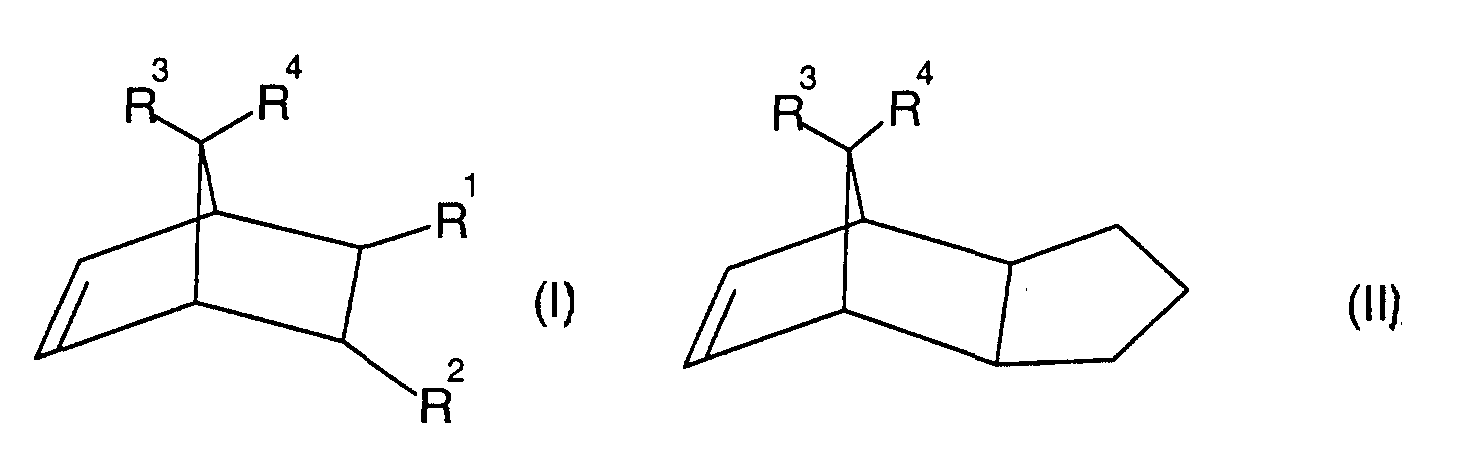
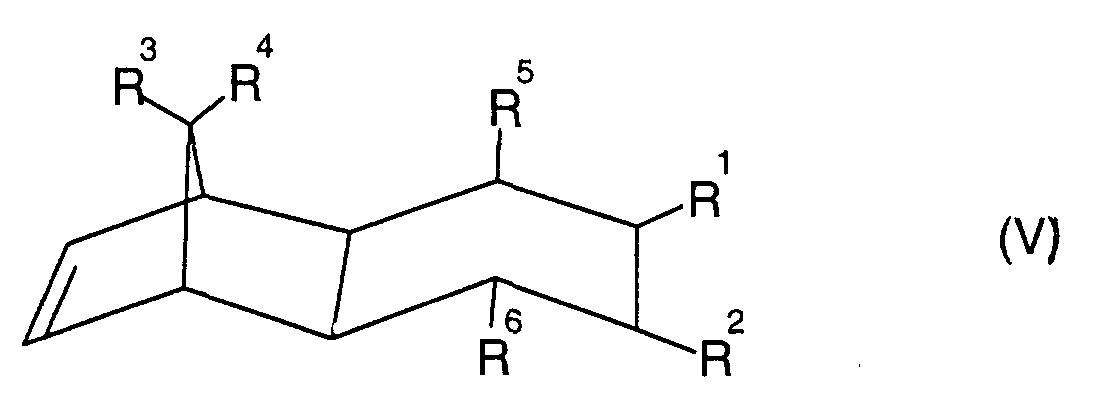
- Cycloolefin polymers are homopolymers or copolymers which contain polymerized cycloolefin units and optionally acyclic olefins as comonomers. Cycloolefin polymers which contain 0.1 to 100% by weight, preferably 10 to 99% by weight, particularly preferably 50-95% by weight, based on the total mass of the cycloolefin polymer, of polymerized cycloolefin units are suitable for the present invention. Particularly preferred are polymers which are composed of the monomers of the cyclic olefins of the formulas I, II, III, IV, V or VI:
- R 1 , R 2 , R 3 , R 4 , R 5 , R 6 , R 7 and R 8 are identical or different and represent a hydrogen atom or a C 1 -C 30 hydrocarbon radical; or two or more of the radicals R 1 to R 8 are cyclically linked, the same radicals in the different formulas having the same or different meaning.
- C 1 -C 30 hydrocarbon radicals are, for example, linear or branched C 1 -C 8 alkyl radicals, C 6 -C 18 aryl radicals, C 7 -C 20 alkylene aryl radicals or cyclic C 3 -C 20 alkyl radicals or acyclic C 2 -C 20 alkenyl groups.
- the COCs can contain 0 to 45% by weight, based on the total mass of the cycloolefin polymer, of polymerized units of at least one monocyclic olefin of the formula VII:
- n is a number from 2 to 10.
- the COCs can optionally contain 0 to 99% by weight, based on the total mass of COC, of polymerized units of an acyclic olefin of the formula VIII:
- R 9 , R 10 , R 11 and R 12 are identical or different and represent a hydrogen atom or C 1 -C 10 hydrocarbon radicals, for example a C 1 -C 8 alkyl radical or C 6 -C 14 aryl radical.
- cycloolefin polymers which are ring-opening Polymerization of at least one of the monomers of the formulas I to VI and subsequent Hydrogenation can be obtained.
- Cycloolefin homopolymers are composed of a monomer of the formulas I to VI. These cycloolefin polymers are less for the purposes of the present invention suitable. Cycloolefin copolymers are for the purposes of the present invention (COC) suitable, which have at least one cycloolefin of the formulas I to VI and acyclic Contain olefins of formula VIII as a comonomer. There are such as acyclic olefins preferred, which have 2 to 20 carbon atoms, especially unbranched acyclic olefins with 2 to 10 carbon atoms such as ethylene, propylene and / or butylene.
- the amount polymerized units of acyclic olefins of the formula VIII is up to 99% by weight, preferably 5 to 80 wt .-%, particularly preferably 10 to 60 wt .-%, based on the Total weight of the respective COC.
- COCs described above those are particularly preferred polymerized units of polycyclic olefins with norbornene basic structure, especially preferably contain norbornene or tetracyclododecene.
- COCs containing polymerized units of acyclic olefins, especially ethylene are particularly preferred.
- norbornene / ethylene and tetracyclododecene / ethylene copolymers which contain 5 to 80% by weight, preferably 10 to 60% by weight, of ethylene (based on the weight of the copolymer).
- the cycloolefin polymers generically described above generally have Glass transition temperatures between -20 ° C and 400 ° C.
- COCs can be used which preferably have a glass transition temperature of greater than 70 ° C have greater than 90 ° C and in particular greater than 110 ° C.
- the viscosity number (Dekalin, 135 ° C, DIN 53 728) is advantageously between 0.1 and 200 ml / g, preferably between 50 and 150 ml / g.
- the COCs are produced by heterogeneous or homogeneous catalysis organometallic compounds and is described in a variety of documents. Suitable catalyst systems based on mixed catalysts made of titanium or Vanadium compounds in connection with aluminum organyls are described in DD 109 224, DD 237 070 and EP-A-0 156 464. EP-A-0 283 164, EP-A-0 407 870, EP-A-0 485 893 and EP-A-0 503 422 describe the production of COCs with catalysts, based on soluble metallocene complexes. To the writings mentioned above The COC manufacturing process described is hereby expressly incorporated by reference taken.
- the COCs are incorporated into the film either as pure granules or as granulated concentrates (masterbatch) by premixing the polyester granules or powder with the COC or the COC masterbatch and then feeding them to the extruder.
- the components are mixed further in the extruder and heated to processing temperature. It is expedient for the process according to the invention that the extrusion temperature is above the glass transition temperature T g of the COC, generally at least 5 K, preferably 10 to 180 K, in particular 15 to 150 K, above the glass transition temperature of the COC.
- the same can be used for the intermediate layers and for the cover layers Polymers are used as for the base layer.
- the Covering layers may also contain other materials, with the covering layers then preferably from a mixture of polymers, a copolymer or a Homopolymers, which consist of ethylene-2,6-naphthalate units and ethylene terephthalate units contain. Up to 30 mol% of the polymers can be made from other Comonomers (e.g. ethylene isophthalate units) exist.
- the base layer and the other layers can additionally conventional additives such as Stabilizers, antiblocking agents and other fillers.
- Stabilizers are, for example, phosphorus compounds, such as phosphoric acid or Phosphoric acid ester used.
- the invention milky translucent film further UV stabilized (see WO 98/06575), flame retardant or UV stabilized and flame retardant in combination.
- Typical flame retardants include bromine compounds, chlorinated paraffins and other chlorine compounds, antimony trioxide, aluminum trihydrates, the halogen compounds are disadvantageous due to the resulting halogen-containing by-products.
- the low light resistance of a film equipped with it is next to the Development of hydrogen halide in the event of fire extremely disadvantageous.
- Suitable flame retardants which are used according to the invention are for example organic phosphorus compounds such as carboxyphosphinic acids Anhydrides and dimethyl methylphosphonate.
- Typical antiblocking agents also referred to as pigments in this context
- inorganic and / or organic particles for example calcium carbonate, amorphous Silica, talc, magnesium carbonate, barium carbonate, calcium sulfate, barium sulfate, Lithium phosphate, calcium phosphate, magnesium phosphate, aluminum oxide, lithium fluoride, Calcium, barium, zinc or manganese salts of the dicarboxylic acids used, carbon black, Titanium dioxide, kaolin or cross-linked polymer particles, e.g. Polystyrene or acrylate particles.
- Antiblocking agents or mixtures of antiblocking agents of the same composition can also be used as additives
- Antiblocking agents or mixtures of antiblocking agents of the same composition can also be used as additives
- Antiblocking agents or mixtures of antiblocking agents of the same composition can also be used as additives
- Antiblocking agents or mixtures of antiblocking agents of the same composition can also be used as additives
- the particles can be the polymers of the individual layers of the film in the respective advantageous amounts, e.g. than glycolic Dispersion during polycondensation or via masterbatches during extrusion be added. Pigment concentrations from 0 to have been found to be particularly suitable 25% by weight (based on the weight of the respective layer).
- a detailed A description of the antiblocking agents can be found, for example, in EP-A-0 602 964.
- the base layer or the other additional layers can be pigmented further contain.
- additional additives Barium sulfate with a grain size of 0.3 to 0.8 ⁇ m, preferably 0.4 to 0.7 ⁇ m, measured according to the Sedigraph method, or titanium dioxide with a grain size of 0.05 to 0.3 ⁇ m. This gives the film a brilliant appearance.
- the amount of Barium sulfate or titanium dioxide is in the range from 0.1 to 25% by weight, preferably from 0.2 to 20 wt .-%, and very particularly preferably from 0.3 to 15 wt .-%.
- the total thickness of the film can vary within wide limits and depends on the intended use.
- the preferred embodiments of the films according to the invention have total thicknesses of 4 to 400 ⁇ m, 8 to 300 ⁇ m, in particular 10 to 300 ⁇ m are preferred.
- the thickness of any, if any Intermediate layer (s) is generally 0.5 to 15 ⁇ m, independently of one another, intermediate layer thicknesses of 1 to 10 ⁇ m, in particular 1 to 8 ⁇ m, are preferred.
- the values given relate to an intermediate layer.
- the thickness of the Top layer / s is chosen independently of the other layers and is preferred in the range from 0.1 to 10 ⁇ m, in particular from 0.2 to 5 ⁇ m, preferably from 0.3 to 2 ⁇ m, with cover layers applied on both sides with regard to thickness and composition can be the same or different.
- the thickness of the base layer results accordingly from the difference between the total thickness of the film and the thickness of the applied top and intermediate layer (s) and can therefore be analogous to the total thickness vary within wide limits.
- the invention further relates to a method for producing the invention Polyester film according to the known extrusion or coextrusion process.
- the procedure is such that the one-layer film / Melt / melts corresponding to the individual layers of the film is / are extruded / co-extruded through a flat die, the film thus obtained for Solidification is peeled off on one or more rollers, then the film biaxially stretched (oriented), the biaxially stretched film is heat-set and, if necessary Corona or flame treated on the surface layer intended for treatment becomes.
- the stretching can also be carried out in one Simultaneous stretching frames (simultaneous stretching) take place, the number of stretching steps both directions (MD direction and TD direction) and their sequence not from is of crucial importance for the property profile of the film.
- Simultaneous stretching frames Simultaneous stretching
- the number of stretching steps both directions (MD direction and TD direction) and their sequence not from is of crucial importance for the property profile of the film.
- Stretching temperatures that are lower than 135 ° C, particularly favorable lower than 130 ° C.
- the Stretching ratios correspond to those of the conventional sequential stretching process.
- the temperature at which the drawing is carried out can be in a relatively large Range vary and depends on the desired properties of the film.
- the longitudinal stretching is at 80 to 130 ° C and the transverse stretching at 90 to 150 ° C carried out.
- the aspect ratio is generally in the range from 2.5: 1 to 6: 1, preferably from 3: 1 to 5.5: 1.
- the transverse stretching ratio is generally in the range of 3.0: 1 to 5.0: 1, preferably from 3.5: 1 to 4.5: 1.
- the film is over a period of about 0.1 to Maintained at a temperature of 150 to 250 ° C for 10 s. Then the slide cooled and then wound up in the usual way.
- the film can be chemically treated to set other desired properties be corona or flame treated.
- the treatment intensity is like this chosen so that the surface tension of the film is generally above 45 mN / m.
- the film can also be coated to set further properties.
- Typical coatings are anti-static, anti-slip or anti-slip layers with an adhesive effect. It is advisable to add these additional layers via in-line coating by means of aqueous dispersions before transverse stretching on the film to apply.
- the particular advantage of the film according to the invention is expressed by its particular Whiteness in combination with their certain opacity with certain at the same time Transparency.
- regenerate essentially from Polyester raw material and COC
- the film does not change its color undefined, which is the case with the prior art films.
- an advantage of the invention is that the manufacturing costs of the inventive film are comparable to conventional opaque films after State of the art.
- the other properties relevant to processing and use the film according to the invention remain essentially unchanged or even are improved.
- the film is ideal for packaging light and / or air sensitive Food and luxury goods. In addition, it is also excellent for use in industrial area, e.g. in the production of stamping foils or as label foils, suitable. In addition, the film is of course particularly suitable for imaging papers, Print sheets, magnetic recording cards, just a few possible applications to call. A particularly impressive visual appearance results, when the foil is subjected to a metallization. Here comes the special one metallic character of the film is particularly noticeable and can thus e.g. can also be used for advertising purposes.
- Table 1 summarizes the most important film properties according to the invention in a particularly illustrative manner.
- the standard viscosity SV (DCE) is measured based on DIN 53726 in dichloroacetic acid.
- the surface defects and the homogeneous coloring are determined visually.
- the friction was determined according to DIN 53 375.
- the sliding friction number was 14 days after measured in production.
- the surface tension was measured using the so-called ink method (DIN 53 364) certainly.
- the roughness R a of the film was determined in accordance with DIN 4768 with a cut-off of 0.25 mm.
- the degree of whiteness and the opacity are determined using the electrical "ELREPHO" remission photometer from Zeiss, Oberkochem (DE), standard illuminant C, 2 ° normal observer.
- the opacity is determined in accordance with DIN 53 146.
- the white standard is a barium sulfate compact (DIN 5033, Part 9) used. A detailed description is e.g. in Hansl Loos "Color measurement”, “Verlagph und here, Itzehoe (1989).
- the light transmittance is measured based on ASTM-D 1033-77.
- the gloss was determined in accordance with DIN 67 530.
- the reflector value was measured as optical parameter for the surface of a film. Based on the standards ASTM-D 523-78 and ISO 2813 the angle of incidence was set at 60 °. A beam of light hits at the set angle of incidence on the flat test surface and is from this reflected or scattered. Those striking the photoelectronic receiver Light rays are displayed as a proportional electrical quantity. The measured value is dimensionless and must be specified with the angle of incidence.
- the glass transition temperature T g was determined on the basis of film samples with the aid of DSC (Differential Scanning Calorimetry) (DIN 73 765). A DSC 1090 from DuPont was used. The heating rate was 20 K / min and the initial weight was about 12 mg.
- the glass transition T g was determined in the first heating process. The samples often showed enthalpy relaxation (a peak) at the beginning of the step-shaped glass transition. The T g was the temperature at which the step-like change in the heat capacity - regardless of the peak-shaped enthalpy relaxation - reached half its height in the first heating process. In all cases, only a single glass transition stage was observed in the thermogram when it was first heated up.
- Polyethylene terephthalate chips (produced by the transesterification process using Mn as the transesterification catalyst, Mn concentration: 100 ppm) were dried at 150 ° C. to a residual moisture content of below 100 ppm and fed to the extruder for the base layer B.
- the quantitative proportion of the cycloolefin copolymer (COC) in the total film was 2% by weight.
- Base layer B mixture of: 98.0% by weight Polyethylene terephthalate homopolymer with an SV value of 800 2.0% by weight Cycloolefin copolymers (COC) from Ticona, Topas 6015
- the film had the required good properties and showed the desired handling and the desired processing behavior.
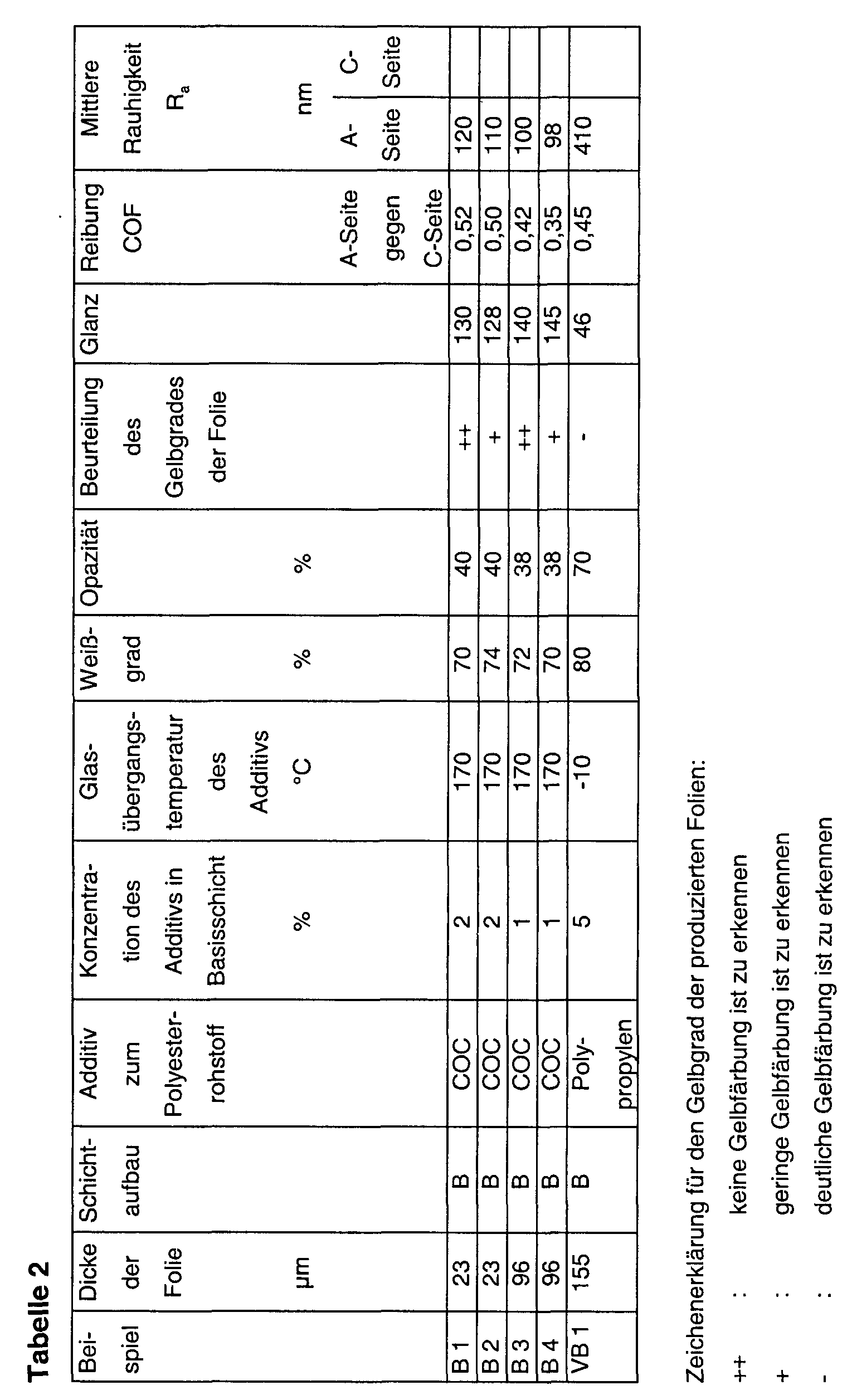
- the properties achieved in this way Films produced are shown in Table 2.
- Example 2 shows that hardly any yellow discoloration of the film has become visible.
- Base layer B mixture of: 49.0% by weight Polyethylene terephthalate homopolymer with an SV value of 800 50.0% by weight Regenerate (98% by weight polyester + 2% by weight Topas 6015) 1.0% by weight Cycloolefin copolymers (COC) from Ticona, Topas 6015
- Example 2 In comparison to Example 1, a film with a thickness of 96 ⁇ m was now produced. The The amount of COC in the film was 1% by weight. The process parameters were in Not changed compared to example 1. The yellowing of the film became visual observed. Table 2 shows that no yellow discoloration of the film is visible has become.
- Base layer B mixture of: 99.0% by weight Polyethylene terephthalate homopolymer with an SV value of 800 1.0% by weight Cycloolefin copolymers (COC) from Ticona, Topas 6015
- Example 2 shows that there is hardly any yellowing of the Film has become visible.
- Base layer B mixture of: 49.5% by weight Polyethylene terephthalate homopolymer with an SV value of 800 50.0% by weight Self-regenerated (99% by weight polyester + 1% by weight Topas 6015) 0.5% by weight Cycloolefin copolymers (COC) from Ticona, Topas 6015
- Example 1 from DE-A 2 353 347 was reworked. Modifying the example an additional 50% by weight of regrind was processed. Table 2 shows that a clear yellowing of the film has become visible. Besides, that is Transparency of the film too low.
- Base layer B mixture of: 47.5% by weight Polyethylene terephthalate homopolymer with an SV value of 800 50.0% by weight Self-regenerated (95% polyester + 5% polypropylene) 2.5% by weight Polypropylene
Landscapes
- Chemical & Material Sciences (AREA)
- Engineering & Computer Science (AREA)
- Manufacturing & Machinery (AREA)
- Organic Chemistry (AREA)
- Health & Medical Sciences (AREA)
- Chemical Kinetics & Catalysis (AREA)
- Medicinal Chemistry (AREA)
- Polymers & Plastics (AREA)
- Materials Engineering (AREA)
- Laminated Bodies (AREA)
- Shaping By String And By Release Of Stress In Plastics And The Like (AREA)
- Manufacture Of Macromolecular Shaped Articles (AREA)
- Molding Of Porous Articles (AREA)
- Compositions Of Macromolecular Compounds (AREA)
- Coating Of Shaped Articles Made Of Macromolecular Substances (AREA)
- Treatments Of Macromolecular Shaped Articles (AREA)
Abstract
Description




Die intrinsische Viskosität (IV) berechnet sich wie folgt aus der Standardviskosität (SV)
| 98,0 Gew.-% | Polyethylenterephthalat-Homopolymer mit einem SV-Wert von 800 |
| 2,0 Gew.-% | Cycloolefincopolymeren (COC) der Fa. Ticona, Topas 6015 |
| Extrusion | Temperaturen Basis-Schicht | 280 °C |
| Temperatur der Abzugswalze | 30 °C | |
| Längsstreckung | Temperatur | 80 - 125 °C |
| Längsstreckverhältnis | 4,2 | |
| Querstreckung | Temperatur | 80 - 135 °C |
| Querstreckverhältnis | 4,0 | |
| Fixierung | Temperatur | 230 °C |
| Dauer | 3 s |
| 49,0 Gew.-% | Polyethylenterephthalat-Homopolymer mit einem SV-Wert von 800 |
| 50,0 Gew.-% | Regenerat (98 Gew.-% Polyester + 2 Gew.-% Topas 6015) |
| 1,0 Gew.-% | Cycloolefincopolymeren (COC) der Fa. Ticona, Topas 6015 |
| 99,0 Gew.-% | Polyethylenterephthalat-Homopolymer mit einem SV-Wert von 800 |
| 1,0 Gew.-% | Cycloolefincopolymeren (COC) der Fa. Ticona, Topas 6015 |
| 49,5 Gew.-% | Polyethylenterephthalat-Homopolymer mit einem SV-Wert von 800 |
| 50,0 Gew.-% | Eigenregenerat (99 Gew.-% Polyester + 1 Gew.-% Topas 6015) |
| 0,5 Gew.-% | Cycloolefincopolymeren (COC) der Fa. Ticona, Topas 6015 |
| 47,5 Gew.-% | Polyethylenterephthalat-Homopolymer mit einem SV-Wert von 800 |
| 50,0 Gew.-% | Eigenregenerat (95 Gew.-% Polyester + 5 Gew.-% Polypropylen) |
| 2,5 Gew.-% | Polypropylen |
Claims (17)
- Milchig durchscheinende, biaxial orientierte Polyesterfolie umfassend mindestens eine Schicht, dadurch gekennzeichnet, dass zumindest diese Schicht ein Cycloolefincopolymeres (COC) in einer Menge von maximal 5 Gew.-%, bezogen auf das Gewicht dieser Schicht enthält.
- Milchig durchscheinende Polyesterfolie nach Anspruch 1, dadurch gekennzeichnet, dass das COC Polynorbornen, Polydimethyloctahydronaphthalin, Polycyclopenten oder Poly(5-methyl)norbornen enthält und dass die Glasübergangstemperatur des COCs im Bereich von 70 bis 270 °C liegt.
- Milchig durchscheinende Polyesterfolie nach Anspruch 1 oder 2, dadurch gekennzeichnet, dass die Schicht das COC in einer Menge im Bereich von 0,1 bis 4,5 Gew.-%, bezogen auf das Gewicht der Schicht, enthält und dass das COC eine Glasübergangstemperatur im Bereich von 90 bis 250 °C aufweist.
- Milchig durchscheinende Polyesterfolie nach einem der Ansprüche 1 oder 2, dadurch gekennzeichnet, dass die Schicht das COC in einer Menge im Bereich von 0,2 bis 4,0 Gew.-%, bezogen auf das Gewicht der Schicht, enthält und dass das COC eine Glasübergangstemperatur im Bereich von 110 bis 220 °C aufweist.
- Milchig durchscheinende Polyesterfolie nach einem oder mehreren der Ansprüche 1 bis 4, dadurch gekennzeichnet, dass die Folie einen Weißgrad im Bereich von 15 bis 110 % aufweist.
- Milchig durchscheinende Polyesterfolie nach einem oder mehreren der Ansprüche 1 bis 5, dadurch gekennzeichnet, dass die Folie eine Opazität im Bereich von 5 bis 55 % aufweist.
- Milchig durchscheinende Polyesterfolie nach einem oder mehreren der Ansprüche 1 bis 6, dadurch gekennzeichnet, dass die Folie eine Transparenz im Bereich von 45 bis 95 % aufweist.
- Milchig durchscheinende Polyesterfolie nach einem oder mehreren der Ansprüche 1 bis 7, dadurch gekennzeichnet, dass die Schicht 0,5 bis 25 Gew.-% weiterer vakuoleniniziierender und/oder weißer Füllstoffe und/oder Pigmente enthält, jeweils bezogen auf das Gewicht der Schicht.
- Milchig durchscheinende Polyesterfolie nach einem oder mehreren der Ansprüche 1 bis 8, dadurch gekennzeichnet, dass auf der COC-haltigen Schicht wenigstens eine Deckschicht angeordnet ist.
- Milchig durchscheinende Polyesterfolie nach Anspruch 9, dadurch gekennzeichnet, dass zwischen der COC-haltigen Schicht und der Deckschicht eine Zwischenschicht angeordnet ist.
- Milchig durchscheinende Polyesterfolie nach einem oder mehreren der Ansprüche 1 bis 8, dadurch gekennzeichnet, dass die Folie einschichtig ist und aus der COC-haltigen Schicht besteht.
- Verfahren zum Herstellen einer milchig durchscheinenden Polyesterfolie nach einem der Ansprüche 1 bis 11, bei dem die der einschichtigen Folie/die den einzelnen Schichten der Folie entsprechende Schmelze/entsprechenden Schmelzen durch eine Flachdüse extrudiert/koextrudiert wird/werden, die so erhaltene Folie zur Verfestigung auf einer oder mehreren Walze/n abgezogen wird, die Folie anschließend biaxial gestreckt, die biaxial gestreckte Folie thermofixiert und gegebenenfalls an wenigstens einer Oberflächenschicht corona- oder flammbehandelt wird, dadurch gekennzeichnet, dass die biaxiale Verstreckung sequentiell durchgeführt wird, wobei zuerst in Längsrichtung und anschließend in Querrichtung verstreckt wird und wobei die Temperatur bei der Längsstreckung in einem Bereich von 80 bis 130 °C und die Temperatur bei der Querstreckung in einem Bereich von 90 bis 150 °C und das Längsstreckverhältnis im Bereich von 2,5:1 bis 6:1, bevorzugt von 3:1 bis 5,5:1, das Querstreckverhältnis im Bereich von 3,0:1 bis 5,0:1, bevorzugt von 3,5:1 bis 4,5:1, eingestellt wird.
- Verfahren zum Herstellen einer milchig durchscheinenden Polyesterfolie nach einem der Ansprüche 1 bis 11, bei dem die der einschichtigen Folie/die den einzelnen Schichten der Folie entsprechende Schmelze/entsprechenden Schmelzen durch eine Flachdüse extrudiert/koextrudiert wird/werden, die so erhaltene Folie zur Verfestigung auf einer oder mehreren Walze/n abgezogen wird, die Folie anschließend biaxial gestreckt, die biaxial gestreckte Folie thermofixiert und gegebenenfalls an wenigstens einer Oberflächenschicht corona- oder flammbehandelt wird, dadurch gekennzeichnet, dass die biaxiale Verstreckung simultan durchgeführt wird und in einem Simultanstreckrahmen erfolgt, wobei die Strecktemperaturen in einem Bereich von kleiner/gleich 135 °C, bevorzugt kleiner/gleich 130 °C, eingestellt werden.
- Verfahren nach Ansprüch 12 oder 13, dadurch gekennzeichnet, dass die Folie nach der Verstreckung zur Thermofixierung über eine Zeitdauer von 0,1 bis 10 s bei einer Temperatur im Bereich von 150 bis 250 °C gehalten und anschließend abgekühlt und dann aufgewickelt wird.
- Verfahren nach einem der Ansprüche 12 bis 14, dadurch gekennzeichnet, dass die Folie zur Einstellung weiterer gewünschter Eigenschaften auf wenigstens einer Oberfläche chemisch behandelt oder corona- bzw. flammbehandelt wird, wobei die Behandlungsintensität ist so eingestellt wird, dass die Oberflächenspannung der Folie über 45 mN/m liegt.
- Verfahren nach einem der Ansprüche 12 bis 15, dadurch gekennzeichnet, dass die Folie zur Einstellung weiterer Eigenschaften mit einer haftvermittelnden oder antistatischen oder schlupfverbessernden oder dehäsiv wirkenden zusätzlichen Beschichtung versehen wird, wobei die zusätzliche Beschichtung über in-line coating mittels wässriger Dispersionen nach der Längsstreckung und vor der Querverstreckung auf die Folie aufgebracht wird.
- Verwendung einer milchig durchscheinenden Folie nach einem der Ansprüche 1 bis 11 zur Verpackung von licht- und/oder luftempfindlichen Nahrungs- und Genußmitteln oder für den Einsatz im industrieellen Bereich, insbesondere bei der Herstellung von Prägefolien oder als Etikettenfolie, oder für Bildaufzeichnungspapiere, Druckbögen oder magnetische Aufzeichnungskarten oder für die Metallisierung.
Applications Claiming Priority (2)
| Application Number | Priority Date | Filing Date | Title |
|---|---|---|---|
| DE10012137 | 2000-03-13 | ||
| DE10012137A DE10012137A1 (de) | 2000-03-13 | 2000-03-13 | Biaxial orientierte Polyesterfolie enthaltend ein Cycloolefincopolymer, Verfahren zu ihrer Herstellung und ihre Verwendung |
Publications (2)
| Publication Number | Publication Date |
|---|---|
| EP1138716A1 true EP1138716A1 (de) | 2001-10-04 |
| EP1138716B1 EP1138716B1 (de) | 2005-06-08 |
Family
ID=7634516
Family Applications (1)
| Application Number | Title | Priority Date | Filing Date |
|---|---|---|---|
| EP01105742A Expired - Lifetime EP1138716B1 (de) | 2000-03-13 | 2001-03-08 | Biaxal orientierte Polyesterfolie enthaltend ein Cycloolefincopolymer, Verfahren zu ihrer Herstellung und ihre Verwendung |
Country Status (5)
| Country | Link |
|---|---|
| US (1) | US6326431B1 (de) |
| EP (1) | EP1138716B1 (de) |
| JP (1) | JP2001294735A (de) |
| KR (1) | KR100729711B1 (de) |
| DE (2) | DE10012137A1 (de) |
Families Citing this family (27)
| Publication number | Priority date | Publication date | Assignee | Title |
|---|---|---|---|---|
| DE19932384A1 (de) * | 1999-07-14 | 2001-01-18 | Mitsubishi Polyester Film Gmbh | Weiße, biaxial orientierte Polyesterfolie mit Cycloolefincopolymer (COC), Verfahren zu ihrer Herstellung und ihre Verwendung |
| DE10009295A1 (de) * | 2000-02-28 | 2001-08-30 | Mitsubishi Polyester Film Gmbh | Weisse, biaxial orientierte, schwer entflammbare Polyesterfolie mit Cycloolefincopolymer, Verfahren zu ihrer Herstellung und ihre Verwendung |
| DE10009286A1 (de) * | 2000-02-28 | 2001-08-30 | Mitsubishi Polyester Film Gmbh | Weisse, biaxial orientierte, schwer entflammbare und UV-stabilisierte Polyesterfolie mit Cycloolefincopolymer, Verfahren zu ihrer Herstellung und ihre Verwendung |
| DE10011652A1 (de) * | 2000-03-10 | 2001-09-13 | Mitsubishi Polyester Film Gmbh | Biaxial orientierte Polyesterfolie mit hohem Weißgrad, Verfahren zu ihrer Herstellung und ihre Verwendung |
| DE10022942A1 (de) * | 2000-05-11 | 2001-11-15 | Mitsubishi Polyester Film Gmbh | Weisse, zumindest einseitig matte, biaxial orientierte Polyesterfolie mit Cycloolefincopolymer, Verfahren zu ihrer Herstellung und ihre Verwendung |
| DE10026177A1 (de) * | 2000-05-26 | 2001-11-29 | Mitsubishi Polyester Film Gmbh | Weiße, hochglänzende Polyesterfolie enthaltend Cycloolefincopolymer (COC), Verfahren zu ihrer Herstellung und ihre Verwendung |
| DE10030238A1 (de) * | 2000-06-20 | 2002-01-03 | Mitsubishi Polyester Film Gmbh | Weiße, siegelfähige, biaxial orientierte, koextrudierte Polyesterfolie mit Cycloolefincopolymer, Verfahren zu ihrer Herstellung und ihre Verwendung |
| DE10030235A1 (de) * | 2000-06-20 | 2002-01-03 | Mitsubishi Polyester Film Gmbh | Weiße, siegelfähige, thermoformbare, biaxial orientierte und koextrudierte Polyesterfolie mit Cycloolefincopolymer, Verfahren zu ihrer Herstellung und ihre Verwendung |
| DE10035328A1 (de) * | 2000-07-20 | 2002-01-31 | Mitsubishi Polyester Film Gmbh | Opake Polyesterfolie enthaltend Cycloolefincopolymer (COC) mit guter Oberflächenhaftung, Verfahren zu ihrer Herstellung und ihre Verwendung |
| DE20020228U1 (de) | 2000-11-29 | 2001-01-25 | Töpfer Kulmbach GmbH, 95326 Kulmbach | Transparente Folie |
| DE10223663A1 (de) * | 2002-05-28 | 2003-12-11 | Mitsubishi Polyester Film Gmbh | Transparente Polyesterfolie mit verbesserter Wasserdampfbarriere, Verfahren zu ihrer Herstellung und ihre Verwendung |
| DE10223662A1 (de) * | 2002-05-28 | 2003-12-11 | Mitsubishi Polyester Film Gmbh | Transparente Polyesterfolie mit verbesserter Wasserdampfbarriere, Verfahren zu ihrer Herstellung und ihre Verwendung |
| DE10352432A1 (de) * | 2003-11-10 | 2005-06-09 | Mitsubishi Polyester Film Gmbh | Weiße, heißsiegelbare, peelfähige Polyesterfolie, Verfahren zu ihrer Herstellung und ihre Verwendung |
| US20060110613A1 (en) * | 2004-11-24 | 2006-05-25 | Toray Plastics (America), Inc. | Flame retardant metallized polyester films having anti-dripping properties |
| DE102005020913B3 (de) * | 2005-05-04 | 2006-08-03 | Brückner Maschinenbau GmbH | Hochfeste Barrierefolie für Verpackungszwecke auf Polypropylenbasis, Verfahren zu ihrer Herstellung und ihre Verwendung |
| JP4756167B2 (ja) * | 2006-12-27 | 2011-08-24 | 株式会社明治 | 包装体 |
| GB0710331D0 (en) * | 2007-05-30 | 2007-07-11 | Bioquell Uk Ltd | Improved in or relating to methods of decontaminating enclosed spaces |
| US8709589B2 (en) * | 2007-06-07 | 2014-04-29 | Toray Industries, Inc. | White polyester film and surface light source therewith |
| JP5366414B2 (ja) * | 2008-03-04 | 2013-12-11 | 三菱樹脂株式会社 | 積層ポリエステルフィルム |
| TWI391429B (zh) * | 2009-11-25 | 2013-04-01 | Ind Tech Res Inst | 白色延伸聚酯薄膜 |
| JP6504955B2 (ja) * | 2015-07-24 | 2019-04-24 | 富士フイルム株式会社 | 積層フィルムの製造方法、積層フィルム、透明導電フィルム、位相差フィルムおよび有機エレクトロルミネッセンス素子 |
| CN111629900B (zh) | 2017-12-29 | 2022-07-01 | 佩恩颜色公司 | 聚酯包装材料 |
| GB201806916D0 (en) | 2018-04-27 | 2018-06-13 | Dupont Teijin Films Us Lp | Polyester film |
| EP3883998A1 (de) * | 2018-11-23 | 2021-09-29 | Holland Colours N. V. | Cyclisches olefinpolymerkonzentrat für polyesterbasierte materialien |
| JP6611292B2 (ja) * | 2019-02-06 | 2019-11-27 | 富士フイルム株式会社 | 積層フィルムの製造方法、積層フィルム、透明導電フィルム、位相差フィルムおよび有機エレクトロルミネッセンス素子 |
| KR102889815B1 (ko) * | 2019-08-05 | 2025-11-27 | 플렉스 필름즈 (유에스에이) 인코포레이티드 | 밀도 조절된 열가소성 다층 필름 |
| JP2025104255A (ja) * | 2023-12-27 | 2025-07-09 | 株式会社ユポ・コーポレーション | 樹脂シートの製造方法及び樹脂シート |
Citations (6)
| Publication number | Priority date | Publication date | Assignee | Title |
|---|---|---|---|---|
| EP0522758A1 (de) * | 1991-07-02 | 1993-01-13 | Unitika Ltd. | Film mit aufgerauchter Oberfläche und Verfahren zu seiner Herstellung |
| JPH05140349A (ja) * | 1991-11-15 | 1993-06-08 | Unitika Ltd | 軽量化ポリエステルフイルム及びその製造方法 |
| EP0812874A1 (de) * | 1995-12-28 | 1997-12-17 | Gunze Limited | Leichtzerbrechbare folie |
| JPH1060143A (ja) * | 1996-08-27 | 1998-03-03 | Toyobo Co Ltd | 微細空洞含有ポリエステル系フィルム |
| JPH1135717A (ja) * | 1997-07-22 | 1999-02-09 | Oji Yuka Synthetic Paper Co Ltd | 微多孔性ポリエステル系樹脂フィルム |
| EP1068949A1 (de) * | 1999-07-14 | 2001-01-17 | Mitsubishi Polyester Film GmbH | Weisse, biaxial orientierte Polyesterfolie mit Cycloolefincopolymer (COC), Verfahren zu ihrer Herstellung und ihre Verwendung |
Family Cites Families (8)
| Publication number | Priority date | Publication date | Assignee | Title |
|---|---|---|---|---|
| DE237070C (de) | ||||
| GB1415686A (en) | 1972-10-24 | 1975-11-26 | Ici Ltd | Voided films |
| US4614778A (en) | 1984-02-03 | 1986-09-30 | Hirokazu Kajiura | Random copolymer |
| US5003019A (en) | 1987-03-02 | 1991-03-26 | Mitsui Petrochemical Industries, Ltd. | Cyclo-olefinic random copolymer, olefinic random copolymer, and process for producing cyclo-olefinic random copolymers |
| DE3922546A1 (de) | 1989-07-08 | 1991-01-17 | Hoechst Ag | Verfahren zur herstellung von cycloolefinpolymeren |
| TW227005B (de) | 1990-11-14 | 1994-07-21 | Hoechst Ag | |
| EP0503422B1 (de) | 1991-03-09 | 1998-06-03 | TARGOR GmbH | Verfahren zur Herstellung chemisch einheitlicher Cycloolefincopolymere |
| JP3131466B2 (ja) * | 1991-07-02 | 2001-01-31 | ユニチカ株式会社 | 軽量化ポリエステルフィルム及びその製造方法 |
-
2000
- 2000-03-13 DE DE10012137A patent/DE10012137A1/de not_active Withdrawn
-
2001
- 2001-02-26 KR KR1020010009681A patent/KR100729711B1/ko not_active Expired - Fee Related
- 2001-02-27 US US09/794,507 patent/US6326431B1/en not_active Expired - Fee Related
- 2001-03-08 EP EP01105742A patent/EP1138716B1/de not_active Expired - Lifetime
- 2001-03-08 DE DE50106425T patent/DE50106425D1/de not_active Expired - Fee Related
- 2001-03-09 JP JP2001066716A patent/JP2001294735A/ja not_active Withdrawn
Patent Citations (6)
| Publication number | Priority date | Publication date | Assignee | Title |
|---|---|---|---|---|
| EP0522758A1 (de) * | 1991-07-02 | 1993-01-13 | Unitika Ltd. | Film mit aufgerauchter Oberfläche und Verfahren zu seiner Herstellung |
| JPH05140349A (ja) * | 1991-11-15 | 1993-06-08 | Unitika Ltd | 軽量化ポリエステルフイルム及びその製造方法 |
| EP0812874A1 (de) * | 1995-12-28 | 1997-12-17 | Gunze Limited | Leichtzerbrechbare folie |
| JPH1060143A (ja) * | 1996-08-27 | 1998-03-03 | Toyobo Co Ltd | 微細空洞含有ポリエステル系フィルム |
| JPH1135717A (ja) * | 1997-07-22 | 1999-02-09 | Oji Yuka Synthetic Paper Co Ltd | 微多孔性ポリエステル系樹脂フィルム |
| EP1068949A1 (de) * | 1999-07-14 | 2001-01-17 | Mitsubishi Polyester Film GmbH | Weisse, biaxial orientierte Polyesterfolie mit Cycloolefincopolymer (COC), Verfahren zu ihrer Herstellung und ihre Verwendung |
Non-Patent Citations (3)
| Title |
|---|
| PATENT ABSTRACTS OF JAPAN vol. 017, no. 516 (C - 1112) 17 September 1993 (1993-09-17) * |
| PATENT ABSTRACTS OF JAPAN vol. 1998, no. 08 30 June 1998 (1998-06-30) * |
| PATENT ABSTRACTS OF JAPAN vol. 1999, no. 05 31 May 1999 (1999-05-31) * |
Also Published As
| Publication number | Publication date |
|---|---|
| DE50106425D1 (de) | 2005-07-14 |
| US6326431B1 (en) | 2001-12-04 |
| DE10012137A1 (de) | 2001-09-20 |
| JP2001294735A (ja) | 2001-10-23 |
| KR20010091911A (ko) | 2001-10-23 |
| EP1138716B1 (de) | 2005-06-08 |
| KR100729711B1 (ko) | 2007-06-18 |
Similar Documents
| Publication | Publication Date | Title |
|---|---|---|
| EP1068949B1 (de) | Weisse, biaxial orientierte Polyesterfolie mit Cycloolefincopolymer (COC), Verfahren zu ihrer Herstellung und ihre Verwendung | |
| EP1138716B1 (de) | Biaxal orientierte Polyesterfolie enthaltend ein Cycloolefincopolymer, Verfahren zu ihrer Herstellung und ihre Verwendung | |
| EP1132425B1 (de) | Weisse, biaxial orientierte, schwer entflammbare Polyesterfolie mit Cycloolefincopolymer, Verfahren zu ihrer Herstellung und ihre Verwendung | |
| EP1132424B1 (de) | Weisse, biaxial orientierte, schwer entflammbare und UV-stabilisierte Polyesterfolie mit Cycloolefincopolymer, Verfahren zu ihrer Herstellung und ihre Verwendung | |
| DE10011652A1 (de) | Biaxial orientierte Polyesterfolie mit hohem Weißgrad, Verfahren zu ihrer Herstellung und ihre Verwendung | |
| EP1296831A2 (de) | Weisse, siegelfähige, thermoformbare, biaxial orientierte und koextrudierte polyesterfolie mit cycloolefincopolymer, verfahren zu ihrer herstellung und ihre verwendung | |
| EP1127912A1 (de) | Weisse, biaxial orientierte und UV-stabilisierte Polyesterfolie mit Cycloolefincopolymer (COC), Verfahren zu ihrer Herstellung und ihre Verwendung | |
| EP1289759B1 (de) | Weisse, hochglänzende, polyesterfolie enthaltend cycloolefincopolymer (coc), verfahren zu ihrer herstellung und ihre verwendung | |
| DE10051083A1 (de) | Koextrudierte, zumindest einseitig matte, biaxial orientierte Polyesterfolie | |
| DE10051082A1 (de) | Matte, koextrudierte, biaxial orientierte Polyesterfolie | |
| DE10121150A1 (de) | Opake Folie aus PLA | |
| DE10051084A1 (de) | Matte, biaxial orientierte Polyesterfolie | |
| DE10022942A1 (de) | Weisse, zumindest einseitig matte, biaxial orientierte Polyesterfolie mit Cycloolefincopolymer, Verfahren zu ihrer Herstellung und ihre Verwendung | |
| EP1186405B1 (de) | Koextrudierte, biaxial orientierte Polyesterfolie mit guter Metallhaftung, Verfahren zu ihrer Herstellung und ihre Verwendung | |
| DE10007671A1 (de) | Weiß-opake Folie mit niedriger Transparenz aus einem kristallisierbaren Thermoplasten | |
| EP1299235B1 (de) | Weisse, siegelfähige, biaxial orientierte, koextrudierte polyesterfolie mit cycloolefincopolymer (coc), verfahren zu ihrer herstellung und ihre verwendung | |
| EP1179420A2 (de) | Mindestens dreischichtige transparente Polyesterfolie, Verfahren zu ihrer Herstellung und ihre Verwendung | |
| DE10063590A1 (de) | Einseitig matte, siegelfähige,biaxial orientierte Polyesterfolie | |
| DE10022946A1 (de) | Weisse, zumindest einseitig matte, biaxial orientierte, UV-stabilisierte und schwer entflammbare Polyesterfolie mit Cycloolefincopolymer (COC), Verfahren zu ihrer Herstellung und ihre Verwendung | |
| DE10022947A1 (de) | Zumindest einseitig matte, biaxial orientierte Polyesterfolie mit hohem Weissgrad, Verfahren zu ihrer Herstellung und ihre Verwendung | |
| DE10026166A1 (de) | Weiße, pigmentierte, hochglänzende Polyesterfolie enthaltend Cycloolefincopolymer (COC), Verfahren zu ihrer Herstellung und ihre Verwendung | |
| DE10022943A1 (de) | Weisse, zumindest einseitig matte, biaxial orientierte und thermoformbare Polyesterfolie mit Cycloolefincopolymer, Verfahren zu ihrer Herstellung und ihre Verwendung | |
| DE10026167A1 (de) | Weiße, hochglänzende, UV-stabilisierte Polyesterfolie enthaltend Cycloolefincopolymer (COC), Verfahren zu ihrer Herstellung und ihre Verwendung | |
| DE10026164A1 (de) | Weiße, hochglänzende, thermoformbare Polyesterfolie enthaltend Cycloolefincopolymer (COC), Verfahren zu ihrer Herstellung und ihre Verwendung | |
| DE10030237A1 (de) | Weiße, siegelfähige, biaxial orientierte, schwer entflammbare, koextrudierte Polyesterfolie mit Cycloolefincopolymer(COC), Verfahren zu ihrer Herstellung und ihre Verwendung |
Legal Events
| Date | Code | Title | Description |
|---|---|---|---|
| PUAI | Public reference made under article 153(3) epc to a published international application that has entered the european phase |
Free format text: ORIGINAL CODE: 0009012 |
|
| AK | Designated contracting states |
Kind code of ref document: A1 Designated state(s): AT BE CH CY DE DK ES FI FR GB GR IE IT LI LU MC NL PT SE TR Kind code of ref document: A1 Designated state(s): DE FR GB IT LU NL |
|
| AX | Request for extension of the european patent |
Free format text: AL;LT;LV;MK;RO;SI |
|
| 17P | Request for examination filed |
Effective date: 20020404 |
|
| AKX | Designation fees paid |
Free format text: DE FR GB IT LU NL |
|
| 17Q | First examination report despatched |
Effective date: 20020619 |
|
| GRAP | Despatch of communication of intention to grant a patent |
Free format text: ORIGINAL CODE: EPIDOSNIGR1 |
|
| GRAS | Grant fee paid |
Free format text: ORIGINAL CODE: EPIDOSNIGR3 |
|
| RBV | Designated contracting states (corrected) |
Designated state(s): DE FR GB IT LU |
|
| GRAA | (expected) grant |
Free format text: ORIGINAL CODE: 0009210 |
|
| AK | Designated contracting states |
Kind code of ref document: B1 Designated state(s): DE FR GB IT LU |
|
| REG | Reference to a national code |
Ref country code: GB Ref legal event code: FG4D Free format text: NOT ENGLISH |
|
| REF | Corresponds to: |
Ref document number: 50106425 Country of ref document: DE Date of ref document: 20050714 Kind code of ref document: P |
|
| GBT | Gb: translation of ep patent filed (gb section 77(6)(a)/1977) |
Effective date: 20050917 |
|
| ET | Fr: translation filed | ||
| PLBE | No opposition filed within time limit |
Free format text: ORIGINAL CODE: 0009261 |
|
| STAA | Information on the status of an ep patent application or granted ep patent |
Free format text: STATUS: NO OPPOSITION FILED WITHIN TIME LIMIT |
|
| 26N | No opposition filed |
Effective date: 20060309 |
|
| PGFP | Annual fee paid to national office [announced via postgrant information from national office to epo] |
Ref country code: DE Payment date: 20070301 Year of fee payment: 7 |
|
| PGFP | Annual fee paid to national office [announced via postgrant information from national office to epo] |
Ref country code: GB Payment date: 20070307 Year of fee payment: 7 |
|
| PGFP | Annual fee paid to national office [announced via postgrant information from national office to epo] |
Ref country code: LU Payment date: 20070313 Year of fee payment: 7 |
|
| PGFP | Annual fee paid to national office [announced via postgrant information from national office to epo] |
Ref country code: IT Payment date: 20070514 Year of fee payment: 7 |
|
| PGFP | Annual fee paid to national office [announced via postgrant information from national office to epo] |
Ref country code: FR Payment date: 20070308 Year of fee payment: 7 |
|
| GBPC | Gb: european patent ceased through non-payment of renewal fee |
Effective date: 20080308 |
|
| REG | Reference to a national code |
Ref country code: FR Ref legal event code: ST Effective date: 20081125 |
|
| PG25 | Lapsed in a contracting state [announced via postgrant information from national office to epo] |
Ref country code: DE Free format text: LAPSE BECAUSE OF NON-PAYMENT OF DUE FEES Effective date: 20081001 |
|
| PG25 | Lapsed in a contracting state [announced via postgrant information from national office to epo] |
Ref country code: FR Free format text: LAPSE BECAUSE OF NON-PAYMENT OF DUE FEES Effective date: 20080331 |
|
| PG25 | Lapsed in a contracting state [announced via postgrant information from national office to epo] |
Ref country code: GB Free format text: LAPSE BECAUSE OF NON-PAYMENT OF DUE FEES Effective date: 20080308 |
|
| PG25 | Lapsed in a contracting state [announced via postgrant information from national office to epo] |
Ref country code: IT Free format text: LAPSE BECAUSE OF NON-PAYMENT OF DUE FEES Effective date: 20080308 |
|
| PG25 | Lapsed in a contracting state [announced via postgrant information from national office to epo] |
Ref country code: LU Free format text: LAPSE BECAUSE OF NON-PAYMENT OF DUE FEES Effective date: 20080308 |