EP1136877A2 - Photothermographisches Material - Google Patents
Photothermographisches Material Download PDFInfo
- Publication number
- EP1136877A2 EP1136877A2 EP01302616A EP01302616A EP1136877A2 EP 1136877 A2 EP1136877 A2 EP 1136877A2 EP 01302616 A EP01302616 A EP 01302616A EP 01302616 A EP01302616 A EP 01302616A EP 1136877 A2 EP1136877 A2 EP 1136877A2
- Authority
- EP
- European Patent Office
- Prior art keywords
- group
- coating
- layer
- photothermographic material
- inv
- Prior art date
- Legal status (The legal status is an assumption and is not a legal conclusion. Google has not performed a legal analysis and makes no representation as to the accuracy of the status listed.)
- Withdrawn
Links
- 239000000463 material Substances 0.000 title claims abstract description 61
- -1 silver halide Chemical class 0.000 claims abstract description 136
- 229910052709 silver Inorganic materials 0.000 claims abstract description 81
- 239000004332 silver Substances 0.000 claims abstract description 81
- 239000011230 binding agent Substances 0.000 claims abstract description 42
- GGCZERPQGJTIQP-UHFFFAOYSA-N sodium;9,10-dioxoanthracene-2-sulfonic acid Chemical compound [Na+].C1=CC=C2C(=O)C3=CC(S(=O)(=O)O)=CC=C3C(=O)C2=C1 GGCZERPQGJTIQP-UHFFFAOYSA-N 0.000 claims abstract description 35
- 229910000077 silane Inorganic materials 0.000 claims abstract description 31
- 239000003638 chemical reducing agent Substances 0.000 claims abstract description 10
- 239000004816 latex Substances 0.000 claims description 20
- 229920000126 latex Polymers 0.000 claims description 20
- 229920000642 polymer Polymers 0.000 claims description 14
- PPBRXRYQALVLMV-UHFFFAOYSA-N Styrene Chemical compound C=CC1=CC=CC=C1 PPBRXRYQALVLMV-UHFFFAOYSA-N 0.000 claims description 9
- 125000000217 alkyl group Chemical group 0.000 claims description 8
- 125000003118 aryl group Chemical group 0.000 claims description 8
- 125000002777 acetyl group Chemical class [H]C([H])([H])C(*)=O 0.000 claims description 7
- 125000000623 heterocyclic group Chemical group 0.000 claims description 7
- KAKZBPTYRLMSJV-UHFFFAOYSA-N Butadiene Chemical compound C=CC=C KAKZBPTYRLMSJV-UHFFFAOYSA-N 0.000 claims description 6
- 125000003342 alkenyl group Chemical group 0.000 claims description 6
- 125000000304 alkynyl group Chemical group 0.000 claims description 5
- DHKHKXVYLBGOIT-UHFFFAOYSA-N acetaldehyde Diethyl Acetal Natural products CCOC(C)OCC DHKHKXVYLBGOIT-UHFFFAOYSA-N 0.000 claims description 4
- OEPOKWHJYJXUGD-UHFFFAOYSA-N 2-(3-phenylmethoxyphenyl)-1,3-thiazole-4-carbaldehyde Chemical compound O=CC1=CSC(C=2C=C(OCC=3C=CC=CC=3)C=CC=2)=N1 OEPOKWHJYJXUGD-UHFFFAOYSA-N 0.000 claims description 2
- VVQNEPGJFQJSBK-UHFFFAOYSA-N Methyl methacrylate Chemical compound COC(=O)C(C)=C VVQNEPGJFQJSBK-UHFFFAOYSA-N 0.000 claims 1
- 239000000178 monomer Substances 0.000 claims 1
- 238000000576 coating method Methods 0.000 description 123
- 239000011248 coating agent Substances 0.000 description 120
- 239000010410 layer Substances 0.000 description 119
- 239000000243 solution Substances 0.000 description 81
- 150000001875 compounds Chemical class 0.000 description 29
- BQCADISMDOOEFD-UHFFFAOYSA-N Silver Chemical compound [Ag] BQCADISMDOOEFD-UHFFFAOYSA-N 0.000 description 24
- XLYOFNOQVPJJNP-UHFFFAOYSA-N water Substances O XLYOFNOQVPJJNP-UHFFFAOYSA-N 0.000 description 24
- 238000000034 method Methods 0.000 description 23
- ZWEHNKRNPOVVGH-UHFFFAOYSA-N 2-Butanone Chemical compound CCC(C)=O ZWEHNKRNPOVVGH-UHFFFAOYSA-N 0.000 description 21
- 230000002829 reductive effect Effects 0.000 description 21
- 239000006224 matting agent Substances 0.000 description 17
- 239000000203 mixture Substances 0.000 description 17
- 239000000975 dye Substances 0.000 description 16
- 238000006243 chemical reaction Methods 0.000 description 15
- 238000005299 abrasion Methods 0.000 description 14
- 239000006185 dispersion Substances 0.000 description 14
- 238000009832 plasma treatment Methods 0.000 description 14
- 229920002451 polyvinyl alcohol Polymers 0.000 description 14
- 235000019422 polyvinyl alcohol Nutrition 0.000 description 14
- 239000007787 solid Substances 0.000 description 14
- 239000004372 Polyvinyl alcohol Substances 0.000 description 13
- VYPSYNLAJGMNEJ-UHFFFAOYSA-N Silicium dioxide Chemical compound O=[Si]=O VYPSYNLAJGMNEJ-UHFFFAOYSA-N 0.000 description 13
- 238000011282 treatment Methods 0.000 description 13
- 230000015572 biosynthetic process Effects 0.000 description 12
- 238000007599 discharging Methods 0.000 description 12
- 229910052751 metal Chemical group 0.000 description 12
- 239000002184 metal Chemical group 0.000 description 12
- 239000000523 sample Substances 0.000 description 12
- 239000000839 emulsion Substances 0.000 description 11
- 238000006359 acetalization reaction Methods 0.000 description 10
- 239000000654 additive Substances 0.000 description 10
- 239000007864 aqueous solution Substances 0.000 description 10
- 238000002474 experimental method Methods 0.000 description 10
- 239000011148 porous material Substances 0.000 description 10
- 230000035945 sensitivity Effects 0.000 description 10
- 150000004756 silanes Chemical class 0.000 description 10
- 239000008199 coating composition Substances 0.000 description 9
- 238000001125 extrusion Methods 0.000 description 9
- 239000003960 organic solvent Substances 0.000 description 9
- 238000002360 preparation method Methods 0.000 description 9
- XKRFYHLGVUSROY-UHFFFAOYSA-N Argon Chemical compound [Ar] XKRFYHLGVUSROY-UHFFFAOYSA-N 0.000 description 8
- 239000003795 chemical substances by application Substances 0.000 description 8
- 229920001577 copolymer Polymers 0.000 description 8
- 230000001747 exhibiting effect Effects 0.000 description 8
- 150000004820 halides Chemical class 0.000 description 8
- 150000002736 metal compounds Chemical class 0.000 description 8
- 239000002245 particle Substances 0.000 description 8
- 230000035515 penetration Effects 0.000 description 8
- LFQSCWFLJHTTHZ-UHFFFAOYSA-N Ethanol Chemical compound CCO LFQSCWFLJHTTHZ-UHFFFAOYSA-N 0.000 description 7
- 108010010803 Gelatin Proteins 0.000 description 7
- 208000028659 discharge Diseases 0.000 description 7
- 238000009826 distribution Methods 0.000 description 7
- 238000001035 drying Methods 0.000 description 7
- 239000008273 gelatin Substances 0.000 description 7
- 229920000159 gelatin Polymers 0.000 description 7
- 235000019322 gelatine Nutrition 0.000 description 7
- 235000011852 gelatine desserts Nutrition 0.000 description 7
- 150000002500 ions Chemical class 0.000 description 7
- CSCPPACGZOOCGX-UHFFFAOYSA-N Acetone Chemical compound CC(C)=O CSCPPACGZOOCGX-UHFFFAOYSA-N 0.000 description 6
- HEMHJVSKTPXQMS-UHFFFAOYSA-M Sodium hydroxide Chemical compound [OH-].[Na+] HEMHJVSKTPXQMS-UHFFFAOYSA-M 0.000 description 6
- 150000001298 alcohols Chemical class 0.000 description 6
- 239000011324 bead Substances 0.000 description 6
- 238000003851 corona treatment Methods 0.000 description 6
- 239000011241 protective layer Substances 0.000 description 6
- 238000003860 storage Methods 0.000 description 6
- 125000001424 substituent group Chemical group 0.000 description 6
- WZHHYIOUKQNLQM-UHFFFAOYSA-N 3,4,5,6-tetrachlorophthalic acid Chemical compound OC(=O)C1=C(Cl)C(Cl)=C(Cl)C(Cl)=C1C(O)=O WZHHYIOUKQNLQM-UHFFFAOYSA-N 0.000 description 5
- CWJJAFQCTXFSTA-UHFFFAOYSA-N 4-methylphthalic acid Chemical compound CC1=CC=C(C(O)=O)C(C(O)=O)=C1 CWJJAFQCTXFSTA-UHFFFAOYSA-N 0.000 description 5
- 241000264877 Hippospongia communis Species 0.000 description 5
- 125000004432 carbon atom Chemical group C* 0.000 description 5
- 239000011229 interlayer Substances 0.000 description 5
- 150000002739 metals Chemical class 0.000 description 5
- 238000002156 mixing Methods 0.000 description 5
- 238000006116 polymerization reaction Methods 0.000 description 5
- 230000005070 ripening Effects 0.000 description 5
- 230000001235 sensitizing effect Effects 0.000 description 5
- 238000001179 sorption measurement Methods 0.000 description 5
- 238000003756 stirring Methods 0.000 description 5
- AUHHYELHRWCWEZ-UHFFFAOYSA-N tetrachlorophthalic anhydride Chemical compound ClC1=C(Cl)C(Cl)=C2C(=O)OC(=O)C2=C1Cl AUHHYELHRWCWEZ-UHFFFAOYSA-N 0.000 description 5
- ZTQSAGDEMFDKMZ-UHFFFAOYSA-N Butyraldehyde Chemical compound CCCC=O ZTQSAGDEMFDKMZ-UHFFFAOYSA-N 0.000 description 4
- FAPWRFPIFSIZLT-UHFFFAOYSA-M Sodium chloride Chemical compound [Na+].[Cl-] FAPWRFPIFSIZLT-UHFFFAOYSA-M 0.000 description 4
- 229910052786 argon Inorganic materials 0.000 description 4
- 125000004429 atom Chemical group 0.000 description 4
- 125000003178 carboxy group Chemical group [H]OC(*)=O 0.000 description 4
- 238000011161 development Methods 0.000 description 4
- 238000009792 diffusion process Methods 0.000 description 4
- UKMSUNONTOPOIO-UHFFFAOYSA-N docosanoic acid Chemical compound CCCCCCCCCCCCCCCCCCCCCC(O)=O UKMSUNONTOPOIO-UHFFFAOYSA-N 0.000 description 4
- 230000000694 effects Effects 0.000 description 4
- 239000010419 fine particle Substances 0.000 description 4
- 239000007789 gas Substances 0.000 description 4
- 229910021645 metal ion Inorganic materials 0.000 description 4
- 229910052757 nitrogen Inorganic materials 0.000 description 4
- 239000002798 polar solvent Substances 0.000 description 4
- IOLCXVTUBQKXJR-UHFFFAOYSA-M potassium bromide Chemical compound [K+].[Br-] IOLCXVTUBQKXJR-UHFFFAOYSA-M 0.000 description 4
- 239000000047 product Substances 0.000 description 4
- 238000006479 redox reaction Methods 0.000 description 4
- 239000012266 salt solution Substances 0.000 description 4
- SQGYOTSLMSWVJD-UHFFFAOYSA-N silver(1+) nitrate Chemical compound [Ag+].[O-]N(=O)=O SQGYOTSLMSWVJD-UHFFFAOYSA-N 0.000 description 4
- 239000002904 solvent Substances 0.000 description 4
- 230000003068 static effect Effects 0.000 description 4
- 239000000126 substance Substances 0.000 description 4
- JLHMJWHSBYZWJJ-UHFFFAOYSA-N 1,2-thiazole 1-oxide Chemical compound O=S1C=CC=N1 JLHMJWHSBYZWJJ-UHFFFAOYSA-N 0.000 description 3
- RPWDFMGIRPZGTI-UHFFFAOYSA-N 2-[1-(2-hydroxy-3,5-dimethylphenyl)-3,5,5-trimethylhexyl]-4,6-dimethylphenol Chemical compound C=1C(C)=CC(C)=C(O)C=1C(CC(C)CC(C)(C)C)C1=CC(C)=CC(C)=C1O RPWDFMGIRPZGTI-UHFFFAOYSA-N 0.000 description 3
- LRUDIIUSNGCQKF-UHFFFAOYSA-N 5-methyl-1H-benzotriazole Chemical compound C1=C(C)C=CC2=NNN=C21 LRUDIIUSNGCQKF-UHFFFAOYSA-N 0.000 description 3
- 229920002126 Acrylic acid copolymer Polymers 0.000 description 3
- KFZMGEQAYNKOFK-UHFFFAOYSA-N Isopropanol Chemical compound CC(C)O KFZMGEQAYNKOFK-UHFFFAOYSA-N 0.000 description 3
- OKKJLVBELUTLKV-UHFFFAOYSA-N Methanol Chemical compound OC OKKJLVBELUTLKV-UHFFFAOYSA-N 0.000 description 3
- ZMXDDKWLCZADIW-UHFFFAOYSA-N N,N-Dimethylformamide Chemical compound CN(C)C=O ZMXDDKWLCZADIW-UHFFFAOYSA-N 0.000 description 3
- BLRPTPMANUNPDV-UHFFFAOYSA-N Silane Chemical group [SiH4] BLRPTPMANUNPDV-UHFFFAOYSA-N 0.000 description 3
- YXFVVABEGXRONW-UHFFFAOYSA-N Toluene Chemical compound CC1=CC=CC=C1 YXFVVABEGXRONW-UHFFFAOYSA-N 0.000 description 3
- 239000002253 acid Substances 0.000 description 3
- 239000012491 analyte Substances 0.000 description 3
- 239000001913 cellulose Substances 0.000 description 3
- 229920002678 cellulose Polymers 0.000 description 3
- 239000011247 coating layer Substances 0.000 description 3
- 239000008119 colloidal silica Substances 0.000 description 3
- 239000003431 cross linking reagent Substances 0.000 description 3
- 125000000113 cyclohexyl group Chemical group [H]C1([H])C([H])([H])C([H])([H])C([H])(*)C([H])([H])C1([H])[H] 0.000 description 3
- 230000006866 deterioration Effects 0.000 description 3
- 125000001495 ethyl group Chemical group [H]C([H])([H])C([H])([H])* 0.000 description 3
- 238000011156 evaluation Methods 0.000 description 3
- 238000007765 extrusion coating Methods 0.000 description 3
- 230000006870 function Effects 0.000 description 3
- 125000002541 furyl group Chemical group 0.000 description 3
- XMBWDFGMSWQBCA-UHFFFAOYSA-N hydrogen iodide Chemical compound I XMBWDFGMSWQBCA-UHFFFAOYSA-N 0.000 description 3
- 125000002883 imidazolyl group Chemical group 0.000 description 3
- 239000011261 inert gas Substances 0.000 description 3
- 239000003446 ligand Substances 0.000 description 3
- 230000013011 mating Effects 0.000 description 3
- 238000005259 measurement Methods 0.000 description 3
- 125000002496 methyl group Chemical group [H]C([H])([H])* 0.000 description 3
- 230000004048 modification Effects 0.000 description 3
- 238000012986 modification Methods 0.000 description 3
- NSBNSZAXNUGWDJ-UHFFFAOYSA-O monopyridin-1-ium tribromide Chemical compound Br[Br-]Br.C1=CC=[NH+]C=C1 NSBNSZAXNUGWDJ-UHFFFAOYSA-O 0.000 description 3
- VLKZOEOYAKHREP-UHFFFAOYSA-N n-Hexane Chemical compound CCCCCC VLKZOEOYAKHREP-UHFFFAOYSA-N 0.000 description 3
- IJGRMHOSHXDMSA-UHFFFAOYSA-N nitrogen Substances N#N IJGRMHOSHXDMSA-UHFFFAOYSA-N 0.000 description 3
- 125000001997 phenyl group Chemical group [H]C1=C([H])C([H])=C(*)C([H])=C1[H] 0.000 description 3
- NLKNQRATVPKPDG-UHFFFAOYSA-M potassium iodide Chemical compound [K+].[I-] NLKNQRATVPKPDG-UHFFFAOYSA-M 0.000 description 3
- 125000002924 primary amino group Chemical group [H]N([H])* 0.000 description 3
- 125000004076 pyridyl group Chemical group 0.000 description 3
- 230000009467 reduction Effects 0.000 description 3
- 238000006722 reduction reaction Methods 0.000 description 3
- 229910052703 rhodium Inorganic materials 0.000 description 3
- 239000010948 rhodium Substances 0.000 description 3
- 150000003839 salts Chemical class 0.000 description 3
- 238000007127 saponification reaction Methods 0.000 description 3
- 239000000377 silicon dioxide Substances 0.000 description 3
- ADZWSOLPGZMUMY-UHFFFAOYSA-M silver bromide Chemical compound [Ag]Br ADZWSOLPGZMUMY-UHFFFAOYSA-M 0.000 description 3
- ZUNKMNLKJXRCDM-UHFFFAOYSA-N silver bromoiodide Chemical compound [Ag].IBr ZUNKMNLKJXRCDM-UHFFFAOYSA-N 0.000 description 3
- 239000003381 stabilizer Substances 0.000 description 3
- 230000000087 stabilizing effect Effects 0.000 description 3
- 239000004094 surface-active agent Substances 0.000 description 3
- 238000012360 testing method Methods 0.000 description 3
- 125000003831 tetrazolyl group Chemical group 0.000 description 3
- 125000000335 thiazolyl group Chemical group 0.000 description 3
- STWZWUFRTQEEMW-UHFFFAOYSA-N 1,1-dichloroethene;prop-2-enoic acid Chemical compound ClC(Cl)=C.OC(=O)C=C STWZWUFRTQEEMW-UHFFFAOYSA-N 0.000 description 2
- OMIGHNLMNHATMP-UHFFFAOYSA-N 2-hydroxyethyl prop-2-enoate Chemical compound OCCOC(=O)C=C OMIGHNLMNHATMP-UHFFFAOYSA-N 0.000 description 2
- 235000021357 Behenic acid Nutrition 0.000 description 2
- IAZDPXIOMUYVGZ-UHFFFAOYSA-N Dimethylsulphoxide Chemical compound CS(C)=O IAZDPXIOMUYVGZ-UHFFFAOYSA-N 0.000 description 2
- MYMOFIZGZYHOMD-UHFFFAOYSA-N Dioxygen Chemical group O=O MYMOFIZGZYHOMD-UHFFFAOYSA-N 0.000 description 2
- SNRUBQQJIBEYMU-UHFFFAOYSA-N Dodecane Natural products CCCCCCCCCCCC SNRUBQQJIBEYMU-UHFFFAOYSA-N 0.000 description 2
- UEXCJVNBTNXOEH-UHFFFAOYSA-N Ethynylbenzene Chemical group C#CC1=CC=CC=C1 UEXCJVNBTNXOEH-UHFFFAOYSA-N 0.000 description 2
- 102000016751 Fringe-like Human genes 0.000 description 2
- 108050006300 Fringe-like Proteins 0.000 description 2
- 239000005057 Hexamethylene diisocyanate Substances 0.000 description 2
- VEXZGXHMUGYJMC-UHFFFAOYSA-N Hydrochloric acid Chemical compound Cl VEXZGXHMUGYJMC-UHFFFAOYSA-N 0.000 description 2
- BAPJBEWLBFYGME-UHFFFAOYSA-N Methyl acrylate Chemical compound COC(=O)C=C BAPJBEWLBFYGME-UHFFFAOYSA-N 0.000 description 2
- MWUXSHHQAYIFBG-UHFFFAOYSA-N Nitric oxide Chemical group O=[N] MWUXSHHQAYIFBG-UHFFFAOYSA-N 0.000 description 2
- ATUOYWHBWRKTHZ-UHFFFAOYSA-N Propane Chemical compound CCC ATUOYWHBWRKTHZ-UHFFFAOYSA-N 0.000 description 2
- FOIXSVOLVBLSDH-UHFFFAOYSA-N Silver ion Chemical compound [Ag+] FOIXSVOLVBLSDH-UHFFFAOYSA-N 0.000 description 2
- 235000021355 Stearic acid Nutrition 0.000 description 2
- NINIDFKCEFEMDL-UHFFFAOYSA-N Sulfur Chemical compound [S] NINIDFKCEFEMDL-UHFFFAOYSA-N 0.000 description 2
- MCMNRKCIXSYSNV-UHFFFAOYSA-N Zirconium dioxide Chemical compound O=[Zr]=O MCMNRKCIXSYSNV-UHFFFAOYSA-N 0.000 description 2
- 230000000996 additive effect Effects 0.000 description 2
- 125000002947 alkylene group Chemical group 0.000 description 2
- 150000001408 amides Chemical class 0.000 description 2
- 125000004397 aminosulfonyl group Chemical group NS(=O)(=O)* 0.000 description 2
- 229940116226 behenic acid Drugs 0.000 description 2
- 125000004369 butenyl group Chemical group C(=CCC)* 0.000 description 2
- CQEYYJKEWSMYFG-UHFFFAOYSA-N butyl acrylate Chemical compound CCCCOC(=O)C=C CQEYYJKEWSMYFG-UHFFFAOYSA-N 0.000 description 2
- 125000000484 butyl group Chemical group [H]C([*])([H])C([H])([H])C([H])([H])C([H])([H])[H] 0.000 description 2
- 125000003917 carbamoyl group Chemical group [H]N([H])C(*)=O 0.000 description 2
- 239000003054 catalyst Substances 0.000 description 2
- 239000000470 constituent Substances 0.000 description 2
- 239000013078 crystal Substances 0.000 description 2
- 125000000753 cycloalkyl group Chemical group 0.000 description 2
- 239000008367 deionised water Substances 0.000 description 2
- 229910021641 deionized water Inorganic materials 0.000 description 2
- 238000000326 densiometry Methods 0.000 description 2
- 235000014113 dietary fatty acids Nutrition 0.000 description 2
- 125000003438 dodecyl group Chemical group [H]C([H])([H])C([H])([H])C([H])([H])C([H])([H])C([H])([H])C([H])([H])C([H])([H])C([H])([H])C([H])([H])C([H])([H])C([H])([H])C([H])([H])* 0.000 description 2
- 239000000194 fatty acid Substances 0.000 description 2
- 229930195729 fatty acid Natural products 0.000 description 2
- 150000004665 fatty acids Chemical class 0.000 description 2
- 230000009477 glass transition Effects 0.000 description 2
- 229910052736 halogen Inorganic materials 0.000 description 2
- 150000002367 halogens Chemical class 0.000 description 2
- 238000010438 heat treatment Methods 0.000 description 2
- IPCSVZSSVZVIGE-UHFFFAOYSA-N hexadecanoic acid Chemical compound CCCCCCCCCCCCCCCC(O)=O IPCSVZSSVZVIGE-UHFFFAOYSA-N 0.000 description 2
- RRAMGCGOFNQTLD-UHFFFAOYSA-N hexamethylene diisocyanate Chemical compound O=C=NCCCCCCN=C=O RRAMGCGOFNQTLD-UHFFFAOYSA-N 0.000 description 2
- 125000004051 hexyl group Chemical group [H]C([H])([H])C([H])([H])C([H])([H])C([H])([H])C([H])([H])C([H])([H])* 0.000 description 2
- 229920001600 hydrophobic polymer Polymers 0.000 description 2
- 125000002887 hydroxy group Chemical group [H]O* 0.000 description 2
- VKOBVWXKNCXXDE-UHFFFAOYSA-N icosanoic acid Chemical compound CCCCCCCCCCCCCCCCCCCC(O)=O VKOBVWXKNCXXDE-UHFFFAOYSA-N 0.000 description 2
- YAMHXTCMCPHKLN-UHFFFAOYSA-N imidazolidin-2-one Chemical compound O=C1NCCN1 YAMHXTCMCPHKLN-UHFFFAOYSA-N 0.000 description 2
- 238000010348 incorporation Methods 0.000 description 2
- 229910001502 inorganic halide Inorganic materials 0.000 description 2
- 229910052741 iridium Inorganic materials 0.000 description 2
- 150000002576 ketones Chemical class 0.000 description 2
- 238000004519 manufacturing process Methods 0.000 description 2
- 150000002731 mercury compounds Chemical class 0.000 description 2
- VNWKTOKETHGBQD-UHFFFAOYSA-N methane Chemical compound C VNWKTOKETHGBQD-UHFFFAOYSA-N 0.000 description 2
- 125000001624 naphthyl group Chemical group 0.000 description 2
- 125000004433 nitrogen atom Chemical group N* 0.000 description 2
- QIQXTHQIDYTFRH-UHFFFAOYSA-N octadecanoic acid Chemical compound CCCCCCCCCCCCCCCCCC(O)=O QIQXTHQIDYTFRH-UHFFFAOYSA-N 0.000 description 2
- OQCDKBAXFALNLD-UHFFFAOYSA-N octadecanoic acid Natural products CCCCCCCC(C)CCCCCCCCC(O)=O OQCDKBAXFALNLD-UHFFFAOYSA-N 0.000 description 2
- 125000002347 octyl group Chemical group [H]C([*])([H])C([H])([H])C([H])([H])C([H])([H])C([H])([H])C([H])([H])C([H])([H])C([H])([H])[H] 0.000 description 2
- 229910052762 osmium Inorganic materials 0.000 description 2
- 125000001715 oxadiazolyl group Chemical group 0.000 description 2
- 125000002971 oxazolyl group Chemical group 0.000 description 2
- 239000000123 paper Substances 0.000 description 2
- 239000000843 powder Substances 0.000 description 2
- 238000012545 processing Methods 0.000 description 2
- 230000001737 promoting effect Effects 0.000 description 2
- 125000004368 propenyl group Chemical group C(=CC)* 0.000 description 2
- 230000001681 protective effect Effects 0.000 description 2
- 125000000714 pyrimidinyl group Chemical group 0.000 description 2
- 125000000168 pyrrolyl group Chemical group 0.000 description 2
- 230000035484 reaction time Effects 0.000 description 2
- 230000000979 retarding effect Effects 0.000 description 2
- 229910052702 rhenium Inorganic materials 0.000 description 2
- 229910052707 ruthenium Inorganic materials 0.000 description 2
- 239000004576 sand Substances 0.000 description 2
- 229910001961 silver nitrate Inorganic materials 0.000 description 2
- 239000011780 sodium chloride Substances 0.000 description 2
- 230000003595 spectral effect Effects 0.000 description 2
- 239000008117 stearic acid Substances 0.000 description 2
- 229920003048 styrene butadiene rubber Polymers 0.000 description 2
- 125000005420 sulfonamido group Chemical group S(=O)(=O)(N*)* 0.000 description 2
- 229910052717 sulfur Inorganic materials 0.000 description 2
- 239000011593 sulfur Substances 0.000 description 2
- 239000002344 surface layer Substances 0.000 description 2
- 239000002562 thickening agent Substances 0.000 description 2
- 125000001544 thienyl group Chemical group 0.000 description 2
- 238000000196 viscometry Methods 0.000 description 2
- KCFUQMFYJCCZMU-UHFFFAOYSA-N 2,2-difluoro-2-[1,1,2,2,3,3,4,4,5,5,6,6,7,7,8,8,8-heptadecafluorooctylsulfonyl(propyl)amino]acetic acid Chemical compound CCCN(C(F)(F)C(O)=O)S(=O)(=O)C(F)(F)C(F)(F)C(F)(F)C(F)(F)C(F)(F)C(F)(F)C(F)(F)C(F)(F)F KCFUQMFYJCCZMU-UHFFFAOYSA-N 0.000 description 1
- SMZOUWXMTYCWNB-UHFFFAOYSA-N 2-(2-methoxy-5-methylphenyl)ethanamine Chemical compound COC1=CC=C(C)C=C1CCN SMZOUWXMTYCWNB-UHFFFAOYSA-N 0.000 description 1
- JAHNSTQSQJOJLO-UHFFFAOYSA-N 2-(3-fluorophenyl)-1h-imidazole Chemical compound FC1=CC=CC(C=2NC=CN=2)=C1 JAHNSTQSQJOJLO-UHFFFAOYSA-N 0.000 description 1
- NIXOWILDQLNWCW-UHFFFAOYSA-N 2-Propenoic acid Natural products OC(=O)C=C NIXOWILDQLNWCW-UHFFFAOYSA-N 0.000 description 1
- JKFYKCYQEWQPTM-UHFFFAOYSA-N 2-azaniumyl-2-(4-fluorophenyl)acetate Chemical compound OC(=O)C(N)C1=CC=C(F)C=C1 JKFYKCYQEWQPTM-UHFFFAOYSA-N 0.000 description 1
- 229940095095 2-hydroxyethyl acrylate Drugs 0.000 description 1
- QCDWFXQBSFUVSP-UHFFFAOYSA-N 2-phenoxyethanol Chemical compound OCCOC1=CC=CC=C1 QCDWFXQBSFUVSP-UHFFFAOYSA-N 0.000 description 1
- 125000001494 2-propynyl group Chemical group [H]C#CC([H])([H])* 0.000 description 1
- IRLPACMLTUPBCL-KQYNXXCUSA-N 5'-adenylyl sulfate Chemical compound C1=NC=2C(N)=NC=NC=2N1[C@@H]1O[C@H](COP(O)(=O)OS(O)(=O)=O)[C@@H](O)[C@H]1O IRLPACMLTUPBCL-KQYNXXCUSA-N 0.000 description 1
- INVVMIXYILXINW-UHFFFAOYSA-N 5-methyl-1h-[1,2,4]triazolo[1,5-a]pyrimidin-7-one Chemical compound CC1=CC(=O)N2NC=NC2=N1 INVVMIXYILXINW-UHFFFAOYSA-N 0.000 description 1
- CUXGDKOCSSIRKK-UHFFFAOYSA-N 7-methyloctyl prop-2-enoate Chemical compound CC(C)CCCCCCOC(=O)C=C CUXGDKOCSSIRKK-UHFFFAOYSA-N 0.000 description 1
- DLFVBJFMPXGRIB-UHFFFAOYSA-N Acetamide Chemical compound CC(N)=O DLFVBJFMPXGRIB-UHFFFAOYSA-N 0.000 description 1
- HRPVXLWXLXDGHG-UHFFFAOYSA-N Acrylamide Chemical compound NC(=O)C=C HRPVXLWXLXDGHG-UHFFFAOYSA-N 0.000 description 1
- RNIHAPSVIGPAFF-UHFFFAOYSA-N Acrylamide-acrylic acid resin Chemical compound NC(=O)C=C.OC(=O)C=C RNIHAPSVIGPAFF-UHFFFAOYSA-N 0.000 description 1
- 229920002799 BoPET Polymers 0.000 description 1
- CPELXLSAUQHCOX-UHFFFAOYSA-M Bromide Chemical compound [Br-] CPELXLSAUQHCOX-UHFFFAOYSA-M 0.000 description 1
- WKBOTKDWSSQWDR-UHFFFAOYSA-N Bromine atom Chemical compound [Br] WKBOTKDWSSQWDR-UHFFFAOYSA-N 0.000 description 1
- OYPRJOBELJOOCE-UHFFFAOYSA-N Calcium Chemical compound [Ca] OYPRJOBELJOOCE-UHFFFAOYSA-N 0.000 description 1
- 229910052684 Cerium Inorganic materials 0.000 description 1
- VEXZGXHMUGYJMC-UHFFFAOYSA-M Chloride anion Chemical compound [Cl-] VEXZGXHMUGYJMC-UHFFFAOYSA-M 0.000 description 1
- ZAMOUSCENKQFHK-UHFFFAOYSA-N Chlorine atom Chemical compound [Cl] ZAMOUSCENKQFHK-UHFFFAOYSA-N 0.000 description 1
- VYZAMTAEIAYCRO-UHFFFAOYSA-N Chromium Chemical compound [Cr] VYZAMTAEIAYCRO-UHFFFAOYSA-N 0.000 description 1
- XFXPMWWXUTWYJX-UHFFFAOYSA-N Cyanide Chemical compound N#[C-] XFXPMWWXUTWYJX-UHFFFAOYSA-N 0.000 description 1
- 102000004190 Enzymes Human genes 0.000 description 1
- 108090000790 Enzymes Proteins 0.000 description 1
- JIGUQPWFLRLWPJ-UHFFFAOYSA-N Ethyl acrylate Chemical compound CCOC(=O)C=C JIGUQPWFLRLWPJ-UHFFFAOYSA-N 0.000 description 1
- KRHYYFGTRYWZRS-UHFFFAOYSA-M Fluoride anion Chemical compound [F-] KRHYYFGTRYWZRS-UHFFFAOYSA-M 0.000 description 1
- PXGOKWXKJXAPGV-UHFFFAOYSA-N Fluorine Chemical compound FF PXGOKWXKJXAPGV-UHFFFAOYSA-N 0.000 description 1
- 244000182067 Fraxinus ornus Species 0.000 description 1
- 238000004566 IR spectroscopy Methods 0.000 description 1
- DGAQECJNVWCQMB-PUAWFVPOSA-M Ilexoside XXIX Chemical compound C[C@@H]1CC[C@@]2(CC[C@@]3(C(=CC[C@H]4[C@]3(CC[C@@H]5[C@@]4(CC[C@@H](C5(C)C)OS(=O)(=O)[O-])C)C)[C@@H]2[C@]1(C)O)C)C(=O)O[C@H]6[C@@H]([C@H]([C@@H]([C@H](O6)CO)O)O)O.[Na+] DGAQECJNVWCQMB-PUAWFVPOSA-M 0.000 description 1
- WHXSMMKQMYFTQS-UHFFFAOYSA-N Lithium Chemical compound [Li] WHXSMMKQMYFTQS-UHFFFAOYSA-N 0.000 description 1
- FYYHWMGAXLPEAU-UHFFFAOYSA-N Magnesium Chemical compound [Mg] FYYHWMGAXLPEAU-UHFFFAOYSA-N 0.000 description 1
- CERQOIWHTDAKMF-UHFFFAOYSA-N Methacrylic acid Chemical compound CC(=C)C(O)=O CERQOIWHTDAKMF-UHFFFAOYSA-N 0.000 description 1
- NTIZESTWPVYFNL-UHFFFAOYSA-N Methyl isobutyl ketone Chemical compound CC(C)CC(C)=O NTIZESTWPVYFNL-UHFFFAOYSA-N 0.000 description 1
- UIHCLUNTQKBZGK-UHFFFAOYSA-N Methyl isobutyl ketone Natural products CCC(C)C(C)=O UIHCLUNTQKBZGK-UHFFFAOYSA-N 0.000 description 1
- 238000005481 NMR spectroscopy Methods 0.000 description 1
- GRYLNZFGIOXLOG-UHFFFAOYSA-N Nitric acid Chemical compound O[N+]([O-])=O GRYLNZFGIOXLOG-UHFFFAOYSA-N 0.000 description 1
- CTQNGGLPUBDAKN-UHFFFAOYSA-N O-Xylene Chemical compound CC1=CC=CC=C1C CTQNGGLPUBDAKN-UHFFFAOYSA-N 0.000 description 1
- 235000021314 Palmitic acid Nutrition 0.000 description 1
- 239000004952 Polyamide Substances 0.000 description 1
- 239000002202 Polyethylene glycol Substances 0.000 description 1
- 239000004642 Polyimide Substances 0.000 description 1
- 229920001328 Polyvinylidene chloride Polymers 0.000 description 1
- ZLMJMSJWJFRBEC-UHFFFAOYSA-N Potassium Chemical compound [K] ZLMJMSJWJFRBEC-UHFFFAOYSA-N 0.000 description 1
- OFOBLEOULBTSOW-UHFFFAOYSA-N Propanedioic acid Natural products OC(=O)CC(O)=O OFOBLEOULBTSOW-UHFFFAOYSA-N 0.000 description 1
- 206010070834 Sensitisation Diseases 0.000 description 1
- 229910021607 Silver chloride Inorganic materials 0.000 description 1
- 229910021612 Silver iodide Inorganic materials 0.000 description 1
- BOTDANWDWHJENH-UHFFFAOYSA-N Tetraethyl orthosilicate Chemical compound CCO[Si](OCC)(OCC)OCC BOTDANWDWHJENH-UHFFFAOYSA-N 0.000 description 1
- DHXVGJBLRPWPCS-UHFFFAOYSA-N Tetrahydropyran Chemical compound C1CCOCC1 DHXVGJBLRPWPCS-UHFFFAOYSA-N 0.000 description 1
- FZWLAAWBMGSTSO-UHFFFAOYSA-N Thiazole Chemical group C1=CSC=N1 FZWLAAWBMGSTSO-UHFFFAOYSA-N 0.000 description 1
- ATJFFYVFTNAWJD-UHFFFAOYSA-N Tin Chemical compound [Sn] ATJFFYVFTNAWJD-UHFFFAOYSA-N 0.000 description 1
- XTXRWKRVRITETP-UHFFFAOYSA-N Vinyl acetate Chemical class CC(=O)OC=C XTXRWKRVRITETP-UHFFFAOYSA-N 0.000 description 1
- 229920002433 Vinyl chloride-vinyl acetate copolymer Polymers 0.000 description 1
- 238000002441 X-ray diffraction Methods 0.000 description 1
- HCHKCACWOHOZIP-UHFFFAOYSA-N Zinc Chemical compound [Zn] HCHKCACWOHOZIP-UHFFFAOYSA-N 0.000 description 1
- SJOOOZPMQAWAOP-UHFFFAOYSA-N [Ag].BrCl Chemical compound [Ag].BrCl SJOOOZPMQAWAOP-UHFFFAOYSA-N 0.000 description 1
- 239000002250 absorbent Substances 0.000 description 1
- 230000002745 absorbent Effects 0.000 description 1
- 238000010521 absorption reaction Methods 0.000 description 1
- 230000002378 acidificating effect Effects 0.000 description 1
- NIXOWILDQLNWCW-UHFFFAOYSA-M acrylate group Chemical group C(C=C)(=O)[O-] NIXOWILDQLNWCW-UHFFFAOYSA-M 0.000 description 1
- 125000002252 acyl group Chemical group 0.000 description 1
- 230000000274 adsorptive effect Effects 0.000 description 1
- 150000001299 aldehydes Chemical class 0.000 description 1
- 125000001931 aliphatic group Chemical group 0.000 description 1
- 125000003545 alkoxy group Chemical group 0.000 description 1
- 125000004453 alkoxycarbonyl group Chemical group 0.000 description 1
- 125000003368 amide group Chemical group 0.000 description 1
- 125000006294 amino alkylene group Chemical group 0.000 description 1
- 125000003277 amino group Chemical group 0.000 description 1
- 238000004458 analytical method Methods 0.000 description 1
- 229910052787 antimony Inorganic materials 0.000 description 1
- WATWJIUSRGPENY-UHFFFAOYSA-N antimony atom Chemical compound [Sb] WATWJIUSRGPENY-UHFFFAOYSA-N 0.000 description 1
- 239000003963 antioxidant agent Substances 0.000 description 1
- 230000003078 antioxidant effect Effects 0.000 description 1
- 125000005161 aryl oxy carbonyl group Chemical group 0.000 description 1
- 125000004104 aryloxy group Chemical group 0.000 description 1
- 125000000852 azido group Chemical group *N=[N+]=[N-] 0.000 description 1
- 229910052788 barium Inorganic materials 0.000 description 1
- DSAJWYNOEDNPEQ-UHFFFAOYSA-N barium atom Chemical compound [Ba] DSAJWYNOEDNPEQ-UHFFFAOYSA-N 0.000 description 1
- 125000003236 benzoyl group Chemical group [H]C1=C([H])C([H])=C(C([H])=C1[H])C(*)=O 0.000 description 1
- GDTBXPJZTBHREO-UHFFFAOYSA-N bromine Substances BrBr GDTBXPJZTBHREO-UHFFFAOYSA-N 0.000 description 1
- 229910052794 bromium Inorganic materials 0.000 description 1
- PLOYJEGLPVCRAJ-UHFFFAOYSA-N buta-1,3-diene;prop-2-enoic acid;styrene Chemical compound C=CC=C.OC(=O)C=C.C=CC1=CC=CC=C1 PLOYJEGLPVCRAJ-UHFFFAOYSA-N 0.000 description 1
- 239000001273 butane Substances 0.000 description 1
- 125000004744 butyloxycarbonyl group Chemical group 0.000 description 1
- 125000004063 butyryl group Chemical group O=C([*])C([H])([H])C([H])([H])C([H])([H])[H] 0.000 description 1
- 229910052793 cadmium Inorganic materials 0.000 description 1
- BDOSMKKIYDKNTQ-UHFFFAOYSA-N cadmium atom Chemical compound [Cd] BDOSMKKIYDKNTQ-UHFFFAOYSA-N 0.000 description 1
- 229910052792 caesium Inorganic materials 0.000 description 1
- TVFDJXOCXUVLDH-UHFFFAOYSA-N caesium atom Chemical compound [Cs] TVFDJXOCXUVLDH-UHFFFAOYSA-N 0.000 description 1
- 229910052791 calcium Inorganic materials 0.000 description 1
- 239000011575 calcium Substances 0.000 description 1
- 230000003197 catalytic effect Effects 0.000 description 1
- ZMIGMASIKSOYAM-UHFFFAOYSA-N cerium Chemical compound [Ce][Ce][Ce][Ce][Ce][Ce][Ce][Ce][Ce][Ce][Ce][Ce][Ce][Ce][Ce][Ce][Ce][Ce][Ce][Ce][Ce][Ce][Ce][Ce][Ce][Ce][Ce][Ce][Ce][Ce][Ce][Ce][Ce][Ce][Ce][Ce][Ce][Ce] ZMIGMASIKSOYAM-UHFFFAOYSA-N 0.000 description 1
- 239000000460 chlorine Substances 0.000 description 1
- 229910052801 chlorine Inorganic materials 0.000 description 1
- 229910052804 chromium Inorganic materials 0.000 description 1
- 239000011651 chromium Substances 0.000 description 1
- 150000001845 chromium compounds Chemical class 0.000 description 1
- 230000015271 coagulation Effects 0.000 description 1
- 238000005345 coagulation Methods 0.000 description 1
- 229910017052 cobalt Inorganic materials 0.000 description 1
- 239000010941 cobalt Substances 0.000 description 1
- GUTLYIVDDKVIGB-UHFFFAOYSA-N cobalt atom Chemical compound [Co] GUTLYIVDDKVIGB-UHFFFAOYSA-N 0.000 description 1
- 239000000084 colloidal system Substances 0.000 description 1
- 239000000567 combustion gas Substances 0.000 description 1
- 239000002131 composite material Substances 0.000 description 1
- 229910052802 copper Inorganic materials 0.000 description 1
- 230000008878 coupling Effects 0.000 description 1
- 238000010168 coupling process Methods 0.000 description 1
- 238000005859 coupling reaction Methods 0.000 description 1
- 238000005336 cracking Methods 0.000 description 1
- 238000004132 cross linking Methods 0.000 description 1
- 125000004093 cyano group Chemical group *C#N 0.000 description 1
- 125000006165 cyclic alkyl group Chemical group 0.000 description 1
- OIWOHHBRDFKZNC-UHFFFAOYSA-N cyclohexyl 2-methylprop-2-enoate Chemical compound CC(=C)C(=O)OC1CCCCC1 OIWOHHBRDFKZNC-UHFFFAOYSA-N 0.000 description 1
- 125000001511 cyclopentyl group Chemical group [H]C1([H])C([H])([H])C([H])([H])C([H])(*)C1([H])[H] 0.000 description 1
- 230000003247 decreasing effect Effects 0.000 description 1
- 230000002950 deficient Effects 0.000 description 1
- 238000011033 desalting Methods 0.000 description 1
- 125000006263 dimethyl aminosulfonyl group Chemical group [H]C([H])([H])N(C([H])([H])[H])S(*)(=O)=O 0.000 description 1
- 239000002270 dispersing agent Substances 0.000 description 1
- 238000004090 dissolution Methods 0.000 description 1
- 125000005066 dodecenyl group Chemical group C(=CCCCCCCCCCC)* 0.000 description 1
- 230000007613 environmental effect Effects 0.000 description 1
- 150000002148 esters Chemical class 0.000 description 1
- 125000002573 ethenylidene group Chemical group [*]=C=C([H])[H] 0.000 description 1
- 150000002170 ethers Chemical class 0.000 description 1
- 125000005677 ethinylene group Chemical group [*:2]C#C[*:1] 0.000 description 1
- 239000004744 fabric Substances 0.000 description 1
- 230000002349 favourable effect Effects 0.000 description 1
- 239000000706 filtrate Substances 0.000 description 1
- 238000001914 filtration Methods 0.000 description 1
- 239000008394 flocculating agent Substances 0.000 description 1
- 239000007850 fluorescent dye Substances 0.000 description 1
- 229910052731 fluorine Inorganic materials 0.000 description 1
- 239000011737 fluorine Substances 0.000 description 1
- 239000004088 foaming agent Substances 0.000 description 1
- 239000011888 foil Substances 0.000 description 1
- 238000005227 gel permeation chromatography Methods 0.000 description 1
- 239000011521 glass Substances 0.000 description 1
- 125000003055 glycidyl group Chemical group C(C1CO1)* 0.000 description 1
- 150000002334 glycols Chemical class 0.000 description 1
- 229910052737 gold Inorganic materials 0.000 description 1
- 239000010931 gold Substances 0.000 description 1
- 150000002344 gold compounds Chemical class 0.000 description 1
- 150000008282 halocarbons Chemical class 0.000 description 1
- 125000005843 halogen group Chemical group 0.000 description 1
- 229910052734 helium Inorganic materials 0.000 description 1
- 239000001307 helium Substances 0.000 description 1
- SWQJXJOGLNCZEY-UHFFFAOYSA-N helium atom Chemical compound [He] SWQJXJOGLNCZEY-UHFFFAOYSA-N 0.000 description 1
- 125000005842 heteroatom Chemical group 0.000 description 1
- 125000004836 hexamethylene group Chemical group [H]C([H])([*:2])C([H])([H])C([H])([H])C([H])([H])C([H])([H])C([H])([H])[*:1] 0.000 description 1
- 125000003104 hexanoyl group Chemical group O=C([*])C([H])([H])C([H])([H])C([H])([H])C([H])([H])C([H])([H])[H] 0.000 description 1
- 230000007062 hydrolysis Effects 0.000 description 1
- 238000006460 hydrolysis reaction Methods 0.000 description 1
- 230000002209 hydrophobic effect Effects 0.000 description 1
- 238000003384 imaging method Methods 0.000 description 1
- 230000006872 improvement Effects 0.000 description 1
- 239000011256 inorganic filler Substances 0.000 description 1
- 229910003475 inorganic filler Inorganic materials 0.000 description 1
- PNDPGZBMCMUPRI-UHFFFAOYSA-N iodine Chemical compound II PNDPGZBMCMUPRI-UHFFFAOYSA-N 0.000 description 1
- 229910052742 iron Inorganic materials 0.000 description 1
- 125000001449 isopropyl group Chemical group [H]C([H])([H])C([H])(*)C([H])([H])[H] 0.000 description 1
- 239000007788 liquid Substances 0.000 description 1
- 238000004811 liquid chromatography Methods 0.000 description 1
- 229910052744 lithium Inorganic materials 0.000 description 1
- 238000011068 loading method Methods 0.000 description 1
- 239000000314 lubricant Substances 0.000 description 1
- 238000005461 lubrication Methods 0.000 description 1
- 229910052749 magnesium Inorganic materials 0.000 description 1
- 239000011777 magnesium Substances 0.000 description 1
- 239000011976 maleic acid Substances 0.000 description 1
- WPBNNNQJVZRUHP-UHFFFAOYSA-L manganese(2+);methyl n-[[2-(methoxycarbonylcarbamothioylamino)phenyl]carbamothioyl]carbamate;n-[2-(sulfidocarbothioylamino)ethyl]carbamodithioate Chemical compound [Mn+2].[S-]C(=S)NCCNC([S-])=S.COC(=O)NC(=S)NC1=CC=CC=C1NC(=S)NC(=O)OC WPBNNNQJVZRUHP-UHFFFAOYSA-L 0.000 description 1
- 238000004949 mass spectrometry Methods 0.000 description 1
- 239000011159 matrix material Substances 0.000 description 1
- 235000012054 meals Nutrition 0.000 description 1
- 238000000691 measurement method Methods 0.000 description 1
- 230000007246 mechanism Effects 0.000 description 1
- 230000001404 mediated effect Effects 0.000 description 1
- QSHDDOUJBYECFT-UHFFFAOYSA-N mercury Chemical compound [Hg] QSHDDOUJBYECFT-UHFFFAOYSA-N 0.000 description 1
- 229910052753 mercury Inorganic materials 0.000 description 1
- BQPIGGFYSBELGY-UHFFFAOYSA-N mercury(2+) Chemical group [Hg+2] BQPIGGFYSBELGY-UHFFFAOYSA-N 0.000 description 1
- CERQOIWHTDAKMF-UHFFFAOYSA-M methacrylate group Chemical group C(C(=C)C)(=O)[O-] CERQOIWHTDAKMF-UHFFFAOYSA-M 0.000 description 1
- 125000006261 methyl amino sulfonyl group Chemical group [H]N(C([H])([H])[H])S(*)(=O)=O 0.000 description 1
- 125000004458 methylaminocarbonyl group Chemical group [H]N(C(*)=O)C([H])([H])[H] 0.000 description 1
- LVHBHZANLOWSRM-UHFFFAOYSA-N methylenebutanedioic acid Natural products OC(=O)CC(=C)C(O)=O LVHBHZANLOWSRM-UHFFFAOYSA-N 0.000 description 1
- 125000006216 methylsulfinyl group Chemical group [H]C([H])([H])S(*)=O 0.000 description 1
- WQEPLUUGTLDZJY-UHFFFAOYSA-N n-Pentadecanoic acid Natural products CCCCCCCCCCCCCCC(O)=O WQEPLUUGTLDZJY-UHFFFAOYSA-N 0.000 description 1
- IJDNQMDRQITEOD-UHFFFAOYSA-N n-butane Chemical compound CCCC IJDNQMDRQITEOD-UHFFFAOYSA-N 0.000 description 1
- OFBQJSOFQDEBGM-UHFFFAOYSA-N n-pentane Natural products CCCCC OFBQJSOFQDEBGM-UHFFFAOYSA-N 0.000 description 1
- 239000003345 natural gas Substances 0.000 description 1
- 229910052754 neon Inorganic materials 0.000 description 1
- GKAOGPIIYCISHV-UHFFFAOYSA-N neon atom Chemical compound [Ne] GKAOGPIIYCISHV-UHFFFAOYSA-N 0.000 description 1
- 230000007935 neutral effect Effects 0.000 description 1
- 229910052759 nickel Inorganic materials 0.000 description 1
- 229910017604 nitric acid Inorganic materials 0.000 description 1
- 125000000449 nitro group Chemical group [O-][N+](*)=O 0.000 description 1
- QJGQUHMNIGDVPM-UHFFFAOYSA-N nitrogen group Chemical group [N] QJGQUHMNIGDVPM-UHFFFAOYSA-N 0.000 description 1
- 239000012454 non-polar solvent Substances 0.000 description 1
- 239000004745 nonwoven fabric Substances 0.000 description 1
- 125000004365 octenyl group Chemical group C(=CCCCCCC)* 0.000 description 1
- 150000007524 organic acids Chemical class 0.000 description 1
- 239000012766 organic filler Substances 0.000 description 1
- 125000003355 oxamoyl group Chemical group C(C(=O)N)(=O)* 0.000 description 1
- 239000007800 oxidant agent Substances 0.000 description 1
- RPQRDASANLAFCM-UHFFFAOYSA-N oxiran-2-ylmethyl prop-2-enoate Chemical compound C=CC(=O)OCC1CO1 RPQRDASANLAFCM-UHFFFAOYSA-N 0.000 description 1
- 125000005702 oxyalkylene group Chemical group 0.000 description 1
- 239000001301 oxygen Substances 0.000 description 1
- 229910052760 oxygen Inorganic materials 0.000 description 1
- 229910052763 palladium Inorganic materials 0.000 description 1
- KDLHZDBZIXYQEI-UHFFFAOYSA-N palladium Substances [Pd] KDLHZDBZIXYQEI-UHFFFAOYSA-N 0.000 description 1
- 150000002941 palladium compounds Chemical class 0.000 description 1
- 125000001147 pentyl group Chemical group C(CCCC)* 0.000 description 1
- PNJWIWWMYCMZRO-UHFFFAOYSA-N pent‐4‐en‐2‐one Natural products CC(=O)CC=C PNJWIWWMYCMZRO-UHFFFAOYSA-N 0.000 description 1
- 125000005007 perfluorooctyl group Chemical group FC(C(C(C(C(C(C(C(F)(F)F)(F)F)(F)F)(F)F)(F)F)(F)F)(F)F)(F)* 0.000 description 1
- 230000000737 periodic effect Effects 0.000 description 1
- 239000005011 phenolic resin Substances 0.000 description 1
- 125000000951 phenoxy group Chemical group [H]C1=C([H])C([H])=C(O*)C([H])=C1[H] 0.000 description 1
- 229960005323 phenoxyethanol Drugs 0.000 description 1
- 239000011941 photocatalyst Substances 0.000 description 1
- 230000000704 physical effect Effects 0.000 description 1
- 239000000049 pigment Substances 0.000 description 1
- 125000003386 piperidinyl group Chemical group 0.000 description 1
- 125000005936 piperidyl group Chemical group 0.000 description 1
- 239000000088 plastic resin Substances 0.000 description 1
- 239000004014 plasticizer Substances 0.000 description 1
- 229910052697 platinum Inorganic materials 0.000 description 1
- BASFCYQUMIYNBI-UHFFFAOYSA-N platinum Substances [Pt] BASFCYQUMIYNBI-UHFFFAOYSA-N 0.000 description 1
- 150000003058 platinum compounds Chemical class 0.000 description 1
- 229920000233 poly(alkylene oxides) Polymers 0.000 description 1
- 229920003229 poly(methyl methacrylate) Polymers 0.000 description 1
- 229920001495 poly(sodium acrylate) polymer Polymers 0.000 description 1
- 229920001467 poly(styrenesulfonates) Polymers 0.000 description 1
- 229920000058 polyacrylate Polymers 0.000 description 1
- 229920002647 polyamide Polymers 0.000 description 1
- 229920000728 polyester Polymers 0.000 description 1
- 229920001223 polyethylene glycol Polymers 0.000 description 1
- 229920000139 polyethylene terephthalate Polymers 0.000 description 1
- 229920001721 polyimide Polymers 0.000 description 1
- 229920005596 polymer binder Polymers 0.000 description 1
- 239000002491 polymer binding agent Substances 0.000 description 1
- 229920006254 polymer film Polymers 0.000 description 1
- 239000004926 polymethyl methacrylate Substances 0.000 description 1
- 229920001296 polysiloxane Polymers 0.000 description 1
- 239000011118 polyvinyl acetate Substances 0.000 description 1
- 229920002689 polyvinyl acetate Polymers 0.000 description 1
- 239000005033 polyvinylidene chloride Substances 0.000 description 1
- 229910052700 potassium Inorganic materials 0.000 description 1
- 239000011591 potassium Substances 0.000 description 1
- 238000001556 precipitation Methods 0.000 description 1
- 230000008569 process Effects 0.000 description 1
- 239000001294 propane Substances 0.000 description 1
- 125000001501 propionyl group Chemical group O=C([*])C([H])([H])C([H])([H])[H] 0.000 description 1
- 125000001436 propyl group Chemical group [H]C([*])([H])C([H])([H])C([H])([H])[H] 0.000 description 1
- 125000004309 pyranyl group Chemical group O1C(C=CC=C1)* 0.000 description 1
- 125000003226 pyrazolyl group Chemical group 0.000 description 1
- 125000004929 pyrrolidonyl group Chemical group N1(C(CCC1)=O)* 0.000 description 1
- 239000011541 reaction mixture Substances 0.000 description 1
- 238000011160 research Methods 0.000 description 1
- MHOVAHRLVXNVSD-UHFFFAOYSA-N rhodium atom Chemical compound [Rh] MHOVAHRLVXNVSD-UHFFFAOYSA-N 0.000 description 1
- 125000000467 secondary amino group Chemical group [H]N([*:1])[*:2] 0.000 description 1
- 239000004065 semiconductor Substances 0.000 description 1
- 230000008313 sensitization Effects 0.000 description 1
- 229910052710 silicon Inorganic materials 0.000 description 1
- 239000010703 silicon Substances 0.000 description 1
- 229940100890 silver compound Drugs 0.000 description 1
- 150000003379 silver compounds Chemical class 0.000 description 1
- 229940045105 silver iodide Drugs 0.000 description 1
- HKZLPVFGJNLROG-UHFFFAOYSA-M silver monochloride Chemical compound [Cl-].[Ag+] HKZLPVFGJNLROG-UHFFFAOYSA-M 0.000 description 1
- 239000002356 single layer Substances 0.000 description 1
- 229910052708 sodium Inorganic materials 0.000 description 1
- 239000011734 sodium Substances 0.000 description 1
- IGAPOKJRTJOKFL-UHFFFAOYSA-M sodium 1,1,2,2,3,3,4,4,5,5,6,6,7,7,8,8,8-heptadecafluorooctane-1-sulfonamide acetate Chemical compound [Na+].CC([O-])=O.NS(=O)(=O)C(F)(F)C(F)(F)C(F)(F)C(F)(F)C(F)(F)C(F)(F)C(F)(F)C(F)(F)F IGAPOKJRTJOKFL-UHFFFAOYSA-M 0.000 description 1
- 238000010186 staining Methods 0.000 description 1
- 239000007858 starting material Substances 0.000 description 1
- 229910052712 strontium Inorganic materials 0.000 description 1
- CIOAGBVUUVVLOB-UHFFFAOYSA-N strontium atom Chemical compound [Sr] CIOAGBVUUVVLOB-UHFFFAOYSA-N 0.000 description 1
- 125000003011 styrenyl group Chemical group [H]\C(*)=C(/[H])C1=C([H])C([H])=C([H])C([H])=C1[H] 0.000 description 1
- 125000000020 sulfo group Chemical group O=S(=O)([*])O[H] 0.000 description 1
- 125000000472 sulfonyl group Chemical group *S(*)(=O)=O 0.000 description 1
- 125000000999 tert-butyl group Chemical group [H]C([H])([H])C(*)(C([H])([H])[H])C([H])([H])[H] 0.000 description 1
- ISXSCDLOGDJUNJ-UHFFFAOYSA-N tert-butyl prop-2-enoate Chemical compound CC(C)(C)OC(=O)C=C ISXSCDLOGDJUNJ-UHFFFAOYSA-N 0.000 description 1
- 125000001302 tertiary amino group Chemical group 0.000 description 1
- 229920002803 thermoplastic polyurethane Polymers 0.000 description 1
- 125000000101 thioether group Chemical group 0.000 description 1
- UMGDCJDMYOKAJW-UHFFFAOYSA-N thiourea group Chemical group NC(=S)N UMGDCJDMYOKAJW-UHFFFAOYSA-N 0.000 description 1
- 229910052718 tin Inorganic materials 0.000 description 1
- 150000003606 tin compounds Chemical class 0.000 description 1
- VZCYOOQTPOCHFL-UHFFFAOYSA-N trans-butenedioic acid Natural products OC(=O)C=CC(O)=O VZCYOOQTPOCHFL-UHFFFAOYSA-N 0.000 description 1
- 230000007704 transition Effects 0.000 description 1
- 125000001425 triazolyl group Chemical group 0.000 description 1
- 125000002023 trifluoromethyl group Chemical group FC(F)(F)* 0.000 description 1
- 238000001132 ultrasonic dispersion Methods 0.000 description 1
- JOYRKODLDBILNP-UHFFFAOYSA-N urethane group Chemical group NC(=O)OCC JOYRKODLDBILNP-UHFFFAOYSA-N 0.000 description 1
- 229920002554 vinyl polymer Polymers 0.000 description 1
- 238000005406 washing Methods 0.000 description 1
- 229920003169 water-soluble polymer Polymers 0.000 description 1
- 238000004078 waterproofing Methods 0.000 description 1
- 230000003313 weakening effect Effects 0.000 description 1
- 230000003245 working effect Effects 0.000 description 1
- 239000008096 xylene Substances 0.000 description 1
- 229910052725 zinc Inorganic materials 0.000 description 1
- 239000011701 zinc Substances 0.000 description 1
Images



Classifications
-
- G—PHYSICS
- G03—PHOTOGRAPHY; CINEMATOGRAPHY; ANALOGOUS TECHNIQUES USING WAVES OTHER THAN OPTICAL WAVES; ELECTROGRAPHY; HOLOGRAPHY
- G03C—PHOTOSENSITIVE MATERIALS FOR PHOTOGRAPHIC PURPOSES; PHOTOGRAPHIC PROCESSES, e.g. CINE, X-RAY, COLOUR, STEREO-PHOTOGRAPHIC PROCESSES; AUXILIARY PROCESSES IN PHOTOGRAPHY
- G03C1/00—Photosensitive materials
- G03C1/494—Silver salt compositions other than silver halide emulsions; Photothermographic systems ; Thermographic systems using noble metal compounds
- G03C1/498—Photothermographic systems, e.g. dry silver
- G03C1/49836—Additives
- G03C1/49845—Active additives, e.g. toners, stabilisers, sensitisers
-
- G—PHYSICS
- G03—PHOTOGRAPHY; CINEMATOGRAPHY; ANALOGOUS TECHNIQUES USING WAVES OTHER THAN OPTICAL WAVES; ELECTROGRAPHY; HOLOGRAPHY
- G03C—PHOTOSENSITIVE MATERIALS FOR PHOTOGRAPHIC PURPOSES; PHOTOGRAPHIC PROCESSES, e.g. CINE, X-RAY, COLOUR, STEREO-PHOTOGRAPHIC PROCESSES; AUXILIARY PROCESSES IN PHOTOGRAPHY
- G03C1/00—Photosensitive materials
- G03C1/005—Silver halide emulsions; Preparation thereof; Physical treatment thereof; Incorporation of additives therein
- G03C1/04—Silver halide emulsions; Preparation thereof; Physical treatment thereof; Incorporation of additives therein with macromolecular additives; with layer-forming substances
-
- G—PHYSICS
- G03—PHOTOGRAPHY; CINEMATOGRAPHY; ANALOGOUS TECHNIQUES USING WAVES OTHER THAN OPTICAL WAVES; ELECTROGRAPHY; HOLOGRAPHY
- G03C—PHOTOSENSITIVE MATERIALS FOR PHOTOGRAPHIC PURPOSES; PHOTOGRAPHIC PROCESSES, e.g. CINE, X-RAY, COLOUR, STEREO-PHOTOGRAPHIC PROCESSES; AUXILIARY PROCESSES IN PHOTOGRAPHY
- G03C1/00—Photosensitive materials
- G03C1/494—Silver salt compositions other than silver halide emulsions; Photothermographic systems ; Thermographic systems using noble metal compounds
- G03C1/498—Photothermographic systems, e.g. dry silver
- G03C1/49836—Additives
- G03C1/49863—Inert additives, e.g. surfactants, binders
-
- G—PHYSICS
- G03—PHOTOGRAPHY; CINEMATOGRAPHY; ANALOGOUS TECHNIQUES USING WAVES OTHER THAN OPTICAL WAVES; ELECTROGRAPHY; HOLOGRAPHY
- G03C—PHOTOSENSITIVE MATERIALS FOR PHOTOGRAPHIC PURPOSES; PHOTOGRAPHIC PROCESSES, e.g. CINE, X-RAY, COLOUR, STEREO-PHOTOGRAPHIC PROCESSES; AUXILIARY PROCESSES IN PHOTOGRAPHY
- G03C2200/00—Details
- G03C2200/50—Polyvinyl alcohol
Definitions
- the present invention relates to a photothermographic material, a preparation method thereof and a coating apparatus for use in the preparation thereof, whereby photothermographic material exhibiting superior photographic performance and storage stability, also having a layer strength sufficient to cause no abrasion mark, without causing uneven or non-uniform coating or coating coagulation.
- JP-A means an unexamined, published Japanese Patent Application
- polar solvents are generally employed to enhance solubility of photographic additives and not a little water is carried therein, having an undesirable effect.
- a silver halide used in the photothermographic material is formed in a water-based medium so that the photographic material necessarily contains a small amount of moisture, resulting in the undesirable influence of moisture.
- Binder resistant to the influence of moisture contain no group capable of cross-linking, such as an amino or carboxy group, so that hardening agents capable of forming cross-linkage with the amino or carboxy group cannot be employed therein, leading to relatively low layer strength and leading to the disadvantage of being easily abraded.
- a technique for forming a coating layer exhibiting sufficient layer strength minimally affected by moisture is therefore desired.
- the present invention has been made and it is an object of the present invention to provide a photothermographic material exhibiting superior photographic performance, storage stability and moisture resistance, and not easy to be abraded, which is capable of compensating deteriorations in various performance, caused by limitations in the manufacturing process; and a manufacturing method and an apparatus for obtaining it.
- the object of the invention can be accomplished by the following constitution:
- a photothermographic material comprising on a support light sensitive silver halide grains, an organic silver salt, a reducing agent and a binder, wherein the photothermographic material further comprises a silane compound represented by formula (1) or (2): formula (1) (R 1 O) m -Si ⁇ [(L 1 ) x R 2 ] n wherein R 1 , R 2 , R 3 , R 4 , R 5 , R 6 , R 7 and R 8 represent each an alkyl group, an alkenyl group, an alkynyl group, an aryl group or a heterocyclic group, which may be substituted; L 1 , L 2 , L 3 and L 4 represent each a bivalent linkage group; m and n each are an integer of 1 to 3, provided that m+n is 4; p1 and p2 are each an integer of 1 to 3 and q1 and q2 are each 0, 1 or 2, provided that p1+q1 and p2+q2 are each 3; r1 and
- U.S. Patent No. 4,828,971 and 5,891,610 describe the use of a polysilicate compound.
- a polysilicate compound exhibits hydrolysis resistance higher than a polyalkoxysilane but has a disadvantage that the resulting dry layer easily causes cracking.
- U.S. Patent No. 3,489,567 and 3,885,965 disclose incorporation of a polysiloxane compound as a lubricant.
- U.S. Patent No. 3,489,567 and 3,885,965 disclose incorporation of a polysiloxane compound as a lubricant.
- such a compound enhances lubrication but does not enhance the surface layer strength of the photothermographic material, enough to improve abrasion resistance.
- U.S. Patent discloses a silane compound to improve adhesion between a protective layer and a light sensitive layer.
- any of of the foregoing is distinct from the object, effects or the compound of the invention.
- Fig. 1 illustrates an example of a vacuum simultaneous five-layer extrusion coating.
- Fig. 2 also illustrates another example of a vacuum simultaneous five-layer extrusion coating.
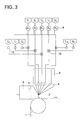
- Fig. 3 shows the case of separate addition of additives in coating shown in Fig. 2.
- Fig. 4 shows the shape of penetration pores.
- the light sensitive layer containing silver halide grains of the photothermographic material further contains an organic silver salt, a reducing agent, an antifoggant, a print out-preventing agent, a binder and a cross-linking agent.
- R 1 , R 2 , R 3 , R 4 , R 5 , R 6 , R 7 and R 8 are each a straight chain, branched or cyclic alkyl group having 1 to 30 carbon atoms (e.g., methyl, ethyl, butyl, octyl, dodecyl, cycloalkyl, alkenyl group (e.g., propenyl, butenyl, nonanyl), an alkynyl group (e.g., acetylene group, bisacetylene group, phenylacetylene group), an aryl group (e.g., phenyl, naphthyl) or a heterocyclic group (e.g., tetrahydropyran, pyridyl group, furyl, thiophenyl, imidazolyl, thiazolyl, thi
- substituent groups include any one of electron-withdrawing and electron-donating groups.
- substituent groups include an alkyl group having 1 to 25 carbon atoms (e.g., methyl, ethyl, propyl, isopropyl, tert-butyl, pentyl, hexyl, cyclohexyl), halogenated alkyl group (e.g., trifluoromethyl, perfluorooctyl), cycloalkyl group (e.g., cyclohexyl, cyclopentyl), alkynyl group (e.g., propargyl group), glycidyl group, acrylate group, methacrylate group, aryl group (e.g., phenyl), heterocyclic group (e.g., pyridyl, thiazolyl, oxazolyl, imidazolyl, furyl, pyrrolyl, pira
- L 1 , L 2 , L 3 and L 4 are each a bivalent linkage group, including an alkylene group (e.g., ethylene, propylene, butylenes, hexamethylene), oxyalkylene group (e.g., oxyethylene, oxypropylene, oxybutylene, oxyhexamethylene, or group comprised of plural these repeating units), aminoalkylene group (e.g., aminoethylene, aminopropylene, aminohexamethylene, or a group comprised of plural these repeating units), and carboxyalkylene group (e.g., carboxyethylene, carboxypropylene, carboxybutylene), thioether group, oxyether group, sulfonamido group and carbamoyl group.
- alkylene group e.g., ethylene, propylene, butylenes, hexamethylene
- oxyalkylene group e.g., oxyethylene, oxypropylene, oxybutylene,
- At least one of R 1 and R 2 in formula (1), or at least one of R 3 , R 4 , R 5 , R 6 , R 7 and R 8 in formula (2) preferably is a ballast group (or a diffusion-proof group) or an adsorption-promoting group, and more preferably, R 2 is a ballast group or an adsorption-promoting group.
- the ballast group is preferably an aliphatic group having 6 or more carbon atoms or an aryl group substituted with an alkyl group having 3 or more carbon atoms.
- Introduction of the ballast group depending on the amount of a binder or crosslinking agent, restrains diffusion at room temperature, preventing reaction during storage.
- the diffusion-proof can be evaluated in the following manner.
- a binder material is put into a capillary tube with opening ends and crosslinked.
- a sample material to be tested i.e., analyte
- the amount of the diffused sample material is determined by infrared spectroscopy, mass spectrometry, an isotope method or NMR spectrometry.
- the extent of diffusion can be determined by varying the temperature or time.
- Diffusion can be retard to levels of 1% to one hundred millionth by the molecular weight or introduction of a fixing group but also produces problems relating to an increase of the molecular weight or solubility of the fixing group, and it is therefore appropriate to introduce a group capable of retarding diffusion at room temperature to levels of 10% to one millionth.
- the adsorption-promoting group can be evaluated by determining adsorption onto silver halide.
- a material to be tested i.e., analyte
- Adsorption depends on a silver ion concentration of the silver halide containing solution, the shape of silver halide and the silver halide grain size and it is preferred to make measurements under the condition close the shape, grain size and electrode potential of silver halide to be added together with an organic silver salt.
- the absorption amount is measured.
- Silver bromide or silver bromide grains containing no iodide may be used for measurement. In cases where coverage of the silver halide grain surface is calculated to be 3 to 10%, it is judge to be adsorptive.
- the adsorption-promoting group may be a group promoting adsorption onto silver halide containing a sulfur or nitrogen atom or a group containing an alkylene oxide group or carboxy group and containing no heteroatom.
- Preferred adsorption-promoting group a primary, secondary or tertiary amino group, animidazole group, an oxazole group, a thiazole group or a tetrazole group.
- m and n each are an integer of 1 to 3, provided that m+n is 4; p1 and p2 are each an integer of 1 to 3 and q1 and q2 are each 0, 1 or 2, provided that p1+q1 and p2+q2 are each 3; r1 and t are each 0 or an integer of 1 to 1000; and x is 0 or 1, and preferably 1.
- the silane compound represented by formula (1) or (2) preferably contains a nitrogen atom, and more preferably a tertiary nitrogen, thereby promoting reaction (or hardening) or preventing coloration.
- a nitrogen atom preferably a nitrogen atom, and more preferably a tertiary nitrogen, thereby promoting reaction (or hardening) or preventing coloration.
- the silane compounds represented by formula (1) or (2) preferred is the compound of formula (1).
- silane compounds can be prepared in the manner that alkoxysilane compounds or silicon halides are used as a starting material, which are allowed to bond by a linkage group.
- the silane compound having a ballast group can be synthesized by allowing a ballast group to combine with a silane group.
- the compound represented by formula (1) or (2) can be incorporated according to the method known in the art.
- the compound can be incorporated through solution in alcohols such as methanol and ethanol, ketones such as methyl ethyl ketone or acetone and polar solvents such as dimethylsulfoxide and dimethylformamide.
- the compound can also be incorporated by forming fine particles of 1 ⁇ m or less dispersed in water or an organic solvent, through sand mill dispersion, jet mil dispersion, ultrasonic dispersion or homogenizer dispersion.
- a sand mill dispersion using glass beads or fine zirconia particle media and a dispersion method in which a solution is allowed to be ejected at a high speed from a canaliculus and be collided with a wall, or solutions ejected from two canaliculi are allowed to collide with each other.
- a fine particle dispersion preferably exhibits an average particle size of 1nm to 10 ⁇ m in an aqueous solution and has a narrow particle distribution.
- Various techniques of fine particle dispersion are disclosed and dispersion can be conducted according thereto.
- the silane compound of this invention is preferably incorporated into a layer containing additives such as silver halide, an organic silver salt or a reducing agent to react with a binder but may be incorporated into a layer adjacent to the layer containing the additives or an interlayer.
- additives such as silver halide, an organic silver salt or a reducing agent to react with a binder
- the silane compound may be incorporated into a layer adjacent to the layer containing the additives or an interlayer.
- the silane compound is incorporated preferably in an amount of 1x10 -8 to 1x10 -1 , and more preferably 1x10 -5 to 1x10 -2 mol per mol of silver halide. In cases where incorporated into a layer containing no silver, the amount is determined as an amount per unit area. An excessive of the compound often causes reduction in sensitivity, contrast or maximum density, and in the case of being deficient, effects of this invention cannot be sufficiently achieved.
- the coating method used in this invention includes organic solvent-based coating in which an organic solvent is employed to dissolve a binder, and water-based coating in which a binder in the form a latex or an aqueous binder solution is employed.
- the organic solvent-based coating refers to coating of solution containing organic solvent(s) accounting for 40 to 100%, specifically 70% or more of the total solvent(s).
- the organic solvents include, for example, non-polar solvents such as hexane, toluene and xylene and polar solvents such as methyl ethyl ketone, methyl isobutyl ketone, ethanol, and isopropyl alcohol. Polar solvents which are capable of dissolving a large amount of additives, are often employed.
- the water-based coating refers to coating of an aqueous solution containing organic solvent(s) which accounting 0 to 40%, preferably not more than 20%, more preferably not more than 10%, and still more preferably not more than 5% of the total solvents.
- Binders usable on the organic solvent-based coating include cellulose derivatives, polyvinyl alcohol derivatives, acrylate polymer derivatives, polyimide derivatives, polyamide derivatives, phenol resin derivatives, urethane resin derivatives and polyester derivatives. Of these, polyvinyl alcohol derivatives and vinyl acetate derivatives are preferred.
- a polyvinyl alcohol derivative represented by formula (3) is specifically preferred: wherein R 9 and R 10 each represent an alkyl group, alkenyl group, aryl group or a heterocyclic group; d1, d2 and d3 represent a constitution ratio and d1 is 20 to 96% by weight, d2 is 1 to 40% by weight and d3 is 0.1 to 80% by weight.
- R 9 and R 10 represents an alkyl group (preferably having 1 to 12 carbon atoms) such as methyl, ethyl, butyl, hexyl, cyclohexyl, octyl and dodecyl; an alkenyl group such as propenyl, butenyl, octenyl and dodecenyl; an alkynyl group such acetylenyl and bisacetylenyl; an aryl group such as phenyl and naphthyl; and a heterocyclic group such as pyridyl, piperidyl, furyl, pyranyl, thiophenyl, pyrrolyl, pyrrolidonyl, imidazolyl, triazolyl, thidiazolyl, oxadiazolyl, tetrazolyl, and pyrimidyl. These groups may be substituted with substituent group(s). Examples of the substituent group(s).
- the molecular weight of the polymeric compound of formula (3) is preferably 800 to 800,000, and more preferably 10,000 to 400,000. In the case of the molecular weight being smaller, sufficient layer strength cannot be obtained and in the case of the molecular weight being larger, solubility is lowered and the viscosity is excessively increased, so that it is preferred to adjust an optimum viscosity so as to fit the additive containing solution.
- the acetalized portion accounting for d 1 percent by weight include not only intramolecularly acetalized portions but also intermolecularly acetalized portions.
- Intermolecularly acetalized polyvinyl alcohol derivatives can be prepared in such a manner that when undergoing acetalization by adding aldehydes to polyvinyl alcohol, the polyvinyl alcohol or aldhydes are allowed to react at a relatively high concentration, the amount of an acetalization catalyst is increased, the catalyst is added at the later stage of the reaction, or the reaction temperature or stirring speed is increased.
- the stirring speed is preferably within a Reynolds number of 1,000 to 10,000.
- the intermolecularly acetalized polymer preferably account for 0.1 to 60%, more preferably 1 to 30%, and still more preferably 3 to 20% of the total polymer.
- the proportion of the intermolecular acetal can be determined by liquid chromatography (Gel Permeation Chromatography) or the viscosity measurement method. Preparation and analysis of intermolecular acetals are referred to JP-A 6-25213.
- intermolecular acetal The structure of an intermolecular acetal is represented by the following formula (4): wherein R 9 , R 10 , d1, d2 and d3 are the same as defined in formula (3), and d4 represents a percentage by weight of intermolecular acetals. Thus, d4 is 0.01 to 5% by weight.
- water-soluble polymers or aqueous-dispersed hydrophobic polymers are preferably employed.
- examples thereof include polyvinylidene chloride, vinylidene chloride-acrylic acid copolymer, vinylidene chloride-itacinic acid copolymer, poly(sodium acrylate), polyalkyleneoxide, acrylic acid amide-acrylic acid ester copolymer, styrene-anhydrous maleic acid copolymer, acrylonitrile-butadiene copolymer, vinyl chloride-vinyl acetate copolymer and styrene-butadiene-acrylic acid copolymer.
- These polymers constitutes a water-based coating solution, which is coated and dried to form a uniform polymer film at the stage of film-forming.
- an aqueous dispersion of an organic silver salt, silver halide, reducing agent and the like is mixed with such a latex to form a uniform dispersion and coated to form a photothermographic layer. Latex particles coagulates upon drying to form a uniform film.
- Polymers exhibiting a glass transition point of -20° C to 80° C, and specifically -5° C to 60° C are preferred.
- the higher glass transition point leads to elevation of developing temperature, and the lower transition point results in an increase in fogging and a decrease in sensitivity or contrast.
- the aqueous-dispersed polymer is preferably comprised of fine particles having an average size of 1 to a few ⁇ ms, dispersed in water.
- the aqueous-dispersed hydrophobic polymer is called a latex and among binders used in water-based coating, such a latex is preferred in terms of enhanced water resistance. The more latex is the better o enhance water resistance.
- the content of a latex is preferably 50 to 100%, and more preferably80 to 100%, based on total binder. Examples of aqueous-dispersed latexes are shown in Table 1, including vinylidene chloride type, styrene type, butadiene type and acryl type.
- the content of polymer binder is preferably one fourth to ten times silver coverage, and more preferably a half to 7 times silver coverage.
- the coating amount of a polymer is preferably 0.5 to 20 g/m 2 , and more preferably 1.0 to 14 g/m 2 .
- silver image tone is markedly deteriorated and unacceptable in practical use, and in the case of more than ten times silver coverage, contrast is markedly decreased and unacceptable in practical use.
- Binders used in the photothermographic material give photothermographic components such as silver halide, organic silver salt and reducing agent a reaction site to proceed an optimum oxidation-reduction reaction of silver halide.
- an organic acid of an organic silver salt employed are fatty acids such as stearic acid, behenic acid and palmitic acid.
- Light sensitive silver halide emulsions usable in the photothermographic materials according to the invention can be prepared according to the methods commonly known in the photographic art, such as single jet or double jet addition, or ammoniacal, neutral or acidic precipitation.
- the silver halide emulsion is prepared in advance and then the emulsion is mixed with other components of the invention to be incorporated into the composition used in the invention.
- polymers other than gelatin, such as polyvinyl acetal are employed as a protective colloid in the formation of photosensitive silver halide, as described in U.S.
- Patent 3,706,564, 3,706,5653,713,833 and 3,748,143 British Patent 1,362,970; gelatin contained in a photosensitive silver halide emulsion is degraded with an enzyme, as described in British Patent 1,354,186; or photosensitive silver halide grains are prepared in the presence of a surfactant to save the use of a protective polymer, as described in U.S. Patent 4,076,539.
- Silver halide used in the invention functions as a highly light sensitive material.
- Silver halide grains are preferably small in size to prevent milky-whitening after image formation and obtain superior images.
- the grain size is preferably not more than 0.1 ⁇ m, more preferably, 0.01 to 0.1 ⁇ m, and still more preferably, 0.02 to 0.08 ⁇ m.
- the form of silver halide grains is not specifically limited, including cubic or octahedral, regular crystals and non-regular crystal grains in a spherical, bar-like or tabular form.
- Halide composition thereof is not specifically limited, including any one of silver chloride, silver chlorobromide, silver iodochlorobromide, silver bromide, silver iodobromide, and silver iodide.
- the content of silver halide is preferably not more than 50%, more preferably 0.1 to 25%, and still more preferably 0.1 to 15%, based on the total amount of an organic silver salt.
- Light sensitive silver halide used in the thermally developable photosensitive material of the invention can be formed simultaneously with the formation of organic silver salt by allowing a halide component such as a halide ion to concurrently be present together with organic silver salt-forming components and further introducing a silver ion thereinto during the course of preparing the organic silver salt.
- a halide component such as a halide ion
- a silver halide-forming component is allowed to act onto a pre-formed organic silver salt solution or dispersion or a sheet material containing an organic silver salt to convert a part of the organic silver salt to photosensitive silver halide.
- the thus formed silver halide is effectively in contact with the organic silver salt, exhibiting favorable actions.
- the silver halide-forming component refers to a compound capable of forming silver salt upon reaction with the organic silver salt.
- Such a compound can be distinguished by the following simple test.
- a compound to be tested is to be mixed with the organic silver salt, and if necessary, the presence of a peal specific to silver halide can be confirmed by the X-ray diffractometry, after heating.
- Compounds that have been confirmed to be effective as a silver halide-forming component include inorganic halide compounds, onium halides, halogenated hydrocarbons, N-halogeno compounds and other halogen containing compounds. These compounds are detailed in U.S. Patent 4,009,039, 3,457,075 and 4,003,749, British Patent 1,498,956 and JP-A 53-27027 and 53-25420.
- Examples thereof are inorganic halide compounds: e.g., a halide compound represented by formula, MXn, in which M represents H, NH4 or a metal atom; n is 1 when M is H or NH4 and a number equivalent to a valence number of the metal atom when M is the metal atom; the metal atom includes lithium, sodium, potassium, cesium, magnesium, calcium, strontium, barium, zinc, cadmium, mercury, tin, antimony, chromium, manganese, cobalt, rhodium, and cerium, and molecular halogen such as aqueous bromine being also effective.
- MXn a halide compound represented by formula, MXn, in which M represents H, NH4 or a metal atom; n is 1 when M is H or NH4 and a number equivalent to a valence number of the metal atom when M is the metal atom; the metal atom includes lithium, sodium, potassium, cesium, magnesium
- the silver halide-forming component is used stoichiometrically in a small amount per organic silver salt. Thus, it is preferably 0.001 to 0.7 mol, and more preferably 0.03 to 0.5 mol per mol of organic silver salt.
- the silver halide-forming component may be used in combination.
- Conditions including a reaction temperature, reaction time and reaction pressure during the process of converting a part of the organic silver salt to silver halide using the silver halide forming component can be appropriately set in accordance with the purpose of preparation.
- the reaction temperature is preferably -20° C to 70° C
- the reaction time is preferably 0.1 sec to 72 hrs.
- the reaction pressure is preferably atmospheric pressure.
- the reaction is performed preferably in the presence of polymer as a binder, wherein the polymer to be used is preferably 0.01 to 100 weight parts, and more preferably 0.1 to 10 weight parts per 1 weight part of an organic silver salt.
- the thus formed light sensitive silver halide can be chemically sensitized with a sulfur containing compound, gold compound, platinum compound, palladium compound, silver compound, tin compound, chromium compound or their combination.
- a sulfur containing compound gold compound, platinum compound, palladium compound, silver compound, tin compound, chromium compound or their combination.
- the method and procedure for chemical sensitization are described in U.S. Patent 4,036,650, British Patent 1,518,850, JP-A 51-22430, 51-78319 and 51-81124.
- a low molecular weight amide compound may be concurrently present to enhance sensitivity at the time of converting a part of the organic silver salt to photosensitive silver halide.
- Silver halide preferably occludes ions of metals belonging to Groups 6 to 11 of the Periodic Table.
- Preferred as the metals are W; Fe, Co, Ni, Cu, Ru, Rh, Pd, Re, Os, Ir, Pt and Au. These metals may be introduced into silver halide in the form of a complex.
- Such metal complexes and metal complex ions are preferably a six coordinate complex ion.
- Exemplary examples of the ligand represented by L include halides (fluoride, chloride, bromide, and iodide), cyanide, cyanato, thiocyanato, selenocyanato, tellurocyanato, azido and aquo, nitrosyl, thionitrosyl, etc., of which aquo, nitrosyl and thionitrosyl are preferred.
- aquo ligand is present, one or two ligands are preferably coordinated.
- Particularly preferred examples of M include Rh, Ru, Re, Ir and Os.
- these metal ions or complex ions may be employed and the same type of metals or the different type of metals may be employed in combinations of two or more types.
- the content of these metal ions or complex ions is suitably between 1 ⁇ 10 -9 and 1 ⁇ 10 -2 mole per mole of silver halide, and is preferably between 1 ⁇ 10 -8 and 1 x 10 -4 mole.
- Compounds, which provide these metal ions or complex ions are preferably incorporated into silver halide grains through addition during the silver halide grain formation. These may be added during any preparation stage of the silver halide grains, that is, before or after nuclei formation, growth, physical ripening, and chemical ripening.
- these are preferably added at the stage of nuclei formation, growth, and physical ripening; furthermore, are preferably added at the stage of nuclei formation and growth; and are most preferably added at the stage of nuclei formation. These compounds may be added several times by dividing the added amount. Uniform content in the interior of a silver halide grain can be carried out. As disclosed in JP-A No. 63-29603, 2-306236, 3-167545, 4-76534, 6-110146, 5-273683, the metal can be non-uniformly occluded in the interior of the grain.
- metal compounds can be dissolved in water or a suitable organic solvent (for example, alcohols, ethers, glycols, ketones, esters, amides, etc.) and then added.
- a suitable organic solvent for example, alcohols, ethers, glycols, ketones, esters, amides, etc.
- an aqueous metal compound powder solution or an aqueous solution in which a metal compound is dissolved along with NaCl and KCl is added to a water-soluble silver salt solution during grain formation or to a water-soluble halide solution; when a silver salt solution and a halide solution are simultaneously added, a metal compound is added as a third solution to form silver halide grains, while simultaneously mixing three solutions; during grain formation, an aqueous solution comprising the necessary amount of a metal compound is placed in a reaction vessel; or during silver halide preparation, dissolution is carried out by the addition of other silver halide grains previously doped with metal ions or complex ions.
- the preferred method is one in which an aqueous metal compound powder solution or an aqueous solution in which a metal compound is dissolved along with NaCl and KCl is added to a water-soluble halide solution.
- an aqueous solution comprising the necessary amount of a metal compound can be placed in a reaction vessel immediately after grain formation, or during physical ripening or at the completion thereof or during chemical ripening.
- a matting agent is preferably incorporated into the image forming layer side.
- the matting agent is provided on the surface of a photosensitive material and the matting agent is preferably incorporated in an amount of 0.5 to 30 per cent in weight ratio with respect to the total binder in the emulsion layer side.
- a matting agent into at least one of the non-photosensitive layer (and more preferably, into the surface layer) in an amount of 0.5 to 40% by weight, based on the total binder on the opposite side to the photosensitive layer.
- the shape of the matting agent may be crystalline or amorphous. However, a crystalline and spherical shape is preferably employed.
- the size of a matting agent is expressed in the diameter of a sphere having the same volume as the matting agent.
- the particle diameter of the matting agent in the present invention is referred to the diameter of a spherical converted volume.
- the matting agent employed in the present invention preferably has an average particle diameter of 0.5 to 10 ⁇ m, and more preferably of 1.0 to 8.0 ⁇ m.
- the variation coefficient of the size distribution is preferably not more than 50 percent, is more preferably not more than 40 percent, and is most preferably not more than 30 percent.
- the variation coefficient of the size distribution as described herein is a value represented by the formula described below: (Standard deviation of particle diameter)/(average particle diameter) ⁇ 100
- the matting agent according to the present invention can be incorporated into any layer.
- the matting agent is preferably incorporated into the layer other than the photosensitive layer layer, and is more preferably incorporated into the farthest layer from the support.
- Addition methods of the matting agent include those in which a matting agent is previously dispersed into a coating composition and is then coated, and prior to the completion of drying, a matting agent is sprayed. When plural matting agents are added, both methods may be employed in combination.
- the content of a matting agent is optimally selected at levels of causing no haze, and preferably is 0.01 mg/m2 to 1 g/m 2 .
- the photothermographic material used in this invention comprises a reducible silver source (e.g., organic silver salt), a catalytically active amount of photocatalyst (e.g., silver halide) and a reducing agent which are dispersed in an organic binder matrix.
- the photothermographic materials are stable at ordinary temperature and forms silver upon heating, after exposure, at a relatively high temperature (e.g., 80 to 140° C) through an oxidation-reduction reaction between the reducible silver source (which functions as an oxidizing agent) and the reducing agent.
- the oxidation-reduction reaction is accelerated by catalytic action of a latent image produced by exposure.
- Silver formed through reaction of the reducible silver salt in exposed areas provides a black image, which contrasts with non-exposes areas, leading to image formation. This reaction process proceeds without being supplied with water from the exterior.
- the photothermographic material of this invention comprises a support having thereon at least one photosensitive layer. Further, at least one non-photosensitive layer is preferably formed on the photosensitive layer. In order to control the amount or wavelength distribution of light transmitted through the photosensitive layer, a filter layer may be provided on the same side as the photosensitive layer, and/or an antihalation layer, that is, a backing layer on the opposite side. Dyes or pigments may also be incorporated into the photosensitive layer.
- Antifoggants may be incorporated into the thermally developable photosensitive material to which the present invention is applied.
- the substance which is known as the most effective antifoggant is a mercury ion.
- the incorporation of mercury compounds as the antifoggant into photosensitive materials is disclosed, for example, in U.S. Pat. No. 3,589,903.
- mercury compounds are not environmentally preferred.
- mercury-free antifoggants preferred are those antifoggants as disclosed in U.S. Patent 4,546,075 and 4,452,885, and JP-A 59-57234. Examples of preferred antifoggants are those described in column [0062] to [0063] of JP-A 9-90550. Further, other preferred antifoggants are those described in U.S. Patent 5,028,523, European Patent No. 600,587, 605,981 and 631,176.
- sensitizing dyes described, for example, in JP-A Nos. 63-159841, 60-140335, 63-231437, 63-259651, 63-304242, and 63-15245; U.S. Pat. Nos. 4,639,414, 4,740,455, 4,741,966, 4,751,175, and 4,835,096.
- Useful sensitizing dyes employed in the present invention are described, for example, in publications described in or cited in Research Disclosure Items 17643, Section IV-A (page 23, December 1978).
- selected can advantageously be sensitizing dyes having the spectral sensitivity suitable for spectral characteristics of light sources of various types of scanners.
- compounds described in JP-A Nos. 9-34078, 9-54409 and 9-80679 are preferably employed.
- the photothermographic material may optionally be added with a sensitizer, an organic or inorganic filler, a surfactant, an anti-staining agent, a UV absorbent, an antioxidant, water-proofing agent, a dispersing agent, a stabilizer, a plasticizer, a coating aid, a de-foaming agent, a fluorescent dye and a meal salt of fatty acid.
- layers may be arranged in such a manner as a high-speed layer/low-speed layer or a low-speed layer/high-speed layer. Further, various additives may be incorporated into either the light-sensitive layer or light-insensitive layer, or both of them.
- a support usable are paper, synthetic paper, nonwoven fabric, metal foil, plastic resin film and composite films by the combination thereof.
- Coating solutions used in this invention can be prepared in the following manner.
- a coating solution can be obtained by mixing a dispersion containing the silane compound relating to this invention together with a binder, a dispersion containing an organic silver salt, a silver halide, a reducing agent and a binder, and a solution or dispersion containing additive(s), together with a binder. Then, the coating solution is coated on the support and dried to obtain a photothermographic material.
- an instantaneously mixing and adding method may be employed, in which the silane compound is added to the coating solution immediately before coating, using a static mixer.
- the period for reacting with a binder contained in the coating solution is so short that variation in physical property of the coating solution such as viscosity and surface tension is less that the previously mixed coating solution described above, advantageously having little influence on photographic performance.
- This period of time depending on the pipe length and diameter, and the supplying rate in a supplying system of from the addition position to a die of a coating solution, is preferably 0.001 to 10 min, and more preferably within 2 min.
- the temperature preferably fits the coating solution temperature range of 5 to 50° C and may be within + 15° C of the coating solution temperature. Larger differences in temperature, which make it difficult to precisely control the solution temperature or viscosity, should be avoided.
- An usable coating system can be optimally selected from various coating systems such as a slide hopper system, wire-bar system, roll coater system and vacuum extrusion system. Of these coating systems, the vacuum extrusion system is preferred, as shown in Figs. 1 and 2.
- Figs. 1 and 2 illustrate a side view of a vacuum extrusion coater simultaneously coating five layers.
- a single layer vacuum extrusion coating apparatus can be prepared referring to JP-A No. 11-207236 and based on this method, five solutions are superposed in the die and extruded.
- Fig. 1 shows the solutions being horizontally extruded and
- Fig. 2 shows the solutions being vertically extruded.
- the extrusion angle is optionally set between 0 to 90°, for example, the extrusion angle can be set to 45°.
- the vertically flowing system shown in Fig. 2 is preferred to achieve a stable supply. In this invention, uniform coating can be conducted at a high speed without causing coating unevenness.
- support 1 is horizontally introduced with respect to a support-driving roll 3 and five solutions are supplied from die 9 and discharged in the direction of 2.
- the five solutions are supplied to addition vessels T 1 through T 5 and allowed to pass through a stabilizing chamber 4 to stabilize supply of the coating solutions in the die by an extrusion pump 8 and is discharged from the top of the die.
- the distance d between the top of the die and the support on the support-driving roll is called the bead distance, which is maintained preferably at 20 to 600 ⁇ m, and more preferably 80 to 300 ⁇ m.
- Reduced pressure chamber 6 having bulkhead 5 is provided under the bead, in which the reduced pressure is maintained by a vacuum pump 7.
- the reduced pressure is maintained at a pressure by 10 to 400 hPa less, and preferably 30 to 300 hPa less than atmospheric pressure.
- Bulkhead 5 in reduced pressure chamber 6 is provided so that the pressure is uniformly reduced in the bead portion.
- it is provided parallel to the discharging direction of the coating solution but may also be provided vertically.
- a multi-step bulkhead having plural bulkheads may be provided.
- fine penetration pores may be provided in the bulkhead, thereby resulting in the reduced pressure under the bead to be more uniform.
- the shape of the penetration pores can be selected from a lattice form, a circular form and a honeycomb form, as shown in Fig. 4.
- the total area of the penetration pores preferably accounts for 1 to 90% of the bulkhead area.
- the diameter of a circle having an area identical to the area of a single pore is calculated to determine the mean diameter of the total pores.
- the mean diameter is preferably 100 ⁇ to 1 cm, more preferably 100 nm to 1 mm, and still more preferably 5 ⁇ m 500 ⁇ m.
- the distance between the bulkhead and the bead portion is optional, preferably 100 ⁇ m to 1 m, more preferably 1 mm to 60 cm, and still more preferably 5 mm to 30 cm.
- the pore size may not necessarily be uniform from the inlet to the outlet but may have plural diameters or may be different between the end and the center.
- Stabilizing chamber 4 for supplying a coating solution, restrains the turbulent flow of the coating solution, which may be single or plural chambers.
- the shape of its cross section is optionally selected from a sphere form, an ellipsoid form, a spindle form, a rectangular solid form, a cubic form, and combinations thereof. Of these, the ellipsoid or spindle form is preferred.
- the viscosity of solutions used in simultaneous multi-layer coating is within the range of 0.01 to 1000 mPa ⁇ s, and preferably 0.1 to 100 mPa ⁇ s. In this case, the viscosity of the layer closest to or farthest from the support is preferably 1 to 100 nPa ⁇ s.
- the largest viscosity specifically the viscosity of the light sensitive layer is preferably 100 mPa ⁇ s or more. In cases when the viscosity exceeds this range, flowability of the coating solution is lowered and no coating can be achieved or uniform coating cannot be achieved.
- the viscosity can be adjusted with a thickening agent comprised of a polymer but the viscosity is also adjustable by varying the molecular weight or the molecular weight distribution, without lowering the layer strength. In this invention, the viscosity is adjusted preferably using the compound represented by formula (3) or (4).
- Coating solutions containing various additives are prepared and then coated.
- Fig. 2 there are also shown a menas for corona discharge or plasma treatment (10), inert gas chamber (11), gas inlet and out let (12, 13) and means for discharging (14).
- addition vessels T 6 through T 10 are separately provided as shown in Fig. 3 and solutions are supplied by pump 15 to be mixed immediately before coating. After two solutions were mixed, the mixture can be further sufficiently mixed using static mixer 16 provided in each line.
- a support or a subbed support prefferably subjected to a corona discharge treatment or plasma treatment before a coating solution is sullied thereto. Before and after such treatments, it is also preferred to conduct a discharge treatment.
- the discharging treatment before the corona treatment or plasma treatment can enhance uniformity or effects of the corona or plasma treatment and the discharging treatment after the corona treatment or plasma treatment results in uniform supply of a coating solution onto the support.
- the extent of the corona or plasma treatment can be adjusted by measuring a contact angle on the surface. The contact angle is preferably within the range of variation of 2 to 70 degrees with respect to water. Instead of the contact angle, it is also adjustable by the level of layer-adhesion.
- the energy value in the adjustment is preferably within the range of 0.1 mW to 100 kW/m 2 ⁇ min., and more preferably 10 mW to 1 kW/m 2 ⁇ min. In case when falling below this range, it is difficult to achieve uniform coating and when exceeding this range, unevenness is caused.
- the plasma treatment is preferably a flame type treatment and although the plasma treatment under atmospheric pressure is simple, the treatment under reduced pressure leads to better results. Examples of usable inert gas include argon, neon, helium and nitrogen and of these, argon is preferred. Combustion gases to be mixed include, for example, town gas, natural gas, propane gas and butane gas.
- the discharging treatments include, for examples, an ion wind type, an electrode type, discharging bar type, a discharging plate and a discharging fabric.
- the charging amount can be determined by measuring voltage of static capacity using a electrostatic charge meter.
- exposure is preferably conducted by laser scanning exposure. It is also preferred to use a laser exposure apparatus, in which a scanning laser light is not exposed at an angle substantially vertical to the exposed surface of the photosensitive material.
- laser light is not exposed at an angle substantially vertical to the exposed surface means that laser light is exposed preferably at an angle of 55 to 88°, more preferably 60 to 86°, still more preferably 65 to 84°, and optimally 70 to 82°.
- the beam spot diameter on the surface of the photosensitive material is preferably not more than 200 ⁇ m, and more preferably not more than 100 ⁇ m.
- a smaller spot diameter preferably reduces the angle displacing from verticality of the laser incident angle.
- the lower limit of the beam spot diameter is 10 ⁇ m.
- Exposure applicable in the invention is conducted preferably using a laser scanning exposure apparatus producing longitudinally multiple scanning laser beams, whereby deterioration in image quality such as occurrence of interference fringe-like unevenness is reduced, as compared to a scanning laser beam of the longitudinally single mode.
- Longitudinal multiplication can be achieved by a technique of employing backing light with composing waves or a technique of high frequency overlapping.
- the expression "longitudinally multiple" means that the exposure wavelength is not a single wavelength.
- the exposure wavelength distribution is usually not less than 5 nm and not more than 10 nm.
- the upper limit of the exposure wavelength distribution is not specifically limited but is usually about 60 nm.
- Both surfaces of a biaxially stretched thermally fixed 175 ⁇ m PET film, commercially available was subjected to corona discharge at 8 w/m 2 ⁇ min.
- the subbing coating composition a-1 descried below was applied so as to form a dried layer thickness of 0.8 ⁇ m, which was then dried.
- the resulting coating was designated Subbing Layer A-1.
- the subbing coating composition b-1 described below was applied to form a dried layer thickness of 0.8 ⁇ m.
- the resulting coating was designated Subbing Layer B-1.
- Subbing Layers A-1 and B-1 were subjected to corona discharging with 8 w/m 2 ⁇ minute.
- the upper subbing layer coating composition a-2 described below was applied so as to form a dried layer thickness of 0.8 ⁇ m, which was designated Subbing Layer A-2
- the upper subbing layer coating composition b-2 was applied to form a Subbing Upper Layer b-2.
- the following constituent layers are coated to prepare a photothermographic material sample, in which the light sensitive layer was coated on the A-2 side of the support. Drying was conducted at 75° C over a period of 1 min.
- Binder PVB-1, polymerization degree 600
- Silane compound Table 1
- Antihalation dye C1 2x10 -5 mol/m 2
- the following composition was dissolved in methyl ethyl ketone and the obtained solution was mixed with a mixture of silver halide and an organic silver salt in an amount of 1.2 g/m 2 , as a silver content to prepare a coating solution of the light sensitive layer.
- Binder PVB-1, polymerization degree 600
- 5.6 g/m 2 Silane compound Table 1
- Senstizing dye A1 2.1x10 -4 mol/m 2
- Antihalation dye C1 1.1x10 -5 mol/m 2
- Antifoggant 1 pyridinium hydrobromide perbromide 0.3 mg/m 2
- Antifoggant 2 isothiazolone 1.2 mg/m 2
- 5-methylbenzotriazole 120 mg/m 2 Developer, 1,1-bis(2-hydroxy-3,5-dimethyl phenyl)-3,5,5-trimethylhexane 3.3 mmol/m 2
- Binder PVB-1, polymerization degree 600
- Silane compound Table 1
- 4-Methylphthalic acid 0.72 g/m 2 Tetrachlorophthalic acid 0.22 g/m 2 Tetrachlorophthalic acid anhydride 0.5 g/m 2 Colloidal silica 0.2 g/m 2
- Binder cellulose acetate-butylate
- Silica mating agent av. size 3 ⁇ m
- Back layer side coating 1st layer Back layer Binder (PVB-1, polymerization degree 600) 1.2 g/m 2 Silane compound (Table 1) 2.3x10 -4 mol/m 2 Dye C1 70 mg/m 2
- Surfactant N-propylperfluorooctylsulfonamidoacetic acid 0.02 g/m 2
- Photothermographic material samples were each exposed to semiconductor laser of 810 nm using a laser sensitometer and then thermally developed at a temperature of 120° C for 8 sec. using a heated drum. The exposure and development were conducted in a room maintained at 25° C and 50% RH. The processed sample were each subjected to densitometry to evaluate obtained images with respect to sensitivity and fogging. Sensitivity was represented by a relative value of the reciprocal of exposure giving a density of 0.3 plus a fog density, based on the sensitivity of Sample No. 1 being 100. Unexposed samples were each thermally developed and subjected to densitometry to determine the fog density. Contrast was determined from the slope of a tangential line at a density of 1.5 on a characteristic curve. The maximum density was determined by measuring the density corresponding to exposure of 10 times the exposure giving a density of 1.5.
- each of the photothermographic material samples were divided into two groups. One of the two groups was allowed to stand at 45° C and 80% RH for 3 days (i.e., samples aged under high humidity) and the other group was allowed to stand at 23° C and 50% RH (i.e., samples aged under ordinary humidity).
- the thus aged samples were exposed and thermally developed to determine the difference in fog density and contrast between samples aged under different conditions. A lower difference in fog and contrast indicates a higher resistance to humidity.
- Abrasion resistance was evaluated in such a manner that each sample was abraded with a roller having 3 ⁇ m high protrusions, while loading with a load of 5 kPa and visually evaluated. A level of showing no abrasion mark was graded as "5", a level of showing most numerous abrasion marks was graded as "1" and an intermediate level, acceptable in practical use was graded as "3".
- the compound used for comparison was Si(OC 2 H 5 ) 4 . Identical silane compound was incorporated into the 1st, 2nd and 3rd layers. Results are shown in Table 2.
- silane compounds relating to this invention led to photothermographic materials exhibiting reduced fogging, enhanced sensitivity, maximum density and contrast, superior moisture resistance and abrasion resistance.
- Photothermographic material samples were prepared similarly to Example 1, provided that the compound represented by formula (3) used as a binder was varied with respect to composition.
- the composition was varied in such a manner that polyvinyl acetate having a polymerization degree of 600 was saponified so that the saponification percentage varied from 70 to 99% to prepare saponified a polyvinyl alcohol.
- the thus prepared polyvinyl alcohols which were different in saponification value were allowed to react with butyl aldehyde to form a butyral.
- Acetalization was carried out in the following manner.
- 10% hydrochloric acid was added and butyl aldehyde was added over a period of 10 min.
- Example 2 The thus prepared samples were evaluated similarly to Example 1. The samples were further evaluated with respect to unevenness in development. Thus, a sample of 35x43 cm was fully exposed to a 810 nm laser so as to give a density of 1.0, developed at 120° C for 8 sec., and visually evaluated on a viewing box with respect to unevenness in density, based on the level of no unevenness in density, due to coating being observed, graded as "5", a level acceptable in practical use, graded as "3" and the level of marked unevenness, graded as "1". Unevenness due to thermal development was excluded from the evaluation. Results are shown in Table 4. Sample No. Silane Compd.
- Binder Storage Stability Abrasion resistance Unevenness Remark d 1 d 2 d 3 d 4 Difference in Fog Sensitivity 301 1 86 12 1 0 0.018 100 5 3 Inv. 302 1 86 12 1 1 0.016 100 5 3 Inv. 303 1 86 12 1 2 0.012 100 5 3 Inv. 304 1 86 12 1 5 0.011 100 5 4 Inv. 305 1 81 12 1 6 0.011 100 5 4 Inv. 306 1 79 12 1 8 0.011 100 5 5 Inv. 307 1 67 12 1 20 0.009 100 5 5 Inv. 308 1 62 12 1 25 0.009 100 5 5 Inv. 309 1 57 12 1 30 0.009 100 5 5 Inv.
- Photothermographic material samples were prepared similarly to Example 1, provided that on a subbed support the light sensitive layer-side was coated by water-based coating using latexes and gelatin as a binder. Used as a binder for comparison was polyvinyl alcohol having a polymerzation degree of 500 and a saponification degree of 99% (also denoted as PVA*).
- PVA* polyvinyl alcohol having a polymerzation degree of 500 and a saponification degree of 99%
- the composition of the light sensitive layer side is shown below. Silane compounds used in respective layers were identical. The 1st to 4th layers were simultaneously coated at a coating speed of 200 m/min. and dried for 3 min. Light sensitive layer side composition
- Binder latex shown in Table 5 1.2 g/m 2 Silane compound (Table 5) 2.3x10 -4 mol/m 2
- composition was dissolved or dispersed in aqueous solution to obtain a coating solution of the light sensitive layer.
- Binder shown in Table 5 5.6 g/m 2 Silane compound (Table 5) 2.2x10 -4 mol/m 2 Sensitizing dye A2 2 mg/m 2 Antifoggant 1, pyridinium hydro- bromide perbromide 0.3 mg/m 2 Antifoggant 2, isothiazolone 1.2 mg/m 2 Antifoggant 3, 5-methylbenzotriazole 120 mg/m 2 Developer, 1,1-bis(2-hydroxy-3,5-dimethyl phenyl)-3,5,5-trimethylhexane 3.3 mmol/m 2
- Binder alkali-processed inert gelatin 1.2 g/m 2 4-Methylphthalic acid 0.72 g/m 2 Tetrachlorophthalic acid 0.22 g/m 2 Tetrachlorophthalic acid anhydride 0.5 g/m 2 Silica mating agent (av. size 5 ⁇ m) 0.5 g/m 2 hexamethylene diisocyanate 0.3 g/m 2
- Photothermographic material samples were prepared similarly to Sample No. 103 of Example 1. Three layers were simultaneously coated using a vacuum extrusion coater, as shown in Fig. 2, in which coating solutions of the 1st, 2nd and 3rd layers of the light sensitive layer side were added into T 1 , T 2 and T 3 , respectively to perform simultaneous multi-layer coating. Viscosity of each coating solution and the degree of reduced pressure in the reduced pressure chamber (i.e., the difference between atmospheric pressure and reduced pressure in the reduced pressure chamber, expressed in hPa) were varied. A bulkhead was also provided in the reduced pressure chamber and the shape, average diameter and opening area ratio of the penetration pores (i.e., percentage of total penetration pore area, based on the bulkhead area) were each varied, as shown in Table 6.
- the viscosity (expressed in mPa ⁇ s unit) was adjusted by varying the solids percentage of the coating solution and by mixing an intermolexularly acetalized binder (as shown in Sample Nos. 304 through 309 of Example 3).
- a stabilizing chamber to stabilize supply of the coating solution having circular section (i.e., spherical chamber) was employed.
- Coating was carried out at a coating speed of 100 m/min and dried for 3 min. at a temperature of 40° C.
- the thus prepared samples were each cut to 35 x 43 cm, thermally developed and evaluated with respect to uniformity in coating. Thus, samples were fully exposed so as to give a density of 1.0 and developed.
- Coating was carried out similarly to Experiment No. 504 in Example 5, provided that addition vessels T 6 through T 10 were further provided at the pipes midway between addition vessels T 1 through T 5 and the die and silane compounds relating to this invention were supplied by a pump and mixed by a static mixer so as to form a turbulent flow. Coating solutions were maintained at 25° C and the silane compounds were each dissolved in methyl ethyl ketone so as to form a 10% solids solution, maintained at 25° C. After start of the coating, coating solutions which were each supplied from addition vessel T 1 through T 3 at a rate suited for the coating speed, were each mixed with the silane compound solution flow, extruded from the die and coated on the subbed support.
- Coating was carried out similarly to Experiment No. 702 in Example 7, provided that the central control mechanism was provided to control a means for controlling supply of a coating solution, a means for controlling the reduced pressure in the reduced pressure chamber, a means for controlling the rotation speed of the support-driving roll and a discharge treatment means.
- the coating solution is supplied at a rate responsible for the coating speed of 100 m/min and when being stabilized, the coating solution is supplied to the support to perform coating.
- coating could be started from the initial stage with supplying the coating solution from the die.
- the discharge treatment was conducted at a discharge of 8 W/min ⁇ m, the pressure reduction was conducted at a rate of 1 hPa/m and the total solution supply was conducted at a coating area of 100 cm/m. Coupling the supply of coating solutions, the level of the reduced pressure, the discharge treatment and the support-driving roll to the central control enabled coating even during the period until reached a constant coating speed.
- Coating was carried out similarly to Experiment No. 503 in Example 5, provided that the subbed support was replaced by a support which was subjected to a plasma treatment without being subbed and to a discharging treatment before and after the plasma treatment.
- the used charge neutralizer was (a) a blower-type discharger (KD-410, available from KASUGA DENKI Co., Ltd.), (b) a brush-type discharger (available from Achilles Nonspark Co.) and (c) a high density discharger (HDIS-400, available from KASUGA DENKI Co., Ltd.).
- Argon gas was employed as an inert gas in the plasma treatment.
- the plasma treatment was conducted with supplying argon at a rate 400 ml/min and oxygen at a rate of 2 ml/min. under the pressure of 400 Pa, using a microwave of 2.45 GHz. Coatability was evaluated similarly to example 5. Results are shown in Table 9. Experiment No. Plasma Treatment Pre-discharging Post-discharging Coating uniformity Remark 801 No No No 50 Inv. 802 Yes No No 20 Inv. 803 Yes a a 4 Inv. 804 Yes b b 3 Inv. 805 Yes c c 2 Inv. 806 Yes No c 8 Inv. 807 Yes c No 8 Inv.
- the plasma treatment in combination with the discharge treatment led to further enhanced coatability.
- Photothermographic material samples were prepared similarly to Example 4, provided that the following layers were coated on the light sensitive layer side of the support by simultaneous five-layer coating method, in place of the simultaneous three-layer coating method employed in Example 5. Coating was done using a vertically falling type vacuum extrusion coater, as shown in Fig. 2 at a coating speed of 100 m/min and drying was done at a drying temperature of 40° C for a period of 2 min. 40 sec. A silane compound was added into addition vessel T 8 and T 9 so that the silane compound was mixed with the coating solution of the 3rd or 4th layer within 3 sec.
- the degree of the reduced pressure and the condition of the bulkhead were the same as in Experiment 504 in example 5 and the viscosity was adjusted by adjusting the solids percentage of the coating solution and using a thickening agent, poly(sodium styrenesulfonate) having a weight-average molecular weight of 560,000.
- the used silane compounds, the viscosity of each layer, and evaluation of coatability and abrasion resistance are shown in Table 10.
- Vinylidene chloride itaconic acid copolymer latex (99.9:0.1 by weight%) molecular weight of 25000, 2% solids 0.45 g/m 2
- Vinylidene chloride acrylic acid copolymer latex (92.5:7.5 by weight%) 0.55 g/m 2
- composition was dissolved or dispersed in aqueous solution to obtain a coating solution of the light sensitive layer.
- Binder vinylidene chloride itaconic acid copolymer (99:1 % by weight) weight0average molecular weight 1.2 g/m 2 Silane compound (Table 10) 2.3x10 -4 mol/m 2 4-Methylphthalic acid 0.72 g/m 2 Tetrachlorophthalic acid 0.22 g/m 2 Tetrachlorophthalic acid anhydride 0.5 g/m 2 Colloidal silica 0.2 g/m 2
- Binder alkali-processed inert gelatin 1.2 g/m 2 4-Methylphthalic acid 0.72 g/m 2 Tetrachlorophthalic acid 0.22 g/m 2 Tetrachlorophthalic acid anhydride 0.5 g/m 2 Silica mating agent (av. size 5 ⁇ m) 0.5 g/m 2 hexamethylene diisocyanate 0.3 g/m 2 Perfluorooctylsulfonamide sodium acetate salt 0.02 g/m 2
Landscapes
- Chemical & Material Sciences (AREA)
- Engineering & Computer Science (AREA)
- Materials Engineering (AREA)
- Physics & Mathematics (AREA)
- General Physics & Mathematics (AREA)
- Non-Silver Salt Photosensitive Materials And Non-Silver Salt Photography (AREA)
Applications Claiming Priority (2)
| Application Number | Priority Date | Filing Date | Title |
|---|---|---|---|
| JP2000077904A JP4048684B2 (ja) | 2000-03-21 | 2000-03-21 | 熱現像感光材料とその製造方法 |
| JP2000077904 | 2000-03-21 |
Publications (2)
| Publication Number | Publication Date |
|---|---|
| EP1136877A2 true EP1136877A2 (de) | 2001-09-26 |
| EP1136877A3 EP1136877A3 (de) | 2003-04-23 |
Family
ID=18595388
Family Applications (1)
| Application Number | Title | Priority Date | Filing Date |
|---|---|---|---|
| EP01302616A Withdrawn EP1136877A3 (de) | 2000-03-21 | 2001-03-21 | Photothermographisches Material |
Country Status (3)
| Country | Link |
|---|---|
| US (1) | US6461805B1 (de) |
| EP (1) | EP1136877A3 (de) |
| JP (1) | JP4048684B2 (de) |
Cited By (7)
| Publication number | Priority date | Publication date | Assignee | Title |
|---|---|---|---|---|
| EP1271235A1 (de) * | 2001-06-26 | 2003-01-02 | Konica Corporation | Photothermographisches Material |
| EP1286210A3 (de) * | 2001-08-20 | 2003-06-25 | Konica Corporation | Photothermographisches trockenentwickelbares Silbersalzmaterial, Bildaufzeichnungsverfahren und Bildherstellungsverfahren |
| EP1388754A1 (de) * | 2002-08-08 | 2004-02-11 | Konica Corporation | Photothermographisches Material beinhaltend ein Alkoxysilan und Polyethylenimin |
| US6699649B2 (en) * | 2001-07-17 | 2004-03-02 | Konica Corporation | Silver salt photothermographic imaging material, and image recording method and image forming method by the use thereof |
| WO2006053621A1 (de) * | 2004-11-11 | 2006-05-26 | Wacker Polymer Systems Gmbh & Co. Kg | Hoch scherverdünnende polyvinylacetale |
| US7348296B2 (en) | 2003-06-06 | 2008-03-25 | Agfa Healthcare | Binders for use in the thermosensitive elements of substantially light-insensitive thermographic recording materials |
| CN108473620A (zh) * | 2016-11-28 | 2018-08-31 | 株式会社Lg化学 | 改性共轭二烯类聚合物及其制备方法 |
Families Citing this family (12)
| Publication number | Priority date | Publication date | Assignee | Title |
|---|---|---|---|---|
| JP2002090934A (ja) * | 2000-09-18 | 2002-03-27 | Fuji Photo Film Co Ltd | 熱現像画像記録材料 |
| US20070099132A1 (en) * | 2000-09-18 | 2007-05-03 | Hajime Nakagawa | Photothermographic material |
| US20060199115A1 (en) * | 2001-01-30 | 2006-09-07 | Hajime Nakagawa | Photothermographic material and image forming method |
| US20050032204A1 (en) * | 2001-04-10 | 2005-02-10 | Bioprocessors Corp. | Microreactor architecture and methods |
| US6702195B2 (en) * | 2002-07-15 | 2004-03-09 | Xerox Corporation | Multi-layer slot coating die with selective ultrasonic assist |
| US7381520B2 (en) * | 2002-12-03 | 2008-06-03 | Fujifilm Corporation | Photothermographic material |
| JP4084645B2 (ja) * | 2002-12-03 | 2008-04-30 | 富士フイルム株式会社 | 熱現像感光材料 |
| EP1628748A2 (de) * | 2003-06-05 | 2006-03-01 | Bioprocessors Corporation | Reaktor mit speicherkomponente |
| US20060046932A1 (en) * | 2004-08-31 | 2006-03-02 | Eastman Kodak Company | Thermally developable materials with backside conductive layer |
| US20080193884A1 (en) | 2005-07-20 | 2008-08-14 | Konica Minolta Medical & Graphic, Inc. | Image Forming Method |
| US7504200B2 (en) | 2007-02-02 | 2009-03-17 | Konica Minolta Medical & Graphic, Inc. | Photothermographic material |
| US8198658B2 (en) * | 2007-06-13 | 2012-06-12 | Samsung Electronics Co., Ltd. | Device and method for detecting biomolecules using adsorptive medium and field effect transistor |
Family Cites Families (5)
| Publication number | Priority date | Publication date | Assignee | Title |
|---|---|---|---|---|
| US4108665A (en) * | 1976-10-07 | 1978-08-22 | Minnesota Mining And Manufacturing Company | Stabilizers for photothermographic constructions |
| US4886739A (en) * | 1988-08-10 | 1989-12-12 | Eastman Kodak Company | Thermally processable imaging element and process |
| EP0672544B1 (de) * | 1994-03-16 | 1998-05-06 | Eastman Kodak Company | Wärmeempfindliches Aufzeichnungselement mit klebender Zwischenschicht |
| JPH08286366A (ja) * | 1995-04-18 | 1996-11-01 | Fuji Photo Film Co Ltd | 感光材料 |
| US6020117A (en) * | 1998-09-30 | 2000-02-01 | Eastman Kodak Company | Thermally processable imaging element |
-
2000
- 2000-03-21 JP JP2000077904A patent/JP4048684B2/ja not_active Expired - Fee Related
-
2001
- 2001-03-16 US US09/817,333 patent/US6461805B1/en not_active Expired - Fee Related
- 2001-03-21 EP EP01302616A patent/EP1136877A3/de not_active Withdrawn
Cited By (12)
| Publication number | Priority date | Publication date | Assignee | Title |
|---|---|---|---|---|
| EP1271235A1 (de) * | 2001-06-26 | 2003-01-02 | Konica Corporation | Photothermographisches Material |
| US6638707B2 (en) | 2001-06-26 | 2003-10-28 | Konica Corporation | Photothermographic material |
| US6699649B2 (en) * | 2001-07-17 | 2004-03-02 | Konica Corporation | Silver salt photothermographic imaging material, and image recording method and image forming method by the use thereof |
| EP1286210A3 (de) * | 2001-08-20 | 2003-06-25 | Konica Corporation | Photothermographisches trockenentwickelbares Silbersalzmaterial, Bildaufzeichnungsverfahren und Bildherstellungsverfahren |
| US6689548B2 (en) * | 2001-08-20 | 2004-02-10 | Konica Corporation | Silver salt photothermographic dry imaging material, an image recording method and an image forming method |
| EP1388754A1 (de) * | 2002-08-08 | 2004-02-11 | Konica Corporation | Photothermographisches Material beinhaltend ein Alkoxysilan und Polyethylenimin |
| US6913876B2 (en) | 2002-08-08 | 2005-07-05 | Konica Corporation | Photothermographic material |
| US7348296B2 (en) | 2003-06-06 | 2008-03-25 | Agfa Healthcare | Binders for use in the thermosensitive elements of substantially light-insensitive thermographic recording materials |
| WO2006053621A1 (de) * | 2004-11-11 | 2006-05-26 | Wacker Polymer Systems Gmbh & Co. Kg | Hoch scherverdünnende polyvinylacetale |
| CN108473620A (zh) * | 2016-11-28 | 2018-08-31 | 株式会社Lg化学 | 改性共轭二烯类聚合物及其制备方法 |
| CN108473620B (zh) * | 2016-11-28 | 2020-11-10 | 株式会社Lg化学 | 改性共轭二烯类聚合物及其制备方法 |
| US11066487B2 (en) | 2016-11-28 | 2021-07-20 | Lg Chem, Ltd. | Modified conjugated diene-based polymer and method of preparing the same |
Also Published As
| Publication number | Publication date |
|---|---|
| EP1136877A3 (de) | 2003-04-23 |
| JP4048684B2 (ja) | 2008-02-20 |
| US6461805B1 (en) | 2002-10-08 |
| JP2001264930A (ja) | 2001-09-28 |
| US20020022203A1 (en) | 2002-02-21 |
Similar Documents
| Publication | Publication Date | Title |
|---|---|---|
| US6461805B1 (en) | Photothermographic material | |
| EP1168066A2 (de) | Photothermographisches trockenentwickelbares Silbersalzmaterial | |
| JP2000221634A (ja) | 熱現像感光材料 | |
| JP2001324776A (ja) | 熱現像材料およびその熱現像方法 | |
| US20070054225A1 (en) | Silver salt photothermographic dry imaging material | |
| US20060172236A1 (en) | Silver salt photothermographic dry imaging material and image forming method | |
| EP1505436A1 (de) | Ein photothermographisches bilderzeugendes trockenentwickelbares Silbersalzmaterial | |
| JP3799885B2 (ja) | 画像形成方法 | |
| JP2000206642A (ja) | 感光性熱現像画像形成材料 | |
| JPH09281636A (ja) | 熱現像感光材料 | |
| JP2002303953A (ja) | 熱現像画像記録材料 | |
| US7147998B2 (en) | Thermally developable materials containing anionic polymer overcoat | |
| JP3954404B2 (ja) | 熱現像感光材料 | |
| JP3894283B2 (ja) | 熱現像画像記録材料 | |
| JP3976960B2 (ja) | 熱現像写真感光材料 | |
| JP2005134434A (ja) | 熱現像感光材料 | |
| JP2000284399A (ja) | 熱現像感光材料 | |
| JP2003066561A (ja) | 光カブリ耐性が改良された光熱写真画像形成材料 | |
| JP2005241691A (ja) | 熱現像感光材料 | |
| JP2002049121A (ja) | 熱現像写真感光材料及びそれを用いた画像形成方法 | |
| JP2005321600A (ja) | 熱現像感光材料 | |
| JP2001255620A (ja) | プリントアウトを改良した熱現像感光材料 | |
| JP2000284416A (ja) | 熱現像画像記録材料の製造方法 | |
| JP2000284413A (ja) | 熱現像感光材料 | |
| JP2000284409A (ja) | 熱現像感光材料 |
Legal Events
| Date | Code | Title | Description |
|---|---|---|---|
| PUAI | Public reference made under article 153(3) epc to a published international application that has entered the european phase |
Free format text: ORIGINAL CODE: 0009012 |
|
| AK | Designated contracting states |
Kind code of ref document: A2 Designated state(s): AT BE CH CY DE DK ES FI FR GB GR IE IT LI LU MC NL PT SE TR |
|
| AX | Request for extension of the european patent |
Free format text: AL;LT;LV;MK;RO;SI |
|
| PUAL | Search report despatched |
Free format text: ORIGINAL CODE: 0009013 |
|
| AK | Designated contracting states |
Designated state(s): AT BE CH CY DE DK ES FI FR GB GR IE IT LI LU MC NL PT SE TR |
|
| AX | Request for extension of the european patent |
Extension state: AL LT LV MK RO SI |
|
| 17P | Request for examination filed |
Effective date: 20030925 |
|
| AKX | Designation fees paid |
Designated state(s): DE FR GB IT NL |
|
| STAA | Information on the status of an ep patent application or granted ep patent |
Free format text: STATUS: THE APPLICATION HAS BEEN WITHDRAWN |
|
| 18W | Application withdrawn |
Effective date: 20050527 |