EP1134841A2 - Anschlussvorrichtung - Google Patents
Anschlussvorrichtung Download PDFInfo
- Publication number
- EP1134841A2 EP1134841A2 EP01106002A EP01106002A EP1134841A2 EP 1134841 A2 EP1134841 A2 EP 1134841A2 EP 01106002 A EP01106002 A EP 01106002A EP 01106002 A EP01106002 A EP 01106002A EP 1134841 A2 EP1134841 A2 EP 1134841A2
- Authority
- EP
- European Patent Office
- Prior art keywords
- contact
- individual conductors
- contact pins
- line
- housing
- Prior art date
- Legal status (The legal status is an assumption and is not a legal conclusion. Google has not performed a legal analysis and makes no representation as to the accuracy of the status listed.)
- Granted
Links
Images

Classifications
-
- H—ELECTRICITY
- H01—ELECTRIC ELEMENTS
- H01R—ELECTRICALLY-CONDUCTIVE CONNECTIONS; STRUCTURAL ASSOCIATIONS OF A PLURALITY OF MUTUALLY-INSULATED ELECTRICAL CONNECTING ELEMENTS; COUPLING DEVICES; CURRENT COLLECTORS
- H01R12/00—Structural associations of a plurality of mutually-insulated electrical connecting elements, specially adapted for printed circuits, e.g. printed circuit boards [PCB], flat or ribbon cables, or like generally planar structures, e.g. terminal strips, terminal blocks; Coupling devices specially adapted for printed circuits, flat or ribbon cables, or like generally planar structures; Terminals specially adapted for contact with, or insertion into, printed circuits, flat or ribbon cables, or like generally planar structures
- H01R12/50—Fixed connections
- H01R12/59—Fixed connections for flexible printed circuits, flat or ribbon cables or like structures
- H01R12/61—Fixed connections for flexible printed circuits, flat or ribbon cables or like structures connecting to flexible printed circuits, flat or ribbon cables or like structures
- H01R12/613—Fixed connections for flexible printed circuits, flat or ribbon cables or like structures connecting to flexible printed circuits, flat or ribbon cables or like structures by means of interconnecting elements
- H01R12/616—Fixed connections for flexible printed circuits, flat or ribbon cables or like structures connecting to flexible printed circuits, flat or ribbon cables or like structures by means of interconnecting elements having contacts penetrating insulation for making contact with conductors, e.g. needle points
-
- H—ELECTRICITY
- H01—ELECTRIC ELEMENTS
- H01R—ELECTRICALLY-CONDUCTIVE CONNECTIONS; STRUCTURAL ASSOCIATIONS OF A PLURALITY OF MUTUALLY-INSULATED ELECTRICAL CONNECTING ELEMENTS; COUPLING DEVICES; CURRENT COLLECTORS
- H01R4/00—Electrically-conductive connections between two or more conductive members in direct contact, i.e. touching one another; Means for effecting or maintaining such contact; Electrically-conductive connections having two or more spaced connecting locations for conductors and using contact members penetrating insulation
- H01R4/24—Connections using contact members penetrating or cutting insulation or cable strands
- H01R4/2404—Connections using contact members penetrating or cutting insulation or cable strands the contact members having teeth, prongs, pins or needles penetrating the insulation
- H01R4/2406—Connections using contact members penetrating or cutting insulation or cable strands the contact members having teeth, prongs, pins or needles penetrating the insulation having needles or pins
-
- H—ELECTRICITY
- H01—ELECTRIC ELEMENTS
- H01R—ELECTRICALLY-CONDUCTIVE CONNECTIONS; STRUCTURAL ASSOCIATIONS OF A PLURALITY OF MUTUALLY-INSULATED ELECTRICAL CONNECTING ELEMENTS; COUPLING DEVICES; CURRENT COLLECTORS
- H01R4/00—Electrically-conductive connections between two or more conductive members in direct contact, i.e. touching one another; Means for effecting or maintaining such contact; Electrically-conductive connections having two or more spaced connecting locations for conductors and using contact members penetrating insulation
- H01R4/24—Connections using contact members penetrating or cutting insulation or cable strands
- H01R4/2416—Connections using contact members penetrating or cutting insulation or cable strands the contact members having insulation-cutting edges, e.g. of tuning fork type
- H01R4/242—Connections using contact members penetrating or cutting insulation or cable strands the contact members having insulation-cutting edges, e.g. of tuning fork type the contact members being plates having a single slot
- H01R4/2425—Flat plates, e.g. multi-layered flat plates
- H01R4/2429—Flat plates, e.g. multi-layered flat plates mounted in an insulating base
- H01R4/2433—Flat plates, e.g. multi-layered flat plates mounted in an insulating base one part of the base being movable to push the cable into the slot
Definitions
- the invention relates to a connection device for connecting a plurality of individual conductors a first line to corresponding individual conductors of a second line with a housing and with a contact part, which according to the principle of Insulation penetration technology contact pins for contacting each other has corresponding single conductors.
- connection device is known from US 5,934,930. She serves for example for connecting a branch or connecting line to a supply line. Such a connection device enables a consumer or to connect a device to a supply line via a branch line.
- a connection device in the device known from US 5,934,930 there is a first Line or supply line between a contact part and an upper housing part and a second line or branch line between a lower housing part and inserted the contact part.
- the two lines each point several individual conductors, which are conical contact pins based on the principle of Insulation penetration technology can be contacted.
- the contact pins protrude from both sides of the contact part.
- the lower part of the housing has grooves into which the individual conductors are inserted become.
- the contact part has correspondingly shaped webs, which in the Engage grooves of the lower housing part and thus the individual conductors in their position fix. This is to ensure that the individual conductors are in their position are held in contact so that they are conical Cannot avoid contact tip when contacting.
- the invention has for its object to provide a connection device which enables reliable contacting.
- connection device for connecting several individual conductors of a first line to corresponding ones Single conductor of a second line with a housing and with a contact part, Which contact pins work according to the principle of insulation penetration technology for contacting the corresponding individual conductors, wherein the contact pins have a cutting area with a cutting edge.
- the contact pins proposed here have an elongated cutting edge on.
- the contact pin penetrates into the Conductor core of the single conductor, the conductor core in particular a bundle of has individual stranded wires.
- the contact pins therefore differ from so-called cutting contacts, in which only the insulation of the individual conductor is severed.
- the elongated cutting edge has the essential advantage that the to be contacted Individual conductors cut open in its longitudinal direction and its individual The stranded wires are only marginally displaced to the side. This side Displacement is compared to the displacement of a cone tip is caused, low. The stranded wires are therefore in contact significantly less stressed. Furthermore, because of the elongated Cutting edge of the individual conductor to be contacted better guided when making contact, so that the risk of evasion of the conductor is reduced and thus a safe one Contacting is guaranteed.
- the cutting edge has a rear extending area and is rounded in particular.
- the cutting edge is This means that it is bent outwards towards the individual conductor, so that only one section is ever used the cutting edge cuts the single conductor.
- the cutting edge gradually penetrates the single conductor, the insulation being cut open little by little. Essential is that this is actually cutting, whereas with conventional conical contact tips, the tip is only pressed in and the material is displaced on all sides. Because of the gradual inclusion in the forces required for contacting are low for the individual conductors. This is This is particularly advantageous if multi-core cables are contacted.
- the cutting area is disc-shaped trained, namely in the sense of a curved on both sides Disc.
- the edge of the disc does not necessarily have to be a circular line be, but can also be elliptical or egg-shaped.
- the discus-like Formation of the cutting area allows gentle contacting with relatively little effort. The gentle contacting is essential influenced by the symmetrical and in particular rounded training.
- the contact pins preferably have at least in one contact area in contact with the individual conductor, perpendicular to its longitudinal axis is an elongated and in particular elliptical cross-sectional area on.
- the contact pin is in particular ellipsoidal or as elongated disc.
- the cross-sectional area of the conical contact pins is hereby achieved a significantly better contact.
- On the one hand is the side Displacement of the individual stranded wires less, which is therefore better suited to the Fit the contact pin. On the other hand, this makes it much larger Contact area allows.
- a shaft adjoins the cutting area with a blunt, especially slightly rounded side edge.
- the flat trained contact pin is on its essentially parallel Side edges not formed with sharp edges. This creates the risk of unwanted Damage or cutting of individual stranded wires of the Single conductor low when penetrating and penetrating the contact pin.
- the contact pins are advantageously provided with two opposite one another Cutting areas formed and protrude from the contact part on both sides, which is arranged between an upper housing part and a lower housing part is so that the two lines to be contacted with each other one above the other to be ordered. For example, the first line between the upper housing part and the contact part and the second line between the Pinched contact part and the lower housing part.
- An alternative embodiment with lines arranged side by side is to realize without restriction of the function of the contact pins and leads to a flat design.
- the housing faces the housing-side guide of the contact pins have recesses which correspond to the contact pins Have geometry.
- the contact pins penetrate the individual conductors completely and in the contacted state they extend from the contact part to the housing, where their tips, i.e. their cutting areas, are guided or held.
- the contact pins are different trained to contact different types of To enable individual conductors.
- a connection device with such contact pins is particularly suitable for example for combined data and Power lines used to connect electrical consumers are controlled, for example, the consumers via a data bus system and are simultaneously supplied with power via the combined line.
- the different design of the contact pins can also be independent of realizing the special shape of the cutting area is also for the known ones conical contact pins suitable.
- At least one contact pin is preferably divided into several functional zones. This enables targeted and safe contacting of special single conductors that are constructed in multiple layers or multiple layers.
- the contact pin here has a contact zone which is separated from a Isolation zone is surrounded. This is an undesirable in an advantageous manner conductive connection via the contact pin between different areas of such a special single conductor prevented.
- the contact pin is preferably used for contacting a shield having individual conductors provided, the insulation zone and the contact zone are arranged such that in the contacting state the contact zone with is in contact with the conductor core of the individual conductor and in particular completely covered, and that the isolation zone completely covers the shield. This is a short circuit between the shield and the core safely prevented.
- the contact part has webs, which is a contact surface for spacers between adjacent individual conductors of the lines.
- These spacers are for example at Ribbon cables formed by the insulation between the individual conductors.
- these spacers as spacers in so-called web cables formed in which the conductors are spaced apart from one another via the spacer webs being held.
- a receptacle for one of the Individual conductors formed.
- the cross-sectional profile of the receiving trough is preferred the cross-sectional profile of the first or second line in the area of adapted to the individual conductor. And the cross-sectional profile is preferred at the same time the webs the cross-sectional profile of the first or second line in the area the spacers adjusted.
- the housing preferably has Corresponding webs corresponding to the webs of the contact part.
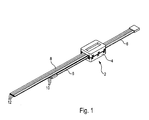
- connection device 2 shown in FIGS. 1 and 2 this has a three-part housing 4 through which a first line, for example a Supply line 6 is guided.
- a second line, for example a branch line 8 opens into the connection device 2.
- the two lines 6,8 are each designed as a multi-core ribbon cable in the exemplary embodiment.
- the supply line 6 has a plurality of individual conductors 10A to 10d and the branch line 8 has corresponding individual conductors 12A to 12D.
- about the connection device 2 becomes the individual conductors corresponding to one another, for example, the individual conductor 10A is conductively connected to the individual conductor 12A.
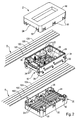
- the supply line is used for contacting 6 between a lower housing part 14 and a middle housing part 16, and the branch line 8 between the housing middle part 16 and an upper housing part 18 inserted.
- the middle housing part 16 has a contact part 20, from which a plurality of contact pins 22 protrude on both sides (cf. also FIG. 3).
- the housing parts 14, 16 and 18 each have openings 24 on their end faces for the supply line 6 or the branch line 8. Because the branch line 8 does not extend through the housing 4, the upper part of the Middle housing part 16 and the upper housing part 18 only one end opening 24.
- the housing middle part 16 has positioning pins 26, which are both extend in the direction of the upper housing part 18 and the lower housing part 14 and there with the housing 4 closed in corresponding positioning recesses 28 grab.
- latching recesses 30 are provided, in the corresponding latching pin 32 of the housing middle part 16 grip.
- the contact part 20 has e.g. 10A, 12A a contact pin 22.
- Several contact pins can also be used per pair of conductors 10A, 12A 22 may be provided.
- the contact pins 22 are in the longitudinal direction 23, along which leads the lines 6, 8 through the housing 4, arranged offset, for example, individual pairs are provided at the same height.
- the staggered arrangement means that the individual conductors 12A to 12D on different Locations contacted with respect to the longitudinal direction 23 and displaced laterally become.
- contact pins are adjacent to one another 22 arranged offset, the first and the third and the second and the fourth contact pin form a pair, which is arranged at the same height.
- the contact pin 3 is one of these contact pin pairs with the Recognize contact pins 22B and 22D. They are arranged on the contact part 20 which forms a partial area of the middle part 16 of the housing.
- the contact pins 22 run perpendicular to the contact part 20 and point at their opposite Each end of a cutting area 36 with a cutting edge 38.
- the between The part of the contact pin 22 lying in the cutting areas 36 is called a shaft Designated 40.
- the individual conductors 10, 12 of the two lines 6, 8 formed as ribbon cables have a conductor core 44 surrounded by insulation 42, which for example is formed from a bundle of individual stranded wires.
- the single ladder 10A, B; 12A, B are designed as data conductors and additionally have one Shield 46 on.
- the two other single conductor types C, D are used in particular the power supply.
- the individual conductors are used to form the ribbon cable 10,12 surrounded by a common insulation jacket 48, wherein between adjacent individual conductors 10, 12 are each provided with spacer webs 50, which serve to separate the individual conductors 10, 12 from one another.
- the contact pin 22B for contacting the shielded individual conductors 10B, 12B is divided into several functional zones. Proves regarding each Individual conductors 10B, 12B each have a contact zone 47 forming a contact area on, which is surrounded by two isolation zones 49.
- the contact zone 47 covers the conductor core 44 and the insulation zones 49 cover the area of the Shield 46 so that a short circuit between the shield 46 and the Conductor core 44 is avoided.
- the isolation zone 49 is, for example, by the Applying, in particular gluing, insulation strips to the base body of the contact pin 22, wherein the base body made of a conductive material consists.
- the cross-sectional contours of the contact part 20 and the lower housing part 14 and of the upper housing part 18 are the cross-sectional contour of the two lines 6, 8 customized.
- webs 52 are provided, between which the spacer webs 50 are clamped in the assembled state.
- the webs 52 preferably have each have a trough-like depression on their end face and form a receiving trough 54 for the spacer bars.
- the side surfaces of the webs 52 run arcuate, with adjacent side faces another receiving trough 56 form. Between two opposite receptacles 56, the individual conductors 10, 12 are clamped.
- the contoured design of the Contact part 20 and the housing parts 14, 18 ensures that the two lines 6.8 safe and secure - for example in the event of a tensile load - in the housing 4 are held.
- the contoured or profiled design is particularly effective as an abutment for magnetic or electromagnetic forces high currents and which tend to contact pins 22 of repel the individual conductors 10, 12.
- the receiving trays 56 have a rectangular profile.
- the webs 52 can have a rectangular profile, so that from the webs 52 and the receiving troughs 56 a crenellated Contour is formed. This crenellated contour is easy to manufacture and leads also to a good hold of the lines 6,8, although the hold with the rounded, Version adapted to the cross-sectional contour of the lines 6,8 is better.
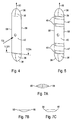
- the special design of the contact pins 22 is best exemplified in FIG Figures 4 and 5 shown. From this it can be seen that the contact pins 22 are substantially flat structures, with at opposite ends each of the shank 40 is a disc-shaped cutting area 36 is located. The edge of the disc-like cutting area 36 forms the cutting edge 38.
- the contact pin 22 has an overall elongated disc-like Shape or a flat ellipsoidal shape with parallel and preferably bluntly formed side edges 58.
- the contact pin 22 has two essential design features, namely the elongated design of the cutting edge 38 and the flat design of the contact pin 22 at least in the contact area or in the contact zone 47, in the or in which the conductor core 44 with the contact pin 22 in the contacted state communicates.
- Knife acts like a knife and therefore for a comparatively simple Penetration of the contact pin 22 in the individual conductors 10, 12 ensures. This means at the same time that the effort to make contact is low.
- Another The aspect of the elongated cutting edge 38 is in comparison to that of punctiform tip better guidance in relation to the respective individual conductor 10.12 to see. The individual conductors 10, 12 do not yield and are contacted safely.
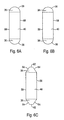
- the cutting edge 38 is semicircular. Instead of semicircular design, the cutting edge can also be on a non-circular curved line.
- the curved design of the cutting edge 38 is the preferred embodiment, since with this embodiment a gradual and uniform cutting of the contact pin 22 into the individual conductors 10, 12 without particularly high effort is made possible.
- the cutting edge 38 is alternatively a polygon, as exemplified in FIG. 6B is shown, trained. This is relatively easy to achieve in terms of manufacturing technology.
- the cutting edge 38 is knife-like as a straight line educated.
- An improved compared to this simplest version Design is shown in Fig. 6C, in which a flat knife-like edge 62 passes over slopes 64 into the shaft 40.
- FIGS. 7A to 7C an elongated cross-sectional area perpendicular to the longitudinal axis 60 alternative embodiments are shown by way of example in FIGS. 7A to 7C.
- the key advantage of the flat design is that the individual conductors 10,12 be cut lengthways and that their individual stranded wires only marginally displaced laterally. Their stress is therefore low.
- the elongated design of the cross-sectional area which is preferred is approximately elliptical or lenticular, as shown in FIG. 7A can be seen, there is a very high contact area with the contact Single conductors 10, 12 achieved with only a very small lateral displacement.
- the Contact reliability is therefore very high, or in other words, the contact resistance between contact pin 22 and the respective individual conductor 10, 12 is very small.
- This cross-sectional shape is an alternative to this 7B formed by a semicircle or by a Rectangle, the long sides of which form a triangle to form the Side edges 58 converge as shown in Fig. 7C.
- connection device 2 described is characterized by several design features which, in their combination, make for particularly secure contacting route the two lines 6,8 together. These are essentially the special design of the contact pins 22 with regard to their geometric Form and its subdivision into several functional zones. As another essential Characteristic is the contoured design of the contact part 20 and the Lower housing part 14 and the upper housing part 18 can be seen. The preferred ellipsoidal Design of the contact pins 22, their subdivision into functional zones 47.49 as well as the contouring are aspects that are also individual and particular Independently advantageous configurations of a connection device represent.
Landscapes
- Coupling Device And Connection With Printed Circuit (AREA)
- Multi-Conductor Connections (AREA)
- Connector Housings Or Holding Contact Members (AREA)
Abstract
Description
Dies ermöglicht eine gezielte und sichere Kontaktierung von speziellen Einzelleitern, die mehrschichtig oder mehrschalig aufgebaut sind.
- Fig. 1
- eine Anschlussvorrichtung mit verschlossenem Gehäuse mit einer Versorgungsleitung und einer Abzweigungsleitung,
- Fig. 2
- die Anschlussvorrichtung nach Fig. 1 in einer Explosionsdarstellung,
- Fig. 3
- die Anschlussvorrichtung in einer Schnittansicht,
- Fig. 4
- einen ellipsoidartig ausgebildeten Kontaktstift,
- Fig. 5
- einen ellipsoidartig ausgebildeten Kontaktstift mit mehreren Funktionszonen,
- Fig. 6A
- eine Schnittansicht des Schnitts 6A-6A durch den Kontaktstift parallel zu dessen Längsachse gemäß Fig. 4,
- Fig. 6B,C
- alternative Schnittgeometrien zu der in Fig. 6A Dargestellten,
- Fig. 7A
- eine Schnittansicht des Schnitts 7A-7A durch den Kontaktstift senkrecht zu dessen Längsachse gemäß Fig. 4,
- Fig. 7B,C
- alternative Schnittgeometrien zu den in Fig. 7A Dargestellten.
- 2
- Anschlussvorrichtung
- 4
- Gehäuse
- 6
- Versorgungsleitung
- 8
- Abzweigleitung
- 10A-D
- Einzelleiter
- 12A-D
- Einzelleiter
- 14
- Gehäuseunterteil
- 16
- Gehäusemittelteil
- 18
- Gehäuseoberteil
- 20
- Kontaktteil
- 22
- Kontaktstifte
- 23
- Längsrichtung
- 24
- Öffnung
- 26
- Positionierzapfen
- 28
- Positionierausnehmung
- 30
- Rastausnehmung
- 32
- Rastzapfen
- 34
- Dichtsteg
- 36
- Schneidbereich
- 38
- Schneidkante
- 39
- Ausnehmung
- 40
- Schaft
- 42
- Isolierung
- 44
- Leiterkern
- 46
- Abschirmung
- 47
- Kontaktzone
- 48
- Isolationsmantel
- 49
- Isolationszone
- 50
- Distanzsteg
- 52
- Steg
- 54
- Aufnahmewanne
- 56
- weitere Aufnahmewanne
- 58
- Seitenkante
- 60
- Längsachse
- 62
- Kante
- 64
- Schräge
Claims (16)
- Anschlussvorrichtung (2) zum Anschließen mehrerer Einzelleiter (10) einer ersten Leitung (6) an korrespondierende Einzelleiter (12) einer zweiten Leitung (8) mit einem Gehäuse (4) und mit einem Kontaktteil (20), welches nach dem Prinzip der Isolationsdurchdringungstechnik wirkende Kontaktstifte (22) zur Kontaktierung der einander korrespondierenden Einzelleiter (10A,12A) aufweist,
dadurch gekennzeichnet, dass die Kontaktstifte (22) einen Schneidbereich (36) mit einer Schneidkante (38) aufweisen. - Vorrichtung (2) nach Anspruch 1,
dadurch gekennzeichnet, dass die Schneidkante (38) einen sich rückwärtig erstreckenden Bereich aufweist und insbesondere gerundet ist. - Vorrichtung (2) nach Anspruch 1 oder 2,
dadurch gekennzeichnet, dass der Schneidbereich (38) diskusförmig ausgebildet ist. - Vorrichtung (2) nach einem der vorhergehenden Ansprüche,
dadurch gekennzeichnet, dass zumindest in einem Kontaktbereich (47) die Kontaktstifte (22) senkrecht zu ihrer Längsachse (60) eine langgestreckte und insbesondere ellipsenartige Querschnittsfläche aufweisen. - Vorrichtung (2) nach einem der vorhergehenden Ansprüche,
dadurch gekennzeichnet, dass sich an den Schneidbereich (36) ein Schaft (40) mit einer stumpfen Seitenkante (58) anschließt. - Vorrichtung (2) nach einem der vorhergehenden Ansprüche,
dadurch gekennzeichnet, dass die Kontaktstifte (22) mit zwei einander gegenüberliegenden Schneidbereichen (36) ausgebildet sind und beidseitig aus dem Kontaktteil (20) herausragen, welches zwischen einem Gehäuseoberteil (18) und einem Gehäuseunterteil (14) angeordnet ist. - Vorrichtung (2) nach einem der vorhergehenden Ansprüche,
dadurch gekennzeichnet, dass das Gehäuse (4) zur gehäuseseitigen Führung der Kontaktstifte (22) Ausnehmungen (39) aufweist, die eine zu den Kontaktstiften (22) korrespondierende Geometrie haben. - Vorrichtung (2) nach einem der vorhergehenden Ansprüche,
dadurch gekennzeichnet, dass unterschiedlich ausgebildete Kontaktstifte (22B,22D) zur Kontaktierung unterschiedlicher Arten von Einzelleitern (10B,12B;10D,12D) vorgesehen sind. - Vorrichtung (2) nach einem der vorhergehenden Ansprüche,
dadurch gekennzeichnet, dass zumindest ein Kontaktstift (22B) in mehrere Funktionszonen (47,49) unterteilt ist. - Vorrichtung (2) nach Anspruch 9,
dadurch gekennzeichnet, dass der Kontaktstift (22B) eine Kontaktzone (47) aufweist, die von einer Isolationszone (49) umgeben ist. - Vorrichtung (2) nach Anspruch 10,
dadurch gekennzeichnet, dass der Kontaktstift (22B) zur Kontaktierung eines eine Abschirmung (46) aufweisenden Einzelleiters (10B,12B) vorgesehen ist, wobei die Isolationszone (49) und die Kontaktzone (47) derart angeordnet sind, dass im Kontaktierungszustand die Kontaktzone (47) mit dem Leiterkern (44) des Einzelleiters (10B,12B) in Berührung ist, und dass die Isolationszone (49) die Abschirmung (46) vollständig überdeckt. - Vorrichtung (2) nach einem der vorhergehenden Ansprüche,
dadurch gekennzeichnet, dass das Kontaktteil (20) Stege (52) aufweist, die eine Auflagefläche für zwischen benachbarten Einzelleitern (10,12) angeordnete Distanzstükke (50) der Leitungen (6,8) bilden. - Vorrichtung (2) nach Anspruch 12,
dadurch gekennzeichnet, dass zwischen zwei benachbarten Stegen (52) jeweils eine Aufnahmewanne (56) für einen der Einzelleiter (10,12) gebildet ist. - Vorrichtung (2) nach Anspruch 13,
dadurch gekennzeichnet, dass das Querschnittsprofil der Aufnahmewanne (56) dem Querschnittsprofil der ersten Leitung (6) bzw. der zweiten Leitung (8) im Bereich der jeweiligen Einzelleiter (10,12) angepasst ist. - Vorrichtung (2) nach einem der Ansprüche 12 bis 14,
dadurch gekennzeichnet, dass das Querschnittsprofil der Stege (52) dem Querschnittsprofil der ersten Leitung (6) bzw. der zweiten Leitung (8) im Bereich der jeweiligen Distanzstücke (50) angepasst ist. - Vorrichtung (2) nach einem der Ansprüche 12 bis 15,
dadurch gekennzeichnet, dass das Gehäuse (4) zu den Stegen (52) des Kontaktteils (20) korrespondierende gleichwirkende Stege (52) aufweist.
Priority Applications (1)
| Application Number | Priority Date | Filing Date | Title |
|---|---|---|---|
| DE20122498U DE20122498U1 (de) | 2000-03-13 | 2001-03-10 | Anschlussvorrichtung |
Applications Claiming Priority (2)
| Application Number | Priority Date | Filing Date | Title |
|---|---|---|---|
| DE10012177 | 2000-03-13 | ||
| DE10012177A DE10012177A1 (de) | 2000-03-13 | 2000-03-13 | Anschlussvorrichtung |
Publications (3)
| Publication Number | Publication Date |
|---|---|
| EP1134841A2 true EP1134841A2 (de) | 2001-09-19 |
| EP1134841A3 EP1134841A3 (de) | 2002-11-20 |
| EP1134841B1 EP1134841B1 (de) | 2005-12-21 |
Family
ID=7634541
Family Applications (1)
| Application Number | Title | Priority Date | Filing Date |
|---|---|---|---|
| EP01106002A Expired - Lifetime EP1134841B1 (de) | 2000-03-13 | 2001-03-10 | Anschlussvorrichtung |
Country Status (3)
| Country | Link |
|---|---|
| EP (1) | EP1134841B1 (de) |
| DE (3) | DE10012177A1 (de) |
| ES (1) | ES2254275T3 (de) |
Cited By (1)
| Publication number | Priority date | Publication date | Assignee | Title |
|---|---|---|---|---|
| EP2031704A2 (de) | 2007-09-03 | 2009-03-04 | Woertz Ag | Vorrichtung zur abisolierfreien Herstellung eines Anschlusses an ein Flachkabel |
Families Citing this family (4)
| Publication number | Priority date | Publication date | Assignee | Title |
|---|---|---|---|---|
| DE20102589U1 (de) | 2001-02-14 | 2001-05-10 | Mazur-Schaar, Bernd, 82166 Gräfelfing | Vorrichtung zum Anschluß elektrischer Bauteile an Kabellitzen |
| DE20114781U1 (de) | 2001-09-06 | 2001-12-06 | ASPÖCH Systems Fahrzeugelektrik Ges. m.b.H. & Co. KG, Peuerbach | Kabelverzweiger |
| DE10213673A1 (de) * | 2002-03-27 | 2003-10-09 | Hella Kg Hueck & Co | Verbindungselement |
| DE102007041815B4 (de) * | 2007-09-03 | 2009-07-09 | Woertz Ag | Vorrichtung zur abisolierfreien Herstellung eines Anschlusses an ein Flachkabel |
Family Cites Families (6)
| Publication number | Priority date | Publication date | Assignee | Title |
|---|---|---|---|---|
| JPH0721971B2 (ja) * | 1987-03-18 | 1995-03-08 | 住友電気工業株式会社 | 多重伝送用ケ−ブル |
| FR2665803B1 (fr) * | 1990-08-09 | 1993-06-18 | Labinal | Connecteur de derivation. |
| DE9214675U1 (de) * | 1992-10-29 | 1994-03-03 | Robert Bosch Gmbh, 70469 Stuttgart | Elektrische Anschluß-Vorrichtung an einem ein- oder mehradrigen Kabel |
| US5498172A (en) * | 1993-07-30 | 1996-03-12 | Sunx Kabushiki Kaisha | Electrical connector for interconnecting parallel multiconductor cables |
| FR2750802B1 (fr) * | 1996-07-02 | 1998-09-18 | Pouyet Sa | Procede et dispositif d'interconnexion rapide de deux cables electriques |
| RU2145756C1 (ru) * | 1998-09-11 | 2000-02-20 | Раков Дмитрий Леонидович | Способ соединения электрических элементов и устройство для его осуществления |
-
2000
- 2000-03-13 DE DE10012177A patent/DE10012177A1/de not_active Withdrawn
-
2001
- 2001-03-10 DE DE50108421T patent/DE50108421D1/de not_active Expired - Fee Related
- 2001-03-10 ES ES01106002T patent/ES2254275T3/es not_active Expired - Lifetime
- 2001-03-10 DE DE20122498U patent/DE20122498U1/de not_active Expired - Lifetime
- 2001-03-10 EP EP01106002A patent/EP1134841B1/de not_active Expired - Lifetime
Cited By (2)
| Publication number | Priority date | Publication date | Assignee | Title |
|---|---|---|---|---|
| EP2031704A2 (de) | 2007-09-03 | 2009-03-04 | Woertz Ag | Vorrichtung zur abisolierfreien Herstellung eines Anschlusses an ein Flachkabel |
| EP2031704A3 (de) * | 2007-09-03 | 2009-12-30 | Woertz Ag | Vorrichtung zur abisolierfreien Herstellung eines Anschlusses an ein Flachkabel |
Also Published As
| Publication number | Publication date |
|---|---|
| EP1134841B1 (de) | 2005-12-21 |
| DE50108421D1 (de) | 2006-01-26 |
| EP1134841A3 (de) | 2002-11-20 |
| DE10012177A1 (de) | 2001-10-31 |
| ES2254275T3 (es) | 2006-06-16 |
| DE20122498U1 (de) | 2005-12-29 |
Similar Documents
| Publication | Publication Date | Title |
|---|---|---|
| DE3127704C2 (de) | Verbinder zum Anschließen eines Vielleiter-Flachkabels | |
| DE69626046T2 (de) | Anschlusselement und Klemmverbinder | |
| DE2754097C3 (de) | Verbinder zum Verbinden von zwei isolierten elektrischen Leitern | |
| DE69006608T2 (de) | Stromschiene als Zwischenschicht in einer Steckvorrichtung. | |
| DE69206615T2 (de) | Elektrische verbinder. | |
| DE2615996A1 (de) | Einstueckig aus metallblech gestanzte und geformte elektrische anschlussklemme | |
| DE4018164A1 (de) | Schneid-klemm-kontakt | |
| CH647895A5 (de) | Elektrischer anschlussteil, verfahren zu dessen verbinden mit einem elektrischen leiter sowie verbinder mit einer mehrzahl von anschlussteilen. | |
| DE69603318T2 (de) | Vorrichtung für elektrische Kontakte mit Isolationsverschiebung | |
| DE2425730A1 (de) | Werkzeug zum einsetzen eines isolierten leiters in einen schnappverbinder | |
| EP3224907B1 (de) | Steckverbinder für flexible leiterfolien | |
| DE69029863T2 (de) | Erdungsklemme von der art der isolationsverdrängung | |
| DE2726922B2 (de) | Elektrischer Verbinder | |
| DE2547166A1 (de) | Elektrische verbinderanordnung | |
| EP0817314A2 (de) | Anschlussvorrichtung für Schneidkontakt | |
| EP0738028A1 (de) | Flachstecker | |
| EP1134841B1 (de) | Anschlussvorrichtung | |
| DE3313284C2 (de) | Elektrischer Stecker | |
| DE10209708A1 (de) | Elektrischer Verbinder | |
| EP0267145B1 (de) | Schneidklemm-Anschlusselement für elektrische Leiter | |
| DE60306327T2 (de) | Kontakt | |
| DE3884720T2 (de) | Elektrischer Verbinder. | |
| EP4386993A1 (de) | Anschlussdose für ein daten- und kommunikationsnetz | |
| DE4320539A1 (de) | Leitungsdraht-Verbindungsklemme | |
| DE2525221A1 (de) | Elektrische reihenverbindungsanordnung |
Legal Events
| Date | Code | Title | Description |
|---|---|---|---|
| PUAI | Public reference made under article 153(3) epc to a published international application that has entered the european phase |
Free format text: ORIGINAL CODE: 0009012 |
|
| AK | Designated contracting states |
Kind code of ref document: A2 Designated state(s): AT BE CH CY DE DK ES FI FR GB GR IE IT LI LU MC NL PT SE TR |
|
| AX | Request for extension of the european patent |
Free format text: AL;LT;LV;MK;RO;SI |
|
| PUAL | Search report despatched |
Free format text: ORIGINAL CODE: 0009013 |
|
| AK | Designated contracting states |
Kind code of ref document: A3 Designated state(s): AT BE CH CY DE DK ES FI FR GB GR IE IT LI LU MC NL PT SE TR |
|
| AX | Request for extension of the european patent |
Free format text: AL;LT;LV;MK;RO;SI |
|
| 17P | Request for examination filed |
Effective date: 20030115 |
|
| AKX | Designation fees paid |
Designated state(s): AT BE CH CY DE DK LI |
|
| RBV | Designated contracting states (corrected) |
Designated state(s): DE ES FR GB IT NL |
|
| 17Q | First examination report despatched |
Effective date: 20041005 |
|
| GRAP | Despatch of communication of intention to grant a patent |
Free format text: ORIGINAL CODE: EPIDOSNIGR1 |
|
| GRAS | Grant fee paid |
Free format text: ORIGINAL CODE: EPIDOSNIGR3 |
|
| GRAA | (expected) grant |
Free format text: ORIGINAL CODE: 0009210 |
|
| AK | Designated contracting states |
Kind code of ref document: B1 Designated state(s): DE ES FR GB IT NL |
|
| REG | Reference to a national code |
Ref country code: GB Ref legal event code: FG4D Free format text: NOT ENGLISH |
|
| REF | Corresponds to: |
Ref document number: 50108421 Country of ref document: DE Date of ref document: 20060126 Kind code of ref document: P |
|
| GBT | Gb: translation of ep patent filed (gb section 77(6)(a)/1977) |
Effective date: 20060313 |
|
| REG | Reference to a national code |
Ref country code: ES Ref legal event code: FG2A Ref document number: 2254275 Country of ref document: ES Kind code of ref document: T3 |
|
| ET | Fr: translation filed | ||
| PLBE | No opposition filed within time limit |
Free format text: ORIGINAL CODE: 0009261 |
|
| STAA | Information on the status of an ep patent application or granted ep patent |
Free format text: STATUS: NO OPPOSITION FILED WITHIN TIME LIMIT |
|
| 26N | No opposition filed |
Effective date: 20060922 |
|
| PGFP | Annual fee paid to national office [announced via postgrant information from national office to epo] |
Ref country code: ES Payment date: 20080326 Year of fee payment: 8 |
|
| PGFP | Annual fee paid to national office [announced via postgrant information from national office to epo] |
Ref country code: GB Payment date: 20080318 Year of fee payment: 8 |
|
| PGFP | Annual fee paid to national office [announced via postgrant information from national office to epo] |
Ref country code: DE Payment date: 20080331 Year of fee payment: 8 Ref country code: FR Payment date: 20080314 Year of fee payment: 8 |
|
| PGFP | Annual fee paid to national office [announced via postgrant information from national office to epo] |
Ref country code: IT Payment date: 20080329 Year of fee payment: 8 |
|
| PGFP | Annual fee paid to national office [announced via postgrant information from national office to epo] |
Ref country code: NL Payment date: 20080318 Year of fee payment: 8 |
|
| GBPC | Gb: european patent ceased through non-payment of renewal fee |
Effective date: 20090310 |
|
| NLV4 | Nl: lapsed or anulled due to non-payment of the annual fee |
Effective date: 20091001 |
|
| REG | Reference to a national code |
Ref country code: FR Ref legal event code: ST Effective date: 20091130 |
|
| PG25 | Lapsed in a contracting state [announced via postgrant information from national office to epo] |
Ref country code: DE Free format text: LAPSE BECAUSE OF NON-PAYMENT OF DUE FEES Effective date: 20091001 |
|
| PG25 | Lapsed in a contracting state [announced via postgrant information from national office to epo] |
Ref country code: NL Free format text: LAPSE BECAUSE OF NON-PAYMENT OF DUE FEES Effective date: 20091001 |
|
| PG25 | Lapsed in a contracting state [announced via postgrant information from national office to epo] |
Ref country code: FR Free format text: LAPSE BECAUSE OF NON-PAYMENT OF DUE FEES Effective date: 20091123 Ref country code: GB Free format text: LAPSE BECAUSE OF NON-PAYMENT OF DUE FEES Effective date: 20090310 |
|
| REG | Reference to a national code |
Ref country code: ES Ref legal event code: FD2A Effective date: 20090311 |
|
| PG25 | Lapsed in a contracting state [announced via postgrant information from national office to epo] |
Ref country code: ES Free format text: LAPSE BECAUSE OF NON-PAYMENT OF DUE FEES Effective date: 20090311 |
|
| PG25 | Lapsed in a contracting state [announced via postgrant information from national office to epo] |
Ref country code: IT Free format text: LAPSE BECAUSE OF NON-PAYMENT OF DUE FEES Effective date: 20090310 |