EP1130935A2 - Aktualisierungsverfahren für ein Mobiltelefon - Google Patents
Aktualisierungsverfahren für ein Mobiltelefon Download PDFInfo
- Publication number
- EP1130935A2 EP1130935A2 EP01200655A EP01200655A EP1130935A2 EP 1130935 A2 EP1130935 A2 EP 1130935A2 EP 01200655 A EP01200655 A EP 01200655A EP 01200655 A EP01200655 A EP 01200655A EP 1130935 A2 EP1130935 A2 EP 1130935A2
- Authority
- EP
- European Patent Office
- Prior art keywords
- mobile phone
- coding
- data transmission
- decoding algorithm
- network
- Prior art date
- Legal status (The legal status is an assumption and is not a legal conclusion. Google has not performed a legal analysis and makes no representation as to the accuracy of the status listed.)
- Granted
Links
- 238000000034 method Methods 0.000 title claims abstract description 15
- 230000015654 memory Effects 0.000 claims abstract description 31
- 230000005540 biological transmission Effects 0.000 claims abstract description 26
- 238000006243 chemical reaction Methods 0.000 claims abstract description 7
- 238000012546 transfer Methods 0.000 description 5
- 238000011161 development Methods 0.000 description 4
- 230000018109 developmental process Effects 0.000 description 4
- 230000001413 cellular effect Effects 0.000 description 2
- 230000006870 function Effects 0.000 description 2
- 206010016275 Fear Diseases 0.000 description 1
- 230000008859 change Effects 0.000 description 1
- 238000004891 communication Methods 0.000 description 1
- 230000000694 effects Effects 0.000 description 1
- 230000006872 improvement Effects 0.000 description 1
- 230000008569 process Effects 0.000 description 1
- 238000012545 processing Methods 0.000 description 1
- 230000001960 triggered effect Effects 0.000 description 1
Images

Classifications
-
- H—ELECTRICITY
- H04—ELECTRIC COMMUNICATION TECHNIQUE
- H04B—TRANSMISSION
- H04B1/00—Details of transmission systems, not covered by a single one of groups H04B3/00 - H04B13/00; Details of transmission systems not characterised by the medium used for transmission
- H04B1/38—Transceivers, i.e. devices in which transmitter and receiver form a structural unit and in which at least one part is used for functions of transmitting and receiving
- H04B1/40—Circuits
-
- H—ELECTRICITY
- H04—ELECTRIC COMMUNICATION TECHNIQUE
- H04W—WIRELESS COMMUNICATION NETWORKS
- H04W8/00—Network data management
- H04W8/22—Processing or transfer of terminal data, e.g. status or physical capabilities
-
- G—PHYSICS
- G10—MUSICAL INSTRUMENTS; ACOUSTICS
- G10L—SPEECH ANALYSIS TECHNIQUES OR SPEECH SYNTHESIS; SPEECH RECOGNITION; SPEECH OR VOICE PROCESSING TECHNIQUES; SPEECH OR AUDIO CODING OR DECODING
- G10L19/00—Speech or audio signals analysis-synthesis techniques for redundancy reduction, e.g. in vocoders; Coding or decoding of speech or audio signals, using source filter models or psychoacoustic analysis
-
- H—ELECTRICITY
- H04—ELECTRIC COMMUNICATION TECHNIQUE
- H04W—WIRELESS COMMUNICATION NETWORKS
- H04W4/00—Services specially adapted for wireless communication networks; Facilities therefor
Definitions
- the invention relates to a method for operating a data transmission network integrated mobile phone, the at least one coding and decoding algorithm for converting analog voice data into digital data and vice versa.
- the improved algorithms can only be used with new mobile phones, since the coding and decoding algorithms for the permanently programmed operating system of the Belong to mobile phones, which cannot be changed after production. This condition is unsatisfactory for both the customer as he has the improved options can not use, as well as disadvantageous for the manufacturer, as there are fears must ensure that such cell phones get a bad image from the buyer.
- the invention is therefore based on the problem of a method for operating a mobile telephone of the type mentioned at the outset, which avoids the disadvantages mentioned,
- At least one another coding and decoding algorithm via a between the mobile phone and the Network established data transfer connection to the mobile phone from received and stored in a non-volatile memory and after implementation is used for data conversion.
- the usual mobile phones are designed for operation in digital, cellular networks. By default, they are manufactured using a trimmed coding and Decoding algorithm equipped, whereby a current standard is used in each case. As soon as a new, improved standard is available, it can be sent to the mobile phone transferred and stored in a non-volatile memory.
- the user the possibility is given according to the invention, either the new or the old algorithm to select. If the new algorithm is selected, then this coding and Decoding algorithm then used for the conversion of the speech data, where only matching coding and decoding algorithms are used can. The user can either immediately after downloading the new algorithm make a selection between the different algorithms or he can change the algorithm later.
- a higher one can be provided Use data transfer rate with improved voice quality at a higher price, or if the quality requirements are lower, a transmission with a reduced channel capacity to claim something. If different algorithms for a mobile phone implemented, it can also be operated in areas where the current algorithms are not yet available.
- the data transmission connection is advantageously used for transmission the coding and decoding algorithm sends an SMS message from the network to the mobile phone sent, or there is a direct call on the mobile phone to call the Trigger mobile phones on the network.
- the user can easily Be informed about new possibilities and properties. If he wishes he can download the new algorithms over the network if necessary. He can however, also refuse to implement new software, or to later Make time.
- a particularly reliable function results when at the end of the data transmission or after a part of the data transmission, a checksum is transmitted, which with a checksum calculated by the mobile phone from the transmitted data is compared the data transfer is terminated with identical checksums and is repeated for different checksums.
- the whole The algorithm is divided into different packets, each sent individually successful data transmission is checked after each part. On downloaded algorithm is only released for use if it is free of errors could be loaded. Otherwise, it is deleted and the occupied memory area becomes released again.
- a mobile phone it a non-volatile memory and means for receiving at least one other Coding and decoding algorithm via one between the mobile phone and the network established data transmission connection and for storing in the non-volatile Has memory.
- non-volatile memory as EEPROM or FlashPROM is formed.
- EEPROM electrically erasable programmable read-only memory
- FlashPROM Flash-programmable read-only memory
- Mobile phones are particularly preferred which have means for switching between the Have coding and decoding algorithms, each with a specific coding and Decoding algorithm is activated.
- This function can be used in the operating system of the Cell phones can be integrated by determining when switching on which coding and decoding algorithms are available. These are displayed to the user who is must decide for a certain coding and decoding algorithm. The one you want Algorithm is selected and activated through a menu. It can also be provided be that only those algorithms are shown to the user for selection that are supported by the network in which the mobile phone is currently logged in is.
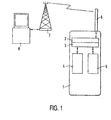
- the cell phone 1 shows a schematic representation of a mobile telephone 1 with a transmitter / Receiver unit 2, a control unit 3, a first memory 4 and a second Memory 5.
- the cell phone 1 with a transmitting / receiving station is located via an antenna 6 7 of a network in radio communication. This transmitting / receiving station 7 is at one Network computer 8 connected.
- the memories 4, 5 can either be formed separately or a single memory can be divided into several areas.
- To establish a data transmission connection for transmitting the coding and decoding algorithm is from the network computer 8 via the transmitting / receiving station 7 SMS message sent to the mobile phone 1, whereupon a call from the mobile phone 1 the network is triggered.
- the network computer 8 sends the new coding-decoding algorithm via the transmitting / receiving station 7 to the Mobile phone 1, which receives the signals via its antenna 6 and to the transmitter / receiver unit 2 forwards.
- the control unit 3 checks which of the memories 4 or 5 can be used to store the coding and decoding algorithm. If for example, memory 4 is activated at the moment, the newly downloaded one Algorithm stored in memory 5.
- the user Via the operating menu of the mobile phone 1 the user can switch between the old algorithm in memory 4 and the new one Select the algorithm in memory 5, whereby only one algorithm is activated at a time may be. If the user decides to use the new algorithm, activated the control unit 3 the memory 5 and at the same time deactivates the memory 4. With others The new coding and decoding algorithm in the memory 5 is then used for conversations.
- Fig. 2 shows schematically the transmitter / receiver unit 2. It contains a demodulator 9, which converts the analog radio waves into electrical signals, which are then transmitted from an A / D converter 10 are converted into digital signals and by one of the Decoders 11, 12 are further processed.
- the decoder 11 uses the one in memory 4 stored coding and decoding algorithm.
- the coding used in the decoder 12 and decoding algorithm is stored in memory 5.
- a means 21 is between the decoders 11 and 12 switched, the digital data is from that Decoder continues to work on the coding and decoding algorithm at the moment active memory. If memory 5 is activated, decoder 12 comes for use.
- the decoder contains the speech algorithm with which the conversion the radio signals are in voice data.
- the converted signals are sent to a D / A converter 13 forwarded, which converts the digital signals into analog signals.
- the analog Signals are output via a loudspeaker 14 integrated in the mobile telephone 1.
- the reverse process takes place when the user enters a microphone 15 of the mobile phone 1 speaks.
- the analog sound waves pass from the microphone 15 to the A / D converter 16 and are converted into digital signals.
- the matching encoder 17 or 18 is also activated.
- the mean 22 at which can be a software-controlled switchover, for example one of the encoders 17 or 18 is selected, the digital signals are from the Encoder implemented so that it can be transmitted by radio.
- the conversion into analog signals takes place in a D / A converter 19 and the forwarding and processing in a modulator 20.
- the modulator 20 effects the radio transmission via the antenna 6 to the transmitting / receiving station 7 and thus to the network computer 8th.
Landscapes
- Engineering & Computer Science (AREA)
- Signal Processing (AREA)
- Computer Networks & Wireless Communication (AREA)
- Databases & Information Systems (AREA)
- Physics & Mathematics (AREA)
- Health & Medical Sciences (AREA)
- Audiology, Speech & Language Pathology (AREA)
- Human Computer Interaction (AREA)
- Computational Linguistics (AREA)
- Acoustics & Sound (AREA)
- Multimedia (AREA)
- Mobile Radio Communication Systems (AREA)
- Telephone Function (AREA)
- Transceivers (AREA)
- Communication Control (AREA)
- Circuits Of Receivers In General (AREA)
Abstract
Description
- Fig.1
- ein erfindungsgemäßes Mobiltelefon während einer Datenübertragungsverbindung mit dem Netzwerk;
- Fig. 2
- die Umwandlung von Funkwellen in Sprachsignale und umgekehrt in Form eines Schaubilds.
Claims (8)
- Verfahren zum Betrieb eines in ein Datenübertragungsnetzwerk eingebundenen Mobiltelefons, das wenigstens einen Kodier- und Dekodieralgorithmus zum Umwandeln von analogen Sprachdaten in digitale Daten und umgekehrt aufweist, bei welchem Verfahren wenigstens ein weiterer Kodier- und Dekodieralgorithmus über eine zwischen dem Mobiltelefon (1) und dem Netzwerk (8) aufgebaute Datenübertragungsverbindung an das Mobiltelefon übertragen, von diesem empfangen und in einen nicht-flüchtigen Speicher (4, 5) abgelegt und nach der Implementierung zur Datenumwandlung verwendet wird.
- Verfahren nach Anspruch 1,
dadurch gekennzeichnet,
dass der über das Netzwerk (8) geladene Kodier- und Dekodieralgorithmus alternativ zu dem oder den bereits vorhandenen Kodier- und Dekodieralgorithmen verwendet wird, wobei jeweils ein bestimmter Algorithmus ausgewählt werden kann. - Verfahren nach Anspruch 1 oder 2,
dadurch gekennzeichnet,
dass zum Aufbau der Datenübertragungsverbindung zum Übertragen des Kodier- und Dekodieralgorithmus eine SMS-Nachricht vom Netzwerk (8) an das Mobiltelefon (1) gesandt wird, oder ein Direktanruf am Mobiltelefon (1) erfolgt, um einen Anruf des Mobiltelefons (1) bei dem Netzwerk (8) auszulösen. - Verfahren nach einem der vorangehenden Ansprüche,
dadurch gekennzeichnet,
dass die Datenübertragungsverbindung der GSM-Norm, insbesondere den Protokollen DCS1800 oder PCS1900, entspricht. - Verfahren nach einem der vorangehenden Ansprüche,
dadurch gekennzeichnet,
dass am Ende der Datenübertragung bzw. nach einem Teil der Datenübertragung eine Prüfsumme übertragen wird, die mit einer von dem Mobiltelefon (1) aus den übertragenen Daten errechneten Prüfsumme verglichen wird, wobei die Datenübertragung bei identischen Prüfsummen beendet wird und bei unterschiedlichen Prüfsummen wiederholt wird. - Mobiltelefon mit wenigstens einem Kodier- und Dekodieralgorithmus zum Umwandeln von analogen Sprachdaten in digitale Daten und umgekehrt,
dadurch gekennzeichnet,
dass es einen nichtflüchtigen Speicher (4, 5) und Mittel zum Empfang mindestens eines weiteren Kodier- und Dekodieralgorithmus über eine zwischen dem Mobiltelefon (1) und dem Netzwerk (8) aufgebaute Datenübertragungsverbindung und zum Ablegen in den nichtflüchtigen Speicher (4, 5) aufweist. - Mobiltelefon nach Anspruch 6,
dadurch gekennzeichnet,
dass der nichtflüchtige Speicher (4, 5) als EEPROM oder FlashPROM ausgebildet ist. - Mobiltelefon nach Anspruch 6 oder 7,
dadurch gekennzeichnet,
dass es Mittel (21, 22) zum Umschalten zwischen den Kodier- und Dekodieralgorithmen aufweist, wobei jeweils ein bestimmter Kodier- und Dekodieralgorithmus aktiviert wird.
Applications Claiming Priority (2)
| Application Number | Priority Date | Filing Date | Title |
|---|---|---|---|
| DE10009444 | 2000-02-29 | ||
| DE2000109444 DE10009444A1 (de) | 2000-02-29 | 2000-02-29 | Betriebsverfahren für ein Mobiltelefon |
Publications (3)
| Publication Number | Publication Date |
|---|---|
| EP1130935A2 true EP1130935A2 (de) | 2001-09-05 |
| EP1130935A3 EP1130935A3 (de) | 2002-08-07 |
| EP1130935B1 EP1130935B1 (de) | 2016-04-13 |
Family
ID=7632773
Family Applications (1)
| Application Number | Title | Priority Date | Filing Date |
|---|---|---|---|
| EP01200655.7A Expired - Lifetime EP1130935B1 (de) | 2000-02-29 | 2001-02-22 | Aktualisierungsverfahren für ein Mobiltelefon |
Country Status (6)
| Country | Link |
|---|---|
| US (1) | US7190953B2 (de) |
| EP (1) | EP1130935B1 (de) |
| JP (1) | JP2001298501A (de) |
| KR (1) | KR100810782B1 (de) |
| CN (1) | CN1264369C (de) |
| DE (1) | DE10009444A1 (de) |
Families Citing this family (3)
| Publication number | Priority date | Publication date | Assignee | Title |
|---|---|---|---|---|
| AU2003213931A1 (en) * | 2002-04-09 | 2003-10-27 | Nortel Networks Limited | Tandem-free operation (tfo) capable communication apparatus |
| RU2312459C2 (ru) * | 2002-12-27 | 2007-12-10 | Максим Владимирович Дорожкин | Система связи с подвижными объектами |
| US11962393B2 (en) * | 2018-03-08 | 2024-04-16 | Smiths Interconnect, Inc. | Network agnostic dynamic SATCOM system and associated network features |
Family Cites Families (28)
| Publication number | Priority date | Publication date | Assignee | Title |
|---|---|---|---|---|
| SU560355A1 (ru) * | 1975-02-12 | 1977-05-30 | Способ передачи данных -позиционны ми сигналами | |
| JPH04345332A (ja) * | 1991-05-23 | 1992-12-01 | Sony Corp | 携帯電話装置 |
| JP3497869B2 (ja) * | 1993-03-19 | 2004-02-16 | 富士通株式会社 | トーン発生回路の送出データ試験回路 |
| US6167253A (en) * | 1995-01-12 | 2000-12-26 | Bell Atlantic Network Services, Inc. | Mobile data/message/electronic mail download system utilizing network-centric protocol such as Java |
| US6636970B2 (en) * | 1995-02-14 | 2003-10-21 | Fujitsu Limited | Software encoding using a combination of two types of encoding and encoding type identification information |
| US5742910A (en) * | 1995-05-23 | 1998-04-21 | Mci Corporation | Teleadministration of subscriber ID modules |
| DE19532069C2 (de) * | 1995-07-17 | 1997-08-28 | Hagenuk Telecom Gmbh | Verfahren zum automatischen Umschalten der Betriebsart in einem Mobiltelefon für Multi-Mode-Betrieb |
| US6349204B1 (en) * | 1996-02-12 | 2002-02-19 | British Telecommunications Public Limited Company | Provision of telecommunications control program data pursuant to preliminary data exchange between system elements |
| WO1997029606A1 (en) * | 1996-02-12 | 1997-08-14 | British Telecommunications Public Limited Company | Telephone system |
| KR100219150B1 (ko) * | 1996-07-11 | 1999-09-01 | 윤종용 | 다중 망접속이 가능한 영상전화시스템 |
| US6240126B1 (en) * | 1996-09-18 | 2001-05-29 | Brother Kogyo Kabushiki Kaisha | Wireless communication device |
| US5855003A (en) * | 1996-10-11 | 1998-12-29 | Motorola, Inc. | Method and apparatus for establishing a link in a wireless communication system |
| US5872775A (en) * | 1996-10-30 | 1999-02-16 | Qualcomm Incorporated | Method and apparatus for performing rate determination |
| US6289037B1 (en) * | 1997-02-24 | 2001-09-11 | At&T Wireless Services Inc. | Out of channel cyclic redundancy code method for a discrete multitone spread spectrum communications system |
| JP3431463B2 (ja) * | 1997-08-28 | 2003-07-28 | 株式会社エヌ・ティ・ティ・ドコモ | 移動体通信システム、サービス提供方法および移動局 |
| US6058359A (en) * | 1998-03-04 | 2000-05-02 | Telefonaktiebolaget L M Ericsson | Speech coding including soft adaptability feature |
| US5898696A (en) * | 1997-09-05 | 1999-04-27 | Motorola, Inc. | Method and system for controlling an encoding rate in a variable rate communication system |
| JPH11120002A (ja) * | 1997-10-16 | 1999-04-30 | Fujitsu Ltd | 複数のdspを有する装置 |
| US6208627B1 (en) * | 1997-12-10 | 2001-03-27 | Xircom, Inc. | Signaling and protocol for communication system with wireless trunk |
| SE516595C2 (sv) * | 1998-03-13 | 2002-02-05 | Ericsson Telefon Ab L M | Kommunikationsanordning och arbetssätt för behandling av röstmeddelanden |
| JPH11298959A (ja) * | 1998-04-09 | 1999-10-29 | Nec Commun Syst Ltd | 移動電話システム |
| US6535497B1 (en) * | 1998-05-11 | 2003-03-18 | Telefonaktiebolaget Lm Ericsson (Publ) | Methods and systems for multiplexing of multiple users for enhanced capacity radiocommunications |
| JPH11331936A (ja) * | 1998-05-20 | 1999-11-30 | Oki Electric Ind Co Ltd | 移動体通信システム |
| JP2000023251A (ja) * | 1998-06-26 | 2000-01-21 | Kokusai Electric Co Ltd | 移動通信機及び移動通信システム |
| US6587684B1 (en) * | 1998-07-28 | 2003-07-01 | Bell Atlantic Nynex Mobile | Digital wireless telephone system for downloading software to a digital telephone using wireless data link protocol |
| SG71832A1 (en) * | 1998-08-24 | 2000-04-18 | Inst Of Microelectronics | Method and apparatus for real-time determination of scalable channel coding scheme parameters |
| US6188981B1 (en) * | 1998-09-18 | 2001-02-13 | Conexant Systems, Inc. | Method and apparatus for detecting voice activity in a speech signal |
| US7307958B2 (en) * | 1999-12-08 | 2007-12-11 | Cello Partnership | Tunnelling wireless voice with software-defined vocoders |
-
2000
- 2000-02-29 DE DE2000109444 patent/DE10009444A1/de not_active Withdrawn
-
2001
- 2001-02-22 EP EP01200655.7A patent/EP1130935B1/de not_active Expired - Lifetime
- 2001-02-24 CN CNB011172479A patent/CN1264369C/zh not_active Expired - Lifetime
- 2001-02-27 JP JP2001052774A patent/JP2001298501A/ja active Pending
- 2001-02-27 KR KR20010009859A patent/KR100810782B1/ko not_active Expired - Lifetime
- 2001-02-28 US US09/795,000 patent/US7190953B2/en not_active Expired - Lifetime
Also Published As
| Publication number | Publication date |
|---|---|
| JP2001298501A (ja) | 2001-10-26 |
| US20010024961A1 (en) | 2001-09-27 |
| KR100810782B1 (ko) | 2008-03-06 |
| KR20010085640A (ko) | 2001-09-07 |
| US7190953B2 (en) | 2007-03-13 |
| DE10009444A1 (de) | 2001-09-06 |
| EP1130935B1 (de) | 2016-04-13 |
| CN1312662A (zh) | 2001-09-12 |
| EP1130935A3 (de) | 2002-08-07 |
| CN1264369C (zh) | 2006-07-12 |
Similar Documents
| Publication | Publication Date | Title |
|---|---|---|
| DE69736687T2 (de) | Verfahren und Einrichtung zum Aktualisieren des Programms eines mobilen Endgerätes unter Verwendung der Luftschnittstelle | |
| DE60036880T2 (de) | Such- und ersetzungsmerkmale für ein endgerätetelefonbuch | |
| DE69423870T2 (de) | Faksimiledienst in einem hf-nachrichtensystem | |
| DE60038035T2 (de) | Headerkomprimierung durch verwendung von divisionsresten | |
| DE69912075T2 (de) | TURBOENKODER/DEKODER UND VON DER SERVICEQUALITÄT (QoS) ABHÄNGIGES RAHMENVERARBEITUNGSVERFAHREN | |
| DE3853707T2 (de) | Multimedien-Postsystem. | |
| EP1308065B1 (de) | Verfahren und basisstation zur signalübertragung in einem funk-kommunikationssystem | |
| DE69500413T2 (de) | Verfahren und gerät zur audiorückkopplung über einen digitalen kanal | |
| DE4340679A1 (de) | Sprachmodul für die akustische Wiedergabe von SAPI 3 Messages (Short Message Service) in einer Mobilstation (MS) | |
| EP1256260A2 (de) | Fitting-anlage | |
| EP0360979A2 (de) | Rundfunkempfänger zum Empfang digital codierter Verkehrsnachrichten mit einer stromsparenden Stand-by-Funktion | |
| DE69833366T2 (de) | Gerät zum speichern von sprachmitteilungen in einem schnurlosen telephonsystem | |
| DE69633384T2 (de) | Unter einem einzigen betriebssystem arbeitendes zellulares kommunikationssystem | |
| DE19818515C2 (de) | Verfahren zum Programmieren eines programmierbaren Funkgeräts sowie ein entsprechendes programmierbares Funkgerät | |
| EP1130935B1 (de) | Aktualisierungsverfahren für ein Mobiltelefon | |
| EP1236372B1 (de) | Verfahren zum betreiben eines mobilfunknetzes | |
| DE10261201A1 (de) | Verfahren zur Herstellung einer Verbindung zwischen einer Mobilstation und einem Kommunikationsnetzwerk | |
| DE19520764B4 (de) | Kommunikationssystem | |
| EP0744114B1 (de) | Verfahren zur übertragung von codierten sprachsignalen in mindestens einem telekommunikationsnetz | |
| EP0902596A2 (de) | Vorrichtung zur Verarbeitung digitaler Signale für ein Endgerät eines Mobilfunknetzes | |
| EP1142185B1 (de) | Verfahren und anordnung zur kanalcodierung bzw. decodierung von in rahmen strukturierten informationen | |
| EP1736022B1 (de) | Mobiles Endgerät zum Empfang paketorientierter Rundfunksignale | |
| DE102020213137A1 (de) | Kommunikationseinheit für ein Fahrzeug, Fahrzeug und Verfahren zum Betrieb einer Kommunikationseinheit für ein Fahrzeug | |
| EP1658742A1 (de) | Verfahren zur bertragung von textnachrichten im textmode | |
| EP0978166A2 (de) | Endgeräat für den digitalen mobilfunk und verfahren zum auswerten von in einem solchen endgerät empfangenen daten |
Legal Events
| Date | Code | Title | Description |
|---|---|---|---|
| PUAI | Public reference made under article 153(3) epc to a published international application that has entered the european phase |
Free format text: ORIGINAL CODE: 0009012 |
|
| AK | Designated contracting states |
Kind code of ref document: A2 Designated state(s): AT BE CH CY DE DK ES FI FR GB GR IE IT LI LU MC NL PT SE TR |
|
| AX | Request for extension of the european patent |
Free format text: AL;LT;LV;MK;RO;SI |
|
| PUAL | Search report despatched |
Free format text: ORIGINAL CODE: 0009013 |
|
| AK | Designated contracting states |
Kind code of ref document: A3 Designated state(s): AT BE CH CY DE DK ES FI FR GB GR IE IT LI LU MC NL PT SE TR |
|
| AX | Request for extension of the european patent |
Free format text: AL;LT;LV;MK;RO;SI |
|
| RAP1 | Party data changed (applicant data changed or rights of an application transferred) |
Owner name: PHILIPS CORPORATE INTELLECTUAL PROPERTY GMBH Owner name: KONINKLIJKE PHILIPS ELECTRONICS N.V. |
|
| 17P | Request for examination filed |
Effective date: 20030207 |
|
| 17Q | First examination report despatched |
Effective date: 20030314 |
|
| AKX | Designation fees paid |
Designated state(s): DE FR GB |
|
| RAP1 | Party data changed (applicant data changed or rights of an application transferred) |
Owner name: PHILIPS INTELLECTUAL PROPERTY & STANDARDS GMBH Owner name: KONINKLIJKE PHILIPS ELECTRONICS N.V. |
|
| RAP1 | Party data changed (applicant data changed or rights of an application transferred) |
Owner name: NXP B.V. |
|
| RAP1 | Party data changed (applicant data changed or rights of an application transferred) |
Owner name: ERICSSON MODEMS SA |
|
| RAP1 | Party data changed (applicant data changed or rights of an application transferred) |
Owner name: ERICSSON MODEMS SA |
|
| REG | Reference to a national code |
Ref country code: DE Ref legal event code: R079 Ref document number: 50116548 Country of ref document: DE Free format text: PREVIOUS MAIN CLASS: H04Q0007320000 Ipc: H04W0008220000 |
|
| GRAP | Despatch of communication of intention to grant a patent |
Free format text: ORIGINAL CODE: EPIDOSNIGR1 |
|
| RIN1 | Information on inventor provided before grant (corrected) |
Inventor name: RICHTER, THOMAS |
|
| INTG | Intention to grant announced |
Effective date: 20150512 |
|
| RIC1 | Information provided on ipc code assigned before grant |
Ipc: H04W 8/22 20090101AFI20150504BHEP |
|
| GRAP | Despatch of communication of intention to grant a patent |
Free format text: ORIGINAL CODE: EPIDOSNIGR1 |
|
| GRAJ | Information related to disapproval of communication of intention to grant by the applicant or resumption of examination proceedings by the epo deleted |
Free format text: ORIGINAL CODE: EPIDOSDIGR1 |
|
| GRAP | Despatch of communication of intention to grant a patent |
Free format text: ORIGINAL CODE: EPIDOSNIGR1 |
|
| INTG | Intention to grant announced |
Effective date: 20150925 |
|
| RAP1 | Party data changed (applicant data changed or rights of an application transferred) |
Owner name: TELEFONAKTIEBOLAGET L M ERICSSON (PUBL) |
|
| INTG | Intention to grant announced |
Effective date: 20151005 |
|
| GRAS | Grant fee paid |
Free format text: ORIGINAL CODE: EPIDOSNIGR3 |
|
| GRAA | (expected) grant |
Free format text: ORIGINAL CODE: 0009210 |
|
| AK | Designated contracting states |
Kind code of ref document: B1 Designated state(s): DE FR GB |
|
| REG | Reference to a national code |
Ref country code: GB Ref legal event code: FG4D Free format text: NOT ENGLISH |
|
| REG | Reference to a national code |
Ref country code: DE Ref legal event code: R096 Ref document number: 50116548 Country of ref document: DE |
|
| REG | Reference to a national code |
Ref country code: DE Ref legal event code: R097 Ref document number: 50116548 Country of ref document: DE |
|
| PLBE | No opposition filed within time limit |
Free format text: ORIGINAL CODE: 0009261 |
|
| STAA | Information on the status of an ep patent application or granted ep patent |
Free format text: STATUS: NO OPPOSITION FILED WITHIN TIME LIMIT |
|
| REG | Reference to a national code |
Ref country code: FR Ref legal event code: PLFP Year of fee payment: 17 |
|
| 26N | No opposition filed |
Effective date: 20170116 |
|
| REG | Reference to a national code |
Ref country code: FR Ref legal event code: PLFP Year of fee payment: 18 |
|
| PGFP | Annual fee paid to national office [announced via postgrant information from national office to epo] |
Ref country code: DE Payment date: 20200227 Year of fee payment: 20 Ref country code: GB Payment date: 20200227 Year of fee payment: 20 |
|
| PGFP | Annual fee paid to national office [announced via postgrant information from national office to epo] |
Ref country code: FR Payment date: 20200225 Year of fee payment: 20 |
|
| REG | Reference to a national code |
Ref country code: DE Ref legal event code: R071 Ref document number: 50116548 Country of ref document: DE |
|
| REG | Reference to a national code |
Ref country code: GB Ref legal event code: PE20 Expiry date: 20210221 |
|
| PG25 | Lapsed in a contracting state [announced via postgrant information from national office to epo] |
Ref country code: GB Free format text: LAPSE BECAUSE OF EXPIRATION OF PROTECTION Effective date: 20210221 |