EP1130186A2 - Verfahren zum Verlegen von Dachdichtungsbahnen - Google Patents
Verfahren zum Verlegen von Dachdichtungsbahnen Download PDFInfo
- Publication number
- EP1130186A2 EP1130186A2 EP01250054A EP01250054A EP1130186A2 EP 1130186 A2 EP1130186 A2 EP 1130186A2 EP 01250054 A EP01250054 A EP 01250054A EP 01250054 A EP01250054 A EP 01250054A EP 1130186 A2 EP1130186 A2 EP 1130186A2
- Authority
- EP
- European Patent Office
- Prior art keywords
- layer
- cover layer
- adhesive
- adhesive layer
- insert
- Prior art date
- Legal status (The legal status is an assumption and is not a legal conclusion. Google has not performed a legal analysis and makes no representation as to the accuracy of the status listed.)
- Withdrawn
Links
Images
Classifications
-
- E—FIXED CONSTRUCTIONS
- E04—BUILDING
- E04D—ROOF COVERINGS; SKY-LIGHTS; GUTTERS; ROOF-WORKING TOOLS
- E04D5/00—Roof covering by making use of flexible material, e.g. supplied in roll form
- E04D5/14—Fastening means therefor
- E04D5/148—Fastening means therefor fastening by gluing
-
- B—PERFORMING OPERATIONS; TRANSPORTING
- B29—WORKING OF PLASTICS; WORKING OF SUBSTANCES IN A PLASTIC STATE IN GENERAL
- B29C—SHAPING OR JOINING OF PLASTICS; SHAPING OF MATERIAL IN A PLASTIC STATE, NOT OTHERWISE PROVIDED FOR; AFTER-TREATMENT OF THE SHAPED PRODUCTS, e.g. REPAIRING
- B29C65/00—Joining or sealing of preformed parts, e.g. welding of plastics materials; Apparatus therefor
- B29C65/02—Joining or sealing of preformed parts, e.g. welding of plastics materials; Apparatus therefor by heating, with or without pressure
- B29C65/34—Joining or sealing of preformed parts, e.g. welding of plastics materials; Apparatus therefor by heating, with or without pressure using heated elements which remain in the joint, e.g. "verlorenes Schweisselement"
- B29C65/36—Joining or sealing of preformed parts, e.g. welding of plastics materials; Apparatus therefor by heating, with or without pressure using heated elements which remain in the joint, e.g. "verlorenes Schweisselement" heated by induction
- B29C65/3604—Joining or sealing of preformed parts, e.g. welding of plastics materials; Apparatus therefor by heating, with or without pressure using heated elements which remain in the joint, e.g. "verlorenes Schweisselement" heated by induction characterised by the type of elements heated by induction which remain in the joint
- B29C65/3608—Joining or sealing of preformed parts, e.g. welding of plastics materials; Apparatus therefor by heating, with or without pressure using heated elements which remain in the joint, e.g. "verlorenes Schweisselement" heated by induction characterised by the type of elements heated by induction which remain in the joint comprising single particles, e.g. fillers or discontinuous fibre-reinforcements
- B29C65/3612—Joining or sealing of preformed parts, e.g. welding of plastics materials; Apparatus therefor by heating, with or without pressure using heated elements which remain in the joint, e.g. "verlorenes Schweisselement" heated by induction characterised by the type of elements heated by induction which remain in the joint comprising single particles, e.g. fillers or discontinuous fibre-reinforcements comprising fillers
-
- B—PERFORMING OPERATIONS; TRANSPORTING
- B29—WORKING OF PLASTICS; WORKING OF SUBSTANCES IN A PLASTIC STATE IN GENERAL
- B29C—SHAPING OR JOINING OF PLASTICS; SHAPING OF MATERIAL IN A PLASTIC STATE, NOT OTHERWISE PROVIDED FOR; AFTER-TREATMENT OF THE SHAPED PRODUCTS, e.g. REPAIRING
- B29C65/00—Joining or sealing of preformed parts, e.g. welding of plastics materials; Apparatus therefor
- B29C65/02—Joining or sealing of preformed parts, e.g. welding of plastics materials; Apparatus therefor by heating, with or without pressure
- B29C65/34—Joining or sealing of preformed parts, e.g. welding of plastics materials; Apparatus therefor by heating, with or without pressure using heated elements which remain in the joint, e.g. "verlorenes Schweisselement"
- B29C65/36—Joining or sealing of preformed parts, e.g. welding of plastics materials; Apparatus therefor by heating, with or without pressure using heated elements which remain in the joint, e.g. "verlorenes Schweisselement" heated by induction
- B29C65/3604—Joining or sealing of preformed parts, e.g. welding of plastics materials; Apparatus therefor by heating, with or without pressure using heated elements which remain in the joint, e.g. "verlorenes Schweisselement" heated by induction characterised by the type of elements heated by induction which remain in the joint
- B29C65/3636—Joining or sealing of preformed parts, e.g. welding of plastics materials; Apparatus therefor by heating, with or without pressure using heated elements which remain in the joint, e.g. "verlorenes Schweisselement" heated by induction characterised by the type of elements heated by induction which remain in the joint comprising independent continuous fibre-reinforcements
-
- B—PERFORMING OPERATIONS; TRANSPORTING
- B29—WORKING OF PLASTICS; WORKING OF SUBSTANCES IN A PLASTIC STATE IN GENERAL
- B29C—SHAPING OR JOINING OF PLASTICS; SHAPING OF MATERIAL IN A PLASTIC STATE, NOT OTHERWISE PROVIDED FOR; AFTER-TREATMENT OF THE SHAPED PRODUCTS, e.g. REPAIRING
- B29C65/00—Joining or sealing of preformed parts, e.g. welding of plastics materials; Apparatus therefor
- B29C65/02—Joining or sealing of preformed parts, e.g. welding of plastics materials; Apparatus therefor by heating, with or without pressure
- B29C65/34—Joining or sealing of preformed parts, e.g. welding of plastics materials; Apparatus therefor by heating, with or without pressure using heated elements which remain in the joint, e.g. "verlorenes Schweisselement"
- B29C65/36—Joining or sealing of preformed parts, e.g. welding of plastics materials; Apparatus therefor by heating, with or without pressure using heated elements which remain in the joint, e.g. "verlorenes Schweisselement" heated by induction
- B29C65/3604—Joining or sealing of preformed parts, e.g. welding of plastics materials; Apparatus therefor by heating, with or without pressure using heated elements which remain in the joint, e.g. "verlorenes Schweisselement" heated by induction characterised by the type of elements heated by induction which remain in the joint
- B29C65/364—Joining or sealing of preformed parts, e.g. welding of plastics materials; Apparatus therefor by heating, with or without pressure using heated elements which remain in the joint, e.g. "verlorenes Schweisselement" heated by induction characterised by the type of elements heated by induction which remain in the joint being a woven or non-woven fabric or being a mesh
-
- B—PERFORMING OPERATIONS; TRANSPORTING
- B29—WORKING OF PLASTICS; WORKING OF SUBSTANCES IN A PLASTIC STATE IN GENERAL
- B29C—SHAPING OR JOINING OF PLASTICS; SHAPING OF MATERIAL IN A PLASTIC STATE, NOT OTHERWISE PROVIDED FOR; AFTER-TREATMENT OF THE SHAPED PRODUCTS, e.g. REPAIRING
- B29C65/00—Joining or sealing of preformed parts, e.g. welding of plastics materials; Apparatus therefor
- B29C65/48—Joining or sealing of preformed parts, e.g. welding of plastics materials; Apparatus therefor using adhesives, i.e. using supplementary joining material; solvent bonding
- B29C65/50—Joining or sealing of preformed parts, e.g. welding of plastics materials; Apparatus therefor using adhesives, i.e. using supplementary joining material; solvent bonding using adhesive tape, e.g. thermoplastic tape; using threads or the like
- B29C65/5007—Joining or sealing of preformed parts, e.g. welding of plastics materials; Apparatus therefor using adhesives, i.e. using supplementary joining material; solvent bonding using adhesive tape, e.g. thermoplastic tape; using threads or the like characterised by the structure of said adhesive tape, threads or the like
- B29C65/5021—Joining or sealing of preformed parts, e.g. welding of plastics materials; Apparatus therefor using adhesives, i.e. using supplementary joining material; solvent bonding using adhesive tape, e.g. thermoplastic tape; using threads or the like characterised by the structure of said adhesive tape, threads or the like being multi-layered
-
- B—PERFORMING OPERATIONS; TRANSPORTING
- B29—WORKING OF PLASTICS; WORKING OF SUBSTANCES IN A PLASTIC STATE IN GENERAL
- B29C—SHAPING OR JOINING OF PLASTICS; SHAPING OF MATERIAL IN A PLASTIC STATE, NOT OTHERWISE PROVIDED FOR; AFTER-TREATMENT OF THE SHAPED PRODUCTS, e.g. REPAIRING
- B29C65/00—Joining or sealing of preformed parts, e.g. welding of plastics materials; Apparatus therefor
- B29C65/48—Joining or sealing of preformed parts, e.g. welding of plastics materials; Apparatus therefor using adhesives, i.e. using supplementary joining material; solvent bonding
- B29C65/50—Joining or sealing of preformed parts, e.g. welding of plastics materials; Apparatus therefor using adhesives, i.e. using supplementary joining material; solvent bonding using adhesive tape, e.g. thermoplastic tape; using threads or the like
- B29C65/5042—Joining or sealing of preformed parts, e.g. welding of plastics materials; Apparatus therefor using adhesives, i.e. using supplementary joining material; solvent bonding using adhesive tape, e.g. thermoplastic tape; using threads or the like covering both elements to be joined
-
- B—PERFORMING OPERATIONS; TRANSPORTING
- B29—WORKING OF PLASTICS; WORKING OF SUBSTANCES IN A PLASTIC STATE IN GENERAL
- B29C—SHAPING OR JOINING OF PLASTICS; SHAPING OF MATERIAL IN A PLASTIC STATE, NOT OTHERWISE PROVIDED FOR; AFTER-TREATMENT OF THE SHAPED PRODUCTS, e.g. REPAIRING
- B29C65/00—Joining or sealing of preformed parts, e.g. welding of plastics materials; Apparatus therefor
- B29C65/48—Joining or sealing of preformed parts, e.g. welding of plastics materials; Apparatus therefor using adhesives, i.e. using supplementary joining material; solvent bonding
- B29C65/50—Joining or sealing of preformed parts, e.g. welding of plastics materials; Apparatus therefor using adhesives, i.e. using supplementary joining material; solvent bonding using adhesive tape, e.g. thermoplastic tape; using threads or the like
- B29C65/5057—Joining or sealing of preformed parts, e.g. welding of plastics materials; Apparatus therefor using adhesives, i.e. using supplementary joining material; solvent bonding using adhesive tape, e.g. thermoplastic tape; using threads or the like positioned between the surfaces to be joined
-
- B—PERFORMING OPERATIONS; TRANSPORTING
- B29—WORKING OF PLASTICS; WORKING OF SUBSTANCES IN A PLASTIC STATE IN GENERAL
- B29C—SHAPING OR JOINING OF PLASTICS; SHAPING OF MATERIAL IN A PLASTIC STATE, NOT OTHERWISE PROVIDED FOR; AFTER-TREATMENT OF THE SHAPED PRODUCTS, e.g. REPAIRING
- B29C66/00—General aspects of processes or apparatus for joining preformed parts
- B29C66/01—General aspects dealing with the joint area or with the area to be joined
- B29C66/05—Particular design of joint configurations
- B29C66/10—Particular design of joint configurations particular design of the joint cross-sections
- B29C66/11—Joint cross-sections comprising a single joint-segment, i.e. one of the parts to be joined comprising a single joint-segment in the joint cross-section
- B29C66/112—Single lapped joints
- B29C66/1122—Single lap to lap joints, i.e. overlap joints
-
- B—PERFORMING OPERATIONS; TRANSPORTING
- B29—WORKING OF PLASTICS; WORKING OF SUBSTANCES IN A PLASTIC STATE IN GENERAL
- B29C—SHAPING OR JOINING OF PLASTICS; SHAPING OF MATERIAL IN A PLASTIC STATE, NOT OTHERWISE PROVIDED FOR; AFTER-TREATMENT OF THE SHAPED PRODUCTS, e.g. REPAIRING
- B29C66/00—General aspects of processes or apparatus for joining preformed parts
- B29C66/01—General aspects dealing with the joint area or with the area to be joined
- B29C66/05—Particular design of joint configurations
- B29C66/10—Particular design of joint configurations particular design of the joint cross-sections
- B29C66/11—Joint cross-sections comprising a single joint-segment, i.e. one of the parts to be joined comprising a single joint-segment in the joint cross-section
- B29C66/114—Single butt joints
- B29C66/1142—Single butt to butt joints
-
- B—PERFORMING OPERATIONS; TRANSPORTING
- B29—WORKING OF PLASTICS; WORKING OF SUBSTANCES IN A PLASTIC STATE IN GENERAL
- B29C—SHAPING OR JOINING OF PLASTICS; SHAPING OF MATERIAL IN A PLASTIC STATE, NOT OTHERWISE PROVIDED FOR; AFTER-TREATMENT OF THE SHAPED PRODUCTS, e.g. REPAIRING
- B29C66/00—General aspects of processes or apparatus for joining preformed parts
- B29C66/01—General aspects dealing with the joint area or with the area to be joined
- B29C66/349—Cooling the welding zone on the welding spot
-
- B—PERFORMING OPERATIONS; TRANSPORTING
- B29—WORKING OF PLASTICS; WORKING OF SUBSTANCES IN A PLASTIC STATE IN GENERAL
- B29C—SHAPING OR JOINING OF PLASTICS; SHAPING OF MATERIAL IN A PLASTIC STATE, NOT OTHERWISE PROVIDED FOR; AFTER-TREATMENT OF THE SHAPED PRODUCTS, e.g. REPAIRING
- B29C66/00—General aspects of processes or apparatus for joining preformed parts
- B29C66/40—General aspects of joining substantially flat articles, e.g. plates, sheets or web-like materials; Making flat seams in tubular or hollow articles; Joining single elements to substantially flat surfaces
- B29C66/41—Joining substantially flat articles ; Making flat seams in tubular or hollow articles
- B29C66/43—Joining a relatively small portion of the surface of said articles
-
- B—PERFORMING OPERATIONS; TRANSPORTING
- B29—WORKING OF PLASTICS; WORKING OF SUBSTANCES IN A PLASTIC STATE IN GENERAL
- B29C—SHAPING OR JOINING OF PLASTICS; SHAPING OF MATERIAL IN A PLASTIC STATE, NOT OTHERWISE PROVIDED FOR; AFTER-TREATMENT OF THE SHAPED PRODUCTS, e.g. REPAIRING
- B29C66/00—General aspects of processes or apparatus for joining preformed parts
- B29C66/70—General aspects of processes or apparatus for joining preformed parts characterised by the composition, physical properties or the structure of the material of the parts to be joined; Joining with non-plastics material
- B29C66/71—General aspects of processes or apparatus for joining preformed parts characterised by the composition, physical properties or the structure of the material of the parts to be joined; Joining with non-plastics material characterised by the composition of the plastics material of the parts to be joined
-
- B—PERFORMING OPERATIONS; TRANSPORTING
- B29—WORKING OF PLASTICS; WORKING OF SUBSTANCES IN A PLASTIC STATE IN GENERAL
- B29C—SHAPING OR JOINING OF PLASTICS; SHAPING OF MATERIAL IN A PLASTIC STATE, NOT OTHERWISE PROVIDED FOR; AFTER-TREATMENT OF THE SHAPED PRODUCTS, e.g. REPAIRING
- B29C66/00—General aspects of processes or apparatus for joining preformed parts
- B29C66/70—General aspects of processes or apparatus for joining preformed parts characterised by the composition, physical properties or the structure of the material of the parts to be joined; Joining with non-plastics material
- B29C66/72—General aspects of processes or apparatus for joining preformed parts characterised by the composition, physical properties or the structure of the material of the parts to be joined; Joining with non-plastics material characterised by the structure of the material of the parts to be joined
- B29C66/723—General aspects of processes or apparatus for joining preformed parts characterised by the composition, physical properties or the structure of the material of the parts to be joined; Joining with non-plastics material characterised by the structure of the material of the parts to be joined being multi-layered
-
- B—PERFORMING OPERATIONS; TRANSPORTING
- B29—WORKING OF PLASTICS; WORKING OF SUBSTANCES IN A PLASTIC STATE IN GENERAL
- B29C—SHAPING OR JOINING OF PLASTICS; SHAPING OF MATERIAL IN A PLASTIC STATE, NOT OTHERWISE PROVIDED FOR; AFTER-TREATMENT OF THE SHAPED PRODUCTS, e.g. REPAIRING
- B29C66/00—General aspects of processes or apparatus for joining preformed parts
- B29C66/90—Measuring or controlling the joining process
- B29C66/91—Measuring or controlling the joining process by measuring or controlling the temperature, the heat or the thermal flux
- B29C66/912—Measuring or controlling the joining process by measuring or controlling the temperature, the heat or the thermal flux by measuring the temperature, the heat or the thermal flux
- B29C66/9121—Measuring or controlling the joining process by measuring or controlling the temperature, the heat or the thermal flux by measuring the temperature, the heat or the thermal flux by measuring the temperature
- B29C66/91211—Measuring or controlling the joining process by measuring or controlling the temperature, the heat or the thermal flux by measuring the temperature, the heat or the thermal flux by measuring the temperature with special temperature measurement means or methods
- B29C66/91218—Measuring or controlling the joining process by measuring or controlling the temperature, the heat or the thermal flux by measuring the temperature, the heat or the thermal flux by measuring the temperature with special temperature measurement means or methods using colour change, e.g. using separate colour indicators
-
- B—PERFORMING OPERATIONS; TRANSPORTING
- B29—WORKING OF PLASTICS; WORKING OF SUBSTANCES IN A PLASTIC STATE IN GENERAL
- B29C—SHAPING OR JOINING OF PLASTICS; SHAPING OF MATERIAL IN A PLASTIC STATE, NOT OTHERWISE PROVIDED FOR; AFTER-TREATMENT OF THE SHAPED PRODUCTS, e.g. REPAIRING
- B29C66/00—General aspects of processes or apparatus for joining preformed parts
- B29C66/90—Measuring or controlling the joining process
- B29C66/91—Measuring or controlling the joining process by measuring or controlling the temperature, the heat or the thermal flux
- B29C66/912—Measuring or controlling the joining process by measuring or controlling the temperature, the heat or the thermal flux by measuring the temperature, the heat or the thermal flux
- B29C66/9121—Measuring or controlling the joining process by measuring or controlling the temperature, the heat or the thermal flux by measuring the temperature, the heat or the thermal flux by measuring the temperature
- B29C66/91221—Measuring or controlling the joining process by measuring or controlling the temperature, the heat or the thermal flux by measuring the temperature, the heat or the thermal flux by measuring the temperature of the parts to be joined
-
- B—PERFORMING OPERATIONS; TRANSPORTING
- B29—WORKING OF PLASTICS; WORKING OF SUBSTANCES IN A PLASTIC STATE IN GENERAL
- B29C—SHAPING OR JOINING OF PLASTICS; SHAPING OF MATERIAL IN A PLASTIC STATE, NOT OTHERWISE PROVIDED FOR; AFTER-TREATMENT OF THE SHAPED PRODUCTS, e.g. REPAIRING
- B29C66/00—General aspects of processes or apparatus for joining preformed parts
- B29C66/90—Measuring or controlling the joining process
- B29C66/91—Measuring or controlling the joining process by measuring or controlling the temperature, the heat or the thermal flux
- B29C66/914—Measuring or controlling the joining process by measuring or controlling the temperature, the heat or the thermal flux by controlling or regulating the temperature, the heat or the thermal flux
- B29C66/9141—Measuring or controlling the joining process by measuring or controlling the temperature, the heat or the thermal flux by controlling or regulating the temperature, the heat or the thermal flux by controlling or regulating the temperature
- B29C66/91411—Measuring or controlling the joining process by measuring or controlling the temperature, the heat or the thermal flux by controlling or regulating the temperature, the heat or the thermal flux by controlling or regulating the temperature of the parts to be joined, e.g. the joining process taking the temperature of the parts to be joined into account
-
- B—PERFORMING OPERATIONS; TRANSPORTING
- B29—WORKING OF PLASTICS; WORKING OF SUBSTANCES IN A PLASTIC STATE IN GENERAL
- B29C—SHAPING OR JOINING OF PLASTICS; SHAPING OF MATERIAL IN A PLASTIC STATE, NOT OTHERWISE PROVIDED FOR; AFTER-TREATMENT OF THE SHAPED PRODUCTS, e.g. REPAIRING
- B29C66/00—General aspects of processes or apparatus for joining preformed parts
- B29C66/90—Measuring or controlling the joining process
- B29C66/91—Measuring or controlling the joining process by measuring or controlling the temperature, the heat or the thermal flux
- B29C66/914—Measuring or controlling the joining process by measuring or controlling the temperature, the heat or the thermal flux by controlling or regulating the temperature, the heat or the thermal flux
- B29C66/9141—Measuring or controlling the joining process by measuring or controlling the temperature, the heat or the thermal flux by controlling or regulating the temperature, the heat or the thermal flux by controlling or regulating the temperature
- B29C66/91431—Measuring or controlling the joining process by measuring or controlling the temperature, the heat or the thermal flux by controlling or regulating the temperature, the heat or the thermal flux by controlling or regulating the temperature the temperature being kept constant over time
-
- B—PERFORMING OPERATIONS; TRANSPORTING
- B29—WORKING OF PLASTICS; WORKING OF SUBSTANCES IN A PLASTIC STATE IN GENERAL
- B29C—SHAPING OR JOINING OF PLASTICS; SHAPING OF MATERIAL IN A PLASTIC STATE, NOT OTHERWISE PROVIDED FOR; AFTER-TREATMENT OF THE SHAPED PRODUCTS, e.g. REPAIRING
- B29C66/00—General aspects of processes or apparatus for joining preformed parts
- B29C66/90—Measuring or controlling the joining process
- B29C66/91—Measuring or controlling the joining process by measuring or controlling the temperature, the heat or the thermal flux
- B29C66/919—Measuring or controlling the joining process by measuring or controlling the temperature, the heat or the thermal flux characterised by specific temperature, heat or thermal flux values or ranges
- B29C66/9192—Measuring or controlling the joining process by measuring or controlling the temperature, the heat or the thermal flux characterised by specific temperature, heat or thermal flux values or ranges in explicit relation to another variable, e.g. temperature diagrams
- B29C66/91921—Measuring or controlling the joining process by measuring or controlling the temperature, the heat or the thermal flux characterised by specific temperature, heat or thermal flux values or ranges in explicit relation to another variable, e.g. temperature diagrams in explicit relation to another temperature, e.g. to the softening temperature or softening point, to the thermal degradation temperature or to the ambient temperature
- B29C66/91931—Measuring or controlling the joining process by measuring or controlling the temperature, the heat or the thermal flux characterised by specific temperature, heat or thermal flux values or ranges in explicit relation to another variable, e.g. temperature diagrams in explicit relation to another temperature, e.g. to the softening temperature or softening point, to the thermal degradation temperature or to the ambient temperature in explicit relation to the fusion temperature or melting point of the material of one of the parts to be joined
- B29C66/91935—Measuring or controlling the joining process by measuring or controlling the temperature, the heat or the thermal flux characterised by specific temperature, heat or thermal flux values or ranges in explicit relation to another variable, e.g. temperature diagrams in explicit relation to another temperature, e.g. to the softening temperature or softening point, to the thermal degradation temperature or to the ambient temperature in explicit relation to the fusion temperature or melting point of the material of one of the parts to be joined lower than said fusion temperature
-
- E—FIXED CONSTRUCTIONS
- E04—BUILDING
- E04D—ROOF COVERINGS; SKY-LIGHTS; GUTTERS; ROOF-WORKING TOOLS
- E04D5/00—Roof covering by making use of flexible material, e.g. supplied in roll form
- E04D5/12—Roof covering by making use of flexible material, e.g. supplied in roll form specially modified, e.g. perforated, with granulated surface, with attached pads
-
- E—FIXED CONSTRUCTIONS
- E04—BUILDING
- E04D—ROOF COVERINGS; SKY-LIGHTS; GUTTERS; ROOF-WORKING TOOLS
- E04D5/00—Roof covering by making use of flexible material, e.g. supplied in roll form
- E04D5/14—Fastening means therefor
- E04D5/141—Fastening means therefor characterised by the location of the fastening means
- E04D5/143—Fastening means therefor characterised by the location of the fastening means in the field of the flexible material
-
- B—PERFORMING OPERATIONS; TRANSPORTING
- B29—WORKING OF PLASTICS; WORKING OF SUBSTANCES IN A PLASTIC STATE IN GENERAL
- B29C—SHAPING OR JOINING OF PLASTICS; SHAPING OF MATERIAL IN A PLASTIC STATE, NOT OTHERWISE PROVIDED FOR; AFTER-TREATMENT OF THE SHAPED PRODUCTS, e.g. REPAIRING
- B29C65/00—Joining or sealing of preformed parts, e.g. welding of plastics materials; Apparatus therefor
- B29C65/02—Joining or sealing of preformed parts, e.g. welding of plastics materials; Apparatus therefor by heating, with or without pressure
- B29C65/34—Joining or sealing of preformed parts, e.g. welding of plastics materials; Apparatus therefor by heating, with or without pressure using heated elements which remain in the joint, e.g. "verlorenes Schweisselement"
- B29C65/36—Joining or sealing of preformed parts, e.g. welding of plastics materials; Apparatus therefor by heating, with or without pressure using heated elements which remain in the joint, e.g. "verlorenes Schweisselement" heated by induction
- B29C65/3672—Joining or sealing of preformed parts, e.g. welding of plastics materials; Apparatus therefor by heating, with or without pressure using heated elements which remain in the joint, e.g. "verlorenes Schweisselement" heated by induction characterised by the composition of the elements heated by induction which remain in the joint
- B29C65/3676—Joining or sealing of preformed parts, e.g. welding of plastics materials; Apparatus therefor by heating, with or without pressure using heated elements which remain in the joint, e.g. "verlorenes Schweisselement" heated by induction characterised by the composition of the elements heated by induction which remain in the joint being metallic
- B29C65/368—Joining or sealing of preformed parts, e.g. welding of plastics materials; Apparatus therefor by heating, with or without pressure using heated elements which remain in the joint, e.g. "verlorenes Schweisselement" heated by induction characterised by the composition of the elements heated by induction which remain in the joint being metallic with a polymer coating
-
- B—PERFORMING OPERATIONS; TRANSPORTING
- B29—WORKING OF PLASTICS; WORKING OF SUBSTANCES IN A PLASTIC STATE IN GENERAL
- B29C—SHAPING OR JOINING OF PLASTICS; SHAPING OF MATERIAL IN A PLASTIC STATE, NOT OTHERWISE PROVIDED FOR; AFTER-TREATMENT OF THE SHAPED PRODUCTS, e.g. REPAIRING
- B29C65/00—Joining or sealing of preformed parts, e.g. welding of plastics materials; Apparatus therefor
- B29C65/48—Joining or sealing of preformed parts, e.g. welding of plastics materials; Apparatus therefor using adhesives, i.e. using supplementary joining material; solvent bonding
- B29C65/4805—Joining or sealing of preformed parts, e.g. welding of plastics materials; Apparatus therefor using adhesives, i.e. using supplementary joining material; solvent bonding characterised by the type of adhesives
- B29C65/481—Non-reactive adhesives, e.g. physically hardening adhesives
- B29C65/4815—Hot melt adhesives, e.g. thermoplastic adhesives
-
- B—PERFORMING OPERATIONS; TRANSPORTING
- B29—WORKING OF PLASTICS; WORKING OF SUBSTANCES IN A PLASTIC STATE IN GENERAL
- B29C—SHAPING OR JOINING OF PLASTICS; SHAPING OF MATERIAL IN A PLASTIC STATE, NOT OTHERWISE PROVIDED FOR; AFTER-TREATMENT OF THE SHAPED PRODUCTS, e.g. REPAIRING
- B29C66/00—General aspects of processes or apparatus for joining preformed parts
- B29C66/90—Measuring or controlling the joining process
- B29C66/91—Measuring or controlling the joining process by measuring or controlling the temperature, the heat or the thermal flux
- B29C66/912—Measuring or controlling the joining process by measuring or controlling the temperature, the heat or the thermal flux by measuring the temperature, the heat or the thermal flux
- B29C66/9121—Measuring or controlling the joining process by measuring or controlling the temperature, the heat or the thermal flux by measuring the temperature, the heat or the thermal flux by measuring the temperature
- B29C66/91211—Measuring or controlling the joining process by measuring or controlling the temperature, the heat or the thermal flux by measuring the temperature, the heat or the thermal flux by measuring the temperature with special temperature measurement means or methods
- B29C66/91216—Measuring or controlling the joining process by measuring or controlling the temperature, the heat or the thermal flux by measuring the temperature, the heat or the thermal flux by measuring the temperature with special temperature measurement means or methods enabling contactless temperature measurements, e.g. using a pyrometer
-
- B—PERFORMING OPERATIONS; TRANSPORTING
- B29—WORKING OF PLASTICS; WORKING OF SUBSTANCES IN A PLASTIC STATE IN GENERAL
- B29C—SHAPING OR JOINING OF PLASTICS; SHAPING OF MATERIAL IN A PLASTIC STATE, NOT OTHERWISE PROVIDED FOR; AFTER-TREATMENT OF THE SHAPED PRODUCTS, e.g. REPAIRING
- B29C66/00—General aspects of processes or apparatus for joining preformed parts
- B29C66/90—Measuring or controlling the joining process
- B29C66/92—Measuring or controlling the joining process by measuring or controlling the pressure, the force, the mechanical power or the displacement of the joining tools
- B29C66/929—Measuring or controlling the joining process by measuring or controlling the pressure, the force, the mechanical power or the displacement of the joining tools characterized by specific pressure, force, mechanical power or displacement values or ranges
-
- B—PERFORMING OPERATIONS; TRANSPORTING
- B29—WORKING OF PLASTICS; WORKING OF SUBSTANCES IN A PLASTIC STATE IN GENERAL
- B29C—SHAPING OR JOINING OF PLASTICS; SHAPING OF MATERIAL IN A PLASTIC STATE, NOT OTHERWISE PROVIDED FOR; AFTER-TREATMENT OF THE SHAPED PRODUCTS, e.g. REPAIRING
- B29C66/00—General aspects of processes or apparatus for joining preformed parts
- B29C66/90—Measuring or controlling the joining process
- B29C66/93—Measuring or controlling the joining process by measuring or controlling the speed
- B29C66/934—Measuring or controlling the joining process by measuring or controlling the speed by controlling or regulating the speed
-
- B—PERFORMING OPERATIONS; TRANSPORTING
- B29—WORKING OF PLASTICS; WORKING OF SUBSTANCES IN A PLASTIC STATE IN GENERAL
- B29C—SHAPING OR JOINING OF PLASTICS; SHAPING OF MATERIAL IN A PLASTIC STATE, NOT OTHERWISE PROVIDED FOR; AFTER-TREATMENT OF THE SHAPED PRODUCTS, e.g. REPAIRING
- B29C66/00—General aspects of processes or apparatus for joining preformed parts
- B29C66/90—Measuring or controlling the joining process
- B29C66/93—Measuring or controlling the joining process by measuring or controlling the speed
- B29C66/939—Measuring or controlling the joining process by measuring or controlling the speed characterised by specific speed values or ranges
-
- B—PERFORMING OPERATIONS; TRANSPORTING
- B29—WORKING OF PLASTICS; WORKING OF SUBSTANCES IN A PLASTIC STATE IN GENERAL
- B29C—SHAPING OR JOINING OF PLASTICS; SHAPING OF MATERIAL IN A PLASTIC STATE, NOT OTHERWISE PROVIDED FOR; AFTER-TREATMENT OF THE SHAPED PRODUCTS, e.g. REPAIRING
- B29C66/00—General aspects of processes or apparatus for joining preformed parts
- B29C66/90—Measuring or controlling the joining process
- B29C66/94—Measuring or controlling the joining process by measuring or controlling the time
-
- B—PERFORMING OPERATIONS; TRANSPORTING
- B29—WORKING OF PLASTICS; WORKING OF SUBSTANCES IN A PLASTIC STATE IN GENERAL
- B29K—INDEXING SCHEME ASSOCIATED WITH SUBCLASSES B29B, B29C OR B29D, RELATING TO MOULDING MATERIALS OR TO MATERIALS FOR MOULDS, REINFORCEMENTS, FILLERS OR PREFORMED PARTS, e.g. INSERTS
- B29K2095/00—Use of bituminous materials as moulding material
-
- B—PERFORMING OPERATIONS; TRANSPORTING
- B29—WORKING OF PLASTICS; WORKING OF SUBSTANCES IN A PLASTIC STATE IN GENERAL
- B29L—INDEXING SCHEME ASSOCIATED WITH SUBCLASS B29C, RELATING TO PARTICULAR ARTICLES
- B29L2009/00—Layered products
Definitions
- the invention relates to a method for laying a upper cover, a lower adhesive layer and a metallic Polymer-modified bitumen waterproofing membrane containing insert, where the geomembrane is rolled out and aligned and then the adhesive layer by an electromagnetic Field is heated so far that it matches the edge area an adjacent geomembrane to form a tight seam and at least partially with the subsurface if necessary is glued.
- the invention further relates to suitable ones Sealing membranes and a roof waterproofing manufactured in this way.
- a method of this kind is from the PCT application WO 93/09310 known. Because of the known dangers of open There will be flames on the roof when laying welding tracks proposed here to use bituminous strips or sheets that contain a metallic layer.
- This metallic For example, layers are inductively heated and melt the surrounding bituminous material. You can the sheets are glued to each other, but also to the surface become.
- the metallic layer consists of Al, Cu, Fe, brass or the like, for example in the form of an imperforate, embossed film.
- Frequencies from 4 to 500 kHz are preferred.
- a full area Bonding is done with overlapping sheets continuous metallic insert, an underside, top layer arranged on base bitumen or polymer bitumen reached.
- the tracks therefore correspond to known ones Vapor barriers that only because of their metal foil insert are difficult to relocate.
- sealing sheets are made of thermoplastic Material mechanically fastened in the overlap area.
- metallic particles in the edge areas to arrange the surface there by inductive heating to melt.
- the Metal particles can be powder, chip, wire, strip, thread or be spherical or similar. So that becomes the problem solved the difficult handling. Still this has The method has so far not found its way into practice. This may be due to the fact that the publication does not indicate this contains, such as excessive heating and thus softening the surface of the web is effectively avoided.
- DE 26 51 756 A1 describes a device for generating a described magnetic induction field, with its Help it is possible, especially on rolled out carpets Glue floors and walls.
- the carpets have on their underside a hot melt adhesive, which acts as a heating armor Contains metal or graphite structures.
- the hot melt adhesive should have a melting temperature between 60 and 120 ° C. she but should not be so high that the carpet fabric would be damaged during melting.
- the device exists made up of two interconnected parts, a frequency generator and an inductor. The generator increases the input frequency from 50 Hz to 30 to 50 kHz.
- the easy-to-handle inductor has an induction coil with an opening of 30 to 40 cm and a slide shoe that presses the carpet at a pressure of 0.067 to 0.13 bar.
- the working speed is 1 to 2 m / min.
- the performance of this device is a maximum of 40 m 2 / min. This is not satisfactory for laying roofing membranes.
- the fiber material can be selected so that the melting temperature of the adhesive is significantly below the temperature at which the fiber material would be damaged. Therefore, the carpet can be loaded immediately after the adhesive has melted.
- Bituminous substances on the other hand, have no actual melting temperature, but a temperature range in which they soften more or less.
- the plasticity range in which the bituminous materials are plastically deformable lies between the breaking point and the pour point. To ensure that the bituminous membrane is also laid at 5 ° C and that roof temperatures of 80 ° C and more can survive undamaged, the plasticity range should be between -10 ° C and 120 ° C. Reaching the pour point can be easily observed when laying welding tracks, thus preventing overheating. This is not possible with a rolled out and aligned web that is inductively heated on its surface.
- the sealing membrane used according to the invention has, as is known an upper bituminous cover layer, a reinforcement insert, a lower bituminous adhesive layer and a metallic one Insert on.
- the needle penetration equal to the mass of the lower adhesive layer, but preferably higher than that of the upper cover layer. Is most preferred at least the needle penetration of the mass of the adhesive layer higher by a factor of 2 than that of the upper cover layer.
- the needle penetration is defined and used in a DIN standard for evaluating geomembranes.
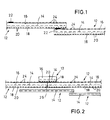
- Fig. 1 shows two overlapping with their longitudinal edges Sealing sheets 12, each with a reinforcing insert 14, one Cover layer 16, an adhesive layer 18 and a metallic Insert 20.
- Strip 22 from a temperature measuring color are placed on the sealing sheets 12. Outside of this Stripes are the tops of the sealing sheets 12 below Formation of a scatter 24 scattered.
- Fig. 2 shows two lower, also with their longitudinal edges overlapping sealing sheets 12 with reinforcing inserts 14.
- these sealing sheets 12 consist only of Adhesive layers.
- the reinforcing insert 14 is made of metal.
- the two lower sealing sheets 12 are only 1 to 2 mm thick. Are located above these lower sealing sheets 12 an offset of approximately 50 cm two with their end faces 26 abutting sealing sheets 12. Over the Butt seam along the end faces 26 is offset by 90 ° another geomembrane 12.
- the two middle geomembranes and the top sealing sheet 12 are similar to the sealing sheets 12 constructed according to FIG. 1.
- the invention ensures that the cover layer even if the adhesive temperature in the lower one is maintained for a longer period Layer not softened inadmissibly. This is necessary since the adhesive temperature decays with time and the condition of the surface. Becomes the sealing membrane, for example, directly on a thermal insulation layer installed, the heat dissipation is underground low. When the sun is strong, you can then the top layer the temperatures necessary for the bonding almost be achieved. The surface temperature should therefore in any case at least 60 ° K lower than the flow temperature the covering mass. The surface temperature of the Top layer is also on the strength and exposure time of the electromagnetic field. This must therefore be constantly checked. This can be done, for example, by measuring the infrared radiation of the web surface in the heating area respectively. The measuring device acts on the inductor. As well can temperature measuring inks preferably in the form of dots or strips be applied to the surface and they show reaching the maximum permissible surface temperature on.
- inductor Basically can be used as a frequency generator and inductor are used, which correspond to those of DE 26 51 756 A1.
- An inductor is preferred for most applications adapted to the web width and with a pressure roller is provided.
- All usual reinforcement inserts are suitable as reinforcement inserts, especially glass and polyester fleeces.
- metallic Formations arranged only in the thinner adhesive layer.
- the metallic Formations can be powdered evenly into the Mass incorporated or as a scattering over the entire free surface of the adhesive layer or applied to partial areas his.
- Fiber or wire structures or the like can arranged on the underside of the reinforcement insert and evenly or unevenly distributed over the web width his.
Landscapes
- Engineering & Computer Science (AREA)
- Mechanical Engineering (AREA)
- Physics & Mathematics (AREA)
- Thermal Sciences (AREA)
- Structural Engineering (AREA)
- Civil Engineering (AREA)
- Architecture (AREA)
- High Energy & Nuclear Physics (AREA)
- Textile Engineering (AREA)
- Plasma & Fusion (AREA)
- Lining Or Joining Of Plastics Or The Like (AREA)
- Laminated Bodies (AREA)
- Adhesives Or Adhesive Processes (AREA)
Abstract
Description
- Fig. 1
- eine vereinfachte Seitenansicht einer Dachabdichtung aus zwei sich überlappenden Dichtungsbahnen und
- Fig. 2
- eine vereinfachte Seitenansicht einer Dachabdichtung aus zwei sich überlappenden Dichtungsbahnen, zwei darüber versetzt liegenden und gestoßenen Dichtungsbahnen und einer weiteren, die Stoßfuge abdeckenden Dichtungsbahn.
Claims (9)
- Verfahren zum Verlegen einer eine obere Deck-, eine untere Klebeschicht und eine metallische Einlage enthaltenden polymermodifizierten Bitumen-Dichtungsbahn (12), bei welchem die Dichtungsbahn ausgerollt und ausgerichtet und die Klebeschicht (18) anschließend durch ein elektromagnetisches Feld so weit erhitzt wird, daß sie mit dem Randbereich einer benachbarten Dichtungsbahn zu einer dichten Naht und gegebenenfalls mit dem Untergrund mindestens teilweise verklebt wird, dadurch gekennzeichnet, daß die Oberflächentemperatur der Deckschicht (16) um mindestens 60°K unter ihrem Fließpunkt gehalten wird.
- Verfahren nach Anspruch 1, dadurch gekennzeichnet, daß die Oberflächentemperatur der Deckschicht (16) überwacht wird.
- Verfahren nach Anspruch 2, dadurch gekennzeichnet, daß die Oberflächentemperatur durch Messen mit Infrarotstrahlung überwacht wird.
- Verfahren nach Anspruch 2, dadurch gekennzeichnet, daß die Oberflächentemperatur mit Verwendung von Temperaturmeßfarben überwacht wird.
- Polymermodifizierte Bitumen-Dichtungsbahn zur Verwendung bei dem Verfahren nach Anspruch 1 bis 4 mit einer oberen bituminösen Deckschicht (16), einer Verstärkungseinlage (14), einer unteren bituminösen Klebeschicht (18) und einer metallischen Einlage (20), dadurch gekennzeichnet, daß die Nadelpenetration der Masse der unteren Klebeschicht (18) gleich, vorzugsweise aber höher als die der oberen Deckschicht (16) ist.
- Polymermodifizierte Bitumen-Dichtungsbahn nach Anspruch 5, dadurch gekennzeichnet, daß die metallische Einlage (20) in der Klebeschicht (18) eingebettet und diese dünner als die Deckschicht (16) ist.
- Polymermodifizierte Bitumen-Dichtungsbahn nach Anspruch 5, dadurch gekennzeichnet, daß auf der Oberfläche der Deckschicht (16) ein Streifen (22) aus einer Temperaturmeßfarbe angeordnet ist.
- Dichtungsbahn nach Anspruch 5, dadurch gekennzeichnet, daß die Verstärkungseinlage (14) aus metallischen Teilchen oder aus einer Kombination mit organischen oder anorganischen Vliesen, Geweben oder Gelegen besteht.
- Zweilagige Dachabdichtung als Erzeugnis des Verfahrens nach Anspruch 1 bis 4, dadurch gekennzeichnet, daß die untere Lage aus eine metallische Einlage (20) enthaltenden Klebeschichten (18) aus auf beiden Seiten mit Klebemasse beschichteten Verstärkungseinlagen (14) und einer oberen Lage aus versetzt zu der unteren Lage angeordneten Schichten aus auf beiden Seiten mit Deckmasse beschichteten Verstärkungseinlagen (14) besteht, wobei die Nadelpenetration der Masse der Klebeschichten (18) mindestens um den Faktor 2 höher als die der Masse der Deckschichten (16) ist.
Applications Claiming Priority (2)
| Application Number | Priority Date | Filing Date | Title |
|---|---|---|---|
| DE10008689A DE10008689A1 (de) | 2000-02-24 | 2000-02-24 | Verfahren zum Verlegen bituminöser Dichtungsbahnen und dafür geeignete Dichtungsbahnen und daraus hergestellte Dachabdichtung |
| DE10008689 | 2000-02-24 |
Publications (2)
| Publication Number | Publication Date |
|---|---|
| EP1130186A2 true EP1130186A2 (de) | 2001-09-05 |
| EP1130186A3 EP1130186A3 (de) | 2002-05-22 |
Family
ID=7632257
Family Applications (1)
| Application Number | Title | Priority Date | Filing Date |
|---|---|---|---|
| EP01250054A Withdrawn EP1130186A3 (de) | 2000-02-24 | 2001-02-19 | Verfahren zum Verlegen von Dachdichtungsbahnen |
Country Status (2)
| Country | Link |
|---|---|
| EP (1) | EP1130186A3 (de) |
| DE (1) | DE10008689A1 (de) |
Cited By (2)
| Publication number | Priority date | Publication date | Assignee | Title |
|---|---|---|---|---|
| ITVI20120068A1 (it) * | 2012-03-26 | 2013-09-27 | Gen Membrane S P A | Dispositivo di connessione per fogli di membrane bituminose e membrana bituminosa comprendente un dispositivo di connessione |
| BE1021183B1 (nl) * | 2013-12-05 | 2015-06-09 | Nv De Boer Waterproofing Solutions | Methode voor het waterdicht verzegelen van dakbedekking |
Families Citing this family (1)
| Publication number | Priority date | Publication date | Assignee | Title |
|---|---|---|---|---|
| DE10213336A1 (de) * | 2002-03-25 | 2003-10-09 | Fischer Artur Werke Gmbh | Befestigungselement, Anordnung und Verfahren zur Befestigung einer Dachbahn |
Citations (3)
| Publication number | Priority date | Publication date | Assignee | Title |
|---|---|---|---|---|
| DE2651756A1 (de) | 1976-04-21 | 1977-11-03 | Weber & Broutin Sa | Verfahren und vorrichtung zum aufheizen einer duennen schicht |
| WO1993009310A1 (en) | 1991-11-05 | 1993-05-13 | Navjord Bjoern | Method of supporting a roof and the like |
| DE19803045A1 (de) | 1998-01-27 | 1999-08-19 | Sfs Ind Holding Ag | Anordnung sowie Verfahren zur Befestigung von Abdeck- und/oder Abdichtungsbahnen |
Family Cites Families (9)
| Publication number | Priority date | Publication date | Assignee | Title |
|---|---|---|---|---|
| CH573808A5 (de) * | 1972-05-12 | 1976-03-31 | Jaeggi Rudolf | |
| DE2840599A1 (de) * | 1978-09-18 | 1980-03-20 | Heyen Johannes | Dichtungsbahn zur abdichtung von bauwerken gegen wasser |
| US4457983A (en) * | 1982-05-24 | 1984-07-03 | Northern Fibre Products Co. | Roofing sheet with upper layer of higher melting point than asphalt |
| JPS59230719A (ja) * | 1983-06-14 | 1984-12-25 | Fujimori Kogyo Kk | シ−トの接続方法 |
| US4834828A (en) * | 1987-04-30 | 1989-05-30 | Engineered Construction Components | Machine for welding roof membranes |
| SE501045C2 (sv) * | 1990-09-17 | 1994-10-24 | Roofer Int Ab | Sätt vid läggning av takpapp och anordning för genomförande av förfarandet |
| US5635094A (en) * | 1995-01-03 | 1997-06-03 | The Boeing Company | Conformal skate for induction welding |
| DE19743166A1 (de) * | 1997-09-30 | 1999-04-01 | Dortmunder Gusasphalt Gmbh & C | Anschmelzbares Bitumen-Fugenband |
| DE19813625C1 (de) * | 1998-03-27 | 1999-06-24 | Braas Gmbh | Verfahren und Fahrzeug zum Verbinden von mit überlappenden Rändern verlegten Dachbahnen |
-
2000
- 2000-02-24 DE DE10008689A patent/DE10008689A1/de not_active Ceased
-
2001
- 2001-02-19 EP EP01250054A patent/EP1130186A3/de not_active Withdrawn
Patent Citations (3)
| Publication number | Priority date | Publication date | Assignee | Title |
|---|---|---|---|---|
| DE2651756A1 (de) | 1976-04-21 | 1977-11-03 | Weber & Broutin Sa | Verfahren und vorrichtung zum aufheizen einer duennen schicht |
| WO1993009310A1 (en) | 1991-11-05 | 1993-05-13 | Navjord Bjoern | Method of supporting a roof and the like |
| DE19803045A1 (de) | 1998-01-27 | 1999-08-19 | Sfs Ind Holding Ag | Anordnung sowie Verfahren zur Befestigung von Abdeck- und/oder Abdichtungsbahnen |
Cited By (8)
| Publication number | Priority date | Publication date | Assignee | Title |
|---|---|---|---|---|
| ITVI20120068A1 (it) * | 2012-03-26 | 2013-09-27 | Gen Membrane S P A | Dispositivo di connessione per fogli di membrane bituminose e membrana bituminosa comprendente un dispositivo di connessione |
| WO2013144987A1 (en) * | 2012-03-26 | 2013-10-03 | General Membrane S.P.A. | Device for heating and connecting sheets of bituminous or synthetic membranes and a bituminous or synthetic membrane thereof |
| CN104411899A (zh) * | 2012-03-26 | 2015-03-11 | 大众薄膜股份公司 | 加热并连接沥青或合成膜片材的装置及其沥青或合成膜 |
| EA026428B1 (ru) * | 2012-03-26 | 2017-04-28 | Дженерал Мембрейн С.П.А. | Система соединения листов битуминозных или синтетических мембран |
| US9944056B2 (en) | 2012-03-26 | 2018-04-17 | General Membrane S.P.A. | Device for heating and connecting sheets of bituminous or synthetic membranes and a bituminous or synthetic membrane thereof |
| BE1021183B1 (nl) * | 2013-12-05 | 2015-06-09 | Nv De Boer Waterproofing Solutions | Methode voor het waterdicht verzegelen van dakbedekking |
| WO2015082680A1 (en) * | 2013-12-05 | 2015-06-11 | De Boer Waterproofing Solutions Nv | Method for waterproofing a roof covering |
| JP2017503098A (ja) * | 2013-12-05 | 2017-01-26 | デ・ブール・ウォータープルーフィング・ソリューションズ・ナムローゼ・フエンノートシャップ | 屋根葺きを防水するための方法 |
Also Published As
| Publication number | Publication date |
|---|---|
| EP1130186A3 (de) | 2002-05-22 |
| DE10008689A1 (de) | 2001-10-04 |
Similar Documents
| Publication | Publication Date | Title |
|---|---|---|
| DE29911125U1 (de) | Bituminöse Dachabdichtungsbahn | |
| DE69404497T2 (de) | Geosynthetische, getuftete Ton-Deckschicht und Herstellungsverfahren dazu | |
| DE3110283A1 (de) | Dichtungsbahn mit einer integrierten semi-independenten lage und verfahren zu ihrer herstellung | |
| DE60013142T2 (de) | Dichtungsbahn | |
| EP1130186A2 (de) | Verfahren zum Verlegen von Dachdichtungsbahnen | |
| DE102010019688A1 (de) | Verfahren und Vorrichtung zum Verschweißen oder Verkleben flächiger Bauwerksabdichtungen | |
| EP1283929B1 (de) | Dachabdichtungsbahn | |
| EP0099562A2 (de) | Verbundstoffbahn | |
| DE202015004236U1 (de) | Bituminöse Dachabdichtungsbahn | |
| DE69001736T2 (de) | Bituminoese dichtungsbahn, um eine gussasphaltschicht zu bekommen. | |
| DE3231372A1 (de) | Selbstklebende dichtungsbahn und verfahren zu deren herstellung | |
| EP0915755B1 (de) | Bitumenbahn | |
| DE8105299U1 (de) | Dichtungsbahn, insbesondere zur verwendung im hoch- oder tiefbau | |
| EP2527530B2 (de) | Bituminöse Dachbahn | |
| DE19851808B4 (de) | Bitumenschweißbahn | |
| DE4112565A1 (de) | Heizmatte und verfahren zu ihrem verlegen | |
| DE8623017U1 (de) | Bitumenbahn mit Abdeckschicht | |
| DE19803045A1 (de) | Anordnung sowie Verfahren zur Befestigung von Abdeck- und/oder Abdichtungsbahnen | |
| DE3534076C2 (de) | ||
| DE3736672A1 (de) | Verfahren zur herstellung einer mehrschichtigen, bituminoesen dichtungsbahn | |
| EP1956160A1 (de) | Bodenbelag | |
| DE4128896C2 (de) | Dichtungsbahn mit wenigstens einer thermoplastischen Deckschicht für Dach- und Bauwerksabdichtung und mit einer Ausgleichschicht und Verfahren zu deren Herstellung | |
| EP1074672B1 (de) | Verfahren und Vorrichtung zum Verlegen kaltselbstklebender Bitumenabdichtungsbahnen | |
| DE60111410T2 (de) | Verfahren zur herstellung einer folie mit einer bituminösen schicht und derart hergestellte folie | |
| DE3440263C2 (de) | Bituminöse Schweißbahn mit Trennfolie |
Legal Events
| Date | Code | Title | Description |
|---|---|---|---|
| PUAI | Public reference made under article 153(3) epc to a published international application that has entered the european phase |
Free format text: ORIGINAL CODE: 0009012 |
|
| AK | Designated contracting states |
Kind code of ref document: A2 Designated state(s): AT BE CH CY DE DK ES FI FR GB GR IE IT LI LU MC NL PT SE TR |
|
| AX | Request for extension of the european patent |
Free format text: AL;LT;LV;MK;RO;SI |
|
| PUAL | Search report despatched |
Free format text: ORIGINAL CODE: 0009013 |
|
| RIC1 | Information provided on ipc code assigned before grant |
Free format text: 7E 04D 5/14 A, 7E 04D 5/10 B, 7B 29C 65/36 B |
|
| AX | Request for extension of the european patent |
Free format text: AL;LT;LV;MK;RO;SI |
|
| 17P | Request for examination filed |
Effective date: 20020628 |
|
| AKX | Designation fees paid |
Designated state(s): AT BE CH CY DE DK ES FI FR GB GR IE IT LI LU MC NL PT SE TR |
|
| STAA | Information on the status of an ep patent application or granted ep patent |
Free format text: STATUS: THE APPLICATION IS DEEMED TO BE WITHDRAWN |
|
| 18D | Application deemed to be withdrawn |
Effective date: 20040831 |