EP1124767B1 - Composition d'application d'email et procede de fabrication de pieces formees emaillees - Google Patents
Composition d'application d'email et procede de fabrication de pieces formees emaillees Download PDFInfo
- Publication number
- EP1124767B1 EP1124767B1 EP99970376A EP99970376A EP1124767B1 EP 1124767 B1 EP1124767 B1 EP 1124767B1 EP 99970376 A EP99970376 A EP 99970376A EP 99970376 A EP99970376 A EP 99970376A EP 1124767 B1 EP1124767 B1 EP 1124767B1
- Authority
- EP
- European Patent Office
- Prior art keywords
- composition
- enamel
- resin
- polymers
- composition according
- Prior art date
- Legal status (The legal status is an assumption and is not a legal conclusion. Google has not performed a legal analysis and makes no representation as to the accuracy of the status listed.)
- Expired - Lifetime
Links
Images

Classifications
-
- C—CHEMISTRY; METALLURGY
- C03—GLASS; MINERAL OR SLAG WOOL
- C03C—CHEMICAL COMPOSITION OF GLASSES, GLAZES OR VITREOUS ENAMELS; SURFACE TREATMENT OF GLASS; SURFACE TREATMENT OF FIBRES OR FILAMENTS MADE FROM GLASS, MINERALS OR SLAGS; JOINING GLASS TO GLASS OR OTHER MATERIALS
- C03C8/00—Enamels; Glazes; Fusion seal compositions being frit compositions having non-frit additions
- C03C8/14—Glass frit mixtures having non-frit additions, e.g. opacifiers, colorants, mill-additions
- C03C8/16—Glass frit mixtures having non-frit additions, e.g. opacifiers, colorants, mill-additions with vehicle or suspending agents, e.g. slip
Definitions
- the invention relates to a composition for applying enamel and a process of enamelling metal parts.
- the possible firing before shaping is a crosslinking firing of the polymeric binder, while the firing after shaping is a vitrification firing of the enamel at a temperature higher than the temperature T g of glass transition of the frit d vitrifiable enamel.
- the temperature of the first firing (crosslinking) is largely lower than the temperature of the second cooking (vitrification).
- the polymer binder is "consolidated” by crosslinking while during the second firing, it is “eliminated” by thermal decomposition and / or pyrolysis.
- the sheet obtained is coated with an entirely mineral layer of "enamel” vitreous ”(“ vitreous enamel ”in English) comprising a phase continuous glass in which mineral charges are dispersed opacification and / or coloring; throughout the document, the terms “Vitrifiable enamel” or “vitreous enamel” are designated more briefly by “ E-mail " ; this meaning is therefore totally different from coatings polymers highly charged with mineral elements, glassy or not, sometimes designated as "enamel” in English, in particular because they do not have no continuous glassy phase.
- steel sheets already coated with enameling composition but not yet shaped can be, in this intermediate state, transported and stored pending the shaping and cooking of vitrification of the enamel.
- the enamel application composition essentially contains a binder polymer in solution in a solvent and an enamel frit suspended in the solution ; in addition, this composition generally contains a suspension (or anti-sedimentation), wetting agents and degassing ("air release agents" in English).
- thermoplastic mixtures of polyhydroxypolyacrylates and polyhydroxypolyesters are used as binder (proportions 9 to 1 to 6 to 4); these mixtures are free from nitrogen or halogens; these mixtures do not crosslink during the drying operation ( ⁇ 50 ° C.) carried out after application of the enameling composition.
- the weight percentage of groups "Hydroxyl” is between 0.5 and 10% by weight.
- the viscosity of the solutions of these polymers at 50% is generally between 3000 and 10000 mPa.s at 23 ° C.
- polyesters known polyols are chosen, which are for example based on (1) aliphatic, aromatic or cycloaliphatic dicarboxylic acids (and corresponding anhydrides), and (2) aliphatic polyhydric alcohols.
- dicarboxylic acids having an average molecular weight of between 146 and 150 are used, such as adipic acid, phthalic acid, tetrahydrophthalic or hexahydrophthalic or mixtures thereof.
- Polyhydric alcohols having a molecular weight between 62 and 150 are used, for example, such as ethylene glycol, propylene glycol, butane-1,4-diol, hexane-1,6-diol, glycerol , trimethylol propane or mixtures thereof.
- These polyester polyols are prepared in a conventional manner from these dicarboxylic acids and these polyhydric alcohols, and, in the polyhydroxypolyester, the proportion of “hydroxyl” groups is adjusted as a function of the excess of polyhydric alcohol.
- Example 1 of the above-mentioned document it is thus possible to use a 80% thermoplastic binder of hydroxypolyacrylate (obtained by polymerization radical in the presence of di-t-butyl peroxide) and 20% of hydroxypolyester (obtained by condensation polymerization of an anhydride mixture phthalic, adipic acid, 1,2-propylene glycol with trimethylol-propane).
- thermosetting mixture of acid functionalized polyhydroxypolyacrylate polymers and of epoxy functionalized polyhydroxypolyacrylate polymers (here: glycidyl methacrylate) is used as binder ; this mixture then crosslinks during the cooking operation (> 50 ° C., in this case 350 ° C.) carried out after application of the enameling composition, by reaction of the acid functions with the epoxy functions of the polymers.
- solvent a mixture of xylene and methoxypropylacetate is used, for example, or an aromatic mixture at high boiling temperature such as the product referenced SOLVESSO 150 from the company EXXON, or cyclohexanone, or glycol etheresters.
- suspension-holding agent hydrated magnesium silicate is used, for example.
- the introduction of the binder in two stages is particularly important in the case of thermosetting binders, because it is to prevent or limit the crosslinking of the mixture at this stage of preparation.
- roller is then applied ( "roll coater” in English) application of enamel compositions obtained on untreated steel sheets, simply degreased.
- the applied layer is then dried at room temperature for about 1 minute.
- thermosetting binder based on a blend of acid functionalized polymers and functionalized polymers epoxy (example 4 already cited), then baked at 350 ° C for about 30 seconds, which causes crosslinking of the mixture by reaction of "acid” functions on the “epoxy” functions of the two polyacrylates of the binder.
- the steel sheets thus coated with enameling composition (still in the state "Raw") are then shaped and subjected to a cooking treatment adapted on the one hand to remove, by pyrolysis, the organic binder from the composition without disturbing the integrity of the coating and secondly for baking and vitrify the enamel of this composition.
- This heat treatment can, for example, be carried out according to the following characteristics: Temperature ... 200 ° C 300 ° C 400 ° C 600 ° C 820 ° C .. reached after: 2 min. 4 min. 5 minutes. and end of pyrolysis 6 min. 8 min. + maintenance 3.5 min.
- the binders or thermosetting resins with thermoplastic binders because they allow obtain more stable “raw” coatings; the sheets thus coated are more resistant to solvents; the enamel composition coating resists better at the shaping operation.
- thermosetting resin proposed in the document US 5 325 580 - in particular in example 4 - is its lack of stability at room temperature in the non-crosslinked state, the hydroxy groups and epoxy tending to react even at room temperature.
- the object of the invention is to offer a composition for applying binder enamel.
- crosslinkable intended to be applied to sheet metal before forming, which is very stable before application on sheet metal and thus much easier to apply.
- US 5,312,868 describes a solid sheet or film applying paint or varnish, which is free of solvent; this film includes thermosetting polymer resin and organic fillers or mineral, such as gloss control agents; this document also describes a method of coating a substrate in which apply this sheet or film on the substrate then perform a treatment thermal of the coated substrate so as to crosslink the resin; in the case of a sheet, one then obtains a product comparable to a painted or varnished sheet.
- the average molecular weight (“Mw” abbreviation in English) of the resin thermosetting is greater than 100,000, because for values the coating to be applied is difficult to maintain in sheet form and risk of cracking after application to the substrate.
- the film of coating includes gloss control agents; among agents gloss control mentioned column 15, line 56 to column 17, line 42, on finds classic components of paint or varnish, such as granules of organic or mineral coloring pigments, resin granules thermoset or thermoplastic, and granules of metal oxides or metals ; among the metal oxides, alumina, silica, glass and even enamel ("enamel" in English).
- gloss control agents among agents gloss control mentioned column 15, line 56 to column 17, line 42, on finds classic components of paint or varnish, such as granules of organic or mineral coloring pigments, resin granules thermoset or thermoplastic, and granules of metal oxides or metals ; among the metal oxides, alumina, silica, glass and even enamel ("enamel" in English).
- the characteristic relating to the high level of vitrifiable enamel frit in the enamel application compositions is important to limit the proportion of organic phase in the dry, even crosslinked coating, and for facilitate the complete elimination of this organic phase during the cooking of vitrification, a necessary condition for obtaining a layer of vitreous enamel acceptable quality.
- compositions crosslinked from this agent have better mechanical properties and are more resistant to shaping as compositions which are crosslinked using a blocked isocyanate; moreover, the aminiplast compounds are more economical than blocked isocyanates.
- the solvent contained in said composition is removed by evaporation.
- the application of said composition by coating is preferably, the application of said composition by coating.
- the invention also relates to a method for producing a sheet coated with vitreous enamel characterized in that it comprises a firing step of vitrification of a sheet coated with vitrifiable enamel obtained by the above process.
- the application of said composition by coating is preferably, the application of said composition by coating.
- the invention has for first objective the preparation of a sheet coated with a composition prepared from one or more thermosetting resins, one or more solvents and an enamel frit vitrifiable; this composition can be easily applied to the sheet in the liquid state, preferably continuously; it is crosslinked by baking; the applied thickness, measured after crosslinking firing, can be greater than 100 ⁇ m; the cohesion between the sheet and the crosslinked composition layer or layers is strong enough to allow the sheet metal coated with stamping, without risk of degradation or de-cohesion.
- the cooking of the possibly shaped pieces is then performed under controlled conditions, to allow complete disposal of the organic part of the composition, as well as the vitrification of the frit enamel so as to form a continuous glassy phase; thus, the invention has as a second objective the preparation of enameled sheet metal parts, within the meaning of pieces coated with vitreous enamel comprising a continuous vitreous phase.
- a glazing composition is prepared in a conventional manner from of the following main components: binder based on polymer resin thermosetting, solvent of the resin, and vitrifiable enamel frit in proportion weight greater than 50%.
- polyester resins used for the invention are oil-free resins prepared according to known methods (see, for example, document EP-A-237 749) by reaction in the melt or in organic solvents at temperatures generally between 200 and 260 ° C.
- polyester resin solutions are used which have a viscosity between 2.5 and 5.5 Pa.s measured in accordance to DIN 53 214.
- polyester resins For the manufacture of these polyester resins, it is possible to use the conventional raw materials used for the manufacture of resins polyester, the proportions of each of the components being to be chosen at each times so that the resin obtained from polyester has the characteristics cited, in particular at the level of the OH index.
- polyester resins are obtained by using terephthalic acid or mixtures of terephthalic acid and adipic acid, optionally together with monocarboxylic acids.
- the carboxylic acids mentioned for the manufacture of polyester resins can be used either in the form of free acids or in the form of their derivatives (for example anhydrides, esters).
- alcohol components, it is possible to use, alone or as a mixture, linear or branched, aliphatic and / or aromatic diols and / or polyols and / or cycloaliphatics.
- Aliphatic diols and / or polyols are preferably used as glycols, for example ethylene glycol, propylene glycol, neopentylglycol, butane-1,4-diol, hexane-1,6-diol, 2,2,4-trimethylpentane-1,3-diol, diethylene glycol, triethylene glycol, or triols and polyols, for example trimethylolethane, trimethylolpropane, glycerin, ethoxylated glycerin and propoxylated glycerin, pentaerythritol, dipentaerythritol, ditrimethylolpropane, mannitol and sorbitol.
- glycols for example ethylene glycol, propylene glycol, neopentylglycol, butane-1,4-diol, hexane-1,6-diol,
- the polyacrylate resins used for the invention are prepared according to conventional methods by co-polymerization of an acrylic monomer containing hydroxyl groups with one or more radically polymerizable unsaturated monomers.
- Suitable monomers containing groups hydroxyls are the C2 - C8 hydroxyalkyl esters of acrylic acid and methacrylic acid, such as, for example, hydroxyethyl acrylate, hydroxyethyl methacrylate, hydroxypropyl acrylate, methacrylate hydroxypropyl and 2-ethylhexyl acrylate and / or methacrylate; these monomers containing hydroxyl groups can be used either individually either as a mixture of two or more of them.
- Any component having an ethylenically bond radically copolymerizable unsaturated can be used as as monomer, if they are copolymerizable with the monomer containing hydroxyl group; these components are chosen in a known manner in itself depending on the desired properties of the copolymer acrylate; representative examples of such monomers are, between others, alkyl esters of acrylic acid and methacrylic acid, vinyl aromatic compounds, ⁇ , ⁇ unsaturated carboxylic acids, amides of acrylic acid or methacrylic acid; details additional information relating to these monomers and to the preparation conditions DE-PS-32 01 749, pages 3 to 5.
- commercially prepared resins can be used as an aqueous emulsion; in this case, the molecular weight of these resins is preferably greater than or equal to 100,000 g / mole.
- a crosslinking agent suitable for the “hydroxy” functions of the resin polymers a blocked isocyanate or an aminoplast compound is preferably used.
- blocked isocyanate one can use, alone or in mixture, a diisocyanate, a linear or cyclized triisocyanate (isocyanurate), a biuret, polyisocyanates, prepolymers or adducts.
- Adduct is understood to mean a reaction product of an isocyanate with a product containing an active hydrogen atom.
- the isocyanate or the mixture of isocyanates is suitable for have a content by weight of NCO radicals of between 10 and 25% based on the total dry weight of crosslinking agent.
- the isocyanate or mixture is added to the enameling compositions of preferably in a quantity such that the equivalence ratio of OH groups of the binder (sum of the OH groups of the polymers polyesters and / or polyacrylates and, where appropriate, those of others components of the binder containing hydroxyl groups) to the groups NCO of the crosslinking agent is between 0.5 and 2.5.
- blocked isocyanate mention may be made of mixtures blocked polyisocyanates as described in documents FR 2 544 322, US 3,577,493, EP 251,267 or JP 02 097536 A.
- the “blocked” character can be obtained by blocking agents; as a blocking agent, it is possible to choose, for example, a phenol, a polypropylene glycol, an oxime, such as methyl ethyl ketoxime, acetone oxime, cyclohexyl oxime, butanone oxime, a triazole, such as benzotriazole, a caprolactam, such as ⁇ -caprolactam, a ⁇ -dicarbolyl compound, such as ethyl acetoacetate or ethyl malonate, or also malonic diester, a carbodiimide or N-hydroxy-succinimide, or also, the blocked adduct of trimethylolpropane caprolactam.
- a blocking agent it is possible to choose, for example, a phenol, a polypropylene glycol, an oxime, such as methyl ethyl ketoxime, acetone oxime, cyclo
- the “blocked” character can be obtained by the very nature of isocyanate, which is then said to be “self-blocked”; as an example of isocyanate self-blocked, one can choose a dimerized isocyanate, or, in the family of IPDI, the uretidione of IPDI.
- Suitable aliphatic and cycloaliphatic diisocyanates and polyisocyanates are hexamethylene diisocyanate, decamethylene diisocyanate, isophorone diisocyanate, dicyclohexylmethane-4,4 'diisocyanate, lysine diisocyanate, bis-4-crocyanate (H 12 MDI), tetramethyl-m-xylidene diisocyanate (TMXDI), as well as dimerized and trimerized derivatives of these diisocyanates.
- Diisocyanates and polyisocyanates can also be used aromatics such as 4,4 'diphenylmethane diisocyanate (MDI), 4,4 'diphenylene diisocyanate, 4,4' diphenylene diisocyanate, 2,4-tolylene diisocyanate (TDI) and 2,6-tolylene diisocyanate (TDI), m-phenylene diisocyanate, p-phenylene diisocyanate, diisocyanate 1,5-naphthalene, 3,3'-dimethyl-4,4'-biphenylene diisocyanate, 3,3'-dimethoxy-4,4'-biphenylene diisocyanate, 3,3'-diphenyl-4,4'-biphenylene diisocyanate, 4,4'-biphenylene diisocyanate, 1,3,5-benzene triisocyanate, para, para ', para "triisocyanate - triphenylmethan
- the aminoplast compound is preferably chosen from the group comprising alkylated compounds of urea-aldehyde, melamine-aldehyde, dicyandiamide-aldehyde, and triazine-aldehyde; the alkylation is carried out for example with an alcohol such as methanol or butanol.
- aldehydes used in reaction with the amino compound are, for example example, formaldehyde, acetaldehyde, and acrolein or precursors aldehyde such as paraformaldehyde and hexamethylenetetramine.
- aminoplast compounds are described in the document US 3,804,920.
- melamine derivatives are used having at least four groups of the type: attached to the amino group of the melamine structure, where R is a hydrogen atom or a monovalent alkyl radical containing from 1 to 5 carbon atoms and R 'is an alkyl group containing from 1 to 6 carbon atoms.
- hexamethoxymethyl melamine is used as the compound aminoplast.
- the amount of aminoplast added is adapted so that the ratio of the mass of resin by the mass of aminoplast compound either between 1.5 and 15.
- the enameling composition For the preparation of the enameling composition according to the invention, it is indifferently uses in the binder polyhydroxypolyesters polymers or polyhydroxypolyacrylate polymers or a mixture of polymers polyhydroxypolyesters and polyhydroxypolyacrylate polymers, of the moment that the OH (or “hydroxy”) index remains between 3 and 100 mg KOH / g, preferably between 3 and 40 mg KOH / g.
- thermosetting system obtained does not contain “epoxy” functions but is therefore crosslinkable by transesterification reaction in the case of the use of aminoplast compounds as crosslinking agent, or by polyaddition reaction in the case of the use of blocked isocyanates as a crosslinking agent.
- the same basic (so-called “mass”) or covered frits are used as those usually used for enamelling on bare steel sheets when the application of the enamel is carried out after sheet metal shaping.
- the enameling composition generally contains conventional additives, in a proportion of less than 10% by weight, for example dispersing agents, anti-sedimentation agents, leveling agents, anti-foaming agents, stabilizing agents and wetting agents.
- Anti-sedimentation agents are particularly important here for the stability in storage and in the supply tanks of the coating means, in particular because the enameling compositions are heavily loaded with solids.
- the choice of solvent is adapted in a manner known per se to obtain good solvent power with respect to the components of the binder.
- the proportion of solvent relative to the total weight of the enamel composition is generally less than or equal to 25%; this proportion must be adapted in based on specific viscosity criteria specific to the application method of the enameling composition.
- aliphatic and / or aromatic hydrocarbons such as for example Naphta® solvent, various types of Solvesso® and Shellsol®, xylene, or esters, such as, for example, methoxypropyl acetate, and butylglycol, or also ketones such as, for example, cyclohexanone.
- a solvent is preferably chosen whose point boiling point is between 120 ° C and 200 ° C, which corresponds to a criterion classic industrial for this type of application.
- the enameling composition To prepare the enameling composition , one proceeds by mixing and / or dispersing its components and additives.
- the polymers of the resin being in solution and / or in emulsion in a solvent
- the enamel frit is dispersed in this solution or emulsion under stirring at room temperature, then added to the suspension obtained the other components, namely the crosslinking agent, the catalyst and the other additives.
- the average molecular weight of the mixture of these polymers is less than 100,000 g / mole, preferably less than 50,000 g / mole.
- the average molecular weight of this emulsion fraction is greater than or equal to 100,000 g / l.
- the mixture obtained is diluted, in particular to adjust the viscosity according to the mode of application considered.
- the enamel application composition obtained always contains a solvent, whether the solvent added for dilution and / or the solvent for the products starting polymers, when in solution or in emulsion; the composition application of enamel obtained is therefore liquid at room temperature.
- vitrification baking heat treatment in practice, we take care, in the thermal profile of rising temperature, a pyrolysis stage lasting between 15 seconds and 4 minutes at a temperature between 350 and 550 ° C, and preferably of 1 to 2 minutes between 400 and 500 ° C, which effectively burns the resin without disturbing the melting of the enamel frit, since the temperature remains then lower than the glass transition temperature of the frit.
- the combustion of the resin is facilitated by maintaining an atmosphere oxidizing in the cooking oven zone corresponding to this level; at this end, we can add in this zone an additional device of burners to direct flame, which allows good simultaneous temperature control and of the combustion atmosphere in this area.
- the temperature is between 500 and 900 ° C, preferably between 560 ° C and 850 ° C, the most low being rather reserved for enamels in contact with low surfaces melting point such as those rich in aluminum as for sheets aluminized.
- the enameling compositions according to the invention intended to be applied before shaping, are intended for the realization of all shaped parts usually produced by enameling on sheets, for which the deposits of enamels were until now carried out after shaping.
- At least one polymer is used (hydroxypolyester and / or hydroxypolyacrylate) which has a COOH index greater than or equal to 5 mg of KOH equivalent per gram of said polymer.
- the composition of enamel application includes, in addition to the conventional additives already mentioned for its preparation, lubrication additives which facilitate the drawing of the sheet coated with this crosslinked composition, which further limits the risk of degradation at the shaping stage.
- a wax polyethylene for example a synthetic wax, prepared by polymerization ethylene so as to obtain a low molecular weight, for example understood between 1000 and 3000 g / mole; we can also use variants to this homopolymer, such as oxidized polyethylene wax, a copolymer ethylene and acrylic acid, or a copolymer of ethylene and acetate vinyl.
- An advantage of polyethylene wax over other lubrication additives is to be easily eliminated by pyrolysis when cooking vitrification of the enamel.
- this additive is added by simple mixing with stirring to the enameling composition.
- PRODUCTS used for the preparation of samples of enamelled pieces:
Landscapes
- Chemical & Material Sciences (AREA)
- Engineering & Computer Science (AREA)
- Chemical Kinetics & Catalysis (AREA)
- General Chemical & Material Sciences (AREA)
- Geochemistry & Mineralogy (AREA)
- Materials Engineering (AREA)
- Organic Chemistry (AREA)
- Life Sciences & Earth Sciences (AREA)
- Paints Or Removers (AREA)
- Glass Compositions (AREA)
- Compositions Of Macromolecular Compounds (AREA)
- Macromonomer-Based Addition Polymer (AREA)
- Application Of Or Painting With Fluid Materials (AREA)
- Laminated Bodies (AREA)
- Distillation Of Fermentation Liquor, Processing Of Alcohols, Vinegar And Beer (AREA)
- Moulds For Moulding Plastics Or The Like (AREA)
- Heat Treatment Of Sheet Steel (AREA)
Description
- avant mise en forme, on applique sur une tôle d'acier au moins une couche de composition d'application d'émail comprenant une fritte d'émail vitrifiable dispersée dans un liant polymère, puis on sèche et/ou on cuit l'au moins une couche,
- on met ensuite en forme la tôle dans la forme de la pièce,
- optionnellement, on applique ensuite sur la pièce au moins une autre couche de fritte d'émail vitrifiable,
- on cuit ensuite la pièce à une température comprise entre 560°C et 850°C, dans des conditions adaptées à la nature de l'acier et de la fritte d'émail utilisés, afin d'obtenir la vitrification de l'émail.
Comme polyhydroxypolyesters, on choisit des polyesters polyols connus, qui sont par exemple basés sur (1) des acides (et anhydrides correspondants) dicarboxyliques aliphatiques, aromatiques ou cycloaliphatiques, et (2) des alcools polyhydriques aliphatiques.
On utilise par exemple des acides dicarboxyliques ayant une masse moléculaire moyenne comprise entre 146 et 150, comme l'acide adipique, l'acide phtalique, tétrahydrophtalique ou hexahydrophtalique ou leurs mélanges.
On utilise par exemple des alcools polyhydriques ayant un poids moléculaire compris entre 62 et 150, comme l'éthylène-glycol, le propylène-glycol, le butane-1,4-diol, l'hexane-1,6-diol, le glycérol, le triméthylol propane ou leurs mélanges.
Ces polyesters polyols sont préparés d'une manière classique à partir de ces acides dicarboxyliques et de ces alcools polyhydriques, et, dans le polyhydroxypolyester, on règle la proportion de groupements « hydroxyl » en fonction de l'excès d'alcool polyhydriques.
- Pour l'émaillage de base, destiné à la première couche au contact du métal :
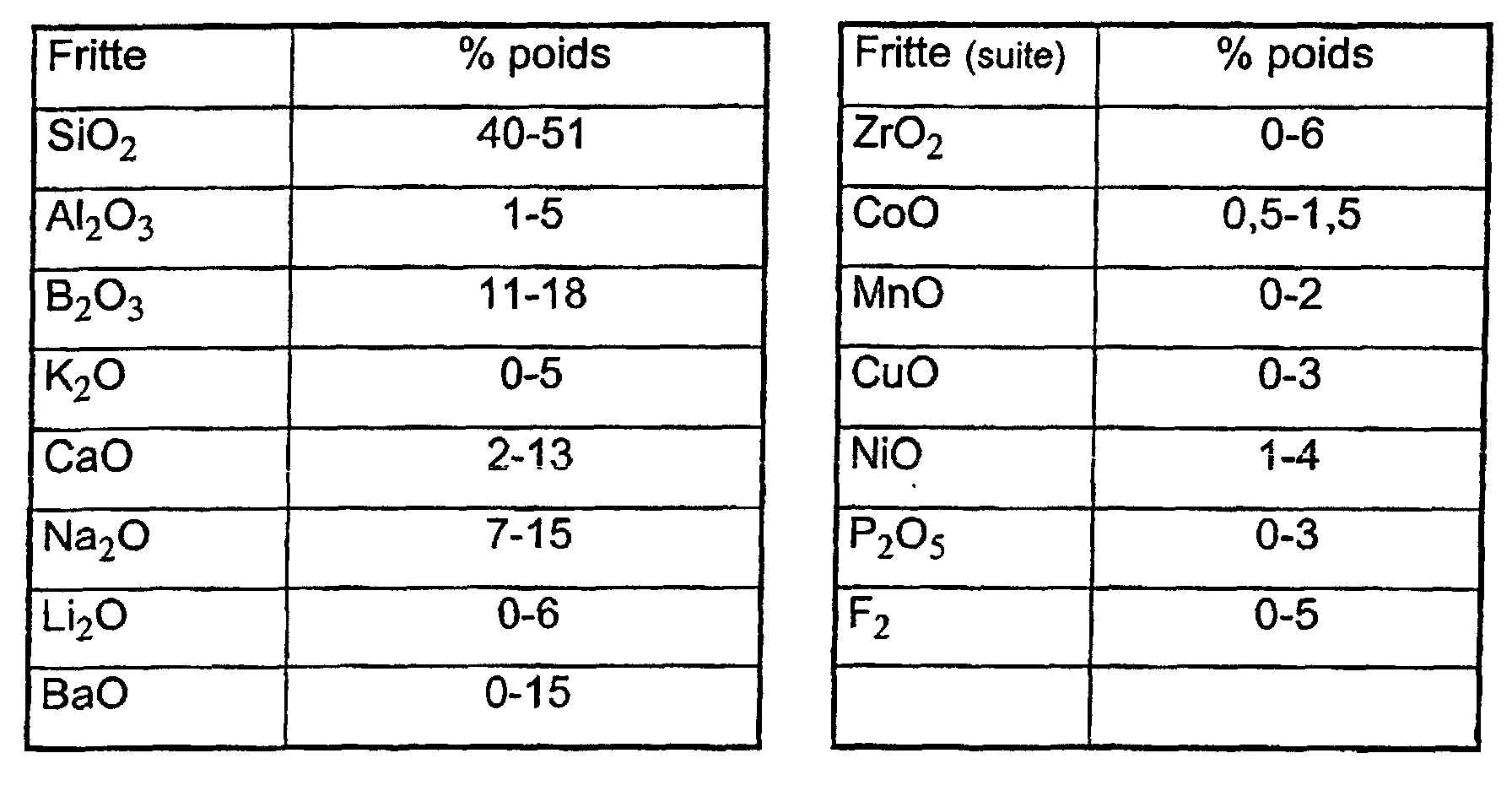
- Pour l'émaillage dit blanc, destiné à la couche de surface, appliquée avant ou
après mise en forme :

- on chauffe un composant du liant polymère,
- on y ajoute lentement et sous agitation l'agent de tenue en suspension,
- on ajoute ensuite la fritte, puis le solvant avec les agents mouillants, les agents de dégazage et autres additifs,
- on broie le mélange jusqu'à obtenir une dispersion satisfaisante de la fritte d'émail,
- après refroidissement, on ajoute ensuite l'autre composant du liant polymère, par exemple le polyacrylate fonctionnalisé époxy.
| US 5,325,580 : | Exemple 1 | Exemple 4 |
| SOLVANT | 16,1% | 23,9% |
| LIANT | 17,1% | 14,0% |
| FRITTE | 63,3% | 56,2% |
| Additifs : | 3,5% | 5,9% |
| Température ... | 200°C | 300°C | 400°C | 600°C | 820°C |
| ..atteinte après : | 2 min. | 4 min. | 5 min. et fin de pyrolyse | 6 min. | 8 min. + maintien 3,5 min. |
- la proportion de verre et/ou d'émail serait insuffisante pour obtenir une couche d'émail de qualité acceptable,
- la présence d'autres composants, organiques ou minéraux, classiques dans le domaine des peintures, nuirait à l'évidence à l'obtention d'une couche d'émail de qualité acceptable.
| US 5,325,580 : poids de FRITTE /... | Exemple 1 | Exemple 4 |
| .../ poids de la composition d'application d'émail : | 63,3% | 56,2% |
| .../ poids du film de revêtement (solvant évaporé) : | 75,4% | 73,8% |
- le taux de charge incorporable est limité, à cause de problèmes de mouillabilité des charges dans la résine, notamment dans le cas des charges minérales comme les frittes d'émail,
- l'adhérence au substrat n'est pas suffisante, même après réticulation, pour résister à des opérations de mise en forme ultérieures, à cause de problèmes de mouillabilité du substrat par la résine.
- reste suffisamment fluide pour mouiller à la fois la fritte d'émail et la tôle, pour être facile à appliquer sur la tôle, notamment par enduction au rouleau,
- donne, après application et réticulation, un revêtement suffisamment adhérent à la tôle pour résister à des opérations de mise en forme ultérieures.
- un ou plusieurs polymères polyhydroxypolyesters et/ou un ou plusieurs polymères polyhydroxypolyacrylates en solution et/ou en émulsion, présentant un indice OH (ou « hydroxy ») compris entre 3 et 100 mg KOH par gramme, adaptés pour que le poids moléculaire moyen de la fraction solubilisée desdits polymères soit inférieur à 100 000 g/mole,
- au moins un agent de réticulation adapté pour réagir avec les fonctions « hydroxy » desdits polymères par transestérification ou par polyaddition, en quantité suffisante pour réticuler ladite résine,
- une quantité de catalyseur suffisante pour catalyser la réaction des groupements hydroxy desdits polymères et de l'au moins un agent de réticulation.
- préparer une composition d'application d'émail vitreux selon l'invention,
- appliquer ladite composition sur la tôle à revêtir,
- cuire la tôle ainsi revêtue de ladite composition dans des conditions adaptées pour faire réticuler ladite résine.
- préparer une composition d'application d'émail vitreux selon l'invention,
- appliquer ladite composition sur une tôle,
- cuire la tôle ainsi revêtue de ladite composition dans des conditions adaptées pour faire réticuler ladite résine,
- mettre en forme la tôle revêtue de ladite composition réticulée, dans la forme de ladite pièce à produire,
- cuire la pièce formée revêtue de ladite composition réticulée dans des conditions d'une part adaptées pour obtenir une pyrolyse complète de ladite résine réticulée, d'autre part adaptées pour vitrifier ladite fritte vitrifiable.
- un ou plusieurs polymères polyhydroxypolyesters et/ou un ou plusieurs
polymères polyhydroxypolyacrylates préparés de manière à présenter :
- un indice OH (ou « hydroxy ») compris entre 3 et 100 mg de KOH par gramme de résine, de préférence entre 3 et 40 mg KOH/g,
- un poids moléculaire moyen inférieur à 100 000 g/mole,
- au moins un agent de réticulation adapté aux fonctions « hydroxy » desdits polymères, en quantité suffisante pour réticuler ladite résine,
- une quantité de catalyseur suffisante pour catalyser la réaction des groupements hydroxy desdits polymères et de l'au moins un agent de réticulation.
- des acides dicarboxyliques et/ou polycarboxyliques aromatiques comme par exemple : l'acide phtalique, l'acide téréphtalique, l'acide isophtalique, l'acide trimellitique et l'acide pyromellitique.
- des acides dicarboxyliques et polycarboxyliques aliphatiques comme par exemple : l'acide succinique, l'acide glutarique, l'acide adipique, l'acide pimélique, l'acide subérique, l'acide azélaïque, l'acide sébacique, l'acide 2-éthylhexanecarboxylique, l'acide isononanoïque ; on peut aussi utiliser conjointement des acides carboxyliques insaturés, par exemple l'acide maléique, l'acide fumarique, l'acide itaconique, l'acide citraconique.
- des acides dicarboxyliques et polycarboxyliques cycloaliphatiques comme par exemple : l'acide tétrahydrophtalique, l'acide hexahydroxyphtalique, l'acide 1,4-cyclohexanedicarboxylique, l'acide méthylcyclohexanedicarboxylique .
- des acides monocarboxyliques aromatiques comme par exemple : l'acide benzoïque, des acides benzoïques substitués en alkyle, des acides naphténiques et leurs isomères, l'acide abiétique et ses isomères, l'acide benzoïque étant utilisé de préférence.
- polyester linéaire ou branché,
- masse moléculaire moyenne M, mesurée par chromatographie de perméation de gel, inférieure à 100 000 g/mole, de préférence comprise entre 10 000 et 25 000 g/mole.
- indice OH compris entre 3 et 100 mg KOH/g, de préférence compris entre 3 et 40 mg KOH/g.
- masse moléculaire moyenne M inférieure à 100 000 g/mole , de préférence inférieure ou égale à 5000 g/mole dans le cas de résines préparées en phase solvant.
- indice OH compris entre 3 et 100 mg KOH/g, de préférence compris entre 3 et 40 mg KOH/g.
- de la Société BAYER, les produits DESMODUR ® référencés BL 3175, LS 2759, TPLS 2957 à base HDI ; BL 4165 et LS 2078 à base IPDI ; TPLS 2117 à base H12HDI ; et BL 1265 à base TDI ;
- de la Société CREANOVA (anciennement HÜLS), les produits VESTANAT ® référencés EPB 1481 à base IPDI ; B 1370 et FPB 1186A.
- de la Société RHODIA (anciennement RHONE-POULENC) : le TOLONATE ® référencé D2, à base HDI.

- dans le cas des isocyanates, on peut prendre par exemple un catalyseur à base de dibutyllaurate étain (DBTL),
- dans le cas des aminoplastes, on peut prendre par exemple un catalyseur à base d'acide paratoluène sulfonique bloqué (APTS).
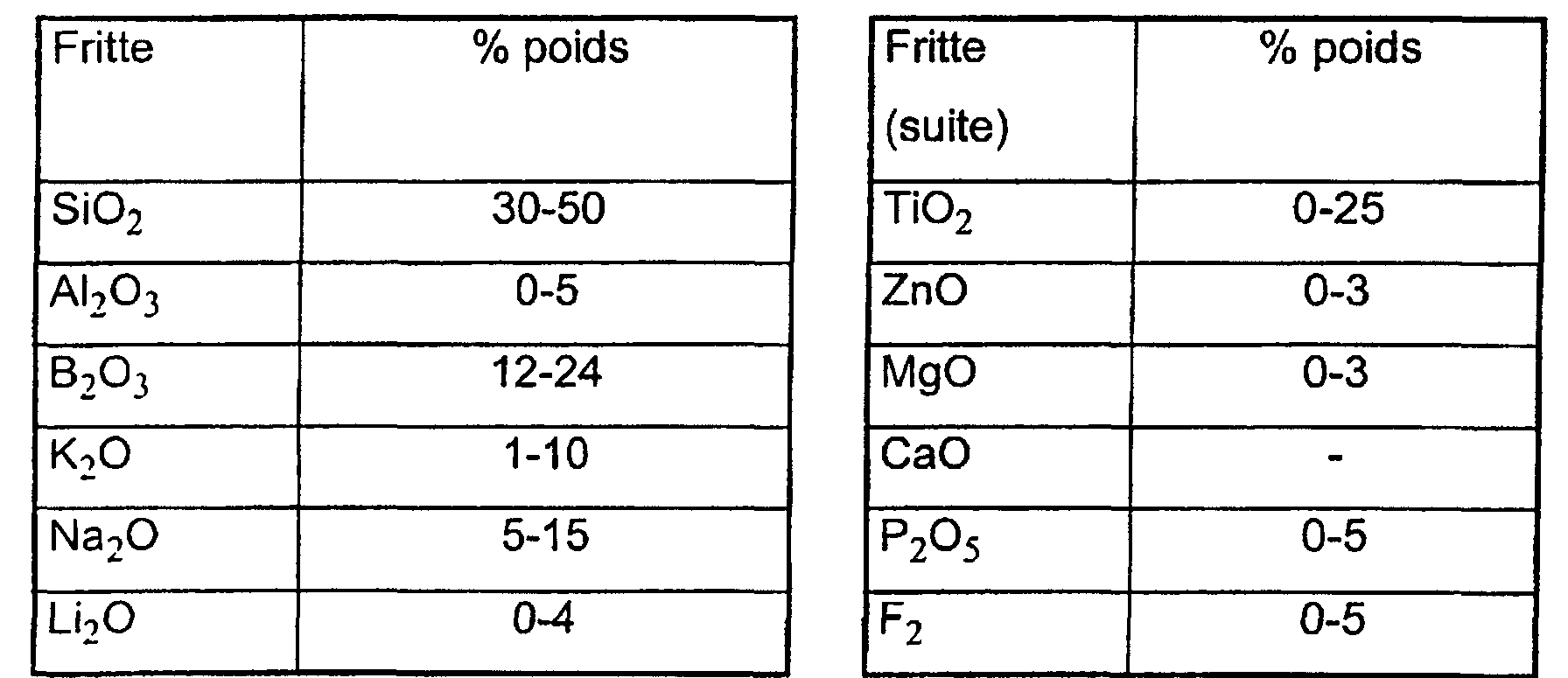
- Pour l'émail de base, destiné à la première couche adhérente appliquée au
contact du métal :

- Pour l'émail blanc, destiné à la couche de surface, appliquée avant ou après
mise en forme
- elle est stable physiquement car la matière solide reste dispersée de manière homogène et stable en suspension dans cette composition,
- elle est stable chimiquement car, grâce au choix du mode de réticulation (via les groupement hydroxy uniquement, contrairement au document US 5 325 580) et des agents de réticulation, il n'y a pas de réaction de réticulation à cette température ; de plus, la viscosité de cette composition est stable et n'évolue pas en fonction du temps, ce qui facilite le contrôle des conditions d'application.
- avant mise en forme, on applique cette composition sur la tôle, puis on cuit la tôle ainsi revêtue dans des conditions adaptées pour faire réticuler le liant polymère de cette composition,
- on met ensuite en forme la tôle revêtue de cette composition réticulée, dans la forme souhaitée de la pièce émaillée à produire ; grâce au type de liant utilisé et malgré la charge important de fritte, on constate que le revêtement de composition réticulée adhère suffisamment à la tôle pour résister à l'opération de mise en forme.- on cuit ensuite la pièce formée dans des conditions d'une part adaptées pour obtenir une pyrolyse complète du polymère réticulé de la composition de revêtement, d'autre part adaptées pour obtenir la vitrification de l'émail de cette composition.
- avant application de la composition d'émaillage, on effectue généralement un traitement de dégraissage de la tôle ; de préférence, on effectue ensuite un traitement de phosphatation de la tôle pour améliorer l'adhérence de l'émail, en évitant tout rinçage chromique pour éviter la pollution par le chrome au cours de la vitrification de l'émail.
- on peut appliquer la composition d'émaillage en plusieurs couches ; on peut appliquer une autre composition d'émaillage après la mise en forme, mais avant la cuisson de vitrification.
- de façon optimale, pour la cuisson de vitrification de la pièce formée, il convient de séparer l'étape de pyrolyse des produits organiques (résine) de l'étape de fusion de vitrification des produits minéraux (frittes).
- au niveau de la mise en forme, que le revêtement réticulé de composition d'émaillage selon l'invention présente une grande souplesse qui autorise de fortes déformations de tôle sans risque de dégradation ; le degré de réticulation de la résine peut néanmoins être adapté selon la souplesse requise et notamment, de manière à obtenir une température de transition vitreuse de la composition réticulée proche de la température ambiante, de préférence proche de 35°C environ ;
- au moment de la cuisson de vitrification, que le revêtement de composition d'émail peut être pyrolysé à grande vitesse sans provoquer de défauts d'aspects de surface sur la tôle émaillée ; cet avantage permet d'améliorer la productivité des installations de cuisson.
- gros électroménager, pour des pièces de four, table de cuisson, pour des couvercles, des bandeaux de cuisinières et des lèche-frite.
- petit électroménager, pour des pièces de minifours, de fours micro-ondes, de fers à repasser, de bouilloires, de gaufriers, de raclettes, et de pierrades, ainsi que pour des articles ménagers comme des casseroles, des poêles, des faitouts , et des assiettes.
- bâtiment, pour des bardages extérieurs, des parois intérieures, et des panneaux architecturaux ou de décoration.
- sanitaire, pour des baignoires, des bacs à douches, des éviers, des pièces de chauffe -eau.
- la figure 1 donne le profil thermique (température en fonction du temps) du traitement de séchage et de réticulation après application d'une composition d'émaillage selon l'invention ; les courbes référencées 1, très voisines, donnent la température de l'atmosphère de traitement et les courbes référencées 2, très voisines donnent la température de l'échantillon en cours de traitement.
- la figure 2 donne le profil thermique (température en °C en fonction du temps en h:min.:sec.) du traitement de cuisson-vitrification après mise en forme d'une tôle revêtue d'une couche réticulée d'une composition d'émaillage selon l'invention ; les courbes 2, 3, 4 et 5 représentent quatre enregistrements différents pour le même profil thermique programmé.
| Société : | CREANOVA (anciennement HÜLS) | ||
| Référence commerciale : | Dynapol LH 818-02 | Dynapol L 205 | LTW |
| Type de polyester | branché | linéaire | linéaire |
| Masse moléculaire moyenne | 600 g/mole | 15000 g/mole | - |
| Indice OH (g. KOH/g) | 15 à 25 | 4 à 10 | ≈ 30 |
| Indice COOH (g. KOH/g) | < 3 | < 3 | 20 à 30 |
| Proportions / total résine : | 83% | 12% | 5% |

- on mélange les résines commerciales,
- on disperse la fritte d'émail dans ce mélange sous agitation à température ambiante,
- on ajoute ensuite à la suspension obtenue l'agent de réticulation, puis le catalyseur et les autres additifs dans les proportions indiquées ci-dessus,
- on dilue avec le solvant.
| Essai | Total résines | Fritte | Agent lubrifiant | Solvant |
| n°1 | 15% | 60% | sans | 25% |
| n°2 | 15% | 60% | sans | 25% |
| n°3 | 14% | 60% | 1% | 25% |
- volume de la fritte d'émail par rapport au volume total de composition (avec solvant) : 0,66.
- poids de l'extrait sec (solvant évaporé) par rapport au poids total de composition (avec solvant) : 0,75.
- volume de l'extrait sec (solvant évaporé) par rapport au volume total de composition (avec solvant) : 0,53.
- densité globale des solvants de la composition : 0,9.
- viscosité mesurée selon la norme DIN 53 211 (en utilisant une coupe consistométrique DIN-6 avec une ouverture de 6 mm) : 110 secondes.
- essai n°1 : composition d'émaillage selon l'invention, mais aucun des polymères de la résine ne possède suffisamment de groupements « acide » pour que son indice COOH soit supérieur ou égal à 5 mg KOH/g.
- essai n°2 : composition d'émaillage selon l'invention dont la résine comprend 5% en poids d'un polymère doté de suffisamment de groupements « acide » pour posséder un indice COOH supérieur ou égal à 5 mg KOH/g, en l'occurrence 20 à 30 mg KOH/g.
- essai n°3 : composition d'émaillage selon l'invention, identique à celle de l'essai n°2 à laquelle on a ajouté 1% en poids d'un additif de lubrification à base de cire de polyéthylène pour faciliter l'emboutissage.
| Résultats de tests .... lors de : | Essai n° 1 | Essai n° 2 | Essai n° 3 |
| 1 - Tests sur la composition : | |||
| - viscosité DIN6/20°C DIN53211 | 110 s. | 110 s. | 110 s. |
| 2 - Tests sur tôle revêtue non vitrifiée | |||
| Propriétés tribologiques : | |||
| - Coefficient de frottement : | 0,20 | 0,20 | 0,13 |
| Résistance à la fissuration : | |||
| - << T bend >> ECCA T7 : | > 2T5 | 2T | 2T |
| - Mandrin conique ISO 1519 : | sans fissure si ⊘≥10 mm | sans fissure si ⊘≥10 mm | sans fissure si ⊘≥10 mm |
| - Tenue au chocs ECCA T5 : | |||
| Limite supérieure en Joule : sans fissures | 4 J | 4 J | 4 J |
| - sans arrachements : | 6 J | 8 J | 8 J |
| - début d'arrachement jusqu'au métal : | 8 J | 12 J | 12 J |
| Résistance à la rayure ISO 1518 : | |||
| - Charge mini. de pénétration : | 4 daN | >5 daN | >5 daN |
| Résistance au pelage : | |||
| - Quadrillage NFT 30038 : | classe 3 | classe 0 | classe 0 |
| Résistance aux solvants : | |||
| - pas de dégradation après : | 20 A-R | 20 A-R | 20 A-R |
| 3 - Tests sur tôle émaillée : | |||
| - Adhérence émail-acier EN10209 | Classe 1 | Classe 1 | Classe 1 |
| - Aspect de surface : | sans défauts | sans défauts | sans défauts |
| - Coups d'ongle : | aucun | aucun | aucun |
| - acide citrique ISO 2722 : | Classe A | Classe A | Classe A |
- que tous les essais, réalisés conformément à l'invention, donnent des pièces émaillées de bonne qualité (voir résultats de tests sur tôle émaillée), alors qu'on a effectué la mise en forme après application de la composition d'émail ;
- que, dans tous les essais, on a pu appliquer la composition d'émaillage au rouleau, sans devoir adapter, en cours d'application, la viscosité de cette composition ; toutes les compositions d'émaillage conformes à l'invention restent stables à température ambiante ;
- que, pour les essais n°2 et n°3, on observe une meilleure résistance à la fissuration, une meilleure tenue au choc et une meilleure résistance au pelage du revêtement d'émail avant cuisson de vitrification, attribuables aux fonctionnalités « acide » plus nombreuses dans la résine de ces compositions d'émail, apportées par le produit LTW à indice COOH élevé ; ces résultats montrent que, au niveau de la mise en forme, le revêtement de composition d'émaillage selon l'invention présente une grande souplesse qui autorise de fortes déformations de tôle sans risque de dégradations, notamment lorsque la résine de la composition d'émaillage contient au moins 5% en poids, par rapport au poids total de polymères, d'un ou plusieurs polymères présentant un indice COOH supérieur ou égal à 20.
- que, pour l'essai n°3, on observe un coefficient de frottement beaucoup plus faible apporté par l'ajout, dans la composition d'émail, de seulement 1% en poids d'un additif de lubrification à base de cire de polyéthylène.
Claims (18)
- Composition liquide d'application d'émail vitreux du type comprenant principalement une résine polymère thermodurcissable, un solvant de ladite résine et plus de 50% en poids de fritte d'émail vitrifiable, caractérisée en ce que ladite résine comprend :un ou plusieurs polymères polyhydroxypolyesters et/ou un ou plusieurs polymères polyhydroxypolyacrylates en solution et/ou en émulsion, présentant un indice OH (ou « hydroxy ») compris entre 3 et 100 mg KOH par gramme, adaptés pour que le poids moléculaire moyen de la fraction solubilisée desdits polymères soit inférieur à 100 000 g/mole,au moins un agent de réticulation adapté pour réagir avec les fonctions « hydroxy » desdits polymères par transestérification ou par polyaddition, en quantité suffisante pour réticuler ladite résine,une quantité de catalyseur suffisante pour catalyser la réaction des groupements hydroxy desdits polymères et de l'au moins un agent de réticulation.
- Composition selon la revendication 1 caractérisée en ce que ladite fritte d'émail vitrifiable comprend au moins 30% en poids de SiO2, au moins 10% en poids de B2O3, et au moins 5% en poids de Na2O.
- Composition selon l'une quelconque des revendications 1 à 2 caractérisée en ce que aucun desdits polymères ne contient de fonctions « époxy ».
- Composition selon l'une quelconque des revendications 1 à 3, caractérisée en ce que, dans le cas d'une réaction de réticulation par polyaddition, l'au moins un agent de réticulation est un isocyanate bloqué.
- Composition selon la revendication 4 caractérisée en ce que la teneur pondérale en radicaux NCO dudit isocyanate est comprise entre 10 et 25% en poids.
- Composition selon l'une quelconque des revendications 4 à 5, caractérisée en ce que la quantité d'isocyanate dans ladite composition est adaptée pour que le rapport d'équivalence des groupements OH de ladite résine aux groupements NCO de l'agent de réticulation soit compris entre 0,5 et 2,5.
- Composition selon l'une quelconque des revendications 1 à 3, caractérisée en ce que, dans le cas d'une réaction de réticulation par transestérification, l'au moins un agent de réticulation est un composé aminoplaste.
- Composition selon la revendication 7 caractérisée en ce que ledit composé aminoplaste est choisi dans le groupe comprenant les composés alkylés d'urée-aldéhyde, de mélamine-aldéhyde, de dicyandiamide-aldéhyde, et de triazine-aldéhyde.
- Composition selon la revendication 8 caractérisée en ce que ledit composé aminoplaste est à base d'hexaméthoxyméthyl mélamine.
- Composition selon l'une quelconque des revendications précédentes, caractérisée en ce qu'au moins un desdits polymères de la résine présente des groupements « acide» de ramification, de manière à ce que l'indice COOH dudit polymère soit supérieur ou égal à 5 mg KOH par gramme.
- Composition selon la revendication 10 caractérisée en ce que la proportion, dans ladite résine, de l'au moins un polymère d'indice COOH supérieur ou égal à 5 mg KOH par gramme est supérieure ou égale à 5% en poids.
- Composition selon l'une quelconque des revendications précédentes caractérisée en ce qu'elle comprend un additif de lubrification.
- Composition selon la revendication 12 caractérisée en ce que ledit additif de lubrification est à base de cire de polyéthylène.
- Procédé de production d'une tôle revêtue d'émail vitrifiable comprenant les étapes consistant à :préparer une composition d'application d'émail vitreux selon l'une quelconque des revendications 1 à 13,appliquer ladite composition sur la tôle à revêtir,cuire la tôle ainsi revêtue de ladite composition dans des conditions adaptées pour faire réticuler ladite résine.
- Procédé selon la revendication 14 caractérisé en ce que l'application de ladite composition est réalisée par enduction.
- Procédé de production d'une tôle revêtue d'émail vitrifié caractérisé en ce qu'il comprend une étape de cuisson de vitrification d'une tôle revêtue d'émail vitrifiable obtenue par le procédé selon l'une quelconque des revendications 14 à 15.
- Procédé de production d'une pièce formée en tôle émaillée comprenant les étapes consistant à :préparer une composition d'application d'émail vitreux selon l'une quelconque des revendications 1 à 13,appliquer ladite composition sur une tôle,cuire la tôle ainsi revêtue de ladite composition dans des conditions adaptées pour faire réticuler ladite résine,mettre en forme la tôle revêtue de ladite composition réticulée, dans la forme de ladite pièce à produire,cuire la pièce formée revêtue de ladite composition réticulée dans des conditions d'une part adaptées pour obtenir une pyrolyse complète de ladite résine réticulée, d'autre part adaptées pour vitrifier ladite fritte vitrifiable.
- Procédé selon la revendication 17 caractérisé en ce que l'application de ladite composition est réalisée par enduction.
Applications Claiming Priority (3)
| Application Number | Priority Date | Filing Date | Title |
|---|---|---|---|
| FR9812769 | 1998-10-12 | ||
| FR9812769A FR2784372B1 (fr) | 1998-10-12 | 1998-10-12 | Composition d'application d'email et procede de fabrication de pieces formees emaillees |
| PCT/FR1999/002381 WO2000021897A1 (fr) | 1998-10-12 | 1999-10-06 | Composition d'application d'email et procede de fabrication de pieces formees emaillees |
Publications (2)
| Publication Number | Publication Date |
|---|---|
| EP1124767A1 EP1124767A1 (fr) | 2001-08-22 |
| EP1124767B1 true EP1124767B1 (fr) | 2002-08-14 |
Family
ID=9531462
Family Applications (1)
| Application Number | Title | Priority Date | Filing Date |
|---|---|---|---|
| EP99970376A Expired - Lifetime EP1124767B1 (fr) | 1998-10-12 | 1999-10-06 | Composition d'application d'email et procede de fabrication de pieces formees emaillees |
Country Status (17)
| Country | Link |
|---|---|
| US (1) | US6455625B1 (fr) |
| EP (1) | EP1124767B1 (fr) |
| JP (1) | JP2002527537A (fr) |
| KR (1) | KR20010085916A (fr) |
| CN (1) | CN1326427A (fr) |
| AT (1) | ATE222221T1 (fr) |
| AU (1) | AU762797B2 (fr) |
| BR (1) | BR9914509A (fr) |
| CA (1) | CA2347122A1 (fr) |
| DE (1) | DE69902554T2 (fr) |
| DK (1) | DK1124767T3 (fr) |
| ES (1) | ES2182596T3 (fr) |
| FR (1) | FR2784372B1 (fr) |
| MX (1) | MXPA01003635A (fr) |
| PT (1) | PT1124767E (fr) |
| TR (1) | TR200101076T2 (fr) |
| WO (1) | WO2000021897A1 (fr) |
Families Citing this family (5)
| Publication number | Priority date | Publication date | Assignee | Title |
|---|---|---|---|---|
| ATE252065T1 (de) * | 2001-03-13 | 2003-11-15 | Cockerill Rech & Dev | Emaillenzusammensetzung und verfahren zur herstellung eines produktes aus emailiertem stahlblech |
| CH705186A2 (de) * | 2011-06-17 | 2012-12-31 | Joulia Ag | Duschwanne mit einem Wärmetauscher und Verfahren zur Herstellung einer Duschwanne. |
| DE102012011936A1 (de) * | 2012-06-18 | 2013-12-19 | Api Schmidt-Bretten Gmbh & Co. Kg | Plattenwärmeübertrager |
| DK3325416T3 (da) * | 2015-07-24 | 2020-01-06 | Onderzoekscentrum Voor Aanwending Van Staal N V | Fremgangsmåde til tilvejebringelse af et Co- og Ni-frit glasemaljeret metalcoatet stålsubstrat og en primersammensætning hertil |
| CN106448442A (zh) * | 2016-12-06 | 2017-02-22 | 深圳市智先联科技有限公司 | 二维码标签生产工艺 |
Family Cites Families (6)
| Publication number | Priority date | Publication date | Assignee | Title |
|---|---|---|---|---|
| DE3322721A1 (de) * | 1983-06-24 | 1985-01-03 | Chemische Werke Hüls AG, 4370 Marl | Einkomponenten-einbrennlacke |
| JPS6291569A (ja) * | 1985-10-18 | 1987-04-27 | Dainippon Ink & Chem Inc | 表面仕上げ塗装方法 |
| DE3641581C3 (de) * | 1986-12-05 | 1996-08-01 | Byk Chemie Gmbh | Verfahren zur Herstellung von Dispergiermitteln und deren Salzen und ihre Verwendung |
| DE3711374A1 (de) * | 1987-04-04 | 1988-10-20 | Huels Chemische Werke Ag | Polyurethan-pulverlacke, die nach aushaertung eine matte oberflaeche ergeben |
| CA1338677C (fr) * | 1989-09-29 | 1996-10-22 | Yoshihiro Nishiyama | Feuille de revetement thermodurcissable et son utilisation pour l'obtention d'un revetement dur a la surface de substrats |
| IT1254613B (it) * | 1992-02-18 | 1995-09-28 | Processo per la produzione di pezzi smaltati |
-
1998
- 1998-10-12 FR FR9812769A patent/FR2784372B1/fr not_active Expired - Fee Related
-
1999
- 1999-10-06 WO PCT/FR1999/002381 patent/WO2000021897A1/fr not_active Ceased
- 1999-10-06 CN CN99813269A patent/CN1326427A/zh active Pending
- 1999-10-06 KR KR1020017004633A patent/KR20010085916A/ko not_active Withdrawn
- 1999-10-06 MX MXPA01003635A patent/MXPA01003635A/es not_active Application Discontinuation
- 1999-10-06 DE DE69902554T patent/DE69902554T2/de not_active Expired - Fee Related
- 1999-10-06 PT PT99970376T patent/PT1124767E/pt unknown
- 1999-10-06 AT AT99970376T patent/ATE222221T1/de not_active IP Right Cessation
- 1999-10-06 TR TR2001/01076T patent/TR200101076T2/xx unknown
- 1999-10-06 US US09/806,916 patent/US6455625B1/en not_active Expired - Fee Related
- 1999-10-06 EP EP99970376A patent/EP1124767B1/fr not_active Expired - Lifetime
- 1999-10-06 JP JP2000575808A patent/JP2002527537A/ja not_active Withdrawn
- 1999-10-06 DK DK99970376T patent/DK1124767T3/da active
- 1999-10-06 CA CA002347122A patent/CA2347122A1/fr not_active Abandoned
- 1999-10-06 ES ES99970376T patent/ES2182596T3/es not_active Expired - Lifetime
- 1999-10-06 BR BR9914509-0A patent/BR9914509A/pt unknown
- 1999-10-06 AU AU59898/99A patent/AU762797B2/en not_active Ceased
Also Published As
| Publication number | Publication date |
|---|---|
| CA2347122A1 (fr) | 2000-04-20 |
| EP1124767A1 (fr) | 2001-08-22 |
| US6455625B1 (en) | 2002-09-24 |
| ATE222221T1 (de) | 2002-08-15 |
| ES2182596T3 (es) | 2003-03-01 |
| AU762797B2 (en) | 2003-07-03 |
| PT1124767E (pt) | 2002-12-31 |
| WO2000021897A1 (fr) | 2000-04-20 |
| CN1326427A (zh) | 2001-12-12 |
| AU5989899A (en) | 2000-05-01 |
| DE69902554D1 (de) | 2002-09-19 |
| BR9914509A (pt) | 2001-06-26 |
| TR200101076T2 (tr) | 2001-10-22 |
| DK1124767T3 (da) | 2002-12-09 |
| JP2002527537A (ja) | 2002-08-27 |
| DE69902554T2 (de) | 2003-04-10 |
| KR20010085916A (ko) | 2001-09-07 |
| FR2784372A1 (fr) | 2000-04-14 |
| MXPA01003635A (es) | 2003-06-09 |
| FR2784372B1 (fr) | 2001-09-07 |
Similar Documents
| Publication | Publication Date | Title |
|---|---|---|
| US20090324957A1 (en) | Conductive, organic coatings having an optimized polymer system | |
| EP2590904B1 (fr) | Article en verre revêtu d'une couche à base d'émail | |
| JP3654521B2 (ja) | 加工性と加工部耐食性に優れた塗装鋼板およびその製造方法 | |
| EP1124767A1 (fr) | Composition d'application d'email et procede de fabrication de pieces formees emaillees | |
| JP6058191B1 (ja) | 硬化電着塗膜の形成方法 | |
| LT3331B (en) | Process for package coating, method of manufacturing coating composition and aplication thereof | |
| EP1241145B1 (fr) | Composition d'émaillage et procédé de production d'une pièce formée en tôle émaillée | |
| US5325580A (en) | Process for the production of enamelled workpieces | |
| JP2011230311A (ja) | 樹脂被覆アルミニウム合金板 | |
| WO2024100307A1 (fr) | Matériau de revêtement monocomposant résistant aux rayures | |
| JP4266524B2 (ja) | 塗装鋼板およびその製造方法 | |
| TW201817823A (zh) | 熱固性組合物,塗料塗裝方法及製造經塗漆物件之方法 | |
| WO2001063009A2 (fr) | Procede de fabrication d'une piece metallique emaillee sans operation de degraissage | |
| RU2739557C2 (ru) | Отверждающаяся композиция, способ финишной окраски и способ производства окрашенных изделий | |
| JPS62218454A (ja) | 金属缶外面用塗料 | |
| JP2001334209A (ja) | クリヤー塗膜の形成方法 | |
| JP2006182967A (ja) | 塗料組成物、これを用いた塗装金属板及び塗装金属板の製造方法 | |
| JPH01254781A (ja) | プレコート鋼板用塗料組成物 | |
| JP2002080789A (ja) | 耐汚染性に優れた熱硬化性塗料組成物 | |
| EP0102606B1 (fr) | Liants pour revêtement thermodurcissables ou séchant à l'air | |
| JP2007091951A (ja) | ワイヤ塗装用塗料及びこの塗料を用いた着色ワイヤの製造方法 | |
| JP2001334200A (ja) | クリヤー塗膜の形成方法 | |
| JP2008012734A (ja) | 塗装金属板 | |
| FR2707624A1 (fr) | Procédé pour l'émaillage d'un substrat en verre et composition d'émail utilisée. | |
| FR2891333A1 (fr) | Garniture d'embrayage a coefficient de frottement ameliore |
Legal Events
| Date | Code | Title | Description |
|---|---|---|---|
| PUAI | Public reference made under article 153(3) epc to a published international application that has entered the european phase |
Free format text: ORIGINAL CODE: 0009012 |
|
| 17P | Request for examination filed |
Effective date: 20010403 |
|
| AK | Designated contracting states |
Kind code of ref document: A1 Designated state(s): AT BE CH CY DE DK ES FI FR GB GR IE IT LI LU MC NL PT SE |
|
| GRAG | Despatch of communication of intention to grant |
Free format text: ORIGINAL CODE: EPIDOS AGRA |
|
| GRAG | Despatch of communication of intention to grant |
Free format text: ORIGINAL CODE: EPIDOS AGRA |
|
| GRAH | Despatch of communication of intention to grant a patent |
Free format text: ORIGINAL CODE: EPIDOS IGRA |
|
| 17Q | First examination report despatched |
Effective date: 20020131 |
|
| GRAH | Despatch of communication of intention to grant a patent |
Free format text: ORIGINAL CODE: EPIDOS IGRA |
|
| GRAA | (expected) grant |
Free format text: ORIGINAL CODE: 0009210 |
|
| RAP1 | Party data changed (applicant data changed or rights of an application transferred) |
Owner name: BECKER INDUSTRIE Owner name: SOLLAC |
|
| AK | Designated contracting states |
Kind code of ref document: B1 Designated state(s): AT BE CH CY DE DK ES FI FR GB GR IE IT LI LU MC NL PT SE |
|
| REF | Corresponds to: |
Ref document number: 222221 Country of ref document: AT Date of ref document: 20020815 Kind code of ref document: T |
|
| REG | Reference to a national code |
Ref country code: GB Ref legal event code: FG4D Free format text: NOT ENGLISH |
|
| REG | Reference to a national code |
Ref country code: CH Ref legal event code: EP |
|
| GBT | Gb: translation of ep patent filed (gb section 77(6)(a)/1977) |
Effective date: 20020814 |
|
| REG | Reference to a national code |
Ref country code: IE Ref legal event code: FG4D Free format text: FRENCH |
|
| REF | Corresponds to: |
Ref document number: 69902554 Country of ref document: DE Date of ref document: 20020919 |
|
| REG | Reference to a national code |
Ref country code: DK Ref legal event code: T3 |
|
| REG | Reference to a national code |
Ref country code: GR Ref legal event code: EP Ref document number: 20020403719 Country of ref document: GR |
|
| REG | Reference to a national code |
Ref country code: PT Ref legal event code: SC4A Free format text: AVAILABILITY OF NATIONAL TRANSLATION Effective date: 20021029 |
|
| REG | Reference to a national code |
Ref country code: ES Ref legal event code: FG2A Ref document number: 2182596 Country of ref document: ES Kind code of ref document: T3 |
|
| PLBE | No opposition filed within time limit |
Free format text: ORIGINAL CODE: 0009261 |
|
| STAA | Information on the status of an ep patent application or granted ep patent |
Free format text: STATUS: NO OPPOSITION FILED WITHIN TIME LIMIT |
|
| 26N | No opposition filed |
Effective date: 20030515 |
|
| PGFP | Annual fee paid to national office [announced via postgrant information from national office to epo] |
Ref country code: CH Payment date: 20030915 Year of fee payment: 5 |
|
| PGFP | Annual fee paid to national office [announced via postgrant information from national office to epo] |
Ref country code: MC Payment date: 20030916 Year of fee payment: 5 |
|
| PGFP | Annual fee paid to national office [announced via postgrant information from national office to epo] |
Ref country code: SE Payment date: 20030917 Year of fee payment: 5 Ref country code: AT Payment date: 20030917 Year of fee payment: 5 |
|
| PGFP | Annual fee paid to national office [announced via postgrant information from national office to epo] |
Ref country code: NL Payment date: 20030918 Year of fee payment: 5 Ref country code: LU Payment date: 20030918 Year of fee payment: 5 Ref country code: DK Payment date: 20030918 Year of fee payment: 5 |
|
| PGFP | Annual fee paid to national office [announced via postgrant information from national office to epo] |
Ref country code: FI Payment date: 20030923 Year of fee payment: 5 Ref country code: CY Payment date: 20030923 Year of fee payment: 5 |
|
| PGFP | Annual fee paid to national office [announced via postgrant information from national office to epo] |
Ref country code: IE Payment date: 20030924 Year of fee payment: 5 |
|
| PGFP | Annual fee paid to national office [announced via postgrant information from national office to epo] |
Ref country code: GR Payment date: 20030930 Year of fee payment: 5 Ref country code: GB Payment date: 20030930 Year of fee payment: 5 |
|
| PGFP | Annual fee paid to national office [announced via postgrant information from national office to epo] |
Ref country code: PT Payment date: 20031002 Year of fee payment: 5 |
|
| PGFP | Annual fee paid to national office [announced via postgrant information from national office to epo] |
Ref country code: DE Payment date: 20031008 Year of fee payment: 5 |
|
| PGFP | Annual fee paid to national office [announced via postgrant information from national office to epo] |
Ref country code: ES Payment date: 20031014 Year of fee payment: 5 |
|
| PGFP | Annual fee paid to national office [announced via postgrant information from national office to epo] |
Ref country code: FR Payment date: 20031016 Year of fee payment: 5 |
|
| PGFP | Annual fee paid to national office [announced via postgrant information from national office to epo] |
Ref country code: BE Payment date: 20031031 Year of fee payment: 5 |
|
| PG25 | Lapsed in a contracting state [announced via postgrant information from national office to epo] |
Ref country code: LU Free format text: LAPSE BECAUSE OF NON-PAYMENT OF DUE FEES Effective date: 20041006 Ref country code: IE Free format text: LAPSE BECAUSE OF NON-PAYMENT OF DUE FEES Effective date: 20041006 Ref country code: GB Free format text: LAPSE BECAUSE OF NON-PAYMENT OF DUE FEES Effective date: 20041006 Ref country code: FI Free format text: LAPSE BECAUSE OF NON-PAYMENT OF DUE FEES Effective date: 20041006 Ref country code: CY Free format text: LAPSE BECAUSE OF NON-PAYMENT OF DUE FEES Effective date: 20041006 Ref country code: AT Free format text: LAPSE BECAUSE OF NON-PAYMENT OF DUE FEES Effective date: 20041006 |
|
| PG25 | Lapsed in a contracting state [announced via postgrant information from national office to epo] |
Ref country code: SE Free format text: LAPSE BECAUSE OF NON-PAYMENT OF DUE FEES Effective date: 20041007 Ref country code: ES Free format text: LAPSE BECAUSE OF NON-PAYMENT OF DUE FEES Effective date: 20041007 |
|
| PG25 | Lapsed in a contracting state [announced via postgrant information from national office to epo] |
Ref country code: MC Free format text: LAPSE BECAUSE OF NON-PAYMENT OF DUE FEES Effective date: 20041031 Ref country code: LI Free format text: LAPSE BECAUSE OF NON-PAYMENT OF DUE FEES Effective date: 20041031 Ref country code: CH Free format text: LAPSE BECAUSE OF NON-PAYMENT OF DUE FEES Effective date: 20041031 Ref country code: BE Free format text: LAPSE BECAUSE OF NON-PAYMENT OF DUE FEES Effective date: 20041031 |
|
| PG25 | Lapsed in a contracting state [announced via postgrant information from national office to epo] |
Ref country code: DK Free format text: LAPSE BECAUSE OF NON-PAYMENT OF DUE FEES Effective date: 20041101 |
|
| PG25 | Lapsed in a contracting state [announced via postgrant information from national office to epo] |
Ref country code: PT Free format text: LAPSE BECAUSE OF NON-PAYMENT OF DUE FEES Effective date: 20050406 |
|
| BERE | Be: lapsed |
Owner name: *BECKER INDUSTRIE Effective date: 20041031 Owner name: *SOLLAC Effective date: 20041031 |
|
| PG25 | Lapsed in a contracting state [announced via postgrant information from national office to epo] |
Ref country code: NL Free format text: LAPSE BECAUSE OF NON-PAYMENT OF DUE FEES Effective date: 20050501 |
|
| PG25 | Lapsed in a contracting state [announced via postgrant information from national office to epo] |
Ref country code: DE Free format text: LAPSE BECAUSE OF NON-PAYMENT OF DUE FEES Effective date: 20050503 |
|
| PG25 | Lapsed in a contracting state [announced via postgrant information from national office to epo] |
Ref country code: GR Free format text: LAPSE BECAUSE OF NON-PAYMENT OF DUE FEES Effective date: 20050504 |
|
| GBPC | Gb: european patent ceased through non-payment of renewal fee |
Effective date: 20041006 |
|
| EUG | Se: european patent has lapsed | ||
| REG | Reference to a national code |
Ref country code: DK Ref legal event code: EBP |
|
| REG | Reference to a national code |
Ref country code: CH Ref legal event code: PL |
|
| PG25 | Lapsed in a contracting state [announced via postgrant information from national office to epo] |
Ref country code: FR Free format text: LAPSE BECAUSE OF NON-PAYMENT OF DUE FEES Effective date: 20050630 |
|
| REG | Reference to a national code |
Ref country code: PT Ref legal event code: MM4A Free format text: LAPSE DUE TO NON-PAYMENT OF FEES Effective date: 20050406 |
|
| NLV4 | Nl: lapsed or anulled due to non-payment of the annual fee |
Effective date: 20050501 |
|
| REG | Reference to a national code |
Ref country code: IE Ref legal event code: MM4A |
|
| REG | Reference to a national code |
Ref country code: FR Ref legal event code: ST |
|
| PG25 | Lapsed in a contracting state [announced via postgrant information from national office to epo] |
Ref country code: IT Free format text: LAPSE BECAUSE OF NON-PAYMENT OF DUE FEES Effective date: 20051006 |
|
| REG | Reference to a national code |
Ref country code: ES Ref legal event code: FD2A Effective date: 20041007 |
|
| BERE | Be: lapsed |
Owner name: *BECKER INDUSTRIE Effective date: 20041031 Owner name: *SOLLAC Effective date: 20041031 |