EP1112958A1 - Verfahren zur Abscheidung von Chlorsilanen aus Gasströmen - Google Patents
Verfahren zur Abscheidung von Chlorsilanen aus Gasströmen Download PDFInfo
- Publication number
- EP1112958A1 EP1112958A1 EP00124511A EP00124511A EP1112958A1 EP 1112958 A1 EP1112958 A1 EP 1112958A1 EP 00124511 A EP00124511 A EP 00124511A EP 00124511 A EP00124511 A EP 00124511A EP 1112958 A1 EP1112958 A1 EP 1112958A1
- Authority
- EP
- European Patent Office
- Prior art keywords
- stage
- water vapor
- chlorosilanes
- gas
- water
- Prior art date
- Legal status (The legal status is an assumption and is not a legal conclusion. Google has not performed a legal analysis and makes no representation as to the accuracy of the status listed.)
- Granted
Links
- KOPOQZFJUQMUML-UHFFFAOYSA-N chlorosilane Chemical class Cl[SiH3] KOPOQZFJUQMUML-UHFFFAOYSA-N 0.000 title claims abstract description 44
- 239000005046 Chlorosilane Substances 0.000 title claims abstract description 43
- 238000000034 method Methods 0.000 title claims description 52
- 239000007788 liquid Substances 0.000 claims abstract description 47
- 239000008346 aqueous phase Substances 0.000 claims abstract description 21
- 239000007789 gas Substances 0.000 claims description 90
- XLYOFNOQVPJJNP-UHFFFAOYSA-N water Chemical compound O XLYOFNOQVPJJNP-UHFFFAOYSA-N 0.000 claims description 64
- 230000007062 hydrolysis Effects 0.000 claims description 49
- 238000006460 hydrolysis reaction Methods 0.000 claims description 49
- 238000001816 cooling Methods 0.000 claims description 45
- VYPSYNLAJGMNEJ-UHFFFAOYSA-N Silicium dioxide Chemical compound O=[Si]=O VYPSYNLAJGMNEJ-UHFFFAOYSA-N 0.000 claims description 23
- VEXZGXHMUGYJMC-UHFFFAOYSA-N Hydrochloric acid Chemical compound Cl VEXZGXHMUGYJMC-UHFFFAOYSA-N 0.000 claims description 16
- IXCSERBJSXMMFS-UHFFFAOYSA-N hydrogen chloride Substances Cl.Cl IXCSERBJSXMMFS-UHFFFAOYSA-N 0.000 claims description 15
- 229910000041 hydrogen chloride Inorganic materials 0.000 claims description 15
- 238000009833 condensation Methods 0.000 claims description 11
- 230000005494 condensation Effects 0.000 claims description 11
- 239000000377 silicon dioxide Substances 0.000 claims description 11
- 239000012071 phase Substances 0.000 claims description 10
- 238000006243 chemical reaction Methods 0.000 claims description 5
- 239000000498 cooling water Substances 0.000 claims description 5
- 229910052710 silicon Inorganic materials 0.000 claims description 5
- 239000000203 mixture Substances 0.000 claims description 4
- 239000010703 silicon Substances 0.000 claims description 4
- 238000004519 manufacturing process Methods 0.000 claims description 3
- 229910000519 Ferrosilicon Inorganic materials 0.000 claims description 2
- HICCMIMHFYBSJX-UHFFFAOYSA-N [SiH4].[Cl] Chemical class [SiH4].[Cl] HICCMIMHFYBSJX-UHFFFAOYSA-N 0.000 claims description 2
- 239000007791 liquid phase Substances 0.000 claims 2
- YZCKVEUIGOORGS-NJFSPNSNSA-N Tritium Chemical compound [3H] YZCKVEUIGOORGS-NJFSPNSNSA-N 0.000 claims 1
- 239000002245 particle Substances 0.000 claims 1
- 239000000047 product Substances 0.000 description 34
- 235000012239 silicon dioxide Nutrition 0.000 description 9
- HEMHJVSKTPXQMS-UHFFFAOYSA-M Sodium hydroxide Chemical compound [OH-].[Na+] HEMHJVSKTPXQMS-UHFFFAOYSA-M 0.000 description 8
- 230000015572 biosynthetic process Effects 0.000 description 8
- 239000007787 solid Substances 0.000 description 8
- 239000000725 suspension Substances 0.000 description 6
- ZDHXKXAHOVTTAH-UHFFFAOYSA-N trichlorosilane Chemical compound Cl[SiH](Cl)Cl ZDHXKXAHOVTTAH-UHFFFAOYSA-N 0.000 description 6
- 239000005052 trichlorosilane Substances 0.000 description 6
- 239000002826 coolant Substances 0.000 description 5
- UFHFLCQGNIYNRP-UHFFFAOYSA-N Hydrogen Chemical compound [H][H] UFHFLCQGNIYNRP-UHFFFAOYSA-N 0.000 description 4
- XUIMIQQOPSSXEZ-UHFFFAOYSA-N Silicon Chemical compound [Si] XUIMIQQOPSSXEZ-UHFFFAOYSA-N 0.000 description 4
- 239000001257 hydrogen Substances 0.000 description 4
- 229910052739 hydrogen Inorganic materials 0.000 description 4
- 239000000463 material Substances 0.000 description 4
- 238000002156 mixing Methods 0.000 description 4
- 238000005201 scrubbing Methods 0.000 description 4
- 239000002210 silicon-based material Substances 0.000 description 4
- -1 components Chemical compound 0.000 description 3
- 238000010586 diagram Methods 0.000 description 3
- 239000011521 glass Substances 0.000 description 3
- 229920000642 polymer Polymers 0.000 description 3
- 238000000926 separation method Methods 0.000 description 3
- 150000003377 silicon compounds Chemical class 0.000 description 3
- QGZKDVFQNNGYKY-UHFFFAOYSA-N Ammonia Chemical compound N QGZKDVFQNNGYKY-UHFFFAOYSA-N 0.000 description 2
- OKTJSMMVPCPJKN-UHFFFAOYSA-N Carbon Chemical compound [C] OKTJSMMVPCPJKN-UHFFFAOYSA-N 0.000 description 2
- 239000006227 byproduct Substances 0.000 description 2
- 125000001309 chloro group Chemical group Cl* 0.000 description 2
- MROCJMGDEKINLD-UHFFFAOYSA-N dichlorosilane Chemical compound Cl[SiH2]Cl MROCJMGDEKINLD-UHFFFAOYSA-N 0.000 description 2
- FDNAPBUWERUEDA-UHFFFAOYSA-N silicon tetrachloride Chemical compound Cl[Si](Cl)(Cl)Cl FDNAPBUWERUEDA-UHFFFAOYSA-N 0.000 description 2
- 238000003786 synthesis reaction Methods 0.000 description 2
- 239000002912 waste gas Substances 0.000 description 2
- VXEGSRKPIUDPQT-UHFFFAOYSA-N 4-[4-(4-methoxyphenyl)piperazin-1-yl]aniline Chemical compound C1=CC(OC)=CC=C1N1CCN(C=2C=CC(N)=CC=2)CC1 VXEGSRKPIUDPQT-UHFFFAOYSA-N 0.000 description 1
- 235000008733 Citrus aurantifolia Nutrition 0.000 description 1
- RWSOTUBLDIXVET-UHFFFAOYSA-N Dihydrogen sulfide Chemical compound S RWSOTUBLDIXVET-UHFFFAOYSA-N 0.000 description 1
- DGAQECJNVWCQMB-PUAWFVPOSA-M Ilexoside XXIX Chemical compound C[C@@H]1CC[C@@]2(CC[C@@]3(C(=CC[C@H]4[C@]3(CC[C@@H]5[C@@]4(CC[C@@H](C5(C)C)OS(=O)(=O)[O-])C)C)[C@@H]2[C@]1(C)O)C)C(=O)O[C@H]6[C@@H]([C@H]([C@@H]([C@H](O6)CO)O)O)O.[Na+] DGAQECJNVWCQMB-PUAWFVPOSA-M 0.000 description 1
- 235000019738 Limestone Nutrition 0.000 description 1
- 229910018557 Si O Inorganic materials 0.000 description 1
- 229910004298 SiO 2 Inorganic materials 0.000 description 1
- 229910000831 Steel Inorganic materials 0.000 description 1
- 235000011941 Tilia x europaea Nutrition 0.000 description 1
- 230000002378 acidificating effect Effects 0.000 description 1
- 229910021529 ammonia Inorganic materials 0.000 description 1
- 239000012736 aqueous medium Substances 0.000 description 1
- 239000007795 chemical reaction product Substances 0.000 description 1
- 239000011248 coating agent Substances 0.000 description 1
- 238000000576 coating method Methods 0.000 description 1
- 238000010924 continuous production Methods 0.000 description 1
- 210000003298 dental enamel Anatomy 0.000 description 1
- 230000008021 deposition Effects 0.000 description 1
- 238000011038 discontinuous diafiltration by volume reduction Methods 0.000 description 1
- 238000004821 distillation Methods 0.000 description 1
- 238000001704 evaporation Methods 0.000 description 1
- 230000008020 evaporation Effects 0.000 description 1
- 238000002474 experimental method Methods 0.000 description 1
- 239000000499 gel Substances 0.000 description 1
- 238000003197 gene knockdown Methods 0.000 description 1
- 238000010438 heat treatment Methods 0.000 description 1
- 125000004435 hydrogen atom Chemical group [H]* 0.000 description 1
- 229910000037 hydrogen sulfide Inorganic materials 0.000 description 1
- 230000002209 hydrophobic effect Effects 0.000 description 1
- 239000004571 lime Substances 0.000 description 1
- 239000006028 limestone Substances 0.000 description 1
- 239000010808 liquid waste Substances 0.000 description 1
- 239000008267 milk Substances 0.000 description 1
- 210000004080 milk Anatomy 0.000 description 1
- 235000013336 milk Nutrition 0.000 description 1
- 210000001331 nose Anatomy 0.000 description 1
- 150000001367 organochlorosilanes Chemical class 0.000 description 1
- JTJMJGYZQZDUJJ-UHFFFAOYSA-N phencyclidine Chemical class C1CCCCN1C1(C=2C=CC=CC=2)CCCCC1 JTJMJGYZQZDUJJ-UHFFFAOYSA-N 0.000 description 1
- 229920001296 polysiloxane Polymers 0.000 description 1
- 229920001343 polytetrafluoroethylene Polymers 0.000 description 1
- 239000004810 polytetrafluoroethylene Substances 0.000 description 1
- LIVNPJMFVYWSIS-UHFFFAOYSA-N silicon monoxide Inorganic materials [Si-]#[O+] LIVNPJMFVYWSIS-UHFFFAOYSA-N 0.000 description 1
- 239000005049 silicon tetrachloride Substances 0.000 description 1
- 239000011734 sodium Substances 0.000 description 1
- 229910052708 sodium Inorganic materials 0.000 description 1
- 239000010959 steel Substances 0.000 description 1
- 239000000126 substance Substances 0.000 description 1
- 239000008399 tap water Substances 0.000 description 1
- 235000020679 tap water Nutrition 0.000 description 1
- PPDADIYYMSXQJK-UHFFFAOYSA-N trichlorosilicon Chemical compound Cl[Si](Cl)Cl PPDADIYYMSXQJK-UHFFFAOYSA-N 0.000 description 1
- 238000005406 washing Methods 0.000 description 1
- 239000002699 waste material Substances 0.000 description 1
- 239000002351 wastewater Substances 0.000 description 1
Images

Classifications
-
- C—CHEMISTRY; METALLURGY
- C01—INORGANIC CHEMISTRY
- C01B—NON-METALLIC ELEMENTS; COMPOUNDS THEREOF; METALLOIDS OR COMPOUNDS THEREOF NOT COVERED BY SUBCLASS C01C
- C01B33/00—Silicon; Compounds thereof
- C01B33/08—Compounds containing halogen
- C01B33/107—Halogenated silanes
-
- B—PERFORMING OPERATIONS; TRANSPORTING
- B01—PHYSICAL OR CHEMICAL PROCESSES OR APPARATUS IN GENERAL
- B01D—SEPARATION
- B01D53/00—Separation of gases or vapours; Recovering vapours of volatile solvents from gases; Chemical or biological purification of waste gases, e.g. engine exhaust gases, smoke, fumes, flue gases, aerosols
- B01D53/34—Chemical or biological purification of waste gases
- B01D53/46—Removing components of defined structure
- B01D53/68—Halogens or halogen compounds
Definitions
- the invention relates to a method for the deposition of Chlorosilanes from gas flows, in which the gas flows in a first stage with water vapor and a second Brings the step into contact with water.
- EP 0 089 783 A2 describes a method for the treatment of liquid waste or by-products containing chlorosilanes the production of silicones by hydrolysis of Organochlorosilanes described in an aqueous medium.
- the distinctive feature of the procedure is an average SiCl functionality of waste or by-products of at least 2.8, the hydrolyzate being in the form of a granulated gels to be obtained.
- EP 0 532 857 A1 describes a process for working up Residues from chlorosilane distillation by hydrolysis described with water vapor, which in its continuous Embodiment at an initial temperature of at most 160 ° C and a final temperature of at least 170 ° C is carried out.
- chlorosilanes are continuous from gas streams can be removed effectively if you remove the Gas flows in a first stage in the gas phase with water vapor and in a second stage with a liquid, aqueous Phase treated.
- the chlorosilanes are obtained quantitatively in the form of readily separable solid hydrolysis products after treating the gas streams with water vapor in the gas phase in the subsequent treatment with a liquid, aqueous phase. It is assumed that in the gas phase, that is to say in the first stage of the process, hydrolysis of Si-Cl bonds takes place with the formation of what are initially still gaseous substances, which are referred to below as primary hydrolysis products.
- the generally known fact that chlorosilanes are decomposed to SiO 2 and HCl by atmospheric moisture speaks for the assumption that such hydrolysis takes place under the process conditions.
- the assumption that the primary hydrolysis products are gaseous is supported by the fact that they cannot be separated in a dry way, for example in cyclones.
- the so-called precoating process in which an additional layer is built up in front of the actual filter by using auxiliary materials such as limestone, kieselguhr or activated carbon, cannot be used successfully for the separation of the primary hydrolysis products from the gaseous treatment mixture.
- aqueous Phase in the second stage of the process act in primary hydrolysis products produced in the gas phase as condensation nuclei.
- a heterogeneous arises Condensate consisting of solid hydrolysis products Chlorosilanes and from the condensation of water vapor water created and / or otherwise supplied, that as a liquid, aqueous phase hydrogen chloride as well dissolved monomeric, oligomeric or polymeric hydrolysis products (presumably monomeric, oligomeric or polymeric silicas) contains.
- the solid hydrolysis products predominate. These solid or dissolved hydrolysis products are in the Sequence referred to as secondary hydrolysis products.
- the method according to the invention is particularly suitable for the removal of chlorosilanes from the gas streams at the direct process for the production of chlorosilanes Silicon (ferrosilicon) and hydrogen chloride after the Low-temperature condensation of the chlorosilanes occur.
- she usually contain 3 to 60 wt .-%, preferably 5 to 15% by weight chlorosilanes, predominantly made from trichlorosilane and to a lesser extent from tetrachlorosilane and dichlorosilane and possibly also traces of monochlorosilane.
- the by far the predominant part of the gas flows consists of hydrogen with minor, albeit substantial, proportions (generally up to 40 wt .-%, in particular 0.5 to 10 wt .-%, based on the gas stream) of hydrogen chloride as well as other components, e.g. Hydrogen sulfide.
- the gas flows fall in after the low temperature condensation usually at a temperature of -50 to -80 ° C but before starting treatment according to the invention on a Temperature can be preheated up to 200 ° C or more can be.
- the gas stream is treated with the chlorosilanes contained therein initially at a temperature at least 125 ° C, advantageously from 130 to 250 ° C, with specially supplied water vapor.
- this embodiment differs from that described later second variant.
- expediently mixed with the gas stream superheated steam the amount and temperature of which must be coordinated so that the mixed Gas-water vapor current has the specified minimum temperature.
- the amount of steam can be kept lower if the gas flow is indirect is preheated to a temperature up to 200 ° C, e.g. on 40 to 200 ° C.
- the water vapor not only serves as a heat carrier, but also also causes hydrolysis of the chlorosilanes. there arises from the chlorine atoms. The hydrogen atoms the chlorosilanes remain on the silicon atom. How already mentioned, the chlorosilanes result in the treatment with steam in the first stage a primary, probably gaseous Hydrolysis product.
- a minimum amount of water vapor is required, namely one Mols per equivalent of chlorine atoms.
- An excess of water vapor from 1.2 times to 300 times, especially from 8 times up to 250 times the stoichiometric amount is in Interest in rapid and complete hydrolysis as well Separation of the silicon-containing hydrolysis products is recommended.
- Such amounts are also preferred because because they are sufficient in the subsequent condensation form a liquid, aqueous phase with which the Gas flow is treated in the second stage. there oligomerize or polymerize the primary hydrolysis products further to easily separable secondary hydrolysis products. If you have water vapor from 140 to 260 ° C, accordingly about 4 to 50 bar, in a 5 to 500 times Amount by weight, preferably 10 to 60 times Weight amount, based on the chlorosilanes applied you usually both have one for hiring a heating power sufficient for a temperature of> 125 ° C, even with non-preheated gas flows, as well as a complete one Conversion of the chlorosilanes into easily removable secondary Hydrolysis products, in the form of a heterogeneous Condensate with amounts of water used to separate the secondary Hydrolysis products still evaporated economically can be.
- Treatment times for treatment with steam in the first stage can be very short and less than 1 sec, for example 0.0005 to 1.5 sec and preferably 0.001 to 1.0 sec.
- the short treatment times correspond to high flow rates, for example from 5 to 30 m / sec.
- Treatment times for treatment with the aqueous phase in the second stage are considerable longer. In general, treatment takes place in the Both stages take between 3 and 300 seconds.
- the flow rates in the second stage are considerably less than in the first stage and amount for example only 0.001 to 0.1 times, preferably 0.002 to 0.01 times the flow velocity the treatment of the gas stream with water vapor in the gas phase.
- Cooling tank in which the second stage of the process expires the dwell time during this stage becomes corresponding extended.
- the first embodiment of the method according to the invention finds the treatment of chlorosilanes Gas flow with steam in the first stage advantageous held in a tubular reactor.
- the gas flow is conveniently in the inside of a water vapor stream in the direction of flow initiated, causing the formation of stuck deposits is counteracted on the pipe wall.
- the gas stream emerges in the second stage of the process the water vapor treatment zone with approximately the inlet temperature, when mixing the chlorosilane containing gas stream with steam, in a Cooling container out and is there to a temperature below of the dew point cooled.
- the water vapor condenses, and a heterogeneous condensate separates out, consisting of a liquid aqueous phase and the mentioned solid or dissolved secondary hydrolysis products.
- the liquid aqueous phase is because of that in the gas stream contained and resulting from hydrolysis of the chlorosilanes Hydrogen chloride strongly acidic.
- the remaining gas flow is in contact with the resulting liquid aqueous phase and is treated with it.
- the gas flow and the heterogeneous condensate are in the cooling tank Heat extracted by a coolant, by a Cooling jacket, through external or internal cooling coils or similar devices flows.
- the coolant is appropriately water from 10 to 90 ° C.
- the cooling container has vertical or approximately vertical walls. This means walls that are perpendicular to the vertical angle of -30 ° to + 30 °, advantageously from -15 ° to + 15 ° and in particular of about 0 °. Such vertical or approximate vertical walls facilitate the desired sliding of the heterogeneous condensate from the walls to the bottom of the Cooling container.
- the process of the invention is the mixture from chlorine silanes containing gas stream and water vapor a temperature> 125 ° C from above by a vertical Reaction tube passed, the central from top to in the lower third of a vertical cylindrical cooling container protrudes, the jacket of which is flowed through by cooling water.
- the cooling container can be divided into two cooling zones, with the larger part in the lower, warmer cooling zone and in the upper, cooler cooling zone the smaller part of the Water vapor is separated. Through this division you get by with less cooling water, which is the later Separation of the secondary hydrolysis product from the aqueous Phase of the heterogeneous condensate facilitated.
- the gas flow can be carried out centrally from above after the steam treatment in a completely outside of the cooler tube reactor are introduced tangentially into the cooling tank that only has one cooling zone.
- the water vapor condenses in the cooling container possibly on the primary hydrolysis products as condensation nuclei, forming droplets that without further measures in the cooler areas of the cooling zone be transported and viewed as a film on the chilled Knock down areas.
- Driving force for transportation is a volume reduction due to condensation of the Current caused by water vapor (Stefan current).
- Smooth inner walls and surfaces are all the more more appropriate, the more the inclination of the inner walls or surfaces to the vertical away from 0 °.
- the heterogeneous condensate exists at the bottom of the cooling container out of water, on which very water-rich, solid secondary Hydrolysis product of chlorosilanes floats.
- the solid hydrolysis product consists of 95.0 to 99.5 % By weight of enclosed aqueous phase.
- the included one Solids content is very fine or gel-like and likewise as in the aforementioned gas washing processes of the prior art Technology difficult to separate from the water. Because the amount of water however, being comparatively small, it can be more economical Way to be removed by evaporation. As The residue remains an almost water-free, finely divided Low density silicon dioxide as the end product, which with can be disposed of at low cost.
- aqueous phase also contains, as mentioned, dissolved hydrolysis products, probably silica oligomers or polymers.
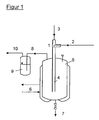
- FIG. 1 shows the diagram of a plant for implementing the method according to the invention in its first embodiment.
- the gas stream 2 containing chlorosilanes and water vapor 3 are introduced into the tubular reactor 4 .
- the treatment of the gas stream with water vapor takes place in it, with the formation of primary hydrolysis products.
- the tubular reactor 4 dips into the cooling container 5 , the cooling jacket of which coolant 6 flows through. When the gas flow enters the cooling container, the flow rate is greatly reduced.
- the water vapor condenses on the inner walls of the cooling container, and the condensate flows together with secondary hydrolysis products in the form of a film to the bottom of the cooling container, from which it is withdrawn continuously or from time to time as heterogeneous condensate 7 .
- the residual gas 8 is passed through the scrubber 9 , which can be charged, for example, with sodium hydroxide solution to remove hydrogen chloride and to check for a content of silicon-containing compounds, and leaves the system as waste gas 10 .
- the exhaust gas is usually free of hydrogen chloride and silicon compounds and can be burned or used for other purposes.
- the heterogeneous condensate 7 can, for example, be air-dried in a paddle dryer (not shown in the figure) at 100 to 160 ° C. and the residue can be disposed of.
- aqueous liquid other than liquid, aqueous phase for the treatment of the gas stream.
- the optionally preheated gas stream generally has a temperature up to 200 ° C, for example of 5 to 200 ° C, advantageously from 30 to 150 ° C, and the temperature the other aqueous liquid is usually 10 up to 90 ° C, especially 20 to 50 ° C.
- the water vapor that ever according to the temperature of this other aqueous liquid in the gas phase over the other aqueous liquid with a Partial pressure of 12 to 700 mbar is used as Steam for the treatment of the gas stream according to the invention in the first stage. This is followed by the second stage in which the gas flow with the other aqueous liquid is treated.
- the other aqueous liquid can be water, for example tap water, steam condensate or demineralized water.
- an aqueous basic liquid such as lime milk, sodium or ammonia lye. This also neutralizes the hydrogen chloride contained in the gas stream or formed by hydrolysis.
- any Si-H bonds still present are converted to Si-O - bonds and H 2 .
- Treatment in the first and second stages lasts in generally 5 to 120 seconds, especially 10 to 40 sec.
- FIG. 2 shows the diagram of a plant for carrying out the method according to the invention in its second embodiment.
- the gas stream 2 containing chlorosilanes is introduced into the tubular reactor 3 , the inner walls of which are filled with a "different aqueous liquid" 12 , such as line or demineralized water.
- the tube reactor 3 is cooled by the coolant 4 on the walls.
- the speed of the gas stream 2 is greatly reduced.
- the treatment of the gas stream 2 with the water vapor originating from the other aqueous liquid 12 takes place with the formation of hydrogen chloride and primary hydrolysis products.
- the formation of secondary hydrolysis products takes place in the other aqueous liquid 12 , which wets the apparatus wall, so that a suspension is formed.
- This is separated from the cleaned gas stream 6 in the collecting tank 5 and removed continuously or from time to time as a hydrolyzate suspension 5 .
- the cleaned gas stream 6 is passed through the scrubber 7 , which can be charged with water, for example, to check for a content of residual silicon-containing compounds, and leaves the system as exhaust gas 8 .
- the suspension can be circulated as stream 9 until the concentration of the secondary hydrolysis products has reached a predetermined value.
- the method according to the second embodiment can be carried out effectively in this way.
- the recycle stream 9 may be added to neutralize the resulting in the hydrolysis of hydrogen chloride with an aqueous alkaline liquid 11, for example, can be taken from the reservoir 10 degrees. If the other aqueous liquid 12 or the circulating stream 9 is made alkaline in this way by regulation according to the pH, largely soluble silicon compounds are formed. As a result, the tendency to form deposits in apparatus 3 and 5 is again significantly reduced.
- the third embodiment of the method according to the invention is a combination of the first two variants. So both steam for treating the gas stream in the gas phase in the first stage and also another aqueous liquid, not exclusively produced by condensation of the water vapor, for treating the gas stream in the second stage are used. The gas stream is then treated both with this liquid and with the condensate of the water vapor which is produced by cooling.
- the other aqueous liquid can in turn be water or a basic, aqueous liquid.
- the heterogeneous condensate or its aqueous phase which collects at the bottom of the cooling container, is expediently used by circulating it and withdrawing only part of it.
- the other aqueous liquid or the aqueous phase of the heterogeneous condensate can be conducted via a ring line in the uppermost part of the cooling container 5 of FIG. 1 onto its cylindrical inner wall. This promotes the sliding of the heterogeneous condensate that separates due to cooling.
- the exhaust gas from the cooling vessel is again free of silicon-containing compounds and can be burned or used for other purposes.
- Treatment in the first and second stages lasts in generally 3 to 120 sec, especially 10 to 40 sec.
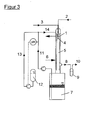
- FIG. 3 shows the diagram of a plant for carrying out the method according to the invention in its third embodiment.
- the gas stream 2 containing chlorosilanes and water vapor 3 are introduced into the tubular reactor 4 .
- the treatment of the gas stream 2 containing chlorosilanes with steam 3 takes place with the formation of primary hydrolysis products.
- the tubular reactor 4 dips into the cooling container 5 , the inner walls of which are wetted with "other aqueous liquid" 14 . This can additionally be cooled via the walls by means of a coolant 6 .
- the gas flow 2 and 3 enters the cooling container 5 the flow rate is greatly reduced.
- the water vapor 3 condenses in the interior of the cooling container 5 , and the condensate is transprotected to the wetted apparatus wall together with secondary hydrolysis products due to a Stefan flow.
- the cleaned residual gas 8 is passed through the scrubber 9 , which can be charged with water, for example, to check for a content of residual silicon-containing compounds, and leaves the system as waste gas 10 .
- the suspension can be circulated as stream 11 until the concentration of the secondary hydrolysis products has reached a predetermined value.
- the method according to the third embodiment can be carried out effectively in this way.
- the circuit stream 11 can be mixed with an aqueous alkaline liquid 13 , which can be taken from the reservoir 12 , for example, to neutralize the hydrogen chloride formed during the hydrolysis. If the other aqueous liquid 14 or the circulating stream 11 is made alkaline in this way by regulation according to the pH value, largely soluble silicon compounds are formed. As a result, the tendency to form deposits in apparatuses 5 and 7 is again significantly reduced.
- the tubular reactor 4 had a length of 2.0 cm and an inner diameter of 1.0 cm.
- the cylindrical cooling container 5 had an inner diameter of 140 cm and a volume of 4.5 dm 3 .
- the temperature of the cooling water was 20 ° C, its flow rate 12 1 / min.
- the other test conditions are shown in Table 1.
- the condensate with the dissolved or suspended secondary hydrolyzate was evaporated, the remaining silicon dioxide was dried at 150 ° C. and weighed. The results obtained are shown in Table 2.
- the tubular reactor 4 had a length of 1.5 cm and an inner diameter of 0.6 cm.
- the cylindrical cooling vessel had an inner diameter of 3.5 cm and a volume of 0.67 dm 3 .
- the temperature of the cooling water was 18 ° C, its flow rate 12 1 / min.
- Desalinated water was used as the other aqueous liquid and was supplied at a pH of 12.5 in an amount of 70 to 100 l / h.
- the pH was adjusted using 10% by weight sodium hydroxide solution.
- the other test conditions are shown in Table 5.
- the suspension with the secondary hydrolyzate was evaporated, the silicon dioxide remaining as a residue was dried at 150 ° C. and weighed. The results obtained are shown in Table 6.
Landscapes
- Chemical & Material Sciences (AREA)
- Engineering & Computer Science (AREA)
- Organic Chemistry (AREA)
- Environmental & Geological Engineering (AREA)
- Health & Medical Sciences (AREA)
- Biomedical Technology (AREA)
- Inorganic Chemistry (AREA)
- Analytical Chemistry (AREA)
- General Chemical & Material Sciences (AREA)
- Oil, Petroleum & Natural Gas (AREA)
- Chemical Kinetics & Catalysis (AREA)
- Silicon Compounds (AREA)
- Treating Waste Gases (AREA)
- Hydrogen, Water And Hydrids (AREA)
Abstract
Description
| Bsp. Nr. | Abgasstrom 2 | Wasserdampfstrom 3 | Mengenverh. | Rohrreaktor 4 | Kühlgefäß 5 | Mischtemp. | |||
| Wasserst | Trichlorsilan | Temperatur (°C) | Menge | Verw. zeit (sec) | Verw. zeit (sec) | (°C) | |||
| (g/h) | (g/h) | (Gew.%) | (g/h) | ||||||
| 1 | 9,0 | 9,9 | 52,4 | 160 | 548,2 | 55,2:1 | 0,01 | 213 | 129 |
| 2 | 9,0 | 9,9 | 52,4 | 220 | 750,0 | 75,8:1 | 0,01 | 213 | 154 |
| 3 | 18,0 | 9,9 | 35,5 | 220 | 657,5 | 66,4:1 | 0,005 | 107 | 152 |
| Beisp. Nr. | Siliciumdioxid (getrocknet) | Abgas 8 Temperatur | Siliciumdioxid in Gaswäsche 9 | Abgas 10 Menge | |
| Menge | Wasserge-halt | ||||
| (g/h) | (Gew.-%) | (°C) | (g/h) | (g/h) | |
| 1 | 4,1 | 0 | 30 | 0,4 | 12,4 |
| 2 | 4,1 | 0 | 32 | 0,3 | 12,8 |
| 3 | 4,3 | 0 | 30 | 0,4 | 24,7 |
| Bsp. Nr. | Abgasstrom 2 | Wasserdampfstrom 3 | Mengenverh. | Rohrreaktor 4 | Kühlgefäß 5 | Mischtemp. | |||
| Wasserst. | Trichlorsilan | Temperatur (°C) | Menge | Verw. zeit (sec) | Verw. zeit (sec) | (°C) | |||
| (g/h) | (g/h) | (Gew.%) | (g/h) | ||||||
| 4 | 18,0 | 9,9 | 35,5 | 220 | 642,0 | 64,8:1 | 0,5 | 84 | 155 |
| 5 | 13,5 | 9,9 | 42,3 | 220 | 468,9 | 47,2:1 | 0,6 | 108 | 151 |
| 6 | 9,0 | 9,9 | 52,4 | 220 | 562,9 | 56,7:1 | 0,9 | 162 | 155 |
| Beisp. Nr. | Siliciumdioxid (getrocknet) | Abgas 8 Temperatur | Siliciumdioxid in Gaswäsche 9 | Abgas 10 Menge | |
| Menge | Wassergehalt | ||||
| (g/h) | (Gew.-%) | (°C) | (g/h) | (g/h) | |
| 4 | 8,1 | 47 | 25 | 1,0 | 23,0 |
| 5 | 7,7 | 46 | 25 | 0,9 | 17,3 |
| 6 | 6,9 | 40 | 25 | 0,9 | 11,5 |
| Bsp. Nr. | Abgasstrom 2 | Wasserdampfstrom 3 | Mengenverh.** | Rohrreaktor 4 | Kühlgefäß 5 | Mischtemp.* | |||
| Wasserst. | Trichlorsilan | Temperatur | Menge | Verw. zeit (sec) | Verw. zeit (sec) | (°C) | |||
| (g/h) | (g/h) | (Gew.%) | (°C) | (g/h) | |||||
| 7 | 9,0 | 9,2 | 58,5 | 220 | 468,9 | 35,7:1 | 0,001 | 20 | 165 |
| 8 | 13,5 | 9,9 | 42,3 | 220 | 138,9 | 14,1:1 | 0,005 | 19 | 138 |
| 9 | 18,0 | 10,7 | 37,3 | 220 | 468,9 | 43,7:1 | 0,001 | 11 | 155 |
| Bsp. Nr. | Abgasstrom 2 | Wasserdampfstrom 3 | Mengenverh. | Rohrreaktor 4 | Kühlgefäß 5 | Mischtemp. | |||
| Wasserst. | Trichlorsilan | Temperatur | Menge | Verw. zeit (sec) | Verw. zeit (sec) | (°C) | |||
| (g/h) | (g/h) | (Gew.%) | (°C) | (g/h) | |||||
| 10 | 9,0 | 12,3 | 57,8 | - | - | - | - | 20 | - |
| 11 | 18,0 | 6,3 | 25,9 | - | - | - | - | 11 | - |
| Beisp. Nr. | Siliciumdioxid (getrocknet) | Abgas 8 Temperatur | Siliciumdioxid in Gaswäsche 9 | Abgas 10 Menge | |
| Menge | Wassergehalt | ||||
| (g/h) | (Gew.-%) | (°C) | (g/h) | (g/h) | |
| 7 | 6,6 | 38 | 30 | 0,8 | 12,4 |
| 8 | 6,8 | 38 | 30 | 0,3 | 16,9 |
| 9 | 7,2 | 38 | 30 | 0,2 | 24,7 |
| 10 | 7,7 | 31 | 30 | 0,4 | 12,4 |
| 11 | 3,7 | 28 | 40 | 0,4 | 12,4 |
Claims (19)
- Verfahren zur kontinuierlichen Entfernung von Chlorsilanen aus Gasströmen, dadurch gekennzeichnet, daß man die Gasströme in einer ersten Stufe in der Gasphase mit Wasserdampf und in einer zweiten Stufe mit einer flüssigen, wäßrigen Phase behandelt.
- Verfahren nach Anspruch 1, dadurch gekennzeichnet, daß die Gasströme bei dem Direktverfahren zur Herstellung von Chlorsilanen aus Silicium oder Ferrosilicium und Chlorwasserstoff angefallen sind und 3 bis 60 Gew.-% Chlorsilane enthalten.
- Verfahren nach Anspruch 1 oder 2, dadurch gekennzeichnet, daß man in der ersten Stufe den Gasstrom mit den darin enthaltenen Chlorsilanen bei einer Temperatur von mindestens 125°C mit eigens zugeführtem Wasserdampf behandelt und in der zweiten Stufe als flüssige Phase das heterogen Kondensat aus Wasser und sekundären Hydrolyseprodukten, das sich bei der Kondensation des Wasserdampfes nach Abkühlung auf eine Temperatur unterhalb des Taupunktes bildet, oder die wäßrige Phase dieses heterogenen Kondensats verwendet.
- Verfahren nach Anspruch 3, dadurch gekennzeichnet daß die Behandlungstemperatur in der ersten Stufe 125 bis 250°C beträgt.
- Verfahren nach Anspruch 3 oder 4, dadurch gekennzeichnet, daß man in der ersten Stufe den Gasstrom in das Innere eines Wasserdampfstromes in Strömungsrichtung einleitet.
- Verfahren nach einem der Ansprüche 3 bis 5, dadurch gekennzeichnet, daß das Gewichtsverhältnis von Wasserdampf zu Chlorsilanen 5:1 bis 100:1 beträgt.
- Verfahren nach einem der Ansprüche 3 bis 6, dadurch gekennzeichnet, daß in der ersten Stufe das Gemisch aus Chlorsilane enthaltendem Gasstrom und Wasserdampf durch ein Reaktionsrohr geleitet wird, das zentral von oben bis in das untere Drittel eines stehenden zylindrischen Kühlbehälters ragt, dessen Mantel von Kühlwasser durchströmt wird und in dem die zweite Stufe des Verfahrens stattfindet.
- Verfahren nach einem der Ansprüche 3 bis 6, dadurch gekennzeichnet, daß der Siliciumdioxidteilchen enthaltende Gasstrom nach der Hydrolyse in einem Rohrreaktor, der vollständig außerhalb des Kühlbehälters liegt, tangential in den Kühlbehälter eingeleitet wird.
- Verfahren nach Anspruch 7 oder 8, dadurch gekennzeichnet, daß der Kühlbehälter in zwei Kühlzonen unterteilt ist.
- Verfahren nach einem der Ansprüche 1 bis 9, dadurch gekennzeichnet, daß die Behandlung in der ersten und zweiten Stufe zusammen 3 bis 300 sec dauert.
- Verfahren nach Anspruch 1 oder 2, dadurch gekennzeichnet, daß man in der ersten Stufe auf die Mitverwendung von eigens zugeführtem Wasserdampf verzichtet und an Stelle des heterogenen Kondensats eine andere wäßrige Flüssigkeit einsetzt, um den Gasstrom in der zweiten Stufe mit einer flüssigen, wäßrigen Phase zu behandeln.
- Verfahren nach Anspruch 11, dadurch gekennzeichnet, daß die Temperatur des Gasstromes bis zu 200°C beträgt.
- Verfahren nach Anspruch 11 oder 12, dadurch gekennzeichnet, daß die Temperatur der anderen wäßrigen Flüssigkeit 10 bis 90°C beträgt.
- Verfahren nach einem der Ansprüche 11 bis 13, dadurch gekennzeichnet, daß die Behandlung in der ersten und zweiten Stufe zusammen 5 bis 120 sec dauert.
- Verfahren nach einem der Ansprüche 11 bis 14, dadurch gekennzeichnet, daß die andere wäßrige Flüssigkeit Wasser oder eine basische wäßrige Flüssigkeit ist.
- Verfahren nach einem der Ansprüche 3 bis 9, dadurch gekennzeichnet, daß man zusätzlich zu der aus Wasserdampf entstehenden flüssigen Phase eine andere, nicht durch Kondensation des Wasserdampfes erzeugte wäßrige Flüssigkeit zur Behandlung des Gasstromes in der zweiten Stufe einsetzt.
- Verfahren nach Anspruch 16, dadurch gekennzeichnet, daß die andere wäßrige Flüssigkeit Wasser oder eine basische wäßrige Flüssigkeit ist.
- Verfahren nach Anspruch 16, dadurch gekennzeichnet, daß die andere wäßrige Flüssigkeit das heterogene Kondensat oder dessen wäßrige Phase ist.
- Verfahren nach einem der Ansprüche 16 bis 18, dadurch gekennzeichnet, daß die Behandlung in der ersten und zweiten Phase zusammen 3 bis 120 sec dauert.
Applications Claiming Priority (2)
| Application Number | Priority Date | Filing Date | Title |
|---|---|---|---|
| DE19963433A DE19963433A1 (de) | 1999-12-28 | 1999-12-28 | Verfahren zur Abscheidung von Chlorsilanen aus Gasströmen |
| DE19963433 | 1999-12-28 |
Publications (2)
| Publication Number | Publication Date |
|---|---|
| EP1112958A1 true EP1112958A1 (de) | 2001-07-04 |
| EP1112958B1 EP1112958B1 (de) | 2003-04-02 |
Family
ID=7934783
Family Applications (1)
| Application Number | Title | Priority Date | Filing Date |
|---|---|---|---|
| EP00124511A Expired - Lifetime EP1112958B1 (de) | 1999-12-28 | 2000-11-09 | Verfahren zur Abscheidung von Chlorsilanen aus Gasströmen |
Country Status (5)
| Country | Link |
|---|---|
| US (2) | US6680038B2 (de) |
| EP (1) | EP1112958B1 (de) |
| JP (1) | JP2001224923A (de) |
| AT (1) | ATE236079T1 (de) |
| DE (2) | DE19963433A1 (de) |
Cited By (2)
| Publication number | Priority date | Publication date | Assignee | Title |
|---|---|---|---|---|
| WO2014166710A1 (de) * | 2013-04-09 | 2014-10-16 | Wacker Chemie Ag | Vorrichtung und verfahren zur behandlung von chlorsilane enthaltenden flüssigkeiten |
| WO2016193579A1 (fr) * | 2015-06-05 | 2016-12-08 | Herakles | Traitement d'effluents d'hydrolyse de gaz chlores. |
Families Citing this family (17)
| Publication number | Priority date | Publication date | Assignee | Title |
|---|---|---|---|---|
| US6245108B1 (en) * | 1999-02-25 | 2001-06-12 | Spineco | Spinal fusion implant |
| DE102004037675A1 (de) * | 2004-08-04 | 2006-03-16 | Degussa Ag | Verfahren und Vorrichtung zur Reinigung von Wasserstoffverbindungen enthaltendem Siliciumtetrachlorid oder Germaniumtetrachlorid |
| DE102005041137A1 (de) | 2005-08-30 | 2007-03-01 | Degussa Ag | Reaktor, Anlage und großtechnisches Verfahren zur kontinuierlichen Herstellung von hochreinem Siliciumtetrachlorid oder hochreinem Germaniumtetrachlorid |
| DE102006003464A1 (de) * | 2006-01-25 | 2007-07-26 | Degussa Gmbh | Verfahren zur Erzeugung einer Siliciumschicht auf einer Substratoberfläche durch Gasphasenabscheidung |
| DE102007007874A1 (de) | 2007-02-14 | 2008-08-21 | Evonik Degussa Gmbh | Verfahren zur Herstellung höherer Silane |
| DE102007014107A1 (de) | 2007-03-21 | 2008-09-25 | Evonik Degussa Gmbh | Aufarbeitung borhaltiger Chlorsilanströme |
| DE102007048937A1 (de) * | 2007-10-12 | 2009-04-16 | Evonik Degussa Gmbh | Entfernung von polaren organischen Verbindungen und Fremdmetallen aus Organosilanen |
| DE102007050199A1 (de) * | 2007-10-20 | 2009-04-23 | Evonik Degussa Gmbh | Entfernung von Fremdmetallen aus anorganischen Silanen |
| DE102007050573A1 (de) * | 2007-10-23 | 2009-04-30 | Evonik Degussa Gmbh | Großgebinde zur Handhabung und für den Transport von hochreinen und ultra hochreinen Chemikalien |
| DE102007059170A1 (de) * | 2007-12-06 | 2009-06-10 | Evonik Degussa Gmbh | Katalysator und Verfahren zur Dismutierung von Wasserstoff enthaltenden Halogensilanen |
| DE102008004396A1 (de) * | 2008-01-14 | 2009-07-16 | Evonik Degussa Gmbh | Anlage und Verfahren zur Verminderung des Gehaltes von Elementen, wie Bor, in Halogensilanen |
| DE102008002537A1 (de) * | 2008-06-19 | 2009-12-24 | Evonik Degussa Gmbh | Verfahren zur Entfernung von Bor enthaltenden Verunreinigungen aus Halogensilanen sowie Anlage zur Durchführung des Verfahrens |
| DE102008054537A1 (de) * | 2008-12-11 | 2010-06-17 | Evonik Degussa Gmbh | Entfernung von Fremdmetallen aus Siliciumverbindungen durch Adsorption und/oder Filtration |
| JP5716279B2 (ja) * | 2010-02-17 | 2015-05-13 | 三菱マテリアル株式会社 | ポリマー処理装置および処理方法 |
| US9193105B1 (en) * | 2011-08-31 | 2015-11-24 | Consolidated Nuclear Security, LLC | Casting fine grained, fully dense, strong inorganic materials |
| CN102942183B (zh) * | 2012-12-11 | 2014-04-02 | 成都蜀菱科技发展有限公司 | 氯硅烷残液处理工艺 |
| US20140271445A1 (en) * | 2013-03-14 | 2014-09-18 | Heritage Research Group | Method of processing waste chlorosilane |
Citations (6)
| Publication number | Priority date | Publication date | Assignee | Title |
|---|---|---|---|---|
| US4454104A (en) * | 1981-10-06 | 1984-06-12 | Wacker-Chemitronic Gesellschaft Fur Elektronik-Grundstoffe Mbh | Process for working up the residual gases obtained in the deposition of silicon and in the conversion of silicon tetrachloride |
| EP0216292A1 (de) * | 1985-09-20 | 1987-04-01 | Wacker-Chemitronic Gesellschaft für Elektronik-Grundstoffe mbH | Verfahren zur Aufarbeitung von chlorwasserstoffhaltigen Abgasen |
| US5066472A (en) * | 1986-12-11 | 1991-11-19 | Huels Aktiengesellschaft | Method for processing the residues of a chlorosilane distillation |
| US5182095A (en) * | 1987-12-16 | 1993-01-26 | Huls Troisdorf Aktiengesellschaft | Method for processing residues from the distillation of chlorosilanes |
| EP0532857A1 (de) * | 1991-09-17 | 1993-03-24 | Hüls Aktiengesellschaft | Verfahren zur Aufarbeitung von Rückständen einer Chlorsilandestillation mit Wasserdampf |
| US5320817A (en) * | 1992-08-28 | 1994-06-14 | Novapure Corporation | Process for sorption of hazardous waste products from exhaust gas streams |
Family Cites Families (10)
| Publication number | Priority date | Publication date | Assignee | Title |
|---|---|---|---|---|
| EP0089183B1 (de) | 1982-03-12 | 1987-07-08 | Cjb Developments Limited | Verfahren zur Abscheidung von Wasserstoff aus Gasen |
| FR2592812B1 (fr) * | 1986-01-14 | 1990-05-04 | Sobea | Procede pour la reduction de la teneur en polluants acides contenus dans des fumees et dispositif pour sa mise en oeuvre |
| DE4126670A1 (de) * | 1991-08-13 | 1993-02-18 | Huels Chemische Werke Ag | Verfahren zur abwasserfreien aufarbeitung von rueckstaenden einer chlorsilandestillation mit salzsaeure |
| US5378444A (en) * | 1991-12-11 | 1995-01-03 | Japan Pionics Co., Ltd. | Process for cleaning harmful gas |
| US6322765B1 (en) * | 1996-02-15 | 2001-11-27 | Wacker-Chemie Gmbh | Process for preparing silicon dioxide |
| DE19701549C2 (de) * | 1997-01-17 | 2000-08-03 | Gnb Gmbh | Verfahren zur Rückkühlung eines von mit abgebrannten Brennelementen beladenen Behälters zum Transport und/oder zur Lagerung der Brennelemente |
| JP3362632B2 (ja) * | 1997-03-26 | 2003-01-07 | 信越化学工業株式会社 | シラン類含有ガスの処理方法 |
| DE19754322B4 (de) * | 1997-12-08 | 2006-01-26 | Degussa Ag | Verfahren zur Herstellung von Salzen cyclischer Amidine |
| DE19816296A1 (de) * | 1998-04-11 | 1999-10-14 | Degussa | Verfahren zur Herstellung von Wasserstoffperoxid durch Direktsynthese |
| US6368568B1 (en) * | 2000-02-18 | 2002-04-09 | Stephen M Lord | Method for improving the efficiency of a silicon purification process |
-
1999
- 1999-12-28 DE DE19963433A patent/DE19963433A1/de not_active Withdrawn
-
2000
- 2000-11-09 AT AT00124511T patent/ATE236079T1/de not_active IP Right Cessation
- 2000-11-09 EP EP00124511A patent/EP1112958B1/de not_active Expired - Lifetime
- 2000-11-09 DE DE50001601T patent/DE50001601D1/de not_active Expired - Lifetime
- 2000-12-25 JP JP2000393552A patent/JP2001224923A/ja active Pending
- 2000-12-28 US US09/749,520 patent/US6680038B2/en not_active Expired - Fee Related
-
2003
- 2003-11-19 US US10/715,359 patent/US7204963B2/en not_active Expired - Fee Related
Patent Citations (6)
| Publication number | Priority date | Publication date | Assignee | Title |
|---|---|---|---|---|
| US4454104A (en) * | 1981-10-06 | 1984-06-12 | Wacker-Chemitronic Gesellschaft Fur Elektronik-Grundstoffe Mbh | Process for working up the residual gases obtained in the deposition of silicon and in the conversion of silicon tetrachloride |
| EP0216292A1 (de) * | 1985-09-20 | 1987-04-01 | Wacker-Chemitronic Gesellschaft für Elektronik-Grundstoffe mbH | Verfahren zur Aufarbeitung von chlorwasserstoffhaltigen Abgasen |
| US5066472A (en) * | 1986-12-11 | 1991-11-19 | Huels Aktiengesellschaft | Method for processing the residues of a chlorosilane distillation |
| US5182095A (en) * | 1987-12-16 | 1993-01-26 | Huls Troisdorf Aktiengesellschaft | Method for processing residues from the distillation of chlorosilanes |
| EP0532857A1 (de) * | 1991-09-17 | 1993-03-24 | Hüls Aktiengesellschaft | Verfahren zur Aufarbeitung von Rückständen einer Chlorsilandestillation mit Wasserdampf |
| US5320817A (en) * | 1992-08-28 | 1994-06-14 | Novapure Corporation | Process for sorption of hazardous waste products from exhaust gas streams |
Cited By (5)
| Publication number | Priority date | Publication date | Assignee | Title |
|---|---|---|---|---|
| WO2014166710A1 (de) * | 2013-04-09 | 2014-10-16 | Wacker Chemie Ag | Vorrichtung und verfahren zur behandlung von chlorsilane enthaltenden flüssigkeiten |
| CN105377392A (zh) * | 2013-04-09 | 2016-03-02 | 瓦克化学股份公司 | 用于处理包含氯硅烷的液体的装置和方法 |
| CN105377392B (zh) * | 2013-04-09 | 2018-04-20 | 瓦克化学股份公司 | 用于处理包含氯硅烷的液体的装置和方法 |
| WO2016193579A1 (fr) * | 2015-06-05 | 2016-12-08 | Herakles | Traitement d'effluents d'hydrolyse de gaz chlores. |
| FR3036976A1 (fr) * | 2015-06-05 | 2016-12-09 | Herakles | Traitement d'effluents d'hydrolyse de gaz chlores |
Also Published As
| Publication number | Publication date |
|---|---|
| US6680038B2 (en) | 2004-01-20 |
| US20040109806A1 (en) | 2004-06-10 |
| EP1112958B1 (de) | 2003-04-02 |
| DE19963433A1 (de) | 2001-07-12 |
| US7204963B2 (en) | 2007-04-17 |
| ATE236079T1 (de) | 2003-04-15 |
| US20010046465A1 (en) | 2001-11-29 |
| DE50001601D1 (de) | 2003-05-08 |
| JP2001224923A (ja) | 2001-08-21 |
Similar Documents
| Publication | Publication Date | Title |
|---|---|---|
| EP1112958B1 (de) | Verfahren zur Abscheidung von Chlorsilanen aus Gasströmen | |
| DE2513608C2 (de) | Verfahren zur Hydrophobierung von Kieselsäuren und Silikaten mit Organosilanen | |
| DE2245432C2 (de) | ||
| EP0116151B1 (de) | Verfahren zur Regenerierung bzw. zum Recycling von wässrigen Entfettungs- und Reinigungslösungen | |
| DE2161641A1 (de) | Verfahren zur herstellung metallfreier chlorsilane bei der chlorierung oder hydrochlorierung von ferrosilicium | |
| DE875846C (de) | Verfahren zum Reinigen von Gasen, insbesondere Koksofengasen, von Schwefelverbindungen | |
| EP0216292B1 (de) | Verfahren zur Aufarbeitung von chlorwasserstoffhaltigen Abgasen | |
| EP2983803B1 (de) | Vorrichtung und verfahren zur behandlung von chlorsilane enthaltenden flüssigkeiten | |
| EP0527309A1 (de) | Verfahren zur abwasserfreien Aufarbeitung von Rückständen einer Chlorsilandestillation mit Salzsäure | |
| DE1906197A1 (de) | Verfahren zur Entfernung von borhaltigen Verunreinigungen aus Chlorsilanverbindungen | |
| DE2240014A1 (de) | Verfahren zur hydrophobierung von hochdispersen oxiden | |
| DE2800272A1 (de) | Verfahren zur herstellung von fluorwasserstoff und siliziumdioxid aus siliziumtetrafluorid | |
| DE1442999B1 (de) | Verfahren zur Herstellung von feinverteiltem amorphem Siliciumdioxid | |
| US4154804A (en) | Novel calcium chloride scrubbing bath | |
| DE69801606T2 (de) | Verfahren und Vorrichtung zur Rückgewinnung von Germanium aus Abgasen chemischer Aufdampfprozesse | |
| DE3307026A1 (de) | Verfahren zurentfernung von germanium aus bei der herstellung von optischen bauteilen anfallenden abstromenden produkten | |
| DE2257948A1 (de) | Verfahren zur veredlung des in der duengemittelindustrie als nebenprodukt anfallenden fluors | |
| DE862895C (de) | Verfahren zur Entfernung des Halogenwasserstoffs aus den Umsetzungsprodukten halogenhaltiger Siliciumverbindungen | |
| US4354943A (en) | Clarification of ammonium polyphosphate solutions | |
| DE3637273C1 (de) | Verfahren zur Herstellung von SiH-Gruppen enthaltenden Organopolysiloxanen | |
| DE19615067C2 (de) | Verfahren zur Behandlung industrieller Abwässer | |
| US4437997A (en) | Clarification of ammonium polyphosphate solutions | |
| US3580844A (en) | Method of processing oil emulsions used in metal machining | |
| DE1077646B (de) | Verfahren zur Trocknung von feinteiligen gefaellten Kieselsaeurefuellstoffen | |
| DE10057483B4 (de) | Verfahren zur Entfernung von Aluminiumtrichlorid aus Chlorsilanen |
Legal Events
| Date | Code | Title | Description |
|---|---|---|---|
| PUAI | Public reference made under article 153(3) epc to a published international application that has entered the european phase |
Free format text: ORIGINAL CODE: 0009012 |
|
| 17P | Request for examination filed |
Effective date: 20001109 |
|
| AK | Designated contracting states |
Kind code of ref document: A1 Designated state(s): AT BE CH CY DE DK ES FI FR GB GR IE IT LI LU MC NL PT SE TR |
|
| AX | Request for extension of the european patent |
Free format text: AL;LT;LV;MK;RO;SI |
|
| AKX | Designation fees paid |
Free format text: AT BE CH CY DE DK ES FI FR GB GR IE IT LI LU MC NL PT SE TR |
|
| GRAH | Despatch of communication of intention to grant a patent |
Free format text: ORIGINAL CODE: EPIDOS IGRA |
|
| GRAH | Despatch of communication of intention to grant a patent |
Free format text: ORIGINAL CODE: EPIDOS IGRA |
|
| GRAA | (expected) grant |
Free format text: ORIGINAL CODE: 0009210 |
|
| AK | Designated contracting states |
Designated state(s): AT BE CH CY DE DK ES FI FR GB GR IE IT LI LU MC NL PT SE TR |
|
| PG25 | Lapsed in a contracting state [announced via postgrant information from national office to epo] |
Ref country code: TR Free format text: LAPSE BECAUSE OF FAILURE TO SUBMIT A TRANSLATION OF THE DESCRIPTION OR TO PAY THE FEE WITHIN THE PRESCRIBED TIME-LIMIT Effective date: 20030402 Ref country code: NL Free format text: LAPSE BECAUSE OF FAILURE TO SUBMIT A TRANSLATION OF THE DESCRIPTION OR TO PAY THE FEE WITHIN THE PRESCRIBED TIME-LIMIT Effective date: 20030402 Ref country code: IE Free format text: LAPSE BECAUSE OF NON-PAYMENT OF DUE FEES Effective date: 20030402 Ref country code: FR Free format text: LAPSE BECAUSE OF FAILURE TO SUBMIT A TRANSLATION OF THE DESCRIPTION OR TO PAY THE FEE WITHIN THE PRESCRIBED TIME-LIMIT Effective date: 20030402 Ref country code: FI Free format text: LAPSE BECAUSE OF FAILURE TO SUBMIT A TRANSLATION OF THE DESCRIPTION OR TO PAY THE FEE WITHIN THE PRESCRIBED TIME-LIMIT Effective date: 20030402 |
|
| REG | Reference to a national code |
Ref country code: GB Ref legal event code: FG4D Free format text: NOT ENGLISH |
|
| REG | Reference to a national code |
Ref country code: CH Ref legal event code: EP |
|
| REG | Reference to a national code |
Ref country code: IE Ref legal event code: FG4D Free format text: GERMAN |
|
| REF | Corresponds to: |
Ref document number: 50001601 Country of ref document: DE Date of ref document: 20030508 Kind code of ref document: P |
|
| GBT | Gb: translation of ep patent filed (gb section 77(6)(a)/1977) |
Effective date: 20030512 |
|
| PG25 | Lapsed in a contracting state [announced via postgrant information from national office to epo] |
Ref country code: SE Free format text: LAPSE BECAUSE OF FAILURE TO SUBMIT A TRANSLATION OF THE DESCRIPTION OR TO PAY THE FEE WITHIN THE PRESCRIBED TIME-LIMIT Effective date: 20030702 Ref country code: DK Free format text: LAPSE BECAUSE OF FAILURE TO SUBMIT A TRANSLATION OF THE DESCRIPTION OR TO PAY THE FEE WITHIN THE PRESCRIBED TIME-LIMIT Effective date: 20030702 Ref country code: PT Free format text: LAPSE BECAUSE OF FAILURE TO SUBMIT A TRANSLATION OF THE DESCRIPTION OR TO PAY THE FEE WITHIN THE PRESCRIBED TIME-LIMIT Effective date: 20030702 Ref country code: GR Free format text: LAPSE BECAUSE OF FAILURE TO SUBMIT A TRANSLATION OF THE DESCRIPTION OR TO PAY THE FEE WITHIN THE PRESCRIBED TIME-LIMIT Effective date: 20030702 |
|
| NLV1 | Nl: lapsed or annulled due to failure to fulfill the requirements of art. 29p and 29m of the patents act | ||
| PG25 | Lapsed in a contracting state [announced via postgrant information from national office to epo] |
Ref country code: ES Free format text: LAPSE BECAUSE OF FAILURE TO SUBMIT A TRANSLATION OF THE DESCRIPTION OR TO PAY THE FEE WITHIN THE PRESCRIBED TIME-LIMIT Effective date: 20031030 |
|
| PG25 | Lapsed in a contracting state [announced via postgrant information from national office to epo] |
Ref country code: LU Free format text: LAPSE BECAUSE OF NON-PAYMENT OF DUE FEES Effective date: 20031109 Ref country code: CY Free format text: LAPSE BECAUSE OF FAILURE TO SUBMIT A TRANSLATION OF THE DESCRIPTION OR TO PAY THE FEE WITHIN THE PRESCRIBED TIME-LIMIT Effective date: 20031109 Ref country code: AT Free format text: LAPSE BECAUSE OF NON-PAYMENT OF DUE FEES Effective date: 20031109 |
|
| REG | Reference to a national code |
Ref country code: IE Ref legal event code: FD4D Ref document number: 1112958E Country of ref document: IE |
|
| PG25 | Lapsed in a contracting state [announced via postgrant information from national office to epo] |
Ref country code: MC Free format text: LAPSE BECAUSE OF NON-PAYMENT OF DUE FEES Effective date: 20031130 Ref country code: BE Free format text: LAPSE BECAUSE OF NON-PAYMENT OF DUE FEES Effective date: 20031130 |
|
| PLBE | No opposition filed within time limit |
Free format text: ORIGINAL CODE: 0009261 |
|
| STAA | Information on the status of an ep patent application or granted ep patent |
Free format text: STATUS: NO OPPOSITION FILED WITHIN TIME LIMIT |
|
| EN | Fr: translation not filed | ||
| 26N | No opposition filed |
Effective date: 20040105 |
|
| BERE | Be: lapsed |
Owner name: *DEGUSSA A.G. Effective date: 20031130 |
|
| PG25 | Lapsed in a contracting state [announced via postgrant information from national office to epo] |
Ref country code: CH Free format text: LAPSE BECAUSE OF NON-PAYMENT OF DUE FEES Effective date: 20041130 Ref country code: LI Free format text: LAPSE BECAUSE OF NON-PAYMENT OF DUE FEES Effective date: 20041130 |
|
| REG | Reference to a national code |
Ref country code: CH Ref legal event code: PL |
|
| PG25 | Lapsed in a contracting state [announced via postgrant information from national office to epo] |
Ref country code: IT Free format text: LAPSE BECAUSE OF NON-PAYMENT OF DUE FEES Effective date: 20051109 |
|
| PGFP | Annual fee paid to national office [announced via postgrant information from national office to epo] |
Ref country code: GB Payment date: 20101118 Year of fee payment: 11 |
|
| GBPC | Gb: european patent ceased through non-payment of renewal fee |
Effective date: 20111109 |
|
| PG25 | Lapsed in a contracting state [announced via postgrant information from national office to epo] |
Ref country code: GB Free format text: LAPSE BECAUSE OF NON-PAYMENT OF DUE FEES Effective date: 20111109 |
|
| PGFP | Annual fee paid to national office [announced via postgrant information from national office to epo] |
Ref country code: DE Payment date: 20141119 Year of fee payment: 15 |
|
| REG | Reference to a national code |
Ref country code: DE Ref legal event code: R119 Ref document number: 50001601 Country of ref document: DE |
|
| PG25 | Lapsed in a contracting state [announced via postgrant information from national office to epo] |
Ref country code: DE Free format text: LAPSE BECAUSE OF NON-PAYMENT OF DUE FEES Effective date: 20160601 |