EP1109633B1 - Verfahren und anlage zum vorbehandeln und aufbereiten von kommunalen und industriellen abfällen zur herstellung von verwendbaren produkten - Google Patents
Verfahren und anlage zum vorbehandeln und aufbereiten von kommunalen und industriellen abfällen zur herstellung von verwendbaren produkten Download PDFInfo
- Publication number
- EP1109633B1 EP1109633B1 EP99940410A EP99940410A EP1109633B1 EP 1109633 B1 EP1109633 B1 EP 1109633B1 EP 99940410 A EP99940410 A EP 99940410A EP 99940410 A EP99940410 A EP 99940410A EP 1109633 B1 EP1109633 B1 EP 1109633B1
- Authority
- EP
- European Patent Office
- Prior art keywords
- wastes
- preparation
- waste
- reactor
- materials
- Prior art date
- Legal status (The legal status is an assumption and is not a legal conclusion. Google has not performed a legal analysis and makes no representation as to the accuracy of the status listed.)
- Expired - Lifetime
Links
Images

Classifications
-
- C—CHEMISTRY; METALLURGY
- C04—CEMENTS; CONCRETE; ARTIFICIAL STONE; CERAMICS; REFRACTORIES
- C04B—LIME, MAGNESIA; SLAG; CEMENTS; COMPOSITIONS THEREOF, e.g. MORTARS, CONCRETE OR LIKE BUILDING MATERIALS; ARTIFICIAL STONE; CERAMICS; REFRACTORIES; TREATMENT OF NATURAL STONE
- C04B28/00—Compositions of mortars, concrete or artificial stone, containing inorganic binders or the reaction product of an inorganic and an organic binder, e.g. polycarboxylate cements
- C04B28/02—Compositions of mortars, concrete or artificial stone, containing inorganic binders or the reaction product of an inorganic and an organic binder, e.g. polycarboxylate cements containing hydraulic cements other than calcium sulfates
- C04B28/10—Lime cements or magnesium oxide cements
-
- C—CHEMISTRY; METALLURGY
- C04—CEMENTS; CONCRETE; ARTIFICIAL STONE; CERAMICS; REFRACTORIES
- C04B—LIME, MAGNESIA; SLAG; CEMENTS; COMPOSITIONS THEREOF, e.g. MORTARS, CONCRETE OR LIKE BUILDING MATERIALS; ARTIFICIAL STONE; CERAMICS; REFRACTORIES; TREATMENT OF NATURAL STONE
- C04B28/00—Compositions of mortars, concrete or artificial stone, containing inorganic binders or the reaction product of an inorganic and an organic binder, e.g. polycarboxylate cements
- C04B28/18—Compositions of mortars, concrete or artificial stone, containing inorganic binders or the reaction product of an inorganic and an organic binder, e.g. polycarboxylate cements containing mixtures of the silica-lime type
-
- C—CHEMISTRY; METALLURGY
- C04—CEMENTS; CONCRETE; ARTIFICIAL STONE; CERAMICS; REFRACTORIES
- C04B—LIME, MAGNESIA; SLAG; CEMENTS; COMPOSITIONS THEREOF, e.g. MORTARS, CONCRETE OR LIKE BUILDING MATERIALS; ARTIFICIAL STONE; CERAMICS; REFRACTORIES; TREATMENT OF NATURAL STONE
- C04B2111/00—Mortars, concrete or artificial stone or mixtures to prepare them, characterised by specific function, property or use
- C04B2111/00474—Uses not provided for elsewhere in C04B2111/00
- C04B2111/00767—Uses not provided for elsewhere in C04B2111/00 for waste stabilisation purposes
- C04B2111/00775—Uses not provided for elsewhere in C04B2111/00 for waste stabilisation purposes the composition being used as waste barriers or the like, e.g. compositions used for waste disposal purposes only, but not containing the waste itself
-
- Y—GENERAL TAGGING OF NEW TECHNOLOGICAL DEVELOPMENTS; GENERAL TAGGING OF CROSS-SECTIONAL TECHNOLOGIES SPANNING OVER SEVERAL SECTIONS OF THE IPC; TECHNICAL SUBJECTS COVERED BY FORMER USPC CROSS-REFERENCE ART COLLECTIONS [XRACs] AND DIGESTS
- Y02—TECHNOLOGIES OR APPLICATIONS FOR MITIGATION OR ADAPTATION AGAINST CLIMATE CHANGE
- Y02W—CLIMATE CHANGE MITIGATION TECHNOLOGIES RELATED TO WASTEWATER TREATMENT OR WASTE MANAGEMENT
- Y02W30/00—Technologies for solid waste management
- Y02W30/50—Reuse, recycling or recovery technologies
- Y02W30/91—Use of waste materials as fillers for mortars or concrete
Definitions
- the invention relates to a process and a plant for preparation and treating of communal and industrial wastes into usable products, according to the preambles of claims 1 and 4. Particularly, the invention relates to treatment, processing and utilisation of many sorts of wastes, especially.
- waste materials of industrial and communal origin differ by their physical properties, chemical contents, form, effecting on each other and the environment, as well as other characteristics.
- hydrocarbon which exists in large numbers of compounds, connections, fractions, states and influences.
- Such common waste usually dumped at communal, industrial, sanitary and other collection and dumping sites, make a specific sort of waste that is, according to this invention, recuperated, immobilised, neutratised and processed into an industrially usable, technically new form material of the form of hydrophobic powder - solidificate.
- wastes solidification process aimed to obtaining quality solidificate, being performed in plants and facilities that treat only particular sorts of wastes classified mostly by their content of hydrocarbons, their states of matter, their content of halogen, heavy metals and elements effecting the process (phosphorus, sulphur, nitrogen, chlorine, CN compounds), and particular linked anions (OH - , SO 4 2- , NO 3 ) and cations (R 1,2 + , H + ), etc.
- a technical problem is also the way of conducting the technological treatment of wastes of different properties and behaviour in its mixing, exothermic reaction, vacuum-gas incapsulation and solidification, because precise conditions of compounds and molecules dissociation are to be observed, and as better as possible TTT (temperature, time, transformation) balance is to be achieved, and the solidification process is to be implemented with regard to differences of electrochemical potentials of particular elements, molecules and ions (treatment reaction speed, quantity, relations and conditions).
- Plants and equipment intended for such waste treatment already known to the invention author, produced in accordance with this or the same author's previous inventions, satisfy the requirements of obtaining of adequate solidificate sorts and qualities.
- a pre-preparation plant comprises intake hoppers, material fragmentation, loosening and a transportation line, and wherein the treatment line comprises basic and additives holding hoppers, dosification means and belt conveyors for transportation.
- US-A-5430237 describes a method of solidifying oil based shale cuttings and used drilling mud on site by thoroughly mixing the shale cuttings and drilling mud with an activated lime mixture to form a uniform dispersion of the lime mixture throughout the composite. The mixture is dried and its acidic components are neutralized to produce an environmentally safe end product.
- wastes are usually produced in manufacturing and processing industries, such as waste oils, gudrons, separator silts, emulsions, heating-plant, incinerator and electro power-plant ashes, as well as metal and non-metal dusts, paint and varnish remnants, asbestos waste, textile and leather industry wastes, mazout-tar wastes, resins, galvanic silts, pharmaceutical industry wastes, oils and greases originating from motor industry, thermo-electric power-plant, petroleum refineries, petrochemistry and other industries.
- manufacturing and processing industries such as waste oils, gudrons, separator silts, emulsions, heating-plant, incinerator and electro power-plant ashes, as well as metal and non-metal dusts, paint and varnish remnants, asbestos waste, textile and leather industry wastes, mazout-tar wastes, resins, galvanic silts, pharmaceutical industry wastes, oils and greases originating from motor industry, thermo-electric power-plant, petroleum refineries, petrochemistry and
- This invention's primary goal is ecological intervention regarding dangerous and special industrial wastes that, when subjected to the adequate technical and technological process and equipment, turn from this, environmentally noxious and unacceptable form to an ecologically acceptable form, acceptable for further technical use, handling, transport, storage and exploitation.
- the next invention's goal is, by such processing, to obtain a quality product - solidificate, of physical, chemical and mechanical properties of a technically new material that can be industrially used as a useful basic material or additive.
- the invention is utilised by means of specially designed plants and its auxiliary equipment, all of them characterised by uniformity of design and accepting various sorts of wastes regardless of their states of matter (liquid, solid, paste) and regardless of the chemical content of particular sorts, enabling by means of determining input quantities of particular materials and additives always to achieve optimum conditions for implementation of the technological process that will result in high-quality sorts of solidificates and water steam with no noxious contents.
- the plant made in accordance with this invention enables conducting of the technological treatment process because it consists of parts and equipment that equalise plant conditions of the TTT-balance where physical and chemical reactions take place, effecting the transformation (T) of one or more sorts of materials, at a given temperature (T) and within a given time (T), and molecules dissociation according to their electrochemical potentials in thermodynamic conditions of the reactor unit spaces, as well as vacuum-gas incapsulation in exothermic conditions of treatment.
- Input materials that are to be treated, are placed into holds A, B, C and D, and process additives into holds E and F. Wastes of liquid properties are placed into holds A and B, and solids into C and D.
- Hold A is intended for storing loose materials (ash, soil, sand, powder etc.), and hold B for liquid wastes (used motor oils, gudron, oiled water and similar), while mixes like slim, clay, mud, oiled soil, filter sediments and similar are stored in hold C.
- Holds B and C contain vibrator grill 1 powered by the motor 2, and the vortex unit 3, directing the material and loading it, after overturning, by means of the motor 4 into the reactor.
- the mixed material is conveyed from the first to the second part of the plant by the pipe extension 11 with vortex unit 12 which, by means of the motor 13, directs the material and loads it, after overtuming, into the lower reactor space.
- the first reactor line 15 powered by its own motor-variator 16 (allowing changing of rotations and flow speed), produces waste mixture of uniform content, determined beforehand according to quantities of particular sorts, the final mixture content to be subjected to the wanted technological process.
- the second reactor line powered by its own motor-variator 18, enables acceptance of Ca 2+ based additives of two sorts: calcium oxide CaO and calcium hydroxide Ca(OH) 2 , that make the entire addition to the processing, producing the required exothermic reaction and the required TTT-balance conditions of state.
- Incapsulation is enabled by incapsulator motors 19 and 20, located where conditions for its implementation following the process exothermic reaction occurrence are the best.
- the entire prepared mixture will solidificate almost at the same time, where the atom Ca 2+ will make a complex molecule with influential anions in dissociated space and will make the carrier, whereas the OH - hydroxy-group will make a new group of anions and will take the role of building the state balance.
- Incapsulation is enabled by incapsulator motors 19 and 20, located where conditions for its implementation following the process exothermic reaction occurrence are the best.
- the plant In order to decrease the steam and other gases coming out, the plant is equipped with pipe bridges and condensers that return it to the treatment process as water.
- the solidificate is conveyed by belt conveyor 26 or compressed (to less than one half or one third of its initial size) by a continuos press that shapes the solidificate as rolls (e.g., ⁇ 120 x 500 mm) about 15 kg in weight.
- Solidificate may also be pressed in a compressing container of communal type, or even sucked into standard tank truck.
- Sampling of mixture for checking the treated material content and chemical properties, is done through the opening 14, of solidificate at the exit from reactor near the opening 22, and of steam at the final coming out after steam filtering.
- Dosing of particular wastes and additives that are to be treated is done by the dosers 5 and 6, provided with gauging marks in order to determine the flows. Adjusting of flow, materials and additives quantities, the first and the second reactor line speeds, process temperature and graded mixing of materials and additives at their entrance, which can be semi- or fully automatic, according to the processing programme set, determine the wanted conditions for the treatment and obtaining of high-quality solidificates, as well as separates steam from noxious contents.
- Running of the process produces energy that is turned into work and heat, where work is distributed to the process of dissociation which, based on electrochemical potentials of elements in reaction make conditions for vacuum-gas incapsulation, and heat is distributed to the exothermic process and steam production.
- the energy contained in the internal steam participates in making numerous microexplosions and vacuum spaces as well as in heat losses.
- the main plant characteristics are the first and the second reactor lines that make the preparatory and the processing part of the plant, this because of the wastes that contain hydrocarbons, mixed with other sorts of organic-inorganic wastes, regardless of the sort but with regard to their portion in the treatment structure, and to the way of pre-preparation and pre-treatment of wastes, which become materials uniform and fit for treatment in the plant.
- next plant characteristics is the way and place of adding additives to the technological process, resulting in avoiding choking, stoppages and sticking, and their adding is exercised at the place of beginning of creating conditions for the process exothermics, followed by vacuum-gas incapsulation and solidification.
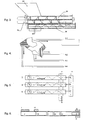
- FIG. 1 Such a plant for preparation and treatment of industrial-communal wastes according to the invention is shown in Figures 1 and 2.
- the plant components are marked with the following letters and numbers:
- Plant parts not shown in Figures 1 and 2 are: belt conveyor for solid materials to be treated, pumps for dosing of liquids, additives silos and electro-controls panel.
- wastes contain particularly dangerous matters and substances, strictly regulated by laws and whose maximum concentration is strictly regulated, limited to very small allowed participation in the total quantity, such as PCB, PCT, heavy metals, phenols, hydrocarbons, sulphur compounds, chlorine and nitrogen compounds, etc.
- the C:H proportion in petroleum is 6:8, other possibly present elements participating with less than 5% ⁇ oxygen (O 2 ) II; sulphur (S) II, IV, VI; nitrogen (N) I, II, III, IV, V.
- Physical-chemical properties of hydrocarbon compounds with these elements are similar to those of pure hydrocarbons. Oils usually contain alkane (paraffin), naphthene (cyclo-paraffin) and aromatic (aliphatic) hydrocarbons, alkene (olein) hydrocarbons being rather rare, and alkyne (acetylene) hydrocarbons not being present in petroleum.
- Petroleum hydrocarbons are classified as: paraffins, naphthenes and aromatics, and they make part of all presently known wastes, in various forms and quantities, especially of industrial wastes. Sulphur, nitrogen and oxygen compounds in petroleum significantly affect sorts, properties and characteristics of future industrial wastes.
- the content of linked sulphur in petroleum is variable, depending on its origin, and amounts to >7% by weight.
- inorganic sulphur may be present in petroleums as free (S°), as well.
- Sulphur in petroleum acts as a catalytic poison.
- the nitrogen (N) content is usually 0.05 - 1.0 % by weight.
- Ash residues after burning of petroleum amount up to 0.08 % by weight.
- a part of the mineral contents is present in the emulgated water phase, the other being dissolved in the oil phase.
- Dry petroleum contains metals boron (B), magnesium (Mg), silicon (Si), iron (Fe), copper (Cu), nickel (Ni) and vanadium (V); wet petroleum contains sodium (Na) and strontium (Sr); whereas ash contains tellurium (Te), barium (Ba), lead (Pb), manganese (Mn), chromium (Cr) and silver (Ag).
- the largest sources of waste hydrocarbons are petroleum refinery processes: production of heating oil and fuels, alkylation with sulphuric acid, polymerisation of propene and butane mixture with phosphoric acid, high-temperature isomerisation, production of lubricant oils, rectification, pipe distillation, boiling distillation, coking, catalytic cracking, reforming, refinery hydrogenation, hydrodesulphurisation of petrol, oil bleaching by hydration, distillation residues indirect desulphurisation, etc.
- Quantities of wastes originating from refinery treatments are relatively large compared to the processed petroleum, making a significant part of industrial wastes.
- Petrol fraction makes the largest part of petroleum products, and is being separated by purposes: special fuels, engine petrol, aeroplane petrol, jet fuels, heavy petrol, kerosene, lamp kerosene, diesel fuels, heating oil, oils (engine, aeroplane, turbine, insulation, hydraulic, metal processing, medical, etc.), antifraction and protection greases, bitumens, petroleum wax as heavy fraction crystallisate, petrol-coke (thermal cracking of distillation and secondary process residues).
- Organic contents based on carbon as the material structure bearer are the most important and most widespread forms of chemical condition of a large number of materials in the human environment and urban waste materials in general, which is why they are mentioned here, because they make base of the technological treatment of wastes by this invention.
- the first stage of waste treatment preparations is establishing the waste initial quantities and properties and selection of the material that will not be treated by this technological treatment such as: bulky wastes, engine parts, household appliances, car bodies, larger wooden, rubber, plastic and glass products, car batteries, engines, electronics, etc.
- the rest of the material makes the future mixture for treatment by this invention, to be prepared and distributed for treatment in accordance with differences in content, granulation, humidity, physical-chemical properties and characteristics.
- the dumping site is entered with building mechanisation, grinders, fragmenters, loaders, excavators and pumps (screw and membrane), containers and belt conveyors, and the following materials are pre-treated: 1.1 silts and soil A1 2.2 ashes and silts B2 1.2 oils and ashes A2 3.1 ashes and soil C1 2.1 communal wastes B1 3.2 remaining wastes C2
- the separated materials, that underwent the preparation line treatment in the treatment preparation stage (six types of mixtures), is finally made into three characteristic groups of treatment materials: A3, B3 and C3.
- Such mixture is passed through the preparation line consisting of three mixers, and through the first reactor line 15 from the holds A, B, C or D, where technical-technological parameters such as first and second reactor line speeds, dosing of treatment material, dosing of calcium oxide and calcium hydroxide, solidificate belt conveyor speed or solidificate press, are adjusted, whereby independent running of the material treatment technological process is commenced.
- Mixture A3 mostly consists of silts and soil (A1), and oils and ashes (A2). Their parts are determined according to the invention, and according to the here presented content description and the previously presented explanations on creation of such materials in the chapter Disclosure of Invention, these relations are set as follows: Silt / soil 30-45 / 55-70; average 37.5 : 62.5 or 1.0 : 1.7 Oils / ash 60-75 / 25-40; average 67.5 : 32.5 or 1.0 : 0.5
- Mixture B3 mostly consists of communal wastes (B1), and ashes and silts (B2), and their parts are determined as follows: Communal waste (mixed) 100 Ash : silt 35-45 : 55-65; average 40.0 : 60.0 or 0.7 : 1.0
- Mixture C3 mostly consists of ash and soil (C1), and remaining wastes (C2), their relations being determined as follows: Ash : soil 45-55 : 45-55; average 50.0 : 50.0 or 1.0 : 1.0 Remaining wastes (mixed) 100
- Mixtures A3, B3 and C3 are let into the three preparation liens, as shown in Fig. 5, to be dosed into the first reactor line 15 as a uniform mixture for treatment in the second reactor line 17, Fig. 1 and 2.
- Wastes Solidificate eluate Organic substance total 5.79 mg/kg 2.12 Organic volatiles, total 4.075 mg/kg 584 Phosphor 1.6 mg/kg 1.06
- Mineral oils 16.4 mg/kg 6.0 Humidity 13 % 5.3 pH 6.8 12.3 Iron - eluate, Fe 56 mg/l Fe 0.07 Chrome - eluate, Cr 0.040 mg/l Cr 0.085 Manganese - eluate, Mn 2.5 mg/l Mn 0.16 Cadmium - eluate, Cd 0.003 mg/l Cd 0.003 Zinc - eluate, Zn 0.340 mg/l Zn 0.05 Aluminium - eluate, Al 9.5 mg/l Al 3.27 Arsenic - eluate, As ⁇ 0.002 mg/l As ⁇ 0.002 Copper - eluate, Cu ⁇ 0.002 mg/l Cu ⁇ 0.002 Molibden - eluate, Mo 0.10 mg/l Mo 0.15 Lead
- the process correction due to exceeded maximum allowed quantities (mineral oils and pH) is achieved by decreasing the waste flow speed, and by increasing the Ca(OH) 2 based additives.
- the processing volume should be decreased at least by the " ⁇ " factor, which is to be calculated according to experience.
- the final material flow speed should due to the " ⁇ " factor be by 3.7% lower, and the processing capacity is to be corrected from 5.5 m 3 /h (1.53 I/s) to 5.3 m 3 /h (1.47 I/s).
- the processing capacity could be increased gradually in 0.05 l/s increments, up to the aimed solidificate quality.
- the calcium additives increase is limited to the proportion wich the process started with (max. 18% vol.) as related to the processing material.
- this sort of pre-treatment is particularly important, because it secures solidification of the entire material and produces the required solidificate quality in terms of purity, hydrophobia, compressibility and further industrial utilisation.
- Wastes containing matters of various solidity, of pasty or semipasty state, such as oiled soil and various cemented materials of uneven content are taken through auxiliary facility for waste pre-preparation that will grind, mix, loose and make them as homogenous as possible and will take them to the output, i.e. the intake into the first reactor line.
- the pre-preparation facility is presented in Fig. 3. It produces the waste mixture that will be put into the first reactor line 15, enabling its final treatment in the second reactor line 17.
- each of them will be transported through the auxiliary facility for pre-preparation and will be stored in holds A, B, C and D above the first reactor line, from where it will be taken for treatment by means of a flow regulating butterfly valve.
- the first reactor line 15, Figs. 1 and 2 has its own drive 16, defining the powering conditions as well as the final intaken material processing capacity. The same is about the second reaction line 17 because of different speeds of the two lines.
- the second reactor line 17 is the final material treatment operation, with its own process technology and treatment speed and capacity.
- the difference in capacity results from the volume of the first reactor line increasing up to > 20% as compared to the first, under powering conditions perfectly different than the first one.
- the rest of the material intended for treatment by this invention falls from belt conveyors into the pre-preparation hopper (Fig. 3), where it is homogenised by granulation, to be transported by worm transporters to particular material holds and the flow regulation butterfly valves let into the first reactor line.
- Calcium oxide and calcium hydroxide are transported by worm transporters from their additive silos over the first reactor line, or are taken directly into the second reactor line by flexible doser.
- material from the first reactor line is let through a closed transport system into the second reactor line, where the final processing is exercised.
- the pre-preparation and the pre-treatment consist of the following operations:
- Such proportions are achieved by the speed of dosing from pre-treatment lines into the first reactor line holds, adjustable by motor-gear-variators and their belt or gear transmissions from one line to another.
- the treatment mixture will in such case have contents of the above proportions, whereby the conditions for a well conducted process with additives based on Ca 2+ (8% vol. Ca(OH) 2 + 10% vol. CaO) are achieved.
- Special additives based on conditionally clean liquids and matters (used oils, greases, gatch, gudron, black lye, tank and separator sediments, oils, lubricants and resins, etc.) are transported directly into one of the first reactor line holds as separate material. The same procedure is performed for other solid matters as well (sands, powders, medicines, dried wastes, paints and varnishes, milled rubber, glass, etc.).
- Fig. 4 presents the principle of this separation, particular separations being for the following materials: N1 Bulky wastes N3 B3 material preparation line N2 A3 material preparation line N4 C3 material preparation line
- Preparation line is presented with two or more worm transporters, mixers, cutters and looseners, that harmonise the mixture content and prepare it for storing in the first reactor line holds, whereby it is marked:
- Vertical transporters marked with a) and b) are worm or belt conveyors that mix the fragmented material as a mixture or as separate sorts, depending on the waste sort.
- a steam jet is directed forward, in the material flow direction, in order to prevent a return reaction with calcium additives and choking of the mixture in the second reactor line space.
- This grill 1 prevents entrance of larger pieces of the material, especially of larger pieces of metal, steel ropes, ropes, rags, pieces of wood, etc.
- Ropes, sheet metal and fabrics can be caught by the mixer-translator mobile spiral and can stop the plant.
- Rocks, even larger, are not harmful and will defragmentate partly in the first and certainly in the second reactor line, to be encapsulated in powder as a constituent part of the solidificate,
- Input material control is located in the pre-preparation processes, and the grill is a protection against passage of materials that could obstacle the treatment.
- Vortex units 3 (Fig. 1) that are to turn over and direct the material to the first reactor line 15, which is achieved by bent blades.
- the blades are fit to the shaft at distances, like interrupted blades of a worm transporter.
- the blades are to rotate in the direction of pushing the material forward, i.e. toward the exit from the second reactor line 17. This is important for the process and for establishing contacts with calcium additives at about the middle of its length where, in exothermic conditions, runs the process of dissociation and degassing at the TTT-balance of status.
- temperature is the highest: about 100-125°C.
- Incapsulator motors 19 and 20 (Figs. 1 and 2), which create vacuum between their blades and where the incapsulation starts, have two rotation speeds (2-pole motors). Viscous sorts of materials use the lower speed (800 rpm), and solid ones the higher (1400 rpm). These two speeds satisfy both conditions. Between the two incapsulator motors there is interactive space where materials from both sides accumulate making solid partitions that totally surround the incapsulation space.
- Directions of motor rotation can be set to any of the two sides, the most often case being the blades to move forward (towards the solidificate exit) or, with liquid mixtures, one towards the other.
- the last motor rotates backwards (opposite to the material direction), slowing the material motion down and increasing the contact surface with calcium particles in incapsulation conditions.
- the processing capacity depends on dosing of the material, controlled by butterfly valves 5 and 6 (Fig. 1) or let directly into the second reactor line for processing.
- Rotation speed is controlled by changing the number of revolutions of the reactor lines 15 and 17 shafts; it is therefore more favourable a variator which has wider choice of rotation speeds (e.g. 2-70 rpm). This is even more important with the second reactor line because here run the final parts of the process and the possibility of rotation regulation is of even greater importance; here, therefore, are more favourable variators of still higher scope (e.g. 2-120 rpm).
- Solidificate is directed forward for loading onto transport facility or in container, or backward for pressing as briquettes.
- Liquid hydrocarbon solidificates are compressible to ⁇ 1/3 of the initial volume, whereas dominantly organic waste solidificates have lesser compressibility (to ⁇ 1/2 of the initial volume) with the same pressing force.
- the maximum pressing is deemed to be the one where no oil drips from the solidificate, these pressures being 10-15 MPa.
- the solidificate temperature is increased to about 100-135°C. Even higher temperatures occur with wastes containing phosphor compounds or mineral acids of higher concentrations and higher water contents.
- Powder solidificate cools very slowly when accumulated to over 500 mm, 32-40°C daily. When loosened (such as on belt conveyor), it cools faster (50-60°C daily), and to be made into briquettes, it is to be cooled down to about 45°C.
- Solidificate temperatures above 135°C at the reactor exit are technologically unfavourable and their occurrence is prevented by changing dosing proportions of particular wastes: by increasing calcium hydroxide Ca(OH) 2 and decreasing calcium oxide CaO contents, or by changing the material flow speed.
- the maximum technological temperature for safe running of the process in the second reactor line is deemed to be about 140°C.
- communicate wastes means a group of wastes dumped by a social community on a certain place, subject to space and time limitations, supervision and control of the wastes, with intervention activities and prevention of soil, water and air pollution, and prevention of infections, degasation and taking fire.
- non-communal wastes such as expired medicines, medical preparations and pharmacological products, solid and liquid synthetic materials, parts of surgery, solvents, motor oils, emulsions, thinners, paints and varnishes, lubricants, filtering system silts, ashes, etc., which requires a completely different treatment and organisation of such area and processing.
- Dumping sites are loaded with other sorts of wastes, too, e.g. communal-industrial waste liquids such as emulsions, solvents and thinners, used motor oils, silts, paints and varnishes, oiled water, alcohols, acids, alkalis, artificial and synthetic liquids and suspensions, various glues, processing bilges, etc.
- communal-industrial waste liquids such as emulsions, solvents and thinners, used motor oils, silts, paints and varnishes, oiled water, alcohols, acids, alkalis, artificial and synthetic liquids and suspensions, various glues, processing bilges, etc.
- Communal waste treatment includes pre-preparation, selection and several operations aimed to separation of usable materials increasing, thus, the level of usability of recyclable raws and decreasing treatment by physical-chemical processes.
- the material selection technology is a separate process, where the selection comprises the following operations:
- the only “residue” is the evaporating part of the wastes (evaporating at the processing temperatures) and water steam created in the solidification plant, which are being filtered and, only after washing of gases and particles and purifying through comb and bag filters, let into the atmosphere, this in order to prevent unwanted effects to the nature and the environment.
Landscapes
- Chemical & Material Sciences (AREA)
- Engineering & Computer Science (AREA)
- Ceramic Engineering (AREA)
- Chemical Kinetics & Catalysis (AREA)
- Inorganic Chemistry (AREA)
- Materials Engineering (AREA)
- Structural Engineering (AREA)
- Organic Chemistry (AREA)
- Processing Of Solid Wastes (AREA)
- Fertilizers (AREA)
- Processing And Handling Of Plastics And Other Materials For Molding In General (AREA)
Claims (5)
- Verfahren zur Behandlung und Aufbereitung kommunaler und industrieller Abfälle zu verwertbaren Produkten, wobei das Verfahren in den folgenden Stufen durchgeführt wird:wobei das Verfahren gekennzeichnet ist durch die folgenden Stufen:I: Vorbereiten von Abfällen, die nicht nach diesem technologischen Verfahren verarbeitet werden, wie zum Beispiel Trennen sperriger Abfälle (Motorteile, Haushaltsgeräte, Autokarosserien, größere Produkte aus Holz, Gummi, Kunststoff und Glas, Batterien, etc.);II : Sortieren von Materialien in Gruppen nach Sorte, Dichte und Körnung, durch Sieben in einem Dosierbehälter, durch Zerkleinern, Häckseln oder Zerstampfen, und Erhalten der Grundabfallmischung, die zu verarbeiten ist;III: Lagern von Grundmaterial zur Verarbeitung nach Sorte, Dichte und Körnung in Behältern (A), (B), (C) und (D), um dieses in eine erste Reaktorstraße (15) zu dosieren, und Lagern von Calciumoxid und Calciumhydroxid als Verfahrenszusätze in Behältern (E) und (F);wobei dieses pulverförmige Solidifikat infolge seiner Eignung zum Pumpen zur weiteren Verwendung im Tiefbau, zur Energieerzeugung oder als spezielles Schutzmaterial für technische Gebäudeisolierungen gegen Einflüsse toxischer, giftiger und radioaktiver Materialien durch Tankfahrzeuge transportiert werden kann.IV: Aufbereitung der Grund- und Zusatzmaterialmischung, die von den Behältern (A), (B), (C) und (D) durch einen Schüttelrost (1) und eine Dosiervorrichtung (5) in die erste Reaktorstraße (15) geleitet wird, wo die Mischung bei Raumtemperatur nach ihren physikalisch-chemischen Eigenschaften harmonisiert wird und deren Geschwindigkeit von der Dichte der Mischung und der Viskosität des Materials sowie dem Endgehalt der dem jeweiligen technologischen Verfahren zu unterziehenden Mischung abhängt,
wobei diese Mischung durch eine Rohrleitung (11) und eine Verwirbelungsvorrichtung (12) in eine zweite Reaktorstraße (17) geleitet wird;V: Verfahren der Einkapselung der Mischung, die von der ersten Reaktorstraße (15) in die zweite Reaktorstraße (17) geleitet wird, in Vakuumgas unter Zugabe von Verfahrenszusätzen auf Calciumbasis aus den Behältern (E) und (F), wobei es zur exothermen Reaktion bei Temperaturen von 100-135°C und zur molekularen Mikroexplosion kommt, so dass Wasserdampf erzeugt wird, was zu einer intensiven und sehr schnellen Einkapselung der eingeleiteten Mischung in Vakuumgas führt, die von da weiter in verwirbelnde Vakuumverkapselungsvorrichtungen (19) und (20) geleitet wird, die Hohlräume erzeugen, in denen Mikropartikel aus Anionenkomplexen erscheinen, die in der Mitte neuer Moleküle komplexer Calciumverbindungen positioniert sind, was zu ausgewogenen Bedingungen und einer stabilen neuen Molekülsorte in Form von Solidifikaten führt, die als Endprodukt des Verfahrens in Form eines Pulvers mit einer Dichte von 950-975 kg/m3 und einer Temperatur von 80-105°C einen Reaktor durch eine Austrittsöffnung (22) auf ein Förderband (26) verlassen;VI: Lagern des erhaltenen Solidifikats unter Abkühlung an Luft mit einer Geschwindigkeit von 28-33°C/Tag, wenn es aufgehäuft ist, oder mit einer Geschwindigkeit von 35-38°C/Tag, wenn es lose ist; nach Erreichen der Temperatur von etwa 45°C wird es zu Briketts mit einer Größe von 40 x 30 mm und einer Dichte von 2380-2900 kg/m3 komprimiert, so dass es zu einem Abfall wird, der auf einem kommunalen Müllabladeplatz abgelagert werden kann; - Verfahren nach Anspruch 1, bei dem Wasserdampf, Gasanteile und Partikel aus dem Verfahren durch Wasser-, Kamm- und Schlauchfilter in ein Reinigungsfiltersystem abgeschieden werden und durch eine Rohrleitung in den Raum zwischen der ersten und der zweiten Reaktorstraße zurückgeführt werden, wo sie sich nach Kondensation mit zugeführten Materialien mischen, was den Austritt von Dampf in die Atmosphäre vermindert.
- Verfahren nach Anspruch 1 oder 2, bei dem in den Stufen II bis VI alle Abfallsorten unabhängig von Zustand, Sorte, Chemikaliengehalt und physikalisch-chemischen Eigenschaften verarbeitet werden können, wenn sie mindestens 5 Vol.-% Kohlenwasserstoffe enthalten oder wenn diese hinzugefügt werden, und wenn der so aufbereiteten Mischung Additive auf Basis von Calciumoxid oder Calciumhydroxid als die einzigen Verfahrenszusätze zur Verarbeitung in der zweiten Reaktorstraße zugesetzt werden.
- Anlage zur Behandlung und Aufbereitung kommunaler und industrieller Abfälle zu verwertbaren Produkten, in der das in Anspruch 1, 2 oder 3 beschriebene Verfahren durchgeführt werden soll und die aus einer Hilfsanlage zur Abfallvorbereitung und einer Abfallbehandlungsanlage besteht, wobei die Hilfsanlage zur Abfallvorbereitung aus einem Einfülltrichter (33), einer Materialzerkleinerungs- und -lockerungsstraße (35) und einer Transportstraße (36) besteht; und wobei die Behandlungsanlage aus Abfallbehältern (A), (B), (C) und (D) und Verfahrenszusatzbehältern (E) und (F), Abfalldosiervorrichtungen (5), Additivdosiervorrichtungen (6) und einem Förderband (26) besteht,
dadurch gekennzeichnet, dass
die Hilfsanlage zur Abfallvorbereitung ferner aus einem Motorvariator (34) besteht, und dass
die Behandlungsanlage ferner aus einem Schüttelrost (1), einer Abfallverwirbelungsvorrichtung (3), einer ersten Reaktorstraße (15) mit ihrem eigenen Variator (16) für Antriebsmotor und Getriebe, einer Rohrleitung (11) zwischen den Reaktoren, einer Verwirbelungsvorrichtung (12) zwischen den Reaktoren, einer zweiten Reaktorstraße (17) mit ihrem eigenen Variator (18) für Antriebsmotor und Getriebe, welche die verwirbelnde "+"-Vakuumverkapselungsvorrichtung (19) und die verwirbelnde "-"-Vakuumverkapselungsvorrichtung (20) zur Einkapselung in Vakuumgas enthält, und aus einem Filtersystem (23) zur Reinigung von Wasserdampf und Partikeln mit Kondensatrückführkanälen (24) besteht, wobei sich an der zweiten Reaktorstraße Dampfauslässe (25) und ein Solidifikatauslass (22) zu dem Förderband (26) mit einem Solidifikatbehälter (27) befinden. - Anlage nach Anspruch 4, bei der die erste Reaktorstraße (15) und die zweite Reaktorstraße (17) Verarbeitungskapazitäten haben, die eine genaue Dosierung von Materialien und eine Regulierung ihrer Drehzahl erlauben, so dass das erforderliche chemische Gleichgewicht des Verfahrens sichergestellt ist.
Applications Claiming Priority (3)
| Application Number | Priority Date | Filing Date | Title |
|---|---|---|---|
| HR980486A HRP980486B1 (en) | 1998-09-01 | 1998-09-01 | Process and plant for preparing and processing of municipal and industrial waste to useful products |
| HR980486 | 1998-09-01 | ||
| PCT/HR1999/000018 WO2000012234A1 (en) | 1998-09-01 | 1999-08-25 | Process and plant for preparation and treating of communal and industrial wastes into usable products |
Publications (2)
| Publication Number | Publication Date |
|---|---|
| EP1109633A1 EP1109633A1 (de) | 2001-06-27 |
| EP1109633B1 true EP1109633B1 (de) | 2005-12-28 |
Family
ID=10946801
Family Applications (1)
| Application Number | Title | Priority Date | Filing Date |
|---|---|---|---|
| EP99940410A Expired - Lifetime EP1109633B1 (de) | 1998-09-01 | 1999-08-25 | Verfahren und anlage zum vorbehandeln und aufbereiten von kommunalen und industriellen abfällen zur herstellung von verwendbaren produkten |
Country Status (8)
| Country | Link |
|---|---|
| EP (1) | EP1109633B1 (de) |
| AT (1) | ATE314161T1 (de) |
| AU (1) | AU5438899A (de) |
| DE (1) | DE69929211T2 (de) |
| ES (1) | ES2257868T3 (de) |
| HR (1) | HRP980486B1 (de) |
| PT (1) | PT1109633E (de) |
| WO (1) | WO2000012234A1 (de) |
Cited By (1)
| Publication number | Priority date | Publication date | Assignee | Title |
|---|---|---|---|---|
| RU2764413C1 (ru) * | 2021-05-18 | 2022-01-17 | Общество с ограниченной ответственностью «ЭКОСИСТЕМА» | Способ производства материала рекультивационного строительного инертного |
Families Citing this family (9)
| Publication number | Priority date | Publication date | Assignee | Title |
|---|---|---|---|---|
| US7252691B2 (en) | 2001-03-06 | 2007-08-07 | John Philipson | Conversion of municipal solid waste to high fuel value |
| HRPK20100325B3 (hr) | 2010-06-05 | 2013-04-30 | Milli Španović | Postupak proizvodnje silikatnih vrsta plino-betona na bazi solidifikata |
| CN103351126A (zh) * | 2013-07-09 | 2013-10-16 | 华侨大学 | 一种新型混凝土浆材及其制备方法 |
| RU2671474C1 (ru) * | 2017-08-15 | 2018-10-31 | Федеральное государственное бюджетное учреждение науки Федеральный научный центр "Владикавказский научный центр Российской академии наук" (ВНЦ РАН) | Способ утилизации молибденшеелитовых отходов |
| RU2742647C2 (ru) * | 2020-02-07 | 2021-02-09 | Мария Александровна Соничева | Способ комплексной переработки смешанных отходов в полезные продукты |
| CN111015926B (zh) * | 2020-02-13 | 2021-05-11 | 张亦军 | 一种水泥袋回收设备 |
| CN111330944B8 (zh) * | 2020-03-02 | 2021-06-22 | 昊威环保集团有限公司 | 一种采用辐照技术处理恶臭气味的装置 |
| CN113406127B (zh) * | 2021-08-19 | 2021-10-26 | 中南大学 | 一种工业固体废物中重金属赋存关键矿相的分析判定方法 |
| CN114409170B (zh) * | 2022-01-29 | 2023-04-07 | 陕西东鑫垣化工有限责任公司 | 一种酚氨废水处理的水油氨硫渣分离系统和方法 |
Family Cites Families (4)
| Publication number | Priority date | Publication date | Assignee | Title |
|---|---|---|---|---|
| BE642452A (de) * | ||||
| FR2620056B1 (fr) * | 1987-09-03 | 1992-04-24 | Moulinec Henri | Procedes de traitement de residus ou produits hydrocarbures. revalorisation des matieres traitees |
| FR2687081B1 (fr) * | 1992-02-07 | 1994-05-06 | Utom Systems International | Procede de traitement des dechets menagers et dechets organiques par voies physico-chimique et thermique dans le but d'obtention de produits reduits inertes et stables valorisables. |
| US5430237A (en) * | 1993-03-19 | 1995-07-04 | Sharp; Terry F. | Method of solidifying oil field waste |
-
1998
- 1998-09-01 HR HR980486A patent/HRP980486B1/xx not_active IP Right Cessation
-
1999
- 1999-08-25 PT PT99940410T patent/PT1109633E/pt unknown
- 1999-08-25 WO PCT/HR1999/000018 patent/WO2000012234A1/en not_active Ceased
- 1999-08-25 ES ES99940410T patent/ES2257868T3/es not_active Expired - Lifetime
- 1999-08-25 AT AT99940410T patent/ATE314161T1/de active
- 1999-08-25 AU AU54388/99A patent/AU5438899A/en not_active Abandoned
- 1999-08-25 DE DE1999629211 patent/DE69929211T2/de not_active Expired - Lifetime
- 1999-08-25 EP EP99940410A patent/EP1109633B1/de not_active Expired - Lifetime
Cited By (2)
| Publication number | Priority date | Publication date | Assignee | Title |
|---|---|---|---|---|
| RU2764413C1 (ru) * | 2021-05-18 | 2022-01-17 | Общество с ограниченной ответственностью «ЭКОСИСТЕМА» | Способ производства материала рекультивационного строительного инертного |
| WO2022245255A1 (ru) * | 2021-05-18 | 2022-11-24 | Олег Олегович ФОТИЕВ | Способ производства материала рекультивационного строительного инертного |
Also Published As
| Publication number | Publication date |
|---|---|
| HRP980486B1 (en) | 2007-03-31 |
| WO2000012234A1 (en) | 2000-03-09 |
| DE69929211D1 (de) | 2006-02-02 |
| PT1109633E (pt) | 2006-05-31 |
| HRP980486A2 (en) | 2001-08-31 |
| EP1109633A1 (de) | 2001-06-27 |
| DE69929211T2 (de) | 2006-09-14 |
| ES2257868T3 (es) | 2006-08-01 |
| AU5438899A (en) | 2000-03-21 |
| ATE314161T1 (de) | 2006-01-15 |
Similar Documents
| Publication | Publication Date | Title |
|---|---|---|
| DE3874460T2 (de) | Verfahren und vorrichtung zur behandlung von schlaemmen. | |
| EP1109633B1 (de) | Verfahren und anlage zum vorbehandeln und aufbereiten von kommunalen und industriellen abfällen zur herstellung von verwendbaren produkten | |
| CN101602566A (zh) | 一种针对油田含油污泥的综合处理新工艺 | |
| RU2266258C1 (ru) | Способ переработки нефтесодержащего шлама и устройство для его реализации | |
| EP0680505B1 (de) | Behandlung von rueckstandsoel | |
| KR100905522B1 (ko) | 유류나 중금속에 오염된 토양, 토사석의 복원방법 및 그 장치 | |
| CN106116067A (zh) | 一种含油污泥处理工艺及装置 | |
| JP2013121568A (ja) | 建設汚泥のリサイクル方法 | |
| CN110270415A (zh) | 研磨机 | |
| CN1887762A (zh) | 固体废物浆渣新型处理方法 | |
| US5681483A (en) | Process for the treatment of oily suspensions | |
| CN109385321B (zh) | 一种废乳化液油泥处理方法 | |
| RU2305116C1 (ru) | Способ обезвреживания отходов, содержащих менее 50% жидких и/или пастообразных углеводородов | |
| EP0834041B1 (de) | Verfahren zur entsorgung von problemabfaellen, organischen oder chemischen abfaellen und anlage zur durchfuehrung des verfahrens | |
| RU76252U1 (ru) | Производственный комплекс по переработке и утилизации нефтешламов | |
| RU2183655C1 (ru) | Способ переработки кислых гудронов | |
| RU2299868C2 (ru) | Смесь добавок для производства цементного клинкера и ее применение | |
| DE2614848A1 (de) | Verfahren und vorrichtung zur ueberfuehrung von schlammfoermigen oder zaehfluessigen abfallstoffen in einen festen deponierbaren zustand | |
| CN216726146U (zh) | 一种含油污泥资源化利用系统 | |
| RU2064962C1 (ru) | Способ утилизации нефтяного шлама | |
| JPH0839099A (ja) | 含油廃棄物の処理法とそれに用いる廃棄物処理装置 | |
| CN219567765U (zh) | 一种熔盐导热连续式油基泥浆热脱附装置 | |
| McDonagh et al. | Handling and disposal of oily waste from oil spills at sea | |
| RU59455U1 (ru) | Установка обезвреживания отходов, содержащих жидкие и/или пастообразные углеводороды | |
| RU81495U1 (ru) | Производственный комплекс для утилизации нефтесодержащих шламов |
Legal Events
| Date | Code | Title | Description |
|---|---|---|---|
| PUAI | Public reference made under article 153(3) epc to a published international application that has entered the european phase |
Free format text: ORIGINAL CODE: 0009012 |
|
| 17P | Request for examination filed |
Effective date: 20010329 |
|
| AK | Designated contracting states |
Kind code of ref document: A1 Designated state(s): AT BE CH CY DE DK ES FI FR GB GR IE IT LI LU MC NL PT SE |
|
| 17Q | First examination report despatched |
Effective date: 20031029 |
|
| GRAP | Despatch of communication of intention to grant a patent |
Free format text: ORIGINAL CODE: EPIDOSNIGR1 |
|
| GRAS | Grant fee paid |
Free format text: ORIGINAL CODE: EPIDOSNIGR3 |
|
| GRAA | (expected) grant |
Free format text: ORIGINAL CODE: 0009210 |
|
| AK | Designated contracting states |
Kind code of ref document: B1 Designated state(s): AT BE CH CY DE DK ES FI FR GB GR IE IT LI LU MC NL PT SE |
|
| PG25 | Lapsed in a contracting state [announced via postgrant information from national office to epo] |
Ref country code: NL Free format text: LAPSE BECAUSE OF FAILURE TO SUBMIT A TRANSLATION OF THE DESCRIPTION OR TO PAY THE FEE WITHIN THE PRESCRIBED TIME-LIMIT Effective date: 20051228 Ref country code: LI Free format text: LAPSE BECAUSE OF FAILURE TO SUBMIT A TRANSLATION OF THE DESCRIPTION OR TO PAY THE FEE WITHIN THE PRESCRIBED TIME-LIMIT Effective date: 20051228 Ref country code: IT Free format text: LAPSE BECAUSE OF FAILURE TO SUBMIT A TRANSLATION OF THE DESCRIPTION OR TO PAY THE FEE WITHIN THE PRESCRIBED TIME-LIMIT;WARNING: LAPSES OF ITALIAN PATENTS WITH EFFECTIVE DATE BEFORE 2007 MAY HAVE OCCURRED AT ANY TIME BEFORE 2007. THE CORRECT EFFECTIVE DATE MAY BE DIFFERENT FROM THE ONE RECORDED. Effective date: 20051228 Ref country code: FI Free format text: LAPSE BECAUSE OF FAILURE TO SUBMIT A TRANSLATION OF THE DESCRIPTION OR TO PAY THE FEE WITHIN THE PRESCRIBED TIME-LIMIT Effective date: 20051228 Ref country code: BE Free format text: LAPSE BECAUSE OF FAILURE TO SUBMIT A TRANSLATION OF THE DESCRIPTION OR TO PAY THE FEE WITHIN THE PRESCRIBED TIME-LIMIT Effective date: 20051228 |
|
| REG | Reference to a national code |
Ref country code: GB Ref legal event code: FG4D |
|
| REG | Reference to a national code |
Ref country code: CH Ref legal event code: EP |
|
| REG | Reference to a national code |
Ref country code: IE Ref legal event code: FG4D |
|
| REF | Corresponds to: |
Ref document number: 69929211 Country of ref document: DE Date of ref document: 20060202 Kind code of ref document: P |
|
| PG25 | Lapsed in a contracting state [announced via postgrant information from national office to epo] |
Ref country code: SE Free format text: LAPSE BECAUSE OF FAILURE TO SUBMIT A TRANSLATION OF THE DESCRIPTION OR TO PAY THE FEE WITHIN THE PRESCRIBED TIME-LIMIT Effective date: 20060328 Ref country code: GR Free format text: LAPSE BECAUSE OF FAILURE TO SUBMIT A TRANSLATION OF THE DESCRIPTION OR TO PAY THE FEE WITHIN THE PRESCRIBED TIME-LIMIT Effective date: 20060328 Ref country code: DK Free format text: LAPSE BECAUSE OF FAILURE TO SUBMIT A TRANSLATION OF THE DESCRIPTION OR TO PAY THE FEE WITHIN THE PRESCRIBED TIME-LIMIT Effective date: 20060328 |
|
| REG | Reference to a national code |
Ref country code: PT Ref legal event code: SC4A Effective date: 20060327 |
|
| NLV1 | Nl: lapsed or annulled due to failure to fulfill the requirements of art. 29p and 29m of the patents act | ||
| REG | Reference to a national code |
Ref country code: CH Ref legal event code: AEN Free format text: DAS PATENT IST AUFGRUND DES WEITERBEHANDLUNGSANTRAGS VOM 19.05.2006 REAKTIVIERT WORDEN. |
|
| REG | Reference to a national code |
Ref country code: ES Ref legal event code: FG2A Ref document number: 2257868 Country of ref document: ES Kind code of ref document: T3 |
|
| REG | Reference to a national code |
Ref country code: CH Ref legal event code: NV Representative=s name: HANS ULRICH SEIFERT SEIFERT & PARTNER |
|
| ET | Fr: translation filed | ||
| PLBE | No opposition filed within time limit |
Free format text: ORIGINAL CODE: 0009261 |
|
| STAA | Information on the status of an ep patent application or granted ep patent |
Free format text: STATUS: NO OPPOSITION FILED WITHIN TIME LIMIT |
|
| 26N | No opposition filed |
Effective date: 20060929 |
|
| REG | Reference to a national code |
Ref country code: CH Ref legal event code: PL |
|
| PG25 | Lapsed in a contracting state [announced via postgrant information from national office to epo] |
Ref country code: CY Free format text: LAPSE BECAUSE OF FAILURE TO SUBMIT A TRANSLATION OF THE DESCRIPTION OR TO PAY THE FEE WITHIN THE PRESCRIBED TIME-LIMIT Effective date: 20051228 |
|
| PGFP | Annual fee paid to national office [announced via postgrant information from national office to epo] |
Ref country code: LU Payment date: 20130227 Year of fee payment: 14 |
|
| PGFP | Annual fee paid to national office [announced via postgrant information from national office to epo] |
Ref country code: MC Payment date: 20130225 Year of fee payment: 14 Ref country code: GB Payment date: 20130227 Year of fee payment: 14 Ref country code: IE Payment date: 20130227 Year of fee payment: 14 |
|
| PGFP | Annual fee paid to national office [announced via postgrant information from national office to epo] |
Ref country code: PT Payment date: 20130222 Year of fee payment: 14 Ref country code: AT Payment date: 20130227 Year of fee payment: 14 |
|
| REG | Reference to a national code |
Ref country code: PT Ref legal event code: MM4A Free format text: LAPSE DUE TO NON-PAYMENT OF FEES Effective date: 20140225 |
|
| REG | Reference to a national code |
Ref country code: AT Ref legal event code: MM01 Ref document number: 314161 Country of ref document: AT Kind code of ref document: T Effective date: 20130825 |
|
| GBPC | Gb: european patent ceased through non-payment of renewal fee |
Effective date: 20130825 |
|
| PG25 | Lapsed in a contracting state [announced via postgrant information from national office to epo] |
Ref country code: MC Free format text: LAPSE BECAUSE OF NON-PAYMENT OF DUE FEES Effective date: 20130902 |
|
| REG | Reference to a national code |
Ref country code: IE Ref legal event code: MM4A |
|
| PG25 | Lapsed in a contracting state [announced via postgrant information from national office to epo] |
Ref country code: AT Free format text: LAPSE BECAUSE OF NON-PAYMENT OF DUE FEES Effective date: 20130825 |
|
| PG25 | Lapsed in a contracting state [announced via postgrant information from national office to epo] |
Ref country code: PT Free format text: LAPSE BECAUSE OF NON-PAYMENT OF DUE FEES Effective date: 20140225 |
|
| PG25 | Lapsed in a contracting state [announced via postgrant information from national office to epo] |
Ref country code: GB Free format text: LAPSE BECAUSE OF NON-PAYMENT OF DUE FEES Effective date: 20130825 Ref country code: IE Free format text: LAPSE BECAUSE OF NON-PAYMENT OF DUE FEES Effective date: 20130825 |
|
| PG25 | Lapsed in a contracting state [announced via postgrant information from national office to epo] |
Ref country code: LU Free format text: LAPSE BECAUSE OF NON-PAYMENT OF DUE FEES Effective date: 20130825 |
|
| REG | Reference to a national code |
Ref country code: FR Ref legal event code: PLFP Year of fee payment: 18 |
|
| REG | Reference to a national code |
Ref country code: FR Ref legal event code: PLFP Year of fee payment: 19 |
|
| REG | Reference to a national code |
Ref country code: FR Ref legal event code: PLFP Year of fee payment: 20 |
|
| PGFP | Annual fee paid to national office [announced via postgrant information from national office to epo] |
Ref country code: DE Payment date: 20180827 Year of fee payment: 20 Ref country code: FR Payment date: 20180824 Year of fee payment: 20 Ref country code: ES Payment date: 20180921 Year of fee payment: 20 |
|
| PGFP | Annual fee paid to national office [announced via postgrant information from national office to epo] |
Ref country code: CH Payment date: 20180827 Year of fee payment: 20 |
|
| REG | Reference to a national code |
Ref country code: DE Ref legal event code: R071 Ref document number: 69929211 Country of ref document: DE |
|
| REG | Reference to a national code |
Ref country code: CH Ref legal event code: PL |
|
| REG | Reference to a national code |
Ref country code: ES Ref legal event code: FD2A Effective date: 20200721 |
|
| PG25 | Lapsed in a contracting state [announced via postgrant information from national office to epo] |
Ref country code: ES Free format text: LAPSE BECAUSE OF EXPIRATION OF PROTECTION Effective date: 20190826 |