EP1105287B1 - Verbundglasscheibe für sicherheisfenstersystem - Google Patents
Verbundglasscheibe für sicherheisfenstersystem Download PDFInfo
- Publication number
- EP1105287B1 EP1105287B1 EP99921902A EP99921902A EP1105287B1 EP 1105287 B1 EP1105287 B1 EP 1105287B1 EP 99921902 A EP99921902 A EP 99921902A EP 99921902 A EP99921902 A EP 99921902A EP 1105287 B1 EP1105287 B1 EP 1105287B1
- Authority
- EP
- European Patent Office
- Prior art keywords
- laminate
- glass
- layer
- interlayer
- ionomer resin
- Prior art date
- Legal status (The legal status is an assumption and is not a legal conclusion. Google has not performed a legal analysis and makes no representation as to the accuracy of the status listed.)
- Expired - Lifetime
Links
- 239000005340 laminated glass Substances 0.000 title description 15
- 239000011521 glass Substances 0.000 claims abstract description 74
- 239000011229 interlayer Substances 0.000 claims abstract description 59
- 229920005989 resin Polymers 0.000 claims abstract description 59
- 239000011347 resin Substances 0.000 claims abstract description 59
- 229920000554 ionomer Polymers 0.000 claims abstract description 53
- 239000010410 layer Substances 0.000 claims abstract description 44
- 229920001169 thermoplastic Polymers 0.000 claims abstract description 24
- VGGSQFUCUMXWEO-UHFFFAOYSA-N Ethene Chemical compound C=C VGGSQFUCUMXWEO-UHFFFAOYSA-N 0.000 claims abstract description 13
- 239000005977 Ethylene Substances 0.000 claims abstract description 13
- 239000002253 acid Substances 0.000 claims abstract description 12
- CERQOIWHTDAKMF-UHFFFAOYSA-N Methacrylic acid Chemical compound CC(=C)C(O)=O CERQOIWHTDAKMF-UHFFFAOYSA-N 0.000 claims abstract description 10
- 239000000155 melt Substances 0.000 claims abstract description 10
- 229920000642 polymer Polymers 0.000 claims abstract description 10
- XLYOFNOQVPJJNP-UHFFFAOYSA-N water Substances O XLYOFNOQVPJJNP-UHFFFAOYSA-N 0.000 claims abstract description 7
- 238000000576 coating method Methods 0.000 claims abstract description 6
- 239000011248 coating agent Substances 0.000 claims abstract description 5
- SMZOUWXMTYCWNB-UHFFFAOYSA-N 2-(2-methoxy-5-methylphenyl)ethanamine Chemical compound COC1=CC=C(C)C=C1CCN SMZOUWXMTYCWNB-UHFFFAOYSA-N 0.000 claims abstract description 4
- NIXOWILDQLNWCW-UHFFFAOYSA-N 2-Propenoic acid Natural products OC(=O)C=C NIXOWILDQLNWCW-UHFFFAOYSA-N 0.000 claims abstract description 4
- 150000003839 salts Chemical class 0.000 claims abstract description 4
- 230000002035 prolonged effect Effects 0.000 claims abstract description 3
- FKNQFGJONOIPTF-UHFFFAOYSA-N Sodium cation Chemical compound [Na+] FKNQFGJONOIPTF-UHFFFAOYSA-N 0.000 claims description 9
- 150000001412 amines Chemical class 0.000 claims description 9
- 229910001415 sodium ion Inorganic materials 0.000 claims description 9
- 238000012360 testing method Methods 0.000 abstract description 38
- 238000000034 method Methods 0.000 abstract description 12
- 238000009864 tensile test Methods 0.000 abstract description 3
- 229920003217 poly(methylsilsesquioxane) Polymers 0.000 abstract description 2
- 229920005992 thermoplastic resin Polymers 0.000 abstract description 2
- 150000001455 metallic ions Chemical class 0.000 abstract 1
- 229920002037 poly(vinyl butyral) polymer Polymers 0.000 description 19
- 230000001351 cycling effect Effects 0.000 description 16
- 238000001125 extrusion Methods 0.000 description 5
- 238000009863 impact test Methods 0.000 description 5
- 239000004416 thermosoftening plastic Substances 0.000 description 4
- 239000003795 chemical substances by application Substances 0.000 description 3
- 239000003086 colorant Substances 0.000 description 3
- 230000003287 optical effect Effects 0.000 description 3
- 230000035515 penetration Effects 0.000 description 3
- 229920003023 plastic Polymers 0.000 description 3
- 229910000831 Steel Inorganic materials 0.000 description 2
- 239000012790 adhesive layer Substances 0.000 description 2
- 230000005540 biological transmission Effects 0.000 description 2
- 238000001816 cooling Methods 0.000 description 2
- 239000005329 float glass Substances 0.000 description 2
- 239000010959 steel Substances 0.000 description 2
- 239000011800 void material Substances 0.000 description 2
- 235000008331 Pinus X rigitaeda Nutrition 0.000 description 1
- 235000011613 Pinus brutia Nutrition 0.000 description 1
- 241000018646 Pinus brutia Species 0.000 description 1
- 229920003182 Surlyn® Polymers 0.000 description 1
- 239000012963 UV stabilizer Substances 0.000 description 1
- 238000005299 abrasion Methods 0.000 description 1
- 239000000654 additive Substances 0.000 description 1
- 239000000853 adhesive Substances 0.000 description 1
- 230000001070 adhesive effect Effects 0.000 description 1
- 238000003915 air pollution Methods 0.000 description 1
- 239000003963 antioxidant agent Substances 0.000 description 1
- 239000005328 architectural glass Substances 0.000 description 1
- 230000015572 biosynthetic process Effects 0.000 description 1
- 238000003490 calendering Methods 0.000 description 1
- 239000003638 chemical reducing agent Substances 0.000 description 1
- 238000000748 compression moulding Methods 0.000 description 1
- 230000009514 concussion Effects 0.000 description 1
- 238000010276 construction Methods 0.000 description 1
- 238000011109 contamination Methods 0.000 description 1
- 238000004132 cross linking Methods 0.000 description 1
- 230000006378 damage Effects 0.000 description 1
- 239000008367 deionised water Substances 0.000 description 1
- 229910021641 deionized water Inorganic materials 0.000 description 1
- 238000010586 diagram Methods 0.000 description 1
- 238000004049 embossing Methods 0.000 description 1
- 239000007863 gel particle Substances 0.000 description 1
- 238000001746 injection moulding Methods 0.000 description 1
- 238000003475 lamination Methods 0.000 description 1
- 239000000463 material Substances 0.000 description 1
- 230000004048 modification Effects 0.000 description 1
- 238000012986 modification Methods 0.000 description 1
- 239000003607 modifier Substances 0.000 description 1
- 238000006386 neutralization reaction Methods 0.000 description 1
- 230000003472 neutralizing effect Effects 0.000 description 1
- 230000000149 penetrating effect Effects 0.000 description 1
- 239000002985 plastic film Substances 0.000 description 1
- 229920006289 polycarbonate film Polymers 0.000 description 1
- 229920006267 polyester film Polymers 0.000 description 1
- 229920002635 polyurethane Polymers 0.000 description 1
- 239000004814 polyurethane Substances 0.000 description 1
- 238000002360 preparation method Methods 0.000 description 1
- 229920002631 room-temperature vulcanizate silicone Polymers 0.000 description 1
- 239000002356 single layer Substances 0.000 description 1
- 210000003625 skull Anatomy 0.000 description 1
- 238000010561 standard procedure Methods 0.000 description 1
- 238000004381 surface treatment Methods 0.000 description 1
- 238000010998 test method Methods 0.000 description 1
- 238000009834 vaporization Methods 0.000 description 1
- 230000008016 vaporization Effects 0.000 description 1
- 230000000007 visual effect Effects 0.000 description 1
- 230000002087 whitening effect Effects 0.000 description 1
- 238000004383 yellowing Methods 0.000 description 1
Images
Classifications
-
- B—PERFORMING OPERATIONS; TRANSPORTING
- B32—LAYERED PRODUCTS
- B32B—LAYERED PRODUCTS, i.e. PRODUCTS BUILT-UP OF STRATA OF FLAT OR NON-FLAT, e.g. CELLULAR OR HONEYCOMB, FORM
- B32B17/00—Layered products essentially comprising sheet glass, or glass, slag, or like fibres
- B32B17/06—Layered products essentially comprising sheet glass, or glass, slag, or like fibres comprising glass as the main or only constituent of a layer, next to another layer of a specific material
- B32B17/10—Layered products essentially comprising sheet glass, or glass, slag, or like fibres comprising glass as the main or only constituent of a layer, next to another layer of a specific material of synthetic resin
- B32B17/10005—Layered products essentially comprising sheet glass, or glass, slag, or like fibres comprising glass as the main or only constituent of a layer, next to another layer of a specific material of synthetic resin laminated safety glass or glazing
- B32B17/1055—Layered products essentially comprising sheet glass, or glass, slag, or like fibres comprising glass as the main or only constituent of a layer, next to another layer of a specific material of synthetic resin laminated safety glass or glazing characterized by the resin layer, i.e. interlayer
- B32B17/10559—Shape of the cross-section
- B32B17/10577—Surface roughness
-
- B—PERFORMING OPERATIONS; TRANSPORTING
- B32—LAYERED PRODUCTS
- B32B—LAYERED PRODUCTS, i.e. PRODUCTS BUILT-UP OF STRATA OF FLAT OR NON-FLAT, e.g. CELLULAR OR HONEYCOMB, FORM
- B32B17/00—Layered products essentially comprising sheet glass, or glass, slag, or like fibres
- B32B17/06—Layered products essentially comprising sheet glass, or glass, slag, or like fibres comprising glass as the main or only constituent of a layer, next to another layer of a specific material
- B32B17/10—Layered products essentially comprising sheet glass, or glass, slag, or like fibres comprising glass as the main or only constituent of a layer, next to another layer of a specific material of synthetic resin
- B32B17/10005—Layered products essentially comprising sheet glass, or glass, slag, or like fibres comprising glass as the main or only constituent of a layer, next to another layer of a specific material of synthetic resin laminated safety glass or glazing
- B32B17/10009—Layered products essentially comprising sheet glass, or glass, slag, or like fibres comprising glass as the main or only constituent of a layer, next to another layer of a specific material of synthetic resin laminated safety glass or glazing characterized by the number, the constitution or treatment of glass sheets
- B32B17/10018—Layered products essentially comprising sheet glass, or glass, slag, or like fibres comprising glass as the main or only constituent of a layer, next to another layer of a specific material of synthetic resin laminated safety glass or glazing characterized by the number, the constitution or treatment of glass sheets comprising only one glass sheet
-
- B—PERFORMING OPERATIONS; TRANSPORTING
- B32—LAYERED PRODUCTS
- B32B—LAYERED PRODUCTS, i.e. PRODUCTS BUILT-UP OF STRATA OF FLAT OR NON-FLAT, e.g. CELLULAR OR HONEYCOMB, FORM
- B32B17/00—Layered products essentially comprising sheet glass, or glass, slag, or like fibres
- B32B17/06—Layered products essentially comprising sheet glass, or glass, slag, or like fibres comprising glass as the main or only constituent of a layer, next to another layer of a specific material
- B32B17/10—Layered products essentially comprising sheet glass, or glass, slag, or like fibres comprising glass as the main or only constituent of a layer, next to another layer of a specific material of synthetic resin
- B32B17/10005—Layered products essentially comprising sheet glass, or glass, slag, or like fibres comprising glass as the main or only constituent of a layer, next to another layer of a specific material of synthetic resin laminated safety glass or glazing
- B32B17/10009—Layered products essentially comprising sheet glass, or glass, slag, or like fibres comprising glass as the main or only constituent of a layer, next to another layer of a specific material of synthetic resin laminated safety glass or glazing characterized by the number, the constitution or treatment of glass sheets
- B32B17/10036—Layered products essentially comprising sheet glass, or glass, slag, or like fibres comprising glass as the main or only constituent of a layer, next to another layer of a specific material of synthetic resin laminated safety glass or glazing characterized by the number, the constitution or treatment of glass sheets comprising two outer glass sheets
-
- B—PERFORMING OPERATIONS; TRANSPORTING
- B32—LAYERED PRODUCTS
- B32B—LAYERED PRODUCTS, i.e. PRODUCTS BUILT-UP OF STRATA OF FLAT OR NON-FLAT, e.g. CELLULAR OR HONEYCOMB, FORM
- B32B17/00—Layered products essentially comprising sheet glass, or glass, slag, or like fibres
- B32B17/06—Layered products essentially comprising sheet glass, or glass, slag, or like fibres comprising glass as the main or only constituent of a layer, next to another layer of a specific material
- B32B17/10—Layered products essentially comprising sheet glass, or glass, slag, or like fibres comprising glass as the main or only constituent of a layer, next to another layer of a specific material of synthetic resin
- B32B17/10005—Layered products essentially comprising sheet glass, or glass, slag, or like fibres comprising glass as the main or only constituent of a layer, next to another layer of a specific material of synthetic resin laminated safety glass or glazing
- B32B17/1055—Layered products essentially comprising sheet glass, or glass, slag, or like fibres comprising glass as the main or only constituent of a layer, next to another layer of a specific material of synthetic resin laminated safety glass or glazing characterized by the resin layer, i.e. interlayer
- B32B17/10743—Layered products essentially comprising sheet glass, or glass, slag, or like fibres comprising glass as the main or only constituent of a layer, next to another layer of a specific material of synthetic resin laminated safety glass or glazing characterized by the resin layer, i.e. interlayer containing acrylate (co)polymers or salts thereof
-
- B—PERFORMING OPERATIONS; TRANSPORTING
- B32—LAYERED PRODUCTS
- B32B—LAYERED PRODUCTS, i.e. PRODUCTS BUILT-UP OF STRATA OF FLAT OR NON-FLAT, e.g. CELLULAR OR HONEYCOMB, FORM
- B32B17/00—Layered products essentially comprising sheet glass, or glass, slag, or like fibres
- B32B17/06—Layered products essentially comprising sheet glass, or glass, slag, or like fibres comprising glass as the main or only constituent of a layer, next to another layer of a specific material
- B32B17/10—Layered products essentially comprising sheet glass, or glass, slag, or like fibres comprising glass as the main or only constituent of a layer, next to another layer of a specific material of synthetic resin
- B32B17/10005—Layered products essentially comprising sheet glass, or glass, slag, or like fibres comprising glass as the main or only constituent of a layer, next to another layer of a specific material of synthetic resin laminated safety glass or glazing
- B32B17/10807—Making laminated safety glass or glazing; Apparatus therefor
- B32B17/10816—Making laminated safety glass or glazing; Apparatus therefor by pressing
- B32B17/10825—Isostatic pressing, i.e. using non rigid pressure-exerting members against rigid parts
- B32B17/10834—Isostatic pressing, i.e. using non rigid pressure-exerting members against rigid parts using a fluid
-
- C—CHEMISTRY; METALLURGY
- C08—ORGANIC MACROMOLECULAR COMPOUNDS; THEIR PREPARATION OR CHEMICAL WORKING-UP; COMPOSITIONS BASED THEREON
- C08L—COMPOSITIONS OF MACROMOLECULAR COMPOUNDS
- C08L23/00—Compositions of homopolymers or copolymers of unsaturated aliphatic hydrocarbons having only one carbon-to-carbon double bond; Compositions of derivatives of such polymers
- C08L23/02—Compositions of homopolymers or copolymers of unsaturated aliphatic hydrocarbons having only one carbon-to-carbon double bond; Compositions of derivatives of such polymers not modified by chemical after-treatment
- C08L23/04—Homopolymers or copolymers of ethene
- C08L23/08—Copolymers of ethene
- C08L23/0846—Copolymers of ethene with unsaturated hydrocarbons containing atoms other than carbon or hydrogen
- C08L23/0869—Copolymers of ethene with unsaturated hydrocarbons containing atoms other than carbon or hydrogen with unsaturated acids, e.g. [meth]acrylic acid; with unsaturated esters, e.g. [meth]acrylic acid esters
- C08L23/0876—Salts thereof, i.e. ionomers
Definitions
- This invention is related to glass laminates and in particular to a glass laminate wherein the glass layers are laminated together with a thermoplastic polymer interlayer to provide a laminate that retains stiffness and load bearing capacity after there has been glass breakage; the interlayer used in the laminate has good glass cut-through resistance, and the laminate has excellent impact resistance and good visual properties.
- PVB Polyvinylbutyral
- Laminates eventually fail due to the large deformation of the polymer interlayer which can cause the laminate to pull out of the window frame and due to the action of shards of broken glass which eventually cut into the PVB layer and allow the laminate to be penetrated by wind, debris or the instrument used by a criminal attempting to break the laminate.
- the use of thicker layers of PVB to gain more stiffness and cut-through resistance is impractical due to cost and the excessive thickness of the interlayer required.
- Glass laminates have been made using interlayers other than PVB, such as polyurethanes and thermoplastic copolymers and these in combination with polyester film and polycarbonate films.
- Bolton et al U.S. Patent 4,663,228 issued May 5, 1987 shows the use of an ionomer resin to form glass laminates.
- the ionomer resins taught therein without further modification are too hazy to be used in windows and require surface treatment to promote adhesion to glass.
- organic amines must be added to the resin during the process of extruding a sheet of the resin that is used to form the laminate and color reducing agents are added to reduce the color.
- the use of organic amines causes a number of problems such as air pollution from vaporization of amine as it is added to the extruder, covalent crosslinking in the polymer and formation of gel and gel particles in the extruded sheet.
- This invention comprises a transparent laminate according to claim 1 having at least one layer of glass and a thermoplastic polymer self-adhered directly to the glass having low haze and the laminate is capable of sustaining repeated or prolonged stress after the breakage of the glass layer while maintaining the structural integrity of the laminate.
- the interlayer of the laminate is a sheet of an ionomer resin; wherein the ionomer resin is of a water insoluble salt of a polymer of ethylene and methacrylic acid or acrylic acid containing 18-20% by weight of the acid and 80-82% by weight of ethylene and having 30-50% of the acid neutralized with a sodium ion, and the ionomer has a melt index of 0.5-5. Melt index is determined at 190 °C according to ASTM D1238.
- the invention also includes other laminate structures such as multiple layers of glass with thermoplastic polymer interlayers, glass/thermoplastic resin laminate incorporating a transparent durable layer and/or a coating and a process for making the laminate structure.
- the transparent glass laminate of this invention is a laminate of at least one layer of glass and thermoplastic polymer layer self-adhered directly to glass which has a high modulus, excellent tear strength and excellent adhesion directly to glass and preferably the thermoplastic polymer layer is a particular ionomer resin.
- the laminate has excellent impact resistance, toughness and glass cut-through resistance and durability which makes it particularly useful for architectural uses in buildings subjected to hurricanes and wind storms and also as side windows for automobiles and trucks that can be subjected to the repeated attacks by a person attempting to break into the vehicle.
- the laminate also has a low haze and excellent transparency. These properties make it useful as architectural glass which can be used for solar reduction, sound control, safety and security.
- One preferred laminate of this invention is a transparent laminate according to claim 1 of two layers of glass laminated together with a thermoplastic polymer interlayer self-adhered directly to the glass; wherein the interlayer is an ionomer resin as recited in claim 1 and has Storage Young's Modulus of 50-1,000 MPa (mega Pascals) at 0.3 Hz and 25 °C determined according to ASTM D 5026-95a, a Minimum Tear Energy of at least 15 MJ/m 3 (mega joules per cubic meter) determined from tensile tests carried out according to ASTM 638-89 at 25 °C and adhesion to glass of 5-42 MPa determined according to Compressive Shear Strength Test at 25°C.
- the laminate is made with an ionomer resin interlayer which has a haze of less than 5% and a transparency of at least 90%.
- Amines and other modifiers are not used in forming a sheet of ionomer resin used in the laminate thereby eliminating the aforementioned problems caused by their use.
- thermoplastic polymer layer when the thermoplastic polymer layer is said to be self-adhered directly to glass, this means that there is no intermediate layer such as a primer or thin adhesive layer between the glass and the thermoplastic polymer layer nor has the surface of the glass or thermoplastic layer been specially treated.
- the interlayer of the laminate is a sheet of an ionomer resin.
- the ionomer resin is a water insoluble salt of a polymer of ethylene and methacrylic acid or acrylic acid containing 18-20% by weight of the acid and 80-82% by weight of ethylene and having 30-50% of the acid neutralized with sodium ion and the ionomer resin has a melt index of 0.5-5.
- the acid content, the acid neutralization level and the neutralizing agent used all must be balanced to provide the ionomer resin with acceptable optical properties.
- the preparation of ionomer resins is disclosed in Rees US Patent 3,404,134 issued October 1, 1968.
- Standard techniques are used to form the resin interlayer sheet such as compression molding, injection molding, extrusion and calendering.
- conventional extrusion techniques are used.
- recycled ionomer resin with virgin ionomer resin to form the interlayer sheet.
- the ionomer resin plus any additives such as colorants, antioxidants and UV stabilizers are charged into a conventional extruder and melt blended and passed through a cartridge type melt filter for contamination removal and extruded through a die and pulled through calender rolls to form sheet 0.38-4.6 mm thick.
- Typical colorants that can be used in the ionomer resin sheet are, for example, a bluing agent to reduce yellowing or a whitening agent or a colorant can be added to color the glass or to control solar light.
- the ionomer resin sheet after extrusion can have a smooth surface but preferably has a roughened surface to effectively allow most of the air to be removed from between the surfaces in the laminate during the lamination process. This can be accomplished for example, by mechanically embossing after extrusion or by melt fracture during extrusion of the sheet and the like.
- the laminate is formed by conventional processes known in the art.
- a glass sheet, an ionomer resin sheet and a second glass sheet are laminated together under heat and pressure and a vacuum [27-28 inches (689-711mm) Hg 91,8-94,8 kPa; to remove air.
- a vacuum a vacuum bag or vacuum ring can be used
- an ionomer resin sheet is positioned between two glass plates and under a vacuum (a vacuum bag or vacuum ring can be used) are heated from about 25 to 135°C and then held at this temperature for about 15 minutes to 2.0 hours and then cooled to 25°C.
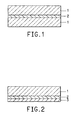
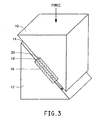
- Figures show typical laminates of this invention.
- Figure 1 shows a typical glass laminate used for windows that are storm and debris resistant of two glass layers 1 having laminated between them an ionomer resin sheet 2.
- Figure 2 shows a laminate of a glass layer 1 having an ionomer resin sheet 2 adhered to a durable transparent plastic layer 3. Any of the above laminates can be coated with conventional abrasion resistant coatings that are known in the art.
- the laminate has two layers of glass and directly self-adhered to the glass is an interlayer of a thermoplastic polymer and the laminate has an overall thickness of 3-30 mm.
- the interlayer has a thickness of 0.38-4.6 mm and each glass layer usually is at least 1 mm thick.
- the interlayer is adhered directly to the glass and an intermediate adhesive layer or coating between the glass and the interlayer is not used.
- other laminate constructions can be used such as multiple layers of glass and thermoplastic interlayers or a single layer of glass with a thermoplastic polymer interlayer and having adhered to the interlayer a layer of a durable transparent plastic film.
- the interlayer usually has a Storage Young's Modulus of 50-1,000 MPa (mega Pascals) and preferably 100-500 MPa and is measured at 0.3 Hz and 25 °C by dynamic mechanical analysis in tension at a frequency of 0.3 Hz and a maximum strain of 10% according to ASTM D 5026-95a.
- the interlayer remains in the 50-1,000 MPa range of its Storage Young's Modulus at temperatures up to 40°C.
- the Minimum Tear Energy of the interlayer is at least 15 MJ/m 3 (mega Joules per cubic meter) and preferably 30-130 MJ/m 3 . Tear energy is determined from the results of a standard tensile test measured at 25 °C carried out in accordance with ASTM D 638-89. A specimen type IV, as specified in the test, is pulled at 2.0 inches/minute (50.8 mm/min). Tensile stress (nominal), ⁇ , is defined as the tensile load per unit area of minimum original cross section. Strain, ⁇ , is defined as the ratio of the elongation to the gage length of the test specimen.
- the tensile stress-strain curve is defined as a diagram in which values of tensile stress are plotted as ordinates against corresponding values of tensile strains as abscissas.
- Adhesion of the laminate i.e. of the interlayer to glass
- Adhesion of the laminate is determined using the compressive shear strength test using the jig 10,12 shown in the FIGURE 3.
- the interlayer is placed between two pieces of annealed float glass of dimension 12"x12" (305 mm x 305 mm) and 2.5 mm nominal thickness which have been washed and rinsed in demineralized water.
- the glass/interlayer/glass assembly is then heated in an oven set at 90-100°C for 30 minutes. Thereafter, it is passed through a set of nip rolls so that most of the air in the void spaces between the glass and the interlayer may be squeezed out, and the edge of the assembly sealed.
- the assembly at this stage is called a pre-press.
- the pre-press is then placed in an air autoclave where the temperature is raised to 135 °C and pressure to 200 psig (1.38 MPa). These conditions are maintained for 20 minutes, after which, the air is cooled , while no more air is added to the autoclave. After 20 minutes of cooling when the air temperature in the autoclave is under 50 °C, the excess air pressure is vented.
- the compressive shear strength of the laminate prepared as prescribed above is determined at 25 °C using the method detailed herein.
- Six 1"x1" (25 mm x 25 mm) chips are sawed from the laminate.
- the compressive shear strength of the chip is determined using the jig shown in the FIGURE 3.
- the chip of glass layers 16, and 20 and an interlayer 18 is placed on the cut-out on the lower half of the jig 12, and the upper half 10 is then placed on top of the chip.
- a cross-head is lowered at the rate of 0.1 inch per minute (2.5 mm per minute) until it contacts the upper piece of the device. As the cross-head continues to travel downward, one piece of the chip begins to slides relative to the other.
- the compressive shear strength of the chip is the shear stress required to cause adhesive failure.
- the precision of this test is such that one standard deviation is typically 6% of the average result of six chips.
- An interlayer tested in this way for adhesion which has compressive shear strength of 5-42 MPa which is considered suitable for use in hurricane and storm resistant windows and for transportation use such as for automobile and truck side-glass windows and backlites and for windows in trains.
- the laminate of glass/interlayer/glass must pass a simulated hurricane impact and cycling test which measures the resistance of a laminate to debris impact and wind pressure cycling.
- a currently acceptable test is performed in accordance to the South Florida Building Code Chapter 23, section 2315 Impact tests for wind born debris: fatigue load testing is determined according to Table 23-F of section 2314.5, dated 1994. This test simulates the forces of the wind plus air born debris impacts during severe weather, e.g., a hurricane.
- a sample 35 inches x 50 inches (88.9x127 cm) of the laminate is tested.
- the test consists of two impacts on the laminate (one in the center of the laminate sample followed by a second impact in the corner of the laminate).
- the impacts are done by launching a 9 pound (4.1 kilograms) board nominally 2 inches (5 cm) by 4 inches (10 cm) and 8 feet (2.43 meters) long at 50 feet/second (15.2 meters/second) from an air pressure cannon. If the laminate survives the above impact sequence, it is subjected to an air pressure cycling test. In this test, the laminate is securely fastened to a chamber. In the positive pressure test, the laminate with the impact side outward is fastened to the chamber and a vacuum is applied to the chamber and then varied to correspond with the cycling sequences set forth in the following Table I.
- the pressure cycling schedule as shown in Table I below, is specified as fraction of a maximum pressure P.
- a laminate passes the impact and cycling test when there are no tears or openings over 5 inches (12.7 cm) in length and not greater than 1/16 inch (0.16cm) in width.
- the haze and transparency of laminates of this invention are measured according to ASTM D-1003-61 by using a Hazegard XL211 hazemeter or Hazegard Plus hazemeter (BYK Gardner-USA). Percent-haze is the diffusive light transmission as a percent of the total light transmission.
- the interlayer of the laminate generally is required to have a transparency of at least 90 and a haze of less than 5%.
- Laminates 1-3 used a 90 mil (2.3 mm) thick interlayer of an ionomer resin composed of 81 % ethylene, 19% methacrylic acid, 37% neutralized with sodium ion and having a melt index of 2 and 2 layers of glass, each 3 mm in thickness.
- the ionomer resin is available as "Surlyn" ionomer resin made by E. I. duPont de Nemours and Company.
- the ionomer resin interlayer has a StorageYoung's Modulus of 361 MPa, a Tear Energy of 101 MJ/m 3 and an adhesion to glass of 24 MPa, all measured at 25°C.
- Laminates 4-6 used a 90 mil (2.3 mm) thick interlayer of Butacite ® polyvinyl butyral PVB resin sheeting interlayer from E.I. duPont de Nemours and Company and 2 layers of glass, each 3 mm in thickness.
- the PVB resin has a Storage Young's Modulus of 25 MPa, a Tear Energy of 30 MJ/m 3 and an adhesion to glass of 21 MPa, all measured at 25°C.
- All six laminates were prepared by placing the interlayer between the glass panels. Each of the glass panels was washed with deionized water. The laminates were placed in an air autoclave at 220 PSIG (1.6 MPa) pressure at 135 °C for 30 minutes. The laminates were 35 inches (88.9 cm) high by 50 inches (127 cm) wide. All six of the laminates were each placed into a window frame using the same procedure using RTV silicone (DC 995) on the inside lip of the frame (edge bite /overlap of 0.75 inches (1.9 cm).
- each of the laminates was tested according to the Florida impact and cycling test sequence.
- a missile of a 9 pound (4.1 kilograms) pine board nominally 2 inches (5cm) by 4 inches (10 cm) and 8 feet (2.43 meters) long is propelled against the laminate at 50 feet/second (15.2 meters/second) from an air pressure cannon striking the laminate "normal" to its surface.
- Each of the laminates is subjected to two impacts in two different locations of the laminate which fractures the glass. The results of the test are shown below in Table A below.
- each of the laminates 1-6 after the impact test was subjected to an air pressure cycling test as described above in the specification except the air pressure cycling sequence as shown in Table B was used. The results of this test are shown below in Table B below.
- Laminates 4-6 prepared with a PVB (polyvinyl butyral) interlayer failed.
- Laminates 1-3 prepared with a ionomer resin interlayer passed the cycling test and were subjected to an additional cycling sequence using higher pressures from 85-130 pounds per square foot (4080-6240 Pascals) which is beyond the pressure required by the Hurricane Impact and Cycling Resistance Test. The results of this test are shown in Table C below.
- Laminate 3 was still acceptable and was subjected to additional testing as shown in Table D below.
- TABLE D Laminate of Ionomer Resin (Invention) AIR-PRESSURE CYCLING SEQUENCE POSITIVE PRESSURE INWARD ACTING Pressure (Pounds per Square Foot) Cycles Result 3 100 (4800 Pascals) 130 Passed 120 (5760 Pascals) 100 Passed 130 (6240 Pascals) 100 Passed 140 (6720 Pascals) 100 Passed 150 (7200 Pascals) 130 Test Suspended* *Test was terminated because of failure of window support structure.
- a laminate 7 was prepared according to the procedure of Example 1 using a 6 mm thick interlayer of an ionomer resin composed of 81 % ethylene, 19% methacrylic acid, 37% neutralized with sodium ion and having a melt index of 2.0 and 2 layers of glass each 3 mm in thickness.
- an ionomer resin composed of 81 % ethylene, 19% methacrylic acid, 37% neutralized with sodium ion and having a melt index of 2.0 and 2 layers of glass each 3 mm in thickness.
- a laminate 8 was prepared according to the procedure of Example 1 using a 6 mm thick interlayer of an ionomer resin composed of 85% ethylene, 15% methacrylic acid, 59% neutralized with sodium ion and having a melt index of 0.9 and containing an organic amine to form an interlayer sheet as taught in Bolton et al U.S. Patent 4,663,228 and 2 layers of glass each 3 mm in thickness.
- an ionomer resin composed of 85% ethylene, 15% methacrylic acid, 59% neutralized with sodium ion and having a melt index of 0.9 and containing an organic amine to form an interlayer sheet as taught in Bolton et al U.S. Patent 4,663,228 and 2 layers of glass each 3 mm in thickness.
- Laminate 7 (the invention) made with the ionomer resin of the invention which did not contain an organic amine had less haze over the temperature range of 30-75°C in comparison to Laminate 8 made with an ionomer resin which contained an organic amine. Laminate 8 had a haze level of greater than 5% over the entire 30-75 °C temperature range which is not acceptable.
- Laminated glass samples were prepared by sandwiching the interlayer between two pieces of annealed float glass with a dimension of 12" x 12" (305 mm x 305 mm) and 2.5 mm nominal thickness which have been washed and rinsed in demineralized water.
- the glass/interlayer/glass assembly is then heated in an oven set at 90-100°C for 30 minutes. Thereafter, it is passed through a set of nip rolls so that the air in the void spaces between the glass and the interlayer is squeezed out, and the edge of the assembly sealed.
- the assembly at this stage is called a pre-press.
- the pre-press is then placed in an air autoclave where the temperature is raised to 135°C and pressure to 200 psig (14.3 bar).
- Example 1 Twenty laminates were prepared using plasticized polyvinyl butyral resin sheeting interlayer (available commercially from DuPont under the tradename of BUTACITE®) and twenty laminates were prepared using ionomer resin interlayer described in Example 1.
- the interlayer thickness in both sample types was 30 mils (0.76 mm).
- a conventional impact test widely used to test the laminates in the safety glazing industry is the 2,26 kg (five pound) steel ball drop test. This test is defined in American National Standard Z26.1-1983 Section 5.26 Penetration Resistance, Test 26. The purpose of this test is to determine whether the glazing material has satisfactory penetration resistance. For automotive windshields, a minimum performance level is set at eight out of ten samples passing a twelve foot ball drop without the ball penetrating the sample within 5 seconds of the impact. The test method calls for controlling laminate temperature between 77 to 104°F (25 to 40°C). The laminates (separated to provide air circulation) were placed in a controlled temperature oven, a minimum of 2 hours prior to impact. Rather than dropping the 2,26 kg (five-pound) ball from 3,7 m (12 feet), a variety of drop heights were used to assess the "mean" support height (the height at which it is estimated that 50% of the samples would be penetrated).
- the laminate formed with the ionomer resin interlayer retains penetration by the steel ball over the range of temperatures tested.
Landscapes
- Chemical & Material Sciences (AREA)
- Health & Medical Sciences (AREA)
- Chemical Kinetics & Catalysis (AREA)
- Medicinal Chemistry (AREA)
- Polymers & Plastics (AREA)
- Organic Chemistry (AREA)
- Joining Of Glass To Other Materials (AREA)
- Laminated Bodies (AREA)
Claims (4)
- Durchsichtiges Laminat aufweisend wenigstens eine Glasschicht und mit einer, direkt an der Glasschicht, selbstanhaftenden Schicht aus einem thermoplastischen Polymer, das weniger als 5% Trübe besitzt, wie nach ASTM D-1003-61 gemessen, worin die Schicht aus thermoplastischem Polymer ein Blatt ist aus einem Ionomerharz, das im Wesentlichen aus einem wasserunlöslichen Salz eines Polymers von- 80 bis 82 Gew.-% Ethylen und 18 bis 20 Gew.-% Methacryl- oder Acrylsäure mit 30 bis 50 Gew.-% der Säure durch Natriumionen neutralisiert, besteht, und das Harz einen Schmelzindex von 0,5 bis 5 hat,und worin die Aminen nicht für die Herstellung der Schicht aus thermoplastischem Polymer verwendet wurden und worin der Laminat nach dem Bruch der Glassschicht einer wiederholten oder anhaltenden Belastung widerstehen kann währendem die strukturelle Integrität des Laminats aufrechterhalten wird.
- Durchsichtiges Laminat nach Anspruch 1, worin das Ionomer einen Schmelzindex von 1 bis 3 besitzt und ein Ionomerharz ist, aufweisend einen Polymer von 80 bis 82 Gew.-% Ethylen und 18 bis 20 Gew.-% Methacryl- oder Acrylsäure mit 35 bis 40 Gew.-% der Säure durch Natriumionen neutralisiert.
- Durchsichtiges Laminat nach Anspruch 1 aufweisend zwei miteinander laminierten Glasschichten mit einer Schicht eines thermoplastischen Polymers, worin die Schicht des thermoplastischen Polymers direkt auf die Glasschicht anhaftet, wobei das Laminat eine Stärke von 3 bis 30 mm und eine Zwischenschichtstärke von 0,38 bis 4,6 mm besitzt.
- Durchsichtiges Laminat nach Anspruch 1, aufweisend eine zweite dauerhafte durchsichtige Schicht oder Überzug eines thermoplastischen Polymers anhaftend an die Schicht des thermoplastischen Polymers mit weniger als 5% Trübe.
Priority Applications (1)
| Application Number | Priority Date | Filing Date | Title |
|---|---|---|---|
| EP06021206A EP1759832A1 (de) | 1998-05-14 | 1999-05-12 | Glaslaminate für bedrohungssichere Fenstersysteme |
Applications Claiming Priority (3)
| Application Number | Priority Date | Filing Date | Title |
|---|---|---|---|
| US7898498A | 1998-05-14 | 1998-05-14 | |
| US78984 | 1998-05-14 | ||
| PCT/US1999/010354 WO1999058334A2 (en) | 1998-05-14 | 1999-05-12 | Glass laminates for threat resistant window systems |
Related Child Applications (1)
| Application Number | Title | Priority Date | Filing Date |
|---|---|---|---|
| EP06021206A Division EP1759832A1 (de) | 1998-05-14 | 1999-05-12 | Glaslaminate für bedrohungssichere Fenstersysteme |
Publications (2)
| Publication Number | Publication Date |
|---|---|
| EP1105287A1 EP1105287A1 (de) | 2001-06-13 |
| EP1105287B1 true EP1105287B1 (de) | 2006-10-11 |
Family
ID=22147393
Family Applications (2)
| Application Number | Title | Priority Date | Filing Date |
|---|---|---|---|
| EP99921902A Expired - Lifetime EP1105287B1 (de) | 1998-05-14 | 1999-05-12 | Verbundglasscheibe für sicherheisfenstersystem |
| EP06021206A Withdrawn EP1759832A1 (de) | 1998-05-14 | 1999-05-12 | Glaslaminate für bedrohungssichere Fenstersysteme |
Family Applications After (1)
| Application Number | Title | Priority Date | Filing Date |
|---|---|---|---|
| EP06021206A Withdrawn EP1759832A1 (de) | 1998-05-14 | 1999-05-12 | Glaslaminate für bedrohungssichere Fenstersysteme |
Country Status (6)
| Country | Link |
|---|---|
| EP (2) | EP1105287B1 (de) |
| JP (1) | JP2002514533A (de) |
| AU (1) | AU3899699A (de) |
| CA (1) | CA2330157A1 (de) |
| DE (1) | DE69933570T2 (de) |
| WO (1) | WO1999058334A2 (de) |
Families Citing this family (66)
| Publication number | Priority date | Publication date | Assignee | Title |
|---|---|---|---|---|
| GB0003781D0 (en) | 2000-02-18 | 2000-04-05 | Pilkington Plc | Laminated glazings |
| US7351468B2 (en) | 2000-10-26 | 2008-04-01 | E. I. Du Pont De Nemours And Company | Interlayers for laminated safety glass with superior de-airing and laminating properties and process for making the same |
| FR2838517B1 (fr) * | 2002-04-15 | 2004-09-10 | Saint Gobain | Procede pour evaluer la resistance mecanique d'un intercalaire |
| CN1671942A (zh) * | 2002-07-31 | 2005-09-21 | 纳幕尔杜邦公司 | 夹层玻璃用点固定系统及其制备方法 |
| WO2004011271A1 (en) | 2002-07-31 | 2004-02-05 | E.I. Du Pont De Nemours And Company | Ink-jet printed rigid interlayer and a process for preparing same |
| US20070087137A9 (en) | 2003-06-26 | 2007-04-19 | Elwakil Hamdy A | Decorative laminated safety glass |
| US7138166B2 (en) | 2003-04-04 | 2006-11-21 | E. I. Du Pont De Nemours And Company | Glass laminates having improved structural integrity against severe stresses for use in external pressure plate glazing applications |
| US7334371B2 (en) | 2003-04-04 | 2008-02-26 | E.I. Du Pont De Nemours And Company | Glass laminates having improved structural integrity against severe stresses for use in external pressure plate glazing applications |
| WO2005014280A1 (en) * | 2003-08-07 | 2005-02-17 | E.I. Dupont De Nemours And Company | Decorative laminated safety glass utilizing a rigid interlayer and a process for preparing same |
| GB0324334D0 (en) | 2003-10-17 | 2003-11-19 | Pilkington Plc | Load bearing laminates |
| CN1918358A (zh) * | 2003-12-15 | 2007-02-21 | 纳幕尔杜邦公司 | 具有改进的抗猛烈撞击的结构完整性的防爆玻璃叠层片 |
| CN1894096A (zh) | 2003-12-16 | 2007-01-10 | 纳幕尔杜邦公司 | 包含柔韧连接物的对抗剧烈撞击具有改进结构完整性的玻璃层合物 |
| JP2005306326A (ja) * | 2004-04-26 | 2005-11-04 | Honda Motor Co Ltd | 合せガラス及び合せガラス用中間膜 |
| EP1805249B1 (de) * | 2004-10-29 | 2011-04-20 | E.I. Du Pont De Nemours And Company | Transparente glaslaminate |
| DE102004000053A1 (de) * | 2004-11-23 | 2006-05-24 | Kuraray Specialities Europe Gmbh | Verbundverglasungen mit hoher Energieaufnahme und hierfür geeignete Zwischenschichtfolien |
| US7749577B2 (en) | 2005-05-26 | 2010-07-06 | E.I. Du Pont De Nemours And Company | High strength multilayer laminates comprising twisted nematic liquid crystals |
| JP2008542065A (ja) | 2005-05-26 | 2008-11-27 | イー・アイ・デュポン・ドウ・ヌムール・アンド・カンパニー | ねじれネマチック液晶を含む多層ラミネート |
| US7759414B2 (en) | 2005-07-14 | 2010-07-20 | E.I. Du Pont De Nemours And Company | Nanoparticulate solar control compositions |
| US8871335B2 (en) | 2005-08-31 | 2014-10-28 | Kuraray America Inc. | Solar control laminate |
| US7445683B2 (en) | 2005-11-30 | 2008-11-04 | E. I. Du Pont De Nemours And Company | Thermoplastic resin compositions suitable for use in laminated safety glass |
| US7678441B2 (en) | 2005-12-02 | 2010-03-16 | E.I. Du Pont De Nemours And Company | Interlayers for laminated safety glass with superior de-airing and laminating properties and process for making the same |
| EP1973987A1 (de) | 2005-12-29 | 2008-10-01 | E.I. Du Pont De Nemours And Company | Zusammensetzung zur reduzierung der durchlässigkeit gegenüber infrarotstrahlen |
| US8101267B2 (en) | 2005-12-30 | 2012-01-24 | E. I. Du Pont De Nemours And Company | Multilayer polymeric laminates and high strength laminates produced therefrom |
| US7622192B2 (en) * | 2005-12-30 | 2009-11-24 | E.I. Du Pont De Nemours And Company | Solar control laminates |
| US7914700B2 (en) | 2006-03-31 | 2011-03-29 | E. I. Du Pont De Nemours And Company | Liquid crystal compositions and polymer networks derived therefrom |
| US7879256B2 (en) | 2006-03-31 | 2011-02-01 | E. I. Du Pont De Nemours And Company | Liquid crystal compositions, polymer networks derived therefrom and process for making the same |
| US8772624B2 (en) | 2006-07-28 | 2014-07-08 | E I Du Pont De Nemours And Company | Solar cell encapsulant layers with enhanced stability and adhesion |
| US20080196760A1 (en) | 2007-02-15 | 2008-08-21 | Richard Allen Hayes | Articles such as safety laminates and solar cell modules containing high melt flow acid copolymer compositions |
| US8691372B2 (en) * | 2007-02-15 | 2014-04-08 | E I Du Pont De Nemours And Company | Articles comprising high melt flow ionomeric compositions |
| US8319094B2 (en) | 2007-11-16 | 2012-11-27 | E I Du Pont De Nemours And Company | Multilayer terionomer encapsulant layers and solar cell laminates comprising the same |
| KR101623603B1 (ko) | 2008-06-02 | 2016-05-23 | 이 아이 듀폰 디 네모아 앤드 캄파니 | 탁도가 낮은 봉지제 층을 가진 태양 전지 모듈 |
| US7641965B1 (en) | 2008-06-30 | 2010-01-05 | E.I. Du Pont De Nemours And Company | Transparent light-weight safety glazings |
| CN102203143B (zh) | 2008-10-31 | 2014-05-07 | 纳幕尔杜邦公司 | 高透明度离聚物组合物和包含其的制品 |
| MX2011004485A (es) | 2008-10-31 | 2011-05-23 | Du Pont | Articulos laminados de alta transparencia que comprenden una capa ionomerica intermedia. |
| DE102008064356A1 (de) * | 2008-12-20 | 2010-06-24 | Saint-Gobain Glass Deutschland Gmbh | Integrierter Glasaufbau, Verfahren zu seiner Herstellung und seine Verwendung |
| KR101643791B1 (ko) | 2008-12-30 | 2016-07-28 | 이 아이 듀폰 디 네모아 앤드 캄파니 | 블렌딩된 고투명성 이오노머 조성물 및 그를 포함하는 용품 |
| BRPI0918712B8 (pt) | 2008-12-31 | 2022-08-02 | Dow Chemical Co | laminado |
| EP2376548B1 (de) | 2008-12-31 | 2020-04-01 | Performance Materials NA, Inc. | Ionomerzusammensetzungen mit geringer opazität und hoher feuchtigkeitsbeständigkeit sowie artikel damit |
| CN102341556A (zh) * | 2009-03-06 | 2012-02-01 | 纳幕尔杜邦公司 | 轻型玻璃层压板 |
| JP5615134B2 (ja) | 2010-04-30 | 2014-10-29 | 日東電工株式会社 | 透明基板の製造方法 |
| AU2011282567B2 (en) | 2010-07-30 | 2015-06-18 | Performance Materials Na, Inc. | Crosslinkable materials for safety laminates |
| WO2012026393A1 (ja) | 2010-08-23 | 2012-03-01 | 株式会社クラレ | 太陽電池用封止材および合わせガラス用中間膜 |
| TWI547369B (zh) | 2011-05-27 | 2016-09-01 | 康寧公司 | 玻璃塑膠積層之裝置、處理線、及方法 |
| EP2879868A4 (de) * | 2012-08-03 | 2016-04-13 | Corning Inc | Mehrschichtige, transparente und leichte sicherheitsverglasung |
| US9387651B2 (en) * | 2012-09-26 | 2016-07-12 | Corning Incorporated | Methods for producing ion exchanged glass and resulting apparatus |
| WO2014059206A1 (en) | 2012-10-12 | 2014-04-17 | E. I. Du Pont De Nemours And Company | Glass laminates with nanofilled ionomer interlayers |
| JP6179096B2 (ja) * | 2012-12-18 | 2017-08-16 | 日立化成株式会社 | 積層板、多層積層板、プリント配線板、多層プリント配線板及び積層板の製造方法 |
| CN104870186B (zh) | 2012-12-19 | 2018-04-27 | 纳幕尔杜邦公司 | 可交联酸共聚物组合物以及其在玻璃层压板中的用途 |
| JP5706054B2 (ja) * | 2013-02-18 | 2015-04-22 | 日本板硝子株式会社 | 合わせガラス、及びこれが取り付けられた取付構造体 |
| KR20160024947A (ko) * | 2013-06-25 | 2016-03-07 | 코닝 인코포레이티드 | 이온 교환 유리 및 결과물인 제품 |
| US20150158986A1 (en) | 2013-12-06 | 2015-06-11 | E.I. Du Pont De Nemours And Company | Polymeric interlayer sheets and light weight laminates produced therefrom |
| WO2016076337A1 (ja) * | 2014-11-10 | 2016-05-19 | 株式会社クラレ | 合わせガラス用中間膜および合わせガラス |
| US20160193812A1 (en) * | 2015-01-06 | 2016-07-07 | Corning Incorporated | Method for reducing bow in laminate structure |
| US10538063B2 (en) | 2016-05-09 | 2020-01-21 | Kuraray America, Inc. | Multilayer interlayer and glass laminate |
| CO2017007432A1 (es) | 2017-03-27 | 2017-11-10 | Agp America Sa | Cristal automotriz laminado resistente a la intrusión |
| CN113646282B (zh) | 2019-03-28 | 2024-04-12 | 株式会社可乐丽 | 夹层玻璃的中间膜用改性乙烯醇缩醛树脂 |
| KR20220016082A (ko) | 2019-05-31 | 2022-02-08 | 주식회사 쿠라레 | 아이오노머, 수지 시트 및 접합 유리 |
| WO2021124951A1 (ja) | 2019-12-19 | 2021-06-24 | 株式会社クラレ | アイオノマー樹脂、樹脂シートおよび合わせガラス |
| WO2021145137A1 (ja) | 2020-01-15 | 2021-07-22 | 株式会社クラレ | 樹脂組成物、樹脂シート及び合わせガラス |
| WO2022063795A1 (en) | 2020-09-28 | 2022-03-31 | Kuraray Europe Gmbh | Glass laminates with reduced creep at elevated temperature |
| CN116348430B (zh) | 2020-09-29 | 2025-10-24 | 可乐丽欧洲有限责任公司 | 离聚物树脂、树脂片及夹层玻璃 |
| JP7124246B1 (ja) | 2020-11-27 | 2022-08-23 | 株式会社クラレ | アイオノマー樹脂 |
| EP4324859A4 (de) | 2021-04-12 | 2025-05-28 | Kuraray Co., Ltd. | Acetalisierungsprodukt eines ethylen/vinylalkohol-copolymers und zusammensetzung mit diesem acetalisierungsprodukt |
| JPWO2022220086A1 (de) | 2021-04-12 | 2022-10-20 | ||
| KR20240040800A (ko) | 2021-07-28 | 2024-03-28 | 쿠라라이 유럽 게엠베하 | 아이오노머 수지 입상물의 제조방법 |
| DE102021134101B4 (de) | 2021-12-21 | 2023-11-09 | SCHOTT Glass Ibérica SL | Verbundglas mit verbesserter Resttragfähigkeit und Verfahren zu dessen Herstellung |
Citations (4)
| Publication number | Priority date | Publication date | Assignee | Title |
|---|---|---|---|---|
| US4323247A (en) * | 1981-01-19 | 1982-04-06 | Acushnet Company | Golf ball cover |
| US4668574A (en) * | 1983-05-03 | 1987-05-26 | Advanced Glass Systems, Corp. | Laminated safety glass |
| US4906703A (en) * | 1984-08-17 | 1990-03-06 | Artistic Glass Products Company | Ionomer resin films and laminates thereof |
| EP0483087A1 (de) * | 1990-10-23 | 1992-04-29 | Artistic Glass Products Company | Verfahren zur Herstellung von Verbundsicherheitsscheiben |
Family Cites Families (11)
| Publication number | Priority date | Publication date | Assignee | Title |
|---|---|---|---|---|
| FR1183541A (fr) | 1956-10-18 | 1959-07-08 | Du Pont | Verre de sécurité stratifié perfectionné |
| NL282755A (de) | 1961-08-31 | 1900-01-01 | ||
| US3344014A (en) * | 1963-02-28 | 1967-09-26 | Du Pont | Safety glass |
| US4297262A (en) | 1979-08-31 | 1981-10-27 | E. I. Du Pont De Nemours And Company | Polyvinyl butyral plasticized with tetraethyleneglycol di-n-heptanoate |
| US4230771A (en) | 1979-08-31 | 1980-10-28 | E. I. Du Pont De Nemours And Company | Polyvinyl butyral laminates with tetraethyleneglycol di-n-heptanoate plasticizer |
| US4663228A (en) | 1983-05-03 | 1987-05-05 | Advanced Glass Systems Corp. | Laminated safety glass |
| JPH04108641A (ja) * | 1990-08-28 | 1992-04-09 | Stanley Electric Co Ltd | 積層透明基板の製造方法 |
| JP3797681B2 (ja) * | 1995-04-21 | 2006-07-19 | 三井・デュポンポリケミカル株式会社 | 合わせガラス用中間膜 |
| IT1282848B1 (it) * | 1995-06-13 | 1998-04-01 | Ipm Ind Plastica Monregalese S | Vetro laminato o stratificato e metodo per la sua fabbricazione. |
| FR2743802B1 (fr) * | 1996-01-19 | 1998-03-20 | Saint Gobain Vitrage | Vitrage feuillete et primaire utilise pour sa realisation |
| US5763062A (en) * | 1996-11-08 | 1998-06-09 | Artistic Glass Products Company | Ionomer resin films and laminates thereof |
-
1999
- 1999-05-12 EP EP99921902A patent/EP1105287B1/de not_active Expired - Lifetime
- 1999-05-12 CA CA002330157A patent/CA2330157A1/en not_active Abandoned
- 1999-05-12 JP JP2000548160A patent/JP2002514533A/ja not_active Withdrawn
- 1999-05-12 WO PCT/US1999/010354 patent/WO1999058334A2/en not_active Ceased
- 1999-05-12 DE DE69933570T patent/DE69933570T2/de not_active Expired - Fee Related
- 1999-05-12 EP EP06021206A patent/EP1759832A1/de not_active Withdrawn
- 1999-05-12 AU AU38996/99A patent/AU3899699A/en not_active Abandoned
Patent Citations (4)
| Publication number | Priority date | Publication date | Assignee | Title |
|---|---|---|---|---|
| US4323247A (en) * | 1981-01-19 | 1982-04-06 | Acushnet Company | Golf ball cover |
| US4668574A (en) * | 1983-05-03 | 1987-05-26 | Advanced Glass Systems, Corp. | Laminated safety glass |
| US4906703A (en) * | 1984-08-17 | 1990-03-06 | Artistic Glass Products Company | Ionomer resin films and laminates thereof |
| EP0483087A1 (de) * | 1990-10-23 | 1992-04-29 | Artistic Glass Products Company | Verfahren zur Herstellung von Verbundsicherheitsscheiben |
Non-Patent Citations (1)
| Title |
|---|
| 'Surlyn[SPEC0416] 1707 packaging resin', Internet brochure by DuPont Packaging, [SPEC0417] 1995-2003 * |
Also Published As
| Publication number | Publication date |
|---|---|
| AU3899699A (en) | 1999-11-29 |
| WO1999058334A2 (en) | 1999-11-18 |
| WO1999058334A3 (en) | 2001-08-02 |
| EP1105287A1 (de) | 2001-06-13 |
| CA2330157A1 (en) | 1999-11-18 |
| JP2002514533A (ja) | 2002-05-21 |
| DE69933570D1 (de) | 2006-11-23 |
| EP1759832A1 (de) | 2007-03-07 |
| DE69933570T2 (de) | 2007-06-28 |
Similar Documents
| Publication | Publication Date | Title |
|---|---|---|
| EP1105287B1 (de) | Verbundglasscheibe für sicherheisfenstersystem | |
| US20030124296A1 (en) | Glass laminates for threat resistant window systems | |
| EP2374837B1 (de) | Thermoplastische harzzusammensetzungen zur verwendung für transparente laminate | |
| US7214433B2 (en) | Laminated structures with superior impact resistance and process for making same | |
| EP1171293B1 (de) | Verbundglasscheiben mit verbesserter strukturintegrität gegen schwere einschläge | |
| EP1322467B1 (de) | Einbruchbeständiges verbundglas | |
| US9248599B2 (en) | High impact polymer interlayers | |
| AU2001293045A1 (en) | Intrusion resistant glass laminate | |
| US3781184A (en) | Safe bi-modal windshields | |
| MXPA00011132A (en) | Glass laminates for threat resistant window systems |
Legal Events
| Date | Code | Title | Description |
|---|---|---|---|
| PUAI | Public reference made under article 153(3) epc to a published international application that has entered the european phase |
Free format text: ORIGINAL CODE: 0009012 |
|
| 17P | Request for examination filed |
Effective date: 20001019 |
|
| AK | Designated contracting states |
Kind code of ref document: A1 Designated state(s): DE FR GB |
|
| 17Q | First examination report despatched |
Effective date: 20031029 |
|
| GRAP | Despatch of communication of intention to grant a patent |
Free format text: ORIGINAL CODE: EPIDOSNIGR1 |
|
| GRAC | Information related to communication of intention to grant a patent modified |
Free format text: ORIGINAL CODE: EPIDOSCIGR1 |
|
| GRAS | Grant fee paid |
Free format text: ORIGINAL CODE: EPIDOSNIGR3 |
|
| GRAA | (expected) grant |
Free format text: ORIGINAL CODE: 0009210 |
|
| AK | Designated contracting states |
Kind code of ref document: B1 Designated state(s): DE FR GB |
|
| REG | Reference to a national code |
Ref country code: GB Ref legal event code: FG4D |
|
| REF | Corresponds to: |
Ref document number: 69933570 Country of ref document: DE Date of ref document: 20061123 Kind code of ref document: P |
|
| ET | Fr: translation filed | ||
| PLBE | No opposition filed within time limit |
Free format text: ORIGINAL CODE: 0009261 |
|
| STAA | Information on the status of an ep patent application or granted ep patent |
Free format text: STATUS: NO OPPOSITION FILED WITHIN TIME LIMIT |
|
| 26N | No opposition filed |
Effective date: 20070712 |
|
| GBPC | Gb: european patent ceased through non-payment of renewal fee |
Effective date: 20070512 |
|
| REG | Reference to a national code |
Ref country code: FR Ref legal event code: ST Effective date: 20080131 |
|
| PG25 | Lapsed in a contracting state [announced via postgrant information from national office to epo] |
Ref country code: DE Free format text: LAPSE BECAUSE OF NON-PAYMENT OF DUE FEES Effective date: 20071201 |
|
| PG25 | Lapsed in a contracting state [announced via postgrant information from national office to epo] |
Ref country code: GB Free format text: LAPSE BECAUSE OF NON-PAYMENT OF DUE FEES Effective date: 20070512 |
|
| PG25 | Lapsed in a contracting state [announced via postgrant information from national office to epo] |
Ref country code: FR Free format text: LAPSE BECAUSE OF NON-PAYMENT OF DUE FEES Effective date: 20070531 |