EP1103925A2 - Verfahren zum Piraterieschutz eines Gerätes und Anordnung zur Durchführung des Verfahrens - Google Patents
Verfahren zum Piraterieschutz eines Gerätes und Anordnung zur Durchführung des Verfahrens Download PDFInfo
- Publication number
- EP1103925A2 EP1103925A2 EP00250401A EP00250401A EP1103925A2 EP 1103925 A2 EP1103925 A2 EP 1103925A2 EP 00250401 A EP00250401 A EP 00250401A EP 00250401 A EP00250401 A EP 00250401A EP 1103925 A2 EP1103925 A2 EP 1103925A2
- Authority
- EP
- European Patent Office
- Prior art keywords
- code number
- consumable
- consumables
- code
- ink
- Prior art date
- Legal status (The legal status is an assumption and is not a legal conclusion. Google has not performed a legal analysis and makes no representation as to the accuracy of the status listed.)
- Granted
Links
Images


Classifications
-
- G—PHYSICS
- G07—CHECKING-DEVICES
- G07B—TICKET-ISSUING APPARATUS; FARE-REGISTERING APPARATUS; FRANKING APPARATUS
- G07B17/00—Franking apparatus
- G07B17/00733—Cryptography or similar special procedures in a franking system
-
- G—PHYSICS
- G06—COMPUTING OR CALCULATING; COUNTING
- G06Q—INFORMATION AND COMMUNICATION TECHNOLOGY [ICT] SPECIALLY ADAPTED FOR ADMINISTRATIVE, COMMERCIAL, FINANCIAL, MANAGERIAL OR SUPERVISORY PURPOSES; SYSTEMS OR METHODS SPECIALLY ADAPTED FOR ADMINISTRATIVE, COMMERCIAL, FINANCIAL, MANAGERIAL OR SUPERVISORY PURPOSES, NOT OTHERWISE PROVIDED FOR
- G06Q20/00—Payment architectures, schemes or protocols
- G06Q20/38—Payment protocols; Details thereof
- G06Q20/382—Payment protocols; Details thereof insuring higher security of transaction
-
- G—PHYSICS
- G07—CHECKING-DEVICES
- G07B—TICKET-ISSUING APPARATUS; FARE-REGISTERING APPARATUS; FRANKING APPARATUS
- G07B17/00—Franking apparatus
- G07B17/00185—Details internally of apparatus in a franking system, e.g. franking machine at customer or apparatus at post office
- G07B17/00435—Details specific to central, non-customer apparatus, e.g. servers at post office or vendor
-
- G—PHYSICS
- G07—CHECKING-DEVICES
- G07B—TICKET-ISSUING APPARATUS; FARE-REGISTERING APPARATUS; FRANKING APPARATUS
- G07B17/00—Franking apparatus
- G07B17/00016—Relations between apparatus, e.g. franking machine at customer or apparatus at post office, in a franking system
- G07B17/0008—Communication details outside or between apparatus
- G07B2017/00153—Communication details outside or between apparatus for sending information
- G07B2017/00161—Communication details outside or between apparatus for sending information from a central, non-user location, e.g. for updating rates or software, or for refilling funds
-
- G—PHYSICS
- G07—CHECKING-DEVICES
- G07B—TICKET-ISSUING APPARATUS; FARE-REGISTERING APPARATUS; FRANKING APPARATUS
- G07B17/00—Franking apparatus
- G07B17/00016—Relations between apparatus, e.g. franking machine at customer or apparatus at post office, in a franking system
- G07B17/0008—Communication details outside or between apparatus
- G07B2017/00153—Communication details outside or between apparatus for sending information
- G07B2017/00177—Communication details outside or between apparatus for sending information from a portable device, e.g. a card or a PCMCIA
-
- G—PHYSICS
- G07—CHECKING-DEVICES
- G07B—TICKET-ISSUING APPARATUS; FARE-REGISTERING APPARATUS; FRANKING APPARATUS
- G07B17/00—Franking apparatus
- G07B17/00733—Cryptography or similar special procedures in a franking system
- G07B2017/00935—Passwords
Definitions
- the invention relates to a method for protecting a device against piracy according to the preamble of claim 1 and an arrangement for Implementation of the method according to the preamble of claim 14.
- the solution below is for the replacement of consumables applicable from franking machines. It is irrelevant whether it is Ink, ink cartridges for ink jet printing units or around thermal transfer ribbon cartridges or rotary printing drums.
- Amount of credit in which the franking machine is managed With every franking this credit amount will be replaced by the amount printed on the package Franking amount reduced.
- the franking machine can with one Credit amount can be reloaded.
- there are special security measures have been developed that allow unauthorized manipulation to Prevent damage to the manufacturer or user or the mail carrier or should detect.
- the franking machine also uses ink and wears out the parts belonging to the printing technology, whereby it Interest of the user and the mail carrier is if high quality the manufacturer's own material is consumed. However so-called piracy products, this affects the Service life and print quality of the machine. But it could be allowed be that an original product is recycled by the manufacturer. For example could be authorized ink in an original cartridge for a printing Device can be refilled. So far, however, it has not been possible to result Exclude manipulation possibilities completely.
- Ink end detection with electrodes is previously known from DE 27 28 283 C2.
- Two electrodes for a comparative measurement and a separate electrode for a conductivity measurement for signaling the end of ink are introduced in the base of the ink container.
- the contact resistance between these electrodes is measured and evaluated by means of an electronic circuit.
- the electrodes are arranged in depressions which are molded into the bottom of the container.
- the use of an electrically conductive ink is a prerequisite for the use of such an ink end detection. Protection against refilling with a different ink than the original ink is not possible.
- cassette-shaped containers with ink liquid, ribbon or toner from US 5,365,312, which has a chip-shaped Integrated circuit with an electronic memory for one Storage container identifying code, for an expiration date and others Show data as well as with a counter to the consumption at To determine printing by counting the individual printing pulses, which printed ink drops correspond.
- the integrated circuit saves the current fill status, which is determined by the printer control can be read out and displayed. Because reprogramming the chip and refilling the container is not possible the container cannot even be recycled by the manufacturer.
- a reusability lock has already been introduced in DE 196 13 945 C2 proposed for a container for the ink supply of an ink printhead.
- An ink connection line is from the ink printhead the container by means of a hollow needle through a rubber-elastic closure docked.
- One cover is when pulling the Container irreversibly triggered by the hollow needle.
- a refilled Ink reservoir can no longer be docked.
- This solution also reuse filled with original ink Containers.
- the used ink tanks can be used for proper Disposal only to the dealer or service of the manufacturer be returned. It appears to be disadvantageous, if even a recycled supplies provided by the manufacturer can be reused. The use of exactly copied piracy ink tanks can unfortunately not be prevented.
- Each code supplied by the data center is also limited in time, which prevents an attack after the predetermined time period.
- the counting of the impressions per se is also known.
- a disadvantage of the above method is the lack of synchronization between the output of the new codes for the consumables and the storage of the corresponding reference codes in the franking machine, on the one hand, and the unforeseeable time of purchase and installation of the consumables in the franking machine. This inevitably leads to temporal overlaps, with consumables with old codes not interfering with the new reference codes stored in the franking machine. If more than one of the codes is declared valid during these transitional periods, the risk increases that codes that have become known are combined with unauthorized consumables and that this cannot be detected.
- Another disadvantage is the lack of information for the manufacturer that a certain customer is trying to use unauthorized consumables. This information is only gained by the franking machine, which can then only react in a pre-programmed manner, for example by refusing the franking. A flexible reaction to the customer, for example through a personal telephone connection on the part of the manufacturer combined with a temporary permission to use the unauthorized consumables, is not possible.
- the object of the invention is to provide a method for protecting against piracy create that is suitable for any system and without one additional hardware expenditure.
- the use of superimposed old consumables, such poor quality of other manufacturers, and other prohibited consumables, piracy products in particular should be largely minimized.
- there Protection should be based on the same procedure in different ways Extend consumables regardless of their physical Consistency. The process is intended for both machines with and without direct contact with a data center may be useful.
- the task is with the features of the method according to the claim 1 or with the features of the arrangement according to Claim 14 solved.
- the first comparison in the postage meter machine can react even if there is no contact with the teleporto data center (TDC) using a voice or modem method or such a contact is generally not provided.
- TDC teleporto data center
- the franking machines recognize misuse of a piracy product via the disproportion of the permitted frankings enabled with code numbers and the actual franking service.
- a further evaluation can also be carried out in the remote data center with a voice / modem method. As a result, marketing measures can then be initiated to counter the abuse of piracy products.
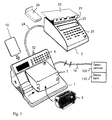
- the perspective view of a franking machine 1 of the T1000 type is shown from the front left according to FIG.
- the franking machine 1 has an internal modem and can be connected to a data center 100, for example, which has a database 130, for reloading credit via a first data connection 14.
- a chip card 10 is used according to the invention for user-friendly input of the code number of the consumer goods, a minimum number of frankings that can be carried out and / or for carrying out other known inputs, for example for setting the franking machine to a cost center under which billing is to be carried out.
- the slot for inserting the chip card is arranged on the back of the franking machine 1, not visible from the front.
- the franking machine 1 has a cassette compartment 7, which must be opened for inserting a thermal transfer ribbon cassette 9.
- a cassette of predetermined types is sufficient for a minimum number of frankings that can be carried out.
- a microprocessor (not shown) of a microcomputer which controls the franking machine counts the imprints or frankings carried out and subtracts the latter from the aforementioned minimum number.
- a display text is then generated by the microprocessor and a warning appears on the display of a user interface 4, according to which the chip card supplied must be inserted into a slot in a chip card read / write unit before inserting a cassette 9 authorized by the manufacturer.
- the warning may also refer to continued operation of the franking machine 1 with an unauthorized cassette in order to prevent damage, as well as premature aging of the printing technology, and a deteriorated print image.
- the microprocessor either causes an OK message to be displayed or an error message (CALL SERVICE) is issued if no manufacturer-authentic ribbon could be recognized.
- CALL SERVICE error message
- Other physical identifiers can be used alternatively, for example in the case of a device type without a chip card read / write unit. For example, it is then possible to stick on a barcode label with the code number, which can be read visually and entered manually via user interface 4. With this code number, the consumables can also be aggregated in other, very different ways.
- the manufacturer of the Device or of the consumables at least one that Consumables generated authoritative code number.
- the assignment of the Code number for a certain consumable is in a Database in the form of a data record with code number and device identification number saved.
- An aggregation of the consumables with the generated code number takes place at the manufacturer by one to Selling supplies a code number, preferably in the form of a chip card, attached or by fastening or similar Measures is firmly assigned. This also includes a marker of supplies with this code number, which depends on the physical consistency of the consumables in very different Done by physical or chemical measures can.
- this marking code number is in a predetermined relationship.
- the consumable for example, a code number aggregated using a chip card.
- the device is on for loading a new group Reference code numbers located in the area. It is done on demand a transfer of reference code words to the device or to the franking machine and possibly special evaluation hardware / software for this.
- FIG. 2 A block diagram is explained with reference to FIG. 2, which applies to the franking machine 1 or any other device shown in FIG.
- a device has a microcomputer ⁇ P 19 for controlling the user interface 4, a modem 13, a chip card read / write unit 70 and a printer 17 with a cassette motor 80 and / or other actuators, not shown, which are connected via an input / output interface 18 the microcomputer ⁇ P 19 are connected.
- further sensors such as an encoder 90, letter sensor 91 and a contact 97, are connected in a known manner.
- the printer 17 works together with a cassette and has in the usual way a print head and its own sensors and actuators or another motor, which need not be shown in FIG. 2.
- the user interface 4 has a keyboard and a display with controller in a known manner, which also need not be shown in FIG. 2.
- the aforementioned device is a franking machine 1
- the An input / output interface 18 a postage computer balance 2 via a cable 24 be connected to the data connection.
- Another data connection 14 is used to connect the modem 13 to the data center 100 for the purpose of reloading credit.
- the Server of a database 110 of a data center 100 is programmed, to determine a unique code number range and to the device ID number Allocate GIN in memory of database 110.
- the franking machine is manufactured by storing reference code numbers the quantity B 'in the memory of the device with the device ID number, where a reference code number is a specific code number assigned to the customer by chip card.
- a code number range is provided in the memory of the database 110, i.e. a customer address in a central customer master file is assigned a set B of code numbers which are within of a code number range.
- one is generated Code number that lies within the number code range, at random by a server of the data center 100.
- An aggregation of the random code number and a number S of prints / frankings with the consumable of a predetermined type can be saved Corresponding data take place in a chip card, which is supplied.
- the delivery of the consumer goods is connected with the request that Enter the random number supplied with the consumer goods using a chip card or alternatively read and into the device using user interface 4 to enter. Entering by means of the chip card has the advantage that in addition to the code number, an identification number of the consumables and a number of quantities, for example a number S, effortlessly entered for consumption when operating the device can.
- Recognize the need to change consumables is based on the number / quantity consumed in the operation of the device and on the storage of the aforementioned Data, such as the number of pieces S, in the device that is associated with the change of the consumables are related.
- ⁇ S generates a corresponding display in the Device for entering a code number.
- the consumption is> S
- no code number was entered.
- the use of a piracy cassette is suspected.
- the data center 100 is a teleporto data center TDC
- the data transmission can take place in connection with a credit reload.
- the consumable is a cassette
- an option is optionally provided for checking in the remote data center 100 or TDC whether the number of prints / frankings is plausible for the number of cassette changes since the last reload.
- Information from data center 100 can prompt the franking machine manufacturer to react flexibly to customer behavior.
- a service technician can be dispatched to check the customer's machine, or the customer can be offered ribbon cartridges at a lower price to change their future behavior.
- the device could at least be made to work more slowly in the future, the more often the customer uses third-party products when changing.
- a slow-working thermal transfer printing machine even an inferior ribbon can still lead to sufficient print quality.
- the franking machine can automatically switch to a slower operating mode, is set slower by the FP service technician, or is set remotely by the data center. Also, the franking machine should only indicate an error when a predetermined number of third-party cassettes are inserted, which prompts the customer to take a look at the operating instructions or call a service technician who, for example, explains to the customer that third-party products would wear out the T1000 franking machines earlier.
- the FP service technician could even demonstrate that the franking machine runs faster with original FP cassettes. In any case, the customer should not be forced to completely do without external cassettes, rather he will do so voluntarily.
- the advantage of the proposed solution lies in the downward compatibility with the devices or franking machines located in the field. The manufacturer does not have to make any hardware intervention, as would be necessary with an additional sensor according to US 5,949,467.
- a software update can be offered through a favorable offer to the customer, the new process combined with a discount on the consumables. In this way, the price of the ribbon cassettes can be reduced for these customers.
- These ribbon cassettes have no stickers and the customer uses them to buy the number of frankings. These ribbon cartridges will only be delivered to customers who participate in the new process. The old customer, who would also like to use the cheaper ribbon cartridges in the future, needs a (free) software update, for example, when he next visits a technician.
- the consumable is an ink tank filled with ink.
- the consumable is an inkjet print head or a cartridge.
- the inkjet print head which has an integrated ink cartridge, is also referred to as a "cartridge".
- Such a disposable print head is, for example, the Siemens type DHP50.
- the consumable is a liquid, for example water for a letter humidifier and letter sealer. The latter can be part of an automatic letter feeder.
- the solution according to the invention can also be used in franking machines of a different type, for example with a franking machine with a printing drum.
- the franking machine of the applicant with a printing drum provided that the consumable is an ink.
- a cover can contain ink from a bottle or ink cartridge be refilled.
- the code number is on the bottle or ink cartridge printed or on a label attached to the latter is attached.
- a franking machine with a printing drum from the applicant type EFS has an inking unit with a step-shaped cover, the a simple refill of the ink color enables and one prevents unwanted leakage of the printing stamp ink (EP 269 883 B1).
- This solution also counts the frankings or Printing processes ahead if necessary in connection with a function Ink end sensor. It is envisaged that the franking machine will have a Has control unit with processor, which is programmed according to the Detect the aforementioned to generate a message and display it display and wait for the number to be entered, which is the code number is related to the reference code number.
- Another variant uses a chip in which the code number is saved and by making electrical contacts during installation of the new consumable can be read out.
- a - shown in Figure 1 - postage calculator scale 2 has a weighing plate 21, a display 23 and a keyboard 25 for entering shipping information about a letter to be conveyed 33.
- a device for example from the postage computer scale 2 one Frankiersystems not only the weight, postage and other data to the franking machine 1 but also a message such as which rate PROM for the postage value calculation is used.
- the latter is located within a memory card 22, which can be inserted into the postage calculator scale 2.
- the franking machine 1 can based on data stored in a memory distinguish whether an authorized or an unauthorized Postage fee table is used in the postage calculator scale 2.
- FIG. 3 There is an internal view of a JetMail® franking machine Data connection to an integrated scale 20 that is not closer is shown.
- the scale 20 has one in a manner known per se Weighing plate 21 and a weighing cell (not shown) with Evaluation electronics.
- a - invisible - postage calculator is not Part of the scale 20, but part of the meter 12.
- a Rate PROM memory module required for postage calculation can be a Be part of the meter 12 or the base of the franking machine 1, being in a modular, removable form.
- the weighed letters are individually upstream of the franking machine 1 on an edge standing up. Alternatively, a stack of letters, each with one Weight that are put in the same weight group at the Postage calculation falls.
- a pressure bracket 35 can be folded up and pushes then on a stack of mail, from which 32 letters by means of take-off rolls be isolated. Under a hood 34 are further parts of the Separating device.
- a letter lies against a guide plate 31 and becomes the downstream to the guide plate 11 of the franking machine 1 moves where the "franking" printing process takes place.
- On franked letter moved on lies on a guide plate 81 a Locking module 8.
- a pair of closing rollers 82 ensures the closing not yet completely closed envelope and for ejection over an insert 5 in the storage box 6.
- the franking machine of the JetMail® type is not in the Pre-published German patent application DE 199 00 686.5-27 have been described in more detail under the title: Arrangement for closing of envelopes.
- a smart card disk / reader unit 70 In the guide plate 11 of the franking machine 1 are a smart card disk / reader unit 70 and an on / off switch 71 arranged. After switching on, a chip card 10 can be connected with the user interface 43, 45 for simplified input and setting the franking machine can be used.
- the user interface 43, 45 is located on meter 12 of the franking machine 1.
- German utility model DE 298 21 903 U1 is an international usable user interface has been explained in more detail.
- a microprocessor (not shown) of the franking machine 1 monitors the fill level of an ink tank cartridge 95 shown in FIG. 4 using an ink end sensor.
- the latter can according to the German Patent 196 13 944 C1 consisting of two electrodes.
- sensors already deliver an end signal in JetMail, if a maximum of 200 frankings are still possible, for one reason Avoid lack of ink incompletely printed franking image.
- This can be a necessary upcoming change of Detect consumables, with the user within a Range of 200 frankings again a supplied chip card 10 can be inserted into a slot of the chip card read / write unit 70, which can be used to indirectly infer the event of the change.
- the microprocessor may generate a display text for display 43: THE INK SUPPLY IS NEARLY EXHAUSTED. PLEASE REPLACE THIS SOON INK TANK! RESERVE IN PRINT: 200.
- the franking machine 1 can still be operated with the reserve ink quantity.
- the microprocessor realizes a down counter in its memory space, which is preset to 200 by the ink end signal and is decremented by one with each additional franking.
- the number 200 results empirically from empirical values for a remainder of possible prints and a safety factor.
- a number of franking imprints that substantially exceeds the number of 200 indirectly suggests the event of the original cartridge being exchanged for an unauthorized, possibly refilled, ink tank cartridge.
- the number identifying the rest can be displayed before the next franking.
- the microprocessor After each further franking, the microprocessor generates a status line which shows the number of remaining prints and finally issues the message: THE INK SUPPLY IS USED. PLEASE CHANGE THE INK TANK.
- the used ink tank cassette 95 can be removed and placed in a plastic bag, which catches any leaking ink residue.
- a new ink tank cartridge 95 can be removed from the package, checking that the color of the ink is correct. For this purpose, a hole coding on the back of the ink tank cartridge 95 can be used. At the same time, the new code number can be read and entered.
- the ink tank cassette 95 is inserted into - not shown - side guide rails of the ink tank compartment 98 and pushed in until it clicks into place. As long as the ink tank cartridge is not inserted correctly, there is no contact via electrodes 93, 94 and the microprocessor generates the message: THE INK TANK MISSING!
- the contact via the electrodes 93 and 94 of the ink tank cartridge 95 to an existing sensor is automatically closed.
- the postage meter recognizes that an ink tank cartridge 95 has been installed as new consumable.
- the original ink type post red, fluorescent red, etc.
- the microprocessor now generates a message which either prompts the customer on the display to replace the ink tank cartridge 95 with another of a permissible color or prompts the user to enter the new code number: ENTER CODE NUMBER.
- the customer can enter this code number, for example, by means of a chip card 10 supplied, or alternatively take it from an imprint on the packaging and enter it into the franking machine 1 by means of the keyboard 45. If the code number entered is outside the valid range, the microprocessor now generates a message: ENTER VALID CODE NUMBER!
- the franking machine 1 has the new code number, after the area review, a review based on the individual Reference code numbers of the quantity B 'carried out.
- the consumed Code numbers are deleted. Is a whole code number range used up, a new code number range can be reloaded. To do this, a communication link is established with the manufacturer's data center manufactured. Modern franking machines are already available today all equipped with a modem to connect to the data center of the Manufacturer to be able to communicate. This is usually used to getting a credit loaded from the data center if the corresponding memory was franked technically.
- the transfer of a Group of new reference code words or in the form of area boundaries of the code area can be separate or in addition to communication be provided for remote loading of the franking machine.
- Known Data backup measures are used to prevent that the reference code words are eavesdropped on the transmission link can be.
- the franking machine receives the new one Consumables 95 associated code number, preferably by inserting a chip card in the franking machine 1.
- the group of stored reference code words will match the appropriate code number searched. If it is found, the registered consumable is considered authorized and a further use of the franking machine 1 is available nothing in the way. If the code number is not identified, a counterfeit one must be used or a code number that is no longer valid. If the code number is falsified, the customer apparently has an unauthorized one Purchased consumables with any pseudo code number or he has invented one and in the absence of an authorized one Code number entered.
- code number is no longer valid, checked whether this has already been used once. If not, it can are authorized but layered consumables. In In this case, it would have to be checked whether the use of the material is still permitted is. If the now invalid code number has already been used, it is obviously a manipulation attempt. Alternatively can use special chip cards to create a group of new reference code words and the area limits of the code area are loaded become. Otherwise, older franking machines must have no An FP service technician called a modem or chip card reading option to a group of new reference code words and the Load area limits of the code area.
- FIG. 5 is a block diagram of a franking machine of the JetMail® type with a control unit (meter) 12, a processor 46 and means 40 to 58, and shown with a base.
- the latter includes an integrated one Balance 20, a rate PROM 22, a modem 53 and an ink end sensor 92, with the help of which the need for Changing the old ink tank cartridge 95 is recognized.
- Sensor / actuator control interface ASIC 58 communicated to microprocessor 46, which then generates an ad.
- a predetermined remainder remains of ink that is sufficient for approx.
- 200 prints if the conductivity between the contacts 93, 94 falls below a predetermined threshold value.
- Switching franking machine 1 on / off via switch 71, while the franking machine only has the ink remaining can be detected via the sensor 97, which is also on the SAS 59 connected.
- at least one ad is generated and, if necessary, sent a message to the data center when a credit comes back must be reloaded.
- a security module 60 developed by the applicant serves as the first Accounting module and has a hardware accounting unit 63 and one battery-supported non-volatile memory 61, in which by modem 53 a credit can be loaded.
- An OTP (One Time Programmable) processor 66 carries out security routines for both credit reloading, as well as to secure the register data with a MAC (Message Authentication Code).
- the advantage of the security module is that the reliability check and approval of the Franking and franking machine according to the invention by the Post carrier takes place, then only for the processor system concerned 60 and the connected printer module 55-57 is required.
- the chip card 10 forms a second processing module in connection with the chip card read / write unit 70.
- the microprocessor 46 and the first memory components 41, 42 then form a third processing module and the microprocessor 46 and the second memory devices 51, 52 (dashed lines) then form a fourth processing module etc.
- the Individual steps of the anti-piracy protection process can, for example processed in the third processing module.
- the microprocessor 46 with the associated memories 41, 42 becomes Counting the prints in connection with the detection of a change the ink tank cartridge programmed as well as postage calculator and Pressure control used.
- the accounting module 60 is used for accounting and calculation of encryption codes at least for communication with the data center for reloading credit. Because of this division of tasks is the accounting module 60 to the security module have been further developed. All processing modules 41.42, 51.52, the Security module 60, the microprocessor 46, the interface modules 44, 54 and 55, a main RAM pixel RAM 47, clock / date block 48, cliché EEPROM 49, program memory ROM 50 and an ASIC with the sensor / actuator control interface 58 are connected to an internal meter bus 40 connected to the controller. An input is made by means of the keyboard 45 to the ports of the microprocessor 46 for appropriate control the franking machine 1. Via the interface module 44 can a generated screen image reach the display 43.
- the display has an integrated controller for support.
- Both interface circuits 54 and 58 can also be implemented in an ASIC user circuit.
- the ASIC with the sensor / actuator control interface 58 and a sensors & Actuator controls SAS 59 are all actuators and sensors in the base addressable or queryable. More details on this are the EP 716 398 A2, which bears the title: Internal franking machine Interface circuit and method for tamper-proof Print data control.
- EP 875 864 Removable A2 To control the other components in the Base and in the periphery are further versions of EP 875 864 Removable A2, which bears the title: arrangement for communication between stations of a mail processing machine.
Landscapes
- Business, Economics & Management (AREA)
- Engineering & Computer Science (AREA)
- Accounting & Taxation (AREA)
- General Physics & Mathematics (AREA)
- Physics & Mathematics (AREA)
- Theoretical Computer Science (AREA)
- Computer Security & Cryptography (AREA)
- Finance (AREA)
- Strategic Management (AREA)
- General Business, Economics & Management (AREA)
- Accessory Devices And Overall Control Thereof (AREA)
- Devices For Checking Fares Or Tickets At Control Points (AREA)
- Burglar Alarm Systems (AREA)
Abstract
Description
Derartige Sensoren zur Tintenendeerkennung liefern der JetMail sicherheitshalber bereits ein Endesignal, wenn noch maximal 200 Frankierungen möglich sind, um ein wegen Tintenmangel unvollständig ausgedrucktes Frankierdruckbild zu vermeiden, daß bereits abgerechnet worden ist. Allerdings ist dann ein Primen bereits nicht mehr möglich. Für eine Nachbestellung eines Tintentankes wird das Endesignal in der Regel zu spät abgegeben.
Nachteilig an obigem Verfahren ist die fehlende Synchronisierung zwischen der Ausgabe der neuen Codes für das Verbrauchsmaterial und der Speicherung der entsprechenden Referenzcodes in der Frankiermaschine einerseits und dem nicht vorhersehbaren Zeitpunkt des Erwerbes und Einbaues des Verbrauchsmaterials in die Frankiermaschine. Zwangsläufig kommt es dabei zu zeitlichen Überlappungen, wobei Verbrauchsmaterial mit alten Codes nicht mit den neu in der Frankiermaschine gespeicherten Referenzcodes zusammenspielt. Wenn man in diesen Übergangszeiten mehr als einen der Codes für gültig erklärt, wächst in diesem Maße auch die Gefahr, daß bekannt gewordene Codes mit unautorisertem Verbrauchsmaterial kombiniert werden und dies nicht detektiert werden kann.
Ein weiterer Nachteil ist die fehlende Information für den Hersteller, daß ein bestimmter Kunde unautorisiertes Verbrauchsmaterial einzusetzen versucht. Diese Information gewinnt lediglich die Frankiermaschine, welche dann nur in vorprogrammierter Weise etwa durch Verweigerung der Frankierung reagieren kann. Eine flexible Reaktion auf den Kunden etwa durch eine persönliche telefonische Verbindungsaufnahme seitens des Herstellers kombiniert mit einer zeitlich befristeten Erlaubnis, das unautorisierte Verbrauchsmaterial zu verwenden, ist so nicht möglich.
Es wurde ein Piraterieschutz für Verbrauchsmaterial basierend auf dessen Authentifizierung entwickelt, wobei das Gerät die Authentizität überprüft, indem vom Hersteller veränderbare Bereichsgrenzen für die Codezahl im Gerät gespeichert sind und ein Größenvergleich der Codezahl zu den Bereichsgrenzen durchgeführt wird. Das Gerät ist beispielsweise eine Frankiermaschine mit einem Eingabemittel für die Codezahl. Der Hersteller liefert eine mit dem Verbrauchsmaterial aggregierte Codezahl. Wenn die Frankiermaschine über eine Chipkarten-Schreib/Leseeinheit verfügt, kann die Eingabe von Codezahl und ggf. weiteren Daten vorteilhaft per Chipkarte erfolgen, die mit dem Verbrauchsmaterial mitgeliefert wurde. Es ist vorgesehen, daß bereits bei Herstellung durch einen Software-update der Frankiermaschine ein Codebereich erzeugt wird, der für einen Kunden reserviert und daß in der Frankiermaschine ein Codebereich für Referenzcodewörter gespeichert wird, daß in der Frankiermaschine mindestens ein erster Vergleich der eingegebenen Codezahl mit den Bereichsgrenzen vor dem Vergleich mit den gelisteten Referenz-Codezahlen durchgeführt wird, um einen Mißbrauch durch Gebrauch eines Piraterie-Produktes zu erkennen, und daß die Frankiermaschine auf einen Mißbrauch mindestens durch eine Signalisierung reagiert. Wenn ein neues Verbrauchsgut eingesetzt und zur eingegebenen Codezahl eine zugehörige Referenzcodezahl noch existiert, wird letztere durch streichen, löschen oder markieren im Speicher konsumiert. Eine wiederholte Benutzung einer zur Eingabe benutzten Chipkarte führt damit nicht mehr zum Erfolg. Hat der Benutzer ein neues Verbrauchsgut eingesetzt aber dann eine früher schon einmal benutzte Chipkarte mit konsumierter Codezahl (versehendlich) eingesteckt, wird eine Anzeige generiert und angezeigt, die den Benutzer zum Einstecken einer das neue Verbrauchsgut autorisierenden Chipkarte auffordert. Auf einer Chipkarte kann optional eine Verbrauchsgröße für eine Frankiermaschine gespeichert sein, die bei einem jeden Frankieren um eine entsprechenden Größe verringert wird. Bei einem Farbband werden beispielsweise vorbestimmte Farbbandlängen konsumiert. Mit dem erfindungsgemäßen Verfahren wird es ermöglicht, verschiedene Verbrauchsmaterialien, unabhängig von deren physicher Konsistenz, mit dem im Prinzip gleichen Verfahren schützen zu können.
Das Gerät weist Sensoren zur direkten Erkennung von Zuständen auf, zum Beispiel einer Relativbewegung zwischen Druckträger und Druckkopf, zum Erkennen des Ein/Auszustandes oder zum Erkennen eines Unterschreitens einer vorbestimmten Restmenge, um die Notwendigkeit des Wechselns eines Verbrauchsmaterials zu signalisieren. Die vornannten Sensoren sind zum indirekten Erkennen eines weiteren Zustandes des Gerätes betriebsmäßig mit dem Mikroprozessor und mit Speichermitteln der Steuereinheit verbunden sind. Der Mikroprozessor des Gerätes ist programmiert:
- zum Unterscheiden eines Zustandes vor und nach dem Wechseln eines Verbrauchsmaterials, wobei ein Zustand vor dem Wechseln die Notwendigkeit des Wechselns signalisiert und wobei der weitere Zustand ein durchgeführtes Wechselns des Verbrauchsmaterials signalisiert,
- für das Wechseln des Verbrauchsmaterials eine Mitteilung zu generieren und per Display (43) anzuzeigen und auf eine Eingabe eines Codes zu warten, für die Eingabemittel (4,10, 45) vorgesehen sind,
- zur Überprüfung der Gültigkeit und Authentizität des Verbrauchsmaterials im Gerät anhand des Referenzcodezahlenbereiches und Konsumieren der gespeicherten Referenzcodezahl, die der eingegebenen Codezahl zuordenbar ist, und
- zur Speicherung von Daten, die mit dem Wechseln des Verbrauchsmaterial in Beziehung stehen, sowie
- den Betrieb des Gerätes zu verändern, wenn die erfolgte Überprüfung der Codezahl im Gerät eine Ungültigkeit ergeben hat.
Außerdem ist vorgesehen, daß die Frankiermaschinen über das Mißverhältnis der zulässigen mit Codezahlen freigeschalteten Frankierungen und der tatsächlichen Frankierleistung einen Mißbrauch mit einem Piraterie-Produkt erkennt. Zu einem späteren Zeitpunkt, vorzugsweise während der Guthabennachladung kann bei einem Voice/Modem-Verfahren außerdem in dem entfernten Datenzentrum eine weitere Auswertung durchgeführt werden. Im Ergebnis können dann Marketing-Maßnahmen veranlaßt werden, um dem Mißbrauch mit Piraterie-Produkten entgegen zu treten.
- Figur 1,
- Perspektivische Ansicht einer Frankiermaschine vom Typ T1000 von vorn links,
- Figur 2,
- Blockschaltbild der Frankiermaschine nach Fig.1,
- Figur 3,
- Perspektivische Ansicht einer Frankiermaschine vom Typ JetMail® von vorn rechts,
- Figur 4,
- Darstellung des Wechselns des Tintentanks bei Frankiermaschine vom Typ JetMail®,
- Figur 5,
- Blockschaltbild der Frankiermaschine vom Typ JetMail®.
Andere physikalische Kennungen sind alternativ einsetzbar, beispielswese beim einem Gerätetyp ohne eine Chipkarten-Schreib/Lese-Einheit. Beispielsweise ist dann das Aufkleben eines Barcodelabels mit der Codezahl möglich, welche visuell gelesen und manuell per Userinterface 4 eingegeben werden kann. Das Verbrauchsmaterials kann mit dieser Codezahl auch in anderer davon sehr unterschiedlicher Weise aggregiert werden.
Der Drucker 17 arbeitet mit einer Kassette zusammen und hat in üblicher Weise einen Druckkopf und eigene Sensoren und Aktoren bzw. einen weiteren Motor, was in der Figur 2 nicht näher gezeigt werden muß. Das Userinterface 4 weist in bekannter Weise eine Tastatur und ein Display mit Controller auf, was in der Figur 2 ebenfalls nicht näher gezeigt werden muß.
Das Gerät detektiert und speichert die Anzahl an Frankierungen, wenn ein Ereignis festgestellt wird, das auf das Wechseln des Verbrauchsgutes schließen läßt. Als Ereignis soll neben einem Fehlen von Encoderimpulsen auch ein Wiedereinschalten nach einem Ausschalten der Frankiermaschine 1 gewertet werden. Letzteres wird von einem Kontakt 97 über das I/O-Interface 18 zum Mikrocomputer 19 übermittelt, falls ein - in der Figur 1 gezeigter - Schlüsselschalter 72 zum Einschalten der Maschine betätigt wird. Der Mikrocomputer 19 ermittelt die Anzahl an Frankierungen bis zum Ereignis, wenn das Ereignis mit einer vorbestimmten Anzahl übereinstimmt, für welche die Orginalkassette ausgelegt ist, erscheint in der Anzeige eine generierte Aufforderung zum Kassettenwechsel. Der Mikrocomputer 19 kann eine Anzeige generieren, welche der Benutzer durch eine Eingabe beantworten muß. Der Benutzer kann eine Codezahl eingeben. Bei der Überprüfung in der Frankiermaschine wird eine eingegebene Codezahl vom Mikrocomputer 19 zunächst daraufhin geprüft, ob letztere im Codezahlenbereich liegt. Es erfolgt dann eine Konsumtion durch Streichen der zufälligen Referenzcodezahl aus der ursprünglichen Menge B, wenn letztere im Codezahlenbereich liegt. Somit ergibt sich ein Vermindern der Anzahl der Referenzcodezahlen auf die Menge B-1. Während des Betriebes des Gerätes wird die Stückzahl an Drucken/Frankierungen gespeichert. Da der Codezahlenbereich endlich ist, wird eine Möglichkeit vorgesehen:
- zum Nachladen eines Codezahlenbereiches, wenn der Codezahlenbereich konsumiert ist,
- zum Nachladen einer neuen Gruppe an Referenzcodezahlen, wenn die Referenzcodezahlen des Referenzcodezahlenbereiches vom Gerät konsumiert sind.
- für eine Datenübermittlung an das Teleporto Datenzentrum TDC beim nächsten Modem-Anruf. Die Datenübermittlung erfolgt durch Code per Modem automatisch. Die Code enthalten eine verschlüsselte Information über das o.g. Mißverhältnis. Die Datenweiterleitung der Anzahl der tatsächlichen Frankierungen an das Teleporto Datenzentrum TDC macht einen evtl. Mißbrauch sichtbar, da bei letzterem die Zahl der freigegebenen Frankierungen deutlich erhöht sein würde;
- für eine Datenübermittlung an das Teleporto Datenzentrum TDC per Telefon bei einer Voice-Frankiermaschine erfolgt eine Generierung einer Anzeige von Zahlencode, welche die verschlüsselte Information über das Mißverhältnis enthalten und an das Teleporto Datenzentrum TDC fernmündlich beim Nachladevorgang von Guthaben übermittelt werden. Wieder würde die in der Frankiermaschine gespeicherte Zahl der tatsächlichen Frankierungen bei einem Mißbrauch deutlich erhöht sein, was über die Registerstände ablesbar ist, die in die übermittelten Zahlencode eingehen;
- für eine Datenübermittlung vom Postbeamten, vom Benutzer der Frankiermaschine oder einem dazu Beauftragten, ggf. vom FP-Service-Techniker, an das Teleporto Datenzentrum TDC gemäß den vorgenannten FP-Übermittlungsverfahren.
Der Vorteil der vorgeschlagenen Lösung liegt in der Abwärtskompatibilität bei den im Feld befindlichen Geräten bzw. Frankiermaschinen. Der Hersteller muß keinen Hardeware-Eingriff vornehmen, wie es bei einem zusätzlichem Sensor gemäß US 5,949,467 erforderlich wäre. Ein Software-update hingegen läßt sich durch ein günstiges Angebot an den Kunden, das neue Verfahren in Verbindung mit einem Preisnachlaß bei dem Verbrauchsmaterial offerieren. So kann für diese Kunden den Preis für die Farbbandkassetten reduziert werden. Diese Farbbandkasseten tragen Nr.-Aufkleber und der Kunde kauft damit die Anzahl an Frankierungen. Diese Farbbandkassetten werden nur den Kunden zugestellt, die an dem neuen Verfahren teilnehmen. Der Alt-Kunde, der in Zukunft auch die preisgünstigere Farbbandkassetten einsetzen möchte, benötigt dazu ein (kostenloses) Software-update, z.B. beim nächsten Technikerbesuch.
Für ein Peripheriergerät ist vorgesehen, daß das Verbrauchsmaterial eine Flüssigkeit, beispielsweise Wasser für einen Briefbefeuchter und Briefschließer ist. Letzterer kann Bestandteil einer automatischen Zuführvorrichtung für Briefe sein.
Die den Rest kennzeichnende Zahl kann vor der nächsten Frankierung zur Anzeige gebracht werden. Nach jeder weiteren Frankierung generiert der Mikroprozessor eine Statuszeile, welche die Anzahl der verbleibenden Drucke anzeigt und gibt zum Ende die Meldung heraus: DER TINTENVORRAT IST AUFGEBRAUCHT. BITTE WECHSELN SIE DEN TINTENTANK.
Nach dem Öffnen der Klappe 99 des Tintenfaches 98 kann die verbrauchte Tintentankkassette 95 entnommen und in einen Plastikbeutel gesteckt werden, welcher eventuell auslaufende Tintenreste auffängt. Eine neue Tintentankkassette 95 kann aus der Verpackung entnommen und dabei überprüft werden, ob die Farbe der Tinte richtig ist. Dazu kann eine Lochcodierung auf der Rückseite der Tintentankkassette 95 herangezogen werden. Zugleich kann die neue Codezahl gelesen und eingegeben werden. Die Tintentankkassette 95 wird in - nicht gezeigte - seitliche Führungsschienen des Tintentankfaches 98 eingesetzt und eingeschoben, bis sie spürbar einrastet. Solange die Tintentankkassette nicht richtig eingesetzt ist, fehlt der Kontakt über die Elektroden 93, 94 und der Mikroprozessor generiert die Meldung: DER TINTENTANK FEHLT !
Beim Andocken der neuen mit leitfähiger Tinte gefüllten Tintentankkassette 95 wird automatisch der Kontakt über die Elektroden 93 und 94 der Tintentankkassette 95 zu einem vorhandenen Sensor geschlossen. Die Frankiermaschine erkennt dadurch, daß eine Tintentankkassette 95 als neues Verbrauchsmaterial installiert wurde. In Abhängigkeit von einer Lochcodierung auf der Rückseite der Tintentankkassette 95 kann mittels geeignet ausgebildeter - nicht gezeigter - weiterer Kontakte der ursprüngliche Tintentyp (Post rot, rot flureszierend, usw.) detektiert werden. Der Mikroprozessor generiert nun eine Meldung, die den Kunden über das Display entweder auffordert, die Tintentankkassette 95 wieder gegen eine andere mit zulässiger Farbe auszutauschen oder auffordert, die neue Codezahl einzugeben: CODEZAHL EINGEBEN. Diese Codezahl kann der Kunde beispielsweise mittels einer mitgelieferten Chipkarte 10 eingeben oder alternativ einem Aufdruck auf der Verpackung entnehmen und mittels der Tastatur 45 in die Frankiermaschine 1 eingeben. Liegt die eingegebene Codezahl außerhalb des gültigen Bereiches generiert der Mikroprozessor nun eine Meldung: GÜLTIGE CODEZAHL EINGEBEN !
Claims (27)
- Verfahren zum Schutz eines Gerätes vor einem Betreiben mit unzulässigem Verbrauchsmaterial, mit folgenden Schritten:Generieren eines Codezahlenbereiches und mindestens einer Codezahl, um ein Verbrauchsmaterial zu identifizieren, wobei die Codezahl in dem vorgenannten Codezahlenbereich liegt, welcher einer generierten Geräte-ID-Nummer zugeordnet wird,Speicherung der generierten Geräte-ID-Nummer und eines generierten Referenzcodezahlenbereiches im Gerät,Aggregation des Verbrauchsmaterials mit der generierten Codezahl bei einer Anforderung des Kunden, wobei die Codezahl in vorbestimmter Beziehung zu einer Referenzcodezahl aus einer Gruppe von Referenzcodezahlen steht, welche im Gerät gespeichert vorliegen und im Referenzcodezahlenbereich liegen,Erkennen einer Notwendigkeit des Wechselns eines Verbrauchsmaterials in einem Gerät entfernt vom Datenzentrum sowieÜberprüfung der Gültigkeit und Authentizität des Verbrauchsmaterials im Gerät anhand des Referenzcodezahlenbereiches und Konsumieren der gespeicherten Referenzcodezahl, die der Codezahl zuordenbar ist, wenn eine solche mit dem Wechseln des Verbrauchsmaterial eingegeben wurde, oder Steuern des Gerätes in Abhängigkeit vom Überprüfungsergebnis.
- Verfahren, nach Anspruch 1, gekennzeichnet durch einZuordnen des Codezahlenbereiches für ein Gerät mit vorgenannter Geräte-ID-Nummer zu einer Kundennummer für einen Kunden und Speichern im Speicher einer Datenbank entfernt vom Gerät,Speicherung der Zuordnung des angeforderten Verbrauchsmaterial in einer Datenbank des Datenzentrums in Form eines Datensatzes mit Kundennummer, Codezahl und Identifikationsnummer des Verbrauchsmaterials,Erkennen des Erfordernis des Wechselns eines Verbrauchsmaterials basierend auf einer Anzahl an Quantitäten für den Verbrauch beim Betrieb des Gerätes entfernt vom Datenzentrum und basierend auf der Speicherung von Daten im Gerät, die mit dem Wechseln des Verbrauchsmaterials in Beziehung stehen,Generieren einer entsprechenden Anzeige im Gerät zur Eingabe einer Codezahl, sowieVerändern des Betriebes des Gerätes, wenn die erfolgte Überprüfung der Codezahl im Gerät eine Ungültigkeit ergeben hat oder wenn keine Codezahl eingegeben wurde.
- Verfahren, nach Anspruch 2, gekennzeichnet durch ein Herstellen einer Kommunikationsverbindung zum entfernten Datenzentrum zur Übermittellung der im Gerät gespeicherten Daten, wenn zwar ein Erfordernis des Wechselns eines Verbrauchsmaterials vom Gerät erkannt wurde, aber anschließend keine Codezahl in das Gerät eingegeben wurde.
- Verfahren, nach Anspruch 2, gekennzeichnet durch ein Herstellen einer Kommunikationsverbindung zum entfernten Datenzentrum zum Nachladen eines neuen Referenzcodezahlenbereiches.
- Verfahren, nach Anspruch 2, gekennzeichnet durch ein Herstellen einer Kommunikationsverbindung zum entfernten Datenzentrum zum Nachladen einer neuen Gruppe an Referenzcodezahlen, wenn die Referenzcodezahlen des Referenzcodezahlenbereiches konsumiert sind.
- Verfahren, nach Anspruch 2, gekennzeichnet durch ein Verwenden einer Chipkarte zum Nachladen einer neuen Gruppe an Referenzcodezahlen, wenn die Referenzcodezahlen des Referenzcodezahlenbereiches konsumiert sind.
- Verfahren, nach Anspruch 1, gekennzeichnet durch eine Aggregation des Verbrauchsmaterials mit einer Chipkarte und ein Eingeben der Codezahl und Identifikationsnummer des Verbrauchsmaterials mittels der Chipkarte.
- Verfahren, nach Anspruch 7, gekennzeichnet durch ein Eingeben mittels der Chipkarte von Codezahl und Identifikationsnummer des Verbrauchsmaterials und einer Anzahl an Quantitäten für den Verbrauch beim Betrieb des Gerätes.
- Verfahren, nach Anspruch 1, gekennzeichnet dadurch, daß die Eingabe der Codezahl unter Verwendung des Userinterfaces (4) vorgenommen wird.
- Verfahren, nach Anspruch 9, gekennzeichnet dadurch, daß dem zum Verkauf vorgesehenen Verbrauchsmaterial ein Codewort beigefügt oder durch Befestigen oder vergleichbare Maßnahmen fest zugeordnet wird und die Zuordnung des Codes zu einem bestimmten Verbrauchsmaterial in der Datenbank gespeichert wird.
- Verfahren, nach Anspruch 9, gekennzeichnet dadurch, daß eine Markierung des Verbrauchsmaterials mit diesem Codewort abhängig von der physicher Konsistenz des Verbrauchsmaterials durch physikalische oder chemische Maßnahmen vorgenommen wird.
- Verfahren, nach Anspruch 2, gekennzeichnet dadurch, daß das Erkennen des Erfordernis des Wechselns eines Verbrauchsmaterials im Gerät mittels einem indirekten Meßverfahren erfolgt.
- Verfahren, nach Anspruch 1, gekennzeichnet dadurch, daß vom Hersteller des Verbrauchsmaterials ein das Verbrauchsmaterial identifizierendes Codewort generiert wird.
- Anordnung zur Durchführung des Verfahrens gemäß Anspruch 1, mit einer Steuereinheit (12, 19) eines Gerätes, zur Überprüfung einer Codezahl mittels einer Referenzcodezahl im Gerät, mit Eingabemitteln (4, 10, 45) und mit Sensoren (90, 92, 97) zur direkten Erkennung von Zuständen, gekennzeichnet dadurch, daß vorhandene Sensoren (90, 92, 97) zum indirekten Erkennen eines weiteren Zustandes des Gerätes betriebsmäßig mit dem Mikroprozessor und mit Speichermitteln (41, 42, 50) der Steuereinheit (12, 19) verbunden sind, wobei der Mikroprozessor programmiert ist,zum Unterscheiden eines Zustandes vor und nach dem Wechseln eines Verbrauchsmaterials, wobei ein Zustand vor dem Wechseln die Notwendigkeit des Wechselns signalisiert und wobei der weitere Zustand ein durchgeführtes Wechselns des Verbrauchsmaterials signalisiert,für das Wechseln des Verbrauchsmaterials eine Mitteilung zu generieren und per Display (43) anzuzeigen und auf eine Eingabe einer Codezahl zu warten, für die Eingabemittel (4,10, 45) vorgesehen sind,zur Überprüfung der Gültigkeit und Authentizität des Verbrauchsmaterials im Gerät anhand des Referenzcodezahlenbereiches und Konsumieren der gespeicherten Referenzcodezahl, die der eingegebenen Codezahl zuordenbar ist, undzur Speicherung von Daten, die mit dem Wechseln des Verbrauchsmaterial in Beziehung stehen, sowieden Betrieb des Gerätes zu verändern, wenn die erfolgte Überprüfung der eingegebenen Codezahl im Gerät eine Ungültigkeit ergeben hat oder wenn eine fehlende Eingabe einer Codezahl festgestellt wird.
- Anordnung, nach Anspruch 14, gekennzeichnet dadurch, daß das Verbrauchsmaterial ein Farbband in einer Kassette (9) und daß der vorhandene Sensor (90) zum indirekten Erkennen eines weiteren Zustandes des Gerätes ein Encoder ist.
- Anordnung, nach Anspruch 14, gekennzeichnet dadurch, daß mittels vorhandener Sensoren (90, 92, 97) in Zusammenwirken mit einer vom Mikroprozessor (46) durchgeführten Auswertung gemessener und gespeicherter Daten indirekt die Anwesendheit von ausgewechselten Verbrauchmaterial nach einem physikalisch Wirkprinzip festgestellt wird.
- Anordnung, nach Anspruch 16, gekennzeichnet dadurch, daß das Verbrauchsmaterial eine elektrisch leitfähige Tinte einer auswechselbaren Tintentankkassette (95) ist, daß der Sensor (92) mit den Kontakten (93, 94) der Tintentankkassette (95) zum Erkennen des Erfordernis des Wechselns der Tintentankkassette (95) verbunden ist, wobei in Zusammenwirken mit einer vom Mikroprozessor (46) durchgeführten Auswertung gemessener und gespeicherter Daten indirekt die Feststellung der Anwesendheit von einer ausgewechselten Tintentankkassette (95) erfolgt.
- Anordnung, nach Anspruch 14, gekennzeichnet dadurch, daß daß das Verbrauchsmaterial Tinte für einen Tintenstrahldruckkopf (57) mit integrierten Tintentank ist.
- Anordnung, nach Anspruch 14, gekennzeichnet dadurch, daß das Verbrauchsmaterial eine Flüssigkeit ist und wobei ein Code mittels einer Kennung des Verpackungsmaterials eingebbar ist, welcher für die Flüssigkeit kennzeichnend ist.
- Anordnung, nach Anspruch 14, gekennzeichnet dadurch, daß sich das Verbrauchsmaterial in einem nichtfesten Aggregatzustand befindet.
- Anordnung, nach Anspruch 14, gekennzeichnet dadurch, daß das Verbrauchsmaterial ein fester Körper ist.
- Anordnung, nach Anspruch 14, gekennzeichnet dadurch, daß das Gerät eine Frankiermaschine (1) ist, daß ein Speichern der Stückzahl an Drucken/Frankierungen während des Betriebes erfolgt, daß der Mikroprozessor der Frankiermaschine über das Mißverhältnis der mit der Codezahl eingegebenen Anzahl an zulässigen Frankierungen und der tatsächlichen Frankierleistung einen unautorisierten Wechsel erkennt und Daten zur Datenübermittlung an das Datenzentrum (100) liefert.
- Anordnung, nach Anspruch 22, gekennzeichnet dadurch, daß der Mikroprozessor (46) eine Anzeige von Zahlencode für das Display (43) generiert und daß die Datenübermittlung mittels Code per Telefon erfolgt, wobei die Code die verschlüsselte Information über das Mißverhältnis enthalten.
- Anordnung, nach Anspruch 23, gekennzeichnet dadurch, daß die Datenübermittlung vom Benutzer der Frankiermaschine oder einem dazu Beauftragten bzw. Postbeamten ausgelöst wird.
- Anordnung, nach Anspruch 22, gekennzeichnet dadurch, daß die Datenübermittlung per Modem automatisch erfolgt, wobei die Code die verschlüsselte Information über das Mißverhältnis enthalten.
- Anordnung, nach einem der Ansprüche 22 bis 25, gekennzeichnet dadurch, daß das Datenzentrum (100) ein Teleporto Datenzentrum (TDC) ist und daß die Datenübermittlung in Verbindung mit einer Guthabennachladung erfolgt.
- Anordnung, nach Anspruch 22, gekennzeichnet dadurch, daß das Datenzentrum (100) mit einer Datenbank (110) und Mitteln im Server ausgestattet ist, zur Überprüfung, ob die Stückzahl an Drucken/Frankierungen plausibel zur Anzahl der Kassettenwechsel seit dem letzen Nachladen ist.
Applications Claiming Priority (2)
| Application Number | Priority Date | Filing Date | Title |
|---|---|---|---|
| DE19958946 | 1999-11-26 | ||
| DE19958946A DE19958946B4 (de) | 1999-11-26 | 1999-11-26 | Verfahren zum Piraterieschutz eines Gerätes |
Publications (3)
| Publication Number | Publication Date |
|---|---|
| EP1103925A2 true EP1103925A2 (de) | 2001-05-30 |
| EP1103925A3 EP1103925A3 (de) | 2001-08-16 |
| EP1103925B1 EP1103925B1 (de) | 2008-01-02 |
Family
ID=7931705
Family Applications (1)
| Application Number | Title | Priority Date | Filing Date |
|---|---|---|---|
| EP00250401A Expired - Lifetime EP1103925B1 (de) | 1999-11-26 | 2000-11-24 | Verfahren zum Piraterieschutz eines Gerätes und Anordnung zur Durchführung des Verfahrens |
Country Status (3)
| Country | Link |
|---|---|
| US (1) | US7047221B1 (de) |
| EP (1) | EP1103925B1 (de) |
| DE (2) | DE19958946B4 (de) |
Cited By (1)
| Publication number | Priority date | Publication date | Assignee | Title |
|---|---|---|---|---|
| EP3588450A1 (de) | 2018-06-28 | 2020-01-01 | Francotyp-Postalia GmbH | Verfahren und system zum steuern der nutzung einer kartuscheneinheit |
Families Citing this family (8)
| Publication number | Priority date | Publication date | Assignee | Title |
|---|---|---|---|---|
| US8019696B2 (en) * | 2003-12-23 | 2011-09-13 | Pitney Bowes Inc. | Method and system to protect and track data from multiple meters on a removable storage medium |
| US7987119B2 (en) * | 2004-01-30 | 2011-07-26 | Neopost Technologies | Inventory management for postage supplies |
| DE202004015278U1 (de) * | 2004-10-01 | 2004-12-16 | Francotyp-Postalia Ag & Co. Kg | Kassettenaufnahmeeinrichtung mit Zustandserkennung für ein druckendes Postverarbeitungsgerät |
| US20120089835A1 (en) * | 2005-03-16 | 2012-04-12 | Dt Labs, Llc | System and Method for Automatic Authentication of an Item |
| US10636040B2 (en) | 2005-03-16 | 2020-04-28 | Dt Labs, Llc | Apparatus for customer authentication of an item |
| DE102007011309B4 (de) * | 2007-03-06 | 2008-11-20 | Francotyp-Postalia Gmbh | Verfahren zur authentisierten Übermittlung eines personalisierten Datensatzes oder Programms an ein Hardware-Sicherheitsmodul, insbesondere einer Frankiermaschine |
| DE102011012874A1 (de) | 2010-12-29 | 2012-07-05 | Francotyp-Postalia Gmbh | Verfahren und Anordnung zum Freigeben der Nutzung einer Verbrauchseinheit |
| US11205103B2 (en) | 2016-12-09 | 2021-12-21 | The Research Foundation for the State University | Semisupervised autoencoder for sentiment analysis |
Citations (6)
| Publication number | Priority date | Publication date | Assignee | Title |
|---|---|---|---|---|
| DE2728283C2 (de) | 1977-06-23 | 1982-04-29 | Siemens AG, 1000 Berlin und 8000 München | Vorrichtung zur Überwachung des Tintenvorrates in Tintenschreibeinrichtungen |
| US5365312A (en) | 1988-07-25 | 1994-11-15 | Mannesmann Ag | Arrangement for printer equipment for monitoring reservoirs that contain printing medium |
| EP0730974A2 (de) | 1995-03-07 | 1996-09-11 | Francotyp-Postalia Aktiengesellschaft & Co. | Anordnung und Farbbandkassette für ein Thermotransferdruckverfahren |
| DE19613944C1 (de) | 1996-04-06 | 1997-09-11 | Francotyp Postalia Gmbh | Anordnung zur Tintenversorgung und Tintenentsorgung für einen Tintendruckkopf |
| DE19613945C2 (de) | 1996-04-06 | 1999-04-22 | Francotyp Postalia Gmbh | Wiederverwendbarkeitssperre für einen Behälter für die Tintenversorgung |
| DE19838913A1 (de) | 1998-08-27 | 1999-10-21 | Bosch Gmbh Robert | Verfahren zur Originalitätsprüfung eines Erzeugnisses |
Family Cites Families (21)
| Publication number | Priority date | Publication date | Assignee | Title |
|---|---|---|---|---|
| US5367148A (en) * | 1986-04-18 | 1994-11-22 | Cias, Inc. | Counterfeit detection using ID numbers with at least one random portion |
| DE3641231A1 (de) * | 1986-12-02 | 1988-06-09 | Francotyp Postalia Gmbh | Farbgeberabdeckung und stempelfarbenbehaelter fuer ein farbwerk |
| US4949381A (en) * | 1988-09-19 | 1990-08-14 | Pitney Bowes Inc. | Electronic indicia in bit-mapped form |
| US4961088A (en) * | 1989-04-20 | 1990-10-02 | Xerox Corporation | Monitor/warranty system for electrostatographic reproducing machines using replaceable cartridges |
| JP2985205B2 (ja) * | 1990-01-25 | 1999-11-29 | ミノルタ株式会社 | 画像形成装置 |
| DE4141672B4 (de) * | 1991-12-17 | 2007-02-01 | Toshiba Tec Germany Imaging Systems Gmbh | Steuerungssystem für Büromaschinen, insbesondere Kopiergeräte oder dergleichen |
| US5305199A (en) * | 1992-10-28 | 1994-04-19 | Xerox Corporation | Consumable supplies monitoring/ordering system for reprographic equipment |
| JPH06336070A (ja) * | 1993-05-27 | 1994-12-06 | Tokyo Electric Co Ltd | プリンタユニット及びプリンタ装置 |
| DE4445053C2 (de) * | 1994-12-07 | 2003-04-10 | Francotyp Postalia Ag | Frankiermaschineninterne Schnittstellenschaltung |
| DE19534529C2 (de) * | 1995-09-08 | 2000-05-04 | Francotyp Postalia Gmbh | Verfahren zur Erhöhung der Manipulationssicherheit von kritischen Daten |
| US5835689A (en) * | 1995-12-19 | 1998-11-10 | Pitney Bowes Inc. | Transaction evidencing system and method including post printing and batch processing |
| JP3363680B2 (ja) * | 1995-12-28 | 2003-01-08 | ブラザー工業株式会社 | カートリッジの真偽判別方法及びそれを利用した出力装置 |
| FR2744391B1 (fr) * | 1996-02-01 | 1998-03-06 | Imaje Sa | Imprimante industrielle apte a recevoir au moins une cartouche de consommable |
| JP2000514961A (ja) * | 1996-04-23 | 2000-11-07 | アスコム ハスラー メイリング システムズ,インコーポレイテッド | 早期警告割り込み郵便装置の置き換えを提供するシステム |
| WO1998004414A1 (en) * | 1996-07-30 | 1998-02-05 | Philips Electronics N.V. | Printing device |
| US5799093A (en) * | 1996-08-23 | 1998-08-25 | Pitney Bowes Inc. | Process and apparatus for remote system inspection of a value dispensing mechanism such as a postage meter |
| DE19711997A1 (de) * | 1997-03-13 | 1998-09-17 | Francotyp Postalia Gmbh | Anordnung zur Kommunikation zwischen einer Basisstation und weiteren Stationen einer Postbearbeitungsmaschine und zu deren Notabschaltung |
| DE19812480A1 (de) * | 1998-03-21 | 1999-09-23 | E B S Gmbh | Tintenstrahldrucker für die Beschriftung von Waren |
| US6264301B1 (en) * | 1998-05-11 | 2001-07-24 | Hewlett-Packard Company | Method and apparatus for identifying parameters in a replaceable printing component |
| DE29821903U1 (de) * | 1998-12-03 | 1999-05-06 | Francotyp-Postalia AG & Co., 16547 Birkenwerder | Anordnung zur Eingabe und Anzeige von Benutzerinformationen auf einem Display |
| DE19900686C2 (de) * | 1999-01-05 | 2002-10-24 | Francotyp Postalia Ag | Anordnung zum Schließen von Briefumschlägen |
-
1999
- 1999-11-26 DE DE19958946A patent/DE19958946B4/de not_active Expired - Fee Related
-
2000
- 2000-11-24 EP EP00250401A patent/EP1103925B1/de not_active Expired - Lifetime
- 2000-11-24 DE DE50014891T patent/DE50014891D1/de not_active Expired - Lifetime
- 2000-11-27 US US09/723,080 patent/US7047221B1/en not_active Expired - Fee Related
Patent Citations (8)
| Publication number | Priority date | Publication date | Assignee | Title |
|---|---|---|---|---|
| DE2728283C2 (de) | 1977-06-23 | 1982-04-29 | Siemens AG, 1000 Berlin und 8000 München | Vorrichtung zur Überwachung des Tintenvorrates in Tintenschreibeinrichtungen |
| US5365312A (en) | 1988-07-25 | 1994-11-15 | Mannesmann Ag | Arrangement for printer equipment for monitoring reservoirs that contain printing medium |
| EP0730974A2 (de) | 1995-03-07 | 1996-09-11 | Francotyp-Postalia Aktiengesellschaft & Co. | Anordnung und Farbbandkassette für ein Thermotransferdruckverfahren |
| DE19549376A1 (de) | 1995-03-07 | 1996-09-26 | Francotyp Postalia Gmbh | Anordnung zur Ermittlung einer Farbbandrestmenge für Thermotransferdruckverfahren |
| US5949467A (en) | 1995-03-07 | 1999-09-07 | Francotyp-Postalia Ag & Co. | Method and apparatus for preventing usage of an unauthorized inking ribbon in a thermal printing process |
| DE19613944C1 (de) | 1996-04-06 | 1997-09-11 | Francotyp Postalia Gmbh | Anordnung zur Tintenversorgung und Tintenentsorgung für einen Tintendruckkopf |
| DE19613945C2 (de) | 1996-04-06 | 1999-04-22 | Francotyp Postalia Gmbh | Wiederverwendbarkeitssperre für einen Behälter für die Tintenversorgung |
| DE19838913A1 (de) | 1998-08-27 | 1999-10-21 | Bosch Gmbh Robert | Verfahren zur Originalitätsprüfung eines Erzeugnisses |
Cited By (2)
| Publication number | Priority date | Publication date | Assignee | Title |
|---|---|---|---|---|
| EP3588450A1 (de) | 2018-06-28 | 2020-01-01 | Francotyp-Postalia GmbH | Verfahren und system zum steuern der nutzung einer kartuscheneinheit |
| DE102018115555A1 (de) | 2018-06-28 | 2020-01-02 | Francotyp-Postalia Gmbh | Verfahren und system zum steuern der nutzung einer kartuscheneinheit |
Also Published As
| Publication number | Publication date |
|---|---|
| EP1103925A3 (de) | 2001-08-16 |
| DE19958946A1 (de) | 2001-06-21 |
| DE50014891D1 (de) | 2008-02-14 |
| US7047221B1 (en) | 2006-05-16 |
| EP1103925B1 (de) | 2008-01-02 |
| DE19958946B4 (de) | 2006-11-09 |
Similar Documents
| Publication | Publication Date | Title |
|---|---|---|
| EP1103924B1 (de) | Verfahren zum Schutz eines Gerätes vor einem Betreiben mit unzulässigem Verbrauchsmaterial und Anordnung zur Durchführung des Verfahrens | |
| DE19958948B4 (de) | Verfahren zur Bestimmung der Anzahl von mit einer Tintenrestmenge ausführbaren Drucken und Vorrichtung zur Durchführung des Verfahrens | |
| EP1064153B1 (de) | Tintenstrahldrucker für die beschriftung von waren | |
| EP0433280B1 (de) | Anordnung für druckeinrichtungen zur überwachung von druckmedium enthaltenden vorratsbehältern | |
| DE60014424T2 (de) | Verhindern des ungenehmigten gebrauches einer reservoirkartusche | |
| EP0660269B1 (de) | Verfahren zur Verbesserung der Sicherheit von Frankiermaschinen | |
| DE69534122T2 (de) | Frankiermaschine | |
| DE3729342A1 (de) | Sicherheitsdrucker fuer ein wertdrucksystem | |
| EP1035517B1 (de) | Verfahren zum Schutz eines Sicherheitsmoduls und Anordnung zur Durchführung des Verfahrens | |
| DE69735322T2 (de) | System zum Installieren und zur Standortbewegung einer Frankiermaschine | |
| DE19757652A1 (de) | Frankiermaschine mit einer Chipkarten-Schreib-/Leseeinheit | |
| EP1035516B1 (de) | Anordnung für ein Sicherheitsmodul | |
| EP1103925B1 (de) | Verfahren zum Piraterieschutz eines Gerätes und Anordnung zur Durchführung des Verfahrens | |
| EP1103923B1 (de) | Verfahren zum automatischen Bestellen von Verbrauchsmaterial und Anordnung zur Durchführung des Verfahrens | |
| DE19757651B4 (de) | Frankiermaschine mit einer Chipkarten-Schreib-/Leseeinheit | |
| EP3588450B1 (de) | Verfahren und system zum steuern der nutzung einer kartuscheneinheit | |
| DE19757653C2 (de) | Verfahren und postalisches Gerät mit einer Chipkarten-Schreib/Leseeinheit zum Nachladen von Änderungsdaten per Chipkarte | |
| EP0927969B1 (de) | Frankiermaschine mit einer Chipkarten-Schreib/Leseeinheit | |
| EP1037172B1 (de) | Verfahren zur automatischen Installation von Frankiereinrichtungen und Anordnung zur Durchführung des Verfahrens | |
| DE69616389T2 (de) | Frankiermaschine und Verfahren zum Identifizieren der Frankiermaschine | |
| EP1132868A1 (de) | Frankiermaschine mit abgesichtertem Druckknopf | |
| EP1202223A2 (de) | Postmachine und Verfahren zu deren Initialisierung |
Legal Events
| Date | Code | Title | Description |
|---|---|---|---|
| PUAI | Public reference made under article 153(3) epc to a published international application that has entered the european phase |
Free format text: ORIGINAL CODE: 0009012 |
|
| AK | Designated contracting states |
Kind code of ref document: A2 Designated state(s): CH DE FR GB IT LI |
|
| AX | Request for extension of the european patent |
Free format text: AL;LT;LV;MK;RO;SI |
|
| PUAL | Search report despatched |
Free format text: ORIGINAL CODE: 0009013 |
|
| AK | Designated contracting states |
Kind code of ref document: A3 Designated state(s): AT BE CH CY DE DK ES FI FR GB GR IE IT LI LU MC NL PT SE TR |
|
| AX | Request for extension of the european patent |
Free format text: AL;LT;LV;MK;RO;SI |
|
| 17P | Request for examination filed |
Effective date: 20020118 |
|
| AKX | Designation fees paid |
Free format text: CH DE FR GB IT LI |
|
| RAP1 | Party data changed (applicant data changed or rights of an application transferred) |
Owner name: FRANCOTYP-POSTALIA AG & CO. KG |
|
| RAP1 | Party data changed (applicant data changed or rights of an application transferred) |
Owner name: FRANCOTYP-POSTALIA GMBH |
|
| GRAP | Despatch of communication of intention to grant a patent |
Free format text: ORIGINAL CODE: EPIDOSNIGR1 |
|
| GRAS | Grant fee paid |
Free format text: ORIGINAL CODE: EPIDOSNIGR3 |
|
| GRAA | (expected) grant |
Free format text: ORIGINAL CODE: 0009210 |
|
| AK | Designated contracting states |
Kind code of ref document: B1 Designated state(s): CH DE FR GB IT LI |
|
| REG | Reference to a national code |
Ref country code: GB Ref legal event code: FG4D Free format text: NOT ENGLISH |
|
| REG | Reference to a national code |
Ref country code: CH Ref legal event code: EP |
|
| REF | Corresponds to: |
Ref document number: 50014891 Country of ref document: DE Date of ref document: 20080214 Kind code of ref document: P |
|
| GBT | Gb: translation of ep patent filed (gb section 77(6)(a)/1977) |
Effective date: 20080305 |
|
| ET | Fr: translation filed | ||
| PLBE | No opposition filed within time limit |
Free format text: ORIGINAL CODE: 0009261 |
|
| STAA | Information on the status of an ep patent application or granted ep patent |
Free format text: STATUS: NO OPPOSITION FILED WITHIN TIME LIMIT |
|
| 26N | No opposition filed |
Effective date: 20081003 |
|
| PGFP | Annual fee paid to national office [announced via postgrant information from national office to epo] |
Ref country code: IT Payment date: 20101123 Year of fee payment: 11 Ref country code: GB Payment date: 20101118 Year of fee payment: 11 |
|
| PGFP | Annual fee paid to national office [announced via postgrant information from national office to epo] |
Ref country code: CH Payment date: 20111123 Year of fee payment: 12 Ref country code: FR Payment date: 20111130 Year of fee payment: 12 |
|
| PGFP | Annual fee paid to national office [announced via postgrant information from national office to epo] |
Ref country code: DE Payment date: 20110908 Year of fee payment: 12 |
|
| REG | Reference to a national code |
Ref country code: CH Ref legal event code: PL |
|
| GBPC | Gb: european patent ceased through non-payment of renewal fee |
Effective date: 20121124 |
|
| PG25 | Lapsed in a contracting state [announced via postgrant information from national office to epo] |
Ref country code: LI Free format text: LAPSE BECAUSE OF NON-PAYMENT OF DUE FEES Effective date: 20121130 Ref country code: CH Free format text: LAPSE BECAUSE OF NON-PAYMENT OF DUE FEES Effective date: 20121130 |
|
| REG | Reference to a national code |
Ref country code: FR Ref legal event code: ST Effective date: 20130731 |
|
| PG25 | Lapsed in a contracting state [announced via postgrant information from national office to epo] |
Ref country code: IT Free format text: LAPSE BECAUSE OF NON-PAYMENT OF DUE FEES Effective date: 20121124 |
|
| REG | Reference to a national code |
Ref country code: DE Ref legal event code: R119 Ref document number: 50014891 Country of ref document: DE Effective date: 20130601 |
|
| PG25 | Lapsed in a contracting state [announced via postgrant information from national office to epo] |
Ref country code: DE Free format text: LAPSE BECAUSE OF NON-PAYMENT OF DUE FEES Effective date: 20130601 |
|
| PG25 | Lapsed in a contracting state [announced via postgrant information from national office to epo] |
Ref country code: GB Free format text: LAPSE BECAUSE OF NON-PAYMENT OF DUE FEES Effective date: 20121124 Ref country code: FR Free format text: LAPSE BECAUSE OF NON-PAYMENT OF DUE FEES Effective date: 20121130 |