EP1101816A2 - Gewebebehandlungsmittel mit optimierten Fleckenentfernungseigenschaften - Google Patents
Gewebebehandlungsmittel mit optimierten Fleckenentfernungseigenschaften Download PDFInfo
- Publication number
- EP1101816A2 EP1101816A2 EP00121988A EP00121988A EP1101816A2 EP 1101816 A2 EP1101816 A2 EP 1101816A2 EP 00121988 A EP00121988 A EP 00121988A EP 00121988 A EP00121988 A EP 00121988A EP 1101816 A2 EP1101816 A2 EP 1101816A2
- Authority
- EP
- European Patent Office
- Prior art keywords
- tissue treatment
- treatment agent
- tissue
- container
- substrate
- Prior art date
- Legal status (The legal status is an assumption and is not a legal conclusion. Google has not performed a legal analysis and makes no representation as to the accuracy of the status listed.)
- Withdrawn
Links
Classifications
-
- C—CHEMISTRY; METALLURGY
- C11—ANIMAL OR VEGETABLE OILS, FATS, FATTY SUBSTANCES OR WAXES; FATTY ACIDS THEREFROM; DETERGENTS; CANDLES
- C11D—DETERGENT COMPOSITIONS; USE OF SINGLE SUBSTANCES AS DETERGENTS; SOAP OR SOAP-MAKING; RESIN SOAPS; RECOVERY OF GLYCEROL
- C11D17/00—Detergent materials or soaps characterised by their shape or physical properties
- C11D17/04—Detergent materials or soaps characterised by their shape or physical properties combined with or containing other objects
- C11D17/041—Compositions releasably affixed on a substrate or incorporated into a dispensing means
- C11D17/047—Arrangements specially adapted for dry cleaning or laundry dryer related applications
-
- C—CHEMISTRY; METALLURGY
- C11—ANIMAL OR VEGETABLE OILS, FATS, FATTY SUBSTANCES OR WAXES; FATTY ACIDS THEREFROM; DETERGENTS; CANDLES
- C11D—DETERGENT COMPOSITIONS; USE OF SINGLE SUBSTANCES AS DETERGENTS; SOAP OR SOAP-MAKING; RESIN SOAPS; RECOVERY OF GLYCEROL
- C11D1/00—Detergent compositions based essentially on surface-active compounds; Use of these compounds as a detergent
- C11D1/66—Non-ionic compounds
- C11D1/83—Mixtures of non-ionic with anionic compounds
-
- C—CHEMISTRY; METALLURGY
- C11—ANIMAL OR VEGETABLE OILS, FATS, FATTY SUBSTANCES OR WAXES; FATTY ACIDS THEREFROM; DETERGENTS; CANDLES
- C11D—DETERGENT COMPOSITIONS; USE OF SINGLE SUBSTANCES AS DETERGENTS; SOAP OR SOAP-MAKING; RESIN SOAPS; RECOVERY OF GLYCEROL
- C11D17/00—Detergent materials or soaps characterised by their shape or physical properties
- C11D17/0043—For use with aerosol devices
-
- C—CHEMISTRY; METALLURGY
- C11—ANIMAL OR VEGETABLE OILS, FATS, FATTY SUBSTANCES OR WAXES; FATTY ACIDS THEREFROM; DETERGENTS; CANDLES
- C11D—DETERGENT COMPOSITIONS; USE OF SINGLE SUBSTANCES AS DETERGENTS; SOAP OR SOAP-MAKING; RESIN SOAPS; RECOVERY OF GLYCEROL
- C11D17/00—Detergent materials or soaps characterised by their shape or physical properties
- C11D17/04—Detergent materials or soaps characterised by their shape or physical properties combined with or containing other objects
- C11D17/041—Compositions releasably affixed on a substrate or incorporated into a dispensing means
-
- C—CHEMISTRY; METALLURGY
- C11—ANIMAL OR VEGETABLE OILS, FATS, FATTY SUBSTANCES OR WAXES; FATTY ACIDS THEREFROM; DETERGENTS; CANDLES
- C11D—DETERGENT COMPOSITIONS; USE OF SINGLE SUBSTANCES AS DETERGENTS; SOAP OR SOAP-MAKING; RESIN SOAPS; RECOVERY OF GLYCEROL
- C11D3/00—Other compounding ingredients of detergent compositions covered in group C11D1/00
- C11D3/16—Organic compounds
- C11D3/20—Organic compounds containing oxygen
- C11D3/22—Carbohydrates or derivatives thereof
- C11D3/222—Natural or synthetic polysaccharides, e.g. cellulose, starch, gum, alginic acid or cyclodextrin
-
- C—CHEMISTRY; METALLURGY
- C11—ANIMAL OR VEGETABLE OILS, FATS, FATTY SUBSTANCES OR WAXES; FATTY ACIDS THEREFROM; DETERGENTS; CANDLES
- C11D—DETERGENT COMPOSITIONS; USE OF SINGLE SUBSTANCES AS DETERGENTS; SOAP OR SOAP-MAKING; RESIN SOAPS; RECOVERY OF GLYCEROL
- C11D1/00—Detergent compositions based essentially on surface-active compounds; Use of these compounds as a detergent
- C11D1/02—Anionic compounds
- C11D1/12—Sulfonic acids or sulfuric acid esters; Salts thereof
- C11D1/14—Sulfonic acids or sulfuric acid esters; Salts thereof derived from aliphatic hydrocarbons or mono-alcohols
- C11D1/146—Sulfuric acid esters
-
- C—CHEMISTRY; METALLURGY
- C11—ANIMAL OR VEGETABLE OILS, FATS, FATTY SUBSTANCES OR WAXES; FATTY ACIDS THEREFROM; DETERGENTS; CANDLES
- C11D—DETERGENT COMPOSITIONS; USE OF SINGLE SUBSTANCES AS DETERGENTS; SOAP OR SOAP-MAKING; RESIN SOAPS; RECOVERY OF GLYCEROL
- C11D1/00—Detergent compositions based essentially on surface-active compounds; Use of these compounds as a detergent
- C11D1/02—Anionic compounds
- C11D1/12—Sulfonic acids or sulfuric acid esters; Salts thereof
- C11D1/22—Sulfonic acids or sulfuric acid esters; Salts thereof derived from aromatic compounds
-
- C—CHEMISTRY; METALLURGY
- C11—ANIMAL OR VEGETABLE OILS, FATS, FATTY SUBSTANCES OR WAXES; FATTY ACIDS THEREFROM; DETERGENTS; CANDLES
- C11D—DETERGENT COMPOSITIONS; USE OF SINGLE SUBSTANCES AS DETERGENTS; SOAP OR SOAP-MAKING; RESIN SOAPS; RECOVERY OF GLYCEROL
- C11D1/00—Detergent compositions based essentially on surface-active compounds; Use of these compounds as a detergent
- C11D1/02—Anionic compounds
- C11D1/12—Sulfonic acids or sulfuric acid esters; Salts thereof
- C11D1/29—Sulfates of polyoxyalkylene ethers
-
- C—CHEMISTRY; METALLURGY
- C11—ANIMAL OR VEGETABLE OILS, FATS, FATTY SUBSTANCES OR WAXES; FATTY ACIDS THEREFROM; DETERGENTS; CANDLES
- C11D—DETERGENT COMPOSITIONS; USE OF SINGLE SUBSTANCES AS DETERGENTS; SOAP OR SOAP-MAKING; RESIN SOAPS; RECOVERY OF GLYCEROL
- C11D1/00—Detergent compositions based essentially on surface-active compounds; Use of these compounds as a detergent
- C11D1/66—Non-ionic compounds
- C11D1/72—Ethers of polyoxyalkylene glycols
-
- C—CHEMISTRY; METALLURGY
- C11—ANIMAL OR VEGETABLE OILS, FATS, FATTY SUBSTANCES OR WAXES; FATTY ACIDS THEREFROM; DETERGENTS; CANDLES
- C11D—DETERGENT COMPOSITIONS; USE OF SINGLE SUBSTANCES AS DETERGENTS; SOAP OR SOAP-MAKING; RESIN SOAPS; RECOVERY OF GLYCEROL
- C11D1/00—Detergent compositions based essentially on surface-active compounds; Use of these compounds as a detergent
- C11D1/66—Non-ionic compounds
- C11D1/75—Amino oxides
Definitions
- the present invention relates to the use of a tissue treatment agent and a surfactant substrate for cleaning (especially stain removal), refreshing, Conditioning or other treatment of tissues or tissue products. It further relates to the provision of a dry cleaning process as well as a Tissue treatment system, which includes the tissue treatment agent and optionally contains surfactant substrates.
- organic solvents are used for the chemical cleaning of tissues, which contaminants such as water-insoluble substances - including fats, oily dirt and the like. - dissolve or disperse and have low boiling points, which enables easy recovery of these solvents.
- solvent-based cleaning processes has so far been primarily limited to commercial cleaning that uses expensive special equipment. These include distillation systems with condensers in which the vapors of the often toxic cleaning solvents are carried in a closed system.
- chemical cleaning methods of this type especially for removing water-insoluble stains and / or soiling from clothing - the user must therefore take the clothing to a specialized chemical cleaning service and collect the cleaned clothing again later.
- An object of the invention was to provide a tissue treatment agent to provide that with optimized cleaning and stain removal properties and any residues present in the tissue after cleaning.
- Another object of the invention was a method for the production and the provision of a surfactant substrate for the portioned application of tissue treatment agents before or during a dry cleaning process.
- An additional object of the invention was a method for cleaning, refreshing and / or conditioning all types of fabrics and fabric products develop.
- Another object of the invention was to provide a tissue treatment system.
- Surfactants fabric treatment agents can be produced that have optimal cleaning and stain removal properties and also after cleaning Reduce any residues in the tissue.
- the subject of the invention in a first embodiment is therefore a particular one liquid tissue treatment agent, which is a combination of anionic and contains non-ionic surfactants and water.
- the nonionic surfactant is an ethoxylated alcohol with an alcohol chain length of 11 - 16 carbon atoms and a proportion of 1.6 - 7 moles of ethylene oxide.
- the anionic surfactant is that of alkyl alcohol sulfates, Alcohol ethoxy sulfates, alkyl alcohol benzene sulfonates or mixtures taken from this existing group. When using the nonionic surfactant would pose a risk that this one leaves oily residue on the treated tissue.
- the nonionic and anionic surfactants result a cleaning composition that on the one hand has excellent dirt removal properties and on the other hand hardly (or leaves no visible residue. So result from the combination of these non-ionic and anionic surfactants, detergent systems with Desired Critical Micellar Concentration (CMC) that is dirt-removing agent give properties.
- CMC Critical Micellar Concentration
- the nonionic surfactant is an ethoxylated alcohol with a chain length of 12-15 carbon atoms and 3-7 moles of ethylene oxide, preferably 3 to 5 moles of ethylene oxide.
- examples of such preferred nonionic surface-active substances include the commercially available products Neodol 25-3, Neodol 23-3 (manufacturer: Shell Corp.), Surfonic L24-3, Surfonic L24-4 and Surfonic L1270-2 (manufacturer: Huntsman Corp. .) in question.
- the proportion of the nonionic surfactant is between 0.05% by weight and 1.0% by weight, in each case based on the total agent.
- the nonionic surfactant must be combined with at least one of the aforementioned categories of anionic surfactants Substances are used.
- Suitable alkyl alcohol sulfates, alkyl alcohol benzene sulfonates and alcohol ethoxy sulfates can be selected accordingly by the person skilled in the art.
- To the preferred alkyl alcohol sulfates include fatty alcohol sulfates, especially sulfates with 10 - 18 carbon atoms.
- the anionic surfactant around a coconut fatty alcohol ether sulfate.
- a preferred surfactant is under the name Burcoterge DG-40 (Manufacturer: Burlington Chemical Co., Inc) commercially available and has an active portion from 40% to.
- the anionic surfactant preferably in an amount between 0.10 wt .-% and 0.80% by weight, based in each case on the mixture as a whole.
- the weight ratio between nonionic and anionic surfactant Substance should preferably be between 49.3: 50.7 and 30.9: 69.4.
- the two surface-active substances mentioned are also non-toxic; by your biodegradation, moreover, there are no ecologically undesirable products.
- the tissue treatment agents according to the invention can contain additional components, if desired, such as thickeners such as gelling agents or viscosity modifiers.
- thickeners such as gelling agents or viscosity modifiers.
- Any thickener used should preferably be present in an amount which causes the liquid dispersions to gel when cooled and applied to a substrate, for example a fabric or nonwoven sheet, as detailed below.
- the thickening agent is preferably such that it stabilizes the cleaning agent and / or contributes to its soluble adherence to the substrate.
- the thickening agent can promote the uniform distribution of the surface-active substances and any solvent used on the substrate without leaving a substantial residue on the fabric.
- Modified starches and modified celluloses are useful as thickeners, but also types of polysaccharide gum which can be gelled in situ by adding an effective amount of one or more metal or ammonia cations.
- polysaccharide rubber for use in the compositions according to the invention it is among others around plant gums such as the alkali metal salts alginic acid (“alginates”), carrageenan, pectin, guar gum and mixtures of these substances. These "strong gums” re-gel from solutions or dispersions forming a continuous gel structure.
- the thickener used may be a carrageenan powder such as. Genu LC-4 or Genu CSW-2 (both manufactured by Hercules Corp.). This preferred thickeners are lighter in color than other carrageenans and confer the composition has an overall visually pleasing appearance.
- organic thickeners that can usefully be used include Polyvinylpyrrolidone, polyvinyl alcohol, polyacrylamides, polysulfonic acid and polymers organic waxes.
- Polymeric waxes include Ethylene acrylate copolymers, ethylene acrylic acid copolymers and polyethylene (i.e. oxidized polyethylene) can be used. These substances are offered in the form of aqueous emulsions or dispersions, e.g. from Allied Chemical, Morristown, NJ in the A-C copolymer and A-C polyethylene series (e.g. A-C Copolymer 540, A-C Copolymer 580 and A-C Polyethylene 617 and 629). Waxy polyethylene glycols (PEGs), e.g. With a molecular weight of approx. 800 to 1700-2000.
- the proportion of any thickener used in the cleaning compositions is between 0.01 and 10 wt .-%, based on the total agent.
- an organic solvent can be added to the compound.
- an organic solvent in the fabric treatment agent can do the same Total proportion about 2 to 99% by weight, but preferably between 5 and 15 % By weight, based in each case on the total average. The total amount, however, is as desired and depending on the presence of other components, as for the specialist is easily recognizable.
- the organic solvent should preferably (at least partially) be water-miscible.
- a suitable organic solvent comes e.g. a glycol ether in question. These connections are to lower (alkoxy) or lower (alkoxy) (alkoxy) ethers of ethanol or isopropanol. Examples of preferred glycol ethers are e.g. under the trade name Arcosolv® (Arco Chemical Co.) or Cellosolve®, Carbitol® or Propasol® (Union Carbide Corp.) available and include e.g.
- organic solvents are e.g. Dipropylene glycol n-propyl ether, dipropylene glycol n-butyl ether, Tripropylene glycol methyl ether, 3-methoxy-3-methyl-1-butanol and ⁇ -butyrolactone.
- glycol ethers include Diethylene glycol monobutyl ether, triethylene glycol monobutyl ether, Ethylene glycol monohexyl ether, diethylene glycol monohexyl ether, dipropylene glycol monobutyl ether, Butylethoxypropylene glycol, diethylene glycol monomethyl ether, Triethylene glycol monomethyl ether, diethylene glycol monoethyl ether, triethylene glycol monoethyl ether, Ethylene glycol monopropyl ether, diethylene glycol monopropyl ether, ethylene glycol monobutyl ether, Propylene glycol monomethyl ether, dipropylene glycol monomethyl ether, Propylene glycol monopropyl ether, propylene glycol monobutyl ether, propylene glycol methyl ether, Propylene glycol ethyl ether, propylene glycol n-propyl ether, propylene glycol t-butyl ether, Propylene
- Alcohols such as liquid polyethylene glycols can be used as additional solvents, such as polyethylene glycol-200, -300, -400 or -600, where the number below indicates the approximate molecular weight of the glycol.
- Other alcohols such as C 2 -C 4 polyols (for example a diol or triol such as ethylene glycol, propylene glycol, glycerol, 1,2-octanediol or mixtures of these compounds) are suitable as additional solvents.
- organic solvents can also be used, e.g. chlorinated solvents, as they are traditionally used in chemical textile cleaning.
- examples for such solvents are the di- or tetrachlor derivatives of methane, the dibis Pentachlor derivatives of ethane and ethylene, the mono- to trichlor derivatives of Cyclohexane and monochlorobenzene.
- chlorinated solvents e.g. the di- or tetrachlor derivatives of methane, the dibis Pentachlor derivatives of ethane and ethylene, the mono- to trichlor derivatives of Cyclohexane and monochlorobenzene.
- Carbon tetrachloride methylene chloride, 1,1-dichloroethane, 1,2-dichloroethane, 1,1-trichloroethane, 1,1,2-trichloroethane, 1,1,1-trichloroethane, 1,1,2-trichloroethane, trichlorethylene, 1,1,2,2-tetrachloroethane, tetrachlorethylene, pentachloroethane, monochlorocyclohexane, 1,4-dichlorocyclohexane, monochlorobenzene and mixtures of the above compounds cite.
- Hydrocarbon solvents e.g. such of the isoparaffin type (commercially available as Isopar K from Exxon and DP-2000).
- the fabric treatment agent can also be small but effective amounts one or more surfactants other than the aforementioned non-ionic ones and contain anionic surfactants.
- additional Surfactant substances can act as cleaning enhancers that remove of dirt after the fabric treatment agent in the dryer has emerged from the substrate.
- lauryl pyrrolidone (Surfadon LP-300) prove not only for stain removal, but also to remove wrinkles and to minimize visible residues.
- amphoteric and other nonionic and anionic surfactants Substances in the compounds are also possible - e.g. other nonionic surfactants and amphoteric surfactants as additional Serve fabric softeners. Minor but effective amounts of certain amphoteric Surfactants can also help prevent the agent from spreading in the dryer to accelerate (e.g. Schercamox DML).
- the (C 8 -C 22 ) alkyl (dimethyl) amine oxides for example from the Schercamox series (Scher Chem. Co., Clifton, New Jersey), are expediently suitable as amphoteric surfactants - inter alia the lauryl (dimethyl) amine oxide Schercamox DML .
- Further useful amphoteric surfactants are previously known, for example from US Pat. No. 3,936,538 to Marshall et al., The disclosure of which is incorporated by reference into this patent.
- the compound can also contain other tissue treatment agents, here commonly u.a. Chemical cleaning agents and fabric softeners in question come.
- tissue treatment agents include Wrinkle preventers, Fatty acid condensates, anti-foaming agents, dirt repellants, bacteriostatics, Brighteners, stand improvers, dyes, colorants, fiber softeners, Finishing agents, fragrances, germicidal substances, finishing agents, anti-mold or anti-moth agents, shrink preventers, preservatives, Fiber softener, stain remover, deodorant, insect repellent, sizing agent, starch etc. as well as mixtures of these substances. It becomes easy for the specialist be able to determine the effective amount of additional tissue treatment substances, to be added to the agent.
- the invention in a further embodiment is a surfactant substrate as well a process for its manufacture.
- the tissue treatment agents according to the invention can be present on a substrate and then form a surfactant substrate according to the invention.
- the substrate must be large enough to contain an effective amount of the tissue treatment agent.
- a preferred substrate is a flat structure, for example a sheet, cloth, star, animal, ball, rod, spherical body, granulate, cube or sheet made of plastic or porous material, to which the agent can be stably impregnated, coated or applied in some other way .
- Surfactant substrates can be obtained by impregnating or coating a substrate, preferably by spraying, dabbing, pouring, rolling out, rolling up and any combination thereof. The coating of the substrate with the tissue treatment agent is particularly preferably carried out by rolling up).
- the surfactant substrates according to the invention are preferably kept in a wet or moist state.
- a substrate is preferred for the surfactant substrates according to the invention.
- Flat structures with a reticulated or ribbed fiber structure or in the form of fibrous mats with random or arbitrary fiber arrangement can also be used.
- the fibers can be natural fibers (e.g. wool, silk, jute, hemp, cotton, linen, sisal, ramie) or synthetic fibers such as rayon, cellulose esters, polyvinyl derivatives, polyolefins, polyamides or polyesters.
- Fibers of any diameter or thread count can be used.
- the fleece should preferably have a certain tear or dissolution resistance when used (for example in an automatic dryer); this can be achieved through a random or arbitrary arrangement of the fibers in the composite, which ensures strength in all directions.
- preferred nonwoven material which is suitable as a substrate in the context of the invention are, for example, flat structures made from 100% rayon, 100% polypropylene or material mixtures (eg from cellulose-based rayon and synthetic fibers).
- the dimensions of these fabrics should preferably be between about 3 "x 4" and about 14 "x 16"; on the other hand, they must be large enough to be able to carry the desired amount of the tissue treatment agent.
- the ideal size of the fabrics therefore varies between about 4 "x 14" (preferably about 5 "x 12") and about 9 "x 10".
- the preferred fabrics should have an area between about 12 square inches and about 224 square inches, but ideally between about 48 square inches and about 120 square inches.
- the bag is so small that it can only hold a single soiled tissue product or several small tissue products (eg dimensions between approximately 18 "x 22" and approximately 20 “x 26", but preferably 20 “x 24"), this should also be the case Flat structures should be correspondingly small (eg dimensions between approximately 3 "x 4" to approximately 6 "x 9", but preferably 5 vorzugtechnisch "x 81 ⁇ 2").
- the substrate is fixed on the inside of a container and can be impregnated or coated there, for example by spraying or rolling on, with a fabric treatment agent.
- the object of the invention in a further embodiment is the use of agents according to the invention for dirt stain (pre) treatment, refreshing or other Conditioning before a subsequent dry cleaning process and use the surfactant substrates according to the invention for dirt stain (pre) treatment, Refreshing or other conditioning before or during a subsequent one Dry cleaning process.
- the use of the agents and surfactant substrates according to the invention consists in using them as part of a dry cleaning for dirt stain (pre) treatment, refreshing or other conditioning of tissue products.
- the term "fabric” or “fabric product” refers not only to clothing, but also to any other textile products that are usually chemically cleaned or treated, such as bed sheets, curtains, carpets, upholstery, towels, etc.
- "fabric” can also include wool, wool blends, linen, cotton, knitted, knitted and crocheted goods, double-faced knitted goods, polyester, twill, synthetics, etc., and fine textiles such as 100% acetate, silk, rayon, but also Mixtures of these tissues include.
- the fabric treatment agents and surfactant substrates according to the invention can be used for fabrics in the wet as well as in the wet or dry state.
- dirty refers here - in connection with the to be cleaned, tissues to be refreshed or otherwise treated - including both olfactory Substances such as Tobacco smoke, residues, perfume, mold, sweat, etc. as well as visible stains and contaminants.
- Treatment is therefore any chemical treatment in the sense of the invention of tissues, i.a. chemical cleaning and refreshing the same. Under “Refreshing” makes removal, deodorization and chemical neutralization more noticeable Connections on or in a tissue and / or their masking understood with a desired fragrance.
- the term "dryer” is a rotary hot air dryer meant the clothes in a drum with warm or heated air at elevated Temperature tumbles.
- the temperature inside such The dryer is usually between approx. 40 ° C and approx. 120 ° C, but can be certain Place inside the dryer - especially near the hot air inlet (often called “Hot spots” in the dryer) - also reach up to 200 ° C. These higher ones Temperatures are also characteristic of industrial dryers or laundromat dryers.
- the temperature in the dryer is preferably above a preselectable one Period (preferably about 15 - about 45 minutes) between about 50 ° C and about 110 ° C.
- an effective amount of at least one of the tissue treatment agents comes into contact with the soiled and / or stained tissue (s) itself and effects its chemical treatment.
- the agent comes into contact with the soiled and / or stained parts of the fabric and removes or reduces the contamination or stains. Additionally or alternatively, the agent comes into contact with and refreshes the tissue.
- the tissue treatment agent is applied directly to the soiled tissue that is to be cleaned, for example by spraying the chemical tissue treatment agent onto the tissue as a spray, applying it using a sponge or spray bottle, dabbing on, rolling on, or rolling on as a moist or dry powder or Granules are sprinkled. Any combination of applications is of course also possible.
- the tissue treatment agent is preferably applied by dabbing using the surfactant substrate according to the invention.
- the introduction of an effective amount of the tissue treatment agent into a container can be realized.
- the application consists in that an effective amount of the tissue treatment agent is releasably absorbed in a part of the inner surface of the container itself - at least in a part of it.
- the inner absorption surface can be a fleece, which is attached to the inside of the container in a second step after production of the container. It is also possible to apply the fabric treatment agent to the inner absorbent surface of the container wall itself (eg by spraying) after the container has been manufactured.
- the container device can be designed such that it is disposed of after use, but can be made from a material that allows repeated use within the scope of different cleaning cycles.
- the tissue treatment agent can act for any time, for example between 5 and 600 s, preferably between 10 and 300 s, particularly preferably between 15 and 250 s and in particular between 20 and 180 s.
- the tissue is then placed in the container and its opening closed.
- the containers are described in more detail below.
- the container can be placed in a device for mixing, for example in a rotary hot air dryer, in order to bring about the heat and mixing required for the effect (tumbling movement).
- the invention further provides a method for cleaning, conditioning and / or refreshing soiled tissue products, in which (a) a soiled (for example stained and / or in need of refreshing) tissue product is placed together with a surfactant substrate in a closable container, (b) the opening of the container is closed and (c) the contents of the container are tumbled in a dryer at a temperature which causes the tissue treatment agent to be released in a liquid or gaseous state, and for so long, that an effective amount of the released agent comes into contact with the soiled tissue and treats it, optionally disperses, cleans and / or refreshes the dirt.
- a soiled tissue product for example stained and / or in need of refreshing
- the tissue treatment agent according to the invention can be released from the surfactant substrate according to the invention in any desired manner, for example when textile products and surfactant substrate are spun together in the bag, preferably in the heated state.
- one or more tissue products and a correspondingly large, flexible sheet which carries a tissue treatment agent (surfactant substrate) are placed in a bag, the opening of which is then closed, whereupon the bag is then moved so intensively and / or is heated so that the agent is released from the flexible sheet upon contact with the fabric products.
- the fabric describes a wobble movement in the middle of the fabric products and thus causes the agent to be evenly distributed over these products. With this touch, the tissue products are cleaned, refreshed or otherwise treated with the agent.
- a bag that contains the surfactant substrate with the fabric product (s) in a rotary hot air tumble dryer place that for the necessary heat and / or movement intensity (Wobble), usually at a temperature of approx. 40 - 120 ° C (preferably 50-110 ° C) over a preselected period of time. At these temperatures is e.g. a tumbling cycle of about 15 - 45 minutes is sufficient, around the fabric treatment agent from the surfactant substrate, particularly preferably from emerge from the surfactant substrate which is fixed on the inner surface of the bag leave and to effect the cleaning or refreshing of the tissue products.
- a tumbling cycle of about 15 - 45 minutes is sufficient
- the fabric treatment agents are preferably effective under the action of heat.
- the liquid and / or vaporous agent then comes with the tissue product in contact and causes its treatment.
- the agent comes along stained areas of tissue in contact and cleans, removes or reduces them Stains. Additionally or alternatively, the agent comes into contact with the tissue and refreshes this.
- the tissue treatment agent according to the invention can be applied to the tissue in another suitable manner, the agent not needing to be contained in the absorbent surface.
- the absorbent surface substrate
- the absorbent surface can serve to absorb dirt and excess moisture during the cleaning process. After the dry cleaning process, the treated tissue pieces can be removed from the container.
- the tissue treatment system contains three components a) one or more tissue treatment agents, preferably tissue treatment agents according to the invention, in one or more applicators.
- tissue treatment agents preferably tissue treatment agents according to the invention
- Liquid containers in which the tissue treatment agent can be stably stored are suitable as applicator systems. Sealable wash bottles, containers with dosing systems such as spray bottles and containers at the outlet opening of which a sponge is permanently attached are particularly suitable.
- the applicators can of course be provided with a sealing cap. The selection of the particular applicator depends on the viscosity properties of the fabric treatment agent and does not pose any difficulties for the person skilled in the art.
- the tissue treatment system contains one or more containers as component b).
- the containers usually have an opening and have sides or walls, each with an inner and outer surface.
- the container can be made of any material that is suitable for holding tissue products without essentially losing its shape or its cohesion. Such a material can easily be selected by the person skilled in the art.
- the container should preferably also have sufficient thermal stability for use in rotary hot air dryers.
- the container should remain essentially undamaged.
- the "hot spots" in the dryer where the temperature can reach up to 200 ° C, should also not harm the bag.
- closable, water vapor impermeable bags that can form a closed system.
- the container advantageously flexible bag, preferably contains a fastening system or a locking mechanism for the reversible opening and closing of the filling opening.
- This locking mechanism can be based, for example, on the fact that the upper edges of the container are folded over and the locking mechanism is then closed. A locking mechanism without this folding process is also conceivable.
- the device can comprise any known type of fastening system, but on the other hand can also be designed without one.
- a closing mechanism of the bag for example, a push button, zipper Velcro®, Velcro, magnetic stripe, folding, latching, clip, button, latch and / or Ziplock® system come into question.
- Zippers of the snap-in type and a closure system which are distinguished by mutually opposite strips with a reclosable adhesive are also particularly suitable.
- the opening also does not need to be arranged at the top of the bag, but can be provided at any side location and can be of any configuration.
- the bottom and side edges of the bag can be joined together by folding, thermal welding, gluing, or a combination of these methods.
- the bag may or may not be hermetically sealed.
- a substrate is fixed on the inside of the container, which substrate can optionally be impregnated or coated with any tissue treatment agent.
- the inner absorption surface can be a fleece, which is attached to the inside of the container in a second step after production of the container.
- the tissue treatment agent according to the invention to the inner absorbent surface of the container wall itself (for example by spraying) after the container has been produced.
- the fabric treatment system contains as component c) one or more surfactant substrates according to the invention and / or one or more substrates without fabric treatment agents, as have already been described above.
- Lipstick, gravy or ketchup stains were applied to wool and polyester fabrics manufactured. The agent was applied to each of these stains. In all Cases the stain was removed or weakened; there was little or no residue of the agent on the fabric.
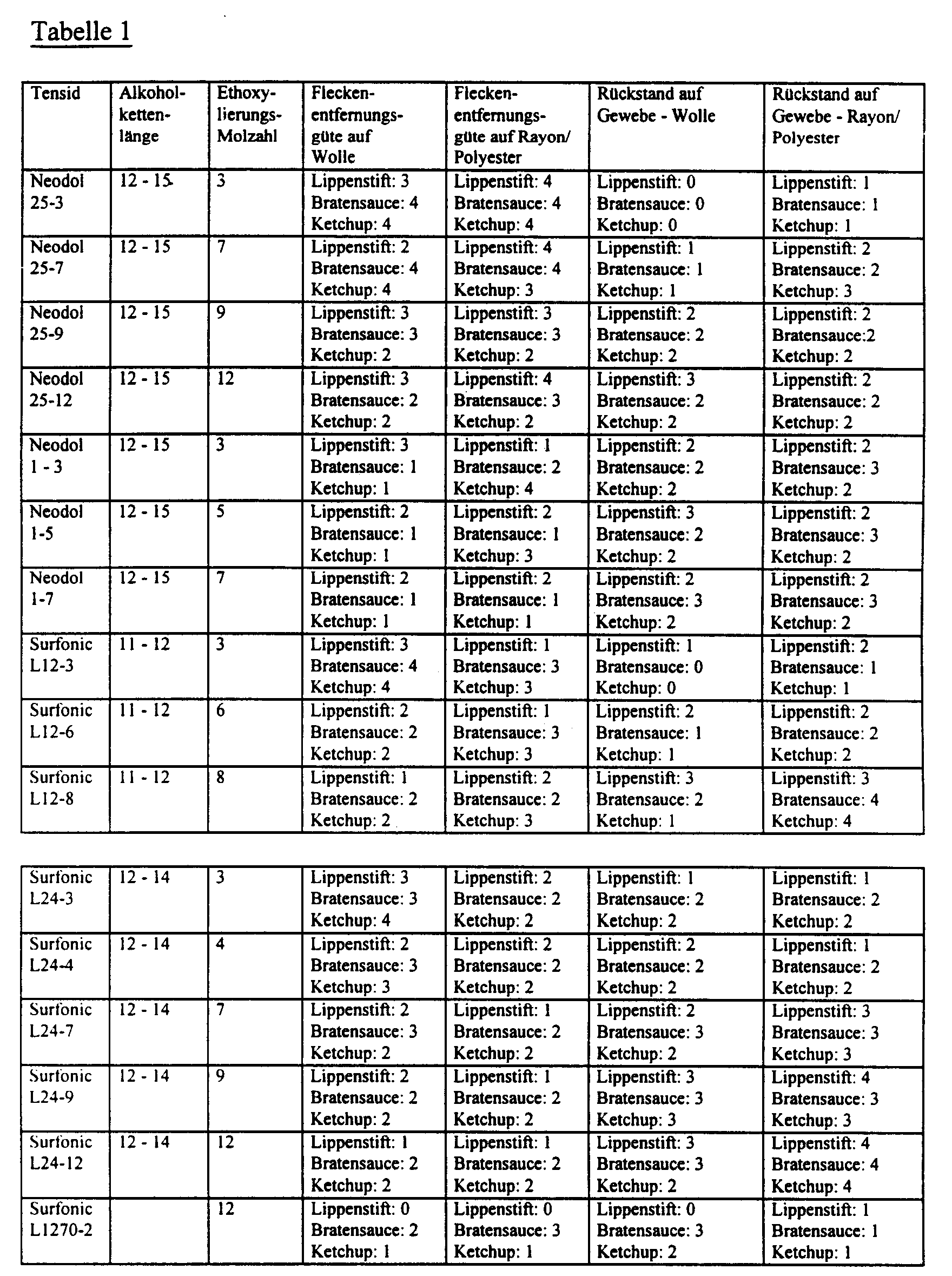
- Example 1 The agent described in Example 1 was made a total of sixteen times, with however, the alcohol chain length and ethoxylation mole number was varied in each case. Fabrics made of wool or rayon / polyester were stained with lipstick, gravy and add ketchup. Subsequently, every agent was applied to every stain brought. The results are summarized in Table 1.
Landscapes
- Chemical & Material Sciences (AREA)
- Life Sciences & Earth Sciences (AREA)
- Engineering & Computer Science (AREA)
- Chemical Kinetics & Catalysis (AREA)
- Oil, Petroleum & Natural Gas (AREA)
- Wood Science & Technology (AREA)
- Organic Chemistry (AREA)
- Health & Medical Sciences (AREA)
- Molecular Biology (AREA)
- Emergency Medicine (AREA)
- Detergent Compositions (AREA)
- Treatments For Attaching Organic Compounds To Fibrous Goods (AREA)
Abstract
Description
Der Einsatz von Reinigungsverfahren auf Lösemittelbasis war bisher primär auf gewerbliche Reinigungen beschränkt, die mit teuren Spezialgeräten arbeiten. Hierzu gehören Destillationsanlagen mit Kondensatoren, in denen die Dämpfe der oft toxischen Reinigungslösemittel im geschlossenen System geführt werden. Um derartige chemische Reinigungsverfahren nutzen zu können - speziell zur Entfernung wasserunlöslicher Flecken und/oder Verschmutzungen aus Kleidungsstücken - muss der Anwender die Kleidung daher in eine hierauf spezialisierte chemische Reinigung bringen und die gereinigten Kleidungsstücke später wieder abholen. Hieraus ergibt sich ein lästiger Zeitaufwand für den Gang zur Reinigung, die Wartezeit bis zur ordnungsgemäßen Durchführung des Reinigungsvorgangs, das Abholen sowie die Klärung etwaiger Beschädigungen bzw. Verluste von Kleidungsstücken. Zudem werden Kleidungsstücke und Gewebeprodukte unterschiedlichster Herkunft bei der chemischen Reinigung mit derselben Lösemittelcharge behandelt, wodurch in der Kleidung geruchsbelästigende Rückstände verbleiben können.
Inzwischen stehen Verfahren zur Verfügung, mittels derer der Verbraucher eine chemische Reinigung seiner Kleidung zu Hause in einem Rotations-Heißlufttrockner vornehmen kann. Bei diesen Verfahren werden die verschmutzten Gewebeteile in einen Kunststoff- oder Nylonbeutel gegeben, in den zusätzlich ein mit einem Reinigungs- bzw. Auffrischungsmittel (aus z.B. Wasser, Duftstoff und Tensiden) beschichtetes Flächengebilde gelegt wird. Der Beutei wird dann geschlossen und in einen Trockner gelegt, wo er eine Zeit lang bei erhöhten Temperaturen in einer rotierenden Trommel in Taumelbewegung gehalten wird, so dass das Reinigungs- bzw. Auffrischungsmittel seine Wirkung entfaltet und damit die Reinigung bzw. Auffrischung der Kleidungsstücke bewirkt.
Als Beispiele solcher bevorzugter nichtionischer grenzflächenaktiver Substanzen kommen u.a. die handelsüblichen Produkte Neodol 25-3, Neodol 23-3 (Hersteller jeweils: Shell Corp.), Surfonic L24-3, Surfonic L24-4 und Surfonic L1270-2 (Hersteller jeweils: Huntsman Corp.) in Frage. Bei den erfindungsgemäßen Zusammensetzungen ist es wünschenswert, dass der Anteil der nichtionischen grenzflächenaktiven Substanz zwischen 0.05 Gew.-% und 1,0 Gew.-%, jeweils bezogen auf das gesamte Mittel, beträgt.
Die erfindungsgemäßen Tensid-Substrate werden vorzugsweise in einem nassen oder feuchten Zustand gehalten.
Für erfindungsgemäße Tensid-Substrate bevorzugtes Substrat ist ein Flächengebilde. Dieses sollte flexibel sein und kann sinnvollerweise u.a. aus Maschenware oder - vorzugsweise - einem Vlies (Textilverbundstoff mit im wesentlichen geklebtem oder thermisch hergestelltem Faserverbund) bestehen. Auch Flächengebilde mit netzförmiger oder gerippter Faserstruktur oder in Form fasriger Matten mit zufälliger oder willkürlicher Faseranordnung sind verwendbar. Bei den Fasern kann es sich um Naturfasern (z.B. Wolle, Seide, Jute, Hanf, Baumwolle, Leinen, Sisal, Ramie) oder Kunstfasern wie Rayon, Zelluloseester, Polyvinylderivate, Polyolefine, Polyamide oder Polyester handeln. Dabei sind Fasern beliebiger Durchmesser bzw. Fadenfeinheiten einsetzbar. Vorzugsweise sollte das Vlies bei der Verwendung (z.B. in einem automatischen Trockner) eine gewisse Reiß- oder Auflösungsfestigkeit aufweisen; dies ist durch eine zufällige oder willkürliche Anordnung der Fasern im Verbund erzielbar, die für Festigkeit in alle Richtungen sorgt.
Beispiele für bevorzugtes Vliesmaterial, das sich im Rahmen der Erfindung als Substrat eignet, sind z.B. Flächengebilde aus 100% Rayon, 100% Polypropylen oder Materialgemischen (z.B. aus zellulosebasiertem Rayon und Kunstfasern).
Zugleich sollten die bevorzugten Flächengebilde eine Fläche zwischen etwa 12 Quadratzoll und etwa 224 Quadratzoll, jedoch im Idealfall zwischen etwa 48 Quadratzoll und etwa 120 Quadratzoll aufweisen. Ist der Beutel so klein, dass er nur ein einzelnes verschmutztes Gewebeprodukt oder mehrere kleine Gewebeprodukte aufnehmen kann (z.B. Abmessungen zwischen etwa 18" x 22" und etwa 20" x 26", jedoch vorzugsweise 20" x 24"), so sollte auch das Flächengebilde entsprechend klein sein (z.B. Abmessungen zwischen etwa 3" x 4" bis ca. 6" x 9", jedoch vorzugsweise 5⅝" x 8½").
In einer bevorzugten Ausführungsform ist das Substrat auf der Innenseite eines Behälters fixiert und kann dort beispielsweise durch Besprühen oder Aufwalzen mit einem Gewebebehandlungsmittel imprägniert bzw. beschichtet werden.
Der Begriff "Gewebe" bzw. "Gewebeprodukt" bezieht sich dabei nicht nur auf Kleidungsstücke, sondern auch auf beliebige sonstige Textilerzeugnisse, die üblicherweise chemisch gereinigt bzw. behandelt werden, so z.B. Bettlaken, Vorhänge, Teppiche, Polsterbezüge, Handtücher u.ä. Im Sinne dieser Erfindung kann "Gewebe" auch Wolle, Wollmischungen, Leinen, Baumwolle, Strick-, Wirk- und Häkelware, doppelflächige Strickware, Polyester, Twill, Synthetik usw. sowie feine Textilien wie z.B. 100% Acetat, Seide, Rayon, aber auch Gemische dieser Gewebe umfassen. Die erfindungsgemäßen Gewebebehandlungsmittel und Tensid-Substrate können sowohl für Gewebe im nassen als auch im feuchten oder trockenen Zustand verwendet werden.
Das Verfahren umfaßt dabei folgende Schritte:
Das Gewebebehandlungsmittel wird in einer bevorzugten Ausführungsform direkt auf das verschmutzte Gewebe, das gereinigt werden soll, aufgebracht, z.B. indem das chemische Gewebebehandlungsmittel auf das Gewebe als Spray aufgesprüht, mittels Schwamm oder Spritzflasche aufgetragen, aufgetupft, aufgerollt, aufgewalzt oder als feuchtes oder trokkenes Pulver oder Granulat aufgestreut wird. Selbstversändlich sind auch beliebige Kombinationen der Applikationen möglich. Bevorzugt wird das Gewebebehandlungsmittel durch Betupfen mittels des erfindungsgemäßen Tensid-Substrats appliziert.
In einer bevorzugten Ausführungsform, ist die Einbringung einer wirksamen Menge des Gewebebehandlungsmittels in einem Behälter realisierbar. Die Applikation, besteht darin, dass eine wirksame Menge des Gewebebehandlungsmittels in einem Teil der BehälterInnenfläche selbst - zumindest in einem Teil derselben -freisetzbar in Absorption gebracht wird. So kann es sich z.B. bei der inneren Absorptionsfläche um ein Vlies handeln, das nach Herstellung des Behältnisses in einem zweiten Schritt an dessen Innenseite befestigt wird. Es besteht auch die Möglichkeit, das Gewebebehandlungsmittel auf die innere absorptionsfähige Fläche der Behälterwandung selbst aufzutragen (z.B. durch Besprühen), nachdem der Behälter hergestellt wurde.
Während das Mittel die Verunreinigungen aus dem Gewebe beseitigt, können überschüssige Feuchtigkeit sowie der entfernte Schmutz auf Wunsch auch von der absorptionsfähigen Fläche des Behälters aufgenommen werden. Möglich ist auch ein manuelles Abreiben fleckiger Gewebebereiche mit der Innenseite des imprägnierten Behälters, um die verschmutzten Flächen mit dem Mittel schmutzlösend vorzubehandeln. Die Behältervorrichtung kann so ausgeführt sein, dass sie nach Gebrauch entsorgt wird, lässt sich jedoch aus einem Material fertigen, das einen mehrmaligen Gebrauch im Rahmen verschiedener Reinigungszyklen zuläßt.
Danach wird das Gewebe in den Behälter gelegt und dessen Öffnung verschlossen. Die Behälter werden nachfolgend noch ausführlicher beschrieben.
Der Behälter lässt sich in einer Vorrichtung zur Durchmischung z.B. in einen Rotations-Heißlufttrockner einlegen, um die wirkungsnotwendige Wärme und Durchmischung (Taumelbewegung) herbeizuführen.
In einer bevorzugten Ausführungsform sieht die Erfindung weiterhin ein Verfahren zur Reinigung, Konditionierung und/oder Auffrischung verschmutzter Gewebeprodukte vor, bei dem (a) ein verschmutztes (z.B. fleckiges und/oder auffrischungsbedürftiges) Gewebeprodukt zusammen mit einem Tensid-Substrat in ein verschließbares Behältnis gegeben, (b) die Öffnung des Behältnisses verschlossen und (c) das Behältnis mit seinem Inhalt in einem Trockner in eine Taumelbewegung versetzt wird, und zwar bei einer Temperatur, die bewirkt, dass das Gewebebehandlungsmittel in flüssigem oder gasförmigem Zustand freigesetzt wird, und so lange, dass eine wirksame Menge des freigesetzten Mittels mit dem verschmutzten Gewebe in Berührung gelangt und dieses damit behandelt, den Schmutz gegebenenfalls dispergiert, reinigt und/oder auffrischt.
Die Freisetzung des erfindungsgemäßen Gewebebehandlungsmittels aus dem erfindungsgemäßen Tensid-Substrat kann auf jede gewünschte Weise erfolgen, z.B. beim gemeinsamen Schleudern von Gewebeprodukten und Tensid-Substrat in dem Beutel, vorzugsweise im erhitzten Zustand.
In dieser Ausführungsform der Erfindung werden z.B. ein oder mehrere Gewebeprodukte sowie ein entsprechend großes, flexibles Flächengebilde, das ein Gewebebehandlungsmittel trägt (Tensid-Substrat), in einen Beutel gelegt, dessen Öffnung dann geschlossen wird, woraufhin der Beutel dann so intensiv bewegt und/oder erwärmt wird, dass das Mittel bei Berührung mit den Gewebeprodukten aus dem flexiblen Flächengebilde freigesetzt wird. Das Flächengebilde beschreibt eine Taumelbewegung inmitten der Gewebeprodukte und bewirkt damit die gleichmäßige Verteilung des Mittels auf diese Produkte. Durch diese Berührung werden die Gewebeprodukte gereinigt, aufgefrischt oder auf sonstige Weise mit dem Mittel behandelt.
Im Anschluß an den Trockenreinigungsvorgang können die behandelten Gewebestücke dem Behälter entnommen werden.
Weiterhin enthält das Gewebebehandlungssystem als Komponente b) ein oder mehrere Behälter.
Die Behälter weisen in der Regel eine Öffnung auf und verfügen über Seiten oder Wände mit jeweils einer Innen- und Außenfläche. Der Behälter kann aus jedem Material gefertigt sein, das zur Aufnahme von Gewebeprodukten geeignet ist, ohne dabei im Wesentlichen seine Form bzw. seinen Zusammenhalt zu verlieren. Ein solches Material ist für den Fachmann ohne weiteres auswählbar. Der Behälter sollte vorzugsweise auch eine zum Einsatz in Rotations-Heißlufttrocknern ausreichende thermische Stabilität aufweisen. Zudem sollte der Behälter unter bestimmtem Bedingungen wie z.B. einer Temperatur, bei der die Freisetzung des Gewebebehandlungsmittels aus dem Substrat, Gewebe usw. bewirkt, im wesentlichen unbeschädigt bleiben. Vorzugsweise sollten dem Beutel auch die "Heißstellen" im Trockner, an denen die Temperatur bis zu 200°C erreichen kann, nichts anhaben können. Bevorzugt sind weiterhin verschließbare, wasserdampfundurchlässige Beutel, die ein geschlossenes System bilden können.
Die Öffnung braucht auch nicht oben an dem Beutel angeordnet, sondern kann an einer beliebigen seitlichen Stelle vorgesehen und beliebig ausgestaltet sein. Die Unter- und Seitenkanten des Beutels können durch Faltung, Thermoschweißen, Verkleben oder eine Kombination dieser Verfahren zusammengefügt sein. Je nach gewünschtem Endeinsatz kann der Beutel hermetisch geschlossen sein oder auch nicht.
In einer besonders bevorzugten Ausführungsform ist auf der Innenseite des Behälters ein Substrat fixiert, das gegebenenfalls mit einem beliebigen Gewebebehandlungsmittel imprägniert oder beschichtet sein kann. So kann es sich z.B. bei der inneren Absorptionsfläche um ein Vlies handeln, das nach Herstellung des Behältnisses in einem zweiten Schritt an dessen Innenseite befestigt wird. Es besteht auch die Möglichkeit, das erfindungsgemäße Gewebebehandlungsmittel auf die innere absorptionsfähige Fläche der Behälterwandung selbst aufzutragen (z.B. durch Besprühen), nachdem der Behälter hergestellt wurde.
Weiterhin enthält das Gewebebehandlungssystem als Komponente c) ein oder mehrere erfindungsgemäße Tensid-Substrate und/oder ein oder mehrere Substrate ohne Gewebebehandlungsmittel, wie sie oben bereits beschrieben wurden.
Claims (36)
- Gewebebehandlungsmittel, das folgende Bestandteile umfasst:a) Wasserb) nichtionische Tenside auf ethoxylierter Alkoholbasis mit einer Alkokolkettenlänge von 11 - 16 Kohlenstoffatomen und einem Anteil von 1,6-7 Mol Ethylenoxidc) anionische Tenside aus der Gruppe, die aus Alkylalkoholsulfaten, Alkoholethoxysulfaten, Alkylalkoholbenzolsulfonaten sowie Gemische dieser Verbindungen besteht.
- Gewebebehandlungsmittel nach einem der vorstehenden Ansprüche, dadurch gekennzeichnet, daß es als nichtionische Tenside ethoxylierte Alkohole mit einer Kettenlänge von 12-15 Kohlenstoffatomen und 3 bis 7 Mol Ethylenoxid, vorzugsweise 3 bis 5 Mol Ethylenoxid, enthält.
- Gewebebehandlungsmittel nach einem der vorstehenden Ansprüche, dadurch gekennzeichnet, daß es nichtionische Tenside in Mengen von 0,05 bis 1,0 Gew.-%, bezogen auf das gesamte Mittel, enthält.
- Gewebebehandlungsmittel nach einem der vorstehenden Ansprüche, dadurch gekennzeichnet, daß es anionische Tenside in Mengen von 0,1 bis 0,8 Gew.-%, bezogen auf das gesamte Mittel, enthält.
- Gewebebehandlungsmittel nach einem der vorstehenden Ansprüche, dadurch gekennzeichnet, daß es als anionisches Tensid Kokosfettalkohol-Ethersulfat enthält.
- Gewebebehandlungsmittel nach einem der vorstehenden Ansprüche, dadurch gekennzeichnet, daß das Gewichtsverhältnis von nichtionischem zu anionischem Tensid zwischen 49,3:50,7 bis 30,9:69,4 liegt.
- Gewebebehandlungsmittel nach einem der vorstehenden Ansprüche, dadurch gekennzeichnet, daß es Verdickungsmittel enthält.
- Gewebebehandlungsmittel nach einem der vorstehenden Ansprüche, dadurch gekennzeichnet, daß es als Verdickungsmittel Polysaccharidgummi-Arten, insbesondere Carragenan-Pulver, enthält.
- Gewebebehandlungsmittel nach einem der vorstehenden Ansprüche, dadurch gekennzeichnet, daß es Verdickungsmittel in Mengen von 0,01 bis 10 Gew.-%, bezogen auf die gesamte Mischung, enthält.
- Gewebebehandlungsmittel nach einem der vorstehenden Ansprüche, dadurch gekennzeichnet, daß es organische Lösungsmittel, vorzugsweise Glykolether, enthält.
- Gewebebehandlungsmittel nach einem der vorstehenden Ansprüche, dadurch gekennzeichnet, daß es organische Lösungsmittel in Mengen von 2 bis 99 Gew.-%, vorzugsweise von 5 bis 15 Gew.-%, jeweils bezogen auf das gesamte Mittel, enthält.
- Gewebebehandlungsmittel nach einem der vorstehenden Ansprüche, dadurch gekennzeichnet, daß es zusätzlich amphotere Tenside, vorzugsweise C8-C22-Alkyldimethylaminoxide und insbesondere das Lauryldimethylaminoxid, enthält.
- Gewebebehandlungsmittel nach einem der vorstehenden Ansprüche, dadurch gekennzeichnet, daß es Duftstoffe enthält.
- Gewebebehandlungsmittel nach einem der vorstehenden Ansprüche, dadurch gekennzeichnet, daß es weitere Gewebebehandlungsmittel wie Knitterverhinderer, Fettsäurekondensate, Schaumverhinderer, Schmutzabweisungsmittel, Bakteriostatika, Aufheller, Standverbesserer, Farbstoffe, Colorierungsmittel, Faserweichmacher, Appreturmittel, keimtötende Substanzen, Avivagemittel, Anti-Schimmel- bzw. Anti-Motten-Wirkstoffe, Schrumpfverhinderer, Konservierungsstoffe, Faserweichmacher, Fleckentferner, Deodorante, Insektenabweiser, Schlichtemittel, Stärke sowie beliebige Gemische dieser Substanzen, enthält.
- Tensid-Substrat, dadurch gekennzeichnet, daß es mit einem Gewebebehandlungsmittel nach einem der Ansprüche 1 bis 14 imprägniert oder beschichtet ist.
- Tensid-Substrat nach Anspruch 15, dadurch gekennzeichnet, daß es in Form eines flexiblen Flächengebildes, insbesondere in der Form eines Blattes, Tuches, Bogens, Sterns, Tieres, Schwamms, Kugel, Stabes, sphärischen Körpers, Granulats oder Würfels, vorliegt.
- Tensid-Substrat nach Anspruch 15 oder 16, dadurch gekennzeichnet, daß es aus Maschenware oder Vlies mit gegebenenfalls netzförmiger oder gerippter Faserstruktur aus Wolle, Seide, Jute, Hanf, Baumwolle, Leinen, Sisal, Ramie, Rayon, Zelluloseester, Polyvinylderivate, Polyolefine, Polyamide, Polyester sowie Gemischen davon besteht.
- Tensid-Substrat nach Anspruch 15 bis 17, dadurch gekennzeichnet, daß es auf der Innenseite eines Behälters fixiert ist.
- Verfahren zur Herstellung eines Tensid-Substrats nach einem der Ansprüche 15 bis 18, dadurch gekennzeichnet, daß die Imprägnierung oder Beschichtung des Substrats mit dem Gewebebehandlungsmittel durch Sprühen, Tupfen, Begießen, Aufwalzen, Aufrollen sowie beliebiger Kombinationen hiervon, erfolgt.
- Verwendung eines flüssigen Gewebebehandlungsmittels nach einem der Ansprüche 1 bis 14 zur Schmutzfleck(vor)behandlung, Auffrischung oder sonstigen Konditionierung vor einem anschließenden Trockenreinigungsverfahren.
- Verwendung eines Tensid-Substrats nach einem der Ansprüche 15 bis 18 zur
Schmutzfleck(vor)behandlung, Auffrischung oder sonstigen Konditionierung vor oder während eines Trockenreinigungsverfahrens. - Verfahren zur Auffrischung, Konditionierung oder Reinigung eines gegebenenfalls verschmutzten Gewebes, dadurch gekennzeichnet, daßa) auf den verfleckten Bereich des verschmutzten Gewebes das flüssige Gewebebehandlungsmittel appliziert wird,b) das Gewebebehandlungsmittel eine beliebige Zeit einwirkt,c) das vorbehandelte Gewebe in einen verschließbaren Behälter eingebracht und der Behälter verschlossen wird,d) der Behälter mit dem vorbehandelten Gewebe in einer Vorrichtung zur Durchmischung hin und her gewälzt wird,e) die gereinigten Gewebe dem Behälter entnommen werden.
- Verfahren nach Anspruch 22, dadurch gekennzeichnet, daß die Applikation des Gewebebehandlungsmittels auf den verfleckten Bereich des Gewebes durch Sprühen, Tupfen, Begießen, Aufwalzen, Aufrollen sowie beliebiger Kombinationen hiervon, erfolgt.
- Verfahren nach einem der Ansprüche 22 oder 23, dadurch gekennzeichnet, daß man das Gewebebehandlungsmittel zwischen 5 und 600 s, vorzugsweise zwischen 10 und 300 s, besonders bevorzugt zwischen 15 und 250 s und insbesondere zwischen 20 und 180 s einwirken läßt.
- Verfahren nach einem der Ansprüche 22 bis 24, dadurch gekennzeichnet, daßa) das gegebenenfalls verschmutzte oder vorbehandelte Gewebe zusammen mit einem Tensid-Substrat in einen Behälter gelegt wird,b) der Behälter verschlossen wird,c) der Behälter mit dem Gewebe und dem Tensid-Substrat in einer Vorrichtung zur Durchmischung hin und her gewälzt wird,d) die gereinigten oder konditionierten Gewebe aus dem Behälter entnommen werden.
- Verfahren nach Anspruch 25, dadurch gekennzeichnet, daß das gegebenenfalls verschmutzte oder vorbehandelte Gewebe zusammen mit einem Tensid-Substrat nach einem der Ansprüche 15 bis 18 in einen Behälter gelegt wird.
- Verfahren nach einem Ansprüche 22 bis 26, dadurch gekennzeichnet, daß der verschließbare Behälter ein Trockner- und Hitze-beständiger Beutel, vorzugsweise ein wasserdampfundurchlässiger Beutel, der ein geschlossenes System bildet, ist.
- Verfahren nach einem der Ansprüche 22 bis 27, dadurch gekennzeichnet, daß der verschließbare Behälter ein Beutel mit einer Öffnung ist, welche reversibel verschließbar ist, wobei das Verschlußsystem Druckknöpfe, Clips, einen Reißverschluß, einen Klettverschluß, einen Reißverschluß des Einsrasttyps oder einander gegenüberliegender Streifen mit einem wiederverschließbaren Kleber aufweist.
- Verfahren nach einem der Ansprüche 22 bis 28, dadurch gekennzeichnet, daß auf der Innenseite des verschließbaren Behälters ein Substrat fixiert ist, das gegebenenfalls mit einem beliebigen Gewebebehandlungsmittel imprägniert oder beschichtet ist.
- Gewebebehandlungssystem, enthaltenda) ein oder mehrere Gewebebehandlungsmittel nach einem der Ansprüche 1 bis 14 in einem oder mehreren Applikator(en),b) ein oder mehrere verschließbare Behälterc) und ein oder mehrere Substrate und/oder Tensid-Substrate.
- Gewebebehandlungssystem nach Anspruch 30, dadurch gekennzeichnet, daß sich das Gewebebehandlungsmittel in einer Tube oder Flasche mit einem Schwamm am Auslaßende (engl.: dauber), in einem Flüssigkeitsbehälter mit Dosiersystem, einer verschließbaren Spritzflasche oder einer Sprühflasche befindet.
- Gewebebehandlungssystem nach einem der Ansprüche 30 oder 31, dadurch gekennzeichnet, daß der verschließbare Behälter ein Trockner- und Hitze-beständiger Beutel, vorzugsweise ein wasserdampfundurchlässiger Beutel, der ein geschlossenes System bildet, ist.
- Gewebebehandlungssystem nach einem der Ansprüche 30 bis 32, dadurch gekennzeichnet, daß der verschließbare Behälter ein Beutel mit einer Öffnung ist. welche reversibel verschließbar ist, wobei das Verschlußsystem Druckknöpfe, Clips, einen Reißverschluß, einen Klettverschluß, einen Reißverschluß des Einsrasttyps oder einander gegenüberliegender Streifen mit einem wiederverschließbaren Kleber aufweist.
- Gewebebehandlungssystem nach einem der Ansprüche 30 bis 33, dadurch gekennzeichnet, daß auf der Innenseite des verschließbaren Behälters ein Substrat fixiert ist, das gegebenenfalls mit einem beliebigen Gewebebehandlungsmittel imprägniert oder beschichtet ist.
- Gewebebehandlungssystem nach einem der Ansprüche 30 bis 34, dadurch gekennzeichnet, daß es ein Tensid-Substrat nach einem der Ansprüche 15 bis 18 enthält.
- Gewebebehandlungssystem nach einem der Ansprüche 30 bis 35, dadurch gekennzeichnet, daß es ein Substrat, in Form eines flexiblen Flächengebildes, insbesondere in der Form eines Blattes, Tuches, Bogens, Sterns, Tieres, Schwamms, Kugel, Stabes, sphärischen Körpers, Granulats oder Würfels, wobei das Substrat vorzugsweise aus Maschenware oder Vlies mit gegebenenfalls netzförmiger oder gerippter Faserstruktur aus Wolle, Seide, Jute, Hanf, Baumwolle, Leinen, Sisal, Ramie, Rayon, Celluloseester, Polyvinylderivate, Polyolefine, Polyamide, Polyester sowie Gemischen davon besteht, enthält.
Applications Claiming Priority (2)
| Application Number | Priority Date | Filing Date | Title |
|---|---|---|---|
| US16585399P | 1999-11-16 | 1999-11-16 | |
| US165853P | 1999-11-16 |
Publications (2)
| Publication Number | Publication Date |
|---|---|
| EP1101816A2 true EP1101816A2 (de) | 2001-05-23 |
| EP1101816A3 EP1101816A3 (de) | 2001-08-16 |
Family
ID=22600752
Family Applications (1)
| Application Number | Title | Priority Date | Filing Date |
|---|---|---|---|
| EP00121988A Withdrawn EP1101816A3 (de) | 1999-11-16 | 2000-10-10 | Gewebebehandlungsmittel mit optimierten Fleckenentfernungseigenschaften |
Country Status (3)
| Country | Link |
|---|---|
| EP (1) | EP1101816A3 (de) |
| AU (1) | AU1352801A (de) |
| WO (2) | WO2001036574A1 (de) |
Cited By (4)
| Publication number | Priority date | Publication date | Assignee | Title |
|---|---|---|---|---|
| WO2005003435A3 (en) * | 2003-06-27 | 2005-06-02 | Procter & Gamble | Fabric article treatment composition for use in a lipophilic fluid system |
| EP3418359A1 (de) * | 2017-06-22 | 2018-12-26 | The Procter & Gamble Company | Reinigungsprodukt |
| US11124739B2 (en) | 2017-06-22 | 2021-09-21 | The Procter & Gamble Company | Cleaning product |
| US11180715B2 (en) | 2017-06-22 | 2021-11-23 | The Procter & Gamble Company | Sprayable cleaning composition |
Families Citing this family (2)
| Publication number | Priority date | Publication date | Assignee | Title |
|---|---|---|---|---|
| US7980001B2 (en) * | 2004-02-27 | 2011-07-19 | The Procter & Gamble Company | Fabric conditioning dispenser and methods of use |
| US20250368923A1 (en) * | 2024-05-29 | 2025-12-04 | The Clorox Company | Pre-moistened articles for refreshing clothing in the dryer |
Family Cites Families (9)
| Publication number | Priority date | Publication date | Assignee | Title |
|---|---|---|---|---|
| DE2559225A1 (de) * | 1975-01-03 | 1976-07-15 | Procter & Gamble Europ | Fluessiges wasch- und reinigungsmittel sowie seine anwendung |
| US5480567A (en) * | 1994-01-14 | 1996-01-02 | Lever Brothers Company, Division Of Conopco, Inc. | Surfactant mixtures for fabric conditioning compositions |
| US5630847A (en) * | 1995-03-30 | 1997-05-20 | The Procter & Gamble Company | Perfumable dry cleaning and spot removal process |
| WO1996039556A1 (en) * | 1995-06-05 | 1996-12-12 | Creative Products Resource, Inc. | Dry-cleaning kit for in-dryer use |
| GB9604883D0 (en) * | 1996-03-07 | 1996-05-08 | Reckitt & Colman Inc | Improvements in or relating to organic compositions |
| ATE207106T1 (de) * | 1996-01-19 | 2001-11-15 | Unilever Nv | Nicht-kationische systeme für gewebetrocknerblätter |
| US5789368A (en) * | 1996-01-26 | 1998-08-04 | The Procter & Gamble Company | Fabric care bag |
| CA2256890A1 (en) * | 1996-05-29 | 1997-12-04 | The Procter & Gamble Company | Phase-stable liquid fabric refreshment composition |
| US5872090A (en) * | 1996-10-25 | 1999-02-16 | The Procter & Gamble Company | Stain removal with bleach |
-
2000
- 2000-10-10 EP EP00121988A patent/EP1101816A3/de not_active Withdrawn
- 2000-10-31 WO PCT/US2000/029859 patent/WO2001036574A1/en not_active Ceased
- 2000-10-31 AU AU13528/01A patent/AU1352801A/en not_active Abandoned
- 2000-11-08 WO PCT/EP2000/011002 patent/WO2001036573A2/de not_active Ceased
Cited By (4)
| Publication number | Priority date | Publication date | Assignee | Title |
|---|---|---|---|---|
| WO2005003435A3 (en) * | 2003-06-27 | 2005-06-02 | Procter & Gamble | Fabric article treatment composition for use in a lipophilic fluid system |
| EP3418359A1 (de) * | 2017-06-22 | 2018-12-26 | The Procter & Gamble Company | Reinigungsprodukt |
| US11124739B2 (en) | 2017-06-22 | 2021-09-21 | The Procter & Gamble Company | Cleaning product |
| US11180715B2 (en) | 2017-06-22 | 2021-11-23 | The Procter & Gamble Company | Sprayable cleaning composition |
Also Published As
| Publication number | Publication date |
|---|---|
| WO2001036573A3 (de) | 2002-03-14 |
| EP1101816A3 (de) | 2001-08-16 |
| WO2001036574A1 (en) | 2001-05-25 |
| WO2001036573A2 (de) | 2001-05-25 |
| AU1352801A (en) | 2001-05-30 |
Similar Documents
| Publication | Publication Date | Title |
|---|---|---|
| DE69620417T2 (de) | Fleckenputzmittel | |
| DE69624486T2 (de) | Trockenreinigungverfahren mit hitzebeständigem beutel | |
| DE69709707T2 (de) | Gewebebehandlungsmittel mit kontrollierter freisetzung | |
| DE60028775T2 (de) | Auftragvorrichtung zum behandeln von gewebe | |
| EP0036833B1 (de) | Verfahren zur Reinigung von Textilmaterial | |
| CA2135746C (en) | Dry-cleaning kit for in-dryer use | |
| US5547476A (en) | Dry cleaning process | |
| DE60022528T2 (de) | Verwendung von wäscheweichmacherzusammensetzungen | |
| DE60023328T2 (de) | Verwendung von wäscheweichmacherzusammensetzungen | |
| DE2635257A1 (de) | Mittel zum nachbehandeln gewaschener waesche im waeschetrockner | |
| JPH11502888A (ja) | 乳化された水/溶剤クリーニング組成物 | |
| CZ20001073A3 (cs) | Soupravy pro chemické čištění zahrnující prostředky obsahující kyselinu polysulfonovou | |
| JPH11502886A (ja) | ドライクリーニングおよびスポット除去組成物 | |
| WO2011051140A1 (de) | Waschen mit polymerkörpern | |
| EP1122302A1 (de) | Behandlung von Schmutz auf Textilien | |
| DE1965470B2 (de) | Verwendung eines Erzeugnisses aus einem absorbierenden Substrat und einem Gewebeweichmachungsmittel zum Weichmachen von Geweben | |
| JPH11507107A (ja) | 二段階染み除去法 | |
| DE2537402A1 (de) | Stoffweichmacherpraeparat | |
| DE2700512A1 (de) | Gegenstand und verfahren zur behandlung von geweben | |
| DE2603823A1 (de) | Duftkissen, insbesondere fuer die verwendung in waeschetrocknern | |
| DE69625215T2 (de) | Handreinigungsmittel | |
| DE60129127T2 (de) | Kit zur textilpflege | |
| DE69934423T2 (de) | Artikel zur chemisch-reinigung, zusammensetzung und verfahren | |
| EP1101816A2 (de) | Gewebebehandlungsmittel mit optimierten Fleckenentfernungseigenschaften | |
| DE69923990T2 (de) | Verfahren zum waschen von empfindliche wäsche in eine waschmachine |
Legal Events
| Date | Code | Title | Description |
|---|---|---|---|
| PUAI | Public reference made under article 153(3) epc to a published international application that has entered the european phase |
Free format text: ORIGINAL CODE: 0009012 |
|
| 17P | Request for examination filed |
Effective date: 20001010 |
|
| AK | Designated contracting states |
Kind code of ref document: A2 Designated state(s): AT BE CH CY DE DK ES FI FR GB GR IE IT LI LU MC NL PT SE |
|
| AX | Request for extension of the european patent |
Free format text: AL;LT;LV;MK;RO;SI |
|
| PUAL | Search report despatched |
Free format text: ORIGINAL CODE: 0009013 |
|
| AK | Designated contracting states |
Kind code of ref document: A3 Designated state(s): AT BE CH CY DE DK ES FI FR GB GR IE IT LI LU MC NL PT SE |
|
| AX | Request for extension of the european patent |
Free format text: AL;LT;LV;MK;RO;SI |
|
| AKX | Designation fees paid |
Free format text: AT BE CH CY DE DK ES FI FR GB GR IE IT LI LU MC NL PT SE |
|
| STAA | Information on the status of an ep patent application or granted ep patent |
Free format text: STATUS: THE APPLICATION IS DEEMED TO BE WITHDRAWN |
|
| 18D | Application deemed to be withdrawn |
Effective date: 20020218 |