EP1083881B1 - LIPOSOME COMPOSITIONs containing a quinolone derivative AND their use as antibacterial agents - Google Patents
LIPOSOME COMPOSITIONs containing a quinolone derivative AND their use as antibacterial agents Download PDFInfo
- Publication number
- EP1083881B1 EP1083881B1 EP99916160A EP99916160A EP1083881B1 EP 1083881 B1 EP1083881 B1 EP 1083881B1 EP 99916160 A EP99916160 A EP 99916160A EP 99916160 A EP99916160 A EP 99916160A EP 1083881 B1 EP1083881 B1 EP 1083881B1
- Authority
- EP
- European Patent Office
- Prior art keywords
- liposomes
- drug
- ciprofloxacin
- liposome
- composition according
- Prior art date
- Legal status (The legal status is an assumption and is not a legal conclusion. Google has not performed a legal analysis and makes no representation as to the accuracy of the status listed.)
- Expired - Lifetime
Links
- 239000002502 liposome Substances 0.000 title claims abstract description 197
- 239000000203 mixture Substances 0.000 title claims abstract description 38
- 150000007660 quinolones Chemical class 0.000 title description 8
- 239000003242 anti bacterial agent Substances 0.000 title 1
- MYSWGUAQZAJSOK-UHFFFAOYSA-N ciprofloxacin Chemical compound C12=CC(N3CCNCC3)=C(F)C=C2C(=O)C(C(=O)O)=CN1C1CC1 MYSWGUAQZAJSOK-UHFFFAOYSA-N 0.000 claims abstract description 109
- 229960003405 ciprofloxacin Drugs 0.000 claims abstract description 98
- 150000001413 amino acids Chemical class 0.000 claims abstract description 22
- 229920001477 hydrophilic polymer Polymers 0.000 claims abstract description 14
- 208000035143 Bacterial infection Diseases 0.000 claims abstract description 5
- 208000022362 bacterial infectious disease Diseases 0.000 claims abstract description 5
- 150000002632 lipids Chemical class 0.000 claims description 56
- 229940024606 amino acid Drugs 0.000 claims description 30
- -1 quinolone compound Chemical class 0.000 claims description 26
- 238000000034 method Methods 0.000 claims description 22
- 235000001014 amino acid Nutrition 0.000 claims description 21
- 150000002500 ions Chemical class 0.000 claims description 19
- 239000012071 phase Substances 0.000 claims description 18
- CJVMYPHDEMEFEM-UHFFFAOYSA-N 6-fluoro-1h-quinolin-2-one Chemical compound C1=C(F)C=CC2=NC(O)=CC=C21 CJVMYPHDEMEFEM-UHFFFAOYSA-N 0.000 claims description 13
- DHMQDGOQFOQNFH-UHFFFAOYSA-N Glycine Chemical compound NCC(O)=O DHMQDGOQFOQNFH-UHFFFAOYSA-N 0.000 claims description 12
- 230000014759 maintenance of location Effects 0.000 claims description 10
- QGZKDVFQNNGYKY-UHFFFAOYSA-O Ammonium Chemical compound [NH4+] QGZKDVFQNNGYKY-UHFFFAOYSA-O 0.000 claims description 9
- 239000004471 Glycine Substances 0.000 claims description 9
- 150000003863 ammonium salts Chemical class 0.000 claims description 7
- 239000008346 aqueous phase Substances 0.000 claims description 7
- 230000007704 transition Effects 0.000 claims description 6
- ROHFNLRQFUQHCH-YFKPBYRVSA-N L-leucine Chemical compound CC(C)C[C@H](N)C(O)=O ROHFNLRQFUQHCH-YFKPBYRVSA-N 0.000 claims description 5
- ROHFNLRQFUQHCH-UHFFFAOYSA-N Leucine Natural products CC(C)CC(N)C(O)=O ROHFNLRQFUQHCH-UHFFFAOYSA-N 0.000 claims description 5
- 239000004473 Threonine Substances 0.000 claims description 5
- LYCAIKOWRPUZTN-UHFFFAOYSA-N Ethylene glycol Chemical compound OCCO LYCAIKOWRPUZTN-UHFFFAOYSA-N 0.000 claims description 4
- QNAYBMKLOCPYGJ-REOHCLBHSA-N L-alanine Chemical compound C[C@H](N)C(O)=O QNAYBMKLOCPYGJ-REOHCLBHSA-N 0.000 claims description 4
- AYFVYJQAPQTCCC-GBXIJSLDSA-N L-threonine Chemical compound C[C@@H](O)[C@H](N)C(O)=O AYFVYJQAPQTCCC-GBXIJSLDSA-N 0.000 claims description 4
- AYFVYJQAPQTCCC-UHFFFAOYSA-N Threonine Natural products CC(O)C(N)C(O)=O AYFVYJQAPQTCCC-UHFFFAOYSA-N 0.000 claims description 4
- 235000004279 alanine Nutrition 0.000 claims description 4
- 125000004193 piperazinyl group Chemical group 0.000 claims description 4
- MTCFGRXMJLQNBG-REOHCLBHSA-N (2S)-2-Amino-3-hydroxypropansäure Chemical compound OC[C@H](N)C(O)=O MTCFGRXMJLQNBG-REOHCLBHSA-N 0.000 claims description 3
- GSDSWSVVBLHKDQ-UHFFFAOYSA-N 9-fluoro-3-methyl-10-(4-methylpiperazin-1-yl)-7-oxo-2,3-dihydro-7H-[1,4]oxazino[2,3,4-ij]quinoline-6-carboxylic acid Chemical compound FC1=CC(C(C(C(O)=O)=C2)=O)=C3N2C(C)COC3=C1N1CCN(C)CC1 GSDSWSVVBLHKDQ-UHFFFAOYSA-N 0.000 claims description 3
- RUXPNBWPIRDVTH-UHFFFAOYSA-N Amifloxacin Chemical compound C1=C2N(NC)C=C(C(O)=O)C(=O)C2=CC(F)=C1N1CCN(C)CC1 RUXPNBWPIRDVTH-UHFFFAOYSA-N 0.000 claims description 3
- AGPKZVBTJJNPAG-WHFBIAKZSA-N L-isoleucine Chemical compound CC[C@H](C)[C@H](N)C(O)=O AGPKZVBTJJNPAG-WHFBIAKZSA-N 0.000 claims description 3
- KZSNJWFQEVHDMF-BYPYZUCNSA-N L-valine Chemical compound CC(C)[C@H](N)C(O)=O KZSNJWFQEVHDMF-BYPYZUCNSA-N 0.000 claims description 3
- MTCFGRXMJLQNBG-UHFFFAOYSA-N Serine Natural products OCC(N)C(O)=O MTCFGRXMJLQNBG-UHFFFAOYSA-N 0.000 claims description 3
- KZSNJWFQEVHDMF-UHFFFAOYSA-N Valine Natural products CC(C)C(N)C(O)=O KZSNJWFQEVHDMF-UHFFFAOYSA-N 0.000 claims description 3
- 229950009484 amifloxacin Drugs 0.000 claims description 3
- XBJBPGROQZJDOJ-UHFFFAOYSA-N fleroxacin Chemical compound C1CN(C)CCN1C1=C(F)C=C2C(=O)C(C(O)=O)=CN(CCF)C2=C1F XBJBPGROQZJDOJ-UHFFFAOYSA-N 0.000 claims description 3
- 229960003306 fleroxacin Drugs 0.000 claims description 3
- 229960000310 isoleucine Drugs 0.000 claims description 3
- AGPKZVBTJJNPAG-UHFFFAOYSA-N isoleucine Natural products CCC(C)C(N)C(O)=O AGPKZVBTJJNPAG-UHFFFAOYSA-N 0.000 claims description 3
- ZEKZLJVOYLTDKK-UHFFFAOYSA-N lomefloxacin Chemical compound FC1=C2N(CC)C=C(C(O)=O)C(=O)C2=CC(F)=C1N1CCNC(C)C1 ZEKZLJVOYLTDKK-UHFFFAOYSA-N 0.000 claims description 3
- 229960002422 lomefloxacin Drugs 0.000 claims description 3
- OGJPXUAPXNRGGI-UHFFFAOYSA-N norfloxacin Chemical compound C1=C2N(CC)C=C(C(O)=O)C(=O)C2=CC(F)=C1N1CCNCC1 OGJPXUAPXNRGGI-UHFFFAOYSA-N 0.000 claims description 3
- 229960001180 norfloxacin Drugs 0.000 claims description 3
- 229960001699 ofloxacin Drugs 0.000 claims description 3
- FHFYDNQZQSQIAI-UHFFFAOYSA-N pefloxacin Chemical compound C1=C2N(CC)C=C(C(O)=O)C(=O)C2=CC(F)=C1N1CCN(C)CC1 FHFYDNQZQSQIAI-UHFFFAOYSA-N 0.000 claims description 3
- 229960004236 pefloxacin Drugs 0.000 claims description 3
- DZZWHBIBMUVIIW-DTORHVGOSA-N sparfloxacin Chemical compound C1[C@@H](C)N[C@@H](C)CN1C1=C(F)C(N)=C2C(=O)C(C(O)=O)=CN(C3CC3)C2=C1F DZZWHBIBMUVIIW-DTORHVGOSA-N 0.000 claims description 3
- 229960004954 sparfloxacin Drugs 0.000 claims description 3
- 239000004474 valine Substances 0.000 claims description 3
- 229940124307 fluoroquinolone Drugs 0.000 claims description 2
- GPRLSGONYQIRFK-UHFFFAOYSA-N hydron Chemical compound [H+] GPRLSGONYQIRFK-UHFFFAOYSA-N 0.000 claims description 2
- WGCNASOHLSPBMP-UHFFFAOYSA-N hydroxyacetaldehyde Natural products OCC=O WGCNASOHLSPBMP-UHFFFAOYSA-N 0.000 claims description 2
- 239000011248 coating agent Substances 0.000 abstract description 14
- 238000000576 coating method Methods 0.000 abstract description 14
- 239000003814 drug Substances 0.000 description 101
- 229940079593 drug Drugs 0.000 description 101
- 238000011068 loading method Methods 0.000 description 41
- 150000001875 compounds Chemical class 0.000 description 19
- 239000002609 medium Substances 0.000 description 19
- 238000002360 preparation method Methods 0.000 description 16
- LISFMEBWQUVKPJ-UHFFFAOYSA-N quinolin-2-ol Chemical compound C1=CC=C2NC(=O)C=CC2=C1 LISFMEBWQUVKPJ-UHFFFAOYSA-N 0.000 description 16
- QGZKDVFQNNGYKY-UHFFFAOYSA-N Ammonia Chemical compound N QGZKDVFQNNGYKY-UHFFFAOYSA-N 0.000 description 15
- HVYWMOMLDIMFJA-DPAQBDIFSA-N cholesterol Chemical compound C1C=C2C[C@@H](O)CC[C@]2(C)[C@@H]2[C@@H]1[C@@H]1CC[C@H]([C@H](C)CCCC(C)C)[C@@]1(C)CC2 HVYWMOMLDIMFJA-DPAQBDIFSA-N 0.000 description 12
- 239000012528 membrane Substances 0.000 description 11
- 239000002202 Polyethylene glycol Substances 0.000 description 10
- WTJKGGKOPKCXLL-RRHRGVEJSA-N phosphatidylcholine Chemical compound CCCCCCCCCCCCCCCC(=O)OC[C@H](COP([O-])(=O)OCC[N+](C)(C)C)OC(=O)CCCCCCCC=CCCCCCCCC WTJKGGKOPKCXLL-RRHRGVEJSA-N 0.000 description 10
- 229920001223 polyethylene glycol Polymers 0.000 description 10
- JZNWSCPGTDBMEW-UHFFFAOYSA-N Glycerophosphorylethanolamin Natural products NCCOP(O)(=O)OCC(O)CO JZNWSCPGTDBMEW-UHFFFAOYSA-N 0.000 description 9
- 238000001727 in vivo Methods 0.000 description 9
- 150000008104 phosphatidylethanolamines Chemical class 0.000 description 9
- 150000003904 phospholipids Chemical class 0.000 description 9
- 241000700159 Rattus Species 0.000 description 8
- 230000008901 benefit Effects 0.000 description 8
- 230000015572 biosynthetic process Effects 0.000 description 8
- 239000008280 blood Substances 0.000 description 8
- 210000004369 blood Anatomy 0.000 description 8
- 230000017531 blood circulation Effects 0.000 description 8
- 239000000872 buffer Substances 0.000 description 8
- 238000000338 in vitro Methods 0.000 description 8
- 238000011534 incubation Methods 0.000 description 8
- 239000004472 Lysine Substances 0.000 description 7
- 229910021529 ammonia Inorganic materials 0.000 description 7
- 230000000052 comparative effect Effects 0.000 description 7
- OKKJLVBELUTLKV-UHFFFAOYSA-N Methanol Chemical compound OC OKKJLVBELUTLKV-UHFFFAOYSA-N 0.000 description 6
- 238000013459 approach Methods 0.000 description 6
- 239000003795 chemical substances by application Substances 0.000 description 6
- 235000012000 cholesterol Nutrition 0.000 description 6
- 239000000725 suspension Substances 0.000 description 6
- 125000003277 amino group Chemical group 0.000 description 5
- 230000000694 effects Effects 0.000 description 5
- 238000001125 extrusion Methods 0.000 description 5
- 239000010408 film Substances 0.000 description 5
- 229920000642 polymer Polymers 0.000 description 5
- 230000004044 response Effects 0.000 description 5
- 230000000717 retained effect Effects 0.000 description 5
- 230000001225 therapeutic effect Effects 0.000 description 5
- HEDRZPFGACZZDS-UHFFFAOYSA-N Chloroform Chemical compound ClC(Cl)Cl HEDRZPFGACZZDS-UHFFFAOYSA-N 0.000 description 4
- KDXKERNSBIXSRK-YFKPBYRVSA-N L-lysine Chemical compound NCCCC[C@H](N)C(O)=O KDXKERNSBIXSRK-YFKPBYRVSA-N 0.000 description 4
- 239000000232 Lipid Bilayer Substances 0.000 description 4
- KDXKERNSBIXSRK-UHFFFAOYSA-N Lysine Natural products NCCCCC(N)C(O)=O KDXKERNSBIXSRK-UHFFFAOYSA-N 0.000 description 4
- 150000001408 amides Chemical class 0.000 description 4
- BFNBIHQBYMNNAN-UHFFFAOYSA-N ammonium sulfate Chemical compound N.N.OS(O)(=O)=O BFNBIHQBYMNNAN-UHFFFAOYSA-N 0.000 description 4
- 229910052921 ammonium sulfate Inorganic materials 0.000 description 4
- 235000011130 ammonium sulphate Nutrition 0.000 description 4
- 230000000844 anti-bacterial effect Effects 0.000 description 4
- 230000000845 anti-microbial effect Effects 0.000 description 4
- 229940088516 cipro Drugs 0.000 description 4
- 238000009472 formulation Methods 0.000 description 4
- 150000002430 hydrocarbons Chemical class 0.000 description 4
- 208000015181 infectious disease Diseases 0.000 description 4
- 230000002401 inhibitory effect Effects 0.000 description 4
- 235000005772 leucine Nutrition 0.000 description 4
- 235000018977 lysine Nutrition 0.000 description 4
- 239000004417 polycarbonate Substances 0.000 description 4
- 229920000515 polycarbonate Polymers 0.000 description 4
- WEVYAHXRMPXWCK-UHFFFAOYSA-N Acetonitrile Chemical compound CC#N WEVYAHXRMPXWCK-UHFFFAOYSA-N 0.000 description 3
- 239000004475 Arginine Substances 0.000 description 3
- YMWUJEATGCHHMB-UHFFFAOYSA-N Dichloromethane Chemical compound ClCCl YMWUJEATGCHHMB-UHFFFAOYSA-N 0.000 description 3
- 241000588724 Escherichia coli Species 0.000 description 3
- 241000495778 Escherichia faecalis Species 0.000 description 3
- ODKSFYDXXFIFQN-BYPYZUCNSA-P L-argininium(2+) Chemical compound NC(=[NH2+])NCCC[C@H]([NH3+])C(O)=O ODKSFYDXXFIFQN-BYPYZUCNSA-P 0.000 description 3
- LRHPLDYGYMQRHN-UHFFFAOYSA-N N-Butanol Chemical compound CCCCO LRHPLDYGYMQRHN-UHFFFAOYSA-N 0.000 description 3
- RWRDLPDLKQPQOW-UHFFFAOYSA-N Pyrrolidine Chemical compound C1CCNC1 RWRDLPDLKQPQOW-UHFFFAOYSA-N 0.000 description 3
- 241000193996 Streptococcus pyogenes Species 0.000 description 3
- 229930006000 Sucrose Natural products 0.000 description 3
- CZMRCDWAGMRECN-UGDNZRGBSA-N Sucrose Chemical compound O[C@H]1[C@H](O)[C@@H](CO)O[C@@]1(CO)O[C@@H]1[C@H](O)[C@@H](O)[C@H](O)[C@@H](CO)O1 CZMRCDWAGMRECN-UGDNZRGBSA-N 0.000 description 3
- QAOWNCQODCNURD-UHFFFAOYSA-L Sulfate Chemical compound [O-]S([O-])(=O)=O QAOWNCQODCNURD-UHFFFAOYSA-L 0.000 description 3
- ZMANZCXQSJIPKH-UHFFFAOYSA-N Triethylamine Chemical compound CCN(CC)CC ZMANZCXQSJIPKH-UHFFFAOYSA-N 0.000 description 3
- ODKSFYDXXFIFQN-UHFFFAOYSA-N arginine Natural products OC(=O)C(N)CCCNC(N)=N ODKSFYDXXFIFQN-UHFFFAOYSA-N 0.000 description 3
- 235000009697 arginine Nutrition 0.000 description 3
- 239000003012 bilayer membrane Substances 0.000 description 3
- 238000012377 drug delivery Methods 0.000 description 3
- 230000002209 hydrophobic effect Effects 0.000 description 3
- RAXXELZNTBOGNW-UHFFFAOYSA-N imidazole Natural products C1=CNC=N1 RAXXELZNTBOGNW-UHFFFAOYSA-N 0.000 description 3
- 238000002347 injection Methods 0.000 description 3
- 239000007924 injection Substances 0.000 description 3
- 210000002540 macrophage Anatomy 0.000 description 3
- 238000004519 manufacturing process Methods 0.000 description 3
- 239000012466 permeate Substances 0.000 description 3
- 239000011148 porous material Substances 0.000 description 3
- 125000002924 primary amino group Chemical group [H]N([H])* 0.000 description 3
- 229920006395 saturated elastomer Polymers 0.000 description 3
- 238000004513 sizing Methods 0.000 description 3
- 239000000243 solution Substances 0.000 description 3
- 239000002904 solvent Substances 0.000 description 3
- 239000005720 sucrose Substances 0.000 description 3
- 238000003786 synthesis reaction Methods 0.000 description 3
- 230000008685 targeting Effects 0.000 description 3
- 235000008521 threonine Nutrition 0.000 description 3
- IMNIMPAHZVJRPE-UHFFFAOYSA-N triethylenediamine Chemical compound C1CN2CCN1CC2 IMNIMPAHZVJRPE-UHFFFAOYSA-N 0.000 description 3
- PORPENFLTBBHSG-MGBGTMOVSA-N 1,2-dihexadecanoyl-sn-glycerol-3-phosphate Chemical compound CCCCCCCCCCCCCCCC(=O)OC[C@H](COP(O)(O)=O)OC(=O)CCCCCCCCCCCCCCC PORPENFLTBBHSG-MGBGTMOVSA-N 0.000 description 2
- 230000004543 DNA replication Effects 0.000 description 2
- QOSSAOTZNIDXMA-UHFFFAOYSA-N Dicylcohexylcarbodiimide Chemical compound C1CCCCC1N=C=NC1CCCCC1 QOSSAOTZNIDXMA-UHFFFAOYSA-N 0.000 description 2
- 229930186217 Glycolipid Natural products 0.000 description 2
- DGAQECJNVWCQMB-PUAWFVPOSA-M Ilexoside XXIX Chemical compound C[C@@H]1CC[C@@]2(CC[C@@]3(C(=CC[C@H]4[C@]3(CC[C@@H]5[C@@]4(CC[C@@H](C5(C)C)OS(=O)(=O)[O-])C)C)[C@@H]2[C@]1(C)O)C)C(=O)O[C@H]6[C@@H]([C@H]([C@@H]([C@H](O6)CO)O)O)O.[Na+] DGAQECJNVWCQMB-PUAWFVPOSA-M 0.000 description 2
- WHUUTDBJXJRKMK-VKHMYHEASA-N L-glutamic acid Chemical compound OC(=O)[C@@H](N)CCC(O)=O WHUUTDBJXJRKMK-VKHMYHEASA-N 0.000 description 2
- 241001465754 Metazoa Species 0.000 description 2
- YNAVUWVOSKDBBP-UHFFFAOYSA-N Morpholine Chemical compound C1COCCN1 YNAVUWVOSKDBBP-UHFFFAOYSA-N 0.000 description 2
- GLUUGHFHXGJENI-UHFFFAOYSA-N Piperazine Chemical compound C1CNCCN1 GLUUGHFHXGJENI-UHFFFAOYSA-N 0.000 description 2
- NQRYJNQNLNOLGT-UHFFFAOYSA-N Piperidine Chemical compound C1CCNCC1 NQRYJNQNLNOLGT-UHFFFAOYSA-N 0.000 description 2
- ZLMJMSJWJFRBEC-UHFFFAOYSA-N Potassium Chemical compound [K] ZLMJMSJWJFRBEC-UHFFFAOYSA-N 0.000 description 2
- 208000004210 Pressure Ulcer Diseases 0.000 description 2
- 229920005654 Sephadex Polymers 0.000 description 2
- 239000012507 Sephadex™ Substances 0.000 description 2
- FAPWRFPIFSIZLT-UHFFFAOYSA-M Sodium chloride Chemical compound [Na+].[Cl-] FAPWRFPIFSIZLT-UHFFFAOYSA-M 0.000 description 2
- QAOWNCQODCNURD-UHFFFAOYSA-N Sulfuric acid Chemical compound OS(O)(=O)=O QAOWNCQODCNURD-UHFFFAOYSA-N 0.000 description 2
- DTQVDTLACAAQTR-UHFFFAOYSA-N Trifluoroacetic acid Chemical compound OC(=O)C(F)(F)F DTQVDTLACAAQTR-UHFFFAOYSA-N 0.000 description 2
- ATBOMIWRCZXYSZ-XZBBILGWSA-N [1-[2,3-dihydroxypropoxy(hydroxy)phosphoryl]oxy-3-hexadecanoyloxypropan-2-yl] (9e,12e)-octadeca-9,12-dienoate Chemical compound CCCCCCCCCCCCCCCC(=O)OCC(COP(O)(=O)OCC(O)CO)OC(=O)CCCCCCC\C=C\C\C=C\CCCCC ATBOMIWRCZXYSZ-XZBBILGWSA-N 0.000 description 2
- 239000002253 acid Substances 0.000 description 2
- 125000002252 acyl group Chemical group 0.000 description 2
- AWUCVROLDVIAJX-UHFFFAOYSA-N alpha-glycerophosphate Natural products OCC(O)COP(O)(O)=O AWUCVROLDVIAJX-UHFFFAOYSA-N 0.000 description 2
- 150000001412 amines Chemical class 0.000 description 2
- 239000012736 aqueous medium Substances 0.000 description 2
- 239000007864 aqueous solution Substances 0.000 description 2
- 229910052799 carbon Inorganic materials 0.000 description 2
- 125000003178 carboxy group Chemical group [H]OC(*)=O 0.000 description 2
- 210000004027 cell Anatomy 0.000 description 2
- 238000012512 characterization method Methods 0.000 description 2
- 238000006243 chemical reaction Methods 0.000 description 2
- 238000004587 chromatography analysis Methods 0.000 description 2
- 230000001684 chronic effect Effects 0.000 description 2
- 230000004087 circulation Effects 0.000 description 2
- 230000008878 coupling Effects 0.000 description 2
- 238000010168 coupling process Methods 0.000 description 2
- 238000005859 coupling reaction Methods 0.000 description 2
- 125000001559 cyclopropyl group Chemical group [H]C1([H])C([H])([H])C1([H])* 0.000 description 2
- 238000001212 derivatisation Methods 0.000 description 2
- 238000000502 dialysis Methods 0.000 description 2
- 238000009792 diffusion process Methods 0.000 description 2
- 238000010790 dilution Methods 0.000 description 2
- 239000012895 dilution Substances 0.000 description 2
- 238000005538 encapsulation Methods 0.000 description 2
- 238000004128 high performance liquid chromatography Methods 0.000 description 2
- 238000001990 intravenous administration Methods 0.000 description 2
- 230000007246 mechanism Effects 0.000 description 2
- 238000002844 melting Methods 0.000 description 2
- 230000008018 melting Effects 0.000 description 2
- 239000002808 molecular sieve Substances 0.000 description 2
- 210000000865 mononuclear phagocyte system Anatomy 0.000 description 2
- 230000007935 neutral effect Effects 0.000 description 2
- 229910052757 nitrogen Inorganic materials 0.000 description 2
- BKIMMITUMNQMOS-UHFFFAOYSA-N nonane Chemical compound CCCCCCCCC BKIMMITUMNQMOS-UHFFFAOYSA-N 0.000 description 2
- 239000003960 organic solvent Substances 0.000 description 2
- 150000003905 phosphatidylinositols Chemical class 0.000 description 2
- 229910052700 potassium Inorganic materials 0.000 description 2
- 239000011591 potassium Substances 0.000 description 2
- 230000008569 process Effects 0.000 description 2
- 238000012545 processing Methods 0.000 description 2
- 239000000047 product Substances 0.000 description 2
- 238000011084 recovery Methods 0.000 description 2
- 230000002829 reductive effect Effects 0.000 description 2
- 125000000467 secondary amino group Chemical group [H]N([*:1])[*:2] 0.000 description 2
- 235000004400 serine Nutrition 0.000 description 2
- 229910052708 sodium Inorganic materials 0.000 description 2
- 239000011734 sodium Substances 0.000 description 2
- URGAHOPLAPQHLN-UHFFFAOYSA-N sodium aluminosilicate Chemical compound [Na+].[Al+3].[O-][Si]([O-])=O.[O-][Si]([O-])=O URGAHOPLAPQHLN-UHFFFAOYSA-N 0.000 description 2
- 238000012360 testing method Methods 0.000 description 2
- 210000001519 tissue Anatomy 0.000 description 2
- WWUZIQQURGPMPG-UHFFFAOYSA-N (-)-D-erythro-Sphingosine Natural products CCCCCCCCCCCCCC=CC(O)C(N)CO WWUZIQQURGPMPG-UHFFFAOYSA-N 0.000 description 1
- UZHVXJZEHGSWQV-UHFFFAOYSA-N 1,2,3,3a,4,5,6,6a-octahydrocyclopenta[c]pyrrole Chemical compound C1NCC2CCCC21 UZHVXJZEHGSWQV-UHFFFAOYSA-N 0.000 description 1
- NENLYAQPNATJSU-UHFFFAOYSA-N 1,2,3,4,4a,5,6,7,8,8a-decahydroisoquinoline Chemical compound C1NCCC2CCCCC21 NENLYAQPNATJSU-UHFFFAOYSA-N 0.000 description 1
- POTIYWUALSJREP-UHFFFAOYSA-N 1,2,3,4,4a,5,6,7,8,8a-decahydroquinoline Chemical compound N1CCCC2CCCCC21 POTIYWUALSJREP-UHFFFAOYSA-N 0.000 description 1
- XGINAUQXFXVBND-UHFFFAOYSA-N 1,2,6,7,8,8a-hexahydropyrrolo[1,2-a]pyrimidine Chemical compound N1CC=CN2CCCC21 XGINAUQXFXVBND-UHFFFAOYSA-N 0.000 description 1
- JIHQDMXYYFUGFV-UHFFFAOYSA-N 1,3,5-triazine Chemical compound C1=NC=NC=N1 JIHQDMXYYFUGFV-UHFFFAOYSA-N 0.000 description 1
- VBXZSFNZVNDOPB-UHFFFAOYSA-N 1,4,5,6-tetrahydropyrimidine Chemical compound C1CNC=NC1 VBXZSFNZVNDOPB-UHFFFAOYSA-N 0.000 description 1
- IHGJZNUBLMAEGL-UHFFFAOYSA-N 1,5-diazabicyclo[4.3.0]nonane Chemical compound N1CCCN2CCCC21 IHGJZNUBLMAEGL-UHFFFAOYSA-N 0.000 description 1
- 238000005160 1H NMR spectroscopy Methods 0.000 description 1
- OLNQNJUJCQXTSS-UHFFFAOYSA-N 2,3,3a,4,5,6,7,7a-octahydro-1h-imidazo[4,5-b]pyridine Chemical compound C1CCNC2NCNC21 OLNQNJUJCQXTSS-UHFFFAOYSA-N 0.000 description 1
- PDELQDSYLBLPQO-UHFFFAOYSA-N 2,3,3a,4,5,6,7,7a-octahydro-1h-indole Chemical compound C1CCCC2NCCC21 PDELQDSYLBLPQO-UHFFFAOYSA-N 0.000 description 1
- SLGBTOVWILTNHZ-UHFFFAOYSA-N 2,3,3a,4,5,6,7,7a-octahydro-1h-pyrrolo[2,3-b]pyridine Chemical compound C1CCNC2NCCC21 SLGBTOVWILTNHZ-UHFFFAOYSA-N 0.000 description 1
- KPXSPHQLZBMRLW-UHFFFAOYSA-N 2,3,4,4a,5,6,7,7a-octahydro-1h-cyclopenta[c]pyridine Chemical compound C1CNCC2CCCC21 KPXSPHQLZBMRLW-UHFFFAOYSA-N 0.000 description 1
- KSCPLKVBWDOSAI-UHFFFAOYSA-N 2,3,4,4a,5,6,7,7a-octahydro-1h-pyrrolo[3,4-b]pyridine Chemical compound N1CCCC2CNCC21 KSCPLKVBWDOSAI-UHFFFAOYSA-N 0.000 description 1
- DDVRNOMZDQTUNS-UHFFFAOYSA-N 2,7-diazaspiro[4.4]nonane Chemical compound C1NCCC11CNCC1 DDVRNOMZDQTUNS-UHFFFAOYSA-N 0.000 description 1
- JINGUCXQUOKWKH-UHFFFAOYSA-N 2-aminodecanoic acid Chemical group CCCCCCCCC(N)C(O)=O JINGUCXQUOKWKH-UHFFFAOYSA-N 0.000 description 1
- 125000000022 2-aminoethyl group Chemical group [H]C([*])([H])C([H])([H])N([H])[H] 0.000 description 1
- RSEBUVRVKCANEP-UHFFFAOYSA-N 2-pyrroline Chemical compound C1CC=CN1 RSEBUVRVKCANEP-UHFFFAOYSA-N 0.000 description 1
- FVKFHMNJTHKMRX-UHFFFAOYSA-N 3,4,6,7,8,9-hexahydro-2H-pyrimido[1,2-a]pyrimidine Chemical compound C1CCN2CCCNC2=N1 FVKFHMNJTHKMRX-UHFFFAOYSA-N 0.000 description 1
- HVCOBJNICQPDBP-UHFFFAOYSA-N 3-[3-[3,5-dihydroxy-6-methyl-4-(3,4,5-trihydroxy-6-methyloxan-2-yl)oxyoxan-2-yl]oxydecanoyloxy]decanoic acid;hydrate Chemical compound O.OC1C(OC(CC(=O)OC(CCCCCCC)CC(O)=O)CCCCCCC)OC(C)C(O)C1OC1C(O)C(O)C(O)C(C)O1 HVCOBJNICQPDBP-UHFFFAOYSA-N 0.000 description 1
- LICHZOBEUWVYSY-UHFFFAOYSA-N 3-azabicyclo[3.2.2]nonane Chemical compound C1CC2CCC1CNC2 LICHZOBEUWVYSY-UHFFFAOYSA-N 0.000 description 1
- FTAHXMZRJCZXDL-UHFFFAOYSA-N 3-piperideine Chemical compound C1CC=CCN1 FTAHXMZRJCZXDL-UHFFFAOYSA-N 0.000 description 1
- KWRJJRJSLJRTRC-UHFFFAOYSA-N 6-aminodecanoic acid Chemical compound CCCCC(N)CCCCC(O)=O KWRJJRJSLJRTRC-UHFFFAOYSA-N 0.000 description 1
- 241000894006 Bacteria Species 0.000 description 1
- 108020000946 Bacterial DNA Proteins 0.000 description 1
- 102000004506 Blood Proteins Human genes 0.000 description 1
- 108010017384 Blood Proteins Proteins 0.000 description 1
- 239000004215 Carbon black (E152) Substances 0.000 description 1
- 108010001857 Cell Surface Receptors Proteins 0.000 description 1
- 108010054814 DNA Gyrase Proteins 0.000 description 1
- 108090000790 Enzymes Proteins 0.000 description 1
- 102000004190 Enzymes Human genes 0.000 description 1
- WHUUTDBJXJRKMK-UHFFFAOYSA-N Glutamic acid Natural products OC(=O)C(N)CCC(O)=O WHUUTDBJXJRKMK-UHFFFAOYSA-N 0.000 description 1
- 229920000663 Hydroxyethyl cellulose Polymers 0.000 description 1
- 239000004354 Hydroxyethyl cellulose Substances 0.000 description 1
- 102000008394 Immunoglobulin Fragments Human genes 0.000 description 1
- 108010021625 Immunoglobulin Fragments Proteins 0.000 description 1
- 206010061218 Inflammation Diseases 0.000 description 1
- CKLJMWTZIZZHCS-REOHCLBHSA-N L-aspartic acid Chemical compound OC(=O)[C@@H](N)CC(O)=O CKLJMWTZIZZHCS-REOHCLBHSA-N 0.000 description 1
- LCGISIDBXHGCDW-VKHMYHEASA-N L-glutamine amide Chemical compound NC(=O)[C@@H](N)CCC(N)=O LCGISIDBXHGCDW-VKHMYHEASA-N 0.000 description 1
- 241000186359 Mycobacterium Species 0.000 description 1
- 208000031998 Mycobacterium Infections Diseases 0.000 description 1
- 241000186365 Mycobacterium fortuitum Species 0.000 description 1
- 241000187479 Mycobacterium tuberculosis Species 0.000 description 1
- 241000187494 Mycobacterium xenopi Species 0.000 description 1
- NQTADLQHYWFPDB-UHFFFAOYSA-N N-Hydroxysuccinimide Chemical compound ON1C(=O)CCC1=O NQTADLQHYWFPDB-UHFFFAOYSA-N 0.000 description 1
- RSJKGSCJYJTIGS-UHFFFAOYSA-N N-undecane Natural products CCCCCCCCCCC RSJKGSCJYJTIGS-UHFFFAOYSA-N 0.000 description 1
- 206010031252 Osteomyelitis Diseases 0.000 description 1
- 229920000954 Polyglycolide Polymers 0.000 description 1
- 241000589516 Pseudomonas Species 0.000 description 1
- 229920002684 Sepharose Polymers 0.000 description 1
- 108010067973 Valinomycin Proteins 0.000 description 1
- 238000009825 accumulation Methods 0.000 description 1
- 230000009471 action Effects 0.000 description 1
- 125000001931 aliphatic group Chemical group 0.000 description 1
- 125000000217 alkyl group Chemical group 0.000 description 1
- 238000009635 antibiotic susceptibility testing Methods 0.000 description 1
- 239000000427 antigen Substances 0.000 description 1
- 102000036639 antigens Human genes 0.000 description 1
- 108091007433 antigens Proteins 0.000 description 1
- 239000004599 antimicrobial Substances 0.000 description 1
- 229920006187 aquazol Polymers 0.000 description 1
- 239000012062 aqueous buffer Substances 0.000 description 1
- 239000007900 aqueous suspension Substances 0.000 description 1
- 235000003704 aspartic acid Nutrition 0.000 description 1
- 230000001580 bacterial effect Effects 0.000 description 1
- 244000052616 bacterial pathogen Species 0.000 description 1
- RQPZNWPYLFFXCP-UHFFFAOYSA-L barium dihydroxide Chemical compound [OH-].[OH-].[Ba+2] RQPZNWPYLFFXCP-UHFFFAOYSA-L 0.000 description 1
- 229910001863 barium hydroxide Inorganic materials 0.000 description 1
- OQFSQFPPLPISGP-UHFFFAOYSA-N beta-carboxyaspartic acid Natural products OC(=O)C(N)C(C(O)=O)C(O)=O OQFSQFPPLPISGP-UHFFFAOYSA-N 0.000 description 1
- 125000002618 bicyclic heterocycle group Chemical group 0.000 description 1
- 238000002815 broth microdilution Methods 0.000 description 1
- 125000004432 carbon atom Chemical group C* 0.000 description 1
- 229920002678 cellulose Polymers 0.000 description 1
- 235000010980 cellulose Nutrition 0.000 description 1
- 238000005119 centrifugation Methods 0.000 description 1
- 125000003636 chemical group Chemical group 0.000 description 1
- DIOIOSKKIYDRIQ-UHFFFAOYSA-N ciprofloxacin hydrochloride Chemical compound Cl.C12=CC(N3CCNCC3)=C(F)C=C2C(=O)C(C(=O)O)=CN1C1CC1 DIOIOSKKIYDRIQ-UHFFFAOYSA-N 0.000 description 1
- 230000009918 complex formation Effects 0.000 description 1
- FCFNRCROJUBPLU-UHFFFAOYSA-N compound M126 Natural products CC(C)C1NC(=O)C(C)OC(=O)C(C(C)C)NC(=O)C(C(C)C)OC(=O)C(C(C)C)NC(=O)C(C)OC(=O)C(C(C)C)NC(=O)C(C(C)C)OC(=O)C(C(C)C)NC(=O)C(C)OC(=O)C(C(C)C)NC(=O)C(C(C)C)OC1=O FCFNRCROJUBPLU-UHFFFAOYSA-N 0.000 description 1
- 230000003013 cytotoxicity Effects 0.000 description 1
- 231100000135 cytotoxicity Toxicity 0.000 description 1
- 238000007865 diluting Methods 0.000 description 1
- 125000002147 dimethylamino group Chemical group [H]C([H])([H])N(*)C([H])([H])[H] 0.000 description 1
- 208000037265 diseases, disorders, signs and symptoms Diseases 0.000 description 1
- 238000009826 distribution Methods 0.000 description 1
- 208000015355 drug-resistant tuberculosis Diseases 0.000 description 1
- 239000012636 effector Substances 0.000 description 1
- 238000003379 elimination reaction Methods 0.000 description 1
- 150000002148 esters Chemical class 0.000 description 1
- 125000006534 ethyl amino methyl group Chemical group [H]N(C([H])([H])*)C([H])([H])C([H])([H])[H] 0.000 description 1
- 125000001495 ethyl group Chemical group [H]C([H])([H])C([H])([H])* 0.000 description 1
- 238000001704 evaporation Methods 0.000 description 1
- 230000008020 evaporation Effects 0.000 description 1
- 238000000605 extraction Methods 0.000 description 1
- 239000012530 fluid Substances 0.000 description 1
- 229930195712 glutamate Natural products 0.000 description 1
- 235000013922 glutamic acid Nutrition 0.000 description 1
- 239000004220 glutamic acid Substances 0.000 description 1
- 125000003827 glycol group Chemical group 0.000 description 1
- VKYKSIONXSXAKP-UHFFFAOYSA-N hexamethylenetetramine Chemical class C1N(C2)CN3CN1CN2C3 VKYKSIONXSXAKP-UHFFFAOYSA-N 0.000 description 1
- 238000000703 high-speed centrifugation Methods 0.000 description 1
- 238000000265 homogenisation Methods 0.000 description 1
- 150000004677 hydrates Chemical class 0.000 description 1
- 230000000887 hydrating effect Effects 0.000 description 1
- 230000036571 hydration Effects 0.000 description 1
- 238000006703 hydration reaction Methods 0.000 description 1
- 229930195733 hydrocarbon Natural products 0.000 description 1
- 229910052739 hydrogen Inorganic materials 0.000 description 1
- 150000002433 hydrophilic molecules Chemical class 0.000 description 1
- 235000019447 hydroxyethyl cellulose Nutrition 0.000 description 1
- 229920003063 hydroxymethyl cellulose Polymers 0.000 description 1
- 229940031574 hydroxymethyl cellulose Drugs 0.000 description 1
- MTNDZQHUAFNZQY-UHFFFAOYSA-N imidazoline Chemical compound C1CN=CN1 MTNDZQHUAFNZQY-UHFFFAOYSA-N 0.000 description 1
- 230000004054 inflammatory process Effects 0.000 description 1
- 239000002054 inoculum Substances 0.000 description 1
- 230000003834 intracellular effect Effects 0.000 description 1
- 239000002555 ionophore Substances 0.000 description 1
- 230000000236 ionophoric effect Effects 0.000 description 1
- 239000003446 ligand Substances 0.000 description 1
- 239000013554 lipid monolayer Substances 0.000 description 1
- 235000010335 lysozyme Nutrition 0.000 description 1
- 102000006240 membrane receptors Human genes 0.000 description 1
- FQPSGWSUVKBHSU-UHFFFAOYSA-N methacrylamide Chemical compound CC(=C)C(N)=O FQPSGWSUVKBHSU-UHFFFAOYSA-N 0.000 description 1
- 238000003808 methanol extraction Methods 0.000 description 1
- 125000000956 methoxy group Chemical group [H]C([H])([H])O* 0.000 description 1
- 125000002496 methyl group Chemical group [H]C([H])([H])* 0.000 description 1
- 230000000813 microbial effect Effects 0.000 description 1
- 238000002156 mixing Methods 0.000 description 1
- 230000004048 modification Effects 0.000 description 1
- 238000012986 modification Methods 0.000 description 1
- 125000002911 monocyclic heterocycle group Chemical group 0.000 description 1
- 201000009671 multidrug-resistant tuberculosis Diseases 0.000 description 1
- 208000027531 mycobacterial infectious disease Diseases 0.000 description 1
- MHWLWQUZZRMNGJ-UHFFFAOYSA-N nalidixic acid Chemical compound C1=C(C)N=C2N(CC)C=C(C(O)=O)C(=O)C2=C1 MHWLWQUZZRMNGJ-UHFFFAOYSA-N 0.000 description 1
- 229960000210 nalidixic acid Drugs 0.000 description 1
- 229910000069 nitrogen hydride Inorganic materials 0.000 description 1
- 210000000056 organ Anatomy 0.000 description 1
- 238000005192 partition Methods 0.000 description 1
- 230000035699 permeability Effects 0.000 description 1
- NMHMNPHRMNGLLB-UHFFFAOYSA-N phloretic acid Chemical compound OC(=O)CCC1=CC=C(O)C=C1 NMHMNPHRMNGLLB-UHFFFAOYSA-N 0.000 description 1
- 239000008363 phosphate buffer Substances 0.000 description 1
- IYDGMDWEHDFVQI-UHFFFAOYSA-N phosphoric acid;trioxotungsten Chemical compound O=[W](=O)=O.O=[W](=O)=O.O=[W](=O)=O.O=[W](=O)=O.O=[W](=O)=O.O=[W](=O)=O.O=[W](=O)=O.O=[W](=O)=O.O=[W](=O)=O.O=[W](=O)=O.O=[W](=O)=O.O=[W](=O)=O.OP(O)(O)=O IYDGMDWEHDFVQI-UHFFFAOYSA-N 0.000 description 1
- 229920000747 poly(lactic acid) Polymers 0.000 description 1
- 239000004633 polyglycolic acid Substances 0.000 description 1
- 239000004626 polylactic acid Substances 0.000 description 1
- 229920000036 polyvinylpyrrolidone Polymers 0.000 description 1
- 239000001267 polyvinylpyrrolidone Substances 0.000 description 1
- 235000013855 polyvinylpyrrolidone Nutrition 0.000 description 1
- 229910001414 potassium ion Inorganic materials 0.000 description 1
- 230000003389 potentiating effect Effects 0.000 description 1
- 239000000843 powder Substances 0.000 description 1
- 239000002244 precipitate Substances 0.000 description 1
- 125000001436 propyl group Chemical group [H]C([*])([H])C([H])([H])C([H])([H])[H] 0.000 description 1
- 230000002685 pulmonary effect Effects 0.000 description 1
- 238000001953 recrystallisation Methods 0.000 description 1
- 238000004007 reversed phase HPLC Methods 0.000 description 1
- 230000002441 reversible effect Effects 0.000 description 1
- 125000006413 ring segment Chemical group 0.000 description 1
- 150000003839 salts Chemical class 0.000 description 1
- 238000000926 separation method Methods 0.000 description 1
- 206010040872 skin infection Diseases 0.000 description 1
- 239000011780 sodium chloride Substances 0.000 description 1
- 239000012064 sodium phosphate buffer Substances 0.000 description 1
- 238000000527 sonication Methods 0.000 description 1
- 241000894007 species Species 0.000 description 1
- WWUZIQQURGPMPG-KRWOKUGFSA-N sphingosine Chemical compound CCCCCCCCCCCCC\C=C\[C@@H](O)[C@@H](N)CO WWUZIQQURGPMPG-KRWOKUGFSA-N 0.000 description 1
- 229910001220 stainless steel Inorganic materials 0.000 description 1
- 239000010935 stainless steel Substances 0.000 description 1
- 238000010561 standard procedure Methods 0.000 description 1
- 239000011550 stock solution Substances 0.000 description 1
- 238000003860 storage Methods 0.000 description 1
- 239000000126 substance Substances 0.000 description 1
- 125000001424 substituent group Chemical group 0.000 description 1
- 239000006228 supernatant Substances 0.000 description 1
- 238000013269 sustained drug release Methods 0.000 description 1
- 238000013268 sustained release Methods 0.000 description 1
- 239000012730 sustained-release form Substances 0.000 description 1
- 230000002194 synthesizing effect Effects 0.000 description 1
- 125000000999 tert-butyl group Chemical group [H]C([H])([H])C(*)(C([H])([H])[H])C([H])([H])[H] 0.000 description 1
- 239000010409 thin film Substances 0.000 description 1
- 201000008827 tuberculosis Diseases 0.000 description 1
- JABYJIQOLGWMQW-UHFFFAOYSA-N undec-4-ene Chemical compound CCCCCCC=CCCC JABYJIQOLGWMQW-UHFFFAOYSA-N 0.000 description 1
- RSJKGSCJYJTIGS-BJUDXGSMSA-N undecane Chemical compound CCCCCCCCCC[11CH3] RSJKGSCJYJTIGS-BJUDXGSMSA-N 0.000 description 1
- 239000002691 unilamellar liposome Substances 0.000 description 1
- FCFNRCROJUBPLU-DNDCDFAISA-N valinomycin Chemical compound CC(C)[C@@H]1NC(=O)[C@H](C)OC(=O)[C@@H](C(C)C)NC(=O)[C@@H](C(C)C)OC(=O)[C@H](C(C)C)NC(=O)[C@H](C)OC(=O)[C@@H](C(C)C)NC(=O)[C@@H](C(C)C)OC(=O)[C@H](C(C)C)NC(=O)[C@H](C)OC(=O)[C@@H](C(C)C)NC(=O)[C@@H](C(C)C)OC1=O FCFNRCROJUBPLU-DNDCDFAISA-N 0.000 description 1
- 210000003462 vein Anatomy 0.000 description 1
- 239000007762 w/o emulsion Substances 0.000 description 1
- XLYOFNOQVPJJNP-UHFFFAOYSA-N water Substances O XLYOFNOQVPJJNP-UHFFFAOYSA-N 0.000 description 1
Images


Classifications
-
- A—HUMAN NECESSITIES
- A61—MEDICAL OR VETERINARY SCIENCE; HYGIENE
- A61K—PREPARATIONS FOR MEDICAL, DENTAL OR TOILETRY PURPOSES
- A61K9/00—Medicinal preparations characterised by special physical form
-
- A—HUMAN NECESSITIES
- A61—MEDICAL OR VETERINARY SCIENCE; HYGIENE
- A61K—PREPARATIONS FOR MEDICAL, DENTAL OR TOILETRY PURPOSES
- A61K9/00—Medicinal preparations characterised by special physical form
- A61K9/10—Dispersions; Emulsions
- A61K9/127—Synthetic bilayered vehicles, e.g. liposomes or liposomes with cholesterol as the only non-phosphatidyl surfactant
- A61K9/1277—Preparation processes; Proliposomes
- A61K9/1278—Post-loading, e.g. by ion or pH gradient
-
- A—HUMAN NECESSITIES
- A61—MEDICAL OR VETERINARY SCIENCE; HYGIENE
- A61K—PREPARATIONS FOR MEDICAL, DENTAL OR TOILETRY PURPOSES
- A61K41/00—Medicinal preparations obtained by treating materials with wave energy or particle radiation ; Therapies using these preparations
- A61K41/0038—Radiosensitizing, i.e. administration of pharmaceutical agents that enhance the effect of radiotherapy
-
- A—HUMAN NECESSITIES
- A61—MEDICAL OR VETERINARY SCIENCE; HYGIENE
- A61K—PREPARATIONS FOR MEDICAL, DENTAL OR TOILETRY PURPOSES
- A61K47/00—Medicinal preparations characterised by the non-active ingredients used, e.g. carriers or inert additives; Targeting or modifying agents chemically bound to the active ingredient
- A61K47/50—Medicinal preparations characterised by the non-active ingredients used, e.g. carriers or inert additives; Targeting or modifying agents chemically bound to the active ingredient the non-active ingredient being chemically bound to the active ingredient, e.g. polymer-drug conjugates
- A61K47/51—Medicinal preparations characterised by the non-active ingredients used, e.g. carriers or inert additives; Targeting or modifying agents chemically bound to the active ingredient the non-active ingredient being chemically bound to the active ingredient, e.g. polymer-drug conjugates the non-active ingredient being a modifying agent
- A61K47/54—Medicinal preparations characterised by the non-active ingredients used, e.g. carriers or inert additives; Targeting or modifying agents chemically bound to the active ingredient the non-active ingredient being chemically bound to the active ingredient, e.g. polymer-drug conjugates the non-active ingredient being a modifying agent the modifying agent being an organic compound
- A61K47/542—Carboxylic acids, e.g. a fatty acid or an amino acid
-
- A—HUMAN NECESSITIES
- A61—MEDICAL OR VETERINARY SCIENCE; HYGIENE
- A61K—PREPARATIONS FOR MEDICAL, DENTAL OR TOILETRY PURPOSES
- A61K47/00—Medicinal preparations characterised by the non-active ingredients used, e.g. carriers or inert additives; Targeting or modifying agents chemically bound to the active ingredient
- A61K47/50—Medicinal preparations characterised by the non-active ingredients used, e.g. carriers or inert additives; Targeting or modifying agents chemically bound to the active ingredient the non-active ingredient being chemically bound to the active ingredient, e.g. polymer-drug conjugates
- A61K47/51—Medicinal preparations characterised by the non-active ingredients used, e.g. carriers or inert additives; Targeting or modifying agents chemically bound to the active ingredient the non-active ingredient being chemically bound to the active ingredient, e.g. polymer-drug conjugates the non-active ingredient being a modifying agent
- A61K47/54—Medicinal preparations characterised by the non-active ingredients used, e.g. carriers or inert additives; Targeting or modifying agents chemically bound to the active ingredient the non-active ingredient being chemically bound to the active ingredient, e.g. polymer-drug conjugates the non-active ingredient being a modifying agent the modifying agent being an organic compound
- A61K47/543—Lipids, e.g. triglycerides; Polyamines, e.g. spermine or spermidine
-
- A—HUMAN NECESSITIES
- A61—MEDICAL OR VETERINARY SCIENCE; HYGIENE
- A61K—PREPARATIONS FOR MEDICAL, DENTAL OR TOILETRY PURPOSES
- A61K9/00—Medicinal preparations characterised by special physical form
- A61K9/10—Dispersions; Emulsions
- A61K9/127—Synthetic bilayered vehicles, e.g. liposomes or liposomes with cholesterol as the only non-phosphatidyl surfactant
- A61K9/1271—Non-conventional liposomes, e.g. PEGylated liposomes or liposomes coated or grafted with polymers
-
- A—HUMAN NECESSITIES
- A61—MEDICAL OR VETERINARY SCIENCE; HYGIENE
- A61P—SPECIFIC THERAPEUTIC ACTIVITY OF CHEMICAL COMPOUNDS OR MEDICINAL PREPARATIONS
- A61P31/00—Antiinfectives, i.e. antibiotics, antiseptics, chemotherapeutics
- A61P31/04—Antibacterial agents
Definitions
- the present invention relates to a composition for administration of a quinolone for treatment of a bacterial infection, and more particularly to a liposome composition for administration of a drug-conjugate of a quinolone covalently attached to an amino acid.
- Liposomes have been proposed as carriers for a variety of therapeutic agents. Drug delivery systems utilizing liposomes offer the potential of improved delivery properties, including enhanced blood circulation time, reduced cytotoxicity, sustained drug release, and targeting to selected tissues.
- liposomes for drug delivery, it is generally desirable to load the liposomes to high encapsulated drug concentration. Rate of leakage of the drug from the liposomes should also be low, to preserve the advantages of drug delivery in liposome-entrapped form.
- a variety of drug-loading methods are available for preparing liposomes with entrapped drug.
- efficient drug entrapment can be achieved by preparing a mixture of vesicle-forming lipids and the drug, e.g., in a dried film, and hydrating the mixture to form liposomes with drug entrapped predominantly in the lipid bilayer phase of the vesicles. Assuming the partition coefficient of the drug favors the lipid phase, high loading efficiency and stable drug retention can be achieved.
- the same type of passive loading may also be employed for preparing liposomes with encapsulated hydrophilic compounds.
- the drug is usually dissolved in the aqueous medium used to hydrate a lipid film of vesicle-forming lipids.
- aqueous medium used to hydrate a lipid film of vesicle-forming lipids.
- encapsulation efficiencies of between about 5-20% are typically obtained, with the remainder of the drug being in the bulk aqueous phase.
- An additional processing step for removing non-encapsulated drug is usually required.
- ionizable hydrophilic or amphipathic drugs even greater drug-loading efficiency can be achieved by loading the drug into liposomes against a transmembrane ion gradient (Nichols, et al ., 1976; Cramer, et al ., 1977).
- This loading method typically involves a drug having an ionizable amine group which is loaded by adding it to a suspension of liposomes prepared to have a lower inside/higher outside ion gradient, often a pH gradient.
- compositions for treatment of a bacterial infection comprising liposomes comprising a vesicle-forming lipid and between 1-20 mol percent of a lipid derivatized with a hydrophilic polymer, and entrapped within the liposomes, a drug-conjugate comprising a quinolone compound covalently attached to an amino acid, said amino acid being effective to enhance retention of the drug-conjugate in the liposomes relative to retention of the quinolone compound in the liposomes.
- the drug conjugate has anti-bacterial activity.
- the quinolone compound is a fluoroquinolone.
- the quinolone compound is 6-fluoroquinolone.
- the 6-fluoroquinolone is selected from ciprofloxacin, norfloxacin, ofloxacin, sparfloxacin, lomefloxacin, fleroxacin, pefloxacin and amifloxacin.
- amino acid is covalently attached to ciprofloxacin's piperazine ring.
- amino acid is selected from alanine, valine, leucine, isoleucine, glycine, serine and threonine.
- said hydrophilic polymer is polyethyelene glycol having a molecular weight between substantially 1,000 to 5,000 daltons.
- the liposomes further comprise surface groups having target binding properties.
- a method of preparing the liposome composition as herein described comprising preparing liposomes to have an internal aqueous phase having a first ion concentration; and incubating the liposomes in a bulk phase medium having a second ion concentration which is higher than said first ion concentration, said bulk phase medium including said drug-conjugate.
- the liposomes are formed predominantly of vesicle-forming lipids having phase transition temperatures above substantially 37°C, and said incubating is carried out at a temperature substantially above the phase transition temperatures of the liposome-forming lipids.
- said first lower ion concentration and said second higher ion concentration are hydrogen ion concentrations which define first and second pH values, respectively, where the first pH is between substantially 4.5 to 7.5 and is at least 2 pH units lower than the second pH of the external bulk phase medium.
- said first and second pH values define a pH gradient which is due to a higher inside/lower outside ammonium ion gradient.
- said gradient is produced by an ammonium salt having a counterion which is effective to decrease the solubility of the drug-conjugate in the internal aqueous phase.
- the present invention provides a liposome composition having a ciprofloxacin-amino acid conjugate entrapped therein.
- Section I describes exemplary conjugates and their preparation and Section II describes preparation of liposomes and loading of the conjugate into liposomes.
- Section III liposomes containing two exemplary conjugates are characterized in vitro and in vivo .
- Quinolones are a class of synthetic antimicrobial agents of a general 4-pyridone-3-carboxylic acid structure, as shown in Fig. IA.
- X is N or C and R,, R2, R, R6 , R, and R. can be any group.
- fluorinated-quinolones have been introduced, and these derivatives offer a therapeutic advantage over the earlier members in the class, as the fluorinated agents have broad antimicrobial activity and are effective after oral administration for the treatment of a wide variety of infections diseases.
- the compounds also have relatively few side effects and microbial resistance to their action does not develop rapidly.
- the general structure of the 6-fluoroquinolones is shown in Fig. 1B.
- 6-fluoro-quinolones have been widely studied and many structural variations are known, many of which are suitable for use in the present invention.
- R 1 is a C 1 to C 3 alkyl group, such as methyl, ethyl, propyl, or cyclopropyl, which may be substituted at one or more positions with F, Cl, or Br
- R 7 is a linear, branched or cyclic nitrogen-containing alkane which preferably contains an ionizable amino group
- exemplary R 7 substituents include ring structures such as 1-azetidyl, 1-piperazinyl, 4-methyl-1-piperazinyl, 4-ethyl-1-piperazinyl, 2-piperazinyl, 1-pyrrolidyl, each of which may be substituted with an NH 2 , NHCH 3 , N(CH 3 ) 2 , 2-aminoethyl, ethylamin
- imidazole imidazole, imidazoline, dihydropyrrole, 1,2,3,6-tetrahydropyridine, 1,4,5,6-tetrahydropyrimidine, pyrrolidine, morpholine, piperidine, piperazine, 1,3,5-triazine and bicyclic heterocycles, e.g.
- cis- and trans- stereoisomers are possible, both isomers are contemplated.
- the compound may include a single stereoisomer or a mixture, typically a racemic mixture, of stereoisomers.
- Some exemplary 6-fluoro-quinolones contemplated for use in the present invention are shown in Figs. 5A-5D.
- 6-fluoro-quinolones include ciprofloxacin, norfloxacin, ofloxacin, sparfloxacin, lomefloxacin, fleroxacin, pefloxacin and amifloxacin.
- ciprofloxacin (1-cyclopropyl-6-fluoro-1,4-dihydro-4-oxo-7-(1-piperazinyl)-3-quinoline carboxylic acid) is one of the more potent and its structure is shown in Fig. 1C.
- ciprofloxacin acts by inhibiting bacterial DNA replication.
- Ciprofloxacin includes a cyclopropyl ring at R1 and piperazine ring at R7, which includes an ionizable amine having a pKa of about 8.7.
- the drug is effective against most gram negative and some gram positive pathogenic bacteria.
- the therapeutic effectiveness of the antibacterial and many of the other quinolone compounds is limited by its short-elimination half-life of 4 hours, which makes it difficult to maintain a therapeutic concentration in the blood.
- entrapment of drugs into liposomes is one approach to improving the therapeutic effectiveness of the drug, and entrapment of ciprofloxacin has been described (Ryan, et al ., 1991; Wong, et al ., 1995, Hope, et al ., 1996).
- liposomally-entrapped ciprofloxacin is not retained in the liposomes for a time sufficient to achieve the extent of in vivo biodistribution of long-circulating liposomes having a surface-coating of hydrophilic polymer chains.
- Comparative Example 1 describes preparation of liposomes having a surface coating of polyethylene glycol chains and entrapment of ciprofloxacin in the liposomes by remote loading.
- the ciprofloxacin-containing liposomes were tested in vitro to measure the amount of ciprofloxacin that was released from the liposomes in plasma (Comparative Example 1B). It was found that 85 % of the drug leaked from the liposomes after incubation in plasma for 24 hours at 37°C, with 40% of the drug released within one hour.
- Long-circulating liposomes remain in the blood stream for up to 24 hours.
- "Long-circulating" liposomes as used herein refers to liposomes having a surface coating of hydrophilic polymer chains, such as the polyethylene glycol-coated liposomes described in U.S. Patent No. 5,013,556. Up to 10% of the injected dose of long-circulating liposomes remains in the blood stream 24 hours after injection, in contrast to conventional liposomes, e . g ., liposomes lacking the coating of polymer chains, which are cleared from the bloodstream in several hours.
- long-circulating liposomes achieve a biodistribution in the body that includes organs and tissues other than those of the mononuclear phagocyte system or reticuloendothelial system where conventional liposomes rapidly accumulate after administration (Paphadjopoulos, et al ., 1991).
- a ciprofloxacin-liposome composition which releases more than half of the load of ciprofloxacin in a period of several hours due to leakage of the drug across the liposome bilayer does not take advantage of the long-circulating lifetime and good biodistribution of long-circulating liposomes.
- the invention provides a liposome composition including a ciprofloxacin conjugate which is able to take advantage of the long blood circulation lifetime to achieve good biodistribution and sustained release of the entrapped compound.
- FIG. 3 A synthetic reaction scheme for preparation of a quinolone-amino acid conjugate as exemplified by a ciprofloxacin-amino acid conjugates is illustrated in Fig. 3 and described in Example 2.
- the 3-carboxy group of the quinolone is protected by any of a number of carboxy protecting groups known in the art (Greene, et al ., 1991), and a t-butyl ester is illustrated in Fig. 3.
- the protected-quinolone is then reacted with an N-protected basic amino acid in the presence of a condensing agent to conjugate any primary or secondary amino group in the quinolone, such as the secondary amino group of the piperazine ring of ciprofloxacin, to the alpha carboxyl group of the basic amino acid by an amide linkage.
- a condensing agent to conjugate any primary or secondary amino group in the quinolone, such as the secondary amino group of the piperazine ring of ciprofloxacin, to the alpha carboxyl group of the basic amino acid by an amide linkage.
- the resulting protected amide conjugate is then deprotected prior to loading into liposomes.
- the amide linkage is chemically stable, however, it may be cleaved in vivo by lysozymes following the uptake of the liposomes by macrophages.
- ciprofloxacin was conjugated according to the scheme of Fig. 3 to the following amino acids: glycine, lysine, threonine and leucine.
- the structures of these ciprofloxacin-amino acid conjugates are shown in Figs. 4A-4D, where Fig. 4A shows ciprofloxacin-glycine, Fig. 4B shows ciprofloxacin-lysine, Fig. 4C shows ciprofloxacin-threonine and Fig. 4D shows ciprofloxacin-leucine.
- glycinyl-ciprofloxacin and lysinal-ciprofloxacin were entrapped in liposomes and tested for in vitro plasma leakage and for in vivo blood circulation lifetime.
- the invention contemplates the use of any of the amino acids in combination with any quinolone compound, so long as the conjugate retains an amount of antibacterial activity suitable for therapeutic efficacy when the conjugate is administered in liposome entrapped form.
- preferred amino acids are those having a linear or branched aliphatic R group, such as alanine, valine, leucine, isoleucine glycine, serine, threonine, aspartic acid, glutamic acid, lysine and arginine.
- amino acids having a pKa above 9.0 are preferred.
- the pKa values associated with the NH 3 in glycine, alanine and leucine are 9.6, 9.7 and 9.6, respectively.
- Lysine and arginine are triprotic, having a second amino group in the R group.
- the pKa values for the amino groups in lysine are 8.95 and 10.53 and for arginine are 9.04 and 12.48 (Lehninger).
- any quinolone or 6-fluoro-quinolone having a pKa value of greater than about 9.0 is suitable for use, and it will be appreciated that the quinolone may include a moiety with a pKa greater than 9.0 or the existing compound may be modified, as described above, with an amino acid or other compound, to include a moiety with a pKa greater than 9.0.
- quinolone compounds can be modified with ligands other than amino acids to achieve the desired enhanced liposome retention.
- ciprofloxacin can be modified with ⁇ -aminocapric acid (pKa 9.6) and ⁇ -aminocapric acid (pKa 10.5) to give ⁇ -aminocaproyl-ciprofloxacin (Fig. 5A) and ⁇ -aminocaproyl-ciprofloxacin (Fig. 5B).
- the ciprofloxacin-amino acid conjugate described above is entrapped in liposomes, where "entrapped” refers to the compound being sequestered in the central aqueous compartment of the liposomes, in the aqueous space between liposome lipid bilayers, or within the bilayer itself.
- This section describes the preparation of liposomes for use in entrapping the drug-conjugate of the invention by remote loading.
- the liposomes of the invention are composed of vesicle-forming lipids, generally including amphipathic lipids having both hydrophobic tail groups and polar head groups.
- a characteristic of a vesicle-forming lipid is its ability to either (a) form spontaneously into bilayer vesicles in water, as exemplified by the phospholipids, or (b) be stably incorporated into lipid bilayers, by having the hydrophobic portion in contact with the interior, hydrophobic region of the bilayer membrane, and the polar head group oriented toward the exterior, polar surface of the membrane.
- a vesicle-forming lipid for use in the present invention is any conventional lipid possessing one of the characteristics described above.
- the vesicle-forming lipids of this type are preferably those having two hydrocarbon tails or chains, typically acyl groups, and a polar head group. Included in this class are the phospholipids, such as phosphatidylcholine (PC), phosphatidylethanolamine (PE), phosphatidic acid (PA), phosphatidylglycerol (PG), and phosphatidylinositol (PI), where the two hydrocarbon chains are typically between about 14-22 carbon atoms in length, and have varying degrees of unsaturation.
- Preferred phospholipids include PE and PC.
- An exemplary PC is hydrogenated soy phosphatidylcholine (HSPC).
- Single chain lipids, such as sphingomyelin (SM) may also be used.
- glycolipid as used herein encompasses lipids having two hydrocarbon chains, one of which is the hydrocarbon chain of sphingosine, and one or more sugar residues.
- Lipids for use in the present invention may be relatively "fluid" lipids, meaning that the lipid phase has a relatively low lipid melting temperature, e.g. , at or below room temperature, or alternately, relatively “rigid” lipids, meaning that the lipid has a relatively high melting point, e.g. , at temperatures up to 50°C.
- relatively rigid i.e. , saturated lipids
- Preferred lipids of this type are those having phase transition temperatures above about 37°C.
- the liposomes may additionally include lipids that can stabilize a vesicle or liposome composed predominantly of phospholipids.
- the most frequently employed lipid from this group is cholesterol at levels between 25 to 45 mole percent.
- Liposomes used in the invention preferably contain between 30-75 percent phospholipids, preferably phosphatidylcholine (PC), 25-45 percent cholesterol, and 1-20 percent polymer-derivatized lipid, expressed on a molar percent basis.
- PC phosphatidylcholine
- One exemplary liposome formulation contains 50 mole percent phosphatidylcholine and 45 mole percent cholesterol and 5 mole percent of a polymer-derivatized lipid, mPEG-DSPE, now to be described.
- the liposomes of the invention include a surface coating of a hydrophilic polymer chain.
- “Surface-coating” refers to the coating of any hydrophilic polymer on the surface of liposomes.
- the hydrophilic polymer is included in the liposome by including in the liposome composition one or more vesicle-forming lipids derivatized with a hydrophilic polymer chain.
- the vesicle-forming lipids which can be used are any of those described above for the first vesicle-forming lipid component, however, vesicle-forming lipids with diacyl chains, such as phospholipids, are preferred.
- One preferred phospholipid is phosphatidylethanolamine (PE), which contains a reactive amino group convenient for coupling to the activated polymers.
- PE distearyl PE
- a preferred hydrophilic polymer for use in coupling to a vesicle forming lipid is polyethyleneglycol (PEG), preferably as a PEG chain having a molecular weight between 1,000-10,000 daltons, more preferably between 1,000-5,000 daltons.
- PEG polyethyleneglycol
- hydrophilic polymers which may be suitable include polylactic acid, polyglycolic acid, polyvinylpyrrolidone, polymethyloxazoline, polyethyloxazoline, polyhydroxypropyl methacrylamide, polymethacrylamide, polydimethylacrylamide, and derivatized celluloses, such as hydroxymethylcellulose or hydroxyethylcellulose.
- lipid-polymer conjugates containing these polymers attached to a suitable lipid have been described, for example in U.S. Patent No. 5,395619, which is expressly incorporated herein by reference, and by Zalipsky in STEALTH LIPOSOMES (1995).
- a suitable lipid such as PE
- Zalipsky in STEALTH LIPOSOMES (1995) Typically, between about 1-20 mole percent of the polymer-derivatized lipid is included in the liposome-forming components during liposome formation.
- hydrophilic polymer chains provide a surface coating of hydrophilic chains sufficient to extend the blood circulation time of the liposomes in the absence of such a coating.
- the extent of enhancement of blood circulation time is severalfold over that achieved in the absence of the polymer coating, as described in co-owned U.S. Patent No. 5,013,556.
- the liposomes may be prepared to contain surface groups, such as antibodies or antibody fragments, small effector molecules for interacting with cell-surface receptors, antigens, and other like compounds for achieving desired target-binding properties to specific cell populations.
- the lipid component included in the liposomes would include either a lipid derivatized with the targeting molecule, or a lipid having a polar-head chemical group that can be derivatized with the targeting molecule in preformed liposomes, according to known methods.
- liposomes with a high internal concentration of drug can be prepared by remote loading.
- a drug is accumulated in the liposomes' central compartment in response to an ion gradient, typically a pH gradient across the liposome bilayer.
- an ion gradient typically a pH gradient across the liposome bilayer.
- Liposomes with the desired ion gradient may be prepared by a variety of techniques. In a typical procedure, a mixture of liposome-forming lipids is dissolved in a suitable organic solvent and evaporated in a vessel to form a thin film. The film is then covered with an aqueous medium containing the solute species that will form the aqueous phase in the liposome interior spaces. in the final liposome preparation, as discussed below.
- the lipid film hydrates to form multi-lamellar vesicles (MLVs), typically with heterogeneous sizes between about 0.1 to 10 ⁇ m.
- MLVs multi-lamellar vesicles
- the vesicles may be sized to achieve a size distribution of liposomes within a selected range, according to known methods.
- the liposomes are preferably uniformly sized to a selected size range between 0.04 to 0.25 ⁇ m.
- Small unilamellar vesicles (SUVs) typically in the 0.04 to 0.08 ⁇ m range, can be prepared by extensive sonication or homogenization (Martin, et al ., 1990) of the liposomes.
- Homogeneously sized liposomes having sizes in a selected range between about 0.08 to 0.4 microns can be produced, e . g ., by extrusion through polycarbonate membranes or other defined pore size membranes having selected uniform pore sizes ranging from 0.03 to 0.5 microns, typically, 0.05, 0.08, 0.1, or 0.2 ⁇ m.
- the pore size of the membrane corresponds roughly to the largest size of liposomes produced by extrusion through that membrane, particularly where the preparation is extruded two or more times through the same membrane.
- the sizing is preferably carried out in the original lipid-hydrating buffer, so that the liposome interior spaces retain this medium throughout the initial liposome processing steps.
- the external medium of the liposomes is treated to produce an ion gradient across the liposome membrane, which is typically a lower inside/higher outside concentration gradient.
- This may be done in a variety of ways, e . g ., by (i) diluting the external medium, (ii) dialysis against the desired final medium, (iii) molecular-sieve chromatography, e.g. , using Sephadex G-50, against the desired medium, or (iv) high-speed centrifugation and resuspension of pelleted liposomes in the desired final medium.
- the external medium which is selected will depend on the mechanism of gradient formation and the external pH desired, as will now be considered.
- the hydrated sized liposomes have a selected internal-medium pH.
- the suspension of the liposomes is titrated until a desired final pH is reached, or treated as above to exchange the external phase buffer with one having the desired external pH.
- the original medium may have a pH of 5.5, in a selected buffer, e.g. , glutamate or phosphate buffer, and the final external medium may have a pH of 8.5 in the same or different buffer.
- the internal and external media are preferably selected to contain about the same osmolarity, e.g. , by suitable adjustment of the concentration of buffer, salt, or low molecular weight solute, such as sucrose.
- the gradient is produced by including in the liposomes, a selected ionophore.
- liposomes prepared to contain valinomycin in the liposome bilayer are prepared in a potassium buffer, sized, then exchanged with a sodium buffer, creating a potassium inside/sodium outside gradient. Movement of potassium ions in an inside-to-outside direction in turn generates a lower inside/higher outside pH gradient, presumably due to movement of protons into the liposomes in response to the net electronegative charge across the liposome membranes (Deamer, et al ., 1972).
- the proton gradient used for drug loading is produced by creating an ammonium ion gradient across the liposome membrane, as described, for example, in U.S. Patent No. 5,192,549.
- the liposomes are prepared in an aqueous buffer containing an ammonium salt, typically 0.1 to 0.3 M ammonium salt, such as ammonium sulfate, at a suitable pH, e.g. , 5.5 to 7.5.
- the external medium is exchanged for one lacking ammonium ions, e.g. , the same buffer but one in which ammonium sulfate is replaced by NaCl or a sugar that gives the same osmolarity inside and outside of the liposomes.
- ammonium ions inside the liposomes are in equilibrium with ammonia and protons.
- Ammonia is able to penetrate the liposome bilayer and escape from the liposome interior. Escape of ammonia continuously shifts the equilibrium within the liposome toward the right, to production of protons.
- ammonium ion gradient provides a number of advantages in active drug loading over the other two approaches given above. Among these are:
- the liposomes formed as above are used in loading the ciprofloxacin-amino acid compound of the invention.
- the compound is added to a suspension of the pH gradient liposomes, and the suspension is treated under conditions effective to allow passage of the compound from the external medium into the liposomes.
- Incubation conditions suitable for drug loading are those which (i) allow diffusion of the derivatized compound, with such in an uncharged form, into the liposomes, and (ii) preferably lead to high drug loading concentration, e.g. , 50-200 mM drug encapsulated.
- the loading is preferably carried out at a temperature above the phase transition temperature of the liposome lipids.
- the loading temperature may be as high as 60°C or more.
- the loading period is typically between 15-120 minutes, depending on permeability of the derivatized drug to the liposome bilayer membrane, temperature, and the relative concentrations of liposome lipid and drug.
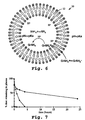
- Fig. 6 illustrates the mechanism of drug loading into liposomes having an ion gradient.
- the figures shows a liposome 10 having a bilayer membrane 12 and a lower inside/higher outside pH gradient by virtue of a higher inside/lower outside ammonium ion concentration.
- the drug-conjugate (designated Q-NH 2 ) is in equilibrium with its protonated amino form, the equilibrium balance being in accordance with the selected external pH.
- the internal pH is between 4.5-7.5 and is about 2 pH units lower than the external pH, which is typically between 6.5-9.5.
- the neutral form of the drug can permeate the liposome bilayer under the incubation conditions during liposome loading, and the uncharged drug external the liposome is in equilibrium with the uncharged drug within the liposome interior.
- the neutral drug permeates the liposome bilayer, it protonates in response to the excess of protons accumulated in the liposome interior.
- the protonated, charged form of the drug does not readily permeate across the liposome bilayer, thus, the drug accumulates in the liposomes.
- the protonated form of the drug in the liposome interior can form a complex or precipitate with a counterion, such as sulfate counterion in an ammonium salt.
- a counterion such as sulfate counterion in an ammonium salt.
- the compound is further driven toward an entrapped state, increasing the concentration of compound that can be entrapped, and the stability of drug entrapment.
- the solubility of a derivatized compound in various ammonium-salt counterions can be determined by standard methods, for purposes of selecting a counterion which will lead to complex formation.
- liposome concentration With proper selection of liposome concentration, external concentration of added compound, and the pH gradient, essentially all of the compound may be loaded into the liposomes. For example, with a pH gradient of 3 units (or the potential of such a gradient employing an ammonium ion gradient), the final internal:external concentration of drug will be about 1000:1. Knowing the calculated internal liposome volume, and the maximum concentration of loaded drug, one can then select an amount of drug in the external medium which leads to substantially complete loading into the liposomes.
- the liposome suspension may be treated, following drug loading, to remove non-encapsulated drug.
- Free drug can be removed, for example, by molecular sieve chromatography, dialysis, or centrifugation.
- glycinyl-ciprofloxacin was prepared as set forth in Example 2A-2B and tested for antimicrobial activity in vitro, as described in Example 2C.
- the minimum inhibitory concentration of the drugs against the bacterial strains S . pyrogenes , E. faecalis, S. aureus, E. coli and P. aeruginosa were determined. The results are shown in Table 1 and are compared to ciprofloxacin.
- Activity of Ciprofloxacin and Glycinyl-ciprofloxacin Drug Minimum Inhibitory Concentration ( ⁇ g/ml) S. pyrogenes E. faecalis S. aureus E. coli P. aeruginosa cipro ⁇ 0.5 1.0 1.0 ⁇ 0.5 ⁇ 0.5 G-cipro 4 32 32 8 >512
- Example 2D the in vitro plasma leakage of liposome-entrapped glycinyl-ciprofloxacin and lysinyl-ciprofloxacin were determined. Briefly, liposomes containing glycinyl-ciprofloxacin or lysinyl-ciprofloxacin were incubated in rat plasma for 24 hours at 37°C. At the end of the 24 hour incubation period, the plasma was analyzed for the presence of free drug. No free drug was detected in the plasma for either the liposome entrapped lysinyl-ciprofloxacin or the liposome-entrapped glycinyl-ciprofloxacin.
- the percent recovery of drug from the liposomal fractions was 93% for the liposome entrapped lysinyl-ciprofloxacin and 100% for the liposome-entrapped glycinyl-ciprofloxacin.
- the in vivo blood circulation lifetime of liposome-entrapped glycinyl-ciprofloxacin was determined in rats and compared to that of liposome-entrapped ciprofloxacin and free glycinyl-ciprofloxacin and free ciprofloxacin.
- sixteen rats were divided into four test groups, and the four animals in each group received an intravenous bolus injection containing 30 ⁇ M/kg drug in one of the aforementioned formulations.
- the drug concentration in the plasma was determined as a function of time and the results are shown in Fig. 7.
- the percentage of drug remaining in the plasma after dosing with liposomally entrapped glycinyl-ciprofloxacin is significantly greater than the percentage of drug in the plasma after dosing with liposomally entrapped ciprofloxacin (•).
- ⁇ the percentage of drug remaining in the plasma after dosing with liposomally entrapped glycinyl-ciprofloxacin
- ⁇ the percentage of drug remaining in the plasma after dosing with liposomally entrapped ciprofloxacin
- the plasma half life of glycinyl-ciprofloxacin entrapped in liposomes having a surface-coating of PEG was determined to be about 24 hours. This is approximately equivalent to the liposomes themselves, an indication that the drug is retained in the liposomes in vivo . This is further supported by the fact that free glycinyl-ciprofloxacin is cleared from the blood in about 30 minutes. In contrast, ciprofloxacin entrapped in liposomes having a surface coating of PEG had a blood circulation half life of approximately 1 hour. Free ciprofloxacin is cleared in about 30 minutes. In this case, while the liposomes are able to remain in circulation for as long as 24 hours, the ciprofloxacin is cleared more rapidly, indicating that the drug is leaking out of the liposomes in vivo .
- the pKa value of the quinolone may work in conjunction with other features of a selected quinolone to enhance retention in a liposomes, for example, the compound's solubility and diffusivity coefficients.
- the liposome composition of the invention can be used in the treatment of a variety of bacterial infections, including treatment of Mycobacterium infection, particularly Mycobacterium tuberculosis , M . kansasil , M . Xenopi , M. fortuitum , and M . avium-M . intracellular complex.
- Mycobacterium infection particularly Mycobacterium tuberculosis , M . kansasil , M . Xenopi , M. fortuitum , and M . avium-M . intracellular complex.
- a liposome-entrapped quinolone compound Other conditions treatable with a liposome-entrapped quinolone compound include chronic skin infections, such as decubitus ulcers or bedsores.
- Administration in a liposome-entrapped form offers the advantage of that the long circulation time of the liposomes allows the drug-carrying liposomes to accumulate at the site of infection and inflammation.
- tuberculosis is another condition treated with quinolone agents and which would benefit from administration in a liposome-enttapped form. This is because tuberculosis often resides in macrophages which actively take up PEG-coated liposomes, resulting in a concentration of the drug at the infection site.
- Other conditions include pulmonary infections caused by gram-negative Pseudomonas , chronic bone infections and conditions related to macrophage dwelling mycobacterium.
- the following comparative example and example illustrate preparation of liposomes, preparation of ciprofloxacin-amino acid conjugates and loading of the conjugate into the liposomes.
- Liposome having a surface-coating of polyethylene glycol were prepared by dissolving 661.1 mg hydrogenated soy phosphatidylcholine (HSPC), 220.5 mg cholesterol and 220.5 mg of polyethylene glycol derivatized to disteroyl phosphatidylethanolamine (PEG-DSPE) in 10 ml chloroform in a 250 mL round bottom flask. The chloroform was removed using a flash evaporator under reduced pressure until dryness. To the thin lipid film on the surface of the flask was added 15 ml of a solution of 250 mM ammonium sulfate, pH 5.5 and the lipids were dispersed in the solution by vigorous shaking for approximately 30 minutes at 60°C.
- HSPC hydrogenated soy phosphatidylcholine
- PEG-DSPE polyethylene glycol derivatized to disteroyl phosphatidylethanolamine
- the multilamellar vesicles obtained were extruded 6 times through a 0.4 ⁇ m pore-size Nucleopore polycarbonate filter, 6 times through a 0.1 ⁇ m polycarbonate filter and 3 times through a 0.05 ⁇ m polycarbonate filter using a stainless steel extrusion cell under a pressure of 200-400 psig.
- the extrusion process was carried out at 60°C.
- Liposomes after the extrusion process had a mean-diameter of 100 ⁇ 30 nm. The liposomes were then dialyzed overnight against 4 liters 10% sucrose to remove external ammonium sulfate at 4°C.
- a stock solution of ciprofloxacin at 40 mg/ml was prepared by dissolving ciprofloxacin HCl powder in a 10% sucrose aqueous solution. Active drug loading was carried out by mixing an equal volume of the liposomes prepared as described above at a total lipid concentration of 80 mg/ml with ciprofloxacin solutions at 40, 20, 10 or 5 mg/ml. The mixtures were incubated at 60°C for 30 minutes. After incubation, the mixtures were immediately cooled in an ice bath. Aliquot samples were taken and the percent of drug loading was determined by using a Sephadex G-50 column (1.0 x 19 cm). The percent of drug loading for the liposome formulations having lipid/drug ratios of 2, 4, 8 and 16 were 49%, 75%, 90% and 91 % respectively.
- the liposome formulation having a lipid/drug ratio of 8 and a ciprofloxacin loading of 75 % (approximately 75 mg/ml in liposome) was diluted 1/50 with rat plasma and incubated at 37°C for 24 hours. At the end of incubation, 0.5 ml of the plasma was loaded on a Sepharose CL-4B column. Approximately 45 1-ml fractions were collected, and the liposomal and free drug fractions were pooled. The pooled fractions were extracted using a methanol and 1 N HCl solvent (9:1 v/v) in a 1:4 dilution.
- the HPLC mobile phase was 85 % 25 mM sodium phosphate buffer, pH 2.3 and 15 % acetonitrile.
- the percent of ciprofloxacin that leaked out of the liposomes in 24 hours was 85 %.
- N-TBOC protected amino acids were purchased commercially. The compounds were reacted with an equi-molar amount of N-hydroxysuccinimide and a 10% excess of dicyclohexylcarbodiimide (DCC) in methylene chloride to form the N-hydroxysuccinimide ester.
- DCC dicyclohexylcarbodiimide
- esters were treated with 2 moles of triethylamine and 1 mole of dry carboxyl-protected ciprofloxacin HCl in a dry solvent to form the TBOC protected ciprofloxacin amide of the amino acid.
- the ciprofloxacin-amides were deprotected with trifluoroacetic acid and then isolated by a method appropriate to the physical and chemical properties of the product.
- L-threonine-ciprofloxacin was recovered by adjusting the pH of the aqueous suspension to pH 7 to cause separation of the crystalline conjugate.
- the conjugate of L-leucine-ciprofloxacin was recovered by 1-butanol extraction from a pH 7-8 aqueous solution followed by recrystallization from methanol.
- the derivative of L-lysine-ciprofloxacin was converted to a phosphotungstate by treatment with phosphotungstic acid and barium hydroxide and then converted to its sulfate by treatment with dilute sulfuric acid.
- Liposomes were prepared as described above in Comparative Example 1 by dissolving 585 mg hydrogenated soy phosphatidylcholine (HSPC), 261 mg cholesterol and 210 mg of PEG-DSPE (prepared as described, for example, in Zalipsky (1995) to form liposomes with the following composition: 50 % HSPC, 45 % cholesterol and 5% mPEG-DSPE.
- HSPC hydrogenated soy phosphatidylcholine
- PEG-DSPE prepared as described, for example, in Zalipsky (1995) to form liposomes with the following composition: 50 % HSPC, 45 % cholesterol and 5% mPEG-DSPE.
- Ciprofloxacin-glycine and ciprofloxacin-lysine drug conjugates were loaded into the liposomes via remote loading, as described above, at the following concentrations.
- Antimicrobial activity of ciprofloxacin, glycinyl-ciprofloxacin and lysinal-ciprofloxacin were measured against S. pyrogenes , E. faecalis, S . aureus, E. coli and P. aeruginosa .
- Minimum inhibitory concentrations were determined by a broth microdilution technique following the National Committee for Clinical Laboratory Standards guidelines (NCCLS document M7-A, National Committee for Laboratory Standards, Villanova, PA, 1994 Approved Standard for "Methods for dilution antimicrobial susceptibility tests for bacteria that grow aerobically") with a starting inoculum of 5 x 10 5 CFU/ml.
- the results for ciprofloxacin and glycinyl-ciprofloxacin are shown in Table 1.
- the liposomes containing lysinyl-ciprofloxacin and glycinyl-ciprofloxacin were diluted 1/10 and 1/100, respectively, with rat plasma and incubated at 37°C for 24 hours.
- the leakage of the drug-conjugates was measured by the method set forth in Comparative Example 1B above. At the end of the 24 hour incubation period, no free drug was detected in the plasma for either the liposome entrapped lysinyl-ciprofloxacin or the liposome-entrapped glycinyl-ciprofloxacin.
- the percent recovery of drug from the liposomal fractions was 93 % for the liposome entrapped lysinyl-ciprofloxacin and 100% for the liposome-entrapped glycinyl-ciprofloxacin.
- Plasma residence time of liposome-entrapped glycinyl-ciprofloxacin and liposome-entrapped ciprofloxacin were determined in rats. Sixteen rats were divided into four test groups, and the four animals in each group received 30 ⁇ M/kg drug in a single intravenous bolus injection of liposome-entrapped glycinyl-ciprofloxacin or liposome-entrapped ciprofloxacin or free glycinyl-ciprofloxacin or free ciprofloxacin.
Landscapes
- Health & Medical Sciences (AREA)
- Chemical & Material Sciences (AREA)
- Life Sciences & Earth Sciences (AREA)
- Veterinary Medicine (AREA)
- Public Health (AREA)
- Medicinal Chemistry (AREA)
- General Health & Medical Sciences (AREA)
- Animal Behavior & Ethology (AREA)
- Pharmacology & Pharmacy (AREA)
- Epidemiology (AREA)
- Dispersion Chemistry (AREA)
- Engineering & Computer Science (AREA)
- Bioinformatics & Cheminformatics (AREA)
- Biophysics (AREA)
- Molecular Biology (AREA)
- Organic Chemistry (AREA)
- Nuclear Medicine, Radiotherapy & Molecular Imaging (AREA)
- General Chemical & Material Sciences (AREA)
- Chemical Kinetics & Catalysis (AREA)
- Oncology (AREA)
- Communicable Diseases (AREA)
- Medicinal Preparation (AREA)
- Pharmaceuticals Containing Other Organic And Inorganic Compounds (AREA)
Priority Applications (1)
| Application Number | Priority Date | Filing Date | Title |
|---|---|---|---|
| DK99916160T DK1083881T3 (da) | 1998-04-02 | 1999-03-24 | Liposomsammensætninger indeholdende et quinolonderivat og deres anvendelse som antibakterielle midler |
Applications Claiming Priority (3)
| Application Number | Priority Date | Filing Date | Title |
|---|---|---|---|
| US54857P | 1998-04-02 | ||
| US09/054,857 US5972379A (en) | 1995-02-14 | 1998-04-02 | Liposome composition and method for administering a quinolone |
| PCT/US1999/006500 WO1999051202A2 (en) | 1998-04-02 | 1999-03-24 | Quinolone containing liposomes and their use as antibacterial agents |
Publications (2)
| Publication Number | Publication Date |
|---|---|
| EP1083881A2 EP1083881A2 (en) | 2001-03-21 |
| EP1083881B1 true EP1083881B1 (en) | 2004-08-25 |
Family
ID=21993954
Family Applications (1)
| Application Number | Title | Priority Date | Filing Date |
|---|---|---|---|
| EP99916160A Expired - Lifetime EP1083881B1 (en) | 1998-04-02 | 1999-03-24 | LIPOSOME COMPOSITIONs containing a quinolone derivative AND their use as antibacterial agents |
Country Status (16)
| Country | Link |
|---|---|
| US (1) | US5972379A (https=) |
| EP (1) | EP1083881B1 (https=) |
| JP (1) | JP2002510611A (https=) |
| KR (1) | KR100617921B1 (https=) |
| CN (1) | CN1149978C (https=) |
| AT (1) | ATE274342T1 (https=) |
| AU (1) | AU763989B2 (https=) |
| CA (1) | CA2326497A1 (https=) |
| DE (1) | DE69919698T2 (https=) |
| DK (1) | DK1083881T3 (https=) |
| ES (1) | ES2226371T3 (https=) |
| IL (1) | IL138685A0 (https=) |
| NZ (1) | NZ506970A (https=) |
| PT (1) | PT1083881E (https=) |
| WO (1) | WO1999051202A2 (https=) |
| ZA (1) | ZA200005333B (https=) |
Cited By (2)
| Publication number | Priority date | Publication date | Assignee | Title |
|---|---|---|---|---|
| EP2759292A1 (en) | 2006-10-24 | 2014-07-30 | Aradigm Corporation | Dual action, inhaled formulations providing both an immediate and sustained release profile |
| US9402845B2 (en) | 2005-12-08 | 2016-08-02 | Insmed Incorporated | Lipid-based compositions of antiinfectives for treating pulmonary infections and methods of use thereof |
Families Citing this family (47)
| Publication number | Priority date | Publication date | Assignee | Title |
|---|---|---|---|---|
| US7311924B2 (en) | 1999-04-01 | 2007-12-25 | Hana Biosciences, Inc. | Compositions and methods for treating cancer |
| US20030147944A1 (en) * | 1999-12-10 | 2003-08-07 | Mayer Lawrence D | Lipid carrier compositions with protected surface reactive functions |
| JP2004501955A (ja) * | 2000-06-30 | 2004-01-22 | アイネックス ファーマシューティカルズ コーポレイション | リポソーム抗新生物薬剤およびその使用 |
| US7452550B2 (en) | 2000-06-30 | 2008-11-18 | Hana Biosciences, Inc. | Liposomal antineoplastic drugs and uses thereof |
| EP1355634B8 (en) | 2000-11-09 | 2009-03-04 | Neopharm, Inc. | Sn-38 lipid complexes and methods of use |
| WO2003030864A1 (en) | 2001-05-29 | 2003-04-17 | Neopharm, Inc. | Liposomal formulation of irinotecan |
| PL369455A1 (en) * | 2001-06-01 | 2005-04-18 | Yamanouchi Europe B.V. | Lipid-polymer-conjugates |
| AU2002334358B2 (en) * | 2001-09-06 | 2008-02-07 | Yissum Research Development Company Of The Hebrew University Of Jerusalem | A method for preparing liposome formulations with a predefined release profile |
| US20040219201A1 (en) * | 2001-12-06 | 2004-11-04 | Yechezkel Barenholz | Tempamine compositions and methods of use |
| WO2003077842A2 (en) * | 2002-03-12 | 2003-09-25 | Bristol-Myers Squibb Company | Palatable oral suspension and method |
| PT1581236E (pt) * | 2002-10-29 | 2013-12-24 | Insmed Inc | Libertação prolongada de anti-infecciosos |
| US7718189B2 (en) | 2002-10-29 | 2010-05-18 | Transave, Inc. | Sustained release of antiinfectives |
| EP1628637A2 (en) * | 2003-05-30 | 2006-03-01 | Alza Corporation | Method of pulmonary administration of an agent |
| CN100431525C (zh) * | 2003-07-17 | 2008-11-12 | 台湾东洋药品工业股份有限公司 | 脂质体悬浮液制造方法及含该法所制脂质体悬浮液的产物 |
| US8173840B2 (en) * | 2003-07-29 | 2012-05-08 | Signature R&D Holdings, Llc | Compounds with high therapeutic index |
| US7589233B2 (en) * | 2003-07-29 | 2009-09-15 | Signature R&D Holdings, Llc | L-Threonine derivatives of high therapeutic index |
| AU2004289174B2 (en) * | 2003-07-29 | 2011-05-19 | Signature R&D Holdings, Lcc | Amino acid prodrugs |
| US7915223B2 (en) * | 2004-09-27 | 2011-03-29 | Technion Research & Development Foundation Ltd. | Antimicrobial agents |
| WO2006039369A1 (en) * | 2004-09-29 | 2006-04-13 | Alza Corporation | Microparticles and nanoparticles containing a lipopolymer |
| TW200618820A (en) * | 2004-11-05 | 2006-06-16 | Alza Corp | Liposome formulations of boronic acid compounds |
| CN100403535C (zh) * | 2005-05-18 | 2008-07-16 | 崇贸科技股份有限公司 | 可控制触发电压的静电放电装置 |
| US8071127B2 (en) | 2006-10-24 | 2011-12-06 | Aradigm Corporation | Dual action, inhaled formulations providing both an immediate and sustained release profile |
| US8119156B2 (en) | 2006-10-24 | 2012-02-21 | Aradigm Corporation | Dual action, inhaled formulations providing both an immediate and sustained release profile |
| KR100916160B1 (ko) * | 2007-02-21 | 2009-09-08 | (주)바이오버드 | 약제학적 항암 조성물 |
| EP2152289A1 (en) * | 2007-04-30 | 2010-02-17 | Technion Research & Development Foundation Ltd. | Novel antimicrobial agents |
| US20100173832A1 (en) * | 2007-04-30 | 2010-07-08 | Technion Research & Development Foundation Ltd. | Anticancerous polymeric agents |
| WO2008137717A1 (en) | 2007-05-04 | 2008-11-13 | Transave, Inc. | Compositions of multicationic drugs for reducing interactions with polyanionic biomolecules and methods and uses thereof |
| US9114081B2 (en) | 2007-05-07 | 2015-08-25 | Insmed Incorporated | Methods of treating pulmonary disorders with liposomal amikacin formulations |
| US9119783B2 (en) | 2007-05-07 | 2015-09-01 | Insmed Incorporated | Method of treating pulmonary disorders with liposomal amikacin formulations |
| US10143652B2 (en) | 2009-09-23 | 2018-12-04 | Curirx Inc. | Methods for the preparation of liposomes |
| CA2781527C (en) * | 2009-09-23 | 2017-10-24 | Indu Javeri | Methods for the preparation of liposomes |
| CN102309448B (zh) * | 2010-06-29 | 2014-07-09 | 中国人民解放军军事医学科学院毒物药物研究所 | 一种肺部给药的环丙沙星药用组合物及其制备方法 |
| CN102188430B (zh) * | 2011-04-06 | 2012-08-15 | 广东如来医药进出口有限公司 | 司帕沙星化合物的组合物制剂及其制备方法 |
| PL2852391T3 (pl) | 2012-05-21 | 2022-04-11 | Insmed Incorporated | Układy do leczenia infekcji płuc |
| MX2015005992A (es) | 2012-11-20 | 2016-03-07 | Spectrum Pharmaceuticals Inc | Metodo mejorado para la preparacion de la vincristina liposomal encapsulada para el uso terapeutico. |
| US10124066B2 (en) | 2012-11-29 | 2018-11-13 | Insmed Incorporated | Stabilized vancomycin formulations |
| WO2015061025A1 (en) | 2013-10-22 | 2015-04-30 | Aradigm Corporation | Inhaled surfactant-modified liposomal formulations providing both an immediate and sustained release profile |
| LT3466432T (lt) | 2014-05-15 | 2020-12-28 | Insmed Incorporated | Būdai, skirti plaučių netuberkuliozinėms mikobakterinėms infekcijoms gydyti |
| EP2957561A1 (en) * | 2014-06-18 | 2015-12-23 | Université Paris 6 Pierre et Marie Curie UPMC | Novel fluoroquinolones and use thereof to treat bacterial infections |
| TWI678213B (zh) | 2015-07-22 | 2019-12-01 | 美商史倍壯製藥公司 | 用於長春新鹼硫酸鹽脂質體注射之即可使用的調配物 |
| GB2552301A (en) * | 2016-07-11 | 2018-01-24 | Evox Therapeutics Ltd | Metabolic drug loading of EVs |
| US20170172921A1 (en) * | 2016-12-14 | 2017-06-22 | Mahmoud Reza Jaafari | Polyphenolic compounds encapsualated in long circulating liposomes and use thereof |
| TWI728255B (zh) * | 2017-07-24 | 2021-05-21 | 國邑藥品科技股份有限公司 | 包含弱酸藥物之脂質體組成物及其用途 |
| CN109305987B (zh) * | 2017-07-27 | 2021-04-20 | 济南大学 | 环丙沙星金属配合物及其制备方法和应用 |
| EP3773505B1 (en) | 2018-03-30 | 2026-04-29 | Insmed Incorporated | Methods for continuous manufacture of liposomal drug products |
| JP7449275B2 (ja) | 2018-05-02 | 2024-03-13 | インスメッド インコーポレイテッド | リポソーム薬物製剤の製造方法 |
| AU2019339401B9 (en) * | 2018-09-14 | 2022-11-03 | Pharmosa Biopharm Inc. | Pharmaceutical composition for controlled release of weak acid drugs and uses thereof |
Family Cites Families (13)
| Publication number | Priority date | Publication date | Assignee | Title |
|---|---|---|---|---|
| US5077056A (en) * | 1984-08-08 | 1991-12-31 | The Liposome Company, Inc. | Encapsulation of antineoplastic agents in liposomes |
| ATE63124T1 (de) * | 1986-03-14 | 1991-05-15 | Fujisawa Pharmaceutical Co | Prodrugverbindungen, verfahren zu deren herstellung und diese enthaltende zubereitungen mit verzoegerter freisetzung. |
| US5057523A (en) * | 1988-09-22 | 1991-10-15 | Abbott Laboratories | Dipeptide quinolone derivatives |
| IL91664A (en) * | 1988-09-28 | 1993-05-13 | Yissum Res Dev Co | Ammonium transmembrane gradient system for efficient loading of liposomes with amphipathic drugs and their controlled release |
| WO1991009616A1 (en) * | 1989-12-22 | 1991-07-11 | Yale University | Quinolone antibiotics encapsulated in lipid vesicles |
| DK0555229T3 (da) * | 1990-07-31 | 1996-08-19 | Liposome Co Inc | Akkumulation af aminosyrer og peptider i liposomer |
| CA2101241C (en) * | 1993-07-23 | 1998-12-22 | Jonathan P. Wong | Liposome-encapsulated ciprofloxacin |
| US5595756A (en) * | 1993-12-22 | 1997-01-21 | Inex Pharmaceuticals Corporation | Liposomal compositions for enhanced retention of bioactive agents |
| US5741516A (en) * | 1994-06-20 | 1998-04-21 | Inex Pharmaceuticals Corporation | Sphingosomes for enhanced drug delivery |
| AU4981896A (en) * | 1995-02-14 | 1996-09-04 | Sequus Pharmaceuticals, Inc. | Liposome composition and method for administering liposome-loadable drugs |
| US5800833A (en) * | 1995-02-27 | 1998-09-01 | University Of British Columbia | Method for loading lipid vesicles |
| ATE252372T1 (de) * | 1996-08-23 | 2003-11-15 | Sequus Pharm Inc | Liposome enthaltend cisplatin |
| US5837282A (en) * | 1996-10-30 | 1998-11-17 | University Of British Columbia | Ionophore-mediated liposome loading |
-
1998
- 1998-04-02 US US09/054,857 patent/US5972379A/en not_active Expired - Lifetime
-
1999
- 1999-03-24 AT AT99916160T patent/ATE274342T1/de not_active IP Right Cessation
- 1999-03-24 JP JP2000541974A patent/JP2002510611A/ja active Pending
- 1999-03-24 CN CNB998046558A patent/CN1149978C/zh not_active Expired - Fee Related
- 1999-03-24 EP EP99916160A patent/EP1083881B1/en not_active Expired - Lifetime
- 1999-03-24 AU AU34533/99A patent/AU763989B2/en not_active Ceased
- 1999-03-24 IL IL13868599A patent/IL138685A0/xx unknown
- 1999-03-24 PT PT99916160T patent/PT1083881E/pt unknown
- 1999-03-24 DE DE69919698T patent/DE69919698T2/de not_active Expired - Fee Related
- 1999-03-24 WO PCT/US1999/006500 patent/WO1999051202A2/en not_active Ceased
- 1999-03-24 ES ES99916160T patent/ES2226371T3/es not_active Expired - Lifetime
- 1999-03-24 KR KR1020007010987A patent/KR100617921B1/ko not_active Expired - Lifetime
- 1999-03-24 DK DK99916160T patent/DK1083881T3/da active
- 1999-03-24 NZ NZ506970A patent/NZ506970A/en unknown
- 1999-03-24 CA CA002326497A patent/CA2326497A1/en not_active Abandoned
-
2000
- 2000-10-02 ZA ZA200005333A patent/ZA200005333B/xx unknown
Cited By (6)
| Publication number | Priority date | Publication date | Assignee | Title |
|---|---|---|---|---|
| US9402845B2 (en) | 2005-12-08 | 2016-08-02 | Insmed Incorporated | Lipid-based compositions of antiinfectives for treating pulmonary infections and methods of use thereof |
| US9511082B2 (en) | 2005-12-08 | 2016-12-06 | Insmed Incorporated | Lipid-based compositions of antiinfectives for treating pulmonary infections and methods of use thereof |
| US9549925B2 (en) | 2005-12-08 | 2017-01-24 | Insmed Incorporated | Lipid-based compositions of antiinfectives for treating pulmonary infections and methods of use thereof |
| US9549939B2 (en) | 2005-12-08 | 2017-01-24 | Insmed Incorporated | Lipid-based compositions of antiinfectives for treating pulmonary infections and methods of use thereof |
| EP2759292A1 (en) | 2006-10-24 | 2014-07-30 | Aradigm Corporation | Dual action, inhaled formulations providing both an immediate and sustained release profile |
| EP2789330A1 (en) | 2006-10-24 | 2014-10-15 | Aradigm Corporation | Dual action, inhaled formulations providing both an immediate and sustained release profile |
Also Published As
| Publication number | Publication date |
|---|---|
| HK1035331A1 (en) | 2001-11-23 |
| DE69919698D1 (de) | 2004-09-30 |
| ES2226371T3 (es) | 2005-03-16 |
| KR20010034727A (ko) | 2001-04-25 |
| ZA200005333B (en) | 2001-10-31 |
| CN1149978C (zh) | 2004-05-19 |
| PT1083881E (pt) | 2004-11-30 |
| WO1999051202A3 (en) | 1999-11-18 |
| IL138685A0 (en) | 2001-10-31 |
| NZ506970A (en) | 2003-07-25 |
| ATE274342T1 (de) | 2004-09-15 |
| CN1295465A (zh) | 2001-05-16 |
| AU3453399A (en) | 1999-10-25 |
| DK1083881T3 (da) | 2005-01-03 |
| JP2002510611A (ja) | 2002-04-09 |
| WO1999051202A2 (en) | 1999-10-14 |
| EP1083881A2 (en) | 2001-03-21 |
| KR100617921B1 (ko) | 2006-08-30 |
| US5972379A (en) | 1999-10-26 |
| CA2326497A1 (en) | 1999-10-14 |
| AU763989B2 (en) | 2003-08-07 |
| DE69919698T2 (de) | 2005-05-25 |
Similar Documents
| Publication | Publication Date | Title |
|---|---|---|
| EP1083881B1 (en) | LIPOSOME COMPOSITIONs containing a quinolone derivative AND their use as antibacterial agents | |
| US20090092661A1 (en) | Liposome compositions for in vivo administration of boronic acid compounds | |
| US20080026049A1 (en) | Liposomal compositions for parenteral delivery of agents | |
| CN102223878A (zh) | 包含鞘磷脂的脂质体系统 | |
| US20100247629A1 (en) | Method for drug loading in liposomes | |
| US20040013720A1 (en) | Receptor antagonist-lipid conjugates and delivery vehicles containing same | |
| EP1448165B1 (en) | Lipid carrier compositions and methods for improved drug retention | |
| WO1999030686A1 (en) | Cationic drugs encapsulated in anionic liposomes | |
| US20030129224A1 (en) | Lipid carrier compositions and methods for improved drug retention | |
| KR20250171477A (ko) | 옥사졸리디논 화합물, 옥사졸리디논 화합물을 포함하는 리포좀 조성물 및 이의 사용 방법 | |
| JP2010518012A (ja) | カンプトテシン誘導体を含む医薬組成物 | |
| EP1176962B1 (en) | Liposome compositions for improved drug retention | |
| WO2010095964A1 (en) | A method for amphiphilic drug loading in liposomes by ion gradient | |
| HK1035331B (en) | Liposome composition and method for administering a quinolone | |
| MXPA00009675A (en) | Liposome composition and method for administering a quinolone | |
| WO2005069750A2 (en) | Therapeutic composition with nanoscale activation agents | |
| KR100768265B1 (ko) | 혈액내 순환시간을 향상시키기 위한 헤파린이 수식된리포솜 및 이의 제조방법 | |
| JPWO2001000173A1 (ja) | リポソームに内包された薬物の漏出抑制方法 |
Legal Events
| Date | Code | Title | Description |
|---|---|---|---|
| PUAI | Public reference made under article 153(3) epc to a published international application that has entered the european phase |
Free format text: ORIGINAL CODE: 0009012 |
|
| 17P | Request for examination filed |
Effective date: 20001102 |
|
| AK | Designated contracting states |
Kind code of ref document: A2 Designated state(s): AT BE CH CY DE DK ES FI FR GB GR IE IT LI LU NL PT SE |
|
| 17Q | First examination report despatched |
Effective date: 20030225 |
|
| GRAP | Despatch of communication of intention to grant a patent |
Free format text: ORIGINAL CODE: EPIDOSNIGR1 |
|
| RTI1 | Title (correction) |
Free format text: LIPOSOME COMPOSITIONS CONTAINING A QUINOLONE DERIVATIVE AND THEIR USE AS ANTIBACTERIAL AGENTS |
|
| RIC1 | Information provided on ipc code assigned before grant |
Ipc: 7A 61P 31/04 B Ipc: 7A 61K 31/495 B Ipc: 7A 61K 31/47 B Ipc: 7A 61K 9/127 A |
|
| GRAS | Grant fee paid |
Free format text: ORIGINAL CODE: EPIDOSNIGR3 |
|
| GRAA | (expected) grant |
Free format text: ORIGINAL CODE: 0009210 |
|
| AK | Designated contracting states |
Kind code of ref document: B1 Designated state(s): AT BE CH CY DE DK ES FI FR GB GR IE IT LI LU NL PT SE |
|
| REG | Reference to a national code |
Ref country code: GB Ref legal event code: FG4D |
|
| REG | Reference to a national code |
Ref country code: CH Ref legal event code: EP |
|
| REG | Reference to a national code |
Ref country code: SE Ref legal event code: TRGR |
|
| REG | Reference to a national code |
Ref country code: IE Ref legal event code: FG4D |
|
| REF | Corresponds to: |
Ref document number: 69919698 Country of ref document: DE Date of ref document: 20040930 Kind code of ref document: P |
|
| RAP2 | Party data changed (patent owner data changed or rights of a patent transferred) |
Owner name: ALZA CORPORATION |
|
| REG | Reference to a national code |
Ref country code: GR Ref legal event code: EP Ref document number: 20040403128 Country of ref document: GR |
|
| REG | Reference to a national code |
Ref country code: PT Ref legal event code: SC4A Free format text: AVAILABILITY OF NATIONAL TRANSLATION Effective date: 20041011 Ref country code: CH Ref legal event code: NV Representative=s name: R. A. EGLI & CO. PATENTANWAELTE |
|
| NLT2 | Nl: modifications (of names), taken from the european patent patent bulletin |
Owner name: ALZA CORPORATION |
|
| REG | Reference to a national code |
Ref country code: DK Ref legal event code: T3 |
|
| REG | Reference to a national code |
Ref country code: ES Ref legal event code: FG2A Ref document number: 2226371 Country of ref document: ES Kind code of ref document: T3 |
|
| PG25 | Lapsed in a contracting state [announced via postgrant information from national office to epo] |
Ref country code: LU Free format text: LAPSE BECAUSE OF NON-PAYMENT OF DUE FEES Effective date: 20050324 Ref country code: CY Free format text: LAPSE BECAUSE OF FAILURE TO SUBMIT A TRANSLATION OF THE DESCRIPTION OR TO PAY THE FEE WITHIN THE PRESCRIBED TIME-LIMIT Effective date: 20050324 |
|
| REG | Reference to a national code |
Ref country code: HK Ref legal event code: GR Ref document number: 1035331 Country of ref document: HK |
|
| PLBE | No opposition filed within time limit |
Free format text: ORIGINAL CODE: 0009261 |
|
| STAA | Information on the status of an ep patent application or granted ep patent |
Free format text: STATUS: NO OPPOSITION FILED WITHIN TIME LIMIT |
|
| ET | Fr: translation filed | ||
| 26N | No opposition filed |
Effective date: 20050526 |
|
| PGFP | Annual fee paid to national office [announced via postgrant information from national office to epo] |
Ref country code: DK Payment date: 20080314 Year of fee payment: 10 Ref country code: CH Payment date: 20080313 Year of fee payment: 10 |
|
| PGFP | Annual fee paid to national office [announced via postgrant information from national office to epo] |
Ref country code: SE Payment date: 20080306 Year of fee payment: 10 Ref country code: PT Payment date: 20080306 Year of fee payment: 10 Ref country code: NL Payment date: 20080303 Year of fee payment: 10 Ref country code: IT Payment date: 20080327 Year of fee payment: 10 Ref country code: IE Payment date: 20080313 Year of fee payment: 10 Ref country code: GB Payment date: 20080326 Year of fee payment: 10 Ref country code: FI Payment date: 20080314 Year of fee payment: 10 |
|
| PGFP | Annual fee paid to national office [announced via postgrant information from national office to epo] |
Ref country code: AT Payment date: 20080313 Year of fee payment: 10 |
|
| PGFP | Annual fee paid to national office [announced via postgrant information from national office to epo] |
Ref country code: FR Payment date: 20080311 Year of fee payment: 10 Ref country code: ES Payment date: 20080418 Year of fee payment: 10 Ref country code: DE Payment date: 20080407 Year of fee payment: 10 |
|
| PGFP | Annual fee paid to national office [announced via postgrant information from national office to epo] |
Ref country code: BE Payment date: 20080522 Year of fee payment: 10 |
|
| PGFP | Annual fee paid to national office [announced via postgrant information from national office to epo] |
Ref country code: GR Payment date: 20080215 Year of fee payment: 10 |
|
| BERE | Be: lapsed |
Owner name: *ALZA CORP. Effective date: 20090331 |
|
| REG | Reference to a national code |
Ref country code: PT Ref legal event code: MM4A Free format text: LAPSE DUE TO NON-PAYMENT OF FEES Effective date: 20090924 |
|
| PG25 | Lapsed in a contracting state [announced via postgrant information from national office to epo] |
Ref country code: PT Free format text: LAPSE BECAUSE OF NON-PAYMENT OF DUE FEES Effective date: 20090924 Ref country code: FI Free format text: LAPSE BECAUSE OF NON-PAYMENT OF DUE FEES Effective date: 20090324 Ref country code: AT Free format text: LAPSE BECAUSE OF NON-PAYMENT OF DUE FEES Effective date: 20090324 |
|
| REG | Reference to a national code |
Ref country code: CH Ref legal event code: PL |
|
| REG | Reference to a national code |
Ref country code: DK Ref legal event code: EBP |
|
| EUG | Se: european patent has lapsed | ||
| GBPC | Gb: european patent ceased through non-payment of renewal fee |
Effective date: 20090324 |
|
| NLV4 | Nl: lapsed or anulled due to non-payment of the annual fee |
Effective date: 20091001 |
|
| REG | Reference to a national code |
Ref country code: IE Ref legal event code: MM4A |
|
| PG25 | Lapsed in a contracting state [announced via postgrant information from national office to epo] |
Ref country code: LI Free format text: LAPSE BECAUSE OF NON-PAYMENT OF DUE FEES Effective date: 20090331 Ref country code: IE Free format text: LAPSE BECAUSE OF NON-PAYMENT OF DUE FEES Effective date: 20090324 Ref country code: DE Free format text: LAPSE BECAUSE OF NON-PAYMENT OF DUE FEES Effective date: 20091001 Ref country code: CH Free format text: LAPSE BECAUSE OF NON-PAYMENT OF DUE FEES Effective date: 20090331 |
|
| PG25 | Lapsed in a contracting state [announced via postgrant information from national office to epo] |
Ref country code: BE Free format text: LAPSE BECAUSE OF NON-PAYMENT OF DUE FEES Effective date: 20090331 Ref country code: NL Free format text: LAPSE BECAUSE OF NON-PAYMENT OF DUE FEES Effective date: 20091001 |
|
| PG25 | Lapsed in a contracting state [announced via postgrant information from national office to epo] |
Ref country code: GB Free format text: LAPSE BECAUSE OF NON-PAYMENT OF DUE FEES Effective date: 20090324 Ref country code: DK Free format text: LAPSE BECAUSE OF NON-PAYMENT OF DUE FEES Effective date: 20090331 |
|
| REG | Reference to a national code |
Ref country code: ES Ref legal event code: FD2A Effective date: 20090325 |
|
| PG25 | Lapsed in a contracting state [announced via postgrant information from national office to epo] |
Ref country code: GR Free format text: LAPSE BECAUSE OF NON-PAYMENT OF DUE FEES Effective date: 20091002 |
|
| PG25 | Lapsed in a contracting state [announced via postgrant information from national office to epo] |
Ref country code: ES Free format text: LAPSE BECAUSE OF NON-PAYMENT OF DUE FEES Effective date: 20090325 |
|
| REG | Reference to a national code |
Ref country code: FR Ref legal event code: ST Effective date: 20100930 |
|
| PG25 | Lapsed in a contracting state [announced via postgrant information from national office to epo] |
Ref country code: IT Free format text: LAPSE BECAUSE OF NON-PAYMENT OF DUE FEES Effective date: 20090324 |
|
| PG25 | Lapsed in a contracting state [announced via postgrant information from national office to epo] |
Ref country code: SE Free format text: LAPSE BECAUSE OF NON-PAYMENT OF DUE FEES Effective date: 20090325 |
|
| PG25 | Lapsed in a contracting state [announced via postgrant information from national office to epo] |
Ref country code: FR Free format text: LAPSE BECAUSE OF NON-PAYMENT OF DUE FEES Effective date: 20100930 |
|
| PG25 | Lapsed in a contracting state [announced via postgrant information from national office to epo] |
Ref country code: FR Free format text: LAPSE BECAUSE OF NON-PAYMENT OF DUE FEES Effective date: 20090331 |