EP1078261B1 - Procede de fixation et d'auto-organisation de macromolecules biologiques sur des nanotubes de carbone et ses applications - Google Patents
Procede de fixation et d'auto-organisation de macromolecules biologiques sur des nanotubes de carbone et ses applications Download PDFInfo
- Publication number
- EP1078261B1 EP1078261B1 EP99917007A EP99917007A EP1078261B1 EP 1078261 B1 EP1078261 B1 EP 1078261B1 EP 99917007 A EP99917007 A EP 99917007A EP 99917007 A EP99917007 A EP 99917007A EP 1078261 B1 EP1078261 B1 EP 1078261B1
- Authority
- EP
- European Patent Office
- Prior art keywords
- alkyl
- groups
- nanotubes
- biological macromolecules
- carbon
- Prior art date
- Legal status (The legal status is an assumption and is not a legal conclusion. Google has not performed a legal analysis and makes no representation as to the accuracy of the status listed.)
- Expired - Lifetime
Links
- OKTJSMMVPCPJKN-UHFFFAOYSA-N Carbon Chemical compound [C] OKTJSMMVPCPJKN-UHFFFAOYSA-N 0.000 title claims description 46
- 238000000034 method Methods 0.000 title claims description 35
- 229920002521 macromolecule Polymers 0.000 title claims description 29
- 239000002041 carbon nanotube Substances 0.000 title description 26
- 229910021393 carbon nanotube Inorganic materials 0.000 title description 26
- 239000002071 nanotube Substances 0.000 claims description 35
- 239000003153 chemical reaction reagent Substances 0.000 claims description 25
- 239000003446 ligand Substances 0.000 claims description 21
- 125000000217 alkyl group Chemical group 0.000 claims description 19
- 229910052799 carbon Inorganic materials 0.000 claims description 12
- 125000003118 aryl group Chemical group 0.000 claims description 11
- RTZKZFJDLAIYFH-UHFFFAOYSA-N Diethyl ether Chemical compound CCOCC RTZKZFJDLAIYFH-UHFFFAOYSA-N 0.000 claims description 10
- 238000001179 sorption measurement Methods 0.000 claims description 9
- -1 antibodies Proteins 0.000 claims description 7
- 238000011534 incubation Methods 0.000 claims description 7
- 150000001408 amides Chemical class 0.000 claims description 6
- 125000006367 bivalent amino carbonyl group Chemical group [H]N([*:1])C([*:2])=O 0.000 claims description 6
- 125000006297 carbonyl amino group Chemical group [H]N([*:2])C([*:1])=O 0.000 claims description 6
- 150000002148 esters Chemical class 0.000 claims description 6
- 150000007523 nucleic acids Chemical class 0.000 claims description 6
- 102000039446 nucleic acids Human genes 0.000 claims description 6
- 108020004707 nucleic acids Proteins 0.000 claims description 6
- 125000002524 organometallic group Chemical group 0.000 claims description 6
- 125000006850 spacer group Chemical group 0.000 claims description 5
- 150000001413 amino acids Chemical class 0.000 claims description 4
- 150000004820 halides Chemical class 0.000 claims description 4
- 229910052736 halogen Inorganic materials 0.000 claims description 4
- 150000002367 halogens Chemical class 0.000 claims description 4
- 125000004435 hydrogen atom Chemical group [H]* 0.000 claims description 4
- 125000002467 phosphate group Chemical group [H]OP(=O)(O[H])O[*] 0.000 claims description 4
- 150000003568 thioethers Chemical class 0.000 claims description 4
- 239000002904 solvent Substances 0.000 claims description 3
- 238000003756 stirring Methods 0.000 claims description 3
- 102000004190 Enzymes Human genes 0.000 claims description 2
- 108090000790 Enzymes Proteins 0.000 claims description 2
- 102000008394 Immunoglobulin Fragments Human genes 0.000 claims description 2
- 108010021625 Immunoglobulin Fragments Proteins 0.000 claims description 2
- 108010052285 Membrane Proteins Proteins 0.000 claims description 2
- 239000003599 detergent Substances 0.000 claims description 2
- 125000003473 lipid group Chemical group 0.000 claims description 2
- 239000012528 membrane Substances 0.000 claims description 2
- 230000003381 solubilizing effect Effects 0.000 claims description 2
- 125000003178 carboxy group Chemical group [H]OC(*)=O 0.000 claims 2
- 230000008878 coupling Effects 0.000 claims 2
- 238000010168 coupling process Methods 0.000 claims 2
- 238000005859 coupling reaction Methods 0.000 claims 2
- 125000000962 organic group Chemical group 0.000 claims 1
- 108091005703 transmembrane proteins Proteins 0.000 claims 1
- 102000035160 transmembrane proteins Human genes 0.000 claims 1
- OKKJLVBELUTLKV-UHFFFAOYSA-N Methanol Chemical compound OC OKKJLVBELUTLKV-UHFFFAOYSA-N 0.000 description 24
- 235000018102 proteins Nutrition 0.000 description 23
- 108090000623 proteins and genes Proteins 0.000 description 23
- 102000004169 proteins and genes Human genes 0.000 description 23
- 239000000243 solution Substances 0.000 description 17
- 150000002632 lipids Chemical class 0.000 description 16
- 238000002425 crystallisation Methods 0.000 description 14
- 230000008025 crystallization Effects 0.000 description 14
- 239000013078 crystal Substances 0.000 description 11
- 230000008569 process Effects 0.000 description 8
- 239000000126 substance Substances 0.000 description 8
- PXHVJJICTQNCMI-UHFFFAOYSA-N nickel Substances [Ni] PXHVJJICTQNCMI-UHFFFAOYSA-N 0.000 description 7
- XEKOWRVHYACXOJ-UHFFFAOYSA-N Ethyl acetate Chemical compound CCOC(C)=O XEKOWRVHYACXOJ-UHFFFAOYSA-N 0.000 description 6
- VYPSYNLAJGMNEJ-UHFFFAOYSA-N Silicium dioxide Chemical compound O=[Si]=O VYPSYNLAJGMNEJ-UHFFFAOYSA-N 0.000 description 6
- 239000000203 mixture Substances 0.000 description 6
- 238000000527 sonication Methods 0.000 description 6
- 239000000725 suspension Substances 0.000 description 5
- QTBSBXVTEAMEQO-UHFFFAOYSA-N Acetic acid Chemical compound CC(O)=O QTBSBXVTEAMEQO-UHFFFAOYSA-N 0.000 description 4
- PEDCQBHIVMGVHV-UHFFFAOYSA-N Glycerine Chemical compound OCC(O)CO PEDCQBHIVMGVHV-UHFFFAOYSA-N 0.000 description 4
- 229910019142 PO4 Inorganic materials 0.000 description 4
- KDLHZDBZIXYQEI-UHFFFAOYSA-N Palladium Chemical compound [Pd] KDLHZDBZIXYQEI-UHFFFAOYSA-N 0.000 description 4
- FAPWRFPIFSIZLT-UHFFFAOYSA-M Sodium chloride Chemical compound [Na+].[Cl-] FAPWRFPIFSIZLT-UHFFFAOYSA-M 0.000 description 4
- 108010090804 Streptavidin Proteins 0.000 description 4
- 230000003993 interaction Effects 0.000 description 4
- 239000013554 lipid monolayer Substances 0.000 description 4
- 125000000896 monocarboxylic acid group Chemical group 0.000 description 4
- 229910052759 nickel Inorganic materials 0.000 description 4
- 235000021317 phosphate Nutrition 0.000 description 4
- 239000012429 reaction media Substances 0.000 description 4
- 239000002356 single layer Substances 0.000 description 4
- YBJHBAHKTGYVGT-ZKWXMUAHSA-N (+)-Biotin Chemical compound N1C(=O)N[C@@H]2[C@H](CCCCC(=O)O)SC[C@@H]21 YBJHBAHKTGYVGT-ZKWXMUAHSA-N 0.000 description 3
- KWYUFKZDYYNOTN-UHFFFAOYSA-M Potassium hydroxide Chemical compound [OH-].[K+] KWYUFKZDYYNOTN-UHFFFAOYSA-M 0.000 description 3
- 239000007864 aqueous solution Substances 0.000 description 3
- 125000004429 atom Chemical group 0.000 description 3
- 238000004587 chromatography analysis Methods 0.000 description 3
- 238000001493 electron microscopy Methods 0.000 description 3
- 235000019439 ethyl acetate Nutrition 0.000 description 3
- 238000007306 functionalization reaction Methods 0.000 description 3
- 239000007789 gas Substances 0.000 description 3
- 239000010439 graphite Substances 0.000 description 3
- 229910002804 graphite Inorganic materials 0.000 description 3
- 235000014304 histidine Nutrition 0.000 description 3
- WSUFQPUYUZXWNO-UHFFFAOYSA-N n-[2-[2-(2-aminoethoxy)ethoxy]ethyl]-2-(anthracen-9-ylmethoxy)acetamide Chemical compound C1=CC=C2C(COCC(=O)NCCOCCOCCN)=C(C=CC=C3)C3=CC2=C1 WSUFQPUYUZXWNO-UHFFFAOYSA-N 0.000 description 3
- BASFCYQUMIYNBI-UHFFFAOYSA-N platinum Chemical compound [Pt] BASFCYQUMIYNBI-UHFFFAOYSA-N 0.000 description 3
- 238000002360 preparation method Methods 0.000 description 3
- 239000000377 silicon dioxide Substances 0.000 description 3
- 239000007787 solid Substances 0.000 description 3
- 238000010186 staining Methods 0.000 description 3
- XLYOFNOQVPJJNP-UHFFFAOYSA-N water Substances O XLYOFNOQVPJJNP-UHFFFAOYSA-N 0.000 description 3
- HEZFWMJOBBWNOH-UHFFFAOYSA-N (2,5-dioxopyrrolidin-1-yl) 2-(anthracen-9-ylmethoxy)acetate Chemical compound C=12C=CC=CC2=CC2=CC=CC=C2C=1COCC(=O)ON1C(=O)CCC1=O HEZFWMJOBBWNOH-UHFFFAOYSA-N 0.000 description 2
- JFJNVIPVOCESGZ-UHFFFAOYSA-N 2,3-dipyridin-2-ylpyridine Chemical compound N1=CC=CC=C1C1=CC=CN=C1C1=CC=CC=N1 JFJNVIPVOCESGZ-UHFFFAOYSA-N 0.000 description 2
- KUQQERYGHQCVDK-UHFFFAOYSA-N 2-(anthracen-9-ylmethoxy)acetic acid Chemical compound C1=CC=C2C(COCC(=O)O)=C(C=CC=C3)C3=CC2=C1 KUQQERYGHQCVDK-UHFFFAOYSA-N 0.000 description 2
- NLXLAEXVIDQMFP-UHFFFAOYSA-N Ammonia chloride Chemical compound [NH4+].[Cl-] NLXLAEXVIDQMFP-UHFFFAOYSA-N 0.000 description 2
- ROFVEXUMMXZLPA-UHFFFAOYSA-N Bipyridyl Chemical compound N1=CC=CC=C1C1=CC=CC=N1 ROFVEXUMMXZLPA-UHFFFAOYSA-N 0.000 description 2
- 0 Cc(c(N)c(*)c(*)c1N)c1P Chemical compound Cc(c(N)c(*)c(*)c1N)c1P 0.000 description 2
- VYZAMTAEIAYCRO-UHFFFAOYSA-N Chromium Chemical compound [Cr] VYZAMTAEIAYCRO-UHFFFAOYSA-N 0.000 description 2
- RYGMFSIKBFXOCR-UHFFFAOYSA-N Copper Chemical compound [Cu] RYGMFSIKBFXOCR-UHFFFAOYSA-N 0.000 description 2
- KCXVZYZYPLLWCC-UHFFFAOYSA-N EDTA Chemical compound OC(=O)CN(CC(O)=O)CCN(CC(O)=O)CC(O)=O KCXVZYZYPLLWCC-UHFFFAOYSA-N 0.000 description 2
- OTMSDBZUPAUEDD-UHFFFAOYSA-N Ethane Chemical compound CC OTMSDBZUPAUEDD-UHFFFAOYSA-N 0.000 description 2
- VEXZGXHMUGYJMC-UHFFFAOYSA-N Hydrochloric acid Chemical compound Cl VEXZGXHMUGYJMC-UHFFFAOYSA-N 0.000 description 2
- XEEYBQQBJWHFJM-UHFFFAOYSA-N Iron Chemical compound [Fe] XEEYBQQBJWHFJM-UHFFFAOYSA-N 0.000 description 2
- YJQPYGGHQPGBLI-UHFFFAOYSA-N Novobiocin Natural products O1C(C)(C)C(OC)C(OC(N)=O)C(O)C1OC1=CC=C(C(O)=C(NC(=O)C=2C=C(CC=C(C)C)C(O)=CC=2)C(=O)O2)C2=C1C YJQPYGGHQPGBLI-UHFFFAOYSA-N 0.000 description 2
- KJTLSVCANCCWHF-UHFFFAOYSA-N Ruthenium Chemical compound [Ru] KJTLSVCANCCWHF-UHFFFAOYSA-N 0.000 description 2
- PMZURENOXWZQFD-UHFFFAOYSA-L Sodium Sulfate Chemical compound [Na+].[Na+].[O-]S([O-])(=O)=O PMZURENOXWZQFD-UHFFFAOYSA-L 0.000 description 2
- 239000007983 Tris buffer Substances 0.000 description 2
- COQLPRJCUIATTQ-UHFFFAOYSA-N Uranyl acetate Chemical compound O.O.O=[U]=O.CC(O)=O.CC(O)=O COQLPRJCUIATTQ-UHFFFAOYSA-N 0.000 description 2
- HCHKCACWOHOZIP-UHFFFAOYSA-N Zinc Chemical compound [Zn] HCHKCACWOHOZIP-UHFFFAOYSA-N 0.000 description 2
- CSCPPACGZOOCGX-WFGJKAKNSA-N acetone d6 Chemical compound [2H]C([2H])([2H])C(=O)C([2H])([2H])[2H] CSCPPACGZOOCGX-WFGJKAKNSA-N 0.000 description 2
- 235000001014 amino acid Nutrition 0.000 description 2
- QGZKDVFQNNGYKY-UHFFFAOYSA-O ammonium group Chemical group [NH4+] QGZKDVFQNNGYKY-UHFFFAOYSA-O 0.000 description 2
- 230000015572 biosynthetic process Effects 0.000 description 2
- LWISPDYGRSGXME-YDHLFZDLSA-N biotin peg2 amine Chemical compound N1C(=O)N[C@@H]2[C@H](CCCCC(=O)NCCOCCOCCN)SC[C@@H]21 LWISPDYGRSGXME-YDHLFZDLSA-N 0.000 description 2
- 150000007942 carboxylates Chemical class 0.000 description 2
- 238000006243 chemical reaction Methods 0.000 description 2
- 229910017052 cobalt Inorganic materials 0.000 description 2
- 239000010941 cobalt Substances 0.000 description 2
- GUTLYIVDDKVIGB-UHFFFAOYSA-N cobalt atom Chemical compound [Co] GUTLYIVDDKVIGB-UHFFFAOYSA-N 0.000 description 2
- 238000000354 decomposition reaction Methods 0.000 description 2
- 230000001066 destructive effect Effects 0.000 description 2
- 238000010891 electric arc Methods 0.000 description 2
- HNDVDQJCIGZPNO-UHFFFAOYSA-N histidine Natural products OC(=O)C(N)CC1=CN=CN1 HNDVDQJCIGZPNO-UHFFFAOYSA-N 0.000 description 2
- 239000010410 layer Substances 0.000 description 2
- 239000007788 liquid Substances 0.000 description 2
- YJQPYGGHQPGBLI-KGSXXDOSSA-N novobiocin Chemical compound O1C(C)(C)[C@H](OC)[C@@H](OC(N)=O)[C@@H](O)[C@@H]1OC1=CC=C(C(O)=C(NC(=O)C=2C=C(CC=C(C)C)C(O)=CC=2)C(=O)O2)C2=C1C YJQPYGGHQPGBLI-KGSXXDOSSA-N 0.000 description 2
- 239000012074 organic phase Substances 0.000 description 2
- 230000008520 organization Effects 0.000 description 2
- 229910052762 osmium Inorganic materials 0.000 description 2
- SYQBFIAQOQZEGI-UHFFFAOYSA-N osmium atom Chemical compound [Os] SYQBFIAQOQZEGI-UHFFFAOYSA-N 0.000 description 2
- 229910052763 palladium Inorganic materials 0.000 description 2
- NBIIXXVUZAFLBC-UHFFFAOYSA-K phosphate Chemical compound [O-]P([O-])([O-])=O NBIIXXVUZAFLBC-UHFFFAOYSA-K 0.000 description 2
- 239000010452 phosphate Substances 0.000 description 2
- 150000003013 phosphoric acid derivatives Chemical class 0.000 description 2
- 238000010992 reflux Methods 0.000 description 2
- 239000011780 sodium chloride Substances 0.000 description 2
- 125000001273 sulfonato group Chemical class [O-]S(*)(=O)=O 0.000 description 2
- LENZDBCJOHFCAS-UHFFFAOYSA-N tris Chemical compound OCC(N)(CO)CO LENZDBCJOHFCAS-UHFFFAOYSA-N 0.000 description 2
- 238000003260 vortexing Methods 0.000 description 2
- 229910052725 zinc Inorganic materials 0.000 description 2
- 239000011701 zinc Substances 0.000 description 2
- YMXHPSHLTSZXKH-RVBZMBCESA-N (2,5-dioxopyrrolidin-1-yl) 5-[(3as,4s,6ar)-2-oxo-1,3,3a,4,6,6a-hexahydrothieno[3,4-d]imidazol-4-yl]pentanoate Chemical compound C([C@H]1[C@H]2NC(=O)N[C@H]2CS1)CCCC(=O)ON1C(=O)CCC1=O YMXHPSHLTSZXKH-RVBZMBCESA-N 0.000 description 1
- 125000004169 (C1-C6) alkyl group Chemical group 0.000 description 1
- XIBSUNDBEOGFFH-QSFIPEERSA-N CCC(O[C@H](CC(O)=O)C(CCCCC(C/C(/CC(c1c(cccc2)c2c(cccc2)c2c1-1)c2c-1c1ccccc1c1c2cccc1)=[O]\C)=N)C(O)=O)=O Chemical compound CCC(O[C@H](CC(O)=O)C(CCCCC(C/C(/CC(c1c(cccc2)c2c(cccc2)c2c1-1)c2c-1c1ccccc1c1c2cccc1)=[O]\C)=N)C(O)=O)=O XIBSUNDBEOGFFH-QSFIPEERSA-N 0.000 description 1
- CCABYJGKXISMPM-BNSCUJALSA-N C[C@H](CC[C@](CCP)([C@@H]1N)P)C1N Chemical compound C[C@H](CC[C@](CCP)([C@@H]1N)P)C1N CCABYJGKXISMPM-BNSCUJALSA-N 0.000 description 1
- 235000000638 D-biotin Nutrition 0.000 description 1
- 239000011665 D-biotin Substances 0.000 description 1
- LFQSCWFLJHTTHZ-UHFFFAOYSA-N Ethanol Chemical compound CCO LFQSCWFLJHTTHZ-UHFFFAOYSA-N 0.000 description 1
- 241000191023 Rhodobacter capsulatus Species 0.000 description 1
- KEAYESYHFKHZAL-UHFFFAOYSA-N Sodium Chemical compound [Na] KEAYESYHFKHZAL-UHFFFAOYSA-N 0.000 description 1
- 240000008042 Zea mays Species 0.000 description 1
- 239000002253 acid Substances 0.000 description 1
- SHGAZHPCJJPHSC-YCNIQYBTSA-N all-trans-retinoic acid Chemical compound OC(=O)\C=C(/C)\C=C\C=C(/C)\C=C\C1=C(C)CCCC1(C)C SHGAZHPCJJPHSC-YCNIQYBTSA-N 0.000 description 1
- 235000019270 ammonium chloride Nutrition 0.000 description 1
- JCJNNHDZTLRSGN-UHFFFAOYSA-N anthracen-9-ylmethanol Chemical compound C1=CC=C2C(CO)=C(C=CC=C3)C3=CC2=C1 JCJNNHDZTLRSGN-UHFFFAOYSA-N 0.000 description 1
- KDRTTZGPESUDSZ-UHFFFAOYSA-N anthracen-9-ylmethyl ethaneperoxoate Chemical compound C1=CC=C2C(COOC(=O)C)=C(C=CC=C3)C3=CC2=C1 KDRTTZGPESUDSZ-UHFFFAOYSA-N 0.000 description 1
- 125000002178 anthracenyl group Chemical group C1(=CC=CC2=CC3=CC=CC=C3C=C12)* 0.000 description 1
- 239000000427 antigen Substances 0.000 description 1
- 102000036639 antigens Human genes 0.000 description 1
- 108091007433 antigens Proteins 0.000 description 1
- 239000012062 aqueous buffer Substances 0.000 description 1
- 230000008901 benefit Effects 0.000 description 1
- 125000001797 benzyl group Chemical group [H]C1=C([H])C([H])=C(C([H])=C1[H])C([H])([H])* 0.000 description 1
- 230000004071 biological effect Effects 0.000 description 1
- 239000012620 biological material Substances 0.000 description 1
- 235000020958 biotin Nutrition 0.000 description 1
- 239000011616 biotin Substances 0.000 description 1
- 229960002685 biotin Drugs 0.000 description 1
- 239000000872 buffer Substances 0.000 description 1
- 210000004899 c-terminal region Anatomy 0.000 description 1
- 229910052804 chromium Inorganic materials 0.000 description 1
- 239000011651 chromium Substances 0.000 description 1
- 150000001875 compounds Chemical class 0.000 description 1
- 239000004020 conductor Substances 0.000 description 1
- 238000001816 cooling Methods 0.000 description 1
- 229910052802 copper Inorganic materials 0.000 description 1
- 239000010949 copper Substances 0.000 description 1
- 230000006378 damage Effects 0.000 description 1
- 230000007547 defect Effects 0.000 description 1
- 238000002050 diffraction method Methods 0.000 description 1
- 238000001035 drying Methods 0.000 description 1
- 238000010218 electron microscopic analysis Methods 0.000 description 1
- WBJINCZRORDGAQ-UHFFFAOYSA-N ethyl formate Chemical compound CCOC=O WBJINCZRORDGAQ-UHFFFAOYSA-N 0.000 description 1
- IWBOPFCKHIJFMS-UHFFFAOYSA-N ethylene glycol bis(2-aminoethyl) ether Chemical compound NCCOCCOCCN IWBOPFCKHIJFMS-UHFFFAOYSA-N 0.000 description 1
- 238000001914 filtration Methods 0.000 description 1
- 239000012530 fluid Substances 0.000 description 1
- 125000003983 fluorenyl group Chemical group C1(=CC=CC=2C3=CC=CC=C3CC12)* 0.000 description 1
- 102000037865 fusion proteins Human genes 0.000 description 1
- 108020001507 fusion proteins Proteins 0.000 description 1
- 150000002411 histidines Chemical class 0.000 description 1
- 125000000487 histidyl group Chemical group [H]N([H])C(C(=O)O*)C([H])([H])C1=C([H])N([H])C([H])=N1 0.000 description 1
- 230000001900 immune effect Effects 0.000 description 1
- 230000001939 inductive effect Effects 0.000 description 1
- 229910052742 iron Inorganic materials 0.000 description 1
- 125000005647 linker group Chemical group 0.000 description 1
- 239000007791 liquid phase Substances 0.000 description 1
- 239000000463 material Substances 0.000 description 1
- 230000010534 mechanism of action Effects 0.000 description 1
- 229910052751 metal Inorganic materials 0.000 description 1
- 239000002184 metal Substances 0.000 description 1
- 150000002739 metals Chemical class 0.000 description 1
- 238000000386 microscopy Methods 0.000 description 1
- 239000002086 nanomaterial Substances 0.000 description 1
- 125000001624 naphthyl group Chemical group 0.000 description 1
- 150000002815 nickel Chemical class 0.000 description 1
- 229960002950 novobiocin Drugs 0.000 description 1
- 125000006353 oxyethylene group Chemical group 0.000 description 1
- 230000035515 penetration Effects 0.000 description 1
- 230000000704 physical effect Effects 0.000 description 1
- 229910052697 platinum Inorganic materials 0.000 description 1
- 229920000642 polymer Polymers 0.000 description 1
- 230000003252 repetitive effect Effects 0.000 description 1
- 229930002330 retinoic acid Natural products 0.000 description 1
- 229910052707 ruthenium Inorganic materials 0.000 description 1
- 229920006395 saturated elastomer Polymers 0.000 description 1
- 239000004065 semiconductor Substances 0.000 description 1
- 239000012312 sodium hydride Substances 0.000 description 1
- 229910000104 sodium hydride Inorganic materials 0.000 description 1
- 229910052938 sodium sulfate Inorganic materials 0.000 description 1
- 235000011152 sodium sulphate Nutrition 0.000 description 1
- 230000002269 spontaneous effect Effects 0.000 description 1
- 150000003431 steroids Chemical class 0.000 description 1
- 229960001727 tretinoin Drugs 0.000 description 1
Images


Classifications
-
- C—CHEMISTRY; METALLURGY
- C07—ORGANIC CHEMISTRY
- C07D—HETEROCYCLIC COMPOUNDS
- C07D495/00—Heterocyclic compounds containing in the condensed system at least one hetero ring having sulfur atoms as the only ring hetero atoms
- C07D495/02—Heterocyclic compounds containing in the condensed system at least one hetero ring having sulfur atoms as the only ring hetero atoms in which the condensed system contains two hetero rings
- C07D495/04—Ortho-condensed systems
-
- B—PERFORMING OPERATIONS; TRANSPORTING
- B82—NANOTECHNOLOGY
- B82Y—SPECIFIC USES OR APPLICATIONS OF NANOSTRUCTURES; MEASUREMENT OR ANALYSIS OF NANOSTRUCTURES; MANUFACTURE OR TREATMENT OF NANOSTRUCTURES
- B82Y30/00—Nanotechnology for materials or surface science, e.g. nanocomposites
-
- C—CHEMISTRY; METALLURGY
- C07—ORGANIC CHEMISTRY
- C07C—ACYCLIC OR CARBOCYCLIC COMPOUNDS
- C07C233/00—Carboxylic acid amides
- C07C233/01—Carboxylic acid amides having carbon atoms of carboxamide groups bound to hydrogen atoms or to acyclic carbon atoms
- C07C233/34—Carboxylic acid amides having carbon atoms of carboxamide groups bound to hydrogen atoms or to acyclic carbon atoms having the nitrogen atom of at least one of the carboxamide groups bound to a carbon atom of a hydrocarbon radical substituted by amino groups
- C07C233/35—Carboxylic acid amides having carbon atoms of carboxamide groups bound to hydrogen atoms or to acyclic carbon atoms having the nitrogen atom of at least one of the carboxamide groups bound to a carbon atom of a hydrocarbon radical substituted by amino groups with the substituted hydrocarbon radical bound to the nitrogen atom of the carboxamide group by an acyclic carbon atom
- C07C233/40—Carboxylic acid amides having carbon atoms of carboxamide groups bound to hydrogen atoms or to acyclic carbon atoms having the nitrogen atom of at least one of the carboxamide groups bound to a carbon atom of a hydrocarbon radical substituted by amino groups with the substituted hydrocarbon radical bound to the nitrogen atom of the carboxamide group by an acyclic carbon atom having the carbon atom of the carboxamide group bound to an acyclic carbon atom of a carbon skeleton containing six-membered aromatic rings
-
- C—CHEMISTRY; METALLURGY
- C07—ORGANIC CHEMISTRY
- C07C—ACYCLIC OR CARBOCYCLIC COMPOUNDS
- C07C235/00—Carboxylic acid amides, the carbon skeleton of the acid part being further substituted by oxygen atoms
- C07C235/02—Carboxylic acid amides, the carbon skeleton of the acid part being further substituted by oxygen atoms having carbon atoms of carboxamide groups bound to acyclic carbon atoms and singly-bound oxygen atoms bound to the same carbon skeleton
- C07C235/04—Carboxylic acid amides, the carbon skeleton of the acid part being further substituted by oxygen atoms having carbon atoms of carboxamide groups bound to acyclic carbon atoms and singly-bound oxygen atoms bound to the same carbon skeleton the carbon skeleton being acyclic and saturated
- C07C235/18—Carboxylic acid amides, the carbon skeleton of the acid part being further substituted by oxygen atoms having carbon atoms of carboxamide groups bound to acyclic carbon atoms and singly-bound oxygen atoms bound to the same carbon skeleton the carbon skeleton being acyclic and saturated having at least one of the singly-bound oxygen atoms further bound to a carbon atom of a six-membered aromatic ring, e.g. phenoxyacetamides
- C07C235/20—Carboxylic acid amides, the carbon skeleton of the acid part being further substituted by oxygen atoms having carbon atoms of carboxamide groups bound to acyclic carbon atoms and singly-bound oxygen atoms bound to the same carbon skeleton the carbon skeleton being acyclic and saturated having at least one of the singly-bound oxygen atoms further bound to a carbon atom of a six-membered aromatic ring, e.g. phenoxyacetamides having the nitrogen atoms of the carboxamide groups bound to hydrogen atoms or to acyclic carbon atoms
-
- C—CHEMISTRY; METALLURGY
- C07—ORGANIC CHEMISTRY
- C07F—ACYCLIC, CARBOCYCLIC OR HETEROCYCLIC COMPOUNDS CONTAINING ELEMENTS OTHER THAN CARBON, HYDROGEN, HALOGEN, OXYGEN, NITROGEN, SULFUR, SELENIUM OR TELLURIUM
- C07F1/00—Compounds containing elements of Groups 1 or 11 of the Periodic Table
- C07F1/005—Compounds containing elements of Groups 1 or 11 of the Periodic Table without C-Metal linkages
-
- C—CHEMISTRY; METALLURGY
- C07—ORGANIC CHEMISTRY
- C07F—ACYCLIC, CARBOCYCLIC OR HETEROCYCLIC COMPOUNDS CONTAINING ELEMENTS OTHER THAN CARBON, HYDROGEN, HALOGEN, OXYGEN, NITROGEN, SULFUR, SELENIUM OR TELLURIUM
- C07F15/00—Compounds containing elements of Groups 8, 9, 10 or 18 of the Periodic Table
- C07F15/04—Nickel compounds
- C07F15/045—Nickel compounds without a metal-carbon linkage
-
- C—CHEMISTRY; METALLURGY
- C30—CRYSTAL GROWTH
- C30B—SINGLE-CRYSTAL GROWTH; UNIDIRECTIONAL SOLIDIFICATION OF EUTECTIC MATERIAL OR UNIDIRECTIONAL DEMIXING OF EUTECTOID MATERIAL; REFINING BY ZONE-MELTING OF MATERIAL; PRODUCTION OF A HOMOGENEOUS POLYCRYSTALLINE MATERIAL WITH DEFINED STRUCTURE; SINGLE CRYSTALS OR HOMOGENEOUS POLYCRYSTALLINE MATERIAL WITH DEFINED STRUCTURE; AFTER-TREATMENT OF SINGLE CRYSTALS OR A HOMOGENEOUS POLYCRYSTALLINE MATERIAL WITH DEFINED STRUCTURE; APPARATUS THEREFOR
- C30B29/00—Single crystals or homogeneous polycrystalline material with defined structure characterised by the material or by their shape
- C30B29/54—Organic compounds
- C30B29/58—Macromolecular compounds
-
- C—CHEMISTRY; METALLURGY
- C30—CRYSTAL GROWTH
- C30B—SINGLE-CRYSTAL GROWTH; UNIDIRECTIONAL SOLIDIFICATION OF EUTECTIC MATERIAL OR UNIDIRECTIONAL DEMIXING OF EUTECTOID MATERIAL; REFINING BY ZONE-MELTING OF MATERIAL; PRODUCTION OF A HOMOGENEOUS POLYCRYSTALLINE MATERIAL WITH DEFINED STRUCTURE; SINGLE CRYSTALS OR HOMOGENEOUS POLYCRYSTALLINE MATERIAL WITH DEFINED STRUCTURE; AFTER-TREATMENT OF SINGLE CRYSTALS OR A HOMOGENEOUS POLYCRYSTALLINE MATERIAL WITH DEFINED STRUCTURE; APPARATUS THEREFOR
- C30B7/00—Single-crystal growth from solutions using solvents which are liquid at normal temperature, e.g. aqueous solutions
-
- G—PHYSICS
- G01—MEASURING; TESTING
- G01N—INVESTIGATING OR ANALYSING MATERIALS BY DETERMINING THEIR CHEMICAL OR PHYSICAL PROPERTIES
- G01N33/00—Investigating or analysing materials by specific methods not covered by groups G01N1/00 - G01N31/00
- G01N33/48—Biological material, e.g. blood, urine; Haemocytometers
- G01N33/50—Chemical analysis of biological material, e.g. blood, urine; Testing involving biospecific ligand binding methods; Immunological testing
- G01N33/53—Immunoassay; Biospecific binding assay; Materials therefor
- G01N33/543—Immunoassay; Biospecific binding assay; Materials therefor with an insoluble carrier for immobilising immunochemicals
- G01N33/54353—Immunoassay; Biospecific binding assay; Materials therefor with an insoluble carrier for immobilising immunochemicals with ligand attached to the carrier via a chemical coupling agent
-
- G—PHYSICS
- G01—MEASURING; TESTING
- G01N—INVESTIGATING OR ANALYSING MATERIALS BY DETERMINING THEIR CHEMICAL OR PHYSICAL PROPERTIES
- G01N33/00—Investigating or analysing materials by specific methods not covered by groups G01N1/00 - G01N31/00
- G01N33/48—Biological material, e.g. blood, urine; Haemocytometers
- G01N33/50—Chemical analysis of biological material, e.g. blood, urine; Testing involving biospecific ligand binding methods; Immunological testing
- G01N33/53—Immunoassay; Biospecific binding assay; Materials therefor
- G01N33/543—Immunoassay; Biospecific binding assay; Materials therefor with an insoluble carrier for immobilising immunochemicals
- G01N33/54366—Apparatus specially adapted for solid-phase testing
- G01N33/54373—Apparatus specially adapted for solid-phase testing involving physiochemical end-point determination, e.g. wave-guides, FETS, gratings
-
- G—PHYSICS
- G01—MEASURING; TESTING
- G01N—INVESTIGATING OR ANALYSING MATERIALS BY DETERMINING THEIR CHEMICAL OR PHYSICAL PROPERTIES
- G01N33/00—Investigating or analysing materials by specific methods not covered by groups G01N1/00 - G01N31/00
- G01N33/48—Biological material, e.g. blood, urine; Haemocytometers
- G01N33/50—Chemical analysis of biological material, e.g. blood, urine; Testing involving biospecific ligand binding methods; Immunological testing
- G01N33/53—Immunoassay; Biospecific binding assay; Materials therefor
- G01N33/543—Immunoassay; Biospecific binding assay; Materials therefor with an insoluble carrier for immobilising immunochemicals
- G01N33/551—Immunoassay; Biospecific binding assay; Materials therefor with an insoluble carrier for immobilising immunochemicals the carrier being inorganic
-
- C—CHEMISTRY; METALLURGY
- C07—ORGANIC CHEMISTRY
- C07C—ACYCLIC OR CARBOCYCLIC COMPOUNDS
- C07C2603/00—Systems containing at least three condensed rings
- C07C2603/02—Ortho- or ortho- and peri-condensed systems
- C07C2603/04—Ortho- or ortho- and peri-condensed systems containing three rings
- C07C2603/22—Ortho- or ortho- and peri-condensed systems containing three rings containing only six-membered rings
- C07C2603/24—Anthracenes; Hydrogenated anthracenes
-
- C—CHEMISTRY; METALLURGY
- C07—ORGANIC CHEMISTRY
- C07C—ACYCLIC OR CARBOCYCLIC COMPOUNDS
- C07C2603/00—Systems containing at least three condensed rings
- C07C2603/02—Ortho- or ortho- and peri-condensed systems
- C07C2603/54—Ortho- or ortho- and peri-condensed systems containing more than five condensed rings
-
- Y—GENERAL TAGGING OF NEW TECHNOLOGICAL DEVELOPMENTS; GENERAL TAGGING OF CROSS-SECTIONAL TECHNOLOGIES SPANNING OVER SEVERAL SECTIONS OF THE IPC; TECHNICAL SUBJECTS COVERED BY FORMER USPC CROSS-REFERENCE ART COLLECTIONS [XRACs] AND DIGESTS
- Y10—TECHNICAL SUBJECTS COVERED BY FORMER USPC
- Y10S—TECHNICAL SUBJECTS COVERED BY FORMER USPC CROSS-REFERENCE ART COLLECTIONS [XRACs] AND DIGESTS
- Y10S977/00—Nanotechnology
- Y10S977/70—Nanostructure
- Y10S977/724—Devices having flexible or movable element
- Y10S977/727—Devices having flexible or movable element formed from biological material
- Y10S977/729—From protein or unit thereof, e.g. enzyme or carboxyl group
-
- Y—GENERAL TAGGING OF NEW TECHNOLOGICAL DEVELOPMENTS; GENERAL TAGGING OF CROSS-SECTIONAL TECHNOLOGIES SPANNING OVER SEVERAL SECTIONS OF THE IPC; TECHNICAL SUBJECTS COVERED BY FORMER USPC CROSS-REFERENCE ART COLLECTIONS [XRACs] AND DIGESTS
- Y10—TECHNICAL SUBJECTS COVERED BY FORMER USPC
- Y10S—TECHNICAL SUBJECTS COVERED BY FORMER USPC CROSS-REFERENCE ART COLLECTIONS [XRACs] AND DIGESTS
- Y10S977/00—Nanotechnology
- Y10S977/70—Nanostructure
- Y10S977/734—Fullerenes, i.e. graphene-based structures, such as nanohorns, nanococoons, nanoscrolls or fullerene-like structures, e.g. WS2 or MoS2 chalcogenide nanotubes, planar C3N4, etc.
- Y10S977/742—Carbon nanotubes, CNTs
-
- Y—GENERAL TAGGING OF NEW TECHNOLOGICAL DEVELOPMENTS; GENERAL TAGGING OF CROSS-SECTIONAL TECHNOLOGIES SPANNING OVER SEVERAL SECTIONS OF THE IPC; TECHNICAL SUBJECTS COVERED BY FORMER USPC CROSS-REFERENCE ART COLLECTIONS [XRACs] AND DIGESTS
- Y10—TECHNICAL SUBJECTS COVERED BY FORMER USPC
- Y10S—TECHNICAL SUBJECTS COVERED BY FORMER USPC CROSS-REFERENCE ART COLLECTIONS [XRACs] AND DIGESTS
- Y10S977/00—Nanotechnology
- Y10S977/70—Nanostructure
- Y10S977/734—Fullerenes, i.e. graphene-based structures, such as nanohorns, nanococoons, nanoscrolls or fullerene-like structures, e.g. WS2 or MoS2 chalcogenide nanotubes, planar C3N4, etc.
- Y10S977/742—Carbon nanotubes, CNTs
- Y10S977/745—Carbon nanotubes, CNTs having a modified surface
- Y10S977/746—Modified with biological, organic, or hydrocarbon material
-
- Y—GENERAL TAGGING OF NEW TECHNOLOGICAL DEVELOPMENTS; GENERAL TAGGING OF CROSS-SECTIONAL TECHNOLOGIES SPANNING OVER SEVERAL SECTIONS OF THE IPC; TECHNICAL SUBJECTS COVERED BY FORMER USPC CROSS-REFERENCE ART COLLECTIONS [XRACs] AND DIGESTS
- Y10—TECHNICAL SUBJECTS COVERED BY FORMER USPC
- Y10S—TECHNICAL SUBJECTS COVERED BY FORMER USPC CROSS-REFERENCE ART COLLECTIONS [XRACs] AND DIGESTS
- Y10S977/00—Nanotechnology
- Y10S977/70—Nanostructure
- Y10S977/734—Fullerenes, i.e. graphene-based structures, such as nanohorns, nanococoons, nanoscrolls or fullerene-like structures, e.g. WS2 or MoS2 chalcogenide nanotubes, planar C3N4, etc.
- Y10S977/742—Carbon nanotubes, CNTs
- Y10S977/745—Carbon nanotubes, CNTs having a modified surface
- Y10S977/746—Modified with biological, organic, or hydrocarbon material
- Y10S977/747—Modified with an enzyme
-
- Y—GENERAL TAGGING OF NEW TECHNOLOGICAL DEVELOPMENTS; GENERAL TAGGING OF CROSS-SECTIONAL TECHNOLOGIES SPANNING OVER SEVERAL SECTIONS OF THE IPC; TECHNICAL SUBJECTS COVERED BY FORMER USPC CROSS-REFERENCE ART COLLECTIONS [XRACs] AND DIGESTS
- Y10—TECHNICAL SUBJECTS COVERED BY FORMER USPC
- Y10S—TECHNICAL SUBJECTS COVERED BY FORMER USPC CROSS-REFERENCE ART COLLECTIONS [XRACs] AND DIGESTS
- Y10S977/00—Nanotechnology
- Y10S977/70—Nanostructure
- Y10S977/788—Of specified organic or carbon-based composition
- Y10S977/789—Of specified organic or carbon-based composition in array format
- Y10S977/79—Of specified organic or carbon-based composition in array format with heterogeneous nanostructures
- Y10S977/791—Molecular array
- Y10S977/793—Protein array
-
- Y—GENERAL TAGGING OF NEW TECHNOLOGICAL DEVELOPMENTS; GENERAL TAGGING OF CROSS-SECTIONAL TECHNOLOGIES SPANNING OVER SEVERAL SECTIONS OF THE IPC; TECHNICAL SUBJECTS COVERED BY FORMER USPC CROSS-REFERENCE ART COLLECTIONS [XRACs] AND DIGESTS
- Y10—TECHNICAL SUBJECTS COVERED BY FORMER USPC
- Y10S—TECHNICAL SUBJECTS COVERED BY FORMER USPC CROSS-REFERENCE ART COLLECTIONS [XRACs] AND DIGESTS
- Y10S977/00—Nanotechnology
- Y10S977/84—Manufacture, treatment, or detection of nanostructure
- Y10S977/842—Manufacture, treatment, or detection of nanostructure for carbon nanotubes or fullerenes
-
- Y—GENERAL TAGGING OF NEW TECHNOLOGICAL DEVELOPMENTS; GENERAL TAGGING OF CROSS-SECTIONAL TECHNOLOGIES SPANNING OVER SEVERAL SECTIONS OF THE IPC; TECHNICAL SUBJECTS COVERED BY FORMER USPC CROSS-REFERENCE ART COLLECTIONS [XRACs] AND DIGESTS
- Y10—TECHNICAL SUBJECTS COVERED BY FORMER USPC
- Y10S—TECHNICAL SUBJECTS COVERED BY FORMER USPC CROSS-REFERENCE ART COLLECTIONS [XRACs] AND DIGESTS
- Y10S977/00—Nanotechnology
- Y10S977/84—Manufacture, treatment, or detection of nanostructure
- Y10S977/842—Manufacture, treatment, or detection of nanostructure for carbon nanotubes or fullerenes
- Y10S977/848—Tube end modifications, e.g. capping, joining, splicing
-
- Y—GENERAL TAGGING OF NEW TECHNOLOGICAL DEVELOPMENTS; GENERAL TAGGING OF CROSS-SECTIONAL TECHNOLOGIES SPANNING OVER SEVERAL SECTIONS OF THE IPC; TECHNICAL SUBJECTS COVERED BY FORMER USPC CROSS-REFERENCE ART COLLECTIONS [XRACs] AND DIGESTS
- Y10—TECHNICAL SUBJECTS COVERED BY FORMER USPC
- Y10S—TECHNICAL SUBJECTS COVERED BY FORMER USPC CROSS-REFERENCE ART COLLECTIONS [XRACs] AND DIGESTS
- Y10S977/00—Nanotechnology
- Y10S977/84—Manufacture, treatment, or detection of nanostructure
- Y10S977/894—Manufacture, treatment, or detection of nanostructure having step or means utilizing biological growth
-
- Y—GENERAL TAGGING OF NEW TECHNOLOGICAL DEVELOPMENTS; GENERAL TAGGING OF CROSS-SECTIONAL TECHNOLOGIES SPANNING OVER SEVERAL SECTIONS OF THE IPC; TECHNICAL SUBJECTS COVERED BY FORMER USPC CROSS-REFERENCE ART COLLECTIONS [XRACs] AND DIGESTS
- Y10—TECHNICAL SUBJECTS COVERED BY FORMER USPC
- Y10S—TECHNICAL SUBJECTS COVERED BY FORMER USPC CROSS-REFERENCE ART COLLECTIONS [XRACs] AND DIGESTS
- Y10S977/00—Nanotechnology
- Y10S977/84—Manufacture, treatment, or detection of nanostructure
- Y10S977/895—Manufacture, treatment, or detection of nanostructure having step or means utilizing chemical property
- Y10S977/896—Chemical synthesis, e.g. chemical bonding or breaking
-
- Y—GENERAL TAGGING OF NEW TECHNOLOGICAL DEVELOPMENTS; GENERAL TAGGING OF CROSS-SECTIONAL TECHNOLOGIES SPANNING OVER SEVERAL SECTIONS OF THE IPC; TECHNICAL SUBJECTS COVERED BY FORMER USPC CROSS-REFERENCE ART COLLECTIONS [XRACs] AND DIGESTS
- Y10—TECHNICAL SUBJECTS COVERED BY FORMER USPC
- Y10S—TECHNICAL SUBJECTS COVERED BY FORMER USPC CROSS-REFERENCE ART COLLECTIONS [XRACs] AND DIGESTS
- Y10S977/00—Nanotechnology
- Y10S977/84—Manufacture, treatment, or detection of nanostructure
- Y10S977/895—Manufacture, treatment, or detection of nanostructure having step or means utilizing chemical property
- Y10S977/896—Chemical synthesis, e.g. chemical bonding or breaking
- Y10S977/898—Enzymatic
-
- Y—GENERAL TAGGING OF NEW TECHNOLOGICAL DEVELOPMENTS; GENERAL TAGGING OF CROSS-SECTIONAL TECHNOLOGIES SPANNING OVER SEVERAL SECTIONS OF THE IPC; TECHNICAL SUBJECTS COVERED BY FORMER USPC CROSS-REFERENCE ART COLLECTIONS [XRACs] AND DIGESTS
- Y10—TECHNICAL SUBJECTS COVERED BY FORMER USPC
- Y10S—TECHNICAL SUBJECTS COVERED BY FORMER USPC CROSS-REFERENCE ART COLLECTIONS [XRACs] AND DIGESTS
- Y10S977/00—Nanotechnology
- Y10S977/902—Specified use of nanostructure
- Y10S977/904—Specified use of nanostructure for medical, immunological, body treatment, or diagnosis
- Y10S977/92—Detection of biochemical
Definitions
- Protein binding on the lipids of the monolayer brings into play chemical interactions at the polar head of lipids. These interactions are either nonspecific, lipids possess charged polar ends, giving crystallization by ionic interactions, ie specific. In this last In this case, the polar head of lipids carries ligands with high affinity with proteins to fix.
- nanotubes involve chemical reactions that either modify dramatically the geometry of the nanotubes (opening of the ends, destruction partial removal of the outer layers), or destroy the intrinsic physical properties nanotubes and therefore do not allow an organization of macromolecules biological proteins such as nanotubes. Modified nanotubes such destructive methods are therefore not suitable for adsorption and / or self-organization on their outer surface of synthetic products or macromolecules organic.
- nanotubes are, from a chemical point of view, polymers carbon-only compounds up to one million atoms. According to the laws of carbon chemistry, the atoms of a nanotube are connected via a solid covalent bond and each atom possesses exactly three neighbors. So whatever its length, a nanotube is obliged to close at its extremities, so as to leave no chemical bond alone. Generally its diameter is generally between 1 and 30 nm and its length can reach several micrometers.
- nanotubes can be defined as carbon crystals extending in a single direction, the repetitive pattern having the symmetry of a helix (B.I. Yakobson et al., American Scientist, 1997, 85, 324-337).
- said biological macromolecules are in particular soluble, membrane proteins, trans-membrane, enzymes, antibodies, antibody fragments or nucleic acids.
- both non-carbon nanotubes treated (non-functionalized) than carbon nanotubes functionalized by non-destructive methods, as defined above, can be used in the process according to the invention.
- the functionalization according to the present invention is, so surprising, nondestructive for nanotubes; in particular, it avoids the openness from their ends.
- the present invention makes it possible to induce the formation arrangements of macromolecules (self-organization) such as proteins, with helical symmetry.
- said solution is constituted of a solvent for solubilizing said biological macromolecules, aqueous or hydroalcoholic and possibly containing at least one detergent, in function of the biological macromolecule to crystallize.
- the Incubation conditions are preferably as follows: incubation at temperature ambient, for 15 minutes to 48 hours, at a pH between 5.5 and 8.5.
- said method makes it possible to obtain biological macromolecules allowing structural studies by microscopy electronics and the preparation of new nano-materials that can be used for their physical, electrical, or biological properties.
- Such a process has the advantage of making the crystallization of proteins reproducible; in particular, it is easy, in the case where a protein does not crystallize in the presence of nanotubes of a given diameter, to implement the process with nanotubes of different diameters; indeed, the crystallization of a given protein is a function of the diameter of the nanotubes.
- the fixation or the crystallization of macromolecules on nanotubes of carbon may be, under the appropriate experimental conditions, as defined above, either spontaneous, ie in the absence of any other synthetic product, or induced by addition of a chemical reagent H-E-L, as defined above.
- the subject of the present invention is also bionanomaterials, characterized in that they consist of carbon nanotubes, on which Biological macromolecules are self-organized in a crystalline form.
- bionanomaterials they are obtained using a process as defined above.
- the present invention further relates to the applications of said bionanomaterials, to the structural study of the biological macromolecules which are associated, as a biological reagent and more particularly as a reagent immunological and as biosensors or bioconductors.
- said chemical reagent has one of the following structures:
- Example 1 Self-organization on multi-layered carbon nanotubes of streptavidin molecules in helical crystals.
- Example 2 Self-organization on multi-layered carbon nanotubes of HupR molecules "tagged-histidine” in helicoidal crystals.
Landscapes
- Chemical & Material Sciences (AREA)
- Health & Medical Sciences (AREA)
- Organic Chemistry (AREA)
- Engineering & Computer Science (AREA)
- Immunology (AREA)
- Life Sciences & Earth Sciences (AREA)
- Hematology (AREA)
- Biomedical Technology (AREA)
- Urology & Nephrology (AREA)
- Molecular Biology (AREA)
- General Physics & Mathematics (AREA)
- Physics & Mathematics (AREA)
- Food Science & Technology (AREA)
- General Health & Medical Sciences (AREA)
- Cell Biology (AREA)
- Biotechnology (AREA)
- Pathology (AREA)
- Medicinal Chemistry (AREA)
- Materials Engineering (AREA)
- Analytical Chemistry (AREA)
- Biochemistry (AREA)
- Microbiology (AREA)
- Crystallography & Structural Chemistry (AREA)
- Metallurgy (AREA)
- Nanotechnology (AREA)
- Composite Materials (AREA)
- Condensed Matter Physics & Semiconductors (AREA)
- Inorganic Chemistry (AREA)
- Carbon And Carbon Compounds (AREA)
- Peptides Or Proteins (AREA)
- Immobilizing And Processing Of Enzymes And Microorganisms (AREA)
- Organic Low-Molecular-Weight Compounds And Preparation Thereof (AREA)
Description
- le ligand porté par les lipides doit être suffisamment accessible, pour pouvoir interagir avec les protéines. Cette accessibilité dépend de la longueur du bras espaceur entre le lipide et le ligand : trop court, il donne lieu à une pénétration de la protéine à l'intérieur de la couche lipidique ; trop long, il confère un trop grand degré de liberté à la protéine liée et augmente l'incidence des défauts dans le cristal ;
- la monocouche lipidique doit être suffisamment fluide pour conférer une mobilité latérale et rotationnelle suffisante à la protéine liée, permettant ainsi aux protéines de s'organiser les unes par rapport aux autres et de développer des contacts intermoléculaires, de façon à donner naissance au cristal ;
- une autre difficulté, inhérente à la cristallisation sur monocouche lipidique concerne la stabilité de la mono couche ; en effet, la stabilité de l'interface air/liquide est difficilement contrôlable. En outre, la monocouche lipidique doit rester stable, non seulement avant la fixation des protéines, mais aussi après leur fixation, pour permettre l'organisation spatiale des protéines ;
- pour l'étude microscopique, qui suit l'étape de cristallisation, il est nécessaire de réaliser une multitude de plans, du fait de la nature plane de la structure obtenue.
- H représente un groupe hydrophile, sélectionné parmi les groupes chargés positivement ou négativement : des ligands ou analogues de macromolécules biologiques, tels que de manière non limitative, la biotine, la novobiocine. l'acide rétinoïque, les stéroïdes, des antigènes ; des complexes organométalliques interagissant avec des acides aminés ou des acides nucléiques, tels que les complexes de cuivre, de zinc, de nickel, de cobalt, de chrome, de platine, de palladium, de fer, de ruthénium ou d'osmium avec des ligands comme IDA, NTA, EDTA, bipyridine ou terpyridine, lesdits ligands étant éventuellement fonctionnalisés par des groupements alkyles de liaison à E (au niveau de X) ; on entend par groupes chargés positivement ou négativement et ce, de manière non limitative : ammoniums, carboxylates, phosphates, sulfonates ; on peut citer par exemple les groupes suivants : -N(CH3)3 + ou -CO2 -.
- E représente un bras espaceur, sélectionné parmi des chaínons
carbonés en C1-C10, éventuellement substitués par des groupes alkyles ou non, présentant
des insaturations ou des motifs poly-oxyéthylène pouvant présenter ou non en
milieu de chaíne des groupes phosphate, tels que :
 dans lesquels :
- m représente un nombre entier de 1 à 10,
- X représente O, NHCO, OCO, COO, CONH, S, CH2 ou NH et constitue aux extrémités desdits chaínons carbonés des fonctions organiques d'accrochage du type esters, amides, éthers, thioéthers ;
- L représente un motif lipidique à une ou plusieurs chaínes de
longueur variable, en C12-C20 présentant ou non des insaturations ; un groupe aromatique
de formule Ar1 ou de formule Ar2 :
dans lesquelles :

- A représente un atome d'hydrogène, l'un des groupes suivants : alkyle, CF3, NO2, NH2, OH, O-alkyle, S-alkyle, COOH, halogène, un cycle aromatique ou un hétérocycle aromatique en C4-C6, éventuellement polysubstitué par des groupes électrodonneurs de type alkyle ou électroattracteurs de type CF3 ou halogénures ; L représente par exemple l'un des groupes aromatiques suivants : benzyle. naphtyle, anthracényle, fluorényle, tétrabenzofluorényle et
- Y représente une liaison à E.
- H représente un groupe hydrophile, sélectionné parmi les groupes chargés positivement ou négativement ; des ligands ou analogues de macromolécules biologiques ; des complexes organométalliques interagissant avec des acides aminés ou des acides nucléiques et dont les ligands sont éventuellement fonctionnalisés par des groupements alkyles de liaison à E ;
- E représente un bras espaceur, sélectionné parmi des chaínons
carbonés en C1-C10, éventuellement substitués par des groupes alkyles, présentant ou
non des insaturations ou des motifs poly-oxyéthylène pouvant présenter ou non en
milieu de chaíne des groupes phosphate, tels que :
 dans lesquels :
- m représente un nombre entier de 1 à 10,
- X représente O, NHCO, OCO, COO, CONH, S, CH2 ou NH et constitue aux extrémités desdits chaínons carbonés des fonctions organiques d'accrochage du type esters, amides, éthers. thioéthers ;
- L représente un groupe aromatique de formule Ar1 ou de formule
Ar2 : dans lesquelles :

- A représente un atome d'hydrogène, l'un des groupes suivants : alkyle, CF3, NO2, NH2, OH, O-alkyle, S-alkyle, COOH, halogène, un cycle aromatique ou un hétérocycle aromatique en C4-C6, lesdits cycles étant éventuellement poly-substitués par des groupes électrodonneurs de type alkyle ou électroattracteurs de type CF3 ou halogénures ; et
- Y représente une liaison à E.


- la figure 1 illustre la cristallisation d'une macromolécule biologique sur un nanotube de carbone, par addition (adsorption physique) d'un réactif chimique ;
- la figure 2 illustre une structure de réactif chimique utilisé pour fonctionnaliser par adsorption physique les nanotubes de carbone ;
- la figure 3 représente des nanotubes d'un diamètre proche de 10 nm, couverts de cristaux hélicoïdaux de streptavidine ;
- la figure 4 représente des nanotubes couverts de cristaux hélicoïdaux de protéine HupR.


FB : C17H14O3 PM : 266,299 g/mol
CCM : Rf (EtOAc/Hex/AcOH ; 80120/1) : 0,56 ;
RMN 1H (300,13 MHz, Acétone d6) : δ 11,2 (bs, 1H, H1) ; 8,64 et 8,10 (d et d, 4H, J = 8,8 Hz, J = 7,9 Hz, H6, H9) ; 8,61 (s, 1H, H11) ; 7,5 - 7,7 (m, 4H, H7, H8) ; 5,68 (s, 2H, H3) ; 4,41 (s, 2H, H2) ;
RMN 13C (75,47 MHz, Acétone d6) : δ 176,27 (1C, C1) ; 136,51 , 136,16 et 133,29 (5C, C4, C5, C10) ; 133,75, 131,10 , 130,14 et 129,73 (9C, C6, C7, C8, C9, C11) ; 71,88 (1C, C3) ; 69,81 (1C, C2) ;
SM (70eV/DCI/intensité %) : m/e : 191 (100, [M-OCH2CO2H]+) ; 266 (12, [M+1]+) ; 284 (58, [M+18]+) ;

FB : C21H17NO5 PM : 363,374 g/mol
CCM : Rf (EtOAc/Hex ; 50/50) : 0,33 ;
RMN 1H (300,13 MHz, CDCl3) : δ 8,51 (s, 1H, H11) ; 8,42 et 8,02 (d et d, 4H, J = 9,0 Hz, J = 8,4 Hz, H6, H9) ; 7,59 et 7,48 (dd et dd, 4H, H7, H8) ; 5,71 (s, 2H, H3) ; 4,53 (s, 2H, H2) ; 2,90 (s, 4H, H13) ;
RMN 13C (75,47 MHz, CDCl3) : δ 168,49 (2C, C12) ; 166,16 (1C, C1) ; 131,13 , 128,94 et 126,36 (5C, C4, C5, C10) ; 128,82, 126,51 , 124,88 et 123,83 (9C, C6, C7, C8, C9, C11) ; 65,28 (1C, C3) ; 64,57 ( 1 C, C2) ; 25,39 (2C, C13) ;
SM (70eV/DCI/intensité %) : m/e : 381 (100, [M+18]+) ;

FB : C23H28N2O4 PM : 396.491 g/mol
CCM : Rf(CH2Cl2/MeOH/TEA ; 90/10/1) : 0,28 ;
RMN 1H (300,13 MHz, CDCl3) : δ 8,44 (s,1H, H11) ; 8.29 et 7,98 (d et d. 4H, J = 9,0 Hz, J = 8,4 Hz, H6, H9) ; 7,53 et 7,45 (dd et dd, 4H, H7, H8) ; 6,93 (t, 1 H, J6-9 = 5,4 Hz, 1H, H12) ; 5,51 (s, 2H, H3) ; 4,13 (s, 2H, H2) ; 3,3 - 3,5 (m, 8H, H14, H15, H16, H17) ; 3,25 (t, J = 5,1 Hz, 2H, H13) ; 2,7 - 2,8 (m, 2H, H19) ; 2.64 (t, 2H, J = 5, 1 Hz,H18) ;
RMN 13C (75,47 MHz, CDCl3) : δ 169,49 (1C, C1) ; 131,11, 130,73 et 127,08 (5C, C4, C5, C10) ; 128,92, 128,69 , 126,39 , 124,87 et 123,64 (9C, C6, C7, C8, C9, C11) ; 72,10 , 69,89 , 69,78 , 69,47 et 69,33 (5C, C3, C14, C15, C16, C17) ; 65,15 (1C, C2) ; 41,03 (1C, C13); 38,31 (1C, C18) ;
SM (70eV/DCI/intensité %) : m/e : 397 (100, [M+1]+) ;

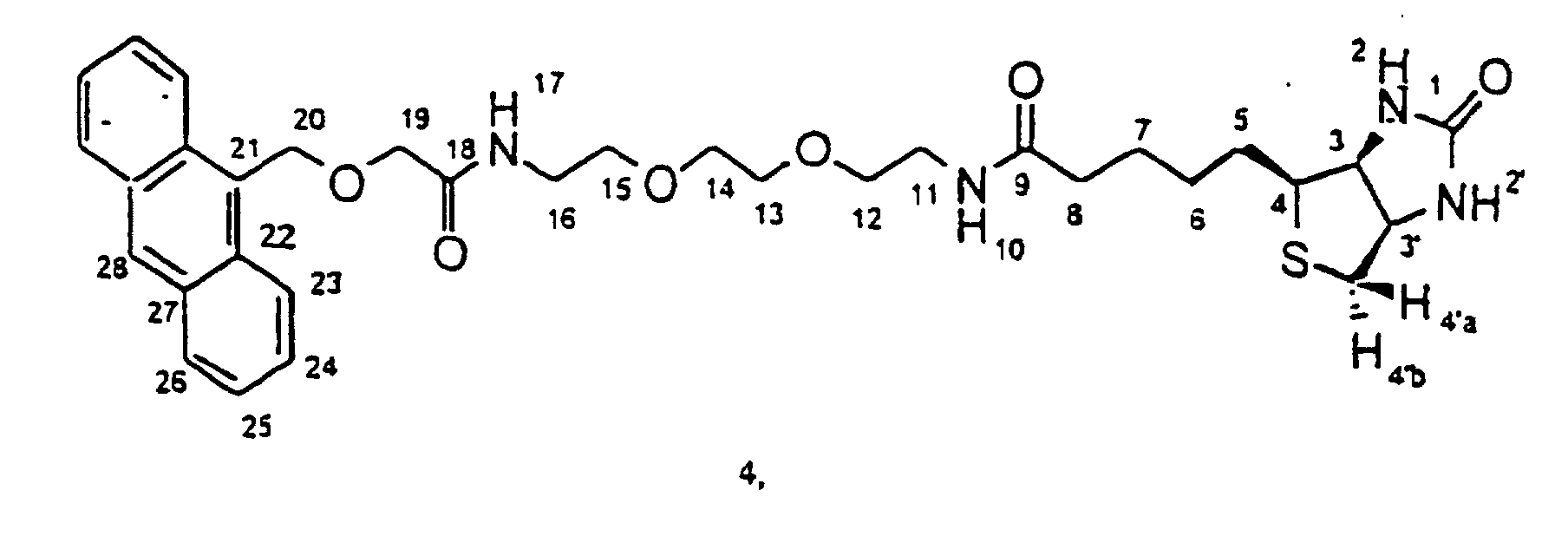
FB : C33H42N4O6S PM : 622,793 g/mol
CCM : Rf(CH2Cl2/MeOH ; 90/10) : 0.5 ;
RMN 1H (300,13 MHz, CDCl3) : δ 8,48 (s, 1H, H28) ; 8,31 et 7,01 (d et d, 4H, J = 9,0 Hz, J = 8,4 Hz, H23, H26) ; 7,55 et 7,47 (dd et dd, 4H, H24, H25) ; 6,89 (t, 1H, J16-17 = 5,0 Hz, H17) ; 6,90 (s, 1H, H2) ; 6,53 (t, 1H, J10-11 = 5,0 Hz, H10) ; 5,67 (s, 1H, H2') ; 5,55 (s, 2H, H20) ; 4,31 (m, 1H, H3) ; 4,17 (s, 2H, H19) ; 4,15 (m, 1H, H3')†; 3,2 - 3,5 (m, 12H, H11, H12, H13, H14, H15, H16) ;2,97 (dt, 2H, H4) ; 2,75 (dt, 1H, J3'-4'a = 4,8 Hz, J4'a-4'b = 12,7 Hz, H4'a) ; 2,2 (d, 1H, J4'a-4'b = 12,7 Hz, H4'b) ; 2,08 (t, 2H, J7-8 = 7,4 Hz, Hg) ; 1,2 - 1,7 (m, 6H, H5, H6, H7) ;
RMN 13C (75,47 MHz, CDCl3) : δ 173,00 (1C, C1) ; 169,56 (1C, C18) ; 163,76 (1C, C9) ; 131,14 , 130,73 et 127,05 (5C, C21, C22, C27) ; 128,98, 128,75 , 126,45 , 124,93 et 123,59 (9C, C23, C24, C25, C26, C28) ; 69,74 , 69,55 , 69.23 et 65,25 (6C, C12, C13, C14, C15, C19, C20) ; 61,50 et 59,88 (2C, C3, C3') ; 55,32 (1C, C4) ; 40,18 (1C, C4') ; 38,76 , 38,33 et 35,65 (3C, C8, C11, C16) ; 27,95 et 27,81 (2C, C5, C7) ; 25,30 (1C, C6);
SM (70eV/DCI/intensité %) : m/e : 623 (100, [M+1]+) ; 640 (8, [M+18]+) ;

Claims (13)
- Procédé de fixation et d'auto-organisation de macromolécules biologiques, caractérisé en ce qu'il comprend l'incubation, sans agitation, pendant au moins 15 minutes, d'une macromolécule biologique en solution avec des nanotubes de carbone fermés à leurs extrémités, dans des conditions de température et de pH convenables.
- Procédé selon la revendication 1, caractérisé en ce que lesdites macromolécules biologiques sont notamment des protéines solubles, membranaires, trans-membranaires, des enzymes, des anticorps, des fragments d'anticorps ou des acides nucléiques.
- Procédé selon la revendication 1 ou la revendication 2, caractérisé en ce que lesdits nanotubes de carbone sont fonctionnalisés par adsorption physique, à leur surface, d'un réactif chimique de formule générale H-E-L,
dans laquelle:H représente un groupe hydrophile, sélectionné parmi les groupes chargés positivement ou négativement ; des ligands ou analogues de macromolécules biologiques ; des complexes organométalliques interagissant avec des acides aminés ou des acides nucléiques et dont les ligands sont éventuellement fonctionnalisés par des groupements alkyles de liaison à E ;E représente un bras espaceur, sélectionné parmi des chaínons carbonés en C1-C10, éventuellement substitués par des groupes alkyles, présentant ou non des insaturations ou des motifs poly-oxyéthylène pouvant présenter ou non en milieu de chaíne des groupes phosphate, tels que : dans lesquels :
m représente un nombre entier compris entre 1 et 10,X représente O, NHCO, OCO, COO, CONH, S, CH2 ou NH et constitue aux extrémités desdits chaínons carbonés des fonctions organiques d'accrochage du type esters, amides, éthers, thioéthers ;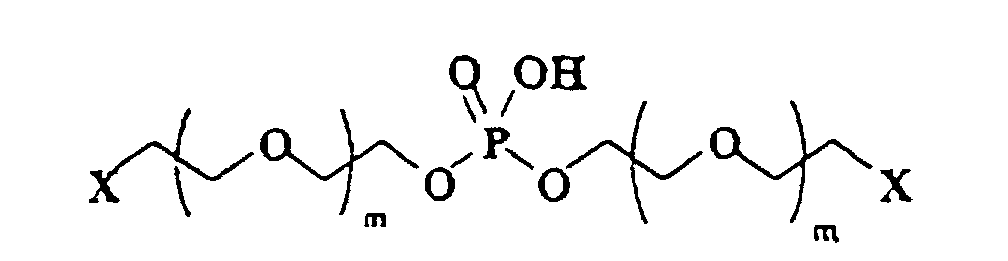 L représente un motif lipidique à une ou plusieurs chaínes de longueur variable, en C12-C20 présentant ou non des insaturations ; un groupe aromatique de formule Ar1 ou de formule Ar2 :dans lesquelles :
 A représente un atome d'hydrogène, l'un des groupes suivants : alkyle, CF3, NO2, NH2, OH, O-alkyle, S-alkyle, COOH, halogène, un cycle aromatique ou un hétérocycle aromatique en C4-C6, éventuellement polysubstitué par des groupes électrodonneurs de type alkyle ou électroattracteurs de type CF3 ou halogénures ; etY représente une liaison à E.
 - Procédé selon l'une quelconque des revendications 1 à 3, caractérisé en ce que ladite solution est constituée d'un solvant de solubilisation desdites macromolécules biologiques, aqueux ou hydroalcoolique et contenant éventuellement au moins un détergent.
- Procédé selon l'une quelconque des revendications 1 à 4, caractérisé en ce que les conditions d'incubation sont de préférence les suivantes : incubation à température ambiante, pendant 15 minutes à 48 heures, à un pH compris entre 5,5 et 8,5.
- Bionanomatzriaux, caractérisés en ce qu'ils sont constitués de nanotubes de carbone, sur lesquels des macromolécules biologiques sont auto-organisées sous une forme cristalline.
- Bionanomatériaux selon la revendication 6, caractérisés en ce qu'ils sont obtenus à l'aide d'un procédé selon l'une quelconque des revendications 1 à 5.
- Utilisation des bionanomatériaux selon l'une quelconque des revendications 6 à 7, pour l'étude structurale des macromolécules biologiques qui leur sont associées.
- Utilisation des bionanomatériaux selon l'une quelconque des revendications 6 à 7, en tant que réactif biologique.
- Utilisation des bionanomatériaux selon l'une quelconque des revendications 6 à 7, en tant que biocapteurs ou bioconducteurs.
- Réactif chimique apte à être adsorbé physiquement sur des nanotubes de carbone, caractérisé en ce qu'il présente la formule générale H-E-L, dans laquelle :H représente un groupe hydrophile, sélectionné parmi les groupes chargés positivement ou négativement ; des ligands ou analogues de macromolécules biologiques ; des complexes organométalliques interagissant avec des acides aminés ou des acides nucléiques et dont les ligands sont éventuellement fonctionnalisés par des groupements alkyles de liaison à E ;E représente un bras espaceur, sélectionné parmi des chaínons carbonés en C1-C10, éventuellement substitués par des groupes alkyles, présentant ou non des insaturations ou des motifs poly-oxyéthylène pouvant présenter ou non en milieu de chaíne des groupes phosphate, tels que :
 dans lesquels :
 m représente un nombre entier de 1 à 10,X représente O, NHCO, OCO, COO, CONH, S, CH2 ou NH et constitue aux extrémités desdits chaínons carbonés des fonctions organiques d'accrochage du type esters, amides, éthers, thioéthers ;L représente un groupe aromatique de formule Ar1 ou de formule Ar2:dans lesquelles :
 A représente un atome d'hydrogène, l'un des groupes- suivants : alkyle, CF3, NO2, NH2, OH, O-alkyle, S-alkyle, COOH, halogène, un cycle aromatique ou un hétérocycle aromatique en C4-C6, lesdits cycles étant éventuellement poly-substitués par des groupes électrodonneurs de type alkyle ou électroattracteurs de type CF3 ou halogénures ; etY représente une liaison à E.
 - Réactif chimique selon la revendication 11, caractérisé en ce qu'il présente l'une des structures suivantes :



- Réactif chirnique selon la revendication 11, caractérisé en ce que H est sélectionné parmi les complexes organbmétalliques suivants :avec R1 = groupe organique de liaison à E

Priority Applications (1)
| Application Number | Priority Date | Filing Date | Title |
|---|---|---|---|
| EP99917007A EP1078261B1 (fr) | 1998-05-07 | 1999-05-07 | Procede de fixation et d'auto-organisation de macromolecules biologiques sur des nanotubes de carbone et ses applications |
Applications Claiming Priority (6)
| Application Number | Priority Date | Filing Date | Title |
|---|---|---|---|
| EP98401114 | 1998-05-07 | ||
| EP98401114 | 1998-05-07 | ||
| FR9806539 | 1998-05-25 | ||
| FR9806539A FR2778846B1 (fr) | 1998-05-25 | 1998-05-25 | Procede de fixation et/ou de cristallisation de macromolecules biologiques sur des nanotubes de carbone et ses applications |
| PCT/FR1999/001086 WO1999057564A1 (fr) | 1998-05-07 | 1999-05-07 | Procede de fixation et/ou de cristallisation de macromolecules biologiques sur des nanotubes de carbone et ses applications |
| EP99917007A EP1078261B1 (fr) | 1998-05-07 | 1999-05-07 | Procede de fixation et d'auto-organisation de macromolecules biologiques sur des nanotubes de carbone et ses applications |
Publications (2)
| Publication Number | Publication Date |
|---|---|
| EP1078261A1 EP1078261A1 (fr) | 2001-02-28 |
| EP1078261B1 true EP1078261B1 (fr) | 2004-10-27 |
Family
ID=26151633
Family Applications (1)
| Application Number | Title | Priority Date | Filing Date |
|---|---|---|---|
| EP99917007A Expired - Lifetime EP1078261B1 (fr) | 1998-05-07 | 1999-05-07 | Procede de fixation et d'auto-organisation de macromolecules biologiques sur des nanotubes de carbone et ses applications |
Country Status (6)
| Country | Link |
|---|---|
| US (2) | US6656712B1 (fr) |
| EP (1) | EP1078261B1 (fr) |
| JP (1) | JP4484361B2 (fr) |
| AU (1) | AU3529299A (fr) |
| DE (1) | DE69921472T2 (fr) |
| WO (1) | WO1999057564A1 (fr) |
Families Citing this family (44)
| Publication number | Priority date | Publication date | Assignee | Title |
|---|---|---|---|---|
| FR2778918B1 (fr) * | 1998-05-25 | 2000-07-21 | Commissariat Energie Atomique | Baton moleculaire et ses applications |
| US8029734B2 (en) * | 2001-03-29 | 2011-10-04 | The Board Of Trustees Of The Leland Stanford Junior University | Noncovalent sidewall functionalization of carbon nanotubes |
| US6723299B1 (en) | 2001-05-17 | 2004-04-20 | Zyvex Corporation | System and method for manipulating nanotubes |
| US8154093B2 (en) | 2002-01-16 | 2012-04-10 | Nanomix, Inc. | Nano-electronic sensors for chemical and biological analytes, including capacitance and bio-membrane devices |
| US20040132070A1 (en) * | 2002-01-16 | 2004-07-08 | Nanomix, Inc. | Nonotube-based electronic detection of biological molecules |
| TW200307563A (en) * | 2002-02-14 | 2003-12-16 | Sixty Inc C | Use of BUCKYSOME or carbon nanotube for drug delivery |
| US7522040B2 (en) * | 2004-04-20 | 2009-04-21 | Nanomix, Inc. | Remotely communicating, battery-powered nanostructure sensor devices |
| US20070048180A1 (en) * | 2002-09-05 | 2007-03-01 | Gabriel Jean-Christophe P | Nanoelectronic breath analyzer and asthma monitor |
| US7547931B2 (en) * | 2003-09-05 | 2009-06-16 | Nanomix, Inc. | Nanoelectronic capnometer adaptor including a nanoelectric sensor selectively sensitive to at least one gaseous constituent of exhaled breath |
| US6905667B1 (en) | 2002-05-02 | 2005-06-14 | Zyvex Corporation | Polymer and method for using the polymer for noncovalently functionalizing nanotubes |
| US20040034177A1 (en) * | 2002-05-02 | 2004-02-19 | Jian Chen | Polymer and method for using the polymer for solubilizing nanotubes |
| US7304128B2 (en) | 2002-06-04 | 2007-12-04 | E.I. Du Pont De Nemours And Company | Carbon nanotube binding peptides |
| US7948041B2 (en) | 2005-05-19 | 2011-05-24 | Nanomix, Inc. | Sensor having a thin-film inhibition layer |
| US20060263255A1 (en) * | 2002-09-04 | 2006-11-23 | Tzong-Ru Han | Nanoelectronic sensor system and hydrogen-sensitive functionalization |
| US20070114573A1 (en) * | 2002-09-04 | 2007-05-24 | Tzong-Ru Han | Sensor device with heated nanostructure |
| AU2003299538B2 (en) * | 2002-09-20 | 2008-05-15 | The Trustees Of Boston College | Nanotube cantilever probes for nanoscale magnetic microscopy |
| US7214303B2 (en) * | 2002-09-20 | 2007-05-08 | The Trustees Of Boston College | Cantilever probes for nanoscale magnetic and atomic force microscopy |
| FR2853657B1 (fr) * | 2003-04-10 | 2005-06-24 | Centre Nat Rech Scient | Macromolecules auto assemblees et photopolymerisees autour de nanotubes de carbone, un procede pour leur preparation, et leurs applications |
| US20060199770A1 (en) * | 2003-04-14 | 2006-09-07 | Alberto Bianco | Functionalized carbon nanotubes, a process for preparing the same and their use in medicinal chemistry |
| WO2004106420A2 (fr) * | 2003-05-22 | 2004-12-09 | Zyvex Corporation | Nanocomposites et procedes |
| KR100525764B1 (ko) * | 2003-06-13 | 2005-11-04 | 한국과학기술원 | 전도성 탄소나노튜브를 이용한 바이오센서 및 그 제조방법 |
| DE10345157B4 (de) * | 2003-09-29 | 2009-01-08 | Qimonda Ag | Wärmeleitende Verpackung von elektronischen Schaltungseinheiten |
| US7399400B2 (en) * | 2003-09-30 | 2008-07-15 | Nano-Proprietary, Inc. | Nanobiosensor and carbon nanotube thin film transistors |
| US9062392B2 (en) | 2003-12-30 | 2015-06-23 | Intel Corporation | Methods for isolating a peptide methods for identifying a peptide |
| US20050147964A1 (en) * | 2003-12-30 | 2005-07-07 | Intel Corporation | Methods for identifying a peptide that binds a geometrical shape |
| US20060054866A1 (en) * | 2004-04-13 | 2006-03-16 | Zyvex Corporation. | Methods for the synthesis of modular poly(phenyleneethynlenes) and fine tuning the electronic properties thereof for the functionalization of nanomaterials |
| EP1743355A2 (fr) * | 2004-04-27 | 2007-01-17 | Koninklijke Philips Electronics N.V. | Utilisation de nanotubes de carbone pour l'analyse d'echantillons |
| EP1605265A1 (fr) * | 2004-06-09 | 2005-12-14 | Centre National De La Recherche Scientifique (Cnrs) | Complexes non-covalent contenant des nanotubes de carbone |
| US8765488B2 (en) * | 2004-07-22 | 2014-07-01 | The Board Of Trustees Of The University Of Illinois | Sensors employing single-walled carbon nanotubes |
| US7296576B2 (en) * | 2004-08-18 | 2007-11-20 | Zyvex Performance Materials, Llc | Polymers for enhanced solubility of nanomaterials, compositions and methods therefor |
| US8033501B2 (en) * | 2005-06-10 | 2011-10-11 | The Boeing Company | Method and apparatus for attaching electrically powered seat track cover to through hole seat track design |
| KR100779008B1 (ko) * | 2005-11-16 | 2007-11-28 | 광주과학기술원 | pH-감응 발광성 단일벽 탄소 나노튜브 유도체 및 그 제조방법 |
| US8859048B2 (en) * | 2006-01-03 | 2014-10-14 | International Business Machines Corporation | Selective placement of carbon nanotubes through functionalization |
| KR100699244B1 (ko) | 2006-01-10 | 2007-03-28 | 이상훈 | 고효율 마이크로 반응 블록 및 그 제조방법 |
| US20090278556A1 (en) * | 2006-01-26 | 2009-11-12 | Nanoselect, Inc. | Carbon Nanostructure Electrode Based Sensors: Devices, Processes and Uses Thereof |
| US8907384B2 (en) * | 2006-01-26 | 2014-12-09 | Nanoselect, Inc. | CNT-based sensors: devices, processes and uses thereof |
| JP4953072B2 (ja) * | 2007-04-11 | 2012-06-13 | 独立行政法人物質・材料研究機構 | レドックスたんぱく質を非共有結合で結合させ機能化した生体反応性カーボンナノチューブ |
| EP2148835A2 (fr) * | 2007-05-30 | 2010-02-03 | LG Chem, Ltd. | Dispersant contenant un complexe métallique pour nanotubes de carbone |
| WO2010123534A2 (fr) * | 2009-01-16 | 2010-10-28 | Rensselaer Polytechnic Institute | Composites de décontamination à l'échelle nanométrique à base d'enzyme |
| WO2011017660A2 (fr) * | 2009-08-07 | 2011-02-10 | Nanomix, Inc. | Biodétection à base d'un nanotube de carbone magnétique |
| WO2013039819A2 (fr) * | 2011-09-12 | 2013-03-21 | Nanoselect, Inc. | Fonctionnalisation couche par couche de surface de nanostructures de carbone |
| WO2013175259A1 (fr) * | 2012-05-23 | 2013-11-28 | University Of Calcutta | Discriminateurs moléculaires utilisant des nanotubes de carbone |
| GB2559094A (en) * | 2014-03-31 | 2018-08-01 | Imperial Innovations Ltd | Nucleant for macromolecule crystallisation |
| JP6516248B2 (ja) * | 2014-12-08 | 2019-05-22 | 国立大学法人福井大学 | 導電性炭素材料への分子識別機能を有する生体分子の固定化方法 |
Family Cites Families (3)
| Publication number | Priority date | Publication date | Assignee | Title |
|---|---|---|---|---|
| US5866434A (en) * | 1994-12-08 | 1999-02-02 | Meso Scale Technology | Graphitic nanotubes in luminescence assays |
| EP0910340A4 (fr) * | 1996-03-06 | 2004-11-17 | Hyperion Catalysis Int | Nanotubes fonctionnalises |
| FR2778918B1 (fr) * | 1998-05-25 | 2000-07-21 | Commissariat Energie Atomique | Baton moleculaire et ses applications |
-
1999
- 1999-05-07 EP EP99917007A patent/EP1078261B1/fr not_active Expired - Lifetime
- 1999-05-07 US US09/673,668 patent/US6656712B1/en not_active Expired - Fee Related
- 1999-05-07 WO PCT/FR1999/001086 patent/WO1999057564A1/fr not_active Ceased
- 1999-05-07 AU AU35292/99A patent/AU3529299A/en not_active Abandoned
- 1999-05-07 JP JP2000547479A patent/JP4484361B2/ja not_active Expired - Fee Related
- 1999-05-07 DE DE69921472T patent/DE69921472T2/de not_active Expired - Lifetime
-
2003
- 2003-07-15 US US10/618,586 patent/US20040018543A1/en not_active Abandoned
Also Published As
| Publication number | Publication date |
|---|---|
| US6656712B1 (en) | 2003-12-02 |
| DE69921472D1 (de) | 2004-12-02 |
| AU3529299A (en) | 1999-11-23 |
| US20040018543A1 (en) | 2004-01-29 |
| WO1999057564A1 (fr) | 1999-11-11 |
| DE69921472T2 (de) | 2006-02-02 |
| JP2002513815A (ja) | 2002-05-14 |
| JP4484361B2 (ja) | 2010-06-16 |
| EP1078261A1 (fr) | 2001-02-28 |
Similar Documents
| Publication | Publication Date | Title |
|---|---|---|
| WO1999057564A1 (fr) | Procede de fixation et/ou de cristallisation de macromolecules biologiques sur des nanotubes de carbone et ses applications | |
| EP2076463B1 (fr) | Complexes de nanotubes de carbone et fullerènes dotés de clips moléculaires et leurs utilisations | |
| RU2200562C2 (ru) | Функционализованные нанотрубки | |
| JP4601086B2 (ja) | 官能基化されたナノチューブ | |
| JP2008513318A (ja) | 官能基化単層カーボンナノチューブ | |
| US5487831A (en) | Recognition and separation of carbon clusters | |
| WO2011006453A1 (fr) | Lipide complexe à base de pentaérythritol, ses intermédiaires, son procédé de préparation et son utilisation | |
| Keskinates et al. | Electrospinning of novel calixarene-functionalized PAN and PMMA nanofibers: Comparison of fluorescent protein adsorption performance | |
| EP1080368B1 (fr) | Baton moleculaire et ses applications | |
| CN114524813A (zh) | 对沙林具有荧光响应的一维有机半导体纳米材料及其制备方法和应用 | |
| EP2380664B1 (fr) | Substrat fonctionnalisé et ses applications | |
| FR2778846A1 (fr) | Procede de fixation et/ou de cristallisation de macromolecules biologiques sur des nanotubes de carbone et ses applications | |
| JP5196287B2 (ja) | 光分解性カップリング剤 | |
| EP1399452B1 (fr) | Revetements de surface mimetique biomembranaire | |
| EP2903973B1 (fr) | Nouveaux azotures, procédés de fabrication et leurs applications | |
| CN108997447B (zh) | 含有二硫键的化合物及其用途和制备方法 | |
| KR20200125501A (ko) | 금 나노클러스터와 이의 제조방법 및 이를 포함하는 광학 센서 | |
| JP2002504167A (ja) | ペル(3,6−アンヒドロ)シクロデキストリン誘導体によるイオン、特にPbの固定と分離 | |
| WO1989010372A1 (fr) | Marquage froid de molecules de nature peptidique ou proteique | |
| DE10222588A1 (de) | Biomimetische Systeme aus Lipidmembranen gebunden an ein Substrat | |
| JP3837493B2 (ja) | 自己組織化膜及びその製造方法。 | |
| JP3538633B2 (ja) | アゾベンゼン誘導体化合物及びそれからなる自己組織化膜 | |
| KR101603038B1 (ko) | 디설파이드―말단 아릴디아조늄 염 화합물 및 이의 제조방법 | |
| JPH0425959B2 (fr) | ||
| FR2882055A1 (fr) | Dibenzopyrromethenes-bore borocarbones insatures |
Legal Events
| Date | Code | Title | Description |
|---|---|---|---|
| PUAI | Public reference made under article 153(3) epc to a published international application that has entered the european phase |
Free format text: ORIGINAL CODE: 0009012 |
|
| 17P | Request for examination filed |
Effective date: 20001109 |
|
| AK | Designated contracting states |
Kind code of ref document: A1 Designated state(s): DE FR GB NL |
|
| 17Q | First examination report despatched |
Effective date: 20030807 |
|
| RTI1 | Title (correction) |
Free format text: METHOD FOR IMMOBILISING AND SELF-ORGANIZING BIOLOGICAL MACROMOLECULES ON CARBON NANOTUBES AND USES |
|
| RTI1 | Title (correction) |
Free format text: METHOD FOR IMMOBILISING AND SELF-ORGANIZING BIOLOGICAL MACROMOLECULES ON CARBON NANOTUBES AND USES |
|
| GRAP | Despatch of communication of intention to grant a patent |
Free format text: ORIGINAL CODE: EPIDOSNIGR1 |
|
| GRAS | Grant fee paid |
Free format text: ORIGINAL CODE: EPIDOSNIGR3 |
|
| GRAA | (expected) grant |
Free format text: ORIGINAL CODE: 0009210 |
|
| AK | Designated contracting states |
Kind code of ref document: B1 Designated state(s): DE FR GB NL |
|
| REG | Reference to a national code |
Ref country code: GB Ref legal event code: FG4D Free format text: NOT ENGLISH |
|
| REF | Corresponds to: |
Ref document number: 69921472 Country of ref document: DE Date of ref document: 20041202 Kind code of ref document: P |
|
| GBT | Gb: translation of ep patent filed (gb section 77(6)(a)/1977) |
Effective date: 20050218 |
|
| PLBE | No opposition filed within time limit |
Free format text: ORIGINAL CODE: 0009261 |
|
| STAA | Information on the status of an ep patent application or granted ep patent |
Free format text: STATUS: NO OPPOSITION FILED WITHIN TIME LIMIT |
|
| 26N | No opposition filed |
Effective date: 20050728 |
|
| PGFP | Annual fee paid to national office [announced via postgrant information from national office to epo] |
Ref country code: FR Payment date: 20110607 Year of fee payment: 13 |
|
| PGFP | Annual fee paid to national office [announced via postgrant information from national office to epo] |
Ref country code: NL Payment date: 20110520 Year of fee payment: 13 Ref country code: GB Payment date: 20110520 Year of fee payment: 13 |
|
| PGFP | Annual fee paid to national office [announced via postgrant information from national office to epo] |
Ref country code: DE Payment date: 20110520 Year of fee payment: 13 |
|
| REG | Reference to a national code |
Ref country code: NL Ref legal event code: V1 Effective date: 20121201 |
|
| GBPC | Gb: european patent ceased through non-payment of renewal fee |
Effective date: 20120507 |
|
| REG | Reference to a national code |
Ref country code: FR Ref legal event code: ST Effective date: 20130131 |
|
| REG | Reference to a national code |
Ref country code: DE Ref legal event code: R119 Ref document number: 69921472 Country of ref document: DE Effective date: 20121201 |
|
| PG25 | Lapsed in a contracting state [announced via postgrant information from national office to epo] |
Ref country code: NL Free format text: LAPSE BECAUSE OF NON-PAYMENT OF DUE FEES Effective date: 20121201 |
|
| PG25 | Lapsed in a contracting state [announced via postgrant information from national office to epo] |
Ref country code: FR Free format text: LAPSE BECAUSE OF NON-PAYMENT OF DUE FEES Effective date: 20120531 Ref country code: GB Free format text: LAPSE BECAUSE OF NON-PAYMENT OF DUE FEES Effective date: 20120507 |
|
| PG25 | Lapsed in a contracting state [announced via postgrant information from national office to epo] |
Ref country code: DE Free format text: LAPSE BECAUSE OF NON-PAYMENT OF DUE FEES Effective date: 20121201 |