EP1072242A2 - Pflaster sowie Verfahren zum Herstellen eines Pflasters - Google Patents
Pflaster sowie Verfahren zum Herstellen eines Pflasters Download PDFInfo
- Publication number
- EP1072242A2 EP1072242A2 EP00111736A EP00111736A EP1072242A2 EP 1072242 A2 EP1072242 A2 EP 1072242A2 EP 00111736 A EP00111736 A EP 00111736A EP 00111736 A EP00111736 A EP 00111736A EP 1072242 A2 EP1072242 A2 EP 1072242A2
- Authority
- EP
- European Patent Office
- Prior art keywords
- melt adhesive
- carrier
- hot melt
- hot
- patch according
- Prior art date
- Legal status (The legal status is an assumption and is not a legal conclusion. Google has not performed a legal analysis and makes no representation as to the accuracy of the status listed.)
- Granted
Links
Images

Classifications
-
- A—HUMAN NECESSITIES
- A61—MEDICAL OR VETERINARY SCIENCE; HYGIENE
- A61F—FILTERS IMPLANTABLE INTO BLOOD VESSELS; PROSTHESES; DEVICES PROVIDING PATENCY TO, OR PREVENTING COLLAPSING OF, TUBULAR STRUCTURES OF THE BODY, e.g. STENTS; ORTHOPAEDIC, NURSING OR CONTRACEPTIVE DEVICES; FOMENTATION; TREATMENT OR PROTECTION OF EYES OR EARS; BANDAGES, DRESSINGS OR ABSORBENT PADS; FIRST-AID KITS
- A61F13/00—Bandages or dressings; Absorbent pads
- A61F13/02—Adhesive bandages or dressings
- A61F13/0276—Apparatus or processes for manufacturing adhesive dressings or bandages
- A61F13/0283—Apparatus or processes for manufacturing adhesive dressings or bandages for making adhesive or cohesive tape or fabrics therefor, e.g. coating or mechanical treatments
-
- A—HUMAN NECESSITIES
- A61—MEDICAL OR VETERINARY SCIENCE; HYGIENE
- A61F—FILTERS IMPLANTABLE INTO BLOOD VESSELS; PROSTHESES; DEVICES PROVIDING PATENCY TO, OR PREVENTING COLLAPSING OF, TUBULAR STRUCTURES OF THE BODY, e.g. STENTS; ORTHOPAEDIC, NURSING OR CONTRACEPTIVE DEVICES; FOMENTATION; TREATMENT OR PROTECTION OF EYES OR EARS; BANDAGES, DRESSINGS OR ABSORBENT PADS; FIRST-AID KITS
- A61F13/00—Bandages or dressings; Absorbent pads
- A61F13/02—Adhesive bandages or dressings
- A61F13/0203—Adhesive bandages or dressings with fluid retention members
- A61F13/0206—Adhesive bandages or dressings with fluid retention members with absorbent fibrous layers, e.g. woven or non-woven absorbent pads or island dressings
-
- A—HUMAN NECESSITIES
- A61—MEDICAL OR VETERINARY SCIENCE; HYGIENE
- A61F—FILTERS IMPLANTABLE INTO BLOOD VESSELS; PROSTHESES; DEVICES PROVIDING PATENCY TO, OR PREVENTING COLLAPSING OF, TUBULAR STRUCTURES OF THE BODY, e.g. STENTS; ORTHOPAEDIC, NURSING OR CONTRACEPTIVE DEVICES; FOMENTATION; TREATMENT OR PROTECTION OF EYES OR EARS; BANDAGES, DRESSINGS OR ABSORBENT PADS; FIRST-AID KITS
- A61F13/00—Bandages or dressings; Absorbent pads
- A61F13/02—Adhesive bandages or dressings
- A61F13/0203—Adhesive bandages or dressings with fluid retention members
- A61F13/0226—Adhesive bandages or dressings with fluid retention members characterised by the support layer
-
- A—HUMAN NECESSITIES
- A61—MEDICAL OR VETERINARY SCIENCE; HYGIENE
- A61F—FILTERS IMPLANTABLE INTO BLOOD VESSELS; PROSTHESES; DEVICES PROVIDING PATENCY TO, OR PREVENTING COLLAPSING OF, TUBULAR STRUCTURES OF THE BODY, e.g. STENTS; ORTHOPAEDIC, NURSING OR CONTRACEPTIVE DEVICES; FOMENTATION; TREATMENT OR PROTECTION OF EYES OR EARS; BANDAGES, DRESSINGS OR ABSORBENT PADS; FIRST-AID KITS
- A61F13/00—Bandages or dressings; Absorbent pads
- A61F13/02—Adhesive bandages or dressings
- A61F13/0246—Adhesive bandages or dressings characterised by the skin-adhering layer
- A61F13/025—Adhesive bandages or dressings characterised by the skin-adhering layer having a special distribution arrangement of the adhesive
Definitions
- the invention relates to a plaster and a method for Making the same, the patch being a porous, comprises beams extending in a longitudinal direction, wherein one side of the carrier at least in sections is coated with a self-adhesive hot melt adhesive.
- Patches currently available on the market are used as rolls made up with the adhesive rolled up with the plaster top of the winding underneath is in contact, and on the other hand in the form of conventional Band-aids to protect the adhesive surface on this protective strip made of a plastic material are arranged, which are deducted before use.
- Plaster of the generic type with hot melt application are z. B. from EP 0 689 408 B1 and EP 0 826 380 A2 known. Because the hot melt adhesive itself is not breathable is generally not a full-surface adhesive application provided, but the hot melt adhesive is applied area by area. The order can e.g. B. in stripes Longitudinal direction of the patch, but also in the form of Horizontal stripes, punctiform, grid-shaped or in the form of a porous application take place so that the breathability is ensured.
- the object of the invention is therefore a plaster and a To provide methods of making a patch, in which the above problem is nonexistent or less Dimensions occurs.
- the invention solves this problem with a plaster which the hot melt adhesive along at least one edge region of the carrier has penetrated further into the porous carrier than in areas adjacent to the edge area.
- Hot melt adhesive along at least one edge area of the Carrier in the porous carrier at least over 70% of Thickness D of the carrier penetrated into it.
- the intrusion of the Hot melt adhesive is in the porous carrier in edge areas yet another advantage is linked, namely this creates a kind of grip area ("finger lift"), because of the adhesive available to the skin standing hot melt adhesive as a result of penetration into the porous carrier is reduced.
- the adhesive force reduced in this border area, and a plaster can be for example, without problems at its edge area with the Grasp fingers to peel it off the surface of the skin can.
- the edge areas can be both in the longitudinal direction also extend in the transverse direction. So at Fixing plasters essentially the longitudinal edge areas like this be designed so that the hot melt adhesive in the Carrier has penetrated as in the neighboring areas. With conventional adhesive plaster strips, however, this can both on the longitudinal and on the transverse edge areas be provided.
- the porous carrier can, for example, be made of nonwoven material or textile material, for example fabric.
- the Hot melt adhesive in the edge area at least over 40% of the thickness of the wearer into it.
- This will already be a essentially sufficient fixation of the components of the Carrier reached among themselves.
- This should also apply to textiles and nonwoven materials ensure that the edge areas dissolve is avoided by essentially all fibers from Hot melt adhesive can be detected.
- the stability against Fraying or fluffing around the edges becomes even more increased, the deeper the hot melt adhesive in the edge area in the cross section of the carrier is present.
- the plaster can, for example, be designed so that the Hot melt adhesive in strips running lengthways attached to the carrier, with a hot melt adhesive strip along at least one in the longitudinal direction extending edge region is arranged.
- a hot melt adhesive strip along at least one in the longitudinal direction extending edge region is arranged.
- the patch is as conventional "adhesive plaster" is designed that on the side of the porous support provided with the hot-melt adhesive a wound pad between the ones in longitudinal and / or Transverse direction extending edge areas is arranged.
- Such wound pads are used to treat smaller wounds cover and at the same time the wound pad through the porous Backing material coated with the hot melt adhesive, to fix securely on the wound. The same will happen at major injuries from using Wound covers in connection with fixation plasters, the be placed all around the wound cover, ensured.
- the longitudinal and / or Edge regions of the carrier extending transversely Have wavy or zigzag cut.
- a method of manufacturing a Patches proposed, one on one side extending in the longitudinal direction from a porous Backing material formed flat material web discontinuously a self-adhesive hot melt adhesive is applied and then the flat material web in the individual plasters in the longitudinal and / or transverse direction is cut, with the applied hot melt adhesive in front cutting at least along a later one Edge area of the patch heated and in the at least displaced an edge area into the porous carrier is so that it enters the pores of the porous support material penetrates.
- the porous carrier material Formed flat material web is first in the usual way discontinuously with the self-adhesive hot melt adhesive coated, whereupon the hot melt adhesive along the later edge areas heated and into the pores of the porous Carrier material is displaced.
- Heating and The hot melt can be displaced, for example direct contact with a heating head can be achieved.
- heating can also take place in another way, for example hot air, UV, IR, etc.
- the Flat material web then along these edge areas cut, preferably such that the cut runs through the track thus treated, so that in the edge regions formed here from the Flat material web cut plaster of hot melt adhesive has penetrated further into the porous carrier material than in adjacent areas.
- the method of claim 14 ensures that at always apply at least one strip of adhesive Hotmelt adhesive strips caught by the effect of heat, melted and into the porous support material is pushed in to an inventive induced track, through which then the Parting cut can be performed without any special elaborate measures for positioning the device for Heating and melting of the glue are taken have to.
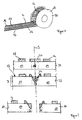
- Fig. 1 shows a patch 10, consisting of a longitudinally extending porous support 12, the discontinuous on one side, namely in longitudinal strips is coated with a self-adhesive hot melt adhesive 14.
- the hot melt adhesive 14 is in the area of both edges of the Carrier 12 applied.
- the Patch 10 is here on a patch roller 18 wound, which consists of a sleeve on which the Patch 10 is wound, and from two side Flanges 20 which limit the patch 10 to the side.
- the carrier material consists of a textile Material that has a certain porosity and therefore one Breathability of the patch 10 ensured.
- FIG. 2 shows a manufacturing method for producing such a plaster 10.
- a partially shown flat material web 22 extending in the longitudinal direction, which consists of a porous material, here a textile cellulose fabric, is discontinuous, namely in longitudinal strips 15 Hot melt adhesive 14 applied.
- the discontinuous application ensures the breathability of the plaster 10, since the hot melt adhesive 14 itself is not breathable.
- the width of the hot-melt adhesive strips 24 is approximately 1 mm.
- the distances between the hot melt adhesive strips are approximately 0.5 mm.
- the basis weight of the hot melt adhesive application (adhesive + adhesive-free areas) is approx. 80 g / m 2 .
- the adhesives mentioned in the patent publications described at the outset are suitable as hot-melt adhesive materials.
- the flat material web 22 is formed from a textile cellulose fabric (viscose) of approximately 115 g / m 2 .
- the thread density of the cellular wool fabric is 33 warp threads per centimeter and 29 weft threads per centimeter.
- the hot melt adhesive 14 is so on the flat material web 22 applied that a hot melt adhesive strip 24 in the area the later longitudinal edge areas 16 of the patch 10 is arranged.
- the hot-melt adhesive strip 24 in the area of the later Longitudinal edge areas 16 heated and by a heating head (not shown) at least partially in the porous Suppressed carrier 22.
- the hot melt adhesive 14 will liquefied and by the over the flat material web 22nd wandering or brushing heating head in the pores of the Carrier material introduced. In the case shown was the hot melt adhesive in this way into the carrier material 22 displaced that it is about 50% of the thickness D or the cross section of the carrier 22 in this stretched in.
- the patches 10 shown only partially point in FIG apply a hot melt adhesive to their longitudinal edge regions 16, which extends further into the porous support than the hot-melt adhesive 14 in the edge regions 16 adjacent areas 17.
- the individual patches 10 then finally to those shown in Figure 1 Plaster rolls 18 rolled up.
- Figure 3 illustrates an alternative variant to Manufacture of a plaster 10, again from one in Longitudinal strips 15 on one side 13 of a flat material web 22 applied hot melt adhesive 14 is assumed.
- Reference number 25 schematically shows a heating head, its cooperating with the flat material web 22 Contact surface transverse to the longitudinal direction of the strips in such a way is dimensioned so that it the space between two bridging adjacent strips 15 and thus two adjacent Hot melt adhesive strips 24 captured. This will make the adjacent hot melt adhesive strips 24 melted, whereby the hot melt adhesive in the previously glue-free space flows and there under the action of the heating head 25 in the Carrier 22 is pushed into it. An im arises essentially determined by the width of the heating head Adhesive track 26.
- a hot melt adhesive strip 24 is detected or their width at least as wide as the sum of the Width of a hot melt adhesive strip 24 and the width of the adjacent adhesive-free area.
Landscapes
- Health & Medical Sciences (AREA)
- Engineering & Computer Science (AREA)
- Life Sciences & Earth Sciences (AREA)
- Biomedical Technology (AREA)
- Heart & Thoracic Surgery (AREA)
- Vascular Medicine (AREA)
- Animal Behavior & Ethology (AREA)
- General Health & Medical Sciences (AREA)
- Public Health (AREA)
- Veterinary Medicine (AREA)
- Manufacturing & Machinery (AREA)
- Dermatology (AREA)
- Medicinal Preparation (AREA)
- Materials For Medical Uses (AREA)
- Curing Cements, Concrete, And Artificial Stone (AREA)
Abstract
Description
- Fig. 1
- eine perspektivische Darstellung eines handeisfertig konfektionierten Fixierpflasters;
- Fig. 2
- in schematisierter Form den Herstellungsablauf eines derartigen Pflasters;
- Fig. 3
- in schematisierter Form den Herstellungablauf eines derartigen Pflasters noch einer weiteren Variante.
Claims (14)
- Pflaster umfassend einen porösen, sich in einer Längsrichtung erstreckenden Träger (12), wobei eine Seite (13) des Trägers (12) wenigstens abschnittsweise mit einem selbstklebenden Schmelzkleber (14) beschichtet ist, dadurch gekennzeichnet, dass der Schmelzkleber (14) entlang wenigstens eines Randbereiches (16) des Trägers (12) weiter in den porösen Träger (12) eingedrungen ist als in zu dem Randbereich (16) benachbarten Bereichen (17).
- Pflaster umfassend einen porösen, sich in einer Längsrichtung erstreckenden Träger (12), wobei eine Seite (13) des Trägers (12) wenigstens abschnittsweise mit einem selbstklebenden Schmelzkleber (14) beschichtet ist, dadurch gekennzeichnet, dass der Schmelzkleber entlang wenigstens eines Randbereichs des Trägers in den porösen Träger (12) wenigstens über 70 % der Dicke (D) des Trägers (12) in diesen eingedrungen ist.
- Pflaster nach Anspruch 1 oder 2, dadurch gekennzeichnet, dass der Randbereich (16) in Längsrichtung erstreckt ist.
- Pflaster nach Anspruch 1, 2 oder 3, dadurch gekennzeichnet, dass der Randbereich (16) in Querrichtung erstreckt ist.
- Pflaster nach Anspruch 1, 3 oder 4, dadurch gekennzeichnet, dass sich der Schmelzkleber (14) im Randbereich (16) wenigstens über 40% der Dicke (D) des Trägers (12) in diesen hineinerstreckt.
- Pflaster nach Anspruch 5, dadurch gekennzeichnet, dass sich der Schmelzkleber (14) im Randbereich (16) wenigstens über 50% der Dicke (D) des Trägers (12) in diesen hineinerstreckt.
- Pflaster nach Anspruch 6, dadurch gekennzeichnet, dass sich der Schmelzkleber (14) im Randbereich (16) wenigstens über 60% der Dicke (D) des Trägers (12) in diesen hineinerstreckt.
- Pflaster nach einem Anspruch 7, dadurch gekennzeichnet, dass sich der Schmelzkleber (14) im Randbereich (16) wenigstens über 70% der Dicke (D) des Trägers (12) in diesen hineinerstreckt.
- Pflaster nach einem der vorangehenden Ansprüche, dadurch gekennzeichnet, dass der poröse Träger (12) aus Vlies oder textilem Material besteht.
- Pflaster nach einem der vorangehenden Ansprüche, dadurch gekennzeichnet, dass der Schmelzkleber (14) in in Längsrichtung verlaufenden Streifen (15) auf den Träger (12) aufgebracht ist, wobei ein Schmelzkleberstreifen (24) entlang wenigstens eines sich in Längsrichtung erstreckenden Randbereiches (16) angeordnet ist.
- Pflaster nach einem der vorangehenden Ansprüche dadurch gekennzeichnet, dass auf der mit dem Schmelzkleber (14) versehenen Seite (13) des porösen Trägers (12) ein Wundkissen zwischen den sich in Längs- und/oder Querrichtung erstreckenden Randbereichen (16) angeordnet ist.
- Pflaster nach einem der vorangehenden Ansprüche dadurch gekennzeichnet, dass die sich in Längs- und/oder Querrichtung erstreckenden Randbereiche (16) des Trägers (12) einen Wellen- oder Zick-Zack-Schnitt aufweisen.
- Verfahren zum Herstellen eines Pflasters nach einem der Ansprüche 1 bis 12, wobei auf einer Seite (13) einer sich in eine Längsrichtung erstreckenden aus einem porösen Tägermaterial gebildeten Flachmaterialbahn (22) diskontinuierlich ein selbstklebender Schmelzkleber (14) aufgebracht wird und die Flachmaterialbahn (22) dann in die einzelnen Pflaster (10) in Längs- und/oder Querrichtung geschnitten wird, dadurch gekennzeichnet, dass der aufgebrachte Schmelzkleber (14) vor dem Schneiden zumindest entlang eines späteren Randbereiches (16) des Pflasters (10) erwärmt und in dem wenigstens einen Randbereich (16) in das poröse Trägermaterial hineinverdrängt wird, so dass er in die Poren des porösen Trägermaterials eindringt.
- Verfahren nach Anspruch 13, dadurch gekennzeichnet, dass zum Erschmelzen eines in Streifen (15, 24) aufgebrachten Schmelzklebers (14) die Flachmaterialbahn (22) über eine Breite quer zur Längsrichtung der Schmelzkleberstreifen (15, 24) erhitzt wird, die wenigstens gleich der Summe eines Schmelzkleberstreifens (15, 24) und der Breite des zwischen zwei Schmelzkleberstreifen (15, 24) befindlichen kleberfreien Bereichs bemessen ist.
Applications Claiming Priority (2)
| Application Number | Priority Date | Filing Date | Title |
|---|---|---|---|
| DE19934591 | 1999-07-23 | ||
| DE19934591A DE19934591C1 (de) | 1999-07-23 | 1999-07-23 | Pflaster sowie Verfahren zum Herstellen eines Pflasters |
Publications (3)
| Publication Number | Publication Date |
|---|---|
| EP1072242A2 true EP1072242A2 (de) | 2001-01-31 |
| EP1072242A3 EP1072242A3 (de) | 2002-06-19 |
| EP1072242B1 EP1072242B1 (de) | 2007-08-08 |
Family
ID=7915812
Family Applications (1)
| Application Number | Title | Priority Date | Filing Date |
|---|---|---|---|
| EP00111736A Expired - Lifetime EP1072242B1 (de) | 1999-07-23 | 2000-06-02 | Pflaster sowie Verfahren zum Herstellen eines Pflasters |
Country Status (4)
| Country | Link |
|---|---|
| EP (1) | EP1072242B1 (de) |
| AT (1) | ATE369106T1 (de) |
| DE (2) | DE19934591C1 (de) |
| ES (1) | ES2288817T3 (de) |
Family Cites Families (5)
| Publication number | Priority date | Publication date | Assignee | Title |
|---|---|---|---|---|
| US4530353A (en) * | 1982-11-12 | 1985-07-23 | Johnson & Johnson Products, Inc. | Unitary adhesive bandage |
| DE4237252C2 (de) * | 1992-11-04 | 1994-10-13 | Zweckform Buero Prod Gmbh | Rückstandsfrei wiederablösbares, flexibles Flächengebilde, Verfahren zu dessen Herstellung und dessen Verwendung |
| JPH09299396A (ja) * | 1996-05-17 | 1997-11-25 | Johnson & Johnson Kk | 絆創膏のヒ−トシ−ル方法および該方法により製造した絆創膏 |
| DE19751873A1 (de) * | 1997-11-22 | 1999-08-05 | Beiersdorf Ag | Partiell selbstklebend ausgerüstetes Trägermaterial |
| DE19925058C1 (de) * | 1998-06-26 | 2000-03-02 | Beiersdorf Ag | Orthopädische Bandage |
-
1999
- 1999-07-23 DE DE19934591A patent/DE19934591C1/de not_active Expired - Fee Related
-
2000
- 2000-06-02 AT AT00111736T patent/ATE369106T1/de not_active IP Right Cessation
- 2000-06-02 DE DE50014539T patent/DE50014539D1/de not_active Expired - Lifetime
- 2000-06-02 EP EP00111736A patent/EP1072242B1/de not_active Expired - Lifetime
- 2000-06-02 ES ES00111736T patent/ES2288817T3/es not_active Expired - Lifetime
Also Published As
| Publication number | Publication date |
|---|---|
| ATE369106T1 (de) | 2007-08-15 |
| DE19934591C1 (de) | 2001-05-03 |
| EP1072242A3 (de) | 2002-06-19 |
| ES2288817T3 (es) | 2008-02-01 |
| DE50014539D1 (de) | 2007-09-20 |
| EP1072242B1 (de) | 2007-08-08 |
Similar Documents
| Publication | Publication Date | Title |
|---|---|---|
| DE69705867T2 (de) | Eine mit öffnungen versehene deckschicht sowie verfahren zur herstellung dieser deckschicht | |
| DE69219591T2 (de) | Verfahren und gerät zum schrittweise strecken einer spannungslosen elastischen mehrschichtbahn | |
| DE60208860T2 (de) | Wegwerfhöschen | |
| DE2605551C2 (de) | ||
| DE60122717T2 (de) | Absorbierende ultradünnschicht, absorbierender artikel mit einer absorbierenden ultradünnschicht und vorrichtung zur herstellung | |
| DE69812109T2 (de) | Verfahren zur herstellung einer perforierten deckschicht für absorbierende artikel | |
| DE69838982T2 (de) | Wegwerfunterhose und verfahren zu ihrer kontinuierlichen herstellung | |
| DE60221750T2 (de) | Dehnbare Verbundfolie und Verfahren zu ihrer Herstellung mit einer Mehrzahl von Falten | |
| EP1725201B2 (de) | Verschlussband für einen hygieneartikel, windel, verfahren zum schliessen einer windel, bandmaterial und wicklung eines bandmaterials | |
| DE69811351T2 (de) | Flüssigkeitsdurchlässige deckschicht für absorbierende artikel | |
| EP2701904B1 (de) | Elastischer absorbierender hygieneartikel für die aufnahme von körperflüssigkeiten | |
| DE69418483T2 (de) | Verfahren zum verbinden von elastischen material auf ein substrat und gegenstand hergestellt durch dieses verfahren | |
| DE1492362A1 (de) | Bandagierungs- oder Verbandmaterial | |
| DE2649039A1 (de) | Zusammenhaengende einteilige wegwerfwindel und verfahren zu ihrer herstellung | |
| DE3739962A1 (de) | Fluessigkeitsundurchlaessiges mehrlagenmaterial und verfahren zu seiner herstellung | |
| DE69919710T3 (de) | Absorbierende struktur | |
| DE2921876A1 (de) | Windel bzw. windelhose und verfahren zu ihrer herstellung | |
| EP1690967A1 (de) | Verbundstoffelement für einen Klettverschluss, insbesondere einen Windelverschluss, und Verfahren zu seiner Herstellung | |
| DE60021662T2 (de) | Flüssigkeitsdurchlässige Decklage für einen saugfähigen Einweggegenstand und Verfahren zu dessen Herstellung | |
| EP3040460A1 (de) | Landing zone mit hotmeltverklebtem velours | |
| DE60105232T2 (de) | Wegwerfwindel | |
| EP0315013A2 (de) | Hygiene-Artikel und Verfahren zur Herstellung eines Hygieneartikels | |
| DE10012582C2 (de) | Verfahren zum Herstellen eines Verbandmaterials und Verbandmaterial | |
| EP1072242B1 (de) | Pflaster sowie Verfahren zum Herstellen eines Pflasters | |
| DE69411752T2 (de) | Beschichtungslaminat für ein absorbierendes produkt, verfahren zur herstellung des beschichtungslaminats und absorbierendes produkt mit einem solchen beschichtungslaminat |
Legal Events
| Date | Code | Title | Description |
|---|---|---|---|
| PUAI | Public reference made under article 153(3) epc to a published international application that has entered the european phase |
Free format text: ORIGINAL CODE: 0009012 |
|
| AK | Designated contracting states |
Kind code of ref document: A2 Designated state(s): AT BE CH CY DE DK ES FI FR GB GR IE IT LI LU MC NL PT SE |
|
| AX | Request for extension of the european patent |
Free format text: AL;LT;LV;MK;RO;SI |
|
| PUAL | Search report despatched |
Free format text: ORIGINAL CODE: 0009013 |
|
| AK | Designated contracting states |
Kind code of ref document: A3 Designated state(s): AT BE CH CY DE DK ES FI FR GB GR IE IT LI LU MC NL PT SE |
|
| AX | Request for extension of the european patent |
Free format text: AL;LT;LV;MK;RO;SI |
|
| 17P | Request for examination filed |
Effective date: 20020828 |
|
| AKX | Designation fees paid |
Designated state(s): AT BE CH CY DE DK ES FI FR GB GR IE IT LI LU MC NL PT SE |
|
| 17Q | First examination report despatched |
Effective date: 20050223 |
|
| GRAP | Despatch of communication of intention to grant a patent |
Free format text: ORIGINAL CODE: EPIDOSNIGR1 |
|
| GRAS | Grant fee paid |
Free format text: ORIGINAL CODE: EPIDOSNIGR3 |
|
| GRAA | (expected) grant |
Free format text: ORIGINAL CODE: 0009210 |
|
| AK | Designated contracting states |
Kind code of ref document: B1 Designated state(s): AT BE CH CY DE DK ES FI FR GB GR IE IT LI LU MC NL PT SE |
|
| REG | Reference to a national code |
Ref country code: GB Ref legal event code: FG4D Free format text: NOT ENGLISH |
|
| REG | Reference to a national code |
Ref country code: CH Ref legal event code: NV Representative=s name: MICHELI & CIE SA Ref country code: CH Ref legal event code: EP |
|
| REG | Reference to a national code |
Ref country code: IE Ref legal event code: FG4D Free format text: LANGUAGE OF EP DOCUMENT: GERMAN |
|
| REF | Corresponds to: |
Ref document number: 50014539 Country of ref document: DE Date of ref document: 20070920 Kind code of ref document: P |
|
| PG25 | Lapsed in a contracting state [announced via postgrant information from national office to epo] |
Ref country code: FI Free format text: LAPSE BECAUSE OF FAILURE TO SUBMIT A TRANSLATION OF THE DESCRIPTION OR TO PAY THE FEE WITHIN THE PRESCRIBED TIME-LIMIT Effective date: 20070808 Ref country code: NL Free format text: LAPSE BECAUSE OF FAILURE TO SUBMIT A TRANSLATION OF THE DESCRIPTION OR TO PAY THE FEE WITHIN THE PRESCRIBED TIME-LIMIT Effective date: 20070808 |
|
| NLV1 | Nl: lapsed or annulled due to failure to fulfill the requirements of art. 29p and 29m of the patents act | ||
| REG | Reference to a national code |
Ref country code: ES Ref legal event code: FG2A Ref document number: 2288817 Country of ref document: ES Kind code of ref document: T3 |
|
| GBV | Gb: ep patent (uk) treated as always having been void in accordance with gb section 77(7)/1977 [no translation filed] |
Effective date: 20070808 |
|
| REG | Reference to a national code |
Ref country code: IE Ref legal event code: FD4D |
|
| EN | Fr: translation not filed | ||
| PG25 | Lapsed in a contracting state [announced via postgrant information from national office to epo] |
Ref country code: GR Free format text: LAPSE BECAUSE OF FAILURE TO SUBMIT A TRANSLATION OF THE DESCRIPTION OR TO PAY THE FEE WITHIN THE PRESCRIBED TIME-LIMIT Effective date: 20071109 Ref country code: DK Free format text: LAPSE BECAUSE OF FAILURE TO SUBMIT A TRANSLATION OF THE DESCRIPTION OR TO PAY THE FEE WITHIN THE PRESCRIBED TIME-LIMIT Effective date: 20070808 |
|
| PG25 | Lapsed in a contracting state [announced via postgrant information from national office to epo] |
Ref country code: GB Free format text: LAPSE BECAUSE OF FAILURE TO SUBMIT A TRANSLATION OF THE DESCRIPTION OR TO PAY THE FEE WITHIN THE PRESCRIBED TIME-LIMIT Effective date: 20070808 Ref country code: IE Free format text: LAPSE BECAUSE OF FAILURE TO SUBMIT A TRANSLATION OF THE DESCRIPTION OR TO PAY THE FEE WITHIN THE PRESCRIBED TIME-LIMIT Effective date: 20070808 Ref country code: PT Free format text: LAPSE BECAUSE OF FAILURE TO SUBMIT A TRANSLATION OF THE DESCRIPTION OR TO PAY THE FEE WITHIN THE PRESCRIBED TIME-LIMIT Effective date: 20080108 |
|
| PLBE | No opposition filed within time limit |
Free format text: ORIGINAL CODE: 0009261 |
|
| STAA | Information on the status of an ep patent application or granted ep patent |
Free format text: STATUS: NO OPPOSITION FILED WITHIN TIME LIMIT |
|
| PG25 | Lapsed in a contracting state [announced via postgrant information from national office to epo] |
Ref country code: SE Free format text: LAPSE BECAUSE OF FAILURE TO SUBMIT A TRANSLATION OF THE DESCRIPTION OR TO PAY THE FEE WITHIN THE PRESCRIBED TIME-LIMIT Effective date: 20071108 |
|
| 26N | No opposition filed |
Effective date: 20080509 |
|
| BERE | Be: lapsed |
Owner name: PAUL HARTMANN A.G. Effective date: 20080630 |
|
| PG25 | Lapsed in a contracting state [announced via postgrant information from national office to epo] |
Ref country code: MC Free format text: LAPSE BECAUSE OF NON-PAYMENT OF DUE FEES Effective date: 20080630 |
|
| PG25 | Lapsed in a contracting state [announced via postgrant information from national office to epo] |
Ref country code: BE Free format text: LAPSE BECAUSE OF NON-PAYMENT OF DUE FEES Effective date: 20080630 |
|
| PG25 | Lapsed in a contracting state [announced via postgrant information from national office to epo] |
Ref country code: CY Free format text: LAPSE BECAUSE OF FAILURE TO SUBMIT A TRANSLATION OF THE DESCRIPTION OR TO PAY THE FEE WITHIN THE PRESCRIBED TIME-LIMIT Effective date: 20070808 |
|
| PG25 | Lapsed in a contracting state [announced via postgrant information from national office to epo] |
Ref country code: LU Free format text: LAPSE BECAUSE OF NON-PAYMENT OF DUE FEES Effective date: 20080602 |
|
| PGFP | Annual fee paid to national office [announced via postgrant information from national office to epo] |
Ref country code: AT Payment date: 20100621 Year of fee payment: 11 |
|
| PGFP | Annual fee paid to national office [announced via postgrant information from national office to epo] |
Ref country code: CH Payment date: 20100624 Year of fee payment: 11 |
|
| PG25 | Lapsed in a contracting state [announced via postgrant information from national office to epo] |
Ref country code: IT Free format text: LAPSE BECAUSE OF NON-PAYMENT OF DUE FEES Effective date: 20080630 |
|
| REG | Reference to a national code |
Ref country code: CH Ref legal event code: PL |
|
| PG25 | Lapsed in a contracting state [announced via postgrant information from national office to epo] |
Ref country code: AT Free format text: LAPSE BECAUSE OF NON-PAYMENT OF DUE FEES Effective date: 20110602 |
|
| REG | Reference to a national code |
Ref country code: AT Ref legal event code: MM01 Ref document number: 369106 Country of ref document: AT Kind code of ref document: T Effective date: 20110602 |
|
| PG25 | Lapsed in a contracting state [announced via postgrant information from national office to epo] |
Ref country code: LI Free format text: LAPSE BECAUSE OF NON-PAYMENT OF DUE FEES Effective date: 20110630 Ref country code: CH Free format text: LAPSE BECAUSE OF NON-PAYMENT OF DUE FEES Effective date: 20110630 |
|
| PG25 | Lapsed in a contracting state [announced via postgrant information from national office to epo] |
Ref country code: FR Free format text: LAPSE BECAUSE OF FAILURE TO SUBMIT A TRANSLATION OF THE DESCRIPTION OR TO PAY THE FEE WITHIN THE PRESCRIBED TIME-LIMIT Effective date: 20080404 |
|
| PGFP | Annual fee paid to national office [announced via postgrant information from national office to epo] |
Ref country code: DE Payment date: 20140625 Year of fee payment: 15 Ref country code: ES Payment date: 20140618 Year of fee payment: 15 |
|
| REG | Reference to a national code |
Ref country code: DE Ref legal event code: R119 Ref document number: 50014539 Country of ref document: DE |
|
| PG25 | Lapsed in a contracting state [announced via postgrant information from national office to epo] |
Ref country code: DE Free format text: LAPSE BECAUSE OF NON-PAYMENT OF DUE FEES Effective date: 20160101 |
|
| REG | Reference to a national code |
Ref country code: ES Ref legal event code: FD2A Effective date: 20160729 |
|
| PG25 | Lapsed in a contracting state [announced via postgrant information from national office to epo] |
Ref country code: ES Free format text: LAPSE BECAUSE OF NON-PAYMENT OF DUE FEES Effective date: 20150603 |